
Vox clamantis in deserto








Chris Powell: DEI programs are no substitute for achievement

The Samuel Wadsworth Russell House (1828), home to the Philosophy Department at the “elite” Wesleyan University, in Middletown, Conn. The building was designated a National Historic Landmark in 2001 and is considered one of the finest examples of Greek Revival architecture.
Wikipedia says: “Wesleyan evaluates roughly 90% of its applicant pool without regard to their ability to pay, but considers financial need for the remaining applicants (typically the final marginal or high-need cases) to manage its budget.’’
MANCHESTER, Conn.
In recent years American higher education has made a fetish of "diversity, equity, and inclusion," which has succeeded "affirmative action" as the euphemism for racial preferences in hiring and the award of other benefits. Since higher education is the fortress of what styles itself as liberalism -- that is, political correctness -- the Trump administration delights in attacking it, and now is proposing to revoke tax-exempt status for colleges whose policies benefit students according to their race. Many colleges have such policies to help Black, Hispanic, and other minority students specifically.
In the strict legal and moral senses the administration is right. Government should be color-blind in dealing with individuals. That's equality under the law.
But of course the country continues to suffer vast economic and social inequality, especially regarding race and class, which should be just as intolerable as racial preferences. Social harmony and justice won't be achieved until opportunity is more equal.
Racial preferences sabotage their purported objective, for they instill suspicion and resentment, impugn the qualifications of their beneficiaries, and confer a false sense of achievement.
But getting rid of racial preferences and curbing the arrogance of higher education, nice as that would be, will do little to democratize opportunity.
Fortunately democratizing opportunity doesn't require treating people according to race or ethnicity, since economic and social inequality are matters of poverty more than race and ethnicity. Higher education implicitly acknowledges this with scholarships and tuition discounts for students who are from poor families or who face other disadvantages. Favoring applicants from minority groups when all other aspects of applicants are equal is fair and won't cause trouble or resentment.
Otherwise racial preferences are clumsy and unintelligent substitutes for fairness and the country doesn't need them to elevate the poor and disadvantaged.
College scholarship programs like those run by the school systems in Hartford, New Haven, and Waterbury, cities with much poverty, elevate students without regard to race even as most of their beneficiaries come from minority groups. Under those programs students who attend school consistently, behave well, and get high grades are guaranteed substantial financial aid for higher education. The money comes from private donors, charitable foundations, colleges, and government. The program in New Haven is largely funded by Yale University, which additionally covers tuition for its own students of limited means.
Colleges today crave outstanding minority students, as they should, since the country needs them badly.
But higher education is only a secondary mechanism of elevating the poor. Indeed, much of higher education is fluff of little value.
The primary mechanisms of elevating the poor are lower education and parenting, areas in which Connecticut, while a rich state, fails terribly.
Most poor children in Connecticut are poor because they have only one parent and because the state's welfare system rewards and incentivizes childbearing outside marriage and thus impairs family formation.
Many of these children never advance far educationally because the state's schools operate by social promotion. Connecticut's schools have no requirement for students to earn advancement from grade to grade and graduation from high school by learning. As a practical matter there is no requirement for students even to attend elementary and high school, since the requirement is not enforced seriously.
So it's no wonder that chronic absenteeism is so high among students in Connecticut's poor cities -- 33 percent in Hartford, 30 percent in Bridgeport and New Britain, 28 percent in New Haven, 25 percent in Norwich and New London, and 22 percent in Waterbury. Children who can't reliably get to elementary and high school are not likely to get to college or even learn enough to qualify for more than menial jobs.
The indifference of elected and school officials to the pernicious results of welfare and educational policies underlies Connecticut's longstanding and disgraceful educational performance gap between white and minority students and the state's continuing failure to elevate the poor.
The country needs diversity, equity, and inclusion. But rewarding people for their race is mere discrimination, political patronage, and evasion, not education and achievement.
Chris Powell has written about Connecticut government, politics and society for many years (CPowell@cox.net).
Chris Powell: State’s concern about social-media harm to kids is laughably hypocritical

MANCHESTER, Conn.
Every individual and business in news and entertainment media tries to entice an audience to return -- to addict it, more or less. Meta Platforms, operator of the Facebook and Instagram social-media outlets, has agreed to pay nearly $17 billion to settle multi-state federal lawsuits charging that the company has been too successful enticing young people, addicting them and causing a national epidemic of mental illness.
Since they are by nature self-absorbed, insecure, and neurotic, young people surely would do better to be less involved with social media. But almost any product can be abused, and blaming social-media companies for the abuse of their products is a stretch that disregards First Amendment rights even as the best solution is close to home.
After all, social-media companies don't give mobile telephones, computers, and Internet connections to minors and then fail to monitor what they make of them. Their parents do. The settlement with Meta Platforms is essentially a substitute for parenting.
The likely disposition of the $265 million Connecticut is expected to receive from the settlement suggests as much. Gov. Ned Lamont says the money will be spent on "mental-health and crisis intervention, after-school and summer school programming, and implementation of phone-free school zones."
There is much mental distress among young people in Connecticut, but with about a third of the state's children living in single-parent households -- in the cities the figure is 60 percent or more -- little of that distress begins with social media. Rather, youthful obsession with social media may be more a consequence of that distress, a consequence of parental neglect.
In any case state government's concern about social-media addiction is laughably hypocritical.
Connecticut has legislated some restrictions on how social-media companies engage with minors but they will have little effect if parents fail to monitor their children's activity on social media and internet. The restrictions that Connecticut has enacted are just substitutes for parenting.
Meanwhile, state government itself has thrown itself into the addiction business -- first with casino gambling and Internet gambling, from which it collects tens of millions of dollars each year through tribute from Connecticut's two Indian tribal casinos, and second through licensing retailers of marijuana products and taxing their sales.
Gambling addiction has devastated thousands of lives in the state and has caused much embezzlement and theft.
Frequent use of marijuana is addictive and often leads to addiction to more dangerous drugs.
But now that state government itself is in the gambling and drug businesses, the only addiction about which the governor, Atty. Gen. William Tong, and state legislators get indignant is addiction to social media. With the settlement of the Meta lawsuit, state government soon will be making money off social media addiction as well.
The most timely and compelling question in American society may be: Where are all the disturbed kids coming from? Some of Connecticut's windfall from the Meta lawsuit settlement could be used to investigate that issue -- or maybe to hire some parents for the many kids who lack them.
ELICKER's COWARDICE: Another New Haven police officer accused of misconduct and hastily fired for his role in the Randy Cox case four years ago, Luis Rivera, has been reinstated by the state Board of Mediation and Arbitration, which found that the officer was not to blame for Cox's crippling injury. The board already had reinstated Officer Oscar Diaz for the same reason. The appeal of a third fired officer is pending while the firing of a fourth has been upheld.
The board found that Cox's injury almost certainly had nothing to do with how he was handled by police after his arrest but was entirely a matter of the lack of seatbelts in the police van in which he was being transported when it stopped abruptly to avoid a crash.
Cox is Black and there were false shrieks of racism when he was injured, and Mayor Elicker lacked the courage to stand up to them and insist on due process.
Chris Powell has written about Connecticut government and politics for many years (CPowell@cox.net).
Chris Powell: Behind chronic school absenteeism

MANCHESTER, Conn.
Chronic absenteeism in Connecticut's schools fell substantially in the school year just ended, state officials announced last week. But their data show the problem remains at what should be appalling levels in many places, especially the state's cities, and the official diagnosis of the problem is incomplete.
Students are classified as chronically absent if they miss 10 percent of their school days, and the new state average for chronic absenteeism is down to 16.4 percent. Officials attribute the decline in part to the state's Learner Engagement and Attendance Program, in which school employees visit the homes of chronically absent students, inquire about problems, and offer help. It's basically social work. This is said to address the "root causes" of chronic absenteeism.
As might be expected, the new data shows that chronic absenteeism correlates heavily with a community's poverty. Hartford's rate is 33 percent, New Britain and Bridgeport are at 30 percent, New Haven 28 percent Norwich and New London 25 percent and Waterbury 22 percent. In turn, poverty correlates with family dysfunction and demoralization.
But Connecticut and the country have always had poverty, and today's high levels of chronic absenteeism are new. So what changed?
First, government stopped enforcing student truancy laws and policies. Today there are no penalties for parents who fail to see that their children get to school.
And second, educational standards were eliminated and replaced with social promotion. Now there are no tests for advancement and graduation. Nearly all students are advanced from grade to grade and given high school diplomas irrespective of learning, and they and their parents know this. While schooling grows ever more expensive to taxpayers, there are no reprimands or penalties for treating it with contempt.
So why should the demoralized attend school consistently if advancement and graduation will follow anyway if they don't? This policy may be the biggest "root cause," but educators and elected officials don't dare to address it.
* * *
Two recent columns of mine were criticized falsely last week in replies by elected officials.
The first column, questioning whether southeastern Connecticut is ready for the massive expansion of employment for submarine construction at Electric Boat, was criticized in an essay by U.S. Rep. Joe Courtney. Courtney's essay stressed the region's efforts with workforce training. But my column never cited workforce training. Its references to unpreparedness involved only housing and transportation.
The second column, criticizing Connecticut's new law restricting police officers from getting near polling places, was denounced in an essay by Stamford state Rep. Matt Blumenthal.
Blumenthal wrote: "Powell writes that our new law 'forbids police officers from getting within 250 feet of a polling place.' Not so. State and local police can do their jobs just as they always have. The law's catch-all exception says just that: All a department or officer needs is the permission of the moderator or the secretary of the state."
But the column explicitly acknowledged the exception. It said: "The law forbids police officers from getting within 250 feet of a polling place unless they are responding to a serious emergency or their presence is approved by an election moderator." Blumenthal deceptively omitted the latter part of that sentence.
Continuing, Blumenthal claimed that the new law has no application to state and local police. He wrote: "What does the law actually do? It stops federal agents and troops -- people with no lawful role in Connecticut elections -- from being stationed at polling places to intimidate voters."
But Blumenthal simultaneously noted that Connecticut Secretary of the State Stephanie Thomas issued state and local police a partial exemption from the law. She wouldn't have done that if the law didn't apply to state and local police, an application Blumenthal now strangely denies.
In any case state law can't restrict the disposition of federal agents and troops, since the Constitution establishes the supremacy of the federal government in such matters. Otherwise General Sherman never would have taken Atlanta and the South would have won the Civil War with a simple court injunction.
There was nothing inaccurate or misleading about either column.
Chris Powell has written about Connecticut government and politics for many years (CPowell@cox.net).
Chris Powell: Conn. casinos are economic parasites that take money from the poorer and give to the richer


The Foxwoods casino complex, in Ledyard, Conn. The term “gaming” is used by casinos in place of “gambling’’ to make it sound more benign.
— Photo by Elfenbeinturm
MANCHESTER, Conn.
Back in the 1990s several rationales were offered when Connecticut approved its two Indian tribal casinos following enactment of the federal Indian Gaming Regulatory Act.
First was that since neighboring states had no casinos and did not seem to want any, Connecticut’s casinos might draw far more customers from out of state than from in state and thus collect more gambling tax revenue from them than from the state’s own residents.
Second was that the casinos, opened on tribal land in the relatively sparsely populated eastern part of the state, would boost the area economically.
And third was social justice. The casinos were portrayed as mechanisms of reparations for the mistreatment of the ancient Pequot and Mohegan people by the European culture that nearly destroyed them.
The third rationale was bogus. The last Pequots and Mohegans who had been mistreated by the Connecticut colony and its successor state died a century or more before Indian casino gambling was established. While members of Indian tribes in Western states were still suffering segregation and poverty, people of Indian descent in Connecticut had long been integrated into society and were living like everyone else.
But that didn’t matter, for the social-justice rationale corresponded with the advent of political correctness and gave people the impression that casinos were good if their owners were distant descendants of people who had been treated badly. Political correctness also gave the impression that anyone who objected to government's basing patronage on ethnicity was racist. This was intimidating and effective.
Now the first and second rationales for casino gambling in Connecticut have collapsed as well.
There are 20 other casinos in New England -- two in Maine, 13 in New Hampshire, three in Massachusetts, and two in Rhode Island. There are five in New York State. Connecticut’s two casinos increasingly draw their patrons from within the state’s own borders.
As a result, they have started taking more out of the state’s economy than they add to it. The two casinos still have thousands of employees, but they are sustained mainly by tens of thousands of customers who are Connecticut residents, people who, but for casino gambling in the state, might spend their entertainment money elsewhere in the state or at out-of-state casinos -- or even save it.
Casino gambling always has been a mechanism of taking money from the many and giving it to the few -- casino owners and their employees, with government skimming some in taxes. Connecticut got around that at the outset with its regional monopoly on casinos. But no more. Economically Connecticut’s casinos now redistribute money from the bottom to the top of the income scale in the state as most forms of gambling do -- and the other day the Hearst Connecticut newspapers calculated that the money being redistributed is in the many billions of dollars.
According to the Hearst report, legal gamblers in Connecticut have lost at least $56 billion since 1993, an amount that doesn’t include casino table games. Now that Connecticut has authorized Internet gambling -- from which the Indian casinos are paid a tribute for sharing their duopoly -- Hearst calculates that in the last five years gamblers in Connecticut have lost $922 million via FanDuel, Draft Kings, and Fanatics.
Since politics in Connecticut is so left-wing and sanctimonious, it might be expected to ask a few questions here, what with billions being transferred from the many to the few in an undertaking that produces so little value, and with gambling addiction exploding, destroying lives and families and causing ever-more bankruptcies.
But no questions are asked, perhaps because, as the Hearst report notes, state government’s total take from gambling -- from the state lottery, started in 1972, to the slot machine tax -- has reached $22 billion, and gambling revenue is now 2.5% of the state budget.
That much money for government seems able to salve most liberal consciences, no matter how it's obtained. It's now the only rationale for casino gambling in Connecticut.
Chris Powell has written about Connecticut government and politics for many years (CPowell@cox.net).
Chris Powell: Conn. courts consider something new for mentally ill defendants


“Anxiety,’’ by Edvard Munch.
MANCHESTER, Conn.
Connecticut's courts are tired of dealing with criminal defendants who are mentally ill but not criminally insane. State government has a place for the latter sort of criminals: Whiting Forensic Hospital, in Middletown. But they are a small subset of the mentally ill, criminals so sick that they are not responsible for themselves.
Most criminal defendants who are mentally ill and convicted of serious crimes end up in Connecticut's prison system -- which may be even more tired of dealing with the mentally ill than the courts are. The prisons are full of people from what the politically incorrect past properly called broken homes, people whose upbringing was miserable, who didn't get a decent education and entered adulthood fit only for menial work, people to whom crime and drug abuse seemed the most practical way of life, and people with learning disabilities.
The prison system does what it can with those people but it's not terribly effective, since most released prisoners return to crime and are back in prison within a few years even as many released prisoners also return to crime but aren't caught.
Connecticut's courts strive to avoid putting people in prison, knowing how prison can damage and handicap troublesome people even more. But the state is full of repeat offenders who should have been locked up permanently after multiple convictions, and at some point the public simply has to be protected. The public is not as protected against repeat offenders as it should be, but prison is expensive and most legislators and governors have preferred to have the public pay for repeat offenders by enduring more crimes than pay with taxes for imprisoning more criminals.
So since the governor and General Assembly seem indifferent to the mental-illness problem faced by the courts and prisons, the Judicial Department has bravely undertaken to try to do something about it on its own.
This month state Chief Justice Raheem L. Mullins announced a committee to plan the creation of an experimental "behavior health court" to be based in New Haven and potentially expanded statewide.
The committee will include judges, police officials, medical and addiction experts, educators, and people who have gone through mental illness and addiction themselves. One of the judges, Dan Klau, lost a daughter to drug addiction and mental illness, and not for lack of trying to help her. Indeed, nearly everyone knows someone who is mentally ill or addicted; the problem is getting worse in Connecticut even as state government, in its relentless pursuit of tax revenue, increasingly facilitates drug and gambling addiction.
Mentally ill or addicted people "might initially come to court for minor incidents," the chief justice says. "However, without proper intervention, their conduct can spiral out of control, especially if they choose to self-medicate with alcohol or illegal drugs. Our goal is to triage these individuals and get them help before they inflict irreparable harm on themselves or someone else."
The chief justice hasn't defined a particular format for the behavioral-health court, leaving that to the committee. Getting people "the help they need" is a cliché that needs definition too.
There are many other questions. Judges already have great discretion in sentencing and can condition sentences and probations on a defendant's cooperation with various treatments, but how well do they work? If judges made enough use of their discretion in sentencing the mentally ill and addicted, and if enough treatment was available and worked, would a behavioral health court be needed?
Would a behavioral-health court be just another mechanism of what state law euphemizes as "accelerated rehabilitation," the gradual erasure of a defendant's responsibility, and the release of more repeat offenders? Who would audit the results of the court to prevent it from becoming such a mechanism? How much would the court cost, and, if it worked, how much might it save?
They committee should answer these questions. In any case it aims to confront a longstanding disaster the rest of state government has been happy to overlook.
Chris Powell has written about Connecticut government and politics for many years (CPowell@cox.net).
Chris Powell: Indignation industry triumphs at New London post office
MANCHESTER, Conn.
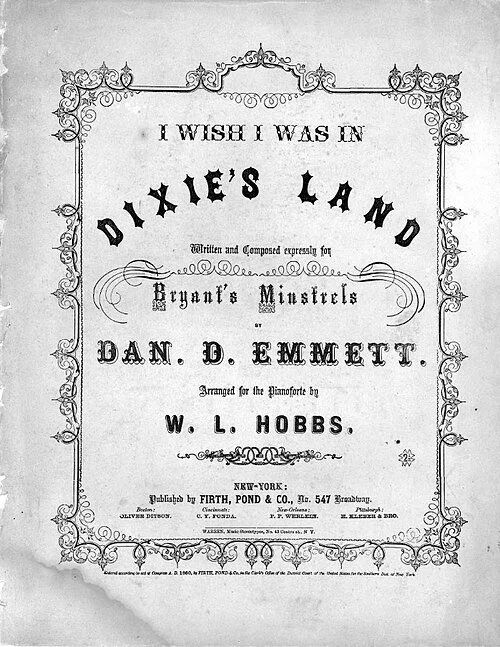
Connecticut has been just about conquered by the indignation industry, as was indicated again the other day when the post office in New London inadvertently offended a customer -- the president of the city's chapter of the National Association for the Advancement of Colored People -- because its doorbell chime happened to play, among other songs, a few bars from "Dixie" during the Juneteenth holiday weekend. The customer complained that "Dixie" is racist because it was sung in minstrel shows and was adopted as an anthem by secessionists during the Civil War.
Instantly intimidated, the post office got rid of the chime's "Dixie" melody. But the complaint was just a matter of guilt by association.
There is nothing racist about "Dixie." Its lyrics are a simple celebration of the South. Many inoffensive songs originated with or were popularized by minstrel shows. While secessionists adopted "Dixie," they weren't the only ones who liked it. It was written by a Northerner prior to secession, first became popular in the North, and the great liberator himself, the destroyer of slavery -- Abraham Lincoln -- declared it a favorite song.
At the White House on the day after the surrender of the Confederate Army of Northern Virginia, the president told a serenading crowd: "I have always thought ‘Dixie' one of the best tunes I have ever heard. Our adversaries over the way attempted to appropriate it, but I insisted yesterday that we fairly captured it. I presented the question to the attorney general, and he gave it as his legal opinion that it is our lawful prize. I now request the band to favor me with its performance."
The band did so, and the song is still enjoyed by people of goodwill even if some people of bad will might like to make hateful use of it.
Music and lyrics can stand on their own.
Francis Scott Key, author of the "The Star-Spangled Banner," the poem that, set to an old British melody, became the U.S. national anthem, was a slave owner and as federal attorney for the District of Columbia persecuted abolitionists. But there is nothing racist in his poem, which, if somewhat ironically in light of the author's background, proclaims "the land of the free."
The German composer Richard Wagner hated Jews. But he is associated with hatred of Jews less because of his operas, which are not explicitly anti-Jewish, than because Adolf Hitler fervently promoted the composer's work as part of the Nazi movement. Even today performing Wagner's operas is informally banned in Israel.
Mark Twain joked that Wagner's music "is better than it sounds." Twain might agree that while the melody and lyrics of "Dixie" are better than the politics of some people who liked them or still do, the singer and the songwriter are not necessarily the song.
Besides, to live in Connecticut and be offended by a few bars from "Dixie" played by the post office door chime may require one to be almost blind to many worse things. Even as the controversy in New London was developing, a national survey reported that Connecticut is among the most racially and economically segregated states. The racial performance gap in the state's schools long has been notorious, along with the state's big racial disproportions in poverty, housing, crime, imprisonment, and health.
Ever preening in self-righteousness, political correctness celebrates its intimidation and shaming of people who have meant and done no harm. So it might have been better if a postal clerk in New London had dared to tell the customer who complained about the door chime that Juneteenth is not what it is said to be -- the anniversary of the end of slavery in the United States -- but just a P.C. contrivance, since slavery actually continued in the United States for six months beyond June 1865 until the 13th Amendment was ratified on December 6. That's the day for celebration, with "Dixie" on the musical program, as it was for Lincoln.
Chris Powell has written about Connecticut government and politics for many years (CPowell@cox.net).
Chris Powell: Will Conn. have a real campaign or just Lamont commercials?

Connecticut River as seen from Gillette Castle, East Haddam, Conn.
—Photo by It'sOnlyMakeBelieve
MANCHESTER, Conn.
Connecticut Gov. Ned Lamont may have the campaign for governor all to himself. His vast wealth is being deployed again and is stuffing Connecticut's airwaves and internet channels with commercials and deluging journalist e-mailboxes with press releases.
While the governor's challenger in the Democratic primary, Hamden state Rep. Josh Elliott, has almost qualified for $3.75 million in state Citizen Election Program campaign funds, he hasn't received the money yet and so hasn't deployed it yet even as the primary is only six weeks away, on Aug. 11. People who are eager for state government to grow and spend know that Elliott is their candidate and don't need advertising to push them, but the volume of the governor's advertising may be effective with other Democratic voters even if it never criticizes Elliott directly.
Meanwhile the Republican nominee for governor, Greenwich state Sen. Ryan Fazio, lets most days go by without having anything to say, not even via "earned" news coverage. This is too bad, since news reports frequently expose mismanagement in state government. Even the governor's press releases and commercials should prompt some talking back from his rivals but aren't getting any.
For example, Lamont recently joined nine other governors in opposing federal legislation that would immunize oil and natural gas companies against state laws seeking to fine them for the pollution caused by use of their fuels. The silly rationale for these state laws is that oil and gas producers fooled the public into thinking that oil and gas are pollution-free, as if, since the industrial age began, nobody ever noticed what was coming out of smokestacks and tailpipes, and as if every state government and the federal government didn't accept that pollution is the price of the most practical forms of energy and didn't happily tax them rather than outlaw them.
Of course the oil and gas producers didn't burn most of their fuels themselves. Ordinary people did -- the constituents of the governors who, like Lamont, now want to blame the producers for pollution. Also, of course, those governors are not prepared to give their constituents much practical alternatives to oil and gas. They want to pretend that conventional fuels are the result of an evil conspiracy of plutocrats and not the result of longstanding policy.
Lamont and the other governors opposing the federal legislation to foreclose state laws punishing oil and gas producers are scapegoating and demagoguing. One proof of this is Lamont's failure to propose legislation to prohibit use of oil and gas in Connecticut. Like the other governors opposing the federal legislation, Lamont doesn't want to outlaw oil and gas and thereby stop pollution; he wants to tax them more in the name of recovering the damages of pollution, which could never be quantified specifically in regard to any particular producer.
Lamont is airing a commercial in which he claims to be protecting Connecticut against President Trump's "chaos." Trump is indeed producing chaos in Washington and around the world but Connecticut has plenty of its own chaos that has little to do with the president.
Apart from all the mismanagement and even corruption in state government, every week brings the usual murders, shootings, and stabbings, as well as incidents of child abuse and neglect that are overwhelming the state's child protection agency; more reckless and even crazed driving; fires in dilapidated housing in the impoverished cities; worsening drug and alcohol abuse; and more psychotic episodes from troubled people. Trump didn't cause those things. Neither did the governor. But getting them under control in Connecticut is the governor's responsibility, not Trump's.
Another Lamont commercial says he wants to end "corporate welfare." But he has been governor for 7½ years and if Connecticut has still has corporate welfare, he must approve of it.
Connecticut should discuss these things. But the only thing Elliott seems to find wrong about state government is that it doesn't spend enough enriching the government class. As for Fazio, for the state to know what he thinks, he'll have to show up.
Chris Powell has written about Connecticut government and politics for many years\ (CPowell@cox.net).
Chris Powell: Conn. judge dismantles due process by impaneling anonymous jurors

People in jury pool waiting to be selected or rejected for duty.
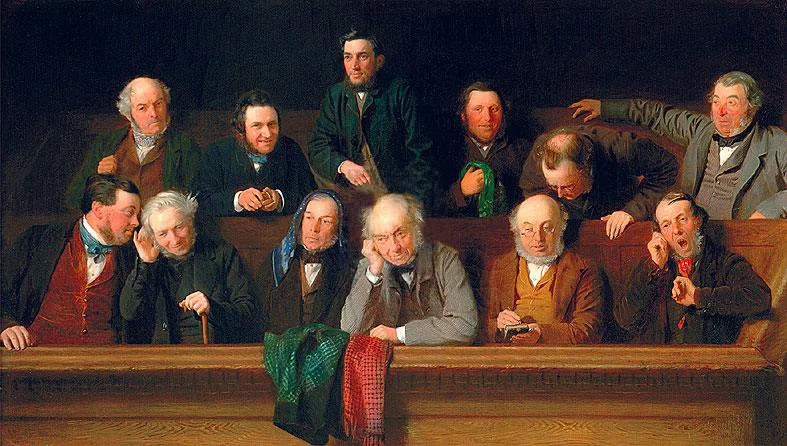
“The Jury,’’ an 1861 painting by John Morgan, of a British jury, all of whom then had to be men.
MANCHESTER, Conn.
Even the Trump administration hasn't yet tried to mangle the criminal-justice system and civil liberties as much as a judge in Meriden (Conn.) Superior Court is trying to do. Where are Connecticut's "No Kings" people when they're needed close to home?
In what seems unprecedented, at least outside of totalitarian jurisdictions, the judge, Maria del Pilar Gonzalez, has decided to empanel a jury in a murder case while concealing the identities of juror candidates from the defense and the public.
Judge Gonzalez isn't doing it for fun. She aims to keep the defense and the public ignorant of juror identities because the prosecution has accused the defendant of conspiring to threaten jurors during his first prosecution for murder, which ended in a mistrial in 2024. The accusation arose from a statement given by a man who was imprisoned with the defendant, but the defendant has not yet been tried on the charge and there seems to be no evidence that any juror was threatened.
So with little evidence the judge presumes that the defendant is probably guilty of jury tampering and she wants to guard against it happening again.
But the judge would be wrong even if the defendant had tried to corrupt his first jury. For the identification of jurors to the defense and the public in criminal cases is basic to due process of law. Jurors must be screened against prejudice and improper motives, and they must be accountable for their service. That can't be achieved if their identities and backgrounds are concealed when jury candidates are examined by the court. If Judge Gonzalez's decision stands, the jury in the murder case she is trying could be rigged against the defendant and no one besides the judge and prosecutor might know.
If there is a credible threat to a jury's integrity, the court can guard against it by other means, as by surveying jurors individually in private or even giving them police protection. Empaneling anonymous jurors compromises justice as much as threatening, blackmailing, or bribing jurors does.
The murder defendant's lawyer has filed an emergency appeal with the state Supreme Court. Meanwhile Judge Gonzalez plans to continue selecting jurors without identifying them. The Supreme Court urgently should undo this secrecy rather than risk the time and expense of appeals that surely will follow a verdict rendered by an anonymous jury. It would be astonishing -- and terrifying -- if eventually a state or federal appeals court didn't punt Judge Gonzalez's decision back to medieval times.
* * *
A NEEDLESS EXPERIMENT: With Gov. Ned Lamont’s signature on the legislation last month, Connecticut began its experiment with what has been called "no-excuse absentee voting." People now may vote by mail for simple convenience; they no longer need to assert a reason such as illness, disability, religious observance, military service, or absence from the state.
The more absentee voting there is -- the more that people are separated from the direct casting of their ballots, the more that people other than election workers handle their ballots -- the greater will be the risk of election fraud. But the governor and General Assembly have decided that the risk is small and worth taking.
Another risk has gotten less consideration -- the risk that opening tens of thousands of additional mailed ballots and running them through tabulation machines will delay the calculation and announcement of results and present opportunities for adjusting the results in political emergencies. Even now Hartford and Bridgeport, always the repositories of huge Democratic pluralities, seem unable to report their final results by dawn the day after the election.
With luck "no-excuse absentee voting" will start slow. People have to apply for absentee ballots in person at town hall or by mail, and then complete and mail the ballot, and for some people that may be more trouble than going to their polling places, especially since Connecticut now provides 14 days of early voting in person so that Election Day crowds can be avoided. That’s all the convenience and security an election needs.
Chris Powell has written about Connecticut government and politics for many years (CPowell@cox.net).
Chris Powell: Housing achieves racial integration better than regional schools

“The Problem We All Live With,’’ by famed artist Norman Rockwell (1894-1978), of Stockbridge, Mass., is a 1964 painting done as an illustration for Look magazine and considered an iconic image of the U.S. civil-rights movement. It depicts Ruby Bridges, a six-year-old African-American girl, on her way to William Frantz Elementary School, an all-white public school, on Nov. 14, 1960, during the New Orleans school desegregation crisi
MANCHESTER, Conn.
Some years ago racial integration in education used to be at least a nominal objective in Connecticut. Not so much anymore.
The state's law against racially imbalanced schools -- schools whose student racial composition is far out of proportion to the racial composition of their municipality -- has been disregarded for years by two schools in Greenwich, one in Fairfield, and two in West Hartford. A recent count says 16 more schools -- including more in Greenwich and West Hartford as well as some in Bloomfield, Branford, Hamden, Milford, and Montville -- are about to slip into imbalance.
Of course many schools in Connecticut's cities, including Hartford, New Haven, and Bridgeport, have student populations that are overwhelmingly from racial and ethnic minorities, without the slightest racial balance at all, just as many other school systems in the suburbs and rural areas are overwhelmingly white. But under the law that's OK, since the law requires racial balance in schools only within a municipality, not racial balance on a regional basis.
Racial residential patterns are such that substantial integration in schools could be achieved only by massive transfers of students, which would be educationally and financially impractical and impossible politically.
The state Education Department hasn't been pressing for action on racially imbalanced schools and is unlikely even to acknowledge the issue in a state election year. While municipalities might racially balance their schools fairly easily with little expense by redrawing school districts, redistricting always aggravates parents and students, especially when resources don't differ much between schools and most townspeople don't care much about racial balance, though society would be better for more integration.
These days there are second thoughts about racial integration in Hartford itself, where the push for integrated schools began more than 60 years ago with a small, voluntary program of busing minority students to the white suburbs, Project Concern. In recent years that push culminated with the Sheff v. O'Neill integration lawsuit.
The lawsuit led state government to establish three dozen regional schools in Hartford and its suburbs, and to the promise made in the lawsuit's settlement that there will always be room for any Hartford student who wants to enroll outside the city school system. As a result many students have entered the regional schools, leading unfortunately to still more racial concentration in Hartford's neighborhood schools and to what the city's Board of Education considers extra expense, since when students leave the city school system, it loses state money while incurring extra tuition and transportation costs.
So the board is hiring a public-relations company to try to lure some regional school students back to city schools. This has angered the Sheff case advocates, who see any strengthening of the city's schools as undermining the settlement of their lawsuit.
While the PR campaign may indeed reduce integration, it wouldn't violate the Sheff settlement as long as any Hartford student could still get into a regional school. Besides, it's fair to wonder whether the limited amount of integration achieved by the regional schools is worth the hundreds of millions of dollars they have cost.
In pursuit of integration it might be better to examine why some of Hartford's inner suburbs that a few decades ago were overwhelmingly white -- such as Bloomfield, East Hartford, Manchester, and Windsor -- have become thoroughly integrated racially with integrated schools. These towns suggest that integration is mainly a matter of a variety of housing options and economic gains for minorities.
Of course new housing can be controversial but to assist integration it doesn't have to be housing for the poor -- just market-rate apartments and condominiums.
Not everything retrograde in race relations in Connecticut comes from white suburbanites.
Black civic leaders in New Haven want the city to establish a satellite campus of a "historically Black college" to help Black students in the city feel more comfortable about higher education. But that would be more racial separatism, which seems to be politically correct lately. Black students must understand that they can and indeed must succeed without it.
Chris Powell has written about Connecticut government and politics for many years (CPowell@cox.net).
Chris Powell: Panel on school financing in Conn. is rigged

MANCHESTER, Conn.
A 23-member committee appointed by Connecticut Gov. Ned Lamont and legislative leaders will convene next week to start devising what the governor wants to be "a top-to-bottom overhaul of how the state funds its public schools."
Methods of school financing are always questionable as to fairness and effectiveness. But just as you shouldn't ask the barber if you need a haircut, you shouldn't ask educators how schools should be financed, for they always will want to get more money by any means, especially means that make the money harder to track, results harder to measure, and accountability harder to achieve.
Unfortunately the governor and legislative leaders have arranged for educators to dominate the committee, though reforming school finance is not a matter of educational practice at all but one of tax fairness and effectiveness.
The inclinations of 17 of the committee's 23 members can be fairly presumed.
Twelve, including the state education commissioner, are employed by school systems or other education agencies. Then there are the president of the state's largest teacher union, a state legislator who is a labor union official, and a legislator who used to be one. Another committee member leads a group that advocates more school spending. The committee's chairman, the governor's deputy chief of staff, used to be the Education Department's legal director.
Only six of the 23 committee members are from outside the education establishment and might feel free to provide analysis independent of the education establishment's desire to raise and spend more money -- not that they will.
That is, the committee is ridiculously rigged.
At least in announcing the committee appointments, the governor briefly referred to the greatest failure of public education in the state: "We need to take another look at how we're maximizing student outcomes."
Another look?
When was the last time that state government measured student performance against school spending and held anyone to account for results?
What exactly are the mechanisms of accountability in public education in Connecticut? When has anyone in authority been challenged about student performance?
Chronic absenteeism is a big problem in many school systems, but when have parents \ been held to account for it?
In fact, public education in Connecticut is built on prohibiting accountability.
That's what binding arbitration of teacher union contracts is about: hobbling public administration, making the union interest equal or superior to the public interest. Binding arbitration prevents elected school boards from running school systems on behalf of democracy even if they want to, which they seldom do.
That's what tenure for teachers is about, making it nearly impossible for schools to fire teachers for anything short of murder.
That's what the exemption of teacher evaluations from the state's open-records law is about.
That's what the minimum school budget requirement is about, making it nearly impossible for school boards to control spending even if student enrollment falls substantially.
That's what state government's refusal to require proficiency tests for student advancement from grade to grade is about. Social promotion is the ultimate prohibition of accountability in education.
Who in the education establishment wants accountability enough to undo those things? No one.
The main problem of public education in Connecticut is that it's not really public at all.
State government can tinker forever with school funding systems in pursuit of fairness. Financing schools entirely from state government, as with a statewide property tax, is an obvious option. But no tinkering with funding formulas will improve school performance, and tax fairness can be increased only by diminishing local control. Good luck with that.
One blow for fairness might be struck easily. State government could assume all costs of "special education," which would relieve poor municipalities of a hugely disproportionate tax burden, a social cost that should be borne widely. The governor recently mused aloud about this.
Indeed, it could have been done this year. But it's an election year, so the governor and legislators instead put extra money into another round of raises for teachers, euphemizing it again as "aid to local education."
Chris Powell has written about Connecticut government and politics for many years (CPowell@cox.net).
Chris Powell: Fewer students; higher teacher pay; missing fathers

MANCHESTER, Conn.
What does it mean that, as the Connecticut Mirror reported last week, Connecticut's birth rate is the ninth lowest in the country and that the state's public school student population has fallen steadily since 2006, from 578,000 to 498,000, down nearly 14 percent in 20 years?
Counterintuitively, it means bigger paydays for teachers and school administrators.
Mere taxpayers might think that such a big reduction in students would prompt school systems to economize, but they'd be wrong. For state government, always in thrall to the teacher unions, has enacted a law -- the so-called minimum budget requirement -- that virtually prohibits school boards from reducing their budgets even as enrollment declines. The law maintains that if a school system spent a certain amount this year, it must spend at least that much every year forever. Economizing is actually illegal.
The premises of the minimum budget requirement law are, first, that spending equals education, and second, that keeping government employees happy is government's highest objective -- that any efficiencies in government should flow not to taxpayers but to government's own payroll.
Of course these premises are absurd. Connecticut has been increasing per-pupil spending for decades only for student achievement to decline. Higher spending has correlated with lower results.
If state residents were aware of the law's contempt for them, they might express resentment to their state legislators and the governor and demand an explanation. That would be awkward.
But no one in authority wants people to be aware of the law. The majority party, the Democrats, is controlled by the government employee unions and particularly the teacher unions, and while the Republican minority in the General Assembly dares to complain about taxes generally and specifics like high electric rates, most Republicans are too scared of the teacher unions to criticize the law.
That leaves news organizations to pursue the public interest by publicizing the law and holding legislators and the governor to account for it. But their coverage suggests that most news organizations in Connecticut also think that money equals education, so they see no problem.
Hamden state Rep. Josh Elliott, challenging Gov. Ned Lamont in a primary for the Democratic nomination for governor, is the perfect representative of far-left educational ideology.
In an interview the other day with WTNH-TV8, in New Haven, Elliott outlined his platform: "The first thing we're going to do is make sure that we fix our tax structure -- that we have what Massachusetts did, a 4 percent surcharge on people making $1 million or more." The extra revenue, Elliott said, would be "sent back to municipalities to make sure that the quality of your education is not dependent on the ZIP code you're born in."
That's the school spending myth in action. Yes, student performance is terrible in certain municipalities, especially the cities, but it's not because of a lack of spending. It's because two-thirds or more of the children there are being raised by only one parent. Most lack a father in their lives and thus receive half or less of the financial support, guidance, discipline, and intellectual and physical stimulation children need.
The problem isn't school spending but poverty and per-pupil parenting. But it can't be discussed in polite company because, to some lefties, fathers and intact families seem a mortal threat to the ever-expanding government that seems to want to make everyone dependent in generational poverty, not self-sufficient.
The other day, U.S. Rep. John B. Larson, being challenged by former Hartford Mayor Luke Bronin in a primary for the Democratic nomination in the 1st Congressional District, accelerated in his race to corner the lefties likely to dominate the vote.
Larson joined two leading national lefties -- Vermont Sen. Bernie Sanders and Minnesota Rep. Ilhan Omar -- to introduce legislation to have the federal government finance free breakfast, lunch, dinner, and a snack for all students every day.
Why stop there? Why not also pay teachers to take their neglected and unfed students home with them at night, or at least start inquiring officially into the disintegration of the family?
Chris Powell has written about Connecticut government and politics for many years (CPowell@cox.net).
Chris Powell: A great candidate in theory but disaster in practice; immigration’s cost

New Britain Mayor Erin Stewart
MANCHESTER, Conn.
In theory Erin Stewart was a great idea for the Republican nomination for governor of Connecticut: not just a woman but a Republican who was elected six times consecutively as mayor of a heavily Democratic city, New Britain. She must have had something going for her.
But in practice as a candidate for governor Stewart has been giddy, superficial, reckless, vulgar, and astonishingly inept politically even as challenging a Democratic incumbent and Connecticut's entrenched Democratic machine requires great political skill just to have a chance.
In recent weeks Stewart has been a disaster.
First she gave an interview in which she claimed to have been offered bribes by many New Britain residents seeking favors from her office, bribes that she didn't accept but never reported. Stewart seems to have thought she was touting her integrity but she actually impugned herself.
Then there were allegations that the Stewart administration's tax collector had mishandled funds and backdated taxpayer checks to let delinquents escape late fees.
Then the Connecticut Mirror disclosed that as Stewart was preparing to leave office she applied to city government for a form of annual pension that didn't exist, a pension she imagined to be worth nearly $40,000 a year. Challenged about this, her explanation was simply: "Why wouldn't I?"
And The Hartford Courant and WTHN-TV8, in New Haven, disclosed that Stewart had used her city government credit card for thousands of dollars of purchases for personal items delivered to her home but misclassified as office expenses, as well as for an expensive membership at the Hartford Club and a $500 birthday dinner. She denied nothing, instead claiming that the purchases were in the city's interest and people were just out to get her.
Even Gov. Ned Lamont couldn't resist noting the irony that, after Republicans highlighted the expense account abuse for which the chancellor of the Connecticut State Colleges and University system, Terrence Cheng, was removed and given a year of paid leave, Republicans seemed about to nominate their own expense-account cheater for governor.
While the governor himself has not been implicated, corruption, malfeasance, and indifference to failure have been frequent in his administration. Mastery of the many specific examples of this might be the strongest attribute for a challenger to the governor's re-election. Can Connecticut's Republicans really think that Stewart could exploit such examples now without being made ridiculous by her own self-dealing and unaccountability?
Indeed, Stewart's exploitation of her expense account probably would resonate more with the public than state government's longstanding failures with education, child protection, housing, and urban living standards. Those failures are simply taken for granted, the natural order of things. But people do understand when elected officials abuse their office to enrich themselves.
At their state nominating convention this weekend maybe some Republican delegates will figure that the party's chances in the state election in November are so poor, with the Democrats so entrenched in the state and President Trump's national Republican administration so capricious and corrupt, it won't matter if, in nominating Stewart, Connecticut Republicans are seen to condone capriciousness and corruption at the top of their state ticket as well.
Republicans who think that way will be wrong. Win or lose, every election is an opportunity to restore faith in democracy, or diminish it.
ILLEGAL IMMIGRATION'S COST: Enrollment in Bridgeport's schools has fallen by 700 students over the last year, from 20,000 to 19,300, and much of the decline is attributed to illegal immigrants leaving the city or at least removing their children from school in fear of the Trump administration's enforcement of immigration law.
Whether this is good or bad, Bridgeport spends an average of more than $18,000 per student per year, so the decline in its student population could save nearly $13 million per year, if the money wasn't used just to increase spending elsewhere.
In any case this development invites review of how much the illegal immigration facilitated by state government is costing Connecticut, and how it is never directly appropriated for.
Chris Powell has written about Connecticut government and politics for many years (CPowell@cox.net).
Chris Powell: ‘Affordability’ for whom in Connecticut?

MANCHESTER, Conn.
A brief chronology from the last four months may explain Connecticut's political economy better than any so-called political scientist could.
In February, with the state's high and ever-rising cost of living -- its "affordability" -- beginning to get political attention, Gov. Ned Lamont said thay state government was doing so well financially that it should bestow tax rebates of $200 on more than 2 million taxpayers, an expense that would total about $400 million. The governor's proposal prompted much cynicism and derision, since the rebates would be delivered a few days before the election in November, in which Lamont will probably again be the Democratic nominee . But at least the governor's proposal was a token of respect for those paying government's bills.
But then the General Assembly convened and the major interests that rely on state government appropriations descended on the state Capitol. They maintained that their own affordability challenges were more compelling than those of mere taxpayers.
The governor already had promised generous raises to the state employee unions, since government employees are a key part of his political party and the Democrats overwhelmingly control the legislature. So the governor negotiated and the legislature approved a new master union contract for the state employees, estimated to cost $675 million more over the next three years than is now being spent for their services.
Municipal government officials were well represented at the Capitol, too, and the governor and legislative leaders promised them an extra $270 million in state financial aid, much of it for "education," the euphemism for raises for unionized teachers, another big component of the Democratic Party. Most of the rest of the extra aid will cover raises for other unionized municipal employees, another Democratic-leaning group.
These raises are euphemized as "contractual obligations" as if the obligations are forces of nature or acts of God, beyond the control of mere mortals, though municipal elected officials helped write and agreed to the contracts imposing the obligations.
So when the legislative session was through, the governor's proposal for $200 rebates for taxpayers had disappeared. He didn't fight for it. He was persuaded to abandon it by a more accurate political calculation -- that the unionized government employees pay far more attention than taxpayers do and would notice and act on the extra money much more than taxpayers would.
So this year in Connecticut "affordability" will be for government employees. They have earned it with their political activism for the Democrats. Other state residents will have to keep bearing their tax burden, which they have earned with their apathy and will keep earning if, as expected, they return the Democrats to power in November.
For as the late New York Times journalist James Reston observed, the first rule of politics is the indifference of the majority. Government money keeps going to the minority that is most mobilized politically to claim it, not necessarily to where it might do the most good for the public. That's Connecticut's political economy.
Even so, a recent poll of Connecticut residents taken by the University of New Hampshire's Survey Center suggested a surprising undertone of dissatisfaction with Governor Lamont and his administration. The poll found that Lamont's job approval is trending gradually down, with 48 percent approving and 46 percen disapproving, and with majorities unhappy with his handling of the state's cost of living, taxes, housing, and the economy.
It's not that the governor has been raising taxes. That complaint in the poll may reflect resentment of municipal property taxes, which rise steadily in part because of longstanding state mandates on local government, such as binding arbitration of government employee union contracts.
It's not clear whether the governor is judged poorly on housing because there is a shortage and prices are high or because he supports controversial legislation that would slightly constrain municipal zoning to encourage housing construction in the suburbs.
But in any case the poll hints at openings for the governor's challengers -- not that they yet have the campaign money, the wit, or the courage to exploit them.
Chris Powell has written about Connecticut government and politics for many years. (CPowell@cox.net),
Chris Powell: Raising taxes on Connecticut’s rich just an excuse for plunder

Copper Beech Farm, formerly the Lauder Greenway Estate, is a private property in Greenwich, Conn.
MANCHESTER, Conn.
Connecticut is already nearly the highest-taxed state in the country, as well as nearly the most expensive (in part because its taxes are so high), but on April 15 -- the deadline for submission of state and federal tax returns -- a hundred people from what calls itself the Connecticut for All coalition gathered at the state Capitol to urge state government to raise taxes on the rich.
When it showed up at the Capitol in March, the Connecticut for All coalition was supporting legislation to increase state government's obstruction of federal immigration-law enforcement. That's what Connecticut for All means by "all" -- open borders admitting all illegal immigrants -- as if the state doesn't already have a desperate shortage of housing and expensive schools whose costs are rising in part because they must enroll so many illegal immigrant students who don't speak English.
Connecticut for All's arguments for higher taxes on the rich are as flawed as its arguments for open borders -- especially its argument that taxes should be raised on the rich because some lower-income people pay a higher share of their income in state and local taxes than rich people do.
As is the case with federal taxes, the rich also already pay the overwhelming majority of state and local taxes in Connecticut.
Poor people pay no income taxes and often get various income supports from the government, like earned-income tax credits, medical insurance, and food and housing stipends, which help refund the taxes they pay indirectly -- sales taxes, municipal property taxes (paid through their rents), and federal and state energy taxes.
Besides, the percentage-of-income argument doesn't accurately indicate the practical burden of taxes.
Twenty percent of the annual income of someone earning minimum wage in Connecticut -- $16.94 per hour or $35,000 per year -- is $7,000.
But just 19 percent of the annual income of someone earning $350,000, who is subject not just to sales and property taxes, as the poor are, but also to state and federal income taxes, is $66,500, more than nine times as much.
Who really bears more of the burden of government?
Yes, inflation -- currency devaluation -- benefits the wealthy, since they own property and stocks, whose value rises even as inflation ravages the poor, who own little property. But then why do Democrats, supposedly the tribunes of the poor, like and perpetuate inflation even more than Republicans do?
Maybe what is most disgraceful about the clamor for raising taxes on the wealthy is its sense of entitlement, as was expressed by a college instructor at the Connecticut for All rally at the Capitol. . "It's time to tax the wealthy and the ultra-wealthy and redistribute those funds to the hard-working people of Connecticut," she said.
Of course many wealthy people are not "hard-working" at all but mere beneficiaries of inherited wealth or government patronage. But many poor people aren't so "hard-working" either but collectors of welfare benefits, people who are already beneficiaries of much income redistribution. Poverty is not virtue.
Yes, taxation is always a mechanism of income redistribution, but its original objective in this country was the maintenance of a decent government and a prosperous society. Contrary to the suggestion of that college instructor who spoke at the Capitol, the tax system was not originally meant for plunder, and it should not be regarded as a device for making one's living from the sweat of others. That attitude has produced vast waste and corruption in government.
Raising taxes on the rich in Connecticut isn't yet a matter of fairness; the people advocating it are not trying to calculate mathematically what tax rates are fair. They just want government to control and spend more money.
All able-bodied people, no matter how poor, should share and feel the burden of government, for as was said by a great liberal authority from a century ago, Theodore Roosevelt, the first duty of a citizen is not to vote himself more government subsidies but to pull his own weight.
Chris Powell has written about Connecticut government and politics for many years (CPowell@cox.net).
Chris Powell: Coming — a new golden age for governmental unaccountability in Connecticut
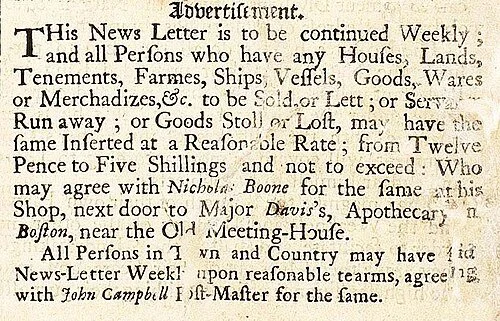
What is believed to be the first newspaper classified ad in America, in The Boston News-Letter of April 24, 1704.
MANCHESTER, Conn.
Connecticut is nearly the highest-taxed and most expensive state in the country, and though state legislators are prattling about making the state more "affordable," most of this year's session of the General Assembly has been a scramble to spend more money. Indeed, the legislature long has been most remarkable for its inability to audit government for actual results and to discover any substantial spending that can be reduced.
But not anymore. The other week the state House of Representatives overwhelmingly approved a bill that would repeal the old state law requiring municipal governments to give formal notice of their plans and actions by purchasing legal notices in newspapers.
The legislation's rationale is that posting the notices on municipal Internet sites will alert the public sufficiently to what local government is doing and that it will be free, saving municipal governments altogether maybe $2 million or $3 million every year.
The money is real but the claim that sufficient notice can be achieved by municipal government Internet sites is laughable. For the audience of municipal government Internet sites is tiny. By contrast, even as newspaper readership declines, newspapers still have a substantial audience. More important, legal notices alert news organizations to what government is doing, and in turn news organizations alert the public both in print and on their Internet sites.
Since newspapers charge for legal-notice advertising, the notice requirement can be viewed as a subsidy to newspapers. But that is not how the advertising requirement originated. The requirement buys a service of value -- and not just notice to the public about the particular item being advertised but also local news reporting generally, which is in serious decline because the Internet and social media are drawing the audience away from local news and because civic engagement is declining along with literacy generally.
If the advertising requirement is repealed, then for everyone who reads legal notices on his municipality's Internet site there may be hundreds or even thousands of people who lose access to local news as newspapers adjust to their loss of income by reducing their news coverage and frequency of publication.
Municipal officials have been advocating repeal of the legal notice advertising requirement for many years, and saving money is not the only reason for their enthusiasm.
The advertising requirement is a relic of the era of limited government, which is long gone. The current era is one of virtually unlimited government with many more people drawing their livelihood from government.
As the primary mechanisms of accountability to the public, news organizations annoy government officials. Government is so much easier without journalism -- which is not to say that government without journalism would be more efficient but rather that government's inefficiencies, mistakes, and crimes would be disclosed less often.
That's why while the legislature finds it almost impossible to reduce or eliminate government spending anywhere else, it seems about to proclaim that journalism about government is readily expendable.
The state Senate's approval of the House-passed legislation and Gov. Ned Lamont's signature on it may inaugurate a golden age of unaccountability in government in Connecticut, a more expensive and mysterious age.
GAMBLING'S DAMAGE: According to a report other week in Connecticut's Hearst newspapers, some state legislators are having doubts about state government's expansion of legal gambling in recent years, particularly about sports betting, which has compounded with casinos, Internet casino gambling, and what now may seem like the deadly first step back in 1972, the state lottery.
Gambling addiction has exploded in the state, damaging thousands of lives, ruining families, helping to corrupt national sports, and recently snaring even New Haven's police chief, all while making a very few people rich in the guise of reparations for ancient wrongs to Indian tribes that no one alive today suffered from. Gullible Connecticut is supposed to believe that casino gambling is social justice.
Legislators and governors have thought that getting money through gambling -- indirect rather than direct taxation -- is worth the awful consequences to society. It isn't and remains a matter of political cowardice.
Chris Powell has written about Connecticut government and politics for many years (CPowell@cox.net).
Chris Powell: Tax credits for dairy cows and journalists?

Trying to keep this Holstein happy.
MANCHESTER, Conn.
Connecticut's dairy farmers, long having suffered in a marginal business and having been reduced in numbers from about 800 in the 1970s to only 80 today, say they are on the brink of failure and require a subsidy from state government to survive.
Other states, including Massachusetts, provide what Connecticut's dairy farmers want: a tax credit to offset low milk prices. So such legislation has been proposed in the General Assembly by state Sen. Stephen Harding, R-Brookfield, whose district is rural and has many farms.
The farmers estimate that collectively they are likely to lose $20 million this year, so the legislation's tax credit would cover that loss.
Of course dairy farms aren't the only businesses in trouble in Connecticut. The state is nearly the highest taxed in the country and might be losing population if not for illegal immigration. These days hardly a business enters or expands in the state without seeking some sort of financial incentive or tax abatement from state or municipal government.
Struggling businesses that receive no such subsidy might look at the proposal to subsidize dairy farms and wonder: What's so special about them?
Cows may be cute and dairy farms quaint, but the legislature should ask that question and, if it approves the subsidy legislation, provide a clear answer to it.
For could Connecticut really not survive without dairy farms? Would it be wrong to let Massachusetts and other states subsidize the milk consumed in Connecticut?
Farming generally is also a marginal business in Connecticut, so if dairy farms get a state subsidy, why shouldn't other farms get one too?
Legislators may have noticed -- and enjoyed -- the sharp decline of the news business in the state in recent years. Local news, the most expensive to produce, since its potential audience is smallest, has nearly vanished. The state's newspapers are shadows of their former selves with less local news than ever. Few radio stations in the state have reporters anymore, and television news increasingly emphasizes weather as if its viewers live without windows.
Last year there was some talk in the legislature about subsidizing the news business in the hope of reviving it. Nothing was done, but if cows can get tax credits, anything serving the public interest more than chocolate milk might have a fair claim as well.
After all, if every dairy farm in Connecticut closed, the state still would get plenty of dairy products elsewhere. For the state's dairy farms aren't as crucial to dairy products in Connecticut as the trucking industry is.
But if Connecticut's news organizations disappear, no one in other states will step in to provide the missing news. Indeed, most news organizations in other states are in as much trouble as Connecticut's are, and for the same reasons.
This doesn't mean that government subsidies for news organizations are a good idea. Government money is inevitably compromising, and defining news organizations for tax purposes would be a challenge. For journalism is a constitutional right, not a profession -- a right anyone can exercise at any time with no more capital than a pen, a pad, and an Internet site or e-mail provider.
Indeed, state policy might be of more help to news organizations not with subsidies but with schools that made their students more literate, more familiar with history and government, more civic-minded, and less full of self-esteem after 13 years of social promotion.
The only people who read newspapers and follow news organizations anymore are people who care about their communities, want to know what is going on in them, and want the authorities to be held to account -- and many if not most people today no longer care about that. More than half Connecticut's eligible adult population didn't vote in the last election for governor. In such an environment there is little future for journalism, civic-mindedness, and democracy itself.
Government subsidies for failing industries are horrible precedents, inviting more special pleading and subsidies. But maybe every Connecticut journalist will have to rent a cow.
Chris Powell has written about Connecticut government and politics for many years (CPowell@cox.net).
Chris Powell: About those droning committee meetings
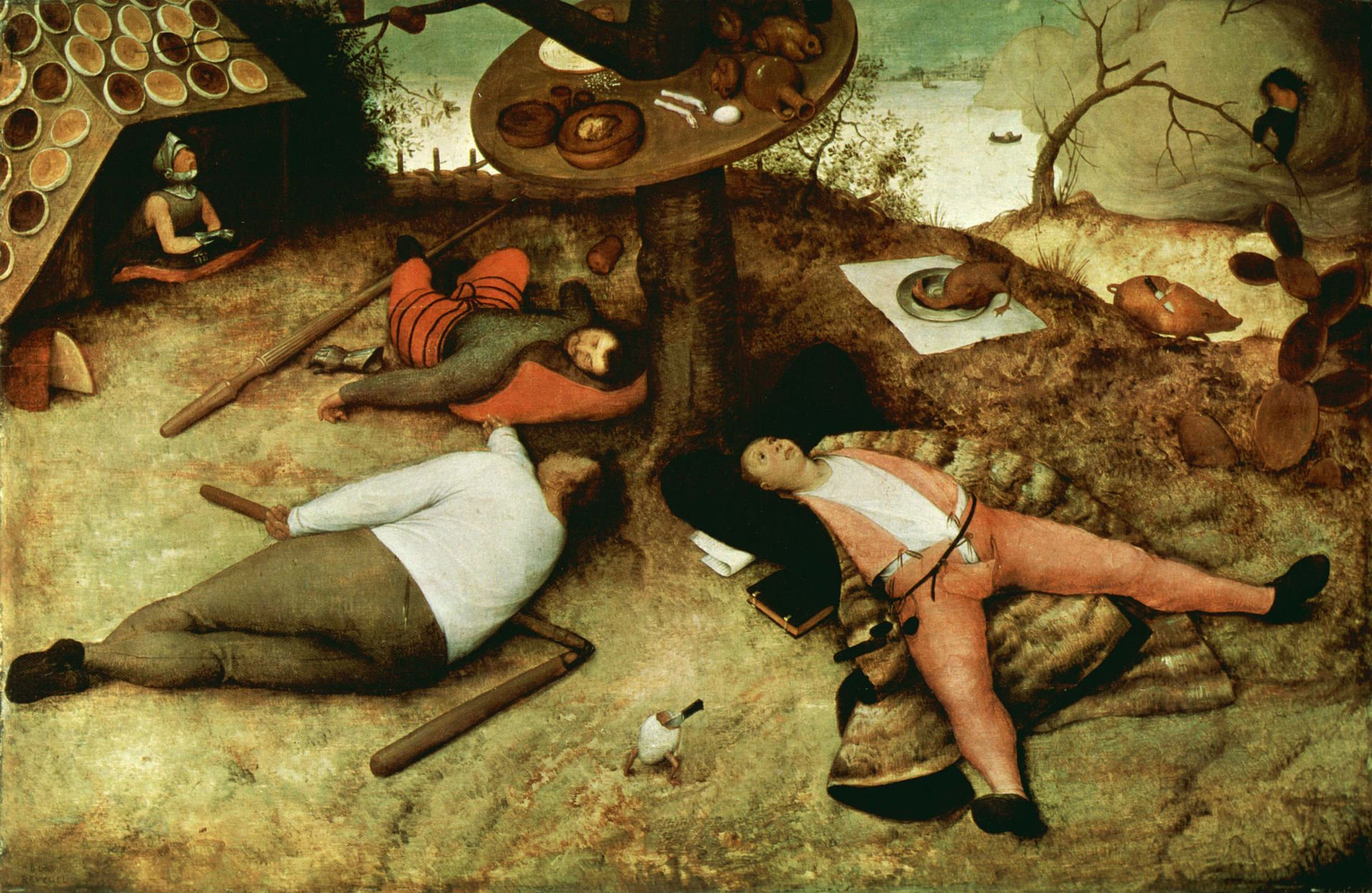
“The Land of Cockaigne,’’ by Pieter Bruegel the Elder (1567)
MANCHESTER, Conn.
Small but feisty, the Republican minority in the Connecticut General Assembly made a big stink the other day about the Democratic majority's deciding to terminate at midnight a public hearing on vaccine legislation. Hundreds of people who wanted to speak at the hearing lost their opportunity.
It didn't look good and the Republicans probably would have been foolish not to complain about it. But there really wasn't much substance to their complaint.
For even with the most controversial issues, public hearings before the legislature are almost always needlessly exhausting. The relevant arguments are always made within the first couple of hours and what follows is mainly repetition and sometimes impotent venting. Meanwhile legislators duck out to attend other hearings, converse with constituents or lobbyists, get something to eat or drink, or use the bathroom.
Seldom are all committee members present during a hearing. As it drags on, only a few committee members may remain at their desks, sometimes only two or three. Even when many committee members are present, as testimony becomes redundant some will immerse themselves in their laptop computers, and they don't miss much.
So it's hard to blame them.
Besides, people can express their views to the legislature without chewing up the clock at three minutes per speaker. For everyone can submit written testimony of nearly any length. That testimony is made available to all committee members and may reach more of them than spoken testimony does. Individual constituent contact with legislators outside of hearings may be far more effective than anything said at a hearing.
Yes, as the Republicans complain, the legislature's Democratic majority has become more arrogant as it has increased. But limits on the public's speaking time aren't the worst of that arrogance. The Democrats' recent use of the "emergency certification" procedure to call urgent votes on disparate legislation about which there was no emergency was far more objectionable -- and a little ridiculous.
The Democrats noted fairly that some of their "emergency" bills were old ones and already had hearings last year, so no one was sneaking something through -- at least not this time. But by invoking a bogus "emergency" the Democrats were really confessing their inability to manage the session well enough to get its work done before this year's earlier adjournment date.
The legislature's tradition of unlimited debate even during the last days of the session does allow a minority to filibuster fatally much legislation that has ample support to pass. But such time pressures could be greatly reduced if not eliminated if the majority didn't let legislators clutter the agenda with so much trivial legislation.
A state like Connecticut -- where public education is collapsing amid its refusal to enforce standards; where poverty, homelessness, and mental illness are exploding as times get harder; and where state employee salaries and pensions are cannibalizing the government -- really doesn't need to consider legislation directing the state's flagship public university to undertake a study of unidentified flying objects. A study of those serious unaddressed issues might be helpful, if much scarier than UFOs.
Nor does Connecticut need the trivial legislation approved the other day by the Government Administration and Elections Committee to allow municipalities to experiment with ranked-choice voting.
Ranked-choice voting -- or "instant runoff" voting -- enables voters to transfer their votes to second-choice candidates if their first choices don't achieve a majority. In recent decades Connecticut has elected a U.S. senator (Lowell P. Weicker Jr.) and three governors (Weicker, John G. Rowland, and Ned Lamont) with less than a majority vote, even as ranked-choice voting might have produced different winners.
Since ranked-choice voting may be complicated, it is worth trying only for the most important offices, not for municipal offices, where few are important, voter participation is low, and understaffed municipal election officials are unlikely to volunteer for the extra work.
Only the secretary of the state's office might be competent to experiment with ranked-choice voting, and only elections for president, governor, and Congress are important enough to require decision by majority rather than mere plurality vote.
Chris Powell has written about Connecticut government and politics for many years (CPowell@cox.net)
Chris Powell: Conn. public Schools couldn’t meet new home-school standards
MANCHESTER, Conn.
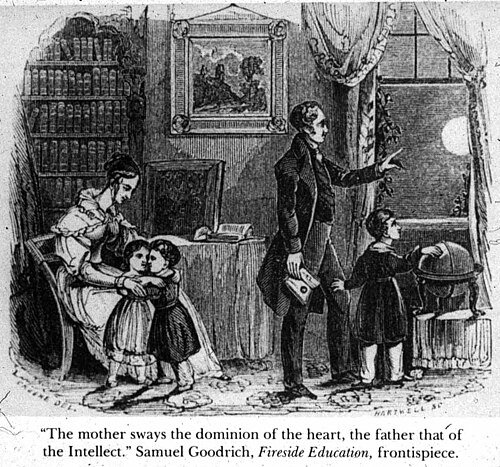
In principle there's nothing wrong with the basics of the home-schooling legislation that got a public hearing before the General Assembly this week. The bill would require people to notify local officials in person when they withdraw their children from public school to home-school them, to bring their home-schooled children to some sort of wellness inspection once a year, and to provide evidence that the children are learning.
But the legislation should prompt howls of ironic laughter.
The legislation has arisen out of the case of an abused girl who was murdered by her family after her abuse and murder were concealed by a claim of home-schooling that fooled the state Department of Children and Families. It's fair to worry that claims of home-schooling can conceal child abuse or worse.
Unfortunately the howling has to start when one notices that child neglect and abuse in Connecticut are almost infinitely more frequent among children being public-schooled, children about whom state and municipal governments seldom do anything.
Thousands of public school students in the state -- almost 20% of them -- are chronically absent from school, but there are no longer any penalties for them or their parents, so the problem endures. In cities the chronic absenteeism rate is closer to 25%. When those children are absent it's not because they are being home-schooled but because their parents are negligent.
A few weeks ago it was reported that Hartford's schools have changed their policy and now accept young children who are not toilet-trained. School staffers were instructed to clean and re-diaper them. This change of policy indicates wholesale child neglect in the city, but no one advocating the new accountability requirements for home-schooling has taken note of it. Nor have the state Education Department and the Department of Children and Families.
Requiring parents of home-schooled kids to produce evidence of learning may be the biggest howler. For Connecticut's public schools have no such requirement for their own students. Social promotion is policy throughout the state, with advancement from grade to grade and graduation achieved without having to learn anything except how to stash your cell phone in a Yondr pouch.
Two years ago Hartford's school system was exposed for having graduated a young woman who was illiterate. She is unlikely to have been the only such graduate in Hartford or the rest of the state that year. The city's school superintendent and the state education commissioner promised investigations but no explanation was produced and no state legislator has ever demanded one.
Indeed, while the failures of public education in Connecticut practically scream for investigation, the General Assembly is deaf to the problem.
Why?
First, it's because the people who most deserve reprimanding -- neglectful parents -- are among the legislators' own constituents. There are many in nearly every legislator's district. The law should hold them to account. But standards are falling throughout society, and politics in Connecticut lacks the courage to restore them.
And second, legislators overlook the failures of public education because an examination would discomfort teachers and their unions. Teachers aren't to blame for child neglect and abuse and chronic absenteeism; they see Connecticut's social disintegration most intimately and must play the hands they are dealt. But teachers are to blame for much of public education's unaccountability -- binding arbitration of union contracts, the secrecy of teacher evaluations, the impossibility of firing inadequate teachers, and hostility to competition in education.
That hostility to competition in education may be the bigger part of the legislative campaign against home-schooling. Legislators know that if they make trouble for home-schooling parents, they will win political points, endorsements, and contributions from teachers and their unions, Connecticut's most influential special interest.
So instead legislators scapegoat the home-schoolers, who probably get far better results with their students than the public schools do. Some proficiency testing could settle the matter but Connecticut practically forbids proficiency testing in public schools, especially at graduation, presumably because the results would be terrifying. Taxpayers mustn't know the results but instead just keep throwing money.
Chris Powell has written about Connecticut government and politics for many years (CPowell@cox.net).
Chris Powell: Democrats want to nullify more; parks won’t save cities

Closed-circuit TV cameras like these can be used to take the images scanned by automatic number-plate recognition systems.
MANCHESTER, Conn.
Most Democratic officials in Connecticut insist that theirs is not a "sanctuary state," a state that obstructs enforcement of federal immigration law, even as nearly every week they call for more such obstruction.
The latest scheme of the nullification Democrats is legislation to prevent the use of Connecticut license-plate camera data for immigration-law enforcement in other states. The bill would forbid Connecticut police departments from contracting with license-plate-reader companies without a guarantee that Connecticut data wouldn't be shared with anyone helping to enforce immigration law.
Such a law may please the nullification crowd but it's hard to imagine any guarantee that would be effective and enforceable. An out-of-state police department might give such an assurance, but who from Connecticut would be assigned to monitor how that department shares it?
Besides, federal immigration agents aren't going to arrest any illegal immigrant for having been in Connecticut at any particular time. Illegal immigrants are arrested for being anywhere in the country. License-plate reader data are most likely to be used simply to narrow the search for an illegal immigrant, and immigration agents aren't likely to use such data in pursuit of ordinary illegals but mainly in pursuit of illegals suspected of more serious offenses.
The leader of the state Senate's Democratic majority, Bob Duff , of Norwalk, says, "The more you learn, the more concerned you get about these license-plate readers and the trouble they can cause." What "trouble"? That immigration law might be enforced?
Do Duff and other advocates of the legislation really mean to prevent sharing license-plate-reader data even in pursuit of an illegal wanted for murder, rape, or robbery? It seems so.
Journalism in Connecticut seldom puts serious questions to the immigration-law nullifiers -- nor any questions, really -- so mere posturing on the issue usually gets a free ride here.
How can advocates of the license-plate reader data legislation deny that it will make Connecticut even more of a "sanctuary state"? They won't have to deny it, because they won't be asked.
Many liberals long have scorned suburbs for environmental degradation – for chewing up the countryside with roads, houses, and cars and increasing air pollution via commuting. Yes, the common desire for a little space, peace, and privacy at home comes with a cost.
But now some liberal Democratic groups -- the Center for American Progress, Justice Outside, and Conservation Science Partners -- are lamenting that most members of minority groups live in cities that are "nature-deprived" areas, suffering greater pollution from industry and highways, along with oppressive heat, flooding, and crowding, which, all together, pose greater risks to physical and mental health.
Yes, city life has its disadvantages. But it has its advantages too, like less expensive housing, cultural and entertainment amenities, and public transit. If cities didn't have their advantages, they wouldn't have so many residents.
Of course cities could be nicer. But their main problem isn't being "nature-deprived." In Connecticut the main problems of the cities arise from the poverty of most of their residents, which is a matter of their lack of parenting, education, and job skills. Poverty in Connecticut has been worsened lately by state government's failure to reduce the cost of living by facilitating housing construction and economizing.
The more job skills that people gain, the more likely their incomes are to rise and to enable them to live in areas that are less "nature-deprived." There will be similar results if more housing is built, more businesses locate in the state, and government cuts costs.
Obvious as that may be, it isn't happening in Connecticut, and in any case there is so much more to prosperous, healthy cities than re-integrating them with nature, as the state has a reason to know well. Because of good urban planning a century ago, Bridgeport has 45 parks comprising 1,800 acres and is nicknamed "the Park City" -- but it is also the Connecticut's poorest and most troubled. More nature isn't going to help.
Chris Powell has written about Connecticut government and politics for many years (CPowell@cox.net).
Chris Powell: Can Connecticut Democrats rise above identity politics?

Still “Unum”?
MANCHESTER, Conn.
Why are some people Democrats and others Republicans?
Personal identities have always had something to do with it. Some people inherit party affiliations from parents. Many Democrats come from the working and government classes. Many Republicans come from the propertied and professional classes.
Ethnicity often has had something to do with it as well.
Many Irish immigrants to Connecticut became Democrats because Republicans were in charge when the Irish arrived and were often hostile to newcomers. The next wave of immigrants, the Italians, found themselves in a rivalry with the Irish and so many became Republicans.
Upon their liberation after the Civil War, Blacks became Republicans because Democrats were aligned with the former Slave States. Blacks began migrating to the Democrats in the 1960s, when Republicans took them for granted and Democratic leaders became more aggressive about civil rights and racial equality.
Political culture is involved as well. The anti-Vietnam War movement originated as a largely youthful rebellion in the Democratic Party during a Democratic presidency, and within a few years the party had become not just anti-Vietnam War but also the party of sex, drugs, rock ‘n’ roll, and perpetual protest. President Richard Nixon exploited the resulting fear of civil disorder and had the Republican Party pose as the representative of the "silent majority," the cultural establishment.
Political correctness is based to a great extent on identity politics, the assignment of the electorate to interest groups based not on public policy but on mere personal characteristics. Democrats see identity politics as a recruiting tool, though it may alienate as many people as it attracts.
Identity politics was the object of an appeal made this week by the vice chairwoman of Connecticut's Democratic State Central Committee, Vanita Bhalla, who urged people to join one of the state party’s "caucuses."
"Our caucuses," Bhalla wrote, "are where Democrats come together around shared experiences, organize, and make sure our party reflects the full diversity of Connecticut. They help shape policy conversations, strengthen relationships across communities, and bring new voices into our work at every level. Joining a caucus is a great way to meet like-minded people."
But the 10 Democratic caucuses Bhalla identified actually proclaim insularity and conformity, implying that members of each group think the same and want something for themselves as a special interest rather than something benefiting the public generally. The special interests the Democrats imagine cultivating with caucuses actually may be hard to figure out.
As policy matters, the LGBTQ+ Caucus may want state government to support the claim of transgender people to a right to participate in sports contrary to their biological sex, and to support sex-change surgery for minors. The Women’s Caucus, at least a caucus of Democratic women, may want state law to tolerate late-term abortion. The Black and Hispanic caucuses may want more state financial aid to the municipalities where most Blacks and Hispanics live.
But what do the Asian-American, Native Hawaiian, and Pacific Islander Caucus, the Disability Caucus, the Immigrant Voters Caucus, the Muslim Caucus, the Small Towns Caucus, and the Veterans Caucus want in public policy that differs from what most other people, or at least most other Democrats, want for everyone?
Do these caucuses ever go beyond the personal-identity interest and approach the national or state interest -- the public interest? Indeed, as these caucuses suggest, is it really possible to approach the public interest only after people are sorted into identity groups? If caucuses are necessary -- and local Democratic town committees insufficient as forums -- why not organize them according to policy issues instead?
Organizing people by identity groups risks stereotyping and caricaturing people -- the opposite of the "diversity" the caucuses are supposed to reflect. But then "diversity" isn't really the objective. Getting votes is, whatever the cost.
Chris Powell has written about Connecticut government and politics for many years (CPowell@cox.net).