Chris Powell: Of teachers’ salaries, per-student parenting and generational poverty in Connecticut
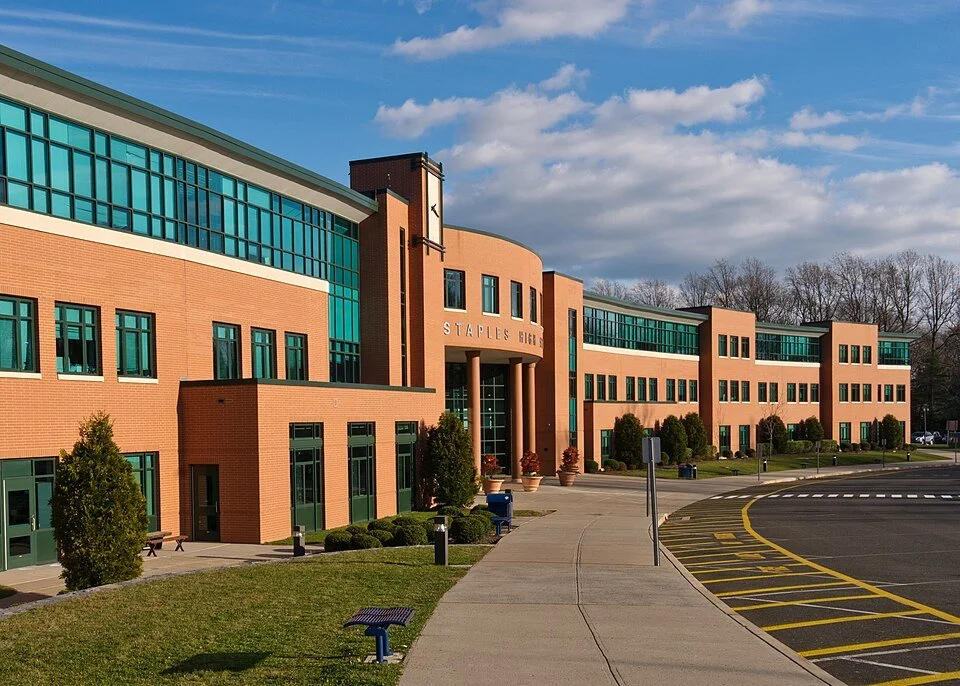
Fancy Staples High School, in rich Westport, Conn.
MANCHESTER, Conn.
Will Connecticut ever realize that two of what it professes to be its highest ideals of public policy, local control and equality of opportunity, are contradictions?
State government was reminded of this again the other day by another report
Connecticut's teacher pension system perpetuates inequity in student tes...
from the Equable Institute, a nonprofit organization that seeks to improve government employee pensions. Connecticut's state teacher- retirement system, the institute notes, does much better by teachers in wealthy municipalities than those in poor ones, because teacher pensions are calculated from their salaries. Wealthy municipalities pay more so their teachers get bigger pensions.
Indeed, Equable says state government pays twice as much for the pensions of teachers in some wealthy municipalities than it pays for the pensions of teachers in some poor ones.
Additionally, because of the higher salaries they pay, wealthy municipalities suffer less turnover in their teaching staffs and retain better teachers longer than poor municipalities do.
Equable says the disparity in pension contributions is responsible for some of the disparity in student performance between wealthy and poor municipalities. That stands to reason, but pension disparities surely matter far less to educational results than the disparities in the household wealth of students and the amount of parenting they get.
As usual, liberals and teachers unions like to attribute all the deficiencies of public education to inadequate spending, even though Connecticut has been raising education spending steadily for almost 50 years, improving teacher salaries and pensions without improving student performance.
Per-pupil parenting has always been the main determinant of student performance, but politics prohibits addressing the parenting problem. No elected official or candidate dares to note the strong correlation between single-parent households and child neglect and abuse, student educational failure, poor physical and mental health, and general misbehavior. Acknowledging that correlation would impugn the entire welfare system and the perverse incentives it gives the poor, and it would show where so much social disintegration is coming from.
But everyone admires teachers as individuals, so finding public money for satisfying them and their unions is easy and doesn't cause the political problems that examining the causes of poverty would.
It's no wonder that teachers prefer to teach well-parented, well-behaved, attentive, and curious kids rather than poorly parented, ill-behaved, and indifferent or demoralized kids. It's no wonder that teachers in impoverished cities, like police officers there, can get worn down quickly and seek to pursue their careers in municipalities with less poverty and dysfunction. This is just another aspect of the flight to the suburbs, which has been caused by government's failure to solve poverty in the cities.
Maybe state law should arrange for all teachers to be paid directly by state government according to the same salary schedule so their pensions would be equalized. No adjustments for union contracts or individual merit could be permitted, since they would generate inequality.
Such an egalitarian system likely would reduce salaries and pensions in wealthy and middle-class municipalities and increase them in poor ones. But of course teacher unions would never give up bargaining power over wages and benefits, not in the pursuit of equality or anything else.
Or maybe teachers in the poorest municipalities should be paid at least $100,000 per year more than teachers in the highest-paying municipalities. They might not all be good teachers but most might deserve more money just for having to deal with so many indifferent and misbehaving students.
While that might be fairer to those teachers, who are part of the constituency the Equable Institute is trying to help, Connecticut's long experience would still be that school spending is almost irrelevant to educational performance, and the presumption of increasing teacher salaries and pensions would still be that the job satisfaction of teachers is more important than education itself and ending generational poverty.
But even the long failure to end generational poverty isn't the biggest problem here. The biggest problem here is simply Connecticut's failure to care much about it. As a political matter, paying off the teachers is the most we can do.
Chris Powell has written about Connecticut government and politics for many years (CPowell@cox.net).