Chris Powell: Democrats want to nullify more; parks won’t save cities
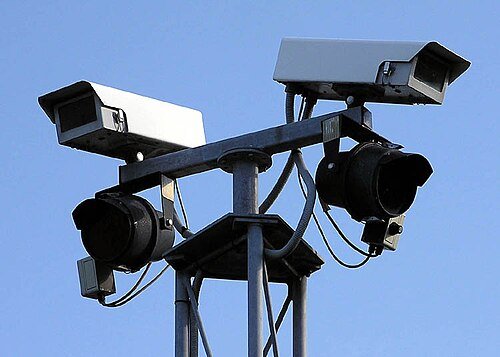
Closed-circuit TV cameras like these can be used to take the images scanned by automatic number-plate recognition systems.
MANCHESTER, Conn.
Most Democratic officials in Connecticut insist that theirs is not a "sanctuary state," a state that obstructs enforcement of federal immigration law, even as nearly every week they call for more such obstruction.
The latest scheme of the nullification Democrats is legislation to prevent the use of Connecticut license-plate camera data for immigration-law enforcement in other states. The bill would forbid Connecticut police departments from contracting with license-plate-reader companies without a guarantee that Connecticut data wouldn't be shared with anyone helping to enforce immigration law.
Such a law may please the nullification crowd but it's hard to imagine any guarantee that would be effective and enforceable. An out-of-state police department might give such an assurance, but who from Connecticut would be assigned to monitor how that department shares it?
Besides, federal immigration agents aren't going to arrest any illegal immigrant for having been in Connecticut at any particular time. Illegal immigrants are arrested for being anywhere in the country. License-plate reader data are most likely to be used simply to narrow the search for an illegal immigrant, and immigration agents aren't likely to use such data in pursuit of ordinary illegals but mainly in pursuit of illegals suspected of more serious offenses.
The leader of the state Senate's Democratic majority, Bob Duff , of Norwalk, says, "The more you learn, the more concerned you get about these license-plate readers and the trouble they can cause." What "trouble"? That immigration law might be enforced?
Do Duff and other advocates of the legislation really mean to prevent sharing license-plate-reader data even in pursuit of an illegal wanted for murder, rape, or robbery? It seems so.
Journalism in Connecticut seldom puts serious questions to the immigration-law nullifiers -- nor any questions, really -- so mere posturing on the issue usually gets a free ride here.
How can advocates of the license-plate reader data legislation deny that it will make Connecticut even more of a "sanctuary state"? They won't have to deny it, because they won't be asked.
Many liberals long have scorned suburbs for environmental degradation – for chewing up the countryside with roads, houses, and cars and increasing air pollution via commuting. Yes, the common desire for a little space, peace, and privacy at home comes with a cost.
But now some liberal Democratic groups -- the Center for American Progress, Justice Outside, and Conservation Science Partners -- are lamenting that most members of minority groups live in cities that are "nature-deprived" areas, suffering greater pollution from industry and highways, along with oppressive heat, flooding, and crowding, which, all together, pose greater risks to physical and mental health.
Yes, city life has its disadvantages. But it has its advantages too, like less expensive housing, cultural and entertainment amenities, and public transit. If cities didn't have their advantages, they wouldn't have so many residents.
Of course cities could be nicer. But their main problem isn't being "nature-deprived." In Connecticut the main problems of the cities arise from the poverty of most of their residents, which is a matter of their lack of parenting, education, and job skills. Poverty in Connecticut has been worsened lately by state government's failure to reduce the cost of living by facilitating housing construction and economizing.
The more job skills that people gain, the more likely their incomes are to rise and to enable them to live in areas that are less "nature-deprived." There will be similar results if more housing is built, more businesses locate in the state, and government cuts costs.
Obvious as that may be, it isn't happening in Connecticut, and in any case there is so much more to prosperous, healthy cities than re-integrating them with nature, as the state has a reason to know well. Because of good urban planning a century ago, Bridgeport has 45 parks comprising 1,800 acres and is nicknamed "the Park City" -- but it is also the Connecticut's poorest and most troubled. More nature isn't going to help.
Chris Powell has written about Connecticut government and politics for many years (CPowell@cox.net).