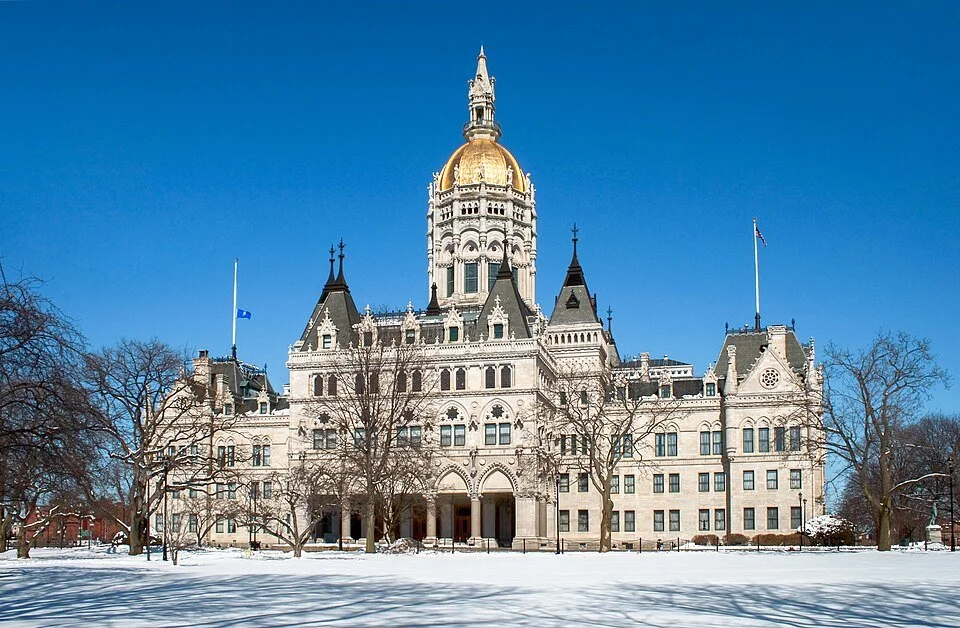
Connecticut Capitol, in Hartford. “The Nutmeg State’’ has always been among the richest states.
MANCHESTER, Conn.
Being governor is a tough job, especially in Connecticut, where thousands have their hands out and the more they're given, the more they want and expect. The state has not prospered particularly during Ned Lamont's two terms, but given his party's ravenous constituencies, things probably would be worse under any other Democrat. Lamont has restrained spending and taxes more than the big Democratic majorities in the General Assembly would have liked.
But state government remains poorly managed and in some cases not managed at all, as was suggested by the audit released this week by the state Economic and Community Development Department about corruption in “anti-poverty" grants that the department administered only nominally. The grants were actually controlled by state Sen. Douglas McCrory, D-Hartford, who routed them through a special friend who, the audit found, took a lot of the money for herself in the guise of providing services not actually rendered.
The governor quickly tried to take ownership of the audit, joining in its announcement. He called it “a strong reminder that when taxpayer dollars are involved, we have zero tolerance for fraud, waste, or mismanagement."
This was nonsense, for such grants have been routinely allocated to Democratic state legislators as raw patronage without oversight or evaluation of results. The governor has gone along with this. The corruption exposed by the audit is a matter of his own indifference and the negligence of his economic development commissioner.
The governor said Senator McCrory should “step back" from Senate business but didn't propose to stop the patronage grants.
And are Connecticut's cities any less poor for the grants, or less poor for any “anti-poverty" programs? Is poverty any less of a patronage business?
In a recent interview with the Connecticut Examiner, Lamont said he was glad to answer for his record and, if elected to the third term he seeks, will address “some unfinished business."
Where to begin? And why wait?
Given the terrible cold descending on the state this weekend, “unfinished business" -- unstarted, really -- could begin with the “cold weather protocol" the governor has invoked. This happens when state government and social-service agencies summon the mentally ill off the streets at night to various overcrowded indoor facilities and send them back outside in the morning in state government's belief that the best therapy for mental illness is fresh air.
More than a hundred of them have died outdoors in Connecticut in the last year.
For decades this therapy has saved state government millions of dollars on mental hospitals, money spent instead on state employee raises and pensions.
Always needing urgent review is the Correction Department. Two Fridays ago the General Assembly's Judiciary Committee held a hearing about the department's chronic management failures, starting with the report issued by the state auditors last July showing that 15 of the 18 failures cited by the audit were cited by previous audits as well. The new audit found that the department lately had paid more than $800,000 in salaries for excessive administrative leave.
Two weeks ago the state inspector general concluded that the deaths of two inmates at the state prison in Newtown within days of each other in 2024 were caused by mistakes with medication administered by medical contractors. This week the department's ombudsman issued a report criticizing not only inadequate medical care for prisoners, a longstanding issue, but also unsanitary conditions and excessive lockdowns.
The correction commissioner said again that the department aims to do better, so that will suppress the issue for another year, since nobody cares much about prisoners besides the ombudsman, whose appointment the governor obstructed.
As for state taxes, however well the governor has restrained them, much of that restraint has always been achieved by pushing what probably should be state expenses down to the municipal level, where they are recovered through higher property taxes, though Connecticut's property taxes are disgracefully high.
For many years that too has been “unfinished business."
Chris Powell has written about Connecticut government and politics for many years (CPowell@cox.net).