
Vox clamantis in deserto



'Simply hold still'
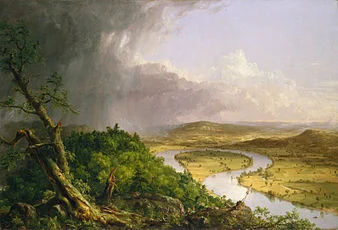
"View {of the Connecticut River Valley} from Mount Holyoke, Northampton, Massachusetts, after a Thunderstorm—The Oxbow,'' by Thomas Cole in 1836.
''A farmer...has an enormous innate need to simply hold still, to keep what he's got, to limit his greed to what he can keep....What's the use of owning more than you can plough, or hay, or cut into sawlogs or pulp or firewood in wintertime, or drive spiles into to bleed out maple sap in sugar time? No use, at all. In the Connecticut Valley, this Yankee trait has saved a lot of beauty.''
-- Evan Hill, from The Connecticut River (1972)

Connecticut needs to fix its cities
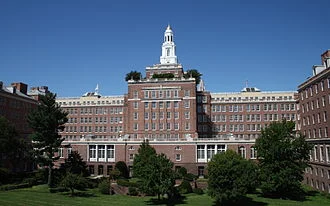
Aetna's headquarters in Hartford, but not for long: The company is moving its home office to Manhattan.
Adapted from Robert Whitcomb's "Digital Diary,'' in GoLocal24.com:
Derek Thompson, writing in The Atlantic’s online service, has some interesting takes on Connecticut’s current fiscal problems. The state government has a huge deficit, some cities are effectively bankrupt, taxes are amongst the highest in the nation and some big companies have fled. And yet the state remains the richest on a per-capita basis in America, albeit largely because of New York City-connected rich folks living in Fairfield County. (Massachusetts is the second-richest; New Jersey the third.)
He notes some remarkably little reported reasons for the state’s ills: One is that Connecticut, like America in general, has lost much of its high-valued manufacturing, a sector for which Connecticut was once famed around the world. (I lived near Waterbury for four years in the early and mid-‘60s, from when I well remember the busy factories up and down the colorfully polluted Naugatuck River.)
Very highly paid people in finance, many of them commuting to Manhattan but many doing their thing in Stamford and Greenwich, have offset some of this loss. However, finance, which of course follows the ups and downs of Wall Street, is more cyclical than manufacturing. And the latter provided a wider range of well-paying jobs to many more people than does finance.
Another important change that Mr. Thompson cited is that the big cities close to Connecticut --- especially New York and Boston – have become much safer and more attractive. Rich people and Millennials have been moving back into them, having grown bored with suburbs, even those as attractively sylvan as some on Connecticut’s strip of the Long Island Sound shoreline.
Conservatives who seem obsessed with high taxes above all else should note that some of the big companies pulling their headquarters from Connecticut are not exactly moving to low-tax venues. Consider that Aetna is leaving Hartford for Manhattan and General Electric has left Fairfield for Boston. They want the dynamism of those cities and are happy to pay for it.
The Nutmeg State has poor, high-crime and often badly run cities. If the state is to improve its long-term prospects, I and Mr. Thompson would agree, it needs to fix its cities. Hartford, which used to be a vibrant and mostly middle-class city before bad municipal government, ill-considered“ urban renewal’’ and other factors drove it into the ditch, is expected to go into official bankruptcy soon. That should let it start cleaning up its act and make it a place that people, especially young adults who might otherwise go to New York, would want to live and work in. That could help turn around the whole state. After all, Hartford is the state capital.
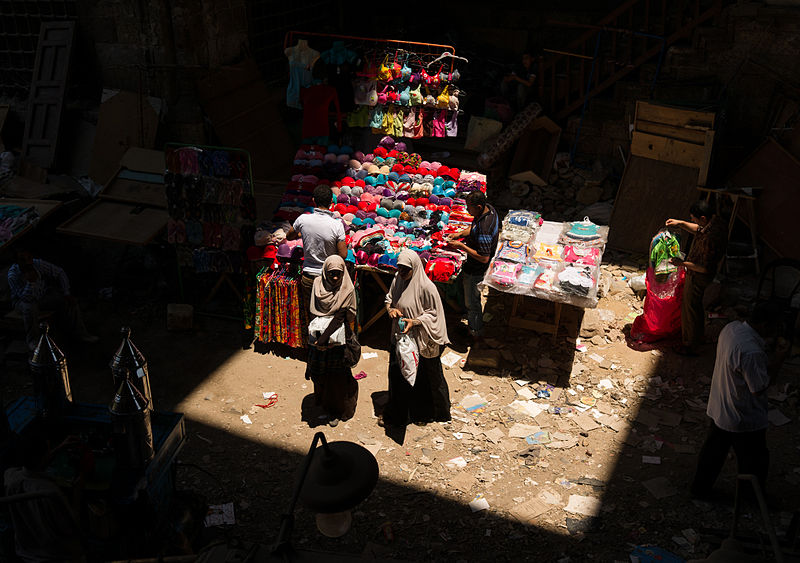
Geoff Coventry: There's no 'free market'' fix for health-care crisis
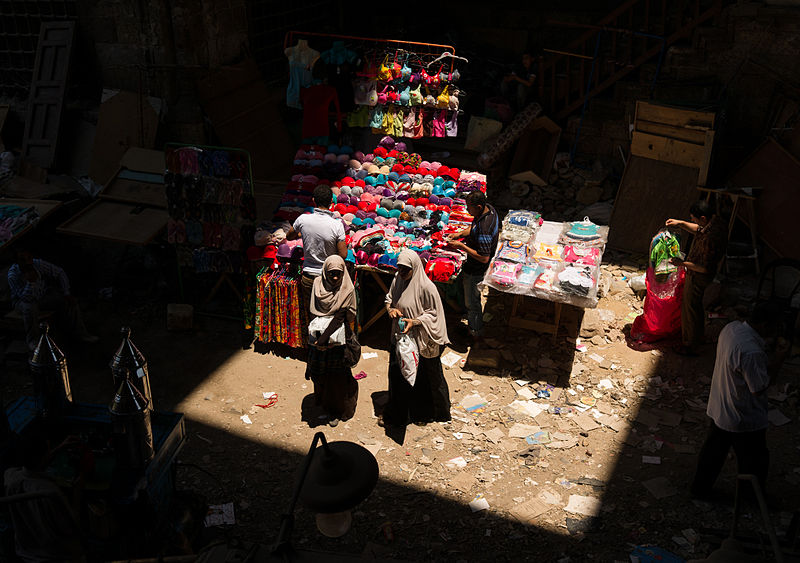
--Photo by Frank Schulenberg
Women shopping at a bazaar in Cairo.
The Republicans have big plans for health care in this country: to eliminate coverage for millions of Americans while delivering a big tax cut to the rich.
As someone who stands to benefit from that tax cut, let me just say: I don’t need it, and I don’t want it. No tax cut is worth excluding millions of Americans from the health services they need.
Any new health-care legislation should be focused on providing the best available health services for all Americans, not deliberately putting them out of reach. And yet, this is exactly what the twin monstrosities that came out of the House and Senate would have done.
According to the Congressional Budget Office, the House bill would’ve left 23 million Americans uncovered by 2026. The Senate version was only a shade better, leaving 22 million people out. Those bills were nonstarters with the public — the party was forced to pull them, along with any immediate plans to repeal the Affordable Care Act (aka Obamacare).
This Republican-majority Congress has shown their cards: They favor less coverage for workers and the elderly and lower taxes for the wealthy.
Republicans in both chambers claim they’re doing this to support “freedom” and “choice” for the American people. They say the “free market” is the only way to provide Americans with access to affordable health care. They claim deregulation will help drive down health costs.
Well, for starters, so-called “free markets” are unicorns — fanciful creatures with magical powers that don’t exist in the real world. All markets are designed; they don’t emerge spontaneously from nature. We form, structure, regulate and enforce markets through policy and institutions which reflect private and public interests.
When it comes to health care, we’re talking about something closer to a “natural monopoly” like electricity, not an industry like autos or breakfast cereals. Everyone needs basic medical services on a regular basis, and we need to make sure the same quality is available to everyone — even in hard to reach or low-income areas.
This will always require some form of direct government funding of services, especially with respect to primary care. Failing to do so means we’re not serious about the goal of quality care for all Americans.
This doesn’t necessarily mean an entirely government-run system — there’s plenty of room for private medical practices and businesses to provide some of the spectrum of services we need. But it does mean some degree of public funding is essential.
A fully privatized system can never adequately provision the nation. Rural communities don’t have adequate medical facilities and staff. Underdeveloped urban communities suffer from the same lack of basic resources, and their residents often don’t have the ability or time to travel to other locations.
Republican leaders claim they want affordable access to quality health care for all Americans, but all of their proposals have focused on lowering taxes on businesses and the rich, regardless of the very real cost in terms of human life.
It’s a false choice, and the effects will be cruel.
A healthy nation is a prosperous nation. This is primarily a challenge of real resources and the distribution of those resources, not of money. Congress can and should authorize any necessary funding to achieve the stated public goal simply by appropriating the funds.
This includes designing a system that will ensure there are enough facilities, doctors, nurses, specialists, transportation systems, and all the other elements of quality care in close proximity to all who need it — at any level of need and ability to pay.
Members of the House and Senate were put there by the voters and have an obligation to fight for and protect all of their constituents, not just the ones wealthy enough to bankroll their campaigns.
Geoff Coventry is a member of the Patriotic Millionaires and a founder and principal of Tradewind Energy Inc.
Beyond Abstract Expressionism

"Ascension'' (oil on canvas), by the late Budd Hopkins, in the show "Budd Hopkins: Full Circle,'' at the Berta Walker Gallery, Provincetown, July 21-Sept. 3.
The gallery said: "When the idea of creating a traveling exhibition of Budd Hopkins' work was first proposed ... art historian, artist and writer John Perrault was invited to curate the exhibition. Before Perrault's untimely death in 2015, Perrault wrote the following: 'Budd Hopkins was embedded in his time but also removed from it. His intelligence, which is clearly revealed in his writings about art, also shines through his paintings. He was an original. (These exhibitions will) display Hopkins' considerable talents as a painter and make a case for his place beyond the category of second-generation Abstract Expressionism."'
An initiative to close the rural broadband gap in Maine via a pilot project

This is from the New England Council (newenglandcouncil.com):
"Microsoft recently announced a national initiative to close the rural broadband gap. As part of a partnership with Axiom Technologies, areas in rural Maine will participate in a pilot project for the program.
"Microsoft aims to utilize unused television frequencies, known as white spaces, to end the digital divide by bringing internet services to remote areas. The technology, nicknamed 'super Wi-Fi,' is similar to traditional Wi-Fi services, but reaches much greater distances and is powered by low power television channels. In the next five years, Microsoft intends to connect two million households in rural America, and Maine has been chosen as one of the pilot locations. According to Maine Public Radio, 20,000 households in rural Maine lack Internet and with the help of a $72,000 grant from Microsoft, Axiom will be able to offer $9.99 TV white space service for the first year.
"Microsoft explained the proposal in a white paper posted on their Web site. 'In urban America, we have thankfully become accustomed to ongoing capital investments to expand broadband capacity in areas that already have broadband coverage,' the white paper stated. 'But the time has come to expand this coverage to the rural areas that lack it entirely. As a country, we should not settle for an outcome that leaves behind over 23 million people living in rural America. To the contrary, we can and should bring the benefits of broadband coverage to every corner of the nation.”'
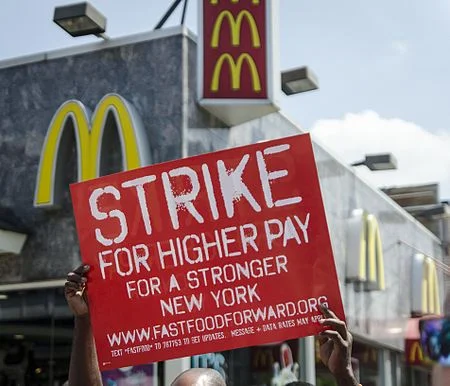
Jill Richardson: America's service workers need healthcare
Via OtherWords.org
Our country has a powerful myth that anyone can succeed as long as he or she works hard.
That’s the story of Alexander Hamilton that has swept Broadway: how a “bastard orphan” can become “a hero and a scholar.” According to the lyrics he did it by working harder, being smarter, and being a self-starter.
If that’s all you need to do to succeed, then it’s your own fault if you’re poor.
And White House spokeswoman Kellyanne Conway has no sympathy for you. If you’re sad the Republicans want to take away your Medicaid, she says you can go get a job. Because your poverty is your own fault.
To quote Ernest Hemingway at the end of The Sun Also Rises, “Isn’t it pretty to think so?”
The reality isn’t as nice. We don’t live in a society where anyone can get ahead just by working hard. It might feel that way if you grew up middle class, but that’s not the reality that millions of Americans live in.
Sociological research confirms this unpleasant truth again and again.
As for the people on Medicaid who should just “get a job,” odds are that they already have a job. Maybe two jobs.
We as a society want people working in restaurants, cleaning our hotel rooms, checking us out and stocking shelves at stores, and doing any number of low-skilled, generally low-wage jobs. Some people even oppose giving those workers a raise because it would either cut into corporate profits or raise prices.
Well, we can’t have it both ways. We can’t benefit from low-wage labor while simultaneously blaming low-wage workers for their own poverty.
And if you’re truly callous enough not to care if the working poor have access to affordable health care, consider how their plight affects you.
Suppose for a moment that 22 million Americans lose their health care, which is what the Congressional Budget Office predicted would happen if the Senate passed the dead-for-now Republican healthcare bill. What happens?
Those 22 million people no longer go for preventive check ups. They don’t treat medical problems when they occur, before the problems get worse. They wait until they have no choice, and then they go to the emergency room.
If they cannot pay the bills accrued at the emergency room, the hospital eats the cost. But hospitals must balance their budgets somehow, so they raise prices for everyone else.
If you’re insured, then you’re not paying the hospital directly, so the higher prices go to your insurance company. And they pass it on to you in the form of higher premiums.
Thus, if you aren’t moved by the human suffering caused by depriving the working poor of health care, perhaps you’ll be moved by your own pocketbook.
Unless emergency rooms start declining treatment to anyone who can’t pay, turning cancer patients and gunshot victims onto the streets to die, somebody is going to pay for the care of the uninsured.
The question is whether they’ll be able to go for preventive check-ups and treat problems early, or whether they ‘ll go to the emergency room after they can no longer avoid it.
For those who rely on Obamacare for their insurance — myself included — the prospects of losing their healthcare is terrifying. I have several friends with cancer who are literally afraid they will die if a repeal bill passes. And that’s not hyperbole.
It’s time we stopped telling ourselves that anyone who’s struggling only has themselves to blame. And as the wealthiest nation on earth, it’s a travesty that we aren’t willing to help them.
Jill Richardson is the author of Recipe for America: Why Our Food System Is Broken and What We Can Do to Fix It.
A looming protein machine

"Towering'' (oil), by Stephanie Bush, in the group show "New Painting & Indoor Sculpture Exhibition,'' at Mill Brook Gallery & Sculpture Garden, Concord, N.H., through Aug. 27.

'The town is drowned'
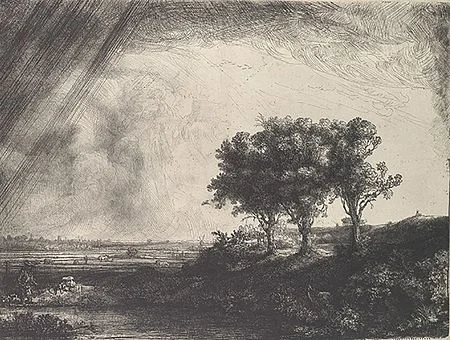
"The Three Trees,'' Rembrandt etching
"Someone on Walnut Hill has taken a picture,
reducing the town by distance to design
under an arch of sky whose empty vastness
the ample clouds can only underline
All that is left of landscape lies at the bottom
of a sea of summer air: the town is drowned
under that sky, remote above the buildings
that in the picture scarcely clear the ground.''
-- From "The Prospect Before Us,'' by Constance Carrier
Industrial image to pastoral image

Boston Manufacturing Company, 1813-1816, Waltham, Mass. (engraving by Elijah Smith).
"{By tne last quarter of the 1800s} tourists sought out the isolated or remote parts of New England, looking for an imagined world of pastoral beauty, rural independence, virtuous simplicity, and religious and ethnic homogeneity. In these years, a trip to New England came to mean an escape from the conditions of modern urban industrial life, the very life New Englanders a generation earlier had been praised (and sometimes blamed) for creating.''
-- Dona Brown, in Inventing New England
Todd Corayer: Plant milkweek to save monarch butterflies

Female monarch butterfly.

Milkweed.
Via ecoRI News (ecori.org)
WAKEFIELD, R.I. — Planting milkweed in your garden may save a Mexican forest. Migrating monarch butterflies rely on milkweed plants for cover and nutrition on their annual 2,500-mile migration from the oyamel fir forests along Central Mexico’s Transverse Neovolcanic Mountain range to the United States and Canada.
In their larval stage as caterpillars, milkweed is all they consume, but a host of causes have limited areas for the species to grow. Planting milkweed is a simple and beautiful way to bring life, color and sustenance to our yards, and Blue Moon Farm, on Saugatucket Road, has quietly become one of Rhode Island's largest providers.
In their larval stage, monarch butterflies are caterpillars.
Monarch butterflies are miracles of strength and persistence, with simple needs for a brief nine-month life. For protection from dangerous elements of cold and rain, they crowd by the thousands on sagging branches of Mexico’s sacred fir trees. This forest once covered greater expanses, but a warming climate forced it up mountainsides into cool, moist air, and with them went the butterflies.
Monarchs overwinter in just 12 locations there, sheltered from extremes amongst the needles and under protective cloud cover, where cool temperatures lower their metabolic rate, conserving expenditures of lipids, necessary to fuel their journey north come springtime. Before leaving, monarchs mate to begin their cycle of new life.
It was because she is so interested in native plants that Jane Case, owner of Blue Moon Farm, began her business designing and creating perennial gardens more than 30 years ago. It was her understanding of how beneficial milkweed is for butterflies and other winged animals, combined with her artist’s eye for bringing special colors to gardens, that convinced her to originally offer a few varieties. Customers were slow to the idea of planting “a weed” in their private spaces, but recently, as the monarch’s plight has gained widespread attention, sales have increased.
“This has been a long haul,” Case said with a laugh.
It takes four generations to complete a monarch migration. Throughout the route, females will deposit up to 500 milky-white eggs the size of a pen tip on the underside of milkweed. In a week or less, the eggs will hatch, allowing emerging caterpillars to feed on the leaves and their nutritionally rich latex sap. The sap also contains toxic glycosides, which stores in their exoskeletons and, later, their wings, causing them no harm but sickens any who prey on them. Combined with their vivid, striking colors, the toxin serves as an effective warning system.
In just over a month, monarchs transform from those tiny eggs to larval caterpillars, to pupa encased in a silken chrysalis to adult butterflies. Throughout this cycle, it’s milkweed which feeds and protects them.
In about a month, monarchs transform from tiny eggs to larval caterpillars, to pupa encased in a silken chrysalis to adult butterflies.
Larvae seem to feed solely on milkweeds in the genus Asclepias, named in honor of the Greek god of medicine and healing, Asklepios. In their larval stage, they rely mainly on butterfly weed, swamp milkweed or common milkweed.
In turn, the 76 milkweed species depend on butterflies, bees, ants, moths and wasps to transport pollen from their pollinarium to the receptive stigma on other flowering plants. This reliance means more beneficial creatures in gardens, with the bonus of being deer deterrents.
Blue Moon Farm sells five species of Asclepias, including varieties of incarnata such as Cinderella, ice ballet and milkmaid. Because milkweed are perennial, living for more than one year and reproducing from rootstock in addition to seeds, they’re a natural fit in her 3-acre nursery, Commercial gardeners from all over the state have become Case’s largest milkweed clients.
In front of the retail store, Case and the farm’s manager, Mike Yarworth, have planted the tropical milkweed curassavica, so customers can see how beautiful the flowers are and how they aid in the butterfly’s metamorphosis.
“Our goal is to encourage monarchs to lay eggs on the leaves, to feed, to form a chrysalis and watch the whole cycle,” Yarworth said. “We want to see the butterfly emerge.”
He and Case have also observed monarchs favoring the tropical milkweed, which tend not to propagate the following spring so are better choices for smaller gardens.
As researchers learn more about monarch migrations, they have found a significant loss of habitat, from fields containing milkweed tilled over to grow more valuable hays for animal feed, persistent urban sprawl, and liberal use of chemical herbicides, sprayed to kill whatever is undesired, especially plants whose name includes the word “weed.”
To compound this loss of habitat, native Mexican peoples continue to harvest fir for fuel, religious ceremonies and profit.
Monarchs butterflies begin to leave Canada and northern New England from August through late December, as milkweed produces long pointed pods full of seeds tailed with silken white fluff, ingenious parachutes designed to carry them on fall breezes. It’s a natural magic, a genetic gift, that leads these fourth-generation butterflies home to Mexico and the cool mountainous forests of sacred oyamel firs to rest and mate.
Blue Moon Farm sells varieties of milkweed that protect and feed monarchs on their magnificent migrations, and, when year classes are strong, greater populations will return to Mexico — their gorgeous millions dabbed black and orange will crowd on branches, reserving their energy for new journeys north.
Those increased populations will serve as vivid reminders of just how critical it is to preserve and protect the sacred fir forests.
Rhode Island resident Todd Corayer runs a blog called "the fishwrap writer''.
Cold but unfriendly

''This can be a cold place, Boston, and the weather is the least of it. We're often unwelcoming to outsiders. We have a maddening trait of sniping at insiders. We have equal parts determination and aloofness proudly bred into our native bones like the hunting instincts in championship dog.''
--Brian McGrory, in The Boston Globe of March 15, 2002
Big new hospital system would compete with Partners on price
Via Cambridge Management Group (cmg625.com)
As has been long expected, and after several previous merger attempts, Beth Israel Deaconess Memorial Center, in Boston, and Lahey Health, in Burlington, Mass., plan to merge, in a combination that would also include, most prominently, New England Baptist Hospital, in Boston; Anna Jacques Hospital, in Newburyport, and Mount Auburn Hospital, in Cambridge. If approved, the merge would create a 13-hospital system, the second-largest in Massachusetts.
The new network plans to compete with Boston-based Partners HealthCare, the state’s biggest system, with 14 institutions, as a lower-cost network. Partners includes huge Massachusetts General Hospital and Brigham and Women’s Hospital.
Meanwhile, Stuart H. Altman, M.D., chairman of the Massachusetts Health Policy Commission, said he worries about ongoing market consolidation and the associated declining number of independent community hospitals in the state.
Healthcare costs in Massachusetts exceed those in most other states, and that has been attributed in part to the high prices by behemoths like Partners.
New gallery to focus on maritime art

"Brooklyn Bridge, '' by Peter Layne Arguimbau, to be shown at the new Mariner Gallery, Newport. The gallery's grand opening will be on July 29. Contemporary maritime art as well as 19th Century fine art depicting sailing events and seascapes in traditional styles will be displayed.

Chris Powell: Forget about Afghanistan, protect lobster owners' privacy

How strange that this country's war in Afghanistan is entering its 17th year with neither success nor political controversy. Americans seem to have taken the advice given to them by the late comedian Mort Sahl about the Vietnam War: Just accept it as part of your life. But the main American portion of the Vietnam War lasted only 10 years.
Of course, Afghanistan is not producing the U.S. military casualties Vietnam did, so presumably the public finds them acceptable if they are even noticed at all. The casualties of Afghans, often innocent civilians, are apparently irrelevant. This lack of interest has caused President Trump to delegate to the defense secretary a decision on whether to send more soldiers to Afghanistan, the current number being grossly inadequate to pacify the country. The necessity and practicality of pacifying it are not questioned, nor the cost -- billions of dollars every year even as the United States is said to lack the money to ensure that everyone has decent medical insurance in America. Indeed, the war in Afghanistan does not seem to be an issue in Congress at all.
But the other day Connecticut's senior U.S. senator, Richard Blumenthal, did express concern about a Transportation Security Administration agent's displaying on Twitter the photo of a 20-pound lobster that was found in a cooler being inspected at the airport in Boston for shipment to Georgia. The lobster had been purchased at a fish shop in Old Saybrook and the shop owner got indignant that the lobster had been displayed without the buyer's permission. So Senator Blumenthal visited the shop to concur with its owner before an audience of journalists.
"What may seem funny to one person may feel like a violation of privacy to another," the senator said. But in displaying the lobster the TSA people did not identify its buyer and thus did not violate his privacy, while if the lobster had any privacy rights, they were first violated by the fish shop itself when it put the crustacean in a display case for sale.
No matter, for the senator had gotten on television again and for a reason -- the privacy rights of lobsters and those who would feast on them -- more interesting than his usual denunciation of the Trump administration, which everyone already knew to be incompetent and disgraceful. But another war waged half-heartedly out of mere inertia is even more disgraceful, and removing that disgrace requires Connecticut's members of Congress to speak out against it and their constituents to press them to.
Nice Guys Finish Without a Budget
Connecticut has gone two weeks without a state budget, but at least House Speaker Joe Aresimowicz this week accepted responsibility for failing to rally the House Democratic majority behind one by July 1. In part the problem may be Aresimowicz's virtues. He is known for reasonableness and patience rather than for cracking heads. To a greater extent the problem may be the division in the speaker’s party.
While most House Democrats, liberals, want to raise taxes again to cover the huge budget deficit that reflects the failure of liberal policies, Governor Malloy has turned against raising taxes, as have a few Democratic House members whose defection would send a tax-raising budget to defeat at the hands of the unusually large minority of Republicans in the House. So for the time being the hapless Democrats seem to prefer to let the governor do Connecticut's budgeting by himself day to day, to exact unpopular cuts on his own, and to take the blame, since he's not seeking re-election. If he tires of that, maybe he will invite the Republicans and dissident Democrats to send him a Republican budget without more taxes.
Chris Powell is managing editor of the Journal Inquirer, in Manchester, Conn.
Tim Faulkner: The governors and global warming
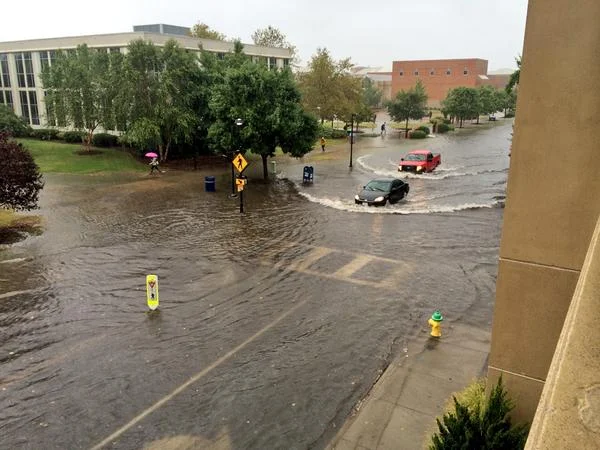
Tidal flooding in Hampton Roads, Va. This has become increasingly common there, and not just during storms.
Via ecoRI News (ecori.org)
PROVIDENCE
For three days inside the Rhode Island Convention Center, governors steered clear of saying “climate change.” The public literature outlining the meetings and activities for the July 13-15 National Governors Association summer gathering didn’t mention the term. Climate change was said twice during a discussion titled “Preparing For the Extreme: Building Resilient Communities.” Only once was it uttered by a governor.
“Whether they believe in climate change or not, they are all aware of it today,” said Virginia Gov. Terry McAuliffe, referring to the residents of his state and the ubiquitous reminders they have of climate-change threats, such as sea-level rise.
For the record, Canadian Prime Minister Justin Trudeau did mention the “fight against climate change” in his speech to the governors. Meanwhile, Vice President Mike Pence boasted about expanding offshore drilling, rolling back the Clean Power Plan and reviving the Keystone XL pipeline.
While climate-change mitigation wasn’t on the agenda, adaptation is well underway in several states. Even as the dozen or so governors in attendance at the breakout meeting avoided saying “climate change," they embraced the word “resilience” as a means to address the destruction caused by more frequent extreme weather, flooding and a rising shoreline.
Louisiana Gov. John Bel Edwards recognized that sea-level rise was a problem. Since he took office in January 2016, 46 parishes have been declared natural-disaster areas.
“Resiliency is a huge issue for us in Louisiana,” Edwards said.
The Louisiana Democrat championed the relocation of the Biloxi-Chitimacha-Choctaw Native American tribe as an successful response to the state’s rapid loss of land to sea-level rise.
Gov. Asa Hutchinson, of Arkansas, and Gov. John Bel Edwards, of Louisiana, didn't say climate change, but they do want to make their states more resilient to extreme weather and flooding.
Republican governors from inland states also seek help with sudden and powerful weather events. Wyoming Gov. Matt Mead wants better forecasting for tornadoes. Arkansas Gov. Asa Hutchinson and Vermont Gov. Phil Scott seek assistance with the preparation for, and response to, flooding.
Brock Long, who was confirmed as director of the Federal Emergency Management Administration (FEMA) on June 23, promised to improve disaster-relief programs, but noted that he doesn’t want to spend money on disaster relief if states don’t prepare for them. FEMA, Long said, spent $3.2 billion during the past four years on disaster relief and only $222 million on emergency planning.
“It should be flipped,” he said.
Long said he worried that states suffer from “hazard amnesia,” meaning that they quickly forget devastating natural disasters and fail to plan for the next one. Simple steps such as teaching residents how to turn off water mains and administer CPR can save lives and money, he said.
Mikael Berkowitz, president of 100 Resilient Cities, the foundation that helps cities adapt to climate change, urged every state to hire a chief resiliency officer to coordinate federal and state emergency planning and responses. He urged replacing aging infrastructure with green infrastructure projects, like the Big U in New York City, to manage flooding and improve the vitality of urban areas.
Climate activists protested outside the Rhode Island Convention Center during the National Governors Association meeting.
Soon after the meeting concluded, some 200 climate activists gathered across the street from the convention center to urge the governors to take aggressive action to cut fossil-fuel emissions.
The protesters called out Rhode Island Gov. Gina Raimondo to respond to a recent letter from the Civic Alliance for a Cooler Rhode Island seeking zero emissions by 2035 and to enact a carbon tax-and-dividend program.
Jerry Elmer, senior attorney for the Conservation Law Foundation, said Raimondo’s act of signing a letter from U.S. governors and mayors in support of the Paris climate agreement was “empty, and meaningless and vacuous as long as she doesn’t take action on climate.”
Elmer chided Raimondo for not opposing the proposed Burrillville power plant.
“What Rhode Island does not need now is a new carbon, long-lived, carbon-emitting power plant," he said. "The bottom line is very, very simple: actions speak louder than words.”
Kat Burnham of People’s Power & Light said Raimondo lacks a clear action plan for addressing climate emissions.
The financial and health costs, Burnham said, will only increase as long as the state relies on fossil fuels.
“We cannot afford to send billions of dollars to other states for natural gas that we don’t want,” she said.
“Environmental protection is not a political issues; it is a human issue," Providence College student Alex Duryea said.
Duryea, the student sustainability coordinator at PC, called for a ban on fracking and an aggressive switch to renewable energy. “The time to act is now," she said.
Tim Faulkner writes frequently for ecoRI News.
'Shimmering grace'
"A something in a summer's Day
As slow her flambeaux burn away
Which solemnizes me.
A something in a summer's noon --
A depth -- an Azure -- a perfume --
Transcending ecstasy.
And still within a summer's night
A something so transporting bright
I clap my hands to see --
Then veil my too inspecting face
Lets such a subtle -- shimmering grace
Flutter too far for me --
The wizard fingers never rest --
The purple brook within the breast
Still chafes its narrow bed --
Still rears the East her amber Flag --
Guides still the sun along the Crag
His Caravan of Red --
So looking on -- the night -- the morn
Conclude the wonder gay --
And I meet, coming thro' the dews
Another summer's Day!"
-- Emily Dickinson, "A Something in a Summer's Day''
David Warsh: Treat the Trump regime as an accidental dark sitcom
I’ve argued that Donald Trump’s election should be viewed as accidental – not the result of an American realignment or identity crisis, but rather a fluke. Pressure to elect an outsider had been growing ever since 1992, when software entrepreneur H. Ross Perot won 19 percent of the popular vote. In 2016, continuing globalization and technology shocks, plus revulsion against the Clinton and Bush dynasties, combined to bring about a result that no one expected.
Jeb Bush, the Establishment candidate, was forced out of the Republican primaries, permitting Trump to take control of the Republican Party. Hillary Clinton battled past her primary challenger, Bernie Sanders, only to lose the presidential election in the Electoral College, when the presumed “Blue wall” states of Michigan, Pennsylvania and Wisconsin very narrowly went for Trump.
So, six months after Trump’s inauguration, how best to think about his presidency?
One view is to reach back nearly 50 years to the Watergate affair, to hunt for misdeeds, to seek to impeach and convict the president of high crimes and misdemeanors, and so repudiate him.
Another is to set a watchful eye, to expect Trump to remain for the rest of his term, and to find new ways to think about what has happened.
Remember The Beverly Hillbillies?
The Beverly Hillbillies was an immensely popular television situation comedy in the 1960s about a rural Southern family that moves to Beverly Hills after becoming rich. It, too, was predicated on an accident. Each successive episode began by recapping the first: patriarch Jed Clampett trying to shoot a squirrel on his farm and hitting a vast oil deposit instead.
The Clampett family are thereupon seen loaded up in a very old truck, like so many Dust Bowl refugees, moving to California – with $25 million in the bank. (It was a lot of money in those days!) In one episode after another, they shake up the privileged society they find there with their backwoods ways.
The twist that sustained the series is that while the Clampetts seem backwoods rubes to their neighbors, who look down on them, they are straightforward, good-hearted, moral folk. It is sophisticated Beverly Hills society that’s self-absorbed, uncomprehending and corrupt, especially Milburn Drysdale, Clampett’s greedy, unscrupulous banker and pretend best friend, who lives next door.
The Trump family saga turns the Clampett gimmick on its head, and weaves a hostile Russian government into the plot. Whether it’s the president declining to release his tax filings, bragging to his Russian guests that the FBI director he has just fired is a “nut job,” casually pulling out of the Paris Climate Accord, or simply telling the French president that his wife is in “such good physical shape – beautiful,” the patriarch is the boor-in-chief, a slippery rogue installed in the White House not by money but by votes. His family members have been outfitted with unaccustomed West Wing offices and security clearances.
The very latest episode, which appeared Saturday on page 1 of The Wall Street Journal (subscription required), features son-in-law Jared Kushner, who organized the meeting of the White House’s American Technology Council last month at which technology industry leaders, venture capitalists and university presidents sat down with the president to talk technology policy. Zachary Bookman, chief executive of OpenGov, got one of 18 seats at the table.
The California start-up, which renders city and state government data more accessible, is seeking federal business. Kushner’s venture-capitalist brother is an investor in the firm, wrote WSJ reporters Jean Eaglesham and Lisa Schwartz. Kushner himself served on Thrive Capital’s board until he sold his interest in the firm to his brother in January. Thrive invested in several fund-raising rounds in InGov, which in 2015 was valued at $180 million – vastly less than the market value of most of the companies at the meeting. Indictable? No. Typical? Yes.
Sitcom is one way of thinking about the Trump administration. The narrative based on the Watergate scandal is the other. Here The New York Times, The Washington Post, and MSNBC have the taken the lead. The latest chapter in this version was the news last week that Donald Trump Jr. sat down last summer with some Kremlin-connected Russians in hopes of finding dirt on Hillary Clinton.
To be sure, the presidency of the United States is not a sitcom. I have myself toggled back and forth between thinking that Donald Trump may have already done something so wrong that he may be driven from office. He may yet do something sufficiently stupid, or dangerous, or both. So far, though, I don’t think that he has.
The Trump presidency will go into history with an asterisk – not because the Russians meddled with the Democrats’ campaign, not because rogue FBI agents put their thumbs upon the scale, but because his election was an accident. The 25-year feud between the Bushes and the Clintons immobilized both major political parties, fracturing one, paralyzing the other, and Trump slipped through as a result. The relevance of the Hillbillies show, a parable of sound values, is to emphasize how unprepared for life in the White House is the Trump clan – a riches-to-rags story just the reverse of what turned out to be the case in the sitcom.
Still, most of us have a distinct preference to let the results of one presidential election stand until the next – Watergate being the exception. Indeed, if the WSJ had chosen to frame the Clinton presidency in terms of The Beverly Hillbillies instead of the Watergate narrative, things might have gone very differently ever since
The Clampett family saga ran for nine seasons, 1962 until 1971. It was among the 20 most popular shows on American television – so popular that it was remade as a film in 1993. The Trump family saga is scheduled for four years. Donald Trump’s administration might be cancelled before then. But, week to week, I find it easier to think of it as a dark sitcom, turning the familiar sound-values premise on its head, a mash-up of West Wing and Breaking Bad. It is not likely to be renewed.
David Warsh, a veteran financial journalist and economic historian, is proprietor of economicprincipals. com, where this essay first appeared.