
Vox clamantis in deserto






‘An older, simpler’ Paris

“Delacroix Les Biscuits Olibet”, by Fabienne Delacroix, in her show “Fabienne Delacroix: La Belle Epoque, ‘‘ at MFine Arts Gallerie, Boston, through Dec. 30.
Fabienne Delacroix (b. 1972), the youngest child of French painter Michel Delacroix, has been painting since the age of ten.
The gallery says:
"Until recently, Fabienne was known mainly for her seascapes and pastoral landscapes while her father was renowned for his Parisian cityscapes. However, now, Fabienne has expanded her lists of subjects to include the streets of Paris. Like her father’s, Fabienne’s Paris is an older, simpler one with horse-drawn carriages filling the streets."
Don Pesci: JFK Democrats and JFK Republicans fade into history

JFK in 1963
VERNON, Conn.
"Only a fool learns from his own mistakes. The wise man learns from the mistakes of others"
-- Otto von Bismarck (1815-1898), German chancellor
New England – most conspicuously Connecticut and Massachusetts – has been a school of hard knocks for Republicans who in the past have been liberal on social issues and conservative on fiscal issues. This brand, popular for many years in Connecticut and Massachusetts, has not sold in either state for decades.
The last fiscally conservative, socially liberal congressman in Connecticut was Chris Shays, whose politics was a mirror image of that of Republican Party destructor-elect Lowell Weicker, a maverick U.S. senator for many years whose long run in Congress was cut short by then Connecticut Atty. Gen. Joe Lieberman in the 1988 election.
Wise heads conjectured at the time that Lieberman had bested Weicker because Lieberman was a Democrat who, like Weicker, was socially liberal and fiscally conservative – a Jack Kennedy kind of Democrat. Weicker’s political hero, he often claimed, was New York Sen. Jacob Javits, a Jack Kennedy Republican – certainly not a conservative.
For the past half century, conservatives had been zeroed out in Connecticut, and never mind that William F. Buckley Jr., who had helped reinvigorate conservatism through his magazine, National Review, had been a lifelong resident of Connecticut, a thorn in the side of such as Weicker, a fervent anti-Reaganite. Buckley called Weicker a gasbag. It sometimes seemed that Weicker regarded Ronald Reagan as a far greater threat to the nation than, say, Soviet ally Fidel Castro, the communist maximum leader of Cuba. Reagan referred to Weicker only once in his published diary -- he said Weicker was a “fathead.”
When Weicker lost his Senate seat to Lieberman, few politically awake commentators in Connecticut were surprised. Registered Democrats in the state, then and now, outnumbered Republicans roughly by a two to one margin, a gap that fully explains Weicker’s political overtures to socially liberal Democrats. Weicker’s liberal Americans for Democratic Action (ADA) rating in the Senate during his last years in Congress, was higher than that of liberal Democratic Connecticut Sen. Chris Dodd.
Sensing the whiff of postmodern Democrat progressivism in the wind, a combination of whipped Republicans, fervent Jack Kennedy Democrats, and politically unaffiliated independents, showed Weicker the door and voted for Lieberman.
On the opposite side of the aisle, fiscally conservative, socially liberal Republicans in Connecticut’s congressional delegation, beginning with Nancy Johnson and ending with Shays, were replaced by – how to put this gently? – fiscally progressive, socially progressive Democrats. The political moral of the tawdry tale is -- if you are a Republican pretending to be a Democrat, you will lose to Democrats who have moved sharply to the left.
Jack Kennedy, Bill Buckley, Weicker –and fiscally conservative, socially liberal Republicans -- all have disappeared in puffs of smoke, leaving the political shop in Connecticut to such progressive Democrats as former Gov. Dannel Malloy, state Senate President Martin Looney, and millionaire Gov. Ned Lamont.
Massachusetts Gov. Charlie Baker, perhaps the last Jacob Javits Republican in New England {along with Vermont Gov. Phil Scott?} survived for a bit, but now even he has thrown in the towel. Like Vermont, where socialist Sen. Bernie Sanders rules the roost, Massachusetts has gone the way of Connecticut. Republicans, fiscally conservative on economic issues, liberal to moderate on social issues in both states have been vanquished.
The rout in Connecticut, nearly complete, has touched the congressional delegation, all Democrats, the constitutional offices in the state, all Democrats, and the General Assembly, mostly Democrats presided over by postmodern progressives.
The dead branches on New England’s political tree are fiscally conservative, socially moderate Republicans, clipped in the bud for decades by New England academics, hungry postmodern progressives supported by an uncritical media almost wholly in the camp of the victors, and moderate Republicans, a politically unplugged species in Connecticut.
The live branches on the Democrat side of the political barricades just now are postmodern progressives, Gramsci cultists, traditional liberal enemies of the captains of industry, and radical redistributionists flying, knowingly or not, the flag of postmodern Marxism.
These are not Jack Kennedy’s political heirs. The liberalism of Jack Kennedy exists among some forlorn Democrats in the Northeast only as a consummation devoutly to be wished.
On the right in Connecticut, the conservative branch has put forth new buds. Both conservatives and libertarians in Connecticut make no attempts to accommodate their politics to disappearing moderate, fiscally conservative, socially liberal Republican antecedents. That way, they have learned from bitter experience, points to the political grave. These relatively new actors on Connecticut’s political stage are energetic, barely noticed, and tendentiously misunderstood by nostalgic academics and old-time political religionists hoping for a resurrection of a once fructifying liberalism vanquished by postmodern progressivism, which has nothing in common with the liberal prescriptions recommended by Jack Kennedy in an address to The Economic Club of New York a year before he was assassinated.
Just as Weicker may have been the last Jacob Javits Republican in New England, so Jack Kennedy may have been the last classical liberal U.S. president.
You can learn a great deal from history, but you cannot set up house in the past. Those who do so are doomed to irrelevance, because time marches on – usually over the prostrate bodies of those who have, as Otto von Bismarck said, learned from their own mistakes but rendered themselves vulnerable by refusing to learn from the mistakes of others.
Don Pesci is a Vernon-based columnist.

Caitlin Faulds: Trying to save a drowning coastal marsh

Wenley Ferguson, of Save the Bay, and many others have spent more than five years trying to save the drowning Sapowet Marsh, in Tiverton. R.I. marsh.
— Photo by Caitlin Faulds/ecoRI News)

Common reed (Phragmites australis) is an invasive species in degraded marshes in the Northeast.

Salt marsh during low tide, mean low tide, high tide and very high tide (spring tide).
From ecoRI News (ecori.org)
TIVERTON, R.I.
The grasses are dying. Clusters of broken, denuded stems stand in shallow pools of brackish water, making a patchwork of the low-lying marshlands.
The slow balding is invisible from the blacktop of Seapowet Avenue, hidden behind a thick curtain of phragmites. But standing boot-deep in the peat, surrounded by the sulfuric scent of decomposition, the bare ground is clear evidence of the steady saltwater creep happening in marshes across Rhode Island.
Spartina alterniflora, or smooth cordgrass, is notoriously salt-tolerant and a common feature in saltwater marsh environments.
“They can grow along the edge of the cove and get flooded twice a day, but they can’t grow in standing water,” said Wenley Ferguson, shovel in hand. All around, the sunlight glints off pools of standing water, unable to drain and slowly growing with each high tide.
The average sea level in Rhode Island has increased by about a foot since 1929. Storm surges and king tides have pushed further and further inland. Normally, the marsh would respond to the rising high-water line by matching the migration inland.
But with the sea on one side and a dense web of roads, development, cultivated fields, and invasive species on the other — and accelerated sea-level rise on its way — Sapowet Marsh has nowhere to move.
But Ferguson, the director of habitat restoration at Save The Bay, is working to save the marsh from that saltwater grave.
Ferguson has been working with the Rhode Island Department of Environmental Management (DEM) at the Sapowet Marsh Wildlife Management Area, a 260-acre state property, for more than five years now.
The coastal edge of Sapowet has seen more than 90 feet of shoreline erosion in the past 75 years. Under Ferguson’s watch, Sapowet has become home to the largest marsh migration facilitation project in the state — a small counter to the forces at play.
“When I say facilitate marsh migration,” she said, “it’s kind of like prepping the land for the marsh to migrate.”
Back in 2017 and 2018, Save The Bay and DEM, along with the Tiverton Conservation Commission, restored 9 acres of coastal grassland and reestablished beachside dunes on the northern side of the marsh to slow erosion.
Now the work has moved to the west and southeast sides of the marsh — and the strategy has changed to match.
Along the western front
The cordgrass roots are taut, but they cut easy. Just one stomp and the shovel sinks through the muck, water pooling up and over the toes of Ferguson’s black rubber boots.
It was a warm and clear November day — too warm, according to Ferguson. She packed for a cool fall day and wore a blue-flowered fleece, but 60 degrees means she’ll be sweating by midday.
Earlier in the week, Ferguson — along with a handful of DEM employees and volunteers — used shovels and a small excavator to dig a weaving network of runnels through the marsh. These shallow creeks will give the pooling water a route out to Narragansett Bay, allowing the area to slowly drain.
If the root zone of the marsh plants is able to dry even slightly, they will grow “healthy and happy,” Ferguson said. Healthy plants build up a stronger root base, and a stronger root base makes a coastline more resilient to erosion and sea-level rise.
But “we don’t want to drain it too fast,” she said. It has been three days since they dug the first runnels and the water level has dropped only slightly, exposing a few inches of bare mud — exactly as planned.
The standing water is thick with unconsolidated sediments and topped by a bacterial mat. If the water rushes out all at once, this sediment will pour into the bay. It’s better to dig in phases and let it settle out in the marsh, maintaining as much high ground as possible.
They are back on this day to adjust the runnels, excavating the areas where the muck has naturally dammed up. Lucianna Faraone Coccia, a Save The Bay volunteer and an environmental science master’s student at the University of Rhode Island, shovels out a cluster of grass roots.
“If that’s in there, it could plug up this whole runnel,” said Faraone Coccia, glancing down to point out a fiddler crab fumbling its way along the channel with its unbalanced claws.
With each shovel-full, the flow of water grows incrementally stronger and piles of dislodged peat beside the runnels grow larger.
“That’s technically considered fill,” said Ferguson, tossing another glob of peat toward the pile beside her. “We actually leave the peat on the marsh and we create these small little islands.”
These islands are about a chunk of peat thick —some 6-12 inches, not too high, Ferguson said — but that small elevation rise “is like a mountain in a marsh.”
Ferguson fought to keep the peat in the marsh, acquiring additional permits from the Coastal Resources Management Council, DEM’s Office of Water Resources, and the Army Corps of Engineers. This microtopography is essential for a healthy marsh surface, she said.
“These areas will just be a little higher, and they might recolonize,” Ferguson said. “And when I say might — they do recolonize.”
Within one season, the islands will host new sprouts of cordgrass, or they’ll prove high and dry enough to support clusters of high marsh grasses. The clusters of high grass will make ideal nesting habitat for the saltmarsh sparrow.
As healthy salt marsh has waned, so has the population of the saltmarsh sparrow — a bird that makes its nest out of a cup of dense high marsh grasses. The nests are built to withstand the highest moon tides, created with a dome so “the eggs float, but they don’t float out of the nest,” Ferguson said. But the area here is flooding too frequently, contributing to nest failure.
“That’s why these little islands that we’re creating are really valuable habitat,” Ferguson said.
Wenley Ferguson is constantly looking for clues to what shaped the marsh seen today.
Old ways and leftover lines
The state of marshes today are the result of centuries of human development and marshland intervention. According to Ferguson, nearly every marsh in the country holds some sort of historical impact. They are in no way pristine.
“So many of them were manipulated in this area for agricultural activity. And then in more recent years, we put roads along them,” Ferguson said. “We culverted them. We created duck habitat and impounded them. We filled them.”
From the 1700s to the 1900s, about 50 percent of marshes in the region were filled, according to Ferguson. Agricultural embankments have manipulated the marsh surface too, dating back to about the 1600s, when people started haying in these areas.
“The fresher the marsh grasses, the fresher the water table, the greater the value of the hay,” she said.
When she digs these runnels, Ferguson is always scouting for clues to what shaped the marsh seen today. A shovel full of root matter means a stagnant pool was once a field. Water pooling along straight lines could be a sign of an old embankment. Long straight trenches are likely remnants of old mosquito ditches — once made to reduce mosquito breeding grounds but now speeding marshland erosion.
The marsh’s tired past — coupled with its location in an old river valley whose steep sides make marsh migration difficult — spell out a challenging future.
“That’s why what we’re doing today is trying to restore some health of the marsh … under current conditions,” Ferguson said, “but always looking at where the marsh wants to go.”
An excavator heads into a thicket of phragmites growing on the eastern edge of Sapowet Marsh.
The eastern blockade
“Be careful of your eyes walking through this,” said John Veale, habitat biologist with DEM’s Division of Fish and Wildlife, as he pushed away the sharp corners of dozens of broken phragmites. “It can be a little bit dangerous.”
In the past century, invasive phragmites species — few native phragmites remain — have taken advantage of weakened saltwater marsh ecosystems to rampage through North American. The eastern edge of Sapowet Marsh, tucked below Old Main Road and several DEM-owned cornfields, is no different.
In many ways, phragmites are the perfect storm. Their feathery seed heads catch the light beautifully, but they also catch the wind and spread like wildfire. Once the seeds take hold, the reeds grow so densely they all but eliminate animal habitat and outcompete native grasses.
On Sapowet Marsh, it serves as an impenetrable blockade to marsh migration. Only a few grapevines are brave enough to reach their tendrils into the thicket. For the marsh to move away from the encroaching seawater, the phragmites need to loosen their hold. But that’s a notoriously difficult task.
“There’s no way we could do it with a shovel,” Ferguson said. “I mean, it’s just so hard. It’s one thing a little patch of phragmites. It’s another thing when it’s head-high.”
Mowing and burning do little to control phragmites, and pulling them out by the roots quickly proves costly. But like the smooth cordgrass, it is vulnerable to salt water. If Ferguson can drain the pooling fresh water and facilitate tidal flow up into the phragmites, they might dissipate — and the native grasses might have a chance at survival.
“We’re not going to get rid of the phragmites, but we can reduce the height and vigor of the phrag by facilitating that freshwater drainage,” she said.
Ferguson is in the early stages of battle on this front, just figuring out the plan. The phragmites grow 10-12 feet high in places, obscuring the lay of the land.
“There’s enough water,” Ferguson said. “It’s coming from someplace. I just can’t figure out the drainage cause it’s too thick.”
She has called in the help of an excavator. Within a few hours, the machine has established a clearing in the reeds and deepened part of a natural creek. Once some of the standing fresh water drains it will be easier to gauge the direction of the water flow.
Ferguson and her team intend to elongate the creek and the old agricultural ditches — putting past mistakes to better use — but for now the plan is still in development. Better to move slowly than be patching more mistakes up in a hundred years.
“The deterioration along the marsh edge is pretty remarkable, in a terrifying sort of way in my mind,” said Ferguson, pausing to point out a flock of buffleheads skimming into the water. “So that’s why we want to be really cautious on not making new openings for that erosion to expand upon.”
Caitlin Faulds is an ecoRI News journalist.

New England may soon become the world’s nuclear-fusion capital

The Sun generates its energy by nuclear fusion of hydrogen nuclei into helium. In its core, the Sun fuses 500 million metric tons of hydrogen each second.

Adapted from Robert Whitcomb’s “Digital Diary,’’ in GoLocal24.com
Happiest news of the month?
Commonwealth Fusion Systems LLC has just gotten $1.8 billion in private funding to build and operate the world's first commercial fusion-energy machine at its facility in Devens, Mass. The company, based in Cambridge, thus is moving faster toward what may bring about a revolution in electricity generation. It could eliminate the scary problem of trying to find safe places to store the radioactive waste that’s produced by nuclear fission, which is what nuclear-power plants use now.
Commonwealth Fusion hopes that it can prove, by 2025, that its fusion reaction creates more energy than it uses and then build a commercial-scale power plant by 2030.
What an environmental and economic boon for the world – massive amounts of clean, noncarbon-based energy -- and a boon for New England to have such an enterprise growing in its midst.
‘Like a hummable melody’

“Sky on Fire,’’ by Sue Charles, at Alpers Fine Art, Andover, Mass.
Ms. Charles is based in Amesbury, Mass., on the Merrimack River. Her artist bio says:
“The northeast coast of the Atlantic is my subject…. Paintings exist in many dimensions;They depict three dimensions of light and space with two dimensions of color, they express the fourth dimension of time in their marks and they reveal metaphysical dimensions of thought and emotion. Finding the intersection between these ways of perceiving is my goal. I work to express the long lines of landscape space, light and air connecting everything and the quiet profundity of nature. A good painting contains only the essentials and it stays with you like a hummable melody. I aim for that. www.suecharlesstudio.com.’’
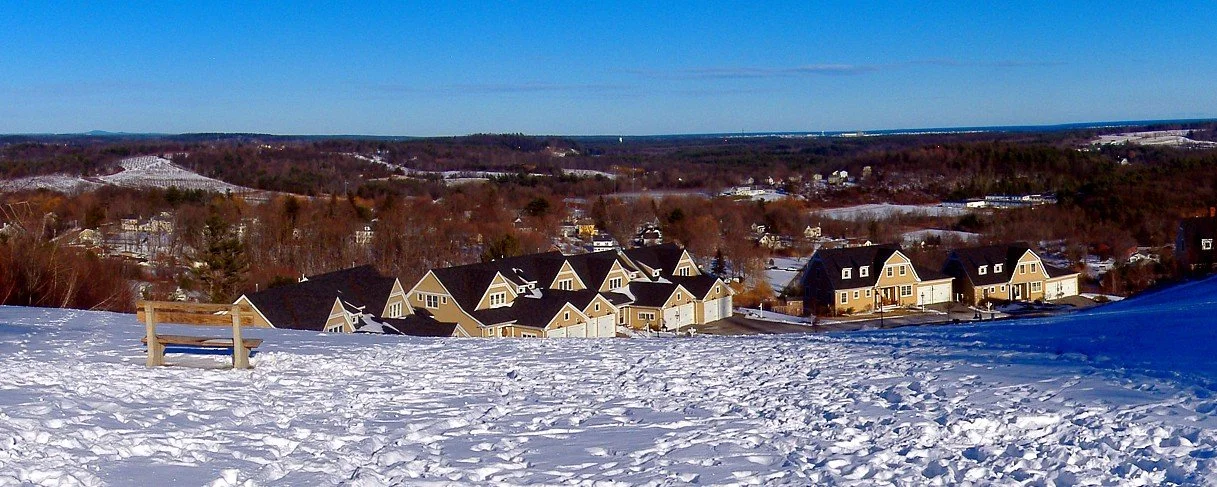
View northeast from Powwow Hill, in Amesbury
Dare to fail
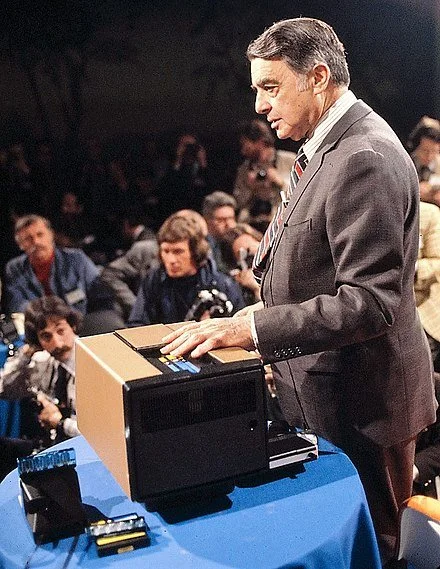
“Dr.” Edwin Land presenting the Polavision home movie system, in1977.
“An essential aspect of creativity is not being afraid to fail.’’
— Edwin Herbert Land (1909-1991) scientist and founder of Polaroid Corporation, founded and based for many years in Cambridge, Mass. (It’s now based in Minnesota.)
He was best known as the co-founder of the Polaroid Corp. for inventing inexpensive filters for polarizing light, in-camera instant photography, and the retinex theory of color vision, among other things. His Polaroid instant camera went on sale in late 1948 and made it possible for a picture to be taken and developed in 60 seconds or less.
For decades, he was probably the best known figure in Greater Boston’s world renown high-technology sector. He was always called “Dr. Land,’’ although he never got a college undergraduate or advanced degree. Later in his career, though, Harvard gave him an honorary doctorate for his scientific and business achievements.

Polaroid Land (name for Mr., Land) Camera Model 95, the first commercially available instant camera, in 1948.
Bumps, bruises and beauty

“Spring Assurance and Fall Endurance” (oil on canvas), by Gayle Mandle, in the group show “HOUSEGUESTS: Endurance,’’ at Atelier Newport (R.I.), Dec. 18-Jan 18.
Members of this revolving group, the gallery says, provide visual metaphors for “the bump and bruises’’ we all endured in 2021 and the perseverance we needed to get through it.
“The show focuses on female artists, women who devote their lives to the arts and their families….
“Gayle Mandle's recent paintings are inspired by her late husband, Roger Mandle {who served as president of the Rhode Island School of Design}, and and his love of nature and gardening. That artisanal of beauty witnessed from her studio view inspired this body of work. She celebrates Roger's handiwork with a series of paintings entitled, ‘Seasonal Quartet’.
“These paintings are also inspired by Roger's love of poetry. The paintings are paired with poems he had written over the years”
Like them, shapeshifting and camouflaging

“Phantom Limbs Can Still Play Hide and Seek’’ (clear and fluorescent acrylic, Stonehenge Aqua, ultraviolet ink), by Kenson Truong, in his show “Bespoke,’’ at Boston Sculptors Gallery.
The gallery says that Truong taps into the psyche of cephalopods, such as cuttlefish and octopuses, while tying in his identity as a gay Asian-American man. He notes their “aptitude to shapeshift and camouflage in plain sight through its cognitive ability to learn systems of deception using spatial memory, personalities and motor play” and how experiments on them “have developed into metaphor for psychological phenomena represented by cognitive dissonance and social cognitive theory.”

Octopus opening a container by unscrewing its cap.
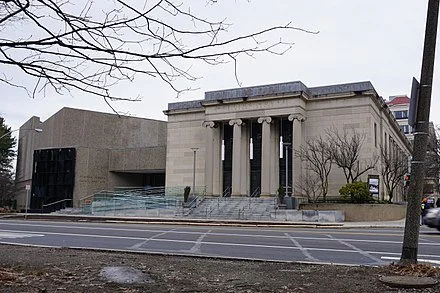
N.E. Council joins group battling anti-semitism
From The New England Council (newenglandcouncil.com)
BOSTON
“As the Hanukkah season ended Dec. 6, The New England Council was pleased to join a coalition of 60 North American organizations, including corporations, in support of the Anti-Defamation League’s (ADL) Shine A Light on anti-semitism national initiative. This national initiative will illuminate the dangers of anti-semitism through education, community partnerships, workplace engagement and advocacy.
“Amid a widespread rise in anti-semitism in North America, Shine A Light seeks to catalyze conversations within and across communities, on school campuses, and in the workplace, so that people will better understand what constitutes anti-semitism and take steps to respond. The nationwide campaign was launched on Nov. 28, 2021, the first day of Hanukkah, and includes a wide array of resources for corporate partners.
The New England Council encourages members to consider becoming a Shine a Light corporate partner.
Shine A Light also includes community and educational events around the country; educational resources for teachers, parents, and school districts; advertising; and social media tools. Learn more here.

An anti-semitic 1892 cartoon in Judge magazine showing the advancement of poor Jewish immigrants.
The most encouraging place in America to play baseball?

“It is said that Jim Thorpe once hit a ball into an adjoining state when playing semi-professional ball in Texas. I don’t know what the big deal is; they do that all the time in Rhode Island.’’
— Jim Hart, in “Swing for the Fences” speech in Des Moines on July 25, 2001
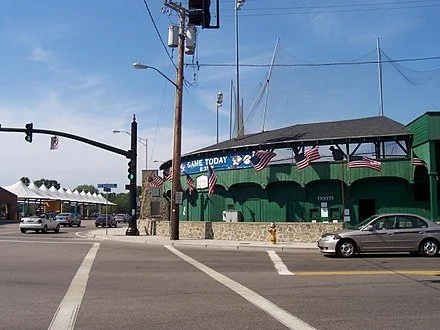
Cardines Field, in Newport, home of the Newport Gulls, a collegiate summer baseball team. The Gulls have played at Cardines Field since 2001.
America’s Cup Boulevard is to the left.
— Photo by Nick Lima
Rainy, icy and small
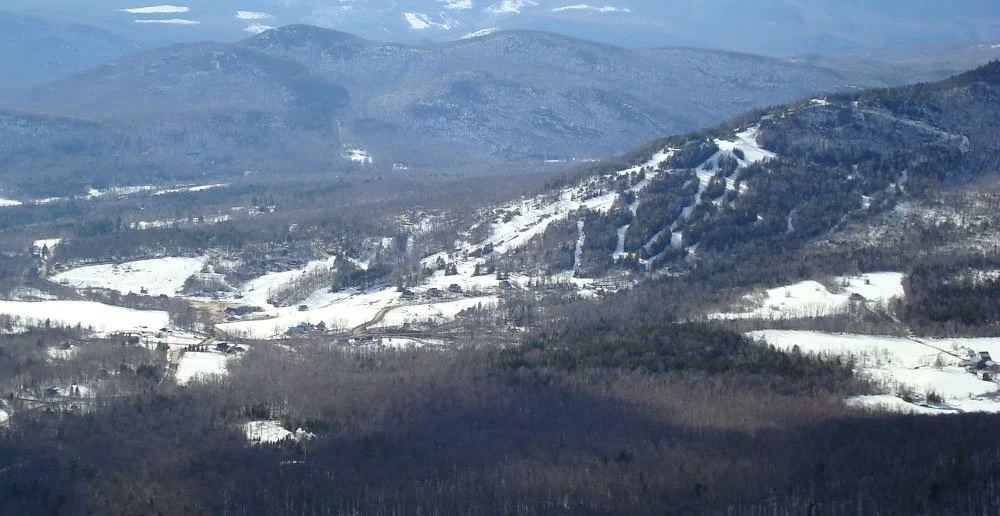
Black Mountain Ski Area, in Jackson, N.H.
— Photo by Jrclark
— Mikaela Shiffrin (born 1995), American Gold Medalist skiier
Beyond carpentry

From the series "Everyday Museum” (wood rulers mounted on a wood board), by Eduardo Terrazas, in the show “Re-inventing the Every-day,’’ at Heather Gaudio Fine Art, New Canaan, Conn.
It features works by Gabriel de la Mora, Martín Soto Climent and Mr. Terrazas.
The gallery says:
“The artists in the exhibition celebrate the aestheticization of ordinary objects through a diverse set of interrogational approaches. They are concerned with a non-hierarchical discourse and formal aspects of art-making, selecting ready-made or discarded materials as metaphors for cultural commentary. Theirs is a meticulous, processed-based approach that seeks to balance the rival goals of formalism and conceptualism.’’
Some stuff I don’t believe

Skaters on the Boston Common Frog Pond.
— Photo by Tkperlman
“I don’t believe in seeking sheet music
by Boston Common on a snowy day, don’t believe
in the lighting of malls seasonably
When I’m sleeping I don’t believe in time
as we own it, though some of the others might….’’
— From “Veteran,’’ by Fanny Howe (born 1940), a Boston-based poet and essayist

“Boston Street Scene (Boston Common),” by Edward Mitchell Bannister, a depiction of the street and Boston Common area in 1898–99
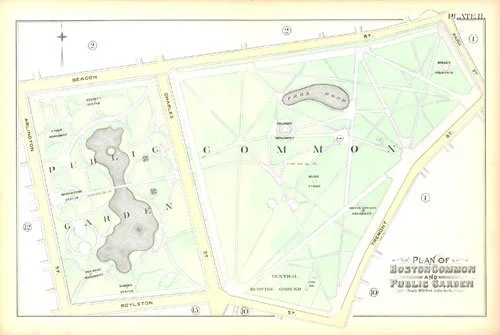
1890 map

Chris Powell: A joke on Danbury’s homeless

— Photo by Eric Pouhier
MANCHESTER, Conn.
Woody Allen movie fans might appreciate the joke that Danbury's Zoning Commission is playing on homeless people in the city and, really, on the whole state.
In Allen's spoof of Russian novels, Love and Death, the comic hero at last wins the woman he adores and on their wedding night puts his arm around her in their marriage bed. She replies: "Not here."
But if not there, where?
The Danbury News-Times reports that Pacific House, a Stamford-based organization that has been helping the homeless in Fairfield County for 20 years, has acquired a former motel building in Danbury with the help of the state Housing Department, which came up with $4.63 million to purchase the property. Pacific House has been operating it as a shelter under one of Gov. Ned Lamont's emergency orders. But the order expires in February and last week the Zoning Commission voted 6-3 against allowing the shelter to operate permanently.
Commissioners accepted complaints that the shelter will harm the character of the neighborhood -- as if homeless people roaming the city and nearby towns without the supervision and services that Pacific House provides won't risk the character of many neighborhoods.
Of course, those needing shelter are problematic, but the homeless are less problematic, more successfully treated, if their treatment begins with what is called "supportive housing." Once the trauma of having no safe place and privacy ends, sobriety and rehabilitation come easier, especially since the needed services -- medical, counseling, and transportation -- can be more centrally provided.
A former motel is perfect for supportive housing. Residents of such a facility may actually be less transient than the people who stayed at the motel. And while opponents of Pacific House's Danbury facility concede the need for a shelter in the area, they offer no other location even as Pacific House's facility is already operating.
Of course, only saints want to live near people who have problems. But people with problems have to go somewhere, and it's far better for them to go where they may be helped out of their problems than to be merely sheltered in a barracks overnight, out of the cold and damp, only to be shooed back into the cold and damp at daybreak.
When supportive housing has a responsible sponsor and state government's support, as Pacific House's facility in Danbury does, state law should exempt it from local zoning. So the issue in Danbury is one for the whole state and the General Assembly should address it urgently when it reconvenes in February.
xxx
Criminal penalties aim to set standards, deter, and punish, but for offenses less than murder they are not meant to ruin lives. For most offenses forgiveness can be earned.
But former Hartford lawyer Corey Brinson is asking for more than forgiveness for his conviction for fraud, his using his former law firm to launder money for stock swindlers while taking a cut. According to The Hartford Courant, Brinson is asking to be restored to a position of honor under state government -- commissioner of the Superior Court -- with reinstatement of the law license he lost with his conviction.
A lawyer disciplinary committee has voted 3-1 to recommend reinstating Brinson's law license, finding that he has rehabilitated himself after a three-year prison term. Maybe he has, but becoming a lawyer is a lot of work, and no one who becomes a lawyer has any excuse not to know that financial fraud is doubly wrong for a lawyer, an offense against the law itself as well as the privileged public office he holds.
The decision on Brinson's reinstatement rests with a committee of Superior Court judges. There is precedent for the committee to decide either way. Decades ago Connecticut's courts maintained that a felony conviction required a lawyer's permanent disbarment. But in recent years standards have been lowered and felonious lawyers have been reinstated.
Such reinstatements have set bad examples. They have shown lawyers that getting caught committing a serious crime is not necessarily the end of their professional careers, and thus have removed an incentive to maintain integrity. Such reinstatements also have diminished regard for the legal profession. But then maybe the profession no longer deserves much regard.-
Chris Powell is a columnist for the Journal Inquirer, in Manchester.
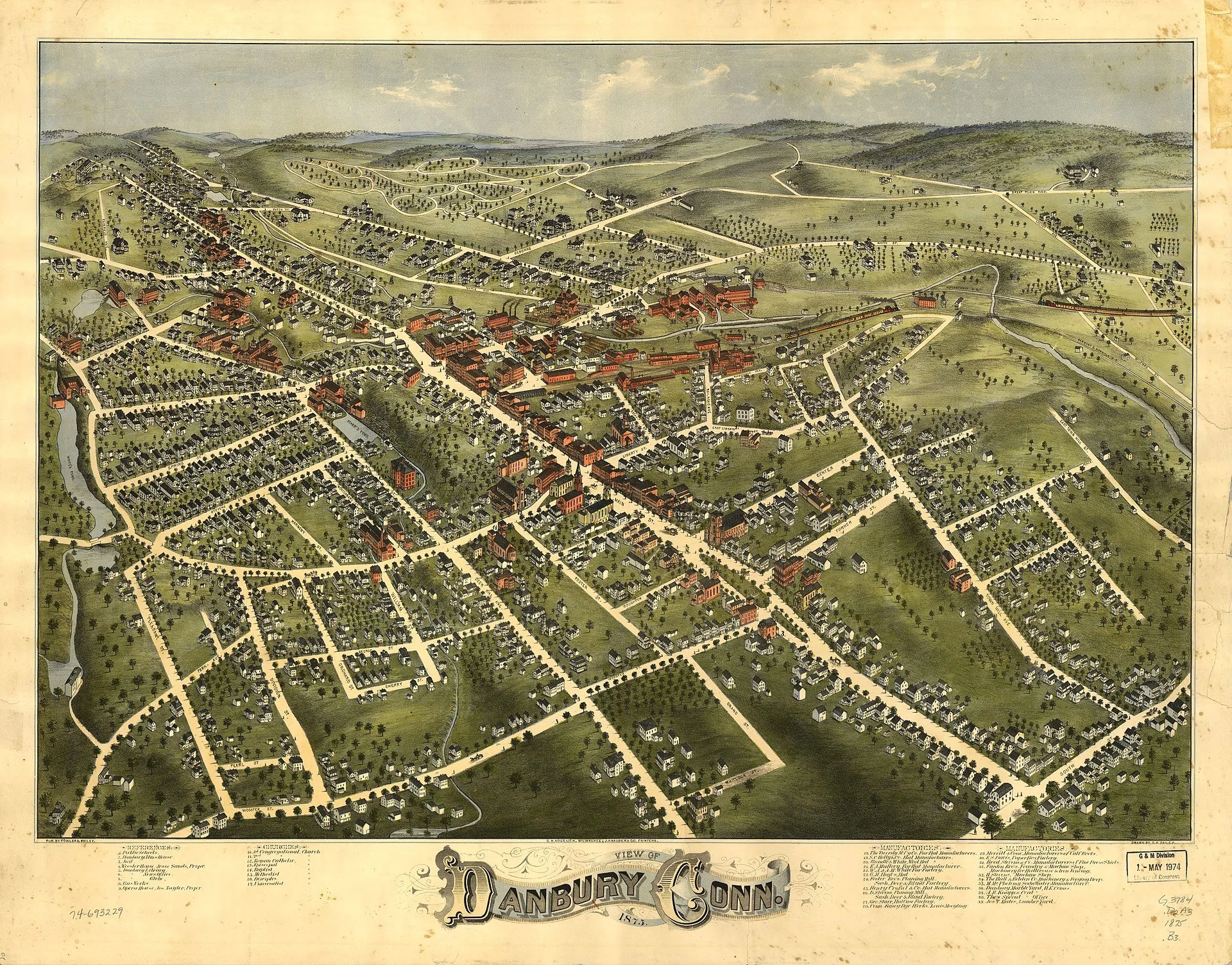
Panoramic view of Danbury in 1875, when it was known as the hat-making capital of America.
‘Between energy and calculation’

“ Immanent Arrival’’ (gouache on panel), by Marjorie Kaye, at Galatea Fine Art, Boston, through Jan. 16. She’s a Boston area sculptor and painter.
She says:
”My gouache paintings are built from the observation of complexity and my intention in actualizing sequential order. I need to work as if untying a complicated and seemingly impossible knot. The forms are immediately organic, swirling and undulating from one end of the surface from the other. Once this has been established, I go in honing, working each shape, dissecting it into its unique rhythm. This is the secondary aspect of making each work, and the action that ties the shapes into a whole, one that balances between energy and calculation.’’

‘Great necessities, great virtues’
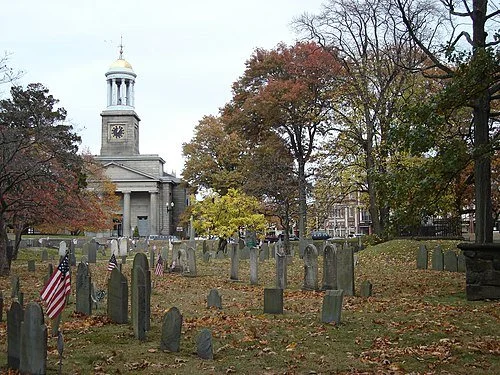
The Hancock Cemetery, in Quincy, Mass., where President John Adams and his wife, Abigail, and their son President John Quincy Adams and his wife, Louisa, are buried.
“It is not in the still calm of life, or the repose of a pacific station, that great characters are formed. The habits of a vigorous mind are formed in contending with difficulties. Great necessities call out great virtues. When a mind is raised, and animated by scenes that engage the heart, then those qualities which would otherwise lay dormant, wake into life and form the character of the hero and the statesman.”
—From letter of Abigail Adams (1744-1818), wife of Founding Father John Adams (1735-1826), to her son John Quincy Adams (1767-1848), like his father a president.
Phil Galewitz: COVID vaccination rates may be inflated

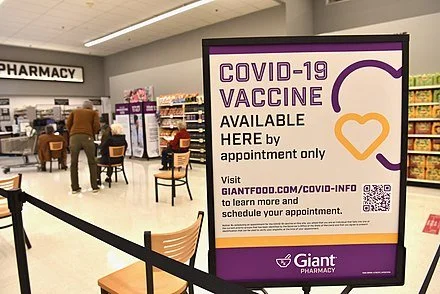
For nearly a month, the Centers for Disease Control and Prevention’s online vaccine tracker has shown that virtually everyone 65 and older in the United States — 99.9% — has received at least one COVID-19 vaccine dose.
That would be remarkable — if true.
But health experts and state officials say it’s certainly not. {See comments from experts at Harvard and Yale below.}
They note that the CDC as of Dec. 5 has recorded more seniors at least partly vaccinated — 55.4 million — than there are people in that age group — 54.1 million, according to the latest census data from 2019. The CDC’s vaccination rate for residents 65 and older is also significantly higher than the 89% vaccination rate found in a poll conducted in November by KFF.
Similarly, a YouGov poll, conducted last month for The Economist, found 83% of people 65 and up said they had received at least an initial dose of vaccine.
And the CDC counts 21 states as having almost all their senior residents at least partly vaccinated (99.9%). But several of those states show much lower figures in their vaccine databases, including California, with 86% inoculated, and West Virginia, with nearly 90% as of Dec. 6.
The questionable CDC data on seniors’ vaccination rates illustrates one of the potential problems health experts have flagged about CDC’s covid vaccination data.
Knowing with accuracy what proportion of the population has rolled up sleeves for a covid shot is vital to public health efforts, said Dr. Howard Forman, a professor of public health at the Yale University School of Medicine.
“These numbers matter,” he said, particularly amid efforts to increase the rates of booster doses administered. As of Dec. 5, about 47% of people 65 and older had received a booster shot since the federal government made them available in September.
“I’m not sure how reliable the CDC numbers are,” he said, pointing to the discrepancy between state data and the agency’s 99.9% figure for seniors, which he said can’t be correct.
“You want to know the best data to plan and prepare and know where to put resources in place — particularly in places that are grossly undervaccinated,” Forman said.
Getting an accurate figure on the proportion of residents vaccinated is difficult for several reasons. The CDC and states may be using different population estimates. State data may not account for residents who get vaccinated in a state other than where they live or in clinics located in federal facilities, such as prisons, or those managed by the Veterans Health Administration or Indian Health Service.
CDC officials said the agency may not be able to determine whether a person is receiving a first, second or booster dose if their shots were received in different states or even from providers within the same city or state. This can cause the CDC to overestimate first doses and underestimate booster doses, CDC spokesperson Scott Pauley said.
“There are challenges in linking doses when someone is vaccinated in different jurisdictions or at different providers because of the need to remove personally identifiable information (de-identify) data to protect people’s privacy,” according to a footnote on the CDC’s COVID vaccine data tracker webpage. “This means that, even with the high-quality data CDC receives from jurisdictions and federal entities, there are limits to how CDC can analyze those data.”
On its dashboard, the CDC has capped the percentage of the population that has received vaccine at 99.9%. But Pauley said its figures could be off for multiple reasons, such as the census denominator not including everyone who currently resides in a particular county, like part-time residents, or potential data-reporting errors.
Liz Hamel, vice president and director of public opinion and survey research at KFF, agrees it’s highly unlikely 99.9% of seniors have been vaccinated. She said the differences between CDC vaccination rates and those found in KFF and other polls are significant. “The truth may be somewhere in between,” she said.
Hamel noted the KFF vaccination rates tracked closely with CDC’s figures in the spring and summer but began diverging in fall, just as booster shots became available.
KFF surveys show the percentage of adults at least partly vaccinated changed little from September to November, moving from 72% to 73%. But CDC data shows an increase from 75% in September to 81% in mid-November.
As of Dec. 5, the CDC says, 83.4% of adults were at least partly vaccinated.
William Hanage, an associate professor of epidemiology at Harvard University, said such discrepancies call into question that CDC figure. He said getting an accurate figure on the percentage of seniors vaccinated is important because that age group is most vulnerable to severe consequences of covid, including death.
“It is important to get them right because of the much-talked-about shift from worrying about cases to worrying about severe outcomes like hospitalizations,” Hanage said. “The consequences of cases will increasingly be determined by the proportion of unvaccinated and unboosted, so having a good handle on this is vital for understanding the pandemic.”
For example, CDC data shows New Hampshire leads the country in vaccination rates with about 88% of its total population at least partly vaccinated.
The New Hampshire vaccine dashboard shows 61.1% of residents are at least partly vaccinated, but the state is not counting all people who get their shots in pharmacies due to data collection issues, said Jake Leon, spokesperson for the state Department of Health and Human Services.
In addition, Pennsylvania health officials say they have been working with the CDC to correct vaccination rate figures on the federal Web site. The state is trying to remove duplicate vaccination records to make sure the dose classification is correct — from initial doses through boosters, said Mark O’Neil, spokesperson for the state health department.
As part of the effort, in late November the CDC reduced the percentage of adults in the state who had at least one dose from 98.9% to 94.6%. It also lowered the percentage of seniors who are fully vaccinated from 92.5% to 84%.
However, the CDC has not changed its figure on the proportion of seniors who are partly vaccinated. It remains 99.9%. The CDC dashboard says that 3.1 million seniors in Pennsylvania were at least partly vaccinated as of Dec. 5. The latest census data shows Pennsylvania has 2.4 million people 65 and older.
Phil Galewitz is a Kaiser Health News journalist.

Rules of conduct for riding an elevator in a Cambridge, Mass., apartment building.
Throw it all out there

“Hey Mommy!” (watercolor, acrylic, hay, child's toy and staples on Arches paper), by Vermont-based Renee Bouchard, in her show “Allegory of Prudence,’’ at LAArts Gallery, in Lewiston, Maine, through Jan. 14.
The title of the show is a homage to a painting by the great Venetian painter Titian (c 1506-1576) She tells the gallery:
“I am constantly playing with this idea {of high art} by allowing nontraditional materials like natural and human made objects into my paintings. Aiming to transcend the materials, I walk over them to flatten them, staple and glue them on the surface. "
She gives her bio:
“Born in 1976 to French Canadian parents, Bouchard has lived throughout New England for most of her life. She studied at the Cleveland Institute of Art, and graduated from the Maine College of Art in 1999. She received her MFA in visual art from the Vermont College of Fine Arts in 2021, when she was nominated for fellowships from the Dedalus Foundation and the College Art Association. She has received grants, awards, and residencies from institutions including the Maine College of Art, the Vermont Arts Council, the Robert Rauschenberg Foundation, the Cooper Union, the Kate Millett Art Colony for women, and the Vermont Studio Center.’’

The Kora Temple is an historic Masonic building in Lewiston. It was built in 1908 by the Ancient Arabic Order, Nobles of the Mystic Shrine. “The Shriners’’ are a fraternal organization affiliated with Freemasonry and known for their charitable works, such as the Shriners Hospitals for Children, which provide free medical care to children. The Kora Temple is a ceremonial space and clubhouse for the Shriners. The building was added to the National Register of Historic Places in 1975 for its distinctive Moorish-inspired architecture.
Lewiston, an old mill town, is best known as home of the prestigious liberal-arts institution Bates College.

James P. Freeman: Will we actually see a predicted generational wealth transfer of $70 trilllion?

"The Young Heir Takes Possession Of The Miser's Effects,’’ from William Hogarth's “A Rake's Progress’’.

One Financial Center and nearby buildings in Boston’s financial district. The city is a national center for investing for retirement.
I was invited recently to an online seminar with this title: “Preparing for the Great Generational Wealth Transfer.”
As a financial professional -- with experience as a private wealth advisor -- I found the subject matter to be particularly intriguing. After all, as a marketer and thought leader today, I look at emerging trends -- behavioral, demographic, and technological, among others -- as a means by which to foster and sustain long-term relationships with clients and prospective clients, alike. All of the looming changes articulated during the webinar (and others I have seen on the horizon) will certainly provide challenges and opportunities in the financial advice business for both the consumer and advisor. But the changes herewith will be seismic.
The webinar presentation was inspired by research conducted by Boston-based Cerulli & Associates, a firm which delivers financial market intelligence to the industry. Cerulli projects that, in the greatest intergenerational reallocation of wealth ever, $70 trillion will be transferred between generations (Silent Gen and Baby Boomers to Gen X and Millennials) by the year 2042. That prediction alone is worthy of our collective attention.
But will that happen? I have my doubts.
Surely, retirement for today’s younger generations will be vastly different from retirement experienced by today’s older generations. But the dollar volume estimated to be passed down seems to me to be fantastically overcooked. Expect the expected. Let me give you my unified field theory.
First, it is important to look at the emerging demographic patterns for a sense of perspective.
Strength in numbers
While the Silent Gen (1928-1945) still plays a role in this “great transfer,” the focus here remains on Baby Boomers. Boomers were born between 1946 and 1964 -- at one point seventy-six million strong. The first Boomer reached the age of 65 -- commonly called “retirement age” -- in early 2011. Today, 10,000 Boomers are turning 65 every single day. Beginning in 2024, however, that figure accelerates to 12,000 per day, in what is being called “Peak 65.” The pace will decline markedly as the last Boomer turns 65 in December 2029. Even more incredibly, sometime during the next decade, one in five Americans will be over the age of 65. That has never happened before.
Gen X members (sometimes referred to as the “MTV Generation”) were born between 1965 and 1980. Today they are between the ages of 41 and 56 and are in the peak earnings years of their careers; the oldest are just starting to contemplate retirement. According to 2019 U.S. census data, they are 65.2 million strong. The oldest Gen Xer has more in common with the youngest Boomer while the youngest Gen Xer has more in common with the oldest Millennial. Arguably, Gen X is a shadow generation given that it is smaller than the Boomer generation preceding it and the Millennial generation following it. And notably, Millennials have eclipsed all other generations for sheer size. So, the attention paid to them is warranted.
Millennials were born between 1981 and 1996. In 2016, Millennials became the largest generation in the U.S. labor force. With 87 million members, Millennials also now represent the largest demographic group in America, surpassing the Boomer generation. In fact, Millennials are the largest adult cohort in the world. Right before their eyes, Boomers are ceasing to be the most influential generation. More than half of Americans are now Millennials or younger, reports brookings.edu
Nonetheless, as the greying of America continues, the median age is now just over 38. Fifty years ago, it was closer to 28 and has been rising ever since.
Adrian Johnstone, president, and co-founder of Practifi, a business management platform for financial advice, was the featured webinar speaker. He delivered examples of the stark contrasts between the generations in how they view the future and view retirement. As you can imagine, there are big cultural differences between these generations. It literally is a generation gap
Understandably, then, Boomers and Millennials have different objectives. At least as understood right now.
Demographics is destiny
Boomers more or less created the financial retirement business. As I like to say it was “of Boomers, by Boomers, and for Boomers.” Not too long ago, a Boomer was likely to measure success in a retirement portfolio by “benchmarking.” For example, this meant comparing the performance of an individual investment portfolio to something like the Standard & Poor’s 500 Index, a broad market index that measures performance. It was an accomplishment if you beat a given index in a given year. But defining success has evolved over time.
Smart people began saying this about benchmarking: “So what?”
Retirement planning was more than just investment performance. Industry leaders started looking at planning in a much more holistic way. Soon, business models would build around a “process” to drive success based on “goal setting.” The thinking was that you had a greater probability of achieving your goals if you followed a process. That concept changed the mindset from the short-term to long-term. Indeed, retirement planning was a long-term journey. The rationale was that retirees should consider whether or not they were achieving their goals as the best way to effectively measure progress in retirement. “Goals” was a much broader concept than “benchmarks,” yet it was much more focused, too -- buying a second home, taking annual vacations, investing in long-term care, setting up gifting, losing weight, etc. Markets go up and go down. But if you could achieve your overall goals despite inevitable market turbulence that was the new paradigm for defining success in retirement.
My sense, however, is that this current model is beginning to change as well. While goals will always be part of retirement planning, I question if setting lofty, long-term goals (even if practical) may prove to be elusive for many retirees going forward. My reasoning is straightforward.
The youngest Boomer and oldest Gen X have had to weather three once-in-a-lifetime events that affected retirement planning and saving in just the last twenty years. (Dotcom in 2000, Great Recession in 2009, COVID-19 in 2020). Combine these events with future funding issues for Social Security, Medicare, and Long-Term Care needs, it paints a less certain financial picture. Throw in the fact that this demographic carve-out is more in debt than older retirees and the relative financial future seems even less assured for them. Goals, then, seem illusory.
Given these realities, I believe that financial planning will once again morph into a new realm. Discussions will center more on “lifestyle” (or standard of living) and less on goal setting. Maintaining -- if not improving -- one’s lifestyles is a more focused conversation than goals; it’s much more tangible than goals, too. Telling clients they will not be able to maintain a given lifestyle is much more powerful than telling them they can not reach a goal.
So, in the span of fewer than forty years, you can see the progression of retirement planning models in how performance is often measured. It began with comparing benchmarks to setting goals and will likely shift even more to living desired lifestyles. Enter Millennials…
Now please fasten your seatbelts before departure
The Practifi webinar suggested even more pronounced changes when Millennials begin serious retirement consideration. According to Johnstone, this generation will be mostly concerned about values -- such as social responsibility and the impact of their decisions on the larger society. In other words, for them, retirement planning must center around their values, with everything else, including, presumably, performance, of less or equal import.
That is a radical shift in priorities.
Additionally, financial advisors should anticipate other changes in how future generations approach retirement. They are just as compelling.
The retirement landscape will probably look unrecognizable after the last Boomer retires in 2029, presenting new complexities for all interested parties.
Surely, there will be a transfer of wealth (more about which anon) and advisors will need to be aligned with the interests of the next generation (values more than goals). Likewise, “NextGen” retirees will have crypto currencies and ESG investments (environment, social, and governance) as staples in their portfolios. They will also be more inclined to make micro loans, a newfangled investment alternative. Fee structures will undoubtedly be altered. Marketing will be impacted by implementing AR (augmented reality) into social media and other platforms. The regulatory apparatus will also look hugely different. And AI (artificial intelligence) software tools will complement human advisors. Finally, future retirees will be more financially literate, more skeptical, and more engaged (via technology) about, well, everything.
Advisors in the future doubtless must change from a Boomer-centric retirement model to a Millennial-centric retirement model not only to accommodate the next retirement class but to prepare for the predicted wealth transfer. For Johnstone, he sees a sea-change from the client point of view, too. He believes that Boomers are “delegators” of their retirement (to advisors). Whereas Millennials will be “validators” of their retirement (from advisors).
Show me the money!
Notwithstanding the extraordinary metamorphosis about to play out in a couple of years in terms of demographics and service delivery models, the real question is about assets. This past June, The Wall Street Journal reported that the great transfer has already begun. It cited Federal Reserve data indicating that Americans over the age of 70 had already accumulated “a net worth of nearly $35 trillion.” That amounts to 27 percent of all U.S. wealth, up from 20 percent three decades ago.
Still, I am not entirely convinced that $70 trillion in assets will ultimately be transferred to heirs and charities, as predicted. That stockpile of money seems high. To better understand that dollar amount, it would mean the transference of roughly $3.3 trillion every year for the next twenty years. Put another way, the total would be the combination of President Biden’s $1.9 trillion Build Back Better Act and $1.2 trillion Infrastructure Investment and Jobs Acts, annually, up to 2042.
Labyrinthine financial trends might well offset the amount substantially.
The real question should be: Will known (and unknown) massive unfunded liabilities eventually absorb much of the $70 trillion because we have simply failed to live within our means today? We have shifted many of today’s financial burdens on younger generations and even generations not yet born. The arithmetic just doesn’t square.
Conceivably, much of these assets would be liquidated -- and hence evaporated -- prior to any transferring or gifting because of future costs. Consider the following four factors: poor savings, rising healthcare costs, Social Security funding concerns, and high personal (not to mention high institutional and governmental) debt loads. It is the liabilities side of the balance sheet that concerns me. Not the assets side.
Something has gotta give
POOR SAVINGS
Despite a staggering amount of cash flooding into the American economy as part of COVID-19 relief (read about the $5.2 trillion in pandemic fiscal stimulus), not to mention an absurdly accommodative monetary policy, America still has a savings problem. (Remember food lines queuing up just a couple of weeks after the first lockdowns in early 2020? We were told people did not have money saved for such “emergencies.”) I don’t subscribe to the idea -- as perpetuated by economists, usually the last group of people “in-the-know” -- that Americans have significantly improved their savings rates. Saving is a behavioral attribute. Have behaviors really changed for the long term? Any built up savings is likely a temporary phenomenon. I write that because much of the chatter we hear from financial commentators centers on all this “pent up demand” stemming from the pandemic. Such demand, we are told, is exacerbating the supply-chain problems. A probable outcome will be all the extra cash will be spent.
Earlier this year the Insured Retirement Institute released the results of a survey conducted on workers between the ages of 40 and 73. Its findings were unsurprising but consistent with many similar studies on worker preparedness for retirement. Two key takeaways were as follows: savings behavior needs to improve, and retirement income expectations are unrealistic. The survey found that 51 percent of respondents had less than $50,000 saved for retirement. Furthermore, the report concluded that “Among savers, savings rates are not nearly high enough for even the youngest respondents to grow their nest eggs to a level sufficient for meeting their income and budget expectations.” The survey was conducted after much of the stimulus was already distributed into personal and small business accounts.
And, perhaps most alarming, the institute wrote that, across several measures of retirement preparedness, “most [respondents] fear they will not have enough income, will not be prepared to transition into retirement, will not have enough money for medical expenses or long-term care should the need arise, and may not be able to live independently for the entirety of their retirement.” A large number of Americans are not putting enough aside to catch up.
Americans’ use of retirement plans has changed dramatically over the last several decades, too. In the past, good-ole-fashion “defined benefit plans” (think pensions) were the norm. They were a stable retirement income source for millions of retirees. But many pension plans -- especially in the public sector -- are grossly underfunded today. The 401(k) was born in 1978 and known as a “defined contribution plan.” Such contribution plans were devised to supplement benefit plans but over time they ended up supplanting those benefit plans. And at their root, 401(k) plans were really DIY plans -- or “do-it-yourself” plans. The result was that the American worker became the principal source of his or her retirement savings, not a corporation or municipality. And the data confirm that Americans are not contributing enough to these plans. Therefore, it is hard to see where additional savings are built into future retirement portfolios -- unless people rely mostly upon enormous equity gains in real estate holdings. Besides, government policy discourages saving (with artificially and historically low interest rates) and encourages speculating (with greater yields in riskier market investments). This is even more outrageous considering higher inflation has returned with gusto.
As 2021 ends, I would imagine that future studies examining the impacts of all this stimulus will confirm that the notion of any substantive increase in savings and savings rates is a grand chimera.
RISING HEALTHCARE COSTS
Nearly ten years ago, in a 2012 speech at the U.S. Naval War College, conservative columnist George Will, then 69, showed those in the audience his Medicare Card. He had also previously shown it to his doctor. To which his doctor said, “That’s wonderful, George, we’ll send your bills to your children.”
Both “Romneycare” (in Massachusetts) and “Obamacare” (at the national level) largely fulfilled their aims of insuring many more of its residents and citizens, respectively, for healthcare. However, neither program did anything to bend the cost curve. In Massachusetts, for instance, healthcare costs now represent 36 percent of total state spending. It was 31.5 percent just three years ago. For fiscal 2008, the figure was approximately 30 percent.
In case you missed it, healthcare costs have been rising and will continue rising, yet few want to pay for spiraling costs. According to healthsystemtracker.org, health spending in America totaled $74.1 billion in 1970. Three decades later, by 2000, health expenditures reached about $1.4 trillion. Put another way, “In 1970, 6.9 percent of the gross domestic product (GDP) in the U.S. was spent toward total health spending (both through public and private funds). By 2019, the amount spent on healthcare has increased to 17.7 percent of the GDP.” It is expected that the number will reach 18 percent soon.
Healthcare costs in this country continue to accelerate because of the intersection of demographics (Boomers retiring in large numbers) and better medicine (diagnostic, therapeutic, pharmacologic). Today, we are consuming $3.8 trillion or $11,582 per person, annually, on healthcare. This is nearly three times what was spent only twenty years ago. And with more Boomers consuming even more healthcare in the future, our healthcare system will strain with greater costs. Spending will sharply hasten.
Data in a 2021 extract provided by the Robert Wood Johnson Foundation reveal that American households paid, on average in 2018, 18.5 percent of their income towards healthcare costs. In addition, “According to Medicare beneficiaries’ data, in 2017, the average total health expenditures in their last year of life was $66,176.”
Medicare currently covers nearly 64 million Americans today. And funding for the program accounted for more than 4 percent of the U.S. GDP in 2020, reports medicareresources.org. Total Medicare spending stood at $917 billion last year, and it is expected to grow to $1.78 trillion in 2031, or two years after the last Boomer retires.
Medicare, established in 1965 as part of The Great Society, has critical funding challenges just like Social Security -- but they are more immediate. It is estimated that the Medicare Trust Fund will be exhausted in 2024 unless Congress acts to implement new reforms. Barring no changes, the Congressional Budget Office projects that following 2024 exhaustion, Medicare will only have sufficient tax receipts to be able to pay 83 cents for every dollar covered. There are three practical solutions to avoid insolvency, concluded forbes.com this past March: “Increase revenues flowing into the trust fund by at least $700 billion to extend solvency to 2036 (experts typically focus on 10-year time horizons); cut spending on Medicare beneficiaries or increase their monthly premiums; or figure out a combination of these two methods.”
All of these challenges were known as far back as twenty years ago. In 2002, Health Services Research issued a study named “The 2030 Problem: Caring for aging Baby Boomers.” Few have paid heed to the warnings that it issued back then. “To meet the long-term care needs of Baby Boomers,” its authors wrote, “social and public policy changes must begin soon.” In 2021, it is obvious that these changes never occurred.\
SOCIAL SECURITY FUNDING
In many respects, healthcare cost concerns are a bigger worry than Social Security because the latter is more manageable and knowable: We have decades of economic data and demographic data to ascertain future costs. We know healthcare costs will rise but it is such a wildcard that it is difficult to enumerate actuarial costs. With Social Security the math is right in front of us, and it is largely predictable. But reforms are needed.
According to the Social Security Administration, the ratio of covered workers to beneficiaries was 159 to 1 in 1940; that figure shrank to 2.8 to 1 in 2013. It is estimated to be 2.7 today. However, when the last Boomers reach age 75, the trustees of the program project that “the ratio will fall to 2.2 to 1 in 2039.”
And unless, in this politically charged environment, changes are made to how Social Security is funded, it will not support paying out 100 percent of benefits beginning in 2034. Barring no change, payroll taxes will only then be able to distribute approximately 75 percent of promised payments. Like Medicare, it would seem that a combination of higher taxes and lower payouts would be the most likely outcome. But that is impossible to predict.
Estimates vary on how much retirees rely entirely on Social Security as a source of income in later years.
The National Institute on Retirement Security (NIRS) in January 2020 reported that, “A plurality of older Americans, 40.2 percent, only receive income from Social Security in retirement.” That analysis was called into question by Andrew G. Biggs, senior fellow at the American Enterprise Institute. Biggs has written extensively on retirement matters. Using different data points collected by other governmental agencies, he found there is not a consensus on the NIRS thesis. Instead, there is evidence that between 12 percent and 20 percent of older Americans rely solely on Social Security for support. Even if those figures are closer to reality, it is a fact that millions of retirees depend on Social Security as a significant source of income. So, this question remains pertinent: What would a potential 25 percent reduction in Social Security benefits do to seniors?
Arguably, in order to finance the current level of Medicare and Social Security benefits for future retirees (will there ever be higher levels of spend?), higher payroll taxes would seemingly be the quickest fix. And it is not too farfetched to reason that inheritance taxes would also rise to address these systemic problems, too. These measures would certainly eat into the great transfer of $70 trillion.
IN DEBT WE TRUST
My favorite website may be debt.org.
The site is really an advocacy platform that wishes to help people who are in debt, but I find it as a reliable financial resource. Its “Demographics of Debt” page is a helpful amalgam of disparate data points that exposes a crisis like an asteroid approaching earth. Recent updates to the page have included debt tabulations made during the pandemic.
American household debt hit a record $14.6 trillion in the spring of 2021, according to the Federal Reserve. (Housing likely accounts for 71 percent of that total.) Furthermore, last year, rather disturbingly, “The total U.S. consumer debt balance grew $800 billion, according to Experian. That was an increase of 6 percent over 2019, the highest annual growth jump in over a decade.” Borrowers have been the beneficiaries of historically low interest rates for over a decade now. This has, in my opinion, been an inducement to borrow more without consequences. But with higher inflation now center stage for an economy that has experienced benign inflation for decades, it would seem that the Federal Reserve would be poised to raise interest rates sooner than later. Such action would make it more expensive to borrow and would obviously make servicing debt more expensive, especially for adjustable-rate debt instruments. (Interestingly, Adjustable Rate Mortgages make up just 3.4 percent of all mortgage applications today; as of 2020, approximately 44 percent of U.S. consumers have a mortgage; in Massachusetts the average individual mortgage balance is $261,345, as of 2020.)
I am keenly interested in the breakdown of debts among the demographic groups. The anticipated great transfer of wealth would imply that older generations (Silent Gen and Boomers) would be relatively unencumbered by debts to allow them to freely pass along assets to heirs (Gen X and Millennials) and charities. On the contrary, the data suggest that picture less clear.
Of these four demographic groups, the Silent Gen has the lowest amount of average debt per member ($41,281), while Millennials have the third lowest ($87,448). What is somewhat surprising is that Boomers place second, having an average of $97,290 of debt per member. Meanwhile, Gen X can claim the largest debt burdens for this comparison with an average of $140,643 per Xer. Academically, this all makes sense as Gen X is still paying off the bulk of its mortgage obligations and the same may be said for the youngest Boomer as well.
It seems to me, that despite the fact that Boomers are no longer the largest demographic cluster, they will largely determine whether or not the great transfer of assets actually happens.
I do not see how the bulk of $70 trillion ever gets delivered to younger generations. I believe that future costs (for healthcare, Medicare, and Social Security) will emphatically eat up much of those assets. Boomers will inevitably be more “takers” than “makers” of the great transfer. Finally, I believe that servicing existing individual debt loads will be as much of a factor in the future as it is today. We also should be mindful of the exorbitant levels of debt at the government and institutional levels that will also need adequate funding. Time was when we borrowed for the future. We now borrow from the future. There is no escape from The Great Debt.
Years ago, I did a short stint as a substitute teacher. I would argue that the elementary classroom is a more challenging environment than the Wall Street boardroom, and higher learning more perspicacious than higher returns. One fine day I was teaching first graders. There was some free time before dismissal, so I simply asked them to draw anything they wanted -- a token for the ride home after school. It was a fun exercise. As I was circulating around the children, watching future Picassos toil away, I came across a young girl named Sally. I couldn’t quite figure out what she was sketching. So, I asked, “Sally, what is that?” She paused, and with steely determination, she said, “I am drawing a picture of God.” I made the mistake of responding, “Well, Sally that’s quite something because no one knows what God looks like.” To which she retorted, with breezy confidence: “They will in a minute.”
With regard to the great wealth transfer and attendant ramifications, we will see in a New York minute.
James P. Freeman is the director of marketing at Kelly Financial Services, LLC, based in in Greater Boston. For much of his professional career in financial services he was an officer in the bond administration departments of a number of banks and trust companies. This content is for informational purposes only and does not constitute an offer to sell or a solicitation of an offer to purchase any interest in any investment vehicles managed by Kelly Financial Services, LLC, its subsidiaries, and affiliates. Kelly Financial Services, LLC does not accept any responsibility or liability arising from the use of this communication. No representation is being made that the information presented is accurate, current, or complete, and such information is at all times subject to change without notice. The opinions expressed in this content and or any attachments are those of the author and not necessarily those of Kelly Financial Services, LLC. Kelly Financial Services, LLC does not provide legal, accounting or tax advice and each person should seek independent legal, accounting and tax advice regarding the matters discussed in this article.