
Vox clamantis in deserto









Sergio Avila: Border wall on U.S.-Mexican border would imperil wildlife

Jaguar in Arizona.
Via OtherWords.org
Some Americans think of the U.S.-Mexico border as a wasteland. In fact, the mountains and deserts of our borderlands are teeming with wildlife.
Here you’ll find large cats such as the jaguar, the subject of my research.
Jaguar sightings have been reported in New Mexico and Arizona for over a century, even as far north as the Grand Canyon. Their presence is a stamp of approval — they mean healthy habitats, prey populations and the connection of critical wildlife corridors across the border.
Humans, after all, aren’t the only animals that cross the border. And they aren’t the only ones whose lives will be disrupted if a Trump administration border wall slices through cross-border wildlife corridors like Big Bend National Park in Texas and Organ Pipe Cactus National Monument in Arizona.
Unfortunately, a federal court recently approved waivers for dozens of environmental and health safeguards in these border regions — all so that wall can go up.
That means the border communities who oppose this wall and fear its destruction of the surrounding lands will have to swallow a wall with no public process. It means there will be no comment period, no baseline research on impact, and a lack of monitoring throughout the building process.
A wildlife preserve in Socorro County, New Mexico (Photo: Michael Littlejohn / Flickr)
And the worst part is, there will be no way to hold the government accountable.
It started when Congress passed the Real ID Act. Though it was billed as an immigration security measure, it gave the government the power to waive the National Environmental Policy Act, the Endangered Species Act, the Clean Water Act, the Wilderness Act, and even the Native American Graves Protection and Repatriation Act, among others.
Since then, miles of border infrastructure have been built along the California, Arizona, and Texas border despite a majority of people in those states opposing the wall. So far, the Trump administration alone has waived 37 laws in San Diego, 28 in Calexico, California, and 23 in Santa Teresa, New Mexico.
Protected areas on both sides of the border are the stepping stones for jaguars to move through and reach new territories. Without legal protection, the wall will destroy their habitat — forever risking their future in the region.
Human communities are at risk, too.
This waiver power resulted in extreme flooding that led to at least two deaths in Nogales, Arizona. According to Harvard researchers, the blockage of underground drainage and natural water routes through Arizona’s border created an effect like a burst dam after strong summer storms.
Other waivers threaten to pollute air and watersheds for hundreds of miles into the borderlands.
This is more than a red flag. It’s a human rights issue.
The Government Accountability Office has failed to provide any conclusions about the benefits of this mission to “protect” the border at all costs. But those of us who actually live in the borderlands have to live with its consequences.
It means the dangers of contaminated water sources, the destruction of our lands, the deaths of our brothers and sisters, and the evisceration of treasured local species like the jaguar.
We — and our public lands in Arizona, California, New Mexico and Texas — are the ones paying the highest price for this unchecked and unnecessary power.
Sergio Avila is an outdoors coordinator for the Sierra Club in the Southwest region. He’s studied the impacts of border infrastructure for over 14 years.

Don Pesci: Most Republicans are RINOS

With apologies to Shakespeare: “Spending’s the thing, wherein we’ll catch the conscience of the King.”
There is in Connecticut no truer Trumpian liege lord than Joe Visconti, a gubernatorial candidate who described himself in one of his campaign documents as “Trump without the millions.”
When Trumpians refer disdainfully to “the DC Swamp,” they have in mind the kind of uncontrolled spending that, during the Obama administration, doubled President George Bush’s $10 trillion deficit. The current deficit now has been boosted by the U.S. Congress, and it was Trump who signed – very reluctantly, to be sure – the “drain the swamp’s” death warrant.
After Trump had signed the budget, Visconti advised: “Still love & support Trump but MAGA [Make America Great Again] is dead. You can’t give huge tax breaks and then give away a trillion $$ in spending in the same year and not expect a $22 Trillion deficit. Build the wall is dead. Lock her [Hillary Clinton] up is dead. Nothing but empty slogans now. As for Republicans? Most are Democrats, always have been. The bill should never have been assembled by Ryan the RINO [Republican In Name Only] but it was. Nothing but betrayal. Here’s how it rolls out in 18, we lose the House because Trump supporters aren’t blind and won’t come out for RINOs, Trump isn’t on the ballot. Pelosi takes over and starts impeachment proceedings day 1.”
Laura Ingraham lamented that the omnibus bill was a huge boondoggle designed to fool most of the people most of the time. Connecticut has its own version of the national omnibus bill, a catch-all bill at the end of the legislative season that few exhausted legislators manage to read. Such massive bills are pokes designed to hide crony swamp dweller's legislation.
The national poke more than adequately finances a military that former President Obama seriously under-financed. It might be recalled that Trump, entering office and during his rambunctious campaign, presented himself as a Pat Buchanan anti-interventionist, after which he surrounded himself with generals. The world is a messy place for anti-interventionist presidents. The budget does not adequately finance the border wall upon which Trump campaigned, but Planned Parenthood, against which Trump campaigned, receives its pound of budget flesh.
Earlier in January, Senator from Planned Parenthood Dick Blumenthal and other extremist socially progressive Democrats beat back a bill that would have imposed a mild and painless restriction on those seeking abortions, the “Pain-Capable Unborn Child Protection Act.” The bill did not interfere with a woman’s right to procure an abortion; it simply restricted abortions to 20 weeks of a pregnancy, a period of time after which, science tells us, the fetus can feel pain. The bill also provided that women who defied the bill could not be prosecuted under the law, while those providing the abortion would be penalized.
Pro-abortion senators such as Blumenthal waved their old campaign placards against the bill. “It is shameful and disgraceful,” Blumenthal fumed, “that this measure should be before Congress. Hands off women’s health care.” The reader will note a tactical change in language: According to Blumenthal, the bill would not interfere with a woman’s “right to choose abortion,” merely hasten the choice. Abortion has little to do with health care and everything to do with abolishing parenthood. The regulation prone Blumenthal later would pronounce “immoral” those who defended a bill that regulated abortion on behalf of unborn children who feel the deadly pain of an abortionist’s knife. As Attorney General of Connecticut, Blumenthal consistently favored the regulation of businesses in his state, and he continues to do so in the Senate, bills affecting Planned Parenthood being a notable and glaring exception to his rule.
No, sorry. It is late-term abortion, the selling of baby parts and the inability of pro-abortionists to make relevant developmental distinctions in the stages of human life from conception to birth that is, by any stretch of the moral imagination, indecently immoral. In their campaigns, cowardly Republicans seem willing to cede the moral high-ground to the immoralists.
The imposition of the Trump tariffs has split Republicans, but Republicans and Trump were marching in tandem on the matter of immigration. That battle has been lost, largely owning to court decisions that have about them the stench of unconstitutionality. Here is Nancy Pelosi crowing her victory in assuring that the nation’s borders remain ungovernable and permeable: “Democrats won explicit language restricting border construction to the same see-through fencing that was already authorized under current law. The [omnibus spending] bill does not allow any increase in deportation officers or detention beds.”
So, the obscenely large spending bill is a win, win for progressive big spenders and a lose, lose for taxpayers. Democrats in Connecticut have offered Republicans the same plank that leads to the same shark-infested waters. Whether they will sleepwalk the plank to their appointed end remains very much an open question.
Don Pesci, a frequent contributor, is a Vernon, Conn.-based columnist.
'Be whole again'

From Robert Whitcomb's "Digital Diary,'' in GoLocal24.com
Amidst all the “crisis chatter’’ (the late novelist Saul Bellow’s phrase) about the news, we’d do well to read Robert Frost’s great haunting late poem “Directive,’’ about a walk in upland New England that turns into a reflection on eons of the natural world, humanity’s experience and, by implication, the poet’s own ordeals and transitory joys. It ends with a quasi-Christian statement. It puts life, especially a long one, into an ambiguous but still vivid perspective.
The poem is too long to run all of here, but here are some fragments:
Back out of all this now too much for us,
Back in a time made simple by the loss
Of detail, burned, dissolved, and broken off
Like graveyard marble sculpture in the weather,
There is a house that is no more a house
Upon a farm that is no more a farm
And in a town that is no more a town.
….
The height of the adventure is the height
Of country where two village cultures faded
Into each other. Both of them are lost.
And if you're lost enough to find yourself
By now, pull in your ladder road behind you
And put a sign up CLOSED to all but me.
…
First there's the children's house of make-believe,
Some shattered dishes underneath a pine,
The playthings in the playhouse of the children.
Weep for what little things could make them glad.
But the end of the poem:
Here are your waters and your watering place.
Drink and be whole again beyond confusion.
'Life between screens'

"Homage 4533" (dye sublimation print on aluminum), by Irene Mamiye, at Lanoue Gallery, Boston.
The gallery says:
"Influenced by her own personal history and artists as diverse as Laszlo Moholy Nagy and Gerhard Richter, Mamiye employs intricate and labor-intensive processes to challenge what is expected of the photographic medium. Culling photographs from social media, Mamiye transforms the plenitude of public images into richly layered works that hint at a life lived between screens. With a playful yet mordant humor, Mamiye creates pieces packed with art historical depth and pop cultural abundance.''
Her work uses photography, video and digital imaging techniques. "With light, color and movement, she blurs distinctions between physical and virtual reality.''
An obsession with the unconscious

The Wadsworth House, in Cambridge, Mass., where George Washington really did sleep in the summer of 1775. This photo was taken in the 1870s. The house is still there, and is used for the office of Harvard's University Marshal, commencement offices and offices of a few professors.
"It is a hoary New England tradition to keep track of where famous people slept instead of something they might have done while conscious.''
Andrew H. Malcolm, in U.S. 1: America's Original Main Street (1991)

This plaque in Hartford suggests that Washington slept around a lot in the Nutmeg State, too.
John O. Harney: Comings & goings in New England academia
Via The New England Board of Higher Education (nebhe.org)
Judy D. Olian, dean and John E. Anderson Chair in Management at the UCLA Anderson School of Management, was named the first woman president of Quinnipiac University, succeeding John L. Lahey.
University of Maine at Farmington President Kathryn A. “Kate” Foster was appointed the next president of The College of New Jersey, beginning July 1.
Mount Holyoke College appointed its first vice president for equity and inclusion and chief diversity officer: Kijua Sanders-McMurtry, who is currently vice president and dean for community diversity at Agnes Scott College in Georgia.
The University of Massachusetts at Dartmouth appointed Smith College Vice President for Alumnae Relations Jennifer Chrisler, formerly executive director of the nonprofit Family Equality Council, to be the university's vice chancellor for advancement.
The New England Aquarium named Vikki Spruill, currently leader of the Council on Foundations, to be the new president and CEO of the aquarium, which hosted 1.4 million visitors last year, but also closed several times recently due to coastal flooding at its Boston waterfront location.
John O. Harney is executive editor of the England Journal of Higher Education, part of the New England Board of Higher Education.
In Boston, long-term health care threatened by plan to end protected status for Haitians

Nirva (left), a Haitian immigrant living in the U.S. under Temporary Protected Status, has helped care for 96-year-old Isolina Dicenso since 2011. Here they are in a windswept Millennium Park in Boston's rather suburb-like West Roxbury neighborhood.
-- Photo by Melissa Bailey for Kaiser Health News
By MELISSA BAILEY
BOSTON
After back-to-back, eight-hour shifts at a chiropractor’s office and a rehab center, Nirva arrived outside an elderly woman’s house just in time to help her up the front steps.
Nirva took the woman’s arm as she hoisted herself up, one step at a time, taking breaks to ease the pain in her hip. At the top, they stopped for a hug.
“Hello, bella,” Nirva said, using the word for “beautiful” in Italian.
“Hi, baby,” replied Isolina Dicenso, the 96-year-old woman she has helped care for for seven years.
The women each bear accents from their homelands: Nirva, who asked that her full name be withheld, fled here from Haiti after the 2010 earthquake. Dicenso moved here from Italy in 1949. Over the years, Nirva, 46, has helped her live independently, giving her showers, changing her clothes, washing her windows, taking her to her favorite parks and discount grocery stores.
Now Dicenso and other people living with disabilities, serious illness and the frailty of old age are bracing to lose caregivers like Nirva due to changes in federal immigration policy.
Nirva is one of about 59,000 Haitians living in the U.S. under Temporary Protected Status (TPS), a humanitarian program that gave them permission to work and live here after the January 2010 earthquake devastated their country. Many work in health care, often in grueling, low-wage jobs as nursing assistants or home health aides.
Now these workers’ days are numbered: The Trump administration decided to end TPS for Haitians, giving them until July 22, 2019, to leave the country or face deportation.
In Boston, the city with the nation’s third-highest Haitian population, the decision has prompted panic from TPS holders and pleas from health-care agencies that rely on their labor. The fallout offers a glimpse into how changes in immigration policy are affecting older Americans in communities around the country, especially in large cities.
Ending TPS for Haitians “will have a devastating impact on the ability of skilled nursing facilities to provide quality care to frail and disabled residents,” warned Tara Gregorio, president of the Massachusetts Senior Care Association, which represents 400 elder care facilities, in a letter published in The Boston Globe. Nursing facilities employ about 4,300 Haitians across the state, she said.
“We are very concerned about the threat of losing these dedicated, hardworking individuals, particularly at a time when we cannot afford to lose workers,” Gregorio said in a recent interview. In Massachusetts, 1 in 7 certified nursing assistant (CNA) positions are vacant, a shortage of 3,000 workers, she said.
Nationwide, 1 million immigrants work in direct care — as CNAs, personal-care attendants or home health aides — according to the Paraprofessional Healthcare Institute, a New York-based organization that studies the workforce. Immigrants make up 1 in 4 workers, said Robert Espinoza, PHI’s vice president of policy. Turnover is high, he said, because the work is difficult and wages are low. The median wage for personal-care attendants and home health aides is $10.66 per hour, and $12.78 per hour for CNAs. Workers often receive little training and leave when they find higher-paying jobs at retail counters or fast-food restaurants, he said.
The country faces a severe shortage in home health aides. With 10,000 baby boomers turning 65 each day, an even more serious shortfall lies ahead, according to Paul Osterman, a professor at Massachusetts Institute of Technology’s Sloan School of Management. He predicts a national shortfall of 151,000 direct-care workers by 2030, a gap that will grow to 355,000 by 2040. That shortage will escalate if immigrant workers lose work permits, or if other industries raise wages and lure away direct care workers, he said.
Nursing homes in Massachusetts are already losing immigrant workers who have left the country in fear, in response to the White House’s public remarksand immigration proposals, Gregorio said. Nationally, thousands of Haitians have fled the U.S. for Canada, some risking their lives trekking across the border through desolate prairies, after learning that TPS would likely end.
Employers are fighting to hold on to their staff: Late last year, 32 Massachusetts health-care providers and advocacy groups wrote to the Department of Homeland Security urging the acting secretary to extend TPS, protecting the state’s 4,724 Haitians with that special status.
“What people don’t seem to understand is that people from other countries really are the backbone of long-term care,” said Sister Jacquelyn McCarthy, CEO of Bethany Health Care Center in Framingham, Mass., which runs a nursing home with 170 patients. She has eight Haitian and Salvadoran workers with TPS, mostly certified nursing assistants. They show up reliably for 4:30 a.m. shifts and never call out sick, she said. Many of them have worked there for over five years. She said she already has six CNA vacancies and can’t afford to lose more.
“There aren’t people to replace them if they should all be deported,” McCarthy said.
Nirva works 70 hours a week taking care of elderly, sick and disabled patients. She started working as a CNA shortly after she arrived in Boston in March 2010 with her two sons.
She chose this work because of her harrowing experience in the earthquake, which destroyed her home and killed hundreds of thousands, including her cousin and nephew. After the disaster, she walked 15 miles with her sister, a nurse, to a Red Cross medical station to try to help survivors. When she got there, she recounted, the guards wouldn’t let her in because she wasn’t a nurse. Nirva spent an entire day waiting for her sister in the hot sun, without food or water, unable to help. It was “very frustrating,” she said.
“So, when I came here — I feel, people’s life is very important,” she said. “I have to be in the medical field, just to be able to help people.”
Caregiver Nirva and Isolina Dicenso have grown close, bonding in part over their Catholic faith. “Thank God I met this woman,” Dicenso, 96, says of Nirva.
The work of a CNA or home health aide — which includes dressing and changing patients and lifting them out of bed — was difficult, she found.
“At the beginning, it was very tough for me,” Nirva said, especially “when I have to clean their incontinence. … Some of them, they have dementia, they are fighting. They insult you. You have to be very compassionate to do this job.”
A few months ago, Nirva was injured while tending to a 285-pound patient who was lying on her side. Nirva said she was holding the patient up with one hand while she washed her with the other hand. The patient fell back on her, twisting Nirva’s wrist.
Injury rates for nursing assistants were more than triple the national average in 2016, federal labor statistics show. Common causes were falling, overexertion while lifting or lowering, and enduring violent attacks.
Nirva works with a soft voice, a bubbling laugh and disarming modesty, covering her face with both hands when receiving a compliment. She said her faith in God — and a need to pay the bills to support her two sons, now in high school and college — help her get through each week.
She started caring for Dicenso in her Boston home as the older woman was recovering from surgery in 2011. Like many older Americans, Dicenso doesn’t want to move out of her home, where she has lived for 63 years. She is able to keep living there, alone, with help from her daughter, Nirva and another in-home aide. She now sees Nirva once a week for walks, lunch outings and shopping runs. The two have grown close, bonding in part over their Catholic faith. Dicenso gushed as she described spending her 96th birthday with Nirva on a daylong adventure that included a Mass at a Haitian church. At home, Dicenso proudly displays a bedspread that Nirva gave her, emblazoned with the word LOVE.
On a recent sunny winter morning, Nirva drove Dicenso across town to a hilltop clearing called Millennium Park.
“What a beautiful day!” Dicenso declared five times, beholding the open sky and views of the Charles River. As she walked with a cane in one hand and Nirva’s hand firmly clasped in the other, Dicenso stopped several times due to pain in her hips.
“Thank God I have her on my arm,” Dicenso said. “Nirva, if I no have you on my arm, I go face-down. Thank God I met this woman.”
In addition to seeing Dicenso, Nirva works three shifts a week at a chiropractor’s office as a medical assistant. Five nights a week, she works the overnight shift, from 11 p.m. to 7 a.m., at a rehabilitation center in Boston run by Hebrew SeniorLife. CEO Louis Woolf said Hebrew SeniorLife has 40 workers with TPS, out of a total of 2,600.
It’s not clear how many direct care workers rely on TPS, but PHI calculates there are 34,600 who are non-U.S. citizens from Haiti, El Salvador, Nicaragua (for which TPS is ending next year) and Honduras, whose TPS designation expires in July. In addition, another 11,000 come from countries affected by Trump’s travel ban, primarily from Somalia and Iran, and about 69,800 are non-U.S. citizens from Mexico, PHI’s Espinoza said. Even immigrants with secure legal status may be affected when family members are deported, he noted. Under Trump, non-criminal immigration arrests have doubled.
The “totality of the anti-immigrant climate” threatens the stability of the workforce — and “the ability of older people and people with disabilities to access home health care,” Espinoza said.
Asked about the impact on the U.S. labor force, a DHS official said that “economic considerations are not legally permissible in TPS decisions.” By law, TPS designation hinges instead on whether the foreign country faces adverse conditions, such as war or environmental disaster, that make it unsafe for nationals to return to, the official said.
The biggest hit to the immigrant workforce that cares for older patients may come from another program — family reunification, said Robyn Stone, senior vice president of research at LeadingAge, an association of nonprofit groups that care for the elderly. Trump is seeking to scrap the program, which he calls “chain” migration, in favor of a “merit-based” policy.
Osterman, the MIT professor, said the sum of all of these immigration policy changes may have a serious impact. If demand for workers exceeds supply, he said, insurers may have to restrict the number of hours of care that people receive, and wages may rise, driving up costs.
“People aren’t going to be able to have quality care,” he said. “They’re not going to be able to stay at home.”
But since three-quarters of the nation’s direct care workers are U.S. citizens, then “these are clearly not ‘jobs that Americans won’t do,’” argued David Ray, spokesman for the Federation for American Immigration Reform, which supports more restrictive immigration policies. The U.S. has 6.7 million unemployed people, he noted. If the health care industry can’t find anyone to replace workers who lose TPS and DACA, he said, “then it needs to take a hard look at its recruiting practices and compensation packages. There are clearly plenty of workers here in the U.S. already who are ready and willing to do the work.”
Angelina Di Pietro, Dicenso’s daughter and primary caretaker, disagreed. “There’s not a lot of people in this country who would take care of the elderly,” she said. “Taking care of the elderly is a hard job.”
“Nirva, pray to God they let you stay,” said Dicenso, sitting back in her living-room armchair after a long walk and ravioli lunch. “What would I do without you?”

'Basic problem of human conduct'
"Vermont tradition is based on the idea that group life should leave each person as free as possible to arrange his own life. This freedom is the only climate in which (we feel) a human being may create his own happiness. ... Character itself lies deep and secret below the surface, unknown and unknowable by others. It is the mysterious core of life, which every man or woman has to cope with alone, to live with, to conquer and put in order, or to be defeated by.''
-- Dorothy Canfield Fisher (1879-1958)
Mrs. Fisher was an education reformer, social activist and best-selling author. She was originally from Kansas but eventually moved to Vermont, which she loved. She died in Arlington, Vt., in the gorgeous valley between the Green Mountains and the Taconic Range. (See pictures below.) She became a luminary of the Green Mountain State and was the first woman to be awarded an honorary degree by Dartmouth College (across the Connecticut in New Hampshire).

At the Vermont State House, in Montpelier (the smallest state capital, but considered hip).

Sleepy downtown Arlington, in southwestern Vermont. In the summer, the area swarms with vacationing and weekending New Yorkers bearing much appreciated cash and credit cards to be used at the area's many inns, restaurants and expensive shops.

The Taconic Range.
R.I. economic advance and anxiety

"Anxiety" (1894), by Edvard Munch.
From Robert Whitcomb's "Digital Diary,'' in GoLocal24.com:
Given that Rhode Island’s economy is generally doing better than it has for years (of course the booming global economy explains much of this), that her administration has not been touched by major scandal (yet) and that she is a very articulate and personable person (more apparent in small groups than in big ones or on TV), Rhode Island Gov. Gina Raimondo’s lack of popularity surprises me.
Some of this is probably Rhode Islanders’ traditional cynicism and distrust of politicians, fueled by past scandals and tribalism. Some of it may be due to the fact that her administration has run a program to attract businesses with tax and other incentives to move to the state, causing some resentment/envy among the businesses already here. I, too, have skepticism about “bribing’’ companies to move to Rhode Island with special deals, preferring to entirely recruit on the basis of the location, quality of the physical and educational infrastructure and that vague but important thing “quality of life.’’
But in the real world, all states wave goodies to lure companies. Maybe if the six New England states agreed not to get into bidding wars with each other it would cut down on tax-incentive brandishing: Promote the region as a whole.
(To read about Vermont’s controversial business incentive program, which may have negative lessons for other New England states, please hit this link.
http://digital.vpr.net/post/can-you-prove-vermont-s-main-business-incentive-creates-jobs-it-s-debatable#stream/0)
And of course she also has to deal with the fallout from the UHIP/Deloitte benefits-payments system disaster, variants of which happened in some other states, too.
But maybe her biggest problem is simply that many see her as a cool technocrat who doesn’t connect with them
Former Sen. and Gov. Lincoln Chafee may run against Ms. Raimondo in the Democratic primary from the left, whose members are, as with the Tea Partiers on the right of the GOP, the most enthusiastic voters. As Richard Nixon, who tended to run from the right but govern in the center or sometimes even center-left, famously put it in a conversation with John Whitaker, an aide:
“The trouble with far-right conservatives … is that they really don’t give a damn about people and the voters sense that. Yet any Republican presidential candidate can’t stray too far from the right-wingers because they can dominate a primary and are even more important in close general elections.”
“The far-right kooks are just like the nuts on the left. They’re door-bell ringers and balloon blowers and they turn out to vote.’’
'Medium and Materiality'

Left to right: "Bernie,'' by Stacey Piwinski, (hand-woven leather jacket and yarn); "Remembrance: A Worker's Altarpiece'' (earthenware and found objects), by Mary E. Carlisle; "Beat,'' by Michael King (pill bottles, wood, LED lights), in the group show "Dialogues: Medium and Materiality,'' at the New Art Center, Newtonville, Mass., April 17-May 5.
The show features sculpture, installation, video and painting by current students and alumni of the Lesley University MFA in Visual Arts program. It examines, in the gallery's words, "the significance that medium brings to an artist's intent and highlights the interdisciplinary aspect of the Lesley program, aiming to create a diverse platform representative of the contemporary arts discourse.''
'They wear in they wear out'

“Jake takes over from Otto, slubs mortar onto brick, clumps brick
onto mortar.
Does this. Does it again. Wears out.
Topples over: No pause.
Rene appears. Homer collapses. Angelo springs up. No break in the
rhythm.
slub clump slub clump
They wear in they wear out.
They lay the bricks that build the mills
that shock the Blackstone River into yellow froth.
-- From “The Tragedy of Bricks,’’ by Galway Kinnell
The Blackstone River runs from Worcester, Mass., to Pawtucket, R.I.

David Warsh: Trump's war on FBI might gradually become the dominating story of his regime

SOMERVILLE, Mass.
What’s going to turn out to be the ultimate story of the Trump presidency? The respective philosophic stances of the four most important English-language dailies could be glimpsed on March 24’s front pages:
· The New York Times: “Trump Seethes, But Signs Bipartisan Spending Pact”; “President Unbound, Aides Bewildered, Capital Reeling”; “A 1.3 Trillion Deal Flies in the Face of His Agenda”; “Icy Maneuvering by U.S. and China in Tech Cold War”
· The Wall Street Journal: “Trump Relishes Off-Script Approach”; “Stocks Sink to the Worst Week in Years”
· Financial Times: “Bolton’s rise signals eclipse of moderates under Trump”; “China ready to hit back with tariffs”
· The Washington Post: “Budget is signed, with a dose of drama”; “Trump aide [George Papadopoulos] got campaign guidance on foreign efforts”; “In Bolton, President gains an old hand at bureaucracy game”
There was nothing that day about the porn star or the Playboy model. But a couple of days earlier, The Post had tucked inside its front section a story about the FBI. “McCabe was asked about media contacts on the day [FBI Director James] Comey was fired” shone a narrow beam of bright light on a dark corner of what I believe will in the end become the dominating story of Trump’s time as president.
Deputy director Andrew McCabe was fired earlier this month by Atty. Gen. Jeff Session, on the advice of the FBI’s Office of Professional Responsibility, which relied on information developed by FBI Inspector General Michael Horowitz. Cited was a “lack of candor” in various interviews with FBI investigators working for Horowitz – a cardinal sin among FBI agents.
The Post article, written by Matt Zapatosky and Karoun Demirjian, presented several new facts. The IG’s team questioned McCabe that day President Trump fired Director Comey. They asked him about the role he played in sourcing of a story that appeared the autumn before in the WSJ, 10 days before the election. His alleged lack of candor that day, May 9, may have been the first of several examples ultimately cited in his firing, a day before he was slated to retire with fully vested pension benefits.
That WSJ article, “FBI in Internal Feud over Hillary Clinton Probe,” by Devlin Barrett, revealed a series of disputes, both between Justice Department prosecutors and the FBI, and among factions within the bureau itself, about whether and how to pursue investigations of the Clinton Foundation. Reporter Barrett disclosed that, according to “people familiar with the matter,... Early this year, four FBI field offices – New York, Los Angeles, Washington, and Little Rock, Ark. – were collecting information about the Clinton Foundation “to see if there was evidence of financial crimes or influence peddling.”
The previously unreported investigation had been a matter of internal debate within both agencies throughout the campaign year, Barrett wrote, before describing the sequence of arguments in unusual detail. The Post hired Barrett away from the Journal in February last year.
Where did Barrett get his information? One vector became clear last week. Zapatosky and Demirjian, similarly citing “people familiar with the matter,” wrote that McCabe, acting in his capacity as deputy director, had
"authorized two FBI officials, the FBI’s top spokesman and FBI lawyer Lisa Page, to talk to a Wall Street Journal reporter [Barrett[ in October 2016, for a story the reporter was preparing on the Clinton email case and a separate investigation of the Clinton Foundation….. McCabe has said publicly that he felt he was “being accused of closing down investigations under political pressure,” and he wanted to push back."
Similar pressures may have led Director Comey to notify Congressional leaders on October 28 of the existence of a small trove of previously unexamined emails from Hillary Clinton’s private email server – a headline-provoking move that may have influenced the election results more powerfully than Russian interference.
The Inspector General’s report has not yet been released. Horowitz, a political appointee in the Bush and Obama administrations, has as good a reputation for integrity and independence as does Comey, but the concerns of the two men are not identical. (Trump and his supporters, and some others, routinely disparage Comey’s reputation.)
Conspicuous in the announcement of the scope of the IG’s review were “allegations that Department and FBI employees improperly disclosed non-public information.” How even-hand and thorough Horowitz’s investigation has been of leaks during the campaign year is, for now, anybody’s guess. Senate Judiciary Committee Chairman Charles Grassley (R-Iowa) has promised hearings once the report becomes public.
The story of a presidency inevitably settles on a narrative. The Watergate inquiries that ended Richard Nixon’s presidency were furthered by a little-noticed battle over who would replace long-time director J. Edgar Hoover after is untimely death. The public understanding of what had happened was greatly shaped by the legend of “Deep Throat.” Internecine strife of a different sort seems likely to ultimately determine the way the Trump administration is remembered.
A daring mutiny by disgruntled FBI agents as the election neared? Political favoritism by those serving in the Obama administration? As with the Watergate proceedings, the questions go to the heart of what it means to serve with honor and to tell the truth. All they lack so far is a relatively dispassionate public forum in which to be examined. My guess is that they’ll find one next year. In that case, unless military conflagration supersedes it, Trump’s war on the FBI will gradually become the dominating story of his administration.
David Warsh, a veteran commentator on financial, political and media matters, is proprietor of economicprincipals.com, where this column first ran.
'The Donkey' in Holy Week

G.K. Chesterton in 1909.
Gilbert Keith Chesterton, always known just as G.K. Chesterton, was a major figure in British literary, artistic and intellectual life in the last years of the 19th century and until his death, in 1936, at the age of 62.
Chesterton was a humorist, a controversialist and a much- loved foil for wits of the day, including George Bernard Shaw, Oscar Wild and H.G. Wells.
He was as physically big as he was prolific: He stood 6 feet four inches and weighed 286 pounds, and wrote 80 books.
His enduring work includes the Father Brown mysteries (the dramatization of which can be seen on PBS), his book in praise of orthodoxy and his defense of tradition in religious service, which led him from the High Church of England to embrace Catholicism. He became a Catholic as an expression of religious orthodoxy.
He was known to board the wrong train and to wire his wife to find out where he should be. Once she replied, "Home."
He said the only way to be assured of catching a train was to miss the preceding one.
Despite his religious stance, he was a lover of fun; warm and endearing.
What I remember of his work, although I have enjoyed his plea for orthodoxy over the years, is his cherishable poem, "The Donkey," written for Good Friday. Every year, I try to share it with as many as possible and have read it on radio and television.

Here it is:
"When fishes flew and forests walked
And figs grew upon thorn,
Some moment when the moon was blood
Then surely I was born;
With monstrous head and sickening cry
And ears like errant wings,
The devil's walking parody
On all four-footed things.
The tattered outlaw of the earth,
Of ancient crooked will;
Starve, scourge, deride me: I am dumb,
I keep my secret still.
Fools! For I also had my hour;
One far fierce hour and sweet:
There was a shout about my ears,
And palms before my feet.''
Llewellyn King is executive producer and host of White House Chronicle, on PBS.
'Marsh at the End of the World'

Sprague River Marsh- Phippsburg, Maine. White line represents study area boundary.
"A gnarled old pine marks the entrance to the Sprague River Marsh {in Phippsburg, Maine}. It is high summer, a short season of riotous green in Maine. But the tree hasn’t taken any cues from the tilting of the planet, the long hours of sunlight, or the sudden warm spike. Its branches extend, empty and bare. This pine must be at least a hundred years old, but as with so many others I saw lining the banks of tidal marshes up and down the coast, too much salt water had too regularly soaked into the ground around the tree’s root system, killing it. On the surface, a single tree might seem inconsequential. But its death is a sign of a much larger transformation—the disintegration of tidal marshes all along the coast.''
From an article by Elizabeth Rush in the magazine Guernica titled "The Marsh at the End of the World:
Wetlands are some of the world’s greatest carbon sinks, and they're starting to rot: from Maine, an investigation of an ecosystem on the brink.''
To read the article, please hit this link.
'Violence Transformed'

"Make Way for Ducklings," by Hope Ricciardi & Dominick Takis, in the "Violence Transformed'' series running through June 4 in galleries around Greater Boston.
"Violence Transformed'' is an annual series of visual and performing arts events currently in its 12th year.
The program's coordinator of performing arts, Hope Ricciardi, explains that the exhibits "specialize in art addressing violence in the community."
For more information on "Violence Transformed'' and its exhibitions for March and April, please visit violencetransformed.com/events.
The title of the picture above refers to Make Way for Ducklings, a famous children's book written and illustrated by Robert McCloskey telling the story of a pair of mallards who decide to raise their family on an island in the lagoon in Boston Public Garden. It was first published in 1941.
Sam Pizzigati: Billionaires like Musk won't save the world

Will we be bar-hopping here soon?
Via OtherWords.org
Will Mars save humanity? Or will our savior be billionaire Elon Musk?
Musk, the CEO of SpaceX and Tesla, humbly believes that we don’t have to choose. Mars will save us, he promises, and Musk himself will engineer this Mars miracle.
In 2019, Musk claims, SpaceX will start making short trips to Mars. By the early 2020s, his company will begin colonizing the Red Planet with a human population.
Why this feverish haste to set foot on interplanetary terra firma?
Musk sees a new “dark age” descending on our precious Earth. Another world war — or some environmental collapse — appears likely to threaten us with extinction, he fears.
Mars strikes Musk as our ideal refuge, the place where humankind will heroically regroup and eventually “bring human civilization back” to our mother planet.
And we can even have some fun in the process. The Mars colony that Musk envisions will have everything from iron foundries to “pizza joints and nightclubs.”
“Mars,” he quips, “should really have great bars.”
Reporters have become accustomed to this sort of visionary whimsy from Musk. The billionaire, In These Times says, has crafted his image as “a quirky and slightly off-kilter playboy genius inventor capable of conquering everything from outer space to the climate crisis with the sheer force of his imagination.”
This carefully cultivated image has proven extraordinarily lucrative.
Investors now value Tesla, his 15-year-old car company, at around $60 billion — not bad, note Wall Street watchdogs Pam and Russ Martens, for a firm that “lost almost $2 billion last year and has never delivered an annual profit to shareholders.”
But Musk remains supremely confident that his enterprise on Mars will take root and prosper. He’s betting a good chunk of his fortune on that.
Or rather, he’s betting a good chunk of taxpayers’ fortune.
Musk owes his billions, as commentator Kate Aronoff points out, to the billions in direct taxpayer subsidies his companies have received over the years — and the billions more in taxpayer-funded research into rocket technology and other high-tech fields of knowledge.
So Musk is essentially investing our billions in his own pet projects, everything from the Mars gambit to establishing a mass-market niche for high-tech flamethrowers.
None of this is going to rescue humanity anytime soon.
Indeed, if Musk really wanted to ensure humankind a sustainable future, he wouldn’t be plotting escapes to Mars or marketing flamethrowers to the masses. He’d be challenging the global economic status quo that’s left him phenomenally rich and our world phenomenally unequal.
This inequality may well pose the greatest threat to our well-being as a species. Stark economic divides invite armed confrontations.
Inequality and conflict, Norwegian scholars observed last year in a major report for the United Nations and the World Bank, remain “inextricably linked.” They found that “inequality influences the outbreak and dynamics of violent conflict,” going all the way back to the ancient Greeks.
In more recent years, researchers have made great strides in understanding the actual pathways in unequal societies that turn conflict violent. But huge gaps in the research are still frustrating our understanding.
What we do know: Hawking high-tech flamethrowers is never going to save humanity. Neither will bar-hopping on Mars.
Sam Pizzigati co-edits Inequality.org, where an earlier version of this appeared. His latest book ,The Case for a Maximum Wage, will be published this spring.
Don Pesci: How to fix Connecticut's fixed-cost problem

"Sisyphys'' (1548–49), by Titian.
Jim Powell asked in an eye-opening piece in Forbes magazine 67 months ago, “How Did Rich Connecticut Morph Into One Of America's Worst Performing Economies?"
A partial answer, freighted with supportive data, has now been advanced in a piece commissioned by The Yankee Institute titled “Above the Law: How Government Unions’ Extralegal Privileges Are Harming Public Employees, Taxpayers And The State."
Everyone, both inside and outside the state, is intimately familiar with the bad news most of us have internally affirmed during the past few decades. Consider the rise in the Connecticut’s “fixed costs,” a fixed cost being one that can be reduced only by extraordinary, politically unlikely efforts: “In 2006, fixed costs constituted only 37 percent of the state’s budget; by 2018 that amount was 53 percent.” In 2016, the Census Bureau reported that Connecticut was one of only eight states to lose population. Fixed costs are strangling the state’s economy and pushing taxpayers and workers out of state.
Chris Powell, who lately retired as managing editor of the Journal Inquirer newspaper, in Manchester, Conn., was asked some time past what should be done about “fixed costs,” to which he replied, “Unfix them.” A fixed cost is one that legislators who have pledged their troths to unions are disinclined to unfix for politically insidious reasons. So long as decision-making in matters of salaries, pensions and benefits remain in the hands of unions negotiating in secret with obliging governors, cowardly legislators subject to reelection will be more than happy to deed their budget responsibilities to others who will "fix costs" so that they then cannot easily be ameliorated by constitutional means.
During Gov. Dannel Malloy’s first term in office, taxes in 2011 increased by $2.5 billion, a record jump that included a 20 percent surcharge on corporate profits. Another $1.3 billion hike occurred in 2015. So onerous are Connecticut taxes that the Tax Foundation “rated the state as 44th in the nation for tax burden, and the second worse – 49th – for property taxes.” Coincidentally, the non-partisan Office of Policy and Management and the Office of Fiscal Analysis showed “a combined downward revision of $1.6 billion in projected tax revenue for fiscal years 2018 and 2019 compared to estimates provided just five months earlier.”
The state was taxing more and getting less, not a surprise to anyone familiar with the law of diminishing returns. At some tipping point in the tax scale, tax increases produce less revenue. Steadily increasing labor costs reduce a state’s ability to meet other more important obligations – especially when the state is averse to implementing long term, permanent reductions in spending.
The late Prime Minister Margaret Thatcher famously said that the trouble with socialism is that “sooner or later, you run out of other people's money.” The same holds true in a progressive state like Connecticut, in which labor costs continue to rise but further taxation is no longer possible because there are limits, economic and political, to taxation . If you cannot reduce labor costs through sensible and necessary measures, and if you cannot meet rising costs through tax increases, the only remaining option open to you, if you are a professional politician, is to commit hara-kiri and deed the intractable problems to your successor – the path chosen by Governor Malloy, who had declined to defend his ruinous policies by running for a third term in office.
The way out of the dark and forbidding forest is the way in – in reverse. Connecticut must move “fixed costs” into the fixable column overseen by elected legislators. This can be done in part by removing pensions and benefits from items negotiated during union-administrative contractual lovefests. Better still, why not allow elected legislators to set all presently negotiated items through statute? By eliminating union contracts and collective bargaining altogether, the General Assembly will simply be reassuming its constitutional obligations; it is the legislature, not the governor in conclave with unions, that is constitutionally obligated to appropriate and expend tax money. It is our elective system of government that holds legislators responsible for getting and spending, and this constitutional authority cannot be farmed out to unions and arbitrators without fatally damaging our republican form of government. Who died in the Constitution State and left unions, arbitrators and cowardly House and Senate leaders our bosses?
In a summary section of “Above The law,” the Yankee Institute provides common sense reforms that, if instituted, “will restore democracy to the Constitution State and secure fairness for taxpayers." These reform measures include: ending the supersedence of labor contracts over state law; prohibiting unelected arbitrators from writing law; promulgating a law requiring unions to undergo regular recertification elections by workers; require the publication and public distribution of all government union reports; limit collective bargaining to wages only; prohibit government employee layoffs based solely on seniority; allow all government workers to opt into union membership every year; at the same time, allow workers to refuse union membership and represent their own interests; enact right-to-work laws for private sector employees now operative in 28 states; eliminate card check and make secret ballot elections the sole method by which workers may select or vote out a union; and lastly, enact meaningful and long term public pension reform.
A government that cannot regulate itself cannot sustain itself as a representative republic, but must eventually become a fixed, inalterable administrative state that abolishes self-rule through constitutionally prohibited means – such as distributing constitutional obligations to unelected bodies unanswerable to the people.
Don Pesci is a Vernon, Conn.-based columnist.

John O. Harney: Comings and goings at New England colleges
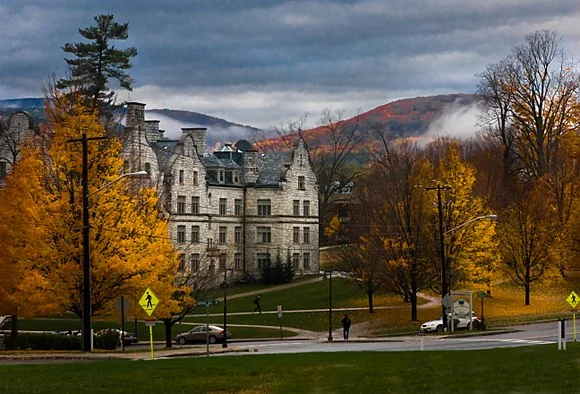
Morgan Hall, at Williams College, in Williamstown, Mass. See the Berkshires in the background. Williamstown has two important museums, among its other beauties -- the Williams College Museum of Art and the Clark Art Institute. The famed songwriter Cole Porter had a house in Williamstown.
Via the New England Board of Higher Education (nebhe.org)
Maud S. Mandel, dean of the college and professor of history and Judaic studies at Brown University, was named president of Williams College, succeeding Protik (Tiku) Majumder, who has served as interim president since Adam F. Falk left the Williams presidency after eight years to be president of the Alfred P. Sloan Foundation.
Massachusetts College of Art and Design Executive VP Kurt T. Steinberg was named president of the Montserrat College of Art in Beverly, Mass., beginning July 1. Steinberg will succeed retiring President Stephen D. Immerman, who led the college for nine years and wrote for NEBHE’s New England Journal of Higher Education about integrating the arts with STEM fields.
Hartford Seminary named Joel N. Lohr, currently dean of religious life at University of the Pacific in Stockton, Calif., to be the seminary's next president, succeeding Heidi Hadsell, who is retiring after leading the seminary for 18 years.
Anthony Poore, director of Regional and Community Outreach at the Federal Reserve Bank in Boston, was named executive director of New Hampshire Humanities. Poore has written for the New England Journal of Higher Education about the Boston Fed's consumer programs in “Counterbalancing Student Debt with ‘Asset Empowerment’” and “Economic Mobility and Baby Talk: Children’s Savings Accounts Mark New Frontier in Paying for College’’.
Endicott College appointed John’s Hopkins University associate dean John Caron to be the college’s provost.
Kathryn Edney, who has served roles at Bowdoin College, Plymouth State University and the University of New England, was named dean of the School of Arts and Sciences at Regis College.
John O. Harney is the executive editor at NEBHE's New England Journal of Higher Education.
Time for for runoff elections
Adapted from Robert Whitcomb's "Digital Diary,'' in GoLocal24.com
With what seems to be a long-term trend of well-known third-party gubernatorial candidates preventing any candidate from getting more than 50 percent of the vote in a general election in some states, including Rhode Island, it’s time for the states to have runoff elections between the two biggest vote getters. The U.S. phenomenon of third-party candidates preventing a candidate in the general election from winning a majority is most entrenched in Maine.
Many Americans would agree with Lee Drutman, writing in Vox:
“{A} two-party system is inadequate to represent the diversity of public opinion. As a result, a lot of voters feel neither party represents them, even if they tend to vote one way or another. Note, for example, that the share of voters identifying as independents hit a record high (tie) of 46 percent in December 2017. The share of voters saying a third party is needed (because Republican and Democratic parties do not do an adequate job of representing the American people) hit a record high of 61 percent in Gallup’s most recent polling on the question.
“The most obvious benefit of ranked-choice voting is that voters can choose the candidate they most want to elect without having to worry so much about the ‘spoiler effect.’’’
“{I}ndependents and third-party candidates could run without being spoilers, giving voters more choices and making for a more vibrant political debate.’’
To read Mr. Drutman’s article, please hit this link.