
Vox clamantis in deserto



Best toward the end

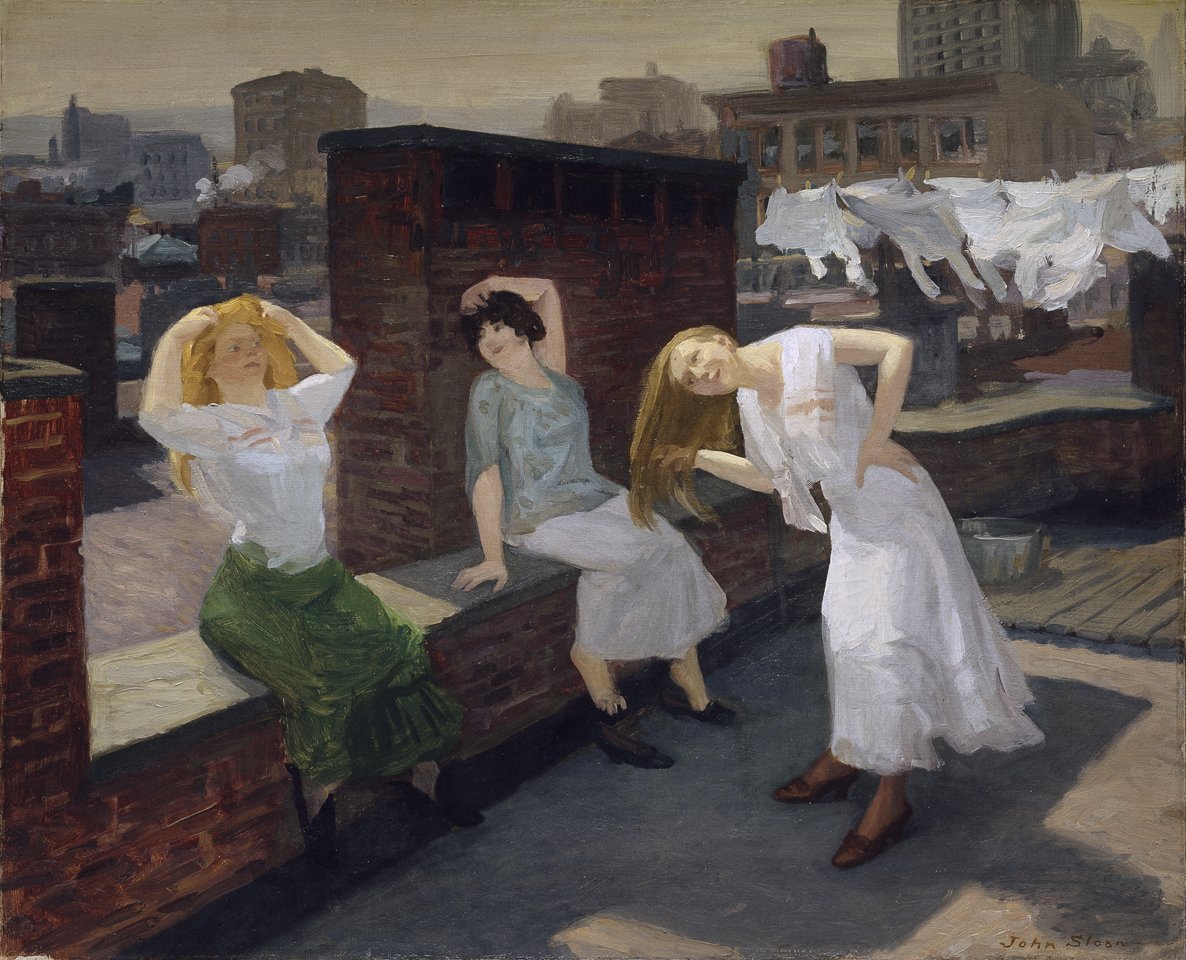
"Here in the Autumn of my days
My life is mellowed in a haze.
Unpleasant sights are none to clear,
Discordant sounds I hardly hear.
Infirmities like buffers soft
Sustain me tranquilly aloft.
I'm deaf to duffers, blind to bores,
Peace seems to percolate my pores.
I fold my hands, keep quiet mind,
In dogs and children joy I find.
With temper tolerant and mild,
Myself you'd almost think a child.
Yea, I have come on pleasant ways
Here in the Autumn of my days.
Here in the Autumn of my days
I can allow myself to laze,
To rest and give myself to dreams:
Life never was so sweet, it seems.
I haven't lost my sense of smell,
My taste-buds never served so well.
I love to eat - delicious food
Has never seemed one half so good.
In tea and coffee I delight,
I smoke and sip my grog at night.
I have a softer sense of touch,
For comfort I enjoy so much.
My skis are far more blues than greys,
Here in the Autumn of my days.
Here in the Autumn of my days
My heart is full of peace and praise.
Yet though I know that Winter's near,
I'll meet and greet it with a cheer.
With friendly books, with cosy fires,
And few but favourite desires,
I'll live from strife and woe apart,
And make a Heaven in my heart.
For Goodness, I have learned, is best,
And should by Kindness be expressed.
And so December with a smile
I'll wait and welcome, but meanwhile,
Blest interlude! The Gods I praise,
For this, the Autumn of my days. ''
-- "My Indian Summer,'' by Robert Service
In city redevelopment, go organic
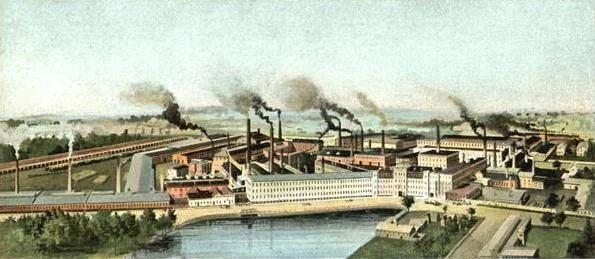
American Steel & Wire Co., Worcester, about 1905. Worcester used to be nicknamed "The Pittsburgh of New England''.
From Robert Whitcomb's "Digital Diary,'' in GoLocal24.com:
The Worcester Telegram ran a boosterish editorial on Oct. 22 about its downtown renaissance.
Among its points, which folks in other old New England cities should remember:
“{E}xisting buildings are also being transformed. As opposed to large, government-driven urban renewal projects that once cut off entire neighborhoods and laid waste to broad swaths of midcentury Worcester, what we’re seeing now is different. It’s different in the number of independent private developers, all seeing opportunity here and now, who in their own ways are driving a renewal of the city.’’
“This isn’t some giant urban renewal project. It’s an organic renewal.
“Organic in that so many developers have discovered opportunity here. But a renewal that is far from accidental. It’s not happening on its own. It’s a product of what came before, and of city leadership in both the public and private sectors.
“The fact that all this development is not reliant on a single, large developer or a giant government project, as has happened before and elsewhere, may be its greatest strength. That so many individual developers, all with a vision and a belief in the city’s future prospects, and with the resources and willingness to put those resources at risk, is the sort of development that drove the emergence of Worcester into an industrial giant. Failure by any single developer doesn’t doom the entire enterprise. ‘’
In other words, don’t depend on a few big developers, or one big company moving in (e.g., Amazon), to turn your city around. Diversify your economy, fix the city’s physical infrastructure and improve the schools. Companies come and go, with a moment’s notice.
The creativity of exile
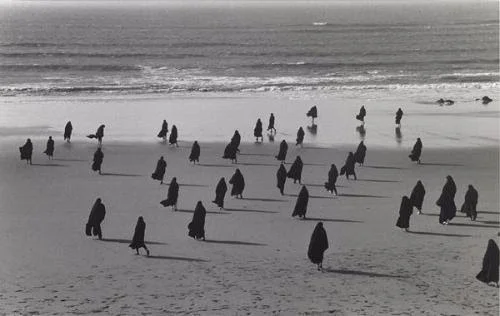
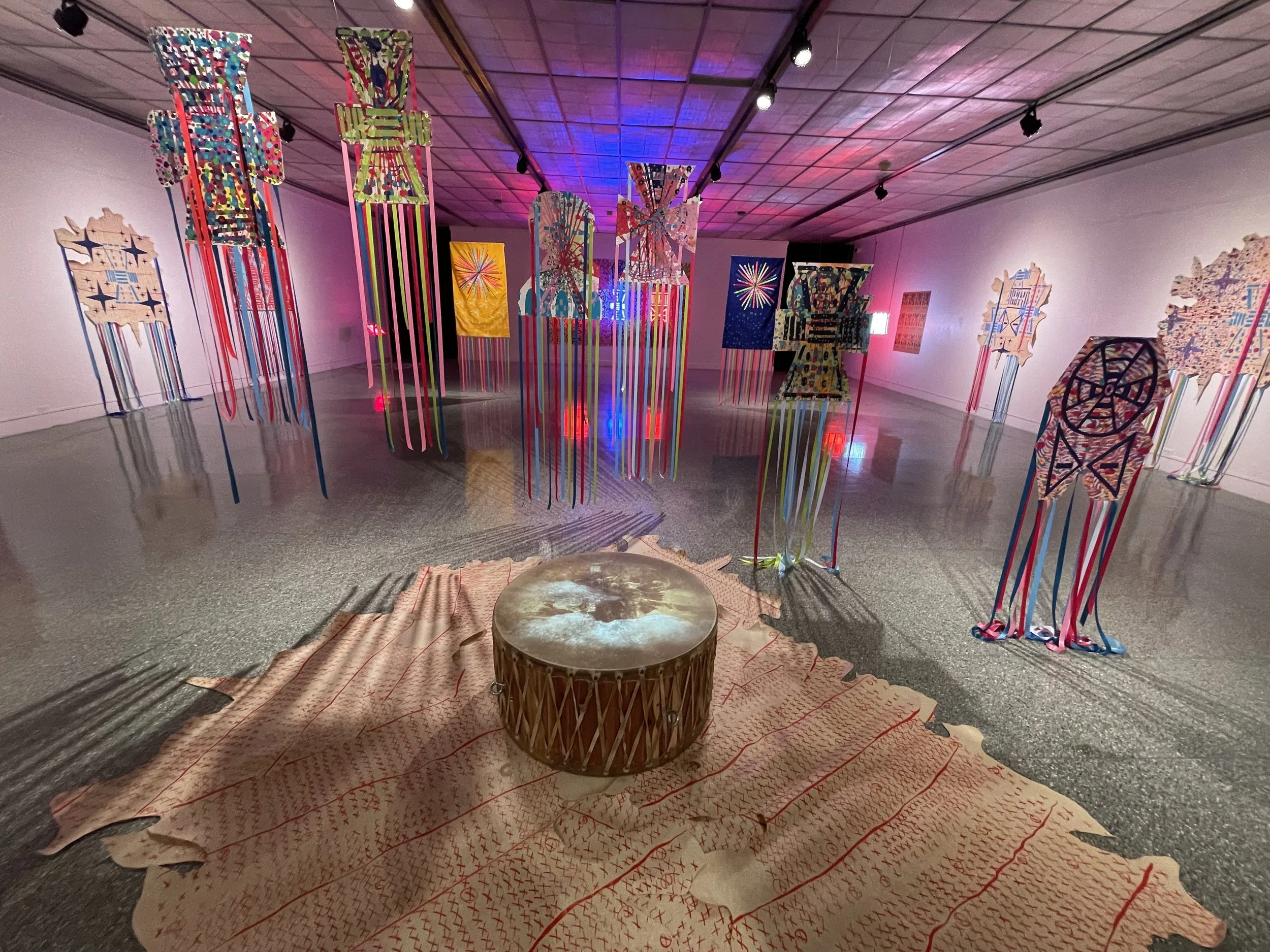
Gelatin silver print by Iranian artist Shirlin Neshat in her series "Rapture,'' in the show "Artists in Exile,'' at the Yale University Art Gallery, New Haven, through Dec. 31. The gallery says the exhibition addresses exile, featuring the work of artists who have left their home country or adopted home. It explores the physical, mental and emotional effects of exile on people and the creativity that a severance with the familiar and journey into the unknown can cause.
Defining Indian summer

"{Indian summer} comes after the early frosts, when the wind is southwest, and the air is delightfully mild and sweet. The sky is then singularly transparent, pure and beautiful, and the fleecy clouds are bright with color. The Indians believed the season to be caused by a wind that was sent from the southwestern god Cautantowwit, who was regarded as superior to all other beings in benevolence and power, and the one to whom their souls went when the departed from the earthly body.''
-- By Sidney Perley, in Historic Storms of New England (1891)
Survival and decoration

"The flowers that thrive on the margins,
by the tracks and roadsides as we pass
on our way somewhere else,
planted by no one and often unnoticed,
their beauty gratuitous, prodigal,
have nothing to do with us,
have nothing to do with decoration
but with survival.''
-- From "Arrangement,'' by Massachusetts poet Jeffrey Harrison
Dangerous dogs

A safe pit bull in public.
Adapted from Robert Whitcomb's "Digital Diary,'' in GoLocal24.com:
Two pit bulls killed a seven-year-old boy Oct. 21 in Lowell. Attacks on people by pit bulls are common. They’re aggressive and muscular dogs with very strong jaws. In some urban neighborhoods, they’re often kept by young men eager to display how tough they (the young men) are; the same as brandishing guns. And sometimes these dubious “pets’’ are kept to help guard drugs and drug dealers.
It is not the dogs’ fault that their physical strength, their breeding and (often) their training to be aggressive make them so dangerous. But it’s past time to ban them from urban neighborhoods.
Pit bulls are generally seen as including the American pit bull terrier, American Staffordshire terrier, Staffordshire bull terrier and American bully. They have been bred to bite and hold their victims.
After some pit-bull attacks, Lowell tried to stem the menace in 2011 by requiring the dogs to be spayed or neutered and muzzled and leashed when off owners’ property. But the Massachusetts legislature, prompted by owners of these breeds denouncing this quasi-racial “discrimination,’’ barred cities and towns from enacting breed-specific ordinances.
With the latest horrific attack, Lowell officials are again demanding that pit bulls be brought under control. Meanwhile, owners who fail to properly control these sometimes murderous beasts must face severe criminal-law punishments.
Seeding Southie

"Study for Day Boulevard at Pleasure Bay, Samaras'' (a samara is a winged nut or achene containing one seed, as in ash and maple), by Ann Wessmann, in her show "Wandering,'' at Kingston Gallery, Boston, Nov. 29-Dec. 30.'' Day Boulevard is in South Boston.
Daniel Regan: Climate-change denial and the limits of higher education
Via the New England Board of Higher Education (nebhe.org):
Last year, I attended my 50th reunion at Amherst College, in Amherst, Mass.. One evening at dinner under a tent, a former roommate, “Nick,” dominated the conversation with assertions that claims about human-induced climate change were a hoax and those about global warming a fraud. At first, I thought he was trying to be entertaining—or provocative.
But after a while, I realized my error. His was no parlor game; nor was he merely pushing his dinner partners by challenging the basis for their own strongly held convictions. He was a climate-change denier and a true believer when it came to denialism.
Since that dinner, I have wondered: How could an Amherst graduate arrive at these conclusions in the face of overwhelming evidence and scientific consensus? Similar questions could be asked of graduates from colleges and universities across the nation. Had the lessons of rigorous thinking, widespread reading, respect for evidence and trustworthy sources been lost on Nick? He had been, as I recalled, a brilliant student. So the answer was not, simply, that a college education had failed somehow to “take.”
On the contrary. He had fully internalized the critical thinking skills at a premium in his college days, but placed them now in the service of climate-change denialism. His lengthy enumeration of purported holes in the evidence was skillful. Indeed, it was strongly reminiscent of Big Tobacco’s methodological arguments in the highly orchestrated, sophisticated and clever campaign to fend off and postpone the inevitable declaration of tobacco as a carcinogen.
Nick was more a product of his regional background—in a hotbed of skepticism about human-induced climate change—than a product of Amherst. He was more a member of that region’s upper-class—its social networks, media preferences and economic interests—than of the Amherst class of ’66.
A higher education—what our college and university students learn both inside and beyond their classrooms—emerges as one of multiple influences but maybe not the most important one. A striking example of this hierarchy of influences emerges in a series of voting studies conducted in the aftermath of the Vietnam War. Not very long after the war’s conclusion, sociologist Seymour Martin Lipset and political scientist Everett Carll Ladd Jr. produced a small avalanche of studies examining the voting patterns and preferences of 1960s college students.
Within a decade, the researchers were able to document shifts in students’ political orientations. Those who came from more liberal or radical backgrounds remained on the left. Those who came from more conservative or centrist backgrounds shifted rightward. The collegiate generation that had seemed so univocal was, in fact, increasingly divided.
Lipset and Ladd found that family background was a key factor in explaining the resulting voting patterns and ideological preferences. Although colleges and universities in the 1960s were viewed as possibly permanent bastions of liberalism, the generational shift to the left may have left its mark upon the lifestyles of those on campus, but did not necessarily leave a lasting impact upon their politics.
There was little chance that a higher education could compete with Nick's social background and current circumstances in influencing his eventual stance of climate change. His higher education was important, just not all-important.
The distinction should be both humbling and liberating. It can allow faculty, staff and administrators to take a deep breath, relax a little and adopt a spirit of what I would call well-considered but “playful experimentalism.” Such an ethos is sorely needed to spur much-needed innovation in higher education. This means risk: trying out that new advising model; experimenting with a novel course format and set of exercises, even though the tried and true ones have served well enough; trying out a new orientation for students at risk; collaborating in untested ways with a sister institution, and so on, through every level of the institu
But paralysis has its own perils in today’s more challenging environment for higher education. Thoughtful experimentation, despite the risks, is by far the wiser strategy for today's higher educators.
Daniel Regan is accreditation liaison officer and former dean of academic affairs at Johnson State College, in Vermont.

Chris Powell: Spoiled NFL players' protests are too vague

MANCHESTER, Conn.
What exactly are the National Football League players trying to accomplish with their protest by kneeling during the National Anthem?
President Trump's assertion that standing should be mandatory rather than done sincerely has focused the controversy on the players' freedom of expression rather than the target of the protests, vaguely described as racial injustice.
Back in the heroic era of civil rights, the 1950s and 1960s, the movement for racial justice had a specific and compelling agenda: voting rights; ending segregation in schools, public accommodations and housing; and improving job opportunities so that the formerly oppressed could advance. Voting rights have been achieved and segregation in public accommodations has been ended, but schools and housing remain segregated informally and racial minorities remain underemployed. Criminal justice and police misconduct increasingly raise racial issues as well.
The players have not articulated what they want the country to do about these issues, and it is little help just to harrumph that racial justice has not yet been fully achieved. It probably never will be.
Whatever the players want, the controversy they have caused shows that they are pursuing their objective in the wrong way, alienating more people than they are gaining sympathy from. For the players have failed to learn from the heroic era of the civil rights movement, whose success resulted in large part from the movement's patriotism, its seizing the flag on behalf of the nation's founding ideals, such as "all men are created equal."
The movement's participants had no special wealth and often put themselves at great risk by confronting armed racists.
By comparison, the players look like spoiled children, rich guys parading what they purport to be their virtue while risking nothing.
This is too bad because the players might accomplish something for racial justice and improve the country if they applied their celebrity to specific legislative proposals and volunteer work to help the disadvantaged. The players' resentment is hollow and they are lucky that the president's usual thoughtless bluster has changed the subject for them.
TRUMP NEEDS TO FIGHT EVERYONE: While he was never a sympathetic character in public life, when he was President Richard Nixon once managed to admit a mistake and thereby resolved an embarrassing problem.
It happened in August 1970 when, at an impromptu press conference in Denver, Nixon remarked on what he saw as the news media's glorification of cult leader Charles Manson, then on trial with his followers for murders in California. Manson, the president said carelessly, was "guilty, directly or indirectly, of eight murders."
That indeed was the charge but nobody had been convicted yet. Within hours the president's remark prompted a defense motion for a mistrial.
Nixon's press secretary quickly tried to clarify things and upon returning to Washington that day the president issued a formal statement saying that he did not know whether Manson and his followers were guilty, adding that they had to be presumed innocent during trial. The mistrial motion was denied and the trial continued and resulted in convictions.
But with President Trump everything has to be a personal challenge and a fight. About his telephone call to the widow of a soldier killed in Niger the other week, Trump could not say simply that he was sorry that he had been misconstrued as callous. No, he said the people on the other end of the call were lying about him.
The next 3½ years may be long ones.
Chris Powell is managing editor of the Journal Inquirer, in Manchester, Conn.
Boston sports teams announce anti-racism initiative
This is from The New England Council
The five major sports teams from the Boston area – the Boston Red Sox and Celtics, New England Patriots, Boston Bruins and New England Revolution – have teamed up to spearhead a campaign to combat racism.
The New England Council reported:
"The 'Take the Lead' initiative was launched with the support of Boston Mayor Marty Walsh at Fenway Park. In a PSA broadcasted in Fenway Park, Gillette Stadium and TD Garden, players urge fans to have open conversations about race and speak up when they hear offensive statements. Team executives spoke about their teams’ efforts to become more racially inclusive and engage in local communities. As part of the initiative, teams will participate in fellowships and career fairs to help all members of the community be on 'an equal playing field.'
“'We, like many Americans, made the mistake of thinking that our region’s and country’s less-than-stellar pasts were firmly behind us, that 21st-century America was becoming a more inclusive nation committed to celebrating diversity. That is not the case,' said John Henry, the Sox’ principal owner. 'Our sports teams, our athletes, are woven into the fabric of our society. For that reason, we cannot remain silent nor still.'''
The Sacklers' deadly drug peddling
Adapted from Robert Whitcomb's "Digital Diary,'' in GoLocal2.com
The Sackler drug-fortune family, whose total wealth is estimated at around $15 billion, recalls the over-the-top Balzac line that “behind every great fortune is a great crime.’’ Theirs was to help create the opioid epidemic.
The Sacklers are the status-obsessed clan that puts its name in large letters on bronze and other fancy signs announcing members’ gifts to already rich museums and colleges and universities (including New England Ivy League schools) to affirm their membership in the social/mercantile aristocracy. Most of their money comes from their closely held company Purdue Pharma, which hugely hyped their painkiller OyxContin to physicians and patients. Purdue lied that the opiate was remarkably safe. No. It's a menace.
The company’s outrageous marketing of OxyContin has led to massive addiction and the overdose deaths of many thousands of people.
Even before OxyContin, Arthur Sackler, one of the three brothers who bought then tiny Purdue Pharma in 1952 and then built it up in a vastly profitable behemoth, heavily and misleadingly promoted the glories of the benzodiazepine Valium when he was an ad man. Valium is also very addictive and potentially lethally dangerous. What an innovative family!
From the start, the family-held firm’s secrets to success have included (as with some members of Big Pharma) its relentless pushing of its products to physicians, with junkets to fancy places, paying doctors big fees to give very short speeches and other perks that some might simply call bribes in the world’s most avaricious health “system.’’
Instead of showing off its money with well-advertised contributions to institutions catering to the elite, the Sacklers would do far better to set up a nonprofit chain of drug-rehabilitation clinics to address the vast damage that they have done.
In a weird way, New Englanders have seen this sort of money-laundering before, when the “China Trade’’ of the late 18th and early 19th centuries earned fortunes from opium sales. Some of it ended up in (what are now called) Ivy League colleges and other prestigious institutions. Opiates forever!
Nihilistic November

"No warmth, no cheerfulness, no healthful ease,
No comfortable feel in any member -
No shade, no shine, no butterflies, no bees,
No fruits, no flowers, no leaves, no birds -
November!"
-- Thomas Hood
Greater Boston forgets the Berkshires

Mt. Greylock, in the northern Berkshires.
"Remember that famous cartoon that spoofed the average New Yorker’s view of the world? (Kansas city was just past the Hudson River and New Jersey; Las Vegas bordered Nebraska.) It’s not entirely different for the average Greater Bostonian’s view which, when picturing the west, undoubtedly imagines Chicago and LA before North Adams or Stockbridge.
"Mention Monterey to a Bostonian, and they will think of Pacific Route 1, not Massachusetts Route 23.
"Always been that way. And in Monterey, North Adams and Stockbridge—as well as Lenox, Otis, and Pittsfield—they’re used to it. It’s no mystery in Monterey, Mass., or anywhere else in the Berkshires. They know the numbers: Fully two-thirds of the Bay State’s population lives in the Greater Boston area.
“'Do you ever feel like second-class citizens in your own state?' I once asked a woman in Great Barrington on that subject.
“'Out of sight, out of mind,' she sighed wistfully.
"When those in eastern Massachusetts do travel west to the Berkshires, it is almost invariably in the fall or, more likely, in the summer, to take advantage of the many cultural activities (Tanglewood, Jacob’s Pillow, Shakespeare & Co., etc.) there.
"But I recently spent a couple of days on a story about the Berkshires in winter.
"And I can confidently report that, even long after the music stops and the lawn picnics are a distant memory, there is still life in them thar hills. Good life, too.''
-- Ted Reinstein on the Web site of WCVB TV, Boston, in 2013. He's the author of the travel book New England Notebook.
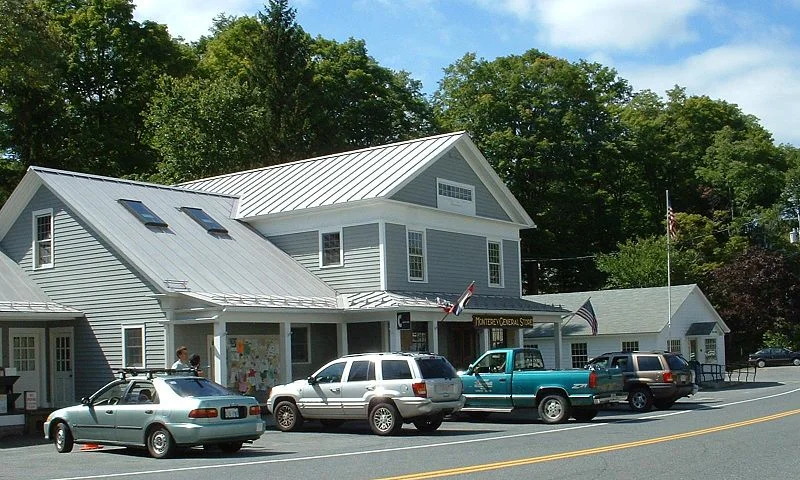
The general store in Monterey, Mass.
-- Photo by ToddC4176 at en.wikipedia
Suburban heavy industry

"Wrentham Asphalt Plant'' (oil), by Lorraine Hynes, in the current group show "The Edge of Light,'' with Mary Jane Begin and Kelly McCullough, at the Providence Art Club.
Tim Faulkner: Gov. Baker still won't oppose natural-gas projects

Opponents of a proposed natural-gas pipeline compressor station recently protested outside a local restaurant, where Gov. Charlie Baker stumped for Attleboro's mayor.
-- Photo by Tim Faulkner for ecoRI News
Via ecoRI News (ecori.org)
ATTLEBORO, Mass.
Even though Spectra Energy Partners has withdrawn plans for a natural-gas pipeline compressor station in Rehoboth, Mass., opponents of the project don’t want it coming back.
Groups such as Citizens Against the Rehoboth Compressor Station (CARCS) have been pleading with Gov. Charlie Baker to take a stand against the compressor station and other pipeline expansions, but so far the governor has refused to bend to public pressure and oppose the natural-gas infrastructure projects proposed for the region.
CARCS activists protested Oct. 28 outside the Uno's Pizzeria & Grill on Route 1, where Baker stumped for local politicians. Baker arrived late and didn't address the demonstrators, including members of the MBTA bus maintenance union who were protesting Baker’s efforts to privatize their jobs.
The International Association of Machinists Union Local 264 protested Baker's efforts to privatize their jobs.
Attleboro Mayor Kevin Dumas was one of the politicians whom Baker has endorsed. Dumas, however, opposes the compressor project. “It’s dead and I hope it stays dead,” Dumas told ecoRI News.
Dumas, a Republican, has been an outspoken critic of the compressor station and signed a resolution opposing the project, the proposed site close to the city’s border with Rehoboth.
Baker has only said that the project is a federal decision and outside of state control. But opponents such as Brian Hatch, a lawyer from Attleboro, said Baker could do more to impede or even stop the compressor station. Recent appeals court decisions, he said, give states more say in the permitting of energy projects that are under the purview of the Federal Energy Regulatory Commission.
The site of the proposed compressor station poses a health threat to residential neighborhoods and youth who frequent the nearby park and athletic fields, Hatch said.
Kathleen Boivin of Rehoboth referred to a 2015 report by Attorney General Maura Healey showing that the growth of renewable energy and energy-efficiency improvements reduce the demand for natural gas and therefore pipeline enhancements.
Boivin said the common belief about the buildout of the Spectra pipeline isn't to provide natural gas for New England but to deliver it to export terminals north of Boston.
“There’s no need for our communities to bear the health, environmental, and financial detrimental effects of this additional infrastructure when it’s not needed,” she said.
Last week CARCS members also hand-delivered a petition signed by 2,500 opponents of the compressor to Baker’s office in Boston.
CARCS Director Tracy Manzella said after 19 months of organized opposition Baker hasn't budged.
“We’ve gone door to door, staged countless community events, sponsored letter-writing campaigns, given interviews, published articles, met with local, state, and federal government officials, drafted bylaws, and even given a Powerpoint presentation at the governor’s executive office of Energy and Environmental Affairs, but the governor himself? So far, no luck.”
The proposed 10,320-horsepower Rehoboth compressor station was halted by Houston-based Spectrain June. The project was one of several Access Northeast projects paused along the Algonquin pipeline. The compressor station was proposed for a privately owned, 120-acre site close to Attleboro and Seekonk, and Pawtucket, R.I., and about 10 miles from downtown Providence.
The projects were withdrawn because of financing trouble, created when the Massachusetts Supreme Judicial Court ruled that a plan by National Grid and Eversource to charge electricity customers for the projects was unconstitutional. It’s expected that Spectra, National Grid, and Eversource will revive the projects if a new funding scheme is approved.
Tim Faulkner is reporter/writer for ecoRI News.
Sam Pizzigati: Payroll tax deeply discriminates against low- and middle-income people
Via OtherWords.org
How much did your paychecks total last year? You know the answer, of course. So does the Social Security Administration. The totals for every American’s paycheck income are sitting in Social Security’s computers.
Once every year, Social Security does a serious data dump out of those computers to let us know just how much working Americans are actually making. The latest totals — covering 2016 — have just appeared.
Most of us, the new numbers show, are simply not making all that much.
In fact, nearly half of our nation’s employed — 49.3 percent — earned less than $30,000 in 2016. A good many of these Americans lived in poverty. In 2016, families of four that earned less than $24,339 ranked as officially poor.
We don’t have an “official” figure for middle class status. But the Economic Policy Institute has calculated the costs of maintaining a no-frills middle class existence in various parts of the United States. In Houston, one of our nation’s cheaper major cities, a family of four needed $62,544 in 2016 to live a bare-bones middle class lifestyle.
Nationally, according to the new Social Security payroll income numbers, over three-quarters of working Americans — 76.4 percent — took home less than $60,000 in 2016.
Some Americans, on the other hand, took home a great deal more. The Social Security Administration counts 133,119 Americans who pocketed over $1 million in paycheck income last year.
Now which of these two groups — the millionaires or the under-$60,000 crowd — do you think paid a greater share of its income in Social Security taxes?
The millionaires could certainly afford to pay the bigger share. But they didn’t.
Individuals who took home $1 million in 2016 had $16,265 deducted from their paychecks for Social Security and Medicare. Those deductions totaled a meager 1.6 percent of their paycheck income. Working Americans making $60,000 last year, by contrast, had 7.65 percent of their take-home deducted for Social Security and Medicare.
In other words, Americans making $60,000 paid over four times more of their income for Social Security and Medicare than Americans who made $1 million.
How could that be?
Our tax code currently has a ceiling on earnings subject to the Social Security tax. That ceiling this year rests at $127,200. All paycheck income up to that level faces a 6.2 percent tax for Social Security and a 1.45 percent tax for Medicare.
Income above that ceiling faces no Social Security tax at all.
Until the Obama years, income above the earnings ceiling faced no payroll tax for Medicare either. But President Obama succeeded in getting that changed. Individual income over $200,000 now faces an additional 0.9 percent Medicare tax.
If all income over $200,000 faced a Social Security tax as well, we’d have enough new revenue to significantly improve Social Security benefits.
The Trump administration is moving in the opposite direction. Earlier this year, the White House tried and failed to get the Obama Medicare tax on the rich repealed.
Now the administration is pushing a tax “reform” that totally ignores the unfairness of the current Social Security payroll tax and instead hands America’s wealthiest a stunningly generous assortment of tax giveaways.
If this Trump tax plan passes, Americans making $60,000 will still be paying over four times more of their income in payroll taxes than Americans who make $1 million. And America’s millionaire-packed top 1 percent will get 80 percent of the new Trump tax cuts, the Tax Policy Center calculates.
The Trump tax plan, in other words, makes the U.S. tax code even more millionaire-friendly than the current code. The White House calls that “reform.” The rest of us ought to call it an outrage.
Sam Pizzigati, an Institute for Policy Studies associate fellow, co-edits Inequality.org.
Chris Powell: Maybe Conn. is starting to gets its government under control
After three months of fecklessness, delusion, incompetence and disorder that embarrassed the state throughout the country, Connecticut may be grateful for any budget at all, even if the compromise budget developed this week by the General Assembly's Democratic and Republican leaders is found to contain more than the usual hurtful, stupid, and dishonest provisions.
In any case if the compromise wins Gov. Dannel Malloy's signature or is enacted over his veto, it will restore at least the semblance of government and end the governor's allocation of money on an emergency and arbitrary basis. That will be a great relief to most municipalities, since the governor has been threatening their school money.
But the budget may cause pain, not relief, for many other recipients of state money, whose funding will have been sharply reduced or even eliminated without much if any public discussion. That pain will be the other side of the budget compromise's not raising taxes sharply and its failure to control state employee and municipal teacher pensions and benefits.
Many more years of such pain are probably ahead for government in Connecticut as people increasingly understand that it is failing to achieve its nominal objectives and is alienating and starting to lose Connecticut's productive, self-sufficient population. A political consensus that state government has to start serving the public more and itself less just may be developing.
If such a consensus is developing, it will have been sparked by the three moderate Democratic senators and five moderate Democratic representatives who undid their party's narrow majorities in the legislature by voting for a Republican budget, thereby forcing their party to settle for something less than another huge tax increase. Another huge tax increase would have only fed the machine of state government, which isn't much more than a pension and benefit society.
Indeed, pension and benefit costs for state employees and municipal teachers cannibalized state government more than ever this year. Yes, the pensions long have been underfunded, but most people in state government and the state employee and municipal teacher unions knew this. The unspoken agreement has been that union members would get contracts making them state government's only secured creditors when the crackup in the state's finances and demographics began. Public services and government's other dependents would suffer but not the union members.
The unions have known this better than many of the public's supposed representatives, so it will be no offense if a new political consensus strives to revise pensions and benefit costs in the public's favor, as the compromise budget has started to do by requiring teachers to contribute more toward their pensions. This provision is remarkable, since teacher unions are the most feared special interest in the state and surely will retaliate, especially against Democratic legislators they had considered their mute tools.
The governor must be credited for forcing the pension issue this year by insisting on maintaining the proper level of contributions to the pension funds. He would have deserved a lot more credit if he had insisted on serious concessions from the state employee unions instead of giving them another generous contract prior to the budget's adoption.
The governor also must be credited for prompting the budget compromise by threatening to cut off the school money. Without that threat by the governor, legislators might have dithered a lot longer.
Chris Powell is managing editor of the Journal Inquirer, in Manchester, Conn.
Before the leaves are blown off

At the farm in Little Compton, R.I., before the storm.
-- Photo by Lydia Davison Whitcomb
Llewellyn King: The Internet of Things has turned on me

Dear Diary,
Dear Diary,
I’m writing by the light of a candle, with a pencil in the bathroom. I have to sit here in the dark. You see, the Internet of Things is driving me mad, out of my mind. The appliances in my home are ruining me; sliming me.
I always had trouble with inanimate objects: doors that hit me, shoes that hid from me, hammers that sought out my thumbs and carpets that wanted me flat on my ass. But that was before the Internet of Things; before Silicon Valley issued them with brains.
That nice, useful microwave is a malicious devil. Would you believe that it has gotten the other appliances – all those with computers built in — to conspire against me because of something I wrote belittling the Internet of Things?
Well, the things have taken up arms against me. It is war, plain and simple, in my home.
They bully me. The washing machine emailed me, “I know what you and the boys did last night. Spaghetti and Chianti again?”
The television in the bedroom tweeted, “You’re cut off. No more binge-watching ‘Married with Children.’ ”
How can I tell my dear wife that I have to sleep on the couch because the microwave is in cahoots with the washing machine and the bedroom TV to torment me? Even my i Phone threatened to put pictures of me in the buff on Facebook.
I’ve tried to reach out to the appliances, tried to make peace with them. I’ve pleaded with the smart meter in the kitchen, “Can’t we just get along? After all, we live in the same house.”
My life is utterly destroyed.
It all began with one of those smart domestic assistants that communicated with the smart devices in your home. I knew about its artificial intelligence but I didn’t think it was intelligent enough to prevail on all the appliances in my home to drive me mad.
How did I get on the wrong side of my appliances, which I bought and installed? Even my video game console is a double agent. It lulls me into a false sense of trust with games, then it hands over the results of secret IQ tests to my boss.
I can’t tell anyone. “Who you going to tell? You’ll be committed,” the cruel refrigerator emailed me.
I begged the appliances collectively to accept my apology, to let me make amends. That set off a torrent of abuse on social media. My smart watch started flashing, “Nice try, big guy.”
I’m now all alone with my toilet bowl. I could hug it because it’s not part of the Internet of Things. It’s solid, old-fashioned and even, in my mental state, lovable.
I had a plan which I broached with my wife. I asked her, out of earshot of anything connected to the Internet, whether she would like to join the Amish, to live simply with a horse-drawn buggy. Then I realized that we couldn’t buy a buggy because the mixer in the kitchen has been monitoring my credit cards obsessively.
Like President Trump, these gadgets don’t brook criticism. Even an innocent clock-radio can turn on you. Mine did. It woke me up on Nov. 9, 2016 to tell me that Trump had won. That’s when I began losing it.
On Twitter: @llewellynking2
Llewellyn King is executive producer and host of White House Chronicle, on PBS.