
Vox clamantis in deserto


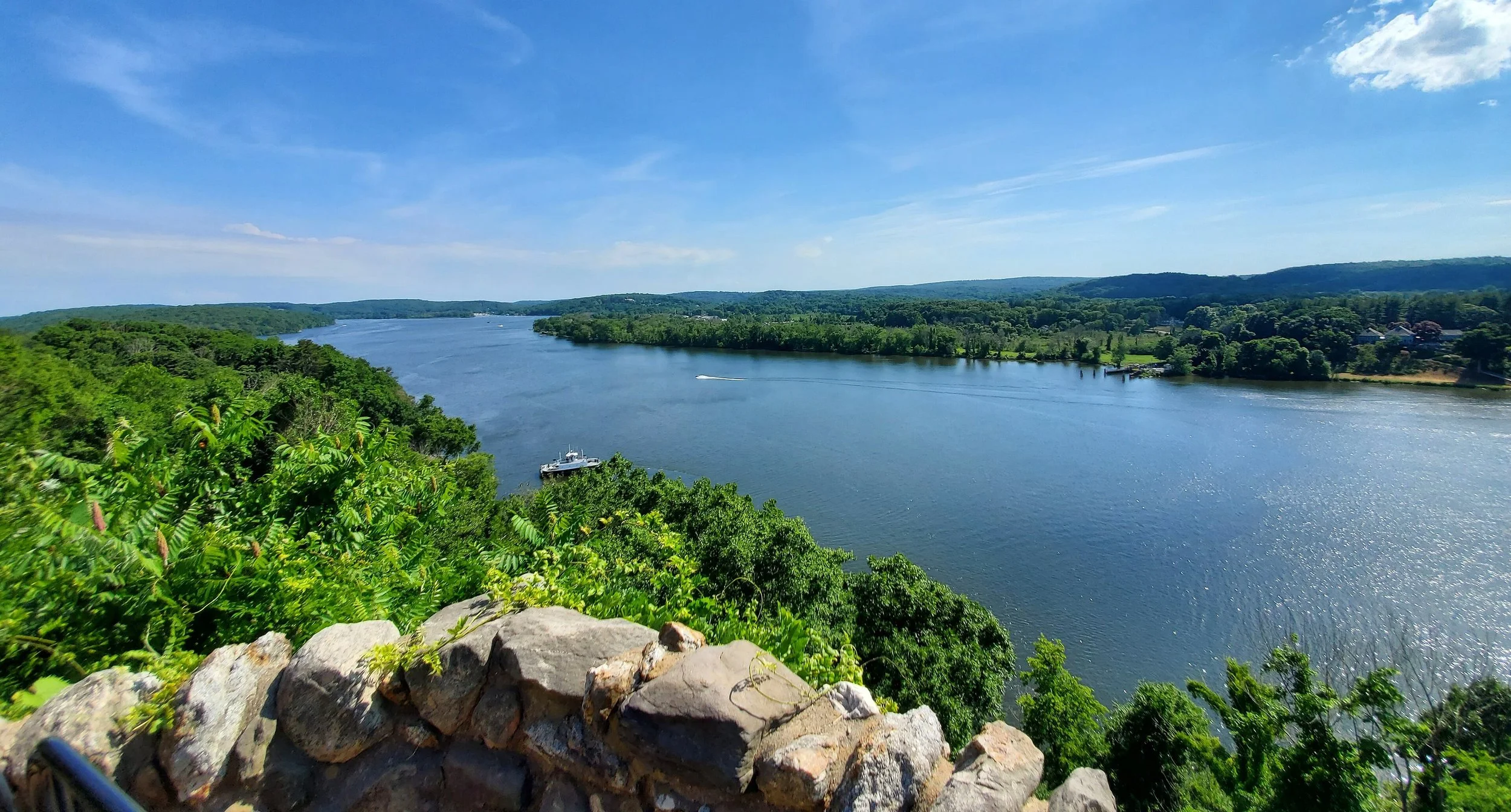



Ready for winter

"Stock Pile'' (acrylic on panel), by Jeremy Miranda, in the two-man show with David Barnes "The View From Plato's Man Cave,'' at Atelier Newport (R.I.), Nov. 12-Dec. 10.
What makes a New Englander?

Apple orchard in Hollis, N.H.
From a 2002 commentary by the Voice of America
Every region of the United States has its bittersweet stereotype. People from the American West are reputed to be long of limb, folksy, at home with nature. Those from the Midwest are solid, corn-fed, plain-speaking "heartlanders." "Yankees", who hail from the older, more settled regions of New England in the northeastern United States, are said to be stubborn people of few words.
Ninety-two-year-old Ruth King-Sanborn sits on a horsehair couch overlooking the hardscrabble New Hampshire farm and mill her ancestors bought back in 1773, when this part of the world was still a remote British colony. But don't ask her to get too emotional about the place.
"New Englanders are loath to discuss their feelings. I think the first thought that occurs to me is that people kept their thoughts to themselves. People did not say that they feel bad about something. I'm using the past tense now. I think it was the isolation. We were isolated here. If I didn't go to school, it would've been weeks when I wouldn't have seen anybody outside of the family!" she said.
Colin Cabot and his wife recently bought the farm and mill from Ms. King-Sanborn's family, hoping to restore it. Before moving here, the couple had lived in a small farming community in the rural Midwest. That was a place where people tended to spend time only with their own religious and ethnic kind.
"… and there it is very clearly either Catholic or Lutheran, and the Catholics and the Lutherans don't talk to each other very much. And they can live across the street from each other, and they don't like it. So when I came to New Hampshire, I thought I'd have the same kind of farming community. But the difference is the New Englanders are individualists, they are completely independent. There may have been political differences or religious difference before the Revolution back in 1770. And now, those differences are forgotten, but the fact is they know they are different than their neighbor. And it doesn't take any specific form, but that's not the way I do it," Mr. Cabot said.
To underscore this idea, Mr. Cabot points to the dented New Hampshire license plate on his pick-up truck. It bears the state motto: "Live Free or Die."
"Yeah, right. Some people say the real Yankees are the way they are because they didn't leave when everyone else went away and therefore they are sort of the cantankerous ones, because they could have gone to the Midwest and made a killing. They were insane and stubborn then, and they are more stubborn now because the genes have been perpetuated," he said.
Not everyone feels that way.
"Sometimes people think of Yankees as being cantankerous [grouchy] [and] as being a little bit aloof. But in fact, that is not the case at all. It's just that people are very thoughtful, they do want to make up their own minds."
That's Jean Sheheen, the {then} governor of New Hampshire. She is proud of the legendary independent-mindedness of people in her state, which is on national display every four years during the early days of American presidential campaigns.
"People are used to having candidates for president come through their living rooms and having the opportunity [to talk with them], and I think many people feel like they have the right to ask those people why they are running for president and what they want to do and challenge their thoughts and their issues. And that's good for the democratic process in this country," Ms. Sheheen said.
Norman Macintyre, who runs a fish auction up in Portland, Maine, to the north of New Hampshire, agrees that his fellow New Englanders tend to keep their own counsel. But he adds that they are also very supportive of each other.
"My example for that is the ice storm we had in the winter of 1997 and 1998. There was very severe ice storm here. Many people were out of power for two weeks or more. Shelters opened up immediately. Teenagers went to work in the shelters just volunteered automatically. You would find ads in the newspaper that said 'I have a generator, I've got my power back. If someone wants to borrow my generator, just call such and such a number.' There was no looting. There was no theft. There were no crimes against the public during that period. Whereas, if it was in South Central Los Angeles, I think it would have been different," he said.
Some predict the demise of the traditional crusty New England personality, due to the influence of global media and the influx of immigrants to the region. But this outcome is far from certain. Even Robert Frost, the quintessential Yankee poet, expressed competing sentiments about this in the same poem. He wrote, "Good fences make good neighbors." But he also wrote, "Something there is [in us] that doesn't love a wall."
Nothing is certain
"A genuine New Englander learned by example never to take anything for granted. Once, when I remarked that it was a nice day, my Uncle Henry looked up at the sky, turned in every direction, and seeing there wasn't a cloud anywhere, took the pipe from his mouth and finally conceded, 'Well. maybe.'''
-- From Fetched-up Yankee, by Lewis Hill
Amazing amphibian

-- Photo by Lydia Whitcomb
Amazing plus-two-foot-long yellow spotted salamander found in a garage near a stream in bucolic Little Compton, R.I. It and other salamanders that joined it were perhaps drawn by the light in the garage Thursday night.
And now, seaweed as fuel

Seaweed being lifted out of top of algae scrubber/cultivator, to be discarded or used as food, fertilizer, or skin care.
Adapted from Robert Whitcomb's "Digital Diary,'' in GoLocal24.com:
The green-energy revolution goes on: As GoLocal24 has reported, the U.S. Energy Department has awarded Woods Hole Oceanographic Institution researchers $5.7 million to advance technology leading to the mass production of sugar kelp, a seaweed, to make biofuels and bio-based chemicals.
The grants are from the Macroalgae Research Inspiring Novel Energy Resources (MARINER) Program (what a name!). A biologist with the group, Scott Lindell, told GoLocal: “Seaweed farming avoids the growing competition for fertile land, energy-intensive fertilizers, and freshwater resources associated with traditional agriculture.’’
Many readers may have eaten seaweed salad in an Asian restaurant; it’s delicious. Seaweed has some other uses, including cosmetics. It’s nice to know that New Englanders might soon grow it for food and fuel, anything to reduce our energy dependency on other regions.

Don Pesci: Fact-checking Sen. Murphy's claims on gun control

An AR-15.
FactCheck.org recently examined a proposition put forward by Connecticut U.S. Sen. Chris Murphy who, according to some of his gun-toting critics, will not rest content until he has repealed the Second Amendment to the U.S. Constitution, abolished the National Rifle Association (NRA), and confiscated every "assault weapon" – assault guns, assault knives and, especially prominent just now in Europe, assault vans – from sea to shining sea.
“What we know, Murphy said, "is that states that have tougher gun laws, that keep criminals from getting guns, that keep those dangerous weapons like AR-15s out of the hands of civilians, have dramatically lower rates of gun violence."
FactCheck found that while Murphy was entitled to make up his own mind on assault weapons, he was not entitled to make up his own facts, and the senator was given three Pinocchios.
Let’s deal first with Murphy’s AR-15 claim, Fact Check began. In support of Murphy’s claim that tough gun laws in such places as Connecticut and Chicago that “keep criminals from getting guns, that keep those dangerous weapons like AR-15s out of the hands of civilians, have dramatically lower rates of gun violence," a Murphy spokesperson pointed to “several studies” that backed Murphy’s assertion.
Fact Check examined the studies, the bedrock upon which Murphy’s claims rest, and found: “None of the studies [cited by the spokesperson] address bans on assault weapons such as the AR-15, but the effectiveness of an assault weapons ban was widely studied after Congress imposed a nationwide 10-year ban in 1994.”
Pointing to one such study undertaken by Christopher Koper, of George Mason University, and his colleagues, FactCheck summarizes the finding of that study: “The effectiveness of the ban was inconclusive. Gun violence declined nationwide into the 2000s, but the researchers ‘cannot clearly credit the ban with any of the nation's recent drop in gun violence.' The researchers estimated that the effects of the ban 'may not be fully felt for several years into the future,’ and ‘'should it be renewed, the ban's effects on gun violence are likely to be small at best and perhaps too small for reliable measurement.’ The ban was not renewed.” Murphy’s claim is not supported by the study.
FactCheck notes the deficiencies of the ban itself: The 1994 ban “may not have covered all forms of assault weapons because it did not ban all semiautomatic weapons. Instead, it banned semiautomatic weapons with large-capacity magazines and weapons that ‘appear useful in military and criminal applications but unnecessary in shooting sports or self-defense.’"
The observation raises the ticklish question: What weapons would an effective ban exclude? And the honest answer to the question is all "assault weapons" -- possibly including the recently favored weapons of terrorists, such as knives, vans and exploding pressure cookers -- not to mention a repeal of the Second Amendment supported by former Hartford Courant columnist Bob Engelhart, and the confiscation of all guns in the United States, the Australia solution to gun violence.
The problem with partial bans is that they are “not comprehensive,” a favorite expression of the anti-Second Amendment left. Englehart is right: We should learn to speak of partial weapons bans with the same smiling contempt used by people who speak of partial pregnancies, partial round circles and partial square holes. The ban enacted into law in Connecticut, if nationally replicated, would not substantially drive down murder rates in Chicago or Hartford.
A recent 2016 study published in Criminal Justice Review, FactCheck notes, addressed “the connection between 19 different gun-control laws and violent crime in roughly 1,000 U.S. cities. Kleck [co-author of the study] found that ‘gun control laws generally show no evidence of effects on crime rates, possibly because gun levels do not have a net positive effect on violence rates.’ But there were a few exceptions. Requiring a license to possess a gun and bans on gun purchases by alcoholics appeared to reduce the homicide and robbery rate.” And, of course, the licensing of guns is as common as table salt. The gun violence figures recently used by Murphy as emotional props to acquire campaign funds include suicides, which account for nearly 60 percent of gun crimes.
On this latter point, Murphy defended himself from the Pinocchio assault by pointing out that suicide was also a violent crime. True enough, but it is a different kind of violent crime, entailing much different consequences, and the General Assembly in Connecticut doubtless would not have successfully passed laws banning the AR-15, a weapon not useful in suicides, had it been forced to argue that the ban would reduce the incidence of suicide alone. The shooter in Sandy Hook first murdered 27 innocent people, 20 of them children, and then turned a pistol on himself, committing suicide.
In a cooler movement, Murphy should ask himself whether the tears poured out in Connecticut and Las Vegas would have flowed so copiously if both shooters had committed suicide before they pulled the trigger on their many victims.
Don Pesci is a Vernon, Conn.-based columnist and a frequent contributor to New England Diary.
Your inner wax

''Primary Instincts'' (encaustic), by Stephanie Roberts-Camello, in the show ''SHIFTS: Approaching Encaustic From All Angles,'' at the Fuller Craft Museum, Brockton, Mass., through Nov. 26. Reception 2-5 p.m. on Saturday, Oct. 28.
'Buried under weeds'

-- Photo by CC BY-SA 3.0
"In solemn pause the forest waits
The signal to return;
Within our rotting gardens gates
The weeds of autumn burn.
Father to son we held our field
Against the siege of tares,
Knowing our weaker sons would yield
The land no longer theirs.
Knowing how wind and sun and rain
Would fling their green stampedes
Where we who harvested the grain
Lie buried under weeds.''
"The Untended Field,'' by Robert Hillyer
Nov. 1 PCFR talk on what a war with North Korea might look like.

To members and friends of the Providence Committee on Foreign Relations (thepcfr.org; pcfremail@gmail.com):
Harry J. Kazianis (Twitter link: @Grecianformula), director of Defense Studies at the Center for the National Interest, will speak on Nov. 1 on how a U.S. war with North Korea might proceed.
He also serves as executive editor of the center's publishing arm, The National Interest, the largest online publication focusing on foreign-policy issues.
Mr. Kazianis is a well-known expert on national-security issues involving North Korea, China, the broader Asia-Pacific region as well as U.S. foreign policy in general. He is also a Fellow for National Security Affairs at the Potomac Foundation and a non-resident Senior Fellow at the University of Nottingham (UK). He holds a master’s degree in international affairs from Harvard University.
On Wednesday, Nov. 15, Maria Karangianis will speak on the refugee crisis in the eastern Mediterranean.
In May 2015, she traveled to the Greek Island of Lesbos, within sight of Turkey. At that time, hundreds of thousands of refugees were spilling onto the beaches in leaky boats, many of them dying, trying to find freedom from war-torn Syria. The Greek people of the island, who have been nominated for a Nobel Peace Prize for their generosity, have faced an economic catastrophe with tourism, their main source of income. Maria is currently a Woodrow Wilson visiting fellow and has traveled across the United States speaking at colleges and universities. She is a former guest editor and an award-winning writer on the editorial board of The Boston Globe.
On Wednesday, Jan. 17, comes Victoria Bruce, author of Sellout: How Washington Gave Away America's Technological Soul, and One Man's Fight to Bring It Home. This is about, among other things, China’s monopolization of rare earths, which are essential in electronics.
On Wednesday, Feb. 21, comes Dan Strechay, the U.S. representative for outreach and engagement at the Roundtable on Sustainable Palm Oil (RSPO), who talk about the massive deforestation and socio-economic effects associated with producing palm oil in the Developing World and what to do about them.

Boarding school beauty

Phillips Exeter Academy in 1911.
"Devon is sometimes considered the most beautiful school in New England....It is the beauty of small areas of order -- a large yard, a group of trees, three similar dormitories, a circle of old houses -- living together in contentious harmony.''
-- From the novel A Separate Peace, by John Knowles
The famous novel is based to some extent on Mr. Knowles's memories of his years as a student at Phillips Exeter Academy, the large boarding school in Exeter, N.H.
'Migration + Memory'

From the show "Migration + Memory: Jewish Artists of the Soviet and Russian Empires,'' through Jan. 28, at the Museum of Russian Icons, Clinton, Mass.
Make sure it's gritty enough

“I guess no true Bostonian would trust a place that was sunny and pleasant all the time. But a gritty, perpetually cold and gloomy neighborhood? Throw in a couple of Dunkin’ Donuts locations, and I’m right at home.”
― Rick Riordan, from The Sword of Summer
Too many hospitals
From Robert Whitcomb's "Digital Diary,'' in GoLocal24.com:
Care New England’s decision to close Memorial Hospital, in Pawtucket, or at least its inpatient services and emergency room, didn't surprise me at all. The fact is that Memorial’s days as a full-scale community hospital have long been numbered.
Our region has too many hospitals in a time when highly effective medications for such chronic ailments as heart disease, as well as proliferating outpatient facilities, such as comprehensive and specialty physician group practices, urgent-care centers, drugstore clinics and free-standing emergency departments, treat many of the ills that used to be treated only within hospitals. Just consider the number of surgeries now done outside hospitals, and that patients are discharged from hospitals after surgery there much faster these days. What might have kept them in a hospital for a week or two a couple of decades ago might now only keep them there for a couple of days.
And for the really serious and/or complicated stuff, patients can go to Rhode Island Hospital or the Miriam Hospital (the latter very close to Memorial), both in Providence, or to a hospital in the world-renowned health-care complex in Greater Boston (of which the Providence area is gradually becoming a part).
Only a small percentage of Memorial’s almost 300 beds are occupied and the place’s operating losses continue to swell.
So what will become of the facility? Probably much outpatient treatment and testing will continue in parts of the hospital buildings; after all, lots of physicians’ offices and very expensive equipment are there. (I go to see my cardiologist at Memorial every few months.) The rest of the structures might be turned into apartments, condos, offices, coffee shops, bars and so on – rather like a mill conversion.
The controversy about Memorial is really more about the threat to the hundreds of jobs at the hospital and the associated politics than about health care. But given the aging of the population, among other factors, the need for physicians, nurses, nurse practitioners, health-care aides and others in the sector will only grow; most of the laid-off folks at Memorial should fairly swiftly find new positions. But many will find leaving the hospital wrenching even as they find jobs elsewhere in the region that might be better for them in the long run. It’s a community.
Of course, politicians will denounce the closing even as they fail to come up with plausible arguments for keeping this old community hospital open in a time of revolutionary change (and confusion) in health care. And it’s been a very long time since Pawtucket was the sort of thriving factory town that could easily support such institutions as hospitals.
Now the city ever more desperately seeks the state’s help to finance a stadium for the Pawtucket Red Sox, although most Rhode Islanders oppose such help, according to a poll done for GoLocal by Socialsphere -- founded by John Della Volpe, the director of polling at the Kennedy School’s Institute of Politics at Harvard.
Far more promising is the coming Pawtucket/Central Falls train station. This facility will, among other benefits, help those cities become Boston suburbs for those who can’t afford the very steep housing costs in and around “The Hub’’ and maybe get some back-office work from Greater Boston companies in mills and other old buildings that have so far escaped the arsonists. Maybe some will live in what is now Memorial Hospital.
A letter from death row

Lethal-injection room at San Quentin State Prison, in California.
An extraordinary episode of White House Chronicle, the long-running program on PBS, will blaze across television screens this weekend. The program airs a letter from Timothy J. Hoffner, a death row inmate in Ohio. He has been on death row since 1995 and is scheduled for execution by lethal injection on May 29, 2019.
Frederic “Rick” Reamer, a guest on the program who served on the Rhode Island Parole Board for more than 20 years, commented, “The majority of prisoners I've dealt with are reflective, but Hoffner is very articulate and atypical.”
Hoffner wrote to Reamer after watching him discuss prison reform on a previous episode of White House Chronicle. Reamer said the letter was unusual because Hoffner didn't ask for clemency or a pardon for the gruesome murder he committed with an accomplice.
Llewellyn King, program host and executive producer, said, “Hoffner makes an articulate plea for the humanity of prisoners, even those who are guilty of major crimes. He also makes a plea for more education, and for educational programs to be available to long-term prisoners as well as those serving shorter sentences.”
In an excerpt of his letter, read on the program by Rhode Island-based actor David Catanzaro, Hoffner said, “What you [Reamer] said about inmates in prison being uneducated and/or having mental health issues of some kind is something I completely understand, because I see it, even in this isolated environment I’m trapped in.”
Reamer, who is a professor at Rhode Island College's School of Social Work, said on the program that he is not soft on prisoners, and has turned down more parole applications than he has approved. However, he has dealt with prisoners who have expressed remorse and Hoffner, in his letter, “was willing to reflect on what he did.”
As for rehabilitation, Reamer mentioned two of his parole cases: a crack dealer who rose from prisoner to become assistant solicitor for Providence, and another who serves as associate director of juvenile corrections for Rhode Island. Both had a thirst for knowledge.
In his many years in prison, Hoffner has educated himself and is the author of books and screenplays, which are available on Amazon or through Lulu.com. His pen name is Tim Lee.
“Over the years I have been locked up, I have educated myself about a variety of things, which is good. I like to learn about various things. The more we know, the better we are able to go through life. You never know when something you have learned will be helpful to you,” Hoffner said in his letter.
Linda Gasparello, co-host of White House Chronicle, said, “This program is so timely because the Justice Department is under a directive from Atty. Gen. Jeff Sessions to take a harder line with prosecutions and sentencing. Eric Holder, the previous attorney general, worked for years to reform the justice system; and there was a move in Congress to get rid of mandatory sentencing, But that has now ended.”
White House Chronicle airs nationwide on PBS and public, educational and government access stations, and on the commercial AMG TV network. It airs worldwide on Voice of America Television and Radio. An audio version airs three times weekends on SiriusXM Radio's P.O.T.U.S., Channel 124. An interactive list of stations which carry the program can be found at whchronicle.com.
For further information, contact Llewellyn King at llewellynking1@gmail.com.
Going, going, gone

October turned my maple's leaves to gold;
The most are gone now; here and there one lingers:
Soon these will slip from out the twigs' weak hold,
Like coins between a dying miser's fingers.
-- "Maple Leaves,'' by Thomas Bailey Aldrich
'Effort and reflection'

"La Bruma" (mist), by Raul Diaz, in his show through Nov. 12 at the Adelson Galleries, Boston. Adelson says: "The ... boats; empty and idle vehicles without a conductor, float on still water. This reoccurring symbol in Diaz’s oeuvre may represent life’s voyage, and the balance between effort and reflection required to move forward. Moments of serenity often follow periods of intensity, exemplified poetically in the artist’s course of creation.''
Vegetable freak shows
-- Photo byDavid Politzer
From Robert Whitcomb's "Digital Diary,'' in GoLocal24.com:
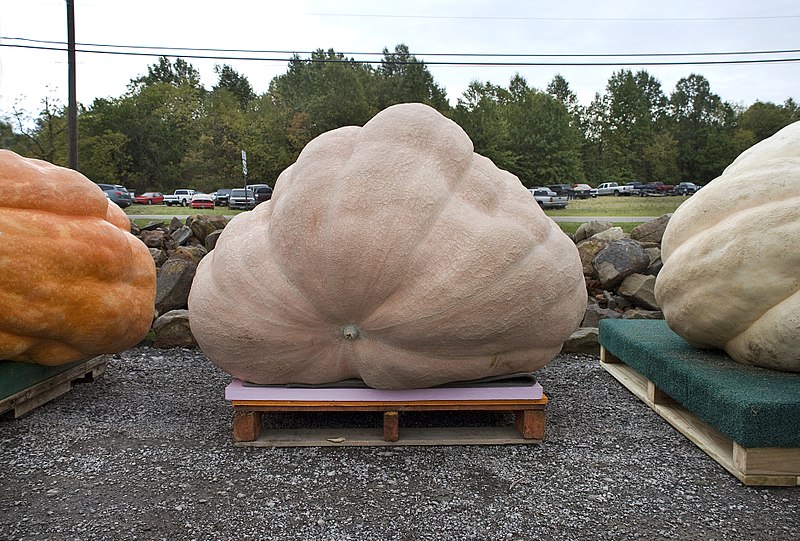
Many years ago, when I worked at the Boston Herald Traveler (RIP), I was amused that late summer and early fall brought lots of phone calls from gardeners and farmers claiming that they had grown the world’s largest vegetable – be it a tomato, a cucumber, a pumpkin, a gourd, etc.
So reading about the achievement of Joe Jutras, of Scituate, R.I., in reportedly growing a world-record-size pumpkin, a record-long gourd and the heaviest squash was a nice nostalgia trip. Of course, while Mr. Jutras’s huge vegetables are impressive (if useless), it’s very unlikely that they’d be considered records if all of the world’s many millions of farmers could have submitted their freaks.
But what do vegetables of these sizes taste like?
'This is how I will live'
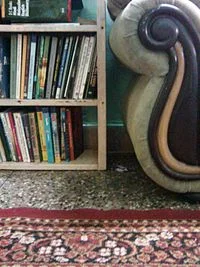
"The living room he took me into was neat, cozy, and plain: a large circular rug, some slipcovered easy chairs, a worn sofa, a long wall of books, a piano, a phonograph, an oak library table systematically stacked with journals and magazines. Above the white wainscoting, the pale-yellow walls were bare but for half a dozen amateur watercolors of the old farmhouse in different seasons. Beyond the cushioned windowseats and the colorless cotton curtains tied primly back I could see the bare limbs of big dark maple trees and fields of driven snow. Purity. Serenity. Simplicity. Seclusion. All one’s concentration and flamboyance and originality reserved for the grueling, exalted, transcendent calling. I looked around and I thought, This is how I will live.
-- Novelist Philip Roth, from The Ghost Writer. He has long lived in an 18th Century house in rural Warren, Conn.

Warren, Conn., around the turn of the 18th Century.
Calm and chaos

"Chaos'' (oils and oil sticks), by Julie Gorn, in her show "Color: Chaos and Harmony,'' at the Colo Colo Gallery, New Bedford, through Oct. 26.
Our world is hectic and mesmerizing, beautiful and noisy. Ms. Gorn responds to these contradictions with work whose colors calm viewers even as they evoke the busy pace of modern life.