
Vox clamantis in deserto





What would war with N. Korea look like?
To members and friends of the Providence Committee on Foreign Relations (thepcfr.org; pcfremail@gmail.com):
Harry J. Kazianis (Twitter link: @Grecianformula), director of Defense Studies at the Center for the National Interest, will speak on Wednesday, Nov. 1, on what a U.S. war with North Korea might look like.
He also serves as executive editor of the center's publishing arm, The National Interest, the largest online publication focusing on foreign-policy issues.
He is a well-known expert on national-security issues involving North Korea,
China, the broader Asia-Pacific as well as U.S. foreign policy in general. He is also a Fellow for National Security Affairs at the Potomac Foundation and a non-resident Senior Fellow at the University of Nottingham (UK). He holds a master’s degree in international affairs from Harvard University.
On Wednesday, Nov. 15, Maria Karangianis will speak on the refugee crisis in the eastern Mediterranean.
In May 2015, she traveled to the Greek Island of Lesbos, within sight of Turkey. At that time, hundreds of thousands of refugees were spilling onto the beaches in leaky boats, many of them dying, trying to find freedom from war-torn Syria. The people of the island, who have been nominated for a Nobel Peace Prize for their generosity, have faced an economic catastrophe with tourism, their main source of income. Maria is currently a Woodrow Wilson visiting fellow and has traveled across the United States speaking at colleges and universities. She is a former guest editor and former award-winning writer on the editorial board of The Boston Globe.
On Wednesday, Jan. 17, comes Victoria Bruce, author of Sellout: How Washington Gave Away America's Technological Soul, and One Man's Fight to Bring It Home. This is about, among other things, China’s monopolization of rare earths, which are essential in electronics.
On Wednesday, Feb. 21, comes Dan Strechay, the U.S. representative for outreach and engagement at the Roundtable on Sustainable Palm Oil (RSPO), who talk about the massive deforestation and socio-economic effects associated with producing palm oil in the Developing World and what to do about them.
Prior to joining the RSPO, he was the senior manager for Sustainability Communications for PepsiCo.
David Warsh: Nobelist Richard Thaler understands how crazy we are
“Frontman (noun): a performer, as a singer, who leads a musical group. More generally, a person who serves as the nominal head of an organization and who represents it publicly.’’ [Dictionary.com]
Richard Thaler is a rock star among economists. Don’t take my word for it. See his cameo appearance in the film The Big Short (2015), sitting next to singer Selena Gomez in a casino, explaining the logic of synthetic collateralized debt obligations.
Or read his 2015 autobiography, Misbehaving: The Making of Behavioral Economics, “laced with antic stories of spirited battles with the bastions of traditional economic thinking,” as the book jacket says. All Thaler’s gifts are on display in Misbehaving: he’s affable, witty, incisive, and more than a little bit pompous. Last week Thaler was recognized with the 2017 Nobel economics prize “for integrating economics with psychology.”
His story begins at the University of Rochester, and with Sherwin Rosen, an up-and-coming assistant professor who supervised Thaler’s thesis on some empirical evidence to be placed on the statistical value of years of life spent working in various professions. “We did not expect much of him,” Rosen told an interviewer many years later. Nevertheless, he helped Thaler publish a paper carved from the thesis in a National Bureau of Economic Research (NBER) conference volume.
A post-doc year spent at the NBER office at Stanford University, courtesy of health economist Victor Fuchs, proved eventful. There Thaler met Israeli psychologistsAmos Tversky and Daniel Kahneman for the first times, as well as, in Eugene, Ore., Baruch Fischoff and Paul Slovic, University of Oregon psychologists who had first sparked Thaler’s interest in the pair. Kahneman would share a Nobel Prize in 2002, after Tversky died unexpectedly, at 59, in 1996.
In his job talks, Thaler spoke, not about measurements of the value of a year of life, but rather about the ideas that would become “Toward a Positive Theory of Consumer Choice,” published in 1980 in the first issue of the Journal of Economic Behavior and Organization, and landed offers from Cornell and Duke. He took the job at Cornell.
At first life was hard. Editor Joseph Stiglitz commissioned him to write a quarterly column. “Anomalies,” for the new Journal of Economic Perspectives. Fuchs last week recalled the reception of Thaler’s ideas: “Ridicule, scorn, laughter, [he was] sometimes fortunate enough to get just plain criticism.” Thaler’s papers in those days were derided as “odd, under-demonstrated,” Tyler Cowen wrote last week; they seldom appeared in top journals. “We need some of that Wackonomics,” said Orley Ashenfelder,” editor of the American Economic Review, inviting him to give a talk to a conference on economics and the law.
Thaler kept at it, cheerful and relentless. A turning point came in 1985, at a conference at the University of Chicago organized by a psychologist, Robin Hogarth, and an economist, Melvin Reder. Thaler had gained tenure at Cornell; he had spent the year before working with Kahneman at the University of British Columbia. In Chicago, Thaler and Tversky were thrown up against the heavyweights of the rational-actor wing of the profession – University of Chicago Professors Robert Lucas, Merton Miller, Eurgen Fama and, by now, Sherwin Rosen.
At the end of the two-day conference, which featured a version of Kahneman’s and Tversky’sfamous paper “The Framing of Decisions and the Psychology of Choice,” many people attending had changed their minds: “No psychology, please, we are economists” was becoming a joke. Ten years later, Chicago’s Graduate School of Business hired Thaler. Miller, already a Nobel laureate, wouldn’t make eye contact with him. Rosen joked, “I knew him when he was an economist.” (About the same time, Cornell economist Robert Frank, Thaler’s long-time fellow-traveler in heterodoxy, declined an offer from Northwestern University, preferring to remain at Cornell.)
IfThaler’s getting the Nobel prize is seen as controversial, as Robert Shiller expects, it is not so much because some economists remain unconvinced that psychology has a place in economics, as Shiller wrote last week, as because so many have been convinced by people sother than Thaler. Both Misbehaving and the Nobel committee’s paper on the scientific background of the award are characterized by a certain lack of generosity towards others who contributed to the acceptance of the new view, including, say, Ariel Rubinstein, Colin Camerer, David Laibson, Matthew Rabin, George Lowenstein, Sendil Mullainathan,Andrei Shleifer and Ernst Fehr.
A case in point: the single most newsworthy piece of evidence in my memory was contributed by Brigitte Madrian and Dennis F. Shea, in 2001, in the Quarterly Journal of Economics. “The Power of Suggestion: Inertia in 401(k) Participation and Savings Behavior” quickly won the TIAA-CREF Paul A. Samuelson Award for outstanding scholarly writing on lifelong financial security. Thaler explains that he had broached its central idea– the advantages that automatic enrollment for employees of companies offering defined-contribution savings plans – in a short paper called “Psychology and Saving Behavior,” in 1994. But it was hard to “encourage take-up” of the idea, he writes, without proof that that it would actually work:
“The problem was solved by a colleague at Chicago, Brigitte Madrian, who now teaches at the Kennedy School of Government at Harvard. Brigitte wandered into my office one day to show me some interesting results she had obtained that were so strong that she could not believe them, even though she had crunched the numbers herself. A company that had tried automatic enrollment asked Brigitte if she would analyze the data. She worked with an employee of the company, Dennis Shea, to see whether automatic enrollment was effective.””
The results were stunning, at least to Brigitte, who had received traditional training as an economist [at the Massachusetts Institute of Technology]. She knew that the default option was a [supposedly irrelevant factor] and therefore should not matter. But she could see that it did.’’
In 2008, Thaler partnered with Harvard Law Prof. Cass Sunstein to turn a joint paper on “libertarian paternalism” into a book. Nudge: Improving Decisions about Health, Wealth, and Happiness sold relatively few copies for Yale University Press in that election year, but Penguin turned a paperback edition into a best-seller after Barack Obama became president. Sunstein went to the White House for four years as administrator of the Office of Information and Regulatory Affairs; Thaler became an informal adviser to British Prime Minister David Cameron’sBehavioural Insights Team, AKA “the Nudge unit.” “Choice architecture,” their coinage, entered the language.
Even before, the rest was gravy. Thaler was elected president of the American Economic Association in 2014; he was succeeded by Shiller, his fellow specialist in behavioral finance, even before Thaler’s autobiography appeared.
“The lunatics are running the asylum!” Thaler crowed. Misbehaving is dedicated to Stanford Professor Fuchs, of the NBER, and Eric Wanner, then of the Russell Sage Foundation, the two men who gave Thaler his big chances; and to George Lowenstein and Colin Camerer, economists whose work he found inspiring. Equally telling, in the acknowledgments he cites literary agent John Brockman and the “dream team” of other writers who read various drafts: Freakonomics co-author Stephen Dubner, Malcolm Gladwell and Michael Lewis.
To Lewis, Thaler is “the man who realized how crazy we are.” To journalist Lowenstein, he has changed “what had become a dry and out-of-touch discipline” into “behaviorism,” which is more relevant and more fun. Kahneman, meanwhile, famously said years ago that “the best thing about Thaler, what really makes him special, is that he’s lazy,” meaning, Kahneman quickly explained, that his friendonly tacklesproblemssufficiently interesting to overcome his native aversion to work. Thaler last week promised to try to spend the $1.1 million cash award that accompanies his prize “as irrationally as possible.”
xxx
Some years ago, I distinguished between museum prizes and history prizes in those given in the economic sciences. The year before, the Nobel committee had cited New York Times columnist Paul Krugman, as much on the basis of his ongoing work on the financial crisis, I suspected, as for the work on international trade he had done 30 years before. (We won’t know with any certainty until that year’s Nobel archives are opened in another 40 years). In 2010 they had chosen Peter Diamond, Dale Mortensen, and Christopher Pissarides for some loosely connected theoretical and empirical work on job search and unemployment. I wrote,
“History prizes identify major turning points in the way that economic problems are conceptualized. Often their award makes news. Museum prizes are more like exhibits or installations. They are designed to showcase technical economics’ relevance to one problem or another, and tell something of how the community has worked together to address it.’’
I was reading Making and Effacing Art: Modern American Art in a Culture of Museums, by Philip Fisher. I was struck by the use he made of Paul Valéry’s 1923 essay, “The Problem of Museums.” Valéry had written of their strange “organized disorder.” A museum was a room wherein 10 orchestras played simultaneously, he wrote, a room where from all sides works cry out for undivided attention. By definition, I thought, museums are the province of the humanities; by their nature, histories of science belong as much to science as to history. Museums exist to serve certain interests: collectors and galleries, on the one hand, critics and visitors on the other. Historians of science work mainly for one another, and, in this case, for the Royal Swedish Academy of Sciences, and for the Nobel Foundation and its funders, who pay the bills.
There is no such thing as a pure prize of one or another; always there are elements of both. But since 2008, the museum approach has dominated the economics awards. There was Krugman; then the political scientist Eleanor Ostrom and organization economist Oliver Williamson, cited for their work on governance, especially of common resources; followed in 2010 by Diamond, Mortensen and Pissarides. Alvin Roth and Lloyd Shapley shared the prize in 2012 for their work on matching and market design, as relevant as kidney transplants and school choice; Eugene Fama, Shiller and Lars Hansen, in 2013, for their differing opinions on why stock prices are what they are; Jean Tirole, in 2014, for his work on market power and regulation; Angus Deaton, in 2015, for his attention to global poverty, well-being and public health; and, this year, Thaler.
Only two awards seem to have been history of science prizes: Thomas Sargent and Christopher Sims, in 2011, for contributions to methods of studying business cycles; and Oliver Hart and Bengt Holmström, in 2016, for contributions to the theory of contracts.
One way to understand this year’s prize is as the psychologists muscling in on the economics prize. It was the psychologist Wanner who supported the 1993 conference volume on behavioral finance that put Thaler on the map. The problem with museum approach is that it may give a misleading impression of how economics moves forward. An alternative narrative might follow the trail of Sherwin Rosen’s landmark 1981 paper, “The Economics of Superstars,” one of those projects in mathematical reasoning on which Thaler’s adviser had begun working by the time the two parted company. The superstar skein probably would have been a candidate for a (history of science) Nobel prize in economics, if Rosen hadn’t died, at 62, in 2001.
David Warsh, a veteran columnist and economic historian, is proprietor of economicprincipals.com, where this essay first ran.
Don Pesci: The Fall of the House of Weinstein
Everyone in Hollywood wants to be a libertine -- like the Marquis de Sade, who also was an amateur revolutionist -- or perhaps they wish to emulate ex-Presidents John Kennedy and Bill Clinton. Kennedy was a tolerable Catholic because Catholic dogma did not live loudly in him, and the husband of Hillary Clinton was permitted indiscretions with cigars and interns because he was a hale fellow well met with a photographic memory, whereas ordinary politicians rely on Google and an expensive staff of brash know-it-alls.
To be an artist, after all, is to be in perpetual revolt against the usual pieties, conveniently listed in the Decalogue. Marriage among the Hollywood elite, for instance, is considered but a temporary interruption of multiple liaisons, and adultery, sex outside the boundaries of marriage -- “You shall not commit adultery” -- is rampant. Andy Rooney, whom everyone will admit was a nice guy, had eight wives, the same as Henry VIII, none of them executed. Ex-Connecticut Sen. and Gov. Lowell Weicker had only four. The second commandment – “You shall not make yourself an idol” -- is in Hollywood incompatible with Oscar Night.
Few are the Hollywood twinkling stars unwilling to rally round the partial-birth-abortion flagpole. A caricaturist neatly summed up the ethos of the Hollywood mega-stardom when he said about his own profession, “What is the point of having absolute power, if you are not prepared to abuse it?”
Hollywood is here used as a synecdoche to indicate anyone, short of convicted felons, who transcends the morality of the lower orders, plebeian ethics, common sense and, worst of all, bad manners. The trouble with bad manners, Bill Buckley used to say, is that they sometimes lead to murder – or reputational suicide, as is the case with Hollywood mogul Harvey Weinstein, whose fall from the starry heights was only a bit less dramatic than that of Icarus.
The New York Times is credited with bringing down Weinstein. On the other hand, former Times reporter Sharon Waxman has said that she had the goods on the serial molester as early as 2004. Her piece, Waxman said, had been gutted after Weinstein contacted the paper “to make his displeasure known.” The FBIdid put a wire on one complainant.
The prosecution fizzled out. The grapevine was full of lurid stories concerning Weinstein, but what happened in Hollywood stayed in Hollywood – until now.
Weinstein was politically connected. He contributed generously to liberal and progressive Democratic candidates: Hillary Clinton, then Running for President, white-hatted U.S. Sen. Dick Blumenthal, U.S. Sen. Chris Murphy, then and now running against the NRA, and other prominent Democrats.
During the 2012 election, President Obama attended a money-making fete at Weinstein’s lavish mansion. Fifty people attended the event, forking over $35,800 each. Weinstein praised the president extravagantly – “Leading with your heart is the utmost for this president. Fighting for Planned Parenthood and protecting women's rights, this president has fought the good fight. Recently in Aurora, we saw him put his arms around the people that needed him the most. You can make the case that he's the Paul Newman of American presidents" – and the money furnished by Weinstein, some now suppose, inoculated him against the charges now swirling above his head.
The House of Weinstein lies in ruins. Blumenthal has now given to some worthy cause, not Planned Parenthood, the campaign donations received from Weinstein, as have other politicos, all of them professing shock and dismay. Weinstein’s Connecticut mansion is up for sale, and his wife has indicated that a divorce may be in his near future. Weinstein will be recovering from culture shock at some place in Arizona that caters to men suffering from satyriasis, an occupational hazard of both the Hollywood and Washington. D.C., cults. Even the libertines in Hollywood are shocked.
Really, who knew?
Lots of people knew, but no one came forward -- because Weinstein had taken out a social- insurance policy that had effectively protected him from exposure. Why should a starlet speak out when she knows the groper had brushed cheeks with Obama and other large political constellations and by doing so she might lose her place in line on the stairway that leads to stardom and riches?
Poor Harvey, adversity now sits on his throne. It's an old story. Even the Psalms offer no solace – only wisdom: “The wicked, in the haughtiness of his countenance, does not seek Him. All his thoughts are, ‘There is no God.’ His ways prosper at all times; your judgments are on high, out of his sight. As for all his adversaries, he snorts at them. He says to himself, ‘I will not be moved. Throughout all generations I will not be in adversity.’”
Don Pesci is a Vernon, Conn.-based essayist.
Llewellyn King: Waiting for the knock on the door
Pity the “Eight Hundred Thousand.” Pity those who came here as the children of parents who moved illegally to the United States. Pity them for every day they walk in dread: Will they be deported if President Trump loses in his power play with Congress over their future? Them or the Wall.
They, these children, some adults now, live in a place uniquely dreadful as they go through each American day — the only days most of them know or can remember. Pity them as they go about their business of school or work, speaking the only language many of them know: English.
Pity them as they wonder if they will be forced, by brutal deportation, to start life over in country in which they may be truly aliens. Not so bad for those from Ireland or Australia, where they will be accommodated by enlightened governments, but those are the small minority.
Think, instead, of those who must go back to the poverty and war, the deprivation and violence, the sheer horror of a life so harsh we cannot with ease imagine it. That is what awaits them in much of Latin America, Africa and parts of Asia and the Middle East.
The illegals committed what is only a misdemeanor in law and tried to improve their own lives and dared to hope for work, food and shelter in the United States. They hoped for more for their dependent children. They shared the same motive that has always brought people to these shores: the dream of a better life.
Unwanted migration is a huge global problem. The desperate vote with their feet. Ironically, illegals have one of the qualities prized in our culture: enterprise. It is not easy to get here and it is not easy to live in the shadows.
But must the children of illegals also live in the shadows, fearing the knock on the door that ends their hope? Must the iniquity of the fathers, as it says in the Book of Exodus, be visited upon the children?
The administration has worked mightily to demonize all illegals, to brand them as murderers, rapists and job-snatchers despite study after study showing illegals to be more law-abiding than the citizen population. Yet Trump is set on deportations and triggering a season of fear in the migrant community.
The knock on the door is one of the terrifying sounds that echoes down through history, a knell of horror for the oppressed. When the state — whether it was the Roman state, the Inquisition state, the Nazi state, the Soviet state or the apartheid state — comes a-calling, it is a time of unmitigated fear.
To hold the “Eight Hundred Thousand” hostage to Trump’s other immigration demands is callous and supremely cruel. He has claimed sympathy for the children who are here through no fault of their own, but his subsequent actions belie that.
Is the president’s only motivation to undo, with pathological fervor, everything that President Obama did? Is the human cost to have no entry in his ledger?
If the deportations begin to include the Dreamers, then there will be shame aplenty to go around. Shame on the Republicans in Congress, who mutter privately against the Trump excesses but do not act, perhaps out of fear of Twitter ridicule. Shame on the evangelical churches, who preach family values but are silent on the tearing apart of parents and children, husbands and wives, mocking all that they profess to hold dear.
There is an economic case for considering the issue of illegals, who are here and contributing mightily. But the moral and human case for the children — these innocents who have adopted us — is prime. Time to adopt them.
To leave the “Eight Hundred Thousand” in limbo is to tear the cloth of our decency.
I get regular cascades of emails that ask: What is it they do not understand about “illegal”? I ask: What is it they do not understand about “innocent child”?
Llewellyn King is executive producer and host of White House Chronicle, on PBS.
'A blue and gold mistake'

"These are the days when birds come back,
A very few, a bird or two,
To take a backward look.
These are the days when skies put on
The old, old sophistries of June, —
A blue and gold mistake.
Oh, fraud that cannot cheat the bee,
Almost thy plausibility
Induces my belief,
Till ranks of seeds their witness bear,
And softly through the altered air
Hurries a timid leaf!
Oh, sacrament of summer days,
Oh, last communion in the haze,
Permit a child to join,
Thy sacred emblems to partake,
Thy consecrated bread to break,
Taste thine immortal wine!''
-- "Indian Summer,'' by Emily Dickinson
Digging for dollars

"When I was a child growing up in Maine, one of my favorite things to do was to look for sand dollars {a kind of sea urchin} on the seashores of Maine, because my parents told me it would bring me luck. But you know, these shells, they're hard to find. They're covered in sand. They're difficult to see.''
-- Sarah Parcak, archaeologist
Red States/Blue States: Taxes and poverty
From Robert Whitcomb's "Digital Diary,'' in GoLocal24.com:
President Trump and congressional Republicans have floated the idea of eliminating the deductibility of state and local taxes on federal personal-income-tax forms. (That would hit upper-middle-class people in southern New England hard.) Not coincidentally this would most affect affluent Blue States, most importantly New York and California, which have high taxes and extensive public services. It’s all part of a much broader plan to slash taxes for Trump and other very rich people, especially those who, like the president, have non-publicly traded companies that take in “pass-through’’ income that goes directly to the owners.
Because evenhuge blue New York and California have GOP congresspeople and they would join their Democratic colleagues in fighting for that deductibility, it seems at the moment that the changewon’t be made.
In any case, the issue reminds me of the gross differences in tax policies between the states. The Red States tend to have lousy public services, high poverty, no or low state income taxes but high sales taxes, which are regressive – they disproportionately hit the middle class and the poor.
Red States tend to disproportionately represent the interest of rich people and big business, who, of course, like most of us, seek to pay as little in taxes as possible. These interests have relatively more power in Red State legislatures and governorships than in Blue States, whose citizens tend to demand stronger state government roles in education, social services, the environment and some other sectors, and thus tolerate higher taxes.
And these better public services pay off: Blue States remain as a group much richer than Red States and with better metrics on health, education, poverty, environment and physical infrastructure, including water and transportation. Indeed, one of the surprises, perhaps, over the last few decades is how the politically powerful (they control the legislative, executive and (mostly) the judicial branches) Red States still lag way behind the Northeast, with its hefty income taxes (except New Hampshire), in so many socio-economic ways.
The fact is that most people are still better off in the Northeast, even as they complain about our taxes. And the two greatestentrepreneurial, innovation and invention centers in America are Silicon Valley, in high-tax California, the Boston-Cambridge-Route 128 complex in high-tax Massachusetts, and the great wealth creator of very-high-tax, high-public-service New York City.
The worst poverty in America remains in the most Red States, and their tax systems, geared to the personalinterests of plutocrats such as the Koch Brothers, helps explain why.
Of course many well-off retirees will move to Florida from the Northeast for the weather and to avoid income taxes. They no longer need good schools for their children, who have long since grown. Then when get really old, many move back to be taken care of by their children and take advantage of social services, such as mass transit, that are lacking in Florida (which I suppose might be more precisely called a Purple State).

James P. Freeman:Tuesdays are big opioid-overdose days on the Cape

The news this past Aug. 22, a Tuesday, seemed promising. The Massachusetts Department of Public Health released its quarterly report showing a 5 percent decline in opioid-related deaths in the first half of 2017 compared with the like period last year (978 deaths, as opposed to 1,031 deaths; January to June). The statistics led The Boston Globe to conclude this was “the strongest indication to date that the state’s overdose crisis might have started to abate.”
But the news was a tantalizing chimera. The Barnstable police already knew. August was cruel.
With overwhelming preponderance and without overlooking prejudice, the opioid crisis still rages unabated in Massachusetts. Especially on Cape Cod.
Figures provided by the Barnstable Police Department, the largest police force on the Cape, reveal a massive spike in opioid overdoses this past August compared with August 2016 (41 overdoses this year as opposed to 8 overdoses last year). Through the end of September, opioid-related overdoses in Barnstable, which at about 45,000 people is the largest town on the Cape, stood at 148. During the like period last year that number was 82.
Overdoses for the combined two months of August and September (61) were the highest for back-to-back months since January and February 2015 (51), when the Barnstable police first began keeping opioid-specific records. That’s when things seemed really bad. In many ways, now they’re worse.
Except for May, every month this year in Barnstable has seen an increase in overdoses compared to corresponding months in 2016. Already, there have been more overdoses in just nine months of 2017 than during all of 2016. And if current trends continue — nothing suggests that they won’t — this year will see more overdoses than in 2015, the year many thought was the high-water mark.
The death rate on the Cape isn’t encouraging, either. It is rising, not declining. Barnstable police report that 19 people have died due to overdoses through Oct. 10 of this year. In the like period, just nine people died through the end of October 2016. It is nearly certain that, beginning with respective Januarys, more lives will be lost by the end of October 2017 than were lost by October 2015 and October 2016, combined. This is progress in reverse.
Officer Eric W. Drifmeyer oversees the Research and Analysis Unit of the Barnstable Police Department. He is a busy man. Before 2015, the department, like many Massachusetts law-enforcement agencies, did not have adequate reporting mechanisms to track and maintain useful information relating to opioid-specific activity. In the past, Drifmeyer says, any data collected were categorized as generic “medical events.” But as the opioid crisis escalated — it is estimated that 85 percent of crimes on Cape Cod are opiate-related — the need for more accurate crime data increased, too.
So Drifmeyer and his colleagues built their own database.
Data-driven information provides police with intelligence. With superior intelligence trends become apparent — such as populations at risk in an opioid crisis. Here, that means young adults who are prone to abusing opioids. In Barnstable — an area of 76 square miles comprising seven villages of affluence and affliction — overdoses in 2017 disproportionately affect white males ages 20-29 and 30-39, far more than any other demographic group. Barnstable police statistics show that men are overdosing at nearly twice the rate of women. And for females, white women ages 20-29 and 30-39 show the highest levels of overdose in 2017. These have been trend lines for years.
A superior database of historical information doesn’t just reveal trends. Consistent trends become accurate predictors of criminal activity. Drifmeyer notes that a spike in overdoses correlates directly with an immediate surge in crimes, such as shoplifting and car and house break-ins. Accordingly, proceeds from illicit sales of ill-gotten goods finance the next purchase of heroin and other opioids on the street. And the cycle repeats itself. From this learning curve emerges better policing — devising effective strategies, dispatching efficacious resources, and thwarting criminal behavior.
Every day on Cape Cod, in a sad ritual, somewhere, someone is rolling up a sleeve, readying an arm for a taut elastic rubber tourniquet, anticipating the needle chill about to puncture a warm vein for perhaps the last sensationally euphoric high.
Tap. Tap. Tap …
Naloxone, the powerful opioid antidote, popularly known as Narcan, reverses the effects of overdose. Its widespread and immediate administration by first responders on those suspected of overdosing is probably the reason that the death rate has declined slightly this year in Massachusetts. Police in Barnstable have revived many people. Of the 148 officially designated overdoses this year, police have administered Narcan 46 times individually and another 25 times with assistance from a third party, such as a firefighter-emergency medical technician. In the short term Narcan saves lives. But Narcan solves nothing.
Stunningly, many addicts today have Narcan present while they are using, says Drifmeyer. Employing what one detective said was a “buddy system,” Narcan is administered by the corresponding partner in the event of overdose by the user. It is a bizarre insurance policy against a bad batch of drugs in this high-stakes risk/reward game; much heroin is now laced with the powerful additive fentanyl (itself a synthetic opiate), 50-100 times more powerful than morphine and 30-50 times more powerful than heroin itself.
Today, Barnstable police cruisers are stocked with two 4-milligram doses of Narcan. Not long ago it was 2-milligram doses. Those lower doses were not effective at neutralizing higher concentrations of fentanyl increasingly found in heroin.
First responders are also at risk from exposure to just small quantities of fentanyl. It is so dangerous, in fact, that police and paramedics can effectively “accidently overdose” if they come into contact with only a bit of the drug. Today, Barnstable police dog units now carry Narcan because service dogs sometimes accidentally overdose, too, by inhaling fentanyl into their nasal passages or absorbing in into their paws while working a case. This unimaginable collateral damage is the newest alarming phenomenon in what PresidentTrump in August rightly called a “national emergency.”
Last decade, the most covered story in The Cape Cod Times, the largest paper on the Cape, was the controversial off-shore wind farm proposed for Nantucket Sound known as “Cape Wind.” By the end of this decade, depressingly, the opioid matter will likely be the top story. Since 2000, nearly 400 people have died on the Cape and Islands due to some form of opioid overdose. With crashing regularity, stories appear on a near-daily basis, one falling into the other, like cascading dominoes.
Click. Click. Click …
In the last month, these stories received front-page treatment: Oct. 7, “Construction Workers Hard Hit by Opioid Addiction”; Oct. 4, “Study at McLean Hospital Reveals Marijuana’s Benefits in Lowering Opioid Usage”; Sept. 22, “Judge: Drug Dealing Merits Homicide-Level Bail”; Sept. 17, “Addiction Experts Warn of Detox Dangers”; and Sept. 12, “Drop-In Night New Option for Drug Users.”
Obituaries in the paper are sad narratives of dying youth. They are all too frequent. Last year, 82 people on the Cape and Islands died because of opioid overdose. (Barnstable County ranked third statewide for fatal overdose rates in 2015 and 2016.) And all too often these announcements contain no cause of death, wrongly stating the deceased died “peacefully” or “quietly.” One was named Arianna Sheedy. She was 23 and a mother of two when she fatally overdosed on Feb. 16, 2015, one of seven who died of similar causes on Cape Cod that month.
Sheedy was featured in the 2015 HBO film Heroin: Cape Cod, USA. The documentary portrays the day-to-day lives of eight young addicts. It is equally haunting and horrifying and must-viewing for anyone — everyone! — intent on understanding the mindset of people completely consumed emotionally, psychologically, and physically by this kind of addiction. (The film will be rebroadcast on HBO2 on Wednesday, Oct. 18.)
There are many memorable vignettes but one stands out. Opioid nirvana, one participant said, “felt like Christmas morning every time I shot up. Who wants to give that up?” Sheedy and another addict, Marissa, died before filming was finished. The film is dedicated to their memory.
Among the intriguing statistics in the Barnstable police database are 2017 overdoses by day-of-the-week. Surprisingly, Tuesdays rank second-highest, only slightly below Fridays. As Drifmeyer dryly concedes, heroin “is not a recreational drug,” so weekdays are just as active as weekends. (Heroin is a retail business; perhaps even big deliveries slow on Sundays.) Still, why Tuesdays figure so prominently is puzzling to police. But as time and statistics accumulate, it is likely that mystery will be solved by their unsung and noble work.
Most of the heroin on Cape Cod arrives from Fall River and New Bedford, transported along the I-195 corridor, what is considered a local Heroin Highway. Every day, anonymous lives, hopes and dreams travel that lonesome road. Until something desperately changes, they are slowly passing …
Gone. Gone. Gone.
James P. Freeman is a New England-based writer and former columnist with The Cape Cod Times. This piece first ran in the New Boston Post. Besides that outlet and newenglanddiary.com, his work has also appeared in The Providence Journal and nationalreview.com.
Man of the Year

"Orwell' (acrylic on canvas), by Arnold Trachtman, in this show "Arnold Trachtman: Paintings,'' at Galatea Fine Art, Boston, Nov. 1-26. Curator Marjorie Kaye writes: "This survey of the paintings of Arnold Trachtman ... encompasses years of the artist's concentration on the portraiture of figures of history, literature and the arts.....{His} paintings {are} "dedicated to those individuals who have made impressions upon further impressions in his work, which largely brings to the surface elements of injustice present in society throughout the decades.''
She'll soon be insufferable or very skeptical

"The Queen" (oil on panel), by Kathryn Geismar, in the show, through Oct. 14, of winners of the "18th Annual Frances N. Roddy Open Art Competition'' at the Concord (Mass.) Center for the Visual Arts.
From one master to another

"The Irishmen soon found that they had exchanged the English landlord for the Yankee mill owner; and they took off their hats, these shanty Irish, as reluctantly to this one as they had to the other. As time went on, the shanties disappeared, but the shanty Irishmen remained, housed now in the long row of red-brick tenements put up by the Yankee mill owners.''
-- Mary Doyle Curran, in The Parish and the Hill (1948)
'Golden madness'

"Along the waste, a great way off, the pines,
Like tall slim priests of storm, stand up and bar
The low long strip of dolorous red that lines
The under west, where wet winds moan afar.
The cornfields all are brown, and brown the meadows
With the blown leaves' wind-heaped traceries,
And the brown thistle stems that cast no shadows,
And bear no bloom for bees.
As slowly earthward leaf by red leaf slips,
The sad leaves rustle in chill misery,
A soft strange inner sound of pain-crazed lips,
That move and murmur incoherently;
As if all leaves, that yet have breath, were sighing,
With pale hushed throats, for death is at the door,
So many low soft masses for the dying
Sweet leaves that live no more.
Here I will sit upon this naked stone,
Draw my coat closer with my numbed hands,
And hear the ferns sigh, and the wet woods moan,
And send my heart out to the ashen lands;
And I will ask myself what golden madness,
What balmed breaths of dreamland spicery,
What visions of soft laughter and light sadness
Were sweet last month to me.
The dry dead leaves flit by with thin weird tunes,
Like failing murmurs of some conquered creed,
Graven in mystic markings with strange runes,
That none but stars and biting winds may read;
Here I will wait a little; I am weary,
Not torn with pain of any lurid hue,
But only still and very gray and dreary,
Sweet sombre lands, like you. ''
-- "In October,'' by Archibald Lampman

Changing face of farming in Nutmeg State

Tobacco field in East Windsor, Conn.
Adapted from Robert Whitcomb's "Digital Diary,'' in GoLocal24.com:
You don’t tend to think of New England as particularly agricultural, especially southern New England. But consider that in heavily urban, suburban and exurban Connecticut, whose rich southwest corner is part of metro New York, agriculture generates up to $4 billiona year in revenue. And the crops are changing: Making wine has become important, as has aquaculture (mostly shellfish) while tobacco, traditional commercial fishing and a logging have declined. (I can remember the vast shade tobacco (for cigars) farms in the Connecticut Valley. See the movie Parrish.) And in parts of the state there’s been a resurgence of small-scale farming selling fruit and vegetables, often marketed as “organic’’ (a claim often difficult to verify) sold in season at the sort of roadside stands that I remember used to be along small roads leading to Cape Cod.
With so many big malls and their vast parking lots closing, it’s pleasant to think that some of this space might be profitably put back into agriculture to serve the local market, asmuch of this land was used 200 years ago.
Might climate warming extend the growing season a lot for some crops?
University of Connecticut researchers wrote in a recent report:
“The agricultural industry in Connecticut appears to be restructuring into new market segments where innovation, diversity and economic viability are key. This may be a consequence of external factors such as competition from other regions and countries as well as natural shocks like climate change.’’
Martha Burk: 'Religious' companies and your health care
Via OtherWords.org
When Obamacare — aka, the Affordable Care Act — became law in 2010, it mandated coverage of birth control without co-payments.
Some employers didn’t like the rule, and Hobby Lobby hated it so much that the company filed a lawsuit to stop it. Company owners said they didn’t believe in contraception and claimed that covering it for female employees violated their religious freedom.
Understand, the Obama administration went to great lengths to exempt churches and church-related institutions from the rule, while still guaranteeing their female employees the right to birth control if they wanted it.
Then the Supreme Court stepped in, siding with Hobby Lobby and ruling that “closely held” corporations with religious objections could join religious employers in excluding birth control from their insurance plans.
Now the Trump administration has gone a giant step further. They’re now allowing any and all businesses, including publicly traded ones, to also cite “religious or moral objections” in denying their employees contraception coverage.
Wait a minute.
Corporations not only have religious freedom but now moral principles, too? I didn’t even know they went to church, and I’m pretty sure I’ve never seen one get down on its knees and pray.
On the other hand, I know women — who are actual people — have religious freedom under the Constitution, too. What about their right not to be forced to bow to their employers’ religious beliefs or highly suspect “moral” principles?
Massachusetts, California and the ACLU have filed lawsuits to stop the rollback. Good luck. Besides Hobby Lobby, the conservative majority in the U.S. Supreme Court ruled years ago in the Citizens United case that corporations have constitutional rights, and they’ve consistently ruled in favor of their corporate buddies over women in employment discrimination cases.
On top of that, six of the nine justices are male, and most of them of rather conservative religious persuasions. The odds look to be stacked against women.
Expanding so-called corporate citizen rights deeper into health care could ultimately affect everybody, not just women.
Christian Scientists are opposed to all kinds of medical treatment, including for diabetes, cancer, and meningitis. Jehovah’s Witnesses don’t believe in blood transfusions. There are undoubtedly other religious taboos on medical procedures.
Enterprising businesses that want to save money could cite “religious freedom” to exclude virtually any medical treatment from their insurance plans. Surgery, antibiotics, immunizations — you name it.
Where will it end? We don’t know. Even if the lawsuits are ultimately successful, a decision could take years.
All I know is that I don’t want my neighborhood corporate citizen making my health care decisions.
Martha Burk is the director of the Corporate Accountability Project for the National Council of Women’s Organizations (NCWO) and the author of the book Your Voice, Your Vote.
Vermont's 'all-payer' pilot expands
From cmg625.com
FierceHealthcare reports:
“Nine hospitals in Vermont have signed on to participate next year in the state’s all-payer pilot.
“OneCare Vermont, the Accountable Care Organization that is heading the effort, estimated that 120,000 Vermont residents will be covered under the program in its second year …compared with 30,000 in year one.
“In all-payer models, providers are reimbursed based on patient outcomes, not on how many procedures are performed. ”
“OneCare announced that a variety of providers would be joining the model for 2018 in addition to the hospitals, according to an article from Vermont Business Magazine. The all-payer program will also include one hospital in New Hampshire, two federally qualified health centers and 19 skilled nursing facilities. ”
“Twenty-four independent physician practices and 30 independent specialty practices have signed on as well, the magazine reports. ”
To read the Vermont Business Magazine article, please hit this link.
To read the FierceHealthcare article, please hit this link.
Boston Guardian has opening for a reporter
The Boston Guardian, the city's biggest weekly and covering the most dynamic parts of Boston, has an opening for a reporter with two or three years experience. If interested, please contact David Jacobs, publisher, at:
djacobs@thebostonguardian.com
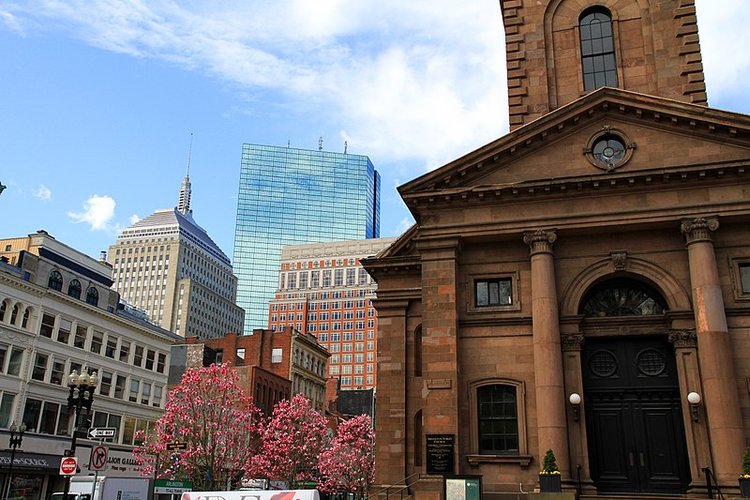
The Arlington Street Church, close to the headquarters of The Boston Guardian. The church used to be jokingly called "The Unitarian Vatican''.
GoLocalProv seeks to hire political reporter
GoLocalProv.com, part of GoLocal24.com, has an opening for a reporter.
GoLocalProv.com is Rhode Island’s largest local all-digital news site. It’s seeking a journalist ready to jump in and cover one of the most dynamic beats in America — the Rhode Island political scene.
This position is the perfect job for those looking to do significant journalism in a state that loves politics.
A year or more of reporting experience at a daily or weekly publication is preferred, but other smart people with a commitment to excellence will also be considered.
Photography and video experience is a big plus.
Must be comfortable using social media to promote stories.
Must be self-motivated, innovative and creative.
Must be able to manage multiple daily deadlines and other priorities while maintaining professionalism in the workplace.
Must possess a bachelor’s degree in journalism or related fields and/or experience as a working journalist.
The position offers a competitive salary, and benefits, vacation, sick, holiday pay.
To apply, please email a cover letter, resume and three or four work samples that demonstrate your talent to info@GoLocalProv.com.
GoLocal24 is a drug-free workplace, and all applicants for employment may be asked to pass a post-offer drug screen and a background check before starting employment. We are an equal-opportunity employer.
Don Pesci: No, Columbus was not a fascist
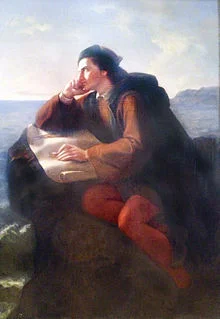
The Inspiration of Christopher Columbus, by José María Obregón, 1856.
“Authorities say the statues [of Christopher Columbus] at Harbor Park in Middletown {Conn.} and Wooster Square in New Haven were vandalized overnight Saturday. The paint has been cleaned up,'' from the Associated Press.
On Aug. 21, The Baltimore Sun reported that a monument to Christopher Columbus had been vandalized by vandals, a perfect word to describe the members of Antifa, a group that claims to be anti-fascist, but does not scruple to employ the methods of fascists, including the beating of non-violent protesters by masked, black-clad brownshirts.
Columbus, we may state with certainty, was not a fascist. We know this because fascism dates from Mussolini’s reign in Italy, well after Columbus sailed the ocean blue in 1492. Neither did Columbus approve of slavery; nor did his patrons, King Ferdinand and Queen Isabella. According to a story printed in The Hill, a Washington, D.C., publication, “it was Spain that forbade slavery of most Native Americans and made them Spanish citizens.”
The Hill also noted “that Columbus seems to have faced arrest by his fellow explorers for punishing — even executing — those who had abused Native Americans.” The zealot “most often cited in smearing Spanish exploration and with it Columbus,” The Hill noted, was “Bartolome De Las Casas … the one who proposed African slavery for the New World.”
One can’t expect members of Antifa, an anarco-Marxist movement, to take notice of such exculpatory data before they deface statues or infiltrate peaceful protests for the purpose of creating havoc and suppressing free speech. Nihilists and anarchists are not likely to be dissuaded by sweet reason, which appears to infuriate them. The defacement of the Columbus monument in Baltimore was recorded on YouTube by the defacer for posterity and the delectation of his fellow brownshirts.
While falsely claiming to be anti-fascist, Antifa effortlessly bridges Marxism and fascism. Fascism, like anarchism and nihilism, is ungoverned dynamism. It is pure spirit, void of reason, murderously directed to an end – the destruction of life, property and culture.
As early as 1914, Albert Camus tells us in his book The Rebel, Mussolini “proclaimed the ‘holy religion of anarchy,’ and declared himself the enemy of every form of Christianity.” Camus adds, “Men of action, when they are without faith, never believe in anything but action… To those who despair of everything” – here Camus had in mind post World War I Germany – “not reason, but only passion, can provide a faith.” Dynamism for dynamism’s sake is an act of contempt for both past and future. Camus again: “Fascism is an act of contempt, in fact. Inversely, every form of contempt, if it intervenes in politics, prepares the way for, or establishes, Fascism.”
Columbus and those who still admire him, while conscious of the defects he shared with his own age, can never be friendly toward the Ku Klux Klan The fury of the KKK was of course directed pitilessly at African-Americans. But the KKK was also contemptuous of Jews and Catholics, and this boundless contempt was expressed in violent acts against the faith of non-Protestants who were not Anglo Saxon. The African American Antifa enthusiast who destroyed the Baltimore statue of Columbus was, by his act of contempt, marching hand in hand with the Ku Klux Klan.
Bill DeBlasio, the mayor of New York City, still teeming with Italian-Americans, is considering removing a statue of Columbus in Columbus Circle. That monument was dedicated in 1941, 50 years after the largest mass lynching in U.S. history. The lynching of 11 Italian Americans occurred after a trial in which 19 Sicilians had been indicted in the murder of New Orleans Police Chief David Hennessy. The jury regarded the evidence presented at trial as highly suspect and insufficient. Six defendants were acquitted and a mistrial was declared for the remaining three because the jury failed to agree on their verdicts. A mob incited by a lawyer, William Parkerson, and led by John Wickliffe, editor of the New Delta newspaper, advanced on the prison shouting “We want the Dagoes!” and murdered the exonerated Sicilians.
Some newspapers of the day approved the vigilante injustice. The New York Times, covering itself in blood and shame, editorialized, “These sneaking and cowardly Sicilians, the descendants of bandits and assassins, who have transported to this country the lawless passions, the cut-throat practices, and the oath-bound societies of their native country, are to us a pest without mitigation. Our own rattlesnakes are as good citizens as they... Lynch law was the only course open to the people of New Orleans.”
The modern descendants of the lynch mob – including, anti-capitalist Marxists, anarco-fascists, the KKK and Antifa – have now taken to lynching statues of Columbus, erected in part as a rebuke to lawless anarchy and the terrible silence surrounding the hateful prejudices that make lynching possible. Silence in the face of anarchy and cultural dissolution is itself an approval of anarchy and cultural disintegration. In an anarchic universe, we have nothing to lose -- but everything.
Don Pesci is a Vernon, Conn.-based columnist,
Institutionalized clam bakes
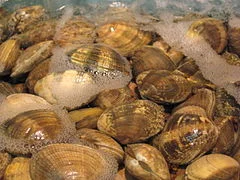
"People all over New England, of course, have always baked clams on the beach -- built a fire of hardwood over stones that will retain the heat, then piled on four or five inches of rockweed that pops and sizzles as it steams -- but the custom seems particularly institutionalized around Providence .... Around Narragansett Bay...the tradition of clam bakes seems to have outlasted the clams.''
-- Calvin Trillin in his 1994 book The Tummy Trilogy
Corny Yankee folk marketing
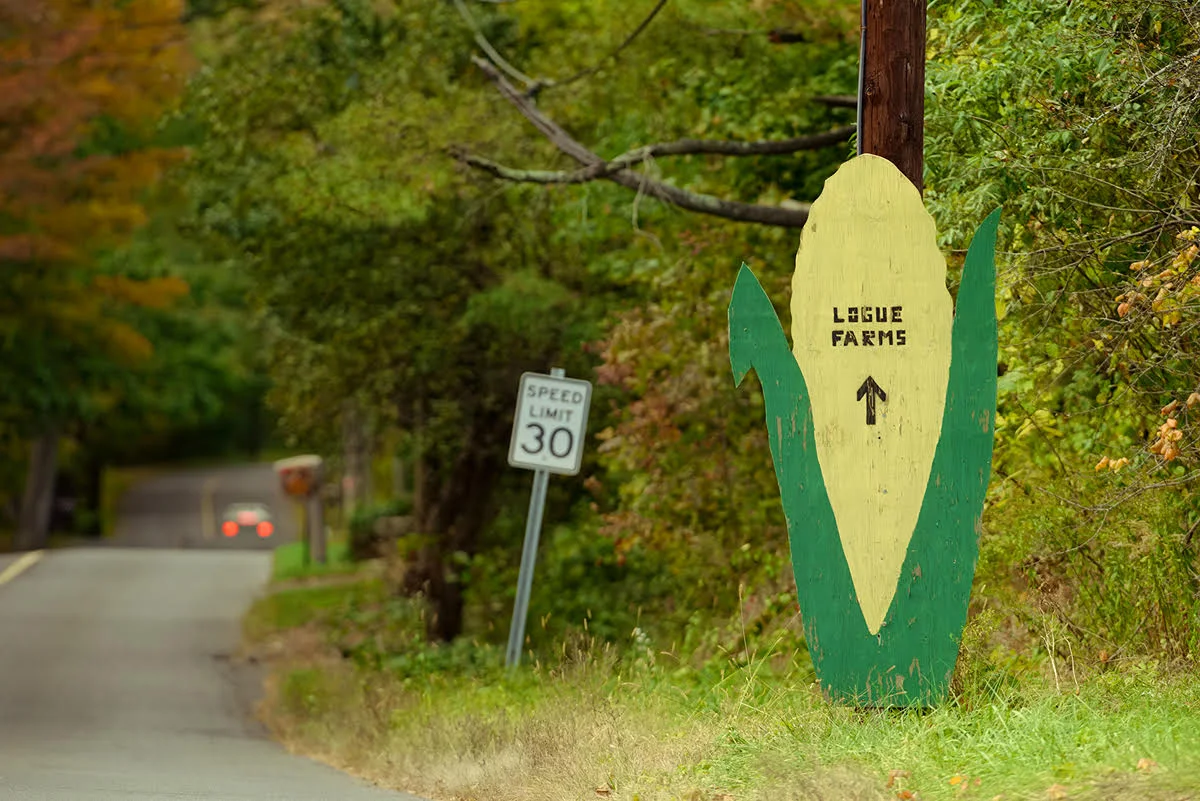
An example of Yankee folk marketing in northern Woodbury, Conn., the other day. The photographer, Thomas Hook, a distinguished wildlife photographer, based in Southbury, Conn., notes sadly that the annual weeks of enjoying delicious sweet corn on the cob are nearing the end for this year.