Llewellyn King: I remain a lover of riding the rails, even Amtrak with its frustrations
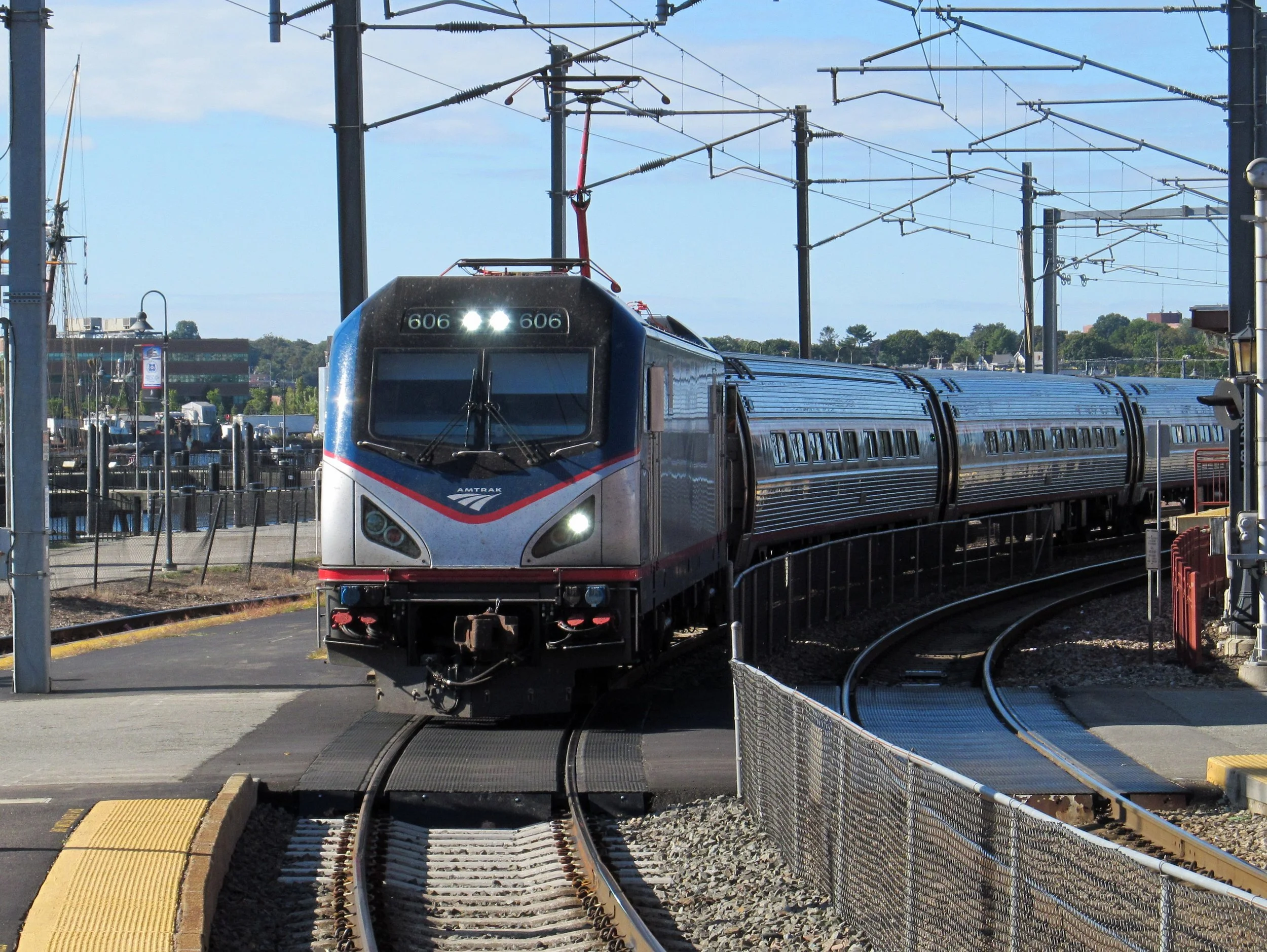
A Northeast Regional train, with an ACS-64 locomotive and Amfleet I passenger cars, at New London, Connecticut’s Union Station.
— Photo by Pi.1415926535
This is being written on Amtrak’s Northeast Regional Train 171, in coach, en route from Providence to New York. I am in my happy place.
I am a trainman. Given a choice, I would ride the rails over any other mode of transport — except flying when I owned a plane.
Something happens to me when the train pulls out of the station. I get a sense of well-being.
Rail travel does things for my soul, puts me into a place of euphoric comfort. Everything becomes possible; things are good and may get better.
Ships do something similar — not cruise liners but ships going somewhere; ships providing transportation not geared to escapism, working ships.
I can trace my train addiction to a journey when I was 5 years old. It was the longest train trip ever and I wouldn’t care to repeat it, although it was the greatest: the adventure of adventures.
It was a train trip from Cape Town, South Africa to Salisbury, Southern Rhodesia (now Harare, Zimbabwe). It took six days; it was a long, long time on the train.
The distance from Cape Town to Harare is slightly over 1,500 miles, but the train wound through endless miles of desert in what was then Bechuanaland (now Botswana) and stopped for long periods for water.
It was, of course, a steam train and steam engines are big, beautiful, thirsty monsters. They could carry enough coal for a fair distance of travel, but water was essential and pumping in remote stretchers of the Kalahari Desert was a slow business, and at times the pumps had to be operated by hand. That could mean hours to water the engine.
But as someone said to me years later, “There is plenty of time in Botswana.”
Later, I would ride an overnight train from Salisbury to Umtali (now Mutare, Zimbabwe) to supervise the production of a newspaper. I rode second class and usually shared a carriage with another man, and sometimes a third and a fourth. As a teenager, I thought of those long discussions through the night as my university.
More steam trains in England, but much faster. The British steam locomotives, before the switchover to diesel, scooped up water from open rail-side troughs as they rushed by at speeds of up to 100 miles per hour.
My work took me weekly by train to Scotland or the North of England, and at times to the Midlands. Those trips were always an adventure in the people I talked to, the great meals on board, and the wonder of falling asleep to the click-clack of the rails.
I took the overnight train to France, before the Channel Tunnel, when the train would leave London, make its way to the coast, be loaded in the dead of night onto a steamer, and continue in France the next day. Good night in England and bonjour in France.
In the 1960s, you could still take a sleeper train from Washington to New York. It isn’t very far and doesn’t require a sleeper, but many took it because it was fun and saved a stay in a hotel in New York. Now Amtrak will get you there in three hours, no muss, no fuss, no romance.
I have train-traveled in Russia, Belgium, the Czech Republic, France, Slovakia, Spain, Sweden and Switzerland, and I am frequently on Amtrak’s Northeast Corridor trains. Amtrak’s on-train service is excellent, with courteous and helpful conductors, but booking tickets on its site requires an AI agent or a tech-savvy kid to fathom.
Twice this year, as my wife and I were heading from Washington to Rhode Island on the last Northeast Regional train of the day, we were told that the train would “terminate” in New York, due to a problem on the line north of the city. Things do happen in train travel.
Both times, Amtrak failed to offer any suggestion as to how the stranded passengers might finish their journeys. Many of the stranded were students and people who couldn’t afford a New York hotel room or rent a car. Quite a few of the stranded didn’t speak English very well.
In the first stranding, we were warned by the sole representative Amtrak had helping abandoned passengers at the Moynihan Train Hall, in New York, that not everyone would be able to get the first train out in the morning or the second. He said graciously that our original tickets would be honored on whichever train we were able to continue our journey north.
On neither occasion did we wait for Amtrak’s gracelessness to play out: We took an Uber home on the first, and a Lyft (a bit cheaper) on the second. For each road trip home, we paid, with tips, over $600.
But I am a constant lover, and I am still riding the rails. Happy man typing!
Llewellyn King is executive producer and host of White House Chronicle, on PBS. His email is llewellynking1@gmail.com and he he’s based in Rhode Island.