
Vox clamantis in deserto

Todd McLeish: In R.I. monarchs resurging, other butterflies not

"Monarch Butterfly {No. 16} (watercolor,) by Titian Ramsay Peale, 1817, in the show "Flora/Fauna: The Naturalist Impulse in American Art,'' at the Florence Griswold Museum, Old Lyme, Conn.
Via ecoRI.org
Monarch butterflies have continued their resurgence in Rhode Island this year after a global decline in 2013, but overall populations of butterflies in the state appear to be declining slightly.
“The biggest factor this year was probably the long, wet spring we had,” said Marty Wencek, a biologist for the Rhode Island Department of Environmental Management and an avid butterfly observer for 55 years. “The wet weather can suppress the population when you have a lot of butterflies wintering as pupa and a lot of small caterpillars. Just like the gypsy moths got whacked by the wet weather, it can also affect other species.”
As if to emphasize the point, the first day of a two-day, statewide butterfly survey sponsored by the Audubon Society of Rhode Island was nearly rained out this year, resulting in fewer surveyors spending fewer hours searching for and counting fewer butterflies.
According to Jon Scoones, who coordinated the survey, 1,454 butterflies of 52 species were identified — a similar number of species but half of the individual totals of past years. Yet, there were still several notable highlights. Numbers of the tiny dun skipper, for instance, doubled compared to last year, while the even tinier sachem went from one in 2016 to 105 this year, almost all in Newport County.
Monarchs, which Scoones said “everyone uses as a litmus test,” increased from 29 to 134, mostly in the West Bay area of Narragansett Bay. Butterfly enthusiasts around the state have posted numerous photos on social media of monarch eggs, caterpillars and adults in recent weeks, many with messages claiming to feel a sense of relief that the butterflies appear to have rebounded.
On the other hand, survey results found the very common cabbage white to have declined from 638 to 243, and the popular pearl crescent dropped from 374 individuals to 78.
Of particular note, Scoones said, is that the number of variegated fritillaries, a southern species found fairly rarely in the state, increased this year, especially in the Big River area.
“I was heartened to see that the variegated fritillaries are coming up here, but I’m not sure if that’s a good thing or bad,” he said. “It’s nice to know that we’re having more butterflies in our area, but should it even be up here? I’m not sure. It might be here because of climate change.”
That may be the reason for increased sightings of other southern species as well, including zabulon skipper and red-banded hairstreak.
“They don’t really belong here, but everything from the south is trending in our direction,” Wencek said. “Why? Because it’s warmer.”
Some southern species aren’t accustomed to the winter cold of southern New England, however, and they become scarce following severe winters, like occurred in 2013. But others appear able to survive.
“A lot of factors affect butterflies,” Wencek said. “I always point to the wet spring when numbers are down, but I know there’s more to it than that, like habitat loss and pesticide use. Those are major factors, too.”
One thing Wencek and Scoones said that almost anyone can do to boost butterfly populations is to plant native flowers from which the adult insects can sip nectar, and plant the specific host plant that each species requires during its caterpillar stage.
“It definitely works,” Wencek said. “I planted hops, and it brought in question marks. I put in pipevine and we got a pipevine swallowtail laying eggs. You want black swallowtail? Plant parsley.
“These bugs are dependent on the host plant, so if climate change hinders that plant’s ability to thrive, it will hinder the ability of that butterfly to survive.”
While butterfly numbers appear to fluctuate widely from year to year, Wencek has observed a slight decline in overall numbers in recent years. It is especially noticeable with the very common species, which he said are still common but he is noticing fewer of them.
Looking to the future, he said Rhode Islanders should expect to see more and more butterfly species from the South making the Ocean State their summer home.
“Every year starting about now, we start getting exotic southern butterflies that fly north until they die, which is an interesting phenomenon,” he said. “We’ll start seeing more of those in the future. Some years you might not see a ton of them, but expect it to be a more common occurrence.”
Rhode Island resident and author Todd McLeish runs a wildlife blog.
Trying to rekindle lost wonder

"Regarder le silence'' (mixed media on canvas), by Eric Roux-Fontaine, in his Sept, 1-Sept. 30 show. "Souvenir du Futur,'' at M Fine Arts Galerie, Boston.
The gallery says that "the scenes {he depicts} are oc:urring in a world apart from ours. In a sense, they are, as we become increasingly detached from the nature around us. Roux-Fontaine describes his work as a 'modest attempt to recapture the enchantment of the world,' the enchantment that many of us have forgotten in the modern age. ''Souvenir du Futur'' aims to rekindle that lost wonder, and help us see the beauty in the world around us again.

Boston one of the biggest art-buying centers
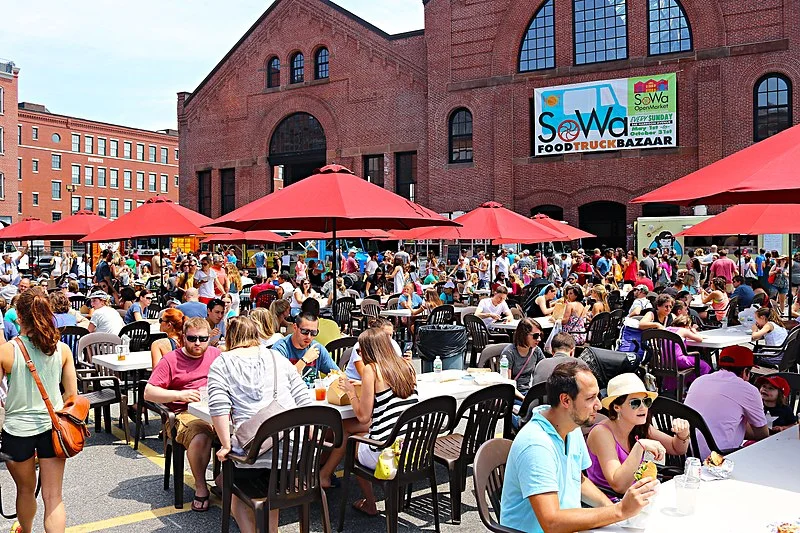
In the SoWa arts district in Boston.
Photo by Sowaboston
From Robert Whitcomb's Digital Diary in GoLocal24,com
Boston was one of the top 10 art buying cities in the U.S. last year, according to a new report by art marketplace Artfinder, the Boston Business Journal reported.
The paper reported that “’Boston is young, cultural and creative, plus it has great universities” Artfinder CEO Jonas Almgren said in an email. ‘We also have a lot of artists in Boston, and of course our customer hubs tend to grow in places where we have thriving artist communities.’’’
So maybe more RISD grads will stay in our area?
But the total dollar value of art buying is and will remain much higher in New York than Boston!
Artfinder’s surprising top 10 list of U.S. cities is below, with each number representing the number of art buyers per million inhabitants in 2016:
Tallahassee (1,303)
New Haven (953)
Anaheim, Calif. (842)
Tampa (789)
Raleigh, N.C. (770)
San Francisco (726)
Miami (620)
Austin (592)
Santa Monica, Calif. (578)
Boston (572
'An end to roaming'
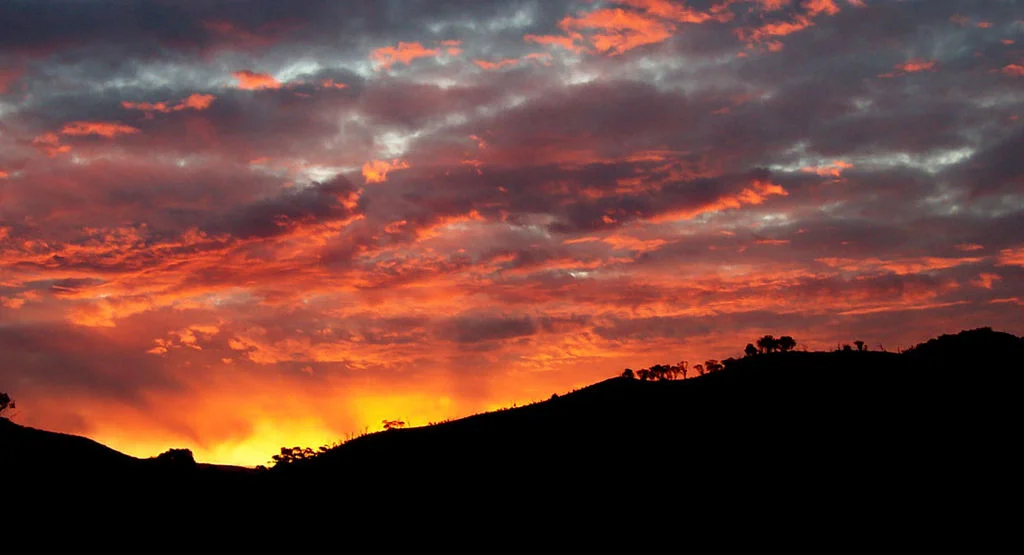
Photo by CC By-SA 3.0
When summer's end is nighing
And skies at evening cloud,
I muse on change and fortune
And all the feats I vowed
When I was young and proud.
The weathercock at sunset
Would lose the slanted ray,
And I would climb the beacon
That looked to Wales away
And saw the last of day.
From hill and cloud and heaven
The hues of evening died;
Night welled through lane and hollow
And hushed the countryside,
But I had youth and pride.
And I with earth and nightfall
In converse high would stand,
Late, till the west was ashen
And darkness hard at hand,
And the eye lost the land.
The year might age, and cloudy
The lessening day might close,
But air of other summers
Breathed from beyond the snows,
And I had hope of those.
They came and were and are not
And come no more anew;
And all the years and seasons
That ever can ensue
Must now be worse and few.
So here's an end of roaming
On eves when autumn nighs:
The ear too fondly listens
For summer's parting sighs,
And then the heart replies.
-- From ''Last Poems,'' by A.E Housman
But you end up on the ground

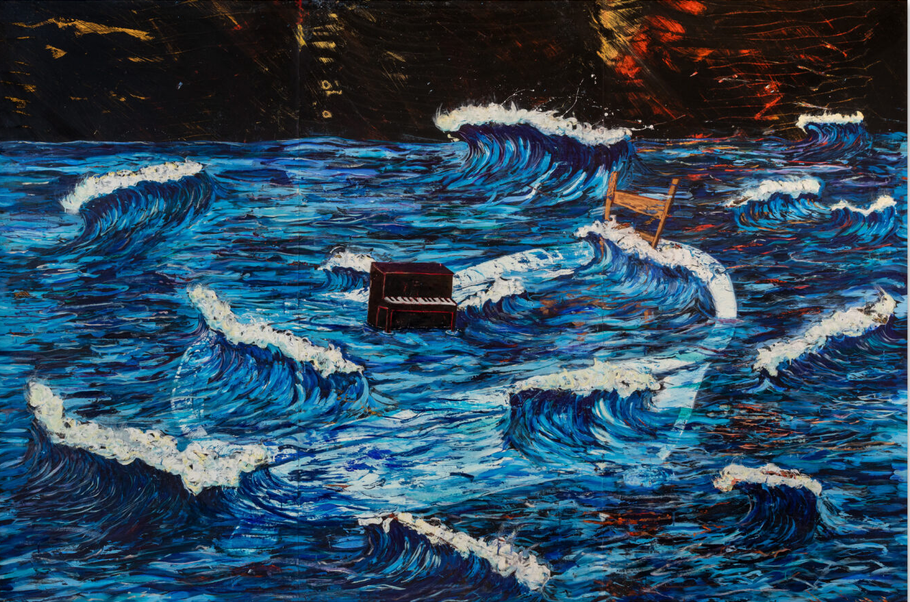
"Updraft'' (acrylic on linen), by Dozier Bell, in his show at Corey Daniels Gallery, Wells, Maine, through Sept. 9.

Michele Perkins: Small colleges can still prosper
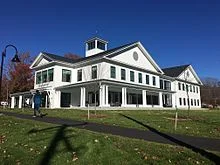
The John Lyons Academic Center on the New England College campus.
Via the New England Board of Higher Education (nebhe.org)
In New England and in several other regions of the country, it’s only natural to be concerned about the fiscal challenges confronting our nation’s private colleges and universities. Forecasts by prominent higher education experts increasingly suggest that many, if not most, of our small private institutions will face closure in the decade ahead. However, Inside Higher Ed recently reconsidered this angle in a piece titled “Healthier Than Imagined?” The article profiles a recently released research report commissioned by the Council of Independent Colleges (CIC) and concludes that the projected demise of small, private colleges may, in fact, be overblown.
New England College (NEC), which was mentioned in the Inside Higher Ed article, contradicts the assertion that most, if not all, small, tuition-dependent liberal arts colleges are failing. Our college is succeeding in this economy and experiencing substantial budget surpluses. At a time when many institutions are struggling to balance their budgets, NEC will post an unrestricted operating surplus of about $800,000 for FY2017 on an operating budget of $57 million. We anticipate growing that surplus to $1 million in the 2018 fiscal year.
While I’m happy to report these numbers, I unfortunately do not have any “secret sauce” recipe to share about how we are doing this in very challenging times and in an era of severely declining demographics. Honestly, the short answer to our success can be described in a few phrases: We are creative; we are unafraid to embrace change and to change in major ways; we are open to intelligent risk-taking; and we are willing to put in the time and effort to make it happen. Everyone at the college shares these values; everyone must share these values to succeed.
We also are clear on what is timeless and not up for modification or elimination— such as the liberal arts. I firmly believe you can do both–embrace innovation and remain faithful to the liberal arts—and we are here to prove it. At NEC, we plan to grow our traditional residential undergraduate enrollment from an expected 1,060 this fall to 1,500 over the next several years—during a period of declining K-12 enrollments (estimated as high as 15% over the next decade by the National Center for Education Statistics). New England College’s enrollment trends project growth, not decline.
NEC’s residential, undergraduate programs don’t currently pay for themselves; operating surpluses are driven by other programs such as online education and graduate programs, which push total enrollment to about 2,700. We know that our traditional undergraduate programs must grow to about 1,300 students to break even financially. To grow our undergraduate numbers in the face of declining high school populations, we looked outside our region.
New England College recruits in secondary markets including New York City and all the Mid-Atlantic states, and we are developing markets in western and southern states. In recent years, we have seen increased enrollment and, with over 35% of our residential undergraduate students from underrepresented populations, NEC now has the largest diversity percentage of any college or university in New Hampshire–public or private.
A final note about enrollment size: The CIC report found that a group of the smallest private colleges—those with fewer than 1,000 students enrolled—have posted consistently weaker financial performance than larger peers through both good times and bad. The data consistently show that if an institution has enrollment under 1,000 students, then it is more difficult to keep the doors open. New England College recognized that there are many opportunities to provide a quality education beyond the traditional student population and crossed the 1,000-student threshold long ago.
As the Inside Higher Ed article correctly points out, NEC has kept its debt levels low, embracing a highly conservative debt strategy for many years and only taking on additional debt in the last few years. We have managed annual budgets conservatively, including leaving some faculty and staff positions unfilled in some years and offering voluntary retirement packages a few years ago, all this while meeting the public’s demand for new program offerings. We have learned to be “Yankee Frugal” in our budget, while also working to be resourceful and creative.
In this environment, some business and political leaders question the role of the liberal arts in this changing economy. While we recognize and actively promote the need for “real-world” learning, we remain undeterred in our belief that a well-rounded education will best serve students as they progress through multiple projected career paths, often in jobs that don’t yet exist. Other concerns also include the evolving policy on immigration that may hurt institutions’ ability to enroll the international students that have increasingly become a financial lifeline.
If we enrolled only traditional, residential undergraduates—with all the services we provide, it would simply not be viable. Given the volatility of higher education enrollment markets, changing student preferences, economic shifts and changing demand for various course offerings, flexibility is essential. We are also struggling to deal with our "discount rate"—the amount colleges increasingly reduce tuition through scholarships in order to attract students without causing inappropriate levels of student debt.
It hasn’t been easy, but flexibility of courses, a variety of delivery modes, online opportunities, competitive scholarships, smart marketing and being open to innovative ideas provide a model that allows us to serve NEC students and meet our academic purpose and mission.
Michele Perkins is president of New England College, in Henniker, N.H., with a total of about 2,700 undergraduate and graduate students.
Jill Richardson: 'Win' hungry Trump is now making a mess of National Parks, too

Via OtherWords.org
By most measures Donald Trump’ has had an ineffective presidency.
If you oppose his agenda, as I do, this is no doubt a good thing. Like countless others, I rely on Obamacare for my health insurance. I sleep soundly at night only because Trump and congressional Republicans failed in their attempts to take my insurance away.
But, while Trump spews verbal diarrhea at press conferences, refuses to denounce Nazis, fires and replaces half of his top appointees, and attempts to convince us he didn’t collude with the Russians, there’s one area in which he’s getting a few things done.
While Trump cannot single-handedly pass new laws, he can alter the policies within the executive branch of the government. And that’s what he’s been doing.
Even as we’ve been distracted by Russia investigations and Nazis, Trump managed to find the time in between his busy golfing and cable TV watching schedule to trash a few Obama-era environmental programs.
To take one petty example, he eliminated a ban on plastic water bottles in National Parks.
Surely that’s less significant than other Obama policies he’s undone, like pulling out of the Paris Climate accord. But it speaks to two facets that have become clear in Trump’s presidency.
First, Trump’s guiding policy goal appears to be demolishing everything that Obama did.
Did Obama do it? OK, undo it. Was Obama for it? Trump’s against it. Down to the minute details, like a local D.C. bike-share station Trump had removed from outside the White House. (Apparently White House commuters used it during the Obama administration.)
Second, those who work with Trump say he wants to “win.” Of course, everybody likes to win. But most politicians have deep convictions that the policies they advocate will benefit the nation in some way, and they want to win in order to better the country.
Sometimes it seems like Trump just wants to win because he wants to win. And, in part, he wants to do it by undoing Obama’s legacy.
True, his poll ratings are extremely low. Perhaps that’s why he continues to have rallies — not because he needs voters to turn out to any upcoming election, but because he enjoys having his ego stoked by thousands of screaming acolytes.
It’s why he fixates on cable news, and sends off nasty tweets about anyone who says anything negative about him. And it’s why his staff has to give him a folder of positive news about himself twice a day — to keep him from typing uncensored tweets that harm his image and his agenda.
Trump’s presidency may eventually self-destruct if he continues going in the same direction. But in the meantime, how much harm will he do?
Being against everything Obama was for, and undoing everything Obama did, will result in making some poor decisions.
Banning bottled water from national parks was never going to get rid of all plastic waste. It wasn’t even going to get rid of all of the plastic waste in the parks themselves. But it would’ve at least removed the most unnecessary waste.
Many of our parks are in remote areas, and handling their garbage requires some finesse to avoid harming wildlife. So reducing waste in the parks can help preserve these precious places Americans love. Bringing or buying a reusable bottle is a small sacrifice to help protect a place you care about for the next generation.
With his hands tied in other areas by a dysfunctional Congress, low approval ratings, high staff turnover, and ongoing scandals, Trump is turning his drive to win for the sake of winning into the small petty victories he can achieve — and in this case, our national parks paid the price.
Jill Richardson is the author of Recipe for America: Why Our Food System Is Broken and What We Can Do to Fix It.
Early-warning system

Male katydid, aka bush cricket.
''{W}e know that once he (a katydid) has started to sing, the day is not far off when we shall hear the last hardy individual of his species, barely able to shake off the numbing effects of cold, dragging out a few last chirps. His first song is, for us if not for him, less the beginning of something than a warning that a season is getting near its end.''
--Joseph Wood Krutch, in "The Twelve Seasons''
Past possibilities
"Nine drops of water bead the jessamine,
And nine-and-ninety smear the stones and tiles:
- 'Twas not so in that August full-rayed, fine
When we lived out-of-doors, sang songs, strode miles.
Or was there then no noted radiancy
Of summer? Were dun clouds, a dribbling bough,
Gilt over by the light I bore in me,
And was the waste world just the same as now?
It can have been so: yea, that threatenings
Of coming down-drip on the sunless gray,
By the then possibilities in things
Were wrought more bright than brightest skies to-day.''
-- "A Wet August,'' by Thomas Hardy
Sealing off the shore
From Robert Whitcomb's "Digital Diary,'' in GoLocal24.com:
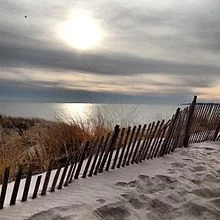
New Englanders are not unfamiliar with the phenomenon of rich people sealing off access to beaches in front of their big houses and estates. It’s outrageous that they do but the rise of an increasingly arrogant plutocracy means that we’re seeing more such seizures of the public commons. So it was gratifying to read about a victory, though perhaps a tentative one, in California, where a three-judge state appeals court has ruled that Vinod Khosla, a billionaire co-founder of Sun Microsystems, can’t block access to a popular strip of beach south of San Francisco; he owns 89 acres behind the beach.
This may go up to the U.S. Supreme Court. God help us.
California has generally been much more supportive of the public’s right of access to the shore than have the New England states, where it has long been very difficult to get to the shore in many communities, in some places because of laws that go back to colonial days.
UNH, NOAA expanding ocean-mapping center

Seafloor map of southern Indian Ocean.
This is from the New England Council (newenglandcouncil.com)
"NEC member the University of New Hampshire (UNH) — in partnership with the National Oceanic and Atmospheric Administration (NOAA) – is expanding its Center for Coastal and Ocean Mapping and Joint Hydrographic Center by adding nine additional labs, offices, and an amphitheater. The joint UNH-NOAA initiative was established in 2000 with the goal of mapping the worldwide ocean floor.
"Students and scientists at the center on UNH’s Durham campus monitor live streams from ships that are collecting data of ocean floor, track fish and whale patterns, and create 3D prototypes. Currently, only 11% of the ocean’s 140 million square mile floor is mapped and internationally, scientists aim to complete a map of the ocean floor in the next thirteen years to ensure ships can safely navigate the ocean by being aware of any potential hazards below them. The center is home to 25 students and scholars from around the world who work with both the private sector and government agencies to achieve that goal.
'''I’ve always wanted to explore the ocean for as long as I can remember. We have better maps of the moon than we do of the ocean,' said UNH student Victoria Dickey during U.S. Rep. Carol Shea-Porter’s recent visit to the center.''
To read more, hit this link.
N.H. 'doesn't fit in'
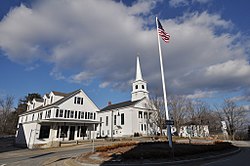
Downtown Dublin, N.H.
"There's little question that Vermont (particularly Vermont), Maine, Boston, and Cape Cod, are, together, responsible for the New England image. New Hampshire just doesn't fit in.''
-- Judson D. Hale, Sr. in "Vermont vs. New Hampshire,'' American Heritage (magazine), April 1992.
Mr. Hale was the long-time editor of Yankee magazine, based in Dublin, N.H., in the "Currier & Ives Corner'' of the Granite State. Dublin, said to be the highest town in New England, perched as it is on Beech Hill, looks like most Americans' idea of a small New England town.
Session for N.E. firms interested in boosting their exports
This is from the New England Council:
"On Sept. 7, 2017, The New England Council – in partnership with a number of other regional business associations–will host a special event highlighting the federal government resources available to New England businesses interested in increasing exports, as well as accessing and investing in foreign markets.
"The event will feature presentations and a panel discussion with representatives of several key federal agencies who support U.S. trade activity:
"James Cox – Northeast Regional Director at the Commercial Service, U.S. Department of Commerce.
"Paul Marin -Director for Partnership and Innovation at the U.S. Trade and Development Agency (USTDA).
"Richard Pearson -Business Development Officer at the Export-Import Bank of the U.S. (Ex-Im Bank).
"Julia Robbins – Director, Structured Finance and Insurance at the Overseas Private Investment Corporation (OPIC).
"The event will take place from 12 – 2 p.m. at the Hampshire House in Boston. If you have questions or would like more information, please contact Taylor Pichette (tpichette@newenglandcouncil.com) or Peter Phipps (pphipps@newenglandcouncil.com).''.
Cat boat at rest
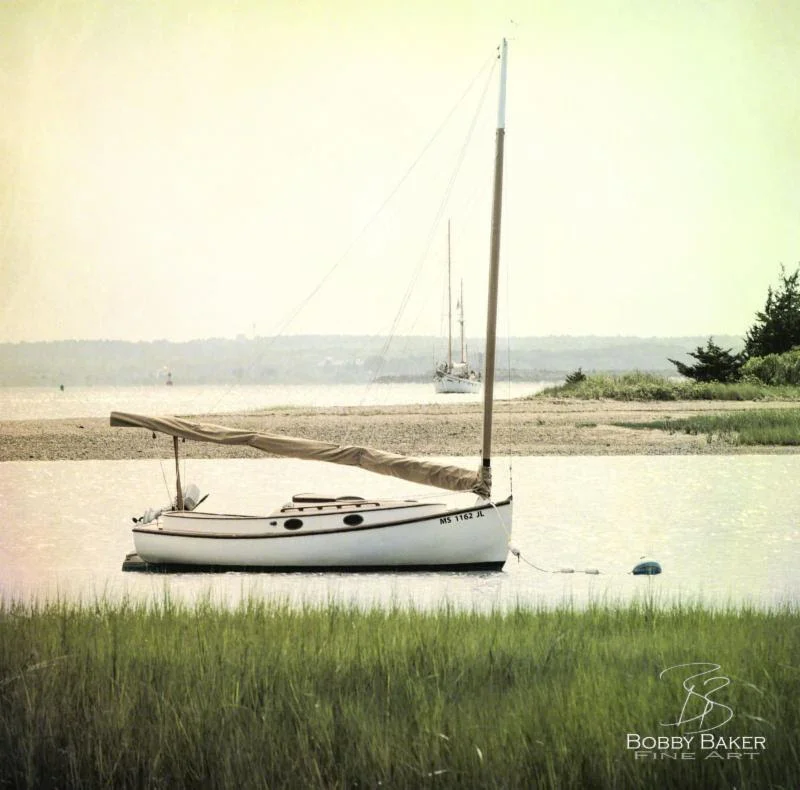
"Pocasset (Mass.) Sunday'' (metal print), by Bobby Baker. Copyright Bobby Baker Fine Art Photography.
What's the 'American Dream'?
From Robert Whitcomb's "Digital Diary,'' in GoLocal24.com
The economist Robert J. Shiller, a Nobel laureate, had a thoughtful essay in the Aug. 6 New York Times headlined “The Transformation of the ‘American Dream’’. In it he provided a corrective to the idea, promoted by politicians going back at least to Ronald Reagan’s presidency and especially by Donald Trump, that it’s all about money. It's not surprising that Trump, with his vast, showy materialism (want some fake-gold faucets anyone?) would present the “American Dream’’ as all about fancy houses and earning millions.
Rather, Mr. Shiller reports, the term more traditionally referred to “freedom, mutual respect and equality of opportunity. It had more to do with morality than material success.’’
The phrase “The American Dream" was coined by popular historian (and prosperous former Wall Streeter) James Truslow Adams in his 1931 book The Epic of America. He described the American Dream as "that dream of a land in which life should be better and richer and fuller for everyone, with opportunity for each according to ability or achievement. It is a difficult dream for the European upper classes to interpret adequately, and too many of us ourselves have grown weary and mistrustful of it. It is not a dream of motor cars and high wages merely, but a dream of social order in which each man and each woman shall be able to attain to the fullest stature of which they are innately capable, and be recognized by others for what they are, regardless of the fortuitous circumstances of birth or position."
A tad different than Trump’s “The American Dream is back’’ remarks in January, which included “We are going to create an environment for small business like wehaven’t seen in many decades. So essentially, we are getting rid of regulations to a massive extent, could be as much as 75 percent.’’ Well, there may well be far too many regulations, but getting rid of 75 percent of them is unlikely to put us on the broad sunlit uplands of the American Dream, especially ones aimed at protecting public health and safety.
'The blue's worn out'
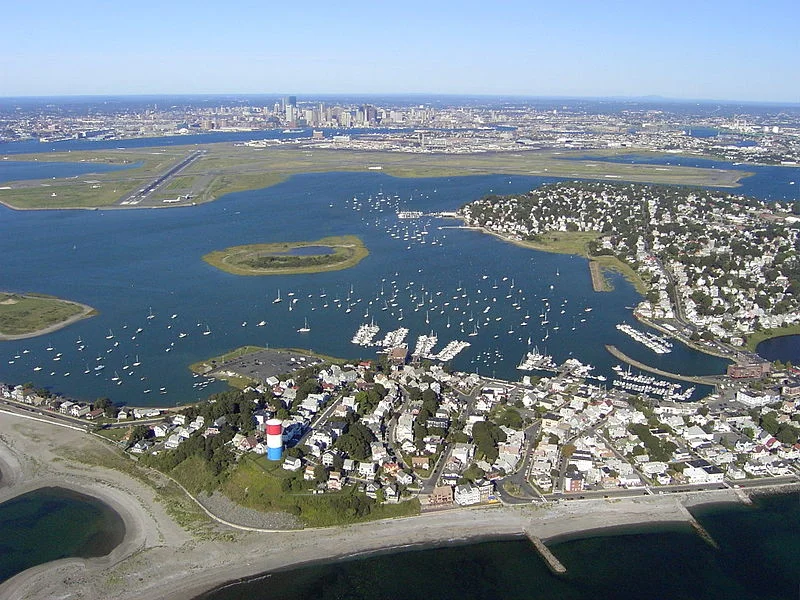
Looking south from Winthrop toward Boston.
"Fifteen years between me and the bay
Profited memory, but did away with the old scenery
And patched this shoddy
Makeshift of a view to quit
My promise of an idyll. The blue's worn out:
It's a niggard estate,
Inimical now. The great green rock
We gave good use as ship and house is black
With tarry muck''
-- From "Green Rock, Winthrop Bay,'' by Sylvia Plath
'Old-worn-down' New England
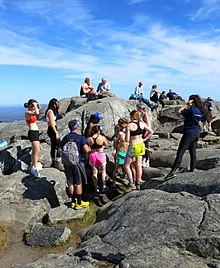
On the rocks at the summit of Mt. Monadnock, in southern New Hampshire in high summer.
''New England has had a long history, not only in relation to the nation of which she is part, but also in relation to the history of the planet. The folded and faulted rocks that form her bony structure are so ancient that their exact history has not yet been fully deciphered; but most of us know them at least vaguely as examples of 'old-worn-down mountains' in the contrast to the 'young-rugged-mountains' of the West. The marks of the last wave of glacial ice, on the other hand, are clear and fresh, and lie about us everywhere. Once one learns to see them, the glacier seems a very real and tangible thing, and twelve thousand years since the ice disappeared become as the twinkling of an eye.''
--- From The Changing Face of New England, by Betty Flanders Thomson
Making 'one's own masculinity'
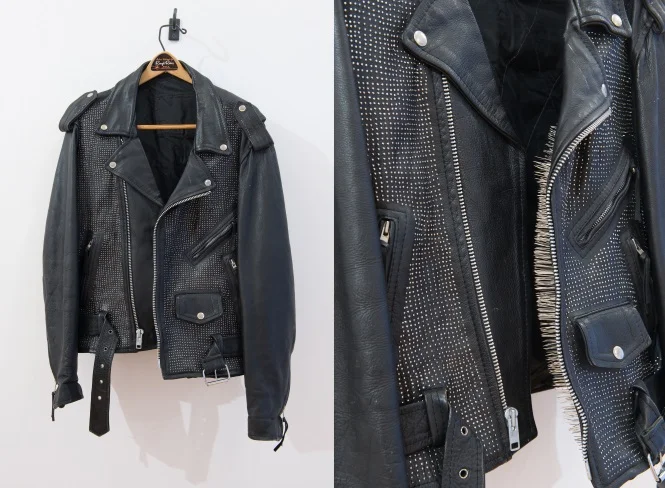
"Calice,'' (vintage motorcycle jacket, vintage hanger, wire), by Caleb Cole, in the group show "Made Masculine,'' Aug. 30- Oct. 15, at the Museum of Art at the University of New Hampshire, Durham. The museum says: "The thirteen contemporary artists in this exhibition accept the framework that masculinity is made, fashioned, and modified generation to generation. Selected works of art explore the artifice of masculinity through themes such as strength, desire, and intimacy while posing the question: What does it mean to be made masculine or to make one’s own masculinity?'