
Vox clamantis in deserto





Jill Richardson: 'Win' hungry Trump is now making a mess of National Parks, too
Via OtherWords.org
By most measures Donald Trump’ has had an ineffective presidency.
If you oppose his agenda, as I do, this is no doubt a good thing. Like countless others, I rely on Obamacare for my health insurance. I sleep soundly at night only because Trump and congressional Republicans failed in their attempts to take my insurance away.
But, while Trump spews verbal diarrhea at press conferences, refuses to denounce Nazis, fires and replaces half of his top appointees, and attempts to convince us he didn’t collude with the Russians, there’s one area in which he’s getting a few things done.
While Trump cannot single-handedly pass new laws, he can alter the policies within the executive branch of the government. And that’s what he’s been doing.
Even as we’ve been distracted by Russia investigations and Nazis, Trump managed to find the time in between his busy golfing and cable TV watching schedule to trash a few Obama-era environmental programs.
To take one petty example, he eliminated a ban on plastic water bottles in National Parks.
Surely that’s less significant than other Obama policies he’s undone, like pulling out of the Paris Climate accord. But it speaks to two facets that have become clear in Trump’s presidency.
First, Trump’s guiding policy goal appears to be demolishing everything that Obama did.
Did Obama do it? OK, undo it. Was Obama for it? Trump’s against it. Down to the minute details, like a local D.C. bike-share station Trump had removed from outside the White House. (Apparently White House commuters used it during the Obama administration.)
Second, those who work with Trump say he wants to “win.” Of course, everybody likes to win. But most politicians have deep convictions that the policies they advocate will benefit the nation in some way, and they want to win in order to better the country.
Sometimes it seems like Trump just wants to win because he wants to win. And, in part, he wants to do it by undoing Obama’s legacy.
True, his poll ratings are extremely low. Perhaps that’s why he continues to have rallies — not because he needs voters to turn out to any upcoming election, but because he enjoys having his ego stoked by thousands of screaming acolytes.
It’s why he fixates on cable news, and sends off nasty tweets about anyone who says anything negative about him. And it’s why his staff has to give him a folder of positive news about himself twice a day — to keep him from typing uncensored tweets that harm his image and his agenda.
Trump’s presidency may eventually self-destruct if he continues going in the same direction. But in the meantime, how much harm will he do?
Being against everything Obama was for, and undoing everything Obama did, will result in making some poor decisions.
Banning bottled water from national parks was never going to get rid of all plastic waste. It wasn’t even going to get rid of all of the plastic waste in the parks themselves. But it would’ve at least removed the most unnecessary waste.
Many of our parks are in remote areas, and handling their garbage requires some finesse to avoid harming wildlife. So reducing waste in the parks can help preserve these precious places Americans love. Bringing or buying a reusable bottle is a small sacrifice to help protect a place you care about for the next generation.
With his hands tied in other areas by a dysfunctional Congress, low approval ratings, high staff turnover, and ongoing scandals, Trump is turning his drive to win for the sake of winning into the small petty victories he can achieve — and in this case, our national parks paid the price.
Jill Richardson is the author of Recipe for America: Why Our Food System Is Broken and What We Can Do to Fix It.
Early-warning system

Male katydid, aka bush cricket.
''{W}e know that once he (a katydid) has started to sing, the day is not far off when we shall hear the last hardy individual of his species, barely able to shake off the numbing effects of cold, dragging out a few last chirps. His first song is, for us if not for him, less the beginning of something than a warning that a season is getting near its end.''
--Joseph Wood Krutch, in "The Twelve Seasons''

Past possibilities
"Nine drops of water bead the jessamine,
And nine-and-ninety smear the stones and tiles:
- 'Twas not so in that August full-rayed, fine
When we lived out-of-doors, sang songs, strode miles.
Or was there then no noted radiancy
Of summer? Were dun clouds, a dribbling bough,
Gilt over by the light I bore in me,
And was the waste world just the same as now?
It can have been so: yea, that threatenings
Of coming down-drip on the sunless gray,
By the then possibilities in things
Were wrought more bright than brightest skies to-day.''
-- "A Wet August,'' by Thomas Hardy

Sealing off the shore
From Robert Whitcomb's "Digital Diary,'' in GoLocal24.com:
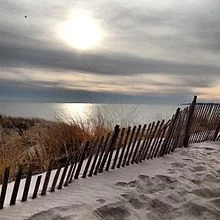
New Englanders are not unfamiliar with the phenomenon of rich people sealing off access to beaches in front of their big houses and estates. It’s outrageous that they do but the rise of an increasingly arrogant plutocracy means that we’re seeing more such seizures of the public commons. So it was gratifying to read about a victory, though perhaps a tentative one, in California, where a three-judge state appeals court has ruled that Vinod Khosla, a billionaire co-founder of Sun Microsystems, can’t block access to a popular strip of beach south of San Francisco; he owns 89 acres behind the beach.
This may go up to the U.S. Supreme Court. God help us.
California has generally been much more supportive of the public’s right of access to the shore than have the New England states, where it has long been very difficult to get to the shore in many communities, in some places because of laws that go back to colonial days.
UNH, NOAA expanding ocean-mapping center
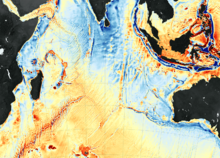
Seafloor map of southern Indian Ocean.
This is from the New England Council (newenglandcouncil.com)
"NEC member the University of New Hampshire (UNH) — in partnership with the National Oceanic and Atmospheric Administration (NOAA) – is expanding its Center for Coastal and Ocean Mapping and Joint Hydrographic Center by adding nine additional labs, offices, and an amphitheater. The joint UNH-NOAA initiative was established in 2000 with the goal of mapping the worldwide ocean floor.
"Students and scientists at the center on UNH’s Durham campus monitor live streams from ships that are collecting data of ocean floor, track fish and whale patterns, and create 3D prototypes. Currently, only 11% of the ocean’s 140 million square mile floor is mapped and internationally, scientists aim to complete a map of the ocean floor in the next thirteen years to ensure ships can safely navigate the ocean by being aware of any potential hazards below them. The center is home to 25 students and scholars from around the world who work with both the private sector and government agencies to achieve that goal.
'''I’ve always wanted to explore the ocean for as long as I can remember. We have better maps of the moon than we do of the ocean,' said UNH student Victoria Dickey during U.S. Rep. Carol Shea-Porter’s recent visit to the center.''
To read more, hit this link.
N.H. 'doesn't fit in'
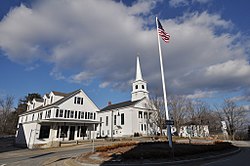
Downtown Dublin, N.H.
"There's little question that Vermont (particularly Vermont), Maine, Boston, and Cape Cod, are, together, responsible for the New England image. New Hampshire just doesn't fit in.''
-- Judson D. Hale, Sr. in "Vermont vs. New Hampshire,'' American Heritage (magazine), April 1992.
Mr. Hale was the long-time editor of Yankee magazine, based in Dublin, N.H., in the "Currier & Ives Corner'' of the Granite State. Dublin, said to be the highest town in New England, perched as it is on Beech Hill, looks like most Americans' idea of a small New England town.
Session for N.E. firms interested in boosting their exports
This is from the New England Council:
"On Sept. 7, 2017, The New England Council – in partnership with a number of other regional business associations–will host a special event highlighting the federal government resources available to New England businesses interested in increasing exports, as well as accessing and investing in foreign markets.
"The event will feature presentations and a panel discussion with representatives of several key federal agencies who support U.S. trade activity:
"James Cox – Northeast Regional Director at the Commercial Service, U.S. Department of Commerce.
"Paul Marin -Director for Partnership and Innovation at the U.S. Trade and Development Agency (USTDA).
"Richard Pearson -Business Development Officer at the Export-Import Bank of the U.S. (Ex-Im Bank).
"Julia Robbins – Director, Structured Finance and Insurance at the Overseas Private Investment Corporation (OPIC).
"The event will take place from 12 – 2 p.m. at the Hampshire House in Boston. If you have questions or would like more information, please contact Taylor Pichette (tpichette@newenglandcouncil.com) or Peter Phipps (pphipps@newenglandcouncil.com).''.
Cat boat at rest
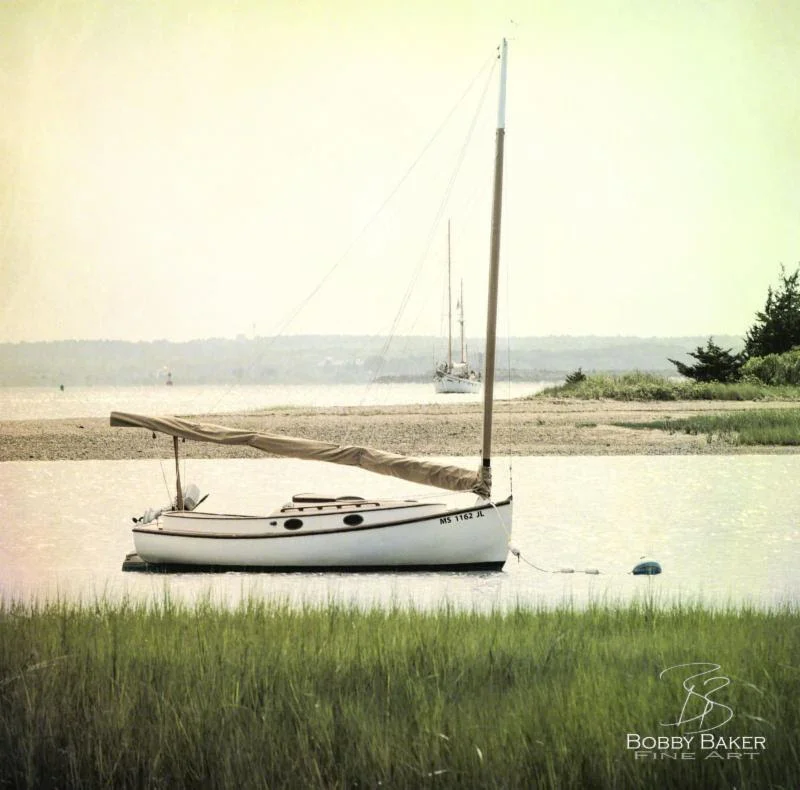
"Pocasset (Mass.) Sunday'' (metal print), by Bobby Baker. Copyright Bobby Baker Fine Art Photography.
What's the 'American Dream'?
From Robert Whitcomb's "Digital Diary,'' in GoLocal24.com
The economist Robert J. Shiller, a Nobel laureate, had a thoughtful essay in the Aug. 6 New York Times headlined “The Transformation of the ‘American Dream’’. In it he provided a corrective to the idea, promoted by politicians going back at least to Ronald Reagan’s presidency and especially by Donald Trump, that it’s all about money. It's not surprising that Trump, with his vast, showy materialism (want some fake-gold faucets anyone?) would present the “American Dream’’ as all about fancy houses and earning millions.
Rather, Mr. Shiller reports, the term more traditionally referred to “freedom, mutual respect and equality of opportunity. It had more to do with morality than material success.’’
The phrase “The American Dream" was coined by popular historian (and prosperous former Wall Streeter) James Truslow Adams in his 1931 book The Epic of America. He described the American Dream as "that dream of a land in which life should be better and richer and fuller for everyone, with opportunity for each according to ability or achievement. It is a difficult dream for the European upper classes to interpret adequately, and too many of us ourselves have grown weary and mistrustful of it. It is not a dream of motor cars and high wages merely, but a dream of social order in which each man and each woman shall be able to attain to the fullest stature of which they are innately capable, and be recognized by others for what they are, regardless of the fortuitous circumstances of birth or position."
A tad different than Trump’s “The American Dream is back’’ remarks in January, which included “We are going to create an environment for small business like wehaven’t seen in many decades. So essentially, we are getting rid of regulations to a massive extent, could be as much as 75 percent.’’ Well, there may well be far too many regulations, but getting rid of 75 percent of them is unlikely to put us on the broad sunlit uplands of the American Dream, especially ones aimed at protecting public health and safety.
'The blue's worn out'
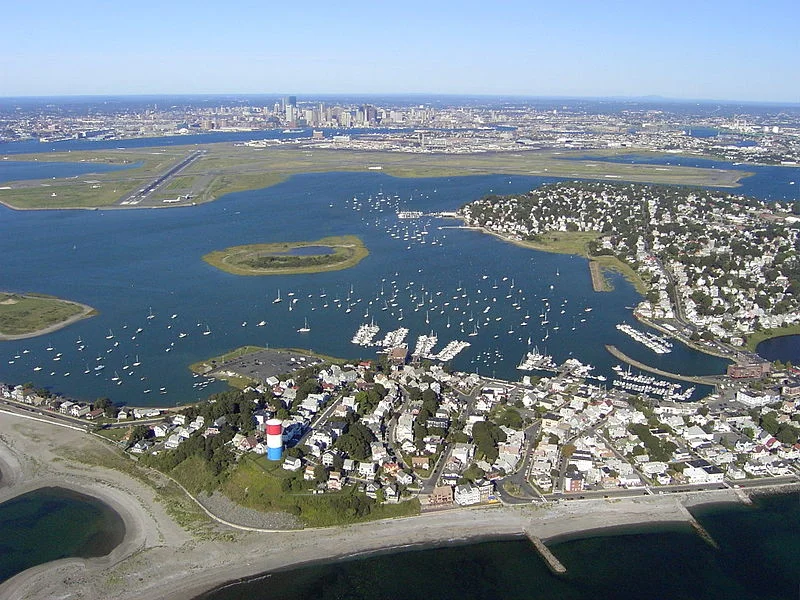
Looking south from Winthrop toward Boston.
"Fifteen years between me and the bay
Profited memory, but did away with the old scenery
And patched this shoddy
Makeshift of a view to quit
My promise of an idyll. The blue's worn out:
It's a niggard estate,
Inimical now. The great green rock
We gave good use as ship and house is black
With tarry muck''
-- From "Green Rock, Winthrop Bay,'' by Sylvia Plath
'Old-worn-down' New England
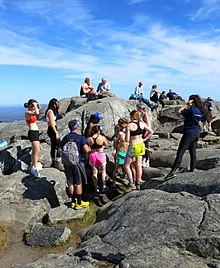
On the rocks at the summit of Mt. Monadnock, in southern New Hampshire in high summer.
''New England has had a long history, not only in relation to the nation of which she is part, but also in relation to the history of the planet. The folded and faulted rocks that form her bony structure are so ancient that their exact history has not yet been fully deciphered; but most of us know them at least vaguely as examples of 'old-worn-down mountains' in the contrast to the 'young-rugged-mountains' of the West. The marks of the last wave of glacial ice, on the other hand, are clear and fresh, and lie about us everywhere. Once one learns to see them, the glacier seems a very real and tangible thing, and twelve thousand years since the ice disappeared become as the twinkling of an eye.''
--- From The Changing Face of New England, by Betty Flanders Thomson
Making 'one's own masculinity'

"Calice,'' (vintage motorcycle jacket, vintage hanger, wire), by Caleb Cole, in the group show "Made Masculine,'' Aug. 30- Oct. 15, at the Museum of Art at the University of New Hampshire, Durham. The museum says: "The thirteen contemporary artists in this exhibition accept the framework that masculinity is made, fashioned, and modified generation to generation. Selected works of art explore the artifice of masculinity through themes such as strength, desire, and intimacy while posing the question: What does it mean to be made masculine or to make one’s own masculinity?'
Chris Powell: Ascension of crotch grabber-in-chief also emboldens crazies against him
Now that President Trump, the crotch grabber-in-chief, has (sort of) condemned neo-Nazism, the Ku Klux Klan, violence, and hate, obediently if belatedly citing each item on the Democratic Party's checklist, will people whose minds he has changed please raise their hands?
Is there even one such person?
Did nearly everyone really not already understand that the things on the checklist are reprehensible?
Does anyone really think that the crotch grabber-in-chief was sincere with his belated remarks rather than just posturing opportunistically to deflect the Democrats' own opportunistic posturing?
Does anyone really think the Democrats were sincere in their denunciation of the crotch grabber-in-chief for not using their checklist from the start? Does anyone really think that the Democrats are more concerned about the worsening embitterment and hysteria of national politics than about exploiting a chance to rile up their base and embarrass the crotch grabber-in-chief, as if he isn't pretty good at that all by himself?
Yes, the ascension of the crotch grabber-in-chief has emboldened certain crazies and strengthened their attraction to the Republican Party. But the crotch grabber-in-chief's ascension also has emboldened other crazies in opposition to him, from black separatists to immigration law nullifiers, some of whom have been welcomed enthusiastically into the Democratic Party.
After all, those who rioted in Charlottesville last weekend aren't the country's only violent crazies. Others rioted in Washington to disrupt the crotch grabber-in-chief's inauguration in January, and two months ago a deranged supporter of Democrat Bernie Sanders shot up the Republican congressional baseball practice in Alexandria.
Few people today look to national elected officials for moral leadership, and those officials are kidding themselves if they think that nobody can distinguish moral leadership from their usual posturing.
Number of Conn. state employees down, costs still up
Gov. Dannel Malloy likes to boast that his administration has shrunk state government's workforce by about 3,200 positions since he took office in 2011. But the Waterbury Republican-American's Paul Hughes reported lasyt week that the total annual cost of that workforce since the governor took office has risen from $5.5 billion to $6.3 billion. That is, while state government's workforce is smaller than it was six years ago, it is more expensive than ever.
Of course if state government had not reduced its workforce since Malloy took office, its cost would be even higher, so this is an accomplishment, just not one from which taxpayers can take as much consolation as the governor might like them to.
Besides, the true test of the government's workforce isn't what it costs but what it delivers. Who would begrudge state government a few more employees if the workforce's total cost declined? Who would begrudge it a few more employees if that's what it took, say, to eliminate long waits at Motor Vehicles Department offices?
In the stalemate over the next state budget, which is eight weeks late, the effectiveness of state government has been almost completely overlooked. The governor is setting state government's spending by executive order because he and the General Assembly can't agree on how much tax revenue to raise, much less how it should be spent.
In these circumstances seriously evaluating state government's performance is pretty much out of the question. It may take a miracle just to get state government running more or less normally again, effective or not.
Chris Powell is managing editor of the Journal Inquirer, in Manchester, Conn.
'Slow-cooling glow'
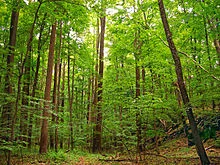
"Let me enjoy this late-summer day of my heart while the leaves are still green and I won't look so close as to see that first tint of pale yellow slowly creep in. I will cease endless running and then look to the sky ask the sun to embrace me and then hope she won't tell of tomorrows less long than today. Let me spend just this time in the slow-cooling glow of warm afternoon light and I'd think I will still have the strength for just one more last fling of my heart."
- John Bohrn, "Late August''

My Cape Cod -- from rural to suburban
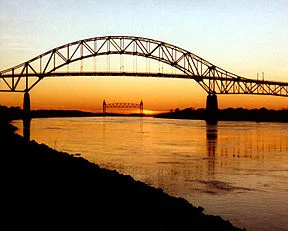
The Bourne Bridge, over the Cape Cod Canal, with the Cape Cod Canal Railroad Bridge in the distance.
From Robert Whitcombs's "Digital Diary','' in GoLocal24com
We went down to the Cape the other day to stay with a cousin in a house on a harbor on Buzzards Bay. I thought of how much the Cape had changed since my boyhood, in the ‘50s. Then, much of it was truly rural, with small farms and many cranberry bogs. There were no superhighways. Approaching from Boston’s southeastern suburbs, you’d go down Route 3A, which would become increasingly rustic as you headed south, with farm stands and general stores. The closer we got to the Cape Cod Canal, the more the air smelled like pine, as we entered a state forest.
Then the excitement of crossing the Sagamore Bridge onto an island/peninsula then devoid of big box stores, malls and gated retirement communities and on to my paternal grandparents’ gray-shingled house in the village of West Falmouth, the land of which some of my Quaker ancestors had bought from the Indians in the 1600’s. Then, if there were still time, to the beach, where the water was much cleaner and warmer than in Massachusetts Bay, and where the private bathhouse would get destroyed from time to time in hurricanes, to whichBuzzards Bay is particularly vulnerable.
After that, getting some ice cream from the village’s one and only general store. Then maybe a trip to Woods Hole the next day to see the aquarium of the world-famous Oceanographic Institution there. Woods Hole was where some of my ancestors built boats and partnered in the Pacific Guano Co., where bird excrement from Pacific Islands was processed with fish meal to make what was considered in the 19th Century the best fertilizer. Nowadays, it’s hard to think of Woods Hole as a factory town. Rather, it’s now in effect a college town.
As for West Falmouth, while it’s still almost as pretty as it was 60 years, it’s a ghost town to me since virtually everyone I knew there has died or otherwise gone elsewhere.
Or we occasionally approached the Cape from the west, on Route 6, with its strips of clam shacks, cheap motels and kitschy tourist-oriented gift stores. Ugly, but delightful to young children. Now, of course, you miss the local and often tacky texture on the boring big divided highways. And these highways draw in so much out-of-region traffic that the traffic jams on the two road bridges (there’s also the beautiful railroad bridge) mean driving to the Cape can take considerably longer now than in the ‘50s.
Because of that and because too much of this glacial moraine now looks like exurbia or suburbia, we don’t makemany visits anymore to Olde Cape Cod. Still, the air down there still has a certain luminosity.
Llewellyn King: In the Trump reign, recall John Donne
WEST WARWICK, R.I.
When I arrived on these shores in 1963, I wrote to a friend in London from New York, “We had America wrong. It is not a melting pot but rather a fruit salad. Spanish-speaking youths sell pizza on Broadway. Italian and German men drive taxis. All the doormen -- they stand in front of the better blocks of flats -- seem to be Irish. Black men and women do menial work: They are less obvious and not prospering.”
Those were the days when integrating the South was being bitterly fought and I, for one, thought that the soaring rhetoric of Martin Luther King Jr. could heal as well as inspire.
The most overt racism I saw in the North was not in New York or Washington but in Baltimore. At a bar beloved by the editorial staff of the Baltimore News American on Pratt Street, a major commercial thoroughfare at the time, an African-American man came in for a drink. The owner, a Polish-American, was on his feet in seconds, telling the man that the bar was in fact a private club, but he could sell him a bottle to go. The would-be patron took this clear lie quietly and left. My colleagues at the newspaper, including an African-American editor, were not interested in protesting the incident.
Race is probably baked into my consciousness, as I was born and raised in the British African colony of Southern Rhodesia (now called Zimbabwe). I grew up in a society in which some dreamed of a multi-racial future and others leaned toward white supremacy. In the end, after independence, Robert Mugabe made a mockery of democracy and civil rights for white and black citizens; his rule has been an equal-opportunity horror.
When King was shot in 1968, Washington and Baltimore erupted in riots. I would not call them race riots, but they were riots of protest, of angry people who felt they had had enough. I walked through some of the worst rioting in Washington, and later drove through burning sections of Baltimore.
Rather than being threatened as a white man in black communities that were gripped with looting and fire-setting, there was an almost eerie politeness, a concern among the rioters for my safety. John Harwood, father of the CNBC correspondent, wrote about this, these manners, in The Washington Post.
It struck me then that the United States could survive even in its worst struggles if it could keep its manners, its sense of the other fellow’s well-being.
Nelson Mandela said that hate has to be learned. What he did not say, as far as I know, is that people love to hate. When hate is sanctioned, as it was in Nazi Germany or in endless Russian pogroms against the Jews, it becomes a creed and a way of seeing everything.
The selection of Barack Obama not as an African-American but as the Democratic presidential candidate was a high point. It made me very proud to be an American, of having been accepted in an exemplary place. It told the world that the United States, for all of its history of slavery and prejudice, was an ascendant society; Ronald Reagan’s “shining city on a hill.”
In Dublin, I chastised an Irish journalist for criticizing a less-than-lovable newscaster as a “Protestant prick.” What had the man’s religion to do with it? In America, I said, we would not add religion to the epithet.
I was lunching with a Malaysian publisher at the National Press Club in Washington when he declared for all to hear, “The only straight thing about a Chinaman is his hair.” I was appalled and said so. We would not have said that, not in recent decades, because of the restraint of brotherhood, the sense of ascendance and the manners of a people from many places who live together.
Now an American president, Donald Trump, has whistled up tribalism, rationalized the unacceptable through false equivalence. And America, as an ascendant place, is in question, the delicate weave of its social fabric under stress.
John Donne, the metaphysical English poet, wrote nearly 400 years ago of “America” as hugely desirable place. He also warned, “No man is an island, entire of itself; every man is a piece of the continent, a part of the main.” Even more so in a diverse nation held together by the knowledge that any other course, any tribal hatred, diminishes the whole construct; or, to me, contaminates the fruit salad with rotten produce.
Llewellyn King (llewellynking1@gmail.com) is executive producer and host of White House Chronicle, on PBS, and a frequent contributor to New England Diary. This piece first appeared in Inside Sources.
Boxwood bathos
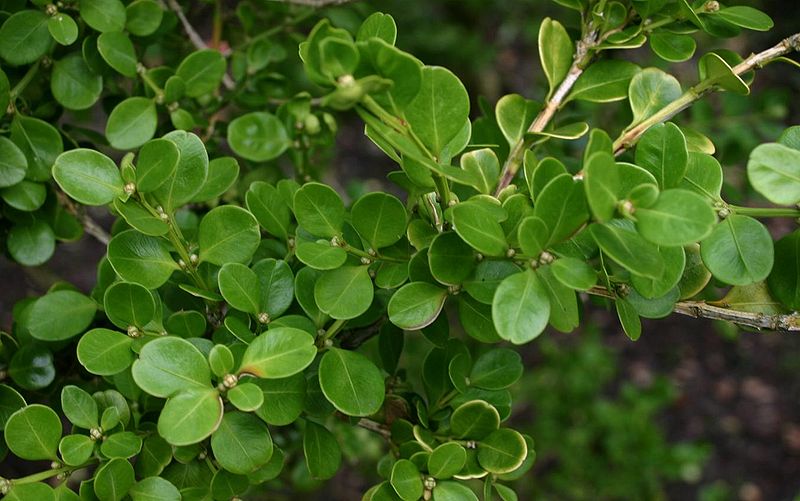
Boxwood
-- Photo by Sten Porse
"I have heard New Englanders say that they have an affinity for Box{wood} -- that it exerts power like a hereditary memory, and affects them with an almost hypnotic force. This is not felt by everyone, but only by those who have loved Box for centuries, in the persons of their ancestors.''
-- Eleanor Early, from A New England Sampler
'Relax! Relax!'

"Crickets leap from the stubble,
parting before me like the Red Sea.
The garden sprawls and spoils.
Across the lake the campers have learned
to water ski. They have, or they haven’t.
Sounds of the instructor’s megaphone
suffuse the hazy air. 'Relax! Relax!'
Cloud shadows rush over drying hay,
fences, dusty lane, and railroad ravine.
The first yellowing fronds of goldenrod
brighten the margins of the woods.''
-- From "Three Songs at the End of Summer,'' by the late New Hampshire poet Jane Kenyon.