
Vox clamantis in deserto







Seasonal sculpture

"Sun Pavillon'' (powdered coated aluminum), by Murry Dewart, in the "20th Annual Outdoor Sculpture Exhibit,'' through Oct. 15 at the Mill Brook Gallery & Sculpture Garden, in Concord, N.H.
Jim Hightower: The campaign to turn far-right churches into temples of dark money
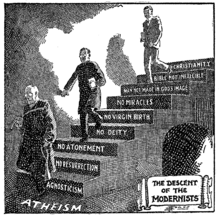
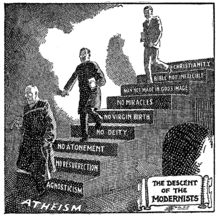
A Protestant Fundamentalist cartoon portraying Modernism as the descent from Christianity into atheism.
Via OtherWords.org
You know what’s wrong with American politics? It’s that there just aren’t enough ways for giant corporations and mega-rich political donors to funnel their big bucks into our elections and buy our government.
At least that’s what Donald Trump, the Republican Party, and a devious group of right-wing political pastors are saying. And, of course, they’ve got a diabolical fix for this “problem.”
Their scheme is to turn tax-exempt, far-right churches into gushing sewers of political money, secretly channeling unlimited amounts of cash from corporations and right-wing extremists through the churches and into the campaigns of politicians who’ll do their bidding.
They don’t admit this, of course. Instead, they wrap their scheme in the pious rhetoric of religious freedom.
Their point of attack is the Johnson Amendment, a 1954 law passed by LBJ that prohibits tax-exempt charities, including churches, from endorsing candidates, funding campaigns, and directly engaging in politics.
The Alliance Defending Freedom, an extremist Christian operation pushing for repeal of the Johnson amendment, asserts that banning churches from overt political campaigning lets the IRS “tell pastors what they can and cannot preach.”
Clever, but totally dishonest.
First, the issue isn’t whether the government can tell church groups what to say — it can’t. The question is whether taxpayers should subsidize a church group’s electioneering views and activities.
Second, and more diabolically, repealing the Johnson ban would turn these churches into holy temples of dark money. Special-interest funders would rush to these political “charities,” turning churches into super-secret super PACs. And since churches are tax exempt, the donors would also be blessed with a tax deduction for their corrupting campaign contributions!
Taxpayers would be underwriting the corruption of American politics. How ungodly is that?
Jim Hightower is a radio commentator, writer, and public speaker. He’s also the editor of the populist newsletter, The Hightower Lowdown.
The greenhouse effect

Adapted from Robert Whitcomb's "Digital Diary,'' in GoLocal24.com
Congratulations to RI Mushroom Co., featured in an Aug. 6 Providence Journal story headlined “They’ve spawned success with rooms of ‘shrooms.’’ It’s a lovely entrepreneurial tale, in which partners MichaelHallock and Robert DiPietro have expanded their mushroom-growing, packaging and sales operation from a “1,500-square-foot facility with one 16-by-50-foot grow room to a 10,000-square-foot facility with three grow rooms, a large packaging room and 1,000 square feet of office space.’’ They told The Journal that they eventually want to grow $100 million a year of mushrooms.
Mushrooms are increasingly popular and it’s unlikely that Amazon will take away the duo’s business. The article reminded me of the broader potential of such indoor agriculture in southern New England. Well-insulated greenhouses could be used to grow a lot of the fresh vegetables that New Englanders now must get from far away (at considerable environmental cost) outside the region’s main vegetable-growing season of May to October. Near-Arctic Iceland, of all places, grows a lot of its own vegetables in greenhouses, albeit with the help of that nation’s geo-thermal riches.
Put up greenhouses on the vacant parking lots around the proliferating number of closed suburban malls and big-box stores, where they could share space with wind turbines and solar-panel arrays.
Backwoods Maine architecture

"When Daddy's downcellah busy with his lathe, I go to the edge of our grass to get a look at the Beans. The Beans' mobile home is one of them old ones, looks like a turquoise-blue submarine. It's got blackberry bushes growin' over the windows.''
-- From The Beans of Egypt, Maine, by Carolyn Chute
Visually unpacking

Left, "Happy Go Lucky'' (mixed media) and right "Balls'' (mixed media), by Joe Caruso, in his show "Joe Caruso: Covered, Uncovered, Discovered,'' at Galatea Fine Art, Boston, Sept. 1-30. The gallery says the "he explores the themes of discovery, time and transformation....The viewer js asked to visually unpack the layers (of these pieces) to discover the treasure within.''

Sarah Anderson: How air conditioning unites and divides Americans

Via OtherWords.org
Before air conditioning, even presidents had to suffer.
In the summer, Abraham Lincoln used to ride a horse every evening from the White House to a cottage at a higher elevation four miles away. There he’d join his family in an attempt to escape the muggiest depths of the nation’s capital.
In July 1881, White House aides took to blowing air through sheets dunked in ice water in an effort to cool a severely wounded James Garfield. He wound up dying from an assassin’s bullet.
In 1909, William Howard Taft took the desperate step of sleeping on the White House roof to escape the furnace that is a Washington summer.
Back then, you could say, extreme heat was a social leveler. When air conditioning first entered American homes, it created a deep divide. Only the extremely wealthy — the ones least likely to have a job that required working up a sweat — could afford these newfangled contraptions.
Minneapolis railroad tycoon Charles Gates is believed to be the first to purchase a home cooling unit in 1914. At 7 feet high and 20 feet long, the device required a mansion-size home.
Smaller window units hit the market in the 1930s, but at a cost of more than $120,000 in today’s dollars, they were beyond the reach of the vast majority of Americans. As late as 1965, just 10 percent of U.S. homes had air conditioning.
Today, the economic divide created by home air conditioning is virtually gone. The Department of Energy estimates that nearly 90 percent of U.S. families have either central air or window units.
The modern divide is in the workplace.
In my Washington, D.C., office, colleagues routinely wrap themselves in blankets for long meetings in our refrigerator-like conference room. And throughout the city, you can see men in dark suits and ties even when temperatures soar near 100 degrees. They may complain (and they do), but they spend so little time exposed to the elements that their hot uniforms aren’t much of a health risk.
The people who have to work outside are the ones who really suffer. And outdoor workers, the people who harvest our food, build our homes and bridges, and care for our greenery, tend to also be among the lowest-paid.
In Las Vegas, where luxury hotels blast cool air out onto the sidewalk, construction workers in the desert heat have sometimes had to fight for the right to water breaks. In the landscaping industry, which employs more than 900,000 workers nationally, average pay is just $28,560 per year, one of the lowest of any occupation tracked by the U.S. Labor Department.
And those are official statistics based on full-time employment. Outdoor workers’ actual earnings are likely much lower.
The Economic Policy Institute recently pointed out that most California farmworkers have unpredictable, seasonal work hours. In 2015, that state’s agricultural workers earned an average of just $17,500 per year, EPI estimates.
The health risks of outdoor work will only worsen, of course, with climate change. And one contributor to that change, ironically, is the air-conditioning boom in the developing world.
The rapid increase in air conditioner sales is narrowing the gaps between cool air haves and have-nots in countries like China, India, and Brazil — just as it did in the United States. But this boom will also generate massive greenhouse gas emissions that will make the planet even hotter.
Today’s air conditioning gaps are a symptom of much bigger problems with complex solutions.
On the labor side, we need to ensure living wages and safe working conditions for all workers. At the same time, we need to get serious about addressing climate change in a way that puts the greatest responsibility on those who have contributed the most to this global challenge.
Sarah Anderson directs the Global Economy Project at the Institute for Policy Studies and is a co-editor of Inequality.org.
Todd McLeish: More seabirds in region turning up dead, perhaps from starvation

Great shearwater.
Walking on the beach at the north end of Block Island last month, Matt Schenck stumbled upon two dead and decomposing seabirds, which the avid birdwatcher identified as great shearwaters. While gulls of various species are commonly found dead on local beaches, shearwaters are an extreme rarity.
Except this year.
Hundreds of great shearwaters have turned up dead on beaches on Long Island and southern New England this summer, and no one seems to know why. In addition to the birds on Block Island, birders and biologists have reported dead shearwaters on Rhode Island beaches in Tiverton and Charlestown.
Shearwaters spend most of their lives far out to sea, where they soar just above the waves as they forage on small fish and other marine creatures near the surface of the water. Four species of shearwater — great, sooty, Cory’s and Manx — are typically seen in Rhode Island waters, though they seldom travel within sight of land. Most breed on remote islands in the South Atlantic.
According to Josh Beuth, a biologist for the Rhode Island Department of Environmental Management, shearwaters have been observed in large numbers from the shore this year, including from Jamestown, Newport and Point Judith. They have also been seen regularly from the Block Island ferry.
“There has been an abundance of sand eels in our local waters, which are a forage fish for shearwaters,” Beuth said. “As a result of them being closer to shore than usual, it would be more likely that they’d wash up on shore if they died.”
While prey may be abundant, some biologists, including Linda Welch, a U.S. Fish & Wildlife Service biologist who studies great shearwaters off Cape Cod, have noted that many of the dead birds are juveniles that have been thin or emaciated, suggesting that the birds have starved.
The dead birds began to show up on beaches in late June, which is about when they should have arrived along the East Coast after their long migration from their breeding grounds in the South Atlantic. By then, they were likely stressed and tired and hungry, which may have made them susceptible to any number of potential sources of mortality.
Wildlife pathologist Joe Okoniewski examined some of the dead shearwaters found on Long Island beaches, and he told The New York Times that the birds were not only thin but anemic. “The big mystery is: Why are they thin? On the surface, it looks like you know what happened — they starved,” he said. “But when you ask why, it becomes much more of a mystery.”
It is especially mysterious if prey is seemingly abundant, as it has been this summer in Rhode Island waters.
Robert Kenney, an oceanographer at the University of Rhode Island’s Graduate School of Oceanography, speculates that toxic algae from red tides may be playing a role in the bird deaths. He said a number of northern gannets, another species of seabird, have been found dead on Cape Cod beaches this summer. The only difference, he said, is that they are “in good condition, except for being dead.”
He noted that toxic algae may have also contributed to the deaths of some of the numerous whales that have been found dead along the East Coast and in the Gulf of Saint Lawrence this year.
Among those trying to find an answer is Julie Ellis, director of the Seabird Ecological Assessment Network at the Tufts University Veterinary Medical Center, which uses volunteers throughout the Northeast to regularly walk beaches to collect dead birds for study. She is reaching out to a number of animal diagnosticians throughout the region in hopes that together they can come up with a consensus of what is causing the shearwater deaths. She hopes they will have an answer next month.
Rhode Island resident and author Todd McLeish runs a wildlife blog.
Don Pesci: In Charlottesville, the success of violence as tool of social change
''Sticks and stones will break my bones, but names will never hurt me.''
- An old children's line
They call themselves Antifa, meaning “antifascists.” George Orwell would have been the first to point out that the anti-fascists are, in fact, a modern offshoot of the brown shirts one associates with Hitler, violent fascists pledged to break the bones of those who disagree with them so that by means of force their intellectual opponents may be silenced. A broken bone is a very convincing argument, as any thug well knows.
Naming is a process of attaching words to events in such a way that the general public may apprehend the events as they had occurred in real time through the assigned words. This process also is open to perversion. But as a general rule, the process breaks no bones and is constitutionally allowed, even when the resulting descriptions violate what we may loosely call the truth.
Naming bears no arms. But fascism, the antifas movement, Nazism and its modern evocations, KluKluxery, the White Separatist movement, are all fully armed and pledged to violent means. All use ideologically neutral populations to accomplish their chief aim, perfectly described by Karl Marx in his "Theses On Feuerbach'': “Hitherto, philosophers have sought to understand the world; the point, however, is to change it.” In the hands of thugs well concealed behind the veil of First Amendment rights, violence is an effective change agent, and violence is the Alpha and Omega of all the above mentioned groups.
What we all witnessed in Charlottesville over the weekend was the success of violence as an instrument of social change. The violent and murderous events in Charlottesville were, everyone can agree, preeminently a failure of crowd control. And what a crowd it was.
On the fringes were professional violent agitators, as usual beating plowshares into swords. Possibly more than 80 percent those arrested, after Antifa thugs and anarchists and Klu-Kluzers and White Separatists were brought together on the streets of Charlotte, were from somewhere else. Two groups – peaceful Black Lives Matter protesters and a group protesting the eradication of Southern history – were used as masks by Antifa, anarchists, KluKluzers and racist separatist groups to accomplish their violent ends.
Violent agitators who march under false flags to commit criminal acts should instantly be denounced by men and women of good will everywhere – including President Trump, who is not a racist, a KluKluxer or a white separatist. How difficult can it be to publicly denounce the Klu Klux Klan, an anti-black, anti-Jewish, anti-Catholic hate-group that dates from the late 1860s?
Not too difficult, apparently, because 48 hours after Charlottesville police, told to stand down, failed to suppress rioting in the streets, Trump issued the following lucid and unambiguous denunciation: “Racism is evil and those who cause violence in its name are criminals and thugs, including the KKK, neo-Nazis, white supremacists and other hate groups that are repugnant to all that we hold dear as Americans.”
This pronouncement will be too little, too late to satisfy the partisan hounds intent upon deposing Trump for the unpardonable crime of defeating Hillary Clinton in a presidential election -- whether by lawsuits or by inflaming the national media against him; not a difficulty chore, since Trump already has alienated most of the nation’s left-of-center media. Belaboring the media and pointing out their sometimes embarrassing hypocrisies, pro-Trumpeters insist, is part of Trump’s politically eccentric charm.
Among repugnant hate groups, one may count with some confidence violence- prone anti-fascist fascists, loudly baying Trump-deposers with knives in their brains, and a left-of-center media that prints with relish rhetorical pot-boilers from, say, Connecticut U.S. Sen. Chris Murphy, among other Democrats inflamed by national ambitions.
Trump, Murphy said, had incited peace-loving anarchists and members of the national antifa movement to commit acts of violence against hateful groups that even Mother Teresa would consider disreputable. Moreover, those who fail to agree with Murphy’s sentiments and do not vigorously denounce Trump are themselves co-conspirators: “Silence or weak condemnation will be rightly read as complicity with this newly emboldened racist movement.”
This is a giant step-up from guilt by association, otherwise known as McCarthyism. The failure to assent vigorously to Murphy’s views is itself proof of complicity. Disagree with Murphy and you are racist, anti-Jewish and homophobic. Only an anarchist could seriously buy into such wild denunciations.
Is Murphy a fascist because he did not instantly denounce antifa and anarchists, which deployed fascist methods to shutdown free speech in Berkley, the home of the Free Speech Movement in 1964? Of course not.
How would one know, Dwight McDonald once asked, if the world were moving into a new Dark Age? One possible answer: cults, separated from the broad way of Western civilization, will be everywhere.
Don Pesci is a Vernon, Conn.-based columnist whose work often appears in New England Diary.
Angel B. Perez: Past time to change how we prepare students to apply to college
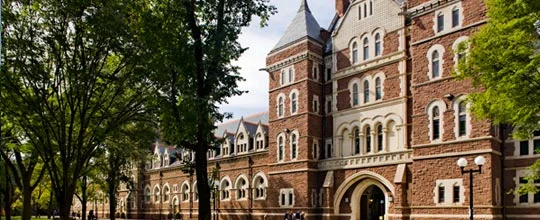
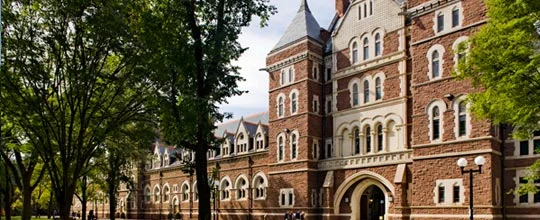
At Trinity College, in Hartford.
Photo by Consigli
Via the New England Board of Higher Education (nebhe.org)
Recently, I read yet another higher education professional’s case for standardized testing, specifically that making such tests free and universal would help level the playing field for low-income and minority students seeking access to top colleges. But while the SAT’s hefty $57 fee contributes to the barriers low-income students face, eliminating it won’t solve the problem. Access to higher education in America is much more complex.
The problem is our nation’s inability to offer consistent college preparation, academic rigor and counseling across varying socioeconomic communities. Data from the College Board show that the higher your family’s income, the higher your SAT scores are. Standardized tests then do more to keep low-income students out of top colleges than to invite them in. There is no shortage of talent in America. The shortage lies in its cultivation.
Many countries surpassed the United States in educational attainment because they believe in providing equal educational opportunity for all. In fact, the Organization for Economic Co-Operation and Development, which measures global student performance, notes that the U.S. is not on the top 10 list of achievement in Math, Reading, and Science. Canada and Japan on the other hand, are. What do these two nations have in common?
Both made equal access to educational opportunity a top priority. In Japan, students may live in a poor neighborhood, but they don’t attend poor schools. In Canada, one third of young people come from immigrant families and, when given the same educational opportunities, perform at the same level as their peers.
Equity has clearly benefited Canada tremendously since it is the only nation in the world where more than half its adult citizens have a college degree. Unfortunately, the U.S. lags behind on this issue. Instead of exerting energy investigating “affirmative action” in college admissions, perhaps the current administration could address the educational inequities that have resulted in America being knocked off the world stage.
A study by the National Association for College Admission Counseling shows that the average public school counselor has a caseload of 476 students and spends only 22% of his or her time on postsecondary counseling. This is in stark contrast to the 55% that private school counselors spend. Most low-income high schools can’t afford to offer expensive test-preparation courses to their students, and while free or low-cost online options are available, the services offered to students who pay for preparation courses are unparalleled.
Yet knowing how stark the contrasts are in preparation between low- and high-income students in America, most colleges still insist on using an exam that was created in 1926 by Carl C. Brigham to “test” America’s intelligence. The exam was originally touted as a tool of meritocracy, the great equalizer among students in America. We all know that dream never actualized. Our world has evolved tremendously since then, and a one-size-fits-all approach cannot be used to evaluate whether a student is ready to succeed in college. Our nation’s talent abounds. It’s higher education’s job to identify it.
From my own experiences as a vice president and teacher at several of America’s most selective institutions, I know it’s easy to dismiss an applicant because he or she doesn’t meet the university’s average test scores, or even worse, would hurt its average on U.S. News and World Report rankings.
But research shows that rather than test scores, the best predictors of success in college are high school grades and academic rigor.
At Trinity College, I have led efforts to rethink how we admit students, and we’ve changed our admissions process to think differently about what it means to be “college ready.” One of the changes we made was to adopt a test-optional policy. Next month, the college will welcome the most diverse first-year class in its history. It includes the highest number of low-income and first-generation students in Trinity’s history. In addition, the academic profile has increased tremendously. The Class of 2021 has twice as many students at the top of our academic profile as did last year’s entering class. We focus on grades, rigor, curriculum and all quantitative data high schools submit to us. But we also pay very close attention to personal qualities that we know will help students succeed in college—qualities such as curiosity, love of learning, perseverance and grit.
Since we’ve redefined our admissions process, members of our faculty have told us that their students are more curious, engaged and involved. Isn’t that what we want from all of our students?
If our educational system in America provided equal educational opportunity to all students regardless of income level, making the SAT and ACT free might significantly increase the number of low-income students in college. However, since this is a far cry from our current reality, it is higher education’s responsibility to think more creatively about whom it allows in the door. We are a long way from ensuring that every citizen has equal access to high-quality education, but in the meantime, universities can play a significant role in ensuring inclusivity of all talent.
The demography of the U.S. is shifting dramatically. Our population is younger, more diverse, and less wealthy. If we are going to prepare the nation for future challenges and regain our status on the world stage, we must rethink our approach to college access. We either fundamentally change student preparation for college or make our admissions processes more inclusive of diverse talents and less traditional—but more predictive—measures of success. Actually, our nation’s future depends on our doing both.
Angel B. Pérez is vice president for enrollment and student success at Trinity College in Hartford, Conn.
Vermonters 'live within their income' (or used to)
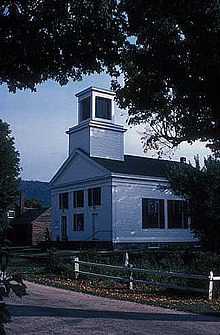
Union Christian Church (1840) in Plymouth, Vt., the town where Calvin Coolidge, the 30th president, was born on July 4, 1872.
"Vermont is my birthright. People there are happy and content. They belong to themselves, live within their income, and fear no man.''
-- Calvin Coolidge
Mystery space

"On a green island in the Main Street traffic
is a granite arch to the dead of the Civil War --
in the Eastlake style, all cubes and tetrahedrons,
each end of the passage barred by an iron-lace door.
They are always locked, tho the space between is empty --
from door to door it isn't much over a yard:
break open one, you could almost touch the other.
Nobody knows what the locks were meant to guard.''
-- From "Pro Patria,'' by Constance Carrier
Group show in tribute to the Virginia Lynch Gallery

"Cy Young'' (oil on linen), by Dean Richardson, in the GALLERY4 show "Lynch Revisited,'' a group show of 19 artists whose work appeared at the former and legendary Virginia Lynch Gallery, at Tiverton Four Corners, in Tiverton, R.I., (where GALLERY4 is now), over two decades.
David Warsh: Economics and presidential volatility in the North Korea crisis
It turns out that the North Korean missile confrontation is, in the first instance, an economic problem. China and the U.S. agree that Pyongyang’s nuclear-weapons program must be stopped. Japan and South Korea concur.
The difficulty has to do with dismantling North Korea’s outsized nuclear industry without touching off an internal crisis. Think back to the problems of German reunification – but much worse. That means lining up plenty of economic aid and international cooperation.
It also means that everyone involved must accommodate themselves beforehand to a further degree of Chinese hegemony on the Korean peninsula.
That’s how I understood Henry Kissinger’s telegraphic essay in The Wall Street Journal on Aug. 12, “How to Resolve the North Korea Crisis” (subscription required).
Say what you will about the bitter views routinely espoused by the editorial writers there, the WSJ op-ed page is still the emergency bulletin board of choice for The American Establishment. (Remember the Nicholas Brady-Eugene Ludwig-Paul Volcker letter at the height of the Panic of 2008?)
Kissinger doesn’t say so, but the urgency of the current crisis derives, not from of any imminent military threat to the United States, but from the volatility of the American president. A former national security adviser and secretary of state under Presidents Nixon and Ford, Kissinger does hint at Donald Trump’s ineptitude as a negotiator.
“Heretofore the administration has urged China to press North Korea as a kind of sub-contractor to achieve American objectives. The better – probably only feasible approach – is to merge the two efforts and develop a common position jointly pursued with the other countries involved.’’
China’s incentives in the matter are two-sided, according to Kissinger. It can’t abide nuclear proliferation in Asia. If North Korean nukes were to become fully operational, South Korea, Japan and even Vietnam would have to develop weapons of their own, or risk nuclear blackmail. But neither does China dare risk chaos on its northeast border in the event of collapse nor permit the possibility of nuclear weapons in South Korea without forfeiting self-respect. “China’s incentive to help implement denuclearization will be to impose comparable restraints on all of Korea,” Kissinger writes.
Moreover, since managing denuclearization requires sustained international aid and cooperation, the U.S. and Chinese must agree on the aftermath, too: “specifically about North Korea’s political evolution and deployment restraints on its territory.” Such an understanding “should not alter existing alliance relationships,” Kissinger writes, meaning the U.S. and South Korea.
South Korea and Japan must be involved in the process: South Korea because it would be most directly affected by a diplomatic solution, Japan because it would suffer most from lack of one. It is one thing for the U.S. and others countries to promise they wouldn’t “take advantage” of denuclearization, meaning, presumably, buy up assets in the North, Kissinger says, delicately. “Seoul is certain to insist on a more formal and embracing concept.”
Though Kissinger doesn’t mention it, Russia, which shares an 11-mile border with North Korea, is also an interested party, if only for having voted earlier this month for a unanimous Security Council resolution imposing sanctions on Pyongyang. It is also reasonable to wonder who, if anyone, financed North Korea’s build-up of nuclear capability, with money, know-how and key materials? Pyongyang’s program grew much more rapidly than had been forecast; Iran’s efforts seem to have proceeded much more slowly. China is an unlikely suspect. What about Putin and Russia? What is given can also be taken away – it would seem a small price to pay for a seat at the table.
So who should negotiate with whom? About what? A joint statement by the U.S. and China would begin the process, bringing home to Pyongyang its isolation, he wrote. The rest could proceed swiftly. Get the details done first, without involving North Korea, says Kissinger. “Pyongyang could best be represented at a culminating international conference.”
What with all the saber-rattling, this is Trump’s first real international crisis as president. The Robert Mueller investigation of his Russian dealings is still in an incipient stage. Henry Kissinger speaks for a broad swathe of well-informed center-right and center-left opinion. Let’s see what happens next.
. xxx
For those interested in plans to develop charter cities, economist Paul Romer’s proposal before he became chief economist of the World Bank, The Economist, has an update on the on-again-off-again project in Honduras.
And for those simply interested in a good time, read Nic Fildes’s wonderful front-page story in the Financial Times about Mr. Oozy Cats, formerly of Boston, apparently.
David Warsh is proprietor of economicprincipals.com, where this piece first ran, and a veteran financial and political columnist and economic historian.
Llewellyn King: Defend civilization -- wear a tie

I ask you, what’s a man to do? Men are terrified to leave the house these days. Should they wear a suit and look overdressed, as though they’re on the way to a meeting with the bank, trying to look both stable and reliable while subtly conveying need? Or should one assume that one’s body language is so articulate that social status, wealth, success and importance (or need) will shine though like people in Hollywood?
Actually, I blame Hollywood for everything: the sartorial confusion, the dress wilderness, the not knowing how to look and the death throes of the necktie.
I have it well documented that the dress decay — that’s what I think it is — came from show business. No less an authority on social rectitude, the manager of the Carlyle Hotel in New York, told me that the Hollywood riffraff, who he loved for their free-spending ways, had destroyed the dress code; made it hard for a poor newspaper man to pass for an investment banker by having the right kit.
“You used to be able to get all togged up for success,” a Savile Row tailor explained.
He said anyone could tell who had a bespoke suit and who didn’t, and he said a real gentlemen had at least one bespoke suit. In a famous phrase from the party girl Mandy Rice-Davies, “He would wouldn’t he.” This man made suits for the upper crust, or those who wished to be thought of us as such.
His name, the master tailor, was Henry Stewart. Although he learned his trade in Savile Row, when I knew him he practiced it in New York and made very beautiful, very expensive suits. He boasted he could “give a man a waist,” even if years of good living had transmuted his concave stomach to convex.
Back in those days, a tailor would ask a man, “How do you dress, sir?” If that phrase has you bemused, think about the male anatomy and what the effects of gravity are on it below the waist and out of sight.
My father owned only one suit and what an ill-fitting thing it was. He wore it for church, Masonic meetings and to borrow money at the bank. Otherwise, a small contractor, he wore his work clothes, which actually gave him more dignity than the suit.
Nowadays, in my experience, rather than dressing up to go to church one does just the opposite: jeans, cut-offs, flip-flops are good enough, apparently. Gone are the days of men in suits and women in hats and gloves on a Sunday. Gone the way of the necktie. What must God think?
I have watched the agonizing death of the tie, of that once sacred part of a man’s wardrobe; that single piece of cloth that gave man the option to express a modicum of individuality. Now it is old-fashioned, out of step and not hip to wear a tie.
But for those of us who were steeped in the tie culture, it is a tough farewell. Men, take your favorite tie in hand and sing, “We’ll meet again, don’t know where don’t know when, but I know we’ll meet again some sunny day.”
I’m putting a lock on my tie rack in case the agents of the open-necked state come for them — to deport them to Italy, the home of gorgeous silk ties.
I wore a tie at school, in my first job at age 16 and ever since. I am naked otherwise. No tie and I feel hostile eyes can see into my soul and know how little I think and what mundane if unspeakable thoughts I have. My soul is exposed without a tie and, preferably, a suit.
I fear the naked throat is the symbol of the decline of the West. I want to be counted as fighting for civilization, with a snazzy Windsor knot, a throwback to when a man’s tie was his shield, his comfort — and something to wipe his eyeglasses with.
Llewellyn King, a frequent contributor to New England Diary, is host and executive producer of White House Chronicle, on PBS. This piece first appeared in Inside Sources.
Bees coming back?

Adapted from Robert Whitcomb's "Digital Diary,'' in GoLocal24.com
Good news! Bees may be coming back, slowly. The U.S. Agriculture Dept. says the number of commercial honeybee colonies rose 3 percent in the April 2016-April 2017 period after years of crashes.
Some of the improvement may stem from a mysterious decrease in the varroa mites implicated in the deaths of many bees. And some may be due to more careful pesticide use by farmers and others. Still, pollinators such as bees and butterflies remain under great stress, much of it manmade, including from the paving over of foraging areas for bees. And without pollinators, we’d eventually starve to death.
The USDA reported that the varroa mite, which has afflictedU.S. honeybee colonies since 1987, was reported in 42 percent of commercial hives between April and June this year, down 53 percent from the year-earlier period.
Many New Englanders have joined the campaign to protect honeybees. Notable among them are the beekeepers and physicians Jane and Allen Dennison, of Rumford, R.I. Among their promotional points is that honey is a very effective treatment for wounds -- and so a way of avoiding antibiotics and thus reducing the prevalence of antibiotic resistance. They've been speaking around America about this.
The end of it

The shadows under the trees
And in the vines by the boat-house
Grow dark,
And the lamps gleam softly.
On the street, far off,
The sound of the cars, rumbling,
Moves drowsily.
The rocks grow dim on the edges of the shore.
The boats with tired prows against the landing
Have fallen asleep heavily:
The monuments sleep
And the trees
And the smooth slow-winding empty paths sleep.
-- "Park Going to Sleep,'' by Helen Hoyt
John O. Harney: Northern N.E. states have much higher 'patriotic' metrics than the southern ones
This piece is by our friend John O. Harney, executive editor of the New England Journal of Higher Education, part of the New England Board of Higher Education (nebhe.org), where this piece originated.
From time to time we revive the collection of facts and figures called "Data Connection" that we had published quarterly for nearly 20 years in the print editions of The New England Journal of Higher Education (formerly Connection magazine).
The latest ...
"Patriotic" rank of northern New England states measured by indicators such as share of enlisted military population, share of adults who voted in the 2016 presidential election, per-capita AmeriCorps volunteers: Maine 11th, New Hampshire 13th, Vermont 21st.
"Patriotic" rank of southern New England states based on such indicators: Connecticut 45th, Rhode Island 47th, Massachusetts 48th .
Number of New England higher education institutions in the Princeton Review's top 20 list of "Future Rotarians and Daughters of the American Revolution" where "surveyed students' answers indicated their personal political persuasions to be very conservative, low levels of acceptance of the gay community on campus, high levels of popularity for student government on campus and a very religious student body": 2 (Gordon College, Saint Anselm College), information from The Princeton Review
Number of New England higher education institutions in the Princeton Review's top 20 list of "Birkenstock-Wearing, Tree-Hugging, Clove-Smoking Vegetarians " where "surveyed students' answers indicated their personal political persuasions to be very liberal, high levels of acceptance of the LGBTQ community on campus, low levels of popularity for student government on campus and a student body that is not very religious": (Bennington College, Wesleyan University, University of Vermont, Brown University, Clark University), from The Princeton Review
Average annual compensation of heads of top 50 New England boarding schools: $455,000, from GoLocalProv.com.
Number of U.S. colleges fielding football teams this fall: 777, from the National Football Foundation.
Number of teams added since 2011: 40, from the National Football Foundation.
Number of teams added in New England since 2011: 1 (University of New England), from thr National Football Foundation
Number of New England teams that will launch in 2017: 1 (Dean College) from the National Football Foundation
Percentage of associate degree holders who report they are effectively managing financial stress and their economic life: 27 percent, from Gallup-USA Funds
Percentage of bachelor's degree holders who report they are: 41 percent, from Gallup-USA Funds
Percentage of community college graduates who go on to earn a bachelor's degree during the next six years: 41 percent, from the National Student Clearinghouse
Chris Powell: Conn. shouldn't get emotional about exit of GE and Aetna
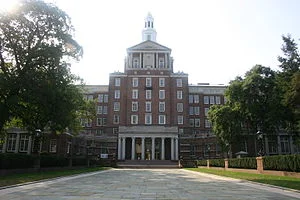
The soon-to-be former headquarters of Aetna in Hartford. It looks like a hotel or part of a college.
Having spent the last several decades capitulating to its government and welfare classes and squandering its advantages over other states, Connecticut has a lot to apologize for and correct. But it shouldn't feel quite so bad about the departure of General Electric's headquarters from Fairfield to Boston and the departure of Aetna's headquarters from Hartford to New York.
People have thought of GE and Aetna as Connecticut companies when they really haven't been.
General Electric got started in Schenectady in upstate New York, consolidated in New York City, and acquired many related companies around America before moving its corporate headquarters to Fairfield and transforming itself into an international financial conglomerate.
While Aetna started in Hartford in 1853, as it grew it also opened offices throughout the country and the world and became a financial conglomerate much like GE. Aetna has 5,000 employees in Connecticut but 44,000 elsewhere.
The boards of both companies long have lacked members with roots in the state.
People here like to think of United Technologies Corp. as a Connecticut company as well. But while UTC began in Connecticut with Pratt & Whitney Aircraft and retains its headquarters here, like GE and Aetna the company used its earnings to acquire other businesses and became an international conglomerate. UTC's employment in the state has declined steadily as it has expanded its aircraft engine and other businesses elsewhere.
Since the businesses of these companies are so dependent on and/or or regulated by national governments, politics has required them to diversify their geography. It's not enough for them to have the support of Connecticut's delegation in Congress. They need support nationally.
Meanwhile other national and international companies have expanded into Connecticut for the same reason, perhaps causing emotional pangs and resentments in the places where they originated.
But that's the evolution of most big businesses -- from entities with local character and geographic loyalty to cold accumulations of mobile capital. They're not emotional about Connecticut and the state is silly to be emotional about them.:
Defending their ratification of the new state employee union contract, Democratic state legislators say that its 10-year term, criticized by Republican legislators as too long, is no big deal. The Democrats note that state employee union contracts have been reopened early before, as the one just extended was.
But that argument is weak, since reopening such contracts is possible only with the consent of the unions and there is no guarantee that the unions will give their consent. Indeed, if, as the Democratic legislators suggest, reopening contracts is a mere technicality, why should their length be specified at all? Why shouldn't the contracts be written so they can be terminated by either party at any time?
When union leaders urged their members to ratify the new contract, they did not argue, as Democratic legislators argue now, that the duration clause is meaningless. No, union leaders argued that the contract provides long-term protection of jobs and compensation. Union members might not have ratified the contract if its four-year guarantee of employment really meant that layoffs could begin at any time.
The essence of the contract issue remains that Democrats, the party of government employees, believe that government employees should have more power over the government than the voters do. It's nonsense but it is repaid well by government employees at election time.
Chris Powell is managing editor of the Journal Inquirer in Manchester, Conn.
Boston charter schools' chiefs rake it in
From Robert Whitcomb's "Digital Diary,'' in GoLocal24.com:
Wages certainly aren’t lagging for company and “nonprofit’’ organizations’ executives as more and more of the country’s wealth goes to a sliver of people at the top, in a winner-take-all economy that eschews sharing with lower-level but essential employees.
Consider The Boston Globe’s Aug. 1 story “Some charter school leaders’ pay far outpaces their public rivals’’. See: https://www.bostonglobe.com/metro/2017/08/01/some-boston-charter-school-leaders-paid-hefty-salaries/fbHDOC33WKmzcvvZaNNkLN/story.html
The Globe discovered that the “median pay package for the top leadersof the 16 charter schools in Boston was $170,00 last year.’’ Some Rhode Islanders might remember the former Providence school Supt. Diana Lam. As the boss of Conservatory Lab, she got a $275,000 in salary and $23,000 more for unused personal time off in 2016.
That was more than Boston School Supt. Tommy Chang’s totalcompensation of$272,000 in 2016.
These just-before-retirement pay packages are used as the basis for maximizing the departing executives’ pensions, which approach $200,000 a year.
Remember these charter schools are public institutions.
Over the years of looking at executive-suite compensation I’ve there’s often remarkably little connection between execs’ pay and the success of their organizations, in the public or private sectors. They mostly get these pay packages because the boards authorizing them are composed of very affluent people made uncomfortable by the idea that these execs should be paid at rates commensurate with common sense and reality. Hey! We’re rich and so you should be too! Meanwhile, lower-level employees often see their pay and benefits slashed.
(If Hollywood, publishing houses, basketball teams, etc., want to pay their stars millions for bringing in these organizations’ revenue, that’s perfectly fair. Clear talent.)_
U.S. Education Secretary Best DeVos, wallowing like much of the Trump regime in economic conflicts of interest, wants to dramatically increase the number of charter schools. If that happens, let’s hope that more attention is paid to their executive salaries.
'Made her light escape'

"As imperceptibly as grief
The summer lapsed away,—
Too imperceptible, at last,
To seem like perfidy.
A quietness distilled,
As twilight long begun,
Or Nature, spending with herself
Sequestered afternoon.
The dusk drew earlier in,
The morning foreign shone, —
A courteous, yet harrowing grace,
As guest who would be gone.
And thus, without a wing,
Or service of a keel,
Our summer made her light escape
Into the beautiful.''
-- Emily Dickinson (of Amherst, Mass.) "Part Two: Nature, XLV''