
Vox clamantis in deserto





Industrial decline
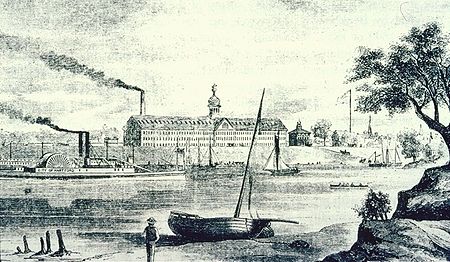
Colt's Armory, in Hartford, from an 1857 engraving viewed from the east. The Connecticut River Valley has long been a center of gun-making.
"The toolmaker
is sixty years old
unemployed
since the letter
from his boss
at the machine shop''
"The family watches
and listens to talk
of a bullet
in the forehead
maybe himself
maybe for the man
holding the second mortgage.
"sometimes
he stares down
into his wallet.''
From "The Toolmaker Unemployed: Connecticut River Valley,'' 1992, by Martin Espada.
Hey there, Donald, you with the stars in your eyes

This Hubble Ultra-Deep Field image shows some of the most remote galaxies visible with present technology.
See President Trump confront infinity as former astronaut Buzz Aldrin looks on with, well, wonder. To see the video, please hit this link.
Postpone until August
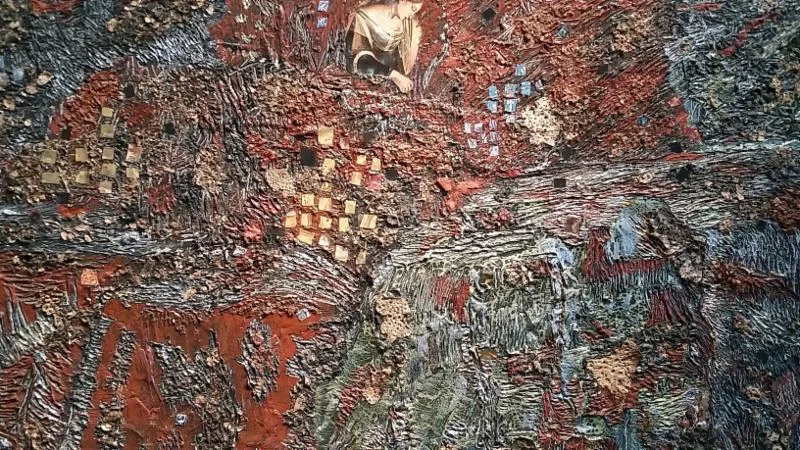
"Prayers for Rain'' (mixed media with lichen on canvas), by Dominick Takis, in the group show "Surface'' (with Ruth LaGue and George Shaw) July 8-Aug. 16 at the Gallery at Spencer Lofts, Chelsea, Mass.
The gallery writes:
‘’Dominick Takis incorporates lichen into his surfaces as a weight and balance for composition; he is mostly interested in its textures and patterns. Lichen has an ancient and weathered look: he references civilizations that revered the stone circle as a symbol of the connection between the harmony of nature and the cosmos. The patterns of the lichen appeared on man-made Dolmens and portal tombs as well as naturally on stone.
"He began to read more about lichen and it's symbiotic relationship to algae; how they create their own existence, yet are attached. He found parallels in his own life; the distance that comes from independence, yet still remaining attached to my ancestors and culture. An outcropping of land, a farmhouse, a church or a graveyard may take on greater significance when it contains some familial connection. This became apparent when traveling through his ancestral Sicily and in his wife's native Ireland. Whether figurative or intellectual, there is a symbiotic relationship with his ancestors and culture and it informs his art.’’
Note from Robert Whitcomb: As kids living next to granite outcroppings, my four siblings and I were mystified that a plant such as lichen could live with no visible source of food on bare rock, and we found lichen's subtle blue, gray and green colors eerily lovely.
Tim Faulkner: Right-wing and anti-wind types blame wind farm for whale's death -- without proof
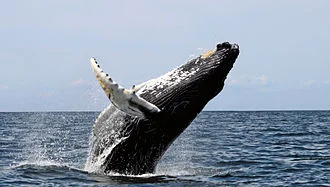
A humpback whale breaching.
Via ecoRI News (ecori.org)
JAMESTOWN, R.I.
There is nothing yet linking the Block Island Wind Farm to the death of humpback whales, but that hasn't stopped anti-wind and conservative groups from making the connection.
The recent stranding and death of a 32-foot juvenile humpback whale in Jamestown triggered speculation, and in some cases unsubstantiated assertions, that noise from the first U.S. offshore wind farm caused this and other whales to die. As the HuffPost recounts, the claim was first made by the conservative Web site Daily Caller and through a conservative news wire has been republished and rewritten in various forms by national new outlets such as The Blaze and through local anti-wind groups and press reports that inferred the link. The Newport Buzz names the five-turbine wind farm as the prime suspect.
None of the anti-wind articles offer a scientist as a source for their claims or research that deduces that the wind farm, owned by Providence-based Deepwater Wind, caused the whale to beach itself. Only the HuffPost quoted a marine biologist, at Cornell University, who said wind turbines contribute to the cacophony of underwater noise from boats, ships and barges, and that this mix of manmade noise — which can also include sonar, fossil-fuel drilling and military exercises and testing — can disorient but isn't likely to kill marine life.
Jeff Grybowski, CEO of Deepwater Wind, told ecoRI News that the five turbines are simply not to blame. "There is absolutely no evidence that the wind farm is in any way connected to this whale," he said. "The wind farm does not create any special risks to marine life. In fact, marine life is thriving near the project.”
As part of its approval process, the wind farm and its transmission system received a finding of no significant impact for acoustic impacts by the federal Bureau of Ocean Energy Management.
Deepwater Wind has a lot riding on the emerging offshore wind industry. The wind and solar developer has several wind farms in the works between New York and Massachusetts. The wind-rich region has also attracted developers from Norway, Denmark and other countries with established wind industries.
Here's what is known about the death of the Jamestown humpback whale:
A necropsy was performed by Mystic Aquarium at the site of the stranding at Beavertail State Park. Tests to determine the case of death were sent to a laboratory and aren't expected for weeks.
The Rhode Island Department of Environmental Management (DEM) won’t say where the carcass was buried. In 2005, a 50-foot finback whale found dead on Newport’s Brenton Point State Park was buried at the Great Swamp Management Area in West Kingston.
There has been a spike in humpback whale deaths along the East Coast between North Carolina and Maine. Since January, 48 humpbacks deaths have been reported. Although ship strikes and entanglements with fishing gear are the main killers of humpback whales, the recent increase in humpback deaths has been classified as an unusual mortality event by the National Oceanic and Atmospheric Administration (NOAA). An investigative team will review data, study samples from future strandings and decide what, if any, action to take.
NOAA also lists sonar, military testing, resort development and increased boat traffic as threats to humpback whales and their habitat.
The Jamestown whale death coincides with a surge in humpback whale sightings between mainland Rhode Island and Block Island, according to DEM. The whales are likely drawn to a growing food supply — the small, eel-like forage fish, called the American sand lance — DEM said.
Humpback whales are protected under the federal Endangered Species and Marine Mammal Protection acts. They grow to about 60 feet in length and have a lifespan of about 50 years. They are the most popular marine mammal for whale watching in New England, because of their habit of breaching and slapping the water surface with their tails.
Tim Faulkner writes frequently for ecoRI News. {Editor's note from Robert Whitcomb, co-author of Cape Wind: Whales and other marine mammals are primarily threatened by boats running into them, fishing nets, human overfishing of fish eaten by some marine mammals, fossil-fuel and other manmade pollution, and acidification and other seawater changes caused by a human-caused increase in greenhouse gases caused by burning fossil fuels. Offshore wind turbines are not implicated in whale deaths. Many conservative and anti-wind people have close economic ties to the oil, natural gas and coal industries.}
Don Pesci: King Kong meets a couple of frenzied Nutmeg State'Never Trumpers'
We all know that President Trump is thin-skinned, as witness the bloodstained Mika Brzezinski of Morning Joe. Recently, Trump tweeted about Ms. Brzezinski, now affianced to Joe Scarborough, the former Republican congressman who is the Joe of Morning Joe, that she had visited him recently and was “bleeding badly from a face-lift.”
The usual kerfuffle in social media ensued, and Trump was bare-knuckled by what he considers media thugs, purveyors of “fake news.” Following the pummeling, Trump tweeted, more temperately, “Crazy Joe Scarborough and dumb as a rock Mika are not bad people, but their low rated show is dominated by their NBC bosses. Too bad!" {Editor's note: The show actually has high ratings.}
If tweets had been available in the glory days of President Andy Jackson, the father of the modern Democratic Party might more easily have signaled to John Calhoun, once Jackson’s vice president, that if the newly elected senator from South Carolina continued to press nullification in response to federal tariffs adversely impacting the economy of his state, Jackson would send federal troops to South Carolina to apprehend Calhoun and hang him from the nearest oak tree.
Troops were sent; South Carolina abandoned its Nullification Ordinance; Calhoun was not hanged; tariffs were made less onerous, and a nullification dispute between the North and the South abated for a few decades, after which a bloody Civil War decided the issues of nullification and slavery.
Try to imagine, if you will, the incendiary tweets that the Civil War might have generated.
Resemblances between Trump and Jackson have been made by the lying media – but, really, Trump is no Jackson. He has not yet threatened to hang his persistent Connecticut “Never-Trumpers,” U.S. Senators Dick Blumenthal and Chris Murphy, from the state’s gypsy-moth- infested oak trees.
Relations between these three are iffy, according to a story in The Hartford Courantheadlined “Amid Vitriol, Can Trump, State's U.S. Senators Come To Terms On Coveted Appointments?”
The coveted appointment is the position soon to be vacated by retiring U.S. District Judge Robert Chatigny, who some years ago improperly intervened in the execution of mass- murderer Michael Ross, for which Judge Chatigny was rebuked, though not fired. It is nearly impossible for an aggrieved public to fire a renegade judge. Even Andy Jackson could not have fired Chatigny. Old age is now bearing him off.
The legal world, according to the story, is waiting with bated breath “to see how Trump and two of his most strident critics come to terms over coveted political appointments.”
The Courant reporter uses the expression “strident critics” to characterize the opposition of Blumenthal and Murphy to past presidential choices. But this is a considerable understatement. Critics render opinions; U.S. senators register votes. And Blumenthal and Murphy, both “Never Trumpers,” have opposed virtually all of President Trump’s major appointments. The usually cautious Blumenthal, a former attorney general for two decades in Connecticut, went so far as to impute racism to former U.S. Sen. Jeff Sessions, Trump’s choice for U.S. attorney general.
“At one point during his cross examination of Sessions,” The Courant piece noted, "U.S. senator and mud thrower from Connecticut Dick Blumenthal subtly suggested that Sessions might have a soft spot in his heart for the KKK. Blumenthal noted that Sessions had received some awards during his twenty years in the Congress, among them an award from the David Horowitz Freedom Center, Frank Gaffney's Center for Security Policy and the Federation for American Immigration Reform, the latter of which Blumenthal noted is classified as a hate group by the Southern Poverty Law Center, according to a story in the Washington Examiner.
"'Given that you did not disclose a number of those awards,' Blumenthal asked Sessions, 'are there any other awards from groups that have similar kinds of ideological negative views of immigrants or of African-Americans or Muslims or others, including awards that you may have received from the Ku Klux Klan?'"
Should Trump seek to appoint to the U.S. District Court a judge who had received awards from the Klu Klux Klan, Blumenthal might just “blue slip” the nominee. The two Connecticut Democratic senators can “issue a blue slip, which kills the nomination by preventing the Judiciary Committee from scheduling confirmation hearings,” according to the story.
Blumenthal insists – wrongly – that such measures are “traditional.” They are extraordinary. Tradition holds that senators from the same party as the president may issue recommendations for judgeships; Blumenthal is a “Never Trumper” Democrat now suing Trump for having violated the emoluments clause of the U.S. Constitution, while Trump is a duly elected Republican president who is under no obligation to accept judicial nominations from suit-prone party opposition pests such as Blumenthal.
One hopes that such issues will not erupt into a bitter twitter war.
Don Pesci (donpesci@att.net) is an essayist who lives in Vernon. Conn.
'Into the summer stars'

"Sometimes I wish I were still out
on the back porch, drinking jet fuel
with the boys, getting louder and louder
as the empty cans drop out of our paws
like booster rockets falling back to Earth
and we soar up into the summer stars.
Summer. The big sky river rushes overhead,
bearing asteroids and mist, blind fish
and old space suits with skeletons inside.
On Earth, men celebrate their hairiness.''
-- From "Jet,' by Tony Hoagland
'Let it rain for a whole day'
"When the thunder threatens the skies
And the lightning draws lines of fire
We begin to wait for the accompanying clouds
But only see a strong wind
Slaughtering those toddler clouds
It is a pain that has a thousand buds.
For a moment I may close my eyes
And may forget the ordeal of heat in mounts.
It is a July wish in vain
Let it rain for a whole day
And let there be a rose blooming in my garden
That I shall offer to the rain god in hide. ''
-- From "A July Wish,'' by M.D. Dinesh Nair
Hub hospital tries to stop 'tailgating'
Brigham and Women's Hospital, in Boston, tries to stop dangerous 'tailgating.'' Read about it by hitting this link.
Hosting a Chinese propaganda agency

Hassenfield Common and the Unistucture & Globe Dome at Bryant University, in Smithfield, R.I. Bryant has a unit of China's controversial Confucius Institute on its remarkably attractive modernistic campus.
Adapted from Robert Whitcomb's "Digital Diary,'' in GoLocal24.com
As the United States withdraws from speaking out for human rights and democracy, the Chinese dictatorship moves in with piles of money. That money is already having sad effects.
Consider that Greece has vetoed a European Union statement denouncing Chinese human-rights abuses in the wake of Greece recently getting billions of dollars in infrastructure investments from Beijing. Croatia and Hungary (the latter run by a semi-fascist president), also the beneficiary of massive Chinese spending, have also blocked E.U. statements on Chinese actions, including China’s attempt to take over the entire South China Sea. Each E.U. nation has veto power over statements meant to be the official E.U. position.
Here at home we have the Confucius Institute problem. The Institute is affiliated with China’s Education Ministry and hasthe official aim to promote Chinese language and culture. But it is really a propaganda and intelligence office, a handy base for industrial and other espionageand a sturdy platform for the increasingly aggressive and expansionist dictatorship to keep in line Chinese students studying abroad. Their very presence tends to constrain intellectual freedom regarding things Chinese.
Some U.S. colleges and universities, such as Rhode Island’s Bryant University, have partnered with the Institutesatellites for the money and business connections they provide after they set up shop on American campuses. These Confucius Institute operations provide free (to the colleges) teachers and textbooks and cover operating costs. Some administrators and faculty members like them because they help bring in full-tuition-paying Chinese students and provide freeand luxurious junkets to China to some administrators and faculty members. Such operations are inappropriate on American college campuses.
Rachelle Peterson, director of research at the National Association of Scholars, a conservative group, has accurately complained: “Confucius Institutes export the fear of speaking freely around the world. They permit a foreign government to have intimate influence over college classrooms. It’s time to kick them off campus.’’ Ms. Peterson quoted former Chinese Communist Party propaganda chief Li Changchun as calling the on-campus Confucius Institute satellites “an important part of China’s overseas propaganda efforts.’’
Less is more

"This simple summer day
Of not too much to do
May be the one
We look back on
When years have swirled away
And days like these are few.''
-- From ''One Day,'' by Alfred Nicol

The vanity of human constructions

-- Photo by Charles Pinning
One of my father’s ways of showing his love for his family was to build things of quality and permanence, things that he had had precious little of growing up.
The swing set in our backyard didn’t lift or shift, no matter how hard you swung, because my father built it himself out of iron pipe, sinking all four posts into the ground and encasing them in cement. He did the same to support the roof he built over the patio, and when he decided to erect a flagpole in the front yard, iron, steel and cement were materials of choice.
I don’t recall any discussion about putting in the flagpole, rather that it just started going up one day. Some of our neighbors had flagpole holders affixed on the front of their houses, but we were the only ones on our street with an actual flagpole in the front yard.
I felt embarrassed when I saw what my father was up to. Even as a 10-year old, I thought it over-the-top to have something that would be more at home in front of the White House than standing in front of our modest Cape Cod-style dwelling.
I do remember my father being very ingenious about how he engineered the project. He set the four-foot-high I-beam steel base in cement. He let me write my name with a twig in the cement. The next day he took his white-painted (carefully primed and then covered with three coats of enamel) steel pole with the gold ball on top—the thing had to have been 20 feet tall—and he attached it to the base, running two thick bolts through the base and pole, and then he hoisted the thing vertical with the block and tackle that you use to run up the flag, tightened the bolts, and voila!—we had Newport’s most imposing residential flagpole.
For awhile, the flag was run up and down daily, but that finally sputtered out because my father insisted that the rules of raising, lowering and folding it be adhered to, and Good Lord, even though he was in the military, his wife and children weren’t.
My older brother was a Boy Scout and got into the whole flag bit for a while, but even he eventually tired of it. The whole thing humiliated me. I recognized that this was just too much of a display of patriotism. Wasn’t it enough to live in the United States and be a good citizen? Did you really have to have this huge flagpole in front of your house?
Nonetheless, the durability of the setup was not lost on me, like the swing set and the patio roof. I admired my father’s diligent workmanship, but unfortunately, it over-influenced my adult life.
Early in my first marriage, there was the badminton net I was going to put up on the front lawn of my in-law’s house. I went to the lumber yard and bought two really beefy wooden posts, big enough to support a heavy fence, and using a post-hole digger, sunk them into the front yard. When my mother-in-law set eyes upon them she rightly said that they had to come out.
Can you imagine? Preparing a badminton court that would survive all but an aerial bombing! And then there was the exterior door I salvaged off the street to put in the doorway to the study of my New York apartment. The thing weighed at least a hundred pounds. What was I thinking?
I recently drove back to Newport and pulled up in front of my boyhood home. The flagpole was gone, but damned if that I-beam base wasn’t still there. The current owners had a bird bath mounted on top of the base.
Feeling around the bottom of it, I pulled back some grass and found the cement and my etched name. My fingertips grazing lovingly over this ruin of ancient Newport revealed all that is ever permanent about the past -- the intent of what we build. (See photo above.)
Charles Pinning is a Providence-based writer.
A sustainable fire hazard
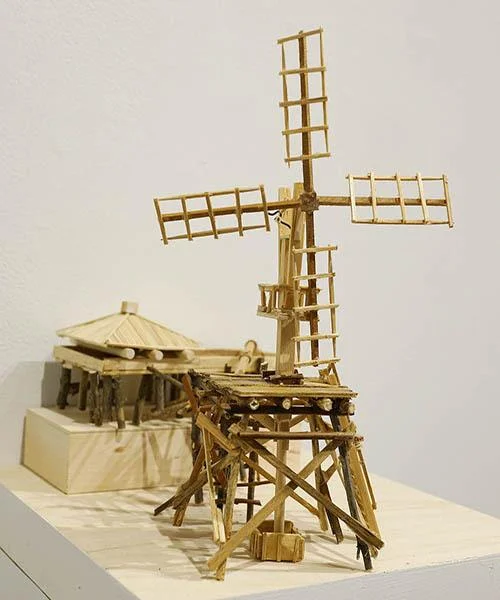
"Corporation Beach'' (toothpicks and wood scraps), by Jennifer Day, in her show "Small Business,'' at Bromfield Gallery, Boston July 5-30. Using wood, she creates dioramas of machinery and vehicles to show the application of medieval technology to modern sustainable energy.
David Warsh: Disillusionment in America and the former Soviet Union
The economics and politics of disillusionment in two nations
Elaine Scarry, an essayist and literature professor, long ago suggested that, in counterpart to the ingenious system of government framed by the Declaration of Independence and the Constitution, the United States also possessed a material constitution, consisting of the technological systems of the nation and no less remarkable than the political structure for being evolved in practice rather than written down.
Riffing on Scarry’s conception, historian of technology Thomas Hughes noted the tendency to take the latter for granted. The intellectual historian Perry Miller had already observed, in The American Scholar, how casually Americans “flung themselves into the technological torrent, how they shouted with glee in the midst of the cataract, and cried to each other as they went headlong down the chute, that here was their destiny….”
Now, Hughes wrote, with technological momentum accelerating, Americans needed to learn to see themselves as a nation of system builders as well as practitioners of their subtle arrangements of political democracy and free enterprise. American Genesis: A Century of Invention and Technological Enthusiasm (Viking, 1990), Hughes’s classic study of the engineering of the key inventions of the century after 1870 – incandescent light, the telephone, the radio, the airplane, the automobile, electric power – was motivated by a concern for the overlooked burdens that technological enthusiasm frequently imposed. Forty years after the development of modern financial markets for corporate control, containerization, microprocessors, personal computers and the Internet, Hughes’s attentiveness to the sudden eruption of a culture of critique, seems especially prescient: “the organic instead of the mechanical; small and beautiful technology, not centralized systems; spontaneity instead of order; and compassion, not efficiency.”
For the last six months, I have been dipping into the burgeoning literature of disillusionment, trying to understand the Trump election: Evicted: Poverty and Profit in the American City, by Matthew Desmond; Hillbilly Elegy: A Memoir of a Family and Culture in Crisis, by J. D Vance; Janesville: An American Story, by Amy Goldstein; Strangers in Their Own Land: Anger and Mourning on the American Right, by Arlie Russell Hochschild, and Doctored: The Disillusionment of an American Physician, by Sandeep Jauhar. The book I read all the way through was Glass House: The 1% Economy and the Shattering of an American Town (St. Martin’s, 2017), by Brian Alexander.
Glass House is about Lancaster, Ohio, and the Anchor Hocking Glass Co., upon which the city’s fortunes were built – and then eventually dissipated by rich New Yorkers – over the course of the 20th Century. At a little more than 300 pages, you might think that Glass House is more than you want to know about a little city on the Hocking River, southwest of Columbus, in the foothills of the Allegheny Mountains. But Alexander grew up in Lancaster in the 1970s, has stayed in touch (he lives in California now) and, as a highly capable magazine writer, he moves the story along with the force of a novel, interweaving the saga of the business itself with the lives of four friends.
It helps that his tale has plenty of colorful signposts along the way: the Ku Klux Klan in Lancaster in the 1920s; Malcolm Forbes in the early 1940s (his father bought him a newspaper there as a Princeton graduation present); Carl Icahn, (a key Donald Trump adviser today) who in 1983 put Anchor in play; Newell Corp., the vagabond manufacturing firm that in the 1980s rolled up Anchor into a giant conglomerate on the strength of a loan from an Arizona savings andloan association; Cerberus, the private-equity firm organized by Stephen Feinberg (another close Trump adviser today) that bankrupted Anchor; Sam Solomon, the African-American scion of North Carolina farmhands, who, as newly appointed CEO, seeks to save Anchor, now branded as EveryWare Global (Anchor survives, barely, Solomon is fired but becomes the hero of the book).
The leitmotif: at each step along the way, Alexander describes the succession of new drug products that began to plague Lancaster, starting in the 1970s: marijuana, cocaine, heroin, methamphetamine, Percocet, OxyContin, and Xanax. The greatest charm of Glass House is that its trajectory since the 1980s resembles that of almost any other Middle American manufacturing city you can think of.
Between times, I have been reading Secondhand Time: The Last Days of the Soviets, An Oral History (Random House, 2016), by Svetlana Alexievich, the 69-year-old Belorussian author who was recognized with the Nobel Prize for Literature in 2015. The book is not easy reading. Like four other “documentary novels” that Alexievich has written over 30 years, chronicling the lives of ordinary citizens of the former Soviet Union since World War II, it consists of a series of collages composed of interviews (“snatches of street noise and kitchen conversations”) with hundreds of characters, some of whom appear and reappear as in any good Russian novel.
The differences between Secondhand Time and Glass House are instructive, the differences between literature and journalism. Secondhand Times begins with a timeline, six pages briefly describing events from the death of Josef Stalin, in 1953 to the Maidan protests, in Kiev, in 2014. Then for 350 pages, consciousness swirls. Alexievich writes:
“The Soviet civilization…. I’m rushing to make impression of its traces, its familiar faces. …The myriad sundry details of a vanished way of life. It’s the only way to chase the catastrophe into the contours of the ordinary and try to tell a story.’’
The triumph of Secondhand Time is to make more understandable how many present-day Russians and others living in former Soviet jurisdictions can feel affection for a system that produced so much misery and permitted so little of the freedom that the Westerners take for granted. Consider the top-down coup that was the Bolshevik Revolution, the Russian Civil War, the murderous collectivization of agriculture, famine, the purges, the Gulag and then the gradual discovery of the awful history that had been hidden.
“Despite the poverty, life was freer” in some respects under communism, Alexievich told Guy Chazan of the Financial Times over dinner last month in Berlin. “Friends would gather at each other’s houses, play the guitar, sing, talk, read poetry.” When democracy came, she said, they expected that everyone would read Solzhenitsyn. Sure enough, with glasnost, Solzhenitsyn’s works were all published in the former Soviet Union, but no one any longer had time to read them. “Everyone just ran past them and headed for twenty different kinds of biscuits and ten varieties of sausage.” The book is about disillusionment plus – how great was the loss of the Great Idea.
I can’t read Alexievich, or any other source on Russian history, without experiencing an overwhelming sense of gratitude for having been born a citizen of the United States. But, as I read Johnson’s Russia List, the indispensable almost-daily chronicle of what the Russians are saying about themselves, it is clear that Russians are gradually coming to grips with their history (Alexievich being a prime example).
There’s no doubt that the government of Russia unwisely sought to underhandedly tamper with the machinery of American democracy in the 2016 election. They didn’t succeed. The Constitution of the United States, both the familiar version enshrined in law and the less-familiar material version, assure that America, for all its sorrows, continues to insure domestic tranquility – more reliably, perhaps, than you think.
David Warsh, a veteran economic historian and columnist on financial, political and historical affairs, is proprietor of economicprincipals.com, where this first ran.


As it speeds by

"Study in Time'' (photo collage), by Jamie Cascio, in the group show ''TIME: Brickbottom Artists Association Members' Exhibition,'' July 13-Aug. 19. Its gallery is in Somerville, Mass.
The curator writes:
"Time's Up, Time Out, Time Warp, Timeless -
"Time presents itself in drama, music, photography, philosophy, science...and life. It's connected to change, growth, mortality and decay. We mark it, track it, keep it, bend it, save it, lose it and waste it. It passes, drags, floats, and flies, but what is time? This summer, the Brickbottom Gallery members' explore this elusive concept.''
FRA's Md. railroad bridge ruling upsets Amtrak bypass-route foes
By ecoRI News staff (ecori.org)
HAMDEN, Conn.
A June 26 announcement by the Federal Railroad Administration (FRA) that the $1.1 billion Susquehanna River Rail Bridge Project on the Northeast Corridor in Maryland poses “no significant impact,” drew sharp rebuke from Daniel Mackay, executive director of the Connecticut Trust for Historic Preservation, who warned that such a decision could set an unacceptably low bar for mitigating historic, cultural and environmental resource impacts from future high-speed rail projects in Connecticut.
The proposed rail bridge replacement project bisects the National Register-listed Havre de Grace Historic District in Maryland, comprised of some 1,000 historic structures, many from the 18th Century, on the banks of the Susquehanna River, according to a recent story in The Baltimore Sun.
“FRA determined that the most comprehensive level of environmental review was not needed for this $1.1 billion dollar rail project in the midst of a historic coastal community in Maryland,” Mackay wrote in a recent press release. “Connecticut and Rhode Island communities caught in the cross-hairs of FRA’s bypass proposals should be concerned for the signal sent by this Maryland project — the process ahead may not yield the protections that communities want for themselves.”
Since the FRA released draft plans on Nov. 15, 2015 to expand new high-speed railroad corridorsacross coastal Connecticut and Rhode Island, under a federal planning process called NEC Future, the Connecticut Trust and its grassroots partner, SECoast, have led a campaign to counter FRA’s “insensitive approach to transportation planning for the Northeast Corridor routes through Connecticut.”
“FRA’s plan represents a once-in-a-generation decision that will fundamentally shape the communities, economies and ecology of coastal southern New England,” according to Gregory Stroud, director of special projects at the Connecticut Trust and co-founder of SECoast. “The only sure way to protect our communities from these types of impacts is to fully remove these projects from the Record of Decision.”
The FRA is expected to announce a long-delayed record of decision for NEC Future this summer, finalizing a blueprint for the Northeast Corridor that will shape infrastructure decisions and investment through 2040, or later.
The current blueprint has been in place since a similar process was completed in 1978. The Northeast Corridor, which connects cities between Washington, D.C., and Boston, is the nation’s busiest rail corridor.
Summer drinking
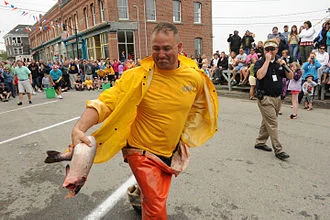
Sailor from USS Nitze competes in the cod race during Fourth of July celebration in Eastport, Maine in 2011.
'"O high New England summer, warm
and fortified against the storm
by nightly nips you once adored,
though never going overboard....''
-- From "Fourth of July in Maine,'' by Robert Lowell
Chris Powell: Connecticut's state government helps create urban poverty
For many years state government has been obsessed with making taxes and spending add up without much regard to what government actually produces.
Few in authority have noticed that despite the desperate efforts with arithmetic, Connecticut has been declining steadily. While the state auditors of public accounts often expose the ordinary management failures of particular agencies, no one in authority has tried to audit Connecticut on a comprehensive scale.
But a few months ago a scholar with the Manhattan Institute, Stephen D. Eide, working with the Yankee Institute, Connecticut's foremost public-policy research organization, produced a few lines of data that may be all the audit Connecticut needs.
For a study titled "Connecticut's Broken Cities," Eide took U.S. Census Bureau figures for Connecticut's four largest cities -- Hartford, New Haven, Bridgeport and Waterbury -- to calculate the changes in the poverty of their populations from 1970 to 2014.
Eide found that poverty had exploded. Hartford's population fell 21 percent but its number of poor people rose by 56 percent. New Haven's population fell 5 percent but the number of its poor rose 41 percent. Bridgeport's population fell 6 percent but the number of its poor rose 86 percent.. Waterbury's population rose marginally, by 1.7 percent, but its poor rose by an extraordinary 154 percent.
That is, during the last five decades Connecticut's cities have been turned into poverty factories. Government policy has only increased poverty and social disintegration in the cities, not reduced it.
Ordinarily such policy might be considered a catastrophic failure. But since these results have been produced for so long without causing any change in policy or even reconsideration, another possibility must be acknowledged: that Connecticut intends to create poverty. After all, poverty creates dependence on government; dependence on government creates political power; and administering poverty creates lucrative business for government and its agents in what are called social services and criminal justice.
Eliminating poverty would destroy that political power and lucrative business. Of course poverty has many destructive and unattractive effects, and if the people whose taxes pay for poverty policy saw those effects up close, they might raise questions.
So with exclusionary zoning, dressed up with noble-sounding terms like open space and farmland preservation, and with the concentration of rent subsidies, Connecticut has confined most of its poverty to the cities, largely out of sight.
But now the poverty business -- welfare, child protection, rent subsidies, Medicaid, criminal justice, remedial education and so forth -- along with government employee pensions, are cannibalizing the rest of state government, and the General Assembly and the governor lately have not been able to enact a budget.
Taxpayers are noticing. So the managers of the poverty business are raising distractions, trying to deter questions. When the state Education Department's program supplying free meals to schoolchildren during the summer reopened the other day, its executive director said the program is needed because many employers fail to pay a "living wage."
That is, Ronald McDonald, the Burger King and Wendy the Hamburger Girl have induced people to have children they were never prepared to support after they graduated from high school without mastering high school work, confident that government would provide. Kids have to be fed but government itself is making more of their parents unfit to feed them.
Chris Powell is managing editor of the Journal Inquirer, in Manchester, Conn.
Do Canto recognized for helping restore Grand Banks schooner
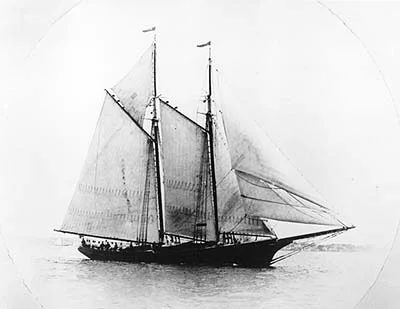
The Ernestina-Morrissey in its heyday. It was launched in 1894.
From the New England Council (https://newenglandcouncil.com/)
"Licy Do Canto, founder and president of NEC member the Do Canto Group, was recently recognized for his work leading the restoration of the Ernestina-Morrissey, the oldest surviving Grand Banks fishing schooner.
"Licy Do Canto serves as Chairman of Massachusetts’ Schooner Ernestina Commission, which is in charge of overseeing the $6.3 million historical preservation of the Schooner Ernestina-Morrissey. The Ernestina- Morrissey serves as the flagship vessel of the state of Massachusetts and Department of Conservation and Recreation (DCR). Officials at the DCR are looking into the possibility of utilizing the ship for educational opportunities for students, including those at the Massachusetts Maritime Academy, once the restoration project is complete. Do Canto hopes to highlight the schooner’s history of carrying immigrants to the United States, such as his own grandmother who emigrated to the United States abroad the Ernestina-Morrissey. The Ernestina-Morrissey was the last sailing ship to have regular service carrying immigrants to the United States, largely from Cape Verde.
“'The state has this opportunity to embrace this vessel for what it is, and the rich culture and history it reflects,' said Do Canto.
"The New England Council thanks Do Canto for his work towards preserving an important piece of history for New England. '' For more information, hit this link.
Fusing tourism and town life
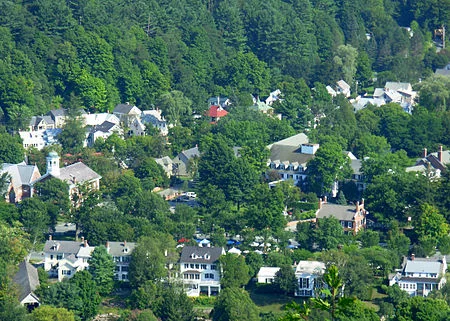
Woodstock, Vt.
''It looked like the set for an Andy Hardy movie - things quaint in the manner of Norman Rockwell...Maybe the town wasn't the prettiest village in America, but if the townspeople wanted to make the claim, I wouldn't have disputed them. It was Woodstock, Vermont.
"....the village lived by the tourist - the well heeled tourist. But few places in the country fused tourism and town life so well. In Woodstock, they were parts of the whole.
"If the village had a fault, it lay in both a hubris about its picturesqueness and in its visitors with new money and new facades...."
-- From William Least Heat-Moon's Blue Highways