
Vox clamantis in deserto





Sculpture from space in the Berkshires

"Crystal'' (wood and zinc-coated copper), by Thomas Schutte, in his show "Crystal at the the Clark,'' at the Clark Art Institute, Williamstown, Mass., through Oct 31.
Mr. Schutte is best known for large-scale sculptures of figures that reimagine the role of statuary and monuments. This installation is in a meadow near the top of Stone Hill, close to the edge of woodland. He got the idea for the unusual asymmetrical shape by thinking of a small piece of crystal scaled up to architectural proportions. He seems to have sought to create a sense that space aliens had landed in the Berkshires.
Upon having our swelter quota
"Our fear of death is like our fear that summer will be short, but when we have had our swing of pleasure, our fill of fruit, and our swelter of heat, we say we have had our day."
-- Ralph Waldo Emerson
July a foggy month along the coast
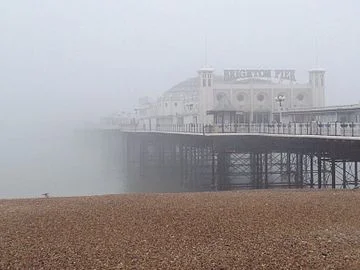
''July can be the foggiest time of the year, as residents of the New England coastal areas know well. Many summer vacationers, attracted by the refreshing coolness of the ocean breezes, complain when sea fog obscures the sun and spoils a beach day for sun-bathing and swimming. {That's because} in July the greatest contrasts exists between the relatively cool ocean waters and the hot air masses from the continent.''
From The Country Journal New England Weather Book, by David Ludlum

Llewellyn King: Trump's staggering ignorance about the energy sector

Two things are reverberating around the energy world. One is President Trump’s announcement that it is U.S. policy to seek energy “dominance,” and the other a projection by Lisa Wood of the Institute for Electric Innovation at the Edison Foundation that by 2025 there will be 7 million electric vehicles on the road.
Let us take them sequentially. In talking about energy dominance the president is acting like a man in a gorilla suit, thumping his chest and making strange noises that can only be understood by other men in gorilla suits.
The goal of every president, from Nixon on, has been to make the United States energy self-sufficient, as it was at the end of World War II — a time when Texas was the Saudi Arabia of fossil fuel and world oil consumption was modest. Now world consumption hovers around 95 million barrels a day and U.S. consumption around 20 million barrels a day.
The government-imposed fleet-mile standards have done much to improve mileage and curb U.S. energy appetite. With that program nixed by Trump and low prices, U.S. consumption might for a while edge up slightly.
The big change has been hugely increased production of oil and gas from shale in the United States through hydraulic fracturing, called “fracking,” of very tight formations.
It is this that allows Trump and Secretary of Energy Rick Perry to talk of “dominance,” undiplomatic and even offensive as such language must seem. It is as though Trump policy is to kick sand in the face of anyone who might be a customer in the future or who bailed us out in the past. In the lexicon of ill-considered words in relations with allies and customers, “dominance” must be right up there.
Oil and natural-gas abundance has changed everything where hydrocarbons are concerned and has even affected nuclear power. Natural gas is cheap, so cheap that it is cheaper than coal or nuclear for electric generation. The president might love coal and coal miners, but even relaxing environmental rules will not save coal domestically though exports will continue.
India and China, which burn vast quantities of coal and may have to burn more, would like to get off it. Their cities are choking on bad air and the health of their people is being harmed. That is why they are the new hope for nuclear generation.
The market is against coal as is public opinion. King Coal is due to abdicate and the men in the gorilla suits cannot save his throne.
Enter the electric car as another game-changer, slowly at first, then very fast.
The projection by the Edison Foundation’s innovation arm that electric-car deployment would reach 7 million vehicles by 2025 should encourage a new interest in the utility sector because it is the electric car that looks likely to change domestic demand for oil, freeing more of it for export. If charging stations can be deployed quickly enough, the 7 million figure may seem modest.
Natural gas is already an export commodity with 16 permits for terminals issued under the Obama administration.
If Trump and Perry want the United States to continue to be out in front in energy, they might think hard about how the fracking miracle came about. Call it the 40-year cycle: It took about 40 years of trial and error to unleash the bounty of close-formation gas and oil. It also took a lot science, a lot of government-backed geology and one brave entrepreneur, George Mitchell of Mitchell Energy & Development Corp. to bring it off. The government poured the science in everything from new design drill bits to 3-D seismic and GPS mapping; oil-field know-how came from Mitchell.
Likewise, with wind and solar technology, the wind turbines and solar panels being deployed today were first investigated, again with a lot of taxpayer money, back in the 1970s at such government laboratories as Sandia in New Mexico. I know: I covered the first faltering steps.
The point here is that to lead or, if you prefer, to dominate in energy you need patience, science and funding endurance. Trump and Perry are starting their quest to world “dominance” by slashing the research budget of the Department of Energy and doing away with ARPA-E, the super-reach arm of the agency.
It is not a strategy for staying out front, for dominating for very long.
Llewellyn King (llewellynking1@gmail.com) is host of White House Chronicle, on PBS, and a veteran publisher, editor. columnist and international business consultant, mostly specializing in energy-related matters. He's based in Washington, D.C., and Rhode Island. This piece first ran in Inside Sources.
Video: Partners CEO discusses impact of GOP insurance legislation
Video: See this New England Council interview with David Torchiana, M.D., president and CEO of Partners HealthCare, the biggest hospital system in New England, on the possible impact of Republican health-insurance legislation on, among other things, the Bay State. To see the video, please hit this link.
Amazon's Whole Foods takeover: Automation will be the job killer

A Whole Foods store in Boston.
From Robert Whitcomb's "Digital Diary,'' in GoLocal24.com:
Amazon’s plan to buy Whole Foods has elicited a lot of heavy breathing and assertions that Amazon will wipe out a lot of grocery stores. I thinkthat these forecasts are exaggerated. Groceries – stuff that can rot – are not the same things as books and clothes. The distribution challenges are very different.
Most people will continue to drive or walk to a regular (not high-end, expensive “organic”) supermarket or small grocery store for the foreseeable future. Inflation-adjusted wages have been falling for most people. The market for expensive (and some would say pretentious) food is unlikely tovastly expand. For all its alleged glamour, most people don’t shop at the expensive likes of Whole Foods – and never will.
An Amazon-Whole Foods mating might work very well in densely populated affluent areas with a close enough proximity to warehouses to ensure that the stuff can be delivered unspoiled to Amazon-Whole Foods supermarkets or to your home. But it wouldn’t work well in thinly populated areas.
Finally, even in this plutocratic age, it’s possible that the Federal Trade Commission and the U.S. Justice Department will awake from their all-too-frequent torpor and press monopoly charges against the company if it tries to take over a big hunk of the grocery business.
Anyway, I’m more worried about the effects on employment and wages of the automation of cashier and other jobs now underway in many kinds of stores than about Amazon specifically (I always use cashiers, not those machines, in a tiny effort to help preserve jobs.) And I worry about the effects on local tax revenue and jobs from so many stores of all kinds closing because of the online revolution.
'Only different grown'
Once more on the fallow hillside, as of old, I lie at rest
For an hour, while the sunshine trembles through the walnut-tree to the west,—
Shakes on the rocks and fragrant ferns, and the berry-bushes around;
And I watch, as of old, the cattle graze in the lower pasture-ground.
"Of the Saxon months of blossom, when the merle and mavis sing,
And a dust of gold falls everywhere from the soft midsummer's wing,
I only know from my poets, or from pictures that hither come,
Sweet with the smile of the hawthorn-hedge and the scent of the harvest-home.
"But July in our own New England—I bask myself in its prime,
As one in the light of a face he loves, and has not seen for a time!
Again the perfect blue of the sky; the fresh green woods; the call
Of the crested jay; the tangled vines that cover the frost-thrown wall:
"Sounds and shadows remembered well! the ground-bee's droning hum;
The distant musical tree-tops; the locust beating his drum;
And the ripened July warmth, that seems akin to a fire which stole,
Long summers since, through the thews of youth, to soften and harden my soul.
"Here it was that I loved her—as only a stripling can,
Who dotes on a girl that others know no mate for the future man;
It was well, perhaps, that at last my pride and honor outgrew her art,
That there came an hour, when from broken chains I fled—with a broken heart.
"'T was well: but the fire would still flash up in sharp, heat-lightning gleams,
And ever at night the false, fair face shone into passionate dreams;
The false, fair form, through many a year, was somewhere close at my side,
And crept, as by right, to my very arms and the place of my patient bride.
"Bride and vision have passed away, and I am again alone;
Changed by years; not wiser, I think, but only different grown:
Not so much nearer wisdom is a man than a boy, forsooth,
Though, in scorn of what has come and gone, he hates the ways of his youth.
"In seven years, I have heard it said, a soul shall change its frame;
Atom for atom, the man shall be the same, yet not the same;
The last of the ancient ichor shall pass away from his veins,
And a new-born light shall fill the eyes whose earlier lustre wanes.
"In seven years, it is written, a man shall shift his mood;
Good shall seem what was evil, and evil the thing that was good:
Ye that welcome the coming and speed the parting guest,
Tell me, O winds of summer! am I not half-confest?
"For along the tide of this mellow month new fancies guide my helm,
Another form has entered my heart as rightful queen of the realm;
From under their long black lashes new eyes—half-blue, half-gray—
Pierce through my soul, to drive the ghost of the old love quite away.
"Shadow of years! at last it sinks in the sepulchre of the past,—
A gentle image and fair to see; but was my passion so vast?
"For you," I said, "be you false or true, are ever life of my life!"
Was it myself or another who spoke, and asked her to be his wife?
"For here, on the dear old hillside, I lie at rest again,
And think with a quiet self-content of all the passion and pain,
Of the strong resolve and the after-strife; but the vistas round me seem
So little changed that I hardly know if the past is not a dream.
"Can I have sailed, for seven years, far out in the open world;
Have tacked and drifted here and there, by eddying currents whirled;
Have gained and lost, and found again; and now, for a respite, come
Once more to the happy scenes of old, and the haven I voyaged from?
"Blended, infinite murmurs of True Love's earliest song,
Where are you slumbering out of the heart that gave you echoes so long?
But chords that have ceased to vibrate the swell of an ancient strain
May thrill with a soulful music when rightly touched again.
"Rock and forest and meadow,—landscape perfect and true!
O, if ourselves were tender and all unchangeful as you,
I should not now be dreaming of seven years that have been,
Nor bidding old love good-by forever, and letting the new love in!''
-- "The Old Love and the New,'' by Edmund Clarence Stedman
Sunny-side up

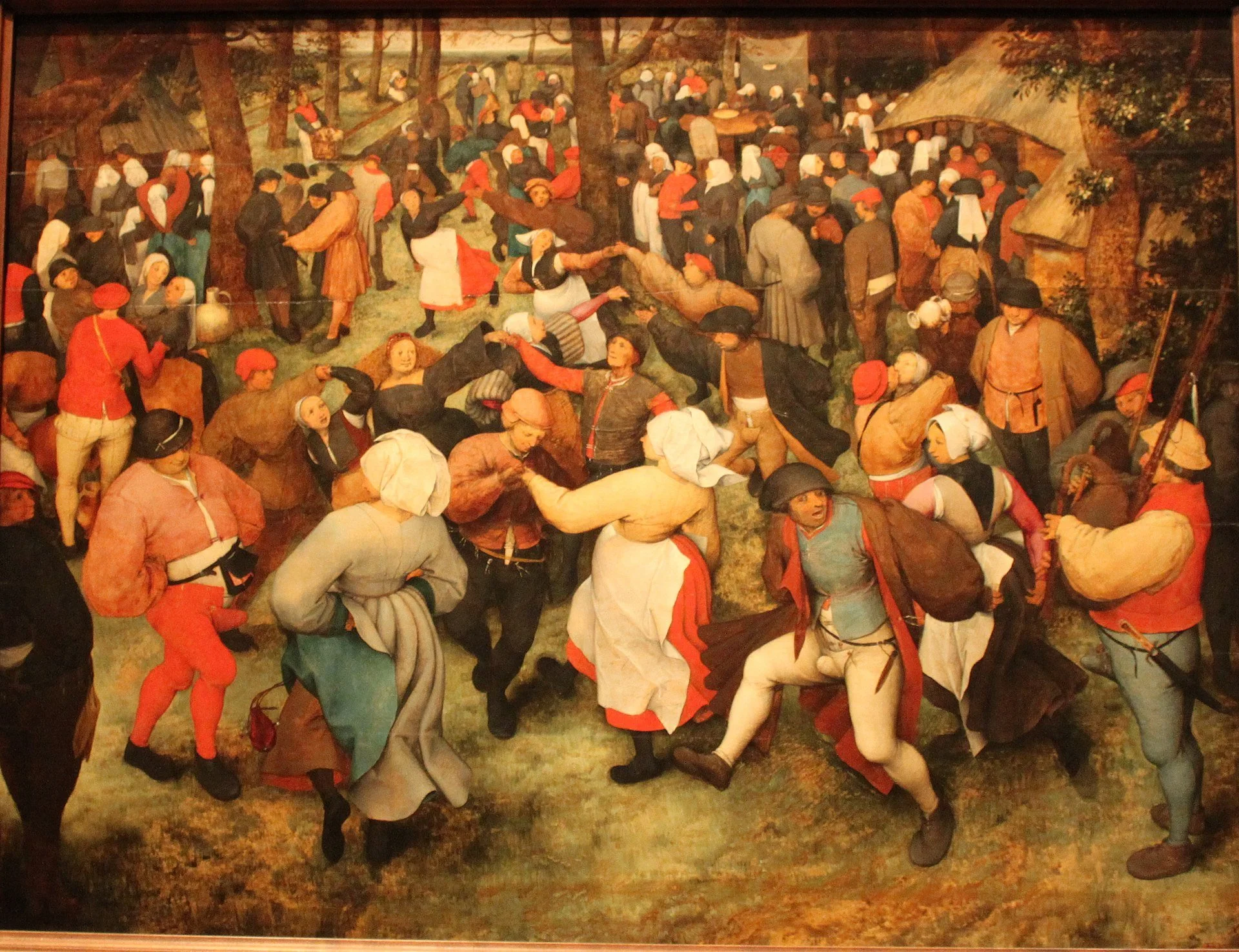
"Jessie's Diner'' (oil on linen), by Andrew Stevovich, at Adelson Galleries, Boston.
Tim Faulkner: Southern New England gas-pipeline project suspended
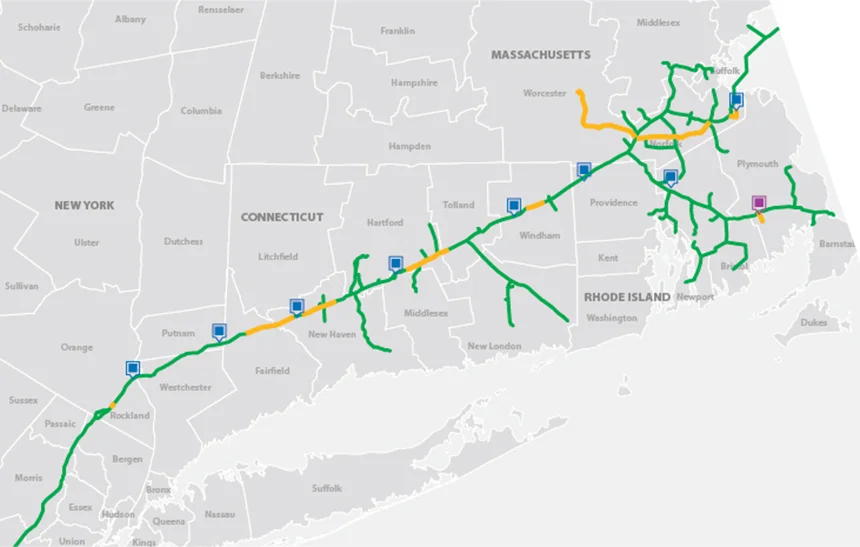
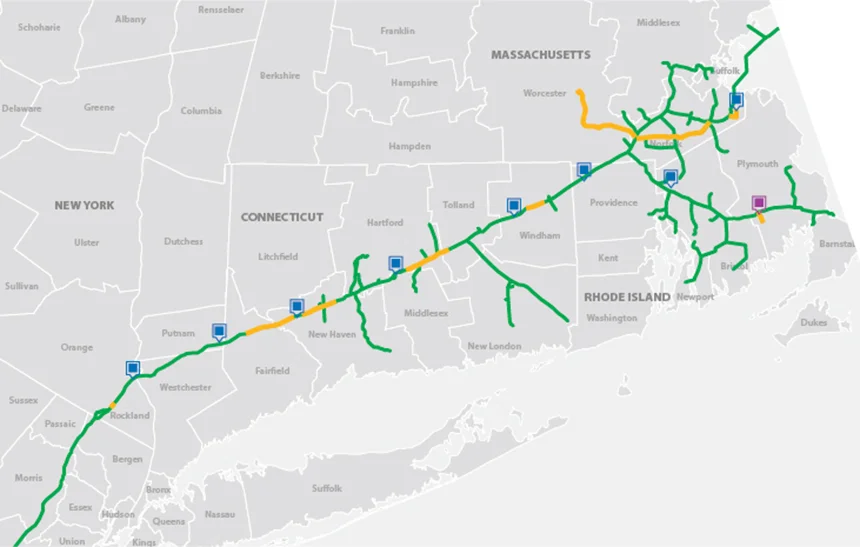
The Access Northeast project
-- Map by Access Northeast
Via ecoRI News (ecori.org)
A natural-gas-infrastructure project slated for southern New England came to a screeching halt June 29, when Houston-based Spectra Energy Partners announced it is suspending the controversial Access Northeast project.
The buildout of the Algonquin natural-gas pipeline centered on a series of extensions and nine compressor station projects between New York and Massachusetts, including a new compressor station in Rehoboth, Mass., and the expansion of a compressor station in Burrillville, R.I.
The 10,320-horsepower Rehoboth compressor station was proposed for a privately owned 120-acre site close to Attleboro and Seekonk, Mass., and Pawtucket, R.I., and about 10 miles from downtown Providence.
Access Northeast was a shared effort by Spectra, National Grid and Eversource. The project was one of several that resulted from a December 2013 agreement between all six New England governors that allowed the states to share the costs of regional energy projects. The effort hit a snag in late 2016, when the Massachusetts Supreme Judicial Court rejected a plan by the three companies to charge electric ratepayers for the natural-gas projects. The demise of the so-called “pipeline tax" put the Access Northeast and other proposed pipeline upgrades in limbo and prompted other New England states to suspend or reject similar funding schemes.
The Access Northeast project provoked stiff local criticism and the formation of opposition groups such as Citizens Against the Rehoboth Compressor Station (CARCS), The FANG Collective and Burrillville Against Spectra Energy.
Opponents united over heath, safety and environmental risks such as air and water pollution, fires and explosions, noise, climate-change impacts, and the notion that the projects helped the export of natural gas from hydraulic fracturing fields in Pennsylvania and Ohio to coastal terminals in or near New England.
News of the canceled project was announced via an e-mail to municipalities hosting projects. The opposition groups were quick to responded to the announcement that Spectra withdraw the Access Northeast application.
“This victory is owed to all of the frontline communities who have been resisting Spectra across the Northeast, and to those who have put their bodies on the line as part of direct actions to stop Spectra," said Nick Katkevich of The FANG Collective, a Providence-based environmental activist group that was founded in reaction to a previous expansion of the Burrillville compressor station.
Katkevich and other activists say there are still many more southern New England projects to oppose, such as Spectra’s Atlantic Bridge project, which includes a bitterly contested compressor station in Weymouth, Mass.
“We must remain ever vigilant since Rehoboth hosts miles of transmission lines which makes us particularly vulnerable,” said Tracy Manzella of CARCS. “We agree and support the messaging from all the other anti-pipeline groups."
Manzella sees bigger forces to reckon with, such as fossil-fuel-friendly policies advanced by the operator of the New England power grid, ISO New England, and Massachusetts Gov. Charlie Baker.
“CARCS will not rest in its resistance to pipeline expansion here or anywhere, not until we have safely made the transition to clean renewable energy and the window of opportunity for these greedy companies to use us for their profit taking is past," she said.
Access Northeast is the second canceled pipeline project. In March 2016, fossil-fuel developer and pipeline owner Kinder Morgan scrapped its proposed $3 billion, 188-mile Northeast Direct pipeline planned for the northern edge of Massachusetts.
“Spectra recognized that their deep pockets were no match for grassroots power," said Craig Altemose, executive director for 350 Massachusetts for a Better Future. "It’s only a matter of time before other fossil-fuel companies come to the same realization. We look forward to Spectra similarly abandoning their plans for the similarly offensive and unnecessary Atlantic Bridge project.”
Tim Faulkner writes frequently for eco RI News.
Job openings at Boston's biggest weekly
Boston’s largest-circulation weekly newspaper is looking for one or more hard-news reporters with experience in complex urban issues (development, zoning, transportation, etc.)
Must have a minimum of one year’s experience beyond college and already live in Boston or a contiguous city.
Please email resume and three hard news clips to:djacobs@thebostonguardian.com
Compensation is commensurate with experience.
David Jacobs
Publisher/Editor
The Boston Guardian
And it used to be frozen
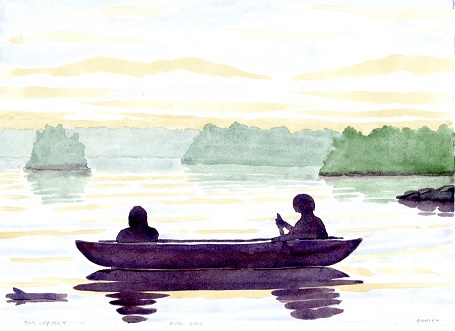
"Bay Odyssey'' (watercolor), by Stoney Conley, at the Patricia Lloyd Carega Gallery, Center Sandwich, N.H.
Felines are finer
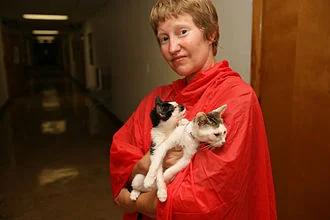
Do your friends want to reform you?
Do they try to mend your ways?
Do they prod you to get moving:
Jog, recycle, fill your days,
Start your own organic garden,
Eat more carrots, eat less fat?
Well, there’s always my solution --
Blow them off, and get a cat.
''Better Company,'' by Felicia Nimue Ackerman
'Relax and just recover'

"Seaweed,'' (photo) by Bobby Baker (copyright Bobby Baker Fine Art).
"On the seawall walking,
As the seagulls squawk.
I'm tossing rocks in the water,
But the birds think it's fish that I feed!
"On the sand I see a crab,
Digging deeper with its pinchers...
Moving tiny bits of pebbles,
As the sunset falls with a breeze.
"Cape Cod invites these scenes,
In New England in the Summer.
It's not odd but quite easy...
To spot two strolling lovers!
"In New England in the Summer.
Loving up like nothing other.
This kind of weather to discover!
Release, relax and just recover. ''
"In New England in the Summer,'' by Lawrence S. Pertillar

Sorry to leave you hanging

"Drive'' (oil on canvas), by Christopher Pendergast, in the group show "+wanderlust,'' at Atelier Newport, in Newport, R.I., July 1-30. The gallery say the show "reflects an urge for self-development by experiencing the unknown, confronting unforeseen challenges, getting to know unfamiliar cultures, ways of life and behaviors driven by the desire to escape. The exhibition will feature objects, sculpture and painting by sixteen artists who explore this concept or the idea of desire.''
Don Pesci: Connecticut awaits a Bismarck
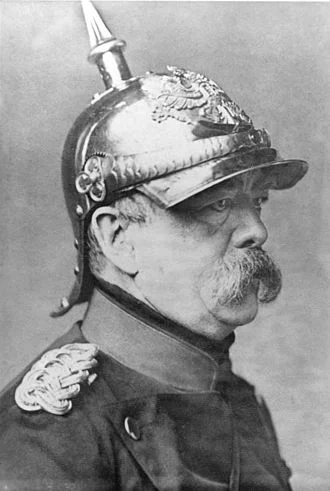
Otto von Bismarck, who unified the German states in the 19th Century.
The usual gubernatorial campaign in Connecticut begins with brave platitudes and ends, once office has been achieve, with whimpering platitudes.
We recall a triumphant Gov. Lowell Weicker warning during his gubernatorial campaign that instituting an income tax in the midst of a recession would be like “pouring gas on a fire,” then, having achieved office, hiring as his Office of Policy Management Director Bill Cibes, who ran an honest but losing Democratic primary campaign by agitating for an income tax. Before you could say, “Let’s pour gas on the fire,” Connecticut had its income tax. State businesses have taken note of the ungovernable growth in spending and now have their eyes fixed on the exit signs.
Republican Gov. John Rowland was wafted into office on a pledge to repeal Weicker’s incendiary income tax; once in office, the pledge was quickly moved to Rowland’s back burner, where it expired from lack of air.
Gov. Jodi Rell, who replaced Rowland when he was sent to jail for the first time for corrupt activity, proved to be an imperfect “firewall” preventing progressive Democrats in the General Assembly from piling up debt through reckless spending. Having declined to run for a third term, Rell passed the gubernatorial reins to then Stamford Mayor Dannel Malloy and retired to Florida, far from the hurly burly of tax increases and spending binges.
Enter Governor Malloy, who imposed on Connecticut the largest and second largest tax increases in state history, having hinted in his own campaign that the weight of debt in Connecticut would be more or less evenly distributed between state employee unions and taxpayers.
One political commentator in Connecticut, weary with all the folderol, has now declared war on platitudes and artfully misleading campaigns. Other journalists committed to telling it like it is may follow suit.
“There may be many differences between Republican and Democratic candidates,” Kevin Rennie tells us. “One unhappy trait, however, unites them. They all want to be governor and no one wants to say how they would solve the state's most pressing problems. With the state facing a $5 billion budget deficit this is the ideal moment to unveil detailed, serious solutions before an engaged public. Let a thousand ideas bloom. If they possess the talent to be a successful governor, tell us what you would do right now, in a forbidding hour for Connecticut.”
Prussian and then German Chancellor Otto von Bismarck put such misgivings more succinctly: “A statesman cannot create anything himself. He must wait and listen until he hears the steps of God sounding through events; then leap up and grasp the hem of His garment.”
In progressive Connecticut, belief in God waxes and wanes in proportion to the trust that one places in blind fate and cowardly politicians; today, public faith in Connecticut politicians is at its lowest ebb. We pray to politicians when times are good and to God when politicians are bad, which is often. Bismarck again: “People never lie so much as after a hunt, during a war or before an election.”
And Bismarck again: “Never believe anything in politics until it has been officially denied.” Official denials are rarely convincing, such as: “Just as he said during the 2014 campaign ‘there is no deficit, there will be no deficit,’ the governor has no clothes,” said House Minority Leader Themis Klarides in October, 2016. The state’s present biennial deficit, as Rennie notes, is hovering around $5 billion.
The elections in 2018 promise to be somewhat different for a series of reasons: 1) progressivism – the notion that if government is good, bigger government is better – has been a conspicuous failure; 2) mindful of Napoleon’s advice – when your enemy is making mistakes, don’t interfere – leading Republicans in Connecticut are fully prepared to exploit in a general election the opposing party’s tactical and strategic errors on tax increases; 3) in the long run, Republicans are committed to substantial reform, including wresting political power from unions entrenched within a solicitous administrative state, while the Democratic Party has been for a half century defenders of the status quo; 4) it is true that there is no Bismarck in the Republican Party gubernatorial line-up for governor so far, but the Democratic Party's gubernatorial roster screams “more of the same,” and its program for the future promises to be chock full of Bismarckian “official denials” that many political watchers will regard as desperate, despicable and laughably untrue.
Don Pesci is a Vernon, Conn.-based columnist whose essays often appear in New England Diary.
General Electric's impact on Massachusetts

This from the New England Council (newenglandcouncil.com):
"New England Council member General Electric (GE) recently released an economic impact analysis (EIA) of the company’s operations in Massachusetts.
"The report, 'General Electric’s Impact on the Commonwealth of Massachusetts’s Economy,' was conducted by Frost & Sullivan, a business economic intelligence and research company, and breaks down GE’s impact into five categories: total economic impact, employment, labor compensation, charitable impact, and investment. GE contributed $6.31 billion to the Massachusetts economy in 2016 through the company’s total production output in the state. GE’s operations in Massachusetts support 17,829 jobs; 4,750 of which come from GE, 4,921 come from supply chain partners, and 8,158 supported by the spending by GE employee households. These direct, indirect, and induced jobs generated $2.352 billion in labor compensation in 2016 due to GE’s presence in Massachusetts. The analysis also found that GE donated $13.26 million in charitable contributions while GE employees volunteered over 6,650 hours to charities in Massachusetts. The total impacts also do not include investments GE has made in the state for future operations, including the company’s headquarters relocation to Boston and the opening of GE Healthcare’s new Life Science headquarters in Marlborough.
"The New England Council thanks GE for its continued investment in Massachusetts and the entire New England region, which contributes to the strengthening of the region’s economy and provides jobs to thousands of New England residents.''
Chuck Collins: America's crumbling infrastructure and the very rich
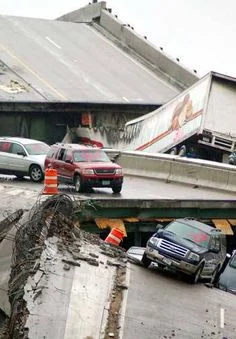
Via OtherWords.org
If you find yourself traveling this summer, take a closer look at America’s deteriorating infrastructure — our crumbling roads, sidewalks, public parks and train and bus stations.
Government officials will tell us “there’s no money” to repair or properly maintain our tired infrastructure. Nor do we want to raise taxes, they say.
But what if billions of dollars in tax revenue have gone missing?
New research suggests that the super-rich are hiding their money at alarming rates. A study by economists Annette Alstadsaeter, Niels Johannesen, and Gabriel Zucman reports that households with wealth over $40 million evade 25 to 30 percent of personal income and wealth taxes.
These stunning numbers have two troubling implications.
First, we’re missing billions in taxes each year. That’s partly why our roads and transit systems are falling apart.
Second, wealth inequality may be even worse than we thought. Economic surveys estimate that roughly 85 percent of income and wealth gains in the last decade have gone to the wealthiest one-tenth of the top 1 percent.
That’s bad enough. But what if the concentration is even greater?
Visualize the nation’s wealth as an expansive and deep reservoir of fresh water. A small portion of this water provides sustenance to fields and villages downstream, in the form of tax dollars for public services.
In recent years, the water level has declined to a trickle, and the villages below are suffering from water shortages. Everyone is told to tighten their belts and make sacrifices.
Deep below the water surface, however, is a hidden pipe, siphoning vast amounts of water — as much as a third of the whole reservoir — off to a secret pool in the forest.
The rich are swimming while the villagers go thirsty and the fields dry up.
Yes, there are vast pools of privately owned wealth, mostly held by a small segment of super-rich Americans. The wealthiest 400 billionaires have at least as much wealth as 62 percent of the U.S. population — that’s nearly 200 million of us.
Don’t taxpayers of all incomes under-report their incomes? Maybe here and there.
But these aren’t folks making a few dollars “under the table.” These are billionaires stashing away trillions of the world’s wealth. The latest study underscores that tax evasion by the super-rich is at least 10 times greater — and in some nations 250 times more likely — than by everyone else.
How is that possible? After all, most of us have our taxes taken out of our paychecks and pay sales taxes at the register. Homeowners get their house assessed and pay a property tax.
But the wealthy have the resources to hire the services of what’s called the “wealth defense industry.” These aren’t your “mom and pop” financial advisers that sell life insurance or help folks plan for retirement.
The wealth defenders of the super-rich — including tax lawyers, estate planners, accountants, and other financial professionals — are accomplices in the heist. They drive the getaway cars, by designing complex trusts, shell companies, and offshore accounts to hide money.
These managers help the private jet set avoid paying their fair share of taxes, even as they disproportionately benefit from living in a country with the rule of law, property rights protections, and public infrastructure the rest of us pay for.
Not all wealthy are tax dodgers. A group called the Patriotic Millionaires advocates for eliminating loopholes and building a fair and transparent tax system. They’re pressing Congress to crack down on tax evasion by the superrich.
Their message: Bring the wealth home! Stop hiding the wealth in offshore accounts and complicated trusts. Pay your fair share to the support the public services and protections that we all enjoy.
Chuck Collins is a senior scholar at the Institute for Policy Studies and a co-editor of Inequality.org. He’s the author of the recent book Born on Third Base.
Information and pictures, please, on the Stone House
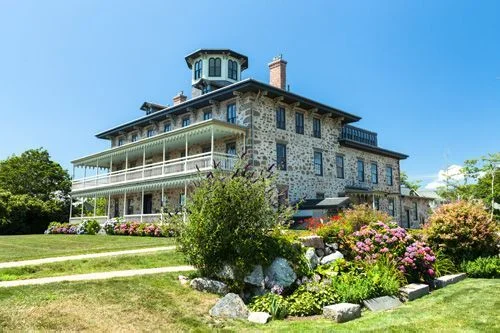
The Stone House, in Little Compton, R.I.
We're doing some historical research on the Stone House, an old inn in Little Compton, R.I. We'd appreciate any information from readers about their own weddings and/or wedding receptions held at the Stone House or such events involving their friends and/or relatives. Dates of the events -- and pictures! -- would be most appreciated. We'd guess that there have been weddings and/or wedding receptions there going back to the late Twenties, when there was a speakeasy in this lovely structure, built in 1854 as a private home.
Please email such information to:
rwhitcomb4@cox.net
Maine's rural health systems should align values
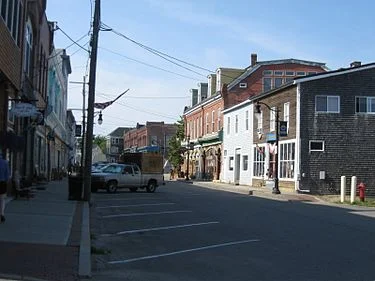
Not exactly wild downtown Eastport, Maine.
Video: Michelle Hood, president and CEO of Eastern Maine Healthcare Systems, discusses why rural healthcare organizations must align their values before become partners or doing an outright merger.
To watch the video, please hit this link.
Seasoned with other seasons
Each season has fragments of others. Consider this morning in southern New England, where the freshness and temperature of the air, and the light, recalled late September.