
Vox clamantis in deserto








War, remembrance and summer
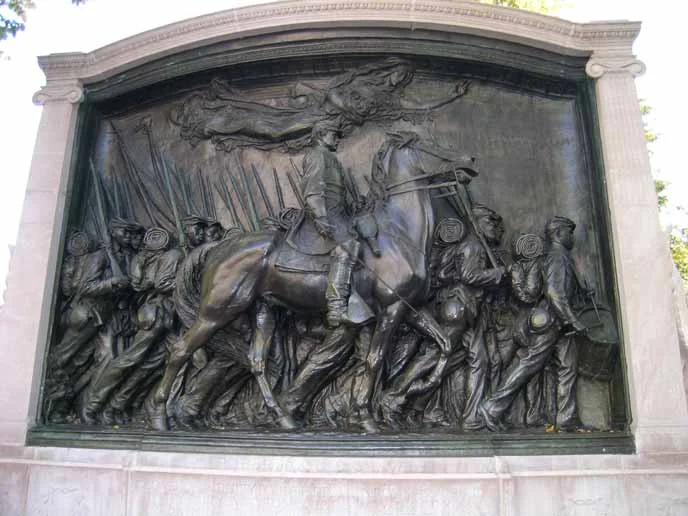
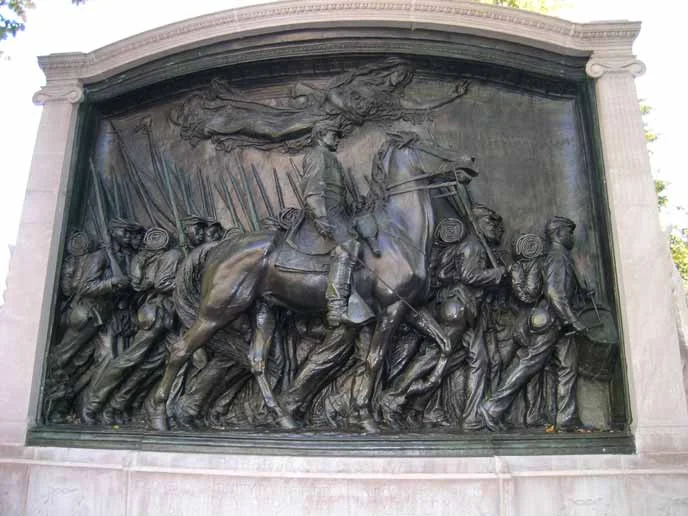
Two months after marching through Boston,
half the regiment was dead;
at the dedication,
William James could almost hear the bronze Negroes breathe.
-- From Robert Lowell’s “For the Union Dead.’’ It refers to the Robert Gould Shaw and Massachusetts 54th Regiment Memorial, above, across Beacon Street from the Massachusetts State House.
Ah, Memorial Day: In somber remembrance of the dead of our wars and in celebration, especially in America’s cooler climes, of the coming of summer. A paradoxical holiday.
My strongest memories of the day are of the Memorial Day Parade in my little hometown. In the maximum lushness of the season, with the fragrance of cut, wet grass and gasoline from the lawn mowers on the common, the men (and a few women) marched, accompanied, I recall, with patriotic music by the high school band. They marched under the elm trees, of which there were still many, although Dutch elm disease was taking a heavy toll.
Most of them were men in their thirties who had fought in World War II, although there were still plenty of World War Ivets around, too. I remember that my father, who had been a Navy lieutenant in the war, and most of his fellow veteran friends, disliked being asked to march in the parade. They had no desire to put on their uniforms again.
Of course, we kids were still in school, which didn't end for another three weeks, but we saw the broad sunlit uplands of summer stretching ahead to the horizon that day. Time seemed to move so slowly then.
-- Robert Whitcomb
Fleeing to New York
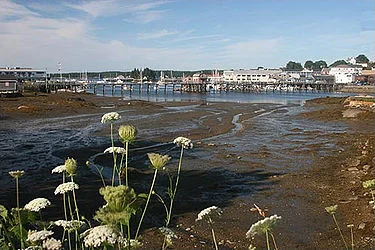
Boothbay Harbor, Maine, during a fragrant low tide.
"In the kind of New England I'm from, you are expected to stay and marry somebody from New England - well, Maine, actually - so I think it was seen as a betrayal when I left for New York, which has been my refuge.''
-- Elizabeth Strout (Pulitzer Prize-winning novelist)
Find a good governor to run for president
Adapted from an item in Robert Whitcomb's "Digital Diary,'' in GoLocal24.com
Hillary Clinton should fight her combative instincts and keepa low profile so as not to take the oxygen out of potential Democratic presidential candidates for 2020, such as the highly effective and popular Colorado Gov. John Hickenlooper and Delaware Gov. Jack Markell. Then there are New York Sen. Kristin Gillibrand and New Jersey Sen. Cory Booker, both smart, articulate and fast on their feet politically.
And wouldn’t it be nice if the very able and popular Republican governor of Massachusetts, Charlie Baker, ran for his party's presidential nomination? Of course, in the current rendition of his part, he’d probably have little chance.
As a general rule, it’s better to elect someone who has run a state than someone who has just served in Congress. Executive experience in a political and public-policy environment is invaluable for would-be presidents. It’s easy to spout off as a legislator, but a lot tougher to oversee administration. The record ofpeople running a state government gives voters quite a bit of useful information in how they might run the federal Executive Branch.
The public’s immune system needs a rest from the Clintons. The kids predictably loved her at Wellesley College’s commencement this year but I suspect that a large majority of the American electorate wants her to take a lower profile.
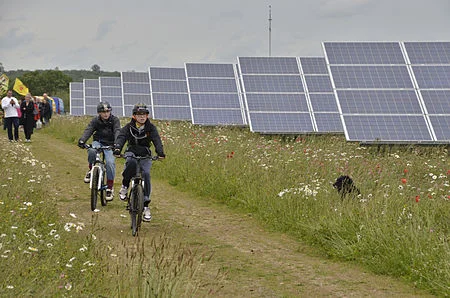
Frank Carini: Energy-sector sprawl raises concerns in southern New England
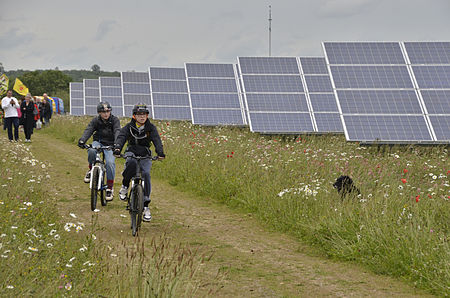
By FRANK CARINI for ecoRI News (ecori.org)
Meeting rising energy demand while minimizing the climate impact is a widely recognized, although often ignored, issue. But there’s an additional challenge that warrants attention: the land-use implications of the world’s energy demands.
This growing pressure is especially acute in southern New England, where land is at a premium.
Worldwide, during the next two-plus decades, some 200,000 square kilometers of additional land area will be directly impacted by energy development, according to a 2016 study. When spacing requirements are included, another 800,000 square kilometers, an area greater than the size of Texas, will also be impacted to quench the world’s thirst for energy.
Development of new land area required for energy production is, and will likely continue to be, the largest driver of land-use change in the United States for the foreseeable future, according to the report.
The U.S. Energy Information Administration has projected energy produced in the United States will increase 27 percent by 2040, to support both domestic and international demand.
Connecticut, Massachusetts and Rhode Island are all feeling crunched for space, and the preferred energy-development areas seem to be forestland and farmland. Forestland in all three states is already being cleared or is in line to be clear-cut to make room for more natural-gas infrastructure.
Fossil fuels, however, aren’t the only form of energy eating up valuable real estate. There’s growing concern that solar- and wind-energy projects will also leave behind environmental scars.
All three states, especially at the statehouse level, routinely rally around energy projects that promise to deliver electricity at the lowest cost. As a result, energy projects are typically directed away from developed land, because it’s cheaper to build from scratch. These open-space projects then inevitably ignore environmental-siting concerns and long-term external costs.
Connecticut’s Council on Environmental Quality (CEQ), for one, is deeply troubled by the region’s rush to take farmland out of production and cut down forest to power overconsumption.
Earlier this year the nine-member council published a report aimed at stimulating the siting of solar-energy facilities in places other than farms and forests. The report, "Energy Sprawl in Connecticut,'' documents the surge in proposals to use farmland and forestland for the construction of large solar electricity-generating facilities.
“We do not see any need for Connecticut’s land conservation and renewable energy goals to be in conflict,” CEQ Chairwoman Susan Merrow said. “We envision a future with ample solar energy, farms, and forests.”
Solar photovoltaic facilities are the largest single type of development consuming agricultural land and forestland in Connecticut. In 2016, the area of farmland and forest selected and/or approved for development of solar facilities nearly equaled the area of such lands preserved by the state in an average year. (CEQ)
The CEQ report analyzed recent state decisions affecting utility-scale solar development, and determined that if all of the projects selected by the Connecticut Department of Energy & Environmental Protection (DEEP) in 2016 to supply renewable energy are built, hundreds of acres of farmland and forest would be converted to electricity generation.
The 16-page report recommended legislation to:
Require DEEP to give “meaningful weight” to environmental-siting criteria when selecting renewable-energy projects that supply electricity to Eversource and United Illuminating. Under current laws and policies, DEEP bases its decisions on the price of electricity supplied, which has led to a surge in projects proposed to be built on farmland and forest.
Require utility-scale solar developments to obtain a certificate of environmental compatibility and public need from the Connecticut Siting Council (CSC). Current statutes require the CSC to approve such projects by declaratory ruling, and severely limit what the CSC may consider before approving a project. The certificate, on the other hand, is the approval tool for most facilities regulated by the CSC, from power plants to cell towers, and provides more detailed oversight of siting. In addition, the report urges the legislature to amend the statute to allow the CSC to consider impacts to agricultural land in all its decisions.
The CEQ also has urged DEEP and the Legislature to consider incentives to encourage developers to put their projects on landfills and other developed sites. The Massachusetts Department of Energy Resources is pushing a similar incentive program.
“The CEQ is focusing on the legal responsibilities of state agencies to select and approve renewable-energy projects,” Merrow said. “We are not recommending anything that would restrict the rights of landowners.”
Scott Millar, manager of community technical assistance for Grow Smart Rhode Island, said solar panels on rooftops, industrial land, landfills and brownfields would minimize environmental damage. He noted that crash-strapped municipalities would be eager to rent vacant and underused development space to renewable-energy developers.
“We need to take a hard look at what we’re proposing,” the former Rhode Island Department of Environmental Management staffer said. “We shouldn’t be sacrificing farms and forests.”
Grow Smart Rhode Island is particularly concerned about two bills filed in the General Assembly this session — similar to other bills filed during the past several years. Both the Senate and House bill would pave the way for energy-project development on farms and both would take away local siting control. Millar said the bills fail to properly value working farmland.
“Renewable-energy proponents are pushing the bills because they’re anxious to get projects built quickly,” he said. “It’s unprecedented that we would amend zoning to make industrial uses in zoned residential allowable and then place restrictions on cities and towns on how they can manage those uses.”
Some Rhode Island farmers have testified that allowing such projects on their land would help make their operations profitable.
Both bills were held for further study.
While Grow Smart has remained quiet regarding the development of what would be Rhode Island’s largest fossil-fuel power plant, the Clear River Energy Center in the woods of Burrillville, the proposed project may well be the best example of how southern New England is grappling with energy demand.
It’s been estimated that at least 200 acres of forestland would be impacted if the natural-gas power plant is built. The area’s forestland is home to some 165 wildlife species, including the hairy woodpecker, the black-throated green warbler, the wood frog, eastern box turtle, big brown bat and the six-spotted tiger beetle.
These woods, one of the largest remaining untouched forest tracts in Rhode Island, also feature an assortment of vegetation, from eastern hemlock, red maple, and various birch and oak trees to maleberry, blueberry, mountain laurel and witch hazel to cinnamon fern, threeleaf goldthread, northern starflower and peat moss.
To combat the increasing demand for energy, the CEQ report noted that energy-efficient appliances and programs would lessen the demand from all sources, including renewable sources.
Frank Carini is editor of ecoRI News.
Land grab

"La Salle Christening the Country 'Louisiana' '' (oil on canvas, 1905), by Howard Pyle, in the current show "Howard Pyle, His Students & the Golden Age of American Illustration,'' at the National Museum of American Illustration, Newport, R.I.
Copyright 2017 National Museum of American Illustration, Newport, R.I. Photo courtesy American Illustrators Gallery, New York, N.Y.
May in Middle English

"In somer when the shawes be sheyne,
And leves be large and long,
Hit is full merry in feyre foreste
To here the foulys song.
To see the dere draw to the dale
And leve the hilles hee,
And shadow him in the leves grene
Under the green-wode tree.
Hit befell on Whitsontide
Early in a May mornyng,
The Sonne up faire can shyne,
And the briddis mery can syng."
-- Anonymous, ''May in the Green Wode,'' 15h Century
Or just old-fashioned

From Renee Caouette's show "Conceptual Realism,'' at South Street Gallery, Hingham, Mass., through May 31.
Saturday greetings in spite of it all

Pollen grains from various plants.
There's a regime whose core is soaked in vast public and public corruption running the Executive Branch of the federal government. This Mafia-like group, the Trump-Kushner clan, engages in what may be treasonous collaboration with a murderous foreign dictatorship. Meanwhile, our civic life continues to rot, as large parts of the public make no effort to follow facts and, in their wishful thinking, have made themselves clay in the hands of demagogues and con men. The duties of citizenship are forgotten.
And, no, the mobsters sort of in charge of the government are not "conservatives.''
Still, the sun is supposed to shine a bit around here today after days or rain -- rain that has lightened the load of pollen in the air. So more of us can breathe more freely for a few hours. But wait until the plants dry out for a day or two, and the wind comes up, and the hay fever will be worse than ever.
-- Robert Whitcomb

Linda Gasparello: Portuguese culture thrives in a Rhode Island village

-- Photos by Linda Gasparello
Journal:
I live in the Riverpoint section of West Warwick, R.I., which I call “Portugal on the Pawtuxet River.” Riverpoint has a Portuguese American Citizens Club; the Jerry's supermarket stocks Portuguese food brands, such as Gonsalves, and there is a Portuguese bakery, Matos, in nearby Arctic Village – I recommend their three-bite, egg custard tarts, pasteis de nata. {There are heavily Portuguese-American neighborhoods in many southeastern New England communities.}
All around the circle at Riverpoint, but especially as you go up Providence Street to Arctic Village, you'll see modest houses, each with baroque front yard landscaping: flowering cherry trees shaped like umbrellas, espaliered shrubs and statuary – especially Virgin Mary statues, either brightly painted or stark white.
Most of the Virgin Mary statues are adorned with plantings – often with perennials, like hostas, and sometimes with plastic flowers or small American and Portuguese flags.
In the backyard of a house near the Bradford Soap Works, there is an Our Lady of Grace statue: a Virgin Mary with outstretched arms, standing on the serpent Satan. The blue paint has largely peeled off her robe, but the snake hasn't lost any of its black paint. It looks lifelike -- and like it is headed into the poison ivy that is creeping closer to the statue.

Just off Riverpoint circle, there is a house where another Our Lady of Grace statue stands among well-tended hostas in a tiny plot along the driveway. I call her “Our Lady of the Hostas.”
I have a chit-chat friendship with the Portuguese-American woman who lives there. Recently, when she saw me admiring the lush plants, she said, “I think Our Lady is smiling because the Pope has made saints of two Portuguese children.” She was referring to Pope Francis's canonization of siblings Francisco and Jacinta Marto who, with their cousin Lucia Santos, reported that on March 13, 1917, the Virgin Mary made the first of six appearances to them while they grazed their sheep in Fatima, Portugal.
My favorite religious statuary in Riverpoint is on East Main Street. It occupies the entire side yard of a house, where you'd expect to see a picnic table and benches or a circle of lawn chairs.
It's is a tableau of brightly painted statues: A statue of Jesus is flanked by one of St. Anthony holding Baby Jesus and another of the Virgin Mary. Fourteen winged cherubs, hands clasped in prayer, stand at their feet. The boys are dressed in blue, and the girls in pink.
Bygones Worth Remembering
My first encounter with the Portuguese wasn't in Portugal. It was on a train from Paris to Dax in June 1968. I was 13 years old and I was headed to this spa town in southwestern France, whose thermal springs and mud baths have been noted for the cure of rheumatism since Roman times, when it was known as Aquae Tarbellicae. There I was to Monsieur and Mme. Albert Barrieu, with whose family I would spend a few life-expanding summers.
The afternoon before I was to take the train to Dax, Madame Berri, who owned the suburban Paris agency that paired me with the Barrieus, warned me to get to the Gare d'Austerlitz early. “The trains to the southwest are crowded on Saturdays,” she said, handing me my ticket. It was going to be a long trip, over six hours, and I couldn't wait to take it.
I was staying at a youth hostel at 11 rue du Fauconnier in the Marais – and 49 years later, the Hotel Fauconnier is one of three youth hostels in Paris. After a week in Paris, I was a Metro master; I knew that it was about a 10-minute ride from the St. Paul station to the Gare d'Austerlitz. Even so, I packed my suitcase, showered and slept in my dress that Friday night. As I remember, I wanted to have more time to eat the breakfast the hostel laid out for the always-hungry youth: croissants, bread rolls, butter, apricot jam, and small bowls of coffee with hot milk.
Eating that breakfast turned out to be one of the smarter things I did that day.
I got to the station with a lot of time to spare. When my train was announced, I noticed that people where running down the platform and pushing into the cars, and shouting to each other in a language I couldn't identify. I had a second-class ticket, and all those people seemed to be headed to second-class cars.
I couldn't run fast because I was wearing wooden-soled clogs. By the time I climbed into one, all the seats in the compartments were taken – and all were taken in the other second-class cars.
As the train pulled out of the station, I placed my hard-sided, American Tourister suitcase in the aisle of one of the cars, and looked out the window. An unsympathetic conductor took my ticket and told me that I might have to stand a long time because “the train is filled with Portuguese, who are going back home for their national holiday.”
Clogs were the right shoes for standing for hours. I was alternately standing and looking out the window, or sitting on my suitcase looking at the Portuguese family across the aisle in a compartment.
About two hours into the trip, the father pulled down a couple of suitcases from the overhead racks. Out came the bread, the sausage, the cheese, the fruit and the wine.
A girl about my age asked her mother something. Then, through the open compartment door, she asked me in French if I wanted some of their lunch. I thanked her and helped myself to some bread and cheese. It was the first time that I had eaten a papa seco – a soft, baby bottom-shaped roll. Poof went my memory of the hostel's petits pains.
The train arrived in Dax in the late afternoon. I got off and waited for M. and Mme. Barrieu on the platform, as Mme. Berri had told me to do. A blonde woman accompanied by a teenaged girl looked at me for a while. They spoke with each other, shook their heads and walked away. No one was left on the platform but me, so I took a seat – and I was happy to do so.
After a couple of hours, the station manager approached me. “Are you still waiting for someone?” he asked.
I told him that I was supposed to be picked up by M. and Mme. Albert Barrieu who live in Pouillon. “It is a village not far from here. Do you have a telephone number?”
Just as I was reaching into my dress pocket to get it, I saw the blonde woman with the teenager walking toward us.
“Are you Linda?” she asked.
“Yes,” I said.
Mme. Barrieu's blue eyes filled with tears of relief. “We are so sorry. We saw you, but we thought you were Dutch,” she said.
They were confused by the tag on my American Tourister suitcase, which looked like the flag of the Netherlands, and by my clogs.
Linda Gasparello (lgasparello@kingpublishing.com) is co-host of White House Chronicle, on PBS.
Kevin Basl: Better ways of honoring our veterans

Soldiers' Monument, at Togus National Cemetery, Togus, Maine, as it appeared around 1906.
Via OtherWords.org
In Dryden, New York, a proposed solar farm recently caused a stir.
Thousands of solar panels — enough to power 7,500 homes — are scheduled to be installed near a rural cemetery in the town. Some opponents complain that it’s disrespectful to the veterans buried there.
Energy and environmental considerations aside, what does it mean to respect our deceased service members and veterans?
We visit their graves, to ensure their small flags stand upright. We grieve during “Taps.” These activities are healthy. But true respect — the kind someone who gave their life in service deserves — begins with learning from our country’s mistakes, not ensuring a scenic resting place.
It’s easy to forget that memorials — gravestones, ceremonies, monuments — aren’t deceased persons themselves. Rather, they’re sacred markers for the living. They provide a space for public mourning, and they teach history.
Memorials can be spontaneous and unique, or they can become so commonplace that we no longer experience them meaningfully. Unfortunately, many events honoring veterans I’ve witnessed over the past decade — I’m an Iraq War veteran myself — have fallen under the latter category.
On Memorial Day, we’ll honor our service members killed in battle, along with deceased veterans. We’ll be reminded of their sacrifice to our country. We’ll hear stories of courage in combat. Respectfully, we’ll bow for a moment of silence.
But what will we learn? What will we do in the following days?
Whatever we do, we should start by admitting that 16 years of war has run up enormous costs.
According to the Watson Institute at Brown University, the United States has spent $4.8 trillion on war since Sept. 11, 2001. That number doesn’t include residual costs, such as treatment for veterans and interest on money our government has borrowed to pay for war.
Perhaps most tragically, it doesn’t include the human costs, either — from resources redirected away from our communities at home, to the millions of Iraqi and Afghan civilians killed or displaced, to veterans and service members in the form of post-traumatic stress, moral injury, or worse.
Those things seldom come up at Memorial Day ceremonies. Most won’t discuss veteran suicide, either.
Since coming home from Iraq in 2008, I’ve known eight veterans who’ve committed suicide. Almost as many have made attempts. The latest Department of Veterans Affairs report on suicide says 20 veterans commit suicide daily — and even that estimate is likely too low.
Veterans who died from cancers linked to toxic burn pits in Iraq and Afghanistan and Agent Orange in Vietnam — victims of military contractors whose top concern is profit — should receive special mention at ceremonies, too. Few will.
Iraqis and Afghans who died helping U.S. forces as translators and escorts — along with deceased workers from other countries who served food, cleaned latrines, and washed U.S. soldiers’ uniforms in hazardous duty areas — likely won’t be included either.
When we exercise our freedoms — our freedom of speech especially — we pay respect to veterans who took an oath to uphold the Constitution.
But we’re repaying them poorly if we don’t use those freedoms to question our nation’s military endeavors, especially when the results have been so barren. After our moment of silence this Memorial Day, we ought to ask if the wars waged in our name have been worth the costs — for veterans and everyone else.
Kevin Basl is a member of Iraq Veterans Against the War and an instructor for Combat Paper NJ and Warrior Writers, two veteran-focused arts organizations.

Kayak in the calm

"Mustard Sky'' (pastel), by Ann Coleman at the gallery named for her in Wilmington, Vt.
For cleaner transmission, too
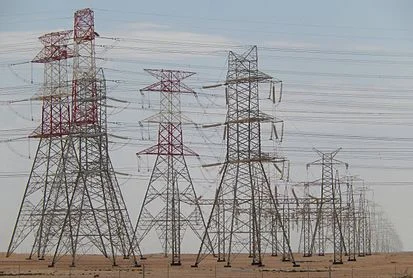
"New England is demanding newer, cleaner, and more innovative energy sources - energy sources that create jobs here in New England. We should also demand newer, cleaner, and more innovative transmission methods.''
-- U.S. Sen. Maggie Hassan, former New Hampshire governor.
'Preparing their Memorial Day'

I know there will be many,
Expressing their thanks and gratitude...
On this, a holiday
To those they once knew,
Who were in their lives...
Doing the best they could do,
To show and proved to others...
How much they loved them too.
I just know...
Those preparing their Memorial Day,
Planning family bar-be-cues...
And spicing their favorite drinks,
With assorted purchased booze...
Relaxing in the Sun and enjoying fun.
'Someone'...
Will be expressing their blessings.
-- Lawrence S. Pertillar’s “Memorial Day’’
Promoting New England in the Trump era
WGBH ran a nice story by David S. Bernstein, about Jim Brett, the president of the New England Council, which is mostly a lobbying organization, and his efforts to promote New England in general and its businesses in particular in the Trump era.
Among Mr. Bernstein's observations:
"{Mr. Brett,} former state representative and Boston mayoral candidate, who has led the regional business advocacy group for two decades ... {acknowledges} that Massachusetts, and the other New England states, no longer hold the kind of sway they did in the days when {U.S. House} Speaker {Tip} O’Neill, {Sen.} Ted Kennedy, {Congressman} Joe Moakley, and other giants pulled strings in the halls of the Capitol.''
"Brett points to {Massachusetts Congressman Richard} Neal as an example of regional influence, using long-developed bipartisan relationships to help craft the tax reform bill. Neal has also used his position as longest-serving New England House member to bring the region’s members together, increasing their influence as a group, Brett says. He also singles out Senator Jack Reed of Rhode Island, and Congressmen Jim Himes of Connecticut, Peter Welch of Vermont, and Joe Kennedy of Massachusetts for their effectiveness across party lines.''
"Brett effuses about Susan Collins, the moderate Republican Senator from Maine, who he says will be a key player in health care reform. Collins spoke at NEC’s reception, where the buzz was about her rumored plans to run for Governor. 'I told her, I hope you stay in the U.S. Senate, because we need you there,' Brett says.''
''For evidence of results, he points to a $2 billion increase for the National Institutes of Health (NIH) in the omnibus funding bill passed this month—a huge boon for New England, whose universities and hospitals take a disproportionate share of NIH grants. The Trump administration had wanted to cut the NIH budget.''
“'An awful lot of people in the (New England) delegation had their fingers in that,' Brett says.''
To read/hear the whole piece please hit this link.
Llewellyn King: The ugly thinking behind the Trump budget
On the face of it, President Trump's $4.1 trillion budget for 2018 is risible. Its math doesn’t add up; it assumes an unlikely growth rate, starting in 2021, of 3 percent a year through 2027; and it avoids calculating the tax cut, which has been promised as the largest in history.
It lays siege to research from medicine to high energy physics – future invention is none of the government's business. It takes calculated aim against environmental science. It also takes an axe to the State Department and American diplomacy, which has been vital to our national interest since the founding of the republic.
But it really warms to its perfidy when it comes to Medicaid and other programs for the poor. It says what some people have whispered for years: The poor are poor because they don’t work, and the sick have charities and emergency rooms.
It is policy based on hearsay, on the reprehensible arguments of the country club soiree and on the folk wisdom of talk radio.
At one level, the budget is an abrogation of responsibility as it says to Congress, “You make this work.” At another, it is a look into the dark hearts of some of those around the president. You have to partially exempt Trump because pulling together the budget is not his kind of thing: He wasn't slaving over the numbers, debating the importance of medical research or the global need for diplomacy. That was done by his surrogates, those who hate what they call the “deep state,” but that might also be called governance.
Broad strokes are Trump’s thing and having authorized them, eager hands have molded what passes for a budget but is in fact a guide to the narrow and deeply prejudiced thinking of the men and women who work in the White House and Mick Mulvaney, the budget director and former congressman from South Carolina.
It is not so much a budget as it is a view into the hearts and minds of the most extreme wing of the conservative persuasion, circa 2017. It is a revelation of ignorance, prejudice and indifference to the humane needs of the United States.
It is the lifting of a caprice that has contained their worst instincts for a long time. Now the hard edge, the granite heart, the cold-steel shoulder to sickness, poverty, incapacity and the resources that might abate their attendant suffering is on full view.
If you don’t see it in the budget, look to the Justice Department and to Atty. Gen. Jeff Sessions, who is all silvery charm on the outside and whose heartlessness can only be measured degrees below zero. For the first time in a long time, Congress was moving toward meaningful reform of the justice system with an end to mandatory and hideously long sentences. The Sessions view: Better to lock them up and throw away the key – and all the better if you put them in for-profit prisons.
Criminologists hate mandatory sentences, and most congressmen know them to be perverse and to result in punishment which is both cruel and unusual. It frustrates judges. The judges and prosecutors are denied the right to use their wisdom in the sentencing, instead substituting the wisdom of Congress and the attorney general.
The same harshness permeates the Department of Homeland Security with the vicious implementation of deportations of family members who are living good, productive lives in America. No thought is being given to any solution to the illegal-immigration problem, at heart a human problem not a national security or a criminal one. There are other ways short of deportation to recognize both the illegality of the immigrants and to give them the American life they have so desired. A renewable work permit, for example, not citizenship or the heavy knock of the state on the door – dreaded down through all of history.
This is a budget which is not only dangerous but also explicitly callous. It reveals a black heart, a locked mind, and an indifference to U.S. needs in years to come. It will be amended in Congress, but its message will linger. It is an ugly message.
Llewellyn King is executive producer and host of White House Chronicle, on PBS. His e-mail is llewellynking1@gmail.com. This was written first for Inside Sources.
Trying to figure out a new stadium's opportunity cost to the taxpayers

From Robert Whitcomb's "Digital Diary,'' in GoLocal24.com:
’Successful investing is anticipating the anticipations of others.’’
-- Economist John Maynard Keynes
The latest proposal by the Pawtucket Red Sox for a new baseball stadium in that city is considerably better than previous ones. Andrew Zimbalist, a Smith College economics professor who has frequently denounced taxpayer subsidies for stadiums, called the proposal “like a pretty good deal,” reported The Boston Globe. But, he added, he wanted more details before deciding whether to endorse it.
“To have that level of private participation is certainly above the norm in Triple-A baseball,” Mr. Zimbalist told the paper.
But there are very big questions. One of the biggest, to me, is the most difficult to answer: How popular will baseball - and Minor League Baseball at that -- be over the decades of this public-private deal? Will changing demographics make the sport less popular (and soccer more so) in our region? If so, will the PawSox owners face what many big-store retailers face: the sort of existential change in consumer patterns that could lead to few if any stores in, for instance, Providence Place within a few years. (Luckily, Providence Place is much more architecturally attractive and interesting than most malls and could work well for such functions as college classrooms and assembly halls, libraries and medical clinics.)
The state would have to pay about $43 million, the city about $29 million and the PawSox organization about $86 million in an overall cost of $158 million in bond principal andinterest over the 30-year deal.
What’s the opportunity cost of the total $72 million that taxpayers would cover? Would such an investment be better spent on fixing up transportation infrastructure and/or schools and/or parks, etc., etc.? Or on a baseball stadium to be used from April to October?
It would be very useful at this point if the public could be provided with rigorous, plausible projections of what the market for Minor League Baseball games could be over the next few decades of taxpayer exposure. But perhaps that’s impossible.
In any case, we need a rigorous independent study on the frequency of possible nonbaseball uses of the proposed stadium to help pay for the project, especially given the limitations imposed by that annual cool snap called “New England winter’’.
As for self-interested projections by Pawtucket (which, like the PawSox, is salivating for this project) and the team on the sales- and income-tax revenues that might be generated by the new stadium: Most such projections turn out wildly wrong. There are just too many variables. The late British Prime Minister Harold Wilson’s remark about politics increasingly applies to business, too: “A week is an eternity in politics.’’
Another point that I assume that the PawSox, the city and the state have carefully considered: The Pawtucket exits on Route 95 are heavily used by people leaving or entering Providence’s East Side. What sort of plans are being made to handle the traffic on game days? At the same time, the new stadium could be a boon for restaurants in Pawtucket, Central Falls and northern Hope Street on the East Side.
My guess is that the Rhode Island legislature will pass and Governor Raimondo will sign a bill close to the latest proposal. They had better get as much solid information on it ASAP, especially given the high possibility that there will be a national recession starting this year or next, with plunging tax revenues. This will be a big, scary bet.
Back in the recession of the early ‘90s, Gov. Bruce Sundlun bravely pushed through major and expensive improvements at T.F. Green Airport in the face of much opposition. It turned out to be a very good bet for the state’s economy. But transportation infrastructure is essential. A baseball stadium ain’t, as much as I love the PawSox.
Whatever, deciding to have the taxpayers help pay for a baseball stadium for a private company in the end may be based more on romance than on economic rationality. But then, that’s true of many public-policy decisions.
Be sure not to enjoy it!
"The New England conscience doesn't keep you from doing what you shouldn't -- it just keeps you from enjoying it.''
--- Isaac Bashevis Singer

Watergate weeks and glorious expense accounts

The Watergate complex in Washington, scene of the break-in that led to the downfall of President Nixon.
From Robert Whitcomb's "Digital Diary'' in GoLocal24.com:
Lots of people are trying to draw similarities between Watergate and the Trump mess. There are some, but we should bear in mind the big differences between Trump and Richard Nixon, whom I’m more than old enough to remember “professionally’’.
I had a seat in the journalistic third balcony during Watergate, copy-editing the occasional story about the developing scandal and from time to time writing short items about it when I filled in as the writer of The Wall Street Journal’s World-Wide column on page one. I did this in New York, and then filled in at the WSJ’s Washington bureau shortly after Nixon resigned on Aug. 8, 1974 to avoid an impeachment trial.
I’ll never forgetcoming upon the block print “Nixon Resigns’’ headline in The New York Times’s Aug. 9 edition at the newsstand at my steamy Brooklyn Heights subway stop. I still associate hot weather with Watergate since so much of the biggest developments came in summer or late spring.
(Ah, those were the salad days of journalism, including expense accounts. I was told to fly first class, and on my Washington gig, stayed in a suite in the oh-so-fancy Hay Adams Hotel.)
Nixon, like Trump, was often paranoid, but Nixon wasn’t a narcissist, of which Trump is an extreme example. And Nixon, who was very well read, had an idealistic streak that resulted in some thoughtful domestic policies and international initiatives.
Finally, he had a far more intelligent and experienced staff than Trump’s, including, of course, some who got caught up in Watergate. Many of Trump’s, on the other hand, tend to mirror his amorality and ignorance.
One of Nixon’s key assistants, especially for domestic policy, was John Ehrlichman. When Mr. Ehrlichman was asked, years after Watergate, what he thought of Nixon, who had basically hung him out to dry, he responded coolly:
“Every man is a mix.’’ Indeed, including Trump, I suppose.
How will the expanding Trump scandal play out? Impeachment is wrenching and much of the GOP in Congress will be very loathe to take one of their own, as much as they’d prefer the very right wing but apparently sane and stable Mike Pence. More likely is a semi-paralyzed administration that staggers along through Republican losses in next year’s congressional elections and finishes its term with few achievements. That President Trump will continue to have control over the U.S. national-security apparatus is scary.
Before the boats go in

"Cove View'' (watercolor), by Stoney Conley, at Patricia Lloyd Carega Gallery, Center Sandwich, N.H.