
Vox clamantis in deserto







A face in the cloud

Featured sculpture by Carolyn Wirth in her show "Seeing Past Faces,'' through Aug. 20 at the Fruitlands Museum, Harvard, Mass., where she is artist-in-residence. The gallery notes say that she "blends images of her subject and photographs of herself in order to create an entirely unique facial structure.''
David Warsh: Robert Bartley's malign ghost at the GOP convention
There is no point in asking Donald Trump about his economists. It hasn’t been that been that kind of a campaign. In May the businessman reached out to Stephen Moore, of the Heritage Foundation, and CNBC television host Lawrence Kudlow, to help cut the $10 trillion cost of the tax cuts that he had proposed. Last week Moore and lawyer-turned-restaurateur Andy Puzder gave Trump a qualified endorsement in The Wall Street Journal: “A Trump Economy Beats Clinton’s.” Mark Skousen made the libertarian case against Trump here last spring.
If there is one man beside Trump himself whose spirit will inhabit the hall in Cleveland, at least metaphorically, it is Robert L. Bartley – not because Bartley himself approved of Trump – who knows if he did? – but because, as editor of the editorial page of The Wall Street Journal, Bartley spearheaded the creation of the say-anything, stop-at-nothing rules that ultimately led to Trump’s success in gaining the Republican Party’s nomination.
Bartley died in 2003. After taking over the editorial page in 1972, he became the most influential administrator of the rules of American public debate in the last third of the 20th Century. In that position, Bartley began the populist revolt that has since found its apotheosis in Trump.
Most influential journalistic umpire of an age? How do you back a claim like that? Mainly by comparison, naturally -- in this case to the career of the most influential journalist of the middle third of the 20th Century, Walter Lippmann. As it happens, thanks to Craufurd Goodwin, of Duke University, dean of U.S. historians of economics we have a first-rate biography of Lippmann that concentrates on his role as a defender of market economics (Walter Lippmann, Public Economist (Harvard, 2014), as opposed to Ronald Steel’s Walter Lippmann and the American Century (1980).
Lippmann was the child of well-to-do German-Jewish parents, attended Harvard College, worked for Woodrow Wilson during World War I, was on friendly terms from then on with Franklin Roosevelt, John Maynard Keynes and Felix Frankfurter. Bartley was the son of a professor of veterinary medicine, attended Iowa State University, and, as editor of the WSJ (as the editorial page editor was and still is called), became a friend of Robert Mundell, of Columbia University; Albert Wohlstetter, of RAND Corp.; Edward Teller, of the University of California, at Berkeley; and President Ronald Reagan.
Bartley was 34 when he was appointed to the job. He had voted for Lyndon Johnson over Barry Goldwater in 1964, but by the time that he spent a year in Washington, in 1971, he had become conservative, and, according to former WSJ reporter Robert Novak, by then a syndicated columnist, he was ostracized by liberal reporters there as a right-wing “kook.” Upon becoming editor he built a staff that eventually totaled fifty writers and editors, creating a universe of conservative opinion parallel to the news side of the paper. Among those he hired was Jude Wanniski, a flamboyant reporter for The National Observer, a weekly newspaper published in those days by Dow Jones.
In a level-headed appreciation in Slate, in 2003, Jack Shafer described an experience that was widely shared during the 1970s:
“[W]hat attracted me to the page when I first started reading it in 1973, fishing it out of a trash can each night as I cleaned an office building, was Bartley’s allegiance to the classical liberal values of free markets and free speech. Back then, Bartley was a minority of one among editorial-page editors in hewing to those views, tilting against the neo-Swedish worldview of The Washington Post, New York Times, and Los Angeles Times editorial pages. So if Bartley overstated his case from time to time by shouting until his vocal chords hemorrhaged and his readers lost their hearing, well, that was OK by me.
“As a small-government libertarian, I never subscribed to the Journal edit page’s supply-side orthodoxy as formulated by Jude Wanniski, which didn’t seem to care about the growth of government as long as taxes got cut. Today, nearly everybody recognizes that the marginal tax rate of 70 percent when Ronald Reagan took office was at least twice as high as it should be. Cutting it down to 28 percent proved to be both a utilitarian and an individual boon. As economist Bruce Bartlett notes, the world took notice of the American tax revolution, and many nations followed our example to excellent effect. But back in the ’70s, when Galbraithism and Heilbronerism ruled, Bartley and his scriveners were the true intellectual radicals.
Wanniski introduced Bartley to a pair of refugees from the University of Chicago, Arthur Laffer and Mundell. By 1975, Mundell was teaching international economics at Columbia. Wanniski described a “Mundell-Laffer hypothesis,” as revolutionary and mysterious as the prescriptions of Keynes 40 years before, all the more so for being confided in a series of restaurant lunches instead of conveyed as formal models in technical papers. The ideas eventually were encoded as WSJ editorials and dubbed ‘supply-side’ economics: massive tax cuts that would pay for themselves by spurring growth.’’
Reagan won the presidency in 1980, and Bartley won a Pulitzer Prize for editorial writing. The editorial page had become immensely powerful, and has remained so. Bartley told an interviewer in 1981, about the time Wanniski was fired for train-station-electioneering for a supply-side insurgent candidate, “Jude had a tremendous influence over the tone and direction of the page. He taught me the power of the outrageous.” Wanniski struck out on his own as a political consultant but remained close to the page. By 1982, Vermont Royster, Bartley’s processor as editor, had joined the critics. Novak later quoted him: “‘When I was writing editorials,’ said Royster, ‘I was always a little bit conscious of the possibility that I might be wrong. Bartley . . . is not conscious of the possibility that he is wrong.’ Yet Bartley’s page “exerted more influence than Royster’s ever attempted,” wrote Novak.
By the end of the 1980s, Bartley had won. George H. W. Bush had succeeded Reagan as president, but the WSJ editorial page refused to take yes for an answer. Bartley vigorously opposed Bush’s decision to seek modest tax increases to pay for war in the Persian Gulf to expel Iraq from Kuwait. And when Bill Clinton defeated Bush, in 1992, the editorial page began a series of attacks on Clinton and his wife that ultimately sought to overturn election results with an impeachment trial.
I can pinpoint the day the page lost me altogether. It was March 18, 1993, with a famous editorial, whose title, “No Guardrails,” has since become a WSJ battle cry. A physician who performed abortions in Florida had been ambushed and killed by a protester in Florida. The editorialist, Daniel Henninger, wrote:
“[T]here really was a time in the United States when life seemed more settled, when emotions, both private and public, didn’t seem to run so continuously at breakneck speed, splattering one ungodly tragedy after another across the evening news. How did this happen to the United States? How, in T.S. Eliot’s phrase, did so many become undone?
“We think it is possible to identify the date when the U.S., or more precisely when many people within it, began to tip off the emotional tracks. A lot of people won’t like this date, because it makes their political culture culpable for what has happened. The date is August 1968, when the Democratic National Convention found itself sharing Chicago with the street fighters of the anti-Vietnam War movement.
“The real blame here does not lie with the mobs who fought bloody battles with the hysterical Chicago police. The larger responsibility falls on the intellectuals –university professors, politicians and journalistic commentators – who said then that the acts committed by the protesters were justified or explainable. That was the beginning. After Chicago, the justifications never really stopped. America had a new culture, for political action and personal living.
“With great rhetorical firepower, books, magazines, opinion columns and editorials defended each succeeding act of defiance – against the war, against university presidents, against corporate practices, against behavior codes, against dress codes, against virtually all agents of established authority.’’
There was something downright creepy about that editorial – like the moment in The Shining when a leering Jack Nicholson, peering over her shoulder, says to his wife, who has just discovered that his manuscript, on which he has been working obsessively, is repetitive nonsense, “How do you like it so far?” Any relatively disinterested observer who lived through the 1970s, ’80s, and ’90s knew the extent to which those years had involved a calming down from the ’60s, of the restoration of rules of civility in the political realm, a process of equilibration.
From the short-lived administration of Gerald Ford to the zero-based budgeting and deregulation under Jimmy Carter, from disinflation under Paul Volcker to tax simplification and Social Security stabilization under Ronald Reagan, the signal events of those years constituted a retreat from the excesses of the ‘60s and a celebration of traditional values of order, credibility, ambition, and achievement. The one sphere in which pressure had continued from the Left was expansion of civil rights — of women, minorities, immigrants, gays, and specifically the rights of women to obtain abortions. Which was, of course, exactly what the writer had in mind.
Shafer described the scorched-earth policies of those years:
“As many of Bartley’s ideas gained ascendancy, his page became shriller, unable to give Clinton proper credit for getting control of spending. There’s a thin line between hard-hitting opinion journalism and character assassination, a line that Bartley frequently erased. Instead of serving as a sophisticated and credible spokespage for classical liberalism—like The Economist—his page descended all too often into the dishonesty and hackery one associates with politicians.’’
By 2001, Bartley was ill. He stepped down and began writing an occasional column. The 9/11 destruction of the World Trade Center temporarily forced the WSJ from its offices around the corner. The editorial page soon began a relentless campaign for the invasion of Afghanistan and Iraq. Bartley died in December 2003, a week after receiving the Presidential Medal of Freedom.
I hope that Bartley will find as wise and good-natured a biographer as did Lippmann in Goodwin. The rise of paleo-conservatives has been the subject of at least one good book, George Nash’s The Conservative Intellectual Movement in America since 1945 (1976), and is soon to have another, a long-awaited biography of William F. Buckley, by Sam Tanenhaus. Peter Steinfels and Jacob Heilbrunn, have chronicled the rise of the neoconservatives: The Neoconservatives: The Men who are Changing America’s Politics (1979) and They Knew They Were Right: The Rise of the Neocons (2008). Populist conservatives were the subject of Peddling Prosperity: Economic Sense and Nonsense in the Age of Diminished Expectations (1994), by Paul Krugman. If paleo-con Buckley’s National Review provided the starting place for the careers of George Will and Garry Wills; if neo-con Irving Kristol’s influence extended to Allan Bloom, Francis Fukuyama, and Dinesh d’Souza (and influenced the views of broadcast journalists such as John McLaughlin, Rush Limbaugh, and Glen Beck); then Bartley can be said to have furthered the careers of Wanniski, Michael Novak, George Gilder and Amity Shlaes. There’s plenty of material to work with there.
Is it fair to blame the chaos surrounding this year’s Republican nomination on Bob Bartley? Clearly I think so. No one in my lifetime systematically removed more of those guardrails, the norms governing good-faith political and economic discourse, than he. Trump is the downside of 40 years of WSJ ed page comment too often just like his: outrageous, sulfurous, and, all too often, half-baked. Bartley is dead; long live Bartley: in his absence, the page was completely unable to steer the nomination toward a more viable candidate this year. The best that can be said is that its editorialists helped keep it away from Sen. Ted Cruz.
Paul Gigot, who succeeded Bartley in 2001, has steered a steady course, admitting more diverse opinion to its op-ed pages, coping with increasing disunity among the -cons mainly by proliferating columnists. Lee Lescaze, whom the WSJ hired from The Washington Post in 1989 and who founded its Weekend section, laid the foundation for a humane and sophisticated new wing of the paper before he died, in 1996.
Rupert Murdoch bought the paper from Dow Jones heirs in 2007. His sons, James and Lachlan, have their work cut out for them. Sometime in the next few years they must replace Gigot, 61, with an editor capable of restoring credible focus to a page that has become alternately ideological and diffuse. The decision of The New York Times in March to replace Andrew Rosenthal with James Bennett, hired back from The Atlantic, can only increase the pressure.
Two great heroes of the Republican Party in living memory were Dwight Eisenhower and Ronald Reagan. To lionize Reagan is not enough. Until the similarities of roles of both are understood, the Republican Party is not going to regain the White House.
David Warsh is proprietor of economicprincipals.com and a longtime financial journalist and economic historian. He, like the overseer of New England Diary, Robert Whitcomb, worked for The Wall Street Journal in the 1970s.

On the silver standard

When I occasionally edited stories in the late '70s about the U.S. jewelry business, much of it then still based in Providence, I got to see some fine work. Now that my daughter Elizabeth Whitcomb is designing jewelry (mostly silver) in New York, I'm looking at jewelry again a lot. Experts tell me that her creations are "organic''. Hit this link. (www.t-a-p-l-ey.com).
Info@t-a-p-l-ey.com
-- Robert Whitcomb



Watch www.trumpthemovie.com: How Donald Trump does business
For a time-capsule look at Donald J. Trump's business methods, watch this long-suppressed movie Trump: What's the Deal?
trumpthemovie.com
Silence at noon
"Loud is the summer's busy song
The smallest breeze can find a tongue,
While insects of each tiny size
Grow teasing with their melodies,
Till noon burns with its blistering breath
Around, and day lies still as death."
John Clare, "July''
John Clat

And good for you

"Blue Bliss'' (mixed media and resin on panel), by Eric Zener, at Lanoue Fine Art, Boston
Robert Whitcomb: A little context, please, on race relations; for ferries; democracy in Vt.
This originated in GoLocalProv.com
The news media, for marketing reasons, and the general public, for psychological/emotional ones, generally want simple narratives of big events, preferably with clear villains and heroes, idiots and geniuses, not to mention vivid starts and banging ends. A recent narrative is that Britain’s exit from the European Union was suicidal and will be a world-historical catastrophe. No it won’t, as calmer members of the financial sector quickly realized.
Last week it was the shootings by police and then the lunatic Micah Xavier Johnson’s murder of five police officers. Tragic indeed, but the implication by some news media that America is somehow doomed to ever-widening conflict about race and related law-enforcement matters is ridiculous.
America -- like all nations! – has plenty of racism. But the progress that our huge, and complicated country has made in recent decades toward an inclusive and mostly un bigoted society is impressive. I can remember back when drinking fountains were segregated in the South. The United States is a far more just (except perhaps economically) and peaceful place now than it was in, say, 1968 -- the disorderly year to which 2016 is now compared by people who didn’t live through ‘68.
That three of the key personalities in commenting on last week’s racially related incidents -- Dallas Police Chief David Brown, President Obama and U.S. Atty. Gen. Loretta Lynch--- are African-American says something important.
Most Americans are ignorant of many basic facts of their nation’s history. About foreign matters they’re even worse: The bigotries in most of the world far exceed America’s. That’s one big reason that, for all our faults, so many people from the rest of the world want to move to the United States. Those denouncing extremely ethnically diverse America as somehow uniquely vicious in race relations ought to do more reading and traveling.
A couple of other observations spawned by last week’s horrors:
Some people complain about the “militarization of America’s police.’’ But what do they expect given that it’s so easy for nonpolice to buy or otherwise get military-style weapons? The NRA, its employees on Capitol Hill and the likes of Walmart that sell so many weapons have been the biggest militarizers of America. They’ve made the nation an armed camp, and the police have to protect themselves.
Meanwhile, an interesting story in the July 11 New York Times reports:
“A new study confirms that black men and women are treated differently in the hands of law enforcement. They are more likely to be touched, handcuffed, pushed to the ground or pepper-sprayed by a police officer, even after accounting for how, where and when they encounter the police.
“But when it comes to the most lethal form of force — police shootings — the study finds no racial bias.
“’It is the most surprising result of my career,” said Roland G. Fryer Jr., the author of the study and a professor of economics at Harvard and anAfrican-American.’’ Here’s the link:
The conventional wisdom can usually use a bit of editing.
xxx
Let’s hope that the return of warm-weather Providence-Newport ferry service, which will last just 10 weeks, helps get Rhode Island officials, working with the U.S. Transportation Department, to start year-round commuter services by boat around Narragansett Bay. TheBay’s coast is heavily populated, there are lots of harbors and the (bad) roads are often congested – all making Rhode Island a damn good place for ferries.
In Europe, most bodies of water with dense populations around them have ferry service, as does Massachusetts Bay. See: http://www.bostonharborcruises.com/commuters/
Boston Harbor Cruises (BHC) runs MBTA commuter boats that carry thousands of passengers to and from work each day, including the Inner Harbor Ferry between Charlestown Navy Yard and Long Wharf; the Hingham-to-Boston Ferry service, and the Hingham/Hull/Boston/Logan service. BHC also operates the Salem Ferry under contract with the City of Salem in the summer. Its slogan is: “Leave Gridlock in Your Wake’’.
What a fine economic-development tool ferries could be for a crowded state much of which is a bay.
xxx
Ah, Vermont, where citizens flock to hear local and state candidates take (usually) polite questions. Vermont and New Hampshire, for all their differences, have especially civic-minded and engaged citizens.
I saw an example last Sunday at a forum sponsored by the Washington and Orange County (Vt.) Republican committees, at which two smart candidates vying for the gubernatorial nomination answered some questions prepared by a moderator, made brief general statements on why they should be governor and took some queries from the floor. The forum was in the barnlike Vermont Granite Museum in Barre. That city is the site of famed granite quarries and some of the most bizarre cemetery sculptures I have ever seen!
The candidates – former Wall Street executive Bruce Lisman and Vermont Lt. Gov. and businessman Phil Scott – were both very articulate. They generally had coherent if, of course, predictably vague answers to questions and made sure that they told the audience what they wanted they to hear.
This led to some typical (hypocritical?) contradictions such as talking up the need for business-friendly deregulation and economic development while also implying that they’d block a big (and utopian) development proposed by a Utah businessman and put the kibosh on more wind turbines on Vermont’s ridges because they’re unpopular among the neighbors.
And the scary word “Trump’’ was never mentioned on the stage.
I went mostly because I wanted to see and hear my friend Josh Fitzhugh, chairman of the Washington County Republican Committee, dress up like Vermont founder Ethan Allen and give a speech, rife with 18th Century language but along the lines of what a Republican circa 2016 might say. To read the speech, hit this link: http://newenglanddiary.com/home/2016/7/11
The speakers, the earnest and cordial audience, the stout and rich-voiced lady singing “The National Anthem’’ at the start and “God Bless America’’ at the end and a fried-chicken picnic (inside – it was raining) made it a day of industrial-strength Americana.
xxx
Donald Trump’s capacity for sleaze is exceeded by his campaign manager, Paul Manafort, a man who apparently would do just about anything for money.
For decades, Washington lobbyist and fixer Mr. Manafort has represented some of the world’s worst people, including the late Congolese dictator Mobutu Sese Seko, former Ukrainian dictator Viktor Yanukovych and the late Somali dictator Siad Barre. He has also worked with Pakistan intelligence services (which have worked hand in glove with Islamic terrorist groups). In purely domestic matters, he has also shown a similar rapaciousness. He is truly an archduke of amorality among his fellow Beltway Bandits. Donald Trump presents himself as an “outsider’’ who will shake up Washington. Eh?
xxx
I think that many readers will look differently at their own lives as they plow through My Struggle, Karl Ove Knausgaard’s 3,600-page, barely edited autobiographical novel, or extended journal, or whatever it is. The Norwegian writer’s astonishing recall of the joys, pains, drama and tedium of daily life deepens our understanding of what it has been like to live in a Western nation for the last few decades.
xxx
As I walked our dog on a balmy night last week, I heard a man softly playing songs from the ‘30s on a piano in his living room. The music mixed with the sound of leaves being rustled by the southwest wind. It was a magical moment, and rare in these cacophonous times.
Robert Whitcomb is overseer of New England Diary.
Summer dreams
"And pomp, and feast, and revelry,
With mask, and antique pageantry,
Such sights as youthful poets dream
On summer eves by haunted stream."
- - John Milton, ''Allegro'' (1631)

The wet stuff

Work by Gillian Frazier in the show with Priscilla Levesque called "Reflections,'' at The Loading Dock Gallery, Lowell, Mass., through July 31.
Llewellyn King: Technology is more powerful than politicians
Dear Candidates:
Even as you strain to tell us the wondrous things that will come about if you are elected in November, may I tell you some wondrous things that are happening anyway?
My contention here is twofold: First, not everything that changes our lives is political. Second, not all technological change has to do with the Internet.
In the same vein, not all progress will come out of the established agencies of private change, such as Amazon, Apple, Google and Tesla.
Of all things, an electric utility has moved into the world of innovation. It is the Southern Co., under the dynamic chairmanship of Tom Fanning.
Southern is on the cutting edge of utility technologies, including carbon capture and storage, and advanced coal combustion. It is also building two state-of-the-art nuclear plants in Georgia.
Fanning believes that the remit of the electric utility runs beyond the flow of electrons. Hence, one of Southern’s newest and most revolutionary undertakings: the vertical, urban farm.
According to Fanning, the idea is to go to blighted city areas where there is a shortage of fresh produce — the kind produced by truck farms — and convert old industrial and office buildings into urban farms. “We’re taking vacant, commercial buildings and creating farms that are vertical. There, produce can be grown more efficiently with our light and water systems. One of the best things is that you don’t need to use pesticides,” he told me.
Other things that are coming down the pike include the capture of carbon after combustion in power plants, steel mills and cement plants. What was a crazy scheme is almost a reality: So, be careful before you join the lynch mob of fossil-fuel haters.
Then there is the revolution in manufacturing. Now, with additive manufacturing, we can build up goods rather than cutting them to shape: no more wasted glass, plastic or steel. Houses, bridges, even guns have been printed.
It ain’t gonna be your father’s factory. So if your plan is to bring back the factories of the Industrial Revolution, better think some more. The new factories will be smaller, more dispersed and, in many cases, may be in or near workers’ homes.
And before you lay into cutting government, be sure you do not cut out vital organs like the Department of Energy’s Lawrence Livermore, Los Alamos, Oak Ridge and Sandia national laboratories that maintain our nuclear weapons and have harnessed things like the seismic technologies that have changed energy supply and kept us as the world’s leader in physics.
These labs are the muscles in the strong arm of American technology. Never forget that the Internet was invented by an arm of the Department of Defense. So do not malign government science and research.
Spare our technology, please, and do not get policy from the old tapes or old demagogues. The world is changing a lot faster than the talking points. If you are to lead it, you ought to understand that what was needed 10 years ago is not needed now, and technology will shape the future as much or more than you think you will, if elected.
Llewellyn King is executive producer and host of White House Chronicle, on PBS. He is a longtime publisher, editor, columnist and international business executive who is now based in Rhode Island and Washington, D.C. This piece first ran on InsideSources.com.
Seth Handy: Paper's censorship vs. the facts of renewable energy
It is sad and ironic that the opportunity for good legislation on the interconnection of renewable energy to Rhode Island’s electricity-distribution system was squandered by utility lobbying and The Providence Journal’s one-sided coverage of one developer’s (Wind Energy Development LLC) alleged undue influence (“Favor to wind-project developer could cost electric rate payers,” June 12; “Republicans want provision that aids R.I. wind-power developer removed,” June 13; “{House Speaker Nicholas} Mattiello removes provision to benefit big donor, cost rate payers,” June 14; and “Wind power favor yanked” and the editorial “No favor to R.I. ratepayers,’’ both on June 15). I was quoted in one article and write to correct the record.
I sent this column to The Journal's editorial-page editor, Edward Achorn, but he declined to run it.
Interconnection legislation is needed and good for the people of Rhode Island. I explained that to the reporter but he neglected to report it. Our utility, National Grid, administers interconnection to protect its interest in the existing energy system, to the detriment of a new-energy economy that greatly benefits Rhode Island. The utility has a history of inflating interconnection costs and delaying interconnection to an extent that many good projects cannot withstand and others are severely overburdened.
The assertion that this bill was to benefit one developer is wrong; interconnection obstructs many good projects. Sadly, too many developers are scared to speak out, because the utility still controls too much of the fate of their projects. National Grid’s abuse of its discretion on interconnection was especially obvious in response to the proposed large Coventry wind project. National Grid refused to interconnect some turbines and sought to charge Wind Energy Development $13 million as part of the process of replacing much of Coventry’s antiquated poles and wires.
But interconnection problems are rampant in Rhode Island and across America. When our “regulated utility” is inadequately regulated, as it has been on interconnection, it is the General Assembly’s duty to protect Rhode Island’s interests through legislation. The interconnection bill put necessary parameters on utility control over interconnection. It was supported by the state Office of Energy Resources and passed the House of Representatives twice by nearly unanimous vote because it is good policy.
National Grid is not a benign steward of ratepayer interests; it is a corporation based in England. When its shareholders’ interests conflict with those of our ratepayers, it favors its shareholders. That is why, for instance, National Grid reported $8 million in annual profits for operating Rhode Island’s municipal streetlights all made while it refused to authorize conversion to more efficient LED fixtures that have much lower maintenance costs.
National Grid’s conflicting interest on local renewables was evident in its proposal to charge Wind Energy Development an access fee to use the distribution system that was put forth without even considering the General Assembly’s order that it first weigh the economic benefits of local generation. Unanimous opposition led National Grid to withdraw that access fee just before the state Public Utilities Commission hearing.
Studies consistently show that local renewables benefit all ratepayers by reducing the costs of energy, capacity, transmission, distribution, line-loss, operating risk, environmental, and other known and measurable costs of our energy system. A national expert presented this information at the State House on March 24, 2016; you can watch it on Capitol TV. The Journal’s reporting that an interconnection policy that fairly allocates responsibility for system upgrades benefitting all customers would cost us all and unduly subsidize renewables ignored that ratepayers already pay National Grid to maintain and improve its distribution system. Most importantly, it overlooks the savings that renewables produce for our energy system. The reporter that interviewed me chose to ignore all that.
National Grid spent at least $84,000 on lobbying this legislative session. Their reporting of their lobbying is unclear and it is hard to track their legislative contributions apparently made through their lobbyist’s Political Action Committee (PAC), “Advocacy Political Action.” Those of us regularly pushing for good energy legislation face the utility’s resistance, not so much in the hearings but late in the session from back rooms of the State House.
Last year, this interconnection law that unanimously passed the House was victim to the Senate’s early adjournment. This year, after very supportive hearings and near unanimous approval from the House, National Grid worked to strip it through the Senate. I deplore the impact of money in politics, but the U.S. Supreme Court’s free speech cases, like Citizens United, protect such spending to sway government action. For The Journal to deride influence sought by a renewable- energy developer awkwardly overlooks the massive influence such developers are up against. National Grid spends huge sums of ratepayer dollars on advertising, much of which is in The Journal. Such well-funded speech evidently earns greater protection.
At the end of this legislative session, strategic and poorly reported last-minute flame-throwing beat down a good bill. The utility still holds its strings on interconnection. Now that the dust has settled we can reflect on that. Much may be vested in our existing energy system, but our people are not well served by its exceptionally high cost, insecurity and other bad impacts. To change that, we need to correct the mechanics under which alternatives are delivered. Those of us who are passionate about Rhode Island’s energy future remain confident that justice ultimately will be served through policies that promote the public good, despite all the financial interests that obstruct them.
Seth Handy is a lawyer in Providence.
Chris Powell: Politically incorrect crime data; illegals get preference; plutocrat Pequots
Cellphone video from around the country continues to suggest that white police officers can be too quick to confront and shoot black men. But whenever there is such cellphone video, nobody wants to wait for due process of law to determine exactly what happened. It's always "no justice, no peace" immediately, even as justice requires a little time.
Immediate justice constitutes lynching, which is as wrong when it is demanded today by black mobs as it was in the last century when it was perpetrated by white mobs.
A report issued last month by Central Connecticut State University, concluding that police in the state use their stun guns more often against Hispanics and blacks than against whites, is not helpful in pursuing justice. It seems meant mainly to intimidate officers out of doing their jobs with racial minorities.
Of course to some extent racial prejudice and racial fear will always figure in police work. Such prejudice and fear may be the most likely explanations for why black people are shot to death by white officers in confrontations that begin over trivia like a broken taillight or the sale of CDs in front of a convenience store.
But crime itself is correlated with race and poverty. For example, that the great majority of Connecticut's prison population is black and Hispanic is not mainly the result of racist cops, prosecutors, judges and juries; it results mainly from the concentration of crime and poverty among certain racial and ethnic groups.
So maybe Connecticut needs a study quantifying the racial disproportions in crime. But since its data would be politically incorrect, the state probably has no institution of higher education capable of the work.
xxx
ILLEGAL ALIENS GET PREFERENCE. Expanding its campaign to nullify federal immigration law and devalue citizenship, state government will place at Eastern Connecticut State University 46 students from other states who are living in the country illegally.
The university won't pay for the students; a national scholarship fund for illegal aliens will cover their expenses. Most of the students are living in states that either prohibit the admission of illegal aliens to their own public colleges or charge them higher nonresident rates. But admitting the illegals to Eastern will reduce admissions for Connecticut's own legal residents and for U.S. citizens generally.
Since the plight of the illegal alien students is largely the responsibility of their parents, they deserve some sympathy. But what compels state government to give them such preference? Only the political correctness that seems to be the highest principle of the current state administration.
xxx
THEY LOOK LIKE PLUTOCRATS. Hardly a day passes when Republican presidential candidate Donald Trump doesn't say something insulting, mistaken, or stupid. So why last week did Connecticut's Mashantucket Pequot tribe bother denouncing him for his remark about the tribe in 1993?
Trump, a casino developer competing with the Pequots, told a congressional hearing, "They don't look like Indians to me."
The Pequots want to construe this as a slur on their ancestry. But Trump was actually challenging the casino privileges the Pequots had gained from the government. For while the federal law authorizing casinos on Indian reservations was presented as economic development for long-oppressed people consigned to Western wastelands, no modern Pequot had ever encountered such disadvantages.
No, the tribe was reconstituted to exploit the casino privilege meant for the oppressed. The people reconstituting the tribe were fully part of the broader community of southeastern Connecticut and had been living in raised ranches and working at Electric Boat like everybody else. Now, because of ethnic patronage and privilege, they're rich, and it's not necessary to support Trump to resent it.
Chris Powell, a Connecticut-based essayist on cultural and political topics, is managing editor of the Journal Inquirer, in Manchester, Conn.

New England's ancient dairy delirium

"Milk Made'' (mixed media), by Peter Thibeault, at Patricia Ladd Carega Gallery, Center Sandwich, N.H.
Sophie Lampard Dennis: The sad decline of face-to-face encounters
Via the New England Board of Higher Education (nebhe.org)
Remember the faculty lounge? When I began at my current institution back in 1999, there was one in every building—sometimes two! This public space—complete with industrial furniture, coffee pots smoldering on burners, and a mini-fridge with sticky notes all over it reminding people to clean out their stinky sandwiches—was higher education’s version of the office water cooler.
Faculty and staff connected, people in different departments shared ideas, jokes and snacks, and mainly people let off a bit of steam while taking a much-needed mental break during the day—often while they also made photocopies (remember those?). Many a problem or conundrum was vented, birthday cards signed (and cake shared), and aha moments with students were exulted over in the faculty lounge. NPR stories were re-told. Most importantly, this simple, open and welcoming space engendered a sense of community. I miss it.
Lately, I have been lamenting the increasing loss of face-to-face interaction. The prevailing attitude of taking care of business without having to actually get together has taken hold across all realms of society. Despite the also-growing trend toward “open workspaces,” there seems to be less and less contact with other human beings as a matter of course in life these days. “No need to meet; we can take care of that with email” has become a consistent mantra- and my nemesis—even as I imagine with dread the numbers of “reply all” to come.
Recently, “I’ll set up a Google Docs account and we can use that to upload information rather than getting together” has taken hold. I am beginning to wonder whether I should, perhaps, begin sending my avatar to teach, thereby staying in my office for the entire working day. Or more to the millennial point—perhaps a class conducted entirely in Facebook Messenger? Class attendance would probably be greatly increased!
The “mail room” where the painted wood faculty mailboxes hang on the wall in alphabetical order—seems mostly a tribute now to a time long gone wherein actual business took place in this room and people converged, if briefly. Now, those mailboxes only occasionally hold a paper phone bill—and surely, these could be generated electronically. The room is no longer a help for those looking for human contact. Even the bulletin board in this room (for those millennials reading this article, that’s a location for actual paper announcements to be posted using thumb-tacks), which at one time held a plethora of messy communications, has been left in the dust as the electronic version has prevailed (so neat! So tidy! No trees killed!).
Campus projects over the years have caused the old lounges, one-by-one, to be converted into other types of spaces. As student programming has expanded and entered the 21st Century, so has the need, for example, for enhanced labs for computer gaming courses as well as for offerings in video production and electronic music. Computers have taken hold where, once, faculty congregated. So here I am, in the comfort of my own lonely office, on a hallway of offices, in a building of offices, with nowhere to wander to. Am I more productive? Maybe. I eat my lunch at my standing desk (don’t get me started about what happened to a common lunchtime!) as I grade papers, while simultaneously receiving and responding to all mail, as well as perusing the electronic faculty bulletin and checking Google Docs for new uploads from my current task force or committee.
The actual faces of my colleagues and friends as seen at one time in person, have now been replaced by a “profile picture”—a tiny square with a face in it- which pops up with their email. At least when I have something funny to share with a colleague, or an aha moment with students to report (I haven’t figured out how to share cake this way yet)—there is an emoji for that: ☺ .
Sophie Lampard Dennis is associate professor of education at Landmark College, in Putney, Vt.


Cute kitsch or deeply depraved?

Henry Houghton, of the central Massachusetts town of Athol, advertised in the May and June 1949 issues of Popular Mechanics, apparently trying to establish a photography business.
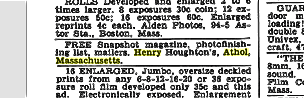
This is the only record that Internet research could turn up on Houghton. But 67 years later, four of his snapshots turned up at the Walden Street Antiques, in Concord, Mass., at $1 apiece in a bin with other mostly unidentified family photos. Each of the prints is stamped on the reverse with an official looking "Henry Houghton's Athol, Mass.," along with the date, in this case, August 1950.

The doll Dorothy is photographed here at Long Lake, a park in Littleton, Mass. Was Houghton on assignment, or was he just having fun, creating a little tableau?

In this and two other images, Dorothy is propped up with a Shmoo. The creation of L'il Abner cartoonist Al Capp, the Shmoo first appeared in Aug. 31, 1948, becoming a sensation in Dogpatch and around the world over the next few months; the spin-off toy Shmoo, like Dorothy, lasted longer.
Unusual critters, to say the least, Shmoon (yes, that's the plural) reproduced asexually, were always smiling and were happy to let you eat them. After dining on their flesh one could use their pelts for leather, but since they produced both milk and butter, it would be a mistake to kill off a Shmoo. In the cartoon strip, contented Shmoon have love hearts drawn are around their heads.
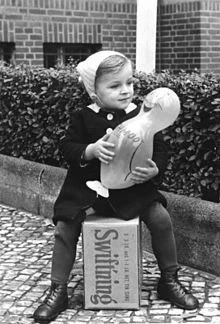
Of course, it's almost impossible to make out the Schmoo in the faded old photo above. Below see picture of a West Berlin child holding a Schmoo and sitting on a Care package in October 1948, during the Soviet blockade and the Western Allies' airlift to relieve the city.

As adorable as a Shmoo is, there is something creepy about this one's friendship with Dorothy – or rather, while Shmoon are harmless, the doll appears somewhat supernatural. What were Henry Houghton's pictures meant to convey? Was he attempting a story for a child or children? Intentional or not, Dorothy is as menacing and as disturbing as a character by that other New Englander, Stephen King.
William Morgan, a Providence-based architectural historian and essayist, taught the history of photography at Princeton University.
Ethan Allen returns to warn Vermont
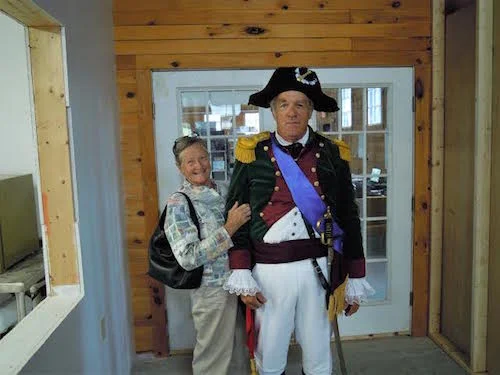
Josh Fitzhugh’s version of a speech that might have been given by Vermont founder Ethan Allen at a July 10 gubernatorial-candidate forum and picnic at the Vermont Granite Museum, in Barre. Mr. Fitzhugh is the chairman of the Washington County (Vt.) Republican Committee.
My fellow Vermonters! The Almighty has given me an unprecedented Opportunity after 225 years to revisit the haunts of my Youth, to see what has become of my own special Green Mountain State, and to share with you my Thoughts regarding the same, with no Shame or Fear but only a Desire to arrive at the Truth using Reason which is the only Oracle of Man!
Ever since I arrived to a state of manhood, and acquainted myself with the general history of mankind, I have felt a sincere passion for Liberty. Many times have I hazarded my life for you, as in my attack on Montreal and my barbarous captivity by the British. You know that when I lived, with a small band of fearless countrymen, I stormed and took Ticonderoga, a stony symbol of Oppression and Tyranny, “in the name of the Great Jehovah and the Continental Congress.” ( I might also have said, “Come out of there, you goddamn old rat!”)
The Green Mountain Boys later defeated the British warlord Burgoyne at Bennington. For many years I wrote, spoke and fought against New York authorities who wished to Deprive us of Property secured by the New Hampshire grants, even to the extent of sentencing us to Death in absentia for our Actions and Beliefs.
There were a number of Depraved and mean spirited Rascals, who would probably have assisted that designing government of Land clenchers to divide and enslave us, had not the Integrity and Heroism of the Green Mountain Boys prevented it.
Since New‐Hampshire had forsaken us, and New York tyrannized us as much as they possibly could or dare, we were left a people between heaven and hell, as free as is possible to conceive as any people to be; and in this condition we formed a government upon the true principles of Liberty and Natural Right.
So what do I see in Vermont today? I see a Beautiful land, as gorgeous as I recall, with as striking views of the Green and Adirondack mountains as ever I witnessed in my youth. I find people warm and friendly but sadly uninspired by the true Passions of our existence, a perpetual quest for Liberty and Personal Achievement. I see well-worked farms and hard-working farmers, and a strong commitment to our militia and armed forces. I see a people less controlled by clerics and more believing, as I am, in the law of nature.
Most proudly I see a state which still exists, independent of New York. But sadly, I also see a government which in many ways resembles the Schemers and Land‐Jockeys who worked so feverishly to deprive us of our Possessions and Liberties some two and a quarter centuries ago
You ask for examples. I see towering industrial windmills placed on Pristine mountaintops, because lobbyists have secured tax breaks and incentives in back room deals. I see contractors unable to choose how they wish to employ their help. I see local schools controlled by state know‐it‐alls. I see one’s very health determined not by one’s lifestyle and family and the will of God, but by the State itself. I see taxes imposed not to fund a critical social need but rather to redistribute income amongst the population. I see a high proportion of families under the regular supervision of state social workers, and I see rows of empty storefronts in some of our biggest cities.
When I lived, except for debts caused by war, government expenses were miniscule. Today, nearly 50 percent of all human enterprise in this state is attributable to government. Taxes and fees are imposed on nearly every human product and activity, from beehives to ginseng, mutual funds to fuel oil. State expenses are increasing twice the rate of income growth. I did not fight to create a “land of endless taxation!”
Our legislature was composed of farmers and small merchants, busy people who found time in winter to discuss and resolve the important issues of the day. Now I see that your solons are nearly full time and no issue seems too small to address. Where is the faith in the people and their families to solve these problems themselves? Above all, I see a state in which Freedom is defined as the ability to Ask for Permission rather than a Right to Act and Do, and where the political leaders routinely hand back our tax money and expect a thank you in return. Our leaders may not seek, but in fact are getting, a permanent dependency from their citizens. My wife, Fanny, doesn’t like me to say it, but I call it the “Mother May I” syndrome, after the children’s game:
“Mother Vermont, may I put a shed on this property? Yes you may, dear Ethan, if you pay us a fee and it satisfies our extensive rules.
“Mother Washington, will you give me some money for a new business? Why yes, Ethan, if we like your business, and you swear an oath to satisfy these 30 conditions.
“Mother Vermont, may I buy a gun from my neighbor? Today, yes, Ethan, but given your reputation, probably not for long.”
A dependent people are an impoverished people. A dependent people are those waiting for, indeed expecting, some kind of a handout. A dependent people are a people who believe that because they live, they are entitled to happiness. By my Beetle of Immortality, Happiness is not guaranteed in life!
You have this strange game where people try to throw a ball through a basket. A player in this game, LeBron James, said it well when he talked about his home in the Western Reserve. There he said, “Nothing is given; everything is earned. You work for what you have.” That is the Vermont I left and the Vermont I love!!
Tyranny, my friends, does not always come at the end of a gun, nor does it always come quickly. You can lose freedom slowly law by law, tax by tax. When I lived, hard currency was scare but we were free to build our lives and fortune in this new land. The opportunity to innovate and profit inspired all of us. Now it seems life is a network of credits and debits so complicated that even your vaulted computers can’t keep them straight, and the word Profit is treated like blasphemy.
We fought the New York patroons, the British lords and the Loyalist sympathizers because law was being used as a tool to cheat us out of the country we had made vastly valuable by labor and expense of our Fortunes. And if my life meant anything, it is that faced with such insatiable, avaricious, overbearing, inhuman, and barbarous intentions, you are not bound to be an accessory to your own ruin and destruction, but may act in accord with the law of Nature and Self Preservation.
Now don't assume I am against all government. Anyone who is acquainted with mankind, and things, must know that it would be impracticable to manage the Political Matters of this country without the assistance of civil government. People without it are like a ship in the Sea without a helm or mariner, tossed with impetuous waves. As the poet Alexander Pope wrote, “Go, teach Eternal Wisdom how to rule / then drop into thyself, and be a fool.”
You ask what can be done. I came here today because I feel these good people speaking today can help get Vermont back on track. I know they care for this state and understand the values that created her. I have previously, upon mature deliberation, expatiated on the good effects which cannot fail of redounding to the inhabitants, in so extensive a frontier country as, from the blessings of a well established civil government; and think it worth my trouble to communicate my sentiments and reflections to the public, with a view of encouraging the good and virtuous inhabitants of this State, to persevere and be happy in the further confirming and establishing the same.
In closing let me repeat something I wrote in my letter to Congress urging acceptance of Vermont as a state in the new Union. “A confederation of the state of Vermont with the other free and independent states cannot fail of being attended with salutary consequences to the confederacy at large, for ages yet to come. What a nursery of hardy soldiers may in future be nourished and supported in this fertile country (which is one hundred and fifty miles in length, and near sixty in breadth), stimulated with the spirit of liberty, having a perfect detestation and abhorrence of arbitrary power, from the exertions whereof they have suffered so much evil.”
I said then, and say now, that Vermonters will instill the principles of liberty and social virtue in their children, which will be perpetuated to future generations. The climate and interior remove from the sea coast will naturally be productive of a laborious life, by which means they will be in great measure exempted from luxury and self indulgence, and be a valuable support to the rising empire of the new world.
Hear ye, Hear ye. What was true then is still true today! Good luck and may I see you again some time!

Robert Whitcomb; Time for some reinstitutionalization

A version of this first ran in GoLocalProv.com, in Robert Whitcomb’s weekly Digital Diary column.
Read the June 23 Boston Globe article “The Desperate and the Dead: Families in Fear,’’ about how tough it is to treat (and keep off the streets) dangerous mentally ill people. To me, it’s part of a wider problem caused by the closing of most state mental hospitals and the decline of institutionalization. And the story shows how hard it is for many families of mentally ill adults to obtain clinical information about their sick relatives and be allowed to work closely with healthcare providers.
We obviously need to reopen many mental hospitals (whose closing was a false economy), to make it easier to institutionalize more of the most severely ill people and to enact “The Helping Families in Mental Health Crisis Act,’’ long sponsored by Pennsylvania Congressman Tim Murphy, a clinical psychologist. The bill would amend the Health Insurance Portability and Accountability Act (HIPAA) to ease clinical-information sharing between providers and the families of adult mentally ill people. It can be a matter of life and death.
As Mr. Murphy notes: “More than 11 million Americans have severe schizophrenia, bipolar disorder and major depression yet millions are going without treatment as families struggle to find care for loved ones….Sadly, patients end up in the criminal justice system or on the streets because services are not available.’’
Of course, many state mental hospitals were snake pits in the old days. New ones must be run much better. Meanwhile, people of a certain age may remember a remarkably stupid argument for closing mental hospitals: That new drugs then, such as thorazine, for schizophrenics, or lithium, for bi-polar disorder, would make almost all mental hospitals unnecessary. But why would mentally ill people take their psychotropic drugs with the regularity, say, of someone with heart disease taking his statins? They are, after all, mentally ill.
xxx
When does police officers’ zeal for chasing people whom they suspect of nefarious acts become irresponsible, adrenaline-fueled showing off of their well-armed power? I thought of that the other week while driving in Providence.
All of a sudden, in heavy, rush-hour traffic, an unmarked police car (we figured out) started moving very fast and erratically across four lanes of traffic, confusing and scaring the drivers of the other vehicles, who had no idea how to get out of the way of the seemingly crazed driver of the cop car, who wasn’t using his siren.
Then I read a story in the June 28 Providence Journal headlined “Coventry couple accuse Providence police of excessive force following chase with unmarked vehicles’’ in 2013. Robert Gadoury and Alisa Chamberlain allege in a lawsuit that the police stopped them in their car without probable cause, made them the victims of excessive force and battery and forced Ms. Chamberlain to undergo an inappropriately invasive search.
The couple say that plainclothes narcotics unit officers in two unmarked Providence Police Department cars chased and cornered them, initially without flashing lights or sirens. Mr. Gadoury said he had feared that the drivers of what he learned later were police vehicles were trying to carjack the couple, which is why he fled.
Apparently the officers (erroneously) suspected that the couple had something to do with a young man on a bicycle in the neighborhood suspected of selling drugs. And The Journal reported, Mr. Gadoury had “faced some drug charges,’’ which may have popped out when the police checked the couple’s license plate. Eventually, the police turned on strobe lights as they moved in on the scared couple.
The lawsuit alleges that after officers pulled Mr. Gadoury from the car, one of them, Matthew Jennette, kicked in his teeth after Mr. Gadoury told the officers that he thought that the couple was being carjacked. Under the circumstances, probably a rational fear.
At the very least, the case raises questions about how well the Providence police are trained to control their adrenaline rushes and power drives when they are exercising their potentially lethal authority. Law enforcement can be difficult and dangerous but that doesn’t obviate the need for self-discipline and an awareness of public safety at all times.
xxx
Crazed Army veteran Micah Johnson might have been able to murder five Dallas police officers if American law and a powerful gun culture hadn’t made it so astonishingly easy for him to obtain military-style weapons meant to kill as many people as fast as possible…
xxx
The Obama administration’s decision not to more forcefully help the moderate foes of Syrian dictator/mass murderer Bashar Assad has let a catastrophic situation to develop that has fueled the perverts known as the Islamic State, given Russian dictator/ Assad ally Vladimir Putin an opportunity to make his nation a major military power in the Mideast and strengthened the Shiite dictatorship of Iran, also allied with Assad.
All this has helped cause the immigration crisis in the European Union, the vote in the United Kingdom to quit the E.U. and the rise of right-wing populist movements in Europe. (The more refugees that Putin’s bombing in Syria helps send to the West, the happier he is.)
What to do? First, the U.S. must lead much more strongly than it has a campaign to destroy ISIS at its heart. That means seizing ISIS’s “capital,’’ Raqqa, Syria, as soon as possible. That ISIS has the structure and ambitions of a government encourages its members to carry out their outrages. Sen. John McCain was quite right when he said last weekend: “What we need to do is to go to Raqqa and kill them.’’
But there can be no peace in Syria as long as Bashar Assad remains in power.
xxx
New England students should know aboutthe New England Regional Student Program, which lets New Englanders enroll at out-of-state public colleges and universities in the region at a discount from the usual out-of-state tuitions. The New England Board of Higher Education elaborates: “Students are eligible for the RSP Tuition Break when they enroll in an approved major that is not offered by the public colleges and universities in their home-state.’’
More such collaborations among the states in our compact region, please!
xxx
I recently read a lovely novel called Emily, Alone, about an elderly widow in Pittsburgh as she goes day to day, trying to maintain her independence, with sadness, joy, humor, impatience, whimsy and fatalism in the shrinking world of the old. What particularly struck a chord was howshe found that memories of her early life in near-poverty in a small Pennsylvania town sharpened with age. Toward the end of the book, she drives there to look around and ruminate.
“In my end is my beginning,” T. S. Eliot wrote in Four Quartets.
xxx
The other day in Newport I saw (in the spectacular Redwood Library) part of a TV documentary being filmed about Oliver Hazard Perry, the Rhode Islander who led the U.S. victory in the Battle of Lake Erie in the War of 1812. He’s the guy who said: “We have met the enemy and they are ours.’’
The Jane Pickens Theater, in Newport, would be the perfect place for the documentary’s premiere.
Robert Whitcomb is overseer of New England Diary.

And we're already sick of it?
Summer has set in with its usual severity.
-- Samuel Taylor Coleridge

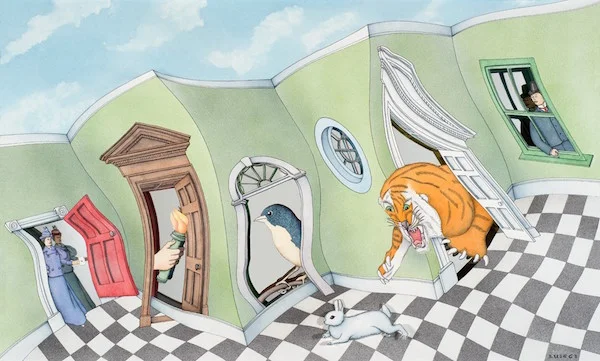
Real-estate agent's nightmare
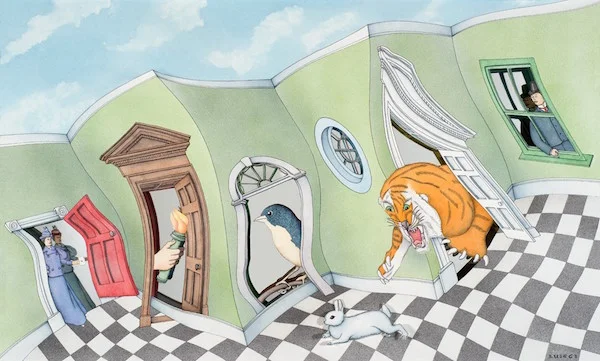
"Seeing Glass'' (watercolor, pen & ink) cut paper and mirror) by Mark Luiggi, in the summer show "Melt'' at the Brickbottom Artists Association, Somerville, Mass. July 14-Aug. 20.