
Vox clamantis in deserto






Mirror, mirror on the wall
"Suppose you were an idiot, and suppose you were a member of Congress; but I repeat myself. ''
--- Mark Twain
This famous quote should be extended to people who could have voted but did not in the 2016 primaries -- about 70 percent of eligible citizens didn't take the few minutes needed to exercise their central democratic right.
Their sloth paved the way for what we got as the major-party putative nominees: An ethically compromised Democrat who shamelessly panders to whatever group is in front of her and, worse, a demagogic, pathologically narcissistic con man Republican who admires murderous dictators.
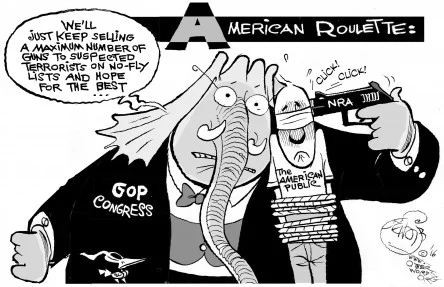
Americans should stop whining about the presidential choices and what Congress does and look in the mirror. If they don't like -- especially today -- that it's easy to go to Walmart and buy a military-style rifle designed to kill as many people as possible in the shortest period of time they could bestir themselves to go vote for a congressional candidate not in thrall to the National Rifle Association and the gun makers and who might vote for the sort of gun controls in force during the Eisenhower administration.
But many, perhaps most, of the complainers won't because America's civic culture is in full decadence mode.
--- Robert Whitcomb

Beach rites

"Ariel (red)'' (screenprint), by Alex Katz, in the show "Waterways IV,'' July 13-Sept. 10, at Heather Gaudio Fine Art, New Canaan, Conn.
Jill Richardson: And now naming rights in our National Parks!
Via otherwords.org
Imagine painstakingly making up your way up the cables of Yosemite National Park’s famous Half Dome peak — only to see swooshes and slogans encouraging you to “Just Do It.”
“Welcome to Half Dome,” a gleaming banner greets you, “sponsored by Nike.”
Unfortunately, it’s a possibility. As the coverage swells over Barack and Michelle Obama’s recent visit to Yosemite and Carlsbad Caverns, Americans are learning that National Parks will now start selling naming rights.
The parks are facing a hefty budget shortfall, so they’re turning to corporations — who are apparently more generous with cash than the current Congress.
Truly, this is a bummer.
We go to National Parks to escape the commercialism of modern life. Nothing is more spectacular than enjoying the beauty of a waterfall or the sunset over the mountains, or the magnificence of grizzly bears, wolves, and bison that one rarely sees outside of a National Park.
What’s more, we don’t have to buy this majesty because we, the American people, already own it. There’s no need to consider what to buy or how much it costs when enjoying the splendor of a National Park. For one thing, it’s worth more than money, and for another, it’s already yours.
But instead of properly funding our parks, the government will now auction off naming rights to the highest corporate bidders, thus cheapening the experience of the millions of Americans who visit the parks each year.
So Coca-Cola, which already wraps itself in the flag to peddle diabetes-inducing sodas, can now place its branding on the most iconic American destinations.
For now, there are limits to which assets businesses can name, and where they can use their slogans. But the next time there’s a shortfall, what else can we expect?
Maybe Angel’s Landing in Zion, brought to you by Victoria’s Secret Dream Angels bras? Or how about Apple, which named its latest operating system for the mountain El Capitan in Yosemite, buying naming rights for the actual El Capitan?
What about re-naming Utah’s Arches National Park for Dr. Scholl’s Arch Support shoe inserts? Or worse, for the Golden Arches of McDonald’s?
The only bright spot I can think of is that Pepsi changed the name of its lemon-lime soda to Mist Twist, so it’s unlikely that the soda Sierra Mist will be the sponsor of actual Sierra mist. Although I suppose that wouldn’t stop them from sponsoring Yosemite’s Mist Trail.
This is a bigger issue than just seeing a corporate logo or two on your next visit to a National Park. This is about how we, as a people, agree to pay for running our nation.
You’ve heard the phrase “you get what you pay for.” Well, we are.
After more than three decades of anti-tax rhetoric and a lot of blustering by members of Congress about stopping the old “tax and spend” ways, they’re cutting back on what makes us American.
Think about how you run your budget. You don’t just buy the cheapest car or the cheapest food, or get the cheapest haircut. You don’t decide to go without a medical procedure or avoid buying clothes just because they cost money.
You weigh costs against value. You buy what you need. Sometimes it makes sense to spend a little more for better quality. And you certainly wouldn’t avoid expenses related to your core values just to save a buck.
So should we as a nation. We should invest in our national parks, and we should invest in other areas too.
Let’s treat our National Parks like the treasures that they are — not as albatrosses to cut costs on by selling naming rights to the highest bidder.
Jill Richardson, an OtherWords.org contributor, is the author of Recipe for America: Why Our Food System Is Broken and What We Can Do to Fix It.
Welcome to the allergy room

"Fritz's Barn'' (oil on canvas), by Tom Pirozzoli, at the Patricia Ladd Carega Gallery, Center Sandwich, N.H.
Llewellyn King: The deluded Trump backers in my old N.E. mill town
In the neighborhood where I live in Rhode Island, Donald Trump is a hero. It is a solid, mostly white, community of working-class people.
They are fiercely patriotic, as the many veterans memorials that dot the landscape testify, as well as the solemnity with which they celebrate Memorial Day.
They are religious. Being mostly of Italian and Portuguese descent, they are practicing Catholics. Plaster Madonnas sit on many lawns.
These people -- these good, hard-working God-fearing Americans -- usually vote Democratic in a state that is more unionized than most. There are deep labor movement roots, and a history of struggle between the mill owners and the workers in the days when New England was home to the textile trade.
But sharing the small, neat lawns with Madonnas are blue Trump campaign signs.
These people are a near mirror-image of the working people in the north of England who voted for Britain to the leave the European Union. They are also working class or, as we have abandoned that term, middle-class people who saw their textile industry implode.
In Rhode Island, these exemplary people clearly are falling for the false music of Pied Piper Donald Trump. His wild, anti-trade siren song appeals here, invoking the time when New England was a manufacturing hub and China was place that you read about in National Geographic.
Their twins in the blighted North of England followed another piper with another myth: the former mayor of London and showman, Boris Johnson. He preached freedom from Europe: a halcyon dream of Britain free of entangling regulation from the European administrative capital, Brussels.
Now Johnson’s bluff has been called, and it is dawning on the good people of the North of England (think of it as England’s Rust Belt) that their well-being -- such as it has been -- has been largely as a result of the European Union. The North, much less prosperous than the South, where London holds hegemony, depends on European Union investments and grants. Now free of Europe, they are free to be poor.
In Rhode Island, after years in the post-industrial doldrums, a zephyr of new hope is just rising, and it has attracted part of General Electric Co.’s digital division. It will sit alongside another global mainstay of the U.S. economy, Textron, based in Rhode Island.
So even as Rhode Island is beginning a new chapter, its citizens are flirting with drinking the Kool-Aid being peddled by Trump.
Johnson and others, mostly Conservatives, peddled the myth that Britain was being hogtied by Europe and was yearning to be free and trade with the world – a sharp contrast to the Fortress America that Trump is peddling, but appealing to workers who, on both sides of the Atlantic, want a fairer shake.
Johnson says: Europe has hindered us and is undermining our national sovereignty. Trump says: The world is stealing from us. Both are political myths: dangerous, toxic myths. Both share a common lack of coherence, as is now so evident in Britain.
The sin of Johnson against the British people is that the campaign was based on lies, and there was no plan for how to proceed after victory: a well-known political trap (see G. W. Bush and Iraq).
No one I know believes that after Trump presumably gets the Republican nomination in Cleveland he will go on to win. But neither did I know anyone in Britain who thought that the country would fall for the wiles of devious leaders who play on patriotism and frustration for their own ends: glorification and power.
The blue Trump signs outside the modest houses proudly owned on my street may not get Trump elected, but -- and here is the danger -- they may draw his putative opponent, Hillary Clinton, toward the same trade poison that he is advocating. She already has backpedaled shamelessly on the Trans-Pacific Partnership, which she helped negotiate, and who knows what anti-trade deals she will strike with the unions?
When politics is informed by myth not policy, democracies are in danger of hurting themselves. We do not need a special relationship with Britain founded on mutual folly.
Llewellyn King (llewellynking2@gmail.com) is executive producer and host of White House Chronicle on PBS. He is also a longtime publisher, editor and international business consultant.

Life was beginning over again with the summer
“And so with the sunshine and the great bursts of leaves growing on the trees, just as things grow in fast movies, I had that familiar conviction that life was beginning over again with the summer.”
― F. Scott Fitzgerald




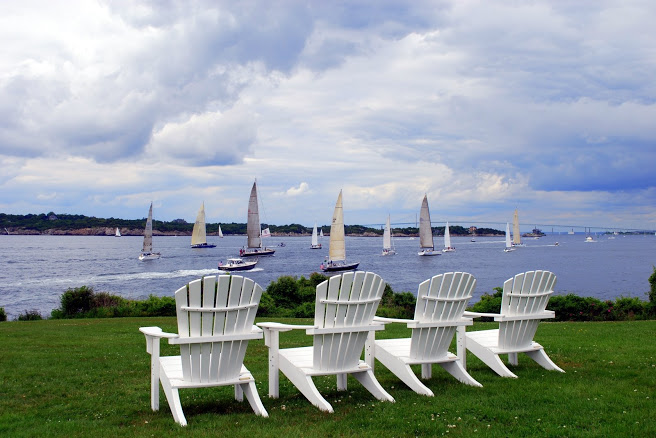


Drunk on delusion
"Summer is the time when one sheds one's tensions with one's clothes, and the right kind of day is jeweled balm for the battered spirit. A few of those days and you can become drunk with the belief that all's right with the world."
- Ada Louise Huxtable
Chris Powell: Arrogant "undocumented immigrants'' out of the shadows; fictionalizing parking for the handicapped
As they blocked Main Street in downtown Hartford by unfurling a 50-foot banner protesting deportations and an unfavorable (to them) U.S. Supreme Court decision, "undocumented immigrants" -- the politically correct term for illegal aliens -- and their supporters declared last week that they were "coming out of the shadows."
"I'm undocumented, unafraid, and here to stay," one announced through a bullhorn.
Nine protesters were charged by police with disorderly conduct.
Their disappointment was understandable but their indignation was misplaced and their presumption of a right to inconvenience and bully everyone else was contemptible.
After all, few illegal aliens are "living in the shadows" in Connecticut. Hartford and New Haven have declared themselves "sanctuary cities," formally committed to nullifying federal immigration law, as state government itself is committed more or less, now that it is providing driver's licenses and college-tuition discounts to illegals. All Connecticut's members of Congress favor amnesty for illegals.
Besides, "living in the shadows" is what lawbreakers do, although it's not as if any immigration-law violator is in danger of being persecuted for innocent characteristics like ethnicity, homosexuality or left-handedness. Every nation has the right to immigration law -- indeed, controlling immigration is the definition of nationhood -- and illegals have violated the law just as much as anyone else has.
Yes, the country's failure to enforce immigration law, induced by pressure from unscrupulous employers and groups that don't want any immigration-law enforcement, has contributed to the extenuating circumstances of millions of young people whose illegality was the responsibility of their parents. Politics has been obstructing legislation that might give them a "path to citizenship" -- and not just the politics of legislators hostile to immigration but also the politics of legislators hostile to achieving border control before amnesty. But that's democracy for you. Building consensus can take time.
Breaking a perfectly legitimate law and then demanding that it be changed in one's favor while one bullies innocent people on the street is pretty arrogant. Who do the illegals think they are -- Citigroup or Tribune Publishing, which undertook illegal corporate acquisitions in Connecticut, confident that they were influential enough to get the laws and regulations repealed?
If their arrogance is going to extend to blocking traffic, the illegals should go back in the shadows.
* * *
Because of legislation signed last week by Gov. Dannel Malloy, Connecticut's official emblem for reserving parking spots for the handicapped has been what the governor calls "modernized." It's more like fictionalized.
The old emblem showed a stick figure sitting in a wheelchair. The new emblem has the stick figure leaning forward in a racing pose as if engaging in a game of wheelchair basketball. The idea is to dispel the supposedly retrograde idea that the handicapped are handicapped and instead suggest that people with disabilities can lead active lives -- as if anyone thought there was some law against it.
But of course if the handicapped were not disadvantaged in some way, they would hardly need preferential parking, and most of the people whose cars are equipped with handicapped parking permits are not athletes but old folks unsteady on their feet, carrying canes, or lugging oxygen canisters.
So the new emblem is just another symptom of the political correctness plaguing Connecticut under the Malloy administration. In this respect the collapse of state government's finances is fortunate, for nothing will be spent to replace the handicapped parking signs just to get rid of the old emblem. The signs with the old emblem will be replaced only as they wear out. For the time being the PC brigades may have to settle for taking the signs off bathroom doors.
Chris Powell is a Connecticut-based columnist on politics and society and managing editor of the Journal Inquirer, in Manchester, Conn.

Want to dance?
"Floating in space, here's a Yellow and Black Garden spider that has its web on our front porch. It's a very small creature magnified by the use of a macro lens. I erased the web because it was distracting.''

-- From photographer Thomas Hook, New England Diary's man in Southbury, Conn.
"Floating in space, here's a Yellow and Black Garden spider that has its web on our front porch. It's a very small creature magnified by the use of a macro lens. I erased the web because it was distracting.''
Whenever I see a spider, I unfortunately think of "Design,'' the great Robert Frost poem below:
I found a dimpled spider, fat and white,
On a white heal-all, holding up a moth
Like a white piece of rigid satin cloth --
Assorted characters of death and blight
Mixed ready to begin the morning right,
Like the ingredients of a witches' broth --
A snow-drop spider, a flower like a froth,
And dead wings carried like a paper kite.
What had that flower to do with being white,
The wayside blue and innocent heal-all?
What brought the kindred spider to that height,
Then steered the white moth thither in the night?
What but design of darkness to appall?--
If design govern in a thing so small.
'When in the course of human events...'

Bobby Baker is a Massachusetts-based photographer many of whose photos have appeared in this site and its predecessor, "This New England''.
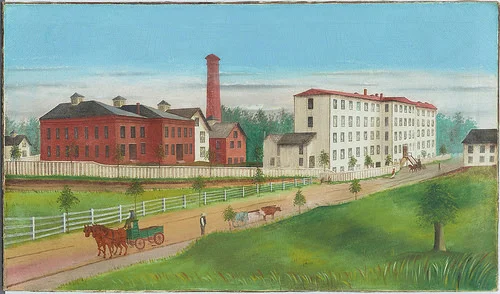
The road to Milltown and Miltown*
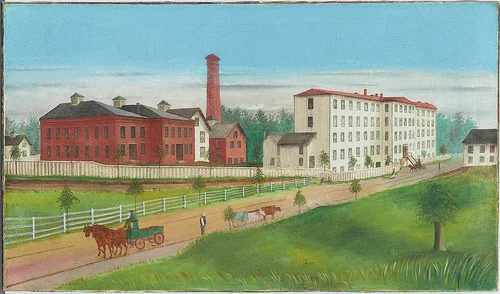
"Work from "A Useable Past: American Folk Art,'' at the Colby College Museum of Art, in Waterville, Maine, July 9-Jan. 8. The show primarily features the work of self-taught artists who worked in the eastern U.S. in the 19th Century. * Read S.J. Perelman's The Road to Miltown, or Under the Spreading Atrophy.
Would't it get boring?
"For him in vain the envious seasons roll
Who bears eternal summer in his soul."
Oliver Wendell Holmes, "The Old Player''
"
Robert Whitcomb; Treatment for Brexit bathos; 'The Genius of Birds'
This first ran in Robert Whitcomb "Digital Diary'' column in GoLocalProv.com.
"There's been a little bit of hysteria post-Brexit vote, as if somehow NATO's gone, the Trans-Atlantic Alliance is dissolving, and every country is rushing off to its own corner. That's not what's happening."
-- President Obama
Quite right. And the Western World has been prosperous for long stretches without the E.U.!
The 51.8 percent vote in the United Kingdom to leave the European Union stemmed from, among other things, the failure of the E.U. to slow the flood of refugees from nasty places and, somewhat related, the dwindling job prospects of millions of people hurt by globalization and computerization. Outgoing British Prime Minister David Cameron, for example, had vowed to cut net immigration into the U.K. to 100,000 a year. In fact, it rose to 333,000 in 2015.
Then there was the desire to protect the orderly British way of life.
The British and many people on the Continent understandably fear for their tolerant and opensocieties when so many people from illiberal, corrupt, religiously fanatic and indeed barbaric cultures flee to Europe for its safety andprosperity, not to mention welfare benefits, butrefuse to give up some of the nasty archaic aspects of the cultures whence they came. The British “Leave’’ voters want to adjust the influx of immigrants from non-Western cultures to a pace that allows for thegradual education of these newcomers so that they come to accept the values of an open, tolerant, democratic and secular society.
What happens next?
Future events might include:
· The U.K. deciding not to leave the E.U. after all. For one thing, the referendum isn’t legallybinding!
· Letting Scotland veto Brexit since, under one legal interpretation, leaving requires the Scottish Parliament’s approval and the Scots have strongly favored staying in the E.U.
· Renegotiating the U.K.’s membership in the E.U. -- for example, giving Britain and other member nations more power to control population movements into their nations.
The U.K. will muddle through with new arrangements with the E.U., perhaps along the lines of non-members Norway and Switzerland and, I hope, develop even closer connections with its offspring the United States.
Brexit should remind us that we need to strengthen the unity of the wider West – Europe, the U.S. and Canada -- especially as aggressive dictatorships, particularly Vladimir Putin’s Russia, as well as Islamic terrorists, pose intensifying dangers. NATO must block Putin’s obvious plan to take over the Baltic Republics and that part of Ukraine he hasn’t already grabbed. And the U.S., the U.K and the E.U. need to accelerate negotiations to enact the TransatlanticTrade and Investment Partnership to strengthen the West on both sides of the Atlantic.
An analysis at the World Economic Forum in Davos listed the 10 best nations to live in. All except Japan are Western democracies. Brexit may spawn new ways of thinking to keep it that way.
xxx
MontyBurnham, who chairs the Preservation Society of Newport County, controlled her exasperation in her recent status report on long-delayed upgrades to three Newport mansions – upgrades that would draw in more tourist money to the City by the Sea.
Tedious Nimby legal actions have long held up a long-overdue welcome center at The Breakers as well as refreshment services at Marble House and The Elms. The society will almost certainly finally triumph this year, letting these improvements be implemented next year. But what a pity it will have taken so long to offer these amenities. America has become an increasingly difficult place to do public projects, no matter how good for the general public.
xxx
Republican leaders have long denounced the Affordable Care Act without coming up with a detailed plan with a cost-benefit analysis to replace it.
The tradition continues with House Speaker Paul Ryan’s election-year healthcare replacement “plan’’ for the ACA. As usual, it involves further complicating the tax code -- in this case, with a new tax credit for people (including rich folks) to buy insurance in markets to be regulated by the states.
The speaker doesn’t project how much the credit would be worth, what the total cost would be, how many people it would cover and the range of health conditions to be covered by such policies. So, at this point anyway, it means pretty much nothing.
Meanwhile, the most cost-effective and least complicated way to improve American healthcare – extending Medicare to everyone – remains off the table. Lobbyists rule!
xxx
Jennifer Ackerman’s new book, The Genius of Birds, about birds’ cognitive abilities, is quite something. Birds use tools, plan, have capacious memories and complex social lives. Many species are anything but what we think of as ‘’birdbrained’’.
But then, the more we learn about nonhuman animals the more we’re surprised by how many species are smart and deeply feeling creatures. Pigs, certainly. (And some fish?)
And yet we continue to terrify, kill and eat intelligent animals.
Robert Whitcomb is overseer of New England Diary.
Todd McLeish: The wildlife effects of defoliation by caterpillars

Hills deforested by caterpillars.
The massive defoliation of trees in southern New England by winter moth and gypsy moth caterpillars this spring and summer has totally changed the look of the regional landscape. And while scientists say it’s unlikely that many trees will die as a result of one year of defoliation, it raises the question of how it will affect other species of wildlife.
University of Rhode Island ornithologist Peter Paton noted that several varieties of songbirds are likely benefiting from the huge number of caterpillars swarming the area. Black-billed and yellow-billed cuckoos, two species that are known to eat large numbers of caterpillars, including the prickly gypsy moth caterpillars that many other birds avoid, are likely to thrive this year. He said birdwatchers in the region have noticed an unusually large number of very active cuckoos since the birds arrived from their wintering grounds in South America in May. As a result, these birds will probably have a very successful nesting season.
“Last week I was watching some robins 40 feet up in a tree foraging, which is a pretty unusual place to find them eating,” Paton said. “So I’m guessing they were probably feasting on caterpillars, too.”
Paton also observed blue jays and hairy woodpeckers tearing apart some of the abundant caterpillar cocoons, another unusual behavior brought about by the caterpillar infestation.
“And if the defoliation ends up killing trees,” he said, “that could eventually have a positive impact on woodpeckers,” which consume insects that live in dead trees and which drill nesting cavities in dead trees.
As for other possible impacts on wildlife, he speculated that the absence of leaves on many trees will enable sunshine to filter down to the forest floor and other areas that are typically shady, which may provide additional sunny areas for turtles and snakes to nest and sun themselves.
On the other hand, fewer shady areas may make it more difficult for wood frogs and salamanders living in the forest to remain cool and moist, according to David Gregg, executive director of the Rhode Island Natural History Survey.
“Ferns and other forest floor plants are also more likely to have a negative experience of this phenomenon than a positive one,” he said.
Natural History Survey botanist Hope Leeson said there will be both winners and losers on the forest floor, depending on the needs of the species living there. “If there is an understory of trees and shrubs, they’ll be happy to have the sun.”
Leeson noted greenbrier as one plant that will thrive with the additional sunlight penetrating to the forest floor, and it will provide benefits to other species that may be at risk.
“At the moment, any small mammal living in the forest doesn’t have any cover,” she said. “Deer have eaten all the tree seedlings and shrub seedlings, so there isn’t anything for the mice and chipmunks to hide under. Once the canopy was removed by the caterpillars, it made it easy for the hawks and owls to see the small mammals pretty well.”
The increased growth of greenbrier, she said, will provide the small mammals with new places to hide.
Both Leeson and Gregg also noted that some unwanted invasive species may also thrive this year, thanks to the defoliation. Amur cork trees, for instance, an Asian species, have invaded forests throughout the Mid-Atlantic states and are now found in small numbers in coastal forests of Rhode Island as well. They grow very slowly in the shade, with some 25-year-old trees no more than 8 feet tall with trunks only an inch or two in diameter.
“They just wait it out in a shady situation,” Leeson said. “They just eek out an existence and wait for the moment when there’s light, and that’s when they put on a lot of growth.”
This year could be the year they will shoot skyward.
According to Rick Enser, retired biologist for the Rhode Island Department of Environmental Management, if the region experiences another gypsy moth infestation next year, tree mortality will likely increase, which could create gaps in the forest for new species to move into.
“Unfortunately, invasives are highly adept at dispersal, although small infestations within forest openings should theoretically be reduced or eliminated as the canopy returns,” he said.
Enser noted winged euonymus, also known as burning bush, as one invasive species that can spread quickly to new areas and survive when the forest canopy returns. It’s a shrub that has become a primary concern at URI’s W. Alton Jones Campus in West Greenwich.
Since it has been more than 30 years since Rhode Island has experienced such a severe defoliation, many of the environmental effects are uncertain and unstudied, leaving some scientists with more questions than answers.
“I was wondering about the nutrient balance,” Gregg said. “Normally oak leaves breakdown in a certain way at a certain time, but this year they've been consumed by caterpillars and turned into manure and sprinkled all over the forest floor. So is that good for the plants? What’s the nutrient analysis of gypsy moth poop?”
Author and EcoRI News contributorTodd McLeish runs a blog about wildlife. Hit this link to read it.

David Warsh: RIP: Great Britain, 1688-2016

SOMERVILLE, Mass.
My English friend first noticed the tendency years ago when English football hooligans began wearing the red and white Cross of St. George to matches in preference to the Union Jack. The latter ensign dated from 1606, when James I ordered the blue and white St. Andrew’s cross of the flag of Scotland to be sewn onto the English banner to represent his dual monarchy. For the next hundred years the striking new design was seen mainly on the masts of his British majesty’s ships at sea.
Not until 1688 did the English parliament get into the act, when its members invited the Dutchman William of Orange and his English wife to become King William III and Queen Mary II, fending off the restoration of hierarchical Catholic governance under James II. Crowned in 1685, James was chased off the throne and out of the country in 1688.
This was the “Glorious Revolution,” long cherished by the English as supposedly peaceful, aristocratic and consensual. It has been persuasively reinterpreted recently as “violent, popular and divisive” by Yale historian Steve Pincus and extensively illuminated by Deidre McCloskey in her Bourgeois Trilogy as the first truly modern revolution, precursor to the American and French experiences.
This was modernization based on a Dutch model, not a French one, writes Pincus. It included a broad array of inventions associated with becoming a nation-state: republican governance; elected representatives of the citizenry; the rule of law; bourgeois values of various sorts, especially the fundamental and widespread curiosity we now describe as “scientific”; and, not incidentally, the strong army and first-rate navy required by a nation bent on global domination. The Union Jack became Britain’s official flag only after both parliaments passed Acts of Union in 1707.

Elizabeth, England’s first Protestant queen, had begun her rule in 1558. For the next 250 years, Britain battled Spain, the Netherlands and France for control of Europe, North America, and the sea, finally emerging mostly victorious in 1815. Long before, writers including Edward Gibbon and Adam Smith had begun comparing its hegemony to that of the Roman Empire.
The Victorian era, broadly construed, lasted for a century, but as early as 1890 it was becoming clear that the empire had become overextended. In The Weary Titan: Britain and the Experience of Relative Decline 1895-1905 (Princeton, 1977), Princeton historian Aaron Friedberg argued that the Boer War, in South Africa, exhausted Britain’s willingness to tax itself to pay to maintain its status as the world’s dominant power.
Two long and bitter wars with Germany in the 20th Century further sapped Britain’s human, military and financial capacity. An attempted military intervention, with the aid of France and Israel, against Egypt in Suez in 1956 succeeded militarily but failed utterly politically and diplomatically. Gradually its naval forces were pulled back from Singapore. Hong Kong remained a commercial enclave long after it ceased to be a naval strong point; its sovereignty and governance were handed over to China in 1997.
What remained, until last week, was Britain’s capacity for moral leadership. Britain had declined to join European Coal and Steel Community in the years after World War II. French President Charles de Gaulle then fended off its attempt to join the European Economic Community (“the Common Market”) that emerged in the late 1950s. Britain finally entered the EEC in 1973, but opted out of the 1985 Schengen Agreement, which abolished most border controls among member states. The landmark Maastricht Treaty of 1992 created the European Union and the concept of European citizenship, E.U. passports and the free movement of labor among the member nations. Subsequent treaties have extended the principle of central European government from its seat in Brussels, and expanded membership to 28 member states.
What happened last week was not just Britain’s retreat from Europe; it was the abandonment of the project that began in 1688 with the Glorious Revolution of 1688, a dream of empire that turned out be a spectacular success. Britain now will return to being the island nation celebrated by Shakespeare as “this fortress built by Nature for herself/ against infection and the hand of war.” None of us who were raised on this story can be less than sad at the news; those who have labored in its service are heartbroken.
What happens now in Britain? Martin Wolf, economics columnist of the Financial Times, put it succinctly: Britain has prospered inside the E.U. but it will not do as well outside. It seems doubtful that London can remain the same immensely powerful global financial hub it has become – central banks such as the Bank of England have power only by dint of governments’ authority to tax.
Elites are fuming; they can hardly believe their comfortable way of life has been put at risk; so are the young, who voted overwhelmingly (75 percent of 18-24-year olds, 56 percent of 25-50 year olds) to remain.
Can the vote be reversed? British law may offer some exits.
My English friend first noticed the tendency years ago when English football hooligans began wearing the red and white Cross of St. George to matches in preference to the Union Jack. The latter ensign dated from 1606, when James I ordered the blue and white St. Andrew’s cross of the flag of Scotland to be sewn onto the English banner to represent his dual monarchy. For the next hundred years the striking new design was seen mainly on the masts of his British majesty’s ships at sea.
Not until 1688 did the English parliament get into the act, when its members invited the Dutchman William of Orange and his English wife to become King William III and Queen Mary II, fending off the restoration of hierarchical Catholic governance under James II. Crowned in 1685, James was chased off the throne and out of the country in 1688.
This was the “Glorious Revolution,” long cherished by the English as supposedly peaceful, aristocratic and consensual. It has been persuasively reinterpreted recently as “violent, popular and divisive” by Yale historian Steve Pincus and extensively illuminated by Deidre McCloskey in her Bourgeois Trilogy as the first truly modern revolution, precursor to the American and French experiences.
This was modernization based on a Dutch model, not a French one, writes Pincus. It included a broad array of inventions associated with becoming a nation-state: republican governance; elected representatives of the citizenry; the rule of law; bourgeois values of various sorts, especially the fundamental and widespread curiosity we now describe as “scientific”; and, not incidentally, the strong army and first-rate navy required by a nation bent on global domination. The Union Jack became Britain’s official flag only after both parliaments passed Acts of Union in 1707.
Elizabeth, England’s first Protestant queen, had begun her rule in 1558. For the next 250 years, Britain battled Spain, the Netherlands and France for control of Europe, North America, and the sea, finally emerging mostly victorious in 1815. Long before, writers including Edward Gibbon and Adam Smith had begun comparing its hegemony to that of the Roman Empire.
The Victorian era, broadly construed, lasted for a century, but as early as 1890 it was becoming clear that the empire had become overextended. In The Weary Titan: Britain and the Experience of Relative Decline 1895-1905 (Princeton, 1977), Princeton historian Aaron Friedberg argued that the Boer War, in South Africa, exhausted Britain’s willingness to tax itself to pay to maintain its status as the world’s dominant power.
Two long and bitter wars with Germany in the 20th Century further sapped Britain’s human, military and financial capacity. An attempted military intervention, with the aid of France and Israel, against Egypt in Suez in 1956 succeeded militarily but failed utterly politically and diplomatically. Gradually its naval forces were pulled back from Singapore. Hong Kong remained a commercial enclave long after it ceased to be a naval strong point; its sovereignty and governance were handed over to China in 1997.
What remained, until last week, was Britain’s capacity for moral leadership. Britain had declined to join European Coal and Steel Community in the years after World War II. French President Charles de Gaulle then fended off its attempt to join the European Economic Community (“the Common Market”) that emerged in the late 1950s. Britain finally entered the EEC in 1973, but opted out of the 1985 Schengen Agreement, which abolished most border controls among member states. The landmark Maastricht Treaty of 1992 created the European Union and the concept of European citizenship, E.U. passports and the free movement of labor among the member nations. Subsequent treaties have extended the principle of central European government from its seat in Brussels, and expanded membership to 28 member states.
What happened last week was not just Britain’s retreat from Europe; it was the abandonment of the project that began in 1688 with the Glorious Revolution of 1688, a dream of empire that turned out be a spectacular success. Britain now will return to being the island nation celebrated by Shakespeare as “this fortress built by Nature for herself/ against infection and the hand of war.” None of us who were raised on this story can be less than sad at the news; those who have labored in its service are heartbroken.
What happens now in Britain? Martin Wolf, economics columnist of the Financial Times, put it succinctly: Britain has prospered inside the E.U. but it will not do as well outside. It seems doubtful that London can remain the same immensely powerful global financial hub it has become – central banks such as the Bank of England have power only by dint of governments’ authority to tax.
Elites are fuming; they can hardly believe their comfortable way of life has been put at risk; so are the young, who voted overwhelmingly (75 percent of 18-24-year olds, 56 percent of 25-50 year olds) to remain.
Can the vote be reversed? Apparently just possibly. Hit this link.
There is a distinct possibility that Scotland will choose to remain in the European Union. In that case the Union Jack may actually come apart. Those ancient flags will reappear: the azure Saltire, worn by Scottish soldiers fighting in France in the 14th Century; the red-on-white St. George’s cross, brought back in the 12th from Malta after the Second Crusade.
Meanwhile, what about the rest of the world? That is a much more complicated story. You can expect to hear plenty more about it in the coming months, beginning with the other huge multi-national organization based in Brussels — the sprawling military-industrial complex known as the North Atlantic Treaty Organization.
David Warsh, a longtime economic historian and financial columnist, is proprietor of economicprincipals.com.
There is a distinct possibility that Scotland will choose to remain in the European Union. In that case the Union Jack may actually come apart. Those ancient flags will reappear: the azure Saltire, worn by Scottish soldiers fighting in France in the 14th Century; the red-on-white St. George’s cross, brought back in the 12th from Malta after the Second Crusade.
Meanwhile, what about the rest of the world? That is a much more complicated story. You can expect to hear plenty more about it in the coming months, beginning with the other huge multi-national organization based in Brussels — the sprawling military-industrial complex known as the North Atlantic Treaty Organization.
David Warsh, a longtime economic historian and financial columnist, is proprietor of economicprincipals.com.

Especially after this day

"Let Evening Come'' (beeswax and pigment on birch board), by Georgia Nassikas, in the current group show "Outside/In'', at the Providence Art Club.

Oh them again

"Artists'' (gouache on paper mounted on panel), by Leslie Roberts, in the show "From Atmosphere to Edge,'' at Kingston Gallery, Boston, through July 31.
George McCully: Don't try to turn colleges into technical schools to feed business
The annual Leadership Summit of the New England Board of Higher Education set for Oct. 17 scheduled for this coming October poses the question, “How Employable Are New England's College Graduates, and What Can Higher Education Do About It?”
The Summit will address numerous well-chosen, commonly current questions in and around this topic, predicated on the assertion that “New England employers consistently claim that they can't find sufficient numbers of skilled workers—especially in key tech-intensive and growth-oriented industries like information technology, healthcare and advanced manufacturing.” The strategic questions are, “Is higher education to blame? Are our colleges and universities still operating in "old economy" modes, in terms of services, practices and strategies for preparing students for career transitions and employability?” And, “Can New England's colleges and universities be the talent engine that they need and ought to be?”
The following addresses the factual premises, their historical context, and strategic issues, in a constructive attempt to clarify and enrich the discussion at the Summit.
First, as to the facts on employability: It is commonly believed, but incorrectly, that today’s college graduates have high unemployment; a recent study found that compared to other age and education cohorts, they actually have the lowest rate of unemployment—about 2 percent. Moreover, today’s job market operates on a new model of employment—the so-called “on-demand” or “gig” economy of short-term jobs perhaps interspersed with underemployment. The Summit needs to begin, therefore, with everyone on the same page with current data on unemployment, employment and underemployment.
As to history, this whole discussion arises from the confluence of two massive trends: the information technology (IT) revolution and the soaring, excessive costs of college matriculation.
The IT revolution, as we all know, is transforming all areas of life and enterprise, at an accelerating pace. It is now in what Steve Case, founder of AOL, calls its “Third Wave,” progressing rapidly from the “Internet of things” to the “Internet of everything.” As this revolution has gained speed and momentum, technological turnover has accelerated and pervaded job markets, so that everyone has now to run and jump to keep up with it. A large part of employers’ difficulty in filling jobs with suitably skilled employees is a side-effect that has become the new normal in high-tech businesses. That will not change, and cannot be blamed on colleges and universities; whether they can realistically be expected to do anything meaningful about keeping up with and advancing it is an open question.
The concurrent soaring college and university costs—and huge loans to help cover them—has made parents and students increasingly concerned about affordability, student indebtedness and practicality. This has had commercializing effects on college and university cultures, in which students and their parents consider themselves increasingly as consumers purchasing credentials for continued financial support and jobs.
Simultaneous grade-inflation, reduction of onerous study workloads, anxiety over what professors want rather than what students should want for themselves, excessive grade-consciousness, and questioning whether the investment is worthwhile, often boils down to a vicious circle: whether the investment will lead to a steady job that will enable paying off the loans.
The combination of these two trends is the dangerous situation we have today. If the job market is in constant, rapid and accelerating turnover so that jobs and even careers become short-term investments in ephemeral results by both employers and employees—and if the culture of colleges and universities is commercialized, operating as an investment in job security—how can colleges and universities, as relatively sluggish institutions already behind the curve, possibly now be expected to provide rapid-turnover kinds of training for rapid-turnover jobs?
Even if they succeed in training students for today’s job market, that same training will become obsolete tomorrow, and then what will the investment have been worth? How can New England’s colleges and universities, caught in this crunch, be presumed to have any real or viable “need” or obligation to be “the talent engine” for current or future job markets?
Here it is strategically useful to distinguish clearly between “education” and “training.” “Training” is “knowledge and skills development” and is the focus of this discussion; “education” is “self-development”, which is what our colleges and universities were created to do, as in the Classical tradition of liberal education. Education certainly includes training, but is both broader and deeper, intensely personal and social—focusing on the cultivation of values. Education is more about who ,training is more about what, students are and will become in their subsequent lives and careers.
It has long been conventionally accepted that the mission of “higher” education in colleges and universities, as distinct from that in schools, is to bring training in disciplined scholarship to bear on the cultivation of personal values, as in liberal education. This is not something that goes in and out of fashion with changes in economies or technologies. While the training function needs to be currently in tune with useful knowledge and skills in fast-changing technology and job markets, the challenge of keeping au courant is real, but always subordinated to the permanent and characteristic mission of higher education.
Here, modern technology itself can help. Training these days is done most productively and efficiently by computers and the Internet, as has been conclusively demonstrated by MOOCs. Obviously the employers who are complaining about the technical preparedness of prospective hires, know best what training (knowledge and skills) they want those new hires to have. They happen also, however, to be in the best position to provide it themselves.
Case (incidentally, a graduate of Williams College), in his book The Third Wave, put it succinctly: Let higher education develop character—which, he advises, is what the innovating entrepreneurs should be looking for in hiring—and let the businesses then train for the special skills they currently and prospectively need. MOOC-style courses could be the instrument of choice for such training; highly flexible, cost-effective, and productive, they can be quickly developed by anyone for any subject and trainee population, at minimal costs, and readily superseded as needs change.
Can colleges and universities help address this employment problem generated by the technological revolution? Yes—they might at tolerable cost to themselves (perhaps supported by businesses who, after all, need the workforce), incentivize this training with (limited) credits toward degrees for online MOOC training; they might provide various certifications apart from degree credits for MOOC students. They might open room and board facilities to MOOC enrollees, especially in summer or other off-season months, at least partially supported by the businesses needing them. They might provide to MOOC trainees a range of supplementary educational support services by adjunct faculty. Adjuncts might assist with running MOOCs, and businesses might have their MOOC instructors appointed as adjunct members of the faculty, if the cost-sharing could be worked out.
There is a wide variety of facilitating and affiliating options for training, short of undertaking full responsibility. But in this whole context, the suggestion that New England’s colleges and universities should assume, or be expected to assume, responsibility for supplying technically prepared employees to businesses, is an idea that is close to absurd and dead on arrival.
George McCully is a former historian, professor and faculty dean at higher education institutions in the Northeast, then professional philanthropist and founder and CEO of the Catalogue for Philanthropy. This piece first ran in the news Web site of the New England Board of Higher Education (nebhe.org)
Lia Spiliotes: To narrow N.E. rural healthcare gaps, boost nurse practitioners
Rural America lives with layers of demographic and geographic obstacles to health care, and not surprisingly, rural Americans face bigger health challenges than their urban and suburban neighbors. Berkshire County, the second most rural county in Massachusetts, is no different.
More than residents elsewhere in the state, our neighbors and communities struggle with high rates of obesity, cancer, diabetes, cardiovascular disease, mental illness and addiction to smoking and other drugs. The suicide rate in Berkshire County was the highest in the state in 2013, and admissions to mental-health facilities are above the norm.
Berkshire County mirrors other remote rural geographic regions in the nation, where recruiting primary-care providers is an ongoing challenge of economics, retirement, the allure of specialty medicine and big-city compensation. In these areas, the supply of primary-care physicians falls below federal standards. (Kaiser Foundation 2015).
The good news is that the education, experience and quality of physicians and nurse practitioners at Community Health Programs in Berkshire County, where I have been interim CEO since January, is on par with any of the best healthcare organizations in which I have worked in Massachusetts. Equally important is the work we are doing to educate patients about the front-line role that nurse practitioners play in the delivery of high quality primary care. Increasingly, patients understand that nurse practitioners are excellent partners in providing primary care.
National studies have shown that patients assigned to either nurse practitioners or primary-care physicians have comparable health outcomes. More than a dozen states — including Maine, Vermont, New Hampshire and Rhode Island — have long-since passed measures freeing nurse practitioners from physician oversight in treating, diagnosing and prescribing medication to patients.
States that have already done so show fewer emergency-room admissions, improved health status, and better overall healthcare experiences. Yet in Massachusetts, physician organizations have resisted giving nurse practitioners sufficient autonomy to practice to the full extent of their training. We need to maximize the use of nurse practitioners as a vital healthcare resource.
This lack of full practice authority for nurse practitioners has broad implications for healthcare access in Massachusetts, particularly in underserved communities. Competition for primary-care providers is intensifying. Physician salaries at community health centers, which serve mostly lower-income residents, remain 25 to 30 percent below entry-level salaries at many hospitals and private physician practices.
Outdated practices
At rural health centers, which continually struggle to attract providers away from urban areas, the impact is even more profound if nurse practitioners cannot provide the full range of patient care. The health of rural communities is compromised by policies that protect outdated ways of delivering primary care.
The role of nurse practitioners should grow as our health system moves toward the team-oriented, patient-centered care approaches — the foundation of post-Affordable Care Act healthcare delivery. Often referred to as the patient-centered medical home (PCMH), this coordinated model emphasizes a critical shift to staying well, not just getting better.
In addition, care for higher-risk patients with chronic needs, who account for so much of our overall healthcare spending, is better managed. In states that have lifted restrictions on nurse practitioners, early data show a reduction in ER admission rates, improvements in residents’ health status and increased patient satisfaction.
The time has come for the Massachusetts legislature to pass House Bill 1996/Senate Bill 1207. The bills, which draw upon guidelines developed by the Institute of Medicine, would remove barriers preventing nurse practitioners and certified registered nurse anesthetists from practicing to the full extent of their training. The bill also ensures that Massachusetts can meet workforce demands, address gaps in access to care and adopt new care models tied to healthcare delivery and payment reforms.
According to the National Council of State Legislatures, of the 2,050 rural U.S. counties, 77 percent are designated as health- professional-shortage areas. Around 4,000 additional primary- care practitioners are needed to meet current rural healthcare needs. There is no single fix to meeting the health needs of rural Americans, but by elevating the role of nurse practitioners, we believe we can begin to close the gap.
Lia Spiliotes, a Cambridge Management Group (cmg625.com) partner and senior adviser, is interim chief executive officer of Community Health Programs, the Federally Qualified Health Network in Berkshire County, and serves on the board of the Massachusetts League of Community Health Centers. This piece first ran in The Berkshire Eagle.