
Vox clamantis in deserto



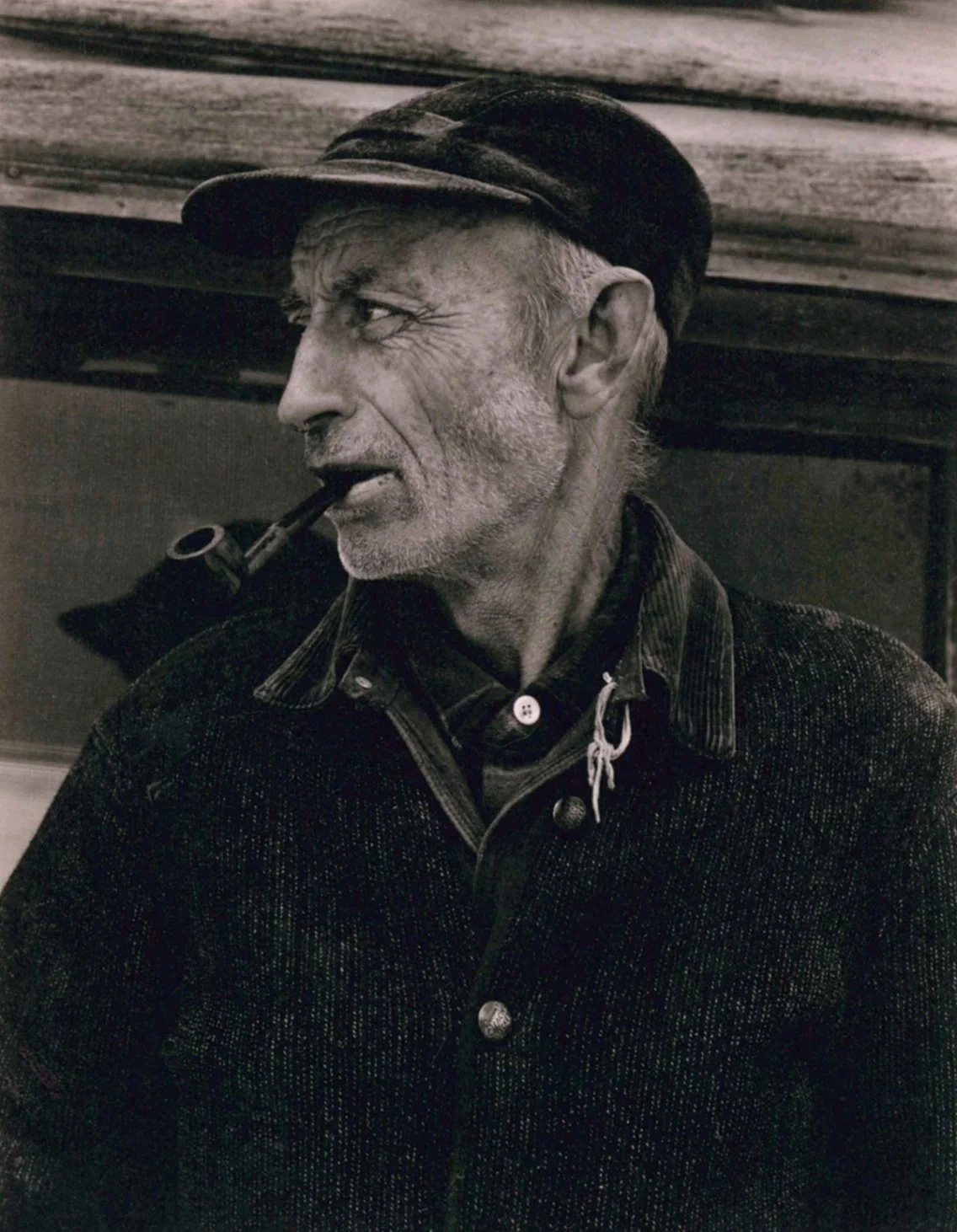
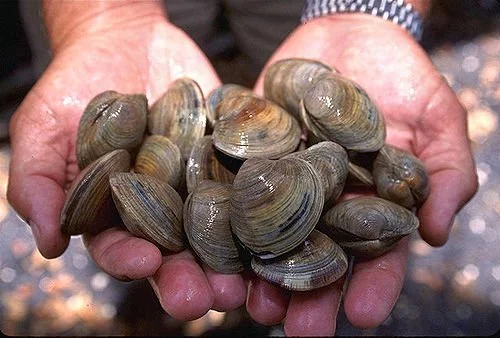
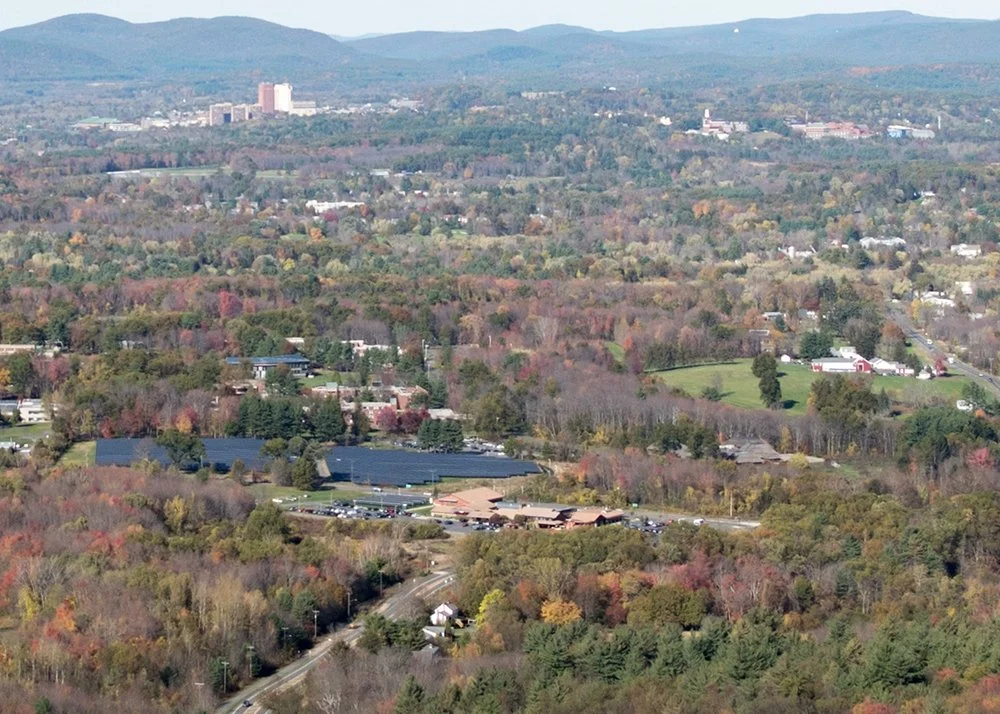
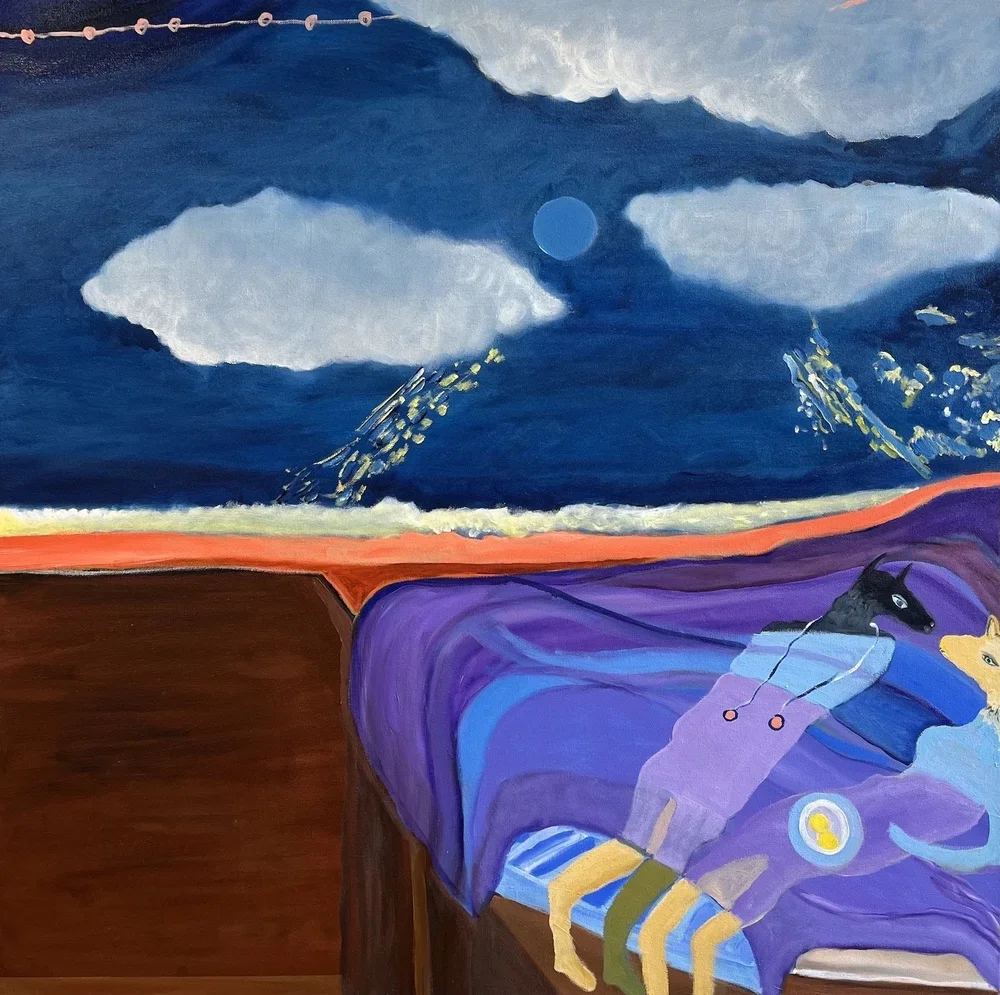


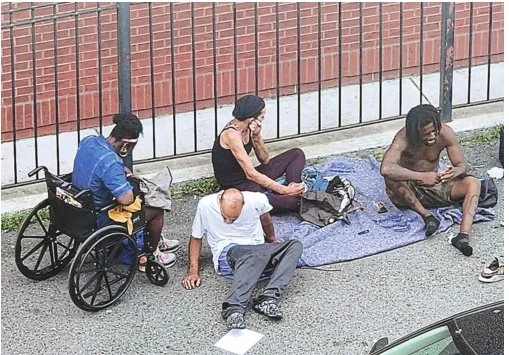
The way I see you now.
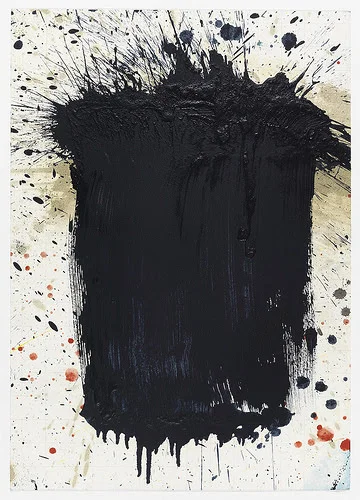
"Untitled,'', by Pat Steir, in her show "Drawings by Pat Steir,'' at the Helen Day Art Center, Stowe, Vt., through Nov. 13.
Earth, fire and water adventure

From "Beyond the Far Blue Mountains,'' a 50-minute, three-screen video by Molly Davies, at the Helen Day Art Center, in Stowe, Vt., through July 31. It's about a young German girl's adventure that includes tests involving earth, fire and water.
Charles Chieppo: Undergoing treatment for sick sick-leave policies
BOSTON
The aftershocks are still being felt in Massachusetts from the case of a state university president who received a payout for unused sick and vacation time of nearly $270,000 upon his retirement last year -- in addition to an annual pension of more than $183,000 and a $100,000 consulting gig. Proposed fixes are taking shape that, though imperfect, are steps in the right direction.
The problem is very real for many state and local governments. In Massachusetts alone, as of last year taxpayers faced about $500 million in liability for unused sick and vacation time.
The outcry over former Bridgewater State University President Dana Mohler-Faria's golden payout has already had an impact. Mohler-Faria refunded the state for 15 weeks of improperly accrued vacation time and agreed to terminate his lucrative consulting contract.
For the longer term. Gov. Charlie Baker, a Republican, has proposed legislation that would limit executive-branch employees' accrued sick time for to 1,000 hours, or about six months of work. The about 5,800 executive-branch workers who already have accrued more than that would be grandfathered, though their sick time would be capped at the hours accrued at the time of the legislation's passage.
Another bill, this one filed by Democratic state Rep. Colleen Garry, is tougher, limiting payouts to 15 percent of an employee's annual salary. Regardless of what you might think of her proposal, Garry made a point that public officials everywhere should heed, saying that government should "pay public employees fairly during their working years and not push compensation into retirement packages."
Mohler-Faria was one of 10 state and community-college officials who received six-figure vacation and sick-time payments between 2011 and 2015. Just this week, the Board of Higher Education eliminated the practice of rolling unused vacation time into a sick-leave bank and will gradually reduce the maximum vacation allowance to 50 days, still over 50 percent more than the limit for most state employees.
The University of Massachusetts, which is not governed by the Board of Higher Education, had previously limited accrued time off to 960 hours for non-union employees, but it remains unlimited for union workers -- yet another reminder of why post-retirement benefits should never be subject to collective bargaining.
The Board of Higher Education's new policies eliminate the worst abuses, but challenges remain when it comes to reforming policies around accrual of unused sick and vacation time. For one thing, whatever emerges from Massachusetts' legislative process is likely to cover only-executive branch employees.
Perhaps state and local government officials everywhere should be guided by Gov. Baker's simple point: "Sick leave is a benefit designed to deal with health and family issues, not a retirement bonus. Bringing … sick-leave accrual policy in line with other private- and public-sector employers just makes sense and is the fiscally responsible thing to do." What a concept.
Charles Chieppo (Charlie_Chieppo@hks.harvard.edu) is a research fellow at the Ash Center at Harvard’s Kennedy School. This piece first ran at governing.com.
And gone tomorrow
How did it get so late so soon?
Its night before its afternoon.
December is here before its June.
My goodness how the time has flewn.
How did it get so late so soon?
-- Dr. Seuss (Theodor Geisel)
Art in three places honors the National Park Service on its centennial

"Cretaceous Egg,'' by Anne Alexander, in the New England Sculptors Association's show "Centennial Visions: 50 Artists in Three Parks,'' marking the National Park Service Association's centennial. The show will run at the Saint Gaudens National Historic Site, in Cornish, N.H., the Marsh-Billings-Rockefeller site, in Woodstock, Vt., and the Springfield Armory, in Springfield, Mass., through Aug. 22.
Chris Powell: Block immigrants from repugnant, anti-Western cultures
According to police and news reports about Omar Mateen, the perpetrator of the atrocity in Orlando:
· He was a Muslim and the son of refugees from Afghanistan who was born in New York.
· His father imagines himself president or a military leader of Afghanistan and hosts a television program on which he has supported the Taliban and called for killing homosexuals.
· He was said to have made remarks sympathetic to terrorism that brought him to the attention of the FBI, which found nothing actionable.
· In accordance with the teaching of the crazy cult that is trying to hijack Islam he frequently beat his first wife, who came to consider him psychotic and left him.
· Also in accordance with the teaching of the crazy cult, he was enraged by homosexuality, and, completing his psychosis, had homosexual tendencies himself, having often visited the gay bar where he eventually perpetrated his murderous rampage.
In this context Mateen's mid-rampage call to police to proclaim his loyalty to the Middle Eastern terrorist group ISIS seems more like a vainglorious afterthought than part of a conspiracy.
Predictably enough, Democrats are using the atrocity to argue for their gun-control agenda, including prohibition of "assault weapons," apparently any rifle with a magazine, any rifle capable of firing more than one or two shots at a time without reloading -- a dubious proposition. As for the Democrats' more compelling propositions -- more background checks for gun buyers and such -- they probably would not have disqualified Mateen from purchasing the guns he used. For he was already licensed as a security guard, held a Florida gun permit, and repeatedly had cleared background checks undertaken by his employer, a federal government contractor.
Also predictably enough, Republicans are using the atrocity to argue for restrictions on immigration and foreign visitors, and at last Donald Trump has figured out that while immigration and visitation cannot be restricted by religion -- not constitutionally and not practically, since no one at a border crossing would admit his adherence to a prohibited religion -- immigration and visitation can be restricted by national origin.
After the atrocity Trump and his recent rival for the Republican presidential nomination, Texas Sen. Ted Cruz, asserted that the United States should not be welcoming people from countries that sponsor or are infected by terrorism or that oppress women, homosexuals, and disfavored religions. Such an exclusion would cover most of Africa and all the Middle East except Israel, the only democratic country there and the refuge of many homosexual Palestinians but nevertheless the bogeyman of the political left.
As Mateen demonstrates, and as has been demonstrated by other recent acts of terrorism, such as the Boston Marathon bombing and the Fort Hood massacre, a background in an oppressive culture can span the generations and explode unexpectedly.
Thus the atrocity in Orlando can be attributed as much to this country's negligent immigration policy as to its negligent gun policy. For our negligent immigration policy celebrates "multiculturalism" even as the culture being imported is repugnant. Europe, which is being overwhelmed by migrants who have contempt for Western values, lacks the will to defend itself and has become Eurabia, thereby showing where negligent immigration policy will take the United States.
Defending the country requires getting a lot more selective with immigration, admitting only those people who can show a firm commitment to democratic and secular culture, not mere desire to get away from someplace else. The country needs no more Afghan refugees, nor more of the Syrian refugees Connecticut's governor lately has been celebrating, nor any more immigrants from the vast expanse of primitive barbarism that constitutes Religious Crazy Land.
Chris Powell is managing editor of the Journal Inquirer, in Manchester, Conn.
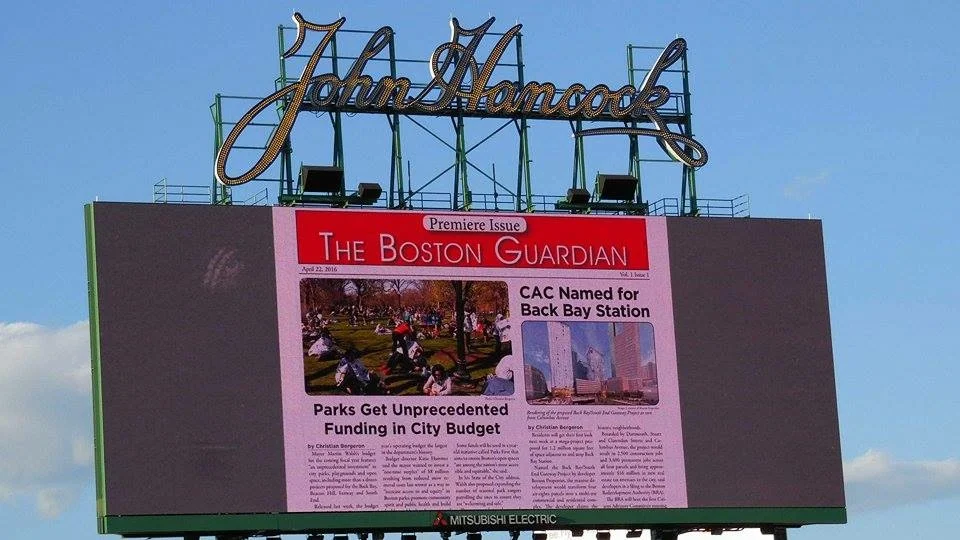
Newspaper bats 1000 at Fenway
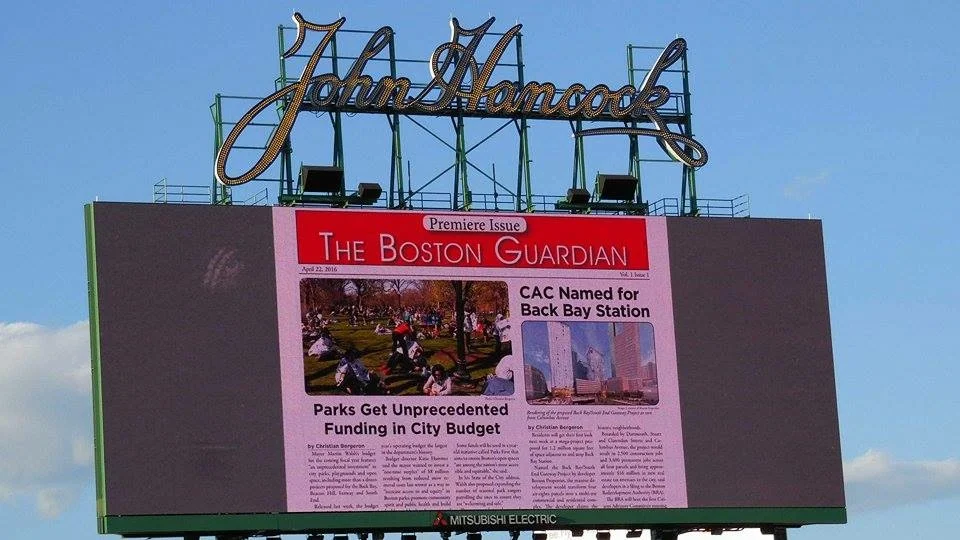
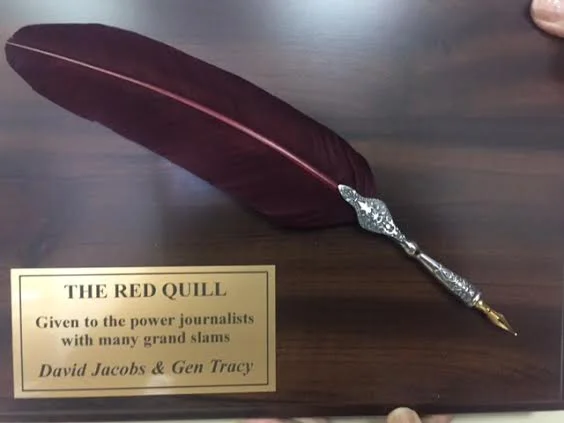
The Boston Red Sox honored David Jacobs and Gen Tracy, my friends and colleagues at The Boston Guardian, and their very able staff, on June 15 in a pregame ceremony at Fenway Park. As everyone knows, The Guardian is a mighty force for civic virtue, high (sometimes) civilization, relentless reporting and droll humor. All hail great newspapers, especially the ones still on paper. Mr. Jacobs is the publisher/editor and Ms. Tracy is the associate editor. The plaque that the Sox gave them is below.
In other good news, the Sox beat the Orioles that night 6-4.
-- Robert Whitcomb
Father of daughter murdered by ISIS sues Google, Facebook, Twitter for enabling terrorists
Reynoldo Gonzalez, whose daughter Nohemi was among the 130 people murdered by Islamist terrorists in Paris last November, is suing Google, Facebook and Twitter, saying that the companies gave "material support" to extremists in violation of the law.
Mr. Gonzalez filed the suit on June 14 in the U.S. District Court in the Northern District of California. The suit asserts that the companies "knowingly permitted" the Islamic State to recruit members, raise money and spread "extremist propaganda" via their services.
For more information, hit this link.
John O. Harney: June update on the condition of New England
BOSTON
New England’s unemployment rate stood at 4.4% in April, compared with 5% nationwide, according to the spring 2016 outlook delivered last week by the New England Economic Partnership (NEEP) to 50 or so economists and others gathered at the Federal Reserve Bank of Boston.
New Hampshire posted the second lowest unemployment rate in the U.S., at 2.6%. But all New England states are projected to have lower annual employment growth than the U.S. average through 2018, partly due to the region’s aging population.
Economist Barry Bluestone, of Northeastern University's School of Public Policy and Urban Affairs, projected that New England’s population will grow by only 5.5% from 14.7 million in 2015 to 15.5 million in 2025.
Turning to the spring 2016 NEEP theme of New England’s special relationship with Canada, Bluestone noted that 6% of jobs in New England depend on trade with Canada. New England’s No. 1 export to Canada is aircraft and aircraft parts, partly from GE and Pratt & Whitney. In some instances, the interdependence is striking: One growing export from New England to Canada is live Maine lobsters.
One major import from Canada back to New England is processed and frozen lobster, much of it for casinos and cruise ships.
The conference was sponsored by Brandeis International Business School’s Perlmutter Institute, the Canadian Consulate General and TD Bank—the Toronto bank that now markets itself as America's Most Convenient Bank and has naming rights to the arena that is home of the Boston Bruins, NHL archrival of the Montreal Canadians.
Bluestone added that New England output is forecast to grow nearly 13% by 2025. At the same time, ISO New England reports that the region’s power-generating capacity will decline by at least 13%, due to nuclear, coal and oil plants going offline. That means more natural gas, including via controversial means such as pipelines carrying fracked gas from Pennsylvania and ships carrying LNG from Yemen. Wind and solar power can supplement that, but cannot provide reliable, 24/7 energy for New England. And there is the question of how to get energy from the hydropower resources of Canada to the markets of New England. People in Maine, New Hampshire and Vermont don’t want to see big power lines. One solution is the power lines currently approved to run under Lake Champlain in Vermont.
Bluestone added that as international flights to Boston's Logan Airport have grown considerably, it may be time for New Englanders to think of Halifax, Nova Scotia, as another viable international airport. It’s closer to Europe than Boston is.
In one of the surprisingly rare references to education and talent at the NEEP conference, Bluestone warned that New England needs more engineers to innovates in areas such as harnessing the region’s high tides for energy and desalinizing seawater for drinking.
State of the states
The Canadian theme is engaging, for sure. But for me, NEEP’s gold comes in its colorful state-specific forecasts, this time down to four state forecasters from the usual six or more. (NEEP mourned the death of stalwart New Hampshire forecaster Dennis Delay, who died in December; Fairfield University professor emeritus Edward Deak, who historically watched ups and downs in Connecticut, retired from NEEP. Ross Gittell, the NEEP vice president who usually delivers the New England regional forecast, could not attend the spring conference because of his duties as chancellor of the Community College System of New Hampshire.)
Independent economist Jeff Carr of Vermont reminded the audience that his last forecast was clouded by Keurig’s launch of its cold-beverage line (which the coffee-brewing company ultimately discontinued) and Global Foundries buying IBM microelectronics facilities in the Northeast (which changed the company’s semiconductor export picture).
In January 2015, Vermont reached full recovery from the Great Recession—a benchmark whose significance is still lost on some who didn’t understand the full trauma of that downturn. Carr noted that, for the first time in years, the decrease in Vermont unemployment is actually due to increasing employment, not declining labor force. He added that the craft food industry (as he said, everything you need for vacation: Ben & Jerry’s ice cream, Cabot cheese and craft beers) has been a key part of Vermont economic resilience, despite hits in overall manufacturing..
Most Vermont exports are integrated circuits from the former IBM plant in Essex Junction and engine blades from Rutland. On the Canada theme, Vermont approved the transmission under Lake Champlain to bring in electricity from Quebec. Carr pointed out that Canadian hydro initially was not considered “renewable” because of an existing large carbon footprint and environmental implications for the Cree Indian Nation.
In a tribute to Delay, who gave a regular “Segway report” based on the motorized scooter invented by New Hampshire’s Dean Kamen, Carr noted the irony that Segway tours have become a top tourist activity in Burlington, Vt.
Charles Colgan, professor emeritus at the University of Southern Maine, who also spends much of the year at the Center for the Blue Economy in Monterey, Calif., returned to NEEP for the Maine forecast. Portland unemployment is extremely low, he said, yet it does not increase in-migration.
Also five paper mills in Maine have closed since 2008, claiming 7,500 total jobs.
On the conference theme, Colgan noted that Canada is Maine’s #1 trading partner, followed by China and Malaysia. Also, Maine still attracts many Canadian tourists to Old Orchard Beach and other coastal spots on the “Quebec Riviera.”
Maine also has led New England in renewable electricity. Colgan told of how a shortage of oil power threatened the Great Northern Paper mill in Millinocket, Maine. Then-Maine Gov. Ken Curtis contacted New Brunswick Premier Richard Hatfleld to nudge Irving Oil of St. John to help keep the mill running. New England governors began meeting with Eastern Canadian premiers to discuss energy issues at that time, and Irving remains a major presence in Northern New England.
Now, many Mainers and others worry about tar sands being transported through a Maine pipeline for later redistribution.
Maine has installed significant wind power and has more planned for Aroostook County, which historically has been connected only to the Canadian grid. Meanwhile, offshore wind may help solidify Maine’s potential in the middle of a rapidly developing energy market from Maine to the ”Boston States.”
Bryant University economist Edinaldo Tebaldi displayed a slide, showing the Rhode Island economy is improving but not as fast as New England or U.S. The Ocean State suffers from very little population growth, and its labor force is actually shrinking. Rhode Island’s unemployment rate is almost back to pre-recession levels, but not quite, partly because of sluggish job growth in manufacturing and construction.
Economist Adam Clayton-Matthews of Northeastern University spoke about high confidence in Massachusetts. Unemployment is now below pre-recession levels, but demography is making it impossible for many employers to replace workers.
Asked about the crisis in creating homes for middle-income households, Carr of Vermont noted that it’s not as cool for millennials to live in Burlington, Vt., as it is to live in booming Boston. People go to Vermont to get educated, then move away, then come back with three kids, Carr quipped. He add that the milestones people used to reach in their twenties—marrying, having kids and buying a home—they now do in their thirties, partly because of the pressure of student loan debt. In Maine, the state with the highest median age in the U.S., the housing problem is a lack of affordable senior housing.
A TD Bank official pointed out that not wanting to lose that enormous body of aging talent, the bank has no mandatory retirement. Many older workers can work one or two days a week. If other companies would do it, she noted, that would help an aging New England.
If the trade data weren't enough to convince the audience of the "special relationship," panelists on Canadian innovation may have drove the point home. TD senior economist Michael Dolega pointed out that no banking crises has occurred in Canada since 1840, compared with 12 in the U.S. (though housing markets are overheating in cities like Toronto and Vancouver and oil-producing regions of Alberta, Saskatchewan and Newfoundland & Labrador are in recession). François-Philippe Champagne, a member of parliament from Québec, and parliamentary secretary to the minister of finance, told the audience that looming Canadian infrastructure investment will emphasize public transportation, water and wastewater treatment, and affordable housing—priorities that perhaps should, but may not, straddle the border.
John O. Harney is executive editor of The New England Journal of Higher Education, where this piece originated. It is part of the New England Board of Higher Education (nebhe.org).
Strolling to safety

"Turtle Amore" (oil on canvas), by Joan Baldwin, in her show "The Marshes, at The Kingston Gallery, Boston, through June 26.
Don Pesci: Yes, mass-murderer acted on Islamist principles
Regarding the murder of 49 people and the death of the Islamist murderer, Omar Mateen, and the wounding of more than 50 others in the Orlando gay club:
Dots were quickly connected. On June 8, Channel 3 in Las Vegas reported:
“A pro-Isis group has released a hit list with the names of more than 8,000 people mostly Americans.
“More than 600-people live in Florida, and one security expert believes that many of those targeted live in Palm Beach County and on the Treasure Coast.
“The ‘United Cyber Caliphate’ that hacked U.S. Central Command, 54,000 Twitter accounts and threatened President Barack Obama is the same pro-Isis group that's reportedly created a ‘kill list’ with the names, addresses and emails of thousands of civilian Americans.
“Reports of the list came to light online when Vocativ reported the list was shared via the encrypted app, Telegram, and called on supporters to kill.
“Former FBI agent-turned lawyer Stuart Kaplan says the threat is especially alarming, because the people on this list are civilians who don't have the security necessary to protect themselves.
"’It's going to create some hysteria,’ " he said.’’
But there was little hysteria in Hartford or Washington, D.C., or indeed within the legacy media, which generally has supported the gay community at home. Islamists have long viciously targeted homosexuals.
Murderous assaults against gays, Christians and Jews abroad do not inspire hysteria. Routine vicious assaults, both at home and abroad, trigger the usual emotional delays while facts are sifted. Is there a connection between the reality-denying Islam of President Obama – peaceful, joyously accommodating to Christians, Jews and gays – and the vicious assaults on all three groups in areas of the world where Islam is most faithfully practiced?
Who will dare say? Really, it’s anyone’s guess. By all means, let us gather together all the facts. Reports immediately following the slaughter of gays in Florida warned against drawing premature conclusions. People are hard at their posts even now, sifting facts – preparing their political briefs, deflecting responsibility from responsible parties to, say, the National Rifle Association.
In Connecticut, the usual pro-gay politicians released the usual media releases, and then returned to their comforting illusions. Hysteria has a way of quickly dissipating in the land of the free and the home of the brave: One day it’s this, another day that. Christian churches are burned, those considered kafir, infidels, by faithful Muslims are beheaded; Coptic Christians, a Christian remnant founded by the Apostle and Evangelist Mark, have nearly been exterminated in the Muslim world; Islam waves its bloody sword in the Middle East and northern Africa; Islamic warriors kill non-Muslims who refuse to bow to the sword, rape and enslave their women, abduct and re-program their young children. This is Islam, says Abu Bakr al-Baghdadi, the founder and leader of ISIS.
Although al-Baghdadi is not a graduate of prominent Islamic seats of learning such as al-Azhar University in Cairo or the Islamic University of Medina, in Saudi Arabia , he is, according to Aaron Zelin of the Washington Institute for Near East Policy, an Islamic minister “more steeped in traditional Islamic education than either al-Qaida's past and current leaders, Osama Bin Laden and Aymen al-Zawahiri, both laymen, an engineer and doctor, respectively.”
This is not Islam, says Mr. Obama, a past guest lecturer at Harvard Law School, about which Bill Buckley, one of the fathers of the modern conservative movement, once said, “I’d rather be governed by the first 1,000 people chosen at random from the phone book than by the Harvard Law School faculty.” So, take your pick.
Omar Mateen, a radicalized American Muslim, left a 911 message praising al-Baghdadi on the day of the slaughter, a bloody theo-ideological fingerprint that only the willfully blind will ignore – or cleverly discount by turning the religious sacrificial lambs to other purposes. Obama, moments after the slaughter, said of Mr. Mateen, “This was a person filled with hatred.” Wrong: Mr. Mateen was filled with a holy purpose.
Hillary Clinton, the almost certain Democratic nominee for president, thought, post-slaughter, that this might be a propitious time to talk about gun control. U.S. Sen. Chris Murphy has twice condemned Congress, silent on the matter of gun control. Previously, on the occasion of yet another mass-murder of civilians by two Islamic terrorists, Mr. Murphy offered tweeted condolences to terrorist victims in San Bernardino – but no prayers.
To those praying for the victims, Mr. Murphy showed the back of his hand: “Your ‘thoughts,” he tweeted, “should be about steps to take to stop this carnage. Your ‘prayers’ should be for forgiveness if you do nothing -- again.” All the pointless prayers and thoughts, Mr. Murphy wrote, were a mask for inaction, and “wholly insufficient.” Mr. Murphy announced that he was a veteran of Sandy Hook.
“And what’s so offensive is in the wake of another mass shooting, we have a gigantic menu of policy options that are at our disposal to try to cut down on this carnage. And we’re not pursuing any of them. We’re just absolutely frozen. Listen, maybe I shouldn’t tweet in anger, but I’m angry that we’re not doing anything to try to stop this.”
And here we are yet again. Apart from passing federal laws that are, to use Mr. Murphy’s words, a mere emotional sop and “a mask for inaction,” what action should the United States take against ISIS that might “stop this?”
Presidential emoticons – the shooter was “filled with anger” – have never warded off attacks committed by terrorists faithful to the revelations of Mohammed, peace be upon him, a live and pertinent connection regularly discounted as irrelevant by Mr. Obama. The shooter, bending his knee to Minister al-Baghdadi and faithful to the Koran, was performing a religious duty. Almost all the sahabas, the companions of the prophet Mohammed, assign deadly punishments for sodomy. Some agree that homosexuals should be burned and stoned, other that they should be thrown from a height and then stoned; most agree their punishment should be death.
Mr. Mateen legally obtained his weapons because at one time he was a security agent. One can be almost certain that gun sales among gays in Orlando, and elsewhere in the nation, will spike after the most deadly terrorist mass shooting yet in the United States. That is exactly what happened after the Cheshire and Sandy Hook killings in Connecticut. In any case, no law promulgated by Mr. Murphy could deprive a faithful observer of the Koran and the Hadith on Sodomy of an overriding religious obligation.
How about this: Suppose we kill ISIS, utterly destroy its presence in northern Iraq and North Africa by any means necessary – and destroy it in such a way that ISIS itself will know it has been destroyed, a more efficacious solution than gun control. Naturally, this cannot be done by sending drones to snuff out al-Baghdadi. It would require lots of American boots on the ground – and the vigorous support of Connecticut’s two U.S. senators, Mr. Murphy and Dick Blumenthal, who tweeted moments after the attack on gays in the United States, “… my heart breaks for the families of loved ones lost or injured.”
Yes, ISIS has left broken hearts – real broken hearts – all over the world. Why should Orlando, Connecticut, or any other convenient target chosen by a militant, unmolested Islam escape the sword of that religion, which has nothing to fear but fear itself? Does Mr. Blumenthal seriously think that ISIS fears his broken heart?
Don Pesci is a Vernon, Conn-based political writer.
Hilary Cosell: My father's friendship with Muhammad Ali and their fight for justice
“I’m gonna kill you, nigger-loving Jew bastard.”
The so-called Jew bastard was my late father, the broadcast sports journalist Howard Cosell, and the quote typical of the hate mail that poured into his office from the moment in 1964 that he said, “If your name is Muhammad Ali, I will call you Muhammad Ali.”
Muhammad’s death on June 3 was a bit like my father dying a second time, because as long as Ali was alive, a piece of my father still lived. Together they represented the very best that this country has to offer, and exposed the worst, too.
As the Ali accolades poured in, and his status as a national treasure remained firmly in place, as I watched and listened to the round-the-clock tributes, I thought back to those years between 1964 and 1971, during which Ali was stripped of his title, the years he lost in boxing, and the hatred that engulfed him. I wondered how many people lauding him now even remember those days, or the true reasons why he deserved such praise.
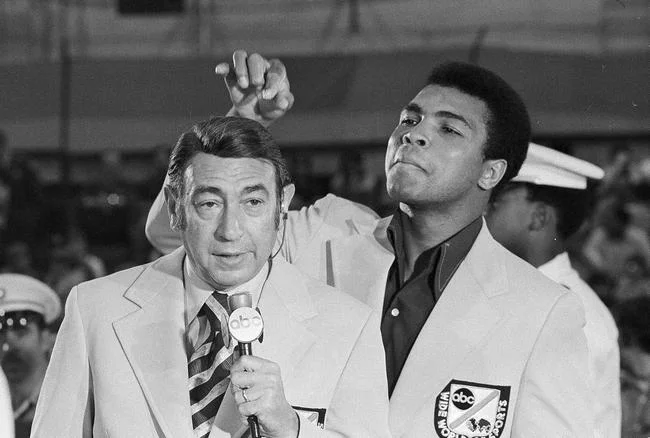
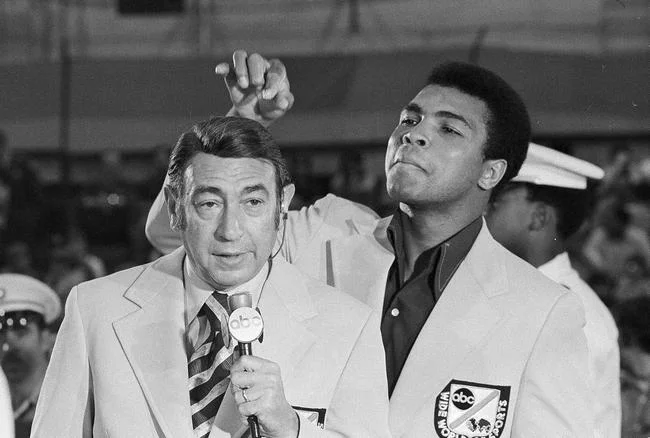
My dad covered boxing for ABC, and so he began to cover Ali. Right from the start they had the kind of rapport that often develops between two smart, fast-talking people. On camera together their relationship was entertaining, and they became synonymous in people’s minds: Ali-Cosell, Cosell-Ali.
But there was a bond between them that had nothing to do with repartee. It was forged during those years of the Freedom Summer, of riots and cities burning in the summer of 1965, the Gulf of Tonkin resolution, the draft, and the Vietnam War, and the Black Power Movement.
My father stood alone and stood his ground when he used Muhammad’s name. Sportswriters and broadcasters refused to speak it, and The New York Times wouldn’t print it. Other boxers continued to use it, and paid for it in the ring.
In 1966 Ali was reclassified as 1A by his draft board, and in 1967 he refused to step forward, and applied for conscientious objector status on religious grounds.
He was stripped of his title, stripped of the right to box professionally, his passport was lifted, and many Americans despised him.
He was called an ingrate, a coward, uppity, someone who didn’t know his place, a traitor, and accused of treason. What made his decision even worse, if possible, was the that he had joined a separatist black Muslim “nation” founded by Malcolm X. (He later left it and practiced a different form of Islam.) It’s no exaggeration to say that he was white America’s nightmare: a young, strong, articulate, separatist black man who said, “No Vietcong ever called me nigger.”
Alone again, my father rose to Ali’s defense. Howard Cosell was a lawyer and knew what was at stake immediately. This had nothing to do with boxing. At issue were freedom of speech, freedom of religion, equal protection and due process.
Amidst the hysteria and hate, my father explained the law, and Ali’s rights, over and over again. Few listened.
When Ali couldn’t box, my dad periodically interviewed him on ABC’s Wide World of Sports, and used him as a commentator on fights. He kept his name, face and case before the public.
One of my favorite stories about them took place at a classic, elegant New York restaurant, called Café des Artistes. It was a hangout for ABC, because the network’s headquarters was directly across the street.
It was a Saturday, lunchtime, and my mother and I got a table and ordered lunch, while my father did an interview with Ali. Suddenly there was a commotion at the entrance and my father strolled in with Ali and his entourage.
“Look who I brought to see you, Em,” he said to my mother, Emmy.
The maître d’ was used to my dad showing up with unexpected people. Tables were quickly pushed together, and Muhammad and friends sat down to eat. I looked around the restaurant, which was fairly crowded with a lily-white clientele who fell silent when Ali arrived, and simply stared. We ignored them.
After they had eaten and left, an older white gentleman cautiously approached our table and asked if he could speak with my father. He nodded.
“Why did you bring him here, Mr. Cosell? He doesn’t belong here. We’re afraid of him. Aren’t you?”
My father looked at the man and quietly replied, “With all due respect, sir, the only thing I’m afraid of are the sentiments you just expressed.” My father then said, “If you’ll excuse me, I’m lunching with my family.” The man scurried away.
Some revisionist historians write that Muhammad and my father were never friends, and that my father hooked on to Ali to further his career, not out of any sense of justice. It’s true that they helped each other’s careers along the way. But Howard Cosell’s defense of Ali defined my father’s career, as well as his character, conscience and courage -- and defined a bond of trust between two unlikely men that would never be broken.
Hilary Cosell is a Connecticut-based writer anda former NBC sports journalist and an occasional contributor to New England Diary.

Llewellyn King: Our destruction of life in the oceans

Memo to environmental activists: It’s the oceans, stupids.
This summer, hundreds of millions of people in the Northern Hemisphere will flock to beaches to swim, surf, wade, boat, fish, sunbathe, or even fall in love. To these revelers, the oceans are eternal -- as certain as the rising and setting of the sun, and a permanent bounty in an impermanent world.
But there is a rub: The oceans are living entities and they are in trouble. Much more trouble than the sun-seekers of summer can imagine.
Mark Spalding, president of The Ocean Foundation, says, “We are putting too much into the oceans and taking too much out.”
In short, that is what is happening. Whether deliberately or not, we are dumping stuff into the oceans at a horrifying rate and, in places, we are overfishing them.
But the No. 1 enemy of oceans is invisible: carbon.
Carbon is a huge threat, according to ocean champion Sen. Sheldon Whitehouse, D-R.I. The oceans are a great carbon sink, he explains, but they are reaching a carbon saturation point, and as so-called “deep carbon” resurfaces, it limits the oxygen in the water and destroys fish and marine life.
There is a 6,474-square-mile “dead zone” -- an area about the size of Connecticut with low to no oxygen -- in the northern Gulf of Mexico. Dead zones are appearing in oceans around the world because of excessive nutrient pollution (especially nitrogen and phosphorous) from agribusiness and sewage. Two great U.S. estuaries are in trouble: the Chesapeake Bay and Long Island Sound.
Warming in the North Atlantic is disturbing fish populations: Maine lobsters are migrating to Canada's cooler waters. Whitehouse and other Atlantic Coast legislators are concerned as they see fish resources disappearing, and other marine life threatened.
Colin Woodard, a reporter at The Portland (Maine) Press Herald, has detailed the pressures from climate change on fish stocks in the once bountiful Gulf of Maine. He first sounded the alarm 16 years ago in his book, Oceans End: Travels Through Endangered Seas, and now he says that things are worse.
The shallow seas, such as the Baltic and the Adriatic, are subject to “red tides” -- harmful algal booms, due to nutrient over-enrichment, that kill fish and make shellfish dangerous to consume.
Polluted waterways are a concern for Rio de Janeiro Olympic rowers and other athletes. Apparently, the word is: Don’t follow the girl from Ipanema into the water. The culprit is raw sewage, and the swelling Olympic crowds will only worsen the situation.
My appeal to the environmental community is this: If you are worried about the air, concentrate on the oceans. It is hard to explain greenhouse gases to a public that is distrustful, or fears the economic impact of reducing fossil-fuel consumption. If I lived in a West Virginia hollow, and the only work was coal mining, you bet I would be a climate denier.
The oceans are easier to understand. You can explain that the sea levels are rising; that it is possible for life-sustaining currents, such as the Gulf Stream, to stop or reverse course; and you can point to the ways seemingly innocent actions, or those thought of as virtuous (like hefting around spring water in plastic bottles) have harmful effects.
Plastic is a big problem. Great gyres of plastic, hundreds of miles long, are floating in the Pacific. Flip-flops washed into the ocean in Asia are piling up on beaches in Africa. Fish are ingesting microplastic particles – and you will ingest this plastic when you tuck into your fish and chips. Sea birds and dolphins get tangled in the plastic harnesses we put on six-packs of beer and soft drinks. They die horrible deaths. Sunscreen is lethal to coral.
It is hard to explain how carbon, methane and ozone in the atmosphere cause the Earth to heat up. It is easier, I am telling my environmentalist friends, to understand that we will not be able to swim in the oceans.
I have met climate deniers, but I have never run into an ocean denier. Enjoy the beach this summer.
Llewellyn King, executive producer and host of White House Chronicle, on PBS, is a longtime publisher, editor, columnist and international business consultant. This piece first ran on InsideSources.
If you take it away, you get it for free

"Truck in the Woods'' (in Thetford, Vt.), by William Hall.
Don Pesci: An overdue threat to Connecticut unions.
As June opened, the Connecticut State Democratic Party held a fundraiser in Hartford. The usual political celebrities were in attendance, along with deep-pocket notables. For once in a long while, state unions in Connecticut were on the outside looking in – and protesting.
It was a difficult moment for union-friendly Democratic politicians. Passing by State AFL-CIO President Lori Pelletier, Comptroller Kevin Lembo paused for a moment, bussed Ms. Pelletier on the cheek, acknowledged the protesters, and moved into the Hartford Convention Center to join those hawking for money at the Democratic Party fund-raising event.
Money, everyone knows, is the mother’s milk of politics. A political organization without money has no power; for power, the ability to convert ideas into practice flows in the rut of money. U.S. Sen. Chris Murphy, one of the attendees at the fundraiser, has often complained that he must spend a good portion of his time in Congress on the phone, chatting up large donors, a painful process familiar to all office holders. The public is beginning to notice the money-power connection, a constant theme of Bernie Sanders’s quixotic quest for the Presidency on the Democratic Party ticket.
These days, every politician is bought by someone, and Democratic politicians are by no means safe from the politically fatal accusation that influential donors have them on a short leash. Republicans are often cited as being the party of the rich, but in truth the fat-cats on Wall Street against whom Mr. Sanders has raised a stink contribute equally to both parties.
Many of the union protesters wearing shirts emblazoned with the motto “UNION POWER” likely were Sanders supporters. All of them want Gov. Dannel Malloy’s “progressive” government to take a stick to rich people in Connecticut, boost the progressive income tax, and cease and desist grinding the faces of the poor.
But in fact, Suzanne Bates of the Yankee Institute reminds us, the Malloy administration did raise taxes on the rich; Mr. Malloy and progressive Democrats in the General Assembly, bowing to union pressure, increased the top tax rate “for single people making over $500,000, or a married couple making over $1 million” by 0.29 percent, a measure that was supposed to increase personal-income tax receipts by $151.5 million.
Despite the progressive knock on the rich, income-tax receipts “continue to decline -- dropping $425 million below projections made before taxes were increased.” In its plunge, Connecticut is beginning to taste the bitter fruit of diminishing returns: It is no longer true in Connecticut that more taxes mean more revenue.
Mr. Malloy, attempting to adjust a chronically out-of-balance budget, has sworn off raising taxes, because Connecticut, which has not yet recovered fully from the Bush-Obama recession, is heavily reliant for its tax revenue on large financial operations in the state; in addition, Connecticut is losing revenue as one-percenters and large companies move to less punishing, low-tax, low-regulatory environments.
In his recent budget, Mr. Malloy, the architect of the largest and second largest tax increases in Connecticut history, facing yet another deficit, did what previous Connecticut governors have done from time immemorial: He cut spending across the board, shifted dedicated funds from one to another non-lockbox spending pile, and announced some layoffs. State workers in the executive and judicial branches so far have received only half of the 1,900-to-2,000 layoff notices “the governor said two months ago that he anticipated being ordered by June 10,” according to a posting in CTMirror.
Following the boycotted fund-gathering event, union rank and file protesters, including Ms. Pelletier, disbanded, no doubt congratulating themselves on having made an important political point or two. Only a handfull of protesters showed up. Many influential in the labor movement were in attendance at other events, and some accessed the fund raiser through other entrances, perhaps fearing backlash from the politicians and the rank and file to which they pander.
In the absence of structural changes in how government gets and spends revenue, “necessary” layoffs will continue; however, all state unions are facing an existential threat in new administrative reforms being pressed upon states by the national AFL-CIO union leadership.
At a meeting last March, Ms. Pelletier advised union members that a “mandatory reorganization of all the Central Labor Councils (CLCs)” had been put on the table. The National AFL-CIO, Ms. Pelletier told the group, according to minutes of the meeting, “wants this reorganization to be completed by June of this year.” The reorganization would entail an "agreed upon” confiscation of all per capita income -- i.e. union dues paid by all the Central Labor Councils CLCs.
Under the new arrangement, CLCs would be reformed into “Chapters.” Money and authority would flow from disbanded CLCs to an “area organization(s),” a new group of labor business administrators “which all the chapters are a part of,” according to a message issued by AFL-CIO Northeast Guild Officer Jan Schaffer.
Following the establishment of the provisionally titled “Regional Federation of Labor” apparatus -- targeted to be in place by the end of June -- protesters at the concluded Democratic Party fund raiser likely will see a money raid on reorganized CLC bank accounts by the new mandated regional apparatus. And (see above) he who has the money will forcefully wield power under pain of non-compliance. Under the new arrangement, CLCs would lose their much prized autonomy to as yet uninstalled administrators, who then would parcel out funds and marching orders to former CLCs -- renamed “Chapters” in a larger book written by regional or even national leaders.
Little or none of this information has yet filtered down to union rank and file members. Only delegates and those with approved credentials are allowed to attend the meeting at Connecticut’s annual AFL-CIO convention in Hartford on June 9 and 10.. One may expect resistance from delegates not in agreement the new national AFL-CIO edict, but that resistance can only begin after rank and file unionized workers become aware that delegates and other decision makers have failed to be transparent with members not privy to orders from above issued by leaders who fear transparency and honest dealing.
Don Pesci is a Vernon, Conn.-based political writer.
Jim Hightower: A Koch brother's pseudo-academic investment
Via OtherWords.org
First came withering hoots of laughter when the honchos of George Mason University named their law school the Antonin Scalia School Of Law — or ASSOL, for short. It was an honor Scalia might’ve merited, but very embarrassing for the university.
Even though administrators quickly changed the name to the Scalia Law School, their embarrassment turned into shame. It turns out they’d sold the naming rights to none other than Charles Koch, a multibillionaire right-wing extremist.
For years, Koch and other moneyed corporatists have quietly pumped millions into pseudo-academic centers on college campuses to promote their laissez-faire ideology, including a handful at George Mason itself.
But here was Virginia’s largest public university letting the infamous Koch brother and another un-named right-winger give $30 million in exchange for branding George Mason’s law school — one of the university’s core academic institutions — with Scalia’s name.
Students and faculty rebelled at the idea that integrity of their university, supposedly a center of enlightenment and erudition, was to be identified with a judge notorious for veering into racist and homophobic rants, and for being the Supreme Court’s most obsequious servant of plutocratic corporate rule.
Rebellion turned to fury when it came out that the ‘donation’ also required school officialsto commit taxpayer money to finance 12 new professorships and two new centers to promote the Koch brothers’ fantasies of free-market plutocracy.
The university’s president calls this perfidious transaction a simple ‘'naming gift.’' But who is he to put the name of the people’s law school up for sale? And why was it sold in a secret, no-bid process?
Koch wasn’t making a gift. He was buying a public asset — including the university’s integrity.
Jim Hightower is a radio commentator, writer, and public speaker.

'Blessed with truth'
Your voice, with clear location of June days,
Called me outside the window.You were there,
Light yet composed, as in the just soft stare
Of uncontested summer all things raise
Plainly their seeming into seamless air.
Then your love looked as simple and entire
As that picked pear you tossed me, and your face
As legible as pearskin's fleck and trace,
Which promise always wine, by mottled fire
More fatal fleshed than ever human grace.
And your gay gift—Oh when I saw it fall
Into my hands, through all that naïve light,
It seemed as blessed with truth and new delight
As must have been the first great gift of all.
Richard Wilbur, "June Light''
Animal house

"Vestigial'' (plexiglass, backlight film, polycarbonate tubes, fluorescent light bulbs), by Clint Baclawski, in his show "Luminus,'' at Adelson Galleries, Boston through Aug. 14.
Book us hotel rooms

"Treehouse'' (acrylic on canvas), by Eveline Luppi, in her current show at Providence Art Club.
Treehouses are one of those outdoor summer creations favored by kids aged from about 6 to 12, at which point most lose all interest, even before the bats and bugs become intolerable. Like camping out, their charm fades as you realize that physical comfort is underrated.
Camping in itchy sleeping bags in which you first wake up sweating and then, before dawn, if you'd been able to sleep since the first wake-up (if there was one), you wake chilled to the bone and sore from lying on those roots and stones you can't seem to avoid and scratching the wounds inflicted by red ants.
Luckily for kids whose parents force them to camp out, the camping season is still brief in New England. Perhaps global warming will extend the misery over the next few decades.
-- Robert Whitcomb