
Vox clamantis in deserto






Chris Powell: Cowering in racial guilt at a New Haven high school
Amistad High School, in New Haven is, according to U.S. News & World Report, the third best high school in Connecticut on account of its success with a disadvantaged student population.
But last week those students let the world know how unhappy they are with the school. They walked out without first attempting to discuss their grievances with school administrators -- and rather than discipline them for their disruption and rudeness, school administrators nervously praised them for their "leadership," as if the school would welcome a student walkout every day.
The main complaint of the students, 98 percent of whom are black or Latino, involved the supposed lack of racial diversity of Amistad's staff. While the school says 27 percent of its staff are black, Latino, or multi-racial, up from 21 percent a year earlier, the students complain that few of these staffers are teachers -- and that this is crucial because black and Latino students can't relate to white teachers.
As one student told the New Haven Independent: "Growing up without a father figure, I always looked to find one inside the classroom. A Caucasian male would never be able to teach me how to live in a society that still looks down at skin of my color."
Of course the assertion that the races can't relate is the essence of racism. That such a claim is coming from Amistad High may have the old Southern segregationist governors who resisted Brown v. Board of Education laughing in Hell and exclaiming, "We told you so!"
Meanwhile, white teachers who, out of idealism, chose to work with disadvantaged kids in a poor city rather than well-to-do kids in a prosperous suburb may think: If people of different races can't relate and won't even try, why did we bother? Why does anyone?
Yes, to some extent racial diversity is a virtue, mostly a political one, but competence is a higher virtue, and given the country's history of slavery and racial discrimination it will be a while before the share of the black population that is qualified for professional employment equals the share of the white population that is qualified. Qualified blacks are in high demand for all sorts of professional positions throughout the country, and Amistad High is only one of thousands of institutions that wishes it could find more of them.
Indeed, school administrators might have told the protesting students that the school's very purpose is to qualify them to become what they and the school wish they had more of now.
The students had secondary grievances -- disciplinary incidents they considered unfair and various rumors that no one had bothered to verify or discredit. The administrators tried to rebut it all.
Parents of Amistad students had grievances, too. One told The New Haven Register that something must be wrong at the school because it rejected her for a teaching job. Her resentment indicated that Amistad's students are not alone in having come to recognize the school as an opportunity for racial patronage.
Despite the disruption and the loss of a day of study on the eve of final exams, Amistad administrators cowered in the racial guilt that the students had hurled at them.
The administrators glorified the walkout as a success for the school, assured the students that they had been heard, and promised to do better to diversify the staff.
The students probably learned from their walkout something that these days unfortunately may be of more practical value than English, math, history, and science -- that no matter how unfair, misleading, opportunistic, or stupid they are, racial grievances pay immediate dividends because so few people dare to talk back to them.
While Amistad High says it wants to create leaders, there are different kinds of leaders, and the school may have just given a start to the next Al Sharpton or Jesse Jackson -- may have just helped create the next national race hustler.
Chris Powell is managing editor of the Journal Inquirer, in Manchester, Conn.
'The Summer of the Just' and our season
There is a June when Corn is cut
And Roses in the Seed—
A Summer briefer than the first
But tenderer indeed
As should a Face supposed the Grave's
Emerge a single Noon
In the Vermilion that it wore
Affect us, and return—
Two Seasons, it is said, exist—
The Summer of the Just,
And this of Ours, diversified
With Prospect, and with Frost—
May not our Second with its First
So infinite compare
That We but recollect the one
The other to prefer?
Emily Dickinson, "There is a June when Corn Is cut''
Trump as the Great Builder: Cheap materials, relentless promotion, sky-high prices
Listen here for more stuff on Donald Trump as real-estate mogul in the '80s. He was a master of using shoddy materials for high-priced places.
Highly aesthetic aquaculture
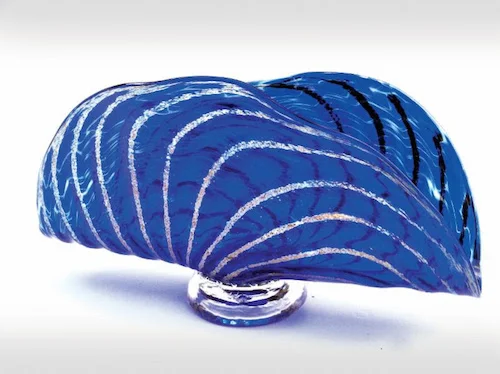
"Aquatic Silver Sea Fan'' (glass and silver), by Daniel Read, at the Providence Art Club through June 24.
PCFR June 7 dinner cancelled
To members and friends of the Providence Committee on Foreign Relations
(thepcfr.org; pcfremail@gmail.com).
Because of the sudden illness of the speaker's wife, we must cancel tomorrow's (June 7) dinner.
We are very sorry for the inconvenience. For those who have paid for June 7 and plan to attend the June 22 meeting, we'll credit that with your payment.
Otherwise, we can refund you by check or credit your payment to our first dinner meeting in September.
Let us know which you prefer.
Again, we are very sorry for the inconvenience.
Where fence meets wall

Photo by Thomas Hook
Here are two kinds of barriers found all over rural New England, in this case in Roxbury, Conn., home of many celebrities over the years, perhaps most famously the playwright Arthur Miller and his (briefly) wife Marilyn Monroe.
David Warsh: Presidential race is swan song of the Baby Boomers
Journalist Andrew Sullivan speculated in New York magazine earlier this month that U.S. democracy is ripe for a tyrant, and that the candidacy of Donald Trump is potentially “an extinction-level event.” Jacob Weisberg, editor-in-chief of the Slate Group, who seems to me (and to the Financial Times) the shrewdest of the current crop of U.S political commentators, thinks Sullivan’s widely-read essay is “one of the most important things written about the phenomenon of Trump.”
I think it is bunk. What about the Sanders phenomenon?
The outcome of the long primary season is best understood as fatigue-turned-protest against the initial promise of a Bush-Clinton race – two families that have loomed large in presidential politics since 1988 and 1992 respectively. The undertone of fascination with the possibilities of authoritarian rule is real enough, at least in some quarters, but it is easily exaggerated.
The second-most salient fact about the 2016 presidential election is the tight grouping of the candidates’ ages: Donald Trump was born in 1946, Hillary Clinton in 1947, Bernie Sanders in 1941. This is not the beginning of the end of the U.S. democracy. It is the last hurrah of the post-World War II Baby Boom.
Certainly the election has become much more dangerous since Trump clinched the Republican nomination. It is highly unlikely, but it is no longer inconceivable that the developer-turned-reality-television-star could become president. This in itself is harmful to the reputation of the United States. I don’t quite see how the Republican Party recovers from its embarrassment, at least over the long term, but likely it will.
For the record, I wish Clinton would win 49 states in November (though it doesn’t seem very plausible that she will) and that Sanders goes back to Vermont. Whoever wins is likely to be a one-term president. Today’s poisonous politics will continue for a while longer. My hunch is that the presidential candidates who lead the Republican and Democratic Parties in 2020 will have been born after 1964 – the last year of the Baby Boom.
. xxx
Yuliy Sannikov, of Princeton University, last week was named winner of the John Bates Clark medal for 2016. The award is given annually by the American Economic Association to an economist working in the United States judged to have made the most significant contribution before the age of 40. He received the recently-established Fischer Black Prize from the American Finance Association in 2015.
Sannikov, who won three gold medals in International Mathematical Olympiads after graduating from Sevastopol Visual Arts School in 1994, is often thought of chiefly as a tool builder, a master of adapting continuous time methods to dynamic games using the stochastic calculus.
But after learning economics as a Princeton undergraduate, the PhD he received from at Stanford Business School in 2004 (where his advisers were Robert Wilson and Andrzej Skrzypacz) immersed him in all kinds of practical problems – everything from corporate management to monetary policy. As the citation says,
Previous models abstracted from crucial economic forces in the name of tractability, but Sannikov’s methods allow models to include the most important forces and thus deliver results that are much more relevant. He is one of the few theorists in many years to have introduced a truly novel tool that changed the way theory is done.
Meanwhile, Olivier Blanchard, who served a heroic tour as chief economist for the International Monetary Fund from 2008 s until 20015, was slated to be elected AEA president. Before joining the IMF, Blanchard was for 25 years a mainstay of economics department at the Massachusetts Institute of Technology, and an influential architect of policy-relevant macroeconomics.
Named distinguished fellows of the AEA were Richard Freeman, of Harvard University; Glenn Loury, of Brown University; Julio Rotemberg, of Harvard University; and Isabel Sawhill, of the Brookings Institution.
David Warsh, a longtime financial journalist and economic historian, is proprietor of Somerville, Mass.-based economicprincipals.com
Pack your Prozac

"Deer Isle (Maine)'' (polymer intaglio) by James B. Myette (member of Providence Art Club.
For all the Downeast beauty, the frequent grayness of the Maine coast because of its infamous fog can make it a profoundly dispiriting place.

Robert Whitcomb: What to do with those islands near Europe
On a business trip to London in the ‘80s, I saw a billboard for an airline at Heathrow Airport that proclaimed “Best Route to Europe’’. I asked a cabbie: “Aren’t we in Europe?’’ He answered: “No, Sir, we’re in England’’.
Whenever I visit Britain, I never feel I am in “Europe,’’ but rather in something closer to the U.S. or Canada. It isn’t just the language; it’s in the manner of the people and the look of the place. London reminds me of Boston (Mass.), Nottingham of Worcester (Mass.).
On June 23, British subjects will vote on whether the United Kingdom (England, Scotland, Wales and Northern Ireland) should quit the European Union (the exit called the “Brexit’’). There would be pitfalls (for a while) in doing so but advantages too.
The pitfalls: Harder for British people to get jobs on the Continent, less flexibility for big U.K. companies in doing deals with Continental companies and snags in coordinating sometransnational anti-terrorism security measures with E.U. members.
Still, while Brexit would hurt the U.K. economy for several years it would strengthen it for the long term.
It would give the U.K. more control over its own affairs, thus letting it better maintain its best qualities, especially its love of liberty; its quirky individualism; its entrepreneurialism; the strength and stability of its institutions, including its glorious Common Law, the astonishingly adaptable language that England gave the world and that 1.5 billion people speak now, and its special relationship with America.
For all their flaws, no nations have benefited the world as much as have the United Kingdom and its offspring the United States. The U.K.’s cultural/political/economic characteristics made that possible. Further absorption into the homogenizing, bureaucratizing and centralizing European Union, mostly run by unelected, if highly professional and well-meaning, administrators, threatens to dilute these strengths.
The late historian Robert Conquest wrote: “within the West, it is above all the English-speaking community which has …pioneered and maintained the middle way between anarchy and despotism.’’
Brexit would probably encourage the U.K. to tighten ties with its most important offspring – America -- with which it shares so many values -- and with the 53-nation Commonwealth of Nations, formerly the British Commonwealth, to help offset negative economic effects of Brexit.
I used to live in France and am a fan of the European Union – for the Continent. For all its regulations, bureaucracy and social engineering, the E.U. has, all in all, helped make the Continent more prosperous and humane and war in Western and Central Europe much less likely.
That the E.U. has made it much easier for citizens of E.U. countries to travel and work where they want within the Union has usually been a boon. But it also has made it easier for terrorists and other criminals to operate freely over a wide area, which has increasingly worried the British. Thank God for the Channel!
The biggest near-term threats to the E.U. come from the gangster Vladimir Putin’s aggression and from Islamic pathologies, which wreak terror attacks and refugee floods, but confronting them is mostly NATO ‘s job, not the E.U.’s. And the United Kingdom will remain in NATO, whether or not it leaves the E.U.
Meanwhile, for all the talk of the glories of “multiculturalism,’’ the fact is that Western culture has brought more prosperity and human rights to the world than any other. No wonder almost all refugees want to flee to the West. We need to do everything possible to boost the broader Western World through, for example, such projects as the Transatlantic Trade and Investment Partnership – a huge free-trade area in the mutual self-interest of the European Union, the U.K. (Brexit or not) and the U.S.
But in such cooperation, let’s not dilute the best idiosyncratic elements of Western Civilization’s parts. The U.K., in the long run, would do better as a friendly partner of the E.U. than as a member. Its history, its enduring psychic separation from Europe, its curious blend of insularity and worldliness (much of the latter stemming from the British Empire experience) has served itself and the world well.
Robert Whitcomb (rwhitcomb51@gmail.com) is overseer of newenglanddiary.com and former finance editor of the International Herald Tribune.
Sam Pizzigati: The affluent are the big tax cheaters
Via OtherWords.org
The folks working for the federal government can do some incredible things.
Over at NASA, for instance, they’re now putting the finishing touches on the new James Webb Space Telescope — an instrument TheWashington Post says will be powerful enough “to capture the heat signature of a bumblebee on the moon.”
Amazing. We can now spot a bug in space.
So why can’t we spot people who cheat on their taxes right here in the US of A?
A great many people, the IRS says in a new report, are stiffing Uncle Sam. Our federal “tax gap” — the disconnect between what taxpayers owe and what they eventually pay — is now averaging $406 billion a year.
(Photo: Timothy Winner / Flickr)
That eye-opening figure comes from the 17 percent of taxpayers who misreport their income and underpay their taxes.
The other side of the coin is that 83 percent of Americans are paying their taxes, in full and on time. If you make a typical American income, you almost definitely fall within this 83 percent.
Actually, you don’t have much choice. All wage and salary income — the overwhelming bulk of the income average Americans receive — gets automatically reported to the IRS and faces automatic withholding from your paycheck.
Under this system, notes the new study, only 1 percent of overall paycheck income goes under- or unreported.
But some Americans — the nation’s most affluent — don’t make their money from wages and salaries. They get the bulk of their income instead from business profits, rents, and the money they make buying and selling assets.
Most of this income doesn’t get automatically reported, so few of these dollars ever face any withholding at all.
That wouldn’t matter all that much if the IRS had plenty of agents out in the field doing in-depth audits. But the IRS has been losing staff. The tax agency had 50,400 full-time-equivalent enforcement staff available in 2010. The 2016 figure: only 38,800.
With fewer watchdogs on the job, almost a fifth of individual tax due on capital gains and “partnership” income is going uncollected. An even higher share of rents, royalties, and “proprietor” income — nearly two-thirds — is escaping taxes.
How much of this tax cheating involves big-time business people and how much involves mom-and-pop business operators? The IRS doesn’t say. The agency doesn’t break down the new tax evasion data by taxpayer income class.
But eight years ago, economists Andrew Johns and Joel Slemrod went through earlier IRS raw data and did just that.
Americans who make between $500,000 and $1 million a year, these two researchers found, misreport their income at triple the rate of taxpayers making between $30,000 and $50,000, and well over double the rate of taxpayers making $50,000 to $100,000.
One key point to keep in mind here: We’re not talking about loopholes in the tax code when we talk about the “tax gap.” Loopholes let the deep-pocket set legally sidestep what otherwise would be a significantly higher tax bill. The IRS tax gap numbers only apply to outright illegal tax cheating.
The rich engaging in this cheating do get nabbed sometimes. This May, for example, a federal judge found that Texas tycoon Sam Wyly engaged in “deceptive and fraudulent actions” to avoid taxes on over $1 billion of his assets.
But the Sam Wylys remain outliers. Most high-income tax cheats don’t get caught. And that won’t change until Congress starts subjecting the incomes of the awesomely affluent to the same reporting and withholding standards that apply to the incomes of average Americans.
Sam Pizzigati, an Institute for Policy Studies associate fellow, co-edits Inequality.org, where an earlier version of this piece appeared. His latest book is The Rich Don’t Always Win: The Forgotten Triumph over Plutocracy that Created the American Middle Class, 1900-1970. Distributed by OtherWords.org.
Expert on international corruption speaks June 7 at PCFR; expert on world shipping June 22
June 5, 2016
To members and friends of the Providence Committee on Foreign Relations (thepcfr.org; pcfremail@gmail.com).
Please see query about June 22 dinner below.
Our next meeting comes on Tuesday, June 7, with Michael Soussan, author and former U.N. whistleblower.
He will talk about global corruption as the driving force behind the rise in extremism and instability in the world today.
Mr. Soussan, formerly at CNN and the UN and the NYU Center for Global Affairs, has commented on international Affairs for CNN, The BBC, NPR, The New York Time, The Wall Street Journal, The New Republic, among others. He is the author of Backstabbing for Beginners: My Crash Course In International Affairs, soon to be a movie starring Ben Kingsley, Theo James and Catherine Bisset.
As usual, the dinner will be at the Hope Club, 6 Benevolent St., Providence. Drinks start at about 6, dinner by 7, then the talk and a Q&A and the evening ends by 9. We will make all possible efforts short of physical violence (psychic violence is allowed) to ensure that the talk ends with plenty of time left for questions and get people out by 9.
Please let us know whether you will join us June 7 by replying to pcfremail@gmail.com.
Thanks very much to those who have already let us know!
The Hope Club needs good estimates no later than the day before a PCFR dinner.
Dues and dinner cost information may be found at: thepcfr.org. Other membership information may be found there, too. (A member asked if (the modest) dues and dinner fees for this nonprofit educational and civic membership organization are deductible for business purposes. In some cases. Ask your tax adviser.)
Our last speaker of the season will be Evan Matthews, a key thought leader at the North Atlantic Ports Association and director of the Port of Davisville. He will talk to us on Wednesday, June 22, on changes in world shipping, including the widening of the Panama Canal and other changes of huge interest to New England ports, especially Quonset/Davisville. Since this will be in some part about Narragansett Bay, it’s a good summery topic to end the season with.
We’d greatly appreciate knowing soon about how many people will come to the June 22 dinner.
We’ll be sending a list of some new-season speakers in the next few weeks. Topics will probably includethe role of Germany in the E.U.; the mess in Brazil; Central Europe facing right-wing populism and an aggressive Russia; Mongolia; the Zika virus; ocean fishing, the Silk Road Project; Japan and God knows what other topics current history might throw at us.
Suggestions are appreciated.
We look forward to seeing you.

Realty check
Work by Deb Hickey in the show "Exploring a Sense of Place,'' now through June 25 at Brickbottom Artists Association, Somerville, Mass.

Work by Deb Hickey in the show "Exploring a Sense of Place,'' now through June 25 at Brickbottom Artists Association, Somerville, Mass.
Beginning and ending faster and faster
“And so with the sunshine and the great bursts of leaves growing on the trees, just as things grow in fast movies, I had that familiar conviction that life was beginning over again with the summer.”
F. Scott Fitzgerald, near the start of The Great Gatsby
Chris Powell: Let suburbanites vote in cities
With Connecticut’s state tax revenue declining, those who consider themselves big thinkers have been advocating more regionalism, as if having towns share a dog warden will save them much as long as their municipal employee union contracts remain subject to binding arbitration and thus exempt from serious economies. In fact, advocacy of regionalism long has been just a cowardly evasion of Connecticut's most expensive policy failures.
In any case try to find someone who will argue for more regionalism in the context of recent developments in Hartford. The city is beyond insolvent, with the new mayor, Luke Bronin, having to slash its budget and seek concessions from the city employee unions. Meanwhile the minor-league baseball stadium the city last year decided to build is now not only 20 percent over budget but also months late in completion. The entire home season of the baseball team seems likely to be lost.
Of course, few observers are surprised by this, competence not being expected from city government. Asked last week about the troubles of the Hartford stadium, even Gov. Dan Malloy remarked that he had not been enthusiastic about it. But the governor could have killed it with a word before it got started. He could have declared that if Hartford, while its school system and police protection were collapsing, really thought that it could afford $50 million to build a minor-league baseball stadium, the state administration, which covers half the city's budget, would reduce financial assistance to the city by whatever amount the city appropriated for the stadium.
Instead the governor, a Democrat, was silent, reluctant to alienate the city's Democratic organization, and now Hartford is out at least $60 million, and instead of a stadium and minor-league baseball the city more likely can look forward to years of expensive litigation with the developer.
Meanwhile The Hartford Courant disclosed last week that even as the city's school administration was closing schools and eliminating services to economize, it was also paying $61,000 for having sent 33 school employees to a conference in Miami, where the school system got an award, which might as well have been for obliviousness.
Such scandals are typical of Connecticut's cities and they happen because the cities long ago lost their independent, self-sufficient, politically engaged middle class employed in the private sector, becoming dominated instead by the government and welfare classes, dominated by takers rather than producers.
As a result people who are self-sufficient or aspire to self-sufficiency and aspire to get their children away from the pathology of government-created poverty relocate to the suburbs, where people who pay more in taxes than they receive in income drawn from taxes want nothing to do with regionalism, insofar as regionalism means fluff like overpriced stadiums and Florida junkets.
Though this situation offers suburbanites an escape, it is hideous all the same, since it lets Hartford, Bridgeport, New Haven, and Connecticut's smaller cities remain corrupt and exploited dependencies, free of political pressure or incentive to change.
So the regionalism that Connecticut needs should recognize that the state pays too much for its cities for them to function mainly as generators of poverty and patronage. The regionalism that Connecticut needs should enfranchise suburban residents to vote in city government elections and referendums, since suburban residents are already paying half of city government expense.
Connecticut's cities do not have a big enough private sector to bring city government under control, to make it pursue the public interest. But if city elections were actually regional elections, city officials might behave more responsibly -- might not even think of spending money on stadiums and trips to Florida.
Chris Powell is managing editor of the Journal Inquirer, in Manchester, Conn.
Baby birds and humanity

“Mourning dove, ‘’ by Julie Zickefoose, in her show “Baby Birds: An Artist Looks into the Nest,’’ at Mass Audubon, Lincoln, Mass., through Sept. 18.
The gallery notes say: “Being in nature and viewing the world around us gives humanity a deeper insight towards ourselves and how we fit into the universe. Artist Julie Zickefoose acknowledges this connection and focuses on baby birds, from eggs throughout their lives in her current exhibition…. Ms. Zickefoose, who is an author, artist and naturalist in addition to being a wildlife rehabilitator, feels a strong connection to nature and feels it is important to show this passion through artwork. Not only are these images based on birds she had seen in nature, but also some in which she felt an even stronger connection to: orphaned baby birds who Julie nursed back to health until they were ready to survive on their own within their natural habitat.’’
Always better than one?

"100 Heads'' ( bronze), by Peter DeCamp Haines, in his show "Mostly Heads,'' at Boston Sculptors Gallery, June 8-July 17.
The gallery says the heads in the show comprise a new subset in Mr. Haines's "Archaeology of the Subconscious''.
'All things were glad'
“Spring flew swiftly by, and summer came; and if the village had been beautiful at first, it was now in the full glow and luxuriance of its richness. The great trees, which had looked shrunken and bare in the earlier months, had now burst into strong life and health; and stretching forth their green arms over the thirsty ground, converted open and naked spots into choice nooks, where was a deep and pleasant shade from which to look upon the wide prospect, steeped in sunshine, which lay stretched out beyond. The earth had donned her mantle of brightest green; and shed her richest perfumes abroad. It was the prime and vigour of the year; all things were glad and flourishing.”
-- Charles Dickens, from Oliver Twist.
Summers on Boston harbor and one in the newsroom
Ah, those usually boring summer jobs. From the time I was 13 to when I was 16 I had a series of the usual jobs --- mowing lawns, cutting shrubs, delivering papers vis bicycle, briefly busboying. But when I turned 16 I started working at a company on the Boston waterfront called Mills Transfer Co., which picked up stuff brought in by ship to the Port of Boston and trucked it around the Northeast.
Mostly what I did was utter tedium – filing multicolored bills of lading and, a bit better, making some deliveries around Boston. Occasional excitement was provided when the IBM punch-card machines malfunctioned, exploding those “do not fold or mutilate’’ cards all over the floor.
But the floor where I worked had a superb view of Boston Harbor and Logan Airport, and it was fun to be sent down to the loading dock to talk with the truckers. Best was that docked nearby by a lunch boat that my office mates (all of whom were full-time employees; I was the only summer worker) took a couple of times a summer around the inner part of Boston Harbor. The wind was soothing on those hot days, albeit often smelly. Boston Harbor was far more polluted than it is now.
Much of the waterfront then was still decrepit. Boston’s redevelopment took a while to get to the waterfront, and arson seemed to be the most common method of removing the eyesores of crumbling old building and collapsing piers. Still , there was a certain romance to it.
So through the hot and humid days of July and August I would trudge from South Station, where the bus from Cohasset, where I lived in the summer (I lived at school in Connecticut most of the rest of the year) stopped, to Mills Transfer, walking over the foul Fort Point Channel. At 5 p.m., I reversed the trip, noting that upon entering August, the light became noticeably dimmer. And then came the tedious traffic jams on the Southeast Expressway that often maderest of the trip home take more than an hour.
Still the boredom involved led me to become a loyal newspaper reader: There was nothing else to do.
So as the summer of 1969 approached and I was looking for a new kind of summer job, I lucked out when an AA friend of my mother, a natty sports columnist called Joe Purcell, helped get me a job as an “editorial assistant’’ (i.e., "copy boy'') at the Boston Record American, a Hearst tabloid heavy on murders and “The Daily Number.’’
The Record was in a beautiful granite building on Winthrop Square in downtown Boston. But other than the executive offices, the facility was not air-conditioned . The filthy newsroom was stifling. There were jars of salt tablets around to try to ward off collapse and a couple of weak fans.
I helped by cutting the teletype paper before handing wire-service copy to rewritemen (there was only one lady journalist in the room), made “books’’ – 2 carbon sheets sandwiched with three sheets of paper for writing stories, was given money by editors to give to the bookies in the composing room and was sent on rather pleasant errands around Boston. It was always cooler on the streets than in the newsroom. (The composing room and press room must have been close to 100 degrees.) For instance, I had to pick up stuff at the Boston Stock Exchange and the Associated Press.
It was the summer of “Woodstock’’ (which of course didn’t happen in Woodstock but rather in Bethel, N.Y.), the moon landing and Ted Kennedy’s Chappaquiddick scandal. The Record being only about an inch above a scandal sheet, the last story drew the most attention in the newsroom in the Capital of the Kennedys. I heard many salacious remarks, but don’t remember details all these years later.
-- Robert Whitcomb