A_map_of_New_England,_being_the_first_that_ever_was_here_cut_..._places_(2675732378).jpg

Vox clamantis in deserto

Commentary Robert Whitcomb Commentary Robert Whitcomb

James P. Freeman: Miracle on Cape Cod?

Congressional candidate John Chapman bristles at the suggestion that the most exciting electoral race in Massachusetts is somehow unexplainable, unexpected, surprising and not “exactly clear.” Rather, to him, it is fundamentally explainable, expected, unsurprising and crystal clear. After all, Chapman, from often foggy Chatham, is only attempting to be the first Republican elected to Congress in the commonwealth since Peter Torkildsen and Peter Blute both won seats in 1994. That campaign—also a mid-term, like 2014—was a national referendum on presidential imperialism and unpopularity.

A Chapman triumph would be redundant evidence in refuting Tip O’Neill’s long held axiom:  All politics is local. Except every breaking wave election, which 2014 may just prove to be (interestingly, a second Republican, Richard Tisei, is also competitive in a Massachusetts congressional race). Chapman hopes history will repeat itself and that this year will mirror 1994.

A lawyer, moderate and mollifying, Chapman is aiming to synthesize his executive experience in fields as diverse as labor, healthcare and finance.

Sitting down with him after an event on a brisk autumn Sunday on Cape Cod recently, he explained quite simply why he is seriously challenging a two-term incumbent Democrat, William Keating. “The people here are starved for representation,” he said. His opponent is “invisible and ineffective.” Chapman—who cannot remember the last time he had a day off since announcing his candidacy last January—recalled meeting a number of residents in the 9th District who did not know who their Congressman was or that they had a choice in this election.

Chapman is a political start-up in a district that perennially is a permutable start-over. The 9th is a creation (in 2012) of the redistricting of the 10th, which was a creation of the redistricting of the 12th, which had roots from the former 4th and 14th districts… as population fled the state.

In Massachusetts, the political hip bone is tightly connected to the thigh bone in the Democrat skeleton. Registered Democrats still outnumber Republicans 3-1; the entire Congressional delegation is of a single party. The last Republican to occupy a seat in this district, and its legacy districts, was Margaret Heckler, who left office in January 1983. Chapman seems unfazed by any perceived structural disadvantage. As do voters.

An unknown and novice to electoral politics, his campaign—which began principally in direct reaction to the Affordable Care Act—received attention, and ultimately national recognition, earlier this month when an Emerson College/WGBH New Poll showed Chapman with a five-point (45 percent to 40 percent) lead over Keating. A seat once considered nearly uncontestable, suddenly seems in jeopardy.

Emerging from the poll’s results are indicators that should alarm Keating. President Obama has only a 37 percent favorable rating and 58 percent unfavorable rating in the 9th District. Chapman is tied with Keating (39 percent) among females. He is less well known but more well liked than Keating. And of supreme consequence, Chapman holds a solid lead (54 percent to Keating’s 28 percent) among unaffiliated voters.

He may also be the beneficiary of a rare phenomenon in Massachusetts politics: A strong top-of-the-ballot Republican (Charlie Baker) may draw votes for down-ballot Republicans. With no Deval Patrick, Elizabeth Warren or Barack Obama on the ticket, disgruntled Democrats are left with Martha Coakley, proving to be uninspiring to unenthusiastic supporters.

This election is also notable for what is conspicuously absent: the potency of progressivism (and, for that matter, the Tea Party). Everywhere in Massachusetts progressives believe in—expect, even--diversity of everything, except political thought and political party. But this election seems more about issues than identity. And issues appear to be propelling Chapman and retarding Keating as Election Day approaches.

The Emerson/WBGH poll showed that those who believe that taxes and jobs are the critical issues prefer Baker while those who prioritize education and healthcare prefer Coakley. Chapman lists jobs and spending (related to taxes) as those issues most in need of addressing but also senses that the Ebola and ISIS concerns tie into immigration. The latter, immigration, is a new third-rail for Democrats in the Commonwealth; it speaks directly to competency of government in general and the unpopularity of Obama (and Patrick) in particular. Which, in turn, feed into national moodiness and uneasiness.

According to the poll, Chapman shows his greatest support to be, unsurprisingly, in Barnstable County. The region’s largest paper, The Cape Cod Times—which recently endorsed two moderate Republicans for the state legislature—actually endorsed Keating, citing the role of small businesses and healthcare. Those issues, however, favor the Republican.

Chapman retold a story that will undoubtedly resonate with the 1,200 National Federation of Independent Business members in the district: Owners of a bakery on the Cape could not hire an additional employee precisely because their healthcare costs rose threefold.

For Chapman, judicious journeyman, that very clear revelation may be looking into the crystal ball of victory.


James P. Freeman is a former Cape Cod Times columnist

Read More
Commentary Robert Whitcomb Commentary Robert Whitcomb

Man's most skeptical friend

~-Images-263-KielyCo_1  

"Beau,'' by COLLEEN KIELY, at South Shore Art Center, Cohasset, Mass., in a national juried exhibition "Works on Paper '' in the Bancroft Gallery through Dec. 21.


Read More
Commentary Robert Whitcomb Commentary Robert Whitcomb

Film about the arts vs. Alzheimer's to be on PBS

hildy boat  

Watercolor by HILDA GORENSTEIN (aka Hilgos), part of a series she did after developing Alzheimer's disease.


Note to  southeastern New England readers: This movie  discussed below will be shown at 10 p.m., Friday, Nov. 7, on Rhode Island PBS. 

I Remember Better When I Paint shows how the creative arts can enhance the quality of life for people with Alzheimer’s. The film will be shown  on public television stations nationwide during November, which is National Alzheimer’s Awareness Month in the U.S.

Narrated by Academy award-winning actress Olivia de Havilland, this international documentary includes visits to a variety of care facilities, as well as leading art museums in North America and Europe, to demonstrate how creative activities such as drawing, painting and museum visits can reawaken a sense of identity, dignity and engagement among those with severe memory impairment.

Leading doctors and neurologists explain how parts of the brain can be spared and discuss the life-enriching benefits of these new approaches. Among these experts are Dr. Robert Butler, M.D.,  founding director of the National Institutes on Aging (NIH) and a Pulitzer Prize-winning author; Dr. Samuel Gandy, M.D., of Mt. Sinai School of Medicine; Dr. Robert Green, M.D., of Brigham and Women’s Hospital and Harvard Medical School,  and Dr. Robert Stern, M.D. professor of neurology at Boston University.

Inspiring personal stories are featured, including that of Rita Hayworth, as told by her daughter, Yasmin Aga Khan, to highlight the transformative impact of art and other creative therapies and how they are changing the way we look at Alzheimer’s.

The inspiration for the film came from the artist Hilgos, who had severe memory loss. When her daughter, Berna Huebner, asked: “Mom, do you want to paint?” She unexpectedly responded, “Yes, I remember better when I paint.” Art students helped her regain a capacity for exchange and communication through painting.

The movie was written and directed by Eric Ellena and Berna Huebner, and is a French Connection Films and Hilgos Foundation production. The program is a presentation of WTTW National Productions in Chicago, and is distributed nationally by American Public Television (APT).


I have been following  the saga  of this movie for years, even before I wrote about it in an article  in a fine magazine then called Miller-McCune and now called Pacific Standard.

-- Robert Whitcomb

Read More
Commentary Robert Whitcomb Commentary Robert Whitcomb

The nays have it

The people who benefit most from the Affordable Care Act -- the poor and the young -- tend not to vote. Those who benefited from the pre-ACA system (including such things as low co-pays that camouflage the rest cost of care)  -- the older and richer -- tend to vote heavily. Thus the GOP should do well in the election on Nov. 4 and cut back on the health programs for the poor. It easier to vote than ever. So the low-income people who will face cutbacks after the election will have no one to blame than themselves.

Read More
Commentary Robert Whitcomb Commentary Robert Whitcomb

Or your lying eyes?

It's sad when timidity wins out. Thus it seems with East Side Monthly, the Providence shopper pub. Apparently to make sure that the pub can safely deal with Buddy Cianci if he is elected mayor of Providence,  the monthly condemns The Providence Journal for ''vitriolic, over-the-top Buddy bashing'' that, East Side Monthly says "has destroyed any possibility of anyone seeing their reporting as useful or objective.''

Oh, come on. We can understand that East Side Monthly would want to curry favor with this tough guy, but what The Journal has done is simply report the facts of just how corrupt Cianci is -- with information from people in all walks of city and state life,  most notably  former federal prosecutors.

As  Chico Marx put it:

"Well, who you gonna believe, me or your own eyes?"


--- Robert Whitcomb


Read More
Commentary Robert Whitcomb Commentary Robert Whitcomb

Charles Pinning: A scary story and then a sad one

They scared trick-or-treaters by enacting horrifying scenes in the foyer of their old Victorian house in Newport. There was Mrs. Mesto (not her real name), draped across a table with her arm chopped off, a bloody ax on the floor, or Mr. Mesto swinging from a noose.

I took piano lessons from Mrs. Mesto, and Mr. Mesto worked at a shoe store on Broadway, but they inhabited other skins on Halloween, convincingly portraying vampires and ax murderers, mummies and zombies. Every year it was something gruesomely different, and we couldn’t wait to get to their house, grab our candy from a table inside the door and run off the porch screaming!

The Mestos were older than my parents and didn’t have any children. Mr. Mesto was slender and of average height, the kind of man whom you might call pleasant-looking, but without any memorable characteristics. He would fit me for school shoes every year, measuring my foot in the metal frame with a sliding scale that I doubt is used anymore.

I took piano lessons from Mrs. Mesto, twice weekly walking up the hill to their house. She was pleasant-looking also, black hair beginning to be laced with gray that she wore pulled back in a bun, a trim figure, a clear complexion. Her nose was very straight. Most notable were her hands, which I had ample opportunity to observe at each lesson. Her fingers were delicate and touched each key with a mesmerizing stroking motion. My attention was often diverted from the lesson to her hands, and she would nudge me awake with her shoulder.

The days approaching Halloween were warm and damp, rich with the fragrance of decomposing leaves on the still-warm earth. The Mestos hired a man to rake the big yellow leaves from their side yard that fell, big as pie plates, from a towering Norway maple. He did odd jobs, including going from house to house in the summer, a stone sharpening wheel leather-strapped on his back to sharpen knives and scissors.

The evening of Halloween, I went out early because the year before I’d missed out on some good candy. At the Mestos’ I climbed the porch alone. The front door was ajar and I pushed it open. Mr. Mesto was dressed in a top hat and tails and Mrs. Mesto was a ballerina. She was bleeding from the mouth and Mr. Mesto took both her hands in his and squeezed them. Mrs. Mesto began screaming at the same time the bones cracked.

I grabbed my candy and flew off the porch!

When I met up with friends later and compared candy, I asked what the Mestos were supposed to be, and they said the Mestos’ house was dark and they weren’t giving out anything.

The next week, my mother told me Mrs. Mesto had to go away to take care of her mother, who was old and lived in Maine. She signed me up with another teacher, but I didn’t like her and quit taking lessons.

I glimpsed Mr. Mesto once or twice after Halloween, but then I didn’t see him again. The next time I went to get shoes, he wasn’t there and somebody new fitted me.

The side yard to the Mestos’ house went uncut and the leaves didn’t get raked anymore. The paint began peeling and rainwater ran over the gutters. It was always dark at night. Nobody lived there that I could tell.

It was vacant for years. I went up on the porch once and peered through a parlor window. All the furnishings were there, including the piano where I’d learned with Mrs. Mesto, but everything was dusty.

Years later, I brought the subject up to my mother. “Whatever happened?” I asked.

“Such a sad story,” said my mother. “Mr. Mesto accused her of having an affair with Neddy Sullivan, you remember: he used to come around and sharpen knives and scissors in the summer. But that was impossible.”

“What do you mean it was impossible?”

“I went to school with Neddy’s sister, and he was wounded in the war and came back, well, you know, he couldn’t make love anymore.”

“So, whatever happened to Mrs. Mesto?”

“Nobody knows what happened to either of them. They just moved away.”

“How sad,” I said.

“Yes. Very sad,” said my mother. “She was a lovely person. And she had the most beautiful hands. I always thought that if she hadn’t left, you never would’ve quit the piano.”

“That’s quite possible,” I mused, also remembering Mrs. Mesto’s hands and fingers, as I did far more often than one might consider natural. But then, I had good reason.

Charles Pinning, a writer and photographer, is the author of the Rhode Island-based novel “Irreplaceable.”

Read More
Commentary Robert Whitcomb Commentary Robert Whitcomb

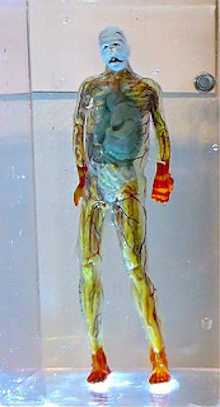
Distillation of man

Blechman  

"Man in a Box of Water,'' by ENID BLECHMAN, in the Hampden Gallery, at the University of Massachusetts at Amherst.


Read More
Commentary Robert Whitcomb Commentary Robert Whitcomb

Call rescue

  horror

Woods aflame. Please advise.

Read More
Commentary Robert Whitcomb Commentary Robert Whitcomb

Don Pesci: Do political endorsements matter?

VERNON, Conn.

First Lady Michelle Obama has endorsed Democrat Dannel Malloy for re-election as Connecticut's governor. In a picture worth a thousand words, Mrs. Obama was shown on “Capitol Report” being bussed robustly by U.S. Sen. Dick Blumenthal, who no doubt would endorse Mr. Malloy were Mr. Blumenthal a newspaper; some would argue that Mr. Blumenthal  is a newspaper. The winner of the Malloy contest with Republican Tom Foley will become governor of a state first in the nation in progressive governance and crony capitalism and last in almost every other important measurement of prosperity.
Will the first lady's endorsement matter to anyone but hardened Democrats, or to voting age high-schoolers who prefer healthy and pallid lunches to pizza and brownies? Probably not. For politicians, endorsements are little more than shows of party solidarity, and there are few political marriages in the nation more solid than that between Mr. Malloy and President Obama. Indeed, newspaper editorial endorsements in Connecticut’s left-of-center news media also have become highly predictable displays of ideological solidarity.
The lame-duck  president has had some difficulty getting himself invited to campaign soirees elsewhere in the Disunited States. Democrats vying for office in Red States  have tended to shun the president, if only to avoid the falling timbers of Mr. Obama’s foreign and domestic policies. Mr. Obama’s foreign policy is recklessly absurd because all foreign policy but his is constructed around a realpolitik understanding of friends and enemies. Mr. Obama is the first U.S. president who seems incapable of distinguishing between the two. In domestic policy, Mr. Obama should have devoted his energies during his first term to settling market uncertainties occasioned by a ruptured housing mortgage bubble partly caused by Beltway favoritism and the dismantling of the Glass Steagall Acta Franklin Roosevelt measure that that prevented investment banks  from meddling in commercial- banking activities. Instead of attending to the crisis at hand, Mr. Obama created a crisis of his own making by instituting Obamacare, a progressive baby step on the way to universal health care.
Mr. Obama will be appearing in Bridgeport – if, indeed he does make an appearance, a previous campaign appearance on behalf of Mr. Malloy having been called off because of the Ebola crisis – only a few days after Anne Melissa Dowling, Connecticut’s deputy commissioner of the Department of Insurance, announced that  of course she was concerned about insurance-policy cancellations in Connecticut.
“Dowling, NBCConnecticut reported, “says some 55,000 people across the state will have their policies canceled either because it no longer meets the requirements of the Affordable Care Act or because grandfathered policies that didn’t need to meet requirements have simply been canceled by the insurer.”
Even here in true blue Connecticut, some members of the state’s all Democratic congressional delegation have proven resistant to Mr. Obama’s charming attempt to make the world over according to his eccentric predilections.  Congresswoman Elizabeth Esty, for instance, has announced she will not attend Mr. Obama’s prospective campaign appearance of behalf of Mr. Malloy unless the president somehow manages to cross her path in her own district. The lady is very busy attending to her re-election – partly by composing and endorsing killer ads against her opponent, Republican Mark Greenberg, that even The Hartford Courant considered “creatively misleading” and (gasp!) “false.” Mrs. Esty has announced she would not be calling on the president when he appears in Bridgeport, only a hop, skip and a jump from Mrs. Esty's 5th District.  Connecticut is such a small state that anywhere in the state is but a hop, skip and a jump from anywhere else.
The Courant, the state’s largest  newspaper, endorsed Mrs. Esty, the second time it had done so. One of the indispensable determinants that garner Courant endorsements is experience in office, a requirement the paper waived during its first endorsement of Mrs. Esty, who at the time was running against a far more experienced candidate, Republican nominee for the U.S. House in the 5th District Andrew Roraback. The notion that the more experienced candidate for a particular office ought to receive the approbation of voters is, in fact, an argument for the perpetual election of incumbents, except on those rare occasions when the retirement of an incumbent leaves an office vacant. It is a policy, highly suspect in a constitutional republic, that would have stopped the American Revolution in its tracts: King George III, who inherited the British throne at the age of  12, had a much longer and deeper experience running the American colonies than did any of the founding fathers of the country. Most Americans are uncomfortable with perpetual monarchies or unchanging legislatures.
But not The  Courant. The paper’s current endorsement of Governor Malloy is riddled with enough qualifiers to sink a battleship, and this year, as usual, Democrats in Connecticut’s congressional delegation have garnered the paper’s affections; this at a time when Republicans are expected to retain control of the House. Some bean counters expect Republicans to capture the Senate as well. As the whole of New England moves further left, the usual endorsements will increasingly be taken with a ton of salt by voters less progressive than the usual progressive representatives.
Don Pesci (donpesci@att.net)  is a Connecticut political writer.
Read More
Commentary Robert Whitcomb Commentary Robert Whitcomb

Robert Whitcomb: Cape Breton: So near but so far


It’s an old cliché that Canada is entirely like the United States — a sort of 51st state. Of course it isn’t. It has some qualities that are characteristically Canadian, not American.

I’ve made some trips to Canada since the 1960s, when I went to college in New Hampshire not far from the border and saw a bit of Quebec. (That province has its own, quasi- and pseudo-French peculiarities.)

General national Canadian characteristics include civility, a kind of friendly reserve, storytelling (much of it very funny) and love of music. The long, cold winters (and thus the need to entertain each other inside) and the vast, sparsely settled spaces presumably encourage these behaviors, and Canadian culture, for historical reasons, doesn’t have quite the same sort of homogenizing effects that American culture has had on its citizenry.

Last week, I toured Cape Breton Island with some very energetic friends who own a house there near the island’s geologically theatrical northern tip. The Cape Bretons, a mix of Scottish, French, English, Irish and those whom Canadians call members of the “First Nations’’ (our “Native Americans’’), have a very strong regional identity.

The core culture is Scottish, albeit with additional flavors. Scots started coming to the island, whose hills and coast look remarkably like parts of Scotland, but with more trees, in large numbers in the late 18th and early 19th centuries after landowners ousted them from tenant farms in the Scottish Highlands.

Besides the occasional road signs in Gaelic (tourism promotion?), the most obvious indication of Scottish culture may be musical. It seems as if everyone has a fiddle. This reaches its heights in the annual Celtic Colours (Canadians, like the rest of the British Commonwealth, love the letter “u’’) music festival in various places all over the island every October. Such venues as hockey arenas and churches are taken over nightly for hours of mostly Scottish — or Scottish-inspired —entertainment. The fiddling, singing, dancing and joke telling go on for hours.

People come from around the world to perform but most have Celtic names. There’s lots of audience foot-stomping, and it’s jolly, except for a few maudlin songs. And, yes, they say “eh?’’ a lot in their jokes, too.

But at the same time, their body language on and off stage suggests that they need more personal space than most Americans do. There’s not much hugging. And Celtic dancers on stage often move with their arms straight down and with a look of grim concentration.

Then there’s the spectacular scenery, with mountains and cliffs along the sea, deep forests and fiords. The tourist photos of the main road in this region, the famous Cabot Trail, don’t do it justice.

That, and the Celtic culture, give one the sense of being far away from the United States. And yet New Englanders can drive there in a day. The distances are long but the vistas make the trip go by faster than you’d think. And visiting such close and traditional communities offers edifying relief from our harsher — if more dynamic — American society.

Many Cape Breton people are poor; the dangerous coal mines that once provided thousands of jobs are all closed. However, publicly funded social services are stronger than in the United States and neighbors tend to help each other more than here. Americans might benefit more from merging our nations than would Canadians. Some think that a merger is inevitable.


xxx

I went to a college fraternity reunion a few days ago. I did so out of zoological and psychological interest: To find out how my classmates (and I) have changed through the years, to better understand the long-term significance (to us) of big events during our time at college and to brood a little on mortality. During our dinner, the MC kept flashing ’60’s newspaper stories on a screen.

There were about 50 people — enough to offer an outline of how such a cohort changes. I’d say the attendees were generally mellower and nicer than they were 45 years ago and have dropped a lot of psychic baggage. There was little sarcasm, name-dropping or job-bragging. Their references to careers were mostly review, since most have retired or are semiretired or will be soon.

Many have had very interesting careers. For instance, one friend, a lawyer, has been representing the Nobel Foundation and had entertaining tales of the white-tie prize ceremonies in Oslo and Stockholm he attended.

Almost a half-century later, attendees’ core personalities seemed the same, if not necessarily their philosophies. In 1964, my father told me how surprised he was at his 25th college reunion that no one had changed much — except for a man held in a Japanese prisoner-of-war camp for three years.

Robert Whitcomb (rwhitcomb51@gmail.com) is a Providence-based editor and writer and a partner in Cambridge Management Group, a health-care sector consultancy (cmg625.com). He oversees this site.

Read More
Commentary Robert Whitcomb Commentary Robert Whitcomb

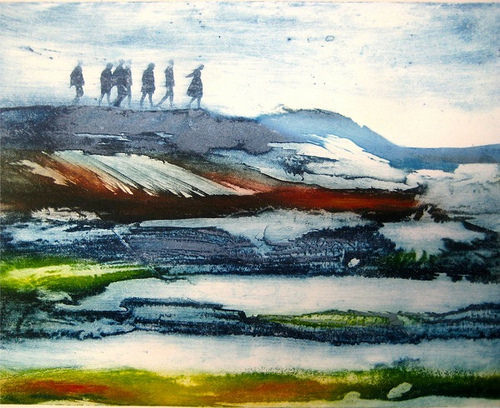
Water colors

prellwitz  

From "Flow: New Prints by Wendy Prellwitz,'' at  the Chandler Gallery, Cambridge, Mass., Oct 30-Nov. 30. Her new prints are, the gallery says, "the product of hours spent contemplating the physical properties and  metaphysical symbolism of water.''

Read More
Commentary Robert Whitcomb Commentary Robert Whitcomb

The orgiastic past

gatsby  

The Great Gatsby plays in the Moonstruck Theater Company, in Marlboro, Mass., through Nov. 2.

One of the most evocative passages in Fitzgerald's 180-page prose poem is his description of returning home from school by train to Minnesota for Christmas. I took similar train trips "home'' myself  -- albeit going east -- for years each December. And I  can imagine the long trip, "over the dark fields of the Republic,'' to St. Paul, where some of my family lived in Fitzgerald's neighborhood on Summit Avenue.

--Robert Whitcomb

Read More
Commentary Robert Whitcomb Commentary Robert Whitcomb

But not with good intentions

jensenpavedway  

"The Paved Way'' (etching), by IRENE JENSEN, in the ''Continental Drift: Printmakers Converge'' show at the Belmont Gallery of Art , Belmont, Mass, through Dec. 5.

Read More
Commentary Robert Whitcomb Commentary Robert Whitcomb

Bradlee's cult of personality

Over the years  I ran into Ben Bradlee a few times, mostly when I was the finance editor of the International Herald Tribune --  The Washington Post then owned a third of its stock -- and even had dinner with him once in Paris, with Donald Graham (of The Post's owning family) and a secretary. He couldn't have been more charming or friendly.

While full of bonhomie, Bradlee evoked a powerful sense of privilege that I  sometimes found a bit off-putting. But then, he  grew up in a Boston Brahmin family, albeit one that had somewhat straitened circumstances (compared to its earlier condition) because of the Great Crash of 1929. (Still,  there were enough rich relatives around to send him to fancy schools.)

Because of the immense confidence with which he carried himself, his theatricality,  his studly good looks,  his memorable mix of the patrician and a swearing sailor, and his social connections with the owners of The Post and other grandees, his  Post editorship developed into a cult of personality,  which I think he much enjoyed cultivating.

It got rather silly: Many of the other senior editors and reporters  started to wear his brand of expensive shirts from London,  use many of his  salty and other expressions and laugh at even his bad jokes. I witnessed this suck-up in full flower in a couple of news meetings at The Post in which he presided.

He had a tendency to  studiously ignore (and even try to make leave the paper) those who had fallen out of his favor, such as by boring him. This created an atmosphere of fear in the newsroom that competed with the pride and energy that the rise of the paper and his charisma fueled. A friend of mine there, an editor, used to joke that he sat at his desk everyday "watching the blood drip down the walls.'')

Whatever, he was a great editor, especially for someone who did remarkably little hand's-on editing, which would have required missing too many Georgetown dinner parties. He made the right choices  for the paper and the nation in printing the Pentagon Papers and pushing the Watergate stories. However, I'm not sure how much social courage was involved in those decisions; most of his social group hated Nixon. It's possible, however, that printing the Pentagon Papers could have landed him in jail for contempt of court. I suspect he would have reveled in that publicity.

In any event, Bradlee picked the perfect stretch of time to work in the newspaper business.

Read More
Commentary Robert Whitcomb Commentary Robert Whitcomb

Llewellyn King: The Bradlee I knew and the creation of 'Style'

  Ben Bradlee, who died Oct. 21 at  93, did not so much edit The Washington Post as lead it.

Where other editors of the times would rewrite headlines, cajole reporters and senior editors, and try to put their imprint on everything that they could in the newspaper, that was not Bradlee’s way. His way was to hire the best and leave them to it.

Bradlee often left the building before the first edition “came up,” but it was still his Washington Post: a big, successful, hugely influential newspaper with the imprimatur of one man.

Bradlee looked, as some wag said, like an international jewel thief; someone you would expect to see in one of those movies set in the South of France that showed off the beauty of the Mediterranean and beauties in bikinis while the hero planned a great jewel heist.

I worked for Bradlee for four years and we all, to some degree, venerated our leader. He had real charisma; we not only wanted to please him, but also we wanted to be liked by him.

Bradlee was accessible without losing authority; he was all over the newsroom, calling people by their first names and sometimes by their nicknames, without surrendering any of the power of his office. He was an editor who worked more like a movie director rather than the traditionally detached editors I had known in New York and London.

The irritation at the paper -- and there always is some -- was not so much that Bradlee was a different kind of editor, but that he had a habit, in his endless search for talent, of hiring new people and forgetting, or not knowing, the amazing talent already on the payroll. The Post was a magnate for gifted journalists, but once hired, there were only so many plum jobs for them to do. People who expected great things of their time at the paper were frustrated when relegated to a suburban bureau, or obliged to write obituaries for obscure people.

Yet we knew we were putting out a very good paper and, in some ways, the best paper in the United States. This lead to a faux rivalry with The New York Times. Unlike today, very few copies of The Times were sold in Washington, and even fewer Washington Posts were sold in New York.

Much has been made of Bradlee’s fortitude, along with that of the publisher, Katherine Graham, in standing strong throughout the Watergate investigation that led to President Nixon's registration. But there was another monumental achievement in the swashbuckling Bradlee years: the creation of the Style section of the newspaper.

When Style first appeared, sweeping away the old women’s pages, it went off like a bomb in Washington. It was vibrant, rude and brought a kind of writing, most notably by Nicholas von Hoffman, which had never been seen in a major newspaper: pungent, acerbic, and choking on invective. Soon it was imitated in every paper in America.

The man who created Style was David Laventhol, who came down from New York to fashion something new in journalism. Laventhol was a newspaper mechanic without equal, but Bradlee was the genius who hired him.

When I worked at The Post, I interacted a lot with Bradlee; partly because we enjoyed it, and partly because it was the nature of the work. I knew a lot about newspaper production in the days of hot type and he affected not to. That gave Bradlee the opportunity to exercise one of his most winning traits: disarming candor. “I don’t know what’s going on here,” he said one frantic election night in the composing room.

But when it came to big decisions, Bradlee knew his own mind to the exclusion of the rest of the staff. The nerve center of a newspaper is its editorial conferences -- usually, there are two every day. The first conference is to plan the paper; the second is a reality check on what is new, and how the day is shaping up.

At these conferences, Bradlee would listen from behind his desk. But when he disagreed with the nine assistant managing editors, and others who needed to be there, he would put his feet on the desk, utter an expletive and cut through fuzzy conversation like a scimitar into soft tissue. As we might say nowadays, he had street smarts. They were invaluable to his editorship and to his charm.

Llewellyn King (lking@kingpublishing.com) is executive producer and host of “White House Chronicle” on PBS. He is a longtime publisher,  broadcaster, writer and  international business consultant.


Read More
Commentary Robert Whitcomb Commentary Robert Whitcomb

Ebola isn't over in Nigeria

I was amused to read the assertions, apparently believed by many in the press, that Nigeria had conquered Ebola. Baloney. Nigeria has about 160 million people and is  among the most corrupt places on Earth. It also has porous borders and a thin public-health system.

Ebola will turn up there again.


-- Robert Whitcomb


Read More
Commentary Robert Whitcomb Commentary Robert Whitcomb

Marjorie E. Wood: So they think they're better, eh?


Tiffany Beroid, a mother and Wal-Mart employee in Laurel, Md., was forced to drop out of college because of her employer’s low wages and erratic scheduling practices.When she spoke out about the problems she faced, Wal-Mart fired her.Since then, Beroid has shared her story with Congress and anyone who will listen. In July, she told lawmakers that Wal-Mart workers “shouldn’t face problems like this working at a company that brings in $16 billion in profits a year.”Makes sense, right?Not according to {professional speaker} Steve Siebold— a multi-millionaire and author of the book How Rich People Think. In a recent viral article with the self-evident headline, "What the Middle Class Doesn’t Understand About Rich People'',  Siebold suggests that working Americans like Beroid should stop making “empty statements” about their billionaire employers and instead take a lesson from them.Call it “richsplaining.”So what are you failing to understand about the rich? Mostly that they’re better than you.

Siebold insists that such billionaires like Wal-Mart founder Sam Walton’s affluent heirs {they did not work for their billions -- they got it by accident of birth} deserve their wealth because they think, feel and act differently from ordinary people. If working Americans could “really understand the mindset of the richest people,” he says, “they would be among the top earners as well.”

Unlike the rest of us, according to Siebold, rich people believe in themselves, focus on the future, value their freedom, and are comfortable with uncertainty — all traits that the masses just can’t fathom.

Come again?

Tiffany Beroid doesn’t need any lectures about believing in herself. She enrolled in college to become a nurse while raising a toddler and holding down a job at Wal-Mart. That takes a lot of self-confidence.

“OK,” Siebold might say, “but she probably doesn’t dream about the future.”

Actually, the future is what guides Beroid’s decisions. As she put it, “I thought that if I worked hard, I could give my family a stable home and lift us out of poverty.”

But does she really understand the value of freedom? According to Siebold, after all, only “rich people can afford to stand up and fight oppression.”

In fact, since losing her job at Wal-Mart, Beroid has been speaking out against worker oppression and taking bold actions to stop it.

At this point, Siebold might take a deep breath and say, “OK, but there’s no way Beroid could understand operating in a state of constant uncertainty. That trait truly distinguishes the rich from everyone else.”

He’d better try again. No one understands uncertainty more than a Wal-Mart employee like Beroid who found herself scheduled to work 40 hours one week and 15 hours the next. Thanks to unpredictable scheduling practices that can make it impossible to budget time or money, many wage workers’ personal lives and economic livelihoods are in constant upheaval.

For his next book, maybe Siebold should just skip the rich. He could interview Wal-Mart employees instead.

Sorry, Siebold. The “richsplaining” just doesn’t fly.

 Marjorie E. Wood is a senior economic policy associate at the Institute for Policy Studies and the managing editor of Inequality.org. IPS-dc.org. This was distributed by OtherWords.org.


Read More
Commentary Robert Whitcomb Commentary Robert Whitcomb

Magic mountain

Higgins  

"Katahdin From Sandy Stream Pond'' (oil on panel), at the "Inspired by Katahdin'' show of 48 artists at the Harlow Gallery, Hallowell, Maine, Nov. 7-29.

Some readers well know the thrill of climbing Mt. Katahdin, which, while  not New England's highest mountain, may be its most spectacular. I've climbed it, and when not driven to distraction by late-spring black flies, was thrilled.

Your vertigo gets a good test in  walking  the "Knife Edge,'' which connects Baxter and Pamola peaks at  the top of the mountain; the "Knife Edge'' is only a few feet wide, with nearly sheer cliffs  dropping off on each side.

As we started across, I was not unhappy that clouds moved across the top of the mountain, obscuring just how exposed we were.


-- Robert Whitcomb


Read More
Commentary Robert Whitcomb Commentary Robert Whitcomb

They'd get back much more than they gave

It is remarkable how many of the people backing Buddy Cianci for mayor of Providence  have a very direct  personal financial reason for doing it.  Most obvious are those in the municipal unions who expect to get massive sweetheart contracts and other deals, as they did when Cianci was last in power,  and developers Joseph Paolino and Pat Conley, who see new riches from dubious projects from having an ally in City Hall. No wonder "The Prince of Providence'' is so far ahead in cash collections for this campaign.

Meanwhile, a lot of the  politically lazy electorate hasn't bothered to learn anything about what actually happened in Cianci's management of the city. And  many national  news media people are besotted with this "rascal king,'' thus turning thuggery into a joke.


Read More
Commentary Robert Whitcomb Commentary Robert Whitcomb

Travel simple

mencoff  

"What We Carry, by GREG MENCOFF, in his show "Chasing Artifacts,'' at Carroll and Sons  Art Gallery, Boston, through Nov. 1


Read More