
Vox clamantis in deserto







Chris Powell: Can Connecticut Democrats rise above identity politics?

Still “Unum”?
MANCHESTER, Conn.
Why are some people Democrats and others Republicans?
Personal identities have always had something to do with it. Some people inherit party affiliations from parents. Many Democrats come from the working and government classes. Many Republicans come from the propertied and professional classes.
Ethnicity often has had something to do with it as well.
Many Irish immigrants to Connecticut became Democrats because Republicans were in charge when the Irish arrived and were often hostile to newcomers. The next wave of immigrants, the Italians, found themselves in a rivalry with the Irish and so many became Republicans.
Upon their liberation after the Civil War, Blacks became Republicans because Democrats were aligned with the former Slave States. Blacks began migrating to the Democrats in the 1960s, when Republicans took them for granted and Democratic leaders became more aggressive about civil rights and racial equality.
Political culture is involved as well. The anti-Vietnam War movement originated as a largely youthful rebellion in the Democratic Party during a Democratic presidency, and within a few years the party had become not just anti-Vietnam War but also the party of sex, drugs, rock ‘n’ roll, and perpetual protest. President Richard Nixon exploited the resulting fear of civil disorder and had the Republican Party pose as the representative of the "silent majority," the cultural establishment.
Political correctness is based to a great extent on identity politics, the assignment of the electorate to interest groups based not on public policy but on mere personal characteristics. Democrats see identity politics as a recruiting tool, though it may alienate as many people as it attracts.
Identity politics was the object of an appeal made this week by the vice chairwoman of Connecticut's Democratic State Central Committee, Vanita Bhalla, who urged people to join one of the state party’s "caucuses."
"Our caucuses," Bhalla wrote, "are where Democrats come together around shared experiences, organize, and make sure our party reflects the full diversity of Connecticut. They help shape policy conversations, strengthen relationships across communities, and bring new voices into our work at every level. Joining a caucus is a great way to meet like-minded people."
But the 10 Democratic caucuses Bhalla identified actually proclaim insularity and conformity, implying that members of each group think the same and want something for themselves as a special interest rather than something benefiting the public generally. The special interests the Democrats imagine cultivating with caucuses actually may be hard to figure out.
As policy matters, the LGBTQ+ Caucus may want state government to support the claim of transgender people to a right to participate in sports contrary to their biological sex, and to support sex-change surgery for minors. The Women’s Caucus, at least a caucus of Democratic women, may want state law to tolerate late-term abortion. The Black and Hispanic caucuses may want more state financial aid to the municipalities where most Blacks and Hispanics live.
But what do the Asian-American, Native Hawaiian, and Pacific Islander Caucus, the Disability Caucus, the Immigrant Voters Caucus, the Muslim Caucus, the Small Towns Caucus, and the Veterans Caucus want in public policy that differs from what most other people, or at least most other Democrats, want for everyone?
Do these caucuses ever go beyond the personal-identity interest and approach the national or state interest -- the public interest? Indeed, as these caucuses suggest, is it really possible to approach the public interest only after people are sorted into identity groups? If caucuses are necessary -- and local Democratic town committees insufficient as forums -- why not organize them according to policy issues instead?
Organizing people by identity groups risks stereotyping and caricaturing people -- the opposite of the "diversity" the caucuses are supposed to reflect. But then "diversity" isn't really the objective. Getting votes is, whatever the cost.
Chris Powell has written about Connecticut government and politics for many years (CPowell@cox.net).
Llewellyn King: We can’t welcome all who want to emigrate here; identity politics threatens America
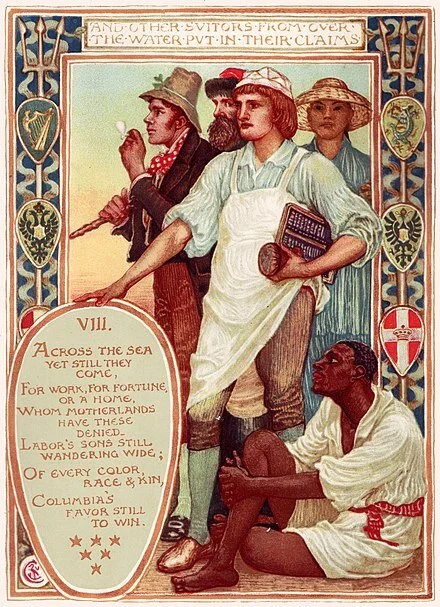
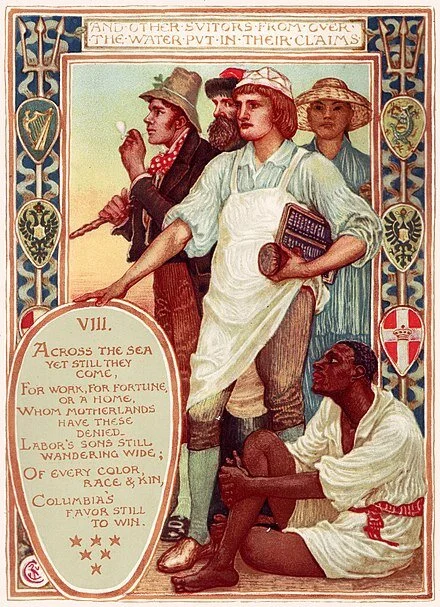
Illustration from Walter Crane's Columbia's Courtship: A Picture History of the United States in Twelve Emblematic Designs in Color with Accompanying Verses (1893). Back then, most immigrants were expected to assimilate into American culture, learning English, etc. A smaller percentage do now, with the rise of identity politics. and “multiculturalism.’’ Too many immigrants continue to see the countries they came from, as awful as they are, as home.

U.S. Border Patrol agents review documents of individuals suspected of attempted illegal entry from Mexico.
The American head and heart aren’t in alignment on immigration. They are savagely apart.
The head argues that all those people amassing on the U.S.-Mexico border, or living in camps across the English Channel, or trying to get into Turkey from Syria should be sent home. The heart argues that people anywhere denied a reasonable life in the place in which they were born are entitled to find what they seek: freedom from want. It argues, too, that immigrants have made us wealthy down through the centuries.
The head is adamant: Unfettered immigration is conquest one person at a time — one ragged child, one desperate mother, one hopeful man. Immigration is destabilizing much of the Middle East, particularly Jordan and Lebanon. It is threatening Europe and is changing the face of the United States.
Bad governance has an impact beyond the borders of the badly governed country.
Small stretches of sea that separate Malta, Greece, Italy and Spain’s Canary Islands from Africa haven’t deterred migrant crossings. If these migrants are accepted by European countries, they will bring with them their religion, their language, and their loyalty to the culture that they left behind.
Before the jet age and the communications revolution, an immigrant sought to be a new American, a new Briton, or a new Frenchman. Many of today’s immigrants don’t feel compelled to assimilate and can reside in North America or Europe but retain the aims and culture of the country from which they came.
I know Koreans who have lived in the United States for decades and speak no English — and have no need to. All their wants are met in Korean, from banking to television to shopping. I also know U.S.-born Salvadorans who talk about El Salvador as “my country.” The wheels have come off assimilation.
The receiving countries deserve some blame for those who remain alien. The prevailing identity politics doesn’t meld a nation. The “woke” reverence for every culture except its native culture and language is destructive.
The immigrants who flooded the United States in the 19th Century and the first half of the last century came to assimilate, with many refusing to teach their children their native tongues. Now immigrants think and feel as though they are the citizens of other countries. It is easy to do, and “multiculturalism” is the facilitator.
American hearts go out to those who are living in hell on the southern border: Frightened, in need of food, in need of places to sleep and to defecate, often sick, preyed on by criminals in their own number, and believing myths — especially the myth that when Donald Trump lost the presidential election, they would be welcome in the United States.
The heart says immigration is good for us and that we are all immigrants; that our generous inheritance, from the genius of the Founding Fathers to the syncopation of jazz and the blues to the techno-wonders of Elon Musk, is the product of immigration.
But my heart and my head, and those of many Americans, align in believing that we have to stop identity politics, treasure our American identity and explain to the world that the United States isn’t open to all, otherwise all would come.
The Trump administration failed to end illegal immigration with its incompetence, its bluster and its wall. So far, the Biden administration has done worse. It has allowed a myth to circulate around the world that if you get to Latin America, even to faraway Chile, you can get into the United States.
President Biden should demand that Vice President Kamala Harris, who he put in charge of the border, do her job and produce some ideas. Her declaration that she will work to strengthen the countries of Central America so that their people stay home is fantasy.
Even if Harris could do that, she should note that the new flood of migrants is coming from across the world — from Haiti to Pakistan and other parts of Asia. U.S. intelligence has failed, and the vice president fails daily to address this global problem, which will only get worse as the climate changes and the seas rise. The brain reels and the heart bleeds.
On Twitter: @llewellynking2
Llewellyn King is executive producer and host of White House Chronicle, on PBS. He’s based in Rhode Island and Washington, D.C.
Roping up identity politics

The Herd Quitter, by C.M. Russell
See Wall Street Journal editorial “Wyoming Cowboys Corral Identity Politics’’ (subscription needed) and Providence poet and philosophy professor Felicia Nimue Ackerman’s response:
Identity politics may attract some,
But what a relief that not all will succumb.
Llewellyn King: Are we surrendering Americanism to identity politics?

Francis Fukuyama earned his place in philosophical history by declaring “the end of history” on the fall of the Berlin Wall and the collapse of communism.
Nowadays Fukuyama, an engaging traveler though the world of ideas, poses this great question: Where are we going?
In New York on Sept. 11, Fukuyama seemed to answer that question by telling an audience: nowhere very good.
The global crisis laid out in Fukuyama’s latest book, Identity: The Demand for Dignity and the Politics of Resentment, is that identity politics -- advanced tribalism, if you will -- is eroding democracy.
Fukuyama writes that the United States invaded the Middle East, during the Iraq War, to Americanize the Middle East, but the Middle East has Middle-Easternized the United States. Not only is there no national identity in Iraq now, he argues, but we are also losing our Americanism to identity politics, with its baggage of racism and division.
He points to two decidedly democratic events as harbingers of a less democratic future: Britain’s vote in June 2016 to leave the European Union and the election that same year of President Donald Trump, disaster following on disaster, identity triumphing over political union. In the case of Brexit, English nationalism upstaging the larger values of a unified Europe; and in the Trump election, the white working class voting against the other constituent parts of the nation.
Listening to Fukuyama answering questions at the New York event, organized by Philip Howard and his Common Good organization, one could be plunged into feeling that the famous American mixing bowl had become unmixed, breaking down, as Fukuyama gently suggested, into competing groups, supporting just those who belong to their group – all of this set off by white fear of the end of their hegemon in America. Hence, the hysteria over immigration.
The difference between the immigration alarm in Europe and in the United States, he said, is that Europe sees not just an invasion of different people with different customs, religions and languages, but also an assault on the cradle-to-grave welfare systems. Fukuyama said Europeans do not mind paying 60 percent of their incomes in tax because they believe they get a lot for it. That, he said, is what they see coming from immigration: People coming to live off the generous social structure for which they have not paid.
Immigrants from Africa going to Sweden -- in the news because of its electoral swing to the right -- must think they have entered nirvana: total freedom from want. Not quite the same as people coming across our southern border, seeking safety and work.
Fukuyama sees the United States in danger from identity grouping overwhelming our commonality as a nation.
I wonder about that. When I landed on these shores as a young (legal) immigrant in 1963, I wrote to a friend in England -- and I remember this clearly – saying: “This is no melting pot. This is a fruit salad.”
Well, that is still so, and it works until it is perverted by minority manipulators. For example, there has always been a racist element. It is just that President Trump and his allies have blown on these embers and brought forth flame. Race dividers feel emboldened under Trump, just as they seethed under President Obama.
It is worth pondering that before Trump, we twice elected an African-American president and that said something about us -- something quite different from what Fukuyama is saying about us in today’s race-heavy, fact-short political debate.
Some at the New York meeting suggested that the pendulum will swing back. Yes, it will but not to the status quo ante. It will be to a new place.
I believe the Trump success was fueled not so much by resentment as by a pervasive sense of irrelevance. It expresses itself politically, but its root may be with the isolation felt by those who have to deal with monopoly businesses from the cable company to the online retailer. Think the politicians ignore you, try those who have market dominance: banks, health insurers, online vendors and telecoms among others.
Fukuyama calls for dignity as a kind of antidote to identity politics. He might want to extend that excellent thought beyond just the political arena.
Llewellyn King is executive producer and host of White House Chronicle, on PBS. His email is llewellynking1@gmail.com.
James P. Freeman: Baker, Beacon Hill and Banacek
During the introductory credits of “The Three Million Dollar Piracy,” from a 1973 episode of television’s Boston-based series Banacek, there is a forgotten moment of morbid foreshadowing: Under a blue sky, as the camera pans across the golden dome of the Federalist-style statehouse, at 24 Beacon St., there looms a dark, steel skeletal structure, One Ashburton Place. More than metaphorically, it marked the time when state government as a bastion of ideas would start to be overshadowed by a bureaucracy of idols.
The 2014 Massachusetts gubernatorial election is about the very role of Beacon Hill.
Sitting down with Charlie Baker, the Republican gubernatorial candidate, at the Pilot House, after remarks he gave to the Sandwich Chamber of Commerce recently, you suddenly realize his candidacy is about balancing and restoring the role of limited government from today’s oppressive one. It is a change of approach, rethinking what government does and how it does it. Or, as one political scientist describes it, “affirming certain values and discouraging certain vices.”
One is struck with what Baker is not: a purveyor of identity politics--so carefully crafted by Democrats — where feeling is substituted for function. Instead, Baker is properly defined by action: “This is what I will do” as opposed to “This is who I am.” It is a marked contrast after eight years of Deval Patrick’s form of leadership; governor as emoticon not manager.
A theme of restoration and repair seems to be supported by residents. In polling results released earlier this month by wbur.org, primary voters overwhelmingly (89 percent of Republicans and 81 percent Democrats) indicated that managing state government effectively is a top priority. Perhaps tellingly, this “ranked higher than likability or progressive/conservative attitudes.”
Democrats display unintentional humor, therefore, when speaking of “change.” Surely, upon hearing this, sensible residents echo the sentiments of Guildenstern: “I have lost all capacity for disbelief.” Beyond, as he said, a “gentle scepticism.”
Martha Coakley, Baker’s principal challenger, has been state attorney general for nearly eight years and running for the fourth time for state-wide office. She would spend $500 million for economic recovery -- a plan modeled after Patrick’s 10-year, $1 billion life-sciences initiative, reports the AP. That's ironic, if anything, as she and fellow party members have run on a platform of change from eight years of Patrick’s grisly governance. Baker is relying upon public skepticism about Coakley’s ability to inspire and effect change.
He rightly believes his election would create a “constructive friction” between him and a de facto Democrat legislature (82 percent in the House and 90 percent in Senate) that would revive public accountability. He says that the one-party government is “more pronounced” now and hears even dissatisfied Democrats whispering about the definitive lack of leadership. Is that when the ghost of John Adams would reappear to haunt the hallowed ground on The Hill with “checks and balances” and instill discipline?
For most voters, such issues as runaway taxes, uncontrolled spending, unfunded pension obligations, massive debt burdens and assorted scandals — exacerbated by single-party politics--are accumulated barnacles below the surface of the ship of state; a seaworthy vessel, nevertheless, but slowly submerging. Baker would bring an immediacy to those issues.
Some will immediately greet the new governor.
Just 11 days after the election, on Nov. 4, 400,000 residents will begin —a gain!--enrolling for healthcare on the new Connector Web site. Its predecessor, unable to conform to myriad rules and regulations of Obamacare, was, Baker says, “an astonishing breakdown.” When, and if, fully implemented, costs may exceed $500 million. A Pioneer Institute healthcare expert called it “irresponsible to taxpayers” and described it a “‘Big Dig’ IT project.” Like its national step-cousin, it will likely not be free from trouble and require comprehensive executive engagement of the next governor.
Is this Patrick’s idea of “innovation” and “infrastructure?” It is a supreme example, certainly one of many, of the legacy migraines left over from his administration.
A considerable amount of Baker’s time was spent on the economy. Because of the saturation of codes, rules and regulations, “this is a complicated place to do business,” he asserts. Adding, the state “needs to think differently about economic development.”
Baker may be a beneficiary of a development not yet largely discernible. With Patrick and his party so aggressively progressive, the Democratic base may actually be more moderate, as evident from a Boston Globe poll conducted last July on immigration. Only 36 percent of respondents supported state spending on unaccompanied immigrant children compared to 57 percent who opposed it. The poll’s numbers overall were consistent with national poll results.
Conceivably, then, those children are not on commonwealth soil because residents questioned the veracity and competency of government supervision, not its compassion. If voters look at such factors surrounding other issues — immediate and intermediate -- it would further affirm the results of the wbur.org poll and would ensure a Baker victory.
Forty one years after George Peppard’s leisurely Beacon Hill drive inBanacek, Charlie Baker would reimagine the scenery.
James P. Freeman is a former Cape Cod Times columnist.