Chris Powell: Housing achieves racial integration better than regional schools
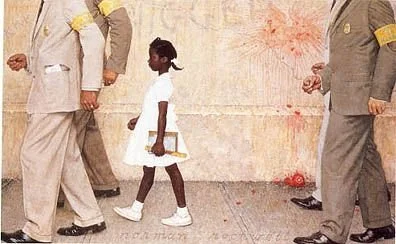
“The Problem We All Live With,’’ by famed artist Norman Rockwell (1894-1978), of Stockbridge, Mass., is a 1964 painting done as an illustration for Look magazine and considered an iconic image of the U.S. civil-rights movement. It depicts Ruby Bridges, a six-year-old African-American girl, on her way to William Frantz Elementary School, an all-white public school, on Nov. 14, 1960, during the New Orleans school desegregation crisi
MANCHESTER, Conn.
Some years ago racial integration in education used to be at least a nominal objective in Connecticut. Not so much anymore.
The state's law against racially imbalanced schools -- schools whose student racial composition is far out of proportion to the racial composition of their municipality -- has been disregarded for years by two schools in Greenwich, one in Fairfield, and two in West Hartford. A recent count says 16 more schools -- including more in Greenwich and West Hartford as well as some in Bloomfield, Branford, Hamden, Milford, and Montville -- are about to slip into imbalance.
Of course many schools in Connecticut's cities, including Hartford, New Haven, and Bridgeport, have student populations that are overwhelmingly from racial and ethnic minorities, without the slightest racial balance at all, just as many other school systems in the suburbs and rural areas are overwhelmingly white. But under the law that's OK, since the law requires racial balance in schools only within a municipality, not racial balance on a regional basis.
Racial residential patterns are such that substantial integration in schools could be achieved only by massive transfers of students, which would be educationally and financially impractical and impossible politically.
The state Education Department hasn't been pressing for action on racially imbalanced schools and is unlikely even to acknowledge the issue in a state election year. While municipalities might racially balance their schools fairly easily with little expense by redrawing school districts, redistricting always aggravates parents and students, especially when resources don't differ much between schools and most townspeople don't care much about racial balance, though society would be better for more integration.
These days there are second thoughts about racial integration in Hartford itself, where the push for integrated schools began more than 60 years ago with a small, voluntary program of busing minority students to the white suburbs, Project Concern. In recent years that push culminated with the Sheff v. O'Neill integration lawsuit.
The lawsuit led state government to establish three dozen regional schools in Hartford and its suburbs, and to the promise made in the lawsuit's settlement that there will always be room for any Hartford student who wants to enroll outside the city school system. As a result many students have entered the regional schools, leading unfortunately to still more racial concentration in Hartford's neighborhood schools and to what the city's Board of Education considers extra expense, since when students leave the city school system, it loses state money while incurring extra tuition and transportation costs.
So the board is hiring a public-relations company to try to lure some regional school students back to city schools. This has angered the Sheff case advocates, who see any strengthening of the city's schools as undermining the settlement of their lawsuit.
While the PR campaign may indeed reduce integration, it wouldn't violate the Sheff settlement as long as any Hartford student could still get into a regional school. Besides, it's fair to wonder whether the limited amount of integration achieved by the regional schools is worth the hundreds of millions of dollars they have cost.
In pursuit of integration it might be better to examine why some of Hartford's inner suburbs that a few decades ago were overwhelmingly white -- such as Bloomfield, East Hartford, Manchester, and Windsor -- have become thoroughly integrated racially with integrated schools. These towns suggest that integration is mainly a matter of a variety of housing options and economic gains for minorities.
Of course new housing can be controversial but to assist integration it doesn't have to be housing for the poor -- just market-rate apartments and condominiums.
Not everything retrograde in race relations in Connecticut comes from white suburbanites.
Black civic leaders in New Haven want the city to establish a satellite campus of a "historically Black college" to help Black students in the city feel more comfortable about higher education. But that would be more racial separatism, which seems to be politically correct lately. Black students must understand that they can and indeed must succeed without it.
Chris Powell has written about Connecticut government and politics for many years (CPowell@cox.net).