
Vox clamantis in deserto








Llewellyn King: A simple precaution would have prevented 9/11

WEST WARWICK, R.I.
There is a terrible truth about 9/11: It didn’t have to happen. Something as simple as a hardware store lock could have deterred the perpetrators.
The arguments against hardening cockpits were numerous, and now seem unconvincing to the point of being risible.
They included: It would cost too much; the public had to see the captain go walkabout during the flight; first responders couldn’t get to the pilots after a crash; air pressure wouldn’t be stable between the cockpit and the passenger cabin; and the pilots wouldn’t be able to go to the toilet.
Long before 9/11, airplane hijackings were a well-established tool for terrorists, asylum-seekers, extortionists, or simply those who were unbalanced.
Generally the hijackers made their way unhindered to the cockpit, with or without a hostage, and forced the pilots to fly to a country estranged from the one they started from — like Cuba for hijackers from the United States or Western Countries for Soviet defectors.
There was no mystery about hijacking and the vulnerability of pilots. What differentiated the 9/11 hijackings was the fiendish planning, complete with flying lessons and, finally, the ease with which they did their evil.
After all the deaths, the untold suffering, the billions of dollars that have gone into airport security, including the establishment of the Transportation Security Administration, the question remains why something wasn’t done before 9/11 to secure the cockpits. They are now impenetrable, they are bulletproof and can even withstand a small bomb.
A White House science adviser told me long after the tragedy, “We should have done more.”
Pilots and informed people suggested over the years that cockpits should be hardened, others went further and petitioned the Federal Aviation Administration. But the cockpits remained open, accessible and vulnerable, inviting heinous crime.
The failure to harden cockpits after early hijackings is a tragedy of multiple derelictions, from the airlines through the FAA, the White House, the FBI (which investigates terrorists and airline crime); the National Transportation Safety Board; the aviation unions, even the Occupational Safety and Health Administration — an airliner is a workplace.
The system failed because the voices from numerous places calling for hardened cockpits were too soft, too scattered, and not united. A strong statement, a loud voice, a repetitive complaint or more media coverage might have made the difference.
Since 9/11 public service announcements on public transport of all kinds have cried out, “If you see something, say something.” People saw something from many angles but said little.
General aviation is a catch-all phrase for everyone who flies everything, from crop dusters to corporate jets, from aerial-mapping aircraft to single-engine Cessnas, even those who fly cadavers overnight, a small industry.
They hangout between flights in dismal places called “pilot lounges.” In these lounges — usually a room with a few couches and vending machines for coffee and snacks — the talk is about aviation and how to fix some aspect of it.
The thing about the men and women of general aviation is that they are in a sense the heart of aviation: They fly because they would rather do that than anything else. They can’t imagine another life. And they, for assorted reasons, haven’t landed jobs with airlines or major overnight delivery services.
In these lounges, long before 9/11, there was always a groundswell of opinion about hijackers, and they all asked rhetorically, “Why don’t they lock the damn cockpits?” I heard a version of that phrase often when I was a private pilot.
Of all of those who could share some blame, the most culpable are the airlines. They didn’t want to alarm the passengers, spend the money or inconvenience the flight crew. But mostly, no airline wanted to be first.
From time to time, there was talk of doing something about the ease with which ill-wishers could penetrate the cockpit on commercial flights. Often doors were open and passengers could go to the flight deck, if they asked.
I have happy memories of being allowed into the cockpit of the French Concorde and being cheerily greeted by the pilot, who was reading Le Monde, “At 60,000 feet and Mach 2, what am I going to do?” Sensibly, he was leaving the flying to the autopilot.
We will forever mourn the 2,977 people who died on 9/11, and all those who have died in its aftermath.
Aviation is usually very safe because it prides itself on its culture of safety. On Sept. 11, 2001, that culture was absent. That culture was reduced to hoping for the best rather than locking the damn door.
On X: @llewellynking2
Llewellyn King is executive producer and host of White House Chronicle, on PBS, and an international energy-sector consultant. He’s based in Rhode Island.
Llewellyn King: New weather reality will change America and unhinge politicians

Flooding in Montpelier, Vt., in 2023.
WEST WARWICK, R.I.
I have never done political consulting. So it was novel to me when a candidate in the midterms asked me what he should be worried about in 2027. I repeated what Harold Macmillan, British prime minister from 1957 to 1963, is believed to have said, “Events, dear boy, events.”
Actually, I had a little list of crises that I have been gathering and that will come to bear on the political establishment — and we the people. Topping the list is one that is already at hand: the climate, which I call the “new weather.”
We have had weeks of atmospheric disturbance resulting in catastrophic floods, power outages, flight cancellations, oppressive heat and fires. Weather disruptions have been the first or second stories on the networks’ evening newscasts, pushing back the news on the Iran and Ukraine wars, and news from the White House.
Television stations like to tell viewers they have “news you can use.” The new weather is news that will abuse you. It knows where you live and it may call. It has called in Europe and across North America. It is a new reality.
The Southwest is parched and the Colorado River, that life channel, is running dry, severely affecting people in seven states. It also affects the food supply, as much farming depends on the bounty of the river. Even Mexico gets some of the dwindling Colorado water supply through a treaty with the United States.
Hundreds of thousands have lost their electricity for hours or days, and others may be making a choice between keeping on the air conditioning and spending on other necessities.
Sustained heat of over 110 degrees is a killer and electricity for air conditioning is a lifesaver. Every year, more than a thousand people die from heat.
The Centers for Disease Control and Prevention reports the number of heat-related deaths in the nation. The worst year was 2023 with 2,325 deaths, as measured by death certificate analysis.
But heat-related fatalities are hard to collect. I would wager that the real death toll is much higher.
Liberal politicians will blame the fossil-fuel industries – coal, oil and natural gas — for continuing to drive up greenhouse gas emissions in the atmosphere; conservatives will blame regulation and lack of infrastructure building.
Local politicians will attack the data centers and the utilities.
President Trump has called global warming a hoax. But “say it ain’t so” doesn’t work when it is too hot for kids to play outside or streets are rivers, and when the flow of food from farm to supermarket is interrupted.
Huge infrastructure projects will be proposed at a time when there is a growing awareness that the budget deficit is out of control and there is no way America will grow out of it on its present tax trajectory.
If my candidate makes it to Congress, he or she will find it is easier to say no to new expenditures than it is to say yes to new taxes.
Nonetheless, great pipelines will be proposed to move water from areas of water plenty to water-starved states. Some of those, such as Texas, drunk on its recent Mecca-like impact on business, will have difficulty accepting that people won’t come if there is no water and, as like, inadequate electricity.
Heat, not economics, could curtail the North to Southwest flow of people which has been the population realignment in recent years.
How to live with the new weather will definitely be a new priority not easily dealt with by politicians. It doesn’t fit behind a political slogan. It does favor infrastructure repair and enhancement, from boosting the electric grid to planting water-frugal crops to serious concern about where people live and how they pay their electric bill — a matter of keeping cool and staying alive.
But for the political establishment, there are other issues forming, each competing with the weather for attention. For a start, there is integrating artificial intelligence into our economy without severe disruption, and dealing with a broken health-care system, and care that is beyond the reach of people who are dealing with higher prices for other survival services and products, like electricity and water.
Easier to say your opponent is a rascal, the other party is fascist or communist, and to worry about the use of AI on cellphones in classrooms.
We all have the weather to deal with, Democrat or Republican, and it is still an issue for governance.
Llewellyn King is executive producer and host of White House Chronicle, on PBS. His email is llewellynking1@gmail.com , and he’s based in Rhode Island.
Llewellyn King: The centrality of natural gas
WEST WARWICK, R.I.
The Trump administration is proud of America’s dominance in natural gas. The nation is the world’s largest producer and a net exporter.
We produce a quarter of the world supply of the fuel, which has become fundamental to electricity production. Forty-three percent of our electricity is produced from natural gas. According to the Energy Information Administration, it is followed by renewables, between 24 and 30 percent, depending on the season; nuclear is at just over 18 percent; and coal a little above 16 percent. Hydro, wood, geothermal and oil make up the rest.
The natural gas success represents a confluence of technologies, collaborations, leadership, and commercial courage over more than 50 years. It is a remarkable story of the coming together of a resource, the politics that govern it, the technologies that liberated it, and the machines that use it.
I had occasion to reflect on this when visiting the Rayburn Energy Station in Sherman, Texas. The plant represents a significant move into natural gas-fired generation by the Rayburn Electric Cooperative, which is the power supplier to four distribution co-ops northeast of Dallas.
Panda Power Funds LP built the original plant, which began commercial operations in August 2014; Rayburn bought it in 2023.
The original combined-cycle gas plant consists of two Siemens combustion turbines and one steam turbine, producing 758 megawatts of base load power. Siemens built these turbines at their plant in Charlotte, N.C.
At an adjacent site, Rayburn is building a new station that will have 10 peaking “black start capable” turbines, each rated at 57 MW, which Siemens is building in Sweden. Black start refers to the ability of the turbines to start without external power. That way they can play a role in restarting other generators after a power failure.
Taken together, the installations in Sherman represent the virtues of natural gas: a small environmental footprint, speed of construction, security of fuel supply, reliability, and modularity, meaning units can go out of service for maintenance without totally isolating the generating station.
No one issue or technology can claim credit for today’s natural gas boom. It is the happy confluence of events and technologies which have combined to save the day for the electricity sector.
In 1977, the fledgling U.S. Department of Energy declared natural gas as having no future. Jack O’Leary, the first deputy secretary of energy, told The Energy Daily’s Richard Myers to stop asking about natural gas as it was “a depleted resource.”
With the technologies of the day, that was true. But the picture was also complicated by a regulatory burden with gas divided between “intrastate gas” and “interstate gas,” and “old gas” and “new gas.”
It took the actions of three presidents — Jimmy Carter, Ronald Reagan, and George W. Bush — to finally untie the regulatory knot.
Likewise, the tech breakthroughs which changed gas from an orphan fuel into coal’s heir took many years.
The oil industry had been experimenting with angled drilling since the 1920s. But it was horizontal drilling in the 1980s that ushered in a new era in gas extraction with the advent of hydraulic fracturing. This met with new turbine designs that owed much to aircraft jets, and had been pioneered by the navy for small-ship propulsion.
Hydraulic fracking had been tried for years by the oil industry. But it took 20 years of trial and error, mostly by the Houston-based Mitchell Energy & Development Corporation, to perfect it with development of a better fracking fluid, a new mud pump, and a better drilling bit. Also, 3D seismic enhanced the accuracy of finding gas. DOE worked closely with the developers of these new technologies.
‘
The Rayburn Energy Station is emblematic of what is happening across the country as utilities face up to rising electricity demand and limited options.
Rayburn President and CEO David Naylor is enthusiastic about the full range of generating options and has embraced distributed generation — which is the linking together of solar, conservation, demand-side load management, residential batteries, and consumer participation to create what is known as a virtual power plant. But gas was the immediate option for Rayburn, as it is for many utilities.
While Alex O’Brien, manager of the Rayburn Energy Station has a penchant for nuclear (he, like many of the plant’s staff, is a veteran of the Nuclear Navy), he understands the immediacy of gas.
Rayburn broke ground on its new peaker turbines this year, and they will be up and running in 2028. In utility terms, that is overnight.
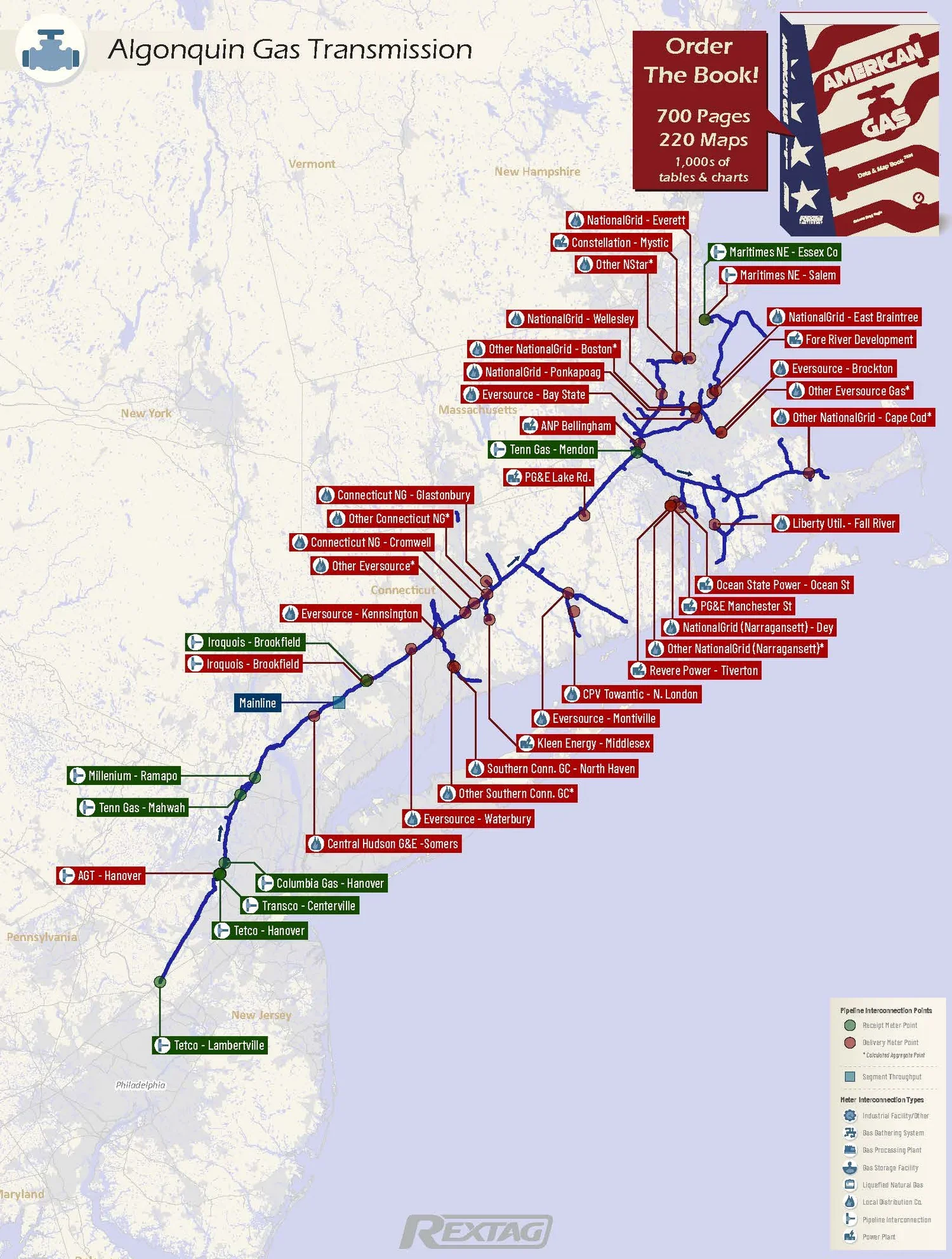
Environmental activists have been critical of natural gas as a greenhouse gas-emitter. In New England, they have blocked the construction of pipelines. The resulting shortage in the region has been acute, so much so that liquified natural gas must be imported, at a price, sometimes from Europe.
Until new nuclear power arrives, the utilities are looking to a mix of renewables and natural gas: the fuel that came back from the dead.
Llewellyn King, an international energy-sector consultant, is executive producer and host of White House Chronicle, on PBS. His email is llewellynking1@gmail.com, and he’s based in Rhode Island,
We’ve thrown away the powerful tool of ‘soft power’; lessons from the British Empire
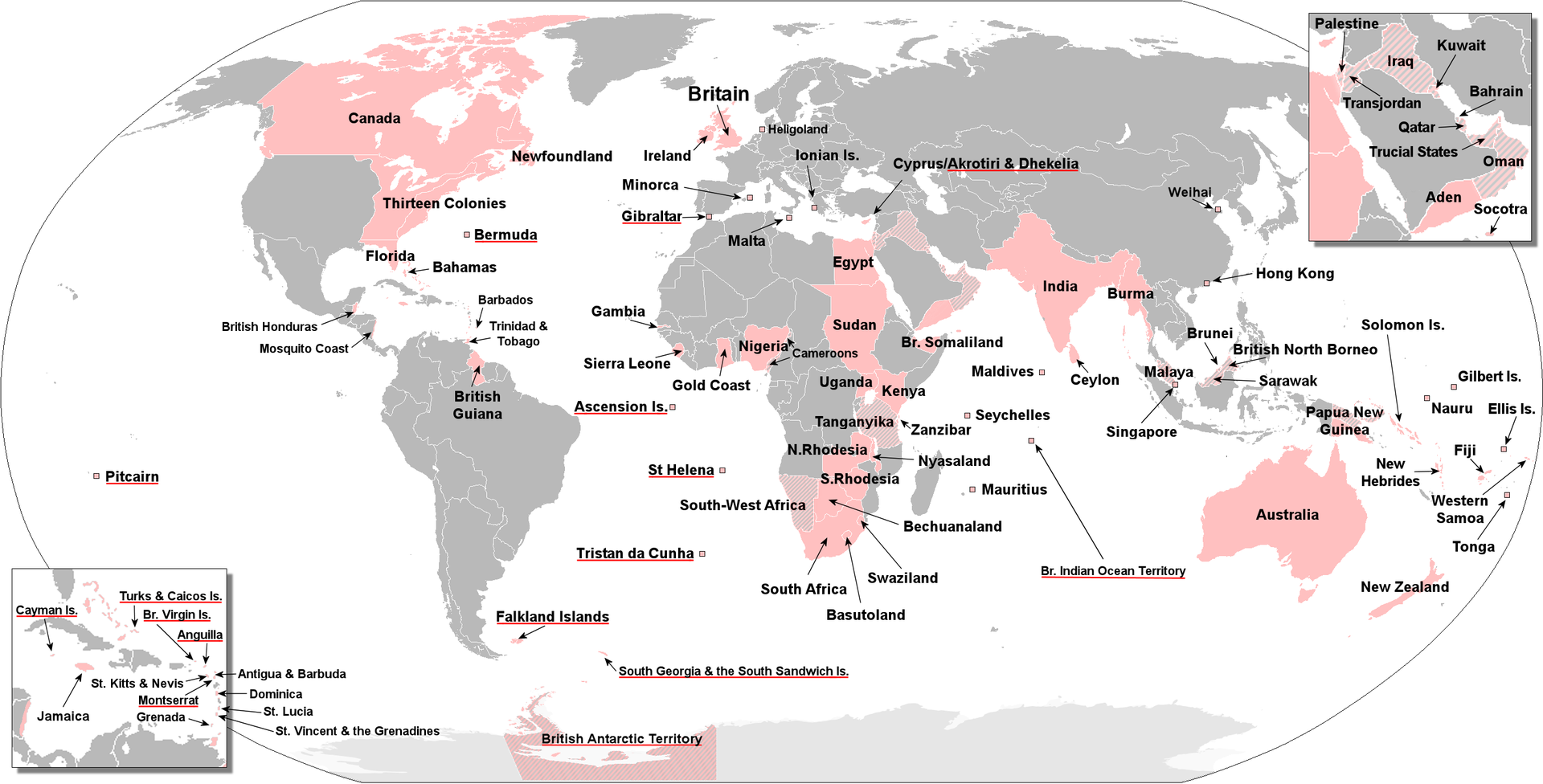
Areas of the world that were part of the British Empire with current British Overseas Territories underlined in red. Mandates and protected states are shown in a lighter shade.
—Map by RedStorm1368
WEST WARWICK, R.I.
When President Trump, on the first day of his second term, closed the U.S. Agency for International Development and began dismantling the Voice of America, he also severely curtailed what had been America’s soft power dominance in the world.
With those actions, we abandoned something of inestimable value: the ability to project Americanism, our ideals. Trump retired an entire diplomatic system that had served the United States well since we more or less inherited it from the British.
“Soft power” was codified as a concept by the late Harvard professor Joseph S. Nye, Jr. in four books published between 1990 and 2023.
While Nye made soft power his own — he coined the term in 1990 — and wrote, lectured and testified before Congress about it, he never totally convinced conservatives what a valuable weapon it was in the national armory.
The proof of that is in the current administration’s indifference to diplomatic and social muscle, and its lack of a mechanism to talk to the Iranian people in Farsi, their language.
Nye believed an important part of soft power was our educational system, and U.S.-educated foreign students going home and spreading the good news about America.
I believe, although it was never thought of that way, that soft power was one of the things that kept the British Empire together. I saw it in action in Africa as colonial rule waned.
James R. Schlesinger, who served as chairman of the Atomic Energy Commission, director of the CIA, secretary of defense, and secretary of energy, was a friend of mine throughout his public career and afterward. The one question he asked me constantly was how the British Empire was able to hold together with so few troops spread across so much of the world.
Schlesinger, a former history professor, wondered how those lessons might be applied to America in the late 20th Century.
I told him that it was a combination of the hard power of the Royal Navy and British Army but also, importantly, of the then-unnamed soft power.
Take the massacre in Amritsar, in the northwestern Indian state of Punjab. This occurred on April 13, 1919, when a local British commander in the Punjab feared a meeting in a garden might turn violent and opened fire without warning on thousands of unarmed civilians. Official figures reported 379 dead and 1,200 injured; Indian estimates exceed 1,000 deaths.
This massacre hardened Mahatma Gandhi’s attitude to British rule over the subcontinent. His initial reaction, on hearing of the slaughter, was disbelief that the British would do such a thing. He had bought the soft-power assertion of British values, of decency.
Winston Churchill, then serving as the minister of war, told Parliament early the next year that the shooting was “unalterably monstrous.”
I tried to explain to Schlesinger over many evenings, over many years, what I had seen growing up in British Africa as the essence of British soft power.
To me, it boiled down to a kind of moral posture, a determination to project British justice as inviolate, British exceptionalism as a moral force, and a general admirable state of decency. The term soft power hadn’t yet been created, but it was the essential ingredient in British colonial administration.
When American commanders sought the “hearts and minds” of the Vietnamese, they might well have said they were seeking to establish “soft power.” But it was too late.
The concept of soft power and how it blossomed for America has wilted under the Trump administration. The posture now is that economic and military power are how we project influence and authority.
Ironically, while I think that Nye did something of great value in identifying and promoting the concept of soft power, he and I didn’t enjoy a warm relationship. He had been President Jimmy Carter’s point man for nuclear disarmament and had favored an end to nuclear reprocessing as well as other aspects of the U.S. nuclear ecosystem.
In 1977, we debated in London, and the argument got so intense that we spilled into the street, shouting at each other.
On X: @llewellynking2
Llewellyn King is executive producer and host of White House Chronicle, on PBS, and an international energy-sector consultant. He’s based in Rhode Island.
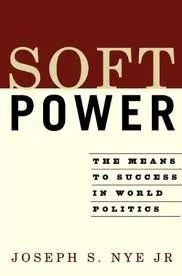
On of Harvard Prof. Joseph Nye’s best-known books.
Llewellyn King: The birth of a new reactor
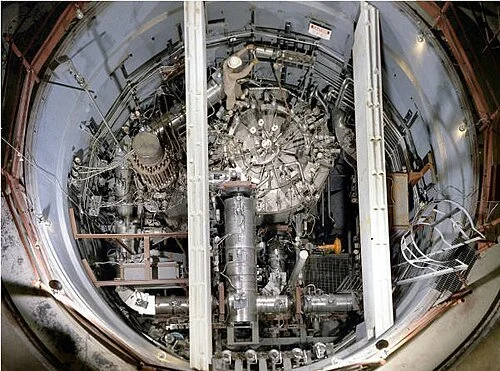
Early thorium-based (MSR) nuclear reactor at Oak Ridge National Laboratory in the 1960s.
WEST WARWICK, R.I.
If you are designing a car from scratch, there are certain essentials to begin with. You need to start with the wheels on the corners, for example.
But when it comes to building a nuclear reactor, things are different. There are hundreds and maybe thousands of ways of doing it. The constant is that you need fissionable fuel and a moderator to collect the heat and manage the neutron flux.
That embarrassment of choice — now reflected in the number of small modular reactors (SMRs) vying for market acceptance — may be why thorium reactors, which began with promise, have been left on the shelf.
The nuclear establishment, goaded by the Nuclear Navy’s Adm. Hyman Rickover, wanted light water technology. That is what the first 100-plus U.S. civilian reactors employed.
At the dawn of the civilian nuclear age, it was a straight contest between two fuels: uranium and thorium. Thorium is fertile but not fissile: It can’t start a chain reaction unless it is triggered by a small amount of the isotope uranium-235.
Once this happens, thorium becomes uranium-232 and fizzes wonderfully with a steady stream of neutrons, producing heat in the moderator, which is where the first steps in making electricity are taken.
That heat is captured to create steam that turns a turbine.
Thorium was used in part in the first power-producing, commercial nuclear reactor: the 60-megawatt Shippingport Nuclear Atomic Power plant in Beaver County, Pennsylvania. With three different fuel assemblies, it ran for 25 years, starting in 1957. It used solid fuel, which was to become the standard for civilian nuclear power.
Meanwhile, at the Oak Ridge National Laboratory, in Tennessee, under its director, physicist Alvin Weinberg, work went ahead on what would become a legendary fast-breeder thorium reactor, using a liquid fuel embedded in molten salt. It went critical in 1965 and operated for five years before it was closed by the Atomic Energy Commission (forerunner of the Department of Energy) in a political move.
A fast reactor uses extra neutrons to create new fuel and burn up radioactive waste. The process is akin to perpetual motion — but isn’t, of course.
Now a charismatic nuclear engineer, Yash Patel, founder and CEO of AMR Reactor, is planning to bring thorium back as a viable future option for space exploration, power generation and, eventually, ship propulsion.
Patel told me he has designs for a microreactor (under 20 MW) and for a SMR (250 MW). The planned reactors are molten salt-moderated, thorium-fueled fast reactors.
He believes they will not only be cheaper, but will also operate better than the SMRs now entering the market.
Patel’s plan for Austin-registered AMR Reactor is to outsource as much of the fabrication as possible.
A fast reactor is called a breeder reactor because it generates more neutrons than are needed to produce fission, and these transmute waste into additional fuel.
Patel went to school in California and while looking for a career, a break came that changed the trajectory of his life. He got an internship with NASA at the Jet Propulsion Laboratory. There he worked on Curiosity, the plutonium-fueled Mars rover. His nuclear love affair, he said was “complete and instant.”
From NASA, he went to Texas A&M and graduated in nuclear engineering. He was well along with his PhD, when a family illness caused him to abandon it.
Patel lists two great blessings in his life. “The first was that I moved to America from India. The second was attending Texas A&M. That was another wonderful break.”
After a stint in biopharma, where he prospered, Patel started designing reactors in all his waking hours along with a friend, D’mitri Scott, now the chief technology officer at AMR Reactor.
Patel said the numbers didn’t work for their plans until they switched to thorium. It was a eureka moment.
There followed a period which he likened to Bill Gates and Steve Wozniak working on the first computer operating system. The two young men were obsessed and inspired by what they believed was extraordinary. “Our girlfriends, now our wives, saw very little of us. We sometimes worked all night,” Patel said.
With thorium, they found all they were looking for: a stable source of reliable power that was safe, couldn’t melt down, and was able to handle most of the fission products.
And it was proliferation-proof because of the presence of intense gamma radiation, which made it hard to process, steal or divert. “Thorium was the winner,” he said.
A new reactor is on the way.
Llewellyn King, an international energy-sector consultant, is executive producer and host of White House Chronicle, on PBS. His email is llewellynking1@gmail.com and he’s based in Rhode Island.
Llewellyn King: Air-conditioning costs might threaten catastrophe

Through-the-wall air-conditioning units, at the University Motor Inn, in Philadelphia.
WEST WARWICK,R.I.
The summer of our discontent is at hand. When I asked a professional weather forecaster what we might expect this season, he said, “Hades.”
That was as disturbing as everything else in this disturbing year.
America has a summer culture. You could say the whole of the Northern Hemisphere has one but there is a special reverence, a profound intimacy that Americans have with summer. It is a happy place for healing hurts, meeting old friends, making new ones, and the extraordinary joy of just basking, even romancing.
The British usually make jokes about summer. One goes, “I missed summer. I went to a movie and when I came out, it was over.”
Clearly, they aren’t making jokes like that this summer when temperatures have set historic records, and forced people to do extreme things to cool off. Untold deaths have resulted.
The French have always had their own reverence for summer and, as a nation, down tools in August and head to the beach, often in the South.
But they, like the British, are suffering in the current heat wave because there isn’t a lot of air conditioning — almost none in homes and a limited amount in public buildings. Only one in five British homes have air conditioning. In France there is more in the south, but not in the north around Paris. It was never needed.
I have been in London when it is hot, but not as hot as it has been so far this summer. Sitting in a theater in London in summer was excruciating, made the more so because Britain is humid.
Anyone who lives in America’s coastal regions, especially the South, knows the awful combo of heat and humidity.
Deaths from heat in Europe are widespread and are still being reported.
Air conditioning has shaped America for the last seven decades. It has made living with year-round comfort possible in the South, the Southwest and the West.
If it weren’t for our ability — with enough electricity — to reverse the climate in places like Florida, Texas and Arizona, the migration from the north wouldn’t have happened. Once there was air conditioning, people felt they could live comfortably anywhere in the nation.
Even so, all isn’t well. Indeed, this may be the summer of catastrophe, and deaths from heat and uncontrolled fires. The prognosis isn’t good.
The impending social pushback was pointed up by my colleague Herman K. Trabish, writing in Utility Dive. He was attending the Edison Electric Institute’s annual meeting in Las Vegas in early June, and wrote in a brief, “Protesters shouting affordability claims and chanting slogans interrupted a speech by NV Energy President and CEO Brandon Barkhuff.”
Trabish continued, “The confrontation shows the extent to which rising energy costs have stoked public anger, raising pressure on utilities and their regulators.”
The protests were directed at a demand charge approved by the utility commission that wouldn’t take effect until next year, but it opened up deep anxiety in southern Nevada about the cost of electricity in weather that is getting hotter and hotter.
Protest leader Leslie Vega told the media, after the protesters were escorted out of the meeting, “In Las Vegas, one of the fastest-warming cities in the country, you cannot live without electricity.”
Vega’s remarks might well reflect a truth for the whole of the South, Texas, and the Southwest. Cheap electricity has been a factor in the migration of tens of millions from the northern states to the South and West. It was never mentioned, it was just there.
Now the price of electricity is rising inexorably as temperatures appear to rise with equal, threatening vigor.
The natural response from those facing disaster in the heat zones will be to blame the electric utilities, and the ubiquitous data centers. There will be calls to nationalize the investor-owned ones, like NV Energy, and calls will go out to curb those utilities that are already publicly owned, which includes the rural electric cooperatives and those owned by towns and cities.
Additionally, residents in many states which have wildfire exposure will from time to time have their power cut off entirely for periods to reduce the danger of new fires being started by sparks from line shorting. That will cause new anger.
Most of the world accepts that aberrant weather, which is now common, is associated with global climate change, blamed in part on greenhouse-gas emissions.
That isn’t accepted by the Trump administration, which favors further use of greenhouse gas-producing fossil fuels. The president has said that global warming is a “hoax.”
Hot people have short tempers. They can be expected to have something to say as they suffer, and death tolls rise.
Llewellyn King is executive producer and host of White House Chronicle, on PBS, and an international energy-sector consultant. His email is llewellynking1@gmail.com, and he’s based in Rhode Island.
Llewellyn King: The new ‘news’ media: A pea of news in a mattress of Words

— Photo by Pmau
WEST WARWICK, R.I.
Journalism is choking on the low-hanging fruit.
Every day hundreds of newsletters and podcasts flood inboxes. These are almost entirely concerned with political goings-on in Washington.
But this isn’t to say that journalism is alive and well. In fact, this is a symptom of journalism’s straitened times.
Mostly, there is just a pea of news in a mattress of words.
The web has made the delivery of journalism cheap and easy, but it hasn’t helped with the high cost of covering the news, of sending reporters to see what is happening in the courts, the state houses, and overseas; or in science and technology, which so affect modern life.
It also hasn’t enabled news organizations to spend months on an investigation that may or may not pay off.
Instead, every minuscule development in politics is treated as a big, breaking event, and is analyzed exhaustively.
Analysis is substituting for reporting. The actual snippet of reporting is often attributed to a newspaper like The Wall Street Journal or The New York Times, or one of the news services, say, Reuters.
Analyzing nothing much doesn’t change it to something.
Much of what is rushed out as news wouldn’t get past an old-fashioned editor like Jim Michaels of Forbes, who I am told, in that magazine’s print heyday would chide reporters, saying, “You’re telling me things I already know.”
The ease of distribution and recording has also caused blogs with attendant webinars to sprout across the news ecosystem. Much of it is in the form of analysis, more and more analysis of less and less.
The big new entry in my inbox is magazines which were once monthly or weekly, but have joined the frenzy with daily newsletters. These include The Economist, The New Yorker, The Spectator, The Atlantic and even Vanity Fair.
I subscribed because they were weekly or monthly. I didn’t want a daily gusher.
There is also a plethora of digital-only publications — the best in my inbox is ProPublica, which manages original reporting.
The big ones which are, almost, substitute newspapers but are heavy on political coverage include Politico (which is broader) and Semafor. A new entry, NOTUS, is staffed by former Washington Post reporters. So far, it is heavily political.
I remember when people bought the Post for the Style section and its other goodies, not just its hometown industry of politics.
A further indication of the news drought, despite the torrents of words, is how many of the new dailies are quoting what was said on television. Time was when no print outlet would deign to do that. It was expected for television to pick up from the newspapers, not the other way round.
There was a reason behind the old pecking order: Broadcasting needs to have people say things in front of a camera or a microphone. By contrast, print’s best stories come from sources who are keen not to be identified, let alone go on television or radio.
In today’s vengeful times, unidentified sources are essential, to be used sparingly, but nonetheless essential. The reader has to depend on the high standing of the platform and the integrity of the byline to judge the truthfulness.
There is no doubt that the tumultuous politics that began when Donald Trump entered the arena have been good for cable news stations, which have morphed into political channels, shamelessly partisan. The politics have also been good for newsletters and blogs.
But will that be true after the Trump era? The strictly conservative New York Sun reports traffic to MAGA websites is down dramatically.
To escape the virtual political overload, I reach for the three heavyweights among newspapers: The Wall Street Journal, The New York Times and, though diminished, The Washington Post.
What the bulk of the press, from weeklies to big city papers to the new digital entrants, need is a sound source of income so that they have the money to do the job, to weed out local scandal, corruption and abuse, and to develop entertaining writers.
You get what you pay for and in the news business, since it lost its advertising revenue to the likes of Google, you are getting political froth: opinions about the news — most days the same opinion with shadings of difference from many publishers.
Yesterday, I counted 19 of these offerings in my inbox. I gave up on the breathlessness and read a book.
Llewellyn King is executive producer and host of White House Chronicle, on PBS, and an international energy-sector consultant. His email is llewellynking1@gmail.com , and he’s based in Rhode Island.
Llewellyn King: Microgrids offer community solution to electricity challenge
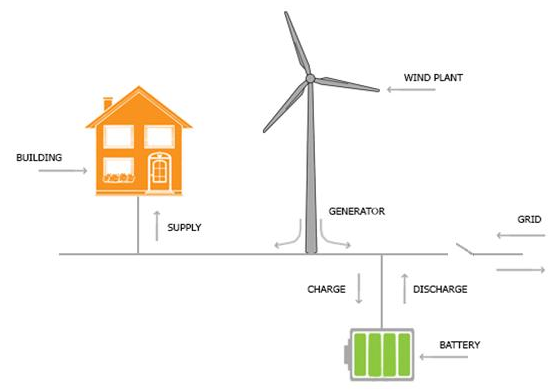
A typical scheme of a microgrid with renewable-energy resources in grid-connected mode.
—Graphic by Le Anh Dao
See this about microgrids in Massachusetts.And this. And in Rhode Island.
WEST WARWICK, R.I.
You may have heard of microgrids in passing, maybe at a town meeting or when the future of your electricity supply is under discussion. Mostly, they aren’t headliners like data centers.
But microgrids are becoming an important part of the future electric infrastructure. They provide a valve to release some of the pressure building for more electricity supply for data centers and transportation.
Burns & McDonnell, an architecture, engineering and construction firm, figures that by 2030, 50 percent of in-city deliveries will be made with electric vehicles of all types, and these will have to be charged daily.
There are about 700 microgrids operating in the United States, and over 7,000 are planned or under construction. While they got off to something of a slow start, they are now going full-speed ahead.
Originally, microgrids were seen as appropriate for military bases, college campuses, and other uses where there was a defense or social purpose, or in remote locations far from the grid.
Utilities were cool or actively hostile to them — although it can be argued that the first microgrid was established by Thomas Edison in Manhattan.
One utility executive said to me four years ago, “What is it about ‘micro’ that the promoters don’t understand?” Now utilities are beginning to embrace microgrids as part of the solution, not a raid on their customer base.
A microgrid, as explained by the futurist-entrepreneur Chase Weir, CEO of Distributed Sun and its spinoff truCurrent, is a way of bringing “kilowatt-hour liquidity” to the electric sector, smoothing out the periods when demand meets maximum capacity, often beginning as the sun sets.
It is a self-contained electric generation and localized distribution entity, using storage, renewables and, at times, traditional generation to create a grid that can operate either independently of the national grid or be connected to it. It is usually separated from but linked to a utility.
Oisin O’Brien, senior director of commercial solutions at truCurrrent, walked me through the dynamics of a microgrid that the company is building for a large food distribution company in Northern California.
Its assignment was to develop a charging station for 30 Daimler electric-tractor trailers used for food distribution. The challenge: To provide 2 megawatts of power for charging the Class 8 trucks during largely off-peak hours. Each truck has a 200-mile range on a single charge, and must be charged daily.
On this project, O’Brien explained, truCurrent is working closely with the local utility, PG&E. “We were able to harness the utility’s flexible service program,” he said.
The full power plant — which is awaiting permission to operate from PG&E — will team 800 kilowatts of solar power with battery storage to create a contained system.
Currently, solar collectors are being installed on the facility’s roof, but two dozen of the company’s trucks are already using the charging points in the parking lot. The 180 kilovolt (which equals 1,ooo volts) fast-chargers can fully recharge a truck in three to four hours.
This first-of-a-kind pilot is remarkable in that it has brought “speed to power,” going from contracting to charging in 13 months. It meets the food distribution company’s need for charging when they need to do so, brings resilient backup and load flexibility, and provides a price hedge at a time of record-high diesel prices.
“Our solutions are only becoming more valuable as cost, reliability and power availability worsens,” said Weir.
According to O’Brien, truCurrent has plans to deploy microgrids across the nation, utilizing a system of turnkey installations where the infrastructure is owned and operated by the local company or the community, but the planning, procurement and installation is provided by truCurrent.
“This project was driven by regulatory pressures in California, the company’s sustainability targets, and the increasing economic benefits with updated analysis, showing lower operating costs for electric fleets compared to diesel [pre-Iran war calculations],” O’Brien said.
The truCurrent project is for transportation usage, but there is a growing demand for microgrid deployment in suburbs, and even in apartment complexes.
It is an example of Weir’s vision for the electrical grid of the future which, in addition to liquidity and speed, must be designed for abundance and affordability.
The project “turned every challenge into an advantage for the developer, the customer, the utility and capital markets,” Weir said.
Shared prosperity with a microgrid: What’s not to like
Llewellyn King, a veteran international energy consultant, is executive producer and host of White House Chronicle, on PBS. His email is llewellynking1@gmail.com, and he’s based in Rhode Island.
Llewellyn King: In the collision between billionaires and news coverage, the public loses

“Big Fish Eat Little Fish,” by Pieter Bruegel the Elder (1556)
WEST WARWICK, R.I.
Trillions, as in trillions of dollars, are being bandied about in the way millions were, then billions. But take a look at 1 trillion expressed numerically: 1,ooo,ooo,ooo,ooo. Awesome, isn’t it? Twelve zeros.
The national debt stands at $39 trillion and the interest on that will top $1 trillion this year.
Very soon the first trillionaire will thunder past the post, presumably Elon Musk.
I have nothing against Musk. And I have nothing against successful people being rewarded for their talent.
Musk has done enormous things. An immigrant from South Africa, he made his first fortune with PayPal. Since then, he has been important in solar-energy revolution, electric cars, and in leading development of a heavy-lift rocket that has made space exploration cheaper than when NASA alone was at the controls. His Boring Company still holds promise.
It is assumed, as so often, that because a person is good at one thing, that same person must be good at everything else. Whoa! Musk’s limits as a manager and a visionary were exposed when he barged about “streamlining” the government for President Trump.
It was a case of a bridge-too-far for Musk — a disaster for America that eroded privacy, critically wounded many departments and saved no money.
Whereas much of what Musk has achieved has been beneficial, his purchase of Twitter, rebranded to X, was evidence of the harm that is a part of gigantic wealth. He wanted to control not just the medium, but also the news.
Musk — although it isn’t good that he has taken steps to control the message with X — isn't the problem facing the media and the public’s right to know. When there is so much money floating around, news-media freedom is in trouble.
The immediate threat comes not from Musk, but from two other men of gargantuan wealth: Larry Ellison, co-founder of the tech firm Oracle Corp., whose personal net worth is estimated at $245 billion, and his son, David.
Together they are set to control the media to an extent not imagined and never seen. The media titans of yesteryear — Pulitzer, Hearst, Luce, Thompson, Sulzberger, Graham and Murdoch — are knee-high to the fearsome power that the Ellisons have, and which will more than double if (and it is more when than if) the merger of their Paramount Skydance Corp. with Warner Bros. Discovery is approved by regulators.
At present, the Ellisons control the CBS Television Network, CBS Sports, MTV, Nickelodeon, Comedy Central, Paramount Network, and BET. They control CBS News, and Paramount+ which has 79 million streaming subscribers.
But if the merger goes through, they will control CNN, HBO Max, and Warner Bros. Studios — a treasure trove of entertainment.
In short, they will control a huge swath of American broadcast news, information dissemination, and movie and television culture.
Their declared purpose is to incorporate more technology and more AI across their astounding current and probably future empire. That is bad for journalism and worse for movies. The invasion of the bots.
I know how media control works. I have seen it firsthand: It isn’t what is said, but what is implied or what employees feel those who own the outlet want. A casual remark can become policy; a hint of preference can become a hard rule.
If an Ellison family member were — of course, this is hypothetical — to say they hated rhubarb, you could bet the Food Network wouldn’t do a show episode on rhubarb pie making. If it were known that one of the owners of Paramount were boosters of nuclear power, movies such as The China Syndrome and Silkwood would never have been made.
In journalism, the story that isn’t covered is as important as the one that is covered. If a disease caused by a common product — asbestos is a good example — isn’t covered because the staff has heard that the media owners love that product or is invested in it, then you can bet it won’t be covered.
Consolidated corporate ownership is antithetical to free speech, creativity, and open government. No news is bad news.
News isn’t suited to the corporate world; it isn’t a fit with those whose interest is adding zeros to bottom lines. It is the pursuit by an irregular army of often eccentric individuals, who turn over stones to find out what is beneath.
Likewise, individual ownership furthers the news objective, which for me was summed up by something Dan Raviv said when he was a correspondent for CBS Radio (recently shuttered by the Ellisons), “My job is simple. I try to find out what is going on and tell people.” Write that in the corporate prospectus.
News organizations need to be owned by news people, such as Ted Turner, Bill Paley and, yes, even Rupert Murdoch.
Llewellyn King is executive producer and host of White House Chronicle, on PBS. His email is llewellynking1@gmail.com, and he’s based in Rhode Island.
Llewellyn King: Three big challenges for new college grads in these crazy times

WEST WARWICK, R.I.
Dear Graduates of 2026,
Welcome to the world you will be taking jobs in and where you will begin building careers, and at times shaping history.
It isn’t the world of your parents, and it isn’t the world your college has taught you about, because it is changing too fast. It begins anew daily. As Maya Angelou said, “This is a wonderful day. I haven’t seen this one before.”
There are three big forces looming on the horizon that will shape your world and that you will play a role in shaping. They are technology, specifically AI; politics, the harsher politics of today; and the environment, which is eventually everything.
AI will have an effect that defies comprehension — it is so enormous. It is also evolving so fast that it keeps slipping out of your grasp.
“It is exponential, and human thinking is linear.” So said one of the foremost thinkers about AI, Omar Hatamleh, former head of AI at the NASA Goddard Space Flight Center. He has written five books on AI.
All that is absolutely, definitely and incontrovertibly known is that AI will affect everything. It will change how we work, play and learn. It will change how we mate, think and expect.
Graduates, you will come to realize that political action and speech have changed from what they were. Both are out of the guide rails that have served them well over time.
Authoritarianism has taken root in America, and it will be hard to pull out. The bureaucracy has been politicized. There has been an expansion of presidential power over areas constitutionally assigned to Congress, under the watch of an accommodating Supreme Court.
There are troops on American streets, political searches and seizures, arrests and indictments, and deportations without due process. All this was unleashed with the Republicans. When Democrats take power, will they put the evil genie of unconstitutional government back in its bottle?
Domestic politics has also changed our relations to the world — a world where America, Canada and Europe stood together, sharing a common heritage and a common view of law, and savoring a shared peace in Europe until Russian President Vladimir Putin invaded Ukraine, and set in motion four years of bloody fighting.
Could we have done more? Yes, more weapons, more money, and less acceptance of Putin. Maybe troops, too.
We didn’t, and that has changed the world. Free countries now know that America won’t axiomatically have their backs. That time is past and will have major geopolitical consequences.
Internationally, the big, open American hand has been closing as it has curtailed or ended participation in international institutions from NATO to the World Health Organization to the Paris climate agreement. The arbitrary closing of USAID was a declaration of withdrawal from the world and from the exercise of soft power as a diplomatic tool.
Another challenge for future Americans as they grow into adulthood: They will live in a more dangerous world with fewer friends. Hubris is an expensive luxury.
They may also not live in a world where the climate is as predictable as it once was. Already aberrant, unpredictable weather is the norm with hurricanes, tornadoes, floods and tinder-dry regions.
Politicians may deny that the climate is changing, but the evidence is there. Sea levels are rising, city streets are flooding, and beachfront homes are being swept away. Hurricanes and tornadoes, part of our usual weather cycle, are getting more severe. Drought and floods, recurring phenomena, are worsening.
Texas and the Southwest, which have long attracted working and retired residents, are facing prolonged droughts and water shortages that will curb future growth.
Dealing with the environment is a challenge that AI may meet quite dramatically. Its ability to predict, organize and find the exit in dense data is without peer.
Graduates, as the generation coming of age in 2026, you shouldn’t fear AI; rather, you should throw yourselves at it and learn what it can do for you. Gradually, it will be understood, regulated and you will come to terms with it as a tool, not an aggressor.
We have left you a messy world, but it was always that way.
Over two and a half centuries, America has absorbed and changed. Along the way — including civil war — it produced a society in which there is still opportunity; there is still freedom, although the door may be closing; and much has been perfected here.
Remember, more people live better in the world today because of America, its ideas, its inventions and its heart. Go forth and be that American.
On X: @llewellynking2
Llewellyn King is executive producer and host of White House Chronicle, on PBS, and an international energy-sector consultant. He’s based in Rhode Island.
Llewellyn King: The disastrous outcomes when politicians ignore cause and effect

Ishikawa diagram on cause and effect
—FabianLange graphic
WEST WARWICK, R.I.
Anyone who has spent time in criminal court knows this: One of the characteristics of lawbreakers is a poorly developed sense of cause and effect.
At the low end, the folly of the defendants is always on display. The young man who takes a gun with him on a night’s drinking. He has increased his chances that he might use it, and spend the rest what might have been his most useful years in prison.
The shoplifter who keeps at it despite past convictions and faces undetermined years behind bars. The burglar who robs a house and while there calls home on a cell phone, which will ping off the nearest cell tower, negating any alibi. The murderer who posts on social media.
This poorly developed sense of cause and effect isn’t confined to the lawless. It is rife in the political class, in both cohorts of the class, but primarily these days in the ruling Republican cohort.
We, as a nation, appear to have forgotten that actions have consequences. Those consequences ricochet down through the decades, even the centuries.
Bomb people and you will get a massive refugee problem.
Deny medical funding and you will get overburdened emergency rooms.
Underfund science and the talent will pop up somewhere else, such as the universities of Europe and Asia.
Cut off immigration and you will have deflation from population decline.
Create stateless people — they are still people, still there — and they will become a burden.
Don’t raise taxes to cover the $39 trillion national debt and the interest payments on the debt will be so enormous that there will be little left for the business of governance.
Action has consequences just as inaction has consequences. Winston Churchill said: ‘’A decision not taken is nonetheless a decision.”
Here are just some areas where the effect may linger long after the cause has lost its currency — long after the action, which seemed to be “a good idea” at the time, was taken:
Cause: Traduced allies, vitiated treaties and long-term friends abandoned with abusive disdain while rewarding the deplorable with praise, recognition and encouragement.
Effect: The slights and the negations won’t be forgotten, but the reason for them will have faded with the perpetrators. America diminished as a global power, taking a seat beside Brazil or Argentina, damned by a history of causing damaging effects for passing motives.
Cause: Profligate use of the presidential pardon.
Effect: A further temptation to abuse power and advance corrupt patronage. Friends go free.
Cause: The abandonment of the sacred right to see a judge, to identify the accuser, to be tried by a jury of your peers.
Effect: A lawless state of injustice and cruelty, the state out of control, thugs loosed on the people.
Cause: Undermine the elections by claiming falsely that they were rigged.
Effect: A fundamental weakening of democracy and the supremacy of the ballot. All elections are doubted and more easily overturned. The system is undermined.
Cause: Sustaining a lie in the belief that if you claim it long enough, it will sow doubt.
Effect: Truth becomes what those who have power say it is, whether it is about an election, immigrants, the cost of wind turbines or climate change. Truth becomes a commodity in short supply in the political marketplace.
All governments make mistakes and most go too far in the service of political ideas, which have legitimacy for a time and then fade. This time it is different.
The list of political actions that will have detrimental effects in the future and substantially threaten our world leadership is long.
Since the end of World War II, we have led the world in everything from creativity to moral example, from generosity in foreign aid to genius in medical science, from legal thought to environmental protection.
Now political exigency is undermining that. Petty, small triumphs in what are often just the culture wars have effects that diminish us worldwide, and harbinger a more troubled future for us and the world.
Any day, in the heat of a political moment, another cause may leave an effect that will damage the decision-making mechanisms of the U.S. Senate. If the filibuster goes, both parties would rue the effects of that, long and often.
If it goes, the cause will be forgotten but the effect will endure.
Llewellyn King is executive producer and host of White House Chronicle, on PBS, and an international energy-sector consultant. His email is llewellynking1@gmail.com , and he’s based in Rhode Island.
Llewellyn King: Looking at New England’s electricity future with some trepidation

Offshore-wind projects will be a growing source of regional electricity.
WEST WARWICK, R.I.
These days, in terms of resources, New England is poorly positioned to make electricity. As Gregg Cornett, president of Rhode Island Energy, told me in an interview, it doesn’t sit on abundant coal reserves and natural gas — the latter the critical fuel in today’s electricity-generating mix — or hide beneath the surface, waiting for the gasman’s drill.
Going forward the prognosis is that New England will make it through without electricity disruption unless there is severe cold, in which case the system will be stretched and blackouts could result.
The North American Electric Reliability Corporation, the industry-supported, not-for-profit authority that studies electricity supply and predicts problems, says New England is at “moderate risk” this summer, but sees changes and stress in consumption patterns as the region shifts from summer peaking to winter peaking. This will put further pressure on the delivery of gas into the region.
Winters are going to be tough for the New England electric grid and the collective transmission organization that distributes power from and between the region's utilities, the New England Independent System Operator (ISO-NE).
Rhode Island Energy’s Cornett points out that the area has continued to grow, but the infrastructure to support that growth — especially of pipelines bringing in natural gas — has languished.
In part, environmentalists have been responsible because of their desire to restrict all fossil fuels. Times of crisis, though, lead to the burning of oil — a much greater environmental challenge.
Also, because of the lack of pipeline capacity, New England imports liquified natural gas (LNG) from as far away as Norway, adding to the cost of electricity throughout the region. It also imports electricity from Canada.
This means that New England has some of the highest electricity rates in the country. Inaction has consequences.
The bright spots for the future are renewables, wind and solar.
At present they contribute only 12 to 15 percent of the total New England mix, but they represent the one resource that the region has aplenty, especially offshore wind. Currently, this is hamstrung by opposition from President Trump, but there are hopes that these sources will play much bigger roles in coming years.
Cornett says that Rhode Island Energy is enthusiastic about solar and expects this to grow, although power from rooftop installations now represents a decided challenge for the utility. It is by law obliged to pay top dollar for this electricity, and that is more than the power is worth in the market.
The law guaranteeing the high rate was passed by the Rhode Island General Assembly in 2014 to encourage solar installations, not to hobble Rhode Island Energy with high costs. Cornett says the utility, which is the dominant one in the state, gets no gain from the solar power which it has to buy under this arrangement.
There is irony in the energy shortage in New England because twice in its history, it has led the nation in energy production.
According to the 1840 U.S. Census, there were 5,000 water-powered log mills in the region and many other mills, making cloth and grinding corn. New England had dominance in milling of all kinds, thanks to its abundance of rivers on which mills were granted “privileges.”
Rhode Island — with five rivers that had sufficient flow for mills — was a beneficiary of the boom. Most of the mills that survived were converted to steam and those that survived after that, mostly textile mills, turned to electricity.
In the 1990s, there were six operational nuclear-power plants with eight reactors. Today there are just two: Millstone, in Waterford, Conn., with two reactors, and Seabrook,in Seabrook, N.H. with one reactor.
All six New England governors have signed a commitment to investigate the deployment of small modular nuclear reactors (SMRs), but at present there are no commitments to build. This may reflect a national uncertainty about which of the many competing SMR designs with their various technologies will eventually be market-dominant and lead the way to a nuclear renaissance.
Meantime, power executives across the region are grateful they aren’t feeling pressure from data center developers and are hoping for mild winters ahead.
Electric-utility executives used to list cybersecurity as their No. 1 worry. Now they say it is the weather.
You can engineer defenses against cyberattack, but when it comes to the weather, the answer is to hope for the best and respond quickly if there is an outage. The supply future is cloudy.
On X: @llewellynking2
Llewellyn King is executive producer and host of White House Chronicle, on PBS, and an international energy consultant. He’s based in Rhode Island.
Llewellyn King: I remain a lover of riding the rails, even Amtrak with its frustrations

A Northeast Regional train, with an ACS-64 locomotive and Amfleet I passenger cars, at New London, Connecticut’s Union Station.
— Photo by Pi.1415926535
This is being written on Amtrak’s Northeast Regional Train 171, in coach, en route from Providence to New York. I am in my happy place.
I am a trainman. Given a choice, I would ride the rails over any other mode of transport — except flying when I owned a plane.
Something happens to me when the train pulls out of the station. I get a sense of well-being.
Rail travel does things for my soul, puts me into a place of euphoric comfort. Everything becomes possible; things are good and may get better.
Ships do something similar — not cruise liners but ships going somewhere; ships providing transportation not geared to escapism, working ships.
I can trace my train addiction to a journey when I was 5 years old. It was the longest train trip ever and I wouldn’t care to repeat it, although it was the greatest: the adventure of adventures.
It was a train trip from Cape Town, South Africa to Salisbury, Southern Rhodesia (now Harare, Zimbabwe). It took six days; it was a long, long time on the train.
The distance from Cape Town to Harare is slightly over 1,500 miles, but the train wound through endless miles of desert in what was then Bechuanaland (now Botswana) and stopped for long periods for water.
It was, of course, a steam train and steam engines are big, beautiful, thirsty monsters. They could carry enough coal for a fair distance of travel, but water was essential and pumping in remote stretchers of the Kalahari Desert was a slow business, and at times the pumps had to be operated by hand. That could mean hours to water the engine.
But as someone said to me years later, “There is plenty of time in Botswana.”
Later, I would ride an overnight train from Salisbury to Umtali (now Mutare, Zimbabwe) to supervise the production of a newspaper. I rode second class and usually shared a carriage with another man, and sometimes a third and a fourth. As a teenager, I thought of those long discussions through the night as my university.
More steam trains in England, but much faster. The British steam locomotives, before the switchover to diesel, scooped up water from open rail-side troughs as they rushed by at speeds of up to 100 miles per hour.
My work took me weekly by train to Scotland or the North of England, and at times to the Midlands. Those trips were always an adventure in the people I talked to, the great meals on board, and the wonder of falling asleep to the click-clack of the rails.
I took the overnight train to France, before the Channel Tunnel, when the train would leave London, make its way to the coast, be loaded in the dead of night onto a steamer, and continue in France the next day. Good night in England and bonjour in France.
In the 1960s, you could still take a sleeper train from Washington to New York. It isn’t very far and doesn’t require a sleeper, but many took it because it was fun and saved a stay in a hotel in New York. Now Amtrak will get you there in three hours, no muss, no fuss, no romance.
I have train-traveled in Russia, Belgium, the Czech Republic, France, Slovakia, Spain, Sweden and Switzerland, and I am frequently on Amtrak’s Northeast Corridor trains. Amtrak’s on-train service is excellent, with courteous and helpful conductors, but booking tickets on its site requires an AI agent or a tech-savvy kid to fathom.
Twice this year, as my wife and I were heading from Washington to Rhode Island on the last Northeast Regional train of the day, we were told that the train would “terminate” in New York, due to a problem on the line north of the city. Things do happen in train travel.
Both times, Amtrak failed to offer any suggestion as to how the stranded passengers might finish their journeys. Many of the stranded were students and people who couldn’t afford a New York hotel room or rent a car. Quite a few of the stranded didn’t speak English very well.
In the first stranding, we were warned by the sole representative Amtrak had helping abandoned passengers at the Moynihan Train Hall, in New York, that not everyone would be able to get the first train out in the morning or the second. He said graciously that our original tickets would be honored on whichever train we were able to continue our journey north.
On neither occasion did we wait for Amtrak’s gracelessness to play out: We took an Uber home on the first, and a Lyft (a bit cheaper) on the second. For each road trip home, we paid, with tips, over $600.
But I am a constant lover, and I am still riding the rails. Happy man typing!
Llewellyn King is executive producer and host of White House Chronicle, on PBS. His email is llewellynking1@gmail.com and he he’s based in Rhode Island.
Llewellyn King: How Trump might sabotage the mid-term elections
WEST WARWICK, R.I.
After some long, dark months, there is an optimism afoot among Democrats, many independents, and a few old- school Republicans that the clouds will part and the sun will shine brightly again on Nov. 4.
Most votes in the midterms will be counted, and Democrats believe that the House will have flipped Democratic with a decent majority. They are daring to hope that the Senate, too, will be theirs.
The Trump presidency, its opponents hope, will be firmly marked “lame duck.” Better, they hope that the years of Trump raging, as they see it, outside of his constitutional authority and acting illegally will be over.
It is fantasized that he will be trussed and restricted from authoritarian governance; that his claims of having a mandate will have been repudiated.
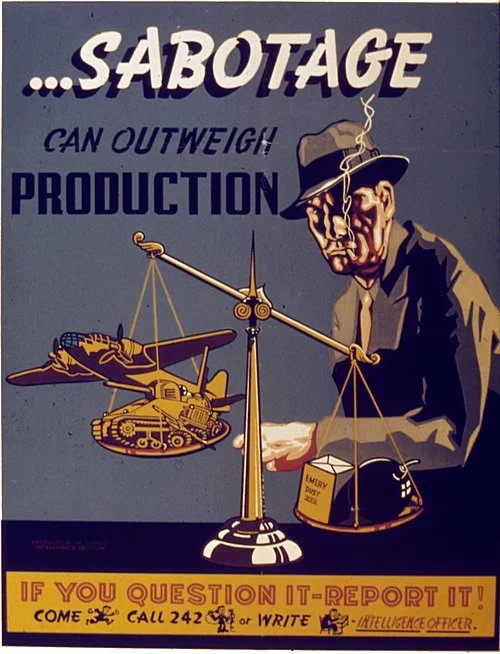
But Trump isn’t a man who takes reversal easily. So there is widespread fear that he will find some way of negating the results of the ballot on Nov. 3 and that Nov. 4 will see him crowing, declaring victory, and being more determined than ever to act as an authoritarian.
Two of the most revered and admired members of the hierarchy of the Democratic Party, Tim Wirth, who represented Colorado for 12 years in the House before entering the Senate, and Richard Gephardt, who represented Missouri for 26 years in the House and rose to become majority leader, have been studying the emergency powers they fear might be used to obstruct the midterms.
The Democratic graybeards state: “Over the past several months we have been examining the structure of presidential emergency authorities, particularly presidential emergency accurate action documents (PEADs) and related to continuity of government provisions. These authorities have existed for decades. What has changed is the context in which they might be used.”
It is these documents, and how they might be used with new intent by Trump and his allies, which alarms the senior Democrats.
They point out that the cadre of Trump loyalists that supported his lie that he won the 2020 election are seeking ways to overcome Democratic victory in the midterms.
Wirth and Gephardt state: “Actors involved in efforts to contest the 2020 election remain active and are again discussing the use of a national emergency to justify federal intervention in election administration.
“At the same time, federal law enforcement has been used directly in relation to contested election processes, and the president has called for federal control over aspects of voting while describing domestic opponents in terms that go well beyond ordinary political language.”
Wirth and Gephardt wonder if “taken together” these developments raise the question of “whether emergency authorities of uncertain scope, capable of rapid implementation and subject to limited oversight, could be brought to bear in a domestic political context before Congress or the courts can respond effectively.”
Clearly the former members of Congress believe that the administration will find pretexts to either subvert the vote, challenge the result or set aside the entire election on emergency grounds.
The first moves are underway to limit mail-in voting, and not to count mail ballots that arrive after Election Day. The SAVE America Act before Congress would impose what its opponents say is excessive voter- identification requirements, including proof of citizenship, supposedly to prevent non-citizen voting. No evidence that this is a problem has been produced.
Trump has added to uncertainty in one statement, suggesting that his administration is so successful that no election is needed. White House Press Secretary Karoline Leavitt walked that back, but the intimation lingers.
My belief is that in no way will there be a smooth transfer of power if the Democrats win in the midterms, and that the full apparatus of emergency powers could be employed to negate the result.
The president has produced an extraordinary convulsion in the country, and it is unlikely to be corrected as easily as by the midterm elections.
Trump, who can widely be inconsistent in what he says, even in the same speech, remains consistent in his lie that the 2020 election was fraudulent. No evidence of this has ever been found despite exhaustive investigations, but he remains firm on that allegation.
He will at least make that assertion about the midterms result if it goes against him.
Of course, a lot happens in a single month of the Trump administration, and there are seven months until the elections.
What is certain is that if the Democrats triumph in the midterms, Trump will use every tool of the executive to frustrate the new Congress. A wild elephant is a dangerous creature when antagonized.
Llewellyn King is executive producer and host of White House Chronicle, on PBS, and an international energy-sector consultant. His email is llewellynking1@gmail.com , and he’s based in Rhode Island.
Llewellyn King: The tech bros won’t cut your electricity bill
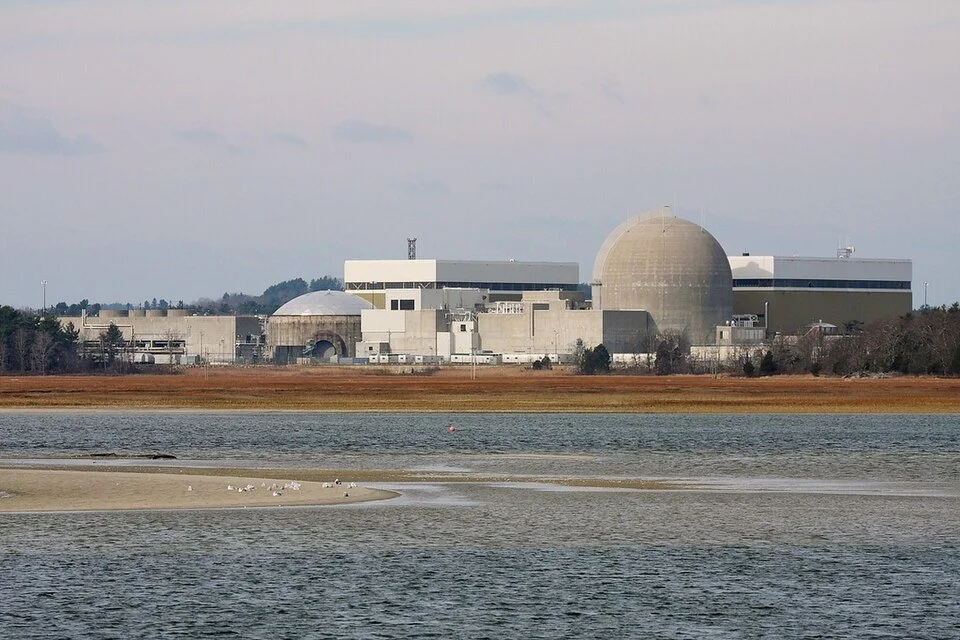
The Seabrook Nuclear Power Plant, in Seabrook, N.H., one of the only two remaining such plants in New England. The other is the Millstone Nuclear Power Plant, in Waterford, Conn.
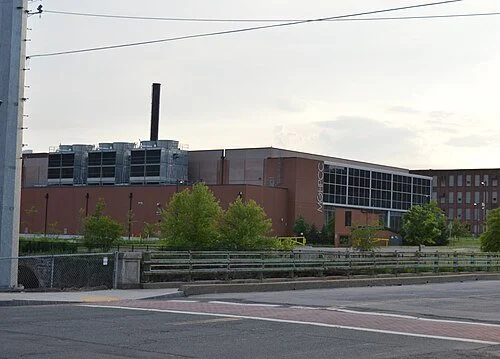
The Massachusetts Green High Performance Computing Center (MGHPCC) is an intercollegiate high-performance data center facility in Holyoke.
WEST WARWICK, R.I.
There is an abiding faith that if someone is good at one thing, they must be good at many things. At heart, it is a belief that outside the metaphorical box, there is much greater ability than inside it.
This is once again on display with widespread enthusiasm for the idea that the looming shortage of electricity can be solved by companies like Amazon, Google, Microsoft and Meta because they have been so wildly successful at what they do — and have mountains of cash to demonstrate it. Also, it is thought they will somehow do it better than the entrenched utilities.
The argument is that those who use vast new quantities of electricity for data centers will pay for its generation, and somehow the rest of the electricity supply system will be unaffected. It won’t.
The new dedicated generators will still buy steel, connectors (wires), transformers, switches, and the myriad bits that go to generating and transmitting electricity. They will still buy uranium, natural gas, strain the gas pipelines and the transmission system.
They will still buy available solar cells, wind turbines and dominate the competition to site these. They will be exerting four-square price pressure for all supplies, including utility-scale batteries.
The data center-dedicated generator will still compete in the labor marketplace for precious skilled workers, now in perilous short supply as the utility industry, without counting data center generators, spends well over $2 billion yearly on upgrading its systems.
I am not saying it isn’t a good thing to shake up the utility industry. I am saying not to expect magical new electricity developments that won’t affect everyone. The bills will still come, and they will be hefty.
Also, big tech will learn some sharp and costly lessons.
The thing about the Internet and the world of computing is that they have been a zero-sum game. There are no rules, there is no legacy drag, and every invention, every step forward, enters the marketplace unencumbered.
There was nothing and no one to hold things back. There still isn’t, except for the availability of power for the data centers.
Not so in the electricity ecosphere. There are rules — local, state and federal. There is political oversight, and issues such as land use, water supply and air pollution must be factored in.
The new generation has to accommodate the rules of yesterday. It will be examined, debated, disputed and delayed.
For big tech and artificial intelligence, its latest frontier, everything is possible. But in their new role of making kilowatt hours, there are entrenched stakeholders and they are vociferous and opinionated, and NIMBY (Not In My Back Yard) is an ever-present reality.
Building a power plant isn’t like designing an algorithm. It isn’t done in secret and then released to the world, as ChatGPT did in November 2022. It must be collaborative and transparent at every step.
The tech giants are betting on nuclear power for their future power needs. Two of them, Microsoft and Google, are supporting restarting mothballed reactors, Three Mile Island, in Pennsylvania, and Duane Arnold, in Iowa. All of them are interested in small modular reactors and have working arrangements with SMR developers.
In this way, the future of nuclear power may rest with the tech giants: They have the money to take the risk. Microsoft has even signed an agreement with Helion, a company planning to bring fusion power to market.
These developments favor a bright future for all electricity as the tech giants assume the challenges and risks of new nuclear technologies. But they won’t contain electric bills in the years ahead. These will continue to rise.
The utilities are doing what they can to contain these bills. The future demands significant expenditures, and, in some way, these will be reflected in consumer electricity costs.
The fact that the tech giants with money aplenty are going to shoulder greater risks doesn’t mean that their presence as ever more demanding electricity consumers won’t affect the commodity’s cost.
The war with Iran will affect global electricity demand. Countries will seek to substitute electricity for oil and gas where they can, thereby straining already-tight supply chains for generation and transmission components.
The essentiality of electricity is growing, as is the household outlay on it. Ouch!
On X: @llewellynking2
Llewellyn King is executive producer and host of White House Chronicle, on PBS, and an international energy-sector consultant. He’s based in Rhode Island.
Llewellyn King: Loving Ireland on St. Patrick’s Day, with all its contradictions

A St. Patrick's Day procession in Downpatrick, Northern Ireland, where St. Patrick is said to be buried.

The Chicago River dyed green for S. Patrick’s Day.
— Photo by Scott M. Liebenson
WEST WARWICK, R.I.
St. Patrick’s Day is Tuessday, and I won’t let it pass without wearing something green and reaching for a glass of something that has been produced through fermentation or distillation. It is the least I can do for all the ways the Irish have enriched the world, but especially the English language, and me.
When it comes to writing, the Irish have what might be termed an ethnic advantage, from the literary game-changers in the last century — George Bernard Shaw, James Joyce, Samuel Beckett and Brendan Behan — to two of the top practitioners of novel-writing today, Sally Rooney, who is only 35, and the prolific and so-readable John Banville.
When it comes to poets, William Butler Yeats is, to my mind, seated among the immortals.
Yet, as I enjoy my St. Patrick’s Day libation, I shall reflect on the contradictions that are Ireland. These are summed up in a personal experience.
I was, for over 20 years, the American organizer of the Humbert Summer School in Ballina, Co. Mayo. One of my missions was to take Americans — often Irish Americans who had never been to their ancestral land — to Ireland and the school.
Summer schools in Ireland are akin to Renaissance weekends or Aspen Institute meetings in America. Some are literary, like the Yeats Summer School in Sligo, or political, like the Parnell Summer School in Co. Wicklow, or musical, like the Willy Clancy Summer School in Co. Clare.
Mine, alas, is defunct, but it was named after the French General Jean Joseph Humbert who landed in Killala Bay to help the United Irishmen’s rebellion against the British in 1798, which was celebrated in Thomas Flanagan’s novel “The Year of the French,” and the movie based on it.
The Humbert School was the creation of its director, John Cooney, a distinguished journalist and major historian. Its mission was to discuss Ireland’s future at home and abroad.
Before the start of one year’s summer school, I briefed my Irish American charge, Ray Connolly, on just how awfully the British, my people, had behaved in the northwest of Ireland, from colonization in 1611 to the 1798 rebellion, to the famine of 1846, when so many perished or fled in the great diaspora, to the notorious Black and Tans after World War I. They were a paramilitary force formed in 1920 to reinforce police posts, act as escorts, and conduct counter-insurgency operations. But their cruelty caused many Irish people to join the Irish Republican Army.
I spared nothing in the telling of Albion’s perfidy in Ireland.
After the weeklong summer school, on our drive to Dublin Airport and our flight back to Washington, we stopped in a pub. When the publican heard my English accent, he asked, ”How’s the weather over there?” I knew he meant in England. I had to explain that I was now an American and had been for years.
The publican threw his arms around me and declared, “God bless you. You never lost your accent.”
Our exchange confused Ray. He reminded me that I had recounted the full litany of English horror in the northwest of Ireland including, after the 1798 rebellion, how Gen. Charles Cornwallis, chagrined after his defeat in America, hanged 20 Irish rebels per day.
“That,” I said of the enthusiastic publican, “is part of the wonder of Ireland: its contradictions.”
Ireland’s relationship with Britain is a fine example of those.
Britain is a prime destination for work and for career opportunities for the Irish. They talk of London with affection, although they may still sing rebel songs with gusto, and mention the horrors of the past as though they were last week.
Under a treaty, the Common Travel Agreement (CTA), Irish citizens have the right of abode in England. For them, there is no frontier; although, I learn, that may change as people who have acquired Irish citizenship, but aren’t Irish-born, are abusing it, adding to the immigration woes in Britain.
If the CTA should end, Britain will lose much, just as America is set to lose Irish talent because of immigration restrictions.
When talking about the impact of Ireland on America – 23 presidents were of at least some Irish descent — it should be noted that America has also had an impact on Ireland.
On the downside, there is fast food. When I asked a cab driver in Dublin about where to get good fish and chips, he said he preferred Kentucky Fried Chicken.
On the upside, there is the celebration of St. Patrick’s Day, which started in America.
But before Americans went crazy for all things Irish on March 17, it was a quiet religious day in Ireland. Now it is more of a celebration there, as it is here and much of the world. Sláinte!
On X: @llewellynking2
Llewellyn King is executive producer and host of White House Chronicle, on PBS.
Llewellyn King: Electronics is robbing Us of much Human contact
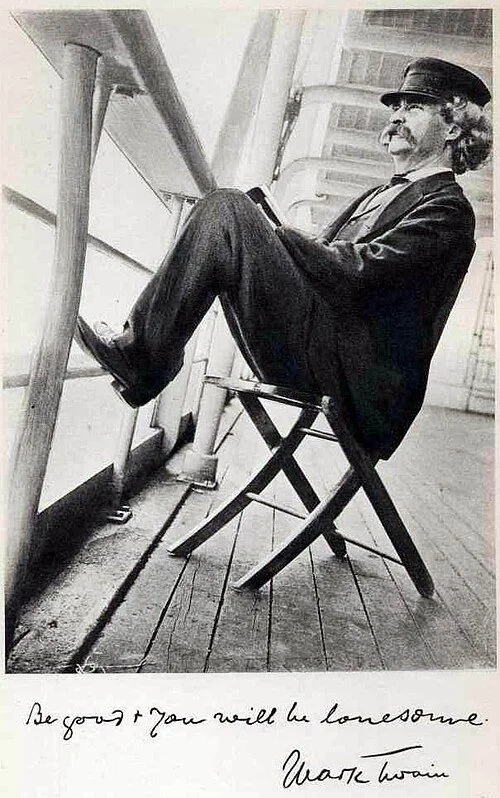
1897 photo
WEST WARWICK, R.I.
You don’t have to be sitting by yourself on an island to be lonely. Loneliness is everywhere.
Studies from universities, governments and public health groups find that the world is in the grip of a loneliness pandemic. More than half the U.S. population is said to be suffering from loneliness. It is classified globally as a mental health problem.
Paradoxically, the studies place most of the blame on our interconnected society and social media: If we communicate electronically, we isolate ourselves. The COVID-19 pandemic also increased our social isolation, and working from home accelerated the trend.
I would suggest that we have been drifting toward loneliness for a long time. Years ago, I wrote about what I called the “box culture.”
In the box culture, people live in a box (apartment), ride down in a box (elevator), get into a box with wheels (car), drive to a stack of boxes (building), ride up in a box (elevator), enter another box (office), and stare into a box (computer).
That, I believe, led to greater isolation. No common dwelling; no common transportation, like a bus or train; and little common work habitat.
The phrase “my space” began to be part of the conversational language. A social networking service named Myspace was launched in 2003.
Email and texting gave isolation a boost even before COVID-19 gave it a massive steroid shot. Now we might be inhabiting “my isolated space.”
Adding to this world of paradox is perhaps the biggest paradox of all — the death of the telephone for the purpose it was invented: talking.
Not only has the telephone declined to near-oblivion as a way of talking to others, but it has also become something of a burden. I find that when I suggest a telephone call, the recipients want to set a time.
When did setting times for calls creep into our lives? It wrings the pleasure out of the telephone, which was always a spontaneous instrument.
When Irving Berlin wrote the song “All Alone by the Telephone” in 1924, he didn’t envisage that people would make appointments to talk.
We have robbed ourselves of the glorious spontaneity, or heartbreak, of the telephone. I have always thought of it as the instrument that can transmute life’s leaden metal into gold unexpectedly, as Omar Khayyam wrote, or as a ray of sunshine you didn’t expect to break through the fog, as Noel Coward wrote. Even just the laughter of an old friend can break out the sunlight on a dismal day.
I can’t catch the laughter in a text. Email is fine for a joke, but it fails where the telephone succeeds: catching the sublimity of laughter, the warmth of love.
Another source of isolation has been the conversion from shopping — the operative part of that word is “shop” — to online buying, a different experience. Or rather, another way of removing the warmth of human interchange from the transaction.
If you are among the legions of the lonely, I would like to suggest, aside from the highly recommended places people meet, like volunteering at a charity or an amateur theater group, going to a pub or to church, do something radical: Speak to a stranger.
My wife and I became friends with two people and their families because I spoke to a stranger in a hotel in Washington, and we spoke to one at a concert in Rhode Island.
We have friends who met while standing in line at an ATM and married not long after. Weight Watchers, when they held meetings, was recommended among the cognoscenti as a place to meet people.
These suggestions may sound trivial, but they are the commerce of life, some of which we have shelved in favor of electronic communications.
In particular, I feel for those who are shut-in by disease and suffer terrible loneliness. They are the loneliest of the lonely.
For many years, I have written and broadcast about Chronic Fatigue Syndrome, also known as Myalgic Encephalomyelitis. It is a terrible disease whose victims have no energy, get no refreshment from sleep, and suffer a plethora of pain, usually for life.
Electronics may have robbed us of much human contact and caused a pandemic of loneliness, but not for those sentenced to loneliness by disease.
On X: @llewellynking2
Llewellyn King is executive producer and host of White House Chronicle, on PBS, and an international energy-sector consultant.
Llewellyn King: Big tech has become a ruthless autocratic oligopoly
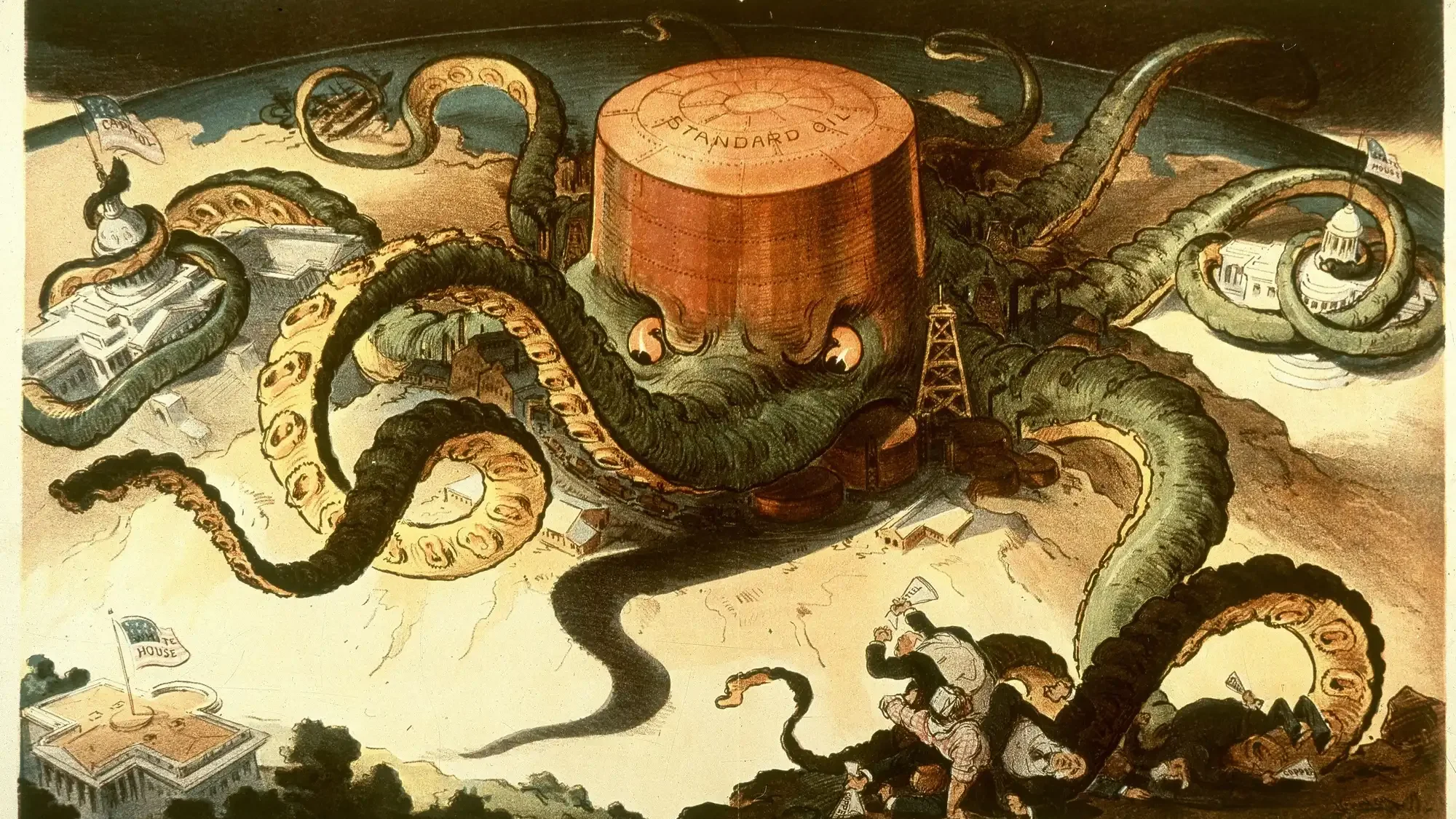
Standard Oil's monopoly at the turn of the 20th Century was often depicted as an octopus, its tentacles infiltrating all aspects of American life. Vanderbilt Law Prof. Rebecca Allensworth says Big Tech companies are like octopuses — "every tentacle is a new set of products."
— Wikimedia Commons
Mark Zuckerberg, in 2005, as another rich kid at Harvard. See the movie The Social Network.
WEST WARWICK, R.I.
"Power tends to corrupt, and absolute power corrupts absolutely.’’
—Lord Acton (1834-1902), English Liberal Party politician, and writer.
For me the most remarkable thing about Facebook boss Mark Zuckerberg’s appearance at a Los Angeles court, to answer questions about the addictive aspects of social media, was that he was there at 8:30 a.m. wearing a suit.
Sarah Wynn-Williams, in her excellent book about Facebook, Careless People: A Cautionary Tale of Power, Greed and Lost Idealism, said Zuckerberg doesn’t see anyone before noon because he has to sleep, having been up most of the night.
This had Wynn-Williams, who rose to head Facebook’s international relations team, sometimes telling heads of state that they would have to wait for the great man to alight from his bed at noon or later.
Zuckerberg could be uninterested or uninformed about the country from which he was trying to get favors for Facebook, she wrote. As Facebook had electorates in its thrall, countries’ leaders were prepared to defer to the sleeping titan.
This doesn’t mean that Zuckerberg is evil, but it does point to enormous self-regard. His sleeping routine is a de facto declaration: I am so rich and so powerful that I can command world leaders to rearrange their schedules to accommodate mine. They did, according to Wynn-Williams.
While the venerable observation by Lord Acton in 1887 is nearly always directed at politicians and autocrats, it is as true for billionaires and their companies.
More so with the tech gargantuans that are a force in the financial markets, a force in politics, and will control much of the future if their investments in artificial intelligence pay off. Among them are Meta (Facebook), Alphabet (Google), Amazon, Apple, Nvidia, Microsoft, Tesla, Anthropic and OpenAI.
Another point, which Wynn-Williams made in her book, is that most of the heads of state whom Zuckerberg treated with minimal respect won’t be in power in 10 years, but Zuckerberg, who is 41, may be around for half a century. The long game is his, along with his colleague-companies and their CEOs, especially when they own a commanding amount of the stock, such as Tesla’s Elon Musk.
The impact of Big Tech as a lobbying force is apparent: Any CEO has access to the White House and is in turn cultivated by the White House. Congress has a permanent welcome mat out to Big Tech lobbyists – and their campaign contributions.
A more damaging impact might be what Big Tech does to new tech.
The biggies buy up every startup that looks as though it might become a mega company. All of the Big Tech companies are conglomerates, and history has shown that conglomerates discard unprofitable enterprises and favor the cash cows. Tech autocracy is no kinder than any other autocracy.
Startups are what keep America ahead of the world in tech, and they are keenly watched for any sign that they may grow into another agent of change. Whereas at the beginning of the tech boom successful startups headed for an initial public offering, now they calculate from the get-go which behemoth tech company will buy them. The circle is closed.
The big get bigger and the startup is absorbed into a giant organization, where it might prosper or whither. Either way it is out of reach, including regulatory reach. It is in the castle walls.
As we see with the fate of CBS and The Washington Post, Big Tech can play havoc with the media and our right to know what is going on. The money is so large that it is almost impossible for politicians not to seek the favor of the mighty techs and their Vesuvian cash flow.
The obverse of that is what they might do if they overreach, as they may be doing now with AI investments, and bring down the stock market.
Big Tech has showered us with wonders that can make life easier and fun for many, but there is a price. The price is that we have handed the future to a group of companies that, understandably, are interested in self-preservation first, as with all autocracy.
Llewellyn King is executive producer and host of White House Chronicle, on PBS and an international energy-sector consultant. His email is llewellynking1@gmail.com, and he’s based in Rhode Island.
Llewellyn King: Washington press corps is swollen, but the news evades it
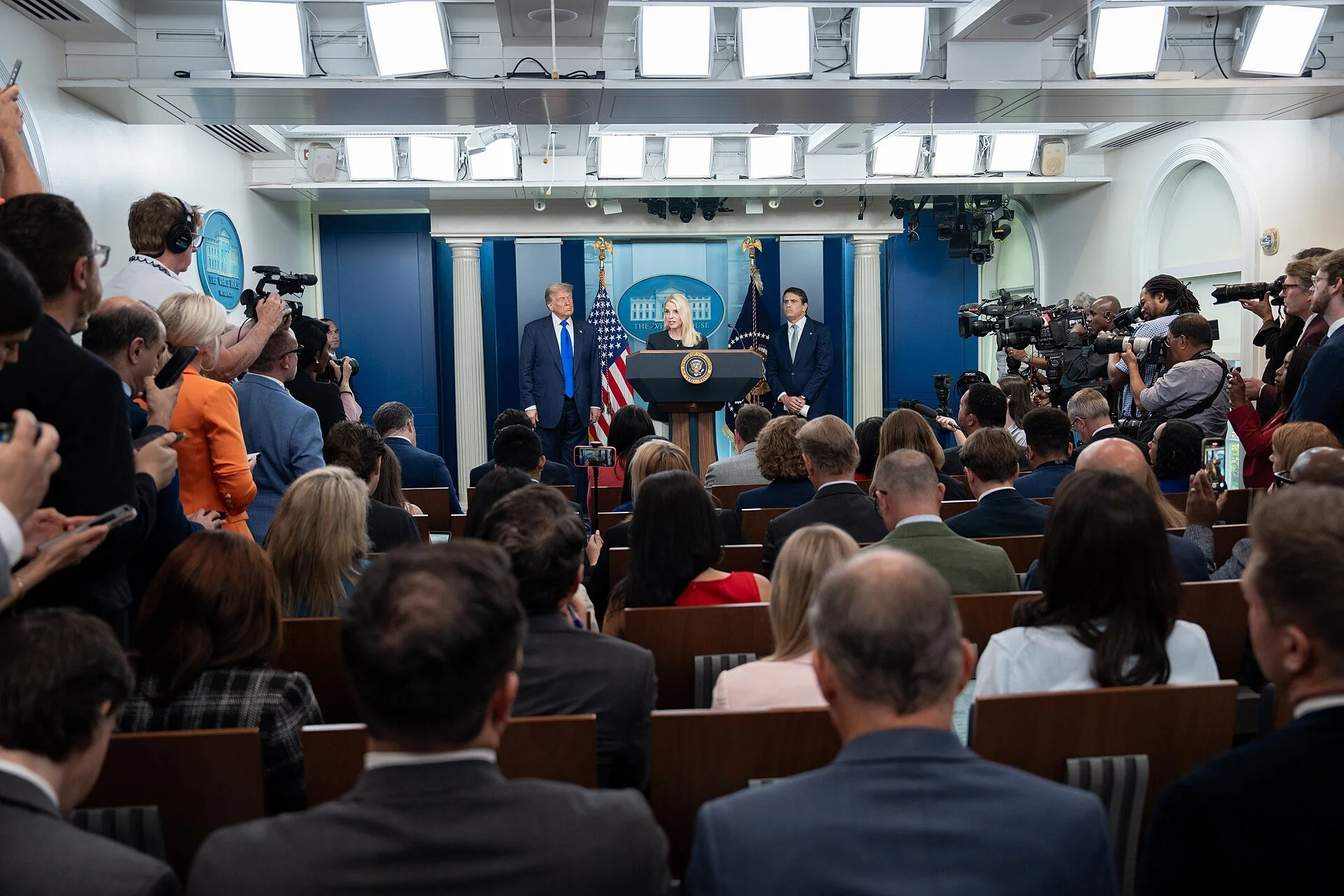
President Trump, Atty. Gen. Pam Bondi and Deputy Atty. Gen. Todd Blanche take questions in the White House Press Room last June.
WEST WARWICK, R.I.
The Trump administration — with the power of the White House being felt from the universities to the Kennedy Center — isn’t the only top-heavy institution in Washington. The media is top-heavy, too.
While state houses around the country go uncovered and local courts go about their business without the light of press scrutiny — a frightening reality — the White House and Congress have more general coverage than they have ever had.
The press briefings at the White House are tightly packed with more standing than sitting. Droves of reporters roam the halls of Congress.
Washington, in media terms, is a two-ring circus.
This doesn’t mean that either the administration or Congress is being better covered. Here, more is less.
The politics that bitterly divide the country have also crippled the old camaraderie between those who made the news and those who reported it.
In the Capitol, reporters thought to have strong political views are favored accordingly. The old repartee, the fun, has gone. Access, the coinage of Washington, is only for those who are subservient.
The White House is a daily pitched battle between the press in general and the administration. Information doesn’t change hands in that atmosphere.
The White House press staff, led by the gladiatorial Karoline Leavitt, abuses and baits the press. It responds with barbs. It’s “Saturday Night Live” every day of the week.
The trend of over-coverage of Washington has been building for a long time, but it has accelerated in Trump’s second term. From day one, it has been a news gusher, a Roman candle of shining, and some dark things, to write about.
Incessant coverage has also been stimulated by the maturing of technology, allowing fast delivery of the product with minimal cost. When the threshold of entry is low, many will avail themselves.
What is harder to get is the real news, what is really happening.
No more do reporters, as I did once, stroll though the West Wing. No more do high officials brief reporters confidentially. And, worse for governance, no more do members of the administration or Congress seek input from the media.
New Hampshire’s John Sununu, President George H.W. Bush’s chief of staff, once told me,“What you tell us is as valuable as what we tell you.” The exchange of information, once seen as vital, is no more.
One phenomenon of the new media ecosystem has been that magazines have started daily feeds, dedicated to what is or isn’t happening in Washington; and what has been triggered from Washington, like the unrest in Minneapolis.
Weekly magazines and a few monthlies are now reporting daily. They are an inbox coagulant. These include Newsweek, The Economist, The New Yorker, The Spectator, The Atlantic, The American Prospect and many others. Even Vanity Fair often files daily.
Add to these the British newspapers that now treat the United States as part of their universe. The Guardian, The Telegraph, The Daily Express, The Daily Mail and The Daily Mirror all have daily American news feeds and virtual editions.
Then there are the noncommissioned combatants, the bloggers, some of whom are favored by the White House and hold White House press passes. No wonder you can’t get a seat when Leavitt’s daily briefing is underway.
It is theater. It is the greatest daily show on earth. The jugglers and the clowns are at work, tossing and catching, and somersaulting. Catch Leavitt on the high wire. Watch CNN’s Kaitlin Collins try to bring her down.
This lack of communication from officialdom extends across the Washington spectrum. Television producers have tired of inviting Cabinet secretaries and members of Congress to come on their programs only to get talking points. That is one reason so much cable television consists of reporters talking about the news they covered or the news they chased but didn’t catch.
As the late Arnaud de Borchgrave, the world-traveling Newsweek correspondent, once told me,“When you and I were young reporters, we wanted to be foreign correspondents. Now everyone wants to cover politics.”
True, and good luck with that.
Llewellyn King is executive producer and host of White House Chronicle, on PBS, and an international energy-sector consultant. His email is llewellynking1@gmail.com and he’s based in Rhode Island.
Llewellyn King: The energy sector and government are inconstant lovers

U.S. energy consumption in 2023.
WEST WARWICK, R.I.
Politics and science are always falling in love, but they seldom live happily ever after. Quick to embrace, messy to separate is the pattern.
Nowhere has this been clearer than with energy, where projects are dependent on some form of government approval, endorsement, funding and sometimes direct involvement — for example, when the Army Corps of Engineers designs a hydroelectric project or the government’s commitment to take nuclear waste.
The late Financial Times science editor, David Fishlock, with whom I collaborated for many years, advised me to be wary of government falling in love with science, because of the catastrophe that ensues when government falls out of love with it.
Consider the love affair between successive U.S. presidential administrations, from Dwight Eisenhower to Gerald Ford, and nuclear power. The administration of Jimmy Carter was cold to nuclear — a cooling that lasted long after he left office.
Carter, a nuclear engineer himself, delivered the lethal kiss when he described nuclear as the choice of last resort. He favored coal and conservation as the best energy policy, and created the U.S. Synthetic Fuels Corp. to exploit coal. Carter envisioned a time when coal would answer most energy needs: coal in the form of synthetic gas, liquid fuel for transportation, and plenty of coal-fired electricity.
Options were few.
I had worked with the Atomic Energy Commission’s Gorman Smith — who later became executive director of the U.S. Energy Association — on a study for President Richard Nixon on the crisis after the Arab Oil Embargo of 1973, and we found the energy cupboard bare. At that time, only nuclear and coal were options. Natural gas was believed to be a resource of the past — the first deputy energy secretary, Jack O’Leary, described it as “a depleted resource.”
Wind and solar were in the dream stage, although the national laboratories were doing yeoman’s work on them.
What wasn’t known was the extent to which technology would upend the energy ecosystem and take it from dearth to abundance.
While Ronald Reagan’s heart was with nuclear, his energy secretary, John Herrington, spooked the debate with his constant leaking to The New York Times about the problems with nuclear waste, and particularly with the large nuclear reservation in Hanford, Wash., where defense waste is stored, dating back to the early days of the Cold War.
Reagan significantly advanced natural gas by deregulating the market and easing the restrictions imposed on it.
Deregulation primed the pump for the explosion that was to come with the perfection of an old technology, fracking, and other technological breakthroughs, particularly horizontal drilling and 3D seismic imaging in gas and oil exploration. A final tech boost to gas was the surge in deployment of aeroderivative turbines — jet engines on the ground — in the late 1980s. They burn gas far more efficiently than placing it directly under boilers, a so-called thermal gas system.
The Joe Biden administration was committed to reducing greenhouse-gas emissions, primarily carbon. It shifted dramatically away from coal and gas and embraced renewables. That administration’s embrace was part of a worldwide transition to renewables, sometimes with aggressive encouragement through loans and tax breaks.
Now with Donald Trump, we have an administration that worships gas, venerates coal, and has come down heavily against wind, especially offshore turbines, even as the world — including China and Europe — has embraced them. It has also criticized solar power, but with less vehemence than its criticism of wind generation.
Nuclear is a favorite now with Democrats and Republicans. However, the Trump administration continues to hamper wind energy, going so far as to cancel offshore leases, while trying to resuscitate the coal industry.
Politics is at work, orchestrating what the administration hopes will be the end of wind and solar.
It also puts them at odds with the big tech companies, which are desperately seeking more green power for their data centers.
Another victim of the administration’s energy policy is hydrogen, a darling of the environmental movement.
The utilities have been here before and have developed a quiet skill in appearing to go along even while they plan — which they do in 25-year cycles — against the four-year political horizon. They have chosen not to challenge the administration’s position with a collective voice.
At present, the administration’s official line is that there is no global warming. The president has called it a hoax and a con. However, utilities are struggling with extremes of winter cold and summer heat that they haven’t historically experienced.
Keep quiet and keep the lights on is the undeclared utility strategy.
On X: @llewellynking2
Llewellyn King is executive producer and host of White House Chronicle, on PBS, and an international energy-sector consultant.