Llewellyn King: Washington press corps is swollen, but the news evades it
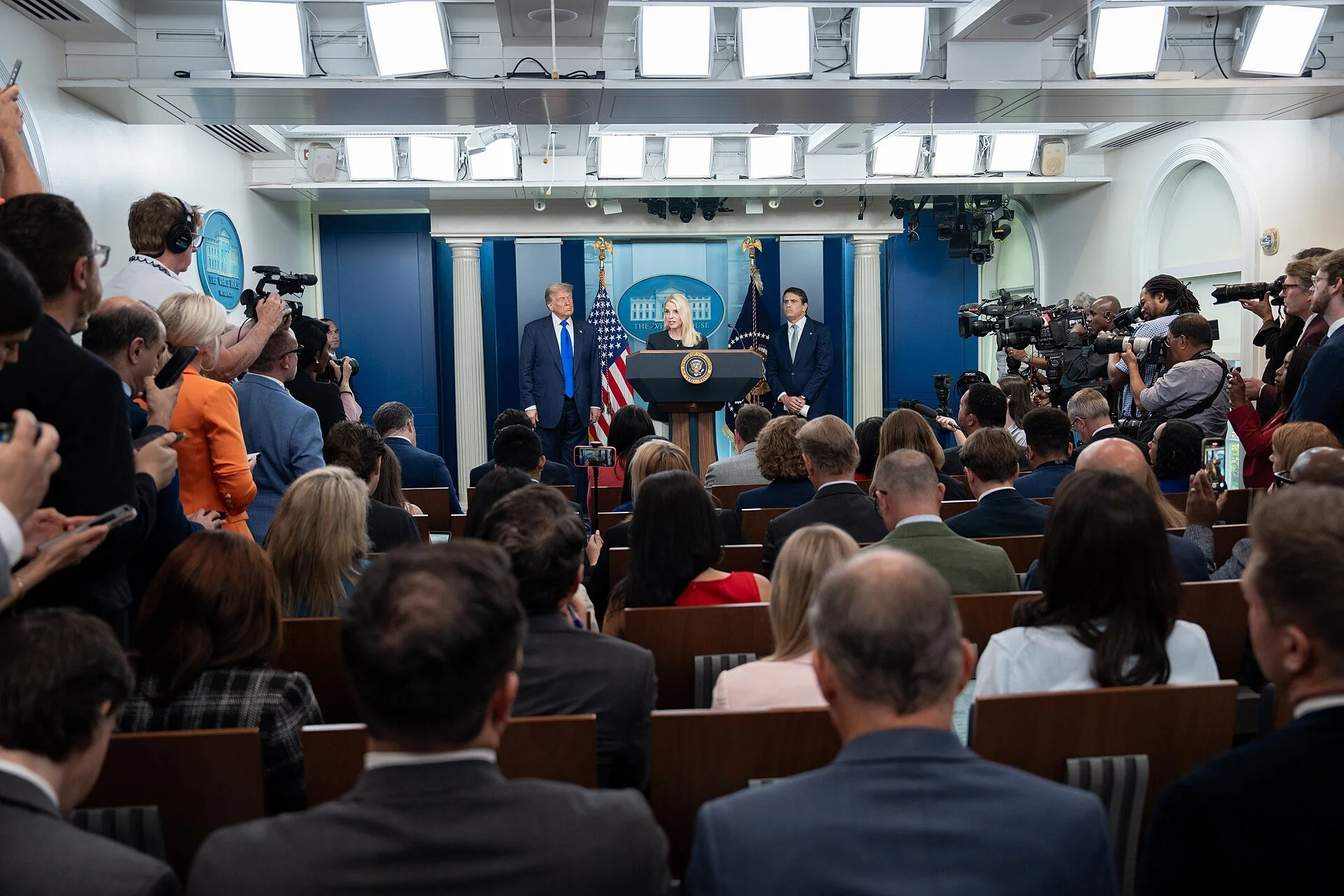
President Trump, Atty. Gen. Pam Bondi and Deputy Atty. Gen. Todd Blanche take questions in the White House Press Room last June.
WEST WARWICK, R.I.
The Trump administration — with the power of the White House being felt from the universities to the Kennedy Center — isn’t the only top-heavy institution in Washington. The media is top-heavy, too.
While state houses around the country go uncovered and local courts go about their business without the light of press scrutiny — a frightening reality — the White House and Congress have more general coverage than they have ever had.
The press briefings at the White House are tightly packed with more standing than sitting. Droves of reporters roam the halls of Congress.
Washington, in media terms, is a two-ring circus.
This doesn’t mean that either the administration or Congress is being better covered. Here, more is less.
The politics that bitterly divide the country have also crippled the old camaraderie between those who made the news and those who reported it.
In the Capitol, reporters thought to have strong political views are favored accordingly. The old repartee, the fun, has gone. Access, the coinage of Washington, is only for those who are subservient.
The White House is a daily pitched battle between the press in general and the administration. Information doesn’t change hands in that atmosphere.
The White House press staff, led by the gladiatorial Karoline Leavitt, abuses and baits the press. It responds with barbs. It’s “Saturday Night Live” every day of the week.
The trend of over-coverage of Washington has been building for a long time, but it has accelerated in Trump’s second term. From day one, it has been a news gusher, a Roman candle of shining, and some dark things, to write about.
Incessant coverage has also been stimulated by the maturing of technology, allowing fast delivery of the product with minimal cost. When the threshold of entry is low, many will avail themselves.
What is harder to get is the real news, what is really happening.
No more do reporters, as I did once, stroll though the West Wing. No more do high officials brief reporters confidentially. And, worse for governance, no more do members of the administration or Congress seek input from the media.
New Hampshire’s John Sununu, President George H.W. Bush’s chief of staff, once told me,“What you tell us is as valuable as what we tell you.” The exchange of information, once seen as vital, is no more.
One phenomenon of the new media ecosystem has been that magazines have started daily feeds, dedicated to what is or isn’t happening in Washington; and what has been triggered from Washington, like the unrest in Minneapolis.
Weekly magazines and a few monthlies are now reporting daily. They are an inbox coagulant. These include Newsweek, The Economist, The New Yorker, The Spectator, The Atlantic, The American Prospect and many others. Even Vanity Fair often files daily.
Add to these the British newspapers that now treat the United States as part of their universe. The Guardian, The Telegraph, The Daily Express, The Daily Mail and The Daily Mirror all have daily American news feeds and virtual editions.
Then there are the noncommissioned combatants, the bloggers, some of whom are favored by the White House and hold White House press passes. No wonder you can’t get a seat when Leavitt’s daily briefing is underway.
It is theater. It is the greatest daily show on earth. The jugglers and the clowns are at work, tossing and catching, and somersaulting. Catch Leavitt on the high wire. Watch CNN’s Kaitlin Collins try to bring her down.
This lack of communication from officialdom extends across the Washington spectrum. Television producers have tired of inviting Cabinet secretaries and members of Congress to come on their programs only to get talking points. That is one reason so much cable television consists of reporters talking about the news they covered or the news they chased but didn’t catch.
As the late Arnaud de Borchgrave, the world-traveling Newsweek correspondent, once told me,“When you and I were young reporters, we wanted to be foreign correspondents. Now everyone wants to cover politics.”
True, and good luck with that.
Llewellyn King is executive producer and host of White House Chronicle, on PBS, and an international energy-sector consultant. His email is llewellynking1@gmail.com and he’s based in Rhode Island.