Gerald FitzGerald: ‘Take him to the Truro line’
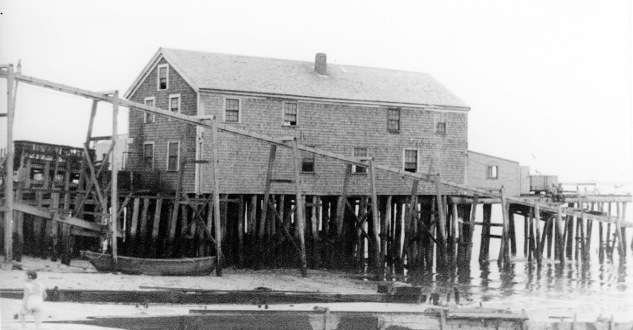
The original, and long-gone, home of The Provincetown Players, founded in 1915 and the origin of The Provincetown Theater.
In 1966, I won the glamorous position of assistant to Armida Gaeta, the assistant of The New York Times’s foreign-news editor. Armida Gaeta was a tiny woman with enormous spectacles and the demeanor of a ticking bomb.
I was 19 and life was glamorous working exactly one step above office boy.
I had begun working for the paper as a messenger carrying advertising copy and art between agencies and the newspaper in a time long before most computers or even fax machines. My brother proofread classified ads there while attending grad school. I had just flunked out of John Carroll University, in University Heights, Ohio -- news I wouldn't tell my parents until I had a place to stay, a job, and was enrolled in evening classes somewhere.
Helen Durrell was a notable figure in The Times’s personnel operations. She hired me on as a messenger; later I was promoted to office boy. When the newsroom job opened up, she told me that I had to type 60 words per minute even to be interviewed. When I was a kid, Mom had taught me to type by drawing the keyboard of her old Underwood on a shirt cardboard and taping it to the wall in front of me.
“Never look at the keys, just the drawing, and you'll see it forever,” she said.
I thought that I could qualify, so Helen gave me the typing test.
I blew it, finishing at 40 wpm, and then asked when I could take it again. Helen told me I could when I had practiced at home and brought myself up to speed.
“How about tomorrow morning?” I asked.
Helen seemed surprised but didn't say no. That evening, I returned to East 4th St., in Greenwich Village, with beer and cigarettes and checked my typewriter's ribbon to be sure that I wouldn’t discover that I needed a new one after the stores closed. All night long, I sat typing some version of “The quick brown fox jumps over the lazy dog” --- a pangram containing every letter of the alphabet. I hardly ever paused but to sip beer or to use the john. Good thing I could type and smoke simultaneously.
The next day I retook the test and clocked at better than 60 wpm. Aided further by a letter of reference from The Times’s chief legal counsel, James Goodale, secretly orchestrated by his two friendly secretaries, I got the job on the third floor’s huge open newsroom.
For a kid who'd dreamed of news writing since he was old enough to attend movies, I was in heaven. What I mostly did was to compose and distribute a list of the daily whereabouts of each foreign correspondent. My desk was next to those of Seymour Topping, the foreign-news editor, and reporter Harrison Salisbury, just back from duty in Moscow.
The newsroom was an equivalent to square city block, and with few interior walls. It was so big that microphones and loudspeakers were needed to page people to report to the metropolitan desk, the sports desk, the national desk, the foreign desk, obituaries or any other part of the operation. A row of wire-service (Associated Press, UPI, Reuters, Agence France-Presse, etc.) teletype machines, constantly sounding bells and keystrokes, stood one after another after another from West 43rd St. to West 44th St.
xxx
Only my then-19-year-old mind could possibly explain why I carried just $5 for a week's stay in Provincetown, Mass. But at least I already had my ticket to Eugene O'Neill's A Moon for the Misbegotten, at the famous Provincetown Theater, along the beach. The theater’s origins go back to 1915, with the establishment of the Provincetown Players.
My tall, blond buddy, Dennis Niermann, nicknamed “The Swede” and from Ohio, would hitch with me as far as Boston. He'd been visiting my fifth-floor walk-up single-bedroom apartment at 73 East 4th St., between Second Avenue and Bowery. I had taken it over from my brother and usually had two roommates to split the $85-a-month rent three ways.
Taking the long route home to Cleveland, Dennis was doing me a favor, but he wouldn't have minded the company, either. At the time he may have been reading electricity meters for a living but, just so you know, he later became a renowned anti-discrimination lawyer. We got to Boston easily and early. We probably grabbed a burger at the Paramount, a Greek place on Charles Street, but eventually walked over to Boston Common, where we rolled out our sleeping bags in the dusk atop a grassy hill just beneath the looming column of the Soldiers and Sailors Monument and slept on the ground undisturbed through the night. You could do that back then. After coffee somewhere, Dennis and I split, he hoofing over to the Mass Pike West and I to hitchhike on Route 3 South, toward Cape Cod.
I don't remember how many rides it took to reach Hyannis, the biggest town center on The Cape, but I recall that it was getting dark and starting to rain as I walked up Main Street in search of somewhere dry. I had visited Hyannis years earlier, when New York neighbor Jack McCarthy took me deep-sea fishing with his son, Johnny. Mr. McCarthy won the boat pool for most fish; Johnny won for biggest, and I won for the first fish caught.
This time I walked past the miniature golf course, where we'd played to celebrate. Just down a cross street, I found a wooden three-sided shelter with a bench and roof. It must have been provided for those waiting for a bus or train. I snuggled into one corner and began to assess my chances of spending the night there without getting rousted by an overeager patrolman. My hand brushed something I could not see in the dark shelter.
It turned out to be one of those small leather change purses. I snapped it open. Inside were two fives and two singles and some quarters, dimes and nickels. No I.D. No phone number. Not even a scrawled nickname. My personal wealth had just catapulted from maybe two bucks to almost fifteen.
I remembered a sign for a really cheap-looking lodging back along Main Street, not a far walk from the miniature golf course on the same side of the street. I found it and purportedly clean sheets for something like $3 a night. I am sure that its exterior sign used the word “Hotel,” but, make no mistake, it was a flop house. The room was the size of an elevator, and none of its walls reached the ceiling. A flop house in Hyannis seems somehow strange, but there it was, and it was dry and I took it.
The next day, I found Route 6 North and, eventually, Provincetown, and walked to the playhouse. I had no plan other than to redeem my ticket, but that would not be for a night or so.
I know that somewhere I still have the playbill from the small wooden theater that burned down about a decade later, but as I write I cannot put hands on it.
I know I have it because I never once in my life have discarded a playbill. I always kept them, and if years later I attended a show with my wife and/or my kids, they signed my playbill. I am going to have to inspect our attic closely. In my dad's Empire book case I have all the playbills from the last nearly 50 years we have lived in our present home. The earlier ones must be boxed somewhere in the attic.
My memory of the small wooden theater along Cape Cod Bay might be distorted.
I spent the week sleeping beneath an overturned dory on a tiny strip of beach that I recall as being between the playhouse and Bradford Street. But that's crazy. The beach must have been on the harbor side of the theater. There were wooden benches inside and space to seat fewer than 200. The theater was made of wooden planks and was caressed by a salty breeze. I don't think that it was insulated at all.
Carved upside down in the port side of the bow of the wooden-plank dory were these words: “The Baron's crib.” I took this to mean that a former adventurer had escaped the elements and, possibly, the nosy, while resting concealed and dry beneath the overturned boat. So that is what I immediately decided to do.
In Provincetown I enjoyed the O'Neill play, whose lead character, Jamie Tyrone, was based on the author's ne'er-do-well older brother in a kind of expansion of the playwright's Long Day's Journey Into Night. My days were spent lazing on the beach reading while eating bread and bologna or occasionally walking through town. I was warm, dry and comfortable within The Baron's crib. Until my very last night.
In the morning blackness, at about 2 or 3 a.m., glaring light burned my face closely, held like a weapon by a uniformed police officer lifting the dory while growling about impermissibly sleeping on the beach. He ordered me to accompany him to Town Hall, a few blocks away. I don't recall that he handcuffed me. We walked to the closed building and, somewhere on the side toward its left rear entered a jail. There was one cell, two at most. A man occupied the only cot in the cell, where they placed me so that if there really were two I think I would have asked for the empty other. Anyway, the man rose as I entered. He reeked of a superhuman dose of cologne. Truly fetid.
It now being surely around 3 a.m. I asked the guy when he'd been arrested. After 10 p.m., he guessed.
“So you've had five hours on the cot,” I told him. “I guess it’s my turn.”
I stretched out on the rumpled, sickly-sweet smelling sheet and was glad to have it. I've always been able to sleep pretty much anywhere, but this was genuinely difficult. My roommate meanwhile sat on the floor, his back against the bars.
I do not recall being offered anything to eat or drink in the morning, and I think we may have been cuffed to go upstairs to the large room being used for court. I was callow enough to be mostly concerned that observers might consider me to be “with” my cellmate, whose offense I never did learn.
When my name was called, I stood before the black-robed judge sitting above the rest of us. He told me that sleeping on the beach carried a $25 fine and asked me if I had anything to say?
I looked up at him and said, quietly:
“Your honor, if I had 25 bucks I wouldn't've been sleeping on the beach.”
The judge looked at me and then turned, a bit harshly, toward a uniformed cop standing off to the side of his bench.
“Take him to the Truro line!” snapped his honor. (Truro being the next town south.)
My response to the judge was the first of hundreds, if not thousands, of responses to judges following a series of news jobs and what became close to 40 years of addressing courts as a trial lawyer. Never having paid a dime in penalty for sleeping on the beach, I guess it counts as a win.
Gerald FitzGerald’s career has included being a newspaper editor, a writer, a prosecutor, a defense lawyer and a civic leader. He lives on Massachusetts’s South Coast.