
Vox clamantis in deserto









Chris Powell: Panel on school financing in Conn. is rigged
MANCHESTER, Conn.
A 23-member committee appointed by Connecticut Gov. Ned Lamont and legislative leaders will convene next week to start devising what the governor wants to be "a top-to-bottom overhaul of how the state funds its public schools."
Methods of school financing are always questionable as to fairness and effectiveness. But just as you shouldn't ask the barber if you need a haircut, you shouldn't ask educators how schools should be financed, for they always will want to get more money by any means, especially means that make the money harder to track, results harder to measure, and accountability harder to achieve.
Unfortunately the governor and legislative leaders have arranged for educators to dominate the committee, though reforming school finance is not a matter of educational practice at all but one of tax fairness and effectiveness.
The inclinations of 17 of the committee's 23 members can be fairly presumed.
Twelve, including the state education commissioner, are employed by school systems or other education agencies. Then there are the president of the state's largest teacher union, a state legislator who is a labor union official, and a legislator who used to be one. Another committee member leads a group that advocates more school spending. The committee's chairman, the governor's deputy chief of staff, used to be the Education Department's legal director.
Only six of the 23 committee members are from outside the education establishment and might feel free to provide analysis independent of the education establishment's desire to raise and spend more money -- not that they will.
That is, the committee is ridiculously rigged.
At least in announcing the committee appointments, the governor briefly referred to the greatest failure of public education in the state: "We need to take another look at how we're maximizing student outcomes."
Another look?
When was the last time that state government measured student performance against school spending and held anyone to account for results?
What exactly are the mechanisms of accountability in public education in Connecticut? When has anyone in authority been challenged about student performance?
Chronic absenteeism is a big problem in many school systems, but when have parents \ been held to account for it?
In fact, public education in Connecticut is built on prohibiting accountability.
That's what binding arbitration of teacher union contracts is about: hobbling public administration, making the union interest equal or superior to the public interest. Binding arbitration prevents elected school boards from running school systems on behalf of democracy even if they want to, which they seldom do.
That's what tenure for teachers is about, making it nearly impossible for schools to fire teachers for anything short of murder.
That's what the exemption of teacher evaluations from the state's open-records law is about.
That's what the minimum school budget requirement is about, making it nearly impossible for school boards to control spending even if student enrollment falls substantially.
That's what state government's refusal to require proficiency tests for student advancement from grade to grade is about. Social promotion is the ultimate prohibition of accountability in education.
Who in the education establishment wants accountability enough to undo those things? No one.
The main problem of public education in Connecticut is that it's not really public at all.
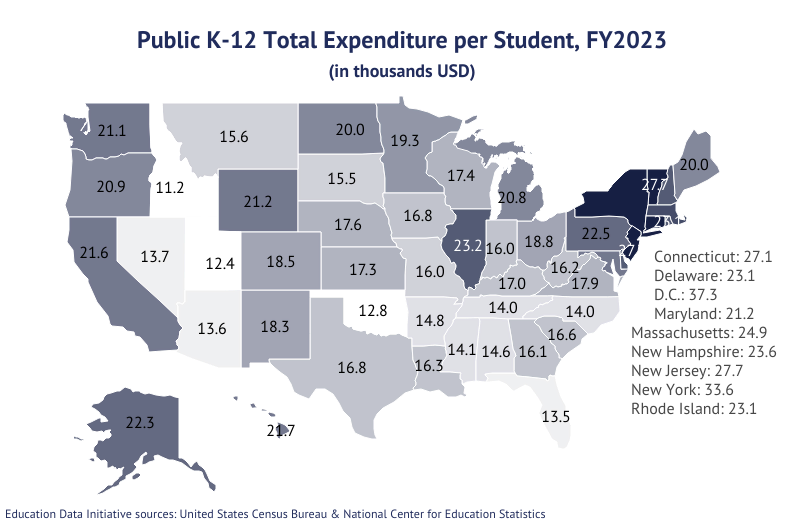
State government can tinker forever with school funding systems in pursuit of fairness. Financing schools entirely from state government, as with a statewide property tax, is an obvious option. But no tinkering with funding formulas will improve school performance, and tax fairness can be increased only by diminishing local control. Good luck with that.
One blow for fairness might be struck easily. State government could assume all costs of "special education," which would relieve poor municipalities of a hugely disproportionate tax burden, a social cost that should be borne widely. The governor recently mused aloud about this.
Indeed, it could have been done this year. But it's an election year, so the governor and legislators instead put extra money into another round of raises for teachers, euphemizing it again as "aid to local education."
Chris Powell has written about Connecticut government and politics for many years (CPowell@cox.net).