Llewellyn King: Journalism in shiny new electronic wrappers

Detail of Linotype mechanism, at the Museum of Printing, in Haverhill, Mass. Linotype machines, invented in 1884, were once the most used printing technology for newspapers.
— Photo by Printhusiast
WEST WARWICK, R.I.
If you know what is going on in Gaza, it is because a journalist told you.
If you know Health and Human Services Secretary Robert F. Kennedy Jr.'s latest comment about autism, it is because a journalist told you.
If you know that there was a tsunami off the coast of Indonesia, it is because a journalist told you.
If you know that Taylor Swift and Travis Kelce are planning to marry, it is because a journalist told you — in print, over the air or on the web.
Yet when “the media" are discussed, you would think that what is essential isn't journalism, but rather the means of delivery. The death of newspapers is high on the woeful list.
I am a newspaperman through and through. Although I have been involved, often simultaneously, with broadcasting, my heart and soul are in newspapers.
I first set foot in a newsroom when I was 14 — and I left part of me there.
I learned a lot about hot type (via Linotype machines) in my youth, and I love the mechanics of newspapers. At The Washington Post, where I had a roving assignment, I often worked on “the stone," where the type was put in the pages by artisans of extraordinary skill.
But that has gone. Hot type is history. If you want to savor it, tour the Museum of Printing in Haverhill, Mass.
Sadly, I must confess that no printed newspaper is delivered to my home every day. I subscribe to the digital versions of four newspapers, four magazines and several online-only outlets, and I suffer jabs of guilt when I sit before a computer screen.
Nearly all major newspapers and many smaller ones have online editions. The largest ones are grabbing much of the subscription money.
That is a repeat of what happened in big cities toward the end of the golden days of words printed on paper: The winners took all.
The New York Times drove out the Herald Tribune. The Washington Post drove out The Washington Star and The Washington Daily News.
In the case of printed newspapers, those with just a slightly larger circulation corralled all the advertising. Today's chances are that those with a greater offering will drive out those with a robust offering, but not as dominant as, say, The Times.
Big newspapers have adopted the paywall as the model for the future, and others have had to follow. It will be a pity if that prevails.
A better model would be a pay-to-read arrangement where you join a collective such as Visa or MasterCard and pay for what you want to read. That would provide a stable future for journalism and enable much of the innovation that is going on to be on a sound financial footing.
There is innovation aplenty in how the precious commodity, journalism, is brought to you.
The magazines have morphed into something more: They have become daily newspapers with their emailed editions. The New Yorker, The Economist, The Atlantic and The Spectator have taken this path, among others. Even Vanity Fair has an emailed edition.
Additionally, British newspapers have invaded the United States with some spritely email offerings. The Daily Mirror, The Independent, The Guardian and The Daily Mail are among them.
Then there are many new entries of purely internet vintage. These include but aren't limited to the leaders, Axios and Semafor — although Axios, with revenues of over $100 million, is the clear winner to date.
This suggests that journalism is alive and well and that its future is online, but its revenue stream isn't certain. One hopes that the winner-takes-all history won't repeat itself and that a vibrant new order of journalism, tempting to talent, grows in importance. After all, at one time big cities had many newspapers; New York had more than 20 daily newspapers.
The threshold of entry for Internet publishing is low. A pay-per-view rather than a paywall would establish a new golden era in which skill and talent would carry the day and where the right content would propel its authors and the publications to success.
As to my world of great presses, raging like livid monsters in the middle of night, well, there will be some for a long time. But the new carriers of that critical commodity known as journalism will carry the day.
On X: @llewellynking2
Llewellyn King is executive producer and host of White House Chronicle, on PBS. He is also an international energy-sector consultant.
Setting forth

“Staggering” (mixed media), by Laura Evans, in her show “The Weight: how to move,’’ at Boston Sculptors Gallery.
Photo by Julia Featheringill
“When we have discovered a continent, or crossed a chain of mountains, it is only to find another ocean or another plain upon the further side. . . . O toiling hands of mortals! O wearied feet, traveling ye know not whither! Soon, soon, it seems to you, you must come forth on some conspicuous hilltop, and but a little way further, against the setting sun, descry the spires of El Dorado. Little do ye know your own blessedness; for to travel hopefully is a better thing than to arrive, and the true success is to labor.’’
— Robert Louis Stevenson (1850-1894)
Wartime ‘Shew’ at the chateau
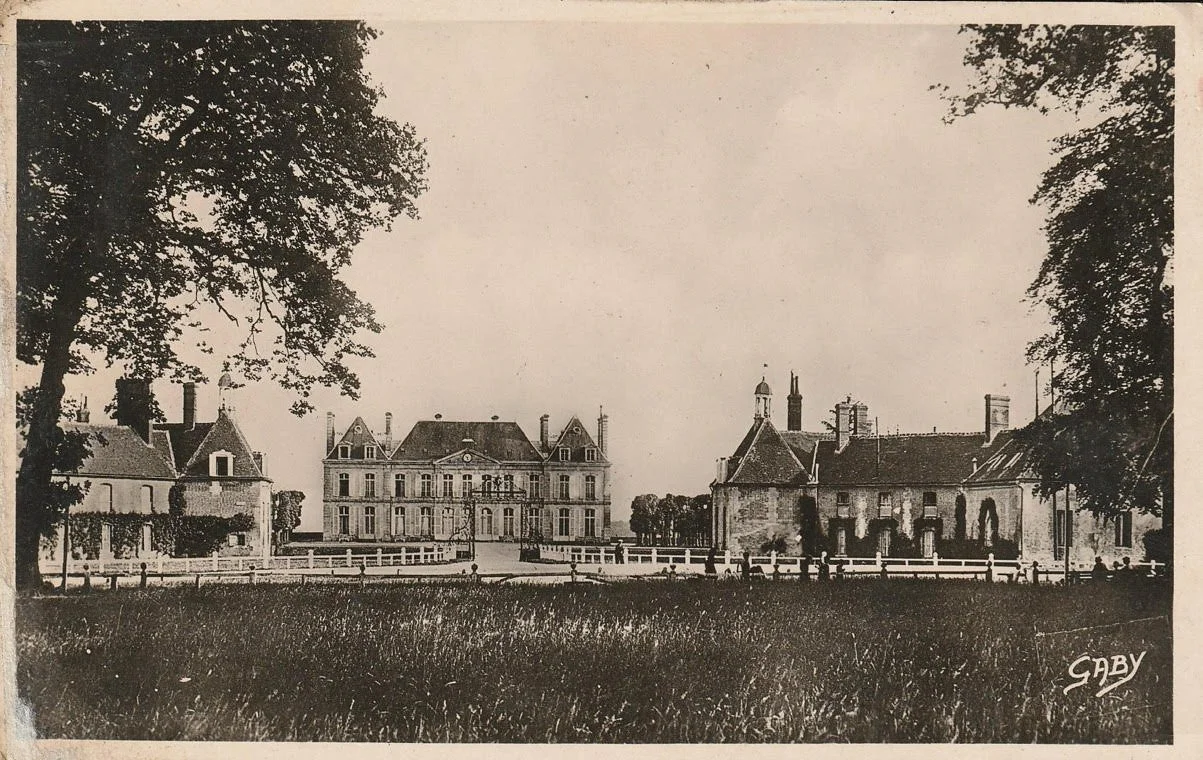
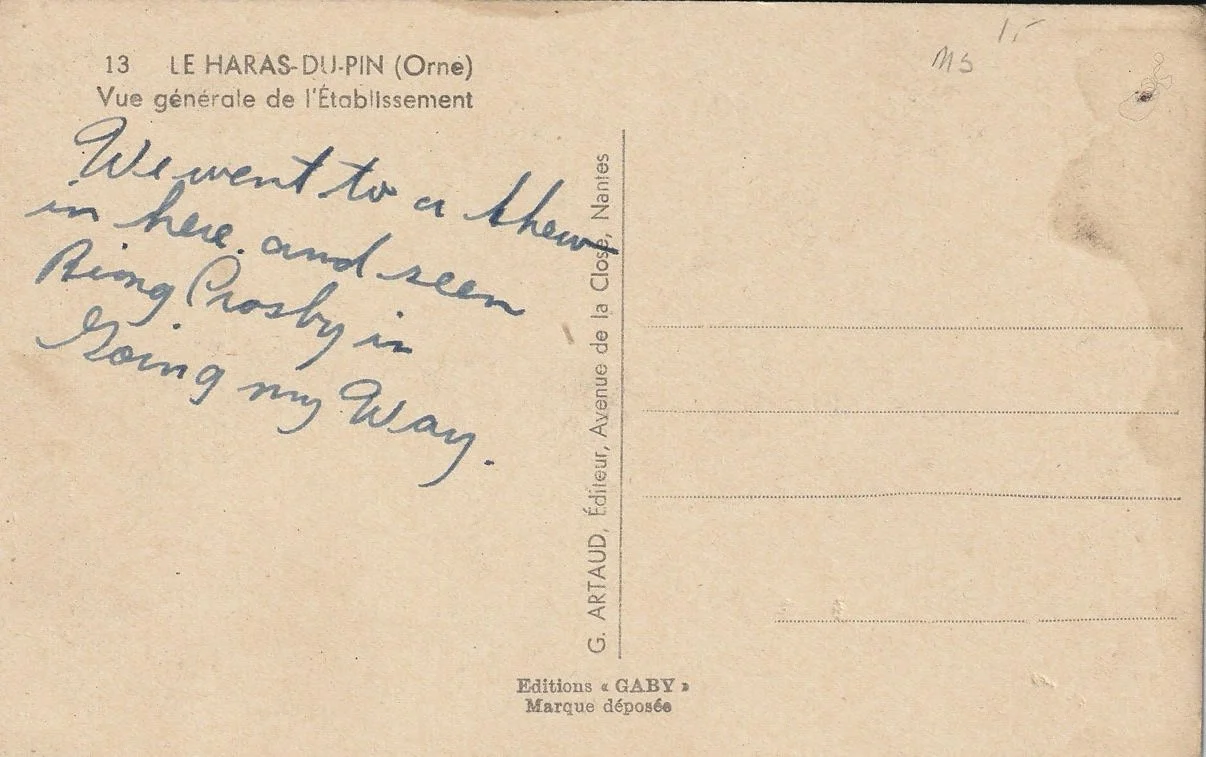
Another $1 postcard in a New England antique shop may offer a mystery, or maybe just a story.
Also known as Le Pin-au-Haras, this early 18th-Century chateau 35 miles southeast of Caen was designed by Robert de Cotte, architect to King Louis XV and successor to the great Jules Hardouin-Mansart, builder of much of Versailles. The complex was the first royal stud farm, created to breed horses for the French army, and was called the equine Versailles.
This postcard, however, dates from 1944, clearly sometime after D-Day, when British troops pushed south from the Normandy beachhead. The area must have been secured enough for the Tommies to safely watch a film at the chateau.
Sadly, the card was never addressed, never sent. But writing in ink, the soldier “went to a Shew in here and seen Bing Crosby in Going My Way.’’ The movie won seven Oscars, including for Best Picture and best song, “Swinging on a Star.’’ It’s star-studded cast and the New York City setting must have offered quite a contrast with war-torn France.
Providence-based architecture writer William Morgan searches for the larger story in the small detail. His books include The Cape Cod Cottage and Academia: Collegiate Gothic Architecture in the United States.

Chris Powell: Trains in Conn. are nice, even romantic, but…

Shore Line East train at Niantic.
MANCHESTER, Conn.
Within living memory of some old people one could go almost anywhere in Connecticut by train or at least take a train to a station near one's destination.
Traveling from north to south across the state by train was much quicker than traveling east to west, the topography presenting more obstacles to east-west railroads. But it could be done.
Rail wasn't as convenient as automobile travel became but it was more civilized and often even enchanting, passing through the secret spaces of nature and industry, amid hints of Connecticut's long history -- the days when little Willimantic was as busy a junction as Hartford, when presidential candidate Abraham Lincoln took the train to Norwich and Meriden, and when the factories that are now in ruins were roaring in Bridgeport and Waterbury.
The romance of the rails endures, even where the rails were torn up long ago and the old grade still provides formal or informal walking trails. Indeed, this romance supplies some of the support for sustaining what's left of the state's passenger railroad service -- the Metro-North system from New York City through Fairfield County to New Haven and, if just barely, Danbury and Waterbury; the Hartford Line from New Haven to Springfield, Mass.; Amtrak from New York to New Haven, Hartford, and Boston; and the Shore Line East service from New Haven to New London.
But how much is the romance or the rails worth to Connecticut residents? With fares on the state's railroads scheduled to rise 10 percent over the coming year, Connecticut's Hearst newspapers found recently that romance doesn't pay the bills. All the passenger trains operate at a loss, sometimes a huge one.
That's no surprise. As noted by Connecticut transportation writer Jim Cameron, every passenger railroad in the United States requires government subsidy.
The subsidy is generally understood with Metro-North, for which government pays half the price of every ticket, about $6.48. Metro-North is the busiest commuter railroad in the country and has tens of thousands of regular passengers in Connecticut, and the southwestern part of the state is so connected economically with the New York metropolitan area that it couldn't manage without the railroad. The Connecticut Turnpike and the Merritt Parkway can't handle more traffic, and the southwestern part of the state contributes so much to state government financially that the railroad subsidy is easy to justify.
But it's something else with the Hartford Line and Shore Line East.
As much as the Hartford area may be glad of a better rail connection to New York via New Haven, it long has had one, while feeble, in Amtrak, the federal passenger railroad. The Hartford Line adds enormous convenience but its passenger volume is not great and probably never will be, since few people in the Hartford area commute to New York for work and working via the internet may keep reducing commuting.
So each Hartford Line passenger is getting an astounding subsidy of $78 from state government.
As for Shore Line East, the subsidy is ridiculous: $184 per passenger. While more trains on the line might add enough convenience to gain passengers, it's impossible to imagine that the subsidy can ever be reduced substantially. There just isn't enough economic connection between the towns along the line.
“Mass transit" can't come close to covering its costs where there is no mass. Metro-North works in large part because there are many local transportation options -- more trains and buses -- when people get off the train in New York City and northern New Jersey. But there are few local connections in New Haven and New London. One doesn't need a car in New York or much of northern New Jersey. But it's almost impossible to do without one in most of Connecticut.
Of course, highways are heavily subsidized by government, too. But they have their own taxes, particularly on fuel, and so can pay for themselves. Unfortunately, as a practical matter Connecticut already has much more passenger rail than it will be able to afford far into the future.
Chris Powell has written about Connecticut government and politics for many years (CPowell@cox.net).
Craft what it all means

“Cosmos,#112’’ (handmade abaca paper with embedded letterpress printed, punched, and intaglio printed paper dots), by Howardena Pindell, in the group show “Making Space,’’ at the Brattleboro (Vt.) Museum and Art Center, through Nov. 2
—Courtesy of Garth Greenan Gallery, New York City
‘Silence Dogood’: Freedom of speech, good government and the security of property
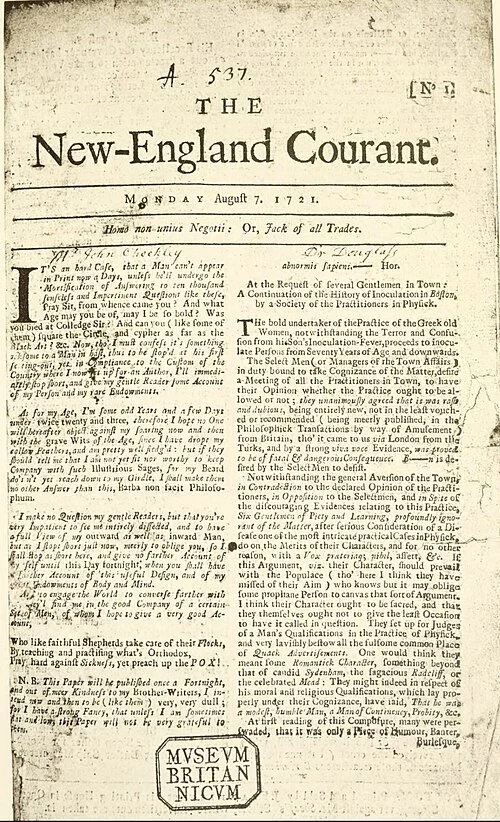
The first issue of The New-England Courant, published in Boston. British colonial officials suppressed it in 1726 for alleged seditious articles. You could say it was a step in the long road to the American Revolution.
Printed in The New-England Courant, July 9, 1722.
Silence Dogood was a popular pen name used by Benjamin Franklin (1706-1790) when he was a teenager to write a series of essays published in the New-England Courant.
Sir,
I prefer the following Abstract from the London Journal to any Thing of my own and therefore shall present it to your Readers this week without any further Preface.
“Without Freedom of Thought, there can be no such Thing as Wisdom; and no such Thing as publick Liberty, without Freedom of Speech; which is the Right of every Man, as far as by it, he does not hurt or controul the Right of another: And this is the only Check it ought to suffer, and the only Bounds it ought to know.
“This sacred Privilege is so essential to free Governments, that the Security of Property, and the Freedom of Speech always go together; and in those wretched Countries where a Man cannot call his Tongue his own, he can scarce call any Thing else his own. Whoever would overthrow the Liberty of a Nation, must begin by subduing the Freeness of Speech; a Thing terrible to Publick Traytors.
“This Secret was so well known to the Court of King Charles the First, that his wicked Ministry procured a Proclamation, to forbid the People to talk of Parliaments, which those Traytors had laid aside. To assert the undoubted Right of the Subject, and defend his Majesty’s legal Prerogative, was called Disaffection, and punished as Sedition. Nay, People were forbid to talk of Religion in their Families: For the Priests had combined with the Ministers to cook up Tyranny, and suppress Truth and the Law, while the late King James, when Duke of York, went avowedly to Mass, Men were fined, imprisoned and undone, for saying he was a Papist: And that King Charles the Second might live more securely a Papist, there was an Act of Parliament made, declaring it Treason to say that he was one.
“That Men ought to speak well of their Governours is true, while their Governours deserve to be well spoken of; but to do publick Mischief, without hearing of it, is only the Prerogative and Felicity of Tyranny: A free People will be shewing that they are so, by their Freedom of Speech.
“The Administration of Government, is nothing else but the Attendance of the Trustees of the People upon the Interest and Affairs of the People: And as it is the Part and Business of the People, for whose Sake alone all publick Matters are, or ought to be transacted, to see whether they be well or ill transacted; so it is the Interest, and ought to be the Ambition, of all honest Magistrates, to have their Deeds openly examined, and publickly scann’d: Only the wicked Governours of Men dread what is said of them; Audivit Tiberius probra queis lacerabitur, atque perculsus est.The publick Censure was true, else he had not felt it bitter.
“Freedom of Speech is ever the Symptom, as well as the Effect of a good Government. In old Rome, all was left to the Judgment and Pleasure of the People, who examined the publick Proceedings with such Discretion, and censured those who administred them with such Equity and Mildness, that in the space of Three Hundred Years, not five publick Ministers suffered unjustly. Indeed whenever the Commons proceeded to Violence, the great Ones had been the Agressors.
“Guilt only dreads Liberty of Speech, which drags it out of its lurking Holes, and exposes its Deformity and Horrour to Daylight. Horatius, Valerius, Cincinnatus, and other vertuous and undesigning Magistrates of the Roman Commonwealth, had nothing to fear from Liberty of Speech. Their virtuous Administration, the more it was examin’d, the more it brightned and gain’d by Enquiry. When Valerius in particular, was accused upon some slight grounds of affecting the Diadem; he, who was the first Minister of Rome, does not accuse the People for examining his Conduct, but approved his Innocence in a Speech to them; and gave such Satisfaction to them, and gained such Popularity to himself, that they gave him a new Name; inde cognomenfactum Publicolae est; to denote that he was their Favourite and their Friend.
“But Things afterwards took another Turn. Rome, with the Loss of its Liberty, lost also its Freedom of Speech; then Mens Words began to be feared and watched; and then first began the poysonous Race of Informers, banished indeed under the righteous Administration of Titus, Narva, Trajan, Aurelius, &c. but encouraged and enriched under the vile Ministry of Sejanus, Tigillinus, Pallas, and Cleander: Queri libet, quod in secreta nostra non inquirant principes, nisi quos Odimus, says Pliny to Trajan.
“The best Princes have ever encouraged and promoted Freedom of Speech; they know that upright Measures would defend themselves, and that all upright Men would defend them. Tacitus, speaking of the Reign of some of the Princes abovemention’d, says with Extasy, Rara Temporum felicitate, ubi sentire quae velis, & quae sentias dicere licet: A blessed Time when you might think what you would, and speak what you thought.
“I doubt not but old Spencer and his Son, who were the Chief Ministers and Betrayers of Edward the Second, would have been very glad to have stopped the Mouths of all the honest Men in England. They dreaded to be called Traytors, because they were Traytors. And I dare say, Queen Elizabeth’s Walsingham, who deserved no Reproaches, feared none. Misrepresentation of publick Measures is easily overthrown, by representing publick Measures truly; when they are honest, they ought to be publickly known, that they may be publickly commended; but if they are knavish or pernicious, they ought to be publickly exposed, in order to be publickly detested.” Yours, &c.
Silence Dogood
It’s only money

“Knowledge, Power, Respect,’’ by Carlin Bear Don’t Walk, in the show “Between Two Worlds: Making Sense of Modern Life Through Indigenous Perspectives,’’ at ShowUp gallery, Boston.
How long can an undone development stay approved?

Proposed One Kenmore
Very slightly edited from a Boston Guardian article by Cullen Paradis.
(New England Diary’s editor, Robert Whitcomb, is chairman of The Boston Guardian.)
With economic headwinds putting many real-estate projects across the city on hold for years, it falls to the Boston Planning Department (BPD) to decide how long is too long for an old plan to stay valid.
It can be hard to make construction budgets work at the best of times, but in recent years resurgent costs have seen a surge of high-profile projects pause their development after winning regulatory approval.
One Kenmore was a 29-story hotel and plaza proposal in the heart of Kenmore Square that finished public review in 2021. Today, market conditions apparently still haven’t recovered enough to make actually building it worth the cost.
“Like a lot of projects, we are considering the broader financing, construction and use environment and don’t have any news to report,” said Diana Pisciotta, president of communications firm Denterlein and spokesperson for proponent Mark Development.
“We remain excited about the transformational project we have proposed in Kenmore Square. Like all property developers, we are considering a variety of strategies to move forward and assure that this project creates maximum positive benefits for the city.”
She confirmed that Mark Development does not currently have any updates on when One Kenmore could proceed.
Air rights parcel 13 at the intersection of Boylston Street and Massachusetts Avenue is another example, where commercial developer The Peebles Corporation proposed a 12-story building with lab space and 125 units of affordable housing. The project passed multiple rounds of public examination in 2023, but since then has been radio silent.
Peebles did not respond by press time to requests for comment on the status of the project.
More recently, the Franklin Cummings Institute admitted that it lost the development partner for its old campus at 41 Berkeley Street. Originally proposed in partnership with developer Related Beal, the upscale senior care center passed public review controversially for BPD approval in 2022. It continued to accrue regulatory approvals as recently as 2024.
Continued, that is, until a listing went up with international real estate broker Colliers showing the property was now for sale, approved plans and all. The Franklin Cummings Institute confirmed that Related Beal had backed out and the project was on hold while they looked for another partner or buyer for the property.
Developments often promise neighbors mitigation funding and public improvements to meet current needs. So what happens when those current needs are years out of date by the time construction actually starts?
The relevant part of the city’s laws is Article 80 of the Boston Zoning Code, specifically section 80A-6.
Project proponents are supposed to notify the BPD if changed plans or lapsed time might subject a project to renewed review, though outside parties can as well. The standard time limit for a period to be “considered significant” is three years between the submission of a project and the next step in development.
If a change of lapse in time is significant, the director of the BPD is the one who decides what, if any, parts of the plan need to be reexamined. The director’s discretion here is broad, but Article 80 does suggest considering increased size, use, traffic, changes to completion schedule or zoning, and changes in the project site or surroundings.
Notably the literal text seems to only mention a three-year period between a submission and its approval as significant, not necessarily after approval, but the BPD gave a statement in response to The Boston Guardian’s questions that suggested the director’s judgement applies to completed processes like One Kenmore as well.
“The director of the BPD has discretion to consider whether a lapse of time following a project's approval significantly increases the impacts of the project and therefore requires new or updated filings and additional review,” it said.
While the BPD does not regularly check unbuilt projects, it does take a look before a final building permit is granted. The agency was less specific about what it considers during those judgements.
“Each project is unique and would include a review of all relevant circumstances specific to that project,” a spokesperson said.
Airy alternatives to driving around here

— Photo by Chacer
Adapted from Robert Whitcomb’s “Digital Diary,’’ in GoLocal24.com.
Trump hates renewable energy (about which he is impressively ignorant, both about its technology and its economics) and public transit. So the general thrust of his policies will be to cause more air pollution (and intensify global warming) and denser road traffic by forcing more people into gasoline-guzzling cars.
Think of that over the next few years when you’re in gridlock on Route 95.
But wait! If you have some disposable income you can fly (at $79 each way) from Logan Airport to New Bedford, in 35 minutes with new Cape Air service, avoiding the claustrophobic traffic in and around Boston. The planes, however, can only take nine passengers.

REGENT Viceroy seaglider model at Dubai Airshow in 2023.
Will REGENT Viceroy “seagliders," electric-powered vehicles that would skim just above the water on “flights” of up to 180 miles along the coast, help reduce car traffic a tad? These vehicles, which would carry 12 passengers, are being developed at Quonset Point. The idea is that they’d blend a (slow) aircraft’s speed with the convenience of a boat. My guess is that tickets would be pricey, and geared to business executives and rich people.
Of course, REGENT’s success would be a boon for the regional economy.
Builds character or fear?

“Cold Plunge” (oil on canvas), by Katherine Bradford, in the group show “Motherhood as Muse,’’ opening Oct. 23 at Concord Art, Concord, Mass.
Tom Courage: What I learned about writing

My writing was certainly undistinguished at The Choate School, in Wallingford, Conn., as my teachers’ reports (which I still have) consistently indicate.
Mr. Gutterson revered E.B. White, and expected me to emulate the breezy, sophisticated froth of a New Yorker magazine “Talk of the Town’’ piece. Nothing could have been more ill-suited to my personality, as a foam-at-the-mouth head-first slide into home plate amidst a choking cloud of dirt is probably the best metaphor for my temperament.
In my term reports, Gutterson portrayed me as a student who combined awkward writing and earnestness. I must acknowledge in retrospect that I had achieved admirable fluency in all the cliches. One of my writing efforts is sufficient to illustrate this.
When I was about 13, my Greenwich, Conn., family moved from the Riverside section to Valley Road in the town’s Cos Cob section, on the shore of the Mianus River (above the dam, built by the power company to generate electricity for the New Haven Railroad ). One of the notable characters in our new neighborhood was an eccentric fellow everyone called Captain Horst, who collected stale bread from the bakeries and delivered it to residents up and down the river, to be fed to the swans.
My story was about Captain Horst, and more particularly about his arrest. Apparently he had been keeping goats in his living room, at odds with the strict dictates of the zoning ordinance of the Town of Greenwich.
Taken in the right direction, such a story might have been right up Mr. Gutterson’s alley.
Predictably, I took a different route, more along the “can’t we all be brothers?” pathway. In Mr. Gutterson’s eyes, I had taken a promising shiny nugget and transformed it into a lump of coal. It is easy to visualize Mr. Gutterson slapping his forehead. My report that term mentioned my steadfast (if boring) pursuit of values.
Mr. Lincoln set me on a different path. Precision was his thing. My writing became like a series of algebra equations. My conclusions followed inexorably from the antecedent text, while giving a wide berth to any ground that might have been considered new or interesting. I continued this approach through my college study of philosophy, and it actually worked quite well.
If there has been any improvement since Choate, I think that performing music was probably a factor. Tone and rhythm are essential elements of flowing prose, and music woke me up to that. Getting the right note is only a starting point; getting the tone and articulation just right is what requires the fullest attention. And just as rehearsing music over and over moves one ever closer to something acceptable, writing allows for endless editing, my favorite delay tactic (greatly abetted by the rise of computerized word processing). Nothing I have ever written would survive another reading without yet a further attempt to make it crisper, more incisive, funnier.
If I didn’t subject myself to the discipline of unyielding deadlines, I would have long since suffocated amidst piles of unreleased drafts.
All this assumes that there is something to explain, and I am not so sure about that. All I can really say, for what it is worth, is that what comes out is just the inevitable result of who I am and all that has happened to me along the way.
And the head-first slide remains a part of that.
Tom Courage, of Providence, is a retired lawyer.
Home before dark

“Farmer’s Dog” (oil on canvas), by Gay Freeborn, in the group show “All Paths Home,’’ at the Lakes Gallery at Chi-Lin, Laconia, N.H., through Oct. 26
N.E. income gaps
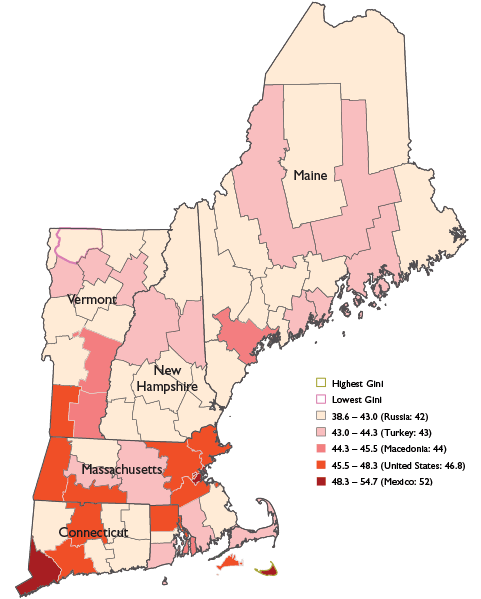
The Gini score has been used to measure income dispersion for a century. A Gini score of one signifies that one household received 100 percent of the income in a region; zero signifies perfect equality of income distribution. The most recent U.S. score was 46.8. This is more uneven income distribution than in Europe, where most countries score between 25 and 35, and similar to Argentina or El Salvador, which score 46 and 47 respectively.
In New England, 62 of the 67 counties score below the United States average (signaling more-equal income dispersion). The region's population-weighted average is 45.2. The county scores range from a low of 38.2 (more equal incomes) to a high of 54.7 (most widely disparate incomes). In Franklin County, Vt. (Gini score of 38.2), the top 5 percent of households receive 16.6 percent of the aggregate income.
In Nantucket County, (Gini score of 54.7), the top 5 percent receive 34 percent of the aggregate income.
Franklin County, Vt., has the smallest gap between low-income and high-income residents. Nantucket County, has the biggest gap. Check the map for your county.
Via the Federal Reserve Bank of Boston
Source: 2006-2010 American Community Survey, prepared by the U.S. Census Bureau, 2011. World Development Indicators, The World Bank 2012.
Into the blue

“Blue Leda Tondo” (encaustic on panel), by Martin Kline, in his show “The Art of Martin Kline,’’ at the New Britain (Conn.) Museum of American Art, Nov. 8-June 7.
Llewellyn King: Fear floods America under Trump

WEST WARWICK, R.I.
There is enough fear to go around.
There is fear of the indescribable horror when the ICE men and women, their faces hidden by masks, grab a suspected illegal immigrant. Their grab could come at the person's home or place of work, while picking up a child from school or standing in the hallway of a courthouse.
That person knows fear as never before. That person's life, for practical purposes, may be over: loved ones left behind, hope shredded. He or she may be shipped to a place where they won't be able to survive.
Fear is there because, maybe decades ago, they sought a better life and voted for it with their feet.
There is no time to argue, no time to ask why, no time to say goodbye. No time to prove your innocence or your U.S. citizenship. It is raw fear — the fear that secret police have always used.
There is the fear of those who work in government — once one of the securest jobs in the country — that they will be fired because their legitimate work in another administration is an affront to this one.
This hammer has come down in the Department of Justice, the FBI, the Department of Homeland Security and the Pentagon. The crime: supposedly being on the wrong side of history.
There is fear in the universities. Once a babel of free, even outrageous speech, they are cowed.
Mighty Harvard, one of the shiniest stars in the education firmament, is dulled, and other universities fear they will be next. Everywhere academics worry that what they say in their classrooms might be reported as inappropriate — their careers ended.
There is fear in the law firms. A new concept is at work: an advocate is somehow guilty because of whom they defended. This violates the whole underpinning of law and advocacy, dating back to Mesopotamia, ancient Greece and Rome, now asunder in the United States.
Media are afraid. Disney, CBS and The Washington Post have bent before the fear of retribution, the fear that other aspects of their business will pay the price for freedom of speech. Journalists fear the First Amendment is abridged and won't protect them.
There is fear, albeit of a lower order, across corporate America as it has become apparent that the government can reach deep down into almost any company, canceling contracts, withholding loan guarantees and, worse, ordering an “investigation." That is a punishment that costs untold dollars and shatters good names, even if no prosecution follows.
Elected officeholders have reason to feel fear. President Trump has suggested that Illinois Gov. JB Pritzker and Chicago Mayor Brandon Johnson should be in jail. Is his compliant Department of Justice working on that? Fear is unleashed for the elected. Doing your job is no protection.
If you have expressed an opinion that could be judged as subversive, the state could come after you. Suppose you walk in a demonstration, exercising your constitutional right to assemble and petition? Suppose you wrote something on social media, so easily traced with AI, which is now out of step with the times? Satire? Opinion? News? Facts that are out of fashion? If you have posted, be afraid.
If you take a flight these days, the Transportation Security Administration will ask you to look into a camera. Then government has a fresh picture of you in its active system, ready for facial recognition software to identify you. It will ID you if you should be walking in a demonstration or just be near one. Your own picture, so easily captured by modern technology, can convict you.
What is the purpose of that picture? It has no bearing on the flight you are about to take. The same thing is true when you reenter the country from abroad. Smile for Big Brother.
Surveillance is a favored tool of the authoritarian state. I have seen it at work in Cuba, in apartheid South Africa and in the Soviet Union. Successive U.S. administrations have been quick to criticize the increasing use of technology for surveillance in China. No more.
Troops are being ordered into cities where the locals don't want them. They come under the promiscuous use of the Insurrection Act of 1807.
Does America fear insurrection? No, but there is fear of federal troops in our cities.
On X: @llewellynking2
Llewellyn King is executive producer and host of White House Chronicle, on PBS, and an international energy consultant. He’s based in Rhode Island.
Let it loose

“Rewilding” (acrylic on canvas), by Marli Thibodeau, in her show at Gallery Sitka, Newport, R.I., opening Nov. 14.
Chris Powell: What next? A course in oppression?

At the University of Connecticut campus, in Storrs.
MANCHESTER, Conn.
Thanks to President Trump, Connecticut now knows a little more about the politically correct nuttiness that afflicts the state's public higher education.
In response to the Trump administration's directive to colleges to get rid of “diversity, equity, and inclusion" stuff or risk losing federal funding, the University of Connecticut said the other day it is suspending a one-credit course on “anti-Black racism" -- a course that seems not to have gotten statewide publicity before.
The Hartford Courant reports that the University Senate voted in 2023 to make completion of the course a requirement for graduation but university administrators didn't get around to doing so. They hope to reinstate the course eventually somehow.
It's not that racism isn't an important subject in United States and world history. It's that separating a course on racism from the teaching of U.S. history and world history -- subjects of which most college students are largely ignorant -- is obviously an exercise in political correctness, guilt mongering, and inflicting a mentality of victimization and entitlement on minority students.
After all, how can one graduate from a high school in Connecticut without knowing that tribalism and racism are basic in history and that the history of the United States in particular is largely a matter of the long and sometimes bloody struggle to overcome them and expand democracy?
But then educational proficiency tests long have suggested that most Connecticut high-school graduates never master high school English and math. If they haven't mastered English, they haven't mastered history. Indeed, they may not even be able to spell it. So for many students a college course requirement in anti-Black racism is probably crowding out basic learning.
The Courant also reports that when the University Senate approved the anti-Black racism course it envisioned adding similar courses about the mistreatment of other groups -- people with darker complexions, Jews, Asians, Muslims, and members of sexual minorities. So maybe, if not for Trump, in another year or two UConn might be offering not just a course in anti-Black racism but entire undergraduate, master's, and doctoral degrees in oppression suffered in the United States, even as the country has been overwhelmed by millions of immigrants who somehow see refuge and opportunity here.
Nowhere has what used to be called the ascent of man been hastened more than in the United States. Land-grant institutions of higher education such as UConn have been a big part of that ascent.
Students admitted to UConn today are amazingly diverse in race, ethnicity, and other backgrounds and are among the luckiest people in the world. UConn should stop using political correctness to turn them into victims.
xxx
Connecticut's ascent was not accomplished by giving the store away as state government long has been doing, a practice exposed again lately by one of the Yankee Institute's journalists, Meghan Portfolio.
Last month Portfolio detailed the case of Shellye Davis, who is nominally a paraeducator in the Hartford school system -- you know, the system that happily advances illiterates and gives them high school diplomas. Davis is president of the Hartford Federation of Paraeducators and secretary-treasurer of the Connecticut AFL-CIO, and Portfolio reported that she doesn't show up for work much even though she is paid as if she does.
Davis was absent from work with pay for 152 days in less than three years -- 55 sick days, 38 “professional development" days, 33 union leave days, and 26 personal days. Some of these days were spent lobbying the General Assembly and participating in political events.
Extreme paid absences like those of Davis are actually authorized for union leaders by the Hartford school system's contract with its unions. State government has a similar practice. In Connecticut the public pays many government employees not to do the jobs they were hired for but instead to work politically against the public interest.
Given their dismal performance, how can Hartford's schools afford to spend money this way? It's probably easier when you don't really care much about education.
Chris Powell has written about Connecticut government and politics for many years (CPowell@cox.net).