Chris Powell: Trains in Conn. are nice, even romantic, but…
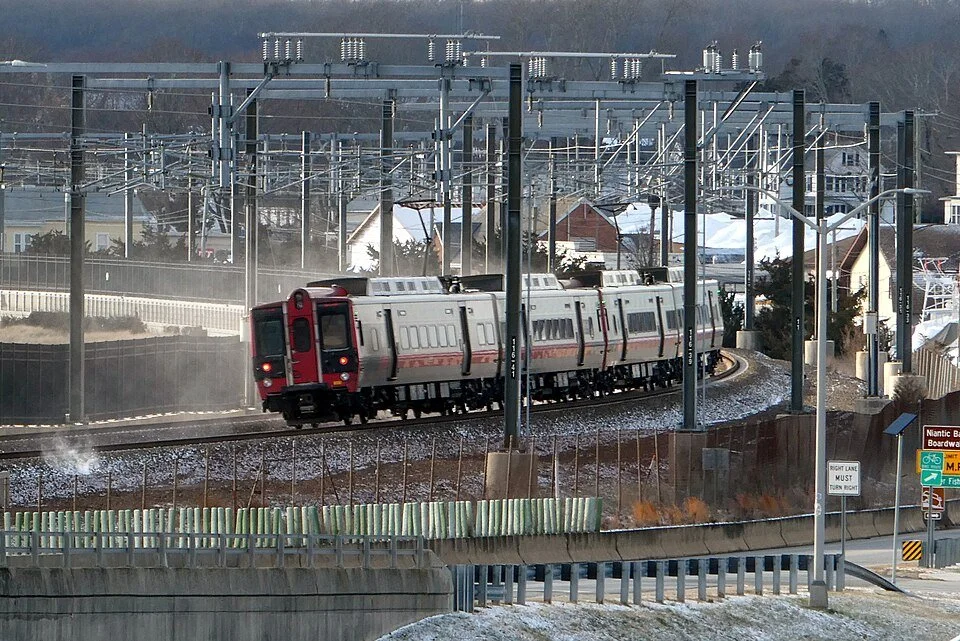
Shore Line East train at Niantic.
MANCHESTER, Conn.
Within living memory of some old people one could go almost anywhere in Connecticut by train or at least take a train to a station near one's destination.
Traveling from north to south across the state by train was much quicker than traveling east to west, the topography presenting more obstacles to east-west railroads. But it could be done.
Rail wasn't as convenient as automobile travel became but it was more civilized and often even enchanting, passing through the secret spaces of nature and industry, amid hints of Connecticut's long history -- the days when little Willimantic was as busy a junction as Hartford, when presidential candidate Abraham Lincoln took the train to Norwich and Meriden, and when the factories that are now in ruins were roaring in Bridgeport and Waterbury.
The romance of the rails endures, even where the rails were torn up long ago and the old grade still provides formal or informal walking trails. Indeed, this romance supplies some of the support for sustaining what's left of the state's passenger railroad service -- the Metro-North system from New York City through Fairfield County to New Haven and, if just barely, Danbury and Waterbury; the Hartford Line from New Haven to Springfield, Mass.; Amtrak from New York to New Haven, Hartford, and Boston; and the Shore Line East service from New Haven to New London.
But how much is the romance or the rails worth to Connecticut residents? With fares on the state's railroads scheduled to rise 10 percent over the coming year, Connecticut's Hearst newspapers found recently that romance doesn't pay the bills. All the passenger trains operate at a loss, sometimes a huge one.
That's no surprise. As noted by Connecticut transportation writer Jim Cameron, every passenger railroad in the United States requires government subsidy.
The subsidy is generally understood with Metro-North, for which government pays half the price of every ticket, about $6.48. Metro-North is the busiest commuter railroad in the country and has tens of thousands of regular passengers in Connecticut, and the southwestern part of the state is so connected economically with the New York metropolitan area that it couldn't manage without the railroad. The Connecticut Turnpike and the Merritt Parkway can't handle more traffic, and the southwestern part of the state contributes so much to state government financially that the railroad subsidy is easy to justify.
But it's something else with the Hartford Line and Shore Line East.
As much as the Hartford area may be glad of a better rail connection to New York via New Haven, it long has had one, while feeble, in Amtrak, the federal passenger railroad. The Hartford Line adds enormous convenience but its passenger volume is not great and probably never will be, since few people in the Hartford area commute to New York for work and working via the internet may keep reducing commuting.
So each Hartford Line passenger is getting an astounding subsidy of $78 from state government.
As for Shore Line East, the subsidy is ridiculous: $184 per passenger. While more trains on the line might add enough convenience to gain passengers, it's impossible to imagine that the subsidy can ever be reduced substantially. There just isn't enough economic connection between the towns along the line.
“Mass transit" can't come close to covering its costs where there is no mass. Metro-North works in large part because there are many local transportation options -- more trains and buses -- when people get off the train in New York City and northern New Jersey. But there are few local connections in New Haven and New London. One doesn't need a car in New York or much of northern New Jersey. But it's almost impossible to do without one in most of Connecticut.
Of course, highways are heavily subsidized by government, too. But they have their own taxes, particularly on fuel, and so can pay for themselves. Unfortunately, as a practical matter Connecticut already has much more passenger rail than it will be able to afford far into the future.
Chris Powell has written about Connecticut government and politics for many years (CPowell@cox.net).