
Vox clamantis in deserto



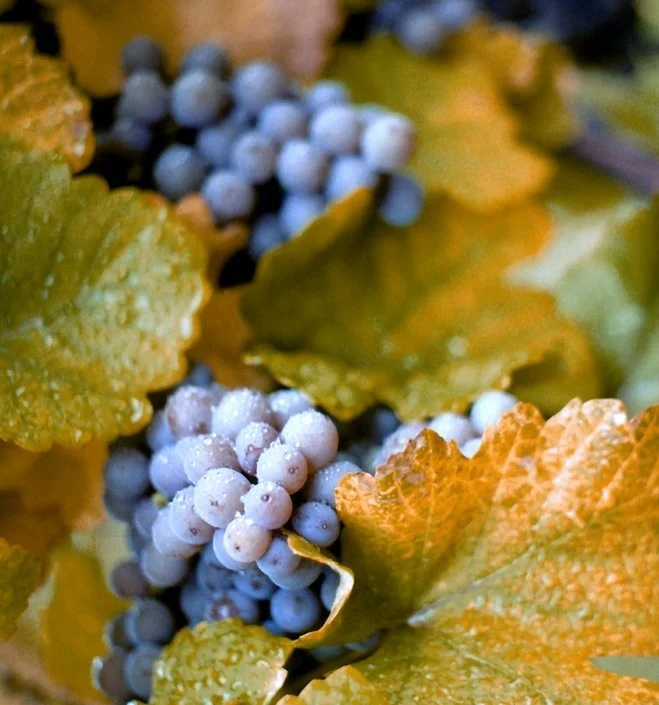
They’re up there to help

“Smoky Panorama” (archival pigment print hand-colored with pastels), by Helen Glazer, in the show “Clouds: A Collaboration with Fluid Dynamics,’’ an group exhibit of cloud photography at the William Benton Museum of Art, in Storrs, Conn., through Dec. 14.
The museum says that although clouds are “often physically far away from life on the Earth’s surface, clouds support life on the planet. We may take them for granted, but like art, we need clouds." This exhibition is presented in collaboration with the University of Connecticut College of Engineering and Professor Georgios Matheou, who recently received a National Science Foundation award for his work on clouds.
It can be very fluid
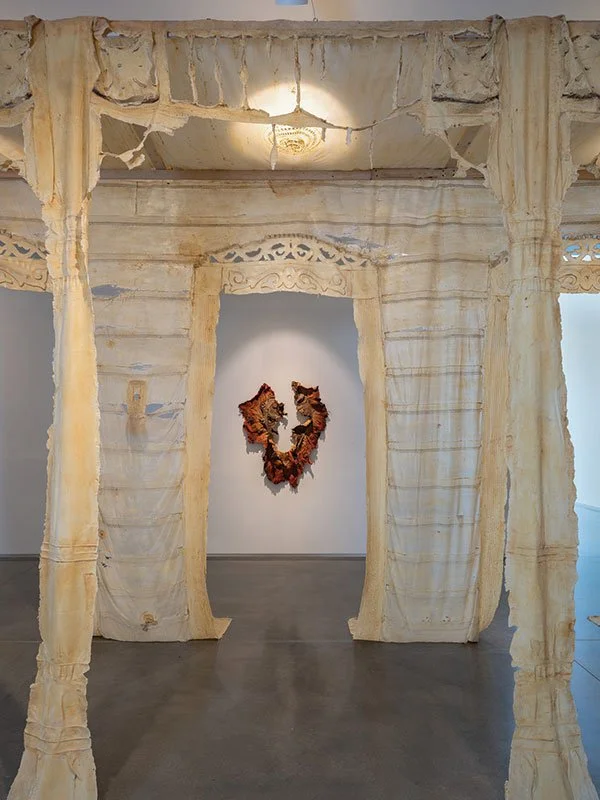
Installation image from Carlie Trosclair’s show “the shape of memory,’’ at the Center for Maine Contemporary Art, Rockland, through Sept. 14.
— Photo by Dave Clough
The gallery says:
“Metaphor is essential to Carlie Trosclair’s work: architecture as body, architectural surface as skin, latex as skin, the domestic space as a vessel of memory and past lives. The resulting sculptures and installations explore the vulnerability and ephemerality of home, as both a physical space and a concept. The poetic takes on a visceral existence in Trosclair’s ghostly sculptures—created by painting liquid latex onto man-made and natural surfaces, allowing it to dry, and then peeling it away. The milky liquid (tapped from rubber trees), applied in multiple layers, dries to a translucent amber.
“At times, the latex picks up color from the original surface; in other works, the artist adds natural pigment to suggest the passage of time.
“Trosclair, the daughter of an electrician, recalls spending her childhood in historic New Orleans residential properties at varying stages of construction and renovation. These memories go hand in hand with the impacts of the Gulf Coast climate, where one is perpetually subjected to evacuation and uncertain return. The repeated act of leaving home and belongings behind led Trosclair to consider closely the haptics of memory and the psychology of place. In recent work, Trosclair expands the notion of regenerative cycles and home beyond the built environment, exploring a symbiotic relationship with the broader landscape.’’
Germán Reyes: Don’t panic about college students’ use of AI
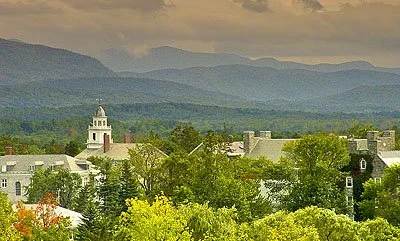
Tower of Old Chapel of Middlebury College, with the Green Mountains in the distance.
— Photo by Dogstarsail
From The Conversation Web site, except for photo above
Germán Reyes is an assistant professor of economics at Middlebury College
He does not work for, consult, own shares in or receive funding from any company or organization that would benefit from this article, and has disclosed no relevant affiliations beyond their academic appointment.
MIDDLEBURY, Vt.
More than 80% of students at Middlebury College, which is considered elite, use generative artificial intelligence for coursework, according to a recent survey I conducted with my colleague and fellow economist Zara Contractor. This is one of the fastest technology- adoption rates on record, far outpacing the 40% adoption rate among U.S. adults, and it happened in less than two years after ChatGPT’s public launch.
Although we surveyed only one college, our results align with similar studies, providing an emerging picture of the technology’s use in higher education.
Between December 2024 and February 2025, we surveyed over 20% of Middlebury College’s student body, or 634 students, to better understand how students are using artificial intelligence, and published our results in a working paper that has not yet gone through peer review.
What we found challenges the panic-driven narrative around AI in higher education and instead suggests that institutional policy should focus on how AI is used, not whether it should be banned.
Contrary to alarming headlines suggesting that “ChatGPT has unraveled the entire academic project” and “AI Cheating Is Getting Worse,” we discovered that students primarily use AI to enhance their learning rather than to avoid work.
When we asked students about 10 different academic uses of AI – from explaining concepts and summarizing readings to proofreading, creating programming code and, yes, even writing essays – explaining concepts topped the list. Students frequently described AI as an “on-demand tutor,” a resource that was particularly valuable when office hours weren’t available or when they needed immediate help late at night.
We grouped AI uses into two types: “augmentation” to describe uses that enhance learning, and “automation” for uses that produce work with minimal effort. We found that 61% of the students who use AI employ these tools for augmentation purposes, while 42% use them for automation tasks like writing essays or generating code.
Even when students used AI to automate tasks, they showed judgment. In open-ended responses, students told us that when they did automate work, it was often during crunch periods like exam week, or for low-stakes tasks like formatting bibliographies and drafting routine emails, not as their default approach to completing meaningful coursework.
Of course, Middlebury is a small liberal-arts college with a relatively large portion of wealthy students. What about everywhere else? To find out, we analyzed data from other researchers covering over 130 universities across more than 50 countries. The results mirror our Middlebury findings: Globally, students who use AI tend to be more likely to use it to augment their coursework, rather than automate it.
But should we trust what students tell us about how they use AI? An obvious concern with survey data is that students might underreport uses they see as inappropriate, like essay writing, while overreporting legitimate uses like getting explanations. To verify our findings, we compared them with data from AI company Anthropic, which analyzed actual usage patterns from university email addresses of their chatbot, Claude AI.
Anthropic’s data shows that “technical explanations” represent a major use, matching our finding that students most often use AI to explain concepts.
Similarly, Anthropic found that designing practice questions, editing essays and summarizing materials account for a substantial share of student usage, which aligns with our results.
In other words, our self-reported survey data matches actual AI conversation logs.
Why it matters
As writer and academic Hua Hsu recently noted, “There are no reliable figures for how many American students use A.I., just stories about how everyone is doing it.” These stories tend to emphasize extreme examples, like a Columbia student who used AI “to cheat on nearly every assignment.”
But these anecdotes can conflate widespread adoption with universal cheating. Our data confirms that AI use is indeed widespread, but students primarily use it to enhance learning, not replace it. This distinction matters: By painting all AI use as cheating, alarmist coverage may normalize academic dishonesty, making responsible students feel naive for following rules when they believe “everyone else is doing it.”
Moreover, this distorted picture provides biased information to university administrators, who need accurate data about actual student AI usage patterns to craft effective, evidence-based policies.
What’s next
Our findings suggest that such extreme policies a blanket bans or unrestricted use carry risks.
Prohibitions may disproportionately harm students who benefit most from AI’s tutoring functions while creating unfair advantages for rule breakers. But unrestricted use could enable harmful automation practices that may undermine learning.
Instead of one-size-fits-all policies, our findings lead me to believe that institutions should focus on helping students distinguish beneficial AI uses from potentially harmful ones. Unfortunately, research on AI’s actual learning impacts remains in its infancy – no studies I’m aware of have systematically tested how different types of AI use affect student learning outcomes, or whether AI impacts might be positive for some students but negative for others.
Until that evidence is available, everyone interested in how this technology is changing education must use their best judgment to determine how AI can foster learning.
John O. Harney: My late-summer reflections on the Rose Kennedy Greenway

In the Rose Kennedy Greenway.
— Photo by John O. Harney
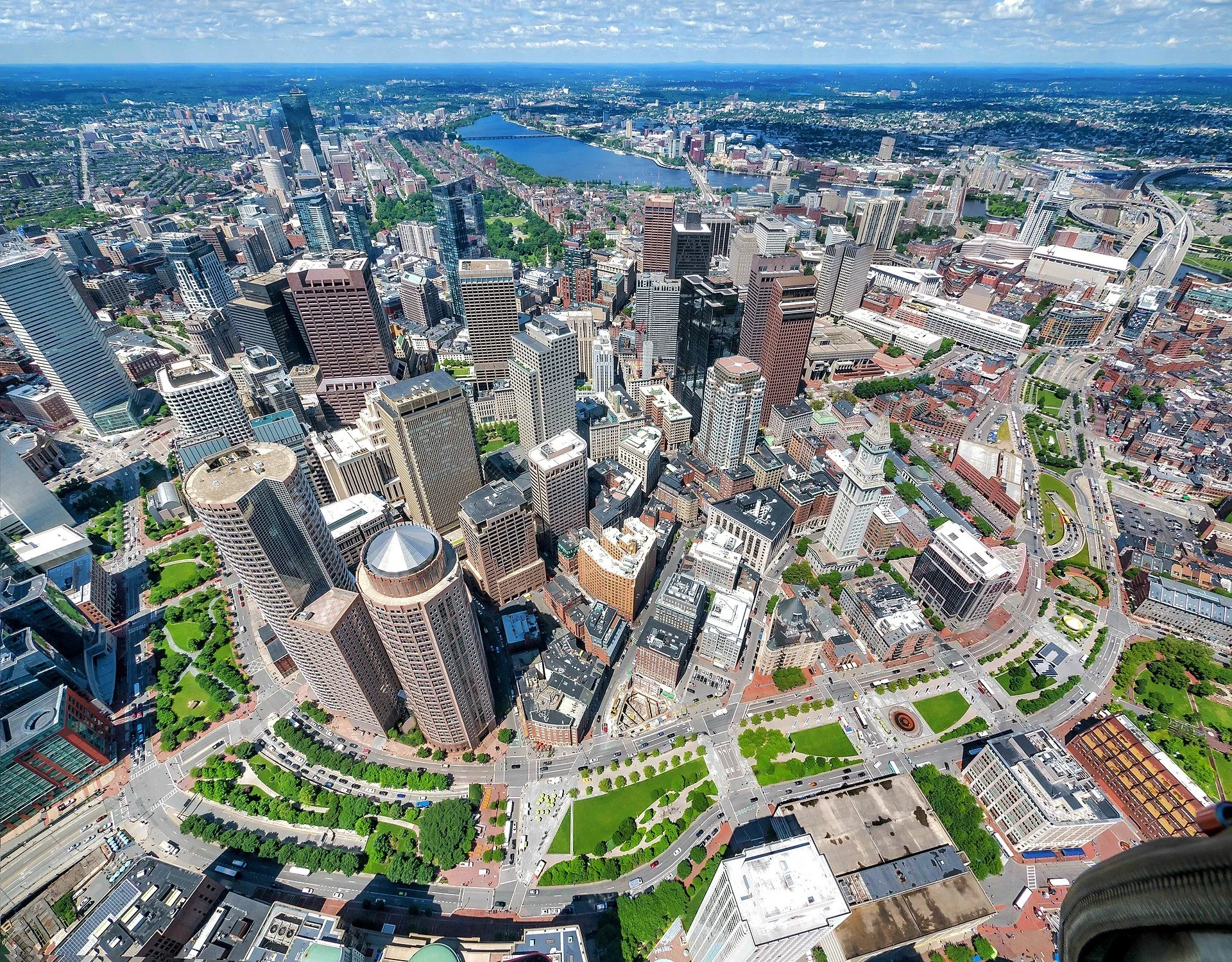
Greenway from above.
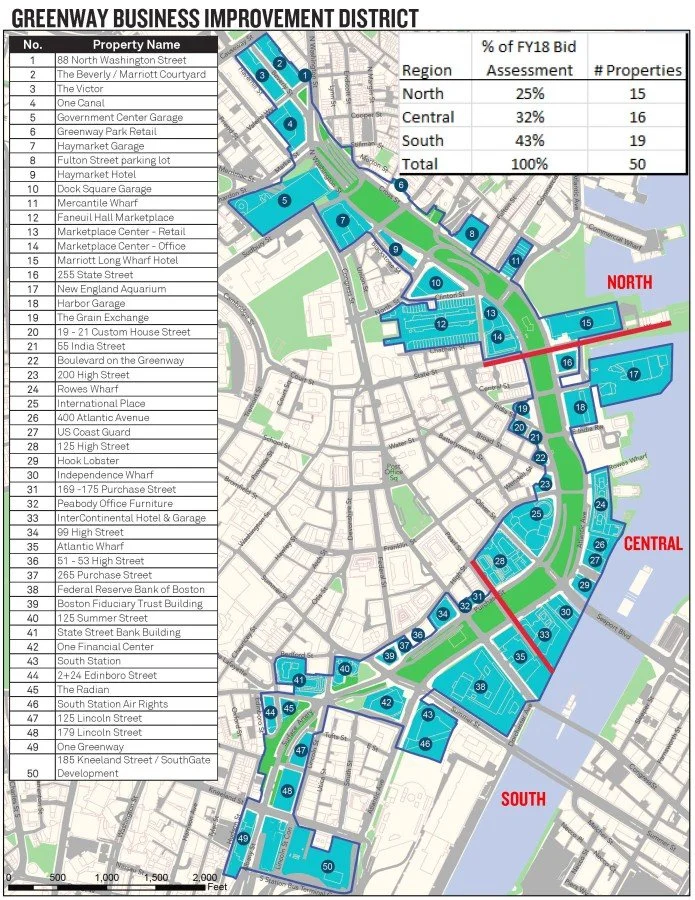
BOSTON
Worry of the day: What if ICE raids the peaceful Rose Kennedy Greenway, in downtown Boston, on a hot summer day and mistakes me in my bucket hat for an immigrant landscaper theoretically ripe for abduction?
In case I join the disappeared, here are some late-summer 2025 reflections on the Greenway.
Before a recent visit to observe blooms there, I enjoyed lunch in a fellow volunteer’s backyard garden on Beacon Hill’s Joy Street. The lunch is to honor semi-retiring horticulture staffer Darrah Cole, who first introduced me to Greenway phenology.
The back garden, complete with a small ornamental pool — more suited for foot-soaking than swimming —reminded me of a similar preserve I saw last year at the South End Garden Tour — another beautiful private space in a place that you might think would/should be public.
I wonder why, among all the prize specimens I see on the Greenway, I am especially taken by the humble fleabane, which is common on New England roadsides?
This time, the tiny daisy-like flower’s usually white petals are slightly bluish. A friend suggests that I like it because it’s a “working-class flower.” A high compliment, I think.
In my own yard, I ponder why bouncing bets are less precious than pink lady slippers. And why are milkweeds and spiderworts dissed for the conditions they prefer? A sort of phenological version of haves and have-nots.
Gourdy pod season
Late summer is a challenging season for tracking blooms on the Greenway. The flowers of the bigleaf magnolia give way to gourdy cones. The yellow-twig dogwood (or is it red- or blood-twig?) shows white berries. Milkweed shows pods, filled with fluffy floss to be carried in the wind. The pawpaw of nursery rhyme now bears “custard apples.”
The peak score on the Greenway ranking scale is 3, with 2 suggesting headed toward peak and 4 indicating on the downswing. If it were a flower being judged, a 4 might signify browning. But a fruit or a cone, who knows?
I tend to cover my bases, noting on my scoresheet, “the fruit/berry/pod dilemma, 2 or 4?”
These colors run
I can’t resist touching the leaves of the wintergreen plant in a stone container near the Red Line Plaza. The small plant’s scent brings back childhood memories of Canada Mints, sometimes carried in my father’s pockets.
Coneflowers put on a show of light and dark pinks. Away from the Greenway, I keep seeing these plants plugged as easy color for your garden. But in my own yard, the flowers are eaten by rabbits within a day of planting.
Anemones now show very few yellow-centered white flowers along Pearl Street. And many of the ones nearer Congress Street have now turned to pompoms that look almost like cotton balls.
I see that irises are no longer flowering in the bed near Atlantic and Pearl. The liliums that in the preflowering stage I mistook for tigerlilies impressed me for a fleeting period with their vibrant white and pink flowers. They’re now bloodshot.
Alliums still show globe flowers but have lost their pink, purple and white showiness and now look brownish. The flowers of their cousin, the common chive, have retained a little of their pink-purple color.
Dicentra formosa shows pink bleeding hearts after weeks of yellowing. Also bucking the troublesome ranking system, dicentra’s hearts disappear one week, then burst back on the scene the next.
Nearby, a large rathole (hardly the only one on the Greenway) appears on Parcel 21 near my beloved umbrella pine. One source suggests that the hole could be the work of toads or cicadas. I’d like that.
Daylilies flowering deep red are a shock compared with the more common oranges and yellows. Most of the latter are now passed but show interesting green seed packets.
Various hydrangeas show ever-less vibrant white or pale blue flowers, including one that has shown white, pink and bluish flowers all at once.
Evolutionary roads
I am still surprised to see crepe myrtle blooming on The Greenway in a parcel near the wharves. I always thought that it was a Southern thing. Inspired by the Greenway’s confidence, I recently bought two small crepe myrtles for my own garden. We’ll see how fast climate change makes them thrive or die in our shifting heartiness zone.
Dracunculus shows an open pod of pea-like fruits (clearly, a reseeding strategy, I think). Eryngium planum shows thistle-like balls almost as respectable as echinops. Black elderberry shows flower clusters, but the white color of the flower and black of the berry is fading. When do they make the wine?, I wonder.
I’ve paid scant attention to the grasses on my parcels, but I’m coming around to their forms from wispy to shrub-like. Between the mural vent and Congress Street, I identify (perhaps incorrectly?) fountain grass shooting out white fronds, which I’ve seen described aptly as a “swollen finger?”
Joe Pye weed is tall and showing pinkish flowers near the rain garden. Cutleaf coneflowers rise tall, flowering yellow inside the small park near the Night Shift (I once thought that they were Jerusalem artichokes). Menthe shows small white flowers and gives a minty smell upon the brush of a hand.
Tall Culver’s root shoots out white veronica-like spikes. Filipendula rubra blooms pink, but increasingly rusty-looking, flowers in the center of tall light-green foliage. In a raised bed, marigolds flower orange and yellow and lavenders purplish. Near the highway underpass wall, false and real sunflowers shine bright yellow. Sweet pea and honeysuckle vines flower vibrant pink and a bit of orange, and eggplant shows small dangling fruits along the wall to the tunnel.
In addition, the flowering raspberry blooms nice pink flowers near a cast-iron bucket. Pineapple sage shows a few strong red flowers. Cardoon shows spiky flowers vaguely familiar from bottles of Cynar, the Italian liqueur made from cardoon’s cousin, the artichoke. Zinnias flower strong dark and light pink in bed with great blue lobelia. Queen Anne’s lace displays white umbrels with a slight pinkish hue — another New England roadside favorite. I should check next time to see if they have the single black flower (some say purple) in the center of their heads that my daughter-in-law Nastya taught me about. If not, I could be seeing the similar-looking poison hemlock!
John O. Harney is a Boston-area writer. For more than 30 years, he was the executive editor of The New England Journal of Higher Education. In 2023, he left the editorship and began volunteering in phenology at the Rose Kennedy Greenway and in English-language teaching at the Immigrant Learning Center in Malden, Mass. Also see A Volunteer Life and Back to Green and Witnessing Beauty but Wilting in Empathy and What To a Volunteer is Labor Day? and Spring Has Sprung.
Philip K. Howard: A program for American revival
This is a lightly edited version of a press release touting my old friend Philip K. Howard’s latest book. The New York-based lawyer, civic leader and photographer is chairman of the nonprofit reform organization Common Good.
(Editor’s note: For an an example of how much we need regulatory streamlining, see the long delays in fixing the Washington Bridge over Rhode Island’s Seekonk River.)
In Saving Can-Do: How to Revive the Spirit of America civic philosopher Howard proposes a governing framework to revive America’s can-do culture — not by DOGE’s Indiscriminate Cuts, and nor by “Abundance”.
Saving Can-Do shows why the waste and paralysis of the red-tape state can be cured only by a new governing framework that empowers human responsibility on the spot. Letting Americans use common sense also holds the key to relieving populist resentment.
This brief book, to be published by Rodin Books on Sept. 23, responds to Americans’ desire for government that delivers results, not overbearing red tape.
“Washington needs to be rebooted, but neither party presents a vision to do this,” Howard notes.
“Republicans focus on cutting programs, not making them work. Democrats want to throw more money at a failing system. Aspiring to abundance is important, but escaping bureaucratic quicksand requires a radical shift in governing philosophy — replacing the red-tape compliance system with a framework activated by human responsibility.”
All societies periodically undergo a major shift in the social order. America is at one of those moments of change, and needs a coherent new overhaul vision to avoid the risks of extremism.
President Trump is swinging a wrecking ball at the status quo, but has no plan for how Washington will work better the day after DOGE. Democrats are in denial, waiting their turn to run a bloated government that Americans increasingly loathe.
Saving Can-Do offers a dramatically simpler governing vision: Replace red tape with responsibility. Let Americans use their judgment. Let other Americans hold them accountable for their results and their values.
“The geniuses in the 1960s tried to create a government better than people,” Howard says. “Just follow the rules. Or prove that your judgment about someone is fair. But how do you prove who has poor judgment, or doesn’t try hard? Bureaucracy makes people go brain dead—so focused on mindless compliance that they can’t solve the problem before them. Americans hate it.”
“We must scrap the red tape state,” argues Howard. “New leadership is not sufficient, because the new leaders will be shackled by rigid legal mandates. Trying to prune the red tape still leaves a jungle of other mandates.’’
“What’s required is a multi-year effort to replace command-and-control bureaucracies with simpler codes that delineate the authority to make tradeoff judgments. The idea is not radical, but traditional— it’s the operating philosophy of the U.S. Constitution. As America approaches the 250th anniversary of the revolution, it’s time to reclaim the magic of America’s unique can-do culture.”
For more information, please contact Henry Miller at hmiller@highimpactpartnering.com.
We could use more fantasy

“Fantasy Landscape’’ (oil on canvas), circa 1911, by Howard Gardiner Cushing, in the show “Howard Gardiner Cushing: A Harmony of Line and Color,’’ through Dec. 31, at the Newport Art Museum.
This is the first major retrospective in decades of Cushing (1869-1916), one of the Gilded Age’s most visionary— and overlooked—American artists.
The exhibition brings together over 55 paintings, many of which have not been publicly exhibited in more than 60 years.
Probably friendlier than Walmart
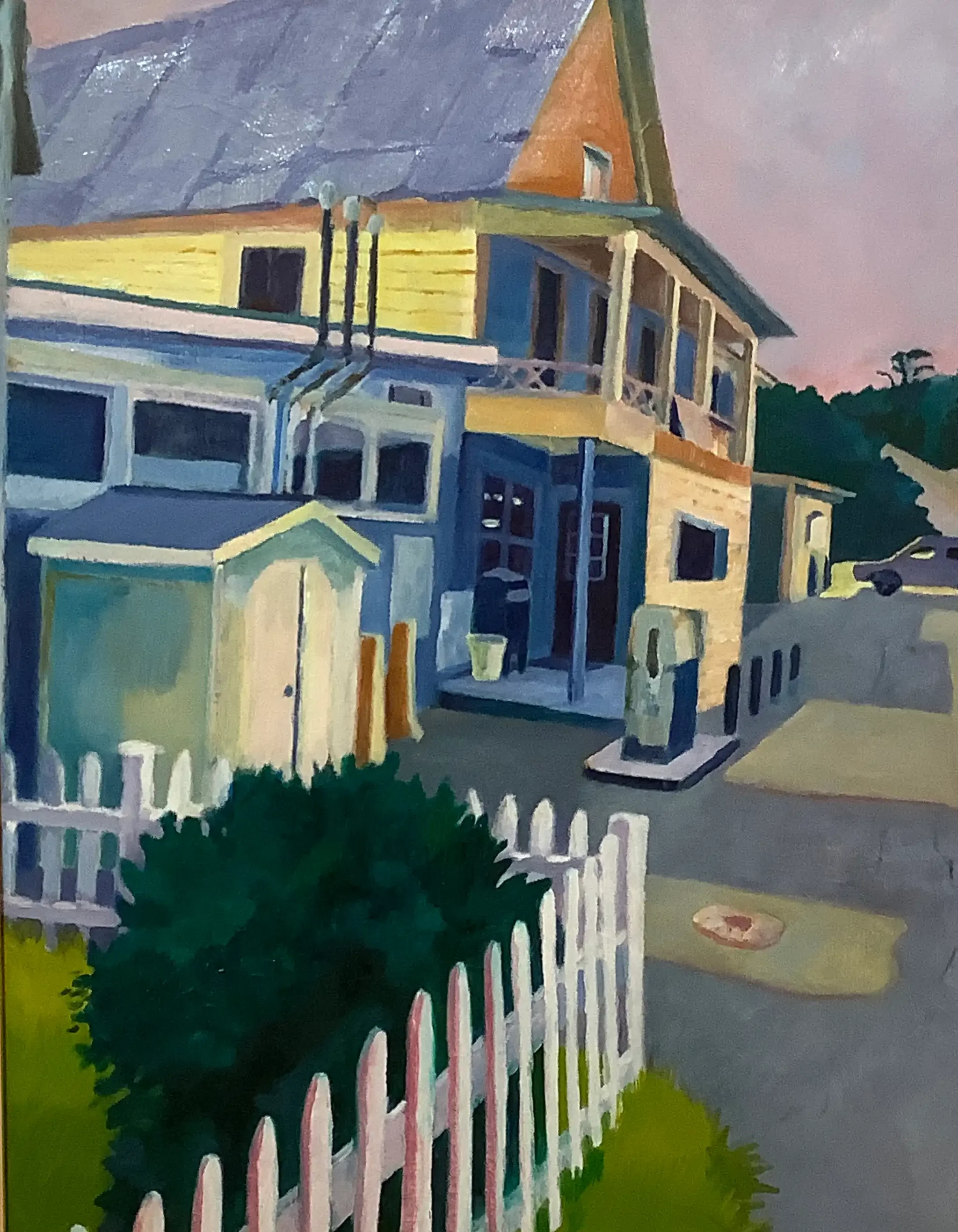
“Coburns General Store” (oil on canvas), in South Strafford, Vt., by Jennifer Brown, at Matt Brown Fine Art, Lyme, N.H.
‘Fuddled age’

Photo taken from the French King Bridge, which connects Erving and Gill, Mass., over the Connecticut River, on the Mohawk Trail.
— Photo by -jkb-
“Time slips indenture, backing age
on fuddled age, confusing fall
with summer-snow with hawthorn flurries,
apple flakes along black boughs.
North of Boston, fire falls
from tree to tree, and leaf by leaf
perverse New England springs to bloom.’’
— From “The Fall,’’ by Joseph Bottum

Asters are associated with early September.

Local inflection
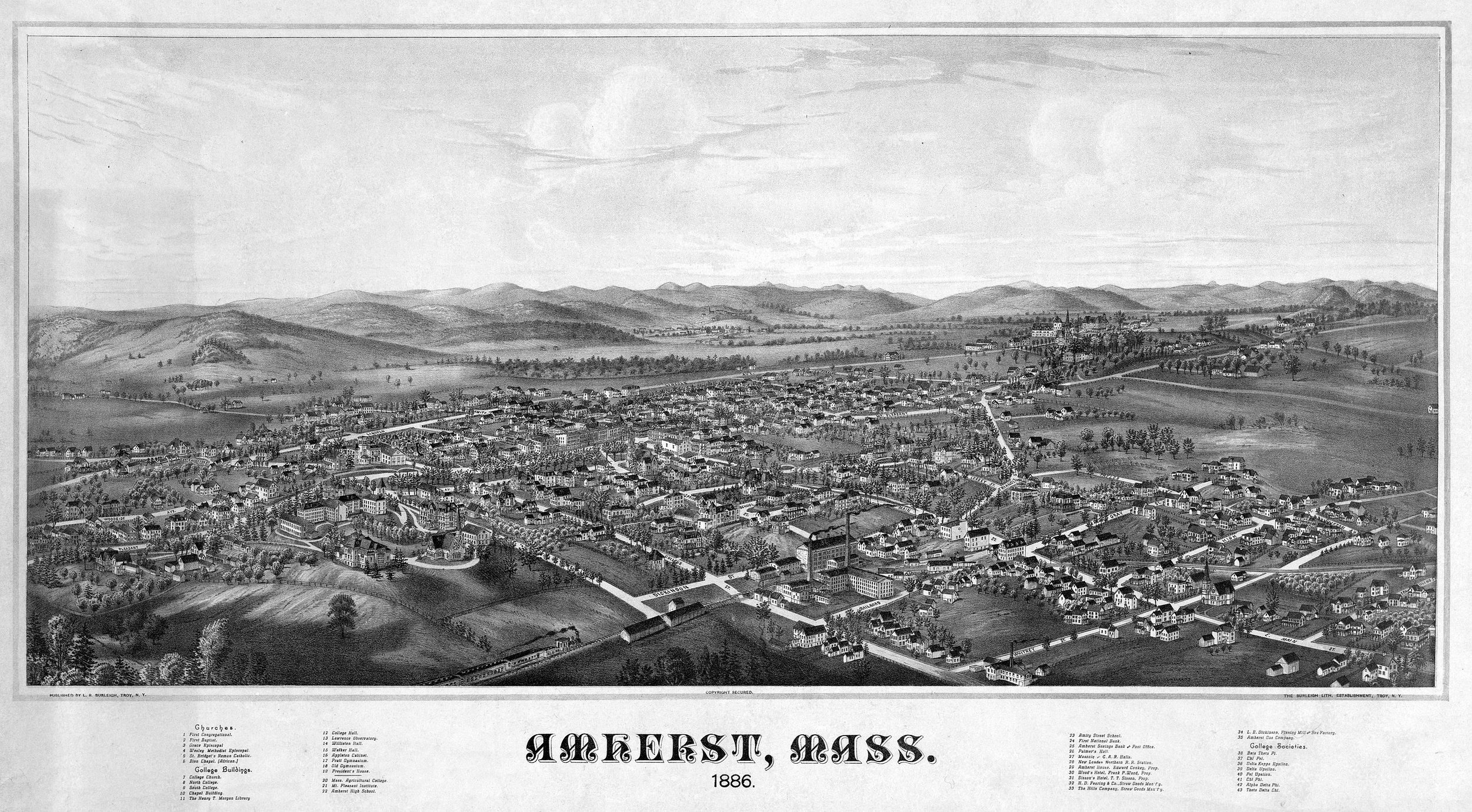
{Emily Dickinson, 1830-1886} wrote about nature, love, life, death, humanity’s relation with God — matters that from time to time occupy the thoughts of all thinking people. But her approach was always that of a New England villager…She wrote that she saw “New Englandly,’’ and she might just as accurately have expressed herself with another coinage, “Amherstly.’’
— From The New England Town in Fact and Fiction, by Perry D. Westbrook (1989)
‘Trapped memories’

From the Safarani sisters' new series of works, called “Submerged in Time,’’ at ShowUp Gallery, Boston, through Sept. 28. The works reflect efforts to deal with memories. The gallery notes: “Balloons and string lights seen through a translucent surface convey mystery and speak to the memories that exist in everyone’s life—those from our childhood or our unconscious. These memories may feel trapped or unclear, sometimes hidden behind a buffer we create to avoid remembering them clearly.’’
Intersecting systems
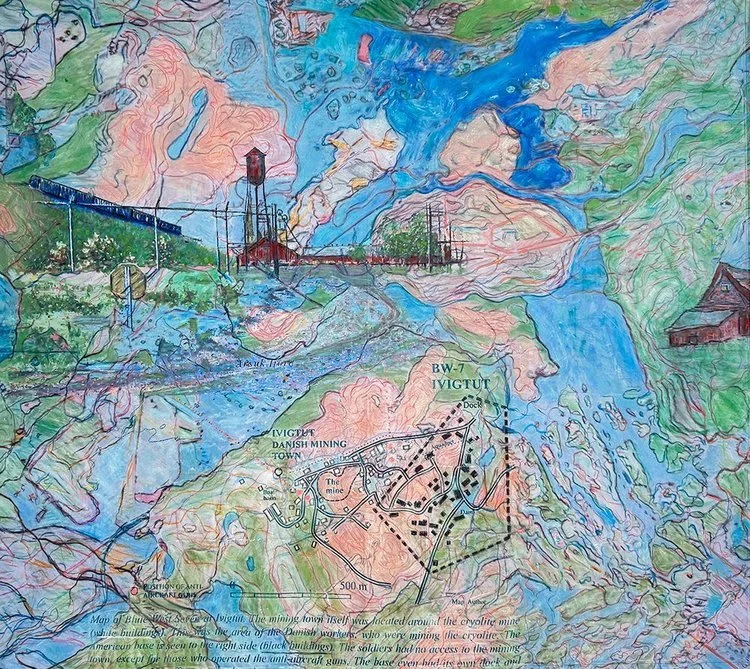
From “Intersecting Ecologies,’’ a two-person, collaborative exhibition by Paula Gerstenblatt and Jan Piribeck focused on the intersection of personal, social and environmental systems. The show runs on Sept. 5-Nov. 30, at The Parsonage gallery, Searsport, Maine. The work is situated in Maine and Greenland, where Gerstenblatt and Piribeck have worked as artists and researchers.
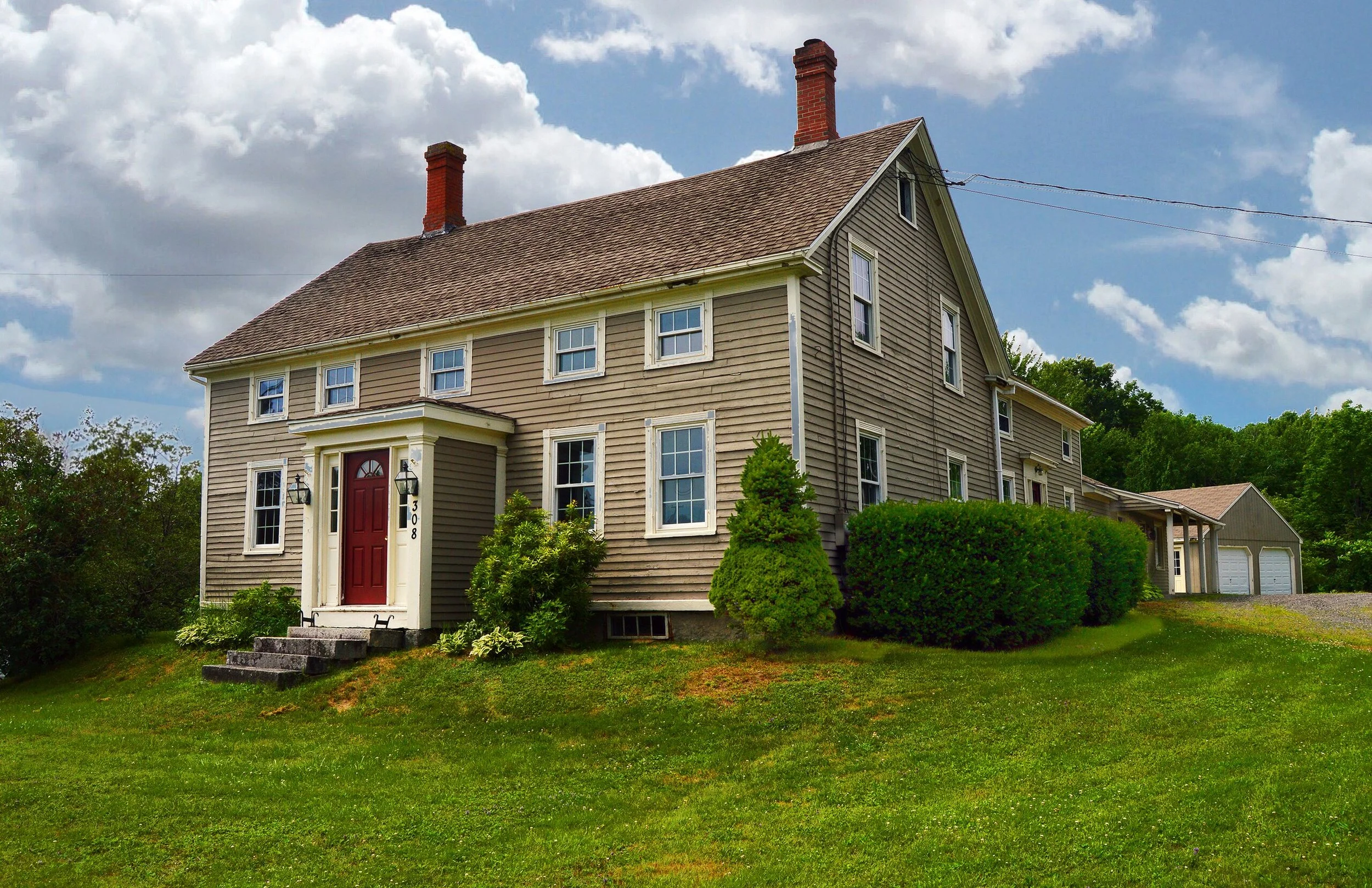
The Park-Griffin-Treat House, in Searsport, Maine, built for sea Captain Benjamin Bentley Park in 1840, during The Pine Tree State’s maritime heyday.
— Photo by Bruce C. Cooper
Chris Powell: Key Conn. Democrats keep pretending they aren’t obstructing ICE

MANCHESTER, Conn.
Some Connecticut Democrats keep doubling down in support of illegal immigration and obstruction of immigration-law enforcement even as they keep pretending they're not doing so.
The other week at the Legislative Office Building about 25 Democratic elected officials held a news conference that made a spectacle of their contradictions.
A week earlier state Rep. Corey Paris (D-Stamford) had issued a warning on social media that federal immigration agents were active in his district. He urged people to “remain vigilant, stay aware of our surroundings, and, above all, prioritize your safety," as well as to bring immigration-enforcement actions to the attention of groups that assist illegal immigrants.
Responding on social media, a conservative organization accused Paris of publicizing the “live location" of immigration agents and urged the Immigration and Customs Enforcement agency to “charge him."
ICE reposted the accusation, prompting, according to Paris, lots of anonymous threats against him. He denied disclosing the “live location" of immigration agents and putting any agents at risk.
Indeed, Paris had not posted that agents were, for example, working around the Stamford train station or a particular supermarket. But his district is a small place with defined borders, and citing it conveyed information useful to people seeking to remain in the country illegally, so Paris's intention was clear: to obstruct enforcement of immigration law.
At their news conference, Democratic elected officials, including Lt. Gov. Susan Bysiewicz and U.S. Sen. Richard Blumenthal, minimized that aspect of the controversy. They concentrated on the threats that Paris received, as if there is substantial political disagreement in Connecticut about the impropriety of such threats. (Even Republican state legislators felt obliged to deplore the threats against Paris while failing to deplore what he did.)
No, the substantial political disagreement is about illegal immigration.
“Corey did nothing wrong," Blumenthal insisted, and his colleagues at the news conference repeated this assertion.
All this came just days after Gov. Ned Lamont and state Atty. Gen. William Tong had proclaimed again that Connecticut is not a “sanctuary state" and does not interfere with immigration-law enforcement.
No one in journalism called the governor and the attorney general to ask why, if Connecticut is not a “sanctuary state," a state legislator had just acted as if it is one and if they approved of what he did.
Indeed, in calling their news conference the Democratic elected officials must have been confident that no one in the Capitol press corps would ever question them critically about illegal immigration.
No one asked the Democrats if, by saying Paris did “nothing wrong," they meant that trying to sabotage immigration-law enforcement is OK.
No one asked if they would feel justified in doing what Paris did if they knew that immigration agents were working in a particular area.
No one asked how the explosion in the country's illegal immigrant population in recent years is likely to affect congressional redistricting and which political party will benefit most from it.
No one asked if immigration-law violators who have not been accused or convicted of other offenses should be exempt from enforcement -- that is, if there should be another immigration amnesty.
No one asked if, for the country's protection, every foreigner should get ordinary vetting before being admitted.
And no one asked if, before publicizing immigration enforcement in his district, Paris should have determined whether the agents were going after criminals or just ordinary immigration law violators.
But almost simultaneously with the Democratic news conference,ICE announced that in a recent four-day operation in Connecticut it had arrested 65 people, 29 of whom “had been convicted or charged in the United States with serious crimes, including kidnapping, assault, drug offenses, weapons violations, and sex crimes." Others, ICE said, had criminal records in their native countries.
“Connectiut is a sanctuary no more," ICE said, implying that there would be more enforcement in the state.
How much more enforcement will be required in Connecticut before critical questions are put to public officials who deplore it?
Chris Powell has written about Connecticut government and politics for many years (CPowell@cox.net).
Michael Rose: New England Wax will celebrate an ancient artform in big Manhattan show
Michael Rose is the gallery manager of the Providence Art Club, as well as as an art reviewer, teacher and consultant.
The medium of encaustic has been in use for millennia and has found resurgent energy in the contemporary art community. Prized for its malleability and suggestive aesthetic qualities, art made in and with wax is again in vogue. New England Wax, a professional association made up of thirty artists across six states, is one of the organizations promoting the medium and supporting artists who create expressive works using bees wax and damar resin.
In an upcoming show at Atlantic Gallery in New York, New England Wax artists will share their work beyond the borders of their region while celebrating the remarkable qualities that can be achieved with their medium of choice.
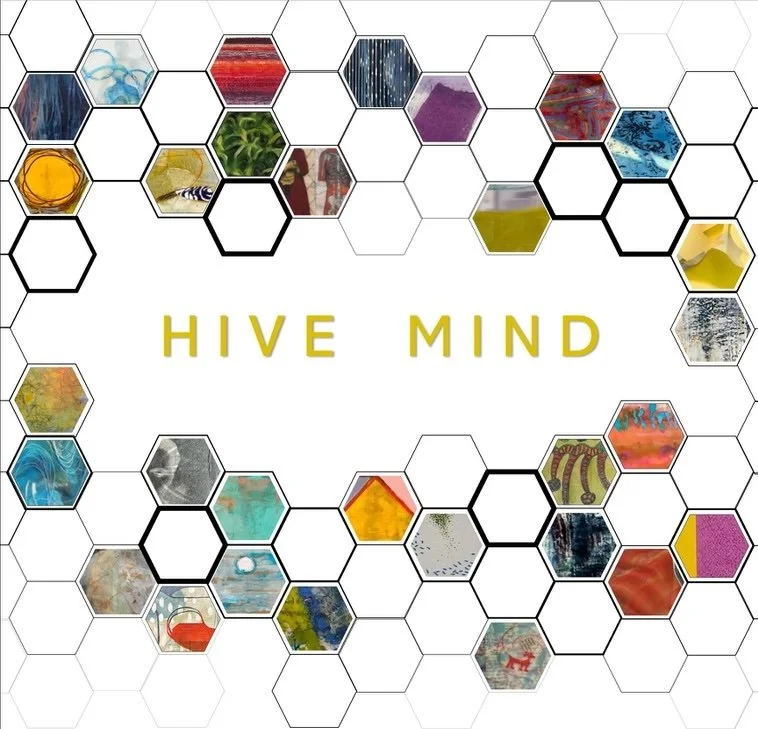
Titled “Hive Mind,’’ the exhibition will feature a collection representing 27 artists and will be on view Sept. 9 - 27 at Atlantic Gallery, at 548 West 28th St., Suite 540, in Manhattan’s Chelsea section. The show will be an opportunity for New Yorkers and visitors to the city to experience artworks by individuals who have been frequently featured in thoughtfully assembled group showcases throughout Connecticut, Rhode Island, Massachusetts, Maine, New Hampshire and Vermont. Past exhibitions organized by New England Wax have been mounted at such venues as Fitchburg State University, Southern Vermont Arts Center, New Bedford Art Museum, Fuller Craft Museum, and the Saco Museum of Art, among others. After their New York show, the group will exhibit in Chicago in November.
Describing the organization’s purpose, current New England Wax President Ruth Sack says, “Our mission is to promote excellence in fine art made with encaustic and other wax-based mediums to educate the general public about this medium to increase interest in encaustic and wax mediums in the art world.”
Diverse in approach, the artists in the upcoming show are united by their love for wax as a medium. Encaustic lends itself to a variety of applications. Some are bulbously dimensional while others are encompassed in a boxy form. Appealing color is a throughline, as is a collective interest in the tension inherent in a surface made of a material that turns from liquid to solid with some seeming magic. Wax is a uniquely sensuous medium and one that engages gallery visitors in a special way.
Among the works that will be on view, one of the punchiest is Kay Hartung’s “Geocolor 19,’’ a bright piece executed on a shaped substrate. Across the surface the artist uses raised geometric and organic patterns that denote different spaces within the form. There is something compartmental about the composition, an effect that builds enticing drama. Based in Massachusetts, Hartung earned her BFA from the Philadelphia College of Art and her MFA from Syracuse University.
Alongside Hartung, pattern is also a key part of “Symbioses,’’ an impressive mixed-media work by Charyl Weissbach. Leafy forms spread out across the surface and seemingly undulate within and atop the slick wax surface. A MassArt alum, Weissbach incorporates such materials as marble and 23-karat gold, a study in the multifaceted nature of encaustics. The subtleties in the piece are laudable and form a striking counterpoint to a more direct interpretation, such as the colorful “Yay! ,’’ by Pamela Dorris DeJong.
For DeJong, the encaustic surface is a playground for a mixed-media piece that leverages monoprints and oils in a collagelike treatment. The silhouettes of individuals populate the surface in a celebratory way while in the foreground two open hands press excitedly into the air. There is an energy of excitement and play here that recurs throughout the exhibition. Many of the artists combine media, experiment and blur boundaries to test how far they can push and pull the encaustic base.
Excitingly diverse and yet tightly choreographed, the exhibition is being assembled by curator Ingrid Dinter, a multitalented professional who has experience as an art dealer and independent curator. For Dinter, the idea of community was in mind as she selected artworks for the show.
She says, “When one thinks of ‘hive mind’ one thinks of busy bees working together -- collectively and in unison -- to produce or construct something with a common goal in mind. That can also apply to humans in social and creative situations, building bonds and unity, strengthening community, fostering solidarity – with a particular purpose in mind. In this case, it’s not so much that things should look the same, but that inherent in the individual differences in approach and appearance there is a shared spirit, overlapping and blending together, producing a whole larger than the sum of its parts.”
The artists of New England Wax form a supportive community. Together they explore the material that they all use with affection and zest. There is little competition among the artists, but instead a collective passion for a timeless artform. The shared enthusiasm of these makers will be on display in their Atlantic Gallery exhibition, which will offer viewers a chance to form a new appreciation for an ancient way of making art.
The reception for “Hive Mind’’ will be held at Atlantic Gallery on Saturday, Sept. 13, at 3-5 p.m., and the gallery will be open late on Thursday, Sept. 11, at 6-8 p.m.
Try to figure it out
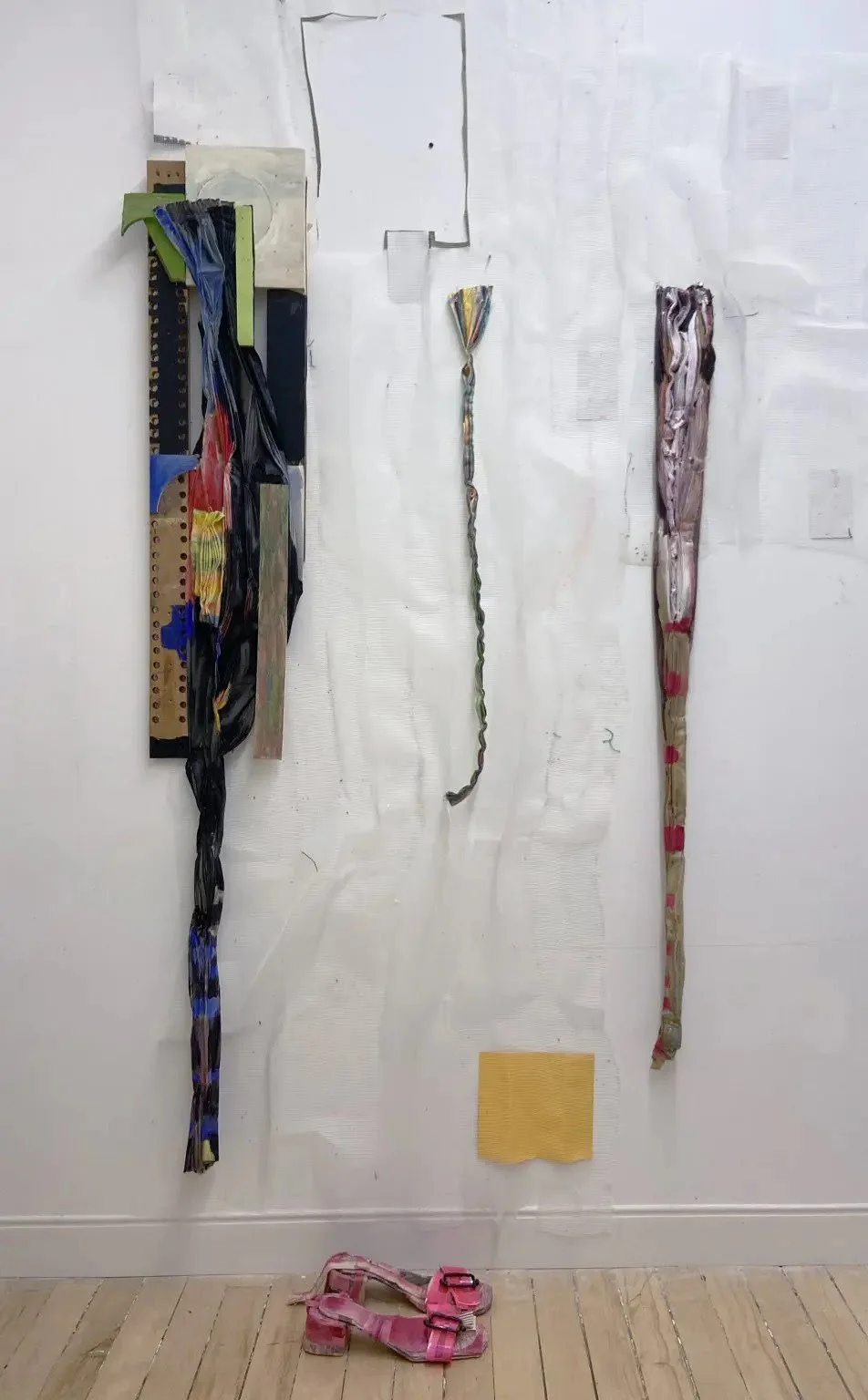
“As the apple disappears into water and sweetness in our bodies’’ (installation view), a show by Earthen Clay, at the Montserrat College of Art, Beverly, Mass., through Sept. 27.
The gallery says:
“This exhibition, named for the book The Wild Heart, by American author Jack Kornfield, includes paintings and sculptures made in the last two years. According to an artist statement, this body of work “responds to Kornfield’s visual theorization of objects" and through a series of interrelated works that call to each other, Clay is interested in questioning an unchanging, fixed view that forecloses alternate potential liberatory futures."
Squash those invasive and destructive Spotted Lanterflies
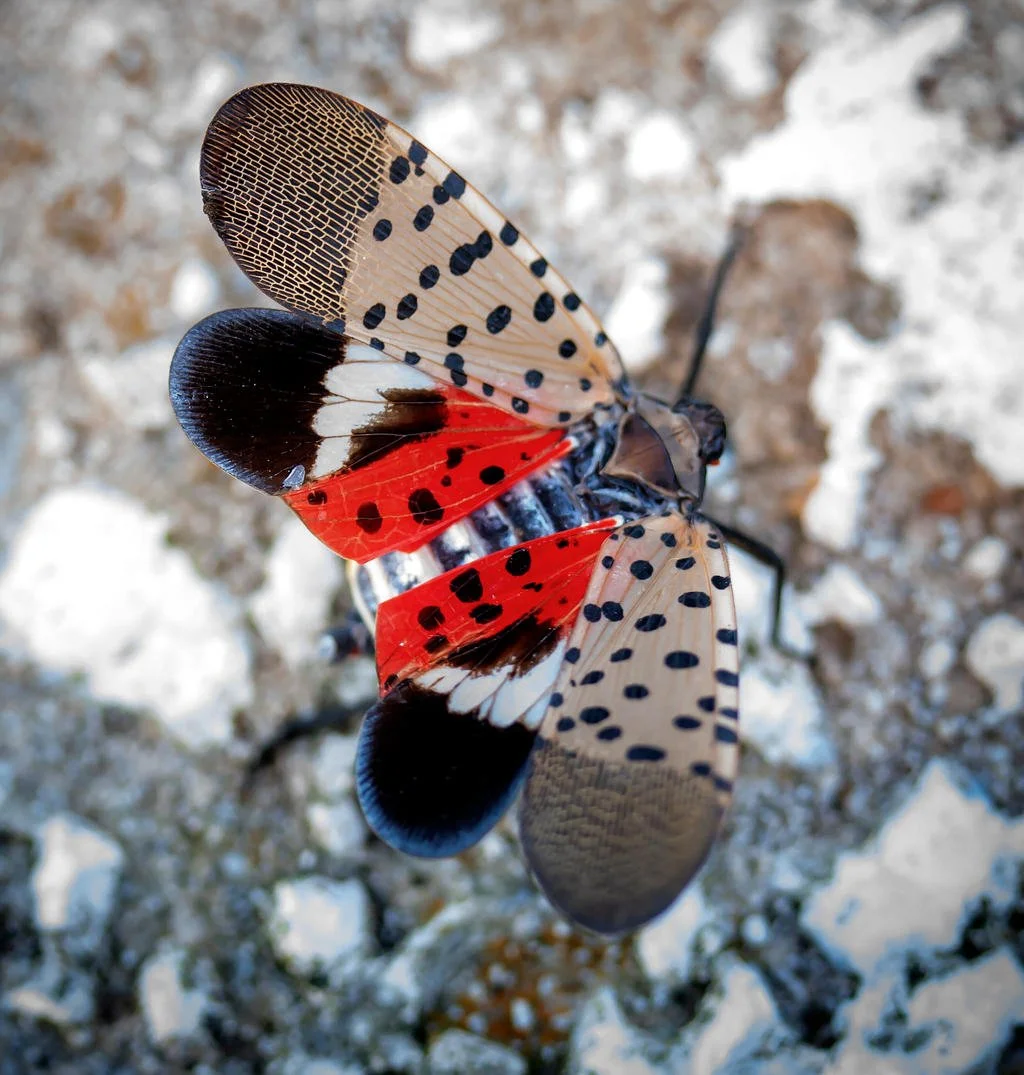
Spotted Lanternfly
Excerpted from an ecoRI News story by Colleen Cronin
PROVIDENCE
“Have you recently seen a blur of bright red on a sidewalk or a tree, moved a little closer to see an insect with spotted wings — and then, hopefully, taken your shoe or a stick and squashed it?
“You aren’t alone. Reports of the invasive Spotted Lanternfly are booming in Rhode Island, according to the Rhode Island Department of Environmental Management, and yes, the agency says, you should squish them….
‘‘A combination of feeding on sap and secreting a sugary substance onto plants that causes mold contribute to the invasive bugs’ destructive nature. They prefer grapes, hops, stone fruits, and hardwood trees….’’

Llewellyn King: The sometimes silly and unfair world of state secrets
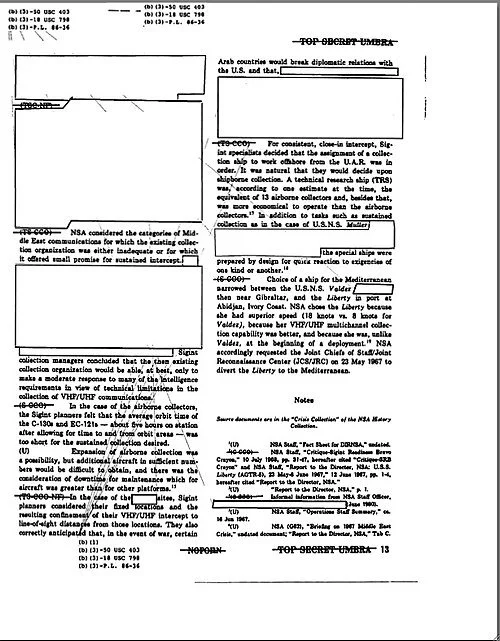
A typical partly declassified U.S. government document from 2004.

J. Robert Oppenheimer, “The Father of the Atomic Bomb,’’ in 1946. He lost his security clearance in 1954. (The movie Oppenheimer is well worth seeing.)
WEST WARWICK, R.I.
Beware: Classified documents don’t always hide state secrets, and security clearances are used as tools of manipulation and vengeance.
Before Xerox, if you wanted to keep a copy of something, you had to type it with a carbon sheet backing every page.
In 1969, I was commissioned by a long-gone consultancy, the Arctic Company, to write a paper on the use of hovercraft by the military, especially the infantry.
They were offering $500 for the job and, like most reporters, I was keen for the income and I signed up.
It was a time when it was believed that hovercraft —vehicles that cover the ground on a cushion of air — would be widely deployed.
I had no great insight into the vehicles or how they might be used as chariots of war. But I did have a lively imagination and access to The Washington Post library. I gorged on newspaper clippings, then wrote my commissioned piece.
After it had been accepted, and I was told by the company that the Army was “very pleased” with it, I forgot about it.
Then someone unrelated asked out of curiosity if they could see it. I said I didn’t have a copy, but I had been told that it had been mimeographed and widely distributed in the Pentagon.
I asked the Arctic Company for a copy, and they referred me to the appropriate office in the Pentagon. I was rebuffed, told that it was classified, and I could only see it if I had security clearance.
The Joint Committee on Atomic Energy, which controlled the nuclear establishment, military and civilian, used classification and security clearances to keep other members of Congress and the press out of its business; it regarded itself as the only responsible custodian of the nation’s nuclear secrets.
I was told that they were so classification-obsessed they couldn’t discuss the contents of the papers they had assembled to discuss because they were marked “Eyes Only.”
When James Schlesinger became chairman of the Atomic Energy Commission (AEC), in August 1971, he set about overhauling the classification of documents.
I was close to Schlesinger, and he told me that he thought more than half of the AEC documents shouldn’t be classified and he set about declassifying them. His argument: If you classify the trivial, all classification is degraded.
Dixy Lee Ray, the last chairperson of the AEC, became a friend of mine. I invited her to dinner at the venerable Red Fox Inn & Tavern in Middleburg, Va., established in 1728. It is a pleasant place to dine and claims to be the oldest continuously operating inn in America.
Ray went everywhere with her two dogs (Ghillie, a Scottish Deerhound, and Jacques, a Miniature Poodle), including in her limousine. The car also contained -- as I am sure the secretary of energy’s car does today -- the hotline that would be part of the launch procedure, in the event a nuclear attack is ordered by the president.
In her briefcase, Ray had an innocuous study she had wanted to give to me.
It was a blustery night, and her driver was waiting in the car in the parking lot with her briefcase on the backseat and both dogs on the front seat.
The moment that Ray opened the rear door, two things happened: A great gust of wind arose and Ghillie leapt from the front seat to the backseat, upsetting the briefcase. Crisis!
All the papers in the briefcase, many of them marked with the big red X of classified documents, blew all over the parking lot.
The three of us, in panic mode, set about scouring the bushes for them in the dark, fearing that someone would find one of them and, so to speak, the jig would be up. We could imagine the headlines.
After an hour’s search, we figured that we had gathered all the papers, and Ray did an inventory. Nonetheless, the next morning I drove out from Washington to make sure that no nuclear secret was impaled on a bush branch.
Most notably from 1954, when J. Robert Oppenheimer, who had been the scientific director of the Manhattan Project, lost his security clearance under murky circumstances, security clearances have been used as a tool of manipulation and vengeance.
If a scientist or a manager loses their clearance, they can appeal in a long, difficult and expensive process. Even if the victim appeals, the damage is done; the subject is damaged goods, publicly humiliated as morally deficient and untrustworthy.
Llewellyn King is executive producer and host of White House Chronicle, on PBS, and an international energy-sector consultant and speaker. His email address is llewellynking1@gmail.com, and he’s based in Rhode Island.
Party wherever you can
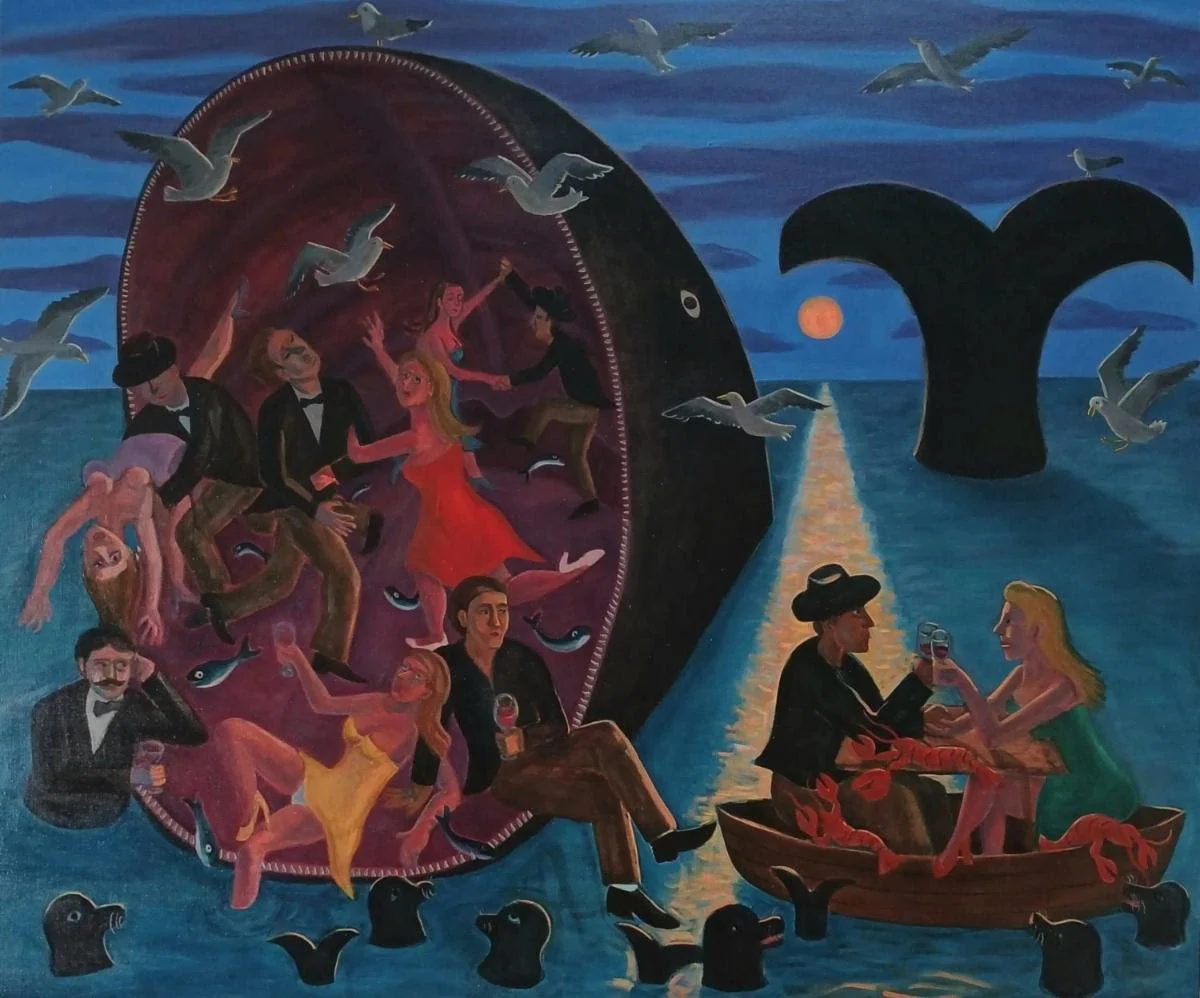
“A Dance in the Mouth of a Whale’’ (oil on linen), by Alexander Nolan, in his show “Airplane Mode,’’ at Cove Street Arts, Portland, Maine, through Oct 18. Mr. Nolan lives in the far Downeast Maine town of Lubec.
The gallery explains:
“Nolan presents a body of work inspired by ‘something funny that pops in my head, a dream, a domestic experience, or it might come from a narrative inspired by a book or movie,’ according to the artist. ‘In my paintings, I explore our human basic needs and need nots in life such as food, sex, love, joy, violence, vice, agony, greed, spirituality, and death.’’’
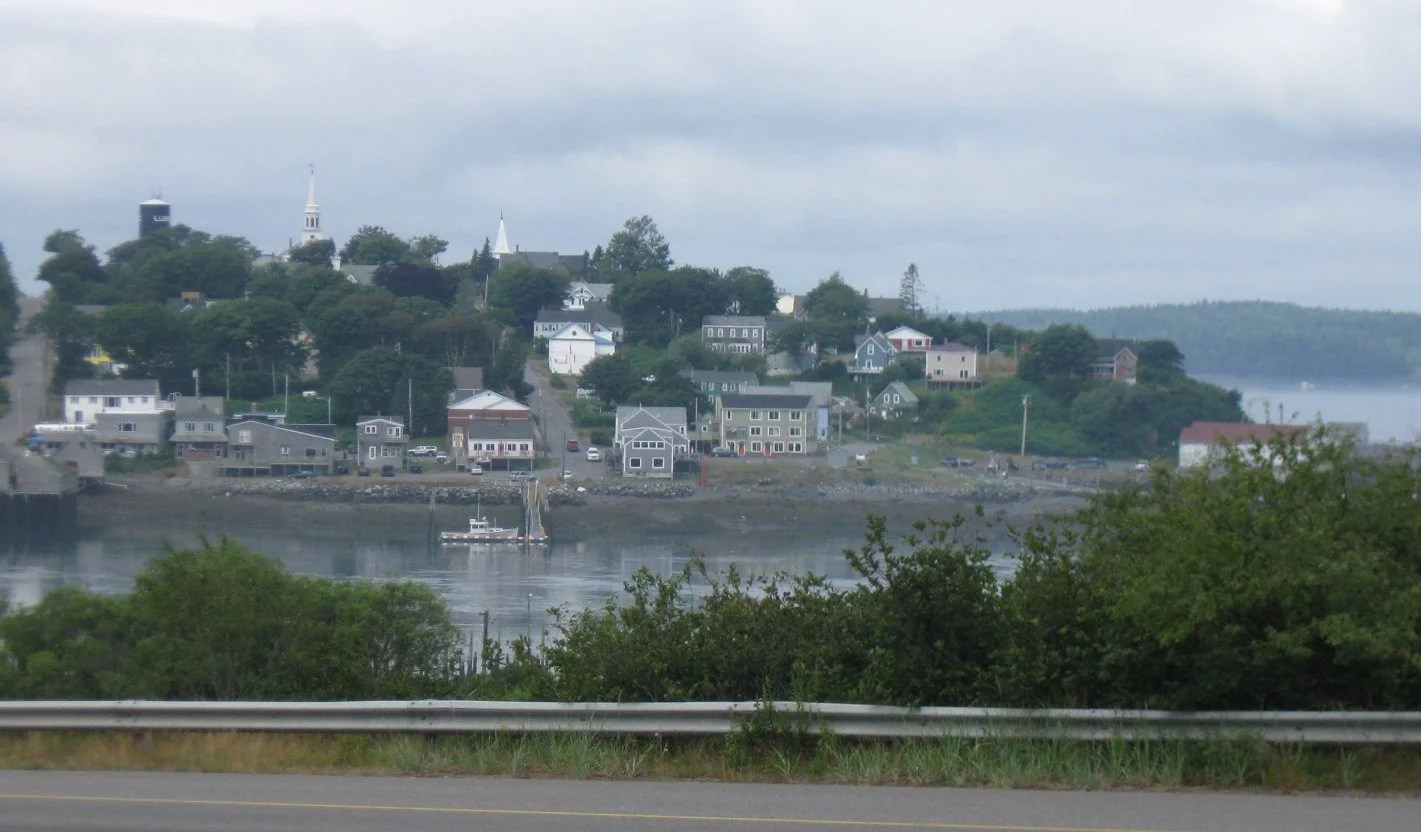
Center of Lubec, as seen from Canada’s Campobello Island.