Llewellyn King: The sometimes silly and unfair world of state secrets
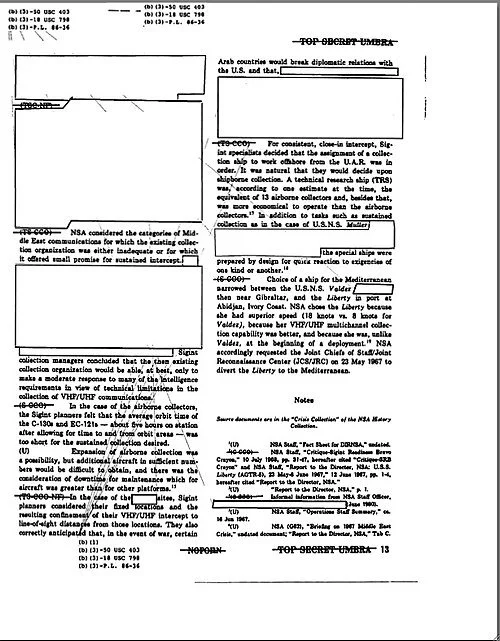
A typical partly declassified U.S. government document from 2004.

J. Robert Oppenheimer, “The Father of the Atomic Bomb,’’ in 1946. He lost his security clearance in 1954. (The movie Oppenheimer is well worth seeing.)
WEST WARWICK, R.I.
Beware: Classified documents don’t always hide state secrets, and security clearances are used as tools of manipulation and vengeance.
Before Xerox, if you wanted to keep a copy of something, you had to type it with a carbon sheet backing every page.
In 1969, I was commissioned by a long-gone consultancy, the Arctic Company, to write a paper on the use of hovercraft by the military, especially the infantry.
They were offering $500 for the job and, like most reporters, I was keen for the income and I signed up.
It was a time when it was believed that hovercraft —vehicles that cover the ground on a cushion of air — would be widely deployed.
I had no great insight into the vehicles or how they might be used as chariots of war. But I did have a lively imagination and access to The Washington Post library. I gorged on newspaper clippings, then wrote my commissioned piece.
After it had been accepted, and I was told by the company that the Army was “very pleased” with it, I forgot about it.
Then someone unrelated asked out of curiosity if they could see it. I said I didn’t have a copy, but I had been told that it had been mimeographed and widely distributed in the Pentagon.
I asked the Arctic Company for a copy, and they referred me to the appropriate office in the Pentagon. I was rebuffed, told that it was classified, and I could only see it if I had security clearance.
The Joint Committee on Atomic Energy, which controlled the nuclear establishment, military and civilian, used classification and security clearances to keep other members of Congress and the press out of its business; it regarded itself as the only responsible custodian of the nation’s nuclear secrets.
I was told that they were so classification-obsessed they couldn’t discuss the contents of the papers they had assembled to discuss because they were marked “Eyes Only.”
When James Schlesinger became chairman of the Atomic Energy Commission (AEC), in August 1971, he set about overhauling the classification of documents.
I was close to Schlesinger, and he told me that he thought more than half of the AEC documents shouldn’t be classified and he set about declassifying them. His argument: If you classify the trivial, all classification is degraded.
Dixy Lee Ray, the last chairperson of the AEC, became a friend of mine. I invited her to dinner at the venerable Red Fox Inn & Tavern in Middleburg, Va., established in 1728. It is a pleasant place to dine and claims to be the oldest continuously operating inn in America.
Ray went everywhere with her two dogs (Ghillie, a Scottish Deerhound, and Jacques, a Miniature Poodle), including in her limousine. The car also contained -- as I am sure the secretary of energy’s car does today -- the hotline that would be part of the launch procedure, in the event a nuclear attack is ordered by the president.
In her briefcase, Ray had an innocuous study she had wanted to give to me.
It was a blustery night, and her driver was waiting in the car in the parking lot with her briefcase on the backseat and both dogs on the front seat.
The moment that Ray opened the rear door, two things happened: A great gust of wind arose and Ghillie leapt from the front seat to the backseat, upsetting the briefcase. Crisis!
All the papers in the briefcase, many of them marked with the big red X of classified documents, blew all over the parking lot.
The three of us, in panic mode, set about scouring the bushes for them in the dark, fearing that someone would find one of them and, so to speak, the jig would be up. We could imagine the headlines.
After an hour’s search, we figured that we had gathered all the papers, and Ray did an inventory. Nonetheless, the next morning I drove out from Washington to make sure that no nuclear secret was impaled on a bush branch.
Most notably from 1954, when J. Robert Oppenheimer, who had been the scientific director of the Manhattan Project, lost his security clearance under murky circumstances, security clearances have been used as a tool of manipulation and vengeance.
If a scientist or a manager loses their clearance, they can appeal in a long, difficult and expensive process. Even if the victim appeals, the damage is done; the subject is damaged goods, publicly humiliated as morally deficient and untrustworthy.
Llewellyn King is executive producer and host of White House Chronicle, on PBS, and an international energy-sector consultant and speaker. His email address is llewellynking1@gmail.com, and he’s based in Rhode Island.