John O. Harney: My late-summer reflections on the Rose Kennedy Greenway
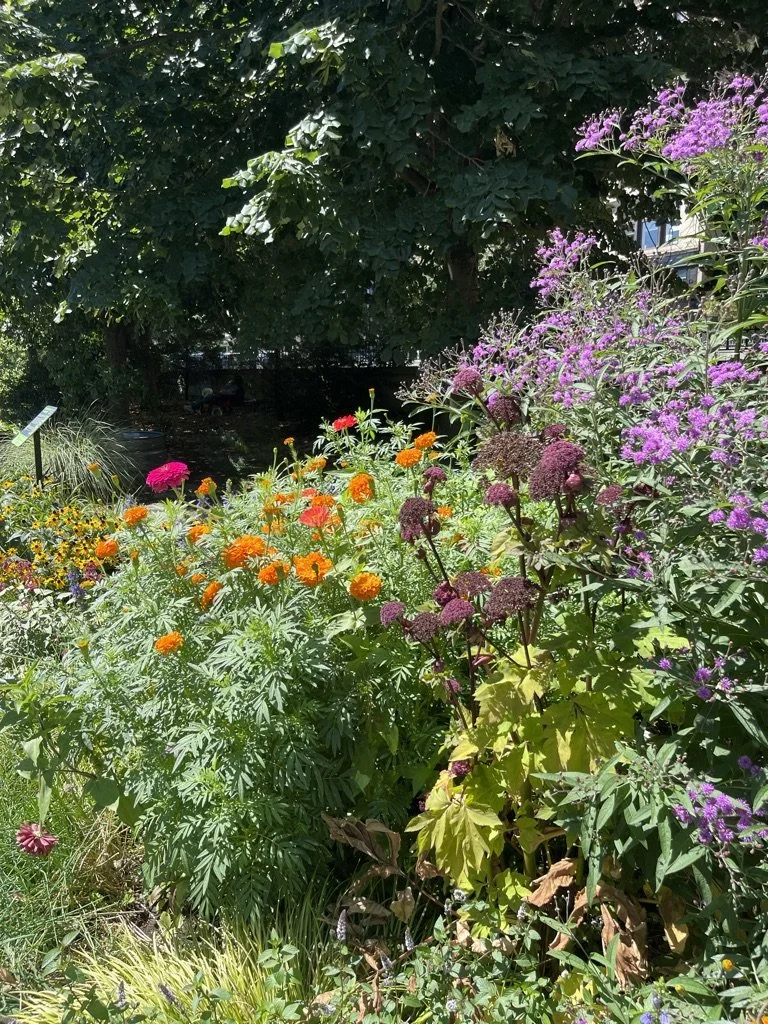
In the Rose Kennedy Greenway.
— Photo by John O. Harney
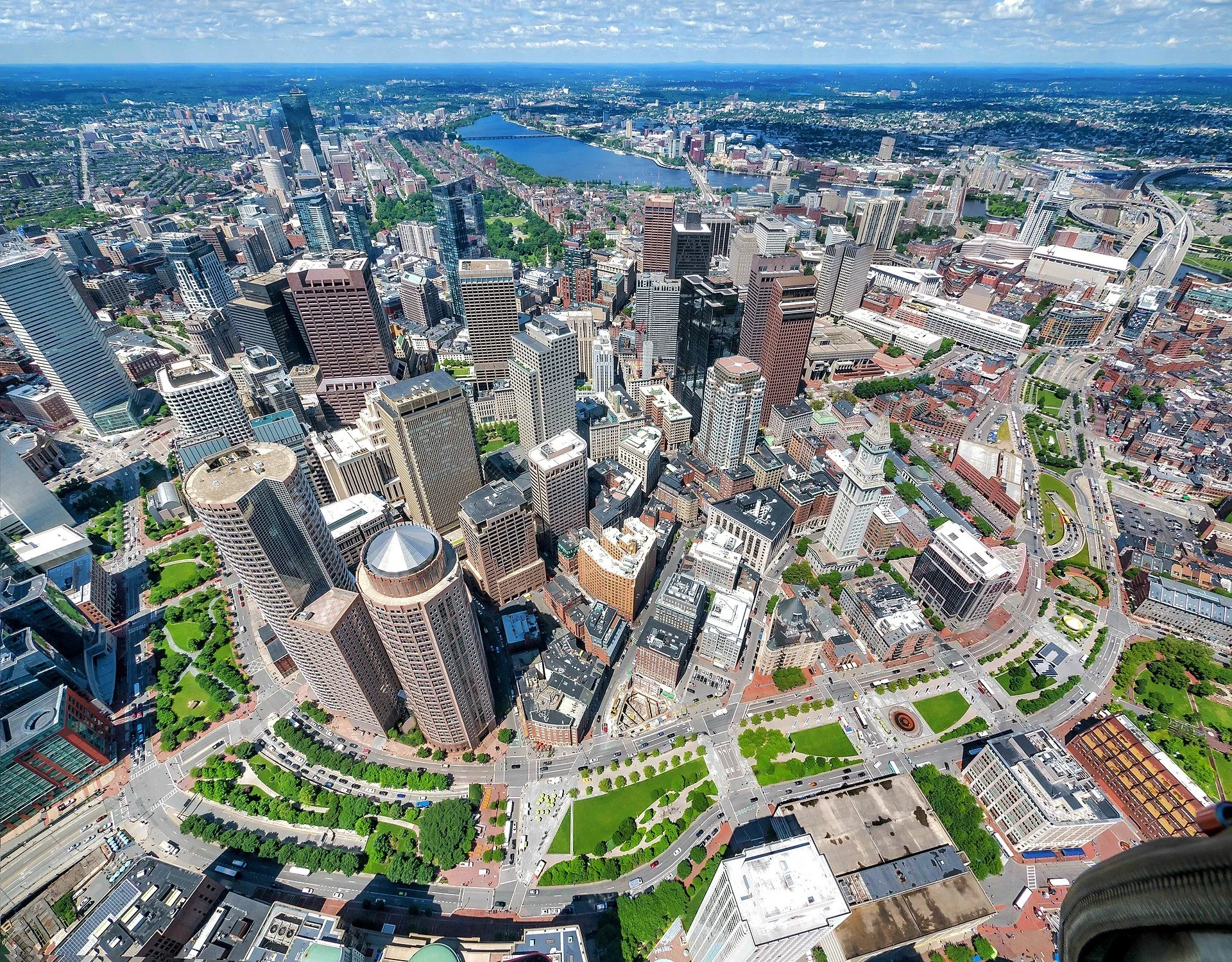
Greenway from above.
BOSTON
Worry of the day: What if ICE raids the peaceful Rose Kennedy Greenway, in downtown Boston, on a hot summer day and mistakes me in my bucket hat for an immigrant landscaper theoretically ripe for abduction?
In case I join the disappeared, here are some late-summer 2025 reflections on the Greenway.
Before a recent visit to observe blooms there, I enjoyed lunch in a fellow volunteer’s backyard garden on Beacon Hill’s Joy Street. The lunch is to honor semi-retiring horticulture staffer Darrah Cole, who first introduced me to Greenway phenology.
The back garden, complete with a small ornamental pool — more suited for foot-soaking than swimming —reminded me of a similar preserve I saw last year at the South End Garden Tour — another beautiful private space in a place that you might think would/should be public.
I wonder why, among all the prize specimens I see on the Greenway, I am especially taken by the humble fleabane, which is common on New England roadsides?
This time, the tiny daisy-like flower’s usually white petals are slightly bluish. A friend suggests that I like it because it’s a “working-class flower.” A high compliment, I think.
In my own yard, I ponder why bouncing bets are less precious than pink lady slippers. And why are milkweeds and spiderworts dissed for the conditions they prefer? A sort of phenological version of haves and have-nots.
Gourdy pod season
Late summer is a challenging season for tracking blooms on the Greenway. The flowers of the bigleaf magnolia give way to gourdy cones. The yellow-twig dogwood (or is it red- or blood-twig?) shows white berries. Milkweed shows pods, filled with fluffy floss to be carried in the wind. The pawpaw of nursery rhyme now bears “custard apples.”
The peak score on the Greenway ranking scale is 3, with 2 suggesting headed toward peak and 4 indicating on the downswing. If it were a flower being judged, a 4 might signify browning. But a fruit or a cone, who knows?
I tend to cover my bases, noting on my scoresheet, “the fruit/berry/pod dilemma, 2 or 4?”
These colors run
I can’t resist touching the leaves of the wintergreen plant in a stone container near the Red Line Plaza. The small plant’s scent brings back childhood memories of Canada Mints, sometimes carried in my father’s pockets.
Coneflowers put on a show of light and dark pinks. Away from the Greenway, I keep seeing these plants plugged as easy color for your garden. But in my own yard, the flowers are eaten by rabbits within a day of planting.
Anemones now show very few yellow-centered white flowers along Pearl Street. And many of the ones nearer Congress Street have now turned to pompoms that look almost like cotton balls.
I see that irises are no longer flowering in the bed near Atlantic and Pearl. The liliums that in the preflowering stage I mistook for tigerlilies impressed me for a fleeting period with their vibrant white and pink flowers. They’re now bloodshot.
Alliums still show globe flowers but have lost their pink, purple and white showiness and now look brownish. The flowers of their cousin, the common chive, have retained a little of their pink-purple color.
Dicentra formosa shows pink bleeding hearts after weeks of yellowing. Also bucking the troublesome ranking system, dicentra’s hearts disappear one week, then burst back on the scene the next.
Nearby, a large rathole (hardly the only one on the Greenway) appears on Parcel 21 near my beloved umbrella pine. One source suggests that the hole could be the work of toads or cicadas. I’d like that.
Daylilies flowering deep red are a shock compared with the more common oranges and yellows. Most of the latter are now passed but show interesting green seed packets.
Various hydrangeas show ever-less vibrant white or pale blue flowers, including one that has shown white, pink and bluish flowers all at once.
Evolutionary roads
I am still surprised to see crepe myrtle blooming on The Greenway in a parcel near the wharves. I always thought that it was a Southern thing. Inspired by the Greenway’s confidence, I recently bought two small crepe myrtles for my own garden. We’ll see how fast climate change makes them thrive or die in our shifting heartiness zone.
Dracunculus shows an open pod of pea-like fruits (clearly, a reseeding strategy, I think). Eryngium planum shows thistle-like balls almost as respectable as echinops. Black elderberry shows flower clusters, but the white color of the flower and black of the berry is fading. When do they make the wine?, I wonder.
I’ve paid scant attention to the grasses on my parcels, but I’m coming around to their forms from wispy to shrub-like. Between the mural vent and Congress Street, I identify (perhaps incorrectly?) fountain grass shooting out white fronds, which I’ve seen described aptly as a “swollen finger?”
Joe Pye weed is tall and showing pinkish flowers near the rain garden. Cutleaf coneflowers rise tall, flowering yellow inside the small park near the Night Shift (I once thought that they were Jerusalem artichokes). Menthe shows small white flowers and gives a minty smell upon the brush of a hand.
Tall Culver’s root shoots out white veronica-like spikes. Filipendula rubra blooms pink, but increasingly rusty-looking, flowers in the center of tall light-green foliage. In a raised bed, marigolds flower orange and yellow and lavenders purplish. Near the highway underpass wall, false and real sunflowers shine bright yellow. Sweet pea and honeysuckle vines flower vibrant pink and a bit of orange, and eggplant shows small dangling fruits along the wall to the tunnel.
In addition, the flowering raspberry blooms nice pink flowers near a cast-iron bucket. Pineapple sage shows a few strong red flowers. Cardoon shows spiky flowers vaguely familiar from bottles of Cynar, the Italian liqueur made from cardoon’s cousin, the artichoke. Zinnias flower strong dark and light pink in bed with great blue lobelia. Queen Anne’s lace displays white umbrels with a slight pinkish hue — another New England roadside favorite. I should check next time to see if they have the single black flower (some say purple) in the center of their heads that my daughter-in-law Nastya taught me about. If not, I could be seeing the similar-looking poison hemlock!
John O. Harney is a Boston-area writer. For more than 30 years, he was the executive editor of The New England Journal of Higher Education. In 2023, he left the editorship and began volunteering in phenology at the Rose Kennedy Greenway and in English-language teaching at the Immigrant Learning Center in Malden, Mass. Also see A Volunteer Life and Back to Green and Witnessing Beauty but Wilting in Empathy and What To a Volunteer is Labor Day? and Spring Has Sprung.