
Vox clamantis in deserto








The great invasion



Text from article by Frank Carini in ecoRI news
A worldwide scientific intergovernmental group on biodiversity, which included a professor from the University of Rhode Island, provides evidence of the global spread and destruction caused by invasive alien species and recommends policy options to deal with the challenges of biological invasions.
The comprehensive report, released Sept. 4 by the Intergovernmental Science-Policy Platform on Biodiversity and Ecosystem Services for the United Nations, found the threat posed by invasive species introduced into new ecosystems is “enormous.”
In 2019, invasive species caused an estimated $423 billion in damages to nature, food sources, and human health. These alien invaders have also contributed to 60% of recorded animal and plant extinctions, and were the sole factor in 16% of extinctions, according to the report.
“This is the first global report on invasive alien species anywhere,” said Laura Meyerson, a URI professor in natural resources science and a contributing lead author on the report. “It’s truly an effort of scientists from around the world. The data touch on every world region, every biome and all major taxa — plants, vertebrates, invertebrates, micro-organisms, fungi.”
Invasive species pose to a threat biodiversity, ecosystem services, and human well-being. The report is designed to raise public awareness to “underpin action to mitigate the impacts of invasive alien species.”
To read the whole article, please hit this link.
Let them rest

“Forest in Autumn,’’ by Jean Courbet (1819-1877)

Fallen leaves in Harvard Yard, in Cambridge, Mass.
— Photo by David Adam Kess
I'll tell you how the leaves came down,"
The great Tree to his children said:
"You're getting sleepy, Yellow and Brown,
Yes, very sleepy, little Red.
It is quite time to go to bed."
"Ah!" begged each silly, pouting leaf,
"Let us a little longer stay;
Dear Father Tree, behold our grief!
'Tis such a very pleasant day
We do not want to go away."
So, for just one more merry day
To the great Tree the leaflets clung,
Frolicked and danced and had their way,
Upon the autumn breezes swung,
Whispering all their sports among--
"Perhaps the great Tree will forget
And let us stay until the spring,
If we all beg, and coax, and fret."
But the great Tree did no such thing;
He smiled to hear their whispering.
"Come, children, all to bed," he cried;
And ere the leaves could urge their prayer,
He shook his head, and far and wide,
Fluttering and rustling everywhere,
Down sped the leaflets through the air.
I saw them; on the ground they lay,
Golden and red, a huddled swarm,
Waiting till one from far away,
White bedclothes heaped upon her arm,
Should come to wrap them safe and warm.
The great bare Tree looked down and smiled.
"Good-night, dear little leaves," he said;
And from below each sleepy child
Replied, "Good-night," and murmured,
"It is so nice to go to bed."
“How the Leaves Came Down,’’ by Sarah Chauncey Woolsey (1835 -1905), an American children's author who wrote under the pen name Susan Coolidge. Born in Ohio into an old New England family, she spent most of her life in Newport, R.I.

Llewellyn King: The dangerous cheapening of the impeachment process
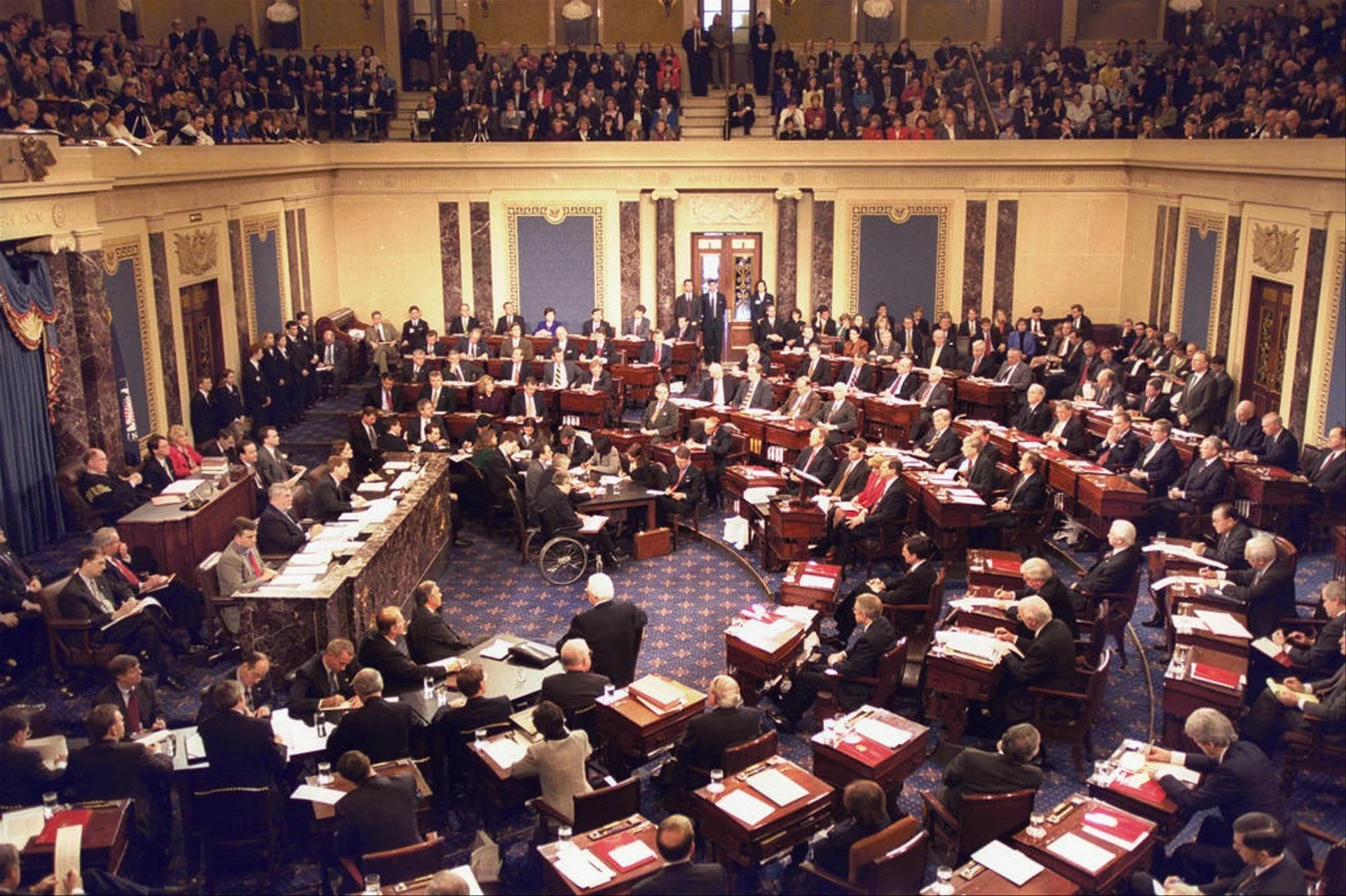
The impeachment trial of Bill Clinton, in 1999, with Chief Justice William H. Rehnquist presiding. The House managers are seated beside the quarter-circular tables on the left and the president's personal counsel on the right, much in the fashion of President Andrew Johnson's trial, in 1868.
WEST WARWICK, R.I.
Edmund Burke, the 18th-Century British statesman, argued during the celebrated impeachment of Warren Hastings, the governor of Bengal, that impeachment was essentially a political process, not a judicial one. Quite so.
The political dimension of impeachment is again on display in Washington, where the Republicans, driven by a faction of the party, are moving toward impeaching President Biden.
Historically, presidential impeachment has been reserved for actions that meet the undefined standard of “high crimes and misdemeanors.” It has been used with great restraint; until the impeachment of Bill Clinton, only Andrew Johnson had been impeached. The bar was lowered for the Clinton action then, and the attempt to impeach Biden is a further lowering — pointing up that it is, as Burke argued, a political process.
Impeachment is becoming a common political tactic not, as envisaged by the Founders, the ultimate censure, leading to a trial in the Senate and removal from office.
The two indictments of Donald Trump would seem to have met, to my mind, the constitutional standard and, had the Senate been in other hands, might have led to a trial and removal. It is argued that those indictments didn’t meet the standard and were no more than censure by another name, carried out along party lines.
The gravity of impeachment has been preserved since the beginning of the republic, but it is in danger.
Some aspects of the structure of the state should be out of reach to the political process most of the time. The U.S. Constitution guarantees that it can’t be easily amended or today it wouldn’t be recognizable, as every fashionable fixation would have been added. The mistake of Prohibition written again and again.
At the time that the Northern Ireland peace accords were being written, I was involved with a lively summer school in Ireland — which might be thought of as a think tank that meets once a year.
This organization, the International Humbert Summer School, studied Ireland’s relationship to the world, but became involved in the peace process. There were speakers from both the Unionists (pro-British) and Sinn Fein, the political wing of the IRA.
At one session, my role was to respond to the late Martin McGuinness, widely known as a top leader of the IRA, believed by the British to be a terrorist with blood on his hands.
Because I have a British accent, the organizers, John Cooney, the Irish historian and journalist, and Tony McGarry, a prominent local headmaster in Ballina, County Mayo, where we gathered, were nervous about what I might say to a man who was regarded with fear and awe as a killer.
Our event turned into a debate. McGuinness was sharp, had a good sense of humor and was open to ideas. Because the IRA had been engaged in armed struggle for so long, it hadn’t thought about constitutional arrangements in peace.
Thinking of the U.S. Constitution, I suggested to McGuinness that if a new constitution for Northern Ireland were to be written, it should sweep nothing under the carpet by ignoring it (as was the American case with slavery) and that when finished, it should be placed on “a high shelf” from which it couldn’t be easily taken down.
McGuinness agreed heartily, and this led to a discussion of constitutions and systems of government, and how the drafting could be perfected.
But my idea of a high shelf was what stuck with him.
So it is deeply disheartening to see impeachment treated as just another political tactic to be launched against any American president simply because the opposition party doesn’t like the president’s policies. But that is what is happening.
Incidentally, the impeachment of Warren Hastings, which dragged on for years and was enormously expensive, ended in acquittal before the House of Lords, proving Burke’s point that impeachment was a political process.
In the United States, for most of our history we have avoided keeping it out of the political maelstrom. It is a sad thing to see used now as a purely political tactic.
We have what is essentially a permanent campaign for the presidency. No sooner is one election certified then rumblings about the next one, with all the attendant speculation, begin.
Will presidential impeachment become part of the political process? And what if a Senate has the two-thirds majority to convict on political grounds? There is danger here.
At the end of our exchange, I wished the IRA leader “the best of British luck.” He laughed. No attempt to kneecap me followed.
Llewellyn King is executive producer and host of White House Chronicle, on PBS. His email is llewellynking1@gmail.com and he’s based in Rhode Island and Washington, D.C.
Visiting rights only
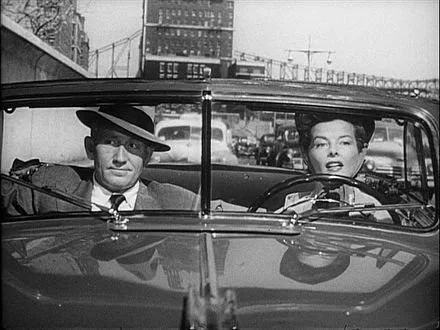
A shot from Adam’s Rib (1949), one of nine movies that Katherine Hepburn (1907-2003) made with her co-star here, Spencer Tracy (1900-1967), who was also her real-life romantic partner. She was from an affluent Connecticut family.
"I have always thought that marriage was a funny sort of institution. Sometimes I wonder if men and women really suit each other at all. It's inevitable that they should come together now and again, but how well suited are they to living in the same house? Perhaps they should live next door and visit every now and then."
— Katherine Hepburn

The former house of Katherine Hepburn, in the very hurricane-exposed Fenwick section of Old Saybrook, Conn.
All-in-one retailing
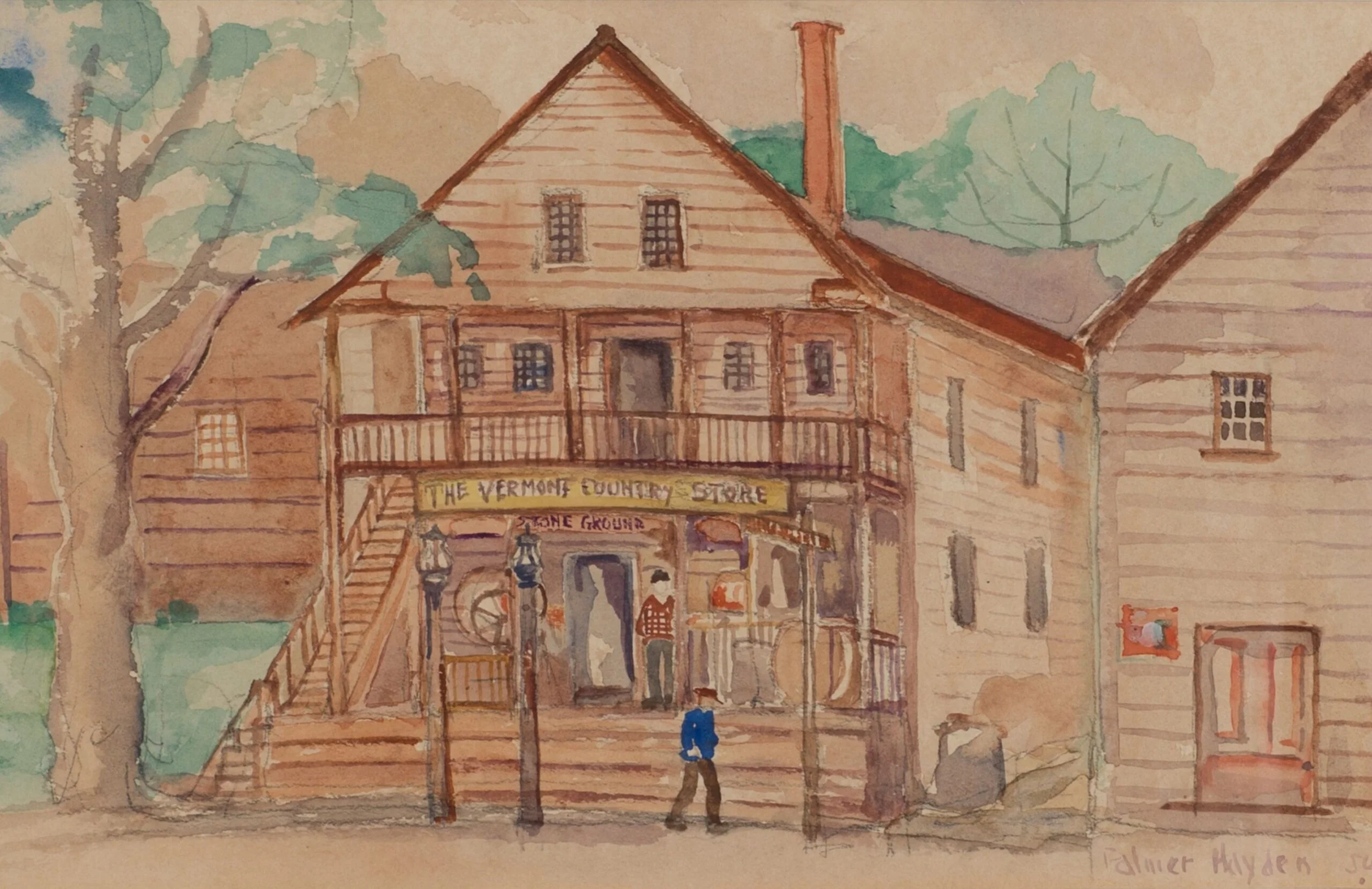
“Vermont Country Store”(watercolor) Palmer Hayden (1890-1973), in the show “For the Love of Vermont,’’ at the Southern Vermont Arts Center, Manchester, Vt., through Nov. 5
There’s a use for everything

“What Remains’’ (mixed media)., by Massachusetts-based artist and fencing coach Elif Soyer, in her show “Making Meaning,’’ at Kingston Gallery, Boston, Nov. 29-Dec. 30.
"Everyday takes figuring out all over again how to f***ing live.”
(Calamity Jane/Deadwood)
The gallery says:
“‘Making Meaning’’’ is a conglomeration of old and new ideas and experiments, culminating in fabrications, layered with both time and materials. For Soyer, the Calamity Jane quote from her favorite character and all time favorite show is true for most of us. Soyer ponders this existential question often, especially in the studio where, for her, making art is making meaning out of the mundane, through work and invested time. Oscillating between the interior landscape of the human body and the exterior landscape of her immediate environment, through collecting, layering or other seemingly obsessive processes, Soyer’s work has always had a very strong tie to time.’’


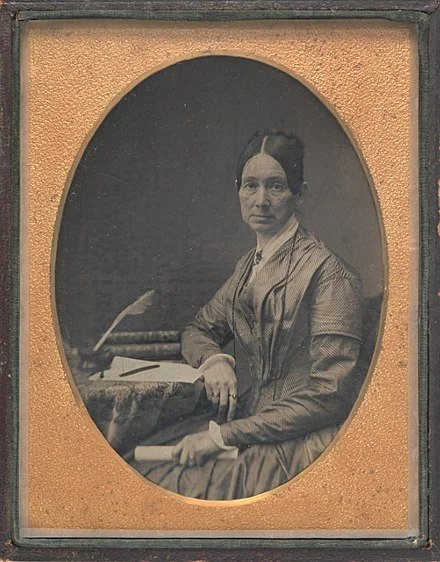
An advocate for the insane
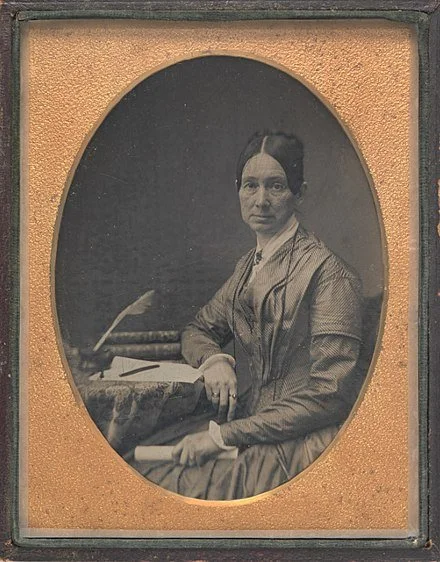
Half-plate daguerreotype of Dorothea Dix, c. 1849
• "I come to present the strong claims of suffering humanity. I come to place before the Legislature of Massachusetts the condition of the miserable, the desolate, the outcast. I come as the advocate of helpless, forgotten, insane men and women; of beings sunk to a condition from which the unconcerned world would start with real horror."
• "The tapestry of history has no point at which you can cut it and leave the design intelligible."
• "In a world where there is so much to be done, I felt strongly impressed that there must be something for me to do."
— Dorothea Dix (1802-1887), mental-health advocate, Civil War nurse and social reformer. She was born in Hampden, Maine, and raised in Worcester, Mass.
Hit this link on 19th Century Boston doctors appealing for a mental hospital.

Hampden Narrows on the Penobscot River, c. 1910
From ‘the life she’s living’

“Flesh Forms” (plaster of paris with encaustic), by Providence-based artist Angel Dean, in her “Flesh, Flora, and Flux’’ show, in the Providence Art Club’s Castelnovo Gallery, through Oct. 5.
Her artist statement says:
“Angel Dean is an artist who mainly works with encaustic media. Her work is personal and unconventional. By contesting the division between the realm of memory and the realm of experience, Dean makes work that is the by-product of the life she’s living.’’
“The advice I like to give young artists, or really anybody who’ll listen to me, is not to wait around for inspiration. Inspiration is for amateurs; the rest of us just show up & get to work. If you wait around for the clouds to part & a bolt of lightning to strike you in the brain, you are not going to make an awful lot of work. All the best ideas come out of the process; they come out of the work itself. Things occur to you.”
—- Chuck Close
First the hurricane, then the popcorn
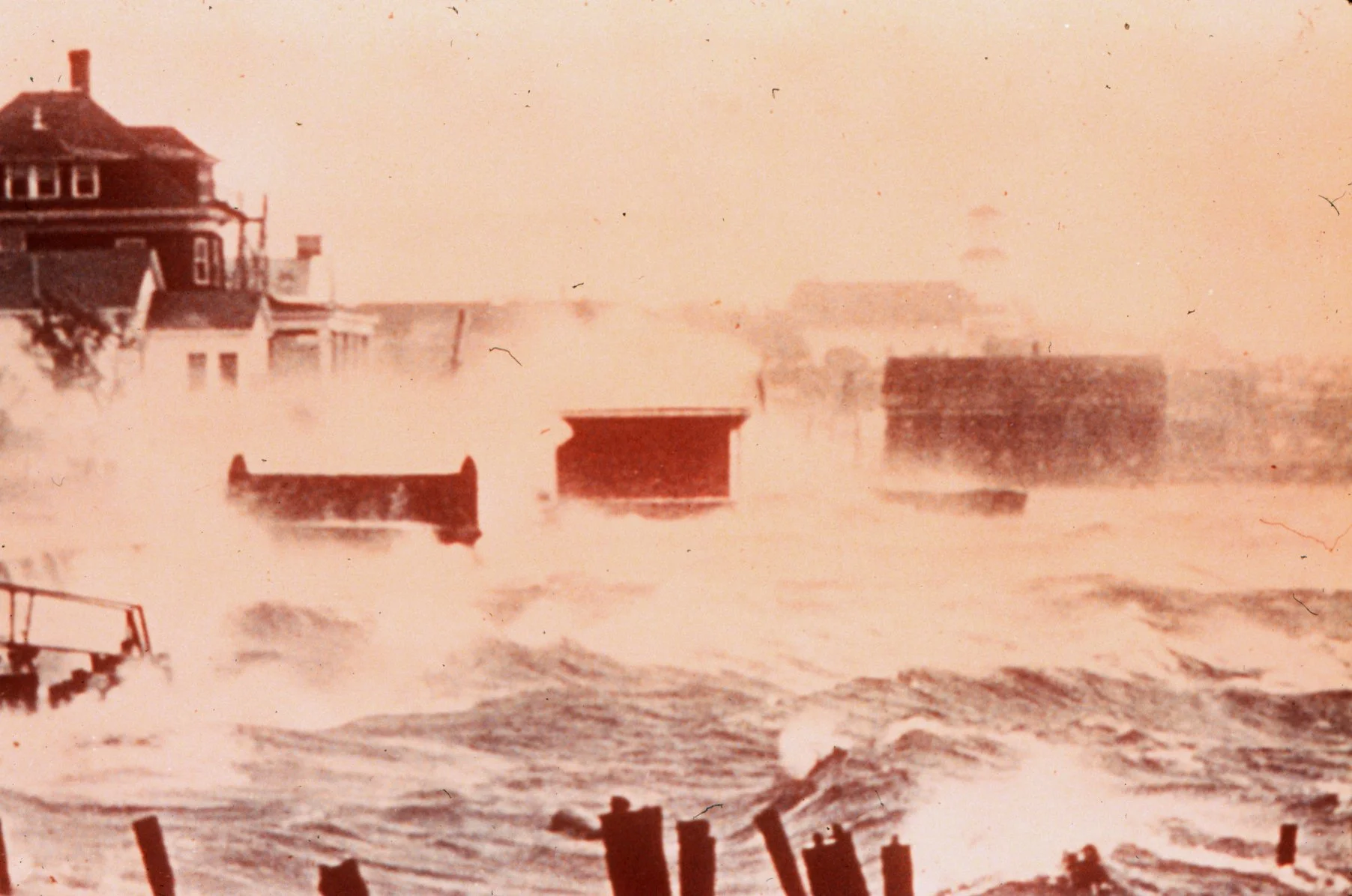
On the Connecticut coast during Hurricane Carol, on Aug. 31, 1954

Get out the popcorn
Adapted from Robert Whitcomb’s “Digital Diary,’’ in GoLocal24.com
The news-media hype last week about Hurricane Lee mostly reflects their craving for clicks/ratings from the drama associated with (mostly free) video. And I suspect that most people enjoy the excitement of a storm even if they’re in it, unless, of course, there’s some personal insult/expense, such as a tree falling on their house.
There was a minor hurricane called Belle back in 1976 that weakened and moved west of Rhode Island during our first residency in Providence. When it became clear that it wouldn’t amount to much, our next-door neighbor, the late great Luigi Bianco, whined in frustration: “But I want drama!”
Back in the ‘50’s, at our house on Massachusetts Bay, several hurricanes kept us well supplied with firewood from fallen trees and branches well into the ‘60s; we started to miss those storms when we ran low of firewood during the ‘60s tropical- storm shortage. The firewood was mostly for decorative fires during the holidays and to pop popcorn (to be soaked in butter and salt – no wonder we all got heart disease) -- and roast chestnuts. I still link the fires with watching home movies taken on a wind-up 8mm camera.

A new way of scaring away sharks from fishing operations?

Electromagnetic field receptors and motion-detecting canals in the head of a shark

Seabirds attracted by longline fishing
Edited from a New England Council report:
“Students at the University of New England (UNE) are researching how electrical pulses can effectively protect sharks while saving fishermen time and money. (UNE has campuses in Portland and Biddeford, Maine.)
“The technology, which works by emitting small, erratic electrical impulses within the water, intends to scare away sharks, which can detect electrical fields, while leaving the intended catch unaffected. If the devices, which can be attached next to each fishing hook, are as effective as anticipated, they can significantly reduce shark bycatch on longline fishing equipment. This result would reduce waste and catch inefficiencies for fishermen and protect sharks from being caught unintentionally.
“Over the past decades, as fishing efforts have increased significantly, sharks and other marine life have seen their populations drop, in major part due to bycatch. The work by UNE students and faculty attempts to simultaneously minimize harm to wildlife, while boosting the sustainability and success of fishermen. While there is plenty of work left to be done before a final device is perfected, students understand how valuable this technology could become.
“‘[The fishermen] lose a lot of money, and they know it,’ Michael Nguyen, a second-year graduate student, told The Portland Press Herald. ‘We are still trying to work out specifics. This is a long way away from being integrated into any commercial fisheries, but there’s a lot of interest, a lot of need, especially now that they see the electrical field isn’t scaring away the tuna.’’’
‘Winter is lurking’

The Blackstone River Bikeway in Rhode Island
— Photo by Srs5694

— Photo by eflon
Sometimes a mortal feels in himself Nature
-- not his Father but his Mother stirs
within him, and he becomes immortal with her
immortality. From time to time she claims
kindredship with us, and some globule
from her veins steals up into our own.
I am the autumnal sun,
With autumn gales my race is run;
When will the hazel put forth its flowers,
Or the grape ripen under my bowers?
When will the harvest or the hunter's moon
Turn my midnight into mid-noon?
I am all sere and yellow,
And to my core mellow.
The mast is dropping within my woods,
The winter is lurking within my moods,
And the rustling of the withered leaf
Is the constant music of my grief...
“I Am the Autumnal Sun,’’ by Henry David Thoreau (1817-1862), of Concord, Mass., essayist, poet, naturalist and practical philosopher

Gerald FitzGerald: My wild ride on a Dukakis campaign

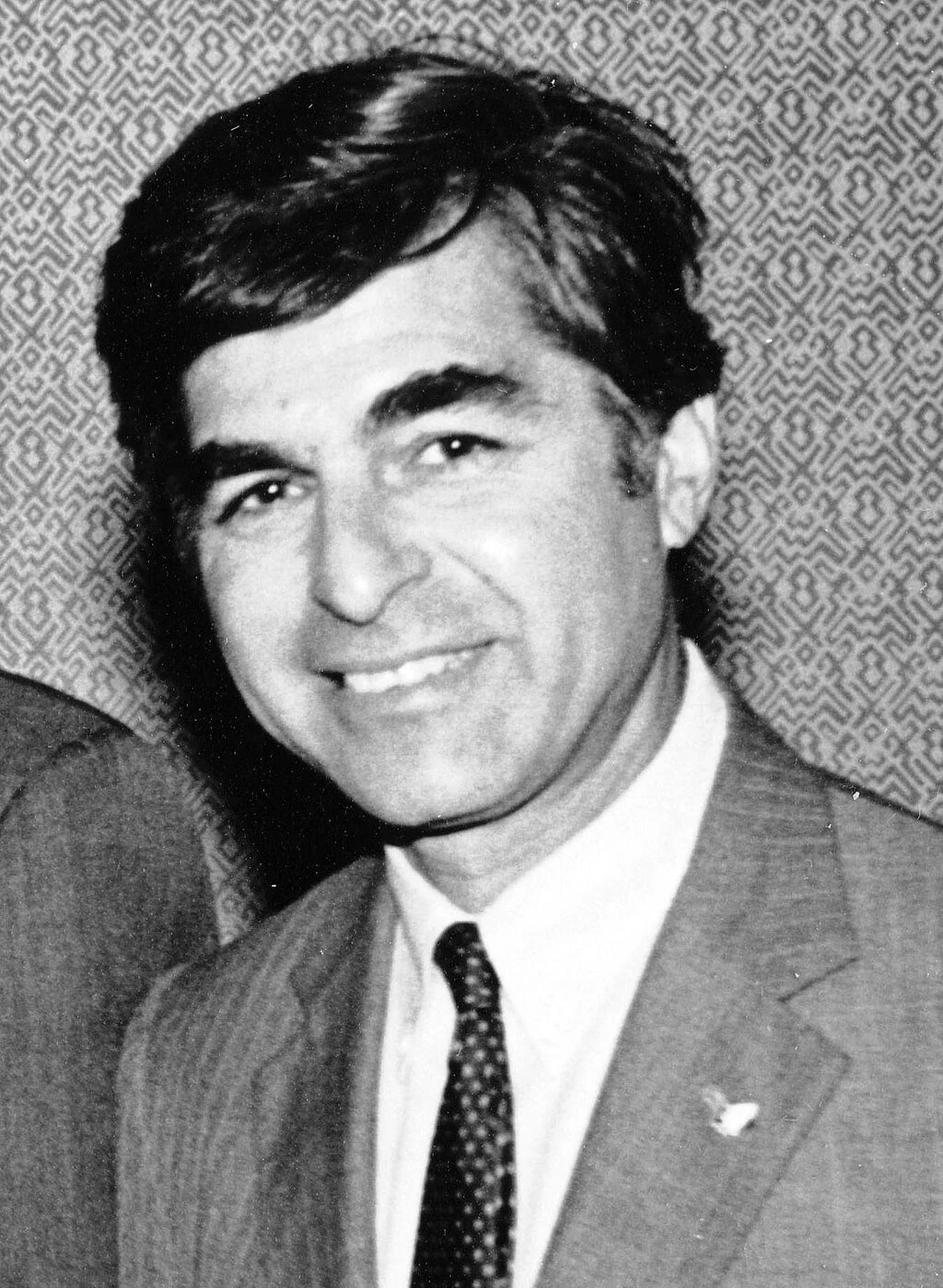
Michael Dukakis in 1984
At nearly one in the morning, two sets of three males paced the sidewalk in front of Phillips Drug Store at the corner of Charles and Cambridge Streets in Boston. It was 1982 in the heated Democratic primary race for governor. The youngish men were political enemies awaiting a delivery truck carrying the first edition of The Boston Globe. On the field for incumbent Massachusetts Gov. Edward J. King were Ed Reilly, political guru/re-election campaign manager; Gerry Morrissey, press secretary, and a factotum named Rick Stanton. Representing the challenger, once and future Gov. Michael S. Dukakis, were ace speechwriter Ira Jackson; deputy issues man Tom Herman and me, the Dukakis campaign press secretary. None of us spoke to any of them.
The bundles eventually dumped from the back of the truck were dragged inside and their cords cut. All six men scurried into Phillips to buy copies. Back outside, I had one Globe for us, holding it open while Jackson and Herman peered over my shoulders. Nothing on Page One! Nothing on the Metro cover! I slowly scanned succeeding pages until I found the story about our campaign besmirching Governor King’s wife. A freelance Dukakis supporter had bastardized a Jodie King radio ad to rearrange her statements as if she were answering a fictitious narrator's questions concerning her husband’s sexual preferences. Smiling broadly, I looked up at Morrissey:
“Inside. Page 19, below the fold,” I said with satisfaction.
Angry, Morrissey quickly moved toward me, thrusting an index finger close to my face:
“We’re going to get you!” he growled.
The doctored tape had arrived unsolicited in the campaign mail. I learned of it when John Sasso, Dukakis’s campaign manager, waved me into his office, grinning. We sat down and he began to play the offensively hilarious recording. Trouble was he had his telephone on speaker. Listening was a reporter from The Globe. I can’t recall clearly if it was Charlie Kenney or Ben Bradlee Jr. but I’m guessing it was Bradlee because my memory tells me that Sasso had first played it for Kenney alone and then again for me and Bradlee. I tried vigorously to stop the tape, but Sasso pushed me away. A brilliant man, John was making a mistake of earthquake proportions. He had grown close to several reporters. He treated them as buddies, expecting similar treatment in return. I had tried to convince Sasso that reporters were good people and fun to be around but they will eat you alive. A good story trumps a good “friend” any day.
The tape, we later learned, had been mailed in by an over-enthusiastic, brutally clever supporter from Ware, Mass., who supposedly used WARE’s radio facilities to create the satire. At the time I didn't even know where Ware was. As King’s campaign continued to work reporters to fan the fires of outrage, we Dukakis employees tried just as hard to hose it out of existence. Keeping what soon became known as “The Sex Tape” off the front page that first news cycle was a win for us good guys.
Earlier that day, Dukakis and I had met with the editorial board of The Patriot-Ledger at its old location in Quincy. The usual point of such meetings was to try to win a paper's endorsement, but the Patriot-Ledger’s policy was not to endorse any primary-election candidates. Dukakis still wanted to meet with them and answer their questions. Present were reporters and editors whose names I no longer recall. Near the end of the session someone entered the room and announced that there was a call for me that would be transferred to a telephone outside the door of the meeting room. I walked out and picked up the phone. Close by were wire-service teletype machines. These noisy, chattering tickers typed breaking news stories on a continuous roll of foolscap, sometimes preceded by dings whose urgency alerted staff to tear the stories off the roll to read.
It was Sasso on the phone. News of the Jodie King tape was out. He asked if the Patriot-Ledger knew this. Were they grilling Dukakis? I told him no. At the same time I turned to read the latest story coming in from Associated Press (or it might have been United Press International). It was all about the sex tape. I don't think I read the incoming story to John because that would have taken time I didn’t have. Instead, I told him that the wire service was breaking the story as we spoke. I turned around to face the newsroom. Glancing back at the machine, I noted where the story ended. Still holding the phone, I slid my left hand behind my back, ripping the paper from the teletype as silently as possible and brought it up under my suit jacket, shoving the paper down between my underpants and trousers.
Minutes later, the Duke and I were back in the car with a waiting driver. If anyone heard the crinkling sound as I scooted onto my seat, he was too polite to comment. They dropped me at campaign headquarters, and Michael went on to Springfield as scheduled.
That night, in the words of Ira Jackson quoting The Godfather script: “We hit the mattresses.” The telephones blazed for a couple of hours. After having been told that all copies of the errant tape had been destroyed, I told Frank Phillips: “The tape does not exist.” Phillips, writing for The Boston Herald, was someone I knew well and had once worked with on a journalism project. He didn’t ask if the tape had ever existed. Yes, I know – I am not proud of myself, then or now.
We went on to beat King by about seven points and defeat Republican John Sears by about a 59-38 percent margin in the general election. Although Dukakis eventually offered me his top press job, I stayed only a couple of weeks after the inauguration, which was on Jan. 6, to help with his transition. It’s one thing to work your heart out for low pay six or seven days a week all year to get your candidate elected. It’s another thing to have to go home for Thanksgiving not knowing if you've got an offer for a job to start in January. I never knew why the offer took so long, but I did learn that a paid campaign media adviser was pushing hard to clip me on behalf of his friend, an editor of an alternative weekly newspaper. Sasso is the one who told me, but advised me not to worry. When I told the Duke that I wouldn't stay he took me to lunch to talk me out of leaving. He even asked if he could meet with my wife to tell her why he wanted me. No way, I replied, she might cave. Dukakis asked me to recommend a replacement. In turn, I asked Frank Phillips. He suggested someone. To ice the interloper, I strongly recommended Frank's candidate, Jim Dorsey, who got the job.
Six years later Dukakis was serving his third term when he was nominated for president at the 1988 Democratic National Convention, in Atlanta. Sasso had run this campaign, too, until he hit a severe bump in the road five months before the convention. This time it was a videotape.
Then Delaware Sen. Joseph Biden, a primary competitor, had made himself vulnerable by delivering public remarks plagiarized from a British politician. Sasso leaked to the press a video comparison of the Biden speech with that of the Brit’s. It was enough to kill Biden's 1988 candidacy. But the public blow back was sufficient to make Sasso resign his own position at the end of September 1987. Still, I didn’t see a thing wrong with Sasso's action. While on a lunchtime walk up Beacon Street in front of the State House I learned from Mike Macklin, a TV news reporter, that Sasso was out. Macklin wanted me to comment since he knew that I had worked closely with John. I told Macklin on camera that Sasso should not take the fall for pointing out the truth and, further, that “I think he's being crucified.”
Years later, John's wife told me that during the Atlanta convention she and her husband dined with a group of national network newsmen. Speaking of his resignation Sasso told the gathering: “When I left the campaign only two people went on television to defend me – then New York Gov. Mario Cuomo and Jerry FitzGerald,” His listeners chewed their food, nodding their heads, until one, Tom Brokaw, I think, asked: “Who's Jerry FitzGerald?”
A year after the Biden tape debacle, about two months before the national election, Dukakis brought Sasso back to run the campaign as “vice-chairman.” John called me, I want to say, on Friday, Sept. 10. We met early next morning at the old Statler Building (now the Park Plaza) in Park Square, the same headquarters location used in 1982. After a brief chat I offered to help him any way he thought I could. Sadly, he declined.
“No, Fitzie. We're going down. What's worse is that we are going down never having stood for anything.” John's words cut me like a sharp knife. Even now, decades later, I find it extremely difficult to believe that he believed what he said.
Afterward followed one of my most enjoyable afternoons ever. Someone, I think on the side of the family of Sasso’s wife, Francine, was in town from New Hampshire with Red Sox tickets. John, the N.H. relative, and -- a surprise to me -- Ted Sorensen and I took a cab to Fenway Park to watch the Sox lose a close one to, as I recall, Cleveland. The seats were good, but sitting next to Sorensen made mine even better. I hardly let him shut up about his nearly 11 years as JFK's right arm, including writing speeches for the president whose phrases still ring in our hearts. In fact, we continued to chat walking all the way back from the stadium to Park Square. He was only 50 then. He would live another 22 years, but I never saw him again.
As we all parted, I clasped his hand and thanked him profusely for all he had done to help our president who had truly helped our nation. For much of my boyhood I had read books by Sorensen, Arthur M. Schlesinger Jr., Pierre Salinger, Arthur Krock and many others while daydreaming of assisting a worthy candidate to become president of the United States. That never happened for me. Still, sometimes the dreaming and the reaching out are nearly enough.
Gerald FitzGerald’s career has also included being a newspaper editor, a writer, a prosecutor, a defense lawyer and a civic leader.
All the world's a shadow box

Work by Melora Kennedy at The Front gallery, in Montpelier, Vt.
The gallery says:
“Melora Kennedy is a painter who has also made shadow boxes, and is currently occupied with still life. Still life makes it possible to practice her art a little every day—which makes it like meditation. Setting up a still life is similar to arranging the elements inside a shadow box: it resembles child's play. She's drawn in by the way that plants, in particular, express human emotion in their every gesture. She tries to paint so this feeling of liveliness comes across.’’
Melora has been living in Vermont since 1998. She teaches at a nursery school and lives with her partner on some land that they garden together.
That was then
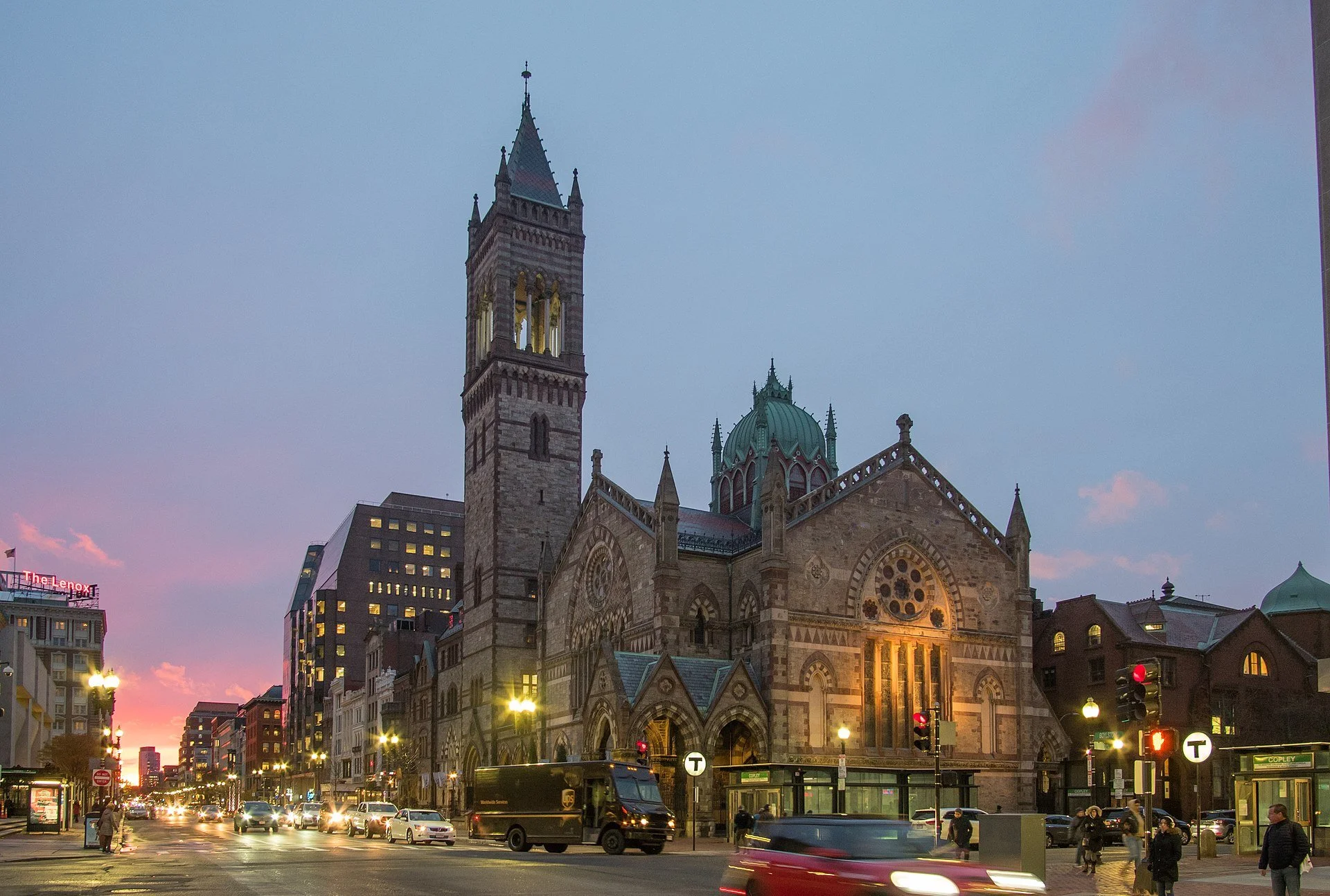
Old South Church at Copley Square at sunset. This United Church of Christ congregation was first organized in 1669.
— Photo by Rhododendrites
“Boston – wrinkled, spindly-legged, depleted of nearly all her spiritual and cutaneous oils, provincial, self-esteeming – has gone on spending and spending her inflated bills of pure reputation, decade after decade.”
— Elizabeth Hardwick (1916-2007), literary critic, short-story writer and novelist, in 1962
Blue but happy

“Happy Dance” (encaustic and ink painting), by Nancy Whitcomb, in the “Out of the Blue” group show, at Spring Bull Gallery, Newport, R.I., through Oct. 29
Kevin Gilmore, the show’s juror, says:
“A word on ‘Out of the Blue’. The color blue is the first ‘clue’ in the prompt for this exhibition. Not surprisingly, for a gallery located on Aquidneck Island, surrounded by the beautiful shorelines and waters of Narragansett Bay, the color blue dominated the group of submissions.’'
Llewellyn King: Memories of people I knew from the Manhattan Project; beautiful "Barbie'

Important sites in the Manhattan Project. Alamogordo is where the first atomic bomb was detonated, on July 16, 1945. The map would have been better if it had included the site of uranium 238 refining for the project by Metal Hydrides Inc., in Beverly, Mass.
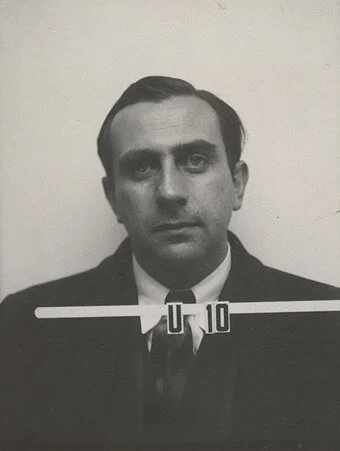
Edward Teller’s (1908-2003) badge photo at the Manhattan Project’s Los Alamos, N.H., facility. Called “The Father of the Hydrogen Bomb,’’ he was seen as an inspiration for the eponymous scientist in Stanley Kubrick’s classic 1964 black comedy Dr. Strangelove.
WEST WARWICK, R.I.
I have been to the movies. I haven’t done that since before the COVID shutdown.
I went to see two huge movies that have each grossed $1 billion so far, and I enjoyed them enormously. They are, of course, Barbie and Oppenheimer.
I went to see Barbie because I thought I should know what people were discussing. I went to see Oppenheimer because, in a sense, I have skin in that game. I knew a few people who worked on the Manhattan Project, and two of them were characterized in the movie: Hans Bethe and Edward Teller, known as the father of the hydrogen bomb.
About Barbie: It is a fantasy romp filled with popular, real-life messages. I had to see how director Greta Gerwig would make an adult movie about a doll, albeit a storied one — with brilliant imagination is how.
Oppenheimer, by contrast, is a major cinematic work, a remarkable recapturing of history and character development on the screen. Christopher Nolan is a director at the top of his game. He deserves a comparison with Orson Welles and David Lean.
Across the board, it is a triumph, compelling and true to the facts and the personalities. The evocative recreation of Los Alamos as it must have been, of the tower from which the first nuclear device was detonated, rings true. I have crawled all over the nuclear-test site and spent many hours at Los Alamos, where I used to give an annual lecture on energy or the relationship of humans to science.
In November 1975, Bethe and another veteran of the Manhattan Project, Ralph Lapp, and I put together a panel of 24 Nobel laureates (including Bethe) to defend civilian nuclear power. We got them all together on a stage at the National Press Club, in Washington. I had hoped that it would be a seminal event, ending some of the nonsense being spread about nuclear radiation.
Ralph Nader took up arms against us and assembled 36 Nobel laureates who were cool to nuclear. Ours were physicists, engineers and mathematicians who had a vast understanding of nuclear and endorsed it enthusiastically.
We didn’t win. Bethe, as I recall, was philosophical about being trounced.
I first met Teller in Geneva. I was to introduce him at a conference, and we had breakfast together. He seemed distracted and confused. But he was in top form when he spoke.
Later, I got to know him better. He gave a series of speeches for conferences I had organized on the Strategic Defense Initiative — colloquially known as Star Wars. He often sat slumped in his chair, clutching his enormous walking stick. But he stood erect on the podium, arguing vigorously the case for Ronald Reagan’s program.
The Oppenheimer movie reminded me of two institutions I covered intensely as a reporter: the Atomic Energy Commission (AEC) and its congressional overseer, the Joint Committee on Atomic Energy.
The committee was supposed to check the AEC. The AEC was a tool of the powerful and wildly pro-nuclear committee — the only joint committee empowered to introduce legislation in both houses of Congress. The reality of that partnership was that the committee proposed and the AEC disposed.
The movie is extraordinary in capturing the workings of Congress and how a nod or a smile can put great events in motion.
This understanding of the nuances and mores of Washington, and particularly the arcane theatricality of the congressional hearings, is accurate in ways seldom captured on film. This is more surprising given that the director is an Englishman who lives a very private life in Los Angeles.
I leave it to sociologists to ponder how two movies as different as Barbie and Oppenheimer could open simultaneously, becoming huge hits. If you see these movies, especially Oppenheimer, see them in the theater. They deserve that big-screen and wraparound-sound environment.
On Twitter: @llewellynking2
Llewellyn King is executive producer and host of White House Chronicle, on PBS.
White House Chronicle

Chris Powell: Tesla’s special deal with the Mohegans; a school for the sexually uncomfortable

The Mohegan tribe’s casino complex, in Uncasville, Conn.
MANCHESTER, Conn.
Nothing may be more beautiful in politics than when influential but selfish special interests clash, catching squeamish elected officials in the middle, forcing them to choose sides on the basis of how much political harm each special interest could inflict on them. Choosing sides according to the public interest seldom occurs to elected officials, since they tend to equate the public interest with whatever gives them political advantage.
Such a clash was renewed in Connecticut the other day when automaker Tesla and the Mohegan Indian tribe announced that Tesla will start selling and delivering cars from a showroom on its reservation in the eastern part of the state.
This practice ordinarily would break state law, which prohibits automakers from selling cars directly and reserves that business for manufacturer-franchised and state-licensed auto dealers. Tesla doesn't use franchisees.
The law's purported premise is that dealers provide better consumer protection than manufacturers would. Of course, the law provides even better protection for auto dealer profitability.
But as a matter of federal law, Indian reservations have some sovereignty, and federal courts almost certainly would construe it in favor of Tesla's arrangement with the Mohegans, which is similar to arrangements Tesla has with Indian reservations in other states
Because of Connecticut’s law, state residents who want to buy Teslas have to leave the state, though Teslas can be viewed and leased at a Tesla showroom in Milford.
Tesla and the Connecticut Automotive Retail Association long have been tangling over the law. The General Assembly always has sided with the auto dealers, who have far more influence and thought they had won. Maybe now they have lost.
Gov. Ned Lamont and state legislators may resent the Mohegans for contravening state policy so dramatically, especially since the tribe usually portrays itself as a good partner with state government. More resentful still, the auto dealers now may propose legislation to wreck Tesla’s arrangement with the Mohegans, as by imposing a prohibitive fee on registering in Connecticut any vehicles for which there is no dealer franchise in the state.
But might car buyers in Connecticut, especially those with enough money to buy Teslas, be allowed to settle this issue for themselves?
New cars are expensive and people today tend to be attentive to their warranties. If car buyers are really so much more protected when buying from an auto dealer rather than direct from a manufacturer, the dealers association could advertise to that effect. Meanwhile, Tesla could advertise why people buying directly are adequately protected. Buyers could decide for themselves.
The world wouldn’t end, and state government could worry less about protecting the auto dealers and more about protecting state residents from failing schools and sewer systems, repeat criminal offenders, street takeovers by wild juveniles, crooked state troopers, grotesque cost-overruns on government construction projects, and other problems against which people can’t protect themselves.
xxx
As sexual discomfort and gender dysphoria seem to be exploding among young people, a teacher is planning to open a private school in Ansonia for seventh- and eighth-graders with such conditions. It didn't get enough enrollment to start with the current school year and it will be surprising if it succeeds.
For tuition is planned to be $20,000 a year while parents of the potential students already may face high medical bills. Transportation will be a challenge. People may be reluctant to commit to a school that may not be around for more than two years, with students risking having to transfer back to school systems they fled.
Competition in education is good but the reasons it is needed aren’t. The main justification claimed for the new school is that many young teens with sexual and gender discomfort are frequently bullied by their peers and school administrators fail to act against it. The remedy offered by the new school is essentially segregation, so no students distressed by matters of sexuality and gender will ever have to deal with students not like them, and vice-versa.
Will that solve problems or just postpone them to when they are even more traumatic?
Apparently it is too much to ask government to figure out why more young people are distressed.
Chris Powell has written about Connecticut government and politics for many years (CPowell@cox.net).
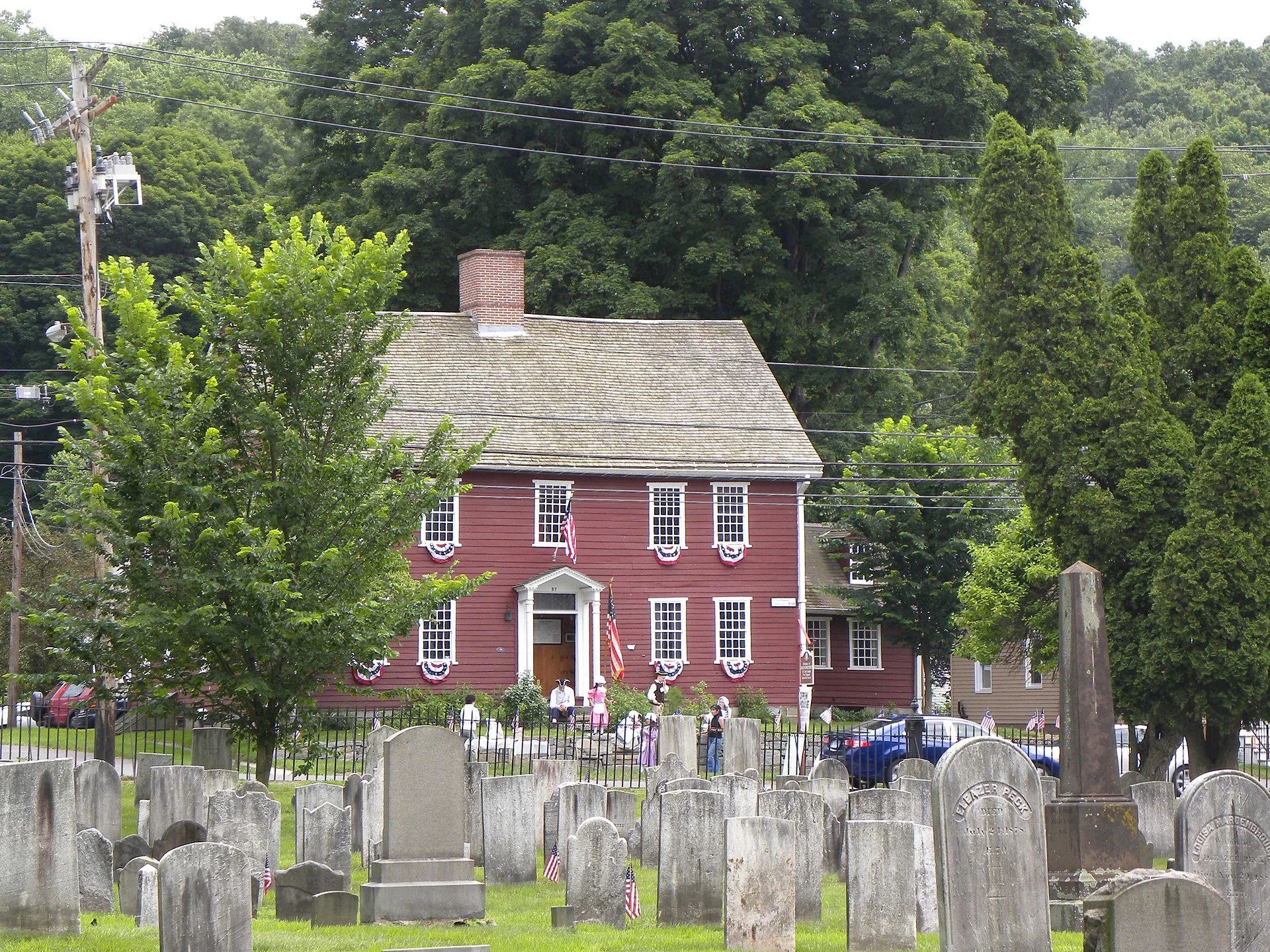
The David Humphreys home, built in 1698, at 37 Elm St., Ansonia, which with other communities in the Naugatuck River Valley became industrial powerhouses in the late 19th and early 20th centuries.
Friendship

“Combinatti #3 (bronze), by J.T. Gibson, in the group show “Lean on Me,’’ at Atelier gallery, in Newport (R.I.), through Oct. 16
The gallery says:
“The show highlights our appreciation for blacksmithing, forged steel, woodworking and cast bronze work both in Newport and in Santa Fe, N.M. Metal casting is a process in which hot liquid metal is poured into a mold to solidify — an art developed over 7,000 years ago during the Bronze Age.’’

Save The Bay Exploration Center and Aquarium, in Newport
—Photo by Kenneth C. Zirkel
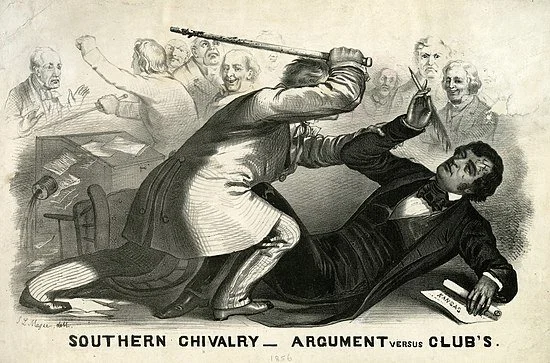
Charles Sumner: Separate isn’t equal
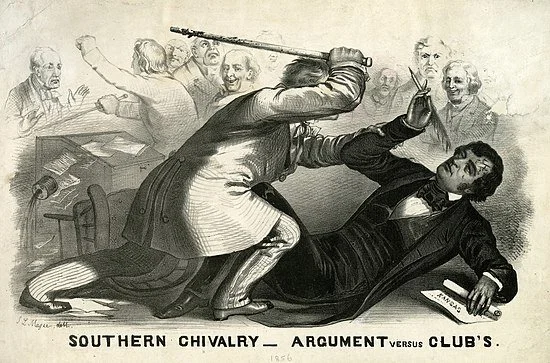
Lithograph of fanatical slavery defender South Carolina Rep. Preston Brooks' s 1856 attack on Charles Sumner in the Senate, which almost killed Sumner

Sumner's birthplace on Irving Street, Beacon Hill, Boston
Massachusetts lawyer, abolitionist and soon-to-be U.S. Sen. Charles Sumner in unsuccessfully arguing a case before the state’s Supreme Judicial Court in 1849:
May it please your Honors:
Can any discrimination on account of race or color be made among children entitled to the benefit of our Common Schools under the Constitution and Laws of Massachusetts? This is the question which the Court is now to hear, to consider, and to decide.
Or, stating the question with more detail and with more particular application to the facts of the present case, are the Committee having superintendence of the Common Schools of Boston intrusted with power, under the Constitution and Laws of Massachusetts, to exclude colored children from the schools and compel them to find education at separate schools set apart for colored children only, at distances from their homes less convenient than schools open to white children?
This important question arises in an action by a colored child only five years old who, by her next friend, sues the city of Boston for damages on account of a refusal to receive her into one of the Common Schools.
It would be difficult to imagine any case appealing more strongly to your best judgment, whether you regard the parties or the subject. On the one side is the city of Boston, strong in wealth, influence, character; on the other side is a little child, of degraded color, of humble parents, and still within the period of natural infancy, but strong from her very weakness and from the irrepressible sympathies of good men, which, by a divine compensation, come to succor the weak. This little child asks at your hands her personal rights. So doing, she calls upon you to decide a question which concerns the personal rights of other colored children; which concerns the Constitution and Laws of the Commonwealth; which concerns that peculiar institution of New England, the Common Schools; which concerns the fundamental principles of human rights; which concerns the Christian character of this community. Such parties and such interests justly challenge your earnest attention.
Though this discussion is now brought for the first time before a judicial tribunal it is no stranger to the public. In the School Committee of Boston for five years it has been the occasion of discord. No less than four different reports, two majority and two minority, forming pamphlets of solid dimensions devoted to this question, have been made to this Committee and afterwards published. The opinions of learned counsel have been enlisted. The controversy, leaving these regular channels, overflowed the newspaper press, and numerous articles appeared espousing opposite sides. At last it has reached this tribunal. It is in your power to make it subside forever.
THE QUESTION STATED.
Forgetting many of the topics and all of the heats heretofore mingling with the controversy, I shall strive to present the question in its juridical light, as becomes the habits of this tribunal. It is a question of jurisprudence on which you are to give judgment. But I cannot forget that the principles of morals and of natural justice lie at the foundation of all jurisprudence. Nor can any reference to these be inappropriate in a discussion before this Court.
Of equality I shall speak, not only as a sentiment, but as a principle embodied in the Constitution of Massachusetts and obligatory upon court and citizen. It will be my duty to show that this principle, after finding its way into our State Constitution, was recognized both in legislation and judicial decisions. Considering next the circumstances of this case, it will be easy to show how completely they violate Constitution, legislation, and judicial decisions,–first, by subjecting colored children to inconvenience, inconsistent with the requirements of Equality, and, secondly, by establishing a system of Caste odious as that of the Hindoos,–leading to the conclusion that the School Committee have no such power as they have exercised, and that it is the duty of the Court to set aside their unjust by-law. In the course of this discussion I shall exhibit the true idea of our Common Schools and the fallacy of the pretension that any exclusion or discrimination founded on race or color can be consistent with Equal Rights.
In opening this argument, I begin naturally with the fundamental proposition, which, when once established, renders the conclusion irresistible. According to the Constitution of Massachusetts all men without distinction of race or color are equal before the law. In the statement of this proposition I use language which, though new in our country, has the advantage of precision.
EQUALITY BEFORE THE LAW–ITS MEANING.
I might perhaps leave this proposition without one word of comment. The Equality of men will not be directly denied on this occasion, and yet it is so often assailed of late that I shall not seem to occupy your time superfluously, I trust, while endeavoring to show what is understood by this term when used in laws, constitutions, or other political instruments. Mr. Calhoun, in the Senate of the United States, and Lord Brougham, in his recent work on Political Philosophy, part II, cap. 4, characterize Equality as impossible and absurd. Had they chosen to comprehend the extent and application of the term thus employed, something if not all of their objection would have disappeared. That we may better appreciate its meaning and limitation, I am induced to exhibit the origin and growth of the sentiment, which, finally ripening into a formula of civil and political right was embodied in the Constitution of Massachusetts.
Equality as a sentiment was early cherished by generous souls. It showed itself in dreams of ancient philosophy, and was declared by Seneca, when in a letter of consolation on death, he said, “Prima enim pars Equitatis est Equalitas.” The first part of Equity is Equality. But not till the truths of the Christian Religion was it enunciated with persuasive force. Here we learn that God is no respecter of persons; that he is the Father of all; and that we are all his children and brethren to each other. When the Saviour taught the Lord’s Prayer he taught the sublime doctrine of Human Brotherhood enfolding the Equality of men.
Slowly did this sentiment enter the State. The whole constitution of government was inconsistent with it. An hereditary monarchy, an order of nobility, and the complex ranks of superior and inferior established by the feudal system all declare, not the Equality but the inequality of men, and all conspire to perpetuate this inequality. Every infant of royal blood, every noble, every vassal is a present example, that whatever may be the injunctions of religion or the sentiment of the heart men under these institutions are not born equal.
The boldest political reformers of early times did not venture to proclaim this truth, nor did they truly perceive it. Cromwell beheaded his king, but secured the supreme power in hereditary succession to his eldest son. It was left to his loftier contemporary, John Milton, in poetic vision, to be entranced “With fair Equality, fraternal state.”
Sidney, who perished a martyr to the liberal cause, drew his inspiration from classic and not from Christian fountains. The examples of Greece and Rome fed his soul. The English Revolution of 1688, partly by force and partly by the popular voice, changed the succession to the Crown, and, if we may credit loyal Englishmen, secured the establishment of Freedom throughout the land. But the Bill of Rights did not declare, nor did the genius of Somers or Maynard conceive the political axiom, that all men are born equal. It may find acceptance from individuals in our day, but it is disowned by English institutions.
I would not forget the early testimony of the judicious Hooker, who in his Ecclesiastical Polity, that masterly work, dwells on the equality of men by nature, or the subsequent testimony of Locke, in his Essay on Government, who, quoting Hooker, asserts for himself that “creatures of the same species and rank, promiscuously born to all the same advantages of nature and the use of the same faculties, should be equal one among another without subordination or subjection.” Hooker and Locke saw the equality of men in a state of nature; but it is difficult to find in them a practical guide.
It is to France that we must pass for the earliest development of this idea, its amplest illustration, and its most complete, accurate, and logical expression. In the middle of the last century appeared the renowned Encyclopedie, edited by D’Alembert and Diderot. This remarkable production, where science, religion, and government are discussed with revolutionary freedom, contains an article on Equality, first published in 1755. Here we find the boldest expression of this sentiment down to that time. “Natural Equality,” says this authority, ” is that which exists between all men by the constitution of their nature only. This Equality is the principle and the foundation of liberty. Natural or moral equality is then founded upon the constitution of human nature common to all men who are born, grow, subsist, and die in the same manner. Since human nature finds itself the same in all men, it is clear, that according to nature’s law, each ought to esteem and treat the others as beings who are naturally equal to himself; that is to say, who are men as well as himself.” It is then remarked that political and civil slavery is in violation of this Equality; and yet the inequalities of nobility in the State are allowed to pass without comdemnation. Alluding to these, it is simply said that they who are elevated above others ought to treat inferiors as naturally their equals, shunning all outrage and demanding nothing beyond what is due, but demanding with humanity what is incontestably due.
Considering the period at which this article was written we shall be astonished less by its vagueness and incompleteness than by its bravery and generosity. The dissolute despotism of Louis XV poisoned France. The antechambers of the King were thronged by selfish nobles and fawning courtiers. The councils of Government were controlled by royal mistresses. The King only a few years before, in defiance of Equality–but in entire harmony with the conduct of the School Committee in Boston–founded a military school, for nobles only, carrying into education the distinction of Caste. At such a period the Encyclopedia did well in uttering important and effective truth. The sentiment of Equality was fully declared. Nor should we be disappointed, that, at this early day, even the boldest philosophers did not adequately perceive, or if they perceived, did not dare to utter, our axiom of liberty.
Thus it is with all moral and political ideas. First appearing as a sentiment, they awake a noble impulse, filling the soul with generous sympathy, and encouraging to congenial effort. Slowly recognized, they finally pass into a formula to be acted upon, to be applied, to be defended in the concerns of life.
Almost contemporaneously with this article in the Encyclopedia our attention is arrested by a poor solitary of humble extraction, born at Geneva, in Switzerland, of irregular education and life, a wanderer from his birth-place, enjoying a temporary home in France–Jean Jacques Rousseau. Of audacious genius, setting at naught received opinions, his earliest appearance was by an eccentric Essay on the Origin of Inequality among Men, where he sustained the irrational paradox that men are happier in a state of nature than under the laws of civilization. This was followed by a later work on the Social Contract. In both the sentiment of Equality is invoked against abuses of society, and language is employed tending far beyond Equality in Civil and Political Rights. The conspicuous position since awarded to the speculations of Rousseau and their influence in diffusing this sentiment would make this sketch imperfect without allusion to him; but he taught men to feel rather than to know, and his words have more of inspiration than of precision.
The French Revolution was at hand. That great outbreak for enfranchisement was the expression of this sentiment. Here it received distinct and authoritative enunciation. In the constitutions of government successively adopted, amid the throes of bloody struggle, the Equality of men was constantly proclaimed. Kings, nobles, and all distinctions of birth passed away before this mighty and trimpuhant truth.
These Constitutions show the grandeur of the principle and how it was explained and illustrated. The Constitution of 1791 in its first article declares that: “Men are born and continue free and equal in their rights.” This great declaration was explained in the sixth article: “The law is the expression of the general will. It ought to be the same for all, whether it protects or punishes. All citizens being equal in its eyes, are equally admissible to all dignities, places, and public employments according to their capacity, and without other distinction than their virtues and talents.” At the close of the Declaration of Rights there is this further explanation: “The National Assembly, wishing to establish the French Constitution on principles which it has just acknowledged and declared, abolishes irrevocably the institutions which bounded liberty and equality of rights. There is no longer nobility, or peerage, or feudal rule, or patrimonial justices, or any titles, denominations and prerogatives thence derived, or any order of chivalry, or any corporations or decorations for which proofs of nobility are required, or which supposed distinctions of birth, or any other superiority than that of public functionaries in the discharge of their functions…”There is no longer, for any part of the nation, or for any individual, any privilege or exception to the law common to all Frenchmen.” These diffuse articles all begin and end in the Equality of men.
In fitful mood another Declaration of Rights was brought forward by Condorcet February 15, 1793. Here also are fresh inculcations of Equality. Article first places Equality among the natural, civil, and political rights of man. Article seventh declares: “Equality consists in this, that each can enjoy the same rights.” Article eighth: “The law ought to be equal for all,” whether it recompense, or punish, or repress.” Article ninth: “All citizens are admissible to all public places, employments, and functions. Free people cannot know other motives of preference than talents and virtues.” Article twenty-third: “Instruction is the need of all, and society owes it equally to all its members.” Article thirty-second: “There is oppression when the law violates the natural, civil, and political rights which it ought to guaranty. There is oppression when a law is violated by public functionaries in its application to individual facts.” Here again is the same constant testimony, reënforced by the accompanying report explaining the Constitution, where it is said: “All political power by inheritance is at the same time an evident violation of natural equality and an absurd institution, since it supposes the inheritance of qualities proper for the discharge of a public function. Every exception from the common law made in favor of an individual is a blow struck at the right of all.”* And in another part of the same report, the sovereignty of the people, equality among men, the unity of the Republic “are declared the guiding principles always present in the formation of the Constitution.
Next came the Constitution of June, 1793, announcing in its second article that the natural and imprescriptible rights of men are “Equality, liberty, safety, property.” In the next article we learn precisely what is meant by Equality when it says, “All men are equal by nature and before the law.” So just and captivating was this definition, which we encounter here for the first time, that it held its place through all the political vicissitudes of France, under the Directory, the Consulate, the Empire, the Restoration, and the Constitutional Government of Louis Philippe. It was a conquest, which, when achieved, was never abandoned. Every charter and constitution certified to it. The charter of Louis Philippe testifies as follows: “All Frenchmen are equal before the law, whatever may be their titles or ranks.” Nor was its use confined to France. It passed into other constitutions, and Napoleon, who so often trampled on the rights of Equality, dictated to the Poles the declaration that all persons are equal before the law. Thus the phrase is not only French but continental, although never English.
While recognizing this peculiar form of speech as more specific and satisfactory than the statement that all men are born equal, it is impossible not to be reminded that it finds a prototype in the ancient Greek language where, according to Herodotus, “the government of the many has the most beautiful name of all “isonomy” or Equality before the law. Thus, in an age when Equality before the law was practically unknown, this remarkable language, by its comprehensiveness and flexibility, supplied a single word, not found in modern tongues, to express an idea practically recognized only in modern times. Such a word in our own language, as the substitute for Equality, might have superseded criticism to which this declaration is exposed.
EQUALITY UNDER CONSTITUTION OF MASSACHUSETTS AND DECLARATION OF INDEPENDENCE.
The way is now prepared to consider the nature of Equality, as secured by the Constitution of Massachusetts. The Declaration of Independence, which followed the French Encyclopedia, and the political writings of Rousseau, announces among self-evident truths, “That all men are created equal, and that they are endowed by the Creator with certain unalienable rights; that among these are life, liberty, and the pursuit of happiness.” The Constitution of Massachusetts repeats the same truth in a different form, saying, in its first article: “All men are born free and equal, and have certain natural, essential, and unalienable rights, among which may be reckoned the right of enjoying and defending their lives and liberties.” Another article explains what is meant by Equality, saying, “No man, nor corporation, or association of men, have any other title to obtain advantages, or particular and exclusive privileges, distinct from those of the community, than what arises from the consideration of services rendered to the public; and this title being in nature neither hereditary nor transmissible to children, or descendants or relations by blood, the idea of a man being born a magistrate, lawgiver, or judge, is absurd and unnatural.” This language, in its natural signification, condemns every form of inequality in civil and political institutions.
These declarations, though in point of time before the ampler declarations of France, may be construed in the light of the latter. Evidently they seek to declare the same principle. They are declarations of Rights, and the language employed, though general in character, is obviously limited to those matters within the design of a declaration of Rights. And permit me to say, it is a childish sophism to adduce any physical or mental inequality in argument against Equality of Rights.
Obviously men are not born equal in physical strength, or in mental capacity; in beauty of form or health of body. Diversity or inequality, in these respects, is the law of creation. From this difference springs divine harmony. But this inequality is in no particular inconsistent with complete civil and political equality.
The equality declared by our fathers in 1776, and made the fundamental law of Massachusetts in 1780, was Equality before the law. Its object was to efface all political or civil distinctions, and to abolish all institutions founded upon birth. “All men are created equal,” says the Declaration of Independence. “All men are born free and equal,” says the Massachusetts Bill of Rights. These are not vain words.
Within the sphere of their influence no person can be created, no person can be born with civil or political privileges not enjoyed equally by all his fellow-citizens; nor can any institution be established recognizing any distinction of birth. Here is the Great Charter of every human being drawing the vital breath upon this soil, whatever may be his condition and whoever may be his parents. He may be poor, weak, humble, or black; he may be of Caucasian, Jewish, Indian, or Ethiopian race; he may be of French, German, English, or Irish extraction, but before the Constitution of Massachusetts all these distinctions disappear. He is not poor, weak, humble, or black–nor is he Caucasian, Jew, Indian, or Ethiopian– nor is he French, German, English, or Irish; he is a Man, the equal of all his fellow men. He is one of the children of the State, which, like an impartial parent, regards all its offspring with an equal care. To some it may justly allot higher duties, according to higher capacities, but it welcomes all to its equal, hospitable board. The State, imitating the divine justice, is no respecter of persons.
Here nobility cannot exist, because it is a privilege from birth. But the same anathema which smites and banishes nobility must also smite and banish every form of discrimination founded on birth;
EQUALITY BY LEGISLATION OF MASSACHUSETTS.
The Legislature of Massachusetts, in entire harmony with the Constitution, has made no discrimination of race or color in the establishment of Common Schools.
Any such discrimination by the Laws would be unconstitutional and void. But the Legislature has been too just and generous, too mindful of the Bill of Rights, to establish any such privilege of birth. The language of the statutes is general, and applies equally to all children, of whatever race or color.
The provisions of the law are entitled, Of the Public Schools, meaning our Common Schools. To these we must look to ascertain what constitutes a Public School. Only those established in conformity with the Law can be legally such. They may, in fact, be more or less public; yet if they do not come within the terms of the Law, they do not form a part of the beautiful system of our Public Schools; they are not Public Schools, or, as I prefer to call them, Common Schools. The two terms are used as identical; but the latter is that by which they were earliest known, while it is most suggestive of their comprehensive character. A “common” in law is defined to be “open ground equally used by many persons,” and the same word when used as an adjective is defined by lexicographers as “belonging equally to many or to the public,” thus implying Equality.
If we examine the text of this statute, we shall find nothing to sustain the rule of exclusion which has been set up. The first section provides that in “Every town containing fifty families, or households, there shall be kept in each year, at the charge of the town, by a teacher or teachers of competent ability and good morals, one school for the instruction of children in Orthography, Reading, Writing, English Grammar, Geography, Arithmetic, and Good Behavior, for the term of six months, or two or more such schools for terms of time that shall together be equivalent to six months.” The second, third, and fourth sections provide for the number of such schools in other towns having more than five hundred inhabitants. There is no language recognizing any discrimination of race or color. Thus in every town the schools, whether one or more, are “for the instruction of children” generally; not children of any particular class, or race, or color, but children–meaning the children of the town where the schools are.
The fifth and sixth sections provide a school, in certain cases, where additional studies are to be pursued, “which shall be kept for the benefit of all the inhabitants of the town.” The language here recognizes no discrimination among the children, but seems directly to exclude it.
In conformity with these sections is the peculiar phraesology of the memorable Colonial law of 1647, founding Common Schools, “to the end that learning be not buried in the graves of our forefathers.” This law obliged towns having fifty families, “forthwith to appoint one” within their limits “to teach all such children as shall resort to him, to write and read.” Here again there is no discrimination among the children. All are to be taught.
On this legislation the Common Schools of Massachusetts have been reared. The clause of the Revised Statutes and the statute appropriating small sums, in the nature of a contribution, from the school fund for the support of common schools among the Indians, do not interfere with this system. These have the anomalous character of all the legislation concerning the Indians. It does not appear, however, that separate schools are established by law among the Indians, nor that the Indians are in any way excluded from the Common Schools in their neighborhood.
I conclude on this head, that there is but one Public School in Massachusetts. This is the Common School equally free to all the inhabitants. There is nothing establishing an exclusive or separate school for any particular class, rich or poor, Catholic or Protestant, white or black. In the eye of the law there is but one class, where all interests, opinions, conditions, and colors commingle in harmony–excluding none, comprehending all.
EQUALITY UNDER JUDICAL DECISIONS.
The Courts of Massachusetts, in harmony with the Constitution and the Laws, have never recognized any discrimination founded on race or color, in the administration of the Common Schools; but have constantly declared the equal rights of all the inhabitants.
There are only a few decisions bearing on this subject, but they all breathe one spirit. The sentiment of Equality animates them. In the case of Commonwealth vs. Davis, while declaring the equal rights of all the inhabitants, in both grammar and district schools, the Court said:
“The schools required by the statute are to be maintained for the benefit of the whole town, as it is the wise policy of the law to give all the inhabitants equal privileges for the education of their children in the Public Schools. Nor is it in the power of the majority to deprive the minority of this privilege. Every inhabitant of the town has a right to participate in the benefits of both descriptions of schools, and it is not competent for a town to establish a grammar school for the benefit of one part of the town to the exclusion of the other, although the money raised for the support of schools may be in other respects fairly apportioned.”
Here is Equality from beginning to end.
In the case of Withington vs. Eveleth, the Court said they “were all satisfied that the power given to towns to determine and define the limits of school districts can be executed only by a geographical division of the town for that purpose.” A limitation of the district merely personal was held invalid. This same principle was again recognized in Perry vs. Doe, where the Court say, “Towns, in executing the power to form school districts, are bound so to do it as to include every inhabitant in some of the districts. They cannot lawfully omit any and thus deprive them of the benefits of our invaluable system of free schools.” Thus at every point the Court has guarded the Equal Rights of all.
The Constitution, the legislation, and the judicial decisions of Massachusetts have now been passed in review. We have seen what is contemplated by the Equality secured by the Constitution; also what is contemplated by the system of Common Schools, as established by the laws of the Commonwealth and illustrated by decisions of the Supreme Court. The way is prepared to consider the peculiarities in the present case, and to apply the principle thus recognized in Constitution, in Laws, and judicial decisions.
SEPARATE SCHOOLS INCONSISTENT WITH EQUALITY.
It is easy to see that the exclusion of colored children from the Public Schools is a constant inconvenience to them and their parents, which white children and white parents are not obliged to bear. Here the facts are plain and unanswerable, showing a palpable violation of Equality. The black and white are not equal before the law. I am at a loss to understand how anybody can assert that they are.
Among the regulations of the Primary School Committee is one to this effect: “Scholars to go to the school nearest their residences. Applicants for admission to our schools (with the exception and provision referred to in the preceding rule) are especially entitled to enter the schools nearest to their places of residence.” The exception here is “of those for whom special provision has been made” in separate schools; that is, colored children.
In this rule–without the unfortunate exception–is part of the beauty so conspicuous in our Common Schools. It is the boast of England that, through the multitude of courts, justice is brought to every man’s door. It may also be the boast of our Common Schools, that, through the multitude of schools, education in Boston is brought to every white man’s door. But it is not brought to every black man’s door. He is obliged to go for it–to travel for it–to walk for it–often a great distance. The facts in the present ease are not so strong as those of other cases within my knowledge. But here, the little child, only five years old, was compelled, if attending the nearest African School, to go a distance of two thousand one hundred feet from her home, while the nearest Primary School was only nine hundred feet, and, in doing this, she would pass by no less than five different Primary Schools, forming part of our Common Schools, and open to white children, all of which were closed to her. Surely this is not Equality before the law.
Such a fact is sufficient to determine this case. If it be met by the suggestion that the inconvenience is trivial, and such as the law will not notice, I reply that it is precisely such as to reveal an existing inequality, and therefore the law cannot fail to notice it. There is a maxim of the illustrious civilian Dumoulin, a great jurist of France, which teaches that even a trivial fact may give occasion to an important application of the law. Modica enim circumstantia facti inducit magnam juris diversitatem. Also from the best examples of our history we learn that the insignificance of a fact cannot obscure the grandeur of the principle at stake. It was a paltry tax on tea laid by a Parliament where they were not represented that aroused our fathers to the struggles of the Revolution. They did not feel the inconvenience of the tax; but they felt its oppression. They went to war for a principle. Let it not be said, then, that in the present ease the inconvenience is too slight to justify the appeal I make in behalf of colored children for Equality before the law.
Looking beyond the facts of this case it is apparent that the inconvenience from the exclusion of colored children is such as to affect seriously the comfort and condition of the African race in Boston. The two Primary schools open to them are in Belknap street and in Sun court. I need not add that the whole city is dotted with schools open to white children. The colored parents, anxious for the education of their children, are compelled to live in the neighborhood of the schools, to gather about them–as in Eastern countries people gather near a fountain or a well. The liberty of choosing their homes, which belongs to the white man, is not theirs. Inclination, or business, or economy may call them to another part of the city; but they are restrained for their children’s sake. There is no such restraint upon the white man, for he knows that wherever in the city inclination, or business, or economy may call him, there will be a school open to his children near his door. Surely this is not Equality before the law.
If a colored person, yielding to the necessities of position, removes to a distant part of the city, his children may be compelled daily, at an inconvenience which will not be called trivial, to walk a long distance for the advantages of the school. In our severe winters this cannot be disregarded in the case of children so tender in years as those of the Primary schools. There is a peculiar instance of hardship which has come to my knowledge. A respectable colored parent became some time since a resident at East Boston, separated from the mainland by water. Of course there are Common Schools at East Boston, but none open to colored children. This parent was obliged to send his children, three in number, daily across the ferry to the distant African School. The tolls amounted to a sum which formed a severe tax upon a poor man, while the long way to travel was a daily tax upon the time and strength of his children. Every toll paid by this parent, as every step taken by the children, testifies to that inequality which I now arraign.
This is the conduct of a colored parent. He is well deserving of honor for his generous efforts to secure the education of his children. As they grow in knowledge, they will rise and call him blessed; but at the same time they will brand as accursed that arbitrary discrimination of color in the Common Schools of Boston which rendered it necessary for their father, out of small means, to make such sacrifices for their education.
Here is a grievance, which, independent of any stigma from color, calls for redress. It is an inequality which the Constitution and the Laws of Massachusetts repudiate. But it is not on the ground of inconvenience only that it is odious. And this brings me to the next point.
SEPARATE SCHOOLS ARE IN THE NATURE OF CASTE.
The separation of children in the Schools, on account of race or color, is in the nature of Caste, and, on this account, a violation of Equality. The case shows expressly that the child was excluded from the school nearest to her dwelling–the number in the school at the time warranting her admission–“on the sole ground of color.” The first Majority Report presented to the School Committee, and mentioned in the statement of facts, presents the grounds of this discrimination with more fullness, saying, “It is one of races, not of color, merely. The distinction is one which the Almighty has seen fit to establish, and it is founded deep in the physical, mental, and moral natures of the two races. No legislation, no social customs, can efface this distinction.” Words could not be chosen more apt than these to describe the heathenish relation of Caste.
This term is from the Portuguese casta, which signifies family, breed, race, and is generally used to designate any hereditary distinction, particularly of race. It is most often applied in India; and it is there that we must go to understand its full force. A recent English writer says that it is “not only a distinction by birth, but is founded on the doctrine of an essentially distinct origin of the different races, which are thus unalterably separated. This is the very ground of the Boston School Committee.
This word is not now for the first time applied to the distinction between the white and black races. Alexander von Humboldt, speaking of the negroes in Mexico, characterizes them as a Caste. Following him, a recent political and juridical writer of France uses the same term to denote, not only the distinctions in India, but those of our own country,* especially referring to the exclusion of colored children from the Common Schools, as among “the humiliating and brutal distinctions” by which their Caste is characterized. It is, then, on authority and reason alike, that we apply this term to the hereditary distinction on account of color now established in the Schools of Boston.
Boston is set on a hill, and her schools have long been the subject of observation, even in this respect. As far back as the last century the French Consul there made a report on our “separate” school, and de Tocqueville in his masterly work testifies with evident pain that the same schools do not receive the children of the African and European. All this is only a reproduction of the Cagots in France, who for generations were put under the ban there–relegated to a corner of the church separate from the rest, and, even in the last resting place, where all are equal, these wretched people are separated by a line of demarkation from the rest. The Cagots are called an “accursed race,” and this language may be applied to the African under our laws. Strange that, here under a State Constitution declaring the Equality of all men, we should follow the worst precedents and establish among us a Caste.
Seeing the discrimination in this light, we learn to appreciate its true character. In India, Brahmins and Sudras, from generation to generation, were kept apart. If a Sudra presumed to sit upon a Brahmin’s carpet his punishment was banishment. With similar inhumanity here, the black child, who goes to sit on the same benches with the white child, is banished, not from the country, but from the school. In both cases it is the triumph of Caste. But the offense is greater with us, because, unlike the Hindoos, we acknowledge that men are born equal.
So strong is my desire that the court should feel the enormity of this system, thus legalized, not by the Legislature, but by an inferior local board, that I shall introduce an array of witnesses all testifying to the unchristian character of Caste, as it appears in India, where it is most studied and discussed. As you join in detestation of this foul institution, you will learn to condemn its establishment among our children.
I borrow these authorities from the work of Mr. Roberts, to which I have already referred, Caste opposed to Christianity, published in London, 1847. Time will not allow me to make comments. I can only quote the authorities and then pass on.
The eminent Bishop Heber, of Calcutta, characterizes Caste in these forcible terms:
“It is a system which tends, more than any else the devil has yet invented, to destroy the feelings of general benevolence, and to make nine tenths of mankind the hopeless slaves of the remainder.”
But this is the very system now in question here. Bishop Wilson, also of Calcutta, the successor of Heber, says:
“The Gospel recognizes no such distinctions as those of Castes, imposed by a heathen usage, bearing in some respects a supposed religious obligation, condemning those in the lower ranks to perpetual abasement, placing an immovable barrier against all general advance and improvement in society, cutting asunder the bonds of human fellowship on the one hand, and preventing those of Christian love on the other. Such distinctions, I say, the Gospel does not recognize. On the contrary, it teaches us that God ‘hath made of one blood all the nations of men.”
The same sentiment is echoed by Bishop Corrie, of Madras:
“Thus Caste sets itself up as a judge of our Saviour himself. His command is, ‘Condescend to men of low estate. Esteem others better than yourself.’ ‘No.’ says Caste. ‘do not commune with low men; consider yourself of high estimation. Touch not, taste not, handle not.’ Thus Caste condemns the Saviour.”
Here is the testimony of Rev. Mr. Rhenius, a zealous and successful Missionary:
“I have found Caste, both in theory and practice, to be diametrically opposed to the Gospel, which inculcates love, humility, and union; whereas Caste teaches the contrary. It is a fact, in those entire congregations where Caste is allowed, the spirit of the Gospel does not enter; whereas in those from which it is excluded, we see the fruits of the Gospel spirit.”
Another Missionary, Rev. C. Mault, follows in similar strain:
“Caste must be entirely renounced; for it is a noxious plant, by the side of which the graces cannot grow; for facts demonstrate, that where it has been allowed, Christianity has never flourished.”
So also does the Rev. John McKenny, a Wesleyan Missionary:
“I have been upward of twelve years in India, and have directed much of my attention to the subject of Caste, and am fully of opinion, that it is altogether contrary to the nature and principles of the Gospel of Christ, and therefore ought not be admitted into the Christian Church.”
So also the Rev. R. S. Hardy, a Wesleyan Missionary, and author of “Notices of the Holy Land:”
“The principle of Caste I consider so much at variance with the spirit of the Gospel, as to render impossible, where its authority is acknowledged, the exercise of many of the most beautiful virtues of our holy religion.”
So also the Rev. D. J. Gorgerly, of the same Society:
“I regard the distinction of Caste, both in its principles and operations, as directly opposed to vital godliness, and consequently inadmissible into the Church of Christ.”
So also the Rev. W. Bridgnall, of the same Society:
“I perfectly agree with a writer of respectable authority, in considering the institution of Caste as the most formidable engine that was ever invented for perpetuating the subjugation of men; so that, as a friend of humanity only, I should feel myself bound to protest against and oppose it; but in particular as a Christian. I deem it my obvious and imperative duty wholly to discountenance it, conceiving it to be utterly repugnant to all the principles and the whole spirit of Christianity. He who is prepared to support the system of Caste, is, in my judgment, neither a true friend of man, nor a consistent follower of Christ.”
So also the Rev. S. Allens, of the same Society:
“During a residence of more than nine years in Ceylon, I have had many opportunities of witnessing the influence of Caste on the minds of the natives; and I firmly believe it is altogether opposed to the spirit of Christianity; and it appears to me that its utter and speedy extinction cannot but be desired by every minister of Christ.”
So also Rev. R. Stoup, of the same Society:
“From my own personal observation, during a four-years’ residence in Ceylon, I am decidedly of opinion that Caste is directly opposed to the spirit of Christianity, and, consequently, ought to be discouraged in every possible way.”
I conclude these European authorities with the fulmination of Rev. Joseph Roberts, author of the work on Caste:
“We must, in everyplace, witness against it, and show that even Government itself is nurturing a tremendous evil, that through its heathen managers it is beguiled into a course which obstructs the progress of civilization,” which keeps in repulsion our kindlier feelings, which creates and nurses distinctions the most alien to all the cordialities of life; and which, more than any other thing, makes the distance so immense betwixt the governed and governors.”
There is also the testimony of native Hindoos converted to Christianity who denounce Caste as Jefferson denounced the whole brood of slavery. Listen to the voice of a Hindoo:
“Caste is the stronghold of that principle of pride which makes a man think of himself more highly than he ought to think. Caste infuses itself into and forms the very essence of pride itself.”
Another Hindoo speaks as follows:
“I therefore regard Caste as opposed to the main scope, principles, and doctrines of Christianity; for, either Caste must be admitted to be true and of divine authority, or Christianity must be so admitted. If you admit Caste to be true, the whole fabric of Christianity must come down; for the nature of Caste and its associations destroy the first principles of Christianity. Caste makes distinctions among creatures where God has made none.”
Another native expresses himself thus:
“When God made man, his intention was, not that they should be divided, and hate one another, and show contempt, and think more highly of themselves than others. Caste makes a man think that he is holier than another and that he has some inherent virtue which another has not. It makes him despise all those that are lower than himself, in regard to Caste, which is not the design of God.”
Still another native uses this strong language:
“Yes, we regard Caste as part and parcel of idolatry, and of all heathen abominations, because it is in many ways contrary to God’s word, and directly contrary to God himself.”
I hope that I have not occupied too much time with this testimony, which is strictly in point. There is not a word which is not plainly applicable to the present case. The witnesses are competent and in their words, as in a mirror, may be seen the true character of the discrimination which I now arraign before this court.
It will be vain to say that this distinction, though seeming to be founded on color, is in reality founded on natural and physical peculiarities, independent of color.
Whatever they may be, there are peculiarities of race, and any discrimination on this account constitutes the relation of Caste. Disguise it as you will, it is nothing but this hateful, irreligious institution. But the words Caste and Equality are contradictory. They mutually exclude each other. Where Caste is, there cannot be Equality. Where Equality is, there cannot be Caste.
Unquestionably there is a distinction between the Ethiopian and the Caucasian. Each received from the hand of God certain characteristics of color and form. The two may not readily intermingle, although we are told by Homer that Jupiter—
“did not disdain to grace The feast of Ethiopia’s blameless race.”
One may be uninteresting or offensive to the other, precisely as individuals of the same race and color may be uninteresting or offensive to each other. But this distinction can furnish no ground for any discrimination before the law.
We abjure nobility of all kinds; but here is a nobility of the skin. We abjure all hereditary distinctions; but here is an hereditary distinction, founded not on the merit of the ancestor, but on his color. We abjure all privileges from birth; but here is a privilege which depends solely on the accident whether an ancestor is black or white. We abjure all inequality before the law; but here is an inequality which touches not an individual, but a race. We revolt at the relation of Caste; but here is a Caste which is established under a Constitution declaring that all men are born equal.
Condemning Caste and inequality before the law, the way is prepared to consider more particularly the powers of the School Committee. Here it will be necessary to enter into details.
SCHOOL COMMITTEE HAVE NO POWER TO DISCRIMINATE ON ACCOUNT OF COLOR.
The Committee of Boston charged with the superintendence of the Common Schools have no power to make any discrimination on account of race or color.
It has been seen already that this power is inconsistent with the Constitution and Laws of Massachusetts, and with adjudications of the Supreme Court. The stream cannot rise higher than the fountain-head; and if there be nothing in these elevated sources from which this power can be derived it must be considered a nullity. Having seen that there is nothing, I might here stop; but I wish to show the shallow origin of this pretension.
Its advocates, unable to find it among express powers conferred upon the School Committee, and forgetful of the Constitution, where “either it must live or bear no life,” place it among implied or incidental powers. The Revised Statutes provide for a School Committee “who shall have a general charge and superintendence of all the Public Schools” in their respective towns. Another section provides that the “Committee shall determine the number and qualifications of the scholars to be admitted into the school kept for the use of the whole town.” These are all the clauses conferring powers on the Committee.
From these no person will imply a power to defeat a cardinal principle of the Constitution. It is absurd to suppose that the Committee in general charge and superintendence of schools, and in determining the number and qualifications of scholars, may ingraft upon the schools a principle of inequality, not only unknown to the Constitution and Laws, but in defiance of their letter and spirit. In the exercise of these powers they cannot put colored children to personal inconvenience greater than that of white children. Still further, they cannot brand a whole race with the stigma of inferiority and degradation, constituting them into a Caste. They cannot in any way violate that fundamental right of all citizens, Equality before the law. To suppose that they can do this would place the Committee above the Constitution. It would enable them, in the exercise of a brief and local authority, to draw a fatal circle, within which the Constitution cannot enter; nay, where the very Bill of Rights becomes a dead letter.
In entire harmony with the Constitution, the law says expressly what the Committee shall do. Besides the general charge and superintendence, they shall “determine the number and the qualifications of the scholars to be admitted into the schools;” thus, according to a familiar rule of interpretation, excluding other powers: Mentio unius est exclusio alterius. The power to determine the number is easily executed, and admits of no question. The power to determine the qualifications, though less simple, must be restrained to age, sex, and fitness, moral and intellectual. The fact that a child is black, or that he is white, cannot of itself be a qualification or a disqualification. Not to the skin can we look for the criterion of fitness.
It is sometimes pretended that the Committee, in the exercise of their power, are intrusted with a discretion under which they may distribute, assign, and classify all children belonging to the schools according to their best judgment, making, if they think proper, a discrimination of race or color. Without questioning that they are intrusted with a discretion, it is outrageous to suppose that their discretion can go to this extent. The Committee can have no discretion which is not in harmony with the Constitution and Laws. Surely they cannot in their mere discretion nullify a sacred and dear-bought principle of Human Rights expressly guarantied by the Constitution.
REGULATIONS OF COMMITTEE MUST BE REASONABLE.
Still further–and here I approach a more technical view of the subject–it is an admitted principle that the regulations and by-laws of municipal corporations must be reasonable, or they are inoperative and void. This has been recognized by the Supreme Court in two different cases, Commonwealth vs. Worcester, in Vardine’s case, In another case, City of Boston vs. Jesse Shaw, it was decided that a by-law of Boston prescribing a particular form of contribution toward the expenses of making the common sewers was void for inequality and unreasonableness. Assuming that this principle is applicable to the School Committee, their regulations and by-laws must be reasonable. Their discretion must be exercised in a reasonable manner. And this is not what the Committee or any other body of men think reasonable, but what is reasonable in the eye of the law. It must be legally reasonable. It must be approved by the reason of the Law.
Here we are brought once more in another form to the question of the discrimination on account of color. Is this legally reasonable? Is it reasonable in the exercise of a just discretion to separate descendants of the African race from white children merely in consequence of descent? Passing over those principles of the Constitution and those provisions of Law which of themselves decide the question, constituting as they do the highest reason, but which have been already amply considered, look for a moment at the educational system of Massachusetts, and it will be seen that practically no discrimination of color is made by Law in any part of it. A descendant of the African race may be Governor of the Commonwealth, and as such, with the advice and consent of the Council, may select the Board of Education. As Lieutenant Governor he may be ex officio a member of the Board. He may be Secretary of the Board, with the duty imposed on him by law of seeing “that all children in this Commonwealth who depend upon Common Schools for instruction may have the best education which those schools can be made to impart.” He may be member of any School Committee or teacher in any Common School of the State. As legal voter he can vote in the selection of any School Committee.
Thus, in every department connected with our Common Schools, throughout the whole hierarchy of their government, from the very head of the system down to the humblest usher in the humblest Primary school, and to the humblest voter, there is no distinction of color known to the Law. It is when we reach the last stage of all, the children themselves, that the beautiful character of the system is changed to the deformity of Caste, as, in the picture of the ancient poet, what above was a lovely woman terminated below in a vile, unsightly fish. And all this is done by the Committee, with more than necromantic power, in the exercise of a mere discretion.
It is clear that the Committee may classify scholars, according to age and sex, for the obvious reasons that these distinctions are inoffensive and especially recognized as legal in the law relating to schools. They may also classify scholars, according to moral and intellectual qualifications, because such a power is necessary to the government of schools. But the Committee cannot assume, à priori, and without individual examination, that an entire race are so deficient in proper moral and intellectual qualifications as to justify the degradation of all to a class by themselves. Such an exercise of discretion must be unreasonable, and therefore illegal.
SEPARATE SCHOOL NOT AN EQUIVALENT FOR COMMON SCHOOL.
But it is said that the Committee, in thus classifying the children, have not violated any principle of Equality, inasmuch as they provide a school, with competent instructors, for colored children, where they have advantages equal to those provided for white children. It is argued that in excluding colored children from Common Schools open to white children, the Committee furnish an equivalent.
To this there are several answers. I shall touch them only briefly, as the discussion, through which we have now traveled, substantially covers the whole ground.
1. The separate school for colored children is not one of the schools established by the law relating to Public Schools. It is not a Common School. As such, it has no legal existence, and, therefore, cannot be a legal equivalent. In addition to what has been already said, bearing on this head, I call attention to one other aspect. It has been decided that a town can execute its power to form a School District only by a geographical division of its territory; that there cannot be what the Court call a personal limitation of the district, and that certain individuals cannot be selected and set off by themselves into a District. The admitted effect of this decision is to render a separate school for colored children illegal and impossible in towns divided into districts. They are so regarded in Salem, Nantucket, New Bedford, and in other towns of this Commonwealth. The careful opinion of a member of this Court, who is not sitting in this case, given while at the bar, (Hon. Richard Fletcher,) and extensively published, is considered as practically settling this point.
But there cannot be one law for the country and one for Boston. It is true that Boston is not divided strictly into geographical districts. In this respect its position is anomalous. But if separate colored schools are illegal and impossible in the country, they must be illegal and impossible in Boston. It is absurd to suppose that this city failing to establish School Districts and treating all its territory as a single district, should be able to legalize a Caste school, which otherwise it could not do. Boston cannot do indirectly what other towns cannot do directly.
This is the first answer to the allegation of equivalents.
2. The second is that, in point of fact the separate school is not an equivalent. We have already seen that it is the occasion of inconvenience to colored children, which would not arise if they had access to the nearest common schools, besides compelling parents to pay an additional tax, and inflicting upon child and parent the stigma of Caste. Still further, and this consideration cannot be neglected, the matters taught in the two schools may be precisely the same; but a school exclusively devoted to one class, must differ essentially in spirit and character from that Common School known to the law, where all classes meet together in Equality.
It is a mockery to call it an equivalent.
3. But there is yet another answer. Admitting that it is an equivalent, still the colored children cannot be compelled to take it. Their rights are Equality before the law; nor can they be called to renounce one jot of this. They have an equal right with white children to the Common Schools. A separate school, though well endowed, would not secure to them that precise Equality which they would enjoy in the Common Schools. The Jews in Rome are confined to a particular district called the Ghetto, and in Frankfort to a district known as the Jewish Quarter. It is possible that their accommodations are as good as they would be able to occupy if left free to choose throughout Rome and Frankfort; but this compulsory segregation from the mass of citizens is of itself an inequality which we condemn. It is a vestige of ancient intolerance directed against a despised people. It is of the same character with the separate schools in Boston.
Thus much for the doctrine of equivalents as a substitute for equality.
DISASTROUS CONSEQUENCES OF POWER TO MAKE SEPARATE SCHOOLS.
In determining that the Committee have no power to make this discrimination, we are strengthened by another consideration. If the power exists in the present case it cannot be restricted to this alone. The Committee may distribute all the children into classes, according to mere discretion. They may establish a separate school for Irish or Germans, where each may nurse an exclusive nationality alien to our institutions. They may separate Catholics from Protestants, or, pursuing their discretion still further, may separate different sects of Protestants, and establish one school for Unitarians, another for Presbyterians, another for Baptists, and another for Methodists. They may establish a separate school for the rich, that the delicate taste of this favored class may not be offended by the humble garments of the poor. They may exclude the children of mechanics, and send them to separate schools. All this, and much more, can be done in the exercise of that high-handed power which makes a discrimination on account of race or color. The grand fabric of our Common Schools, the pride of Massachusetts–where, at the feet of the teacher, innocent childhood should come, unconscious of all distinctions from birth–where the equality of the Constitution and of Christianity should be inculcated by constant precept and example–will be converted into a heathen system of proscription and Caste. We shall then have many different schools, representatives of as many different classes, opinions, and prejudices; but we shall look in vain for the true Common School of Massachusetts. Let it not be said that there is little danger that any Committee will exercise a discretion to this extent. They must not be intrusted with the power. Here is the only safety worthy of a free people.
BY-LAW VOID.
The Court will declare the by-law of the School Committee unconstitutional and illegal, although there are no express words of prohibition in the constitution and laws.
It is hardly necessary to say anything in support of this proposition. Slavery was abolished in Massachusetts, under the declaration of rights in our Constitution, without any specific words of abolition in that instrument, or in any subsequent legislation. The same words, which are potent to destroy slavery, must be equally potent against any institution founded on inequality or Caste. The case of Boston vs. Shaw, to which reference has been already made, where a by-law of the city was set aside as unequal and unreasonable, and therefore void, affords another example of the power which I now invoke. But authorities are not needed. The words of the Constitution are plain, and it will be the duty of the Court to see that they are applied to the discrimination now in question.
The Court might justly feel delicacy if they were called to revise a law of the legislature. But it is simply the action of a local committee that they are to overrule.
They may also be encouraged by the circumstance, that it is only to the Schools of Boston that their decision can be applicable. Already the other towns have voluntarily banished Caste. Banishing it from the schools of Boston, the Court will bring them into much desired harmony with the schools of other towns, and with the whole system of Common Schools. I am unwilling to suppose that there can be any hesitation or doubt. If any should arise, there is a rule of interpretation which I invoke. According to familiar practice, every interpretation is made always in favor of life or liberty. So here, the Court should incline in favor of Equality, that sacred right which is the companion of these other rights. In proportion to the importance of this right, will the Court be solicitous to vindicate and uphold it. And in proportion to the opposition which it encounters from prejudices of society, will the Court brace themselves to this task. It has been pointedly remarked by Rousseau, that “It is precisely because the force of things tends, always to destroy Equality, that the force of legislation should always tend to maintain it.” In similar spirit, and for the same reason, the Court should always tend to maintain equality.
ORIGIN OF SEPARATE SCHOOLS.
In extenuation of the Boston system, it is sometimes said that the separation of white and black children was originally made at the request of colored parents. This is substantially true. It appears from the interesting letter of Dr. Belknap, in reply to Judge Tucker’s queries on Slavery in Massachusetts, at the close of the last century, that at that time no discrimination on account of color existed in the Common Schools of Boston. “The same provision,” he says, “is made by the public for the education of the children of the blacks, as for those of the whites. In this town, the Committee who superintend the free schools have given in charge to the schoolmasters to receive and instruct black children as well as white.” Dr. Belknap adds that he had not heard of more than three or four who took advantage of this privilege, though the blacks in Boston probably exceeded one thousand. It is to be feared that the inhuman bigotry of Caste–sad relic of the servitude from which they had just escaped!–was at this time too strong to allow colored children kindly welcome in the free schools, and that, from timidity and ignorance, they hesitated to take a place on the same benches with the white children. Perhaps the prejudice was so inveterate that they could not venture to assert their rights. In 1800 a petition from sixty-six colored persons was presented to the School Committee, requesting the establishment of a school for their benefit. Private munificence came to the aid of the city, and the present system of separate schools was brought into being.
These are interesting incidents belonging to the history of the Boston Schools, but they cannot in any way affect the rights of colored people or the powers of the Committee. These rights and these powers stand on the Constitution and Laws. Without adopting the suggestion of Jefferson, that one generation cannot by legislation bind its successors, all must agree that the assent of a few to an unconstitutional and illegal course nearly half a century ago, when their rights were imperfectly understood, cannot alter the Constitution and the Laws so as to bind their descendants forever in the thrall of Caste. Nor can the Committee derive from this assent, or from any lapse of time, powers in derogation of the Constitution and the Rights of Man.
It is clear that the sentiments of the colored people have now changed. The present case, and the deep interest which they manifest in it, thronging the court to hang on this discussion, attest the change. With increasing knowledge they have learned to know their rights and feel the degradation to which they are doomed. Their present effort is the token of a manly character which this Court will cherish and respect. The spirit of Paul now revives in them, even as when he cried, “I am a Roman citizen.”
EVILS OF SEPARATE SCHOOLS.
But it is said that these separate schools are for the benefit of both colors and of the Public Schools. In similar spirit Slavery is sometimes said to be for the benefit of master and slave and of the country where it exists. There is a mistake in the one case as great as in the other. This is clear. Nothing unjust, nothing ungenerous can be for the benefit of any person or anything. From some seeming selfish superiority, or from the gratified vanity of class, short-sighted mortals may hope to draw permanent good; but even-handed justice rebukes these efforts and redresses the wrong. The whites themselves are injured by the separation. Who can doubt this? With the law as their monitor they are taught to regard a portion of the human family, children of God, created in His image, coequals in His love, as a separate and degraded class; they are taught practically to deny that grand revelation of Christianity, the Brotherhood of Man. Hearts while yet tender with childhood are hardened and ever afterward testify to this legalized uncharitableness. Nursed in the sentiment of Caste, receiving it with the earliest food of knowledge, they are unable to eradicate it from their natures, and then weakly and impiously charge upon our Heavenly Father the prejudice derived from an unchristian school. Their characters are debased, and they become less fit for the duties of citizenship.
The Helots of Sparta were obliged to intoxicate themselves that by example they might teach the deformity of intemperance. Thus sacrificing one class to the other both were degraded–the imperious Spartan and the abased Helot. The School Committee of Boston act with a similar double-edged injustice in sacrificing colored children to the prejudice or fancied advantage of white.
A child should be taught to shun wickedness, and, as he is yet plastic under impressions, to shun wicked men. Horace was right, when speaking of a person morally wrong, false, and unjust, he calls him black and warns against him:
“Hic niger est, hunc tu, Romane, caveto.”
The Boston Committee adopt the warning, but apply it not to the black in heart, but the black in skin. They forget the admonition addressed to the prophet: “But the Lord said unto Samuel, look not on his countenance, for the Lord seeth not as man seeth; for man looketh at the outward appearance, but the Lord looketh at the heart.” The Committee look only on the outward appearance without looking at the heart, and then fancy that they are doing right!
Who can say that this does not injure the blacks? Theirs, in its best estate, is an unhappy lot. A despised class, blasted by prejudice and shut out from various opportunities, they feel this proscription from the Common Schools as a peculiar brand. Beyond this, it deprives them of those healthful animating influences, which would come from participation in the studies of their white brethren. It adds to their discouragements. It widens their separation from the community, and postpones that great day of reconciliation which is sure to come.
The whole system of Common Schools suffers also. It is a narrow perception of their high aim, which teaches that they are merely to furnish an equal amount of knowledge to all, and, therefore, provided all be taught, it is of little consequence where, and in what company. The law contemplates not only that all shall be taught, but that all shall be taught together. They are not only to receive equal quantities of knowledge, but all are to receive it in the same way. All are to approach the same common fountain together; nor can there be any exclusive source for any individual or any class. The school is the little world where the child is trained for the larger world of life. It is the microcosm preparatory to the macrocosm, and, therefore, it must cherish and develop the virtues and the sympathies needed in the larger world. And since, according to our institutions, all classes, without distinction of color, meet in the performance of civil duties, so should they all, without distinction of color, meet in the school–beginning there those relations of Equality which Constitution and Laws promise to all.
As the State derives strength from the unity and solidarity of its citizens without distinction of class, so the school derives strength from the unity and solidarity of all classes beneath its roof. In this way the poor, the humble, and the neglected share not only the companionship of the more favored, but enjoy also the protection of their presence, which draws toward the school a more watchful superintendence. A degraded or neglected class, if left to themselves, will become more degraded or neglected. “To him that hath shall be given;” and the world, true to these words, turns from the poor and outcast to the rich and fortunate. Happily our educational system, by the blending of all classes, draws upon the whole school that attention which is too generally accorded only to the favored few, and thus secures to the poor their portion of the fruitful sunshine. But the colored children, placed apart in separate schools, are deprived of this peculiar advantage.
Nothing is more clear than that the welfare of classes, as well as of individuals, is promoted by mutual acquaintance. The French and English, for a long time regarded as natural enemies, have at last, from more intimate communion, found themselves natural friends. Prejudice is the child of ignorance. It is sure to prevail where people do not know each other. Society and intercourse are means established by Providence for human improvement. They remove antipathies, promote mutual adaptation and conciliation, and establish relations of reciprocal regard. Whoso sets up barriers to these, thwarts the ways of Providence, crosses the tendencies of human nature, and directly interferes with the laws of God.
DUTY OF THE COURT.
May it please your Honors: Such are some of the things which I have felt it my duty to say in this important cause. I have occupied much time, but I have not yet exhausted the topics. Still, which way soever we turn, we are brought back to one single proposition–the Equality of men before the law. This stands as the mighty guardian of the colored children in this case. It is the constant, ever present, tutelary genius of this Commonwealth, frowning upon every privilege of birth, every distinction of race, every institution of Caste. You cannot slight it, or avoid it. You cannot restrain it. God grant that you may welcome it. Do this, and your words will be a “charter and freehold of rejoicing” to a race which, by much suffering, has earned a title to much regard. Your judgment will become a sacred landmark, not in jurisprudence only, but in the history of Freedom, giving precious encouragement to the weary and heavy-laden wayfarers in this great cause. Massachusetts through you, will have fresh title to regard, and be once more, as in times past, an example to the whole land.
Already you have banished Slavery from this Commonwealth. I call upon you now to obliterate the last of its footprints, and to banish the last of the hateful spirits in its train. The law interfering to prohibit marriages between blacks and whites has been abolished by the Legislature. Railroads which, imitating the Boston schools, placed colored people apart by themselves, are compelled, under the influence of an awakened public sentiment, to abandon this regulation and to allow them the privileges of other travelers. Only recently I have read that his Excellency, our present Governor, took his seat in a train by the side of a negro. In the Caste schools of Boston the prejudice of color seeks its final refuge. It is for you to drive it forth. You do well when you rebuke and correct individual offenses; but it is a higher office to rebuke and correct a vicious institution. Each individual is limited in influence; but an institution has the influence of numbers organized by law. The charity of one man may counteract or remedy the uncharitableness of another; but no individual can counteract or remedy the uncharitableness of an established institution. Against it private benevolence is powerless. It is a monster which must be hunted down by the public and by the constituted authorities. And such is the institution of Caste in the Common Schools of Boston, which now awaits a just condemnation from a just Court.
One of the most remarkable expositions of slavery is from the pen of Condorcet in a note to the “Thoughts” of Pascal. Voltaire in his later commentary on the same text speaks of this “terrible” note and adopts its conclusion. In the course of this arraignment the philosopher, painting the character of the slave master says, “Such is the excess of his stupid contempt for this wretched race that returning to Europe he is indignant to see them clothed as men and placed by his side.” Thus the repugnance of the slave-master to see the wretched race placed by his side is adduced as crowning evidence of the in humanity of slavery. But this very repugnance has legal sanction among us, and you are to determine whether it shall be longer permitted. Slavery in one of its enormities is now before you for judgment. Do not hesitate to strike it. Let the blow fall which shall end its domination here in Massachusetts.
The civilization of the age joins in this appeal. Allow me to remind you that this prejudice of color is peculiar to our country. You do not forget that two youths of African blood only recently gained the highest honors in a college at Paris, and on the same day dined with the King of France, the descendant of St. Louis, at the Palace of the Tuileries. And let me add, if I may refer to my own experience, that at the School of Law in Paris, I have sat, for weeks, on the same benches with colored persons, listening, like myself, to the learned lectures of Degerando and of Rossi–nor do I remember, in the throng of sensitive young men, any feeling toward them except of companionship and respect. In Italy, at the Convent of Pallazuola, on the shores of the Alban Lake, and the very site of the ancient Alba Longa, where I was once a guest, I have seen, for days, a native of Abyssinia, only recently from his torrid home, and ignorant of the language spoken about him, mingling with the Franciscan friars, whose visitor and scholar he was, in delightful and affectionate familiarity. Do I err in saying that the Christian spirit shines in these examples?
And, finally, this Christian spirit I invoke. Where this prevails there is neither Jew nor Gentile, Greek nor barbarian, bond nor free; but all are alike. From this we derive new and solemn assurance of the Equality of man, as an ordinance of God. Human bodies may be unequal in beauty or strength; these mortal cloaks of flesh may differ, as do these worldly garments; these intellectual faculties may vary, as do opportunities of action and advantages of positions; but amid all unessential differences there is essential agreement and equality. Dives and Lazarus were equal in the sight of God. They must be equal in the sight of all just institutions.
This is not all. The vaunted superiority of the white race imposes corresponding duties. The faculties with which they are endowed, and the advantages they possess, must be exercised for the good of all. If the colored people are ignorant, degraded, and unhappy, then should they be especial objects of your care. From the abundance of your possessions you must seek to remedy their lot. And this Court, which is parent to all the unfortunate children of the Commonwealth, will show itself most truly parental, when it reaches down, and, with strong arm of law, elevates, encourages, and protects our colored fellow-citizens.