
Vox clamantis in deserto





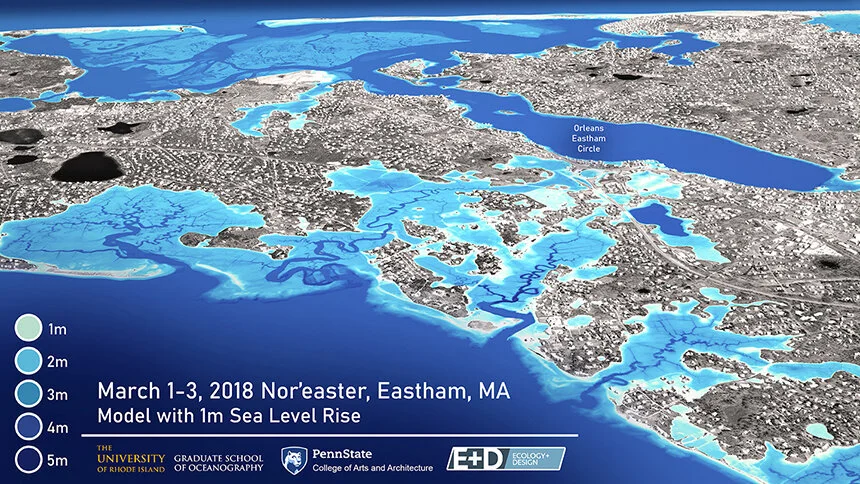
Study to look at relationship of sea-level rise and flooding in hurricanes and nor’easters
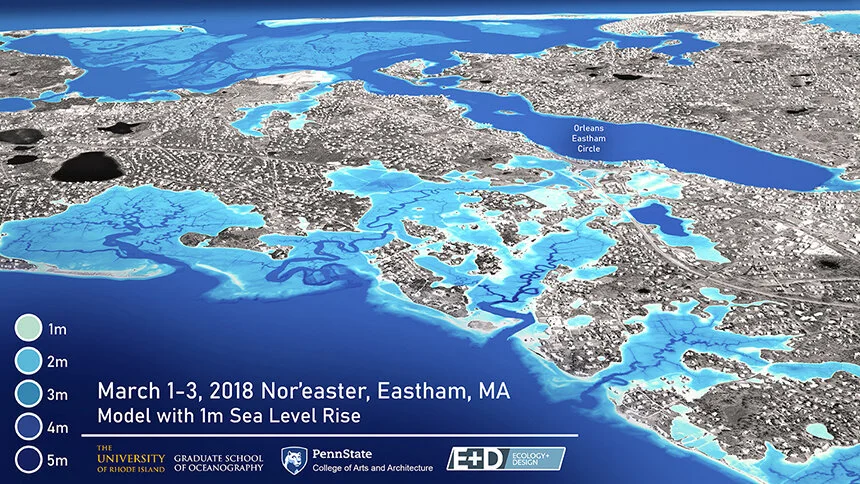
Realistic 3D visualization for Eastham, Mass., along the Cape Cod National Seashore using advanced modeling results of a March 2018 nor'easter with 3 feet of sea-level rise
From ecoRI News (ecori.org)
KINGSTON, R.I. — Researchers at the University of Rhode Island and Pennsylvania State University were recently awarded a four-year, $1.5 million grant through the National Oceanic and Atmospheric Administration (NOAA) to study the effects of sea-level rise and how it may exacerbate the impact of extreme weather.
The project will draw on expertise from researchers at URI’s Graduate School of Oceanography, its College of the Environment and Life Sciences, the Department of Ocean Engineering, and the URI Coastal Resources Center.
Other collaborative participants include the Schoodic Institute, in Maine, and the National Park Service. The goal of the project is to help communities, the National Park Service, and the U.S. Fish & Wildlife Service adapt to a changing climate and more frequent and extreme weather.
The rate of sea-level rise is accelerating, according to NOAA. Since 1993, the average global sea level has increased by 3.4 inches. Sea level plays a role in flooding, shoreline erosion and other hazards, impacting nearly 40 percent of the U.S. population living in high-density coastal areas.
However, despite what is known about sea-level rise, there is a lack of research available when it comes to how the impacts of nor’easters and hurricanes may be amplified as a result.
“There are a number of studies that have been done looking at just sea-level rise or just extreme weather, but what we're really lacking in terms of clear understanding is the combined impact of these two phenomena,” said Isaac Ginis, a URI professor of oceanography who is leading the study. “This is especially important to us on the East Coast and in New England, where we’ve seen significant coastal flooding produced by waves and storm surge during nor’easters and hurricanes. How these effects are amplified by sea-level rise has been largely unexplored. This information gap inhibits our ability to properly plan for the future and is likely to lead to under-informed and ineffective adaptation measures.”
The project will expand the body of research related to the effects of extreme weather and sea-level rise on five New England national parks and two wildlife refuges — Cape Cod National Seashore, Boston Harbor Islands National Recreation Area and New Bedford Whaling National Historical Park, in Massachusetts; Ninigret National Wildlife Refuge, Trustom Pond National Wildlife Refuge and Roger Williams National Memorial, in Rhode Island; and Acadia National Park, in Maine, as well as their surrounding communities.
Using atmosphere, storm surge and wave/erosion modeling the team will provide high-resolution recreations of the impact of future storm and sea-level rise scenarios, identifying vulnerabilities in the ecosystems and infrastructure of the identified sites and their adjacent communities. The modeling will also include hazard, risk, and adaptability assessments, and mitigation scenarios.
Researchers will work closely with the National Park Service, U.S. Fish & Wildlife Service, and stakeholders at the community level to tailor the research and translate the science in a way that can be incorporated into local resource management and adaptation measures to improve coastal resilience and to protect communities, people, infrastructure, and ecosystems.
“Each community has their own needs,” said Ginis, “but our modeling results will produce tailored and tangible information for local decision-makers — state and local governments, emergency management officials, town and city planners, and other stakeholders — to address their specific needs and enable them to plan and adapt as the sea-level rises and climate continues to change.”
Taking historical data into account, as well as topography, geology, water depth, land elevation, natural processes such as shoreline changes, and human influence, the team will be able to project more than 50 years into the future, using 3D visualization to provide computer simulations illustrating storm hazards and identifying potentially effective mitigation measures.
Ultimately, the project will open an important dialogue among researchers, local stakeholders, and federal resource managers, and facilitate the development of science-based best practices that will guide future policies and resource management strategies.
Flood voyeurism
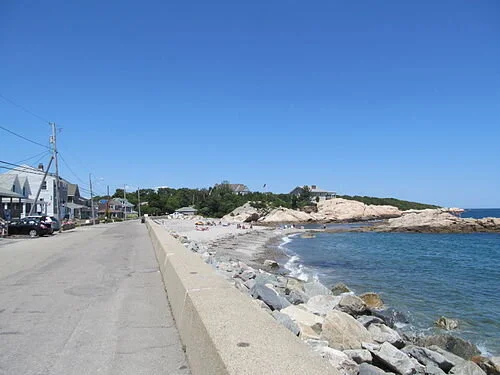
Glades Road in a frequently flooded section of Minot, a neighborhood of Scituate, Mass. “The Glades” is a summer compound of Massachusetts’s historically famous Adams family. Hit the links below to see the area in a more exciting situation.
Adapted from Robert Whitcomb’s “Digital Diary,’’ in GoLocal24.com
When I was kid, we much enjoyed the coastal flooding that accompanied Nor’easters in Cohasset, my hometown on Massachusetts Bay. Sometimes the water would cover some stretches of streets from which you couldn’t see the ocean because of the woods in the way. Sometimes we’d get to row on these roads. Cheap thrills indeed.
But a better show was in nearby Scituate, where a densely packed community on a point, with both summer and year-round houses, is massively flooded every few years. The houses shouldn’t be there, but federal flood insurance, which started in 1968, sustains this seeming idiocy even as rising sea level makes places such as Scituate more vulnerable.
After I got my driver’s license, I’d go to Scituate alone or with friends to watch the show and take some pictures.
Hit these links to get a sense of what we’d see:

Cambridge Trust commits $110 million to affordable housing in the very pricey Bay State

From The New England Council (newenglandcouncil.com)
“Cambridge Trust has committed $110 million to the Massachusetts Housing Partnership’s (MHP) multifamily construction loan pool to help construct affordable housing across the state. Cambridge Trust’s commitment marks the largest ever voluntary contribution to MHP.
“This commitment from Cambridge Trust was made possible through its acquisition of Wellesley Bank last year. While its contribution is voluntary, state-mandated taxes on bank acquisitions require the equivalent of just under 1 percent of the acquired bank’s assets to be contributed to MHP’s multifamily housing loan pool. Cambridge Trust’s contribution will help to finance rental apartment construction with the ultimate purpose of easing the current housing crunch. According to an estimate by MHP, the effort could help to finance 1,400 apartments over the next decade.
“‘We saw an opportunity to make a commitment and we jumped on it,’ said Tom Fontaine, Cambridge Trust’s Executive Vice President. ‘The prices are just out of control [in Greater Boston]. The land has so much value, and affordability becomes an issue.”’
“The New England Council celebrates Cambridge Trust’s efforts to provide affordable housing in Massachusetts.’’

An advertisement from the 1930s from the U.S. Housing Authority advocating slum clearance as a way to stop crime.
'They collide'

“Stalking Heron” (welded found steel scrap), by Madeleine Lord, in “Art Forward,’’ a group show of the National Association of Women Artists, at Galatea Fine Art, Boston, Nov. 5-Nov. 28.
The gallery says:
“Art Forward' is a group exhibition of 2D and 3D works that explore all things that have their turn to change with time. In us, past, present, future meet. They collide and synthesize cultures - allowing time to change, end, begin a new. Change is life, inconsistent as our future is time's excuse. The future frightens us, too profound and vague, but change is hopeful, healing, and leaves us smiling ahead.’’
Madeleine Lord is based in Dudley, Mass., south of Worcester and on the border with Connecticut. George Washington really did sleep there.
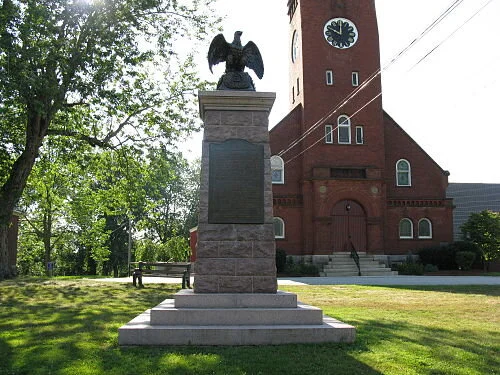
The Soldiers and Sailors Monument in Dudley, designed by renowned Canadian-born sculptor John A. Wilson, who eventually was based in the Chestnut Hill section of Newton, Mass. The statue is meant to honor veterans of all American wars.
Renowned Modernist architect Walter Gropius called Wilson’s studio “the most beautiful in the world."
Gorgeous Gloucester makes hay
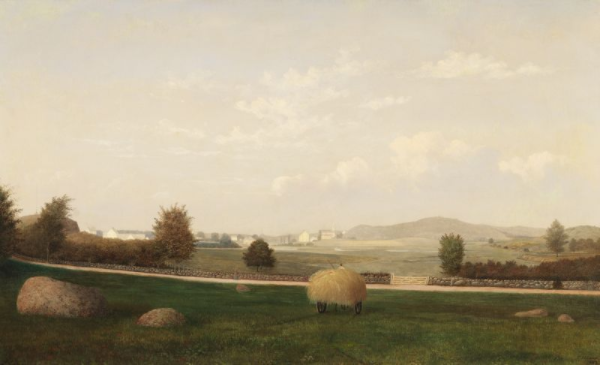
“The Babson Meadows {in Gloucester, Mass.} at River” (1863, oil on canvas), by Fitz Henry Lane (1804-1865), at the Cape Ann Museum, Gloucester.
(Gift of Roger W. Babson, 1937)
David Warsh: Goldin's marriage manual for the next generation

SOMERVILLE, Mass.
For many people, the COVID-19 pandemic has been an eighteen-month interruption. Survive it, and get back to work. For those born after 1979, it may prove to have been a new beginning. Women and men born in the 21st Century may have found themselves beginning their lives together in the midst of yet another historic turning point.
That’s the argument that Claudia Goldin advances in Career and Family: Women’s Century-long Journey toward Equity (Princeton, 2021). As a reader who has been engaged as a practitioner in both career and family for many years, I aver that this is no ordinary book. What does greedy work have to do with it? And why is the work “greedy,” instead of “demanding” or “important?” Good question, but that is getting ahead of the story.
Goldin, a distinguished historian of the role of women in the American economy, begins her account in 1963, when Betty Friedan wrote a book about college-educated women who were frustrated as stay-at-home moms. Their problem, Friedan wrote, “has no name.” The Feminine Mystique caught the beginnings of a second wave of feminism that continues with puissant force today. Meanwhile, Goldin continues, a new “problem with no name” has arisen:
Now, more than ever, couples of all stripes are struggling to balance employment and family, their work lives and home lives. As a nation, we are collectively waking up to the importance of caregiving, to its value, for the present and future generations. We are starting to fully realize its cost in terms of lost income, flattened careers, and trade-offs between couples (heterosexual and same sex), as well as the particularly strenuous demands on single mothers and fathers. These realizations predated the pandemic but have been brought into sharp focus by it.
A University of Chicago-trained economist; the first woman tenured by Harvard’s economics department; author of five important books, including, with her partner, Harvard labor economist Lawrence Katz, The Race between Education and Technology (Harvard Belknap, 2010); recipient of an impressive garland of honors, among them the Nemmers award in economics; a former president of the American Economic Association: Goldin has written a chatty, readable sequel to Friedan, destined itself to become a paperback best-seller – all the more persuasive because it is rooted in the work of hundreds of other labor economists and economic historians over the years. Granted, Goldin is expert in the history of gender only in the United States; other nations will compile stories of their own. .
To begin with, Goldin distinguishes among the experiences of five roughly-defined generations of college-educated American women since the beginning of the twentieth century. Each cohort merits a chapter. The experiences of gay women were especially hard to pin down over the years, given changing norms.
In “Passing the Baton,” Goldin characterizes the first group, women born between 1878-97, as having had to choose between raising families and pursuing careers. Even the briefest biographies of the lives culled from Notable American Women make interesting reading: Jeannette Rankin, Helen Keller, Margaret Sanger, Katharine McCormick, Pearl Buck, Katharine White, Sadie Alexander, Frances Perkins. But most of that first generation of college women never became more prominent than as presidents of the League of Women Voters or the Garden Club. They were mothers and grandmothers the rest of their lives.
In “A Fork in the Road,” her account of the generation born between 1898 and 1923, Goldin dwells on 75-year-old Margaret Reid, whom she frequently passed at the library as a graduate student at Chicago, where Reid had earned a Ph.D. in in economics in 1934. (They never spoke; Goldin, a student of Robert Fogel, was working on slavery then.) Otherwise, this second generation was dominated by a pattern of jobs, then family. The notable of this generation tend to be actresses – Katharine Hepburn, Bette Davis, Rosalind Russell, Barbara Stanwyck – sometimes playing roles modeled on real-world careers, as when Hepburn played a world-roving journalist resembling Dorothy Thompson in Woman of the Year.
In “The Bridge Group,” Goldin discusses the generation born between 1924-1943, who raised families first and then found jobs – or didn’t find jobs. She begins by describing what it was like to read Mary McCarthy’s novel, The Group (in a paper-bag cover), as a 17-year-old commuting from home in East Queens to a summer job in Greenwich Village. It was a glimpse of her parents’ lives – the dark cloud of the Great Depression that hung over w US in the Thirties, the hiring bars and marriage bar that turned college-educated women out of the work-force at the first hint of second income.
“The Crossroads with Betty Friedan” is about the Fifties and the television shows, such as I Love Lucy, The Honeymooners, Leave It to Beaver and Father Knows Best that, amid other provocations, led Betty Friedan to famously ask, “Is that all there is?” Between the college graduation class of 1957 and the class of 1961, Goldin finds, in an enormous survey by the Women’s Bureau of the U.S. Labor Department, an inflection point. The winds shift, the mood changes. Women in small numbers begin to return to careers after their children are grown: Jeane Kirkpatrick, Erma Bombeck, Phyllis Schafly, Janet Napolitano and Goldin’s own mother, who became a successful elementary school principal. Friedan had been right, looking backwards, Goldin concludes, but wrong about what was about to happen.
In “The Quiet Revolution,” members of the generation born between 1944-1957 set out to pursue careers and then, perhaps, form families. The going is hard but they keep at it. The scene is set with a gag from the Mary Tyler Moore Show in 1972. Mary is leaving her childhood home with her father, on her way to her job as a television news reporter. He mother calls out, “Remember to take your pill, dear.” Father and daughter both reply, “I will.” Father scowls an embarrassed double-take. The show’s theme song concludes, “You’re going to make it after all.” The far-reaching consequences of the advent of dependable birth control for women’s new choices are thoroughly explored. This is, after all, Goldin’s own generation.
“Assisting the Revolution,” about the generation born between1958-78, is introduced by a recitation of the various roles played by Saturday Night Live star Tina Fey – comedian, actor, writer. Group Five had an easier time of it. They were admitted in increasing numbers to professional and graduate schools. They achieved parity with men in colleges and surpassed them in numbers. They threw themselves into careers. “But they had learned from their Group Four older sisters that the path to career must leave room for family, as deferral could lead to no children,” Golden writes. So they married more carefully and earlier, chose softer career paths, or froze their eggs. Life had become more complicated.
In her final chapters – “Mind the Gap,” “The Lawyer and the Pharmacist” and “On Call” – Goldin tackles the knotty problem. The gender earnings gap has persisted over fifty years, despite the enormous changes that have taken place. She explores the many different possible explanations, before concluding that the difference stems from the need in two-career families for flexibility – and the decision, most often by women, to be on-call, ready to leave the office for home. Children get sick, pipes break, school close for vacation, the baby-sitter leaves town.
The good news is that the terms of relationships are negotiable, not between equity-seeking partners, but with their employers as well. The offer of parental leave for fathers is only the most obvious example. Professional firms in many industries are addicted to the charrette – a furious round of last-minute collaborative work or competition to meet a deadline. Such customs can be given a name and reduced. Firms need to make a profit, it is true, but the name of the beast, the eighty-hour week, is “greedy work.”
It is up the members of the sixth group, their spouses and employers, to further work out the terms of this deal. The most intimate discussions in the way ahear will occur within and among families. Then come board rooms, labor negotiations, mass media, social media, and politics. Even in its hardcover edition, Career and Family is a bargain. I am going home to start to assemble another photograph album – grandparents, parents, sibs, girlfriends, wife, children, and grandchildren – this one to be an annotated family album.
David Warsh, a veteran columnist and an economic historian, is proprietor of Somerville-based economicprincipals.com, where this essay first ran.
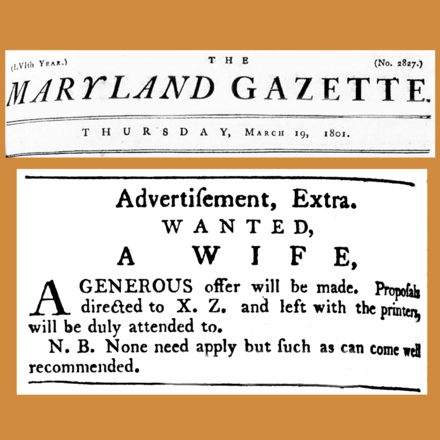
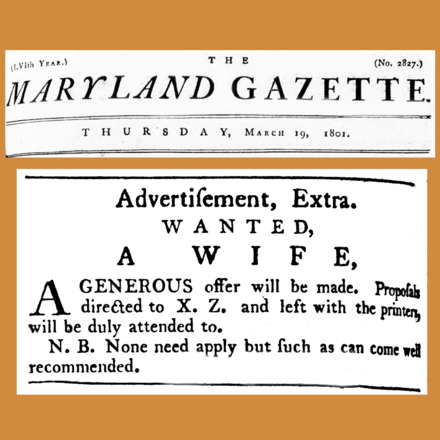
A "Wife Wanted" ad in an 1801 newspaper
"N.B." means "note well".
‘Bring your camera’

Granny Smith apples are unusual in being green when ripe.
— Photo by Assianir
“Cider served in pounded copper mugs.
Covered bridge rides.
Pumpkin pies.
Tourists in Vermont. What do they want?
Where to find Granny Smith?
She waits for you in my tree. Bring your camera, you'll see.’’
—From “Smell the Season Sunshine,’’ by Marikate Kingston, a poet who lives in Westport, Conn.
'Tosses up our losses'
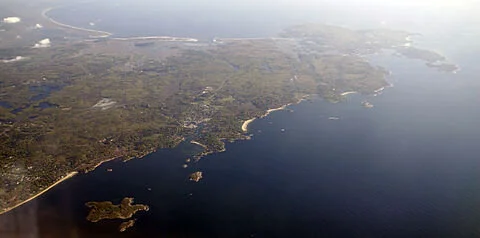
Cape Ann
“It tosses up our losses, the torn seine,
The shattered lobster pot, the broken oar
And the gear of foreign dead men. The sea has many voices.’’
Many gods and many voices.’’
From “The Dry Salvages,’’ by T.S. Eliot (1888-1965), the famed Anglo-American poet from a Boston Brahmin family, who had a summer place on Cape Ann, off which the rocks called “The Dry Salvages’’ menaced boats.
Chris Powell: Fight bulimia with censorship?
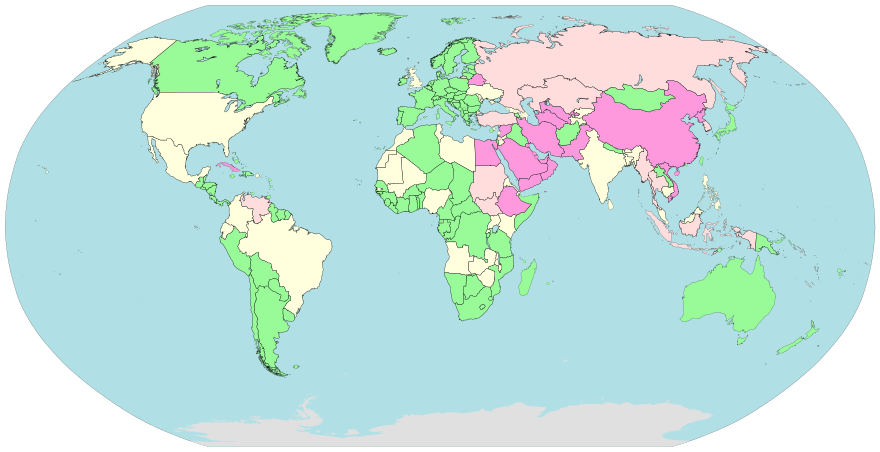
Internet censorship by country: Dark pink has pervasive censorship; light pink substantial; yellow selective, and green little or none.

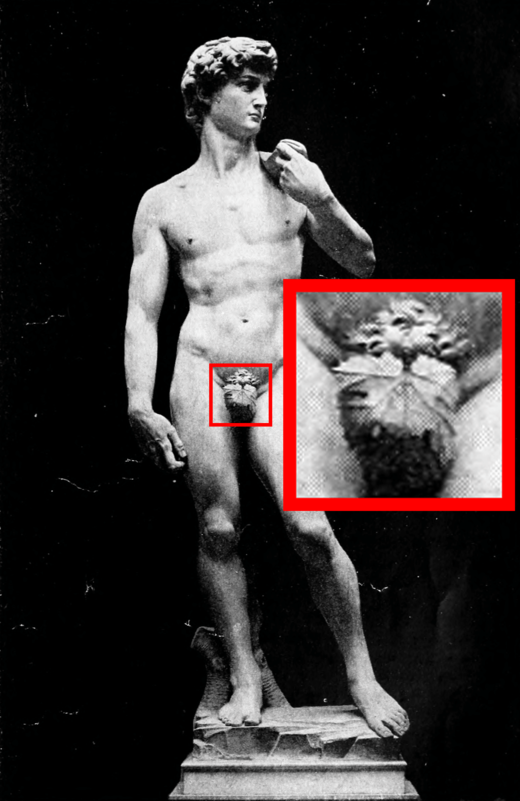
The plaster cast of Michelangelo’s ‘‘David ‘‘ at the Victoria and Albert Museum, in London, has a detachable plaster fig leaf displayed nearby. Legend claims that the fig leaf was created in response to Queen Victoria's shock upon first viewing the statue's nudity, and was hung on the figure before royal visits, using two strategically placed hooks.
MANCHESTER, Conn.
Nearly everyone on Planet Earth with Internet access seems to use the social-media platform Facebook and its subsidiary Instagram even as last week's U.S. Senate subcommittee hearing over which Connecticut's Richard Blumenthal presided suggested that Facebook is an evil scheme to push young teenage girls into bulimia and other psychological disorders.
Facebook and Instagram certainly have brought out the latent narcissism of hundreds of millions of people, allowing them to spend half their day inflicting on others every trivial detail of their lives. But of course no one is compelled to participate in social media, and young teenage girls can participate only if their parents provide them with cell phones, computers and Internet access and pay little attention to what the kids do with those things.
This seemed lost on last week's hearing, as Senator Blumenthal read aloud a text message he said he had received from an unidentified father:
“My 15-year-old daughter loved her body at 14, was on Instagram constantly and maybe posting too much. Suddenly she started hating her body -- her body dysmorphia, now anorexia -- and was in deep, deep trouble before we found treatment. I fear she will never be the same.”
So who is responsible? The hearing accused Facebook co-founder and CEO Mark Zuckerberg.
And what is the remedy? The hearing seemed to be demanding censorship by the government.
"Facebook and Big Tech are facing a ‘Big Tobacco' moment," Blumenthal said, referring to the tobacco industry's long struggle against regulation of its product and its concealment of research showing that -- as everyone with half a brain had known for hundreds of years -- using tobacco is unhealthy.
Former Facebook employee Frances Haugen testified that the company knows that teenage girls are especially vulnerable to what may be said about them on social media -- as if anyone needed confidential company documents to confirm the neurotic tendencies of teenage girls.
But Facebook's product and the major product of technology companies is not tobacco. It is speech and self-expression, freedom of which is constitutionally guaranteed even when it is narcissistic, stupid, mistaken and capable of being construed destructively. All other vehicles for conveying expression and information are just as capable of facilitating the harm being attributed to Facebook and Instagram.
Haugen suggested that Congress repeal the law exempting Internet companies from being sued for content posted by their users. That well might be the end of social media, since there is no way to police large volumes of social-media postings except by using computer programs to target keywords, a mechanism that censors the innocent and the guilty alike.
And what about the individual privacy of communicating by Internet? Should the government be empowered to compel Facebook and other social-media companies to become general censors? If government can do that to social-media companies, it can do that to newspapers, magazines, broadcasters, e-mail service providers and even telephone companies.
While the teen years always will be full of psychological stress, most young people in the land of the free have recovered more or less and grown up to be glad of their freedom.
Yet last month the FBI reported a 30 percent annual increase in murders in this country, from which no one will be recovering. The country is coming apart, and it's not because of Facebook and bulimia.
xxx
Farmington's police union president, Sgt. Steve Egan, blames Connecticut's new police accountability law for the severe injury inflicted on Officer James O'Donnell last month when a man driving a stolen car sped off, crushing the officer against his cruiser.
No evidence has been provided for the union president's claim. But a failure of law can be seen here. For the man charged in the incident is reported to have a long criminal record. That is, a state with an incorrigibility law already might have put him away for life, or at least for enough years to eliminate his capacity for crime.
Connecticut is not such a state. Instead of enacting an incorrigibility law the state keeps closing prisons and letting incorrigibles hurt people.
Chris Powell is a columnist for the Journal Inquirer, in Manchester.
Autumn browning

“Split Second” (oil on gallery-wrap canvas), by Tanya Hayes Lee, at Alpers Fine Art, Andover, Mass.
Beats whale-oil lamps
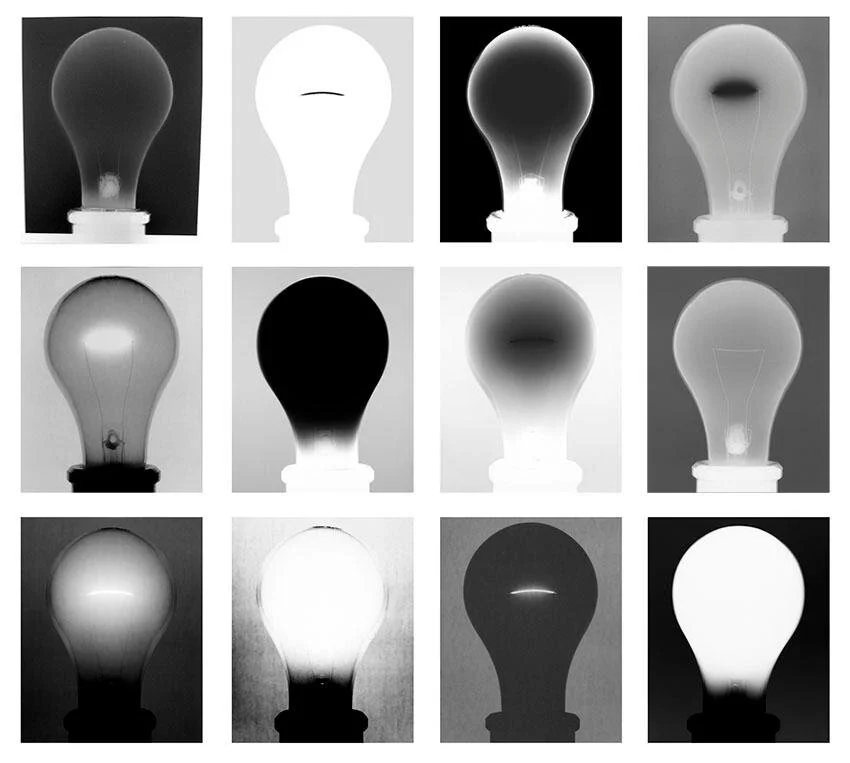
“One Bulb (Version II)” (12 Gelatin Silver Prints on Ilford Matte), by Amanda Means, at the University of Massachusetts at Dartmouth’s art gallery in New Bedford, Oct., 14-Oct. 23.
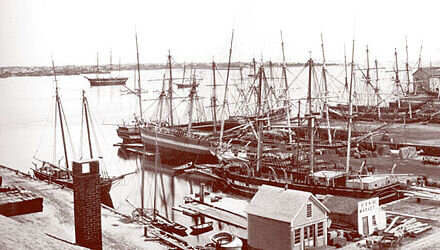
New Bedford waterfront in 1867. For part of the 19th Century, New Bedford was the world’s whaling capital.

Todd McLeish: Artificial light threatens animal populations


Light pollution is mostly unpolarized, and its addition to moonlight results in a decreased polarization signal.
From ecoRI News (ecori.org)
Global insect populations have declined by as much as 75 percent during the past 50 years, according to scientists, potentially leading to catastrophic impacts on wildlife, the environment and human health. Most studies point to habitat loss, climate change, industrial farming and pesticide use as the main factors driving the loss of insects, but a new study in the United Kingdom points to another cause: light pollution.
The ever-increasing glow of artificial light from street lights, especially LED lights, was found to have detrimental effects on the behavior of moths, resulting in a reduction in caterpillar numbers by half. And since birds and other wildlife rely on caterpillars as an important food source, the consequences of this decline could be devastating.
According to Douglas Boyes of the British Center for Ecology & Hydrology, street lights cause nocturnal moths to postpone laying their eggs while also making the insects more visible to predators such as bats. In addition, caterpillars that hatch near artificial light exhibit abnormal feeding behavior.
But moths are not the only wildlife affected by artificial light.
Since most songbirds migrate at night, birds that have evolved to use the moon and stars as navigational tools during migration often become disoriented when flying over a landscape illuminated with artificial light.
“City centers that are very bright at night can act as attractants to migrating birds,” said ornithologist Charles Clarkson, director of avian research at the Audubon Society of Rhode Island. “They get pulled toward cities, and when they find themselves amid heavily lit buildings, they become disoriented, leading to a large number of window strikes and increased mortality.”
It is unclear why birds are attracted to lights, but studies have found increasing densities of migrating birds the closer one gets to cities.
“Birds probably see these cities on the horizon from a long distance, and they get pulled toward these locations en masse,” Clarkson said.
Street lights have also been found to be problematic to birds. Birds are active later into the evening when they are exposed to nearby artificial lighting at night, and they often sing later as well.
“Sometimes that might lead to more food availability, since lights attract insects,” Clarkson said. “But it also affects the physiology of the birds when they’re active when they should be sleeping. Some birds that live in heavily lit urban or suburban areas begin nesting earlier, too, up to a month earlier than they typically would. And that leads to a phenological mismatch between when food is traditionally available and when the chicks are hatching and need to be fed.”
Artificial lighting may cause other species to face a similar mismatch. Christopher Thawley, a lecturer and researcher in the Department of Biological Sciences at the University of Rhode Island, studied lizards in Florida and found not only that the reptiles advanced the onset of breeding when exposed to artificial light, but they also laid more eggs and even grew larger under artificial lighting conditions. Other kinds of wildlife could have comparable results.
“Light at night can sometimes mimic a longer day length, and a lot of animals use length of day as a cue for when to start breeding,” he said. “If they’re exposed to light at night, they think the days are longer so it must be time to breed. Length of daylight is also a good cue for when to migrate or when to start calling, and that could potentially be an issue for some species.”
Thawley said frogs that call at night near artificial light could be more vulnerable to predators.
“When nights are darker, frogs call more, and when the moon is bright they call less,” he said. “It’s more dangerous to call during a full moon because predators could see you. That would be especially true under artificial lighting conditions, too.”
Scientists are still trying to understand the intricacies of how light pollution impacts wildlife, and yet some cities are already taking action to reduce its impact. Dozens of cities around the United States and Canada, including Boston, New York, Chicago and Washington, D.C., have launched “lights out” programs aimed at dimming city lights during the peak of bird migration.
Providence is not among the cities participating in a “lights out” program, but local advocates have discussed how to get it started for several years. They say it would be a positive first step toward reducing the impact of artificial lighting on local and migrating wildlife.
Rhode Island resident and author Todd McLeish runs a wildlife blog and frequently writes for ecoRI News.
If you see this above, take cover

“River in the Sky,’’ by Mo Kelman, in the group show “Luminous,” at Dedee Shattuck Gallery, Westport, Mass., Oct. 16-Nov. 14
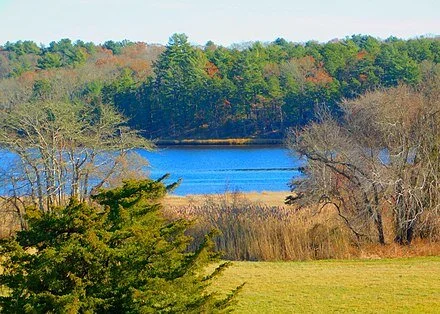
Fall on the Westport River
Llewellyn King: Shutting off natural gas can dangerously destabilize the electricty grid
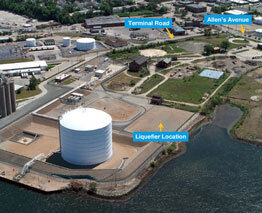
Fields Point liquified natural gas facility, in Providence
WEST WARWICK, R.I.
It has been an annus horribilis for the nation’s electric utility companies. Deadly storms and wildfires have left hundreds of thousands -- and for short periods millions -- of electricity customers without power, sometimes for days and weeks.
These destructive weather events have come at a time when utilities are being squeezed from all directions: by customer needs, by activists’ demands, by state regulators, and by the zero-carbon urgency of the Biden administration as expressed in its bill, the Build Back Better Act, to upgrade and overhaul the nation’s infrastructure.
The utilities themselves have set ambitious carbon-emission-reduction goals, but in some cases, they still can’t meet the demands of the government. They are caught between the clear need to harden their infrastructure against severe weather and shuttering their reliable but polluting coal plants and mothballing their dependable gas turbines.
This predicament caused Jim Matheson, president of the National Rural Electric Cooperative Association, which represents hundreds of utilities, mostly small, in rural areas, to ask Congress to make exceptions, or at least to understand that things can’t be changed overnight. In a letter to House Committee on Energy and Commerce Chairman Frank Palone (D.-N.J.) and ranking minority member Cathy McMorris Rogers (Wash.), Matheson said there was concern with the Clean Electricity Performance Program (CEPP) part of the bill.
“The CEPP’s very narrow, 10-year program implementation window is unrealistic. The electric co-ops have existing contractual obligations and resource development plans that extend for several years, if not decades. Many of those plans continued deployment of a diverse set of affordable, clean electricity sources, but not all those plans align with the CEPP. …. The narrow implementation window also limits our ability to take advantage of technologies like energy storage, carbon capture, or advanced nuclear, which are unlikely to be deployable in the near term,” Matheson said.
The predicament of utilities is that there is no reliable storage and that the two principal sources of renewable power, wind and solar, are subject to the vagaries of weather. During Winter Storm Uri, which hit Texas last February, solar, along with all other sources of energy, froze under sheets of snow and ice. The result was disaster and heavy loss of life.
In that instance, gas didn’t save the day: Lines and instruments froze, and what gas was available was sold at astronomical prices.
The lesson was clear: Prepare for the worst. That lesson was repeated in a series of hurricanes, including this year’s devastating Ida, which plunged parts of Louisiana into the dark for more than a week.
If the lesson hasn’t been grasped in the United States, it is being repeated in Europe right now: A unique wind drought that lasted six weeks has left the European grid reeling and has thrown Britain into a full energy crisis.
The issue is not that alternative energy -- wind and solar for now -- isn’t the way to go to reduce the amount of carbon spewing into the atmosphere. Instead, it is not to destabilize what you have by prematurely taking gas offline.
Gas has certain useful qualities not the least of which is that it can be stored. Storage is the bugaboo of alternative energy. Batteries are good for a few hours at best and the other main way of storing energy, pumped storage, requires large expenditures, substantial engineering, and a usable site. It requires the creation of a big water impoundment, which will provide hydro when extra power is needed. It works, it is efficient, and it isn’t something that you build in a jiffy.
I have spent half a century writing about the electricity industry and when it comes to decarbonization, I can say that while many in the industry were doubtful about global warming at one time, the industry now is committed to eliminating carbon emissions by 2050.
The joker is storage or some other way of backing up the alternatives. That may be hydrogen, but a lot of research and engineering must take place before it flows through the pipes which now carry natural gas. Likewise, for small modular reactors.
The Economist, pointing to Europe, says that the Europeans have destabilized their grid by failing to prepare for the transition to alternatives, triggering a global natural gas shortage. Gas should be used sparingly and treasured. The trick is to throw out the bath water and save the baby.
Llewellyn King is executive producer and host of White House Chronicle, on PBS. His email is llewellynking1@gmail.com and he’s based in Rhode Island and Washington, D.C.
A very comfortable faith
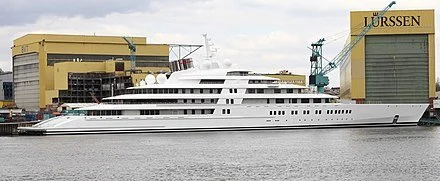
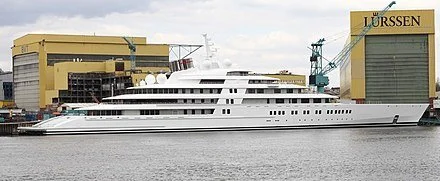
The superyacht Azzam, which from 2013 to 2019 was the largest private yacht in the world.
For N.T.
The path to joy is faith in God,
The young man told his friend.
His joy was plain upon his face;
He hoped not to offend.
All night they talked, and on the morn,
When day dawned bright and hot,
He shook her hand and wished her well
And set out on his yacht.
By Felicia Nimue Ackerman, a poet and a Brown University philosophy professor. This poem is slightly revised from one that ran in Free Inquiry.

Harbour Court, the Newport, R.I. headquarters of the hyper-exclusive New York Yacht Club
'Neat and tractored'

The Green in Hanover, N.H.
“Although the smell of fresh-cut grass
is the same everywhere to me
it will always be Hanover {N.H.}:
rec soccer, someone’s tamed
plot of land neat and tractored…’’
— From “A Child’s Guide to Grasses,’’ by Jay Deshpande
Cod helped build New England
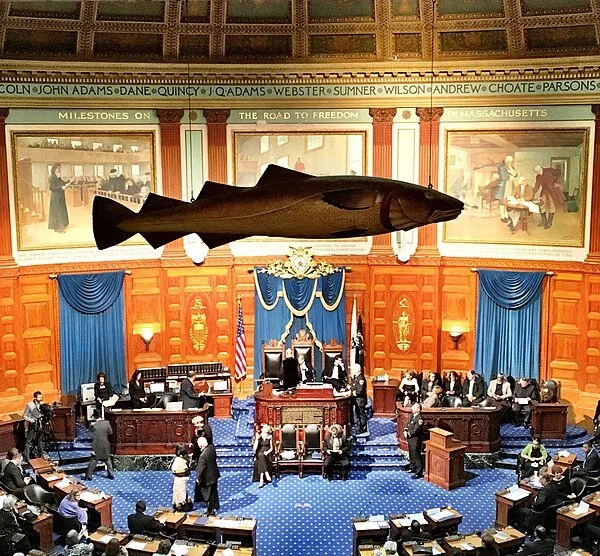
“The Sacred Cod” hangs above the Massachusetts House of Representatives chamber as a symbol of the fish’s historical importance to the prosperity of the state.
“By 1937, every British trawler had a wireless, electricity, and an echometer - the forerunner of sonar. If getting into fishing had required the kind of capital in past centuries that it cost in the twentieth century, cod would never have built a nation of middle-class, self-made entrepreneurs in New England.”
― From Cod: A Biography of the Fish that Changed the World, by Mark Kurlansky
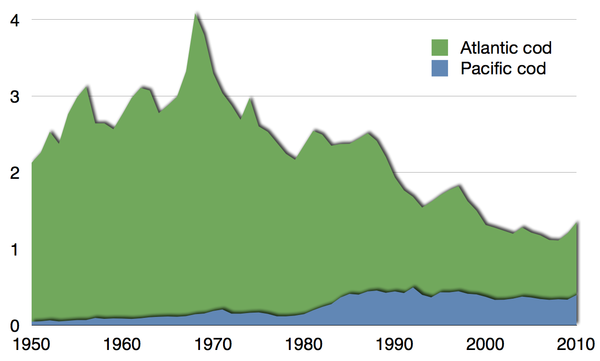
Showing embedded in light green the collapse of the northwest Atlantic cod fishery
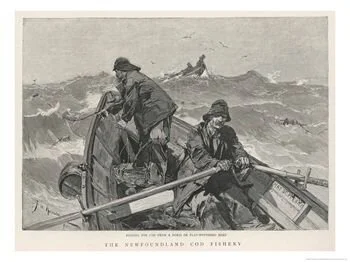
In the 19th Century, banks dories were carried aboard larger fishing schooners, and used for handlining cod on the Grand Banks and Georges Bank.
'The strangeness from my sight'
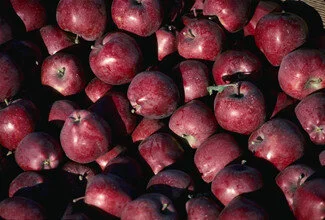
My long two-pointed ladder's sticking through a tree
Toward heaven still,
And there's a barrel that I didn't fill
Beside it, and there may be two or three
Apples I didn't pick upon some bough.
But I am done with apple-picking now.
Essence of winter sleep is on the night,
The scent of apples: I am drowsing off.
I cannot rub the strangeness from my sight
I got from looking through a pane of glass
I skimmed this morning from the drinking trough
And held against the world of hoary grass.
It melted, and I let it fall and break.
But I was well
Upon my way to sleep before it fell,
And I could tell
What form my dreaming was about to take.
Magnified apples appear and disappear,
Stem end and blossom end,
And every fleck of russet showing clear.
My instep arch not only keeps the ache,
It keeps the pressure of a ladder-round.
I feel the ladder sway as the boughs bend.
And I keep hearing from the cellar bin
The rumbling sound
Of load on load of apples coming in.
For I have had too much
Of apple-picking: I am overtired
Of the great harvest I myself desired.
There were ten thousand thousand fruit to touch,
Cherish in hand, lift down, and not let fall.
For all
That struck the earth,
No matter if not bruised or spiked with stubble,
Went surely to the cider-apple heap
As of no worth.
One can see what will trouble
This sleep of mine, whatever sleep it is.
Were he not gone,
The woodchuck could say whether it's like his
Long sleep, as I describe its coming on,
Or just some human sleep.
— “After Apple Picking,’’ by Robert Frost
No more renewals
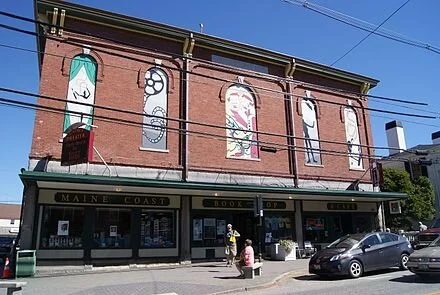
Lincoln Theater (upper level) and the Maine Coast Bookshop at 158 Main Street, Damariscotta
“The circulation manager of Down East magazine sent a letter to Abner Mason of Damariscotta, Maine, notifying him that his subscription had expired. The notice came back a few days later with a scrawled message: “So’s Abner.’’
Judson D. Hale Sr., in Inside New England (1982)

Philip K. Howard: A way to make Biden infrastructure program work as hoped

Construction crew laying down asphalt over fiber-optic trench, in New York City
— Photo by Stealth Communications
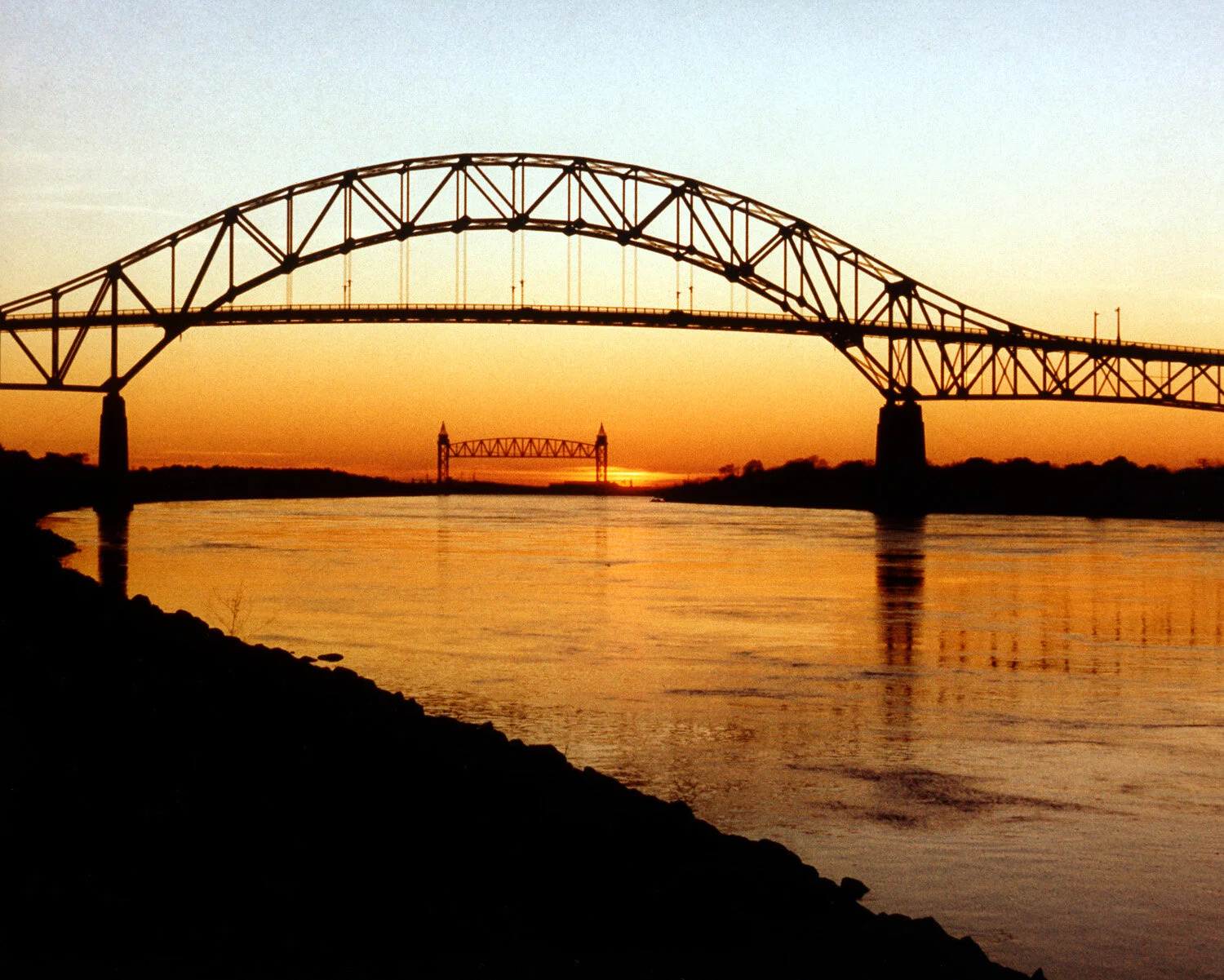
The Bourne Bridge and the Cape Cod Canal Railroad Bridge at sunset. The Bourne Bridge, at the canal’s western side, and the Sagamore Bridge, to the east, both built in the Thirties, are slated to be replaced.
President Biden’s breathtaking $5 trillion infrastructure agenda — about $50,000 in debt for each American family — is stalling on broad skepticism on both the goals and means of spending that money. There’s bipartisan agreement on at least some of the goals: Spending $1.2 trillion to fix roads, build new transmission lines, expand broadband, and provide clean water could improve American competitiveness as well as its environmental sustainability.
There’s a deal to be made here: Use this moment to overhaul how Washington spends money. Skeptics are correct that, otherwise, most of the money will go up in smoke. What’s needed is a new set of spending principles, based on the principle of commercial reasonableness, enforced by a nonpartisan National Infrastructure Board.
The key to governing is implementation. Big talk in press conferences rarely results in success. Nor does throwing money at a problem. The chaos in Afghanistan reveals what happens when top-down dictates are not accompanied by a practical plan for executing the goal. But the Biden administration has no plan on how to implement its infrastructure proposals wisely.
What is certain is that, without reform, most of the infrastructure money will be wasted. Red tape, delays, rigid contracting rules, entitlements and other inefficiencies guarantee that American taxpayers will receive less than 50 cents of infrastructure value for each dollar. That’s optimistic. Comparative studies of infrastructure costs in developed countries show that public transit in the U.S. can be four times as expensive as in, say, Spain or France. A highway viaduct in Seattle cost three times more than a comparable project in France, and seven times more than one in Spain.
What causes the waste? No U.S. official has authority to use commonsense, at any point in the process, to build infrastructure sensibly. Other countries have “state capacity”— a euphemism for public departments where officials are given the authority to make contract and other decisions comparable to their counterparts in the private sector. In America, by contrast, officials’ responsibility is preempted by red tape.
Here are some of the main drivers of waste:
- Permitting can take years because no official has authority to 1) limit environmental reviews to important impacts; 2) resolve disagreements among competing agencies; or 3) expedite resolution of lawsuits. In our study Two Years, Not Ten Years we found that delay alone can more than double the effective cost of projects.
- Rigid procurement protocols strive to detail each nut and bolt in advance, limiting the flexibility needed to confront unanticipated issues inherent in any complex construction project. This leads to massive waste as well as costly change orders.
- Union collective-bargaining entitlements have accumulated over the decades, for example, requiring twice as many workers as needed to operate the tunneling machine for a New York subway. Work rules are designed not for safety or efficiency, but to provide compensation even where there’s no work.
- Legislative mandates further increase the cost of public projects. The “Buy American” laws can increase costs by 25 percent, sometimes more. The Davis-Bacon Act from 1931 increases labor costs by upwards of 20% over market by requiring “prevailing wages”— which is a euphemism for highest wage that can be justified. An army of Washington bureaucrats has the job of dictating wage rates and benefit packages in hundreds of construction job categories in each of 3,000 designated labor markets in the U.S.
- All these legal processes, rigidities and entitlements provide grounds for a lawsuit for any unhappy bidder, contractor, labor union, or environmental group. Lawsuits not only add costs to delay projects, but are commonly used as a weapon to extract payments and concessions that further raise the costs.
Thick rulebooks have supplanted human responsibility. Washington allocates money, with lots of legal strings. It then gives grants to states and localities, many of which are actuarily insolvent – precisely because they cannot manage their public unions and other interest groups. Time passes. Lawyers and consultants produce environmental impact statements. Various groups object and threaten lawsuits. Unions demand ever-greater benefits. Understaffed civil servants try to write procurement guidelines that anticipate every detail and eventuality. The low bidder wins, even if the bidder has a lousy record. Some infrastructure gets built, often badly, and always at a cost that far exceeds what a commercial builder would have paid. The waste here is a scandal — political leaders might as well take taxpayer money and throw it in the fireplace.
How should infrastructure be built? What causes waste in building infrastructure, as NYU’s Alon Levy puts it, is “rigid[ity], where what is needed is flexibility and empowerment” of officials with responsibility. Someone needs to be in charge of each project, and whoever’s in charge needs to have the flexibility to negotiate contracts, adapt to new conditions, and, above all, not to be hamstrung by unrelated requirements.
Building roads, bridges and power lines isn’t rocket science. Other countries and private companies know how to do this. Most public engineers know what performance standards are required. By the simple mechanism of empowering public servants to take responsibility, Levy found, other countries are able to “spend a fraction of what the US does on the same bridge or tunnel.”
Giving officials flexibility to use their judgment, however, requires a mechanism to overcome Americans’ distrust of government. That’s what keeps America’s byzantine bureaucracy in place. Any effort at reform is resisted by groups who argue “What if... an official is on the take?” “What if…the official is Robert Moses, and wants to bulldoze poor communities?”
Opponents to spending reform are mobilizing as I write. The $1.2 trillion Senate bill includes permitting reforms that seek to limit the permitting process to two years. But even this modest reform is under attack by “environmental justice” groups who argue that two years is insufficient to consider those issues. Similarly, a reform to expedite permits for interstate transmission lines is being vigorously opposed by the state energy regulators. They pluck the strings of distrust. But their real objection is that minimizing delay removes the legal veto which they use to extract lucrative benefits for themselves.
What’s needed to overcome distrust is a nonpartisan oversight body that is empowered to avoid waste and corruption. In other developed countries, most citizens accept official authority. But Americans don’t. Creating a trusted oversight institution means it can’t be in the control of either political party. An example are the nonpartisan “base-closing commissions” which decide which defense bases should be shuttered.
I propose a nonpartisan National Infrastructure Board, analogous to oversight boards in Australia and other countries. Its responsibilities would be not to build infrastructure but to oversee and report on how infrastructure is built. Funding could still go through states, but only on condition that timelines and contracts meet standards of commercial reasonableness. No more featherbedding. No more payoffs. States would lose funding if they continued current practices.
The power of a trusted oversight body is exponentially greater than its size. The availability of accountability, not micromanagement, is the element that avoids waste while instilling trust and confidence that everyone is doing their part.
America is at an institutional crossroads. Nothing much works as it should because no official, or teacher, or hospital administrator, or manager, is authorized to make sensible choices. Pruning the jungle of red tape never works because the underlying premise is to avoid human judgment on the spot. The only solution is to replace the jungle with a simpler framework activated by human responsibility and accountability. But who will oversee those officials? That’s why a trusted oversight body is essential.
Philip K. Howard is a lawyer, author and chairman of Common Good, a bipartisan reform coalition. This piece first ran in The Hill.