
Vox clamantis in deserto









Good time to be an escape artist

“Boom4Real: Escape Artist Series, {After}Jean Michel Basquiat,’’ by Li Sumpter, at Burlington (Vt.) City Arts but only open for viewing on the Web.

Lake Champlain from the Burlington docks, with the Adirondacks.
— Photo by Jscarreiro

Ethan Allen Homestead (1784)

Old Mill building at the University of Vermont
‘From heaven to earth’

“It hangs from heaven to earth.
There are trees in it, cities, rivers,
small pigs and moons. In one corner
the snow falling over a charging cavalry,
in another women are planting rice.’’
— From “Tapestry,’’ by Charles Simic, an emeritus professor of literature at the University of New Hampshire and former U.S. poet laureate. He lives on Bow Lake, in Strafford, N.H.

Bow Lake, in Stafford, N.H., from the town dock.

In Strafford: The Blue Hills and the Job Hills from Northwood Road, circa 1910
Jordan Frank: Ways to reduce the (now high) risk of COVID-19 at supermarkets
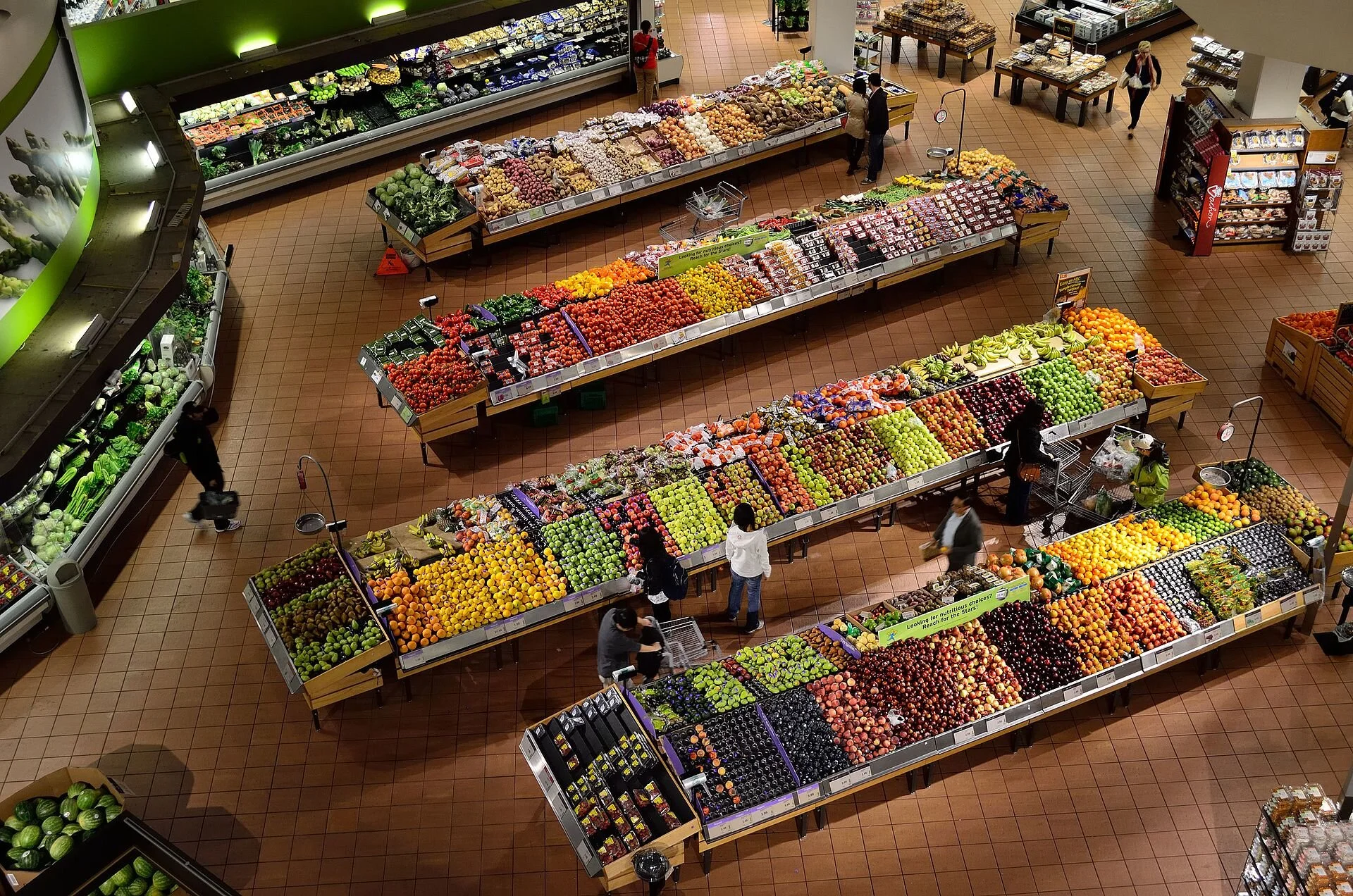
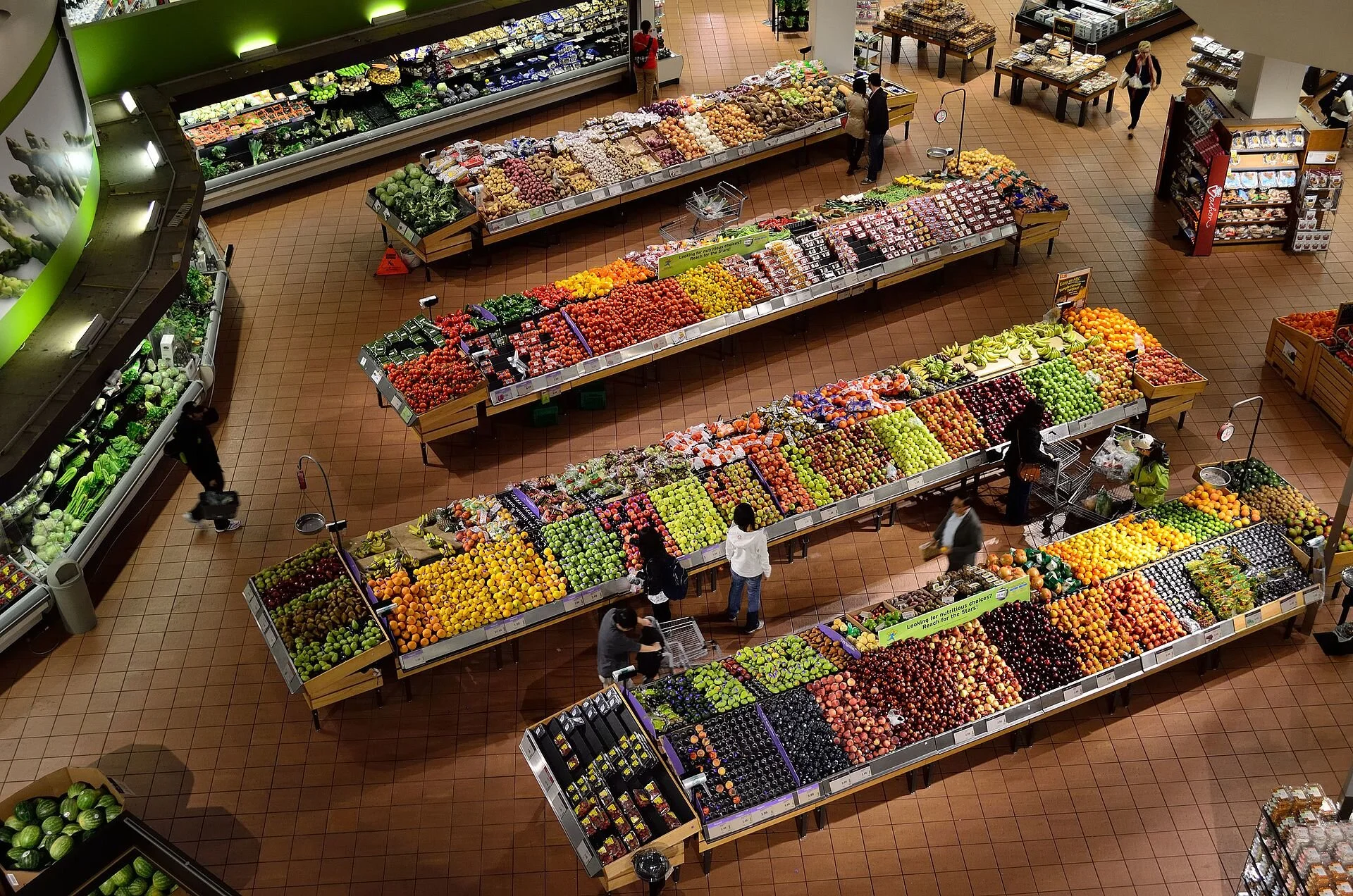
Consumers, sick or healthy, like to touch produce.
Over the last few months, I've become increasingly concerned that supermarkets are our second worst COVID-19 hot spot (behind health-care and nursing-home environments). Since March 20,, I’ve lobbied the Providence City Council, Mayor Jorge Elorza, federal and state legislators and our governor to take more aggressive steps to recognize and stop supermarket spread. The governor took one step to limit capacity and push for social distancing. That was a good first step, but should not be the last.
Given that 29 million to 41 Million Americans visit one of our country’s 38,000 supermarkets every day, and that aerosol and surfaced based COVID-19 virus particles are now known to pose a threat to people of all ages and conditions, there is a good chance that “Supermarket Spread” is our Achilles Heel in this crisis.
The only way to be sure that cashiers, other supermarket staff and customers are as safe as possible is to keep customers outside. A mandate for curbside ordering and to your car delivery is a solution that may also promote quicker throughput for customer orders and create jobs. Short of such a mandate, every possible way to improve safety should be explored and implemented as soon as possible.
As COVID-19 rapidly spreads across America, social distancing and maximum group size rules are changing our lives. To keep crowds from forming and to reduce transmission points, governors nationwide are steadily closing down the world around us.
First were the restaurant closures and work from home (if possible) orders, then it was non-essential retail, and then parks and beaches and nature trails. All of this is done with the goal of enforcing social distance and, therefore, public health.
BUT, when it comes to supermarkets and pharmacies… with the exception of capacity limits (which limit spot capacity but not the number of customers per day) all bets are off.
THAT, is scary.
Supermarkets are essential and, due to lack of other dining options beyond take-out, supermarkets must be more used than ever before.
Grocery Shopping Statistics: 23 Fun Size Facts to Know provides a glimpse into the scale of the supermarket situation. Americans spend 41 minutes per trip to the supermarket, 1.5 times per week. Adding it up, 29 million to 41 million shoppers frequent supermarkets every single day.
Across 38,000 supermarkets, there are 763 to 1,073 visitors per day per market. Assuming 4 check out aisles (assume reduced aisles in many stores for social distancing).. that is 190 to 269 people through each check out aisle per day. That is 19 to 27 per hour… one every 2 to 3 minutes in a 10-hour day.
One shopper every 2 to 3 minutes per check out aisle seems improbably high except at peak hours… but you get the picture. Supermarkets are a super party every single minute of every single day. That is not a party I want to attend right now.
It is not a party in which any low paid, unprotected or lightly protected worker should have to be a part of for an 8 hour shift, or any shift.
But it’s safe to shop in a supermarket and your food is safe to eat!!
On March 20, at the time I started contacting my local government representatives, any scan of the news showed stories confirming that food is safe and that grocery stores are safe. The stories relied on six feet of social distancing and good cleaning procedures as being enough to waylay any fears.
Since then, well written stories have emerged that detail customer carelessness and highlight the fears of cashiers, pharmacists and other workers.
In Grocery Stores are the New Tipping Point, Olga Khazan’s March 24 article in The Atlantic raises concerns that supermarket workers aren’t given masks and highlights the limitations of sanitization in light of shoppers who cough or sneeze.
Brent Shrotenboer, on March 27, asked Are Grocery Stores and Pharmacies Vectors for the Coronavirus? in USA Today. Among other key points, he reminds us that “Even in the best of times, grocery stores have been hives of invisible germs. A study in 2017 found that shopping carts at regular and budget food stores carry hundreds of times more colony-forming units of bacteria per square inch “than surfaces in your bathroom.” A shopping cart at a budget store had 270 times more colony-forming units than your average toilet handle.”
Close to home here in Rhode Island, on March 30 The Providence Journal’s Katie Mulvaney sounds the alarm in For RI Pharmacists, Virus is a Formula for Stress. Mulvaney describes the pressures of drug shortages due to hoarding, sick patients walking in the doors and a lack of PPE.
Beyond our shores, on April 1, International Business Times’s Alexandria Sage reports In Supermarket Front Lines, Italy's Workers Fear The Worst. She writes “The customers push their carts, touch the food and even lick their fingers while riffling through bills. Any one of them could have the virus, and pass it along. Such are the nagging thoughts of grocery store workers in Italy, exhausted, under protected and, many say, overly exposed to the coronavirus still spreading throughout the country.” She follows with some detail on a 48-year-old cashier and a 33-year-old supermarket security guard who died from COVID-19. Like health-care workers, these people are on the proverbial front lines.
Seeing the confirmed cases spread from roughly 0 to well over 100,000 cases in the USA in one month should be ample evidence to raise suspicion that assumptions were wrong about simply sanitizing hands and surfaces but falling short of recommending face masks in indoor spaces. “Anecdotally,” a Los Angeles Times story by Richard Read on the Skagit Valley Choir tells us that 45 of 60 people got sick and 2 died within 19 days of their March 10th rehearsal. This story should also be enough to confirm that airborne virus droplets and aerosols, at least indoors, are a threat to address quickly and squarely.
New Research Challenges Prior Assumptions
The research has caught up with front-line worker fears and anecdotal evidence.
MIT’s Lydia Bourouiba, Ph.D., published new research in JAMA on March 26 showing that droplets can travel up to 27 feet and can remain suspended in stagnant air for hours before settling onto a surface.
Couple that with a letter to the editor in the New England Journal of Medicine on March 17th which warns that the virus remains viable in aerosol form for more than 3 hours and can remain viable on surfaces for more than 72 hours.
Finally, people are starting to understand that the virus *is* in the air and, at least when indoors, it is harder to dodge than we think. Per Elizabeth Cohen’s April 4 story on CNN, Even experts advising the White House are saying coronavirus can spread through talking or even just breathing.
Despite so many precautions, even health care workers are getting sick in high numbers. Ann Goulard’s March 31 article in The Telegraph asks “What is viral load and why are so many health workers getting sick?” Along with a lot of other convincing facts, she states that “Studies in mice have also shown that repeated exposure to low doses may be just as infectious as a single high dose.”
Implications for Supermarkets
A small amount of exposure *might* be OK, but supermarket (and health-care) environments which are indoors and exposed to 100s or 1000s of people throughout the day, possibly leaving their workers exposed to high viral loads, or low viral loads that add up over time.
People enter the supermarket, exhale (and possibly cough or sneeze) throughout the store, while they also touch and handle products as well as open and close freezer doors. They pass each other well within a six-foot radius as they work their way through the aisles. Then they stack up at the checkout aisle. Since you can only have one person at the check out aisle, a line inevitably piles up into the main thoroughfare leading to the checkout aisle. Shoppers working through their lists have to navigate around these lines as they gather.
Searching for Solutions
Supermarkets are likely to be a COVID-19 Achilles Heel, and every weapon in our arsenal should be used to combat that possibility. Pharmacies see less foot traffic, but are also enclosed and are a popular place for people who are ill and need to pick up medication and other remedies.
We know that people are now using online shopping more and more. That’s great, but as of a year ago, only 3 percent of shoppers buy groceries over the internet. There has been a big increase in online orders for home delivery, but that has brought problems. If you go to PeaPod, you may have to schedule deliveries up to one to two weeks out. My own experience: We waited 2 weeks for a delivery, and, upon arrival, it was missing the eggs and a few other key items.
How do we fix this in a way that lets people get their groceries today? in a way that is safe? in a way that actually improves shopping time? in a way that improves personal safety for shoppers and workers?
Easy.
Look no further than veterinarians in Rhode Island for a good idea. The Providence Journal’s Donita Taylor’s March 26th story Veterinarians can see animal patients, but humans have to stay out says it all.
If a veterinarian doesn’t allow a few healthy dog owners a day into their office out of fear for their staff’s health, why should a supermarket allow 1,000+ customers into their place of business?
Curbside ordering and to your car delivery works for veterinarians, and it should work for supermarkets too.
Retailers like Camping World have a Curbside program. Whole Foods also announced “In response to COVID-19, we're quickly expanding our list of stores that offer grocery pickup.” If Whole Foods sees any need for pickup, why then don’t they also see a need to expel customers entirely? These two thoughts are hard to reconcile in combination.
There are challenges
Kelly Tyko’s March 31st USA Today story, Curbside pickup is growing due to coronavirus, lists 20 stores offering a curbside program. She puts a finger on one key problem with this quote:
“Many grocers are offering curbside pickup but the issue is that websites can’t put the highest volume (items) online because they sell out so quickly, so that limits the appeal of online grocery shopping… People need to go to the store to get the products they want.”
The answer is the people need to go to the store, without going into the store
Curbside (or online) ordering and to your car delivery can work.
It can also increase throughput, decrease the time it takes to “shop,” reduce hoarding, reduce the number of hours a market must stay open, and protect public health.
In order for it to work in a way that solves the public health problem and the supermarket staff problem, it has to be mandatory and it has to work for everyone.
This wants to be done as a no-tech, simple approach that doesn’t require an App and doesn’t require you to wait days or weeks for grocery delivery, only to discover that they couldn’t include your eggs or dish soap.
Here’s how it could work, as a simple analog to how people shop already:
The solution relies on paper, an outdoor squad, and an indoor squad.
Customers print and fill out an order sheet at home, or get one from the “Outdoor Squad" when they arrive at a store.
Order sheets are organized into zones in the market such as Produce, Deli / Butcher, Center Aisles, Cold Area.
Each item on the sheet has a check box to indicate if a “substitute item” is OK.
Each sheet has box to indicate your parking spot, car description, plate number and cell phone.
A shopper hands the sheet to someone in an outdoor squad - possibly dropping it straight into a plastic sleeve. A credit card could be included with the order. The order is assigned an order number and a corresponding number card is placed in the shopper’s windshield (or hand).
The outdoor squad takes the order sheet (and a few others) to the indoor squad.
The indoor squad shops for two customers at at time, using one or two carts.
By shopping for two a time, the indoor squad improves throughput and reduces the number of people that ever have to be in the premise by at least half.
Indoor squad members are knowledgeable of the store, as well as what is in stock, and will move through the aisles quickly and in a one-way pattern that reduces the number of times the indoor squad members are near each other.
When the indoor squad shopper finishes two orders, they unload onto the end of a check out counter’s belt. The order sheet and customer credit card is included.
Now, the indoor squad member goes to get another sheet. The checkout person/cashier moves the order along and bags it.
An outdoor squad member picks up the bags from the end of the checkout counter, rolls them out to the waiting customer’s car and puts them in the customer’s trunk.
Notice that no one ever goes through the check-out aisle. As such, there *could* be more cashiers without compromising social distance. However, minimizing cashiers (and number of indoor staff overall) is still advisable.
All the regular supermarket employees, as well as indoor and outdoor squad members, are temp checked and surveyed in the morning to determine that they are feeling healthy and so are the people with whom they have come in contact. They all wear masks, and possibly gloves.
A given store might need 5 to 10 outdoor squad members and 10 to 30 indoor squad members. That is a lot of people, but is nothing compared to the 800 to 1,200 shoppers that might come through a store in a given day. By reducing the total population going through the store and confining it to trusted employees, there’s a logical chance that potential for COVID-19 exposure to staff drops by orders of magnitude and potential to expose customers drops to a point that is close to zero. Less is more.
You might wonder where all the squad members come from and how they are paid?
I do too!
Fortunately, there is no lack of idle workforce in the USA right now.
With the closure of so many restaurants, the first logical source of workforce for the squads is the ample supply of well trained waiters and food service professionals who are presently out of work. Many of these workers have food safety training and certification. Besides being available and aware of how to safely handle food, this segment of our labor market knows their food products very well and are customer service driven. I imagine there are ample people from other walks of life, and who do not need to take care of children or others at home, who could be well suited to this kind of employment.
Financially speaking, it may be worthwhile for supermarkets to hire indoor and outdoor squads because it would allow the markets to service more customers with less risk to their own staff, and to their own customers. Furthermore, supermarkets and pharmacies (and Netflix, perhaps) are some of the few businesses that are *not* negatively affected by the COVID-19 crisis. In light of that, they can likely afford to adapt to this model.
If markets can’t make it work financially, states and/or federal government could cooperate, by allowing squad members to remain on unemployment plus a possible bonus from the market.
Moving to a curb-side ordering and to your parked car delivery model is a national and international priority. It could save millions of lives by solving for one of our biggest addressable Achilles Heel in the midst of the COVID-19 crisis.
I think the only way to move in this direction is a local, state or federal government mandate with a very limited time horizon to achieve it. If a given supermarket chain does it voluntarily, though, I’d gamble that others would follow suit.
Some Other Ideas
While curb-side ordering and to your parked car delivery is one good idea, there are others. Just a few other ideas include:
find ways to move more people to online shopping and home delivery, while improving responsiveness to 2 hours to 2 days maximum wait time
provide high quality - possibly N95 - masks to supermarket staff - to reduce their viral load and their potential to infect customers
require shoppers to wear surgical or, at least, multi-layer cotton masks
further reduction of the number of shoppers allowed in each store at any time
increase social distancing in-store from 6 feet to 10 or more feet higher number
create one-way traffic patterns in-store
require customers to drop products on the checkout belt, then circulate around to the other side of the check-out counter without going through the check-out aisle itself
increase air circulation in-store (if that helps, not hurts)
put high-touch foods like produce behind a counter that is serviced by an employee
staff the freezer aisle with a person who opens the doors for shoppers
Many a good thinker out there could think of a lot more ideas.
Jordan Frank is a Providence-based entrepreneur and civic leader.
N.E. Council COVID-19 update: Beth Israel's new testing swabs; Samuel Adams aid program and more
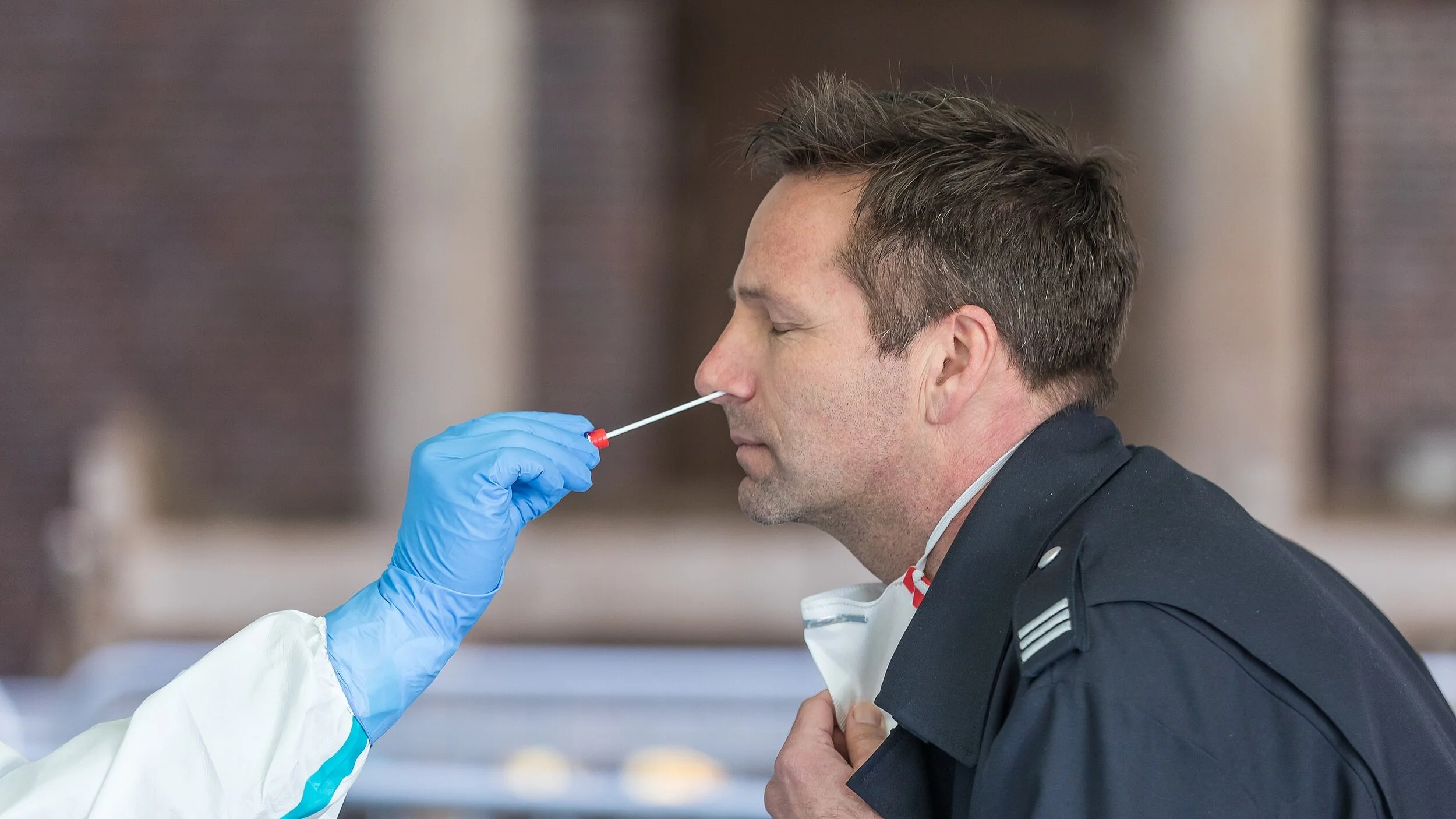
— Photo by Raimond Spekking
BOST0N
From The New England Council (newenglandcouncil.com)
As our region and our nation continue to grapple with the Coronavirus disease (COVID-19) pandemic, The New England Council is using our blog as a platform to highlight some of the incredible work our members have undertaken to respond to the outbreak. Each day, we’ll post a round-up of updates on some of the initiatives underway among council members throughout the region. We are also sharing these updates via our social media, and encourage our members to share with us any information on their efforts so that we can be sure to include them in these daily round-ups.
You can find all the council’s information and resources related to the crisis in the special COVID-19 section of our Web site. This includes our COVID-19 Virtual Events Calendar, which provides information on upcoming COVID-19 Congressional town halls and webinars presented by NEC members, as well as our newly-released Federal Agency COVID-19 Guidance for Businesses page.
Here is the April 6 roundup:
Medical Response
Beth Israel Deaconess Medical Center Develops Prototype Testing Swabs – Confronting a shortage of testing swabs, Beth Israel Deaconess Medical Center (BIDMC) is leading efforts to mass-produce swabs. After only 15 days of research with both private and public partners, BIDMC expects to produce 10,000 swabs each day beginning next week week, eventually ramping up to 1 million daily—likely enough to supply all of America and part of Europe. Read more in The Boston Business Journal.
MIT Researchers Create Equipment Decontamination Resources– To provide advice on best practices for decontaminating and reusing protective equipment used by healthcare providers, researchers at the Massachusetts Institute of Technology (MIT) entered a consortium to create an online resource page. The site aims to help providers with limited time and resources make informed decisions on how to best use existing supplies. More from MIT News
Economic/Business Continuity Response
Boston University Provides Online Learning Resources for Deaf Children – Boston University (BU) has created a new resource—the Deaf Education Library—for deaf children to access courses, curriculum, and books in American Sign Language while they learn at home. In providing this new tool, BU noted that deaf children can find themselves in “double seclusion” as they navigate both the transition to remote learning and being sequestered with people who may struggles to communicate with them. BU Today has more.
Verizon Increases Access to Internet Resources, Employee Pay – To facilitate as smooth a transition as possible to remote work and learning, Verizon is offering access to learning tools and news channels at no additional cost. The network provider has also expanded its Pay It Forward Live gaming campaign to support small businesses affected by the outbreak, and has committed to increasing the pay for its essential employees. Read more.
Lowe’s Takes Steps to Protect Employees – To best comply with social distancing protocols, Lowe’s is working to ensure that its essential employees are protected during the pandemic. Lowe’s announced measures to restrict the number of customers in locations and has expanded remote purchasing offerings. The more stringent guidance come after Lowe’s $170 million commitment to relief efforts. Read more in The Charlotte Business Journal
Community Response
City of Boston Announces $2 Million Small Business Relief Fund – Boston Mayor Martin Walsh announced a relief fund to support small businesses directly affected by closures due to the COVID-19 pandemic. The fund—with contributions from city, private, and federal sources—will target those businesses that do not qualify for federal relief or unemployment benefits. The Boston Business Journal has more.
Northeastern University to Provide Employment and Educational Opportunities for Third-Party Employees – Northeastern University will provide educational assistance and temporary employment opportunities for campus workers who employed by third-party vendors, such as those working in dining and parking services—. Utilizing its existing network of employers usually used for its co-op program, the university will provide language, educational, and career support to address the immediate needs of these workers. Read more from News@Northeastern
Samuel Adams Offers $1,000 Payments to Out-of-Work Food Industry Employees – After establishing its Restaurant Strong Fund to raise money for workers in food service affected by revenue losses, Samuel Adams (part of Boston Beer Company) has expanded the fund’s operations to 19 additional states and is now offering a $1,000 grant to workers who have suffered financial hardship due to the pandemic. CBS Boston has more.
Stay tuned for more updates each day, and follow us on Twitter for more frequent updates on how Council members are contributing to the response to this global health crisis.
Especially during a pandemic...

An Amtrak Downeaster at the Portland train station
“It appears to be the firm conviction of many of the Maine citizenry that since there’s no legal way to keep people from coming to Maine, the least that can be done is to make it as inconvenient as possible.’’
-- Lew Dietz, in Night Train at Wiscasset Station (1977) on the end of passenger-train service to Maine. Passenger train service has since been restored, first to Portland and then extended to Brunswick.

A favorite summer eatery in Wiscasset

Wiscasset’s Nickels-Sortwell House, built in 1807, after the town had prospered as a shipbuilding and fishing center. There are many grand old houses in the town.
In Stockbridge, Norman Rockwell and civil rights

“The Problem We All Live With” (1963), by Norman Rockwell, at the Norman Rockwell Museum, Stockbridge, Mass.
The museum reports it is offering virtual exhibits with Google Arts & Culture “themed around civil rights and presidential politics. The exhibits are constructed like presentations, with written information and video to supplement the photos and illustrations each exhibit is centered around.’’
Hit this link for more information.
“Norman Rockwell in the Age of the Civil Rights Movement ‘‘ explores some of his famous illustrations in support of civil rights: “The Problem We All Live With,’’ “Murder in Mississippi (Southern Justice)’’ and "New Kids in the Neighborhood (Negro in the Suburbs)”.
Meanwhile, “Norman Rockwell: Presidential Elections Illustrated’’ showcases his portraits of presidents and presidential candidates, including John F. Kennedy, Richard M. Nixon, Dwight D. Eisenhower and many others. The museum says “Also shown are photographs of Rockwell and the presidents, and notes about his interactions with them. As Rockwell poignantly said, ‘I am no politician and certainly no statesman. But I have painted thousands of people and I should now be a judge of what their faces say about what they are.’’’
Meanwhile, the museum’s show “Presidents, Politics, and the Pen: The Influential Art of Thomas Nast” is a “showcase of the election art of the famous artist, whose politically charged and satirical cartoons often influenced the opinion of the American public, earning him the moniker of ‘The President Maker." ‘

The Austen Riggs Center, in Stockbridge, a psychiatric treatment center famed for its celebrity patients. Norman Rockwell’s second wife was mentally ill, which is a reason that the couple moved to Stockbridge from Vermont.

Stockbridge’s famous Naumkeag Gardens. now part of a museum, around 1908

At Naumkeag, the summer mansion built by powerful New York lawyer Joseph Choate The estate's centerpiece, besides its gardens, is a 44-room, Shingle Style country house designed principally by Stanford White of McKim, Mead & White, and constructed in 1886 and 1887.
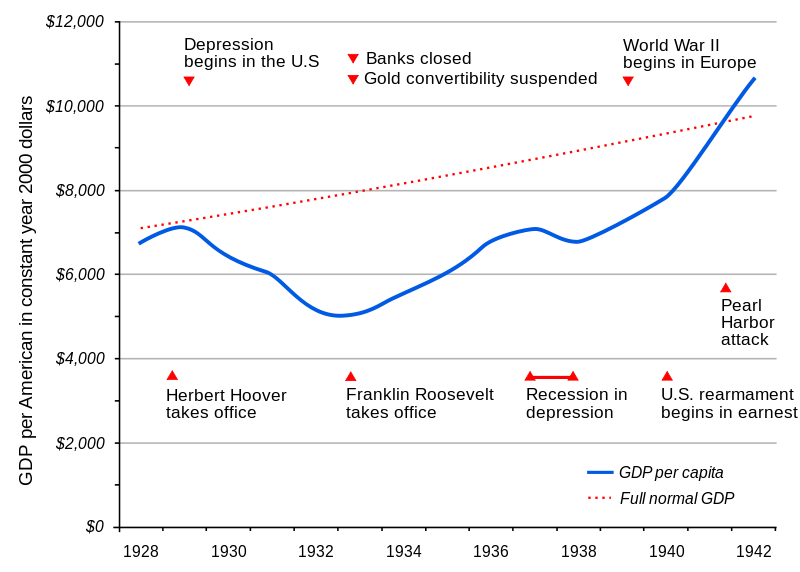
David Warsh: The Great Depression and the possible 'Coronavirus Depression'

The course of the Great Depression in the United States, as reflected in per-capita GDP (average income per person.
SOMERVILLE, Mass.
People are searching for a way to talk about the economic consequences of the COVID-19 pandemic. Veteran economic journalist Robert Samuelson wrote last week in The Washington Post, “For the first time in my life, I think a depression is conceivable.” The Financial Times Saturday led the paper with a four-column headline: “Global Economy set for deepest reversal since Great Depression.”
Robert Gordon, a member for more than 40 years of the Business Cycle Dating Committee of the National Bureau of Economic Research, wrote to say: “Thinking ahead to the ultimate data that the Bureau of Economic Analysis will release on the decline in GDP in 2020:Q2, I should look back at my interpolated quarterly data for the 1930s to see what was the largest quarterly decline of GDP during 1929-32 or 1937-38. Will this time be larger than that?”
Even without the BEA data, it seems reasonable to suppose that the next several quarters – and whatever financial fragility is exposed therein – will enter historical consciousness around the world as the Coronavirus Depression. Already the experience is very different from the W-shaped recessions of 1981-82, or the deep recession, lasting from December 2007 until June 2009, that accompanied the slow-fused Panic of 2007-08.
Samuelson listed three distinctive characteristics that distinguished the Great Depression from business contractions before and since: the scale of havoc and economic suffering that occurred; the “intellectual vacuum” that accompanied it, insofar as economists lacked a widely accepted theory to explain it; and the absence of a social safety net to cushion the human costs of collapse.
He might have added its length – two contractions, 1929-1933 and 1937-38 —gave it the shape of a 10-year lazy-W – and the fact that it culminated in a long global war.
But of course the Great Depression has not gone into history as altogether unexplained, even though Keynesians and monetarists continue to argue about it. And while the United States had very little in the way of a safety net at the beginning of the 1930s, many of the features that are cushioning the blow today were in place by the end of the decade – bank-deposit protection, unemployment insurance and the Social Security System.
Three years of Depression brought about a change in administration, and, after a false start (the National Recovery Administration), President Franklin Roosevelt and the 73rd Congress produced the lasting reforms of the New Deal – public works, safety nets, labor-market reforms and an array of new regulatory agencies. The onsets of both those later “great recessions,” in 1980 and 2008, also brought changes in the White House and Congress. In their respective ways, those elections, too, produced changes in the country’s long-term direction.
What might be expected to result if Democrat Joe Biden is elected in the fall? Whatever his imperfections as a candidate, he is just one among many leaders who would come to the fore. I am just guessing, but perhaps health-care reform would top the agenda once again.
President Trump made yet another attempt to damage the Affordable Care Act last week, when he declined to open enrollment to millions of suddenly unemployed and uninsured workers and ordered Medicare to cover coronavirus treatment fr the uninsured instead.. For a Democratic administration, tackling reform of the health-care system in the wake of the Coronavirus Depression would be the logical place to start.
David Warsh, an economic historian and veteran columnist, is proprietor of Somerville-based economicprincipals.com, where this column first appeared.
Kill everything

Ready for the Apocalypse in Essex, Mass.
—Photo by David Jacobs

Barn in beautiful exurban/suburban Essex, on Greater Boston’s North Shore
Before they fixed Copley Square

Copley Square, Boston, in the ‘50s. It’s much more beautiful, exciting and crowded (except maybe the past couple of weeks!) these days.

Copley Square fountain, with Old South Church tower in distance
— Photo by Caroline Culler

'Wider sunrise in the dawn'

An altered look about the hills;
A Tyrian light the village fills;
A wider sunrise in the dawn;
A deeper twilight on the lawn;
A print of a vermilion foot;
A purple finger on the slope;
A flippant fly upon the pane;
A spider at his trade again;
An added strut in chanticleer;
A flower expected everywhere;
An axe shrill singing in the woods;
Fern-odors on untravelled roads, —
All this, and more I cannot tell,
A furtive look you know as well,
And Nicodemus' mystery
Receives its annual reply.
— Poem on April, by Emily Dickinson

Amherst in the year that lifelong resident Emily Dickinson (born 1830) died.
Easier than Walt Disney World

Adapted from Robert Whitcomb’s “Digital Diary,’’ in GoLocal24.com
In a happy reminder of summer, there’s an elderly Cape Cod couple’s uber-charming and kitschy (36-hole) Sandwich Mini Golf, on what used to be a cranberry bog. Construction started on the course back in 1950.
"Even in the winter, he’s repainting," Sylvia Burke said of her husband, Maurice (“Mo’’), who started construction on the course in 1950, when he was 15, reported WBUR’s Gary Waleik back in 2016. "In the evening hours, he’ll be busy carving signs. Every sign that’s on the mini golf is all hand-carved by him." There’s a Mo’s Mountain on the course, by the way. The attraction is squeezed between scenic Route 6 A and a salt marsh. (Salt marshes are the defining characteristic of the Cape Cod Bay side of the peninsula.) A brook flows under the course’s bridges, around a simulated giant lily pad and past a white whale and a lighthouse – all very Cape Coddish.
“I love Sandwich Mini Golf because each time I play there, I feel like a kid. My wife and children seem to love it as much as I do. It’s one of our very happy places,’’ Mr. Waleik wrote.
To read his story, please hit this link.
To see the Sandwich Mini Golf Web site, hit this link.
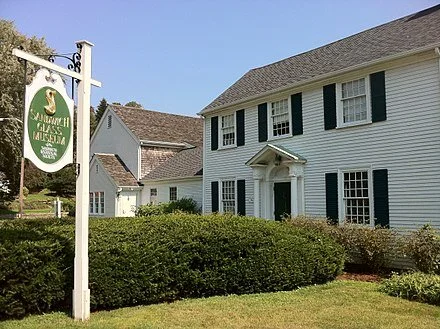
Sandwich was a famous early glass-making center (lots of sand with which to make it) — “Sandwich Glass’’ — and one of America’s earliest Quaker centers.

Boardwalk in Sandwich marshes
House walls instead

“The Peaceful Use of Walls” #2 (encaustic on panel), by Willa Vennema. She lives most of the year in Portland but summers with her family on Swan’s Island, south of Mount Desert Island, where most of Acadia National Park is.
She says:
“My most recent series of work is entitled ‘The Peaceful Use of Walls.’ This series was in response to the controversy over President Trump’s desire to build a multibillion-dollar wall on our boarder with Mexico. I do not believe a huge wall is the answer to our immigration problems. This series depicts a hopeful, nurturing and peaceful alternative for the use of walls—houses.’’
She’s a member of New England Wax.
See her video by hitting this link.

Squirrels and season

“Squirrels from treetops listen to
pine wind song. Such overtures of
the season come again and again….’’
-- From “Squirrels in Wind Pine,’’ by David Kherdian, who lives in Florence, a village in Northhampton, Mass. Because it had a thriving silk industry in the 19th Century, the village was named in 1852 after Florence, Italy, for its own thriving silk trade.
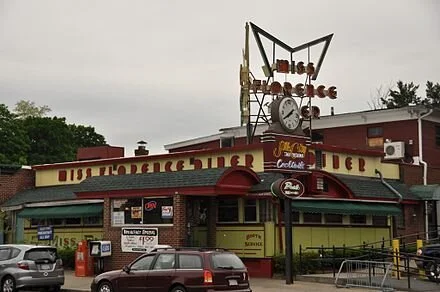
A classic breakfast-all-day diner in Florence
...And a refuge for rich New Yorkers fleeing (they hope) COVID-19

Gingerbread cottages in Oak Bluffs, on The Vineyard
“Once one puts in any amount of time here, one becomes gradually addicted. Eventually, living on the (Martha’s) Vineyard becomes a passionate obsession, a religion, a personal identity and a raison d’’etre.’’
— Peter Simon (1947-2018) in On the Vineyard II (1990)

The famous colorful clay cliffs on Gay Head
'Joy shivers in a corner'

“Northeaster,’’ by Winslow Homer (1836-1910). Much of his work was inspired by the New England coast.
Here where the wind is always north-north-east
And children learn to walk on frozen toes,
Wonder begets an envy of all those
Who boil elsewhere with such a lyric yeast
Of love that you will hear them at a feast
Where demons would appeal for some repose,
Still clamoring where the chalice overflows
And crying wildest who have drunk the least.
Passion is here a soilure of the wits,
We're told, and Love a cross for them to bear;
Joy shivers in the corner where she knits
And Conscience always has the rocking-chair,
Cheerful as when she tortured into fits
The first cat that was ever killed by Care.
“New England,’’ by Edwin Arlington Robinson (1869-1935). The famed poet grew up on the Maine Coast.

April 3 update from N.E. Council on COVID-19 response

Harvesting cranberries in the fall in southeastern Massachusetts
Ocean Spray is raising wages and making donations to farm regions in the crisis
April 3 update from The New England Council (newenglandcouncil.com):
As our region and our nation continue to grapple with the Coronavirus Disease (COVID-19) pandemic, The New England Council is using our blog as a platform to highlight some of the incredible work our members have undertaken to respond to the outbreak. Each day, we’ll post a round-up of updates on some of the initiatives underway among Council members throughout the region. We are also sharing these updates via our social media, and encourage our members to share with us any information on their efforts so that we can be sure to include them in these daily round-ups.
You can also check our COVID-19 Virtual Events Calendar for information on upcoming COVID-19 related programming – including Congressional town halls and webinars presented by NEC members.
Medical Response
Boston Convention & Exposition Center Become Commonwealth’s First Field Hospital – Amid predictions that Massachusetts cases of COVID-19 could arrive next week, Governor Charlie Baker (R-MA) announced that the Boston Convention and Exhibition Center (BCEC)—owned by the Massachusetts Convention Center Authority—will become the commonwealth’s first field hospital. Officials plan for 1,000 beds total, split evenly between the city’s homeless population and overflow patients from area hospitals. WBUR has more.
Partners HealthCare Brings Mask Sterilizer to Massachusetts – Confronting an impending shortage of protective equipment and other personal protective equipment for healthcare workers, Partners HealthCare has entered into a partnership to bring a machine that can sterilize up to 80,000 respirator masks a day to Massachusetts. The device, described as a “game changer” for the region’s response, could reduce strain on dwindling supplies and possibly serve all hospitals in New England, according to the Massachusetts Health & Hospital Association. Read more in NBC.
Sanofi Prepares to Produce Millions of Doses of Potential Treatment – Should a now-famous malaria drug prove effective in combatting the coronavirus, Sanofi has confirmed it has the potential to produce hundreds of millions of doses of hydroxychloroquine. In addition, the pharmaceutical company has ensured its supply chain remains stable. Read more in The Wall Street Journal.
Economic/Business Continuity Response
Duane Morris Offers Guidance on Employment Retention Assistance – A guide to the options businesses have for assistance under the recent stimulus package provided by Duane Morris gives the business community clarity on eligibility, the scope of the package, and limitations of assistance. Read the guide in Forbes.
Ocean Spray Increases Wages, Donates Meals to Farmer Regions – To support its employees who continue to work despite personal safety concerns, Ocean Spray is increasing wages and providing an extra week of vacation to front-line employees. In addition to the wage increases, the company also plans to donate 100,000 meals to its farm regions across the country. Fox Business has more.
Dell Provides Resources for Remote Work Transition – As businesses of all types and sizes navigate an abrupt transition to remote work, Dell is offering a host of online materials to support and expedite the move. Webinars from senior executives on employee flexibility and posts highlighting the importance of cybersecurity are just some of the services Dell is offering for the business community. More can be found here.
Community Response
American Hospital Association Successfully Urges Administration for Direct Assistance to Hospitals – After pressure from lawmakers and healthcare organizations across the country, including a letter from the American Hospital Association (AHA), the Trump Administration is now planning to pay hospitals to treat uninsured patients with COVID-19. The letter from AHA calls for direct aid as well as the expansion of infrastructure investment assistance, among other things. The Wall Street Journal
Endicott College President Profiled on Leading a College Through Crisis – NEC Board Member Steven DiSalvo, president of Endicott College, was profiled in the Boston Business Journal highlighting his leadership during a pandemic that has sent his students home and grinded daily operations to a halt. DiSalvo discussed the school’s commitment to fully pay employees through June, and the potential benefits the switch to online learning could provide for its online graduate offerings. Read the profile here.
Stay tuned for more updates each day, and follow us on Twitter for more frequent updates on how Council members are contributing to the response to this global health crisis.

College Hall at Endicott College, in Beverly, a former industrial town part of which is a rich Boston suburb with old Brahmin as well as new money.
Danger! Don't eat!

“Climbing Oysters” (watercolor and pastel), by Carolyn Newberger, in her two-person show, “Nature and Abstraction,’’ with Philip Gerstein at Galatea Fine Art, Boston, now closed to the public.
Chris Powell: Too much stress from 'high-stakes' school testing? Get used to it!

“Anxiety’’ (1894), by Edvard Munch
Parents and educators alike increasingly complain that "high-stakes” testing in school causes too much stress for students and fails to provide a complete measure of their learning.
A few weeks ago at a meeting of the New Haven Public School Advocates organization, a city Board of Education member and pediatrician, Tamiko Jackson-McArthur, said the prospect of final exams and mastery tests gives students headaches and insomnia. "High-stakes testing does not take into account the social well-being of children,” Jackson-McArthur said, adding that she does not permit her children to take such tests. She echoed calls for less formal and more opinion-based measures of learning.
Of course, there now may be far more stress on everybody than an occasional test imposes, what with school suspended everywhere amid the virus epidemic and children stuck at home all day with parents or relatives, who in turn are stuck with them all day. But if those “high-stakes” tests are abolished and there are no test scores, just a teacher's evaluation of whether a student did well with book reports or a science fair project, the tendency may be to conclude that, as in Lake Wobegon, all students are above average.
For without "high-stakes” tests there will be no verifiable and comparable measures of learning in basic subjects. Teachers are already under great administrative and political pressure not to fail anyone, and Connecticut's main educational policy long has been social promotion. School systems no longer have the political strength to uphold standards.
While students may get anxious as a "high-stakes” test approaches, why shouldn't they become so? Life itself sometimes involves high stakes and requires an ability to handle stress. Gaining that ability is what growing up is about, since Mommy and Daddy won't be around forever.
Besides, in a system of social promotion, how much stress can there really be? It may be impossible for any Connecticut student to get to third or fourth grade without realizing that his learning or lack of it has no bearing on his advancement. By high school most students have realized that not only will they be graduated even if they learn nothing but also, if they desire it, they will be promoted to a community college or state university where they can take remedial high school courses, just as most freshmen in Connecticut's community colleges and state universities do.
Mastery tests, college entrance examinations, and other standardized tests are not perfect but they are probably the most comprehensive educational measures possible. These measures long have been conveying poor performance, and if the risk of stress to students is to be eliminated, what incentive will many students have to perform any better?
That so many high school and even college graduates these days are skilled for little more than menial employment argues powerfully for more anxiety in education, not less.
Of course, it is easy for those who have already endured the trials of school and growing up to disparage the anxiety of today's students. But not all of today's grown-ups are as educated as they should be.
They may remember Alice Cooper singing (screaming, really) decades ago, "School's out forever!” Amid the virus shutdown they may wonder: Why couldn't they have done it before we got too old to enjoy it
Chris Powell is a columnist for the Journal Inquirer, in Manchester, Conn.
Partly non-virus-related!

Adapted from Robert Whitcomb’s “Digital Diary,’’ in GoLocal24.com
With many newspapers shrinking unto death, all they seem to have room for is COVID-19 stuff; there are many other important things happening around the world that aren’t being reported. As the late Bill Kreger, a news editor to whom I reported at The Wall Street Journal once observed: “Sometimes the most important story starts out at the bottom of Page 37.’’ What might we be missing?
Well, The Boston Guardian reports that property and violent crime is down in its circulation area (the Back Bay, Beacon Hill , downtown and Fenway) this year. But maybe that’s a virus-related story? As newly unemployed people run out of money will property crimes increase?
Then there’s an inspiring little item from the March 24 Wall Street Journal: Voters in Mexican border city of Mexicali have admirably told the U.S. company Constellation Brands not to complete a $1.4 billion brewery there because the facility would take so much water that it could jeopardize the irrigation-dependent agriculture in the region.
In other heartening, if mostly symbolic, news, the U.S. has indicted Venezuelan dictator Nicolas Maduro and some sidekicks for drug trafficking and is offering $15 million to those who aid his capture. Don’t expect Maduro to appear any time soon in a federal court, but the move is apt to make him nervous.
And there’s the important unhappy news that the world’s greatest coral reef, Australia’s Great Barrier Reef, had just suffered another mass bleaching caused by global warming, whose associated increase in carbon dioxide makes sea water more acidic. For more information, please hit this link.
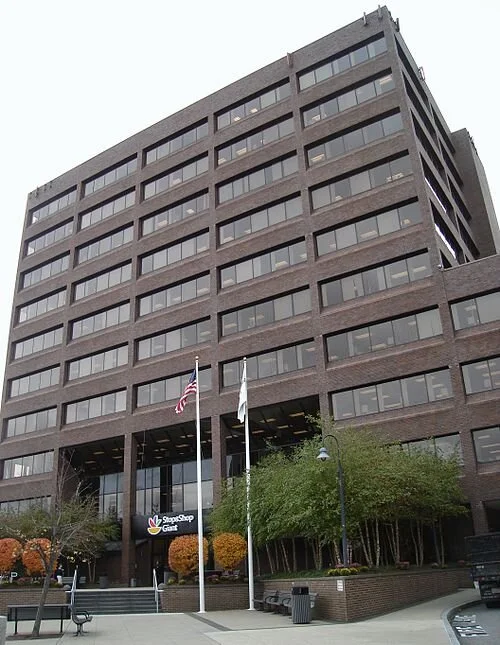
Update from New England Council on region's response to COVID-19 crisis
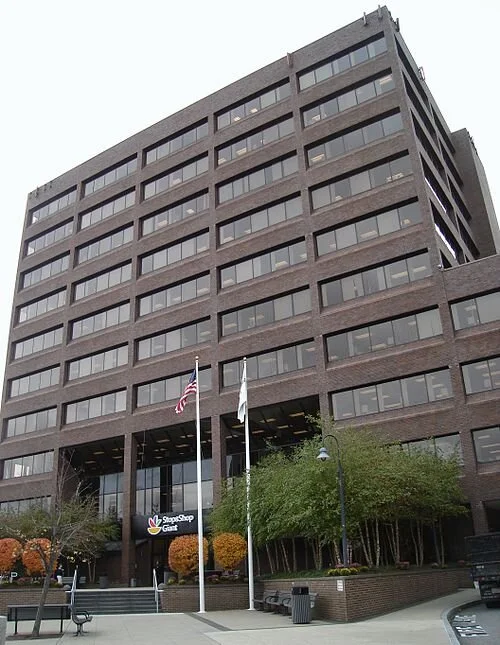
Headquarters building of the Stop & Shop supermarket chain, in Quincy, Mass. The company is donating food to health-care workers.
Update from The New England Council (newenglandcouncil.com):
As our region and our nation continue to grapple with the Coronavirus Disease (COVID-19) pandemic, The New England Council is using our blog as a platform to highlight some of the incredible work our members have undertaken to respond to the outbreak. Each day, we’ll post a round-up of updates on some of the initiatives underway among council members throughout the region. We are also sharing these updates via our social media, and encourage our members to share with us any information on their efforts so that we can be sure to include them in these daily round-ups.
You can also check our COVID-19 Virtual Events Calendar for information on upcoming COVID-19 related programming – including Congressional town halls and webinars presented by NEC members.
Here is the April 2 roundup:
Medical Response
Northeastern University Models Used in White House Response to Virus – The White House coronavirus response team has been using models produced by the Network Science Institute (NSI) at Northeastern University to project how varying mitigation strategies could “flatten the curve” of COVID-19. The models allow policymakers and members of the response team to visualize the effects of policies being considered, such as specific travel restrictions and staggered school closings. Read more.
Boston Scientific Begins Work to Produce Ventilators, Protective Equipment – To confront the growing need for medical equipment, Boston Scientific is collaborating with public and private partners to bring necessary devices to market. From making more affordable and portable ventilators to producing face shields and reusable protective equipment, the company continues to use innovation to address some of the most pressing problems facing healthcare workers. Read more.
Abiomed Expands Remote Training for Medical Providers – Medical device manufacturer Abiomed is expanding its utilization of its online physician community to provide expanded physician education and training. The company has plans to launch its largest interactive educational site in its history in April. More information can be found here.
Economic/Business Continuity Response
Proctor & Gamble Increases Production During Crisis – In the wake of shortages of some of its most common products—including napkins, paper towels, and diapers—P&G has increased production of all paper goods at its factories. The company is also manufacturing face masks to help alleviate the increasing demand of protective equipment. USA Today has more.
M&T Bank Provides Hardship Assistance – M&T Bank has created an impact form for its clients to identify their need for a variety of assistance options, including late fee suppression and changes to loan payment plans. In addition to case-by-case measures, the bank is offering unsecured personal loans, suspending negative credit reporting, and more. More information can be found here.
Community Response
Stop & Shop Donates Daily Meals to Healthcare Workers, $500,000 for Research – Using its expansive food production and delivery network, Stop & Shop (owned by Ahold Delhaize) will provide 5,000 meals daily to health-care providers in the greater New York City and Boston areas. In addition to the daily meals, the grocer is providing $500,000 to Boston Children’s Hospital for research on a potential vaccine. Read the press release here.
DraftKings Announces New Charity Initiative, $500,000 Donation – DraftKings has created its own charity initiative, #DKRally, to mobilize sports fans to donate to relief efforts. In addition to an initial $500,000 donation, the betting service will match up to a total of $1 million from contributors. The donations to the initiative will be distributed to United Way to support relief efforts across the country. US Betting Report has more.
Holy Cross Student-Run Nonprofit Raises Over $23,000 for Response Fund – Working for Worcester, a student-run nonprofit founded at the College of the Holy Cross, has raised more than $23,000 for the Worcester Together COVID-19 emergency response fund. The money was raised in just five days as part of a blitz from the school’s alumni and students. The Worcester Together fund provides money for immediate needs and to support local community organizations. The Worcester Business Journal
Stay tuned for more updates each day, and follow us on Twitter for more frequent updates on how Council members are contributing to the response to this global health crisis.