
Vox clamantis in deserto







Llewellyn King: Hydrogen is back as the clean fuel of the future

Hydrogen as a clean fuel is back with a new mission and better ways of producing it.
Jan Vrins, a partner in Guidehouse (formerly Navigant), a leading consulting firm, says hydrogen is a critical component in the carbon-free future of electricity. He told a press event at the National Press Club in Washington that the role of hydrogen as a storage medium as well as a clean fuel will be vital going forward.
Vrins, who heads a team of 800 consultants and researchers at Guidehouse, told reporters that Europe is ahead of the United States in the new uses of hydrogen and in offshore wind development as a hydrogen source. The two are linked, he said, and hydrogen will grow in importance in the United States.
In the bleak days of energy shortage in the 1970s and 1980s, hydrogen was hailed as a magical transportation fuel. Cars would zip around with nary a polluting vapor, except for a drip of water from the tailpipe.
But this white knight never quite got into the saddle. Hydrogen wasn’t easily handled, wasn’t easily produced and wasn’t economically competitive.
Now hydrogen is back as a carbon-free fuel — a means of sopping up excess generation from wind and solar, when production from those exceeds needs, and as an alternative source of energy storage besides batteries.
In theory, hydrogen may yet make it in transportation via fuel cells. But that puts it in competition with electric vehicles for new infrastructure.
Unlike the 197os and 198os, today there is natural gas aplenty for producing hydrogen. Vrins calls this a “bridge” until hydrogen from water takes over.
Hydrogen doesn’t have the same properties as natural gas, and these must be accounted for in designing its use. It has greater volume than an equivalent amount of natural gas and it’s very volatile. But it can make electricity through fuel cells or burning.
Hydrogen isn’t found free in nature, although it’s the world’s most plentiful element — water is made of hydrogen and oxygen. To get hydrogen, coal or natural gas must be steam-reformed, or it can be extracted from water with electrolysis — a development that isn’t missed on companies like Siemens which makes electrolyzer units. Siemens is a leader in a field that is fast attracting engineering companies.
Hydrogen needs special handling and must be engineered into a system. It can’t be treated as being a one-for-one exchange with natural gas at the turbine intake. It has a lower energy density which means it must be stored under pressure in most instances.
Adam Forni, a hydrogen researcher at Guidehouse with an extensive background in natural gas and hydrogen, told me the emphasis today is on reforming natural gas and desulfurizing it in the process with carbon capture, use and storage (CCUS) technology. This gas is known as “blue hydrogen,” as opposed to gas from electrolysis which is known as “green hydrogen.”
Green hydrogen is the long-term goal of Guidehouse’s Vrins and his team. It makes alternative energy more efficient.
The Los Angeles Department of Water and Power has announced it will convert an 1,800-megawatt coal-fired power plant located in Utah to 800 megawatts of all hydrogen. Initially, the plant will burn 70 percent blue hydrogen and will convert to 100 percent green hydrogen by 2045.
But even blue hydrogen with CCUS is a clean fuel, emitting no carbon. Natural gas when burned emits about half the carbon of coal; blue and green hydrogen, zero.
At the Washington press event, Vrins said hydrogen will help in the creation of microgrids which are the coming thing as utilities reorganize themselves. He said natural gas could be piped to the site and then reformed into hydrogen or, better yet, green hydrogen could be made on-site with the surplus electricity from windmills and solar installations.
Vrins sees a future when the grid or microgrid doesn’t need all the power being produced it can be diverted to electrolyzing water and making hydrogen, thus acting as an energy storage medium with greater versatility than batteries. Batteries draw down quickly, whereas hydrogen can be stored in quantity and used over time, as natural gas is today.
Hydrogen is one of the tools as utilities go green. It’s back all right.
On Twitter: @llewellynking2
Llewellyn King is executive producer and host of White House Chronicle, on PBS. He’s based in Rhode Island and Washington, D.C.
This email was sent to rwhitcomb51@gmail.com
why did I get this? unsubscribe from this list update subscription preferences
White House Chronicle · 125 Providence Street, Suite S302 · West Warwick, RI 02893 · USA
ReplyForward
The foundational Mass. fish story

The Sacred Cod is a four-foot eleven-inch carved-wood effigy of an Atlantic codfish, "painted to the life", hanging in the Massachusetts House of Representatives chamber of Boston's Massachusetts State House— "a memorial of the importance of the Cod-Fishery to the welfare of this Commonwealth" — in its first 200 years.
“As for what you're calling hard luck - well, we made New England out of it. That and codfish.’’
— Stephen Vincent Benet (1898-1943), poet, short story writer and novelist. He is best known for his book-length narrative poem of the American Civil War John Brown's Body (1928), for which he received the Pulitzer Prize for Poetry, and for the short stories "The Devil and Daniel Webster" (1936) and "By the Waters of Babylon" (1937). He’s buried in Stonington, Conn., where he owned an historic house.
Providence's 'Great Streets' initiative

From ecoRI News (ecori.org)
PROVIDENCE — Following a year of community engagement, the city’s “Great Streets’’ initiative has established a framework for public-space improvements to ensure that every street is safe.
City officials said the plan’s creation was informed by insights generated “from thorough analysis of crash data, traffic calming requests, and housing and transportation figures.” According to the city, the 94-page plan outlines “a bold vision for the future of Providence’s largest public asset, its streets.”
“Great Streets rebalances the public space of our streets to meet the needs of all residents,” said Bonnie Nickerson, the city’s director of planning and development. “It’s a new approach to how we invest in Providence that will have a long-term impact on safety, equity and resilience.”
Covering about 13 percent of Providence’s total land area — some 1,500 acres — streets play a central part in the city’s neighborhoods. A key strategy outlined in the plan is reducing household transportation costs by making it more convenient for people to use and access affordable transportation options such as walking, riding bicycles, and public transit.
Other goals include improving traffic safety and personal safety within the public realm for people of all ages, abilities, and economic statuses, lowering greenhouse-gas emissions, and improving public health. According to the World Health Organization’s 2018 Global Status on Road Safety report, traffic-related crashes are the No. 1 cause of death in children and young adults aged 5-29.
The plan complements the work of ongoing infrastructure projects outlined in the city’s FY2020-FY2024 Capital Improvement Plan (CIP), signed by Mayor Jorge Elorza in early January. Over the next five years, the CIP identifies nearly a $20 million investment in Great Street initiatives. These improvements include: streetscape and placemaking projects; safety improvements to make streets and intersections safer for people walking and riding bicycles; traffic calming to reduce speeding and cut-through traffic; and the creation of a “spine” network of urban trails that connect every Providence neighborhood.
These improvements will bring 93 percent of residents and 95 percent of jobs within easy walking distance of the Urban Trail Network, according to city officials. This is a significant increase compared to the 21 percent of residents and 37 percent of jobs within easy walking distance of the existing network.
According to the city, urban trails are on or off-street paths that are “safe, comfortable, and easily accessible for people of all ages and abilities.” On busy streets, urban trails are fully separated from vehicle traffic. In other instances, off-road trails and paths such as the Blackstone Bike Path and the Woonasquatucket River Greenway serve as part of the Urban Trail Network.
Always pick the richest parents you can find

Too small for the Sussexes? The great hall in The Breakers, the old Vanderbilt mansion in Newport
From Robert Whitcomb’s “Digital Diary,’’ in GoLocal24.com
Of course, things are always rigged for the rich and well-connected –why complain that rocks are hard! -- but since the Second Gilded Age started back in the ‘80s we set new levels of goodies for the privileged. Consider Hunter Biden’s stretch of getting paid $50,000 a month for sitting on the board of a Ukrainian gas company although he knew little about that industry. Then we have Chelsea Clinton, the only child of Bill and Hillary, pulling in $9 million in salary and stock since 2011 for sitting on the board of the Internet investment company IAC/InterActive Corp., which happens to be controlled by mogul Barry Diller, a pal of the Clintons.
Still, that’s bush league compared to the Trump Family’s profiteering off Daddy’s occupation of the Oval Office and steering vast sums of foreign and U.S. government money to Trump resorts and hotels. The Constitution’s Emoluments Clause? What’s that?!
And now the Duke and Duchess of Sussex have decided they want to make a killing, er be “financially independent,’’ and withdraw from many of their tedious public duties as Royals. Are Sussex sweatshirts coming up? Too tacky! Think luggage. There’s a push on to get them to move to Rhode Island. Maybe a shingle-style mansion near Taylor Swift’s pile on Watch Hill?
Art and civics in Peterboro
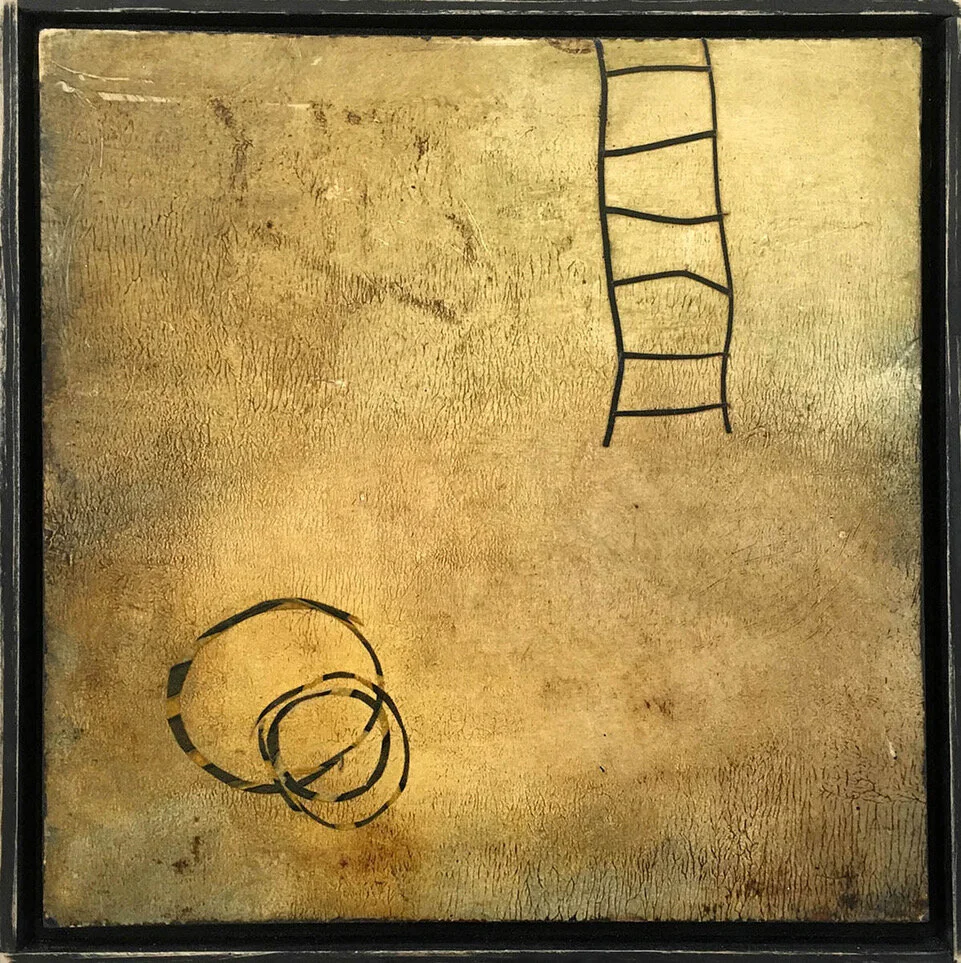
“Hidden Myth” (collagraph, wax, tape), by Soosen Dunholter, a Peterboro, N.H.-based painter.
Peterboro, in New Hampshire’s (Mount) Monadnock Region (named for the mountain that has long been reputed to be the second-most climbed in the world, after Mt. Fuji), is famous for the many writers and other artists who have lived and/or worked there. That’s party because of the MacDowell Colony, which has been a cozy and supportive place for writers, composers and visual artists to work since its founding, in 1907. One of its writers was Thornton Wilder, who is said to have based the community, Grover’s Corners, in his famous play Our Town on Peterboro. Peterboro is still more rural than not, but Boston’s exurban sprawl is pushing toward the town, which remains a weekend and vacation home for quite a few affluent people.
Peterboro is well known for its engaged and well-informed citizenry.
Next door is beautiful Dublin, the highest town in New England and the site of the headquarters of Yankee Inc., which publishes the eponymous magazine and the Old Farmer’s Almanack and has a couple of glorious lakes. For many years Dublin hosted Beech Hill Farm, a substance-abuse (mostly of alcohol) facility in an old mansion on top of Beech Hill that drew a fair share of celebrities who needed to dry out. The property is no longer used for that.

Children’s arts parade in Peterboro.

Bond House at the MacDowell Colony
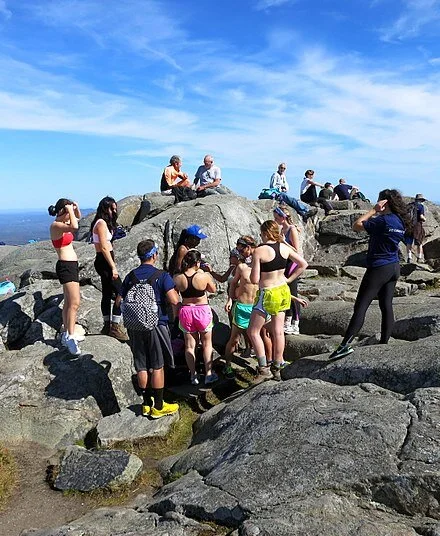
The top of Mount Monadnock on a typically crowded day in warm weather.

Trying to get at time in Rockland

“Continuum (Magenta)’’ (oil on linen — detail), by Grace DeGennaro, at the Center for Maine Contemporary Art, Rockland, through Feb. 23.
The gallery says:
”This exhibit is the second in an ongoing series at CMCA that addresses common themes in contemporary art. The biennial series began in 2017 with ‘Materiality | The Matter of Matter’ and continues to ‘Temporality’ with the work of 14 contemporary artists. ‘Temporality’ explores our deepest questions about the concept of time: What is time, how do we measure it, how can we ascribe value to it? The featured artworks offer their own answers to these questions using painting, photography, sculpture, installation, video and other media. However, one can say that time itself is also a medium in these pieces, as the exhibit webpage points out: The only sure things about time are that "artists need time to make their work and viewers need time to look. ‘Temporality,’ therefore, asks the viewer to slow down and take the time to consider the questions it asks about time and perhaps find the answers.’’
xxx
Rockland, on Penobscot Bay, is a fascinating place — a celebrated arts center, a fishing port and a major recreational-sailing center. Besides the CMCA (designed by the internationally known architect Toshiko Mori), the town is also home to the Farnsworth Museum of Art, which has paintings by Andrew Wyeth and other well-known New England artists. It hosts the Maine Lobster Festival, held annually in honor of the town's primary export: lobster. Rockland's downtown has many small shops, some very charming, including coffee shops, book stores, art supply stores, restaurants, organic markets, computer repair and toy stores. The city's dramatic breakwater, built in the 19th Century, draws tourists.

Downtown Rockland

Some of Rockland’s waterfront
— Photo by Jeff G.
'A classical tone'
"There is about Boston a certain reminiscent and classical tone, suggesting an authenticity and piety which few other American cities possess."
— E.B. White (1899-1985), the famous essayist and children’s book author. He’d often go through Boston to take the old Boston & Maine Railroad to approach his place on the Maine Coast.


Chris Powell: Past time to reject the transgendering racket

A man who decided he wanted to be a woman
Few people care if men want to dress up as women or women as men. For most such people it's not a lark but a deep psychological issue likely to cause them some trouble throughout their lives. They are entitled to be comfortable in their own skin.
But everybody else is entitled to care when this imposture infringes on gender privacy in bathrooms and competition in sports, areas where individual lives inevitably affect other lives.
If the imposture of transgendering is skilled enough, it won't be noticed in a bathroom. But it can't help be noticed in sports, for physical gender is simply biology and men tend to be larger and stronger than women. Calling a man a woman doesn't make him one physically. Gender division in sports was instituted because biology cannot be denied, even though politically correct pretense lately has been trying to deny it in Connecticut and throughout the country and to intimidate doubters out of asserting the obvious.
But here and there some people are not being intimidated. A few state legislators around the country have even introduced bills to reject the transgendering racket and keep boys and girls in their proper divisions in public school sports.
At a hearing on such legislation in New Hampshire's House of Representatives this month, a girls cross-country and track and field coach from West Hartford, Meredith Gordon Remigino, bravely decried the unfairness increasingly inflicted on young female athletes by the transgendering racket. Remigino noted that some males who are only ordinary athletes in male events now impersonate females and vanquish all competition there. Indeed, for several years now this has been happening in Connecticut foot races.
"We know firsthand that fairness and equality require sports to be categorized and differentiated based on sex, not based on gender identity," Remigino told the hearing.
Three Connecticut young women athletes have complained to the U.S. Education Department's Office of Civil Rights about the state policy that is letting transgender boys dominate girls track and field events in the state. Maybe federal action will induce the state to drop its political correctness, face reality, and change the policy, if only until political correctness returns to federal administration.
But most people in Connecticut probably will remain too intimidated to complain about this unfairness until some young man who can't quite make it on the University of Connecticut men's basketball team decides that he's really a woman and joins the women's team, or until the women's basketball teams at Notre Dame, Tennessee, or Baylor come to UConn fielding players with male chromosomes.
That might be Connecticut's long-overdue moment from "The Emperor's New Clothes."
After all, if even in athletics gender is merely a state of mind, not biology, what about age too?
Surely there are some old men who were never more than mediocre athletes but who feel young at heart and would love to play Little League baseball again against 12-year-olds and swing for the shorter fences. These old men would be no more out of place than the biological males who are expropriating female prizes.
The author of 1984, George Orwell, saw such nonsense coming 80 years ago. He wrote: "We have now sunk to a depth at which restatement of the obvious is the first duty of intelligent men." As Coach Remigino showed, women too.
Chris Powell is a columnist for the Journal Inquirer, in Manchester, Conn.
The tamed with the untamed

Photo by Vaughn Sills in her Feb. 5-March 1 show “Inside Outside’,’ at Kingston Galley, Boston. It’s a group of photographs that blend still life and landscape, such as bouquets with landscapes that Sills creates of Prince Edward Island, her mother’s home, in a juxtaposition of highly cultivated nature versus the untamed natural world. The gallery says: “Domestic life is represented by garden-grown flowers in vases, alluding to the traditional notion of women’s work in gardens and in the home; while the outside world is seen in the images of sea and land. Mortality and beauty are explored in a secondary layer of this body of work. The Prince Edward Island landscapes and seascapes are part of a series about grieving for Sills’s mother, a woman noted for her remarkable beauty. They represent expressions of sadness, love, memory and connection. Flowers, with their ephemeral beauty, are reminders of death and contrast with the feeling of infinitude implied by the sea and rolling hills. A third layer speaks to the artist’s concern for the planet. She is attuned to the climate crisis implied in these photographs. Local streams and ponds are polluted by the farmer’s field featured in her work, and the flowers purchased for the photographs are transported via trucks that contribute to carbon emissions, a factor in the rise of sea levels.’’
Campaign for Common Sense
Watch for action by the new national reform project called Campaign for Common Sense, started by the legal- and regulatory-reform organization Common Good. The project’s Web site will be up soon. One of the organization’s key goals is to start rebuilding America’s crumbling infrastructure by cutting red tape.
WHOI vehicle uses robotic arm to take sample on seabottom

From The New England Council (newenglandcouncil.com)
Woods Hole Oceanographic Institute (WHOI) used a recently developed hybrid vehicle to take the first sample from the sea bottom by a robotic arm.
The vehicle, Nereid Under Ice (NUI), was operated remotely by scientists off the coast of Greece to explore an active submarine volcano, as part of the National Aeronautics and Space Administration’s (NASA) Planetary Science and Technology from Analog Research (PSTAR) interdisciplinary research program. Only slightly smaller than a Smart Car, NUI used artificial intelligence to determine which sites to visit and when to take samples autonomously. NUI is one of the first results of a larger push for automation technology, with further developments promising results in not only independent ocean research, but for NASA’s work in exploring other planets.
“For a vehicle to take a sample without a pilot driving it was a huge step forward,” says Rich Camilli, an associate scientist at WHOI leading the development of automation technology. “One of our goals was to toss out the joystick, and we were able to do just that.”
Jungle in the Bronx

“New York Botanical Garden (in the Bronx)’ ‘ (gelatin silver print), by Peter Moriarty, in his show “Peter Moriarty: Warm Room,’’ at the Iris & B. Cantor Art Gallery, College of the Holy Cross, Worcester, through Feb. 29.
The gallery says:
”With his portfolio of gelatin silver prints, Peter Moriarty explores the architecture and collections of a series of historic European and American greenhouses. Taken over the course of more than 20 years, Moriarty's evocative works explore the interactions of familiar architectural forms with the lush, exotic, organic, and often disorienting collections housed within.’’
The gallery says:
”With his portfolio of gelatin silver prints, Peter Moriarty explores the architecture and collections of a series of historic European and American greenhouses. Taken over the course of more than 20 years, Moriarty's evocative works explore the interactions of familiar architectural forms with the lush, exotic, organic, and often disorienting collections housed within.’’

Will these sculptures preside over the (Conn.) Thames?

New London from Fort Trumbull
From Robert Whitcomb’s “Digital Diary,’’ in GoLocal24.com
I love this sort of project!
Killingworth, Conn., sculptor Renee Rhodes wants to create two 30-foot-tall bronze statues of female figures, one on the Groton side and the other on the New London side of the Thames River. Some readers may have seen her very popular life-size bronze sculpture of Athena in downtown New London.
I hope that her Thames project happens. Such creations tend to cheer the traveling public and arouse local pride
Pass through after plowing and primary

An apple orchard in Hollis, N.H.
"You don't want someone to think you're from New Hampshire, because who cares about New Hampshire? You're basically just a pass-through.''
-- Timothy Simons, actor and comedian. He’s from Maine.

Historical marker in Concord
'Between pole and tropic'

“Midwinter spring is its own season
Sempiternal though sodden towards sundown,
Suspended in time, between pole and tropic.’’
— From “Little Gidding,’’ by T.S. Eliot

John O. Harney: News and random thoughts from the region

“If Wishes Were Horses (For Dad)”, by Timothy Harney, a professor at the Montserrat College of Art, in Beverly, Mass. He’s the brother of John O. Harney.
From The New England Journal of Higher Education, a service of The New England Board of Higher Education (nebhe.org)
FICE-y conditions. MIT recently alerted its staff that federal immigration officials would be checking the status of foreign postdoctoral students, researchers and visiting scholars in the sciences, and urged them to cooperate. … Meanwhile, an Iranian student, returning to study at Northeastern University, was detained at Boston’s Logan International Airport then deported, despite having a valid student visa and court order permitting him to stay in the U.S. The stories reminded me of Politico’s report on “5 ways universities can support students in a post-DACA world” by Jose Magaña-Salgado, of the Presidents’ Alliance on Higher Education and Immigration. And of own NEJHE piece by Harvard attorney Jason Corral, whose job is advising undocumented students in the age of the Trump administration.
Caste away. Brandeis University announced it will include “castes” in its non-discrimination policy. Discrimination based on this system of inherited social class will now be expressly prohibited along with more familiar measures such as race, color, religion, gender identity and expression, national or ethnic origin, sex, sexual orientation, pregnancy, age, genetic information, disability, military or veteran status.
Institution news. Massachusetts approved new regulations on how to screen colleges and universities for financial risks and potential closures. … The University of Maine System Board of Trustees adopted a recommendation from Chancellor Dannel Malloy to transition the separate institutional accreditations of Maine’s public universities into a single “unified institutional accreditation” for the 30,000-student University of Maine System through the New England Commission on Higher Education (NECHE). One institution the UMaine System is likely to collaborate with according to Malloy’s office: Northeastern University’s planned Roux Institute for advanced graduate study and research to open in Portland, Maine. … In Connecticut, meanwhile, Goodwin College became Goodwin University. Such rebranding has been something of a trend in recent years. … In other institution news, monks at Saint Anselm College challenged the New Hampshire Catholic college’s board of trustees over a move the monks say could lead to increased secularization. The college’s charter dictated that the monks have the power to amend laws governing the school. Saint Anselm College President Joseph Favazza said in a letter that the board was not trying to change the mission of the college, but rather aiming to meet the standards set by NECHE, the accrediting body.
Cold War chills. Primary Research Group Inc. has published its 2020 edition of Export Controls Compliance Practices Benchmarks for Higher Education with this grim reminder: “Increasingly, U.S. universities and their corporate and government research partners are under pressure to demonstrate compliance with U.S. export control and other technology transfer restriction and control policies. The deterioration of U.S.-relations with China and Russia threatens the return of export control philosophies common during the Cold War. Major universities in the U.K., Australia and Canada, among other countries, are experiencing similar changes.”
Media is not the enemy, but … The free Metro Boston newspaper ended operation after 19 years, following the sale of the New York and Philadelphia Metro papers. One explanation offered by a columnist at The Boston Globe, which is a part-owner of the Boston Metro: more commuters using their phones to catch up on news.
Latest from LearnLaunch. Watch NEJHE for reports from the 2020 Learn Launch Across Boundaries Conference, including an exclusive Q&A with the new LearnLaunch president, former Massachusetts Gov. Jane Swift.
John O. Harney is executive editor of The New England Journal of Higher Education.
'Celebrating that imperfection'

“Totem 2’’ (acrylic on collaged Yupo), by Jane Sherrill, in the group show “Broken Beauty,’' at the Cambridge (Mass.) Art Association through Feb. 1.
The gallery says:
”This exhibit means to celebrate the imperfect, whether by commemorating it or endeavoring to repair it. The artworks examine questions of value, viability and perception, exploring what it means to be ‘imperfect’ and celebrating that imperfection.’’
Time to launch tech battle against sea-level rise?
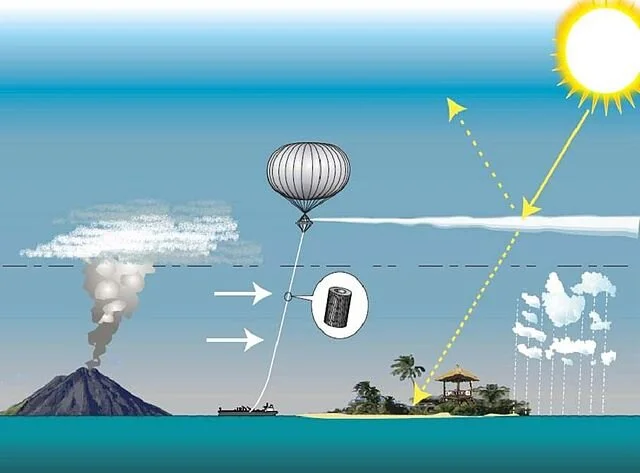
Proposed solar radiation management using a tethered balloon to inject sulfate aerosols into the stratosphere.
The next dinner speaker of the Providence Committee on Foreign Relations (thepcfr.org; pcfremail@gmail.com; 401-523-3957), on Wednesday, Feb. 5, will be the internationally known science journalist, book author and coastal-erosion expert Cornelia Dean. With reference to sea-level rise caused by global warming, she’ll talk about geo-engineering -- the use of engineering techniques to alter Earth’s climate.
Some geo-engineering strategies are (relatively) uncontroversial, such as removing CO2 from the atmosphere. And some are controversial, such as seeding iron-poor ocean areas with iron to encourage plankton growth, the consequences of which are unknown and potentially unpleasant.
And consider the techniques known collectively as Solar Radiation Management. They include deliberate cloud-thinning, seeding the atmosphere with aerosols to make the planet more reflective, stationing mirrors in stationary orbit between Earth and the Sun, etc.
Dean, a science writer and the former science editor of The New York Times, as well as a former deputy Washington Bureau chief of that paper, is well known for her knowledge of coastal-erosion issues as well as other scientific matters.
In her tenure running The Times’s science-news department, members of its staff won every major journalism prize as well as the Lasker Award for public service. She began her newspaper career at The Providence Journal. Her first book, Against the Tide: The Battle for America’s Beaches, was published in 1999 and was a New York Times Notable Book of the year. Her guide to researchers on communicating with the public, Am I Making Myself Clear?, was published in 2009. Her most recent (2017) book is Making Sense of Science: Separating Substance from Spin.
She has taught at Brown and Harvard and lectured in many other places, too
Please let us know if you're coming to the Feb 5. event by registering on our Web site, thepcfr.org, or emailing us at pcfremail@gmail.com. You may also call (401) 523-3957.
Joining the PCFR is simple and the dues very reasonable. Please check the organization’s Web site – thepcfr.org – email pcfremail@gmail.com and/or call (401) 523-3957 with any questions.
All dinners are held at the Hope Club, 6 Benevolent St., Providence. They begin with drinks at 6, dinner by about 6:40, the talk -- usually around 35-40 minutes – starts by dessert, followed by a Q&A. The evening, except for those who may want to repair to the Hope Club’s lovely bar for a nightcap, ends no later than 9 p.m.
xxx
And for the rest of the PCFR season, subject to the vagaries of weather, flu epidemics, cyberattacks and so on:
On March 18 comes Stephen Wellmeier, managing director of Poseidon Expeditions. He’ll talk about the future of adventure travel and especially about Antarctica, and its strange legal status.
xxx
News to come soon about an April 8 speaker, who will probably be an expert on the unrest in Hong Kong, and what it means for China and the world.
xxx
On Wednesday, April 29 comes Trita Parsi, founder and current president of the National Iranian American Council, author of Treacherous Alliance and A Single Roll of the Dice. He regularly writes articles and appears on TV to comment on foreign policy. He, of course, has a lot to say about U.S. Iranian relations.
xxx
On Wednesday, May 6, we’ll welcome Serenella Sferza, a political scientist and co-director of the program on Italy at MIT’s Center for International Studies, who will talk about the rise of right-wing populism and other developments in her native home of Italy.
She has taught at several U.S. and European universities, and published numerous articles on European politics. Serenella's an affiliate at the Harvard De Gunzburg Center for European Studies and holds the title of Cavaliere of the Ordine della Stella d'Italia conferred by decree of the President of the Republic for the preservation and promotion of national prestige abroad.
xxx
On Wednesday June 10, the speaker will be Dr. Elizabeth H. Prodromou, who directs the Initiative on Religion, Law, and Diplomacy, and is visiting associate professor of conflict resolution, at The Fletcher School of Law and Diplomacy at Tufts University. She titles her talk "God, Soft Power, and Geopolitics: Religion as a Tool for Conflict Prevention/Generation". She was originally scheduled for Dec. 5 but had to postpone because of illness.
A great sight

In South Hero, Vt.
“{New England villages} are one of the great sights of the Western World — red buildings to house the cattle, white ones to hold the spirit, and trees like the spirit itself abroad on the countryside.’’
— Jane Langton, in “New England Classic,’’ in New England: The Four Seasons (1980)