
Vox clamantis in deserto









Put big green power somewhere....?

From Robert Whitcomb’s “Digital Diary,’’ in GoLocal24.com
The continuing controversy over Central Maine Power’s plan for a $1 billion transmission line, much of it through the North Woods, from Quebec’s massive hydroelectric operations to Massachusetts customers bespeaks the usual sort of “don’t tax me, don’t tax thee, tax the man behind the tree’’.
In addition to some business and labor unions, a bunch of former state environmental officials and activists have lauded the project because it is “clean energy.’’ Other enviros, including the Sierra Club, not very convincingly complain that it would hurt the vast Maine forests. Actually, the environmental impact of this project, which, besides providing green energy, would also make New England less dependent on fluctuations in the global gas and oil market, and thus more economically secure, would be minor once it’s built though construction can be messy.
The Portland Press Herald reported: “Mainers for Clean Energy Jobs – which comprises individuals, businesses, labor unions and trade associations backing the proposal to link hydroelectric power generated in Canada with customers in Massachusetts – announced on Monday a statement of support from a group that includes former commissioners of the Maine Department of Conservation, two former executive directors of the Natural Resources Council of Maine and a former president of the Maine Audubon Society.’’
Dot Kelly is co-chair of the energy team of the Maine Chapter of the Sierra Club. She has alleged that regulators haven’t addressed alternatives to the project, but it’s been under discussion for months -- since New Hampshire rejected a somewhat similar project. (The Granite State route apparently raised more serious and complex scenic/aesthetic (the White Mountains), economic and social issues than apply in the Pine Tree State.) Ms. Kelly, in the Press Herald account, seemed to tout the idea of burying the entire line, but Central Maine Power asserts that would raise the cost of the project to $1.6 billion from $950 million.
So reduce fossil-fuel burning – somewhere….
To read more, please hit these links:
https://www.pressherald.com/2020/01/13/group-backing-cmp-power-line-wins-support-of-former-environmental-leaders/
https://energynews.us/2019/06/04/northeast/developer-says-burying-power-line-through-maine-woods-is-not-practical/
William Morgan: Big box bathos in Fall River

Closed BJ’s Wholesale Club in Fall River. Photos by William Morgan
As if the hard luck mill city of Fall River, Mass., did not suffer enough existential angst, the failure of a big box store, such as BJ’s Wholesale Club, off Quequechan Avenue and with its prominent “Store Closed” banner, serves as a constant reminder of struggle. The hunkered down sea gulls might as well be vultures. But turn your back on BJ’s carcass and there’s the largest box store of them all, Walmart.
The Bentonville, Ark.-based commercial behemoth, has sucked the life out of Main Streets all across America, and arguably spelled the doom of BJ’s. Bigger and cheaper (in both senses of the word) than a score of older Spindle City businesses that it supplanted, this particular box store is touted as a Walmart Super Center. Fall River has some of the largest and emptiest parking lots around, reminders of the vain hope that massive shopping centers would save this once heroic economic powerhouse. These asphalt deserts are infertile ground indeed.

Looking toward Walmart Super Center in Fall River
Providence-based architectural historian, book author, essayist and photographer William Morgan was for many years the chairman of the Kentucky Historic Preservation Review Board.
Editor’s Note: Ironically, perhaps, Amazon has a big distribution center in Fall River. Amazon, of course, has ravaged many brick-and-mortar stores.
Tiffany Muller: The court ruling that sold our democracy

Via OtherWords.org
Ten years ago, in January 2010, the U.S. Supreme Court released its disastrous Citizens United decision. The court, either through remarkable naivete or sheer malevolence, essentially married the terrible idea that “money is speech” to the terrible idea that “corporations are people.”
The ruling put a for-sale sign on our democracy, opening up a flood of corporate, special interest, and even foreign money into our politics.
Through Citizens United and related decisions, the court made a bad situation worse. We saw the proliferation of super PACs, which can accept and spend unlimited amounts of money to influence elections, and the rise of dark money, which is undisclosed political spending that can come from any special interest, including foreign countries.
In the 10 years since the decision, there’s been $4.5 billion in political spending by outside interest groups, compared to $750 million spent in the 20 years prior to the case.
From 2000-2008, there were only 15 federal races where outside spending exceeded candidate spending. In the same amount of time following Citizens United, this occurred in 126 races. Now, almost half of all outside spending is dark money that has no or limited disclosure of its donors.
That money isn’t coming from the farmers suffering through Donald Trump’s trade war or the fast-food workers fighting for a living wage. It’s coming from the wealthiest donors, people often with very different priorities than the majority of Americans. In fact, a full one-fifth of all super PAC donations in the past 10 years have come from just 11 people.
This has led to an unresponsive and dysfunctional government. With so many politicians in the pockets of their big donors, it’s been even harder to make progress on issues like gun safety, health care costs, or climate change.
Not to mention, we’re left with the most corrupt president in American history, who’s embroiled in a series of scandals that threaten our prosperity, safety, and security.
To name just a few of these scandals: Trump urged a foreign country to investigate his political opponents. His lawyer’s “associates” funneled money into Trump’s super PAC through a sham corporation. The National Rifle Association spent tens of millions of dollars in unreported “dark” money to elect him while allegedly serving as a Russian asset.
Trump and his accomplices should be held accountable, through congressional impeachment, the judicial process, or both. But we also need meaningful anti-corruption reforms.
Thanks to a class of reformers elected in 2018, we’ve already begun that process. Last year, the House of Representatives passed the For the People Act (H.R. 1).
H.R. 1 would strengthen ethics rules and enforcement; reduce the influence of big money while empowering individual, small-dollar donors; and, along with a bill to restore the Voting Rights Act, protect every American’s right to vote. It also calls for a constitutional amendment to overturn Citizens United.
Sadly, this bill is being blocked by Senate Majority Leader Mitch McConnell in that body.
These reforms are all popular with the American people. We can unrig the system and restore that faith by fighting for these priorities, and by pressuring elected officials to act. Join groups like End Citizens United or Let America Vote to push back against our rigged system and put people ahead of corporate special interests.
Together, we can restore trust in government, prevent corruption, strengthen our national security, and ensure Washington truly works for the people.
Tiffany Muller is the president of End Citizens United. Follow her at @Tiffany_Muller. This op-ed was adapted from text in Inequality.org.
Mining for gold in 'nonprofit' universities

From Robert Whitcomb’s “Digital Diary,’’ in GoLocal24.com
Could an executive have been found who could have run Bryant University as well as its competent and charming but astronomically highly paid ($6.2 million in 2017) president, Ron Machtley, at half his compensation? Probably! But clearly Bryant’s board, composed mostly of rich people itself (who must, as the trustees, give or get lots of money for the school, or get off the board) has been besotted with this charming man. And paying the CEO, even of a “nonprofit,’’ ever more gargantuan amounts, reflects our winner-take-all (or a lot!) economy and the myth of the superman CEO.
And then there’s Bryant’s first lady, Kati Machtley, who was paid $85,581 for running the institution’s one-day Women’s Summit, which must mean it was a world-historical event!
Mr. Machtley was the nation’s highest paid college or university president in 2017, followed by John Bowen, Johnson & Wales’ now retired leader, at $5.3 million, that year. Generous place, Rhode Island, although students and low-paid adjunct professors might prefer that a few of those dollars had drifted down to them in the form of more financial aid and/or lower tuitions and higher pay.


Greg Gerritt: Cemeteries as refuges for wild animals

Coyotes are among the wildlife in Providence’s North Burial Ground that Greg Gerritt has photographed and videotaped.
— Photo by Greg Gerritt
From ecoRI News (ecori.org)
PROVIDENCE — I started hanging out in cemeteries when I was in graduate school, sort of a reasonable place for an anthropology major, but also a reasonable destination for someone who needs to be around trees. I returned to spending much time in cemeteries when I moved to Providence more than 20 years ago, walking in Swan Point Cemetery within four days of moving here.
I still walk in Swan Point at least weekly, the magnificence of the 170-year-old forest along the river matching any of the famous people buried there, and demonstrating greater diversity. But much more of my time is spent in the North Burial Ground, which is on my side of the hills and ridges that make up the spine of the East Side.
Shortly after I convened a delegation to visit the city’s Parks Department to unlock the walk-in gates of the North Burial Ground and let the community in, I found a thriving toad population breeding in a small wetland. The Fowler’s toad tadpoles were rather photogenic and within a couple of years I found myself in the middle of a long-term project to document the lives of the wild animals that live in the North Burial Ground.
The Moshassuckcritters YouTube Channel is a project of the Friends of the Moshassuck, the local watershed group. Eventually, this work became connected to other people working to bring notice to other aspects of the North Burial Ground, and we jointly founded the Friends of the North Burial Ground and Randall Park.
While this journey has been interesting, what I want to focus on here is the need for all of us to better understand cemeteries as critical ecological habitat for wild things and to recognize that as an important part of what cemeteries do in a community.
I think of it as cemeteries as refuges.. Even the tiniest of urban cemeteries have a few trees, some squirrels, small birds, insects, and who knows what else. But larger urban cemeteries, especially if they have trees and water, can support nearly everything that lives in the bioregion
Some of the extraordinary features of larger cemeteries are the easy digging soils — sometimes they smartly locate cemeteries in areas of easy digging and good drainage — which encourage all sorts of burrowing creatures; lack of street lighting, allowing darkness to reign at night; and lack of automobile traffic after dark, allowing all of the wild animals to move around much more safely at night. This is especially important for amphibians — one of the most endangered group of animals on the planet — as they mostly breed at night in places where breeders congregate from all over the area.
Many places where they have to cross roads to get to the breeding sites can become kill zones. Many a night I have watched Fowler’s toads and gray tree frogs safely hop across a cemetery road to get to the breeding pool and hop back to the surrounding hills after the frolic.
I also want to put in a plug for thinking about stormwater management in cemeteries — in a new way, more in keeping with cemeteries and refuges for both people and wild things. Standard stormwater management techniques want to whisk water away as soon as possible. But wildlife needs pools of water for drinking, breeding, and feeding, and open waters, moving or ponded, are critical habitat.
Cemeteries have less need to get rid of water fast, water providing a relaxing and calming vista for those visiting the deceased, and with few nighttime visitors, less of an urgency to remove any place mosquitos might breed, especially as this also provides habitat for mosquito predators, which will keep mosquito populations in check most years
I have looked around for partners to further the discussion and practice of cemeteries as refuges, but other than Friends of the North Burial Ground and Randall Park I have had found few enthusiasts. If this interests you, please contact me and hopefully we build the movement.
Providence resident Greg Gerritt won an Environmental Protection Agency Merit Award in 2012 for his work raising awareness about the importance of composting. He is the founder of Friends of the Moshassuck, and runs the blog Prosperity For RI. He can be reached at gerritt@mindspring.com.
Anna Almendrala/Phil Galewitz: 'Hotspotting' in health care not dead

A highly publicized approach to lowering health costs failed to pass rigorous study this month, but hospitals, insurers and government health programs don’t intend to give up on the idea.
The “hotspotting” model was pioneered in Camden, N.J.,c , in 2002 and inspired dozens of similar projects around the country, many financed by millions of dollars from the government and private foundations. The model focuses on people who face social barriers such as homelessness or drug addiction and use the hospital multiple times a year, typically for avoidable complications from chronic diseases. The participants work with doctors, social workers and nurses for individual help, seeking to prevent future hospital admission and extra expenses down the road.
A study in the New England Journal of Medicine, done by Massachusetts Institute of Technology researchers, published this month confirmed that repeat hospitalizations dropped for participants in the Camden program but the result was no better than the results from a group of patients who did not get the intensive care coordination.
A different study, released Jan. 22, showed that a similar, multibillion-dollar experiment in California yielded even more discouraging preliminary results: Participants were hospitalized at more than double the rate of patients who were not enrolled in the program.
State and federal policymakers were attracted to the hotspotting model because they saw it as a possible solution for this intractable reality: Just 5% of patients account for half of all health spending.
The disappointing results from Camden caused some angst among health officials working on the model from Oregon to North Carolina — even before the California study was released.
“The study should give everyone who is involved in hotspotting a chance to pause and really reflect on the programs that they are doing,” said Dr. Amit Shah, chief medical officer at CareOregon, a large Medicaid managed-care insurer that for a decade has targeted some of these high-cost patients.
But “to stop now would be foolish,” said Susan Cooper, chief integration officer for Regional One Health, a Memphis, Tenn., health system that launched a program in 2018 based on the Camden model. It is geared to patients who have the most emergency room and hospital visits because of unmet social needs such as hunger and housing.
Using nurses and social workers, the hospital pairs up these “super-utilizer” patients with community resources such as housing, transportation and meals as well as connecting them to primary care. From April 2018 through last month nearly 350 people have enrolled in the program and the hospital said it has saved more than $9 million than would have been expected to be spent on them by reducing ER visits and hospital admissions.
A Medicaid experiment similar to the Camden approach may also expand in the most populous state in the nation — at great cost and despite disappointing initial results.
As part of his 2020-21 state budget proposal, California Gov. Gavin Newsom wants to add $582.5 million to Medi-Cal, the state’s Medicaid program, to increase intensive, comprehensive care management to high-needs, high-risk patients, including homeless people and those getting out of jail or prison. If approved by the state legislature, the infusion would also fund services designed to decrease reliance on expensive hospital visits and emergency service transportation.
The move would expand the state’s $3 billion, five-year Medicaid experiment called “Whole Person Care,” which began in 2016 and provides participants with social and medical services, such as substance abuse treatment and recuperative care after hospital stays. In most cases, California is creating services for participants in addition to connecting people to existing programs.
Twenty-five counties, cities, health plans and hospitals currently participate, and nearly 150,000 patients have enrolled.
But a new report by researchers at the UCLA Center for Health Policy Research suggests that California’s experiment has resulted in more participant hospitalizations, despite offering comprehensive services.
The study found that, two years into the experiment, there was no significant change in emergency department visits for participants compared with a similar group of patients who were not part of the program. But hospitalizations went up for both groups, with participants getting admitted at more than twice the rate of the control group: 17.47 inpatient admissions per 1,000 enrollees, compared with 7.41 admissions per 1,000 for the control group.
Dana Durham, chief of the policy and medical monitoring branch of the state Department of Health Care Services, said that the data is preliminary and that she expects hospitalizations to drop the longer patients are in the program.
“There hasn’t been enough enrollment in the program to make this comparison one that we have confidence in yet,” she said.
Clemens Hong, director of the Whole Person Care pilot in Los Angeles, which has served more than 46,000 people and has a five-year budget of more than $1 billion, could not be reached for comment after the results were released Wednesday.
Prior to the release, Hong said it would take time to see positive results because the participant population is “much sicker than most people understand or realize.” He also said evaluations of these programs shouldn’t focus exclusively on hospitalizations, but should also consider outcomes such as how well they increase employment or reduce time spent living on the street.
“One of the key lessons is that it can’t just be medically focused,” Hong said about the results of the Camden study.
Camden Coalition officials agree. They say that, although their work was originally designed to help people find safety-net services, they learned that sometimes those resources were not available. The coalition now has expanded its outreach and set up more partnerships, including efforts to start a housing program.
Looking For ‘Hot Spots’
The Camden Coalition, which provided services for 194 people last year, was founded by Dr. Jeffrey Brenner, a family doctor, who was looking to improve health care in one of the poorest cities in the country.
Using medical billing data from hospitals in Camden, Brenner located “hot spots” that had larger numbers of high-cost patients — even down to the city block. These patients, he found, repeatedly showed up in emergency rooms and doctors’ offices. They often had physical health issues such as diabetes, asthma and other chronic illnesses that were compounded by psychological and social issues such as anxiety and homelessness.
Earlier studies of the initiative primarily measured how patients in the program used services before and then after being enrolled. By coordinating the medical care and social services these patients needed, Brenner and his group were able to cut down the number of rehospitalizations.
The New England Journal of Medicine study, published Jan. 9, confirmed that the program over six months reduced readmissions by nearly 40%. But a group of similar patients who did not get the interventions had a similar drop.
This type of randomized-control trial, the gold standard in clinical medicine, is rarely used in health policy studies, partly due to the cost.
Shah of CareOregon said the study results prove there is no single solution that will work in every community for every type of patient.
“There is no one magic bullet,” Shah said. “The study confirmed there is a population of super utilizers that will not go away” just through these community efforts alone. He stressed local, state and federal policy changes are needed to fix social and legal challenges that influence patients’ health.
Camden Coalition officials said the results were disappointing but noted they have made major changes to the hotspotting efforts since the study trial ended in 2017. This includes efforts to help participants find stable housing and legal services to break down barriers to Medicaid and other benefits.
“We have already made some pivots,” said the coalition’s CEO, Kathleen Noonan.
She said people should not take away from the study “that focusing on social determinants of health and all those efforts are moot.” The study showed some positive benefits, including how participants were more likely to obtain food stamp benefits compared with those in the control group.
“To paraphrase Mark Twain, reports of the death of the hotspotting model are greatly exaggerated,” said Rutgers University professor Joel Cantor, director of the Center for State Health Policy, before the California results dropped. Cantor has worked closely with the coalition. “This is a single study, focusing mainly on one of many possible outcomes, in a single location.”
Brenner, who won a MacArthur Foundation fellowship — known as a “genius” grant — in 2013, said hotspotting efforts need to keep evolving
“There are glimmers of things that work, and we need to keep at this. It is a solvable problem,” said Brenner.
When he first started the coalition, Brenner said, he hoped just helping people navigate the health system would improve their health and lower costs. But that approach faced shortcomings when services such as addiction treatment and housing assistance were lacking.
“It’s not as simple as just navigating and coordinating,” he said.
Anna Almendrala and Phil Galewitz are Kaiser Health News journalists.
Anna Almendrala: aalmendrala@kff.org, @annaalmendrala
Phil Galewitz: pgalewitz@kff.org, @philgalewitz
Rocky, dark and deep

“Woods in Maine” (watercolor on paper), by John Singer Sargent. (1856-1925), in the “Winter Show,’’ at Adelson Galleries, Boston, through Feb. 2
Llewellyn King: Energy group head reinvents foreign aid
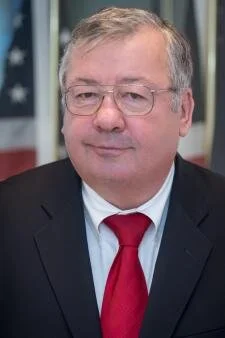
Barry Worthington
He is an unlikely person to have reinvented foreign aid. But, in his way, that is what Barry Worthington has done. He is the executive director of the U.S. Energy Association, and he has brought hope to troubled energy companies around the globe, first in Eastern Europe and now in Africa, South Asia and Latin America.
Thirty-one years ago, when Worthington came to Washington to assume the role of USEA executive director, he was young and had not traveled widely. Now he is perhaps the most traveled man I know. A member of his staff says, “He is the globe-trottingest.”
Worthington makes at least 30 trips a year — most are overseas. He has been known to fly to a distant capital, say Beijing, hold a meeting and fly back the same day.
But Washington’s influence and globalism were not on the horizon when Worthington, his bride, Louise, and young son Barry, now an award-winning filmmaker, (daughter Kelly was yet to arrive) first moved to Washington
This most-American of men, educated at Penn State and the University of Houston, looked for a career in the electric utility industry, where he was hired as a junior executive by Houston Lighting and Power. He had embarked on a quintessentially American career.
Then he was offered a job at the nonprofit Thomas and Alva Edison Foundation. “I took it because it was twice the pay and we were young and broke,” he told me.
The foundation was foundering, and he accepted an offer to head USEA. It was not, on the face of it, an auspicious move.
USEA, the U.S. branch of the World Energy Council, was in dire straits itself. It had made good money on the World Energy Conference, held in Detroit in 1974. But USEA, supported by a modest dues structure, was headed for oblivion when that conference money was exhausted. In fact, the association was down to Worthington and a secretary.
“It had expenses of $250,000 and revenues of $200,000,” Worthington told me over lunch at the National Press Club in Washington. Last year its revenues were $9.4 million, and membership dues account for only 3 percent. “It was our best year yet,” he said.
USEA does not lobby and supports all fuels as an information source and a clearinghouse, and a place where diverse energy interests meet. It runs five major conferences a year and 40 informational briefings.
Worthington looked for new revenue sources, and the unlikely saviour he found was the U.S. Agency for International Development.
When the Soviet Union collapsed, the United States wanted to help the former Soviet satellites. But the usual aid, handed out for bridges and roads, did not fit the situation. Expertise was required, very specialized expertise, and Worthington’s members had it, particularly in the electric field.=
The ticket, the Worthington solution, was to pair American utilities with Eastern European ones and show them “best practices.” The first challenge Worthington said was to get them off power at 48.6 cycles and to boost their output to the European standard.
“Frankly, it was an ethnicity play,” Worthington said.
He explained that he was able to find U.S. companies who had engineers who were either from the Eastern European countries or were first-generation Americans. Houston Lighting and Power, for example, had not one but two émigré senior engineers from Czechoslovakia, now the Czech Republic.
The cost to the U.S. companies is minor and the sense of helping and being part of history is major. USEA costs — management and out-of-pocket — are borne by USAID. To the agency that is a pittance to pay for an incontrovertible success.
These partnerships have been an eye-opener to all involved in foreign aid and the idea is spreading. Latest to seek help from Worthington and his 25-person team is the U.S. Department of Energy, realizing it is better to give away skill than money. Skill sticks, money evaporates. The proof of that is the Worthington formula, still spreading useful skills in everything from dispatching electricity to designing rates.
In a town of strivers, Worthington plays in a mellow tone. He dresses modestly, makes conversational speeches and, in my experience, ruffles no one. An unpretentious man who wanted to work in an electric company has left his footprint on the world — USEA has executed more than 80 partnerships.
On Twitter: @llewellynking2
Llewellyn King is executive producer and host of White House Chronicle. on PBS.
Read this column on:
InsideSources
Ferocious in fiber

“Dream Team: Forrest Bess, Cave Painter, and Hieronymous Bosch’’ (textile), by Caroline Wells Chandler, at Wheaton College’s Beard and Weil Galleries, Norton, Mass., Jan. 30-March 28.
This show features the unique textile work of seven contemporary artists, Caroline Wells Chandler, Pilar Sans Coover, Gabrielle Ferreira, Sean Paul Gallegos, Sarah E. Jenkins, Saberah Malik and Sarah Zapata.

An iconic show

From Christine Palamidessi’s show “Icons & Talismans,’’ art inspired by the Byzantine frescoes of Puglia, Italy, at Galatea Fine Art, Boston, Feb. 5-March 1

Jill Richardson: 'Little Women' and the American attitude toward poverty

Louisa May Alcott’s grave in Sleepy Hollow Cemetery, in Concord, Mass., near the graves of Ralph Waldo Emerson, Nathaniel Hawthorne and Henry David Thoreau, on a hillside now known as "Authors' Ridge’’. Concord was a famous literary center in the 19th Century.
Via OtherWords.org
With Greta Gerwig’s new movie take on Louisa May Alcott’s classic 19th Century novel, Little Women, in theaters, I decided to reread the book.
The novel, set in Concord, Mass., communicates Alcott’s (1832-1888) beliefs about proper morality and gender roles through stories of a family of four sisters, Meg, Jo, Beth, and Amy March, touting the American virtues of hard work, frugality, self-reliance, and charity.
The March family once had wealth, but they no longer do. Their father is serving in the Civil War, so they try to make do with what they have, even going without Christmas gifts.
When any of the sisters are overtaken by vanity or greed for finer things than they can afford, they learn their lessons. Love and hard work are enough to sustain a family, the story goes, and more important for one’s happiness than money.
What intrigues me is the double standard Alcott — and Americans — have for charity. Helping others is portrayed as virtuous. Receiving help, on the other hand, is not.
That poses quite a dilemma: How can any of us practice charity while others practice refusing it?
Alcott’s answer seems to be that only the “truly” destitute may accept help. In the book, the March sisters often help a family even poorer than they are. While the March sisters can stretch what they have to make due, the other family is starving.
This is more or less how means-tested government programs work today. To qualify for the Supplement Nutrition Assistance Program, better known as Food Stamps, in 2019, a family of four could earn no more than $33,475 — a pitiful sum — and could only have a small amount of assets in savings.
When others want to help the March sisters, Alcott does not always approve. She’s comfortable with them receiving help from a wealthy aunt, but usually not from anyone outside the family. After one of the sisters, Amy, marries well, her husband disguises his charity to his sister-in-law Jo, so she doesn’t recognize it as such.
Again, giving is noble, but receiving is not.
This ties into Max Weber’s The Protestant Ethic and the Spirit of Capitalism, which describes a value system in which financial success is considered a mark of moral goodness. If one is rich, that shows they worked hard and practiced virtue. The flipside, by that logic, is the poor are lazy and morally suspect.
For the past four decades in American politics, that’s how our leaders have treated the poor, as well. We’ve altered social-safety-net programs such as Bitwelfare to add often impossible, bureaucratically burdensome work requirements, or even drug testing. Recipients are suspected of wanting free handouts without having to work for them.
Studies of welfare recipients, like Jane Collins and Victoria Mayer’s book Both Hands Tied, shows that the working poor are anything but lazy. They are hard-working people trapped in an impossible situation. When drug tested, welfare recipients use drugs at lower rates than the general population.
Pulling yourself up by your own bootstraps is impossible, but rising out of poverty with a helping hand — or being prevented from falling into it with a safety net — isn’t. That should go for the Marches of the world as well as the “truly destitute.”
We’ve advanced beyond the 19th Century gender roles portrayed in Little Women, so that women have career options beyond marriage. So let’s also get past the 19th Century moralizing that ignores the structural factors that prevent class mobility for those who have done nothing wrong besides being born to poor parents.
OtherWords columnist Jill Richardson is a sociologist.

The Wayside, in Concord, home in turn to Louisa May Alcott, Nathaniel Hawthorne and Margaret Sidney

Central Concord in the 1840s

Big public projects

From Robert Whitcomb’s “Digital Diary,’’ in GoLocal24.com
Publicly funded projects such as that in and around the Worcester Red Sox’s pending Polar Park Stadium, involving a taxpayer commitment of $132 million, up $9.4 million from the previous estimate, tend to create metastasizing tax breaks. Consider that Worcester City Manager Edward Augustus now wants additional tax breaks for private developers in the WooSox district, in this latest case for a 15-year tax break for a building near the ballpark’s left field and for a residential building, and a 10-year tax break for an office, labs and retail complex.
Maybe these projects will indirectly create long-term tax-revenue streams for the city in the form of more economic development and new property-tax revenue nearby -- and maybe not. Depends a lot on how the economic cycle goes in this new decade. In any case, taxpayers should remember that the taxes the developers aren’t paying other taxpayers will have to offset.
All this is part of the vision for a total of $125 million in private development next to Polar Park.
Stadium-construction projects usually turn out well for rich team owners and associated developers, but generally not – at least economically -- for the general taxpaying public. That isn’t to say that having a baseball team in town won’t make plenty of people feel better, at least for a while, especially if the team wins more than it loses and spawns stars that head for the Major Leagues.]
For more information, please hit these links:
https://www.wbjournal.com/article/worcester-seeking-more-tax-breaks-for-woosox-related-development
https://www.golocalprov.com/news/leading-stadium-expert-blasts-worcester-for-polar-park-cost-overruns
xxx

Field house and pump station built by the New Deal’s Works Progress Administration in Scituate, Mass., in 1938
But public projects can be immensely useful and profitable for the general public. Consider the bridges, roads, tunnels schools, post offices, parks, etc., built in the New Deal – a lot of them still serving the public. They were, in general, very well built. But America’s public infrastructure has been falling apart for decades, damaging our quality of life and making America less economically competitive. When he was running for president, Trump promised to start rebuilding our infrastructure. Instead, he pushed for big tax cuts for the rich.
A presidential candidate who can credibly promise to lead that rebuilding, with many well-paying jobs included, would have a very strong issue in this year’s election.

Tim Faulkner: Future of offshore wind hangs on agency's report

Progression of expected wind turbine evolution to deeper water
From ecoRI News
The forthcoming report from the federal Bureau of Ocean Energy Management (BOEM) on the cumulative environmental impacts of the Vineyard Wind project will determine the future of offshore wind development.
BOEM’s decision isn’t just the remaining hurdle for the 800-megawatt project, but also the gateway for 6 gigawatts of offshore wind facilities planned between the Gulf of Maine and Virginia. Another 19 gigawatts of Rhode Island offshore wind-energy goals are expected to bring about more projects and tens of billions of dollars in local manufacturing and port development.
Some wind-energy advocates have criticized BOEM’s 11th-hour call for the supplemental analysis as politically motivated and excessive.
Safe boat navigation and loss of fishing grounds are the main concerns among commercial fishermen, who have been the most vocal opponents of the 84-turbine Vineyard Wind project and other planned wind facilities off the coast of southern New England.
Last month, Rhode Island state Sen. Susan Sosnowski, D-New Shoreham and South Kingstown, gave assurances that the Coast Guard will not be deterred from conducting search and rescue efforts around offshore wind facilities, as some fishermen have feared.
“The Coast Guard’s response will be a great relief to Rhode Island’s commercial fishermen,” Sosnowski is quoted in a recent story in The Independent. “We have many concerns regarding navigational safety near wind farms, and that was the biggest.”
The anticipated release of the BOEM report coincides with President Trump’s efforts to weaken environmental impact reviews for all energy proposals, including wind, coal, and natural gas. National Environmental Policy Act (NEPA) reviews have slowed pipeline projects such as Keystone XL and, as of last summer, Vineyard Wind. Both industries praised the move to loosen environmental rules. Environmentalists, meanwhile, fear that the removal of terms such as “cumulative,” "direct," and "indirect" from NEPA’s directives will nullify future federal efforts to address the climate crisis.
Once the expanded environmental impact statement is released, BOEM will offer a comment period and hold public hearings
Stephens leaves Vineyard Wind
Barrington native and Providence resident Erich Stephens resigned at the end of 2019 from Vineyard Wind, a company he helped found in 2009 and is now co-owned by Avangrid and Copenhagen Infrastructure Partners. The original wind company was called Offshore MW. Prior to Vineyard Wind, Stephens was head of development for Bluewater Wind, one of the first U.S. offshore wind companies.
Stephens has considerable roots in Rhode Island. He attended Barrington High School and received his undergraduate degree from Brown University. He was founder and executive director of People’s Power & Light, now called the Green Energy Consumers Alliance. He was also a founding partner of Solar Wrights, a residential solar company that was based in Barrington and moved to Bristol. The company was later acquired by Alteris Renewables. Stephens also worked for two of Rhode Island’s first oyster farms.
More megawatts
New York plans to add 1,000 megawatts of offshore wind power to the 1,700 megawatts it awarded last summer to offshore wind projects that will deliver electricity to Long Island and New York City.
The state also announced it’s taking bids for $200 million in port development projects that will support the offshore wind industry.
The recent notifications are part of the state’s Green New Deal, which aims for 9 gigawatts of offshore wind by 2035 and 20 large solar arrays, battery-storage facilities, and onshore wind turbines in upstate New York. The state aims for 100 percent renewable energy by 2040.
The latest offshore wind projects consist of the 880-megawatt Sunrise Wind facility, developed by Ørsted and Eversource Energy, to power Manhattan. Long Island will receive up to 816 megawatts from the Empire Wind facility, developed by Equinor of Norway.
Pricing for the projects hasn’t been made public.
Offshore leader
Based in Denmark, Ørsted is the early leader in the size and number of U.S. offshore wind projects. Ørsted was awarded the 400-megawatt Revolution Wind project for Rhode Island. It’s also developing the 1,100-megawatt Ocean Wind facility in New Jersey, a demonstrations project in Virginia, and projects in Connecticut, Delaware, Massachusetts, and Maryland. The company acquired Providence-based Deepwater Wind in 2018 for $510 million.
Ocean Wind, New Jersey’s first offshore wind project, and the 120-megawatt Skipjack Wind Farm off Maryland will use General Electric’s huge 12-megawatt Haliade-X turbines. The 853-foot-high turbines are the tallest in production and have twice the capacity of the 6-megawatt GE turbines now spinning off Block Island, which are 600 feet tall.
Tim Faulkner is a journalist with ecoRI News.
"A father and son's journey in paint'
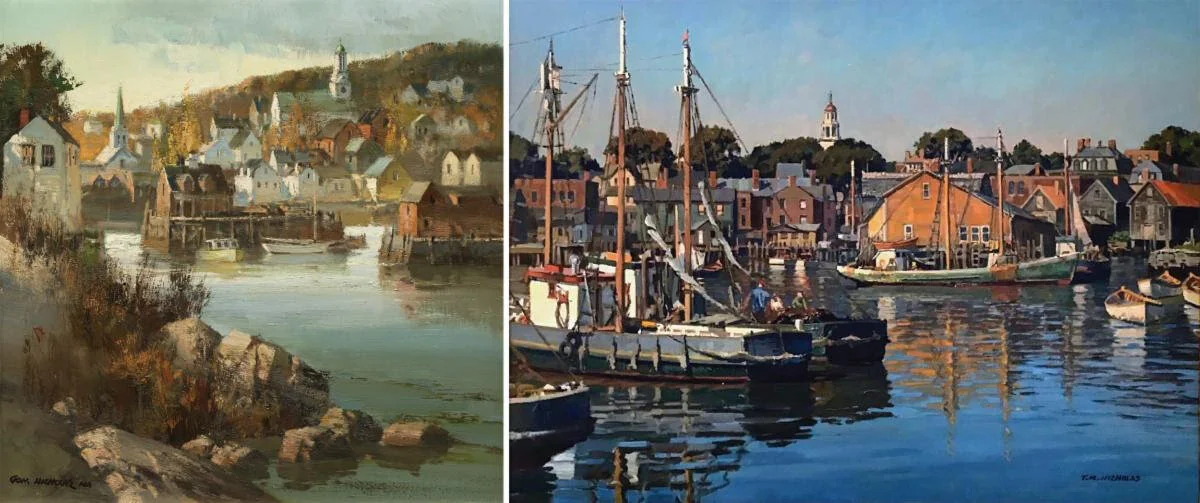
(left) Tom Nicholas, “Late Autumn, Rockport Harbor’’’ (oil on canvas, private collection), by Tom Nicholas); right, “Old Harbor, Gloucester’’ (oil on canvas; private collection), by T.M. Nicholas, in the show “Tom and T.M. Nicholas: A Father and Son’s Journey in Paint,’’ through April 12 at the Cape Ann Museum, Gloucester.
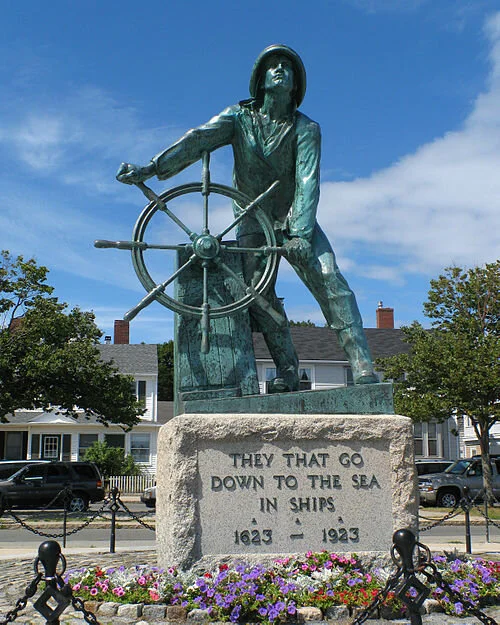
“Man at the Wheel,’’ Fisherman's Memorial Cenotaph, in Gloucester, a major fishing port for hundreds of years
Gritty, cold and caffeinated
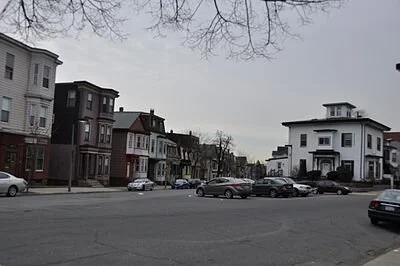
In East Boston
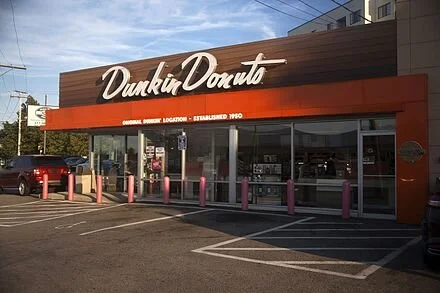
“I guess no true Bostonian would trust a place that was sunny and pleasant all the time. But a gritty, perpetually cold and gloomy neighborhood? Throw in a couple of Dunkin’ Donuts locations, and I’m right at home.”
― Rick Riordan, in The Sword of Summer
James T. Brett: 3 programs good for New England growth

From The New England Council (newenglandcouncil.com)
As 2019 drew to a close, so too did the first half of the 116th Congress. And as is often the case at year’s end, our leaders in Washington, D.C.,. ended the year with a flurry of activity. In its final week on Capitol Hill, Congress passed a $1.4-billion spending bill to fund the government through September. Included in that bill were several top priority measures for The New England Council: boosting retirement savings, re-authorizing the terrorism-risk-insurance program, and renewing the charter of the Export-Import Bank of the United States.
Now with our national leaders back in Washington, D.C., the expectation is – like in all presidential election years – it will not be a very productive year. However, Congress could take several actions to support continued economic growth in our region:
1. Invest in infrastructure. Nearly 1,600 bridges are in “poor” condition across New England, roughly 9 percent. Last year, Washington could not reach agreement on an infrastructure package even as such investments are critically needed. This fall, a renewal of the 2015 FAST Act – America’s surface transportation law – must occur. A key Senate Committee last July approved a $287-billion replacement. Perhaps Congress can aim higher and address our region’s additional infrastructure requirements as well.
2. Promote investment in renewable energy. New England has become a leader in the development and deployment of offshore wind energy. Our region is home to the nation’s first offshore wind farm and more are in development, helping reduce our carbon footprint while creating hundreds of jobs. This tremendous growth is due in part to tax credits for the development and production offshore wind, which have unfortunately expired. Several proposals have been introduced to reinstate and extend these credits, with support from members of the New England delegation. Congress needs to extend these important incentives.
3. Ensure banking for the cannabis industry. In New England, marijuana has been legalized for medical and/or recreational use in all six states. However, because marijuana is illegal under federal law, legitimate cannabis enterprises cannot bank at any federally insured financial institution, and are forced to operate as cash businesses, at risk for theft and fraud. Fortunately, last year, the House passed the SAFE Banking Act, which would establish protections for banks to provide financial services to legal cannabis businesses. The Senate should follow suit and pass this bill.
The good news is all three of these items enjoy strong support from the New England Congressional delegation and strong bipartisan support nationally. Action on these items would no doubt result in job creation and economic growth here in New England and would show that Congress can indeed act in a bipartisan manner to advance policies benefiting the nation.
James T. Brett is president and CEO of The New England Council, an alliance of businesses and nonprofits dedicated to economic growth in the region.
Taking flight in Duxbury

“Flight ‘‘ (mixed media/printmaking), by Mandy Fariello, in the Duxbury (Mass.) Art Association’s annual “Winter Juried Show’’ in February at the Art Complex Museum, in Duxbury

View of Bluefish River inlet, in Duxbury with King Caesar House in background. Duxbury is both an upscale Boston suburb and a place with many summer homes.

The John Alden House, built in 1653
Chris Powell: Ways to help keep ex-cons out of jail

Now that the majority in the Connecticut General Assembly is more Democratic and liberal, the legislature is paying more attention to the plight of prisoners and former offenders. While the attention is welcome, it has been entirely of the bleeding-heart variety, not very thoughtful -- leading only toward a policy of erasing or concealing criminal records, since those records are impediments to former offenders as they return to society.
Of course,
there is a strong public interest in reintegrating former offenders. Society needs them to be productive and self-supporting so they don't return to crime or kill themselves in despair. But the public interest in access to criminal records is just as strong. For how can any potential employee, tenant, borrower, or romantic partner be evaluated when government aims to keep the public ignorant?
Besides, erasing or concealing criminal records won't be as helpful to former offenders as some legislators think. Any conscientious employer, landlord, or lender will notice crime-caused gaps in a former offender's employment history, and any self-respecting person will want to know a date's background before they go home together.
So former offenders should always have some explaining to do. But some state legislators and the legislature's recently created study group, the Council on the Collateral Consequences of a Criminal Conviction, seem to think otherwise.
Members of the council recently visited the state prison in Somers to research what are said to be the scores of state laws that make life harder for former offenders. According to a Connecticut Mirror report, council members interviewed 25 prisoners who will be released soon, and some prisoners said they already know they will have trouble getting jobs and housing because they have been in and out of prison before.
Legislators and council members call this "discrimination" as if discrimination is always irrational and bigoted. But "discrimination" really isn't a dirty word. It is a necessity of life. It is the recognition of differences, like the difference between good and bad, safe and unsafe, skilled and unskilled, and reliable and unreliable.
Former offenders will always be competing for jobs, housing, and romantic partners with people who have no criminal records. It cannot be otherwise. For why should people who have lived within the law not have an advantage over those who have broken the law? If there is no advantage in obeying the law, the law is pointless.
Besides, legislators pursuing erasure or concealment of criminal records don't seem to realize that society has only as much crime as it legislates, nor that much criminality arises from victimless crime -- particularly drug criminalization -- as well as from the negligent parenting facilitated by welfare policy and from public education's practice of social promotion, which produces many young adults without job and life skills. Elected officials will benefit from erasure or concealment of criminal records because it will conceal their responsibility for the awful results of government's mistaken policies.
Will state government ever care enough about former offenders to indemnify their employers, landlords and romantic partners? Of course not. But state government easily enough could give former offenders rudimentary paid jobs, medical insurance, and housing to help settle them in their first year or two out of prison.
Indeed, offenders should get much more job training in prison and it might be good at sentencing in court to condition their release on their showing they have the skills needed to make an honest living.
Chris Powell is a columnist for the Journal Inquirer, in Manchester, Conn.