
Vox clamantis in deserto





David R. Evans: How is Bulgaria like New England?

Graduating seniors at the American University in Bulgaria
From The New England Journal of Higher Education, a service of The New England Board of Higher Education (nebhe.org)
This question in the headline above probably seems like a lead-in for a funny non-sequitur, but bear with me for a moment.
The American University in Bulgaria (AUBG), in Blagoevgrad, where I currently serve as interim president, was founded in 1991, soon after the fall of communism in Eastern Europe, originally as a branch campus of the University of Maine. Like several other international institutions, AUBG is accredited by the New England Commission of Higher Education, so we’re at least an honorary New England institution. This strategy streamlined initial accreditation and provided us with a base of institutional resources to start from scratch in a country that had no tradition of American-style undergraduate education. We have long since become completely independent, but our roots in New England remain fundamental to our institutional identity.
Our mission was, and remains, to promote democratic values and open inquiry and to provide opportunities for students to experience the freeing—liberating—benefits of the liberal arts. We strive to create engaged, effective citizens, critical thinkers and excellent communicators empowered by their education to take an active role in their professions and communities and always work to make the world better.
In this respect, AUBG embodies a modern version of the ethos that founded so many colleges in New England and spread across the U.S. in the 18th and 19th centuries. While unlike many such institutions, we have no history as a training ground for the clergy, the parallels remain clear: Our founders envisioned a better world and hoped, through establishing this institution, to play a definitive role in bringing that better world into being. In a country where, for nearly a half-century prior to our founding, the absolute last thing the communist government wanted was engaged, empowered democratic citizens who had learned and been encouraged to question and critique everything, our project and mission to bring the outcomes of a good liberal arts education to Bulgaria have been genuinely revolutionary.
AUBG also shares with many small New England colleges some significant challenges. Most importantly, Bulgaria, like many parts of New England, is in a serious demographic crisis. Bulgaria is a small country with a population of just under seven million people. Its population peaked at nearly nine million in about 1985, and has been declining ever since. Moreover, its fertility rate has been below replacement since about 1985 and is now at only 1.6 live births per woman, while the replacement rate is about 2.1. Because AUBG, like most private colleges, is significantly dependent on tuition revenue, and because our primary market is Bulgaria, the steady decline in our national population is something to take very seriously. We are, in short, deep into the worst nightmares that Nathan Grawe has recently articulated in his indispensable book, Demographics and Demand for Higher Education
Unlike institutions in the U.S., we face another specific enrollment challenge. When AUBG was founded, Bulgaria was not a member of the European Union, and the university quickly became an—if not the—institution of choice for Bulgarian young people seeking a top-quality education conducted in English. However, since Bulgaria joined the E.U. in 2007, such young people have a range of options throughout Europe at very favorable prices and have chosen particularly to pursue higher education in the United Kingdom and the Netherlands. Because of generous public support for higher education in the E.U., there are some parallels with the challenges the “free public college” movement poses to private institutions in the U.S., but the complexities of language and culture further complicate these situations.
In Bulgaria and most of our primary markets extending throughout Eastern Europe, we face another issue in that we proudly promote American-style liberal arts undergraduate education (though honestly more in philosophy and educational practice than in our majors, which are highly weighted toward careers in our service region in business, IT, journalism and communications, and politics).
Where in the U.S., comparable institutions face increasing skepticism about the “liberal arts” in general, in our area, the question is more about what a liberal arts education actually is, and how it differs and adds value to the undergraduate experience. The public universities of Bulgaria, of which there are many, tend to follow the European model of institutional specialization, with strong specific emphases rather than a deep investment in broad liberal education. (The technocratic and often applied focus of many of these universities is also surely a relic of communist practices as well.) In that context, as sadly often in the U.S. as well, our stress on general education is often seen as alien and unhelpful, a useless distraction from the actual business at hand. In many cases, our programs require an additional year to accommodate our curriculum’s required breadth, as we follow the traditional American four-year bachelor’s model, and this added time requires a real commitment on the part of our students and their families.
I bring a very particular, painful experience to my work here, because I was the president of the private Southern Vermont College when it closed last spring as a result of declining enrollment and the associated financial stress. I have seen first-hand the challenges that face private colleges in a highly competitive market, with a product not fully understood or appreciated by its clientele, and presenting a value proposition that is not always evident to the people who most need to embrace it. There, our mission was to provide a strong, broad education to a student body comprising mostly first-generation students and students from diverse and high-need backgrounds. Over time, and exacerbated by the broad declines in high school graduates across our region, it became increasingly difficult to manage institutional finances to support affordable access for them and thus to convince them to invest in our institution despite our evident success in supporting students to graduation and successful careers.
At recent professional meetings back in the U.S., in conversations with colleagues, I have been struck by how comparable, if not similar, our challenges are. Like many colleagues, I take strength from the power and importance of AUBG’s mission and from the tremendous success of our alumni, and work constantly to ensure that this mission can endure in the context of unprecedented challenges to a basic model that has, as New Englanders know, developed and supported exceptional leaders for over three centuries.
David R. Evans is interim president of the American University in Bulgaria.
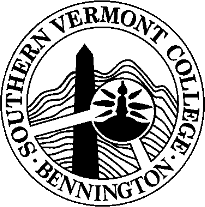
RIP: Seal of Southern Vermont College, in Bennington, 1926-2019
Finally, some loyalty!

“Waiting for My Master” (encaustic, toner transfer), by Heather Douglas, who has a home in tiny Cornwall, Vt., in the Champlain Valley. She’s a member of New England Wax.

The Champlain Valley
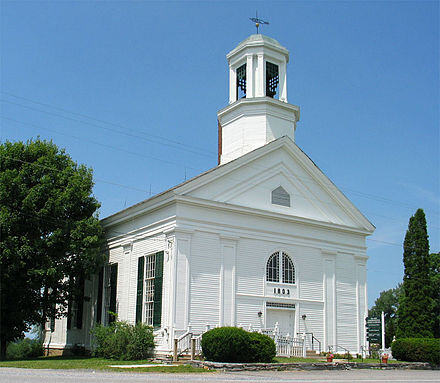
Classic New England: The Cornwall Congregational Church
Ah, those rankings!

“Paradise,’’ by Jan Bruegel
From Robert Whitcomb’s “Digital Diary,’’ in GoLocal24.com
WalletHub’s rankings of the “best’’ and “worst’’ states in which to retire put Rhode Island as third worst, with Kentucky the worst and New Mexico second worst, and the three “best” as Florida, New Hampshire and Colorado. (So the rankings can’t be said to be biased for warm states.) Massachusetts was put at 14th best and Connecticut at 33rd.
Such lists are fun but even the choice of metrics for establishing rankings is itself subjective. To paraphrase Tolstoy, each individual and each family is happy or unhappy in its own way.
“John Tworog,’’ in the comments section below GoLocal’s article on the rankings, had some interesting observations:
“Balderdash! Quality of life like beauty is in the eye of the beholder! RI can compete with any state in that category! RI has a four season moderate climate. It is poised to get better with global warming. It's not too cold unlike the northern states and not too hot unlike the southern states. The thing is RI is a small state. But that is just lines on a map. We are really residents of the state of Southern New England. Boston is a lot closer to us than residents in other states are to their big cities. Apples and oranges!’’
--But from “Jane Blythe’’:
“Those are the reasons I had to leave R.I. --- it could be THE best state, but because of corruption and other factors, it has sunk so low. Just could be the ideal place, in so many ways --- its small size, its friendliness, its sense of pride, the proximity to Boston --- but the leaders have ruined it. Sad....’
Of course, hating the state’s leaders (a common emotion soon after they’re elected) doesn’t address the flaws of those responsible for electing them, either through voting or failing to vote – the oh-so-put-upon citizenry.
As usual, the majority of comments on such articles are negative, with the traditional denunciations of the state for its taxes, history of corruption and other pathologies, real or imagined. I think that a lot of this negativity can be explained by the Ocean State’s history of class and ethnic animosity and how its intimacy has fueled too many insider deals. “I know a guy,’’ etc. – not that other states are unfamiliar with such things….
The names of many complainants after such stories are familiar, which reminds me that many Rhode Islanders who constantly complain about the place could easily afford to move but stay put. It’s as if they fear losing the satisfaction and indeed pleasure from complaining about the tight little place while they’re in it. The thrill would be gone if they lived year round in, say, the bland land of palmetto-shaded strip malls and gated communities (albeit with energetic alligators in the golf course water hazards).
Anyway, these are the sort of typical remarks:
-- From “Justice ONeil:” (identified on Facebook as a dog!)
“Only surprise there is it's not #50”
-- From “Scott J. Grzych’’
“The good news is that the taxes are so high, I'll never be able to retire.’’
Ah, those rankings! Forbes ranks Rhode Island 20th for “quality of life,’’ whatever that may mean.
To read the WalletHub rankings, please hit this link.
To read the GoLocal article on the report, please hit this link.\
Maybe the Ocean State would have better politics and government if more Rhode Islanders showed less fatalism and bestirred themselves to vote, or even run for office. Consider that the United States Elections Project ranked Rhode Island as having the worst voter turnout in New England in the 2016 election, at 59.7 percent. Massachusetts was at 68.3 percent; Connecticut at 64.9 percent; Vermont at 64.8 percent; New Hampshire at 72.5 percent, and Maine at 72.9 percent.
Hit this link to see United States Elections Project site.

Basav Sen: Americans overwhelmingly want to get off fossil fuels

From OtherWords.org
Late last year, The Washington Post reported a remarkable poll finding: Nearly half of American adults — 46 percent — believe the U.S. needs to “drastically reduce” fossil fuel use in the near future to address the climate crisis. Another 41 percent favor a more gradual reduction.
In short, almost 90 percent of us support transitioning off fossil fuels — including over half of Republicans, whose elected officials overwhelmingly support the industry.
This is remarkable. The U.S. is the world’s largest oil and gas producer, third largest coal producer, and the only country to leave the universally adopted Paris Climate Agreement. Yet nearly all of us want off these fuels.
You’d expect a media outlet to treat this as the immensely newsworthy (and headline-worthy) finding that it is — especially if that outlet commissioned the poll!
Yet The Washington Post buried these numbers in the 14th and 15th paragraphs of the story. Their headline? “Americans like Green New Deal’s goals, but they reject paying trillions to reach them.”
This assertion, while not outright false, is misleading.
The poll had a single vaguely worded question about the price tag for a national climate action plan, which asked whether respondents supported raising federal spending by unspecified “trillions.” Two-thirds of respondents said no.
Pollsters gave respondents no specifics on the amount of “trillions” we’re talking about, or how they would compare to the overall federal budget, huge existing line items like the military and fossil fuel subsidies, or the country’s GDP.
The poll didn’t ask respondents whether they would support such a spending increase if it were paid for entirely by revenue increases. But actually, they might.
The same poll found that more than two-thirds of Americans — 68 percent — support raising taxes on the wealthy to pay for climate action. Another 60 percent support raising taxes on fossil-fuel-burning companies “even if that may lead to increased electricity and transportation prices.
The Post ignored both findings entirely in the article. A more accurate portrayal of the poll results might say that U.S. adults support paying for climate action by raising taxes on corporations and the wealthy, but they don’t want to raise taxes for working people (for example, by raising gas taxes).
Why did the Post bury some of the most significant findings of their own poll? I won’t speculate too much — that’s for them to answer. But in establishment media, political biases that equate government spending with waste — while evading or ignoring issues of tax fairness — run deep.
A more objective — and hopeful — reading might emphasize that the vast majority of Americans support phasing out fossil fuels. Large majorities also support reaching 100 percent renewable electricity in 10 years (69 percent support) and a jobs guarantee with good wages for all workers (78 percent support).
Finally, two-thirds of respondents support increased spending on climate resilience for communities who are vulnerable to disasters. Two-thirds also support a government program for universal health care.
Polls aren’t always trustworthy. But as a snapshot, this one shows large majorities of Americans wanting serious governmental action on climate change that incorporates social justice and workers’ rights, paid for by progressive taxation. They also want more regulation of corporations, more government spending on community resilience, and public, universal health care.
This is great news for those of us who want a just transition from our extractive fossil-fuel driven economy to a safe, healthy future for all. The Washington Post may not think that’s important, but we do.
Basav Sen directs the Climate Policy Project at the Institute for Policy Studies. This op-ed was adapted from one at Inequality.org to be distributed by OtherWords.org.
Creative CommonsExcept where otherwise noted, content on t
'Burned underlayer'

The gallery says she “uses the title, a mathematical term for dividing space, as a departure point for a nuanced exploration of painted surfaces that reveal, conceal, and seem to invert portions of the original understructure. While her works are technically paintings---specifically, acrylic pigment, acrylic medium, balsa wood, and pyrography---they transcend the formal preconceptions of this medium by referencing fiber art and sculpture. In fact, the experience of viewing her work is an invitation to move closer, to navigate the edges, to catch glimpses of a burned underlayer partially buried under patterns of paint. Or was that thread?’’


Paul F.M. Zahl: Heroic border agents, pastors confront trafficking of minors and other woes at Texas facilities

Unaccompanied immigrant minors in McAllen, Texas, at Border Patrol facility in McAllen, Texas
— Border Patrol photos

On-Site Observations,
U.S. Border Patrol and Office of Refugee Resettlement facilities,
McAllen/Harlingen, Texas
15-16 January 2020
At the invitation of Pastor Todd Lamphere of Paula White Ministries, I was given the opportunity to visit the U.S. Border Patrol processing center at McAllen, Texas, and the ORR (i.e., Office of Refugee Resettlement) facility for unaccompanied minors, in this case boys age 13-17, at Harlingen, Texas.
{Editor’s note: Paula White is a pastor, televangelist, author and adviser to President Trump.}
The 19 in our group, who were mostly but not all pastors, were ushered right into the center of the complex issue presented by illegal immigration at the U.S. southern border. We got to see the situation there as it is on the ground.
Because this is a report of personal responses, I shall give just three broad-brush impressions of what we saw and heard:
1) The members of the Border Patrol who guided and accompanied us are of outstanding personal caliber. That includes Chief Carla Provost, who gave us an entire morning; the chief provost's deputy, Agent Scott; Agent Austin Skero, who briefed us initially; and also the agent in specific charge of the McAllen facility, whose name I forgot to write down.
These are men and women of obvious, outstanding dedication, professionalism, and self-sacrifice. Despite the sometimes negative coverage given them by the media, I did not hear one word of reactivity or animus. In fact, given the pressures that these officers are under, both from within the never-ending demands of their task itself and from the outside criticism they receive, they keep their cool in a way I found extremely impressive. Such over-burdened and under-supported representatives of the U.S. government should be treasured and not excoriated. I think I now regard them as heroes.
P.S. to point (1): At least half of the Border Patrol agents we met are Hispanic and/or people of color. Command of the Spanish language is an almost pre-requisite to serving there.
2) It was apparent, as we walked through the processing area at McAllen and the protocol was explained to us for each immigrant who is apprehended crossing illegally at the border (i.e., not crossing at a legal point of entry), that many of the cases involve fraud. Because of an expedited DNA test newly available to the Border Patrol, it is no longer anecdotal that many "family units" apprehended at the border are not what they claim to be. Or rather, large numbers of minors are being trafficked by the “coyotes’’ (individuals who smuggle people across the U.S. border, usually charging high fees) and cartels and using false identifications, taking unfair advantage of compassionate policies on the U.S. side.
It was more than sobering to hear the results of the new DNA testing, and to learn that minors are being routinely "passed back and forth" for the enriching of human traffickers. This story needs to be told.
P.S. to point (2): No one is being kept in cages. The chain-link fences we saw are what you see on any child's playground at school -- to protect and not imprison. Young people being held in the first 24 hours of their apprehension can go from fenced-in area to most other fenced-in areas, freely enter adjoining playground space, and connect with their friends. There is well founded concern about minor-on-minor sexual abuse, and that is the main reason for see-through fencing. Even so, although there are no cages, the Border Patrol is preparing to replace the chain-link fences with see-through plastic and/or glass barriers.
3) Among the true heroes of the immigration crisis at the Southern Border are the Christian churches. We stayed at a Baptist retreat center, one campus of which is the leased ORR (i.e., Office of Refugee Resettlement) facility at Harlingen. The chaplain of that campus, which has a capacity of 593 minor boys and is currently home to 160, is the Rev. Eli Lara, who has God's Spirit simply shining out from his face. Pastor Lara's ministry in recent years to the hundreds and hundreds of teenage boys who have been housed in Harlingen, almost all of whom are from the "Northern Triangle" of Guatemala, Honduras and El Salvador, is as bright a light to young sufferers and strugglers as I have ever witnessed.
The Christian churches of the Rio Grande Valley, both Protestant and Catholic, have stepped up to the plate in a very big way. They are doing, right there, what churches in other parts of the country say that believers should be doing. Here in Harlingen is a story that merits the widest possible coverage: the Rio Grande faith communities' putting their shoulder to the wheel in service of God and neighbor.
In summary,
1) Our U.S. Border Patrol members are over-taxed, under-resourced, and came across to us as uniformed channels of efficient compassion and rough-and- ready sacrifice;
2) The on-again, off-again flood of immigration at the border has a lot to do with intentional fraud, i.e., the criminal taking-advantage of sincere aspirers for a better life by unscrupulous and greedy “coyotes’’ and cartels. Children and minors are grievously victimized in this cycle.;
(3) The Christian churches of the Rio Grande Valley are doing unheralded superb work, "works of love" in the best Kierkegaardian sense — that is, issuing in a harvest of new disciples and new hope within the battered, vulnerable population they are now serving. And I heard no one blowing their own horn.
Respectfully submitted,
Paul Zahl
The Rev. Dr. Paul F.M. Zahl
Dean/President emeritus
Trinity Episcopal School for Ministry
Ambridge, Penn.
Paul F.M. Zahl, a retired Episcopal minister, is also a writer and theologian.
New England Council touts trade pact

From The New England Council (newenglandcouncil.com)
New England Council President & CEO James T. Brett has released the following statement upon the U.S. Senate’s vote to approve the US-Mexico-Canada Agreement (USMCA):
“ vote in the U.S. Senate to approve the USMCA will no doubt have a significant positive impact on the New England economy. With over 600,000 jobs in our region supported by trade with Canada and Mexico, and nearly $13 billion in exports in 2018 alone, the importance of this agreement for our region’s continued growth and prosperity cannot be understated. Beyond the numbers, the USMCA makes important updates to modernize our trade relationship with these key partners to take into account modern day technology and innovation. From provisions to allow for cross-border data flow, to clear guidance on data localization, to protections for intellectual property, this is truly a 21st century trade deal and hopefully a model for future free trade agreements.”

A Canadian National freight car. This railroad brings much stuff to the United States.
‘Natural Lineage’


“Charged” (oil on canvas), by Natalie Arnoldi
Heather Gaudio Fine Art, in New Canaan, Conn., is showing through March 7 "Charles and Natalie Arnoldi: Natural Lineage," recent paintings by father and daughter.
The gallery says:
“Although the visual language of these two Californian artists could not be more different -- the brightly colored geometric abstractions by Charles Arnoldi a bold contrast to Natalie's muted representational evocations of light and atmosphere -- the two share common threads in their investigative approach. Both enjoy conveying their creativity in series, encapsulating ideas and delving deep into their enquiry, painting several canvases of the same subject to fine-tune the aesthetic in question. Both are not shy to present their output in oversized scales, unabashedly captivating the viewer with patchworks of color or quotidian references, and both are equally deft at pivoting their magnitudes to smaller, more relatable sizes.’’
Small town 'third places'
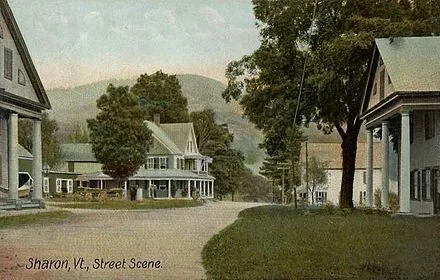
Post card from 1906 of Sharon street scene
From Robert Whitcomb’s “Digital Diary’’ in GoLocal24.com
I got a pang when reading in The Valley News that another small-town local store that has acted as an informal community center is being absorbed by a chain. This is the Sharon (Vt.) Trading Post, a general store and gas station. It’s been owned for 32 years by a local couple – Rob and Cathy Romeo -- but they’re selling it to a chain of 50 convenience stores/gas stations, albeit a Vermont one, called Maplefields. Maybe that means prices will fall a bit – economies of scale – but so probably will service and commitment to the community, in the White River Valley, for which the store has been a central meeting place.
There are fewer independent establishments in small towns like the Romeos’ these days, and that’s too bad. All towns need “third places’’ – not work, not homes – to get together.
To read more, please hit this link.
The American Leader: New publication focuses on problem solving, not partisan pandering

The American Leader is an important new publication.
Here’s its mission statement:
The American Leader is a nonprofit, progress-oriented news and knowledge center committed to giving the public an unrelenting view of the systemic problems that shape our lives and the progress being made to resolve them.
Rather than report on breaking news, we gather the best available data points – whether they were reported today or a year ago – and connect them so that you can stay focused on the problems that matter to you most.
Our emphasis is on results, not storytelling. Despite often excellent journalism, the headline-driven media typically lacks memory, context, and a fixation on progress towards solving our systemic problems. By eliminating the distractions, distortions and obfuscations that pollute the info sphere and keeping our spotlight on the problems, The American Leader is that place in the marketplace of truth for robust and prolonged inquiry. It is a place to come when you want to fit together the fragments of information that you get elsewhere and consider what you can do about it.
And here is its founder’s brief on voting rights
By George Linzer
In Defense of Knowledge: Developing an Intelligence Brief on Voting Rights
On Election Day in 2019, I launched (with a lot of help) The American Leader, a news and knowledge center that tackles the systemic problem of misinformation by offering a new journalistic approach to seeing the world. Using our guiding principles on bias, common purpose, problem-solving, priority setting, accountability, and the search for truth as our framework, we have set out to become a go-to resource for casual news consumers who lack the time or energy to consult multiple resources for the answers to their questions and for purpose-minded citizens who are looking for inspiration on how they can get involved in the issues that matter to them. With the help of a Misinfocon microgrant, we were able to address the corrosion of voting rights, which we published in a brief (below) shortly after launch.
In the battle against misinformation, particularly in the political sphere, knowledge seems to be swimming upstream. It is so much easier for a rumor or overt effort at disinformation to go viral than it is for evidence-based information. Whereas today’s knowledge is dependent on thousands of years of human trial and error, observation of patterns of nature and behavior, and problem-driven innovation, the disinformation that plagues our discourse today is untethered from all but contemporary fears and insecurities and partisan opportunism. It’s as if disinformation, unencumbered by the weight of what’s come before, is able to float higher and travel farther and faster than information weighted down by the burden of proof.
The incendiary tweets, denials of science and eyewitness accounts, and “alternative facts” are nothing more than word bombs tossed on the fragile trust on which knowledge depends. Sow enough doubt and confusion, and we fall into darkness.
That’s one reason why I committed to launching The American Leader. Technologies that combat the spread of misinformation are critical in today’s connected world, but, ultimately, the battle won’t be won until we restore people’s faith in knowledge and their trust in the people who develop that knowledge, and in the people who use it. Knowledge is a cornerstone of democracy — it reveals to us the challenges of managing conflicting views amidst a world of rapid change, giving us the opportunity to choose together how we can most effectively respond for maximum benefit and who should lead the way. When knowledge works, it works for this common good. When knowledge is ignored or attacked and undermined, it weakens support for the system as a whole.
The American Leader makes it easier to access the knowledge that is needed and available for understanding the systemic problems that shape the world we live in, and it brings focused attention to the people who are acting to solve them and the progress they are making. Traditional media, our window on the world, is not optimized for these tasks. Instead, despite courageous and sometimes impactful work, it remains headline-driven and diffuse and too often beholden to the newsmakers of the day, making it all too easy for those who wish to distract from, confuse, and obfuscate the systemic issues that need our attention.
Those of us at The American Leader are building a more outcomes-driven news media.
To this end, The American Leader gathers and synthesizes the best available knowledge on systemic problems like voting rights and presents the information in the form of an intelligence brief. Each brief establishes what we can learn about a particular problem from the multiple sources available to us. As importantly, we also highlight what we don’t know because humility and respect for the accumulation of knowledge and our limitations in that process are essential to regaining trust. The brief puts all this information in a context that connects it to the broader political, social, and economic landscape. The intent is to surface the deeper currents that drive the problems so that we can bring about greater understanding and more lasting solutions to them.
Connecting the Dots, Building a Broader View
For our brief on voting rights, thanks in part to the help from MisinfoCon, our first consideration was to decide whether to draft separate problem briefs on gerrymandering and voter suppression or to prepare a broader overview of the corrosion of voting rights in which we would cover several specific areas of the electoral process that are contributing to it. Given the complexities involved, it would have made a lot of sense to treat each of these problems separately, but ultimately, concluded that that approach dilutes a fuller awareness of how oppressed and impotent our votes have become.
By treating gerrymandering, voter suppression, interference, and structural components of the system as four critical elements contributing to the corrosion of voting rights, we believe we can better spotlight a problem that threatens to undermine one of our nation’s foundational principles — that every vote actually matters.
The decision proved daunting in execution, as the goal of gathering and synthesizing “best available knowledge” is challenging enough in a single narrowly defined area like gerrymandering. Doing so in all four areas offered so many rabbit holes to fall into that at times it nearly paralyzed our work. We were able to move on by remembering that our mission is not necessarily to be comprehensive but to be insightful — to present the landscape in terms of strongest, evidence-based features and to identify the features where that evidence is weak or limited.
While we published it a month later than anticipated, we are not done. These briefs are not static documents — there is always more knowledge and new discoveries to consider that bear on the problem. As our sphere of understanding expands and circumstances shift, we will update this and every problem brief accordingly.
At the top of the website on every page are the words, “work in progress." This is not a reflection of a website that is under construction, but a comment on our democracy and the problems we need to address in order for it to thrive. These are ever works in progress.
The American Leader does not stand alone. Now that we’ve launched, we are beginning to partner with organizations that can bring technical expertise to what we publish, as the Committee for a Responsible Federal Budget did to our brief on the national debt. We are also seeking additional grants, corporate sponsorships, and individual donations to support our work. And we are looking for engagement and guidance from those purpose-minded citizens who share our interest in making progress on our long-term, systemic problems, despite the noise that strives to obscure the common goals of a diverse and inclusive and sustainable democracy.
Please take some time to explore The American Leader and consider how you can get involved.
GE looking better, but Boeing....

Carmen Miranda in a 1945 advertisement for a General Electric FM radio in The Saturday Evening Post
From Robert Whitcomb’s “Digital Diary,’’ in GoLocal24.com
After many cheers when giant General Electric company decided to move its headquarters to Boston from Fairfield, Conn., the noise turned to boos as its stock price tanked. But last year, the stock of the venerable company surged 53 percent from 2018, its biggest jump since the 1980s, and much better than the nearly 30 percent increase in the Standard & Poor’s 500 index, notes The Boston Globe’s estimable Jon Chesto.
Much of the turnaround has been attributed to new CEO Larry Culp’s rigorous and decisive management.
Still, there might be a big problem this year as GE waits to see if engine orders pick up for Boeing’s 737 Max jetliners, grounded last year after two crashes that killed hundreds of people. The engines were not a factor in the crashes.
In any event, the Boston area should still be happy that a company with such engineering expertise as General Electric is based in Boston – a world-renowned center for science and engineering. Synergy! And investors should always keep in mind how fast things can change even for the biggest companies.
A week is an eternity in business….
Meanwhile, haggling continues on what sort of building should go on the site of what was to have been GE’s headquarters in Boston’s Seaport District. The company had planned to put up a sort of sci-fi 12-story headquarters building but decided to settle for two rehabbed older buildings next door – a touch of New England conservatism.
To read Mr. Chesto’s piece, please hit this link.
Green Mountain gorgeous

"Top of the World" (pastel), by Ann Coleman, in the Ann Coleman Gallery, West Dover, Vt., part of Dover, in southern Vermont, and best know for Mount Snow, the big ski area that was among the first to install snow-making equipment and that has always had a large percentage of “snow bunnies,’’ who tend to lounge at the base lodge rather than ski.
An edited version of the Wikipedia entry on Dover:
“West Dover was settled in 1796, when the area was part of Wardsboro, and was incorporated into Dover when that town was chartered, in 1810. The village grew economically in the 19th Century due to the construction of mills along the river. The first mill, a sawmill, was built in 1796, and was expanded to process wool through the first half of the 19th Century. The mill complex was destroyed by fire in 1901, bringing an end to that source of economic activity. Only traces of the mill complex survive today, but the village has a fine assortment of Federal and Greek Revival buildings that give it its character. In the 20th Century the village benefitted from the state's promotion of out-of-staters’ purchase of farms for vacation and weekend homes, and the growth of the nearby ski areas.’’

Judith Graham: What's in store for aging Boomers in this decade?

From Kaiser Health News
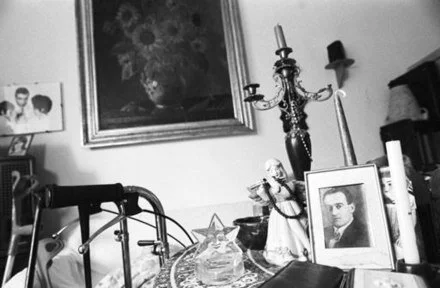
Within 10 years, all of the nation’s 74 million baby boomers will be 65 or older. The most senior among them will be on the cusp of 85. Even sooner, by 2025, the number of seniors (65 million) is expected to surpass that of children age 13 and under (58 million) for the first time, according to Census Bureau projections.
“In the history of the human species, there’s never been a time like [this],” said Dr. Richard Hodes, director of the National Institute on Aging, referring to the changing balance between young people and old.
What lies ahead in the 2020s, as society copes with this unprecedented demographic shift?
I asked a dozen experts to identify important trends. Some responses were aspirational, reflecting what they’d like to see happen. Some were sobering, reflecting a harsh reality: Our nation isn’t prepared for this vast demographic shift and its far-reaching consequences.
Here’s what the experts, in Boston and elsewhere, said:
A crisis of care. Never have so many people lived so long, entering the furthest reaches of old age and becoming at risk of illness, frailty, disability, cognitive decline and the need for personal assistance.
Even if scientific advances prove extraordinary, “we are going to have to deal with the costs, workforce and service delivery arrangements for large numbers of elders living for at least a year or two with serious disabilities,” said Dr. Joanne Lynn, a legislative aide on health and aging policy for Rep. Thomas Suozzi (D-N.Y.).
Experts caution we’re not ready.
“The cost of long-term care [help in the home or care in assisted-living facilities or nursing homes] is unaffordable for most families,” said Jean Accius, senior vice president of thought leadership at AARP. She cited data from the Genworth Cost of Care Study: While the median household income for older adults was just $43,696 in 2019, the annual median cost for a private room in a nursing home was $102,204; $48,612 for assisted living; and $35,880 for 30 hours of home care a week.
Workforce issues are a pressing concern. The need for health aides at home and in medical settings is soaring, even as low wages and poor working conditions discourage workers from applying for or staying in these jobs. By 2026, 7.8 million workers of this kind will be required and hundreds of thousands of jobs may go unfilled.
“Boomers have smaller families and are more likely to enter old age single, so families cannot be expected to pick up the slack,” said Karl Pillemer, a professor of human development at Cornell University. “We have only a few years to plan different ways of providing care for frail older people to avoid disastrous consequences.”
Living better, longer. Could extending “healthspan,” the time during which older adults are healthy and able to function independently, ease some of these pressures?
The World Health Organization calls this “healthy life expectancy” and publishes this information by country. Japan was the world’s leader, with a healthy life expectancy at birth of 74.8 years in 2016, the most recent year for which data is available. In the U.S., healthy life expectancy was 68.5 years out of a total average life expectancy of 78.7 years.
Laura Carstensen, director of Stanford University’s Center on Longevity, sees some cause for optimism. “Americans are beginning to exercise more” and eat more healthful diets, she said. And scientific studies published in recent years have shown that behavior and living environments can alter the trajectory of aging.
“With this recognition, conversations about aging societies and longer lives are shifting to the potential to improve quality of life throughout,” Carstensen said.
Other trends are concerning. Notably, more than one-third of older adults are obese, while 28% are physically inactive, putting them at higher risk of physical impairments and chronic medical conditions.
Rather than concentrate on treating disease, “our focus should shift to health promotion and prevention, beginning in early life,” said Dr. Sharon Inouye, a professor at Harvard Medical School and a member of the planning committee for the National Academy of Sciences’ Healthy Longevity Global Grand Challenge.
Altering social infrastructure. Recognizing the role that social and physical environments play in healthy aging, experts are calling for significant investments in this area over the next decade.
Their wish list: make transportation more readily available, build more affordable housing, modify homes and apartments to help seniors age in place, and create programs to bring young and old people together.
Helping older adults remain connected to other people is a common theme. “There is a growing understanding of the need to design our environments and social infrastructure in a way that designs out loneliness” and social isolation, said Dr. Linda Fried, dean of Columbia University’s Mailman School of Public Health.
On a positive note, a worldwide movement to create “age-friendly communities” is taking hold in America, with 430 communities and six states joining an effort to identify and better respond to the needs of older adults. A companion effort to create “age-friendly health systems” is likely to gain momentum.
Technology will be increasingly important as well, with aging-in-place likely made easier by virtual assistants like Alexa, video chat platforms like Skype or FaceTime, telemedicine, robotic caregivers and wearable devices that monitor indicators such as falls, according to Deborah Carr, chair of the sociology department at Boston University.
Changing attitudes. Altering negative attitudes about aging — such as a widespread view that this stage of life is all about decline, loss and irrelevance — needs to be a high priority as these efforts proceed, experts say.
“I believe ageism is perhaps the biggest threat to improving quality of life for [older] people in America today,” Harvard’s Inouye said. She called for a national conversation about “how to make the last act of life productive, meaningful and fulfilling.”
Although the “OK Boomer” barbs that gained steam last year testify to persistent intergenerational tension, there are signs of progress. The World Health Organization has launched a global campaign to combat ageism. Last year, San Francisco became one of the first U.S. cities to tackle this issue via a public awareness campaign. And a “reframing aging” toolkit developed by the FrameWorks Institute is in use in communities across the country.
“On the bright side, as the younger Baby Boom cohort finally enters old age during this decade, the sheer numbers of older adults may help to shift public attitudes,” said Robyn Stone, co-director of LeadingAge’s LTSS (long-term services and supports) Center @UMass Boston.
Advancing science. On the scientific front, Dr. Pinchas Cohen, dean of the Leonard Davis School of Gerontology at the University of Southern California, points to a growing recognition that “we can’t just apply one-size-fits-all guidance for healthy aging.”
During the next 10 years, “advances in genetic research and big data analytics will enable more personalized — and effective — prescriptions” for both prevention and medical treatments, he said.
“My prediction is that the biggest impact of this is going to be felt around predicting dementia and Alzheimer’s disease as biomarker tests [that allow the early identification of people at heightened risk] become more available,” Cohen continued.
Although dementia has proved exceptionally difficult to address, “we are now able to identify many more potential targets for treatment than before,” said Hodes, of the National Institute on Aging, and this will result in a “dramatic translation of discovery into a new diversity of promising approaches.”
Another potential development: the search for therapies that might slow aging by targeting underlying molecular, cellular and biological processes — a field known as “geroscience.” Human trials will occur over the next decade, Hodes said, while noting “this is still far-reaching and very speculative.”
Addressing inequality. New therapies spawned by cutting-edge science may be extraordinarily expensive, raising ethical issues. “Will the miracles of bioscience be available to all in the next decade — or only to those with the resources and connections to access special treatment?” asked Paul Irving, chairman of the Milken Institute’s Center for the Future of Aging.
Several experts voiced concern about growing inequality in later life. Its most dramatic manifestation: The rich are living longer, while the poor are dying sooner. And the gap in their life expectancies is widening.
Carr noted that if the current poverty rate of 9% in the older population holds over the next decade, “more than 7 million older persons will live without sufficient income to pay for their food, medications and utilities.” Most vulnerable will be black and Latina women, she noted.
“We now know that health and illness are affected by income, race, education and other social factors” and that inequalities in these areas affect access to care and health outcomes, Pillemer said. “Over the coming decade, we must aggressively address these inequities to ensure a healthier later life for everyone.”
Working longer. How will economically vulnerable seniors survive? Many will see no choice but to try to work “past age 65, not necessarily because they prefer to, but because they need to,” Stone said.
Dr. John Rowe, a professor of health policy and aging at Columbia University, observed that “low savings rates, increasing out-of-pocket health expenditures and continued increases in life expectancy” put 41% of Americans at risk of running out of money in retirement.
Will working longer be a realistic alternative for seniors? Trends point in the opposite direction. On the one hand, the U.S. Bureau of Labor Statistics suggests that by 2026 about 30% of adults ages 65 to 74 and 11% of those 75 and older will be working.
On the other hand, age discrimination makes it difficult for large numbers of older adults to keep or find jobs. According to a 2018 AARP survey, 61% of older workers reported witnessing or experiencing age discrimination.
“We must address ageism and ageist attitudes within the workplace,” said Accius of AARP. “A new understanding of lifelong learning and training, as well as targeted public and private sector investments to help certain groups transition [from old jobs to new ones], will be essential.”
Judith Graham is a Kaiser Health News reporter.

U.S. birth rate (births per 1,000 population). The segment for 1946 to 1964 — the Baby Boomers — is highlighted in red.
William Morgan: Emlen book goes beyond the stereotype of the Shakers
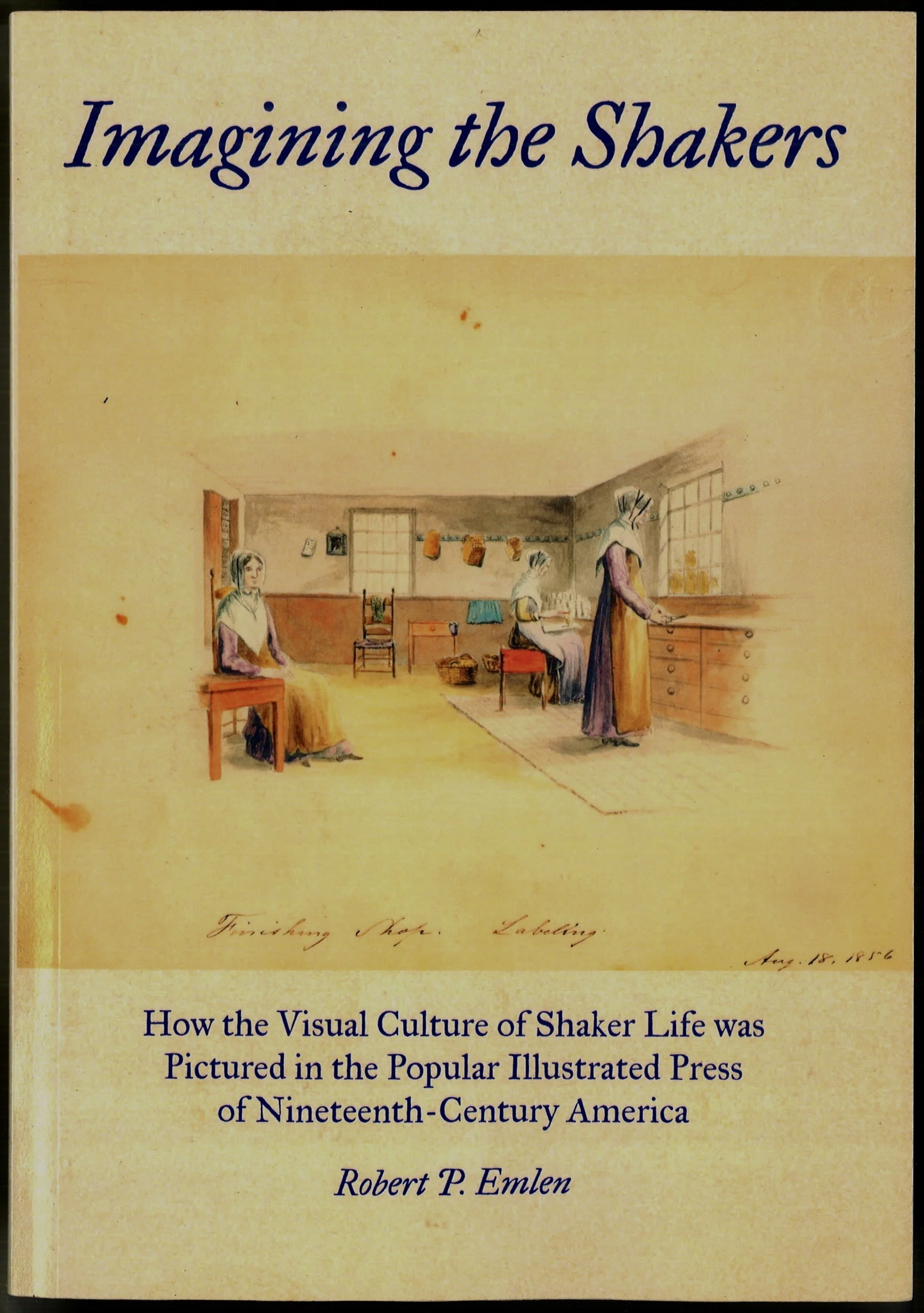
The United Society of Believers in Christ's First and Second Appearing are among the most beloved – and thus most mythologized – religious groups in American history. The Shaking Quakers or Shakers, as we call them, are usually remembered for their vows of celibacy and their proto-Modern design.
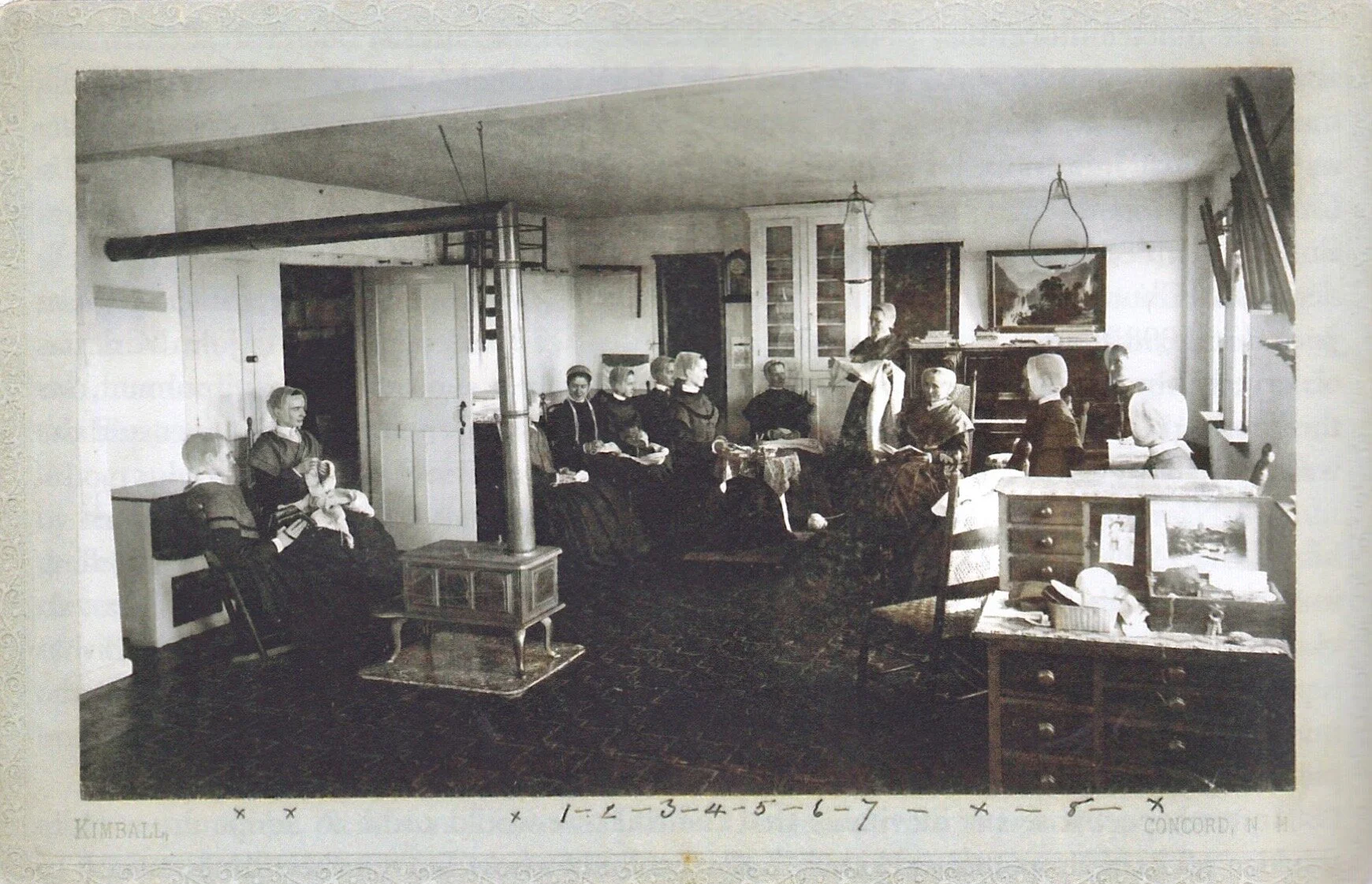
Shaker Sisters at Canterbury, N.H., circa 1893. All pictures are from Imagining the Shakers.
This stereotype does not do them justice, because while adhering to their tenets of simplicity, apartness, and prayer, they also managed to be remarkably efficient farmers and businesspeople. Even while having to depend upon recruits instead of future generations, the Shakers managed a widespread agricultural enterprise, along with furniture making, emanating from communities from Maine to Kentucky. There was much more that was worldly about these entrepreneurs than exquisite rocking chairs and efficient wood stoves.
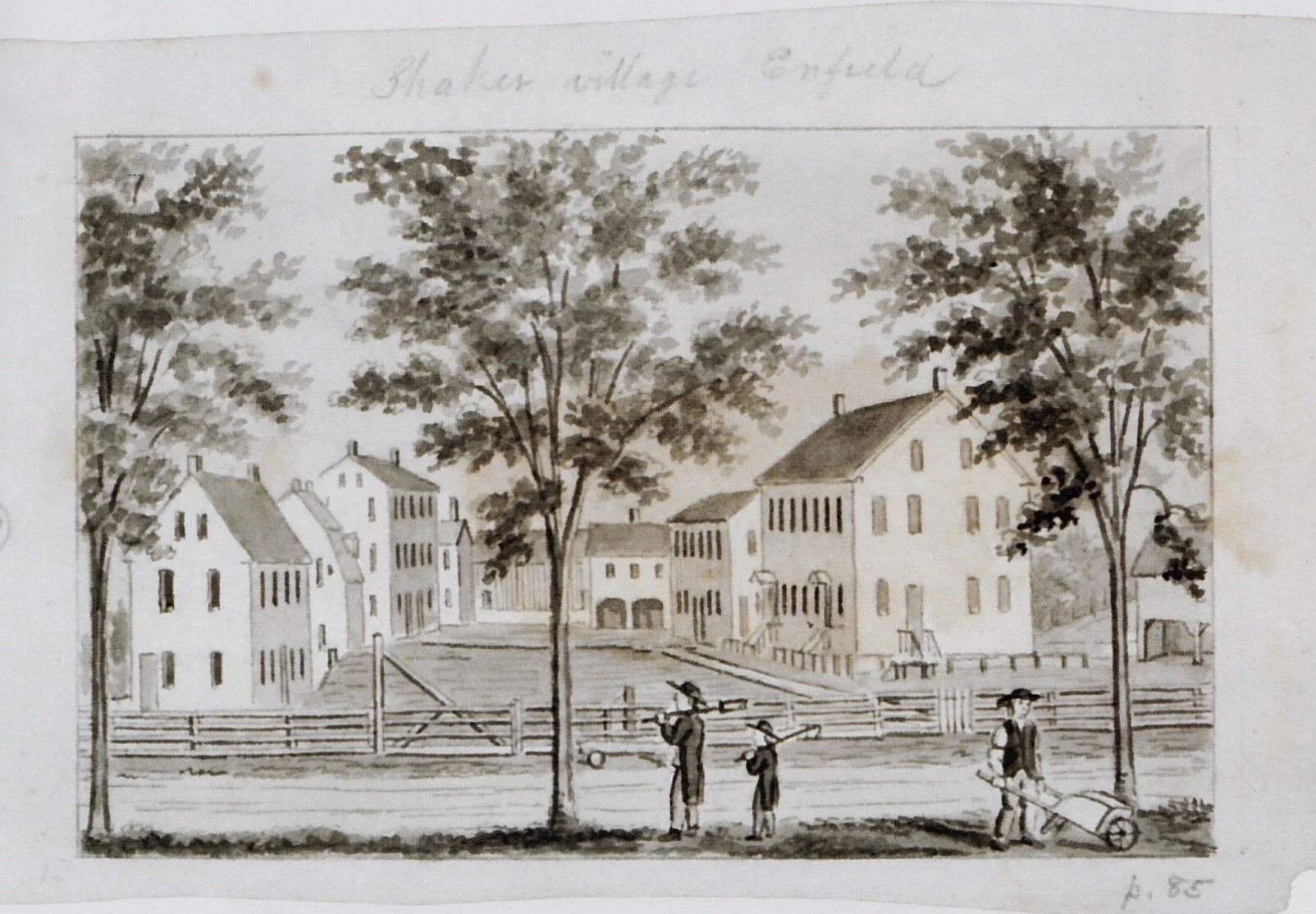
Shaker Village, Enfield, Conn., in 1834
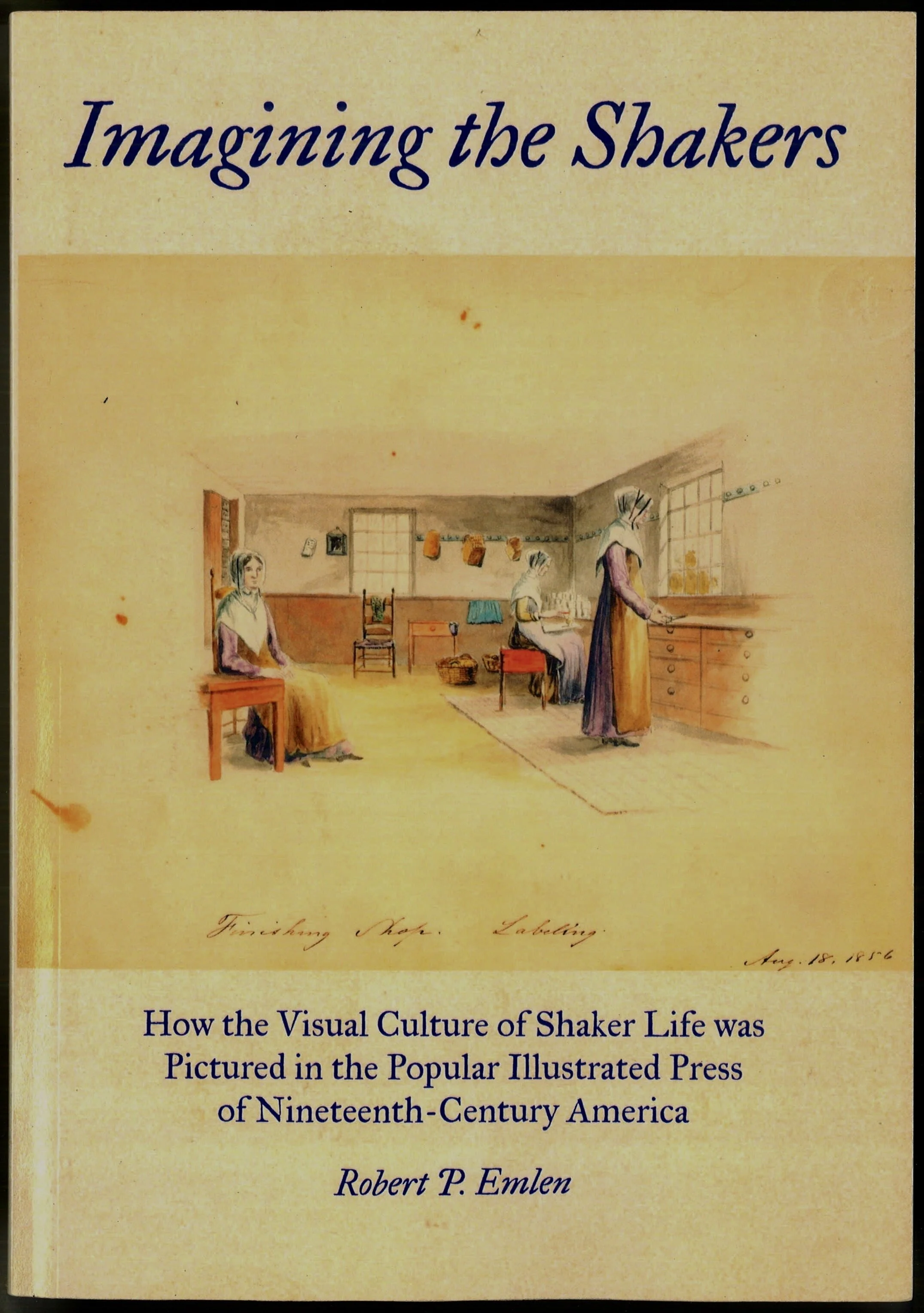
Robert P. Emlen's Shaker Village Views of 1987 remains a classic among a cottage industry of Shaker books. Now, the retired curator of Brown University collections and a former Rhode Island School of Design professor, Emlen has published one of the most intriguing books on the Shakers ever: Imagining the Shakers: How Visual Culture of Shaker Life was Pictured in the Popular Illustrated Press of Nineteenth-Century America (R.W. Couper Press, 2019, $45; R.W. Couper Press is part of Hamilton College, in Clinton, N.Y.)
Emlen, who once lived with the last surviving Shakers at their farming village in Sabbathday Lake, Maine, has gathered every known engraving or lithograph about the Shakers between 1830 and 1880. There are a few photographs, plus advertisements of the Shakers’ own and some Shaker-themed products.
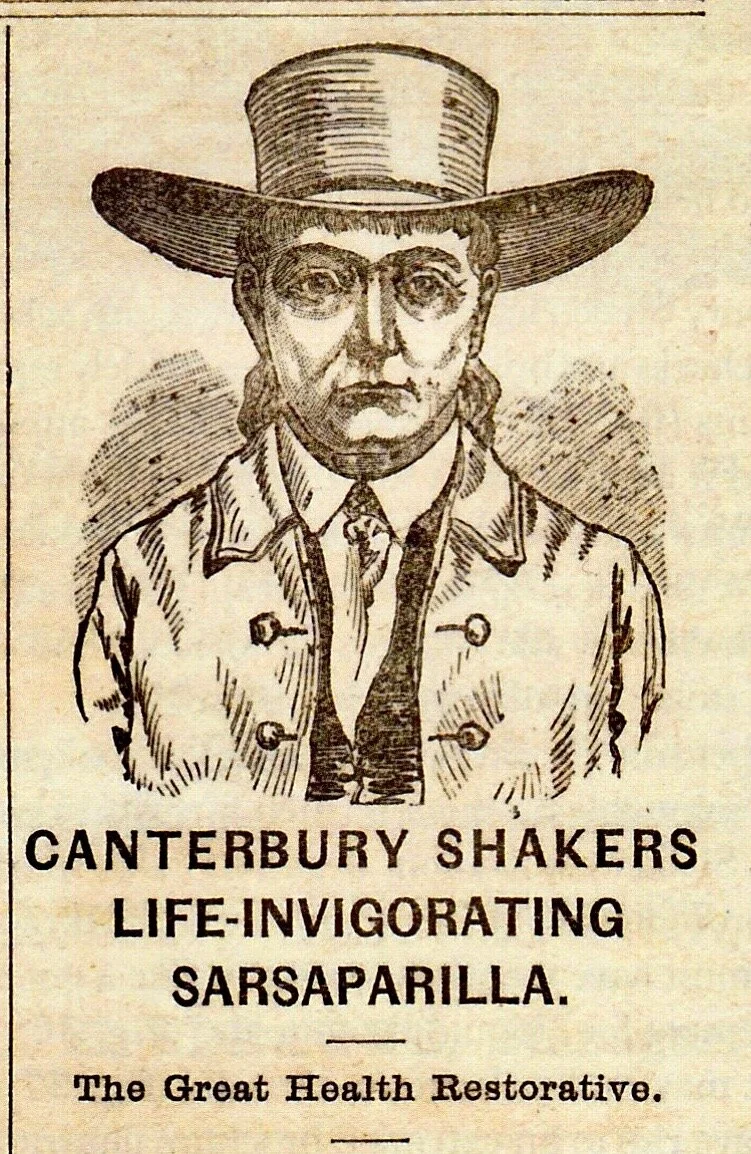
Advertisement in the Maine Farmer, 1890
Fascinating and important to furthering our understanding of the Shakers, this is the sort of book that needed the support of a university press. In this case, the committed publisher is at Hamilton College, and they earn high marks for a very handsome production.

Shaker Pickles label, circa 1880-85
William Morgan, an architectural historian and a columnist, is the author of, among other books, American Country Churches, which includes a chapter on the Shaker settlement at Sabbathday Lake, Maine.
'Watch out for reefs'
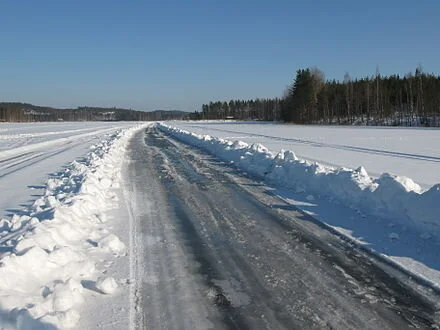
“As I set out across the lake, about noontime, the cook, emerging to draw molasses from the barrel, warned me to ‘watch out for reefs’– rifts, that is, in the ice, where a warm current might have melted most of the way through. But the ice was solid, several inches thick, heavy enough to hold a team. There was only gladness in my heart as I started across the wide white plain toward the woods on the far-off shore.’’
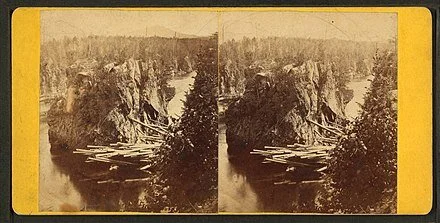
Stereoscopic photos of lumber being pushed down a Maine river around 1900
-- Robert Smith, in My Life in the North Woods (1986), a memoir of his stint in a lumber camp in Maine during the Depression.
Bret Murray: Possible Title IX changes could boost colleges' exposure, discourage victims from coming forward

Title IX played a major role in expanding women students’ team sports at co-ed institutions
From The New England Journal of Higher Education, a service of The New England Board of Higher Education (nebhe.org)
BOSTON
Title IX, the federal civil rights law passed in 1972, was a landmark piece of legislation that prohibited sexual discrimination in educational institutions across America. It reads, “No person in the United States shall, on the basis of sex, be excluded from participation in, be denied the benefits of, or be subjected to discrimination under any education program or activity receiving Federal financial assistance.”
Enforced by the U.S. Department of Education’s Office of Civil Rights (OCR), Title IX has helped level the playing field by ensuring that students of all genders receive access to scholarships, funding, sports, academic coursework, and protection from sexual harassment, among other things.
But three recent lawsuits in which male students (John Does) who were accused of and disciplined for sexual misconduct argue that they were denied due process by their universities because of unfair Title IX policies. The men filing suits are from Michigan State, the University of California and California State. While the circumstances of the cases are different, the John Does essentially argue that Title IX policies were administered unfairly at their universities. The accused male students say they were denied their due-process rights, they weren’t allowed to cross-examine their accusers, and they were not given a live hearing before a neutral fact-finder.
Significantly, the plaintiffs in these cases are seeking to have their cases certified as class-action suits.
If any of these cases receive class-action status and prevail, it could reverse the outcomes of numerous sexual violence cases that were adjudicated on college campuses over the years. The effects could be far-reaching and present a host of problems for universities that have sanctioned students after conducting Title IX investigations of sexual-misconduct accusations. This could include any investigation by a college or university of sexual assault, harassment, exploitation, indecent exposure, relationship violence and stalking.
What is the impact of a class-action certification for colleges and universities not named in the suits?
First of all, disciplinary sanctions on students who were previously found guilty on sexual violence charges at these universities could be overturned. And that could open the doors to more lawsuits at more colleges and universities within their federal circuit court jurisdictions. Any John or Jane Doe who was expelled from a school after a sexual misconduct adjudication hearing would only need to prove that they were denied their due-process rights by not having the opportunity to cross-examine their accuser or other witnesses before a neutral fact-finder to make a prima facie case. Universities could face mounting legal defense fees, potential settlement payouts, as well as other costs like hiring outside public relations counsel.
Secondly, class-action status could force universities to change their processes for handling sexual violence cases going forward. Affected schools would have to allow cross-examining opportunities in front of neutral fact-finders and wouldn’t be able to use school adjudication officers as judges. For institutions not utilizing mediators or other third-parties as neutral fact-finders during their Title IX processes, additional funds will need to be budgeted in order to pay for these new expenses.
Lastly, should the cases be certified and rule in favor of the John Does, the courts will base their rationale on due-process fairness to all parties. But such a ruling could have the unintended consequence of discouraging victims from coming forward if they must be cross-examined by a representative of the alleged assailant during the hearing process. Affected colleges and universities will clearly need to incorporate the courts’ holdings into their Title IX policies and processes, but they need to do so in ways that will not discourage victims from reporting acts of sexual violence.
These cases could have implications when it comes to the exposure that colleges and universities face in their Title IX policies and investigations.
How can universities mitigate their exposure if the Title IX cases are certified as class-action suits? Educator Legal Liability (ELL), Directors & Officers Liability and Commercial General Liability insurance policies can offer a layer of protection for both the higher education institutions and their employees. In addition to covering legal defense costs, ELL coverage can assist with fines and potential settlements in these matters as well.
Schools might have an adequate existing insurance program, or they might have to amend their policies and program to ensure coverage for such risk exposures. As these and other similar cases play out, now is a good time for colleges and universities to proactively check in with their risk advisers and brokers.
Bret Murray is higher-education practice leader at Boston-based Risk Strategies.
To address affordable-housing issue, fix zoning
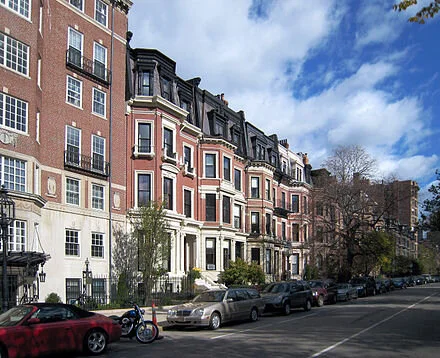
Unaffordable (except for the truly rich) housing on Commonwealth Avenue in Boston
From Robert Whitcomb’s “Digital Diary,’’ in GoLocal24.com
Officials in Rhode Island, Massachusetts and elsewhere are calling for a big push to expand that rather nebulous thing called “affordable housing.’’ Probably the most dramatic set of proposals in New England comes from Boston Mayor Marty Walsh, who presides over a city in the middle of a metro area whose tech, health-care and financial-services companies have brought great wealth but have also driven up further what have long been among America’s highest living costs.
Mr. Walsh has vowed to commit $500 million over five years to address the city’s affordable-housing crisis. That would necessitate, among other things, the sale of a parking garage and implementing a real-estate transfer tax.
The mayor is also pressing major companies and foundations to consider pooling some money — perhaps as much as $100 million — to help finance affordable housing in Boston. If this actually happens, Boston would apparently become the first East Coast city to do something like what’s happening on the West Coast, where tech companies are funding some big housing programs to address some of the cost challenges they created.
Still, isn’t having rich companies, with highly paid workers, better than having poor ones? As always, each success presents new problems.
Over the long run, the affordable-housing issue will be most effectively addressed through changes in zoning laws, especially in the suburbs, that have long discouraged mixed-used neighborhoods (commercial/residential) and multi-family housing. “Snob zoning,’’ which sets high per-residence minimum acreage, has, in particular, removed a lot of land from possible new-housing construction. But those who live on snob zoning lots have much more political clout than people searching for a place to live that they can afford. And zoning is mostly a local power.
Anyway, certain changes could dramatically increase the supply of less expensive housing, reducing the price pressure. That would include a slowing population growth, making housing more of a buyers’ market.
Warm memories; grow very old in Portland

“That Summer Day’’ (encaustic and photo transfer), by Kimberly Curry
Ms. Curry says she uses her home state of Maine as her muse, as well as her travels around the world, and is inspired by the the beauty (and its opposites) in ordinary things.
Her style ranges from seascapes of Maine that capture a point in time to following a concept in a loose abstract way.
She lives in hip Portland, whose excellent health care, physical beauty, exciting working waterfront, famous food sector and strong cultural and educational resources for older people put it on Parade magazine’s list of seven places in America to “Live Here and Live to 100’’.
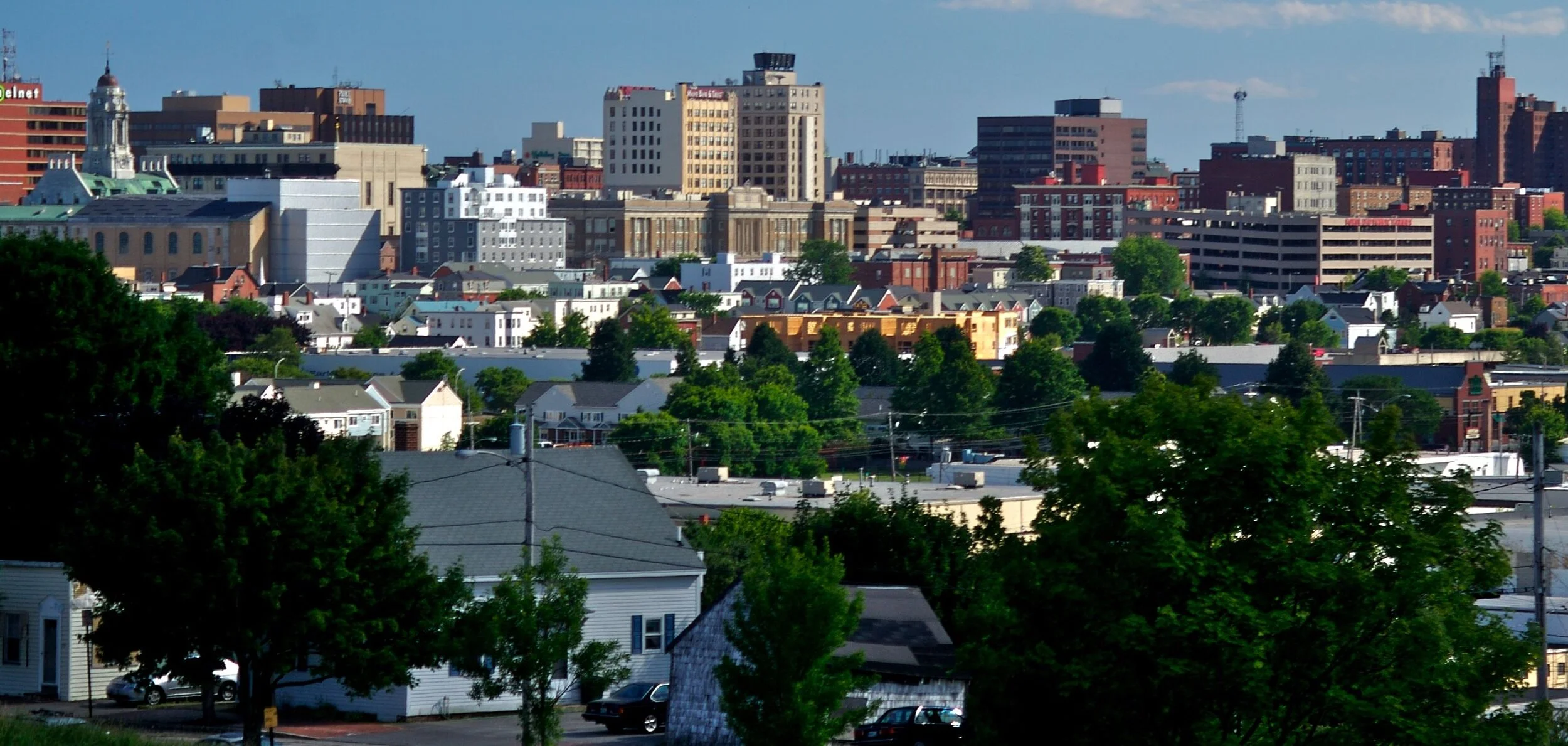
Downtown Portland
— Photo by Autocracy

Farmers market on Monument Square

Portland waterfront with warm-season cruise ships
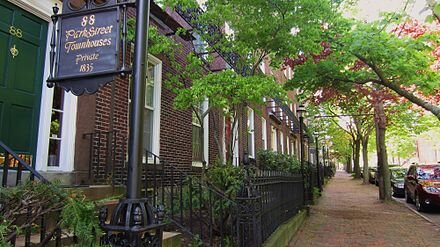
Old townhouses in Portland