
Vox clamantis in deserto





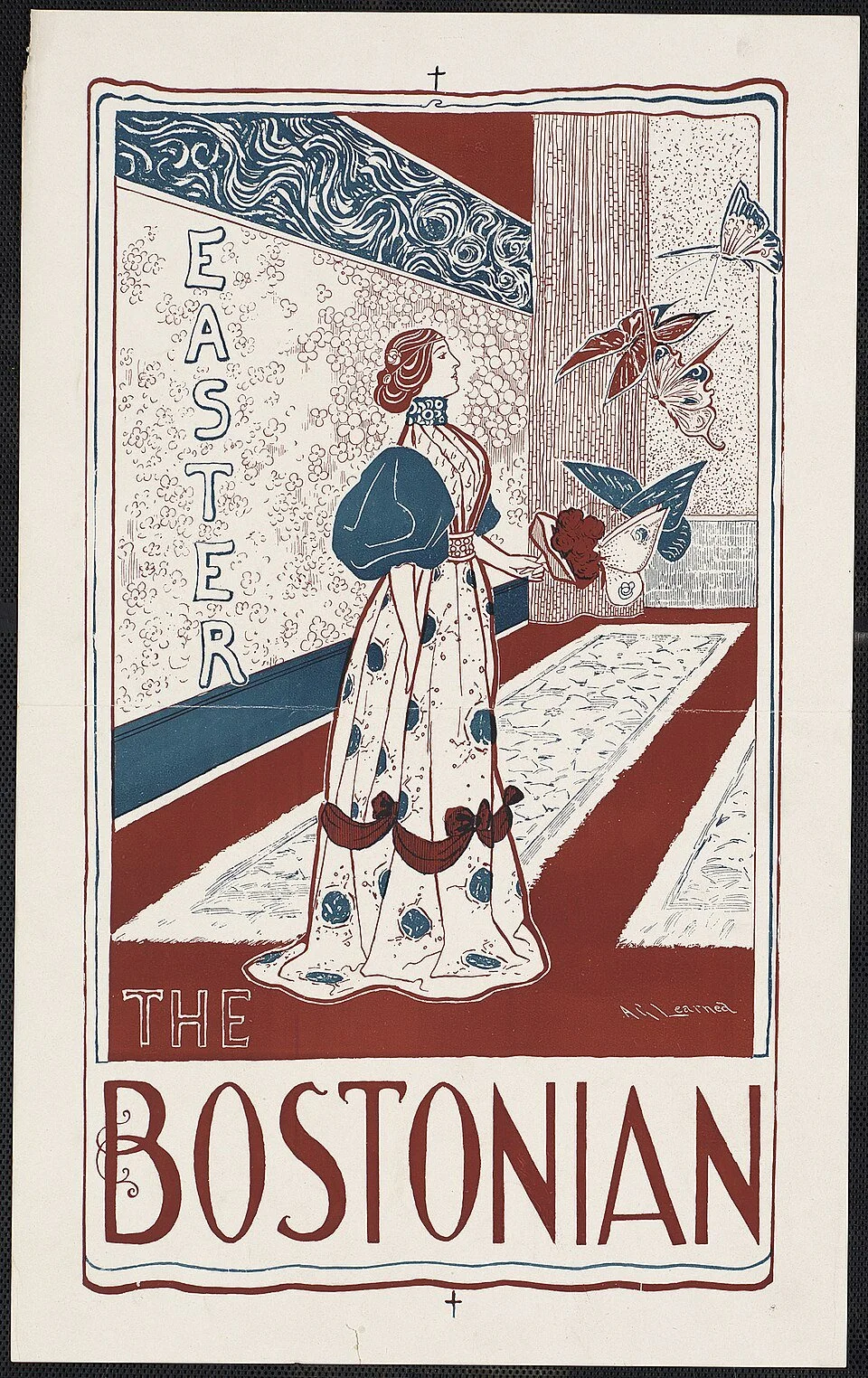
Builds character
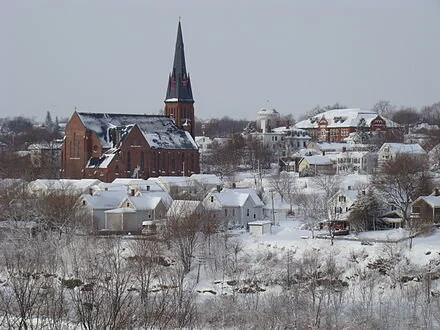
Bangor, Maine
“Maine's long and cold winters may help keep our state's population low, but our harsh climate also accounts for what is unique and valuable about our land and our people.’’
— Former Maine Congressman Tom Allen


He didn't go for the night life
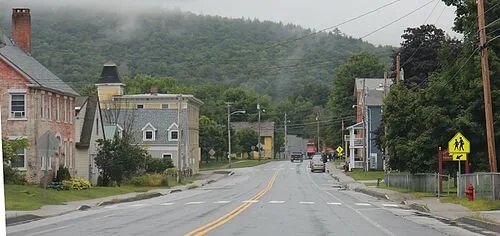
Downtown Cavendish, Vt.
“Exile is always difficult, and yet I could not have imagined a better place to live, and wait for my return home, than Cavendish, Vermont.’’
— Russian novelist, historian, short story writer (and Nobel laureate) and anti-Soviet political activist Alexander Solzhenitsyn (1918-2008) in a 1994 letter to the Town of Cavendish. He was expelled from the Soviet Union in 1974 and returned in 1994, after that empire fell apart, in 1991.
From dartblog.com:
An article in Humanities, the National Endowment for the Humanities’ magazine, “A Tiny Village in Vermont Was the Perfect Spot to Hide Aleksandr Solzhenitsyn,’’ describes Solzhenitsyn’s time in Vermont.
After traveling throughout the region in 1975, they decided Cavendish would be their new home. Its small size (population: 1,264 in 1970) meant that privacy wouldn’t be a problem. Its remote location was far away from reporters, fans, and the Soviet security services. And its proximity to Dartmouth College provided easy access to a wealth of library and research resources. The entire family, including Natalia’s mother, Ekaterina, moved to a large wooded property there in 1976 [where they stayed until 1994].
Wild and tamed

From Vaughn Sills’s show “Inside Outside,’’ at Kingston Gallery, Boston, Feb. 5-29. The gallery says “the group of photographs blend still life and landscape, “combining bouquets of flowers with landscapes that Sills creates of Prince Edward Island, her mother’s home. For the artist, the fundamental concept is expressed in the exhibition title, a juxtaposition of highly cultivated nature versus the untamed natural world. Domestic life is represented by garden-grown flowers in vases, alluding to the traditional notion of women’s work in gardens and in the home; while the outside world is seen in the images of sea and land.’’
Mortality and beauty are explored in a secondary layer of this body of work. The Prince Edward Island landscapes and seascapes are part of a series about grieving for Sills’ mother, a woman noted for her remarkable beauty. They represent expressions of sadness, love, memory, and connection. Flowers, with their ephemeral beauty, are reminders of death and contrast with the feeling of infinitude implied by the sea and rolling hills. A third layer speaks to the artist’s concern for the planet. She is attuned to the climate crisis implied in these photographs. Local streams and ponds are polluted by the farmer’s field featured in her work, and the flowers purchased for the photographs are transported via trucks that contribute to carbon emissions, a factor in the rise of sea levels. It is the ugly price of beauty, and a reminder of the impermanence of our world.
Visit here for the artist's bio.
Image credit: Vaughn Sills, Double Northumberland Strait Boom Tulips, archival pigment print, 21 x 14 inches, 2015, courtesy the artist.

Llewellyn King: Brexit may be good for the E.U.

PARIS
There are those who believe when Britain finally shakes off its European bondage it will prosper as never before. This prosperity will be so compelling that the remaining 27 countries that comprise the European Union will follow suit in pursuit of riches. The end of European integration.
This is a view easier to find in Washington than it is here in Paris or in London. There is a sense here of Europe Rising not Europe Disintegrating. Britain will still, despite the contrived case against membership, look to selling to and buying from Europe. After all, the E.U. will still be there: a huge market just a little over 20 miles across the English Channel.
Europe is beset with sluggish growth. The euro -- the currency used by 19 of Europe’s nations -- has been a mixed blessing, unable to serve hurting states by devaluing to increase exports. Yet it is the symbol of Europe, particularly to a new generation that has known nothing else and looks more to a united Europe than, perhaps, their parents.
These are problems but not insuperable. From what I heard here at the annual congress of the Association of European Journalists (AEJ), Europeans feel that they really need each other, not least because they are constantly under a sophisticated and relentless attack of fake news and disinformation from Russia. Russia is a huge problem in Europe with fake information and even fake events, like the planting of disrupters pretending to be reporters or staged events suggesting a fascist penetration that does not exist. Daily, Russia endangers the truth in Europe.
The AEJ is, to my mind, as good a place as any to take the temperature of Europe. It is made up of working journalists, not stars or polemicists, but day-to-day reporters from across Europe, from Bulgaria to Spain and from Finland to Ireland. Collectively, they provide unique insight on the mood of Europe.
Rather than Britain’s departure (which nobody in Europe wants), here at the AEJ congress Brexit is regarded as the kind of misfortune that brings people together and leads on to triumph. Rather than Europe’s tragedy, here it is seen as Britain’s tragedy. And rather than Brexit being a precursor to the breakup of the E.U., here it is seen as a precursor to the breakup of the United Kingdom.
Otmar Lahodynsky, president of the AEJ, says that England has discovered nationalism, as have Scotland and Wales -- suggesting the inevitable breakup of the United Kingdom as it has been constituted since the Act of Union in 1707.
For Europe, the continuing problem is immigration.
While there are rich and poor nations, those in poverty will try to live in those with prosperity and migrate illegally. Not only has this been one of the drivers of Brexit, but it is also a massive problem for Europe, both the internal movement of people from countries like Poland to France, Holland and Germany, and from countries outside, especially Africa where people board unseaworthy vessels and risk drowning trying to reach Europe.
Add climate change to worries about Russia and immigration.
Europeans, much more than Americans, are palpably stricken about climate change and concomitant sea level rise. This adds to immigration pressure and free-floating anxiety about the future -- an anxiety which is unifying, particularly for the young.
In London, once my home, and now a bitterly divided place, there is agreement that new trade deals will not be written at the speed of a French train. People point out ruefully that it took Britain seven years to conclude a trade deal with Canada -- and Britain and Canada l-o-v-e each other as mother and daughter. Who wants a deal with, say, the Czech Republic, with such passion? Not a tempting future.
Llewellyn King is executive producer and host of White House Chronicle, on PBS. His email is llewellynking1@gmail.com.
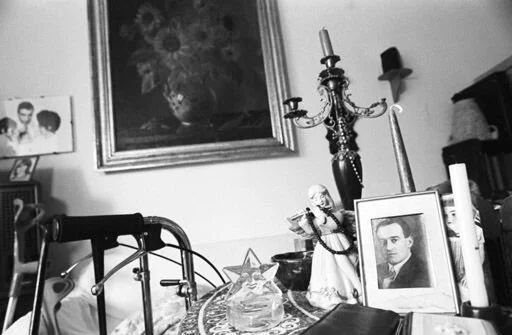
Judith Graham: Some promises you can't keep
— Photo by Andreas Bohnenstengel
It was a promise Matt Perrin wasn’t able to keep.
“I’ll never take away your independence,” he’d told his mother, Rosemary, then 71, who lived alone on Cape Cod, in a much-loved cottage.
That was before Rosemary started calling Perrin and her brother, confused and disoriented, when she was out driving. Her Alzheimer’s disease was progressing.
Worried about the potential for a dangerous accident, Perrin took away his mother’s car keys, then got rid of her car. She was furious.
For family caregivers, this is a common, anxiety-provoking dilemma. They’ll promise Mom or Dad that they can stay at home through the end of their lives and never go to assisted living or a nursing home. Or they’ll commit to taking care of a spouse’s needs and not bringing paid help into the home. Or they’ll vow to pursue every possible medical intervention in a medical crisis.
Eventually, though, the unforeseen will arise ― after a devastating stroke or a heart attack, for instance, or a diagnosis of advanced cancer or dementia ― and these promises will be broken.
Mom or Dad will need more care than can be arranged at home. A husband or wife won’t be able to handle mounting responsibilities and will need to bring in help. A judgment call ― “this will only prolong suffering, there’s no point in doing more” ― will be made at the bedside of someone who is dying.
“We want to give loved ones who are sick or dying everything we think they want ― but we can’t,” said Barbara Karnes, 78, an end-of-life educator and hospice nurse based in Vancouver, Wash. “And then, we feel we’ve failed them and guilt can stay with us for the rest of our lives.”
She hasn’t forgotten an experience with her mother-in-law, Vi, who moved in with Karnes, her husband and two children after becoming a widow 30 years ago. At the time, Vi was in her 70s, weak and frail. Karnes was working full time and keeping the household going.
“My mother-in-law and I got into a disagreement, I don’t remember what it was about. But I remember her saying to me, ‘You promised you would take care of me,’ and making it clear that she felt I’d let her down. And I said, ‘I know, I was wrong ― I can’t do it all,’” she remembered. “I still feel bad about that.”
“No caregiver I know sets out to deceive another person: It’s just that none of us have a crystal ball or can predict what the future will hold,” she said. “And the best we can do isn’t always as much as we thought was possible.” “We have to figure out a way to forgive ourselves.”
Richard Narad, 64, a professor of health services administration at California State University, spent months after his wife’s death in December 2011 mentally reviewing the last hours of her life before achieving a measure of peace.
His wife, April, was diagnosed with Type 1 diabetes at age 5 and was legally blind when the couple married in 1994. A year later, she had the first of a series of strokes. Eventually, April was diagnosed with congestive heart failure. In the last 18 months of her life, she was hospitalized 13 times.
April Narad had told her husband she wanted “full code” status in the event of an emergency ― in other words, “do everything possible to keep me alive.” But she was nervous about his willingness to honor her wishes because his own end-of-life views differed from hers.
“I think certain care is futile and you need to give up earlier,” he explained.
In the end, April was rushed to the hospital one night after dinner, gasping for breath. There, Narad directed medical staff to pursue “full code” interventions. But when a physician came out to tell him that death appeared inevitable, Narad remembers saying, “Well, if that’s the case, just call it.
Had he broken a promise to insist that other treatments be tried? Narad spent months wondering but eventually accepted that he acted in good faith and couldn’t have saved April’s life.
With illness, older couples can end up re-evaluating commitments they’ve made. Kathy Bell, 66, of Silver Spring, Md., promised her husband, Bruce Riggs, 82, that she’d stay with him “through all the changes in our lives” when they married in 1987. Then in August 2011, he received a diagnosis of Alzheimer’s.
The couple moved into a senior living facility, but as Riggs’s condition worsened he had to go to a memory care facility in 2014. The following year, Bell had lunch with a man whose wife lived at the same facility. He told her his therapist had recommended he start dating.
“That planted the idea of possibly doing this myself at some point,” Bell said, and two years ago she met a man who has become a regular companion.
Does she feel she’s broken her promise to her husband, who was committed to a monogamous marriage? “No, I don’t,” Bell said, adding that “it’s not clear whether he knows me at this point. He doesn’t talk. The way I view it: I still love him. I still go to see him. I’m still taking care of him.”
Promises can be explicit ― spoken aloud ― or implicit, understood without direct communication. Both kinds can inspire regret.
Debra Hallisey, 62, a caregiver consultant based in Lawrenceville, N.J., describes making an unspoken promise to her father, Don, when he was diagnosed with congestive heart failure in 2014. Their agreement, which was never voiced: Neither would tell Hallisey’s mother, Doris ― who has diabetes, mobility issues and is legally blind ― how sick he was.
“I knew he was shielding [Mom] from knowing the truth. When she would ask questions, he wouldn’t say anything,” Hallisey said. Because her mother was disabled, Hallisey accompanied her father to doctor’s appointments.
When Hallisey’s father died, in February 2015, Doris was profoundly shocked and Hallisey was overcome by remorse. “It was then, I said to my mother, ‘Mommy, there are no more secrets. If something is wrong, I am going to tell you, and together we’re going to determine the best thing to do,’” she said.
In line with that promise, Hallisey has been direct with her mother, who uses a walker to get around her home in Somerset, N.J., and has round-the-clock home care. If and when Doris becomes unable to walk, she’ll have to move, Hallisey has said.
“I’ve told her, ‘Mommy, I’ll do everything to keep you in this house, but you have to use your walker and work at staying strong. A wheelchair won’t work in your house,’” Hallisey said. “I know that keeping her at home is a promise I may not be able to keep.”
Matt Perrin made the decision to move his mother, Rosemary, to assisted living in 2017, after realizing he couldn’t coordinate care for her escalating needs at a distance. (Rosemary lived on Cape Cod; Perrin lived in New Hampshire.) Because he’d vowed to protect her independence, “I felt so guilty ― a guilt that I had never felt before,” he admitted.
Rosemary resisted the move passionately, but after a few months settled into her new home.
“I felt relief then, and I still do,” Perrin said. “I wish I didn’t make that promise to my mom, and I wish she weren’t living with Alzheimer’s. But I’m thankful that she’s in a place that’s really good for her, all things considered.”
Judith Graham is a Kaiser Health News reporter.
RELATED TOPICS
AGING NAVIGATING AGING
365-day growing season in Providence

From Robert Whitcomb’s “Digital Diary,’’ in GoLocal24.com
Gotham Greens, in Providence, is the most exciting new business in the city for a long time. The company will grow about 10 million heads of leafy greens a year inside its 110,000-square-foot facility, now open. This gives our region a tad more food independence by letting crops be harvested even through our annual cold snap called “winter’’ and in what had been an industrial wasteland. There are other tracts in the city that could be converted to year-round food production.
That includes crops that can be grown in rooftop greenhouses. Then there’s the stuff to grow on open rooftops seasonally. Hit this link for more information.
Public transit entertainment

“Angels Among Us” (photo), by Chelsea Bradway, in the show “The Big Tent: HCA Members Show,’’ at the Hopkinton (Mass.) Center for the Arts, through Jan. 9.
The show displays the work of 30 Hopkinton Center for the Arts artists from 13 communities, featuring art in a wide range of mediums and styles.
Sarah Anderson: Comeback for Toy 'R' Us after being ravaged by rapacious private equity firms?

A Toys ‘R’ Us store in Auburn, Mass., on June 24, 2018
For many years, Giovanna De La Rosa enjoyed working at Toys ‘R’ Us — especially during the holiday shopping season. “I loved bringing joy to families and to children,” she shared at a recent congressional hearing. “I watched so many of the local kids grow up over the years while shopping in our store.”
De La Rosa’s 20-year career with Toys ‘R’ Us came to an abrupt end in 2018 when the bankrupt company shuttered all of its 700 U.S. outlets, leaving more than 30,000 employees jobless.
Now Toys ‘R’ Us is trying to make a comeback. It re-opened its first U.S. store in New Jersey just in time for Black Friday, and it’s planning to open another in Texas before Christmas.
But the company is a shadow of its former self, and many former Toys ‘R’ Us employees are still struggling to get back on their feet. De La Rosa, an assistant store manager at the time of the layoffs, searched for a year and a half to find another full-time position before having to settle for a seasonal job.
Who does she blame for her employer’s collapse? Greedy Wall Street firms.
Toys ‘R’ Us was still profitable in 2005, when three private equity funds — KKR, Bain and Vornado — acquired the retailer and loaded it up with billions of dollars in debt. This level of indebtedness “served no rational business need for Toys ‘R Us,” according to Eileen Appelbaum, co-director of the Center for Economic and Policy Research.
The buyout forced the company to pay more than $400 million per year in interest, on top of hundreds of millions of dollars in “advisory” fees to the private equity funds who’d purchased it. All these extra costs drove the company to ruin.
This is the typical M.O. for private equity funds that specialize in highly leveraged buyouts. They take out massive loans to finance corporate takeovers, quickly suck out whatever value they can, and then stick the companies with the IOUs.
ShopKo, Payless ShoeSource, Gymboree, The Limited, and Sports Authority have all collapsed under the weight of their debts after being taken over by private equity funds. Over the past decade, nearly 600,000 retail jobs in private-equity backed companies have been lost.
De La Rosa traveled from her home near San Diego to Washington, D.C. recently to advocate for legislation that would crack down on this Wall Street recklessness. The Stop Wall Street Looting Act would make private equity firms jointly liable for repaying debts they burden companies with in leveraged buyouts.
The bill also aims to prevent executives from lining their pockets while workers suffer. The kinds of ridiculous fees that private equity fund managers extracted from Toys ‘R’ Us would face a 100 percent tax.
The bill would also help protect workers in a bankruptcy by banning special executive payouts until employees receive promised severance payments.
After filing for bankruptcy, Toys ‘R’ Us initially gave its workers zero severance, despite a longstanding policy of giving a week of pay for every year of service. Meanwhile, the co-founders of just one of the private equity firms that took over the company — KKR — both made about $100 million in 2018.
Toys ‘R’ Us has new owners now, and De La Rosa is encouraged by the fact that they have asked her and two other former employees to serve on an advisory group. But what makes her even more optimistic is seeing more and more workers standing together to fight for Wall Street accountability
She’s now a leader in United for Respect, a retail worker advocacy group that has pressured the private equity funds to provide some financial support for laid off Toys ‘R’ Us workers.
Her bigger goal: to regulate private equity so they can no longer make money by putting people out of work.
Sarah Anderson directs the Global Economy Project and co-edits Inequality.org for the Institute for Policy Studies.

Chris Powell: Those no-see taxes

With elected officials, the best taxes are those that most people can't see or understand and that can't easily be evaded even by the people who can see and understand them. That's one reason Connecticut Gov. Ned Lamont last week settled on a proposal to impose highway tolls exclusively on trucks. The other reason is that once the toll gantries are in place, they can toll all traffic if trucks-only tolling is found unconstitutional or against federal law.
The governor says his latest toll proposal could raise nearly $200 million a year for transportation infrastructure. People are supposed to think that this revenue will come only from truckers and not ask where the truckers will get the money. Of course, the truckers will get it from raising rates for deliveries throughout Connecticut, thereby raising prices on everything shipped into the state. Most people will pay through intermediaries without realizing that they are paying at all -- politically perfect.
Advocates of this tolling claim that trucks don't pay their "fair share" of taxes while doing most of the damage to Connecticut's highways. But trucks in interstate commerce already pay heavy taxes to all states, including Connecticut, and most of the highway damage in the state is due to its sharply variable climate, not trucks.
But no matter, since the Lamont administration and the Democratic majority in the General Assembly want tolls not for transportation at all but just to avoid economizing in the rest of state government in favor of transportation. Already this year they have diverted transportation fund money to other spending.
Indeed, while the governor was touting tolls again, the University of Connecticut announced that it would raise tuition by 23 percent over five years, almost 5 percent a year. The leader of the state Senate's Republican minority, Len Fasano, of North Haven, groused about this and the university's longstanding failure to control costs, but no one else in authority criticized UConn.
Nobody ever asks a critical question with specifics, like whether the university should raise tuition for ordinary students while continuing to waive tuition for children of the university's own employees, a spectacular fringe benefit worth $14,000 per year per student.
Since most UConn employees are amply compensated quite apart from the tuition waiver, it's unlikely that the university would lose anyone essential if this fringe benefit was withdrawn. But as the total annual cost for an in-state student at UConn surpasses $31,000, increasingly pricing out middle-class kids or burdening them with loans, the public again is just supposed to shut up and pay in the confidence that the university's new president, Thomas C. Katsouleas, and the Board of Trustees are doing all they can to control costs.
Meanwhile Katsouleas is receiving a salary of $525,000 per year with annual fringe benefits worth perhaps another $200,000 and is guaranteed annual raises of 3 percent.
xxx
TEARS OF JOY, THANKLESS WORK: Many eyes were filled with tears of joy two weeks ago as the state Department of Children and Families held its annual Adoption Day at courts throughout the state, placing 70 children with new parents, their natural parents having failed them. The department strives to place such kids with relatives so some family ties can be preserved.
This was a much-needed good-news story. But it shouldn't obscure the difficult, thankless, and unpublicized work the department does every other day of the year coping with the worsening social disintegration elected officials overlook. That so many kids lack decent parents is the cause of the state's worst and most expensive problems.
Chris Powell is a columnist for the Journal Inquirer, in Manchester, Conn.
Chris Powell
8:49 AM (8 hours ago)
to Chris
Liberty isn't inevitable

“Liberty III (Nothing is Inevitable)” (acrylic on canvas), by Diana Zipeto, in her show “Tectonics,’’ at Galatea Fine Art, Boston, Jan. 1-Feb. 2. She told the gallery:
"My folded paper paintings investigate issues of freedom and equality. The paintings express these ideals as both formidable and fragmented, unshakable and vulnerable, solid and uncertain.
“Starting with paper photographs, I fold the images to give them a new 3rd dimension, communicating both disruption and resilience. The ability to fold and reconfigure uncovers new meanings in familiar images. I make large paintings of the fragile paper constructions to fix transitional moments in a solid form.
“As an American female raised in the 1980s, I grew up in a time when liberty and equality seemed inevitable and always advancing. My paintings question that inevitability, and look at the uncertainty and possibility in our new era."
Physician, novelist to speak at Dec. 8 PCFR
The next dinner of the Providence Committee on Foreign Relations (thepcfr.org; pcfremail@gmail.com) comes on Wednesday, Jan. 8, with Michael Fine, M.D., the speaker. He'll talk about his novel Abundance, set in West Africa, and the challenges of providing health care in the developing world.
Dr. Fine has been an advocate for communities, health-care reform and the care of under-served populations worldwide for 40 years. He is a former director of the Rhode Island Department of health.
His career as a community organizer and family physician has led him to some of the poorest places in the United States, as well as dangerous, war-ravaged communities in third-world countries. He is a former director of the Rhode Island Department of health.
Please let us know if you're coming to the Jan. 8 event by registering on our Web site, thepcfr.org, or emailing us at pcfremail@gmail.com. You may also call (401) 523-3957.
As you know, our speaker who had been scheduled for Dec. 5, Dr. Elizabeth Prodromou, who was to speak on “God & Geopolitics,’’ had to cancel because of illness. We're working on a new date for her this season.

A new Pawtucket?

Rendering of the Fortuitous Partners proposal for Pawtucket
From Robert Whitcomb’s “Digital Diary,’’ in GoLocal24.com
t’s far too early to know the fate of a Fortuitous Partners proposal to create a $400 million project in downtown Pawtucket that would include a minor league soccer stadium, an “indoor sports event center,’’ apartments, a hotel, offices, shops and restaurants. What will the financing environment look like over the next few years? What if the nation goes into a recession soon? But from what we know now it does look like a better -- and of course much bigger -- project for the city and region than the Pawtucket Red Sox plan to build a new stadium – as sad as the team’s exit is.
The project would leverage people’s love of being along the water – in this case the Seekonk River (which I always think is the Blackstone in that part of Pawtucket) – and presumably heavily promote the project to people from very expensive Greater Boston who might want to live in Pawtucket, further encouraged to do so by the Pawtucket-Central Falls MBTA commuter rail station, scheduled to open in 2022. A big question is how successful the soccer stadium would be, however popular the greatest international sport has become around here, considering that the major league New England Revolution is based just up the road at Gillette Stadium, in Foxboro.
The public part of the financing totals $70 million to $90 million, most of it from a commonly used tax technique called “tax increment financing.’’ This lets developers use part of the tax revenue created by developments to help pay to build them. Also involved in what the developers call “Tidewater Landing’’ are often controversial federal “Opportunity Zone’’ tax breaks that are supposed to encourage economic development in low-income areas but, many note, greatly benefit rich developers. But then, most tax breaks favor the rich. (See below.)
In any case, I hope that this is not one of those projects whose fate is tied in knots in layer upon layer of regulatory red tape. America used to be known for doing big projects; now, big – and needed— projects often seem impossible because of the veto power of too many interest groups, public and private. And there is no such thing as a perfect project. For an overview of our big-project paralysis, using New York’s Penn Station as Exhibit A, please hit this link.
Maine lab sends mice to space station

Jackson Laboratory, in Bar Harbor
From The New England Council (newenglandcouncil.com):
”Jackson Laboratory will send a group of their ‘custom-designed mice’ to the International Space Station to help scientists better understand muscle and bone loss in both space and on Earth. Based in Bar Harbor, Maine, Jackson Laboratory is a nonprofit biomedical research institute focused on improving health care through analyzing the unique genetic makeup of each individual.
The study, designed by Jackson’s Se-Jin Lee, will examine the effects of microgravity on astronauts’ bones and muscles during space flight, and explore ways to prevent it. In addition, the study’s results may also yield information that can help the elderly, bedridden, and those with muscle-wasting conditions. The strain of mice that will be used in this study are referred to as “mighty mice” by the Jackson Lab, which engineered them to be without the gene responsible for producing a muscle growth inhibitor named myostatin. Without the gene, the lab’s mice grow skeletal muscles twice the normal size.
Mr. Lee traveled to the Kennedy Space Center, in Florida, to deliver a group of 10-week-old mighty mice for their Dec. 4 departure to the International Space Station, where they will spend 40 days. Upon their return, Mr. Lee will continue the research alongside his team and students from two Connecticut public high schools.
“Our discovery suggested blocking myostatin activity in livestock and aquatic species could be an effective strategy for dramatically improving meat/fish yields to help meet the shrinking world food supply,” he said. “Inhibiting myostatin activity may represent a new strategy for increasing muscle growth and regeneration.”
David Warsh: The Streaming Age
“The Future is Streaming,” trumpeted the 16-page special section of the Dec. 1 New York Times. I knew in my bones they were right. “Are you ready?” they asked.
Most definitely, I learned, I was not.
Much of what I know about developments in the stories I follow, I learn from the four newspapers I read daily: the NYT, The Wall Street Journal, the Financial Times, all on paper, and, online, The Washington Post. I especially gain from paying attention to the differential treatments in their coverage of particular stories, internal (news columns vs. editorial pages) and external (one paper vs. the others). I read parts of a lot of books, and all of some of them. I watch almost no television, hardly use Netflix and seldom see a movie at the corner theater, an old vaudeville palace now flanked by four smaller screening rooms on one side.
My budget, both time and money, began to change last week as a result of reading the Times section. In itself, that was no easy matter, since half of it was a 48-inch-wide pull-out (a double-double truck of facing pages, in newspaper parlance) containing a stylized map of representative content from the 271 entities in the new streaming universe, with articles printed on th other side. The idea of the map was offer guidance on various approaches to viewing, depending on one’s tastes and pocketbook: the Frugalist, the Harried Parent, the Fan(atic), the Connoisseur, the Escapist, the Omnivore.
Brooks Barnes, a Times reporter who covers Hollywood, wrote the lead piece. Four times in the last hundred years, more or less every 30 years, every three decades, enough to define several generations, he wrote, Hollywood has experienced a “seismic shift.” These seem to have been a matter of technological change.
In the 1920s, Talkies (and radio) supplanted vaudeville. In the 1950s, broadcast television took center stage. In the 1980s, the cable boom took over, led by music videos. Now the long-promised streaming revolution is at hand – entertainment over the Internet. Netflix began streaming movies and TV movies in 2007. Recently it financed Martin Scorsese’s latest gangster movie, The Irishman, starring Robert De Niro and Al Pacino, betting that far more people would rather watch a three-hour epic at home, rather than in theaters. The Irishman may be the first very expensive movie to depend primarily on streaming to recover its very high costs. Now, Barnes wrote, the three biggest old-line media companies – Disney, NBCUniversal, and WarnerMedia – were about to join in.
In another article, The Great Streaming Space-Time Warp, Times television critic James Poniewozik argued that “the shift from network schedules to TV-when-you-want-it may change not just viewing habits but the whole culture of the medium.” Never mind the culture of television, I thought; with the demise of focal points like the thump of the morning paper on the doorstep and the six o’clock news, it is the culture of everyday life that has changed.
In fact, I wasn’t contemplating streaming at all when the week began. I was thinking about cable television. With the presidency of Donald Trump, the division of opinion in America has become profound. That’s obvious. I’m interested mainly in professional opinion, practitioners of all sorts – politicians and the journalists, film-makers, and scholars of contemporary affairs who cover and egg them on.
My conviction has long been that print newspapers continue to occupy the high ground of this community and likely will do so for many years to come. Myriad independent tributaries contribute to their deliberations, beginning with the online news services that have grown up to compete with them – giants like Bloomberg and Reuters, any number of startups as well, including ProPublica, Quartz and Axios. There are the usual suspects as well, naturally: magazines, book publishers, and, yes, the entertainment machine known as Hollywood. Even a stylized map depicting all these would-be narrators would take a double-double-double truck of newsprint.
Specifically, I have resolved to pay more attention to those with whose opinions I disagree That means editorial page of the WSJ in particular. I have been reading those pages for nearly 50 years, sometimes with admiration, sometimes with scorn, never with greater bafflement than today.
Why not, I decided, try to delineate a little more carefully positions they take that seem reasonable to me, the better to recognize and perhaps understand those that do not? To this end, it has seemed for some time that I should begin watching the Friday night edition of the Journal Editorial Report on Fox News, in hopes of getting a peek behind the scene.
So last week I ordered its basic cable TV package from my Internet service provider, only to discover that its 57 channels contained in the bundle included only five of any interest to me (ABC, CBS, NBC, Fox, and PBS), and none of the new news services that I craved: Fox News, CNN, MSNBC, and ESPN.
And that is how I became acquainted with the world of streaming. I read the Times section on “The Future of Streaming,” It turned out that I didn’t understand streaming at all. I knew that other people, chiefly the young, had long since ceased to deal with the cable television companies. I knew, too, that Comcast and GE had bought the giant content producers NBCUniversal (though I clearly didn’t understand why).
Finally I understood that I didn’t have to deal with the cable companies, either. I could turn my attention to their internet-based competitors, By then, however, I was on the way to the airport, out of time, if not endurance. I put off the search until I returned from out-of-town meetings.
Meanwhile, as a hedge, I invested in a copy of Great Society: A New History, by journalist Amity Shlaes (HarperCollins, 2019). Shlaes is the author of three well-regarded earlier books: Germany: The Empire Within (Farrar, Straus, 1991); The Forgotten Man: A New History of the Great Depression (HarperCollins, 2007); and Coolidge (Harper, 2013)
The book on Germany is, as I remember it, brilliant. The Forgotten Man and Coolidge. explorations of paleo-conservativism – counterfactuals in which the losers were the heroes – if only we had listened to them! The new book is an account of the beginnings of the “market turn,” at least in the US. That seems like something in which I might hope to identify plenty of common ground. It will take time. The book is 504 pages long. I plan to read every word.
. xxx
New on the EP bookshelf: Great Society: A New History, by Amity Shlaes (HarperCollins, 2019)
David Warsh, a veteran columnist and an economic historian, is proprietor of Somerville-based economicprincipals.com, where this column first appeared.
'Lovely, dark and deep'

“Intangible Aspects of the Forest,” (color pencil on Arches paper), by Stacey Cushner, at Kingston Gallery, Boston, through December.
A New England paradox

The grand summer resort hotel Wentworth-by-the-Sea, in New Castle, N.H., in 1892

Inside one of the world’s largest factory complexes, the Amoskeag Mills, in Manchester, N.H., around the turn of the 20th Century
“{By the last quarter of the 1800s} tourists sought out the isolated or remote parts of New England, looking for an imagined world of pastoral beauty, rural independence, virtuous simplicity and religious and ethnic homogeneity. In these years, a trip to New England came to mean an escape from the conditions of modern urban industrial life, the very life New Englanders a generation earlier had been praised (and sometimes blamed) for creating.’’
From Inventing New England (1995), by Dona Brown
The beauty of Shaker furniture

On Thursday, Dec. 12, The Art Complex Museum, in Duxbury, Mass., will offer a program on Shaker furniture.
The museum explains:
“Hands to work. Hearts to God. They called themselves the United Society of Believers in Christ's Second Appearing, but the world called them Shakers because of their ecstatic dancing. The collection of Shaker furniture and crafts at The Art Complex Museum is widely recognized among experts for its fine examples of classic Shaker design. The initial interest in Shaker objects was inspired by Maud Moon Weyerhaeuser Sanborn (the grandmother of current museum director, Charles Weyerhaeuser), whose home in the Berkshires was close to the Hancock and New Lebanon Shaker communities. Participants will discover how Shaker communities celebrated the holidays, and how objects from the collection were used in daily life.’’
The most famous Quaker center is Shaker Village, in Canterbury, N.H. The village was established in 1792.
At its peak, in the 1850s, more 300 people lived, worked and worshiped in 100 buildings on 4,000 acres in the central New Hampshire town, farming, selling seeds, herbs and herbal medicines and making textiles, pails, brooms and other products. Wikipedia says that “the last resident, Sister Ethel Hudson, died in 1992, and the site is now a museum, founded in 1969, to preserve the heritage of the utopian sect.
“Canterbury Shaker Village is an internationally known, non-profit historic site with 25 original Shaker buildings, four reconstructed Shaker buildings and 694 acres of forest, fields, gardens and mill ponds under permanent conservation easement. It has been designated a National Historic Landmark for its architectural integrity and significance.’’
Perhaps the Shakers were doomed by one of their rules — celibacy.

Canterbury Shaker Village, circa 1906
Todd McLeish: Beavers continue their long comeback

On this property owned by the Cumberland (R.I.) Land Trust, the organization installed plastic pipes and fencing to address the flooding problems beavers created. There is large beaver lodge in the background.
— Photo by Todd McLeish/ecoRI News)
From ecoRI News (ecori.org)
CUMBERLAND, R.I. — At the Cumberland Land Trust’s nature preserve on Nate Whipple Highway, beavers created numerous dams on East Sneech Brook in the years after their arrival in 2014, flooding the property and forcing the organization to detour its hiking trail and build a boardwalk over the wettest areas.
Worse, the flooding killed many trees in the Atlantic white cedar swamp, a rare habitat found at just a few sites in Rhode Island.
It’s a sign that beavers are continuing their comeback in Rhode Island, after being extirpated from the region about 300 years ago.
“There’s a historic culvert on the property, and we noticed it was being plugged up with sticks, but we didn’t know how,” said Randy Tuomisto, president of the land trust. “So we removed the debris, but it subsequently got filled in again. That’s when we noticed small twigs were being cut, telltale signs of a beaver.”
When the white cedar trees began to die, the land trust took action to address the situation. They hired a Massachusetts beaver-control expert to advise them on how to install a series of water-flow devices — a combination of wire fencing and plastic pipes going through the beaver dam that tricks beavers into thinking their dam is still working but which allows the water to flow down the stream unhindered.
While Tuomisto said he believes there are six or eight beavers on the property, along with a 6-foot tall beaver lodge, flooding has been reduced considerably.
“Now they’ve moved down Sneech Brook to other areas in town, to Diamond Hill Reservoir and Abbot Run Valley Stream. And they’re aggressively on the Blackstone River,” he said. “If you take a trip on the Blackstone bike path from Manville to Valley Falls, you’ll see the destruction of all the trees that they felled.”
According to Charles Brown, a wildlife biologist for the Rhode Island Department of Environmental Management, beavers were probably the first animal to disappear from the New England landscape after the arrival of European settlers. Their fur was in great demand by Native Americans and the new arrivals, and many beaver pelts were shipped to Europe as well. Brown speculates that the animals were extirpated from the area by the end of the 1600s
It took until 1976 for the first ones to return. That’s when a beaver lodge was discovered on the brook that leads into Carbuncle Pond in Coventry.
“They’ve been expanding ever since,” Brown said. “By 1982, my predecessor Charlie Allen did a float trip around Coventry and Foster and found several colonies within that watershed.”
Communities in western Rhode Island have been dealing with the inevitable flooding that beavers create for more than 30 years, but Brown said the animals have only recently arrived in the area of the lower Blackstone, Pawtuxet, and Moshassuck rivers, where municipal public works officials are now being called on to address flooding issues.
“Beavers have been entrenched in Burrillvillle and other parts of western Rhode Island for some time, and the towns there know how to deal with them. But they’re still finding new habitat and expanding elsewhere in the state,” Brown said. “It takes them a while to move around and get established in new areas. They were pioneering into the Cumberland and Lincoln area about 10 years ago, and now they’ve become a regular part of the landscape there.”
Brown had meetings with Cumberland officials to discuss how to address the flooding caused by beavers at Monastery and Diamond Hill State Park, and he often has similar meetings with officials in other communities. He offers counsel about beaver behavior and life cycle and offers advice on how to reduce the flooding using water-control structures and how to protect notable trees with perimeter fencing.
Sometimes Brown advises officials to consider hiring a trapper to capture the beavers during trapping season, which runs from Nov. 1 through mid-March. Rhode Island fur trappers typically harvest about 100 beavers each year, many of which are captured because of nuisance situations.
Despite their reputation for damming streams and flooding roadways, beavers play an important role in the environment by creating habitat upon which many other species depend, from river otters, mink, and muskrats to ducks, dragonflies, and amphibians.
“Great blue herons gravitate toward newly flooded areas with dead standing trees,” Brown said. “But beaver ponds aren’t perpetual. They come and they go. Beavers create a dynamic state of change that can benefit a lot of things.”
According to Ben Goldfarb, author of the award-winning 2018 book Eager: The Surprising, Secret Lives of Beavers and Why They Matter, beaver ponds also help to recharge aquifers, dissipate floods, filter pollutants, and ease the impact of wildfires. A 2011 report he highlighted estimated that restoring beavers to one river basin in Utah would provide annual benefits valued at tens of millions of dollars.
“Even acknowledging that beavers store water and sustain other creatures is insufficient,” Goldfarb wrote. “Because the truth is that beavers are nothing less than continental-scale forces of nature, in large part responsible for sculpting the land upon which we Americans built our towns and raised our food. Beavers shaped North America’s ecosystems, its human history, its geology. They whittled our world, and they could again — if, that is, we treat them as allies instead of adversaries.”
Tuomisto of the Cumberland Land Trust has a similar perspective.
“We want to keep the water level high enough so the lodge can sustain the beavers through the winter. We would rather live with beavers because they provide an ecological benefit in creating wetlands and wildlife habitat,” he said. “We understand the destruction they cause to neighbors and roadways, and we could have trapped them out. But we’re willing to take the bad with the good.”

A beaver slowly chops down a tree with his teeth
Rhode Island resident and author Todd McLeish runs a wildlife blog.
Invasive Snake Worms Have Jumped Into Rhode Island
Salamander Survey Hopes to Find Conservation Success
DEM Finds Invasive Species in Two Lincoln Ponds
Declining Orchid Populations Need Forested Protection
New Study Finds Balloons Deadliest Trash for Seabirds
Timber Harvesting Project Planned for Arcadia
Fast-Spreading Lotus Takes Over Cranston Lake
Wildlife & Nature RSS
EcoRI_Advertisement_250x500.png
PVD Flea Holiday '19 EcoRI (1).png
2019_11 ECO Regift Sale Box Ad.png
WhatGrowsOnRI_150RGB-copy.jpg
Get the latest ecoRI News headlines in your inbox. Subscribe to our free weekly newsletter
Search
About | Staff & Board | Advertise | Privacy Policy
DONATE
ecoRI News // 10 Davol Sq., Suite 100, Providence, RI 02903 // E-MAIL
Share to Facebook
Share to Twitter
Share to Email
Share to LinkedIn
Share to PrintFriendly
Your Donation is Doubled!