
Vox clamantis in deserto


Wind-farm configurations

From Robert Whitcomb’s “Digital Diary,’’ in GoLocal24.com
Predictability and standardization are generally sought by businesses, large and small. Thus it should be good news that five companies seeking to set up offshore wind-turbine farms off southern New England have agreed to a common layout for their projects: a standard east-west orientation, with each turbine a nautical mile apart. That’s mostly to try to satisfy fishermen, some of whom express the (exaggerated) fear that the wind farms would reduce their ability to maneuver.
The five companies are Vineyard Wind, Eversource Energy, Mayflower Wind, Orsted North America and Equinor Wind.
The Trump administration, in thrall to the Red State-based fossil-fuel industry, seems to be using some fishermen’s complaints as cover in trying to stop some big renewable-industry projects, which the regime, as with “green energy’’ projects in general, associates with Democrats.
An irony in all this is that the supports for turbine towers act as reefs that attract fish.
The long debate about offshore wind farms continues as signs rapidly multiply that global warming caused by burning oil, gas and coal is accelerating, along with the damage it’s doing, although most people are not yet concerned enough about the crisis to push for serious political and policy action to reverse it. Some of those actions would indeed be quite inconvenient.
Judith Graham: The education of a doctor caring for his wife
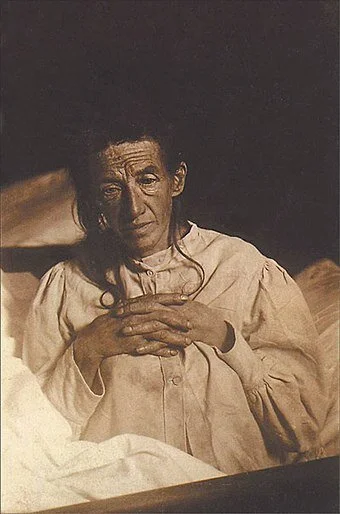
Dr. Alois Alzheimer's patient Auguste Deter in 1902. Hers was the first described case of what became known as Alzheimer's disease.
Dr. Arthur Kleinman, a professor of psychiatry and anthropology at Harvard University, calls this “enduring the unendurable” in his recently published book, The Soul of Care: The Moral Education of a Husband and a Doctor.
The book describes Kleinman’s awakening to the realities of caregiving when his beloved wife, Joan, was diagnosed with a rare form of early Alzheimer’s disease that causes blindness as well as cognitive deterioration.
Although Kleinman’s specialty is studying how patients experience illness, he wasn’t prepared for the roller coaster of family caregiving. Each time he adapted to Joan’s changing condition, another setback would occur, setting off new crises and fueling uncertainty and stress.
During 11 years of caregiving until Joan’s death, in 2011, Kleinman learned that no one who goes through this emerges unchanged. He became less self-centered, more compassionate and more aware of how the health-care system fails to support family caregivers ― the backbone of the nation’s long-term care system.
I spoke with Kleinman in mid-November at a caregiving panel. His remarks below are edited for length and clarity.
About his book. “I wrote it for a specific reason. I had spent my whole career as an expert on care. I myself was a psychiatrist who worked with patients with chronic medical disorders, [such as] chronic pain, diabetes, heart disease, cancer. I thought I knew it all. A veil of ignorance was raised from my eyes by my experience as a primary family caregiver.
“What is that veil of ignorance about? It’s about recognizing just how difficult family care is for [people with] dementia and, not just dementia, but many other problems.”
Daily responsibilities. “Let’s say in the fifth year, what was it like? I would get Joan up around 6 a.m. and take her to the bathroom. I have to handle the toilet paper, wash her hands, dress her to work out, take her to the bath and bathe her.
“I would shampoo her hair, dry her, pick out her clothes [for the day]. After that, I would prepare breakfast. As she got increasingly agitated, [that] became difficult because I had to sometimes hold her hands [to] keep her from throwing things or getting up and hurting herself. Because she was blind, she couldn’t see where she was. And then I would help her eat ― usually, at the end, feeding her ― and then take her to a room where we would sit and listen quietly to music.
“Maybe six, seven years into this, I would just sit there and hold her hands. And even that became difficult. So, I would tell her stories of the past … our stories. [Editorial note: This is just the beginning of a day full of similar tasks.]
“I discovered early on that the ritualization of acts of caring ― the dressing, bathing, all these things ― is a way of habit formation that keeps you going.”
Challenging masculinity. “We had a great relationship, but it was asymmetrical. For 36 years, my wife took care of me. I was raised as a classical male in the 1940s. When I showed an interest in cooking, my grandmother said to me, ‘What are you, a sissy?’ I was a tough kid on New York [City] streets. I had the most unpromising beginnings to be a caregiver. And my wife slowly socialized me to a different kind of masculinity, to be able to care.
“[Pay family members for caregiving] and you’ll see more men do it. Go to Australia, for example, where there’s very good compensation for care, and you’re astonished at the number of men who are caring for children, who are caring for elderly, and the like.”
Asking for help. “I have a wide circle of friends and colleagues, and [after the book] many of them said they had never realized what was involved. Part of that was my fault. I had a lot of trouble asking for help. Actually, at one point, I so exhausted myself that my kids, who are great, said, ‘You really need assistance.’ And they stepped in, as did my mother. My mother, who at the time was in her 90s.
“So, I had a great system of care around me, but I [also] needed a home health aide to [help with Joan and] keep myself going. I found an Irish woman … and she was fabulous.”
Maintaining presence. “In spite of that, I found it extraordinarily difficult in terms of other elements of care, one of which is presence. To keep your liveliness, your love, the presence of who you are going while you’re doing all this work of caregiving ― it is extremely difficult and demanding, but it’s crucial.
“When people ask ‘Why do you do [this]?’ the answer of most family caregivers I’ve spoken to is ‘Well, it was there to do. It’s got to be done, [so] you do it.’”
Learning about failure. “I was fortunate in life; I had a golden career. I have a personality that is like a bulldog, and when I start something I finish it. But there’s no finishing care. Every one of us [family caregivers], if we’re honest, you fail at a certain point. The frustrations build, anger mounts, you control your anger so you don’t injure the person you’re caring for. But you’ve got to somehow handle it inside you.”\
The soul of care. “I think what lies at the soul of care is a form of love. You will do everything you can for another because they mean so much to you. [But] it is also problematic, because we all have complex relationships and we’ve got other things going on in our lives.
“We endure, we learn how to endure, how to keep going. We’re marked, we’re injured, we’re wounded. We’re changed … [in] my case, for the better. If you had known me before my 11 years of care, you wouldn’t recognize me today. I was your classical hard-driving Harvard professor … as tough as any other professor at Harvard Medical School.
“I’ve redeemed myself through this experience, in a way.”
A call for change. “How do we strengthen caregiving? How do we do those things that will make it recognized as important as it is? It’s going to take a radical rethinking. Our health-care system [is focused on] entirely the wrong issues. Economics is not the most central aspect of care; it’s caregiving
“Do you know not a single one of the senior neurologists I went to with Joan who wanted to do everything diagnostically made the recommendation ‘You want to think about a home health aide now, even though you don’t need it right now. You have to look into how you’re going to reconfigure your house [for] someone who’s both blind and with dementia. [Or] a social worker is a great navigator of what the health-care system is about. You want to take advantage of that.’
“So, this is where I believe that our whole health care system has got to be rethought, from the bottom up with attention to care at its core.”
We’re eager to hear from readers about questions you’d like answered, problems you’ve been having with your care and advice you need in dealing with the health-care system. Visit khn.org/columnists to submit your requests or tips.
Judith Graham is a Kaiser Health News journalist.
Couldn't someone else change the lightbulb?

‘Forget-Me-Not,’’ by Chelsea Revelle, in the group show “Read Between the Lines,’’ at Fountain Street gallery, Boston, through Dec. 22

Llewellyn King: Perhaps the queen likes Trump

LONDON
I have a secret. I can’t verify it, but I can share it. It’s this: I think that Her Majesty Queen Elizabeth II likes President Trump.
Honestly, I’ve been studying video of them together and despite what the press here thinks, I believe she likes him. She’s amused by him. Poor woman, she deserves some amusement; she deserves some international figure who isn’t fazed by the honor of meeting the world’s most important monarch.
Consider what a relief it must be for the queen to see someone as unlearned in matters of protocol as Trump. Legions of heads of state and heads of government have leaned low over her hand while their wives have curtsied, often clumsily despite hours of practice. What a trial all this must be to a woman of 93, who has been subject to this since her ascent as queen, in 1952.
Elizabeth must be the hardest-working woman on earth. She's met thousands of stiff, boring men, day after day. She's been sung to by countless legions of well-scrubbed schoolchildren and has endured thousands of hours of native dancing, from the Maoris of New Zealand to the Ndebele of Zimbabwe.
The mere knowledge that you're to go to Buckingham Palace produces a kind of paralysis in most. The honor of the thing with the ghastly small talk that they feel they must be ready to speak can only make for a tedium that defies imagination. From great generals like America’s Dwight Eisenhower to such mass murderers as Romania’s Nicolae Ceausescu, each has taken the royal paw and whispered idiocies about the weather in London that day.
No one -- except possibly Trump -- meets the queen without hours of preparation. How to shake hands, how to check that the great moment hasn’t caused you to break out in an embarrassing sweat. Those clothes! Is it to be rented morning wear (Who owns that?) or something less formal. Has your wife ordered correctly? Nothing off-the-peg or too high-fashion -- except for Melania who, on this trip, appeared to be working as an haute couture model.
There’s evidence that the queen, after a long life of boredom, finds some relief in two American exceptions: Meghan Markle, the wife of her grandson, Prince Harry, and Trump.
Would the queen, one wonders, have opened Buckingham Palace to NATO for a reception if she hadn’t liked Trump who, for good or otherwise, was the man of the hour: the mad cousin, if you will, expected to metaphorically blow on his soup and say awful things, but still the most important member of the family.
I think that the gauche American president was a little reward for the hard-working Windsor (the family name, in case you’ve forgotten) who was dealing with yet another family crisis: An American woman has accused the queen’s son, Prince Andrew, of having sex with her when she was just 17 years old.
The rest of the NATO summit was all downhill. Trump left early when the media published and broadcast pictures of others at the summit chortling about him, including his host, Prime Minister Boris Johnson, the queen’s daughter Princess Anne and – oh, the villainy! -- Canadian Prime Minister Justin Trudeau, who regaled a small group with gestures, showing how Trump’s aides were open-mouthed at what their boss had said at his press conference.
Anne was already in bad favor with her mother for not joining the receiving line at the palace along with the her more dutiful brother, Prince Charles, and his wife, Camilla.
Those who made merry of Trump’s antics might beware. He’s a counterpuncher (which means vindictive) and someone already critical of NATO. A chortle at Buckingham Palace might irreparably harm the defense alliance.
Maybe the queen will have reason to regret her hospitality and warmth toward the boredom-breaking American president. Her majesty won’t then be amused any longer.
On Twitter: @llewellynking2
Llewellyn King is executive producer and host of White House Chronicle, on PBS. He’s based in Rhode Island and Washington, D.C.
Read this column on:
InsideSources
White House Chronicle
But is it edible?

“Survival Mode” (ceramic, plaster, vinyl, foam, pigments), by Linda Leslie Brown, in her show of the same name at Kingston Gallery, Boston, through Dec. 29
Linda Leslie Brown: Survival Mode
December 4–December 29, 2019
They overlooked the granite
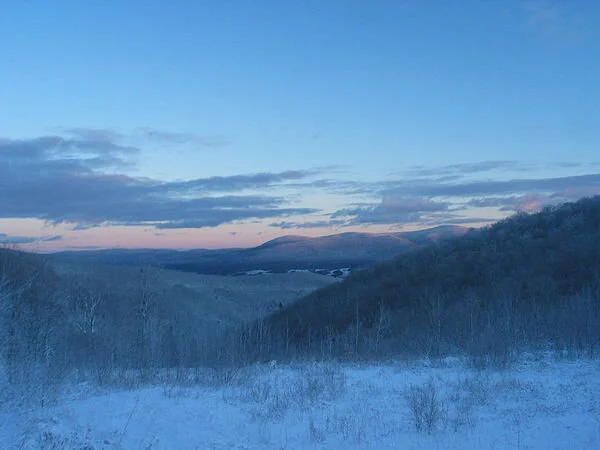
In the Berkshires, about now
"I had known something of New England village life long before I made my home in the same county {Berkshire County, Mass.} as my imaginary Starkfield; though, during the years spent there, certain of its aspects became much more familiar to me. Even before that final initiation, however, I had had an uneasy sense that the New England of fiction bore little -- except a vague botanical and dialectical -- resemblance to the harsh and beautiful land as I had seen it. Even the abundant enumeration of sweet-fern, asters and mountain-laurel, and the conscientious reproduction of the vernacular, left me with the feeling that the outcropping granite had in both cases been overlooked. I give the impression merely as a personal one; it accounts for Ethan Frome, and may, to some readers, in a measure justify it.''
From the introduction to the novel Ethan Frome (1911), by Edith Wharton
Maine's rockweed disputes

From Robert Whitcomb’s “Digital Diary,’’ in GoLocal24.com
The Boston Globe has published an article on a struggle on the Maine Coast between some coastline property owners and people harvesting that bubbly green or brown seaweed called rockweed (it grows on rocks) in the area between high and low tide. Rockweed is an increasingly valuable commodity used for fertilizers and food products. Its expanding harvesting raises some interesting issues about the rights of property owners vs. those who want to gather stuff from what fishermen and many others like to see as “the commons.’’
Complaining property owners don’t like the noise of rockweed harvesters operating power boats and mechanized equipment to remove the seaweed from rocks that might be only a few yards away from shoreline houses, more than a few owned by affluent summer people. And they and some ecologists complain that extensive stripping away of rockweed hurts the coastal environment. They say the harvesting, now a $20 million industry in the Pine Tree State, reduces habitats for juvenile lobster, cod, and other important species that use rockweed for protection and food.
The state’s Supreme Judicial Court has ruled that the harvesters must ask property owners’ permission before harvesting. “We agree that rockweed in the intertidal zone belongs to the upland property owner and therefore is not public property, is not held in trust by the state for public use, and cannot be harvested by members of the public as a matter of right,” Justice Jeffrey Hjelm wrote in the majority opinion. Of course, harvesters could ask for proof that the property owners’ deeds cover land extending to the shore.
The Maine Coast is long and convoluted, and so rockweed harvesting will continue to be very difficult to monitor.
As more human uses are found for animal and plant life along the shore, expect more such conflicts.
To read The Globe’s story, please hit this link.

John O. Harney: Are N.E. colleges ready for the next recession?

Maine Maritime Academy, in Castine, Maine. Its graduates incur high debt levels but have very low default rates.
From The New England Journal of Higher Education (NEJHE), a service of The New England Board of Higher Education (nebhe.org)
Times are already complex for higher education. In Massachusetts, 18 higher education institutions (HEIs) have closed or merged in the past five years. In Vermont, College of St. Joseph, Green Mountain College and Southern Vermont College all held their final graduation ceremonies in the spring. What would happen if a recession were to add to this uncertainty?
With that question in mind, NEBHE in mid-October convened a small group* of higher education leaders and economists to talk about “The Future of Higher Education and the Economy: Lessons Learned from the Last Recession.”
To be sure, some of the problems that have forced college closures are national, but New England (along with the rest of the Northeast and the Upper Midwest) faces specific challenges: most importantly, a daunting demography that spells trouble for college enrollments. By 2032, the number of new high school graduates in New England is projected to decline by 22,000 to a total 140,273, according to the Western Interstate Commission for Higher Education.
The NEBHE confab aimed to better understand the key challenges and consequences HEIs faced as a result of the so-called “Great Recession” and what can be learned from them. Among guiding questions:
What is the likely course of the economy over the next 18 to 24 months?
How prepared are institutions for the next recession?
What lessons did higher education learn from the Great Recession?
What conversations should HEIs—presidents, senior leaders, board leaders—be having now?
How fragile are higher ed institutions in New England and beyond?
What economic or other indicators should we be watching at this point in the economic cycle?
What’s the impact of reduced or stagnant state and federal government support?
How did the last recession impact families—and what does it mean for their ability to pay ever-increasing tuition and fees?
When another recession hits, are there adequate social safety nets to cushion the blow?
Which responses to changing demographics, customer preferences and new technology could help institutions avert closure … and even thrive?
The current state and future course of the economy
NEBHE President and CEO Michael K. Thomas opened the discussion asking for panelists’ perceptions of the state of the economy.
The U.S. has been enjoying the longest economic expansion in history. But looking worldwide, China’s economy is slowing, global manufacturing is suffering, and trading nations like Germany and Singapore are close to recession.
Nigel Gault, chief economist in the Boston office of EY-Parthenon, noted that the current expansion has been long (more than 10 years) but slow, not reaching 3% GDP growth in any year. Moreover, higher education enrollments have trended down while student loan debt has exploded. Tuition prices keep going up, raising increasing questions about whether the investment in higher education is worth it. And the demography will get even worse after 2025.
In addition, the international enrollment that kept some HEIs above water is under increased pressure. For international students, “it’s a combination of sensing they’re not wanted and facing more hurdles to get the necessary visa to come,” said Gault.
The overall result: fewer traditional-age college applicants.
“Back in the last expansion, enrollment was still growing 1 to 2%, which is not great, but this time, the expansion has been much slower overall, and enrollment growth is only half a percent to 1%,” said Thomas College President Laurie Lachance.
In her previous roles as the Maine state economist and as corporate economist at Central Maine Power Co., Lachance heard from businesses that bad economic policy is better than frequently changing policy. She wondered if the current whiplash of national policies could tip us into recession.
Gault shared the thought: “Bad policy and volatile policy is a toxic combination. Often the best thing for the economy is policy paralysis because people know the rules are going to stay as they are now and they can plan on that basis.”
What kind of recession?
Recessions can result from global market downturns or be sparked by outside geopolitical events such as the Gulf War in the early 1990s or the subprime mortgage crisis that began in 2007 and led to the 2008 Great Recession.
None of the panelists thought a 2008-magnitude recession would come soon. But Gault suggested the No. 1 risk is the intensification of trade wars between the U.S. and China or the U.S. and Europe. Gault added that China can no longer play the role of savior of the global economy as it did after the Great Recession.
Participants agreed that different kinds of HEIs would be hurt differently by different kinds of recessions. Not only would a recession caused by global downturn be very different from one caused by local or even institution-specific financial factors. At the family level, a recession centered around the financial sector would directly hit a different group of New Englanders than one centered on manufacturing recession.
The panelists imagined multiple scenarios. Some elite HEIs with significant endowments will be hurt for a short time with a market downturn, but they’ll be OK. Some state universities will be too big to fail. Some independent HEI leaders wonder if state governments will consider consolidating low-performing public campuses? If some public HEIs adopt free tuition models, their programs will be hard to resist for students whose parents lose their jobs in a recession. But a downturn would slow public investment in such programs.
If the past is a guide, any recession will bring some enrollment spurt, especially among older students because job options will be less plentiful, Gault observed. But unlike the tailwind during the Great Recession, the demographic headwind this time around, will probably result in a smaller enrollment spike. A modest recession that takes unemployment up to 6% could bring a less than 3% increase in annual enrollment, Gault said.
Even the recovery from the Great Recession varied by HEI based on the regions from which they drew students and whether their students were in programs that are cyclical or counter-cyclical, said University of Saint Joseph President Rhona Free. USJ’s latest focus has been nursing, teaching and social work, which were not especially hurt in 2008. The experience may have been different at liberal arts institutions that primarily offer disciplines, which in careerist times and places get reactions ranging from disparagement for having weak immediate career prospects to praise for being the key to critical thinking, noted Free, who was provost at Eastern Connecticut State University before joining USJ.
Endowment pressures
On average, 12% of operating budgets at HEIs are covered by endowments, though the figure at some wealthy institutions exceeds 50%, according to Timothy T. Yates, Jr., president and CEO of Commonfund Asset Management Company. He pointed out that most investment committees think of endowments by size, but the more important metric is how dependent institutions’ operating budgets are on endowment returns. He told of a private HEI where the share of operating budget covered by endowment went from 18% in 2008 to 15% in 2009. “That’s a huge hole in their operating budget and it took six years to recover.”
Moreover, most investment committees have not been happy with their recent return rates, Yates said. He explained that a market downturn on an endowment causes a drop in funding. HEIs generally draw about 5% from their endowments to support themselves. Yates said about 32% of HEIs have taken special-purpose appropriations from their endowments this year, up from 26% in 2017 and 18% in 2009. Some of these special appropriations have gone to marketing campaigns to drive enrollment; others have been aimed at addressing a deficit, Yates said.
“If people are drawing from their endowments with a one-time, one-year promise-we-won’t-do-it-again appropriation, I’m not sure that’s the way we should be operating. It’s potentially a Hail Mary activity.” said Susan Whealler Johnston, president and CEO of the National Association of College and University Business Officers (NACUBO).
Lachance saw all the high-finance handwringing as “first-world” problems. Her Thomas College, with just 800 undergraduates and a $13 million endowment, was on the brink of bankruptcy three decades ago. Now, the college, in the same Maine town, Waterville, as the richer Colby College (which has 2,000 undergraduates and an endowment of more than $800 million), makes tough business decisions to invest in only things that could lead to higher enrollment. Thomas draws just a few percentage points of its endowment annually for its operating budget.
Among new business models, Thomas College has added three-year degrees for high-performing high school students, and key employability programs such as a “golf guarantee” to make sure students, many the first in their families to attend college, graduate networking-ready and more familiar with practical realities of business leadership.
The demographic factor
In the 1970s and early ‘80s, when endowment values dropped sharply, high inflation exacerbated the problem, Yates said. But what higher ed had at that time was a big demographic tailwind with baby boomers starting to come into colleges. Baby boomers now represent about 25% of the population but nearly half of charitable giving.
Also in the ‘70s, higher ed saw the front end of more structured fundraising and the consolidation benefits of single-sex institutions merging. Plus, since there hadn’t yet been large tuition increases, there was room to fill classes with students who were willing to pay more. “In higher education, history has been kind to the continuation of bad business practices, for example, thinking you could just go on and on raising tuition,” Lachance said. But our expert panelists agreed that such slack was no longer in the system.
All in all, a lot of New England higher education’s fortunes can be tied to an aging population. Too few babies are being born to sustain our overbuilt higher education infrastructure. Adults, though underserved, are seen as possible saviors. Professors are aging too, and the older ones are less likely to buy into cost-saving technology and open-education resources that some HEIs such as Thomas College consider a key to success. College presidents, whose average tenure is less than seven years, and chief business officers are also heading toward a retirement cliff.
Johnston reflected on the challenges of HEI governance and added that a lot of board members are in their seventies and will be retiring soon. “Are they the big givers that institutions want to hold onto, or do we need new bring in younger, different thinkers?” Or is the best approach to encourage both, since senior trustees can help newer board members with the institutional context for board decision-making?
Young blood with a new perspective may also bring more honesty to boards. Roger Goodman of the Yuba Group and previously Moody’s (where he wrote for (NEJHE during the last recession) was surprised when a poll at a recent conference for higher education trustees showed nearly 65% believed their HEIs were on a solid financial footing. Such findings suggest a certain level of naivete or denial about the realities facing HEIs.
Then, there are questions about the whole higher education governance model. Board members’ connections to the world outside higher ed surely bring value. But does someone who’s made millions in private equity know the complexities of dealing with a shared governance model and the challenges of higher ed finances? And what about those trustees of public HEIs, some named to boards partly based on connections to governors and other appointing authorities?
Student loans and defaults
One of higher education’s biggest challenges is captured by a staggering number: $1.6 trillion. That’s the current total amount of student loan debt. And unlike other forms of consumer credit, student loan debt is only rising.
Phil Oliff noted that a fifth of federal loan borrowers are in default. There has been much discussion about how student loan debt itself may delay markers of adulthood such as buying a car or home, starting a family or starting a business. Default is an even bigger deal. Wages can be garnished. In some places, professional certifications can be stripped. And credit scores can be hit.
Notably and counterintuitively, the higher defaults are among students with low balances, often because they left college without completing a degree that would provide the earnings to repay their loans.
In Maine, not just community colleges but also lower-tiered university campuses, have higher default rates. Higher default rates seem to be more highly correlated with low graduation rates than they are with larger loan balances. For example, Maine Maritime graduates incur high debt levels but very low default rates, said Lachance.
Much was made of defaults among students at for-profit colleges. But enrollment at for-profits has plummeted since spiking around the time of the last recession.
Public investment in higher education
State funding of higher education has come back somewhat and state fiscal reserves have been built up since the Great Recession, said Oliff. But public higher ed gets disproportionately hit in recessions—as it is seen as a “balance wheel” for legislators struggling to write budgets during downturns.
In the last recession, Oliff added, the federal government created a specific pot of money for states to prop up budgets, plus policy decisions to increase the maximum Pell Grant award, veterans benefits and tax expenditures, such as credits for tuition and college savings incentives. The impact of the last recession, albeit significant, was softened by federal policy interventions. But there’s no guarantee that D.C. will act in the same way in the next recession.
The student debt issue also feeds into and grows out of the changing perceptions of the value of higher education. Increasing critiques of higher ed could affect the cyclical dynamic that has sent more students back to college during recessions. When a recession occurs, will some people question if investing in some or more higher education is a good strategy? Further, shorter-term credentials, rather than degrees, may be key in a changing economy, Gault said. Indeed, NEBHE and others increasingly focus on how “high-value” credentials can more efficiently prepare students for in-demand jobs than can full degree programs.
As an immigrant, USJ’s Rhona Free said she always saw “part of the American Dream is that your 18-year-old goes off to live on a campus and grows in many ways for four years, but the reality is that is largely a middle-class, upper-income, white American Dream. We have to innovate in getting all families to believe that this is achievable for their children and there’s a good return on investment. It will be less debt than if they bought a new car.”
Mergers and alliances
Johnston warned that presidents and boards should be talking about what alliances and mergers might mean to their institutions. But many do not want to talk about it, until they’re hard-pressed. Some of that is reflected in the sentiment noted by Goodman in which two-thirds of board members saw their HEIs as being on solid ground.
In addition, the process of mergers can put a lot of pressure on surviving HEIs. An institution facing the threat of closure might decide to get by for another year with an unsustainable discount, say 75%, to get the incremental student it wants. That can put a lot of pressure on other HEIs that are competing in the market. Johnston pointed out that one HEI in Virginia, determined to grow its enrollment, decided to go deeper into its waiting lists, which affected enrollments at competitors across the state, many of whom did not meet their revenue goals as a result.
“The business model isn’t working for us, and that requires innovation,” said Johnston. And it is explained poorly to the public and students with confounding concepts such as “tuition discounts” and “net prices vs. sticker prices.”
Students and families
When the discussion turned to the condition of social safety nets, Lachance lamented: “The rich are getting richer, the poor are getting poorer. When I was growing up, there were so many mills around us where a high school grad could do just fine. They’d get on a union wage scale and they had a great standard of living to send their own kids to college. Now it seems like the difference is based on your educational attainment. And if you don’t attend college and you don’t persist and graduate, you’ll never earn the return on that investment and you’ll be in debt.”
A recession will surely exacerbate the difference between those who have and those who have not, concluded Johnston. The question is not just which institutions will be most affected, but which students, for example, those with food insecurity. As President Free noted, HEIs’ food pantries and in-demand mental health services are now key social safety nets upon which many students already depend.
Moreover, “Kids who were watching their families go through the last recession may bring a separate set of anxieties with them if there’s another recession,” said Johnston. “They may dial back what they think they can do even if the circumstances don’t require it.”
John O. Harney is executive editor of The New England Journal of Higher Education.
* The panelists …
Rhona C. Free became the ninth president of the West Hartford, Conn.-based University of Saint Joseph in July 2015. During her time at USJ, she has championed the creation of the Women’s Leadership Center and guided the deliberations that led to the university’s decision to become fully coeducational in fall 2018. She joined USJ from Eastern Connecticut State University, where she served as vice president for academic affairs from 2007 to 2013 and provost from 2013 to 2015. She taught Economics at Eastern for 25 years before becoming an administrator.
Roger Goodman is a partner in the Boston office of The Yuba Group LLC, which provides independent financial advice and consulting to higher education institutions on debt and credit-related matters. Prior to joining the Yuba Group, he served as the team leader for the Higher Education and Not-for-Profit Team at Moody’s Investors Service, leading a team of 11 analysts responsible for credit analysis and credit ratings.
Nigel Gault is EY-Parthenon’s chief economist based in the Boston office. He was with Parthenon for a year before its combination with EY in August 2014. He advises clients on issues relating to their strategies, market growth and pricing. Gault was most recently chief U.S. economist at IHS Global Insight, where he was a seven-time winner of the Marketwatch Forecaster of the Month accolade for key economic indicators. He has also served as chief European economist in London for Standard & Poor’s/Data Resources and for Decision Economics.
Susan Whealler Johnston is president and CEO of the National Association of College and University Business Officers (NACUBO), a position she has held since Aug. 1, 2018. Prior to joining NACUBO, she was at the Association of Governing Boards of Universities and Colleges (AGB), where she served as executive vice president and chief operating officer, responsible for the day-to-day operations of the organization as well as strategic planning. Prior to joining AGB, she was professor of English and dean of academic development at Rockford University.
Laurie Lachance is Thomas College’s fifth president and the first female and alumna to lead the college in its 125-year history. From 2004 to 2012, she served as president and CEO of the Maine Development Foundation. Prior to MDF, she served three governors as the Maine state economist. Before joining state government, she served as the corporate economist at Central Maine Power Company.
Phillip Oliff is senior manager at The Pew Charitable Trusts in Washington, D.C., where he leads Pew’s work exploring the fiscal and policy relationships between the federal and state governments on a variety of topics, including how federal budget and tax changes could affect states, the role that federal and state finances play in higher education and surface transportation. He previously was a policy analyst at the Center on Budget and Policy Priorities, where he wrote reports on topics including education finance, state tax policy, states’ post-recession fiscal conditions and the impact of emergency federal aid on state budgets.
Timothy T. Yates, Jr. is president and CEO of Commonfund Asset Management and responsible for managing all aspects of Commonfund’s Outsourced Chief Investment Office (OCIO) business, which focuses exclusively on nonprofit institutions. Before joining Commonfund, he was an instructor of Spanish and Italian at Fordham Preparatory School in the Bronx, N.Y.
Don Pesci: Conn. truck tolls and searching for journalistic balance
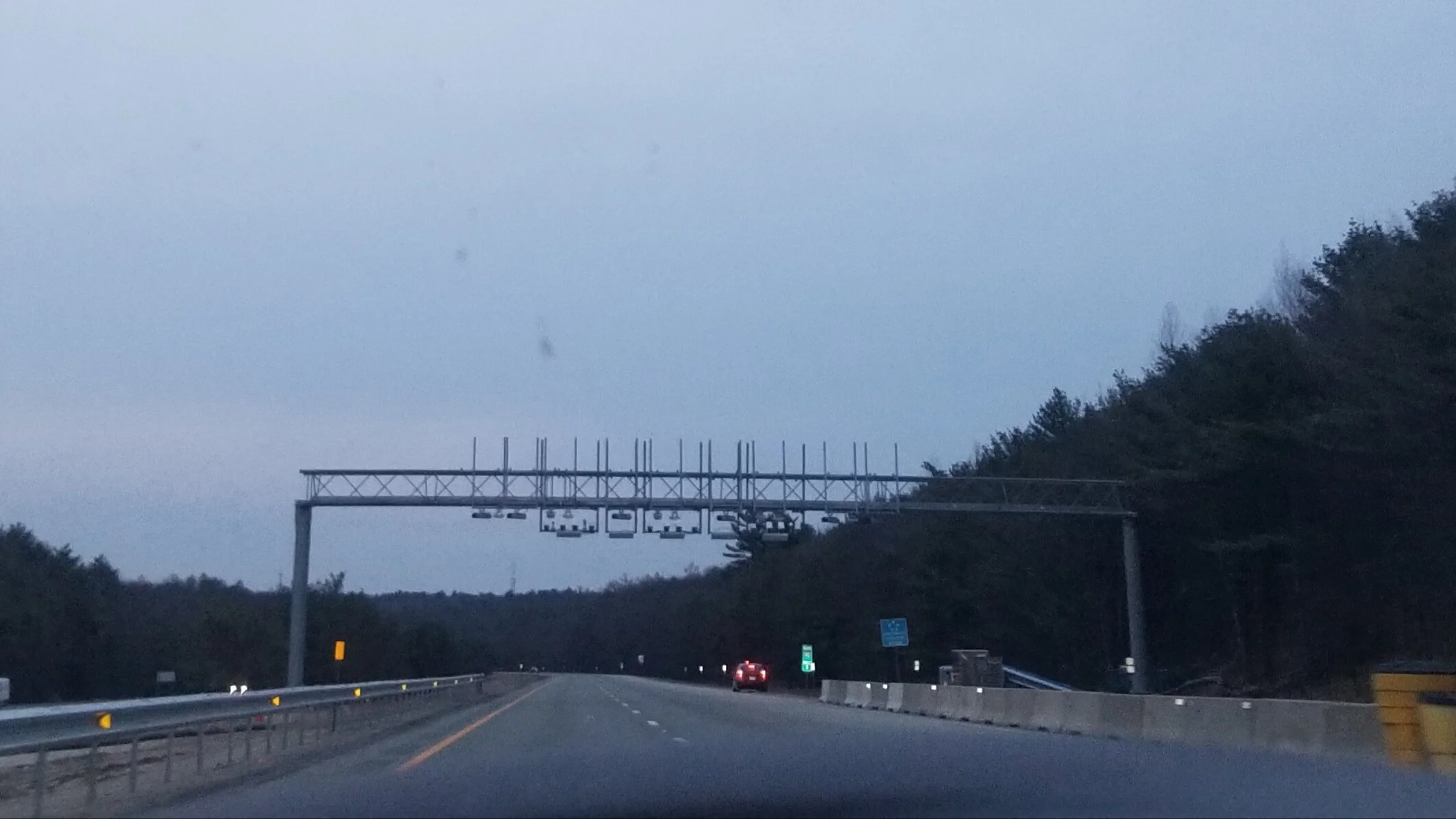
Truck tolls on Interstate 95 north in Rhode Island
Photo by Scientificaldan
Surely no one is surprised that Connecticut Gov. Ned Lamont has thrown his support to a trucks-only toll bill. {Rhode Island has already imposed truck tolls.}
Connecticut, according to a handful of media critics of the measure, needs a new source of revenue, pretty much for the same reason the prodigal’s son needed more dough from his dad. He overspent, drew down his allowance and took on debt, the way a sinking ship takes on water through a hole in its hull. If Dad can absorb the debt, there is no problem; he can in that case, quite literally, afford to be merciful. But if he himself has fallen on hard times, mercy comes at too dear a price. Connecticut is the prodigal’s father who has fallen on hard times.
The author of the new transportation initiative, we are given to understand from various news sources, is state Senate President Martin Looney, who seemed, only a short time ago, to have wrinkled his nose at the toll proposals then on the table for discussion, one of which was a trucks-only tolling scheme.
Democrats are now agreed that a new revenue stream is necessary and that Lamont’s rollout was defective. During his gubernatorial campaign, Lamont proposed truck only tolling; once elected, he proposed multiple gantries on major highways, about 58 gantries that would collect user fees from all road travelers. The new revenue source is necessary, Democrats continue to argue, because the Transportation Fund lock-box has been depleted – by legislators who, as it turns out, had diverted funds destined for the lock-box, dumping them into the General Fund so they might reduce the continuing budget deficits for which they absurdly do not claim responsibility.
This analysis barely scratches the surface, though it does point to the real problem. The real problem is that the ruling Democratic Party is disinclined to make long-term, permanent cuts in spending. Additional taxes, we all know, are always permanent and long term. If you raise taxes, you eliminate the disturbing need to cut spending. Additional ruinous taxation, at this point in Connecticut's descent into its three decades old death spiral, will help only politicians -- no one else.
Why are Democrats so averse to permanent, long-term cuts in spending?
They are operating, as we all do, on a pleasure-pain principle. All life on the planet tends to resist pain and welcome pleasure. Even a daisy raising its head to greet the morning sun operates on the pleasure-pain principle. So then, we should ask ourselves: which is more painful for the average Democrat legislator, incurring the displeasure of the many supportive special interests in his political universe, or incurring the much more defused displeasure of those people he claims to represent who will be adversely impacted by yet another tax?
Democrat legislators are supposed to represent the general good of the whole demos, not special interests such as state worker unions. That is the desideratum we find in textbooks on good government. If Connecticut could produce a Machiavelli and put him to work churning out editorials for most newspapers in the state, we should soon have a proper view of modern state politics. Chris Powell at the Journal Inquirer occasionally quotes Ambrose Bierce on this point. Bierce defined “politics” in his “Devil’s Dictionary as: “a strife of interests masquerading as a contest of principles. The conduct of public affairs for private advantage.”
If that seems cynical, it is. But perhaps the state could use a strong dose of cynicism, purely as an emetic. In the golden age of Athenian democracy, cynics were the world’s first hippies: They questioned all authority. It may seem cynical to say so, but a questioning and contrarian posture is proper to good journalism. In fact, it is indispensable to good journalism. How, without a touch of cynicism, should journalists go about comforting the afflicted and afflicting the comfortable? Journalism’s most deadly enemy is auto-pilot thoughtlessness and political sycophancy. There was a heroic journalist – whose name I have forgotten, so rare are instances of heroism in the field – who made it a habit of blowing his sources every five years or so because he feared falling into a slough of sycophancy.
Before we leave the question of cynicism, which is poorly understood, allow me to use the substitute term “contrarian.” We know a thing by contraries. If you want to know whether position A advances the common good, you cannot arrive at an adequate answer to the question without due consideration of position B -- B being “Not A.” Without a consideration of B, A will be accepted unreflectively without serious examination. In all areas of human life, we seek proportional balance. In Connecticut politics, we seek what has been called internationally a “balance of power.”
Indeed, I may observe parenthetically that both state and national constitutions provide a balance of power between three functions indispensable to democracy: the legislative power of writing laws, the executive power of executing laws, and the judicial power of judging laws. These powers should be separate and equal -- in a special sense. And they cannot be equal unless they are separate. Equality among the different departments is arrived at when each department is prevented from encroaching on the constitutional prerogatives of the other two departments. The powers are divided functionally so that each function may retain its integrity. That is constitutional balance. It is also good government.
The Sad Estate of Connecticut's Fourth Estate
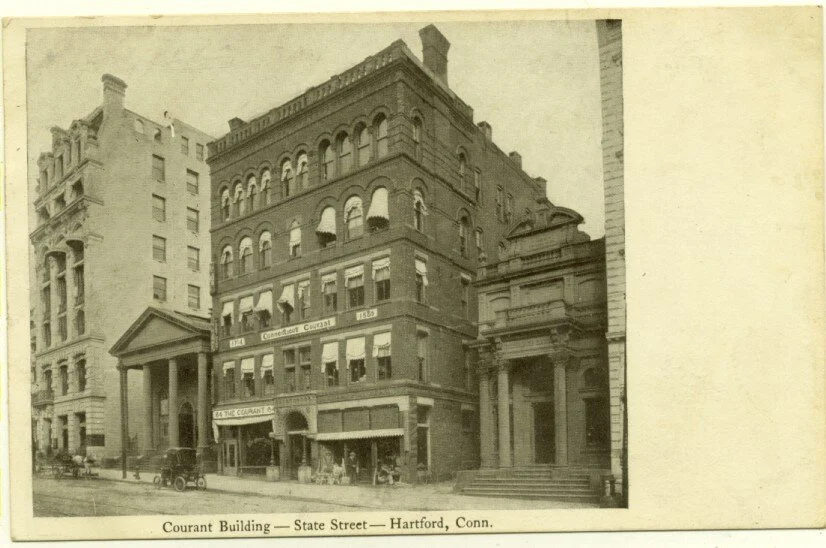
The old Hartford Courant Building circa 1900. The Connecticut Courant began as a weekly on Oct. 29, 1764, started by Thomas Green. The daily Hartford Courant, which remains after many decades state’s biggest newspaper, traces its existence back to the weekly, thus claiming the title of "America's oldest continuously published newspaper", and adopting as its slogan, "Older than the nation."
It is important to bear in mind an adversarial balance when discussing, say, the proper relationship between political parties or the proper relationship between government and the media.
There is universal agreement that the relationship between the Trump administration and the national media is an adversarial one. Some wonder, however, whether in this instance the adversarial relationship is too much of a good thing. A judicious journalistic balance weaves like a battered boxer between too much and too little. Moderation in all things -- though Trump seems to be unfamiliar with the concept -- is still the golden rule. Then too, the chief pursuit of good journalism is the objective, politically unadorned truth, which ought never to be sacrificed to a strife of interests. Was the relationship between the media and the Obama administration an adversarial one? The frisson as Obama did what some saw as him pledging to do -- remake the United States from the bottom up -- was, as many of us remember it, mild to non-existent.
Coming back to home plate, is the relationship between Connecticut’s media and what we perhaps should call the Weicker-Malloy-Lamont administration – all three administrations favoring tax increases over long-term, permanent cost reductions – an adversarial one? On important questions of the day, are Connecticut editorialists and commentators truly objective? How many editorials in Connecticut papers may be described as objectively conservative?
Don Pesci is a columnist based in Vernon, Conn.
'Metallic frankness'

“Winter walks up and down the town swinging his censer, but no smoke of sweetness comes from it, only the sour, metallic frankness of salt and snow.’’
— Mary Oliver (1935-2019), a famed poet who lived much of life in Provincetown, on the tip of Cape Cod.
Tracey L. Rogers: Plantation tours can helpfully lean us into discomfort
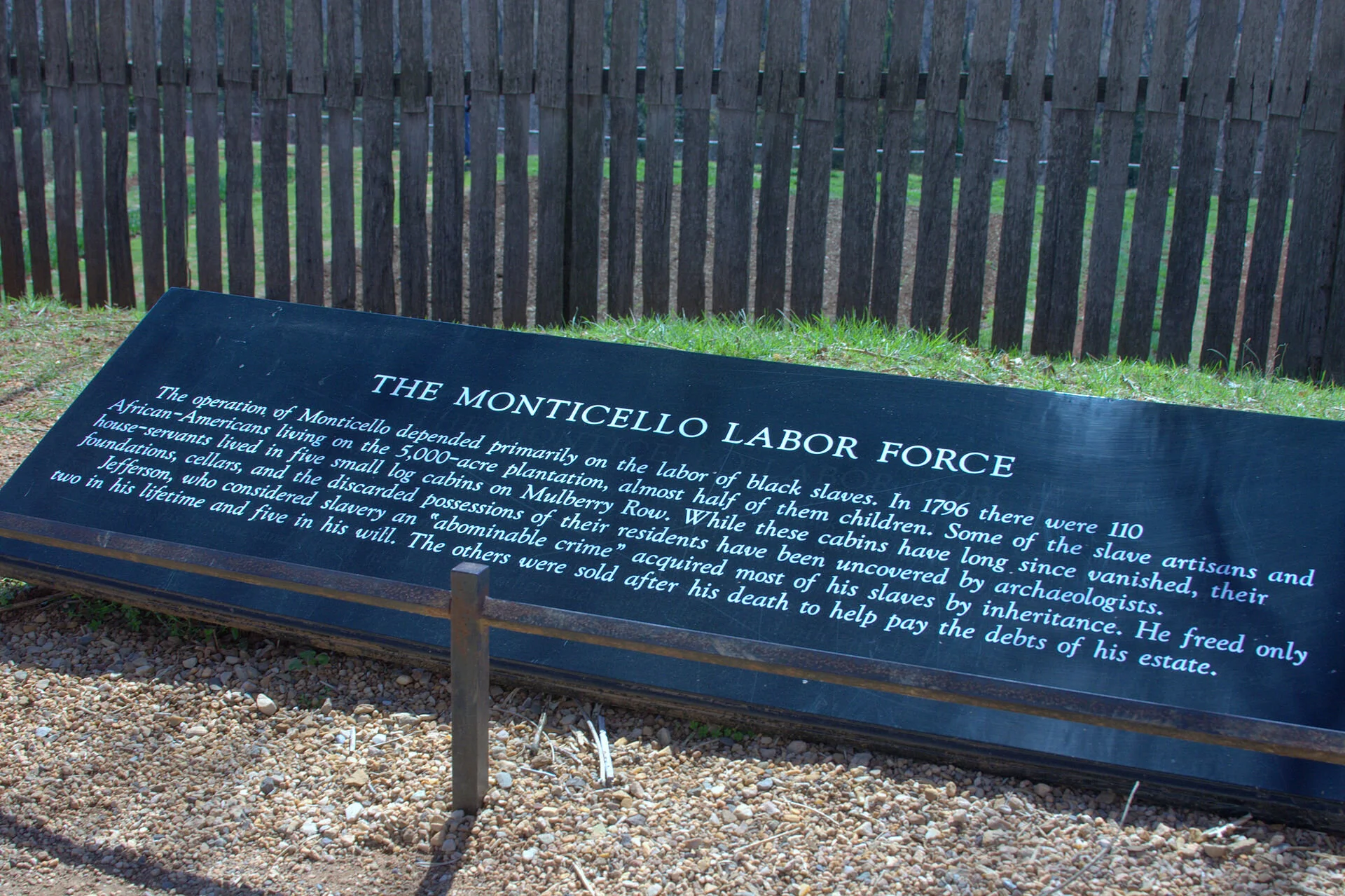
— Photo by Allspamme
Via OtherWords.org
Thomas Jefferson may have written that all men were created equal in the Declaration of Independence. But he, along with so many of his fellow plantation owners, was still complicit in the institution of slavery.
Jefferson’s famous Monticello plantation, in the foothills of Virginia’s Blue Ridge, a picturesque venue most popular today for hosting weddings and other special occasions, was a place of terror for those African captives who would never gain freedom in Jefferson’s lifetime.
During a recent visit to Monticello, I learned that Jefferson personally kept upwards of 600 people in bondage. It was ironic — the very man I was taught to revere in history class kept my ancestors as property.
My trip to the plantation was emotional. I had heard stories of the slave quarters along Mulberry Row, and the recent discovery of unmarked graves of enslaved people who died at Monticello. Seeing the place firsthand was an altogether heavy experience.
But I also felt something else on that trip — something surprising: relief.
I had been certain that the dark history of slavery would be watered down at a tourist destination like Monticello. But thankfully, that was not the case. Instead, I was impressed by the site’s thorough, honest, and critical depiction of slave life at Monticello.
Our tour guide shared the brutality endured by slaves along Mulberry Row. He spoke of how they lived, and how they were severely punished to the point of death.
Our tour guide retold the radical truth of what my ancestors experienced under the purveyance of Thomas Jefferson. I was simultaneously angered by what I learned and satisfied that this history was offered in a way that demanded compassion and understanding by those present.
Yet, I was also appalled by the comments and questions of some of the white people on the tour. One man asked if Thomas Jefferson had been a “kind slave owner,” to which our tour guide — himself a white man — responded there was no such thing.
Another woman commented that the slave quarters weren’t “so bad.” Our tour guide responded with a simple question: “Would you live there?”
Such questions are not uncommon, and reports abound of white visitors complaining about having to confront facts about slavery during plantation tours. All this makes it abundantly clear that the history of slavery needs to be taught with unwavering honesty, whether when visiting a plantation or developing school curricula.
White America needs to acknowledge that, like it or not, racism is alive and well today because of the horrors of our past that helped shape who we are as a society. Racism is as American as Apple pie; to shirk away from the awful details is as shameful as the details themselves.
After 250 years of chattel slavery, and another 100 years of Jim Crow, one can only imagine the trauma that Blacks have endured. Imagine our ancestors being bought, sold, beaten and separated from their families. Imagine the lynchings that took place in this country, and the justice that went unserved.
If it’s difficult for white Americans to discuss racism, how must Black Americans must feel?
In her book White Fragility, author Robin DiAngelo wrote that many white people lack the “racial stamina” to even engage in such conversations. As an activist, I would have to agree. But it’s hardly impossible, as the dedicated white tour guide at Monticello showed. And it’s worth it.
It’s been 400 years since the first enslaved Africans arrived on these shores, and that’s why we must talk about the history of race in America. In doing so, while bravely leaning into our discomfort, we heal. We reconcile our history. We’re no longer beholden to the guilt and shame of the past. Humanity is restored.
Tracey L. Rogers is an entrepreneur and activist living in Northern Virginia.

Connecting New England students and employers

Flag of the New England Governors Conference
From The New England Council (newenglandcouncil.com):
BOSTON
“The New England Council is pleased to share with you the third edition of ‘Partnerships for the Talent Pipeline: Directory of New England Higher Education & Industry Partnerships.’ This updated version of the directory, which was first released in the fall of 2016 and updated in 2018 – highlights nearly 100 programs affiliated with colleges and universities throughout New England which aim to connect students and employers in order to strengthen our regional workforce. As educators, employers and community leaders wrestle with how to best prepare students for a successful career, these innovative models are being put to the test around our region to ensure that education meets changing demands.
“For the New England economy to continue to grow and for our region’s businesses to compete globally, employers of all types and sizes are dependent on a skilled workforce. In addition to traditional classroom training, educators and employers alike have embraced partnerships that bring together industry and higher education to work collaboratively to prepare students for career success. The New England Council has worked with our members to collect information on partnerships that are designed to develop a skilled talent pipeline and provide a mutual benefit to both students and businesses. These partnerships go beyond the traditional internship model to provide a variety of experiential learning opportunities, to develop curriculum that will best prepare students for future job opportunities, and to develop pipelines for post-graduation employment.
“The Council hopes that this updated directory will continue to be a useful resource to policymakers and other stakeholders, and will encourage employers and educational institutions to continue to pursue and expand partnership initiatives that develop our region’s talent pipeline.’’
The directory is available on our Web site and will be updated periodically as we learn of new partnerships in the region. Hard copies are also available upon request. If you have programs that you think could be included in future versions of this directory, please contact Taylor Pichette at tpichette@newenglandcouncil.com
Dining on the rails
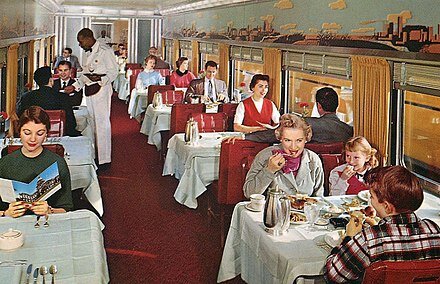
From Robert Whitcomb’s “Digital Diary,’’ in GoLocal24.com
One of my fondest travel memories is eating in train dining cars, with most of my experience going way back to before Amtrak, on the likes of the New Haven, New York Central and Pennsylvania railroads. The food and service were remarkably good, considering the lines’ dubious finances and it was pleasant to watch the passing scenery through the window and brood. Compared to other modes of transportation, trains are good to eat on, read on, and, especially, brood on. And you can go for walks.
A drawback, or an allure, of the dining cars is that you sometimes have to share a table. Practiced train travelers learn how to determine whether the other person(s) wants to chat, or be left alone, and how to politely convey whether you want to talk. Decades later, I remember some of these conversations.
Sadly, Amtrak is ending traditional dining-car service on many overnight trains, starting with eliminating those east of the Mississippi, citing the desire by Millennials for more “flexible” and “contemporary’’ eating options. Another treasure of gracious living is derailed.
For a good overview of Amtrak’s current status, please hit this link.
Print against the tide

At the entrance of David R. Godine Inc.’s warehouse, in Jaffrey, N.H.. Godine is a small, high-end book publisher based in Boston and famed for both the content of its books and for their physical beauty.
— Photo by William Morgan
Night work

“The Music Pavilion at Versailles, Moonlight“ (oil on canvas), by Henri Eugene Le Sidaner, in the show “Highlights from the Permanent Collection: Nocturne ,’’ at the Art Complex Museum, Duxbury, Mass., through Jan. 12.
The museum says that "Nocturne paintings" were “originally defined as those that depict scenes evocative of the night, or portray subjects in a veil of light or at twilight. Nowadays, the term tends to refer to any paintings of nighttime scenes. Nocturne paintings are moody and alluring, capturing the unique tranquility that nighttime brings. Nocturne features works by a variety of artists across different countries and times.’’
Religion -- starting conflict and ending it

A common symbol of Christian ecumenicalism
To members and friends of The Providence Committee on Foreign Relations (thepcfr.org; pcfremail@gmail.com)
On Thursday, Dec. 5, The Providence Committee on Foreign Relations (thepcfr.org; pcfremail@gmail.com) will welcome as its dinner speaker, who directs the Initiative on Religion, Law, and Diplomacy, and is visiting associate professor of conflict resolution, at The Fletcher School of Law and Diplomacy at Tufts University. She titles her talk "God, Soft Power, and Geopolitics: Religion as a Tool for Conflict Prevention/Generation".
Dr. Prodromou is also a non-resident senior fellow and co-chair of the Working Group on Christians and Religious Pluralism, at the Center for Religious Freedom at the Hudson Institute, and is also non-resident fellow at The Hedayah International Center of Excellence for Countering Violent Extremism, based in Abu Dhabi.
Dr. Prodromou is former vice chair and commissioner on the U.S. Commission on International Religious Freedom and was a member of the U.S. Secretary of State’s Religion & Foreign Policy Working Group. Her research focuses on geopolitics and religion, with particular focus on the intersection of religion, democracy, and security in the Middle East and Southeastern Europe. Her current research project focus on Orthodox Christianity and geopolitics, as well as on religion and migration in Greece.
Schedule:
6:00 - 6:30 PM: Cocktails
6:30 - 7:30: Dinner (salad, entree, dessert/coffee)
7:30 - 8:30: Speaker Presentation
8:30 - 9:00: Q&A with Speaker.
Please let us know if you have any dietary restrictions.
For information on the PCFR, including on how to join, please see our Web site – thepcfr.org – or email pcfremail@gmail.com or call 401-523-3957

James P. Freeman: Cape Cod winter storms -- curiosity and ferocity


“Winter is begun here, now, I suppose. It blew part of the hair off the dog yesterday & got the rest this morning.”
-- Mark Twain (1892)
The old logs tell it all.
“Blizzard ’05 worst on Cape in my life…” reads the entry on Jan. 23, 2005 in the Weather Wizard’s Weather Diary. So hand-wrote meteorologist Tim Kelley. Indeed, it was epic.
That personal proclamation reflects a larger generational curiosity about the wicked winter weather on Cape Cod. For centuries, the unpredictable oscillations of nature’s fury have provoked vigorous debate about the worst storm to ravage the very exposed peninsula.
Hurricanes come and go. Blizzards stall and meander. Winter’s ferocity is more spellbinding than summer’s clemency. And so the lore and allure of the Cape’s cold-weather excitement – especially nor’easters, sometimes with whiteouts -- is a rich narrative of meteorology, history and geology. And some mythology. Let the debates begin…
“A storm in the fall or winter is the time to visit it…”
--Henry David Thoreau, Cape Cod (published in 1865)
A Cape native, Kelley radiates enthusiasm about the weather like loose electricity. His stacks of spiral, cardboard-bound, black-inked journals date back to March 3, 1992, when he first began broadcasting with then-start up New England Cable News (now sharing production facilities with NBC10 in Boston). With more than 10,000 daily reports, Kelley calls them “probably the most gratifying part of my career.” Reviewing them is an exercise in excavation: They are a captivating analog history, a sober juxtaposition against the blitzkrieg of digital noise emanating from today’s televisions, laptops and mobile phones. His entries about the Cape are particularly illuminating.
Take the Blizzard of Jan. 22-23, 2005, perhaps the most notorious blizzard in recorded Cape history. Kelley’s observations are stark and emphatic. He recalls that all of Nantucket was “without power,” “80 mph gusts” lashed the coast, and “31 inches” of snow buried Hyannis. (The Cape Cod Times reported 10-to-15-foot drifts and 27-foot swells.) Another entry reads “Benchmark.”
In New England meteorological lingo the benchmark is 40°N 70°W and helps identify the impacts that a winter storm might have on a region. When the center of an intense low-pressure area moves directly across those coordinates in the winter southeastern New England coastal communities can often expect a massive snow event, if it is cold enough. The Cape has been in the bull’s eye on many occasions.
“The very snow in the air had a character of its own…the snow of the outer Cape.…”
--Henry Beston, The Outermost House (1928)
Kelley brings an encyclopedic knowledge and perspective to storms big and small. Maybe surprisingly, then, he is not convinced that The Blizzard of 1978 warrants its place on a list of top winter tempests in Cape Cod history. In fact, he calls that one a “dud” – on Cape Cod. But one man’s dud is another man’s bomb.
Make that bombogenesis.
Don Wilding, a Cape Cod historian, writer and speaker, thinks otherwise. While other winter beasts certainly merit consideration, “nothing tops ’78,” he asserts. That storm (Feb. 6-7) did not qualify as a blizzard on the Cape, certainly not for the snow, which \changed to rain. Rather, this classic nor’easter was a severe wind (92 mph recorded in Chatham) and tidal event (14-½ foot tides measured in Provincetown). “It was a different experience on the Cape” than farther west, which got very deep snow, Wilding notes.
More of a winter hurricane (a definitive “eye” passed over the Outer Cape), the storm stalled out and hit at high tide on a new moon (astronomically high), when tides would have been “only” four feet above normal. More so, it ravaged the coast, most dramatically rearranging Coast Guard Beach in Eastham and Nauset Spit (later storms would inflict similar damage on Orleans and Chatham beaches).

Satellite view of the Blizzard of ‘78
“The storm had been terrific…”
-- Joseph C. Lincoln, Cape Cod Yesterdays (1935)
That blockbuster storm evoked an existential threat that presaged future peril. Its lasting legacy was less physical and more psychological. True, its coastal savagery surprised many forecasters at the time (grainy black and white images from space were still relatively new accessories, and there wasn’t much sophisticated computer guidance). But, more importantly, it shocked most sensibilities. When the storm swept Henry Beston’s long-revered “Outermost House’’ out to sea it affected Cape Codders’ psyche. The tiny structure was named “The Fo’castle,’’ was designated a literary landmark by the federal government in 1964, and was seen as a sturdy symbol of the new environmentalism of the 1970s. Tempests before that storm were recalled mostly for their maritime death and destruction. The shoreline was mere collateral damage.
Henceforth, the idea of coastal areas being routinely imperiled became front and center. Advances in climate-related technology and early-warning alerts probably fed that psychology. The ’78 monster became a psychological benchmark.
Still, before the days of Doppler radar and ensemble modeling, the most memorable Cape storms were chronicled by journalists, not in meteorologists. Old newspapers, magazines and books told the story, not the latest GOES satellite composites. And back then, words, not images or metrics, filled minds and bled hearts. That makes Kelley’s written work so compelling today.
Ironically, Thoreau, who wrote what may be the most memorable manuscript about Cape Cod, is not among the scribes who captured the exquisite cruelty of winter on the barred and bended arm; none of his four trips to the Cape in the mid-1800s occurred in winter.
“A winter-closed house gives the effect of mournfulness.”
--Gladys Taber, My Own Cape Cod (1971)
Henry Beston was more daring. His eyewitness accounts are riveting. During a year-long stay at the Outermost House, in Eastham, he wrote in January 1927, “So began the worst winter on the Cape for close upon fifty years, a winter marked by great storms and tides, six wrecks, and the loss of many lives.” He was enthralled by the fierce gale that hit on Feb. 19 and 20, describing a “convulsion of elemental fury.” Later, in March, he details the wreck of the three-masted schooner Montclair off Orleans. (Her bones still reappear after a good winter thrashing.)
Then there is the account of the terrible Portland Gale, in 1898. Much of Joseph C. Lincoln’s work was set in a fictionalized Cape Cod. But Lincoln remembered the Nov. 26 and 27 storm, so named for the sinking of the side-wheel steamer Portland, plying between Boston and the Maine city. Storm damage was catastrophic. There was tremendous damage to the Provincetown waterfront and its fishing fleet. Regionally, more than 400 people perished and 150 boats were destroyed. Nearly 200 people went down with The Portland off Cape Ann. The exact number isn’t known because the ship manifest was lost. Among the dead were a newly married couple of Lincoln’s acquaintance. Eerily, he memorializes, “… the young wife’s trunk, with all her bridal finery, was washed ashore at Orleans.” The bodies of the couple were never found.
The late-Noel Beyle, local author and agitator, relished winter weather. His black and white photo-essay booklets on all things Cape Cod are tinged with gallows humor. “The real test of wills,” he thought, “is whether the weather is hot or cold! That is the true contest on Cape Cod, regardless of the season, and it’s paramount most every winter.” April may be the cruelest month, he joked. Consider the April 6-7 blizzard that blanketed the Cape in 1982. Its “north-to-northwest gale” and full-moon tide caused “severe erosion along parts of the Bay shoreline.”
“It does get a bit rough at times… to tough out all these fun winter storms!”
--Noel Beyle, Cape Cod Weather Oddities (1982)
Of course, other storms deserve honorable mention. Some bloggers on americanwx.com rank the Jan. 26-27, 2015 blizzard (named Juno by The Weather Channel) right up there with the 2005 blizzard. (Sandwich recorded 34.4 inches of snow). The Feb. 8-9, 2013 “extreme nor’easter” Nemo bore resemblance to its 1978 ancestor (it was a benchmark storm too). Three notable storms from the last century weren’t the beneficiaries of the 24/7 news cycle or social-media promotion: the Feb. 17-18, 1952 nor’easter (S.S. Pendleton disaster); the March 2-5, 1960 blizzard (record Nantucket snowfall of 31.3 inches); the Feb. 9-10, 1987 storm (a rare Cape-only blizzard; at the time, said to be the worst blizzard in 30 years). Surely, over time, their standings will be diminished.
Much was made of the three roaring nor’easters that struck the Cape in March 2018 over the span of just 11 days. All three storms were essentially benchmark events. And the coastal erosion that the trio caused was depressingly brutal at such places as Nauset Beach in Orleans. Their formation and subsequent track was, weather.com reported, unusual but not unprecedented. The three potent systems that formed in early 2015 were of similar occurrence; they also passed near the benchmark. Storms, like history, can repeat themselves.
Before he became known as “Dr. Beach,” Stephen P. Leatherman wrote Cape Cod Field Trips, published in 1988. A geologist by training, his expedition underscores that the Cape is a relative geologic infant, a product of the last Ice Age, which ended about 12,000 years ago. He traces its origin and evolution from “yesterday’s glaciers” to “today’s beaches.” It is exclusive real estate.
The Cape’s location makes it a desirable target for storms. It’s on the edge of a continent and on the edge of an ocean. It also sits about half-way between the equator and the North Pole, and thus in a region where tropical and arctic air clash. Throw in a fluctuating jet stream and the Labrador Current and Gulf Stream, too. As a consequence, weather comes from all directions. Tim Kelley boasts that “Cape Cod has the most interesting weather on earth.” Especially the winter variety.
“This storm, it is true, had extraordinary credentials.”
--Robert Finch, The Outer Beach (2017)
In many ways Kelley himself bridges past and present -- yesterday’s journalist and today’s meteorologist. His state-of-the-art tools allow him unparalleled access to high-tech prediction but his old-school weather logs allow him deep access to recollection -- a key intangible that gives his on-air presentation the depth of soul. Something we need now. Even when the power goes out.
In a data-driven world, we also demand nontechnical, accessible explanations of events that just might be beyond our ability to explain and act on. Meanwhile, there’s the age-old drama/conflict: man vs. environment. In any case, Kelley reminds us, “Weather is a balance of extremes; ‘normal’ is abnormal.”
How will Boreas, Greek god of winter, and other divines manage the ferocity of storms not yet dreamed up? For those seeking comfort, take solace in Mark Twain’s universal exasperation. Trapped for days indoors during the Blizzard of 1888 and his wife unable to travel, he wrote Olivia the following:
“… a blizzard’s the idea; pour down all the snow in stock, turn loose all the winds, bring a whole continent to a stand-still: that is Providence’s idea of the correct way to trump a person’s trick.”
xxx
James P. Freeman is a New England-based writer, financial adviser and former banker. He is a former columnist with The Cape Cod Times and New Boston Post. His work has also appeared here as well as in The Providence Journal, The Cape Codder, golocalprov.com, nationalreview.com, and insidesources.com. A version of this essay has appeared in Cape Cod Life.
Boarding school art
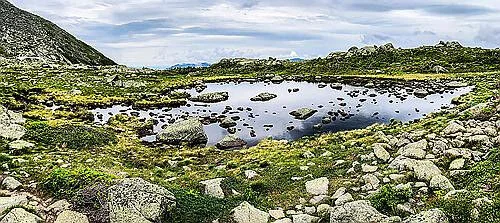
Kelly McGahie, “Star Lake’’ (digital photograph), by Kelly McGahie, in the show “Hidden Treasures 5,’’ at Phillips Exeter Academy’s Lamont Gallery through Dec. 14.
This exhibit features the work of Phillips Exeter Academy employees, faculty and students across departments. The pieces span media as well, including stained glass, watercolor, photography, fiber arts and more. The artists use their different media to reflect on exploration, expression and the role of the arts at the famous boarding school in Exeter, N.H.

Water Street in downtown Exeter, an affluent town founded in 1638 and named after a town in Devon, England.

Llewellyn King: Homelessness in America at crisis point

The British call it sleeping rough. We call it for what it is: homelessness.
It starts the day when all the support systems -- fragile as they often are -- fail. When there is no home to go to; no bed to sleep in, no meal to eat, no toilet to use, no place to wash even a face -- just the hard, cold and often wet streets that offer no succor. The hospitality of a concrete sidewalk is scant.
That is what faces 4 million luckless children each year in the United States, according to Renee Trincanello, chief executive officer of Covenant House Florida, which operates shelters in Ft. Lauderdale and Orlando. Once they hit the streets, they are vulnerable to every horror that can happen to a child, including sex trafficking. “They also are used by drug dealers to inculcate a habit,” Trincanello told me.
In the United States, homelessness is at a crisis point. Cities are clogged with the homeless from coast to coast. If you travel a lot, as I do, you are aware of how homelessness is at its most conspicuous where there is prosperity -- a byproduct of high rents in cities like San Francisco, Austin, New York and Boston.
Very close to the Capitol in Washington, around Union Station, the homeless sleep on the sidewalks, sometimes with the barest needs met by charities -- needs like a sleeping bag, if they have been identified and are lucky. Train stations are a mecca for the homeless because they have public toilets and offer warmth. But Union Station has removed most of its seating to keep out the homeless.
To draw attention to the misery and extreme danger of children sleeping in the streets, and to raise money, Covenant House branches in the United States, Canada and Latin America organize sleep outs. Once a year, executives like my friend Jan Vrins, managing director and leader of Navigant’s global energy practice, takes a sleeping bag, puts it on top of a cardboard box and gets a hard night’s rest on a parking lot pavement.
Vrins says, “It isn’t fun to sleep in a concrete parking lot on a carton box with a sleeping bag. But the time we spend with these youths before we sleep out is wonderful. First, we have dinner with them and have sessions where they share their stories.” Afterward, the children are safely tucked up in the shelter and the adults repair to the parking lot.
In every case, Vrins says, something has happened to them. “Their families have broken up, sometimes because of addiction; there have been storms, as in Puerto Rico, and they end up in the shelters. So, climate change is leading to more kids on the street,” he says.
Vrins says that he was introduced to Covenant House by an executive from Florida Power & Light. “That was 11 years ago, and I got hooked,” he says. Now he is Covenant House Florida’s vice chairman.
Trincanello, who is married with two daughters, has spent her career with Covenant House. She told me that her father wanted her to be a lawyer; she pushed back and became a social worker.
If you sign up to sleep out with Covenant House, whether it is in chilly Toronto or as, as Vrins notes, more benign Florida, you will join some of the cream of America’s executive talent from Accenture and Black Rock, to Cisco, KPMG and other companies. In fact, prominent companies field “teams.”
Vrins, who is married with two sons, heads the Navigant team. Each sleeper is expected to raise $1,000 for Covenant House. This year, he laid down on the concrete in Ft. Lauderdale on Nov. 26. He says 130 people slept out there and raised $270,000.
A native of the Netherlands, Vrins is one of those gregarious people who puts his arms around you with his smile. He speaks with passion and love of the homeless children in their crises. Trincanello, whom I have not met, has a voice as warm as a winter hearth. I can imagine it melting fear in a scared child. Together they do work which is not a molecule short of noble.
Vrins says of sleeping out: “When you wake up in the morning, you feel blessed. When homeless kids must look for the next place to spend the night, you feel blessed.”
Llewellyn King is executive producer and host of White House Chronicle, on PBS. He’s based in Rhode Island and Washington, D.C.
On Twitter: @llewellynking2
What's historic in Newport?

Shops along Newport’s Thames Street near Waites Wharf
From Robert Whitcomb’s “Digital Diary,’’ in GoLocal24.com
The main owner of the western end of Waites Wharf, in Newport, and the owners of The Deck restaurant, Riptides bar and Dockside nightclub on the wharf, want to demolish those establishments to make way for a 150-room waterfront hotel. Some people want to block the demolition with the argument that the buildings are somehow historically significant, which seems a stretch to me.
The bigger issue is whether it’s a good idea that even more of downtown Newport’s storied waterfront be blocked off by hotels and condos. And a longer-term issue is what rising seas, which already imperil the city’s Point neighborhood, might do to the likes of Waites Wharf.
Please hit this link to read a good article in the Newport Daily News article on this.