
Vox clamantis in deserto

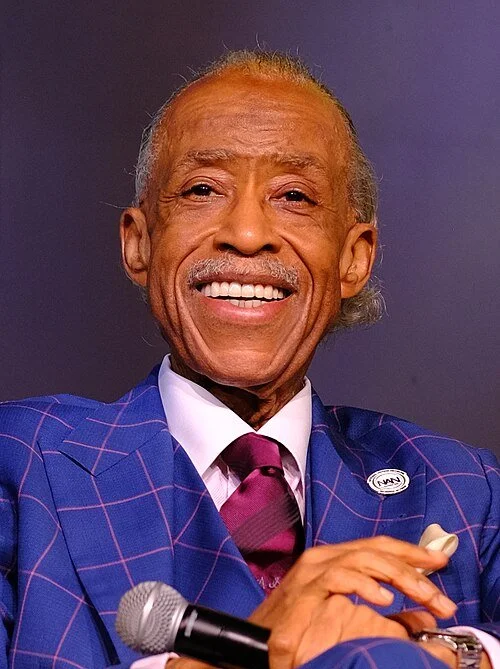
Public transit entertainment

“Angels Among Us” (photo), by Chelsea Bradway, in the show “The Big Tent: HCA Members Show,’’ at the Hopkinton (Mass.) Center for the Arts, through Jan. 9.
The show displays the work of 30 Hopkinton Center for the Arts artists from 13 communities, featuring art in a wide range of mediums and styles.
Sarah Anderson: Comeback for Toy 'R' Us after being ravaged by rapacious private equity firms?

A Toys ‘R’ Us store in Auburn, Mass., on June 24, 2018
For many years, Giovanna De La Rosa enjoyed working at Toys ‘R’ Us — especially during the holiday shopping season. “I loved bringing joy to families and to children,” she shared at a recent congressional hearing. “I watched so many of the local kids grow up over the years while shopping in our store.”
De La Rosa’s 20-year career with Toys ‘R’ Us came to an abrupt end in 2018 when the bankrupt company shuttered all of its 700 U.S. outlets, leaving more than 30,000 employees jobless.
Now Toys ‘R’ Us is trying to make a comeback. It re-opened its first U.S. store in New Jersey just in time for Black Friday, and it’s planning to open another in Texas before Christmas.
But the company is a shadow of its former self, and many former Toys ‘R’ Us employees are still struggling to get back on their feet. De La Rosa, an assistant store manager at the time of the layoffs, searched for a year and a half to find another full-time position before having to settle for a seasonal job.
Who does she blame for her employer’s collapse? Greedy Wall Street firms.
Toys ‘R’ Us was still profitable in 2005, when three private equity funds — KKR, Bain and Vornado — acquired the retailer and loaded it up with billions of dollars in debt. This level of indebtedness “served no rational business need for Toys ‘R Us,” according to Eileen Appelbaum, co-director of the Center for Economic and Policy Research.
The buyout forced the company to pay more than $400 million per year in interest, on top of hundreds of millions of dollars in “advisory” fees to the private equity funds who’d purchased it. All these extra costs drove the company to ruin.
This is the typical M.O. for private equity funds that specialize in highly leveraged buyouts. They take out massive loans to finance corporate takeovers, quickly suck out whatever value they can, and then stick the companies with the IOUs.
ShopKo, Payless ShoeSource, Gymboree, The Limited, and Sports Authority have all collapsed under the weight of their debts after being taken over by private equity funds. Over the past decade, nearly 600,000 retail jobs in private-equity backed companies have been lost.
De La Rosa traveled from her home near San Diego to Washington, D.C. recently to advocate for legislation that would crack down on this Wall Street recklessness. The Stop Wall Street Looting Act would make private equity firms jointly liable for repaying debts they burden companies with in leveraged buyouts.
The bill also aims to prevent executives from lining their pockets while workers suffer. The kinds of ridiculous fees that private equity fund managers extracted from Toys ‘R’ Us would face a 100 percent tax.
The bill would also help protect workers in a bankruptcy by banning special executive payouts until employees receive promised severance payments.
After filing for bankruptcy, Toys ‘R’ Us initially gave its workers zero severance, despite a longstanding policy of giving a week of pay for every year of service. Meanwhile, the co-founders of just one of the private equity firms that took over the company — KKR — both made about $100 million in 2018.
Toys ‘R’ Us has new owners now, and De La Rosa is encouraged by the fact that they have asked her and two other former employees to serve on an advisory group. But what makes her even more optimistic is seeing more and more workers standing together to fight for Wall Street accountability
She’s now a leader in United for Respect, a retail worker advocacy group that has pressured the private equity funds to provide some financial support for laid off Toys ‘R’ Us workers.
Her bigger goal: to regulate private equity so they can no longer make money by putting people out of work.
Sarah Anderson directs the Global Economy Project and co-edits Inequality.org for the Institute for Policy Studies.

Chris Powell: Those no-see taxes

With elected officials, the best taxes are those that most people can't see or understand and that can't easily be evaded even by the people who can see and understand them. That's one reason Connecticut Gov. Ned Lamont last week settled on a proposal to impose highway tolls exclusively on trucks. The other reason is that once the toll gantries are in place, they can toll all traffic if trucks-only tolling is found unconstitutional or against federal law.
The governor says his latest toll proposal could raise nearly $200 million a year for transportation infrastructure. People are supposed to think that this revenue will come only from truckers and not ask where the truckers will get the money. Of course, the truckers will get it from raising rates for deliveries throughout Connecticut, thereby raising prices on everything shipped into the state. Most people will pay through intermediaries without realizing that they are paying at all -- politically perfect.
Advocates of this tolling claim that trucks don't pay their "fair share" of taxes while doing most of the damage to Connecticut's highways. But trucks in interstate commerce already pay heavy taxes to all states, including Connecticut, and most of the highway damage in the state is due to its sharply variable climate, not trucks.
But no matter, since the Lamont administration and the Democratic majority in the General Assembly want tolls not for transportation at all but just to avoid economizing in the rest of state government in favor of transportation. Already this year they have diverted transportation fund money to other spending.
Indeed, while the governor was touting tolls again, the University of Connecticut announced that it would raise tuition by 23 percent over five years, almost 5 percent a year. The leader of the state Senate's Republican minority, Len Fasano, of North Haven, groused about this and the university's longstanding failure to control costs, but no one else in authority criticized UConn.
Nobody ever asks a critical question with specifics, like whether the university should raise tuition for ordinary students while continuing to waive tuition for children of the university's own employees, a spectacular fringe benefit worth $14,000 per year per student.
Since most UConn employees are amply compensated quite apart from the tuition waiver, it's unlikely that the university would lose anyone essential if this fringe benefit was withdrawn. But as the total annual cost for an in-state student at UConn surpasses $31,000, increasingly pricing out middle-class kids or burdening them with loans, the public again is just supposed to shut up and pay in the confidence that the university's new president, Thomas C. Katsouleas, and the Board of Trustees are doing all they can to control costs.
Meanwhile Katsouleas is receiving a salary of $525,000 per year with annual fringe benefits worth perhaps another $200,000 and is guaranteed annual raises of 3 percent.
xxx
TEARS OF JOY, THANKLESS WORK: Many eyes were filled with tears of joy two weeks ago as the state Department of Children and Families held its annual Adoption Day at courts throughout the state, placing 70 children with new parents, their natural parents having failed them. The department strives to place such kids with relatives so some family ties can be preserved.
This was a much-needed good-news story. But it shouldn't obscure the difficult, thankless, and unpublicized work the department does every other day of the year coping with the worsening social disintegration elected officials overlook. That so many kids lack decent parents is the cause of the state's worst and most expensive problems.
Chris Powell is a columnist for the Journal Inquirer, in Manchester, Conn.
Chris Powell
8:49 AM (8 hours ago)
to Chris
Liberty isn't inevitable
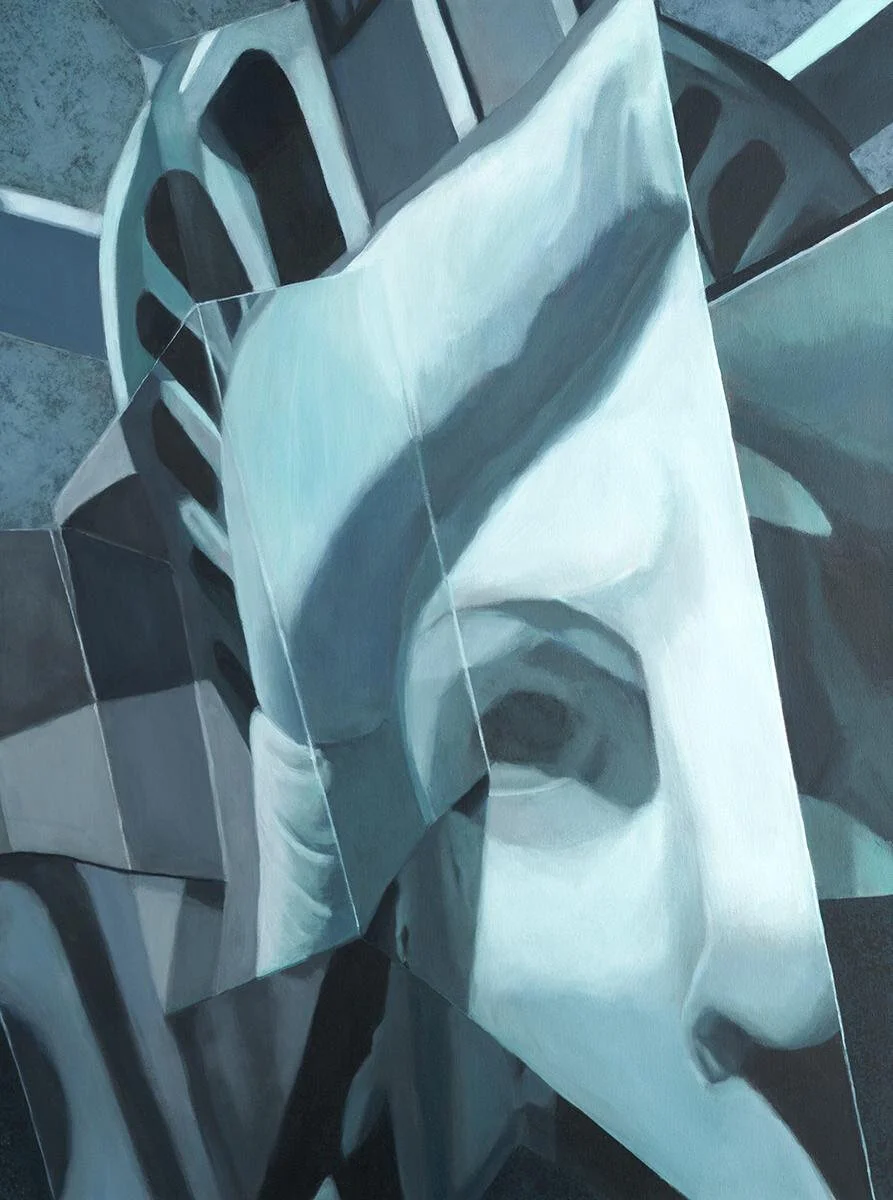
“Liberty III (Nothing is Inevitable)” (acrylic on canvas), by Diana Zipeto, in her show “Tectonics,’’ at Galatea Fine Art, Boston, Jan. 1-Feb. 2. She told the gallery:
"My folded paper paintings investigate issues of freedom and equality. The paintings express these ideals as both formidable and fragmented, unshakable and vulnerable, solid and uncertain.
“Starting with paper photographs, I fold the images to give them a new 3rd dimension, communicating both disruption and resilience. The ability to fold and reconfigure uncovers new meanings in familiar images. I make large paintings of the fragile paper constructions to fix transitional moments in a solid form.
“As an American female raised in the 1980s, I grew up in a time when liberty and equality seemed inevitable and always advancing. My paintings question that inevitability, and look at the uncertainty and possibility in our new era."
Physician, novelist to speak at Dec. 8 PCFR
The next dinner of the Providence Committee on Foreign Relations (thepcfr.org; pcfremail@gmail.com) comes on Wednesday, Jan. 8, with Michael Fine, M.D., the speaker. He'll talk about his novel Abundance, set in West Africa, and the challenges of providing health care in the developing world.
Dr. Fine has been an advocate for communities, health-care reform and the care of under-served populations worldwide for 40 years. He is a former director of the Rhode Island Department of health.
His career as a community organizer and family physician has led him to some of the poorest places in the United States, as well as dangerous, war-ravaged communities in third-world countries. He is a former director of the Rhode Island Department of health.
Please let us know if you're coming to the Jan. 8 event by registering on our Web site, thepcfr.org, or emailing us at pcfremail@gmail.com. You may also call (401) 523-3957.
As you know, our speaker who had been scheduled for Dec. 5, Dr. Elizabeth Prodromou, who was to speak on “God & Geopolitics,’’ had to cancel because of illness. We're working on a new date for her this season.
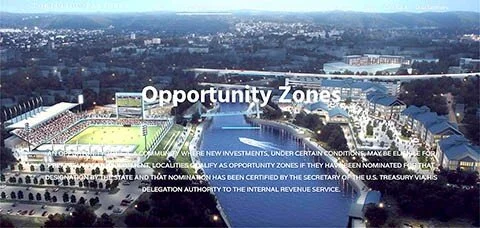
A new Pawtucket?
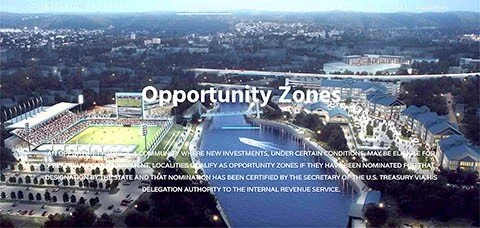
Rendering of the Fortuitous Partners proposal for Pawtucket
From Robert Whitcomb’s “Digital Diary,’’ in GoLocal24.com
t’s far too early to know the fate of a Fortuitous Partners proposal to create a $400 million project in downtown Pawtucket that would include a minor league soccer stadium, an “indoor sports event center,’’ apartments, a hotel, offices, shops and restaurants. What will the financing environment look like over the next few years? What if the nation goes into a recession soon? But from what we know now it does look like a better -- and of course much bigger -- project for the city and region than the Pawtucket Red Sox plan to build a new stadium – as sad as the team’s exit is.
The project would leverage people’s love of being along the water – in this case the Seekonk River (which I always think is the Blackstone in that part of Pawtucket) – and presumably heavily promote the project to people from very expensive Greater Boston who might want to live in Pawtucket, further encouraged to do so by the Pawtucket-Central Falls MBTA commuter rail station, scheduled to open in 2022. A big question is how successful the soccer stadium would be, however popular the greatest international sport has become around here, considering that the major league New England Revolution is based just up the road at Gillette Stadium, in Foxboro.
The public part of the financing totals $70 million to $90 million, most of it from a commonly used tax technique called “tax increment financing.’’ This lets developers use part of the tax revenue created by developments to help pay to build them. Also involved in what the developers call “Tidewater Landing’’ are often controversial federal “Opportunity Zone’’ tax breaks that are supposed to encourage economic development in low-income areas but, many note, greatly benefit rich developers. But then, most tax breaks favor the rich. (See below.)
In any case, I hope that this is not one of those projects whose fate is tied in knots in layer upon layer of regulatory red tape. America used to be known for doing big projects; now, big – and needed— projects often seem impossible because of the veto power of too many interest groups, public and private. And there is no such thing as a perfect project. For an overview of our big-project paralysis, using New York’s Penn Station as Exhibit A, please hit this link.
Maine lab sends mice to space station

Jackson Laboratory, in Bar Harbor
From The New England Council (newenglandcouncil.com):
”Jackson Laboratory will send a group of their ‘custom-designed mice’ to the International Space Station to help scientists better understand muscle and bone loss in both space and on Earth. Based in Bar Harbor, Maine, Jackson Laboratory is a nonprofit biomedical research institute focused on improving health care through analyzing the unique genetic makeup of each individual.
The study, designed by Jackson’s Se-Jin Lee, will examine the effects of microgravity on astronauts’ bones and muscles during space flight, and explore ways to prevent it. In addition, the study’s results may also yield information that can help the elderly, bedridden, and those with muscle-wasting conditions. The strain of mice that will be used in this study are referred to as “mighty mice” by the Jackson Lab, which engineered them to be without the gene responsible for producing a muscle growth inhibitor named myostatin. Without the gene, the lab’s mice grow skeletal muscles twice the normal size.
Mr. Lee traveled to the Kennedy Space Center, in Florida, to deliver a group of 10-week-old mighty mice for their Dec. 4 departure to the International Space Station, where they will spend 40 days. Upon their return, Mr. Lee will continue the research alongside his team and students from two Connecticut public high schools.
“Our discovery suggested blocking myostatin activity in livestock and aquatic species could be an effective strategy for dramatically improving meat/fish yields to help meet the shrinking world food supply,” he said. “Inhibiting myostatin activity may represent a new strategy for increasing muscle growth and regeneration.”
David Warsh: The Streaming Age
“The Future is Streaming,” trumpeted the 16-page special section of the Dec. 1 New York Times. I knew in my bones they were right. “Are you ready?” they asked.
Most definitely, I learned, I was not.
Much of what I know about developments in the stories I follow, I learn from the four newspapers I read daily: the NYT, The Wall Street Journal, the Financial Times, all on paper, and, online, The Washington Post. I especially gain from paying attention to the differential treatments in their coverage of particular stories, internal (news columns vs. editorial pages) and external (one paper vs. the others). I read parts of a lot of books, and all of some of them. I watch almost no television, hardly use Netflix and seldom see a movie at the corner theater, an old vaudeville palace now flanked by four smaller screening rooms on one side.
My budget, both time and money, began to change last week as a result of reading the Times section. In itself, that was no easy matter, since half of it was a 48-inch-wide pull-out (a double-double truck of facing pages, in newspaper parlance) containing a stylized map of representative content from the 271 entities in the new streaming universe, with articles printed on th other side. The idea of the map was offer guidance on various approaches to viewing, depending on one’s tastes and pocketbook: the Frugalist, the Harried Parent, the Fan(atic), the Connoisseur, the Escapist, the Omnivore.
Brooks Barnes, a Times reporter who covers Hollywood, wrote the lead piece. Four times in the last hundred years, more or less every 30 years, every three decades, enough to define several generations, he wrote, Hollywood has experienced a “seismic shift.” These seem to have been a matter of technological change.
In the 1920s, Talkies (and radio) supplanted vaudeville. In the 1950s, broadcast television took center stage. In the 1980s, the cable boom took over, led by music videos. Now the long-promised streaming revolution is at hand – entertainment over the Internet. Netflix began streaming movies and TV movies in 2007. Recently it financed Martin Scorsese’s latest gangster movie, The Irishman, starring Robert De Niro and Al Pacino, betting that far more people would rather watch a three-hour epic at home, rather than in theaters. The Irishman may be the first very expensive movie to depend primarily on streaming to recover its very high costs. Now, Barnes wrote, the three biggest old-line media companies – Disney, NBCUniversal, and WarnerMedia – were about to join in.
In another article, The Great Streaming Space-Time Warp, Times television critic James Poniewozik argued that “the shift from network schedules to TV-when-you-want-it may change not just viewing habits but the whole culture of the medium.” Never mind the culture of television, I thought; with the demise of focal points like the thump of the morning paper on the doorstep and the six o’clock news, it is the culture of everyday life that has changed.
In fact, I wasn’t contemplating streaming at all when the week began. I was thinking about cable television. With the presidency of Donald Trump, the division of opinion in America has become profound. That’s obvious. I’m interested mainly in professional opinion, practitioners of all sorts – politicians and the journalists, film-makers, and scholars of contemporary affairs who cover and egg them on.
My conviction has long been that print newspapers continue to occupy the high ground of this community and likely will do so for many years to come. Myriad independent tributaries contribute to their deliberations, beginning with the online news services that have grown up to compete with them – giants like Bloomberg and Reuters, any number of startups as well, including ProPublica, Quartz and Axios. There are the usual suspects as well, naturally: magazines, book publishers, and, yes, the entertainment machine known as Hollywood. Even a stylized map depicting all these would-be narrators would take a double-double-double truck of newsprint.
Specifically, I have resolved to pay more attention to those with whose opinions I disagree That means editorial page of the WSJ in particular. I have been reading those pages for nearly 50 years, sometimes with admiration, sometimes with scorn, never with greater bafflement than today.
Why not, I decided, try to delineate a little more carefully positions they take that seem reasonable to me, the better to recognize and perhaps understand those that do not? To this end, it has seemed for some time that I should begin watching the Friday night edition of the Journal Editorial Report on Fox News, in hopes of getting a peek behind the scene.
So last week I ordered its basic cable TV package from my Internet service provider, only to discover that its 57 channels contained in the bundle included only five of any interest to me (ABC, CBS, NBC, Fox, and PBS), and none of the new news services that I craved: Fox News, CNN, MSNBC, and ESPN.
And that is how I became acquainted with the world of streaming. I read the Times section on “The Future of Streaming,” It turned out that I didn’t understand streaming at all. I knew that other people, chiefly the young, had long since ceased to deal with the cable television companies. I knew, too, that Comcast and GE had bought the giant content producers NBCUniversal (though I clearly didn’t understand why).
Finally I understood that I didn’t have to deal with the cable companies, either. I could turn my attention to their internet-based competitors, By then, however, I was on the way to the airport, out of time, if not endurance. I put off the search until I returned from out-of-town meetings.
Meanwhile, as a hedge, I invested in a copy of Great Society: A New History, by journalist Amity Shlaes (HarperCollins, 2019). Shlaes is the author of three well-regarded earlier books: Germany: The Empire Within (Farrar, Straus, 1991); The Forgotten Man: A New History of the Great Depression (HarperCollins, 2007); and Coolidge (Harper, 2013)
The book on Germany is, as I remember it, brilliant. The Forgotten Man and Coolidge. explorations of paleo-conservativism – counterfactuals in which the losers were the heroes – if only we had listened to them! The new book is an account of the beginnings of the “market turn,” at least in the US. That seems like something in which I might hope to identify plenty of common ground. It will take time. The book is 504 pages long. I plan to read every word.
. xxx
New on the EP bookshelf: Great Society: A New History, by Amity Shlaes (HarperCollins, 2019)
David Warsh, a veteran columnist and an economic historian, is proprietor of Somerville-based economicprincipals.com, where this column first appeared.
'Lovely, dark and deep'

“Intangible Aspects of the Forest,” (color pencil on Arches paper), by Stacey Cushner, at Kingston Gallery, Boston, through December.
A New England paradox

The grand summer resort hotel Wentworth-by-the-Sea, in New Castle, N.H., in 1892

Inside one of the world’s largest factory complexes, the Amoskeag Mills, in Manchester, N.H., around the turn of the 20th Century
“{By the last quarter of the 1800s} tourists sought out the isolated or remote parts of New England, looking for an imagined world of pastoral beauty, rural independence, virtuous simplicity and religious and ethnic homogeneity. In these years, a trip to New England came to mean an escape from the conditions of modern urban industrial life, the very life New Englanders a generation earlier had been praised (and sometimes blamed) for creating.’’
From Inventing New England (1995), by Dona Brown
The beauty of Shaker furniture

On Thursday, Dec. 12, The Art Complex Museum, in Duxbury, Mass., will offer a program on Shaker furniture.
The museum explains:
“Hands to work. Hearts to God. They called themselves the United Society of Believers in Christ's Second Appearing, but the world called them Shakers because of their ecstatic dancing. The collection of Shaker furniture and crafts at The Art Complex Museum is widely recognized among experts for its fine examples of classic Shaker design. The initial interest in Shaker objects was inspired by Maud Moon Weyerhaeuser Sanborn (the grandmother of current museum director, Charles Weyerhaeuser), whose home in the Berkshires was close to the Hancock and New Lebanon Shaker communities. Participants will discover how Shaker communities celebrated the holidays, and how objects from the collection were used in daily life.’’
The most famous Quaker center is Shaker Village, in Canterbury, N.H. The village was established in 1792.
At its peak, in the 1850s, more 300 people lived, worked and worshiped in 100 buildings on 4,000 acres in the central New Hampshire town, farming, selling seeds, herbs and herbal medicines and making textiles, pails, brooms and other products. Wikipedia says that “the last resident, Sister Ethel Hudson, died in 1992, and the site is now a museum, founded in 1969, to preserve the heritage of the utopian sect.
“Canterbury Shaker Village is an internationally known, non-profit historic site with 25 original Shaker buildings, four reconstructed Shaker buildings and 694 acres of forest, fields, gardens and mill ponds under permanent conservation easement. It has been designated a National Historic Landmark for its architectural integrity and significance.’’
Perhaps the Shakers were doomed by one of their rules — celibacy.

Canterbury Shaker Village, circa 1906
Todd McLeish: Beavers continue their long comeback

On this property owned by the Cumberland (R.I.) Land Trust, the organization installed plastic pipes and fencing to address the flooding problems beavers created. There is large beaver lodge in the background.
— Photo by Todd McLeish/ecoRI News)
From ecoRI News (ecori.org)
CUMBERLAND, R.I. — At the Cumberland Land Trust’s nature preserve on Nate Whipple Highway, beavers created numerous dams on East Sneech Brook in the years after their arrival in 2014, flooding the property and forcing the organization to detour its hiking trail and build a boardwalk over the wettest areas.
Worse, the flooding killed many trees in the Atlantic white cedar swamp, a rare habitat found at just a few sites in Rhode Island.
It’s a sign that beavers are continuing their comeback in Rhode Island, after being extirpated from the region about 300 years ago.
“There’s a historic culvert on the property, and we noticed it was being plugged up with sticks, but we didn’t know how,” said Randy Tuomisto, president of the land trust. “So we removed the debris, but it subsequently got filled in again. That’s when we noticed small twigs were being cut, telltale signs of a beaver.”
When the white cedar trees began to die, the land trust took action to address the situation. They hired a Massachusetts beaver-control expert to advise them on how to install a series of water-flow devices — a combination of wire fencing and plastic pipes going through the beaver dam that tricks beavers into thinking their dam is still working but which allows the water to flow down the stream unhindered.
While Tuomisto said he believes there are six or eight beavers on the property, along with a 6-foot tall beaver lodge, flooding has been reduced considerably.
“Now they’ve moved down Sneech Brook to other areas in town, to Diamond Hill Reservoir and Abbot Run Valley Stream. And they’re aggressively on the Blackstone River,” he said. “If you take a trip on the Blackstone bike path from Manville to Valley Falls, you’ll see the destruction of all the trees that they felled.”
According to Charles Brown, a wildlife biologist for the Rhode Island Department of Environmental Management, beavers were probably the first animal to disappear from the New England landscape after the arrival of European settlers. Their fur was in great demand by Native Americans and the new arrivals, and many beaver pelts were shipped to Europe as well. Brown speculates that the animals were extirpated from the area by the end of the 1600s
It took until 1976 for the first ones to return. That’s when a beaver lodge was discovered on the brook that leads into Carbuncle Pond in Coventry.
“They’ve been expanding ever since,” Brown said. “By 1982, my predecessor Charlie Allen did a float trip around Coventry and Foster and found several colonies within that watershed.”
Communities in western Rhode Island have been dealing with the inevitable flooding that beavers create for more than 30 years, but Brown said the animals have only recently arrived in the area of the lower Blackstone, Pawtuxet, and Moshassuck rivers, where municipal public works officials are now being called on to address flooding issues.
“Beavers have been entrenched in Burrillvillle and other parts of western Rhode Island for some time, and the towns there know how to deal with them. But they’re still finding new habitat and expanding elsewhere in the state,” Brown said. “It takes them a while to move around and get established in new areas. They were pioneering into the Cumberland and Lincoln area about 10 years ago, and now they’ve become a regular part of the landscape there.”
Brown had meetings with Cumberland officials to discuss how to address the flooding caused by beavers at Monastery and Diamond Hill State Park, and he often has similar meetings with officials in other communities. He offers counsel about beaver behavior and life cycle and offers advice on how to reduce the flooding using water-control structures and how to protect notable trees with perimeter fencing.
Sometimes Brown advises officials to consider hiring a trapper to capture the beavers during trapping season, which runs from Nov. 1 through mid-March. Rhode Island fur trappers typically harvest about 100 beavers each year, many of which are captured because of nuisance situations.
Despite their reputation for damming streams and flooding roadways, beavers play an important role in the environment by creating habitat upon which many other species depend, from river otters, mink, and muskrats to ducks, dragonflies, and amphibians.
“Great blue herons gravitate toward newly flooded areas with dead standing trees,” Brown said. “But beaver ponds aren’t perpetual. They come and they go. Beavers create a dynamic state of change that can benefit a lot of things.”
According to Ben Goldfarb, author of the award-winning 2018 book Eager: The Surprising, Secret Lives of Beavers and Why They Matter, beaver ponds also help to recharge aquifers, dissipate floods, filter pollutants, and ease the impact of wildfires. A 2011 report he highlighted estimated that restoring beavers to one river basin in Utah would provide annual benefits valued at tens of millions of dollars.
“Even acknowledging that beavers store water and sustain other creatures is insufficient,” Goldfarb wrote. “Because the truth is that beavers are nothing less than continental-scale forces of nature, in large part responsible for sculpting the land upon which we Americans built our towns and raised our food. Beavers shaped North America’s ecosystems, its human history, its geology. They whittled our world, and they could again — if, that is, we treat them as allies instead of adversaries.”
Tuomisto of the Cumberland Land Trust has a similar perspective.
“We want to keep the water level high enough so the lodge can sustain the beavers through the winter. We would rather live with beavers because they provide an ecological benefit in creating wetlands and wildlife habitat,” he said. “We understand the destruction they cause to neighbors and roadways, and we could have trapped them out. But we’re willing to take the bad with the good.”

A beaver slowly chops down a tree with his teeth
Rhode Island resident and author Todd McLeish runs a wildlife blog.
Invasive Snake Worms Have Jumped Into Rhode Island
Salamander Survey Hopes to Find Conservation Success
DEM Finds Invasive Species in Two Lincoln Ponds
Declining Orchid Populations Need Forested Protection
New Study Finds Balloons Deadliest Trash for Seabirds
Timber Harvesting Project Planned for Arcadia
Fast-Spreading Lotus Takes Over Cranston Lake
Wildlife & Nature RSS
EcoRI_Advertisement_250x500.png
PVD Flea Holiday '19 EcoRI (1).png
2019_11 ECO Regift Sale Box Ad.png
WhatGrowsOnRI_150RGB-copy.jpg
Get the latest ecoRI News headlines in your inbox. Subscribe to our free weekly newsletter
Search
About | Staff & Board | Advertise | Privacy Policy
DONATE
ecoRI News // 10 Davol Sq., Suite 100, Providence, RI 02903 // E-MAIL
Share to Facebook
Share to Twitter
Share to Email
Share to LinkedIn
Share to PrintFriendly
Your Donation is Doubled!
Wind-farm configurations

From Robert Whitcomb’s “Digital Diary,’’ in GoLocal24.com
Predictability and standardization are generally sought by businesses, large and small. Thus it should be good news that five companies seeking to set up offshore wind-turbine farms off southern New England have agreed to a common layout for their projects: a standard east-west orientation, with each turbine a nautical mile apart. That’s mostly to try to satisfy fishermen, some of whom express the (exaggerated) fear that the wind farms would reduce their ability to maneuver.
The five companies are Vineyard Wind, Eversource Energy, Mayflower Wind, Orsted North America and Equinor Wind.
The Trump administration, in thrall to the Red State-based fossil-fuel industry, seems to be using some fishermen’s complaints as cover in trying to stop some big renewable-industry projects, which the regime, as with “green energy’’ projects in general, associates with Democrats.
An irony in all this is that the supports for turbine towers act as reefs that attract fish.
The long debate about offshore wind farms continues as signs rapidly multiply that global warming caused by burning oil, gas and coal is accelerating, along with the damage it’s doing, although most people are not yet concerned enough about the crisis to push for serious political and policy action to reverse it. Some of those actions would indeed be quite inconvenient.
Judith Graham: The education of a doctor caring for his wife
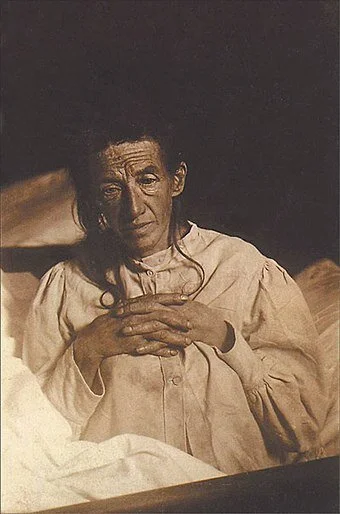
Dr. Alois Alzheimer's patient Auguste Deter in 1902. Hers was the first described case of what became known as Alzheimer's disease.
Dr. Arthur Kleinman, a professor of psychiatry and anthropology at Harvard University, calls this “enduring the unendurable” in his recently published book, The Soul of Care: The Moral Education of a Husband and a Doctor.
The book describes Kleinman’s awakening to the realities of caregiving when his beloved wife, Joan, was diagnosed with a rare form of early Alzheimer’s disease that causes blindness as well as cognitive deterioration.
Although Kleinman’s specialty is studying how patients experience illness, he wasn’t prepared for the roller coaster of family caregiving. Each time he adapted to Joan’s changing condition, another setback would occur, setting off new crises and fueling uncertainty and stress.
During 11 years of caregiving until Joan’s death, in 2011, Kleinman learned that no one who goes through this emerges unchanged. He became less self-centered, more compassionate and more aware of how the health-care system fails to support family caregivers ― the backbone of the nation’s long-term care system.
I spoke with Kleinman in mid-November at a caregiving panel. His remarks below are edited for length and clarity.
About his book. “I wrote it for a specific reason. I had spent my whole career as an expert on care. I myself was a psychiatrist who worked with patients with chronic medical disorders, [such as] chronic pain, diabetes, heart disease, cancer. I thought I knew it all. A veil of ignorance was raised from my eyes by my experience as a primary family caregiver.
“What is that veil of ignorance about? It’s about recognizing just how difficult family care is for [people with] dementia and, not just dementia, but many other problems.”
Daily responsibilities. “Let’s say in the fifth year, what was it like? I would get Joan up around 6 a.m. and take her to the bathroom. I have to handle the toilet paper, wash her hands, dress her to work out, take her to the bath and bathe her.
“I would shampoo her hair, dry her, pick out her clothes [for the day]. After that, I would prepare breakfast. As she got increasingly agitated, [that] became difficult because I had to sometimes hold her hands [to] keep her from throwing things or getting up and hurting herself. Because she was blind, she couldn’t see where she was. And then I would help her eat ― usually, at the end, feeding her ― and then take her to a room where we would sit and listen quietly to music.
“Maybe six, seven years into this, I would just sit there and hold her hands. And even that became difficult. So, I would tell her stories of the past … our stories. [Editorial note: This is just the beginning of a day full of similar tasks.]
“I discovered early on that the ritualization of acts of caring ― the dressing, bathing, all these things ― is a way of habit formation that keeps you going.”
Challenging masculinity. “We had a great relationship, but it was asymmetrical. For 36 years, my wife took care of me. I was raised as a classical male in the 1940s. When I showed an interest in cooking, my grandmother said to me, ‘What are you, a sissy?’ I was a tough kid on New York [City] streets. I had the most unpromising beginnings to be a caregiver. And my wife slowly socialized me to a different kind of masculinity, to be able to care.
“[Pay family members for caregiving] and you’ll see more men do it. Go to Australia, for example, where there’s very good compensation for care, and you’re astonished at the number of men who are caring for children, who are caring for elderly, and the like.”
Asking for help. “I have a wide circle of friends and colleagues, and [after the book] many of them said they had never realized what was involved. Part of that was my fault. I had a lot of trouble asking for help. Actually, at one point, I so exhausted myself that my kids, who are great, said, ‘You really need assistance.’ And they stepped in, as did my mother. My mother, who at the time was in her 90s.
“So, I had a great system of care around me, but I [also] needed a home health aide to [help with Joan and] keep myself going. I found an Irish woman … and she was fabulous.”
Maintaining presence. “In spite of that, I found it extraordinarily difficult in terms of other elements of care, one of which is presence. To keep your liveliness, your love, the presence of who you are going while you’re doing all this work of caregiving ― it is extremely difficult and demanding, but it’s crucial.
“When people ask ‘Why do you do [this]?’ the answer of most family caregivers I’ve spoken to is ‘Well, it was there to do. It’s got to be done, [so] you do it.’”
Learning about failure. “I was fortunate in life; I had a golden career. I have a personality that is like a bulldog, and when I start something I finish it. But there’s no finishing care. Every one of us [family caregivers], if we’re honest, you fail at a certain point. The frustrations build, anger mounts, you control your anger so you don’t injure the person you’re caring for. But you’ve got to somehow handle it inside you.”\
The soul of care. “I think what lies at the soul of care is a form of love. You will do everything you can for another because they mean so much to you. [But] it is also problematic, because we all have complex relationships and we’ve got other things going on in our lives.
“We endure, we learn how to endure, how to keep going. We’re marked, we’re injured, we’re wounded. We’re changed … [in] my case, for the better. If you had known me before my 11 years of care, you wouldn’t recognize me today. I was your classical hard-driving Harvard professor … as tough as any other professor at Harvard Medical School.
“I’ve redeemed myself through this experience, in a way.”
A call for change. “How do we strengthen caregiving? How do we do those things that will make it recognized as important as it is? It’s going to take a radical rethinking. Our health-care system [is focused on] entirely the wrong issues. Economics is not the most central aspect of care; it’s caregiving
“Do you know not a single one of the senior neurologists I went to with Joan who wanted to do everything diagnostically made the recommendation ‘You want to think about a home health aide now, even though you don’t need it right now. You have to look into how you’re going to reconfigure your house [for] someone who’s both blind and with dementia. [Or] a social worker is a great navigator of what the health-care system is about. You want to take advantage of that.’
“So, this is where I believe that our whole health care system has got to be rethought, from the bottom up with attention to care at its core.”
We’re eager to hear from readers about questions you’d like answered, problems you’ve been having with your care and advice you need in dealing with the health-care system. Visit khn.org/columnists to submit your requests or tips.
Judith Graham is a Kaiser Health News journalist.
Couldn't someone else change the lightbulb?

‘Forget-Me-Not,’’ by Chelsea Revelle, in the group show “Read Between the Lines,’’ at Fountain Street gallery, Boston, through Dec. 22

Llewellyn King: Perhaps the queen likes Trump

LONDON
I have a secret. I can’t verify it, but I can share it. It’s this: I think that Her Majesty Queen Elizabeth II likes President Trump.
Honestly, I’ve been studying video of them together and despite what the press here thinks, I believe she likes him. She’s amused by him. Poor woman, she deserves some amusement; she deserves some international figure who isn’t fazed by the honor of meeting the world’s most important monarch.
Consider what a relief it must be for the queen to see someone as unlearned in matters of protocol as Trump. Legions of heads of state and heads of government have leaned low over her hand while their wives have curtsied, often clumsily despite hours of practice. What a trial all this must be to a woman of 93, who has been subject to this since her ascent as queen, in 1952.
Elizabeth must be the hardest-working woman on earth. She's met thousands of stiff, boring men, day after day. She's been sung to by countless legions of well-scrubbed schoolchildren and has endured thousands of hours of native dancing, from the Maoris of New Zealand to the Ndebele of Zimbabwe.
The mere knowledge that you're to go to Buckingham Palace produces a kind of paralysis in most. The honor of the thing with the ghastly small talk that they feel they must be ready to speak can only make for a tedium that defies imagination. From great generals like America’s Dwight Eisenhower to such mass murderers as Romania’s Nicolae Ceausescu, each has taken the royal paw and whispered idiocies about the weather in London that day.
No one -- except possibly Trump -- meets the queen without hours of preparation. How to shake hands, how to check that the great moment hasn’t caused you to break out in an embarrassing sweat. Those clothes! Is it to be rented morning wear (Who owns that?) or something less formal. Has your wife ordered correctly? Nothing off-the-peg or too high-fashion -- except for Melania who, on this trip, appeared to be working as an haute couture model.
There’s evidence that the queen, after a long life of boredom, finds some relief in two American exceptions: Meghan Markle, the wife of her grandson, Prince Harry, and Trump.
Would the queen, one wonders, have opened Buckingham Palace to NATO for a reception if she hadn’t liked Trump who, for good or otherwise, was the man of the hour: the mad cousin, if you will, expected to metaphorically blow on his soup and say awful things, but still the most important member of the family.
I think that the gauche American president was a little reward for the hard-working Windsor (the family name, in case you’ve forgotten) who was dealing with yet another family crisis: An American woman has accused the queen’s son, Prince Andrew, of having sex with her when she was just 17 years old.
The rest of the NATO summit was all downhill. Trump left early when the media published and broadcast pictures of others at the summit chortling about him, including his host, Prime Minister Boris Johnson, the queen’s daughter Princess Anne and – oh, the villainy! -- Canadian Prime Minister Justin Trudeau, who regaled a small group with gestures, showing how Trump’s aides were open-mouthed at what their boss had said at his press conference.
Anne was already in bad favor with her mother for not joining the receiving line at the palace along with the her more dutiful brother, Prince Charles, and his wife, Camilla.
Those who made merry of Trump’s antics might beware. He’s a counterpuncher (which means vindictive) and someone already critical of NATO. A chortle at Buckingham Palace might irreparably harm the defense alliance.
Maybe the queen will have reason to regret her hospitality and warmth toward the boredom-breaking American president. Her majesty won’t then be amused any longer.
On Twitter: @llewellynking2
Llewellyn King is executive producer and host of White House Chronicle, on PBS. He’s based in Rhode Island and Washington, D.C.
Read this column on:
InsideSources
White House Chronicle
But is it edible?

“Survival Mode” (ceramic, plaster, vinyl, foam, pigments), by Linda Leslie Brown, in her show of the same name at Kingston Gallery, Boston, through Dec. 29
Linda Leslie Brown: Survival Mode
December 4–December 29, 2019
They overlooked the granite
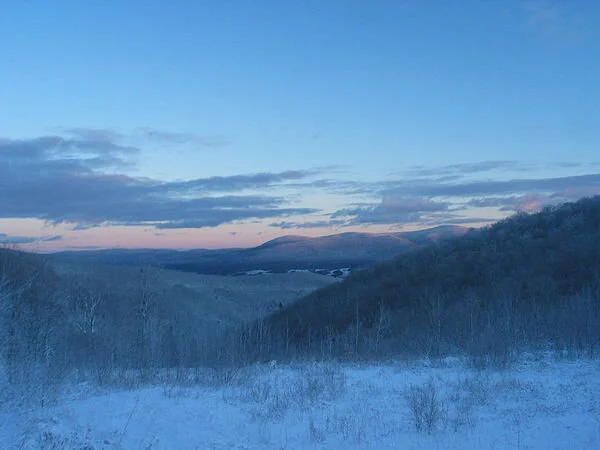
In the Berkshires, about now
"I had known something of New England village life long before I made my home in the same county {Berkshire County, Mass.} as my imaginary Starkfield; though, during the years spent there, certain of its aspects became much more familiar to me. Even before that final initiation, however, I had had an uneasy sense that the New England of fiction bore little -- except a vague botanical and dialectical -- resemblance to the harsh and beautiful land as I had seen it. Even the abundant enumeration of sweet-fern, asters and mountain-laurel, and the conscientious reproduction of the vernacular, left me with the feeling that the outcropping granite had in both cases been overlooked. I give the impression merely as a personal one; it accounts for Ethan Frome, and may, to some readers, in a measure justify it.''
From the introduction to the novel Ethan Frome (1911), by Edith Wharton
Maine's rockweed disputes

From Robert Whitcomb’s “Digital Diary,’’ in GoLocal24.com
The Boston Globe has published an article on a struggle on the Maine Coast between some coastline property owners and people harvesting that bubbly green or brown seaweed called rockweed (it grows on rocks) in the area between high and low tide. Rockweed is an increasingly valuable commodity used for fertilizers and food products. Its expanding harvesting raises some interesting issues about the rights of property owners vs. those who want to gather stuff from what fishermen and many others like to see as “the commons.’’
Complaining property owners don’t like the noise of rockweed harvesters operating power boats and mechanized equipment to remove the seaweed from rocks that might be only a few yards away from shoreline houses, more than a few owned by affluent summer people. And they and some ecologists complain that extensive stripping away of rockweed hurts the coastal environment. They say the harvesting, now a $20 million industry in the Pine Tree State, reduces habitats for juvenile lobster, cod, and other important species that use rockweed for protection and food.
The state’s Supreme Judicial Court has ruled that the harvesters must ask property owners’ permission before harvesting. “We agree that rockweed in the intertidal zone belongs to the upland property owner and therefore is not public property, is not held in trust by the state for public use, and cannot be harvested by members of the public as a matter of right,” Justice Jeffrey Hjelm wrote in the majority opinion. Of course, harvesters could ask for proof that the property owners’ deeds cover land extending to the shore.
The Maine Coast is long and convoluted, and so rockweed harvesting will continue to be very difficult to monitor.
As more human uses are found for animal and plant life along the shore, expect more such conflicts.
To read The Globe’s story, please hit this link.

John O. Harney: Are N.E. colleges ready for the next recession?

Maine Maritime Academy, in Castine, Maine. Its graduates incur high debt levels but have very low default rates.
From The New England Journal of Higher Education (NEJHE), a service of The New England Board of Higher Education (nebhe.org)
Times are already complex for higher education. In Massachusetts, 18 higher education institutions (HEIs) have closed or merged in the past five years. In Vermont, College of St. Joseph, Green Mountain College and Southern Vermont College all held their final graduation ceremonies in the spring. What would happen if a recession were to add to this uncertainty?
With that question in mind, NEBHE in mid-October convened a small group* of higher education leaders and economists to talk about “The Future of Higher Education and the Economy: Lessons Learned from the Last Recession.”
To be sure, some of the problems that have forced college closures are national, but New England (along with the rest of the Northeast and the Upper Midwest) faces specific challenges: most importantly, a daunting demography that spells trouble for college enrollments. By 2032, the number of new high school graduates in New England is projected to decline by 22,000 to a total 140,273, according to the Western Interstate Commission for Higher Education.
The NEBHE confab aimed to better understand the key challenges and consequences HEIs faced as a result of the so-called “Great Recession” and what can be learned from them. Among guiding questions:
What is the likely course of the economy over the next 18 to 24 months?
How prepared are institutions for the next recession?
What lessons did higher education learn from the Great Recession?
What conversations should HEIs—presidents, senior leaders, board leaders—be having now?
How fragile are higher ed institutions in New England and beyond?
What economic or other indicators should we be watching at this point in the economic cycle?
What’s the impact of reduced or stagnant state and federal government support?
How did the last recession impact families—and what does it mean for their ability to pay ever-increasing tuition and fees?
When another recession hits, are there adequate social safety nets to cushion the blow?
Which responses to changing demographics, customer preferences and new technology could help institutions avert closure … and even thrive?
The current state and future course of the economy
NEBHE President and CEO Michael K. Thomas opened the discussion asking for panelists’ perceptions of the state of the economy.
The U.S. has been enjoying the longest economic expansion in history. But looking worldwide, China’s economy is slowing, global manufacturing is suffering, and trading nations like Germany and Singapore are close to recession.
Nigel Gault, chief economist in the Boston office of EY-Parthenon, noted that the current expansion has been long (more than 10 years) but slow, not reaching 3% GDP growth in any year. Moreover, higher education enrollments have trended down while student loan debt has exploded. Tuition prices keep going up, raising increasing questions about whether the investment in higher education is worth it. And the demography will get even worse after 2025.
In addition, the international enrollment that kept some HEIs above water is under increased pressure. For international students, “it’s a combination of sensing they’re not wanted and facing more hurdles to get the necessary visa to come,” said Gault.
The overall result: fewer traditional-age college applicants.
“Back in the last expansion, enrollment was still growing 1 to 2%, which is not great, but this time, the expansion has been much slower overall, and enrollment growth is only half a percent to 1%,” said Thomas College President Laurie Lachance.
In her previous roles as the Maine state economist and as corporate economist at Central Maine Power Co., Lachance heard from businesses that bad economic policy is better than frequently changing policy. She wondered if the current whiplash of national policies could tip us into recession.
Gault shared the thought: “Bad policy and volatile policy is a toxic combination. Often the best thing for the economy is policy paralysis because people know the rules are going to stay as they are now and they can plan on that basis.”
What kind of recession?
Recessions can result from global market downturns or be sparked by outside geopolitical events such as the Gulf War in the early 1990s or the subprime mortgage crisis that began in 2007 and led to the 2008 Great Recession.
None of the panelists thought a 2008-magnitude recession would come soon. But Gault suggested the No. 1 risk is the intensification of trade wars between the U.S. and China or the U.S. and Europe. Gault added that China can no longer play the role of savior of the global economy as it did after the Great Recession.
Participants agreed that different kinds of HEIs would be hurt differently by different kinds of recessions. Not only would a recession caused by global downturn be very different from one caused by local or even institution-specific financial factors. At the family level, a recession centered around the financial sector would directly hit a different group of New Englanders than one centered on manufacturing recession.
The panelists imagined multiple scenarios. Some elite HEIs with significant endowments will be hurt for a short time with a market downturn, but they’ll be OK. Some state universities will be too big to fail. Some independent HEI leaders wonder if state governments will consider consolidating low-performing public campuses? If some public HEIs adopt free tuition models, their programs will be hard to resist for students whose parents lose their jobs in a recession. But a downturn would slow public investment in such programs.
If the past is a guide, any recession will bring some enrollment spurt, especially among older students because job options will be less plentiful, Gault observed. But unlike the tailwind during the Great Recession, the demographic headwind this time around, will probably result in a smaller enrollment spike. A modest recession that takes unemployment up to 6% could bring a less than 3% increase in annual enrollment, Gault said.
Even the recovery from the Great Recession varied by HEI based on the regions from which they drew students and whether their students were in programs that are cyclical or counter-cyclical, said University of Saint Joseph President Rhona Free. USJ’s latest focus has been nursing, teaching and social work, which were not especially hurt in 2008. The experience may have been different at liberal arts institutions that primarily offer disciplines, which in careerist times and places get reactions ranging from disparagement for having weak immediate career prospects to praise for being the key to critical thinking, noted Free, who was provost at Eastern Connecticut State University before joining USJ.
Endowment pressures
On average, 12% of operating budgets at HEIs are covered by endowments, though the figure at some wealthy institutions exceeds 50%, according to Timothy T. Yates, Jr., president and CEO of Commonfund Asset Management Company. He pointed out that most investment committees think of endowments by size, but the more important metric is how dependent institutions’ operating budgets are on endowment returns. He told of a private HEI where the share of operating budget covered by endowment went from 18% in 2008 to 15% in 2009. “That’s a huge hole in their operating budget and it took six years to recover.”
Moreover, most investment committees have not been happy with their recent return rates, Yates said. He explained that a market downturn on an endowment causes a drop in funding. HEIs generally draw about 5% from their endowments to support themselves. Yates said about 32% of HEIs have taken special-purpose appropriations from their endowments this year, up from 26% in 2017 and 18% in 2009. Some of these special appropriations have gone to marketing campaigns to drive enrollment; others have been aimed at addressing a deficit, Yates said.
“If people are drawing from their endowments with a one-time, one-year promise-we-won’t-do-it-again appropriation, I’m not sure that’s the way we should be operating. It’s potentially a Hail Mary activity.” said Susan Whealler Johnston, president and CEO of the National Association of College and University Business Officers (NACUBO).
Lachance saw all the high-finance handwringing as “first-world” problems. Her Thomas College, with just 800 undergraduates and a $13 million endowment, was on the brink of bankruptcy three decades ago. Now, the college, in the same Maine town, Waterville, as the richer Colby College (which has 2,000 undergraduates and an endowment of more than $800 million), makes tough business decisions to invest in only things that could lead to higher enrollment. Thomas draws just a few percentage points of its endowment annually for its operating budget.
Among new business models, Thomas College has added three-year degrees for high-performing high school students, and key employability programs such as a “golf guarantee” to make sure students, many the first in their families to attend college, graduate networking-ready and more familiar with practical realities of business leadership.
The demographic factor
In the 1970s and early ‘80s, when endowment values dropped sharply, high inflation exacerbated the problem, Yates said. But what higher ed had at that time was a big demographic tailwind with baby boomers starting to come into colleges. Baby boomers now represent about 25% of the population but nearly half of charitable giving.
Also in the ‘70s, higher ed saw the front end of more structured fundraising and the consolidation benefits of single-sex institutions merging. Plus, since there hadn’t yet been large tuition increases, there was room to fill classes with students who were willing to pay more. “In higher education, history has been kind to the continuation of bad business practices, for example, thinking you could just go on and on raising tuition,” Lachance said. But our expert panelists agreed that such slack was no longer in the system.
All in all, a lot of New England higher education’s fortunes can be tied to an aging population. Too few babies are being born to sustain our overbuilt higher education infrastructure. Adults, though underserved, are seen as possible saviors. Professors are aging too, and the older ones are less likely to buy into cost-saving technology and open-education resources that some HEIs such as Thomas College consider a key to success. College presidents, whose average tenure is less than seven years, and chief business officers are also heading toward a retirement cliff.
Johnston reflected on the challenges of HEI governance and added that a lot of board members are in their seventies and will be retiring soon. “Are they the big givers that institutions want to hold onto, or do we need new bring in younger, different thinkers?” Or is the best approach to encourage both, since senior trustees can help newer board members with the institutional context for board decision-making?
Young blood with a new perspective may also bring more honesty to boards. Roger Goodman of the Yuba Group and previously Moody’s (where he wrote for (NEJHE during the last recession) was surprised when a poll at a recent conference for higher education trustees showed nearly 65% believed their HEIs were on a solid financial footing. Such findings suggest a certain level of naivete or denial about the realities facing HEIs.
Then, there are questions about the whole higher education governance model. Board members’ connections to the world outside higher ed surely bring value. But does someone who’s made millions in private equity know the complexities of dealing with a shared governance model and the challenges of higher ed finances? And what about those trustees of public HEIs, some named to boards partly based on connections to governors and other appointing authorities?
Student loans and defaults
One of higher education’s biggest challenges is captured by a staggering number: $1.6 trillion. That’s the current total amount of student loan debt. And unlike other forms of consumer credit, student loan debt is only rising.
Phil Oliff noted that a fifth of federal loan borrowers are in default. There has been much discussion about how student loan debt itself may delay markers of adulthood such as buying a car or home, starting a family or starting a business. Default is an even bigger deal. Wages can be garnished. In some places, professional certifications can be stripped. And credit scores can be hit.
Notably and counterintuitively, the higher defaults are among students with low balances, often because they left college without completing a degree that would provide the earnings to repay their loans.
In Maine, not just community colleges but also lower-tiered university campuses, have higher default rates. Higher default rates seem to be more highly correlated with low graduation rates than they are with larger loan balances. For example, Maine Maritime graduates incur high debt levels but very low default rates, said Lachance.
Much was made of defaults among students at for-profit colleges. But enrollment at for-profits has plummeted since spiking around the time of the last recession.
Public investment in higher education
State funding of higher education has come back somewhat and state fiscal reserves have been built up since the Great Recession, said Oliff. But public higher ed gets disproportionately hit in recessions—as it is seen as a “balance wheel” for legislators struggling to write budgets during downturns.
In the last recession, Oliff added, the federal government created a specific pot of money for states to prop up budgets, plus policy decisions to increase the maximum Pell Grant award, veterans benefits and tax expenditures, such as credits for tuition and college savings incentives. The impact of the last recession, albeit significant, was softened by federal policy interventions. But there’s no guarantee that D.C. will act in the same way in the next recession.
The student debt issue also feeds into and grows out of the changing perceptions of the value of higher education. Increasing critiques of higher ed could affect the cyclical dynamic that has sent more students back to college during recessions. When a recession occurs, will some people question if investing in some or more higher education is a good strategy? Further, shorter-term credentials, rather than degrees, may be key in a changing economy, Gault said. Indeed, NEBHE and others increasingly focus on how “high-value” credentials can more efficiently prepare students for in-demand jobs than can full degree programs.
As an immigrant, USJ’s Rhona Free said she always saw “part of the American Dream is that your 18-year-old goes off to live on a campus and grows in many ways for four years, but the reality is that is largely a middle-class, upper-income, white American Dream. We have to innovate in getting all families to believe that this is achievable for their children and there’s a good return on investment. It will be less debt than if they bought a new car.”
Mergers and alliances
Johnston warned that presidents and boards should be talking about what alliances and mergers might mean to their institutions. But many do not want to talk about it, until they’re hard-pressed. Some of that is reflected in the sentiment noted by Goodman in which two-thirds of board members saw their HEIs as being on solid ground.
In addition, the process of mergers can put a lot of pressure on surviving HEIs. An institution facing the threat of closure might decide to get by for another year with an unsustainable discount, say 75%, to get the incremental student it wants. That can put a lot of pressure on other HEIs that are competing in the market. Johnston pointed out that one HEI in Virginia, determined to grow its enrollment, decided to go deeper into its waiting lists, which affected enrollments at competitors across the state, many of whom did not meet their revenue goals as a result.
“The business model isn’t working for us, and that requires innovation,” said Johnston. And it is explained poorly to the public and students with confounding concepts such as “tuition discounts” and “net prices vs. sticker prices.”
Students and families
When the discussion turned to the condition of social safety nets, Lachance lamented: “The rich are getting richer, the poor are getting poorer. When I was growing up, there were so many mills around us where a high school grad could do just fine. They’d get on a union wage scale and they had a great standard of living to send their own kids to college. Now it seems like the difference is based on your educational attainment. And if you don’t attend college and you don’t persist and graduate, you’ll never earn the return on that investment and you’ll be in debt.”
A recession will surely exacerbate the difference between those who have and those who have not, concluded Johnston. The question is not just which institutions will be most affected, but which students, for example, those with food insecurity. As President Free noted, HEIs’ food pantries and in-demand mental health services are now key social safety nets upon which many students already depend.
Moreover, “Kids who were watching their families go through the last recession may bring a separate set of anxieties with them if there’s another recession,” said Johnston. “They may dial back what they think they can do even if the circumstances don’t require it.”
John O. Harney is executive editor of The New England Journal of Higher Education.
* The panelists …
Rhona C. Free became the ninth president of the West Hartford, Conn.-based University of Saint Joseph in July 2015. During her time at USJ, she has championed the creation of the Women’s Leadership Center and guided the deliberations that led to the university’s decision to become fully coeducational in fall 2018. She joined USJ from Eastern Connecticut State University, where she served as vice president for academic affairs from 2007 to 2013 and provost from 2013 to 2015. She taught Economics at Eastern for 25 years before becoming an administrator.
Roger Goodman is a partner in the Boston office of The Yuba Group LLC, which provides independent financial advice and consulting to higher education institutions on debt and credit-related matters. Prior to joining the Yuba Group, he served as the team leader for the Higher Education and Not-for-Profit Team at Moody’s Investors Service, leading a team of 11 analysts responsible for credit analysis and credit ratings.
Nigel Gault is EY-Parthenon’s chief economist based in the Boston office. He was with Parthenon for a year before its combination with EY in August 2014. He advises clients on issues relating to their strategies, market growth and pricing. Gault was most recently chief U.S. economist at IHS Global Insight, where he was a seven-time winner of the Marketwatch Forecaster of the Month accolade for key economic indicators. He has also served as chief European economist in London for Standard & Poor’s/Data Resources and for Decision Economics.
Susan Whealler Johnston is president and CEO of the National Association of College and University Business Officers (NACUBO), a position she has held since Aug. 1, 2018. Prior to joining NACUBO, she was at the Association of Governing Boards of Universities and Colleges (AGB), where she served as executive vice president and chief operating officer, responsible for the day-to-day operations of the organization as well as strategic planning. Prior to joining AGB, she was professor of English and dean of academic development at Rockford University.
Laurie Lachance is Thomas College’s fifth president and the first female and alumna to lead the college in its 125-year history. From 2004 to 2012, she served as president and CEO of the Maine Development Foundation. Prior to MDF, she served three governors as the Maine state economist. Before joining state government, she served as the corporate economist at Central Maine Power Company.
Phillip Oliff is senior manager at The Pew Charitable Trusts in Washington, D.C., where he leads Pew’s work exploring the fiscal and policy relationships between the federal and state governments on a variety of topics, including how federal budget and tax changes could affect states, the role that federal and state finances play in higher education and surface transportation. He previously was a policy analyst at the Center on Budget and Policy Priorities, where he wrote reports on topics including education finance, state tax policy, states’ post-recession fiscal conditions and the impact of emergency federal aid on state budgets.
Timothy T. Yates, Jr. is president and CEO of Commonfund Asset Management and responsible for managing all aspects of Commonfund’s Outsourced Chief Investment Office (OCIO) business, which focuses exclusively on nonprofit institutions. Before joining Commonfund, he was an instructor of Spanish and Italian at Fordham Preparatory School in the Bronx, N.Y.