
Vox clamantis in deserto





An ER for geriatric patients in northern New England

Main entrance of Dartmouth-Hitchcock Medical Center, in Lebanon, N.H.
Council member Dartmouth-Hitchcock has announced plans to open a Geriatric Emergency Department in Lebanon, NH. Dartmouth-Hitchcock is New Hampshire’s largest private employer and only academic health system.
Dartmouth-Hitchcock will partner with West Health, a group of nonprofit, nonpartisan organizations dedicated to lowering healthcare costs for seniors, to establish their geriatric ER. Over the next three years, Dartmouth-Hitchcock plans to develop specialized areas within its emergency department and then use telehealth to spread the practices to four other sites in the region. The geriatric ER will be designed with protocols, resources, and specialized care areas to optimize the acute care of senior citizens. The majority of hospitals implementing geriatric ER’s are located in urban or larger medical centers, making the Dartmouth-Hitchcock-West Health partnership the first in the nation to focus on a largely rural population.
“Improving the delivery of care in rural areas is one of the strategic imperatives for Dartmouth-Hitchcock Health, as we grow to meet the needs of patients around the region,” said Dartmouth-Hitchcock CEO and President Joanne M. Conroy, MD. “With our strong programs and passionate providers in Emergency Medicine and Geriatrics, along with our dynamic Connected Care Center, we are uniquely qualified for the development of a rural telehealth model of geriatric emergency care that this collaboration will enable.”
Weep for what could make them glad

“First there's the children's house of make-believe,
Some shattered dishes underneath a pine,
The playthings in the playhouse of the children.
Weep for what little things could make them glad.
Then for the house that is no more a house,
But only a belilaced cellar hole,
Now slowly closing like a dent in dough.’’
From “Directive,’’ by Robert Frost, written in 1946 and widely considered the greatest poem of his later years, and one of his most unsettling.
To read the whole poem, please hit this link.
David Warsh: Take Trump's attempted extortion to the electorate
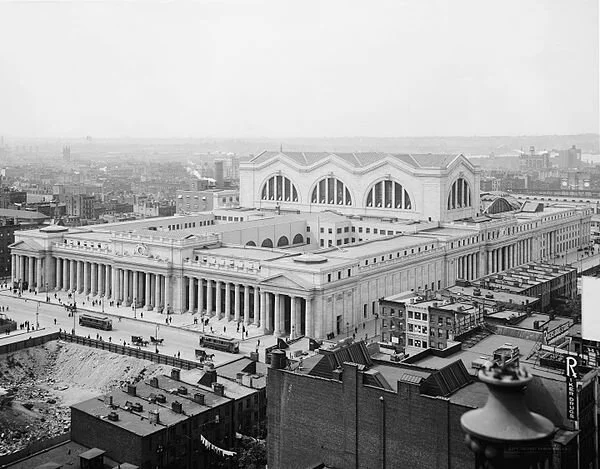
Pennsylvania Station in the 1910s. It was torn down in 1963.
There was a time when New York City had the gateway it deserved.
Demolished more than half a century ago, the former Pennsylvania Station by McKim, Mead & White was hardly the first great building in town to face the wrecking ball. The Lenox Library by Richard Morris Hunt and the old Waldorf-Astoria by Henry Hardenbergh on Fifth Avenue also came down. For generations, New Yorkers embraced the mantra of change, assuming that what replaced a beloved building would probably be as good or better.
The Frick mansion, by Carrère and Hastings, replaced the Lenox Library. The Empire State Building replaced the old Waldorf.
Then, a lot of bad Modern architecture, amid other signs of postwar decline, flipped the optimistic narrative.
From “Penn Station Was an Exhalted Gateway. Here’s How It Became a Reviled Rat’s Maze,’’ by Michael Kimmelman, The New York Times. April 29, 2019
You hear a lot these days about narrative. I don’t know anyone better on the topic, at least in the world of economics that I follow, than Mary Morgan, of the Department of Economic History at the London School of Economics.
Morgan is an expert because she is an accomplished practitioner. The World in the Model: How Economists Work and Think (Cambridge, 2012), is based on eight scrupulous case studies of how mathematical models gradually supplanted words in workaday technical economics. The philosophical examination established Morgan among the world’s leading historians of economic thought.
A related group research project on the nature of evidence produced an edited volume of essays, How Well Do Facts Travel? The Dissemination of Reliable Knowledge (Cambridge, 2011). Since 2016, she has led a scholarly European Commission research project on “Narrative in Science.” Elected a Fellow of the British Academy in 2012, she served four years as its vice president for publications.
From Morgan’s introduction to a special issue of Studies in History and Philosophy of Science, “Narrative knowing is most immediately relevant when the scientific phenomena involve complexity, variety, and contingency….”
From her essay in the same issue, “What narratives do above all else is create a productive order amongst materials with the purpose to answer why and how questions.” Their power is illustrated in novels, she writes; their question-answering and problem-solving capabilities are most evident in detective stories.
I’ve been reading Morgan in connection with an economics story. But I thought of her in connection with events these last two weeks in Washington, D.C.
I had no time to listen to the impeachment hearings last week. I gathered from the news reports I read that the testimony was damning.
Republicans seem to believe that the attempted extortion of the government of Ukraine was, as Wall Street Journal editorial columnist Daniel Henninger put it, nothing more than Donald Trump’s “umpteenth ‘norms’ violation.” The Ukraine caper wasn’t a constitutional crisis. But is clearly was a crime. The fake Ukraine election-interference story was even more shocking.
Therefore it seems right to bring the case. Still, it doesn’t seem sufficient reason to remove the president from office at a time when an election is at hand, especially since a significant minority of voters seem not to think the president did anything out of the ordinary. Impeachment forces Republicans candidates to clarify their views – and to go on clarifying them for years to come.
The thing to do is to take it to the electorate. The attempted extortion was an anecdote – a short, grimly entertaining account of something that Trump did, an illustration of a good tradition torn down. But it is only one anecdote of many.
Next year’s election is the key event. The order of American presidents is among the most fundamental narratives of the history of the United States. Let the House leaders draft the impeachment articles, the membership pass quickly them, and the Senate debate. Move on to the Democratic Party primaries.
The Moynihan-conceived plan to convert the Farley Postal Building across the street across the street from Penn Station (also designed by McKim, Mead & White, into a new train hall is going forward. But only Donald Trump’s defeat next year can begin to flip the pessimistic narrative of the nation.od
David Warsh, an economic historian and veteran columnist, is proprietor of Somervillle, Mass.-based economicprincipals.com, where this column first ran.
Just keep it away from Facebook

“Data Collection” (onionskins, dye and acrylic on canvas), by Marsha Nouritza Odabashian, in her show “Stir: Drawings and Paintings,’’ through Dec. 1 at Galatea Fine Art, Boston
'Treading on shadow'

Looking down the Charles toward Boston
“Taking the well-worn path in the mind through dusk encroaches
upon the mind, taking back alleys careful step by step
past parked cars and trash containers, three blocks to the concrete ramp
of the footbridge spanning the highway with its rivering, four-lane
unstaunchable traffic, treading on shadow and slant broken light
my mother finds her way.’’
— From “Island in the Charles ,’’ by Rosanna Warren
Laundering social dysfunction

From Robert Whitcomb’s “Digital Diary,’’ in GoLocal24.com
In another sign of our society’s dysfunction, Providence Mayor Jorge Elorza has put forward a plan, which apparently isn’t going anywhere for now, to spend $50,000 to buy washing machines to put in schools. The idea is that this would reduce absenteeism by students embarrassed to come to school in dirty clothes.
But cleaning clothes is a household function, not the schools’. Why are some parents – and their children - not dealing with this? I suspect it’s connected with the chaos at home of some single-parent (overwhelmingly it’s the mother) households. Please, let’s bring back marriage and two-parent households, especially in low-income places. For the schools to provide such basic services as laundry will only encourage people to throw more such intrinsically private obligations onto the public sector.
Far too many young people are ill-prepared economically and psychologically to be parents.
Chris Powell: Mass transit can be tough to do in suburbia

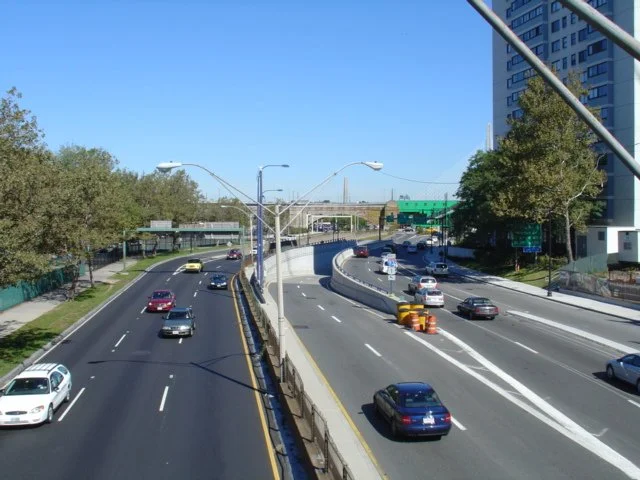
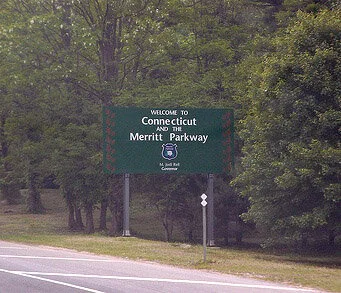
Entering the Merritt Parkway, which serves mostly suburban Fairfield County.
Highway tolls aren't the only objection to Connecticut Gov. Ned Lamont's transportation-infrastructure plan. Now that the Democratic majority caucus in the state Senate seems to have blocked tolls for another year or two, there are also complaints about how the governor recommends spending whatever money still can be raised for transportation.
Some people say the governor mistakenly emphasizes highway widening over mass transit and that the "bottlenecks" he wants to remove can never be removed because "if you built it, they will come" -- that new traffic eventually will materialize to clog whatever highways are widened.
There is some truth to that, but it is not dispositive. For if increased traffic really should disqualify highway construction, the Boston Post Road, U.S. Route 1 northeast from New York, never could have been more than a footpath, never widened for wagons and paved, and the mail between the two cities forever would have had to be carried by boat through Long Island Sound and around Cape Cod.
Politically incorrect as it may be, population growth almost always will require road construction and widening, and it will always be a matter of judgment as to how much crowding and traffic signify too much growth.
Of course just as when you're a hammer, everything looks like a nail, when you're a roadbuilder everything looks like it needs paving, and most of the recent support for tolls in Connecticut came from construction businesses and labor unions that stood to receive most of the toll revenue and so were indifferent to which forms of transit might be best. Roadbuilding can get out of control, as it did in New York City in the 1950s and ‘60s during the tenure of the now-infamous parks, bridge, and tunnel commissioner Robert Moses, though the city, being so densely populated, was perfect for expanding mass transit. As a result ,construction of the Second Avenue subway line has been nearly a century behind schedule.
Today the transit dilemma identified by the governor's critics arises mostly where city and suburb meet -- where population density falls below the level needed to prevent mass transit from operating at an impossible deficit. Unfortunately, that's Connecticut for you -- largely suburban. Rebuilding the railroad line between Hartford and New Haven just cost the state and federal governments almost $800 million and each passenger's one-way trip incurs a grotesque operating cost of almost $60 even as the price of a ticket is only $8.
Mass transit works best where it is comprehensive -- where travelers don't need a car at either end of the line or where there is commuter parking at one end and the last leg of the trip is short. That is often the case in lower Fairfield and New Haven counties, along the Metro-North commuter railroad, the busiest such railroad in the country, but not in the rest of the state, which still needs roads more than rails.
Another complaint made lately in regard to tolls is that people in Connecticut think that highways should be free. But they don't really. Rather they are realizing that they have been paying for highways through fuel and related taxes while much of the revenue has been diverted to state employee pensions and other irrelevant purposes.
Connecticut could greatly reduce its transportation-infrastructure needs if it ever reduced poverty in its anarchic cities enough that middle-class people wanted to live there again. But maintaining poverty here is a bigger business than maintaining the roads and rails and it can't be questioned in polite company.
Chris Powell is a columnist for the Journal Inquirer, in Manchester, Conn.
Night falls on Andover

At Alpers Fine Art, Andover, Mass.: Above, “Ignite the Night” (mixed media on canvas), by Debra Corbett, below, “Sundowner” (oil painting), by Sue Charles

'Geological strata'
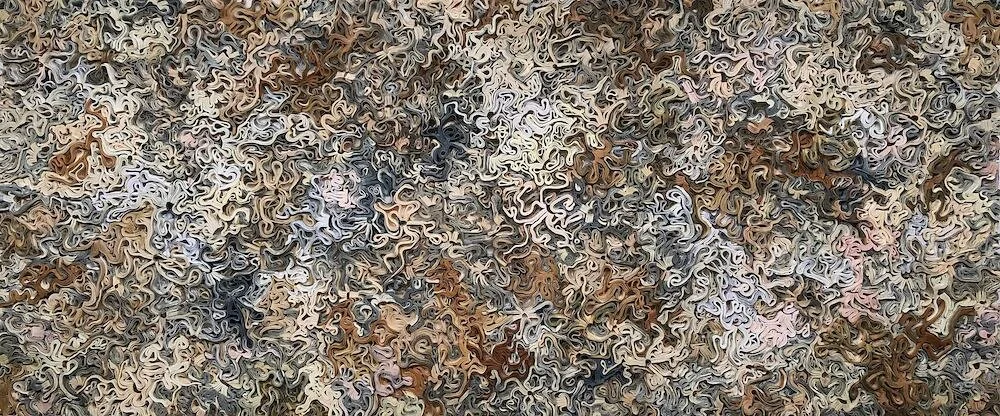
“Compression 2” (books and wax), by Jessica Drenk, in her show “Jessica Drenk: Second Nature,’’ at Heather Gaudio Fine Art, New Canaan, Conn., Nov. 23-Jan 11.
The gallery says:
“For Drenk, the material is the starting point of her artistic inquiry, an exploration that takes her from simple notions and ideas to complex expressions of information, systems and patterns. She reconfigures every-day materials such as books, pencils, plastic bags, even PVC pipe, drawing on their physical properties to re-contextualize them into visually compelling and thought-provoking sculptural outcomes.
“The exhibition will feature a new body of work emerging from mass-produced utilitarian and readily discarded objects: plastic bags. Spliced and organized by color, they are transformed into banded formations, layers resembling geological strata. Repurposing this product into a structure resembling its material origins, plastic as a by-product of petroleum, Drenk's reconfiguration timely questions the reverberations of our every-day consumption and its long-lasting environmental impact.’’

Llewellyn King: Will Democrats break their Christmas present?

Historical sea level reconstruction and projections up to 2100 published in January 2017 by the U.S. Global Change Research Program for the Fourth National Climate Assessment.
The Democrats have no need to fret about what they’ll get for Christmas this year. Their worry shouldn’t be the gift, but rather how they choose to open it.
The gift is global warming.
Don’t call it climate change; that fuzzies the issue. Call it for what it is: global warming. It is heat that is melting the polar ice cap, stripping Greenland of its ice sheet, opening Arctic shipping lanes and sinking Venice, one of the jewels of civilization.
Global warming isn’t an existential threat but a real problem that is here, real and now. It is happening today, this hour, this minute, this second.
President Trump has taken his stand. He said of the rising seas and wild weather, which are science-supported evidence of global warming, “I don’t believe it.”
That is a political gift, shimmering and alluring. That is a target affixed to Trump. That is an image as evocative as Nero’s fiddling or Canute’s apocryphal ordering the waves from the incoming tide to stop. That is an opening wide enough for the Democrats to drive a truckload of election victories through.
Democratic strategists need to tell their candidates, “The climate, stupid!” All they must do is to hammer the Republicans and the administration relentlessly on the matter of global warming.
But this gift, looking so unassailable, may be undermined by the current stars on the left of the party. They have a sledgehammer approach and they may do damage to the gift before it is unwrapped.
Their passion is for the simplistic-but-seductive Green New Deal. It defines the problem as fossil fuels and wants to ban them. Then it prescribes the fixes. Bad move.
The cost and disruption of the fixes are ignored. That is why former Secretary of Energy Ernie Moniz -- a man who knows a lot about both politics and energy -- is pushing a concept he calls the Green Real Deal, which aims not to eliminate all fossil fuel use but to move to “net zero.” It means that many technologies will be used, including nuclear power and carbon capture and storage. It means that some fossil fuels will be used so long as their impact is mitigated by gains elsewhere.
These finer points of energy policy and environmental mitigation are too complicated for an election debate. They give too many opportunities for opposition ridicule. Too many handles for the Ridiculer in Chief and his acolytes to grab.
The Democrats need to repeat that the Republicans denied global warming even as the seas are rising. They need to sound the alarm that Boston, New York, Charleston and Miami may be headed for disaster very soon. They need to repeat it over and over, and then some more.
When running an election, a simple, repeatable message, without the details of how the goal will be achieved, wins the day. Clinton’s message served up by James Carville, “The economy, stupid!” won the day. Trump’s enticing “Make America Great Again” cry resonates.
The Democrats need only to dwell on rising sea levels and that the Republicans have repudiated the science. “The seas are rising and we’re going to do something about it,” is a reasonable Democratic message.\
Nixon showed us the effectiveness of framing the problem and hinting at a solution. “I have a plan,” he said about Vietnam. He didn’t mention it included bombing Cambodia.
The Democrats can win on a strong climate message. The seas are rising, wildfires ravage California year after year, Puerto Rico and other islands have been devastated by high-category hurricanes, and we may lose Venice.
A slam dunk in 2020? Don’t count on it. The Democrats likely will lard the message with social concerns, impossible marketplace tinkering and, in so doing, smash their winning gift as they open it. The Democrats are good at that, fatally so.
Llewellyn King is executive producer and host of White House Chronicle, on PBS. His email is llewellynking1@gmail.com and he’s based in Rhode Island and Washington, D.C.
New proto-centrist party in Mass.

Charlie Baker
Perhaps the country’s most interesting political development right now is in Massachusetts, where Gov. Charlie Baker, a moderate Republican, is supporting a sort of proto-new party called Massachusetts Majority that gives money to candidates of both parties whom Mr. Baker, currently America’s most popular governor, support. As Ed Lyons wrote in CommonWealth Magazine:
‘’By all appearances, Massachusetts Majority is the engine of a new statewide political party, targeting that sizeable majority of largely unenrolled voters who support Charlie Baker and his politics but are not being served by loud partisans to the left and right. These voters do not want to choose between supporting the positions of Donald Trump or progressive purists. Massachusetts Majority is specifically designed to be the organization they can finally support.
“Can Charlie Baker be the most popular governor in America, govern as a Republican, and also be the detached head of a third party here that supports Republican and Democratic candidates? It’s remarkably non-binary of him, and I think people in this state will be OK with that. After all, it is strict binary choices, and the accompanying polarization, that is destroying American politics. Here in Massachusetts, more than half want non-binary choices.’’
Can the newish organization be part of a foundation for a thoughtful new center or center-right national party? The old Slave States are probably off limits but perhaps something like the Massachusetts Majority can spread to large areas of the Northeast, Middle Atlantic, Upper Midwest and West Coast. The Northeast and Upper Midwest were the original heartland of the Republican Party – a party now dominated by the political descendants of the old Southern Democrats in the great 180-degree political party turn of the last half century.
To Mr. Lyons’s piece, please hit this link.
Shefali Luthra: Do 160 million people 'like' their health care? Kind of

Articulating his proposal for health-care reform, former Vice President Joe Biden emphasized the number of Americans who, he said, were more than perfectly satisfied with the coverage they have.
“One hundred sixty million people like their private insurance,” Biden said during the November Democratic presidential primary debate.
That argument is at the heart of many moderate Democrats’ criticism of the “Medicare for All” proposal backed by two presidential candidates from New England — Senators Bernie Sanders (I-Vt.) and Elizabeth Warren (D-Mass.). We decided to take a closer look.
We reached out to the Biden campaign for comment. The campaign directed us to his next point — that people who don’t like their private coverage could, under his health plan, opt into government-sponsored coverage.
160 Million, And Some Squishy Polling
The figure appears to refer to the number of Americans who receive health benefits through work — so-called employer-sponsored health insurance. Under Medicare for All that would no longer be an option.
On first blush, polling seems to suggest that most people with employer-sponsored coverage like it.
Polling done earlier this year by the Kaiser Family Foundation with the Los Angeles Times found that most beneficiaries are “generally satisfied” with this insurance. (Kaiser Health News is an editorially independent program of the foundation.)
But that doesn’t get at the whole story.
“Most like their policy, but not all,” said Robert Blendon, a health-care pollster at Harvard T.H. Chan School of Public Health.
The context matters.
In the same KFF/L.A. Times poll, about 40% of people with employer-sponsored coverage said they had trouble paying medical bills, out-of-pocket costs or premiums. About half indicated going without or delaying health care because — even with this coverage — it was unaffordable. And about 17% reported making “difficult sacrifices” to pay for health care.
Beneficiaries who have higher-deductible plans — that is, they are required to pay larger sums of out-of-pocket before health coverage kicks in — are also less likely to be happy with their coverage, and more likely to report problems paying for health care.
And it’s also worth noting that these high-deductible plans have grown increasingly common, even for the 160 million Americans who get insurance from work, though that trend may now be losing steam. Research from the Commonwealth Fund, meanwhile, notes that increasing numbers of “underinsured” people do, in fact, have employer-sponsored health insurance. Underinsured people are those who have coverage but delay care because they still can’t afford it.
Meanwhile, other polling, such as a January Gallup survey, suggests that about 7 in 10 Americans believe the nation’s health-care system is in crisis.
So while Americans may individually not express frustration with their specific private plans, more are learning that, when they try to use that coverage, it doesn’t meet their health needs..
These findings cast significant shade on the idea that all 160 million Americans with employer-sponsored coverage actually like it.
Biden argued that “160 million people like their private insurance.”
A cursory look at polling would suggest that most of the people he’s talking about — Americans who get coverage through work — are happy with their plans.
But once you dig a little deeper, that narrative gets more complicated. Even while Americans say they like their plans, large proportions indicate that the private coverage they have still leaves meaningful gaps, requiring them to skip or delay health care because they cannot afford it.
Biden’s argument is technically correct, but it leaves out important context and relies on a somewhat squishy number. We rate it Half True.
Shefali Luthra is a reporter for Kaiser Health News.
Shefali Luthra: ShefaliL@kff.org, @Shefalil
And ready for winter

“Empty Nesters” (branch and gold leaf), by Karen Loomis, at Hampden Gallery, Amherst, Mass., through Dec. 6.
Paul Armentano: Beware unregulated CBD

An example of beverages said to contain CBD in a Los Angeles grocery store
Via OtherWords.org
One in seven Americans say they use CBD products, according to Gallup.
The rising popularity of these products — which range from oils and gummies to topical salves and most everything in between — is staggering, especially when one considers that much of the public had never even heard of CBD two or three years ago.
CBD stands for cannabidiol, one of over 100 distinct compounds found in the marijuana plant. Unlike THC, it is not significantly mood-altering. Instead, many consumers believe the compound helps treat pain, anxiousness, and other ailments.
But Americans’ exuberance for CBD could well be short-lived. That’s because many products currently marketed under the CBD banner are of low or variable quality.
Back in 2017, the Journal of the American Medical Association reported that only 31 percent of commercially available CBD products contained percentages of cannabidiol that accurately reflected the products’ labeling. Since then, little has changed.
An October 2019 analysis of 30 leading CBD products by the watchdog group LegitScript.com reported that two-thirds possessed significant deviations in CBD content from what was advertised. Typically, these products contained far lower percentages of CBD than the manufacturer promised — a finding that is woefully consistent with prior analyses.
Investigators also reported that some of the products evaluated in the LegitScript analysis tested positive for either solvent residue or elevated levels of heavy metals — findings that are also similar to those of prior reports.
Other analyses have identified even more problematic issues. Some CBD products, for instance, have tested positive for the presence of THC, the primary psychoactive constituent in cannabis, despite being advertised as “THC-free” — an oversight that could cost customers their jobs if they fail a drug test they expected to pass.
Most concerning, some CBD products have tested positive for added psychotropic adulterants — such as dextromethorphan or synthetic cannabinoid agonists. Exposure to these latter agents, typically found in illicit so-called “synthetic marijuana” products like Spice, can lead to serious health consequences.
All this is rapidly creating a “buyer beware” environment for consumers — and potentially placing them at risk.
This situation persists because the federal government — and the Food and Drug Administration in particular — doesn’t regulate either the manufacturing or testing of these products. Despite the presumption of most Americans, the commercial CBD market is entirely unregulated by the FDA.
This is because, until recently, federal law defined all cannabis-derived products as illicit. Now, the FDA and other agencies are playing catch up, with the federal regulators estimating it could take years before the FDA finalizes rules governing the commercial CBD market.
This intransigence is no longer acceptable.
Currently, the heavy burden of overseeing the CBD marketplace falls solely on state regulators in jurisdictions that have legalized cannabis use. But these regulations are not consistent from state to state, and are often far from comprehensive.
Further, state-specific regulations typically only govern CBD products that are sold in licensed dispensaries or retail outlets that exclusively sell cannabis products. They may not cover products sold online or at gas stations, which are subject to virtually no oversight.
Congress facilitated the growth of the commercial CBD market by passing legislation in 2018 that, for the first time, recognizes the production and distribution of certain hemp-derived CBD products. But without federal rules, standards, and oversight, this new market is a wild west — rife with questionable players hawking low-quality or even fraudulent products upon a largely unsuspecting public.
The tens of millions of Americans soliciting this market deserve better. It’s time for federal officials to set appropriate standards to govern this industry — so consumers can be assured, once and for all, they are getting what they pay for
Paul Armentano is the deputy director of NORML, the National Organization for the Reform of Marijuana Laws. He’s the co-author of Marijuana Is Safer: So Why Are We Driving People to Drink? and author of The Citizen’s Guide to State-By-State Marijuana Laws.
Creative CommonsExcept where otherwise noted, content on this site is licensed under a Creative Commons Attribution-No Derivative 3.0 License.
Now leave

“...you don't actually have to go to Maine. And this is finally great news for me again, because I don't want to see you there. The spirit of Maine has infected me. I gave you your goddamned wood, now get the fuck out of here.”
― John Hodgman, from Vacationland: True Stories from Painful Beaches
What does it mean?

Historical coat of arms (1876)
“these days
sometimes you sleep
in a purple T-shirt
that says Massachusetts
which means something
in an older language
I can never remember.’’
— From “Poem for Massachusetts, by Matthew Zapruder
“Massachusetts’’ is an Algonquin word that roughly translates to “large hill place” or “at the great hill.”
The word refers to Great Blue Hill, in Milton, an ancient volcano last active over 400 million years ago. It’s now part of a park that includes a famous and historic weather observatory and a ski area.

Great Blue Hill

The weather observatory atop Great Blue Hill
— Photo jameslwoodward
— P{j
—
Organically screened

“Gathering #1” ( horse chestnut hulls & waxed linen thread), by Ann Wessmann, in her show at Kingston Gallery, Boston, through Dec. 1

Lauren Carson/Terri Cortvriend: R.I. must face the challenge of coastal erosion

From ecoRI News (ecori.org)
You may have heard about the Charlestown, R.I., man who is suing the town of South Kingstown and one of its police officers over his arrest in June on a trespassing charge while he was collecting seaweed along a beach.
The charge was dismissed, but the act itself was, in part, intended to call attention to unresolved questions about shoreline access here in Rhode Island, a right enshrined in our state constitution. A 1982 Supreme Court ruling attempted to clarify the issue by saying the public’s right ends at the mean high-tide line, but since that line is a calculation of averages over an 18.6-year cycle, there’s no way for a beachgoer to identify it.
Further complicating matters is that the line will continually move inland as sea level rises, most of the time gradually, but at times heaving large chunks off dunes and other coastal features. With sea rise, property owners and members of the public whose shoreline access is constitutionally guaranteed will continue losing ground.
After Hurricane Sandy destroyed properties along the coasts of New York and New Jersey, there was an uptick in discussion about whether some particularly at-risk coastal properties should even be rebuilt. Many were, in fact, abandoned there, because increasingly violent weather events and rising seas have rendered them too much of a risk for repeated loss.
As much as we value the right of landowners, there may well be properties in our state, too, that are similarly unjustifiable risks for flooding, destruction, and even loss of life.
As the Ocean State, we should be much more proactive when it comes to resiliency along our shores. We should be exploring the actual risk to each coastal community and each property using current technology that models expected risks. We must continue to train our municipal planning and zoning boards on the risks of sea rise so they have the tools they need to make sound decisions that don’t jeopardize property investments and keep the shoreline open to the public under their constitutional rights.
There’s little doubt that, in general, homeowners are less than ideally prepared for flood risks, particularly the increasing risks associated with rising seas in the coming decades. Only about 15,000 Rhode Island properties in the flood zones carry flood insurance, and only those with mortgages are actually required to have it. Those with enough cash to buy a beach home without a mortgage aren’t. While they may have the means to risk property destruction in the event of a major disaster, are they putting public assets and people’s lives at risk?
The risk isn’t limited to private property. Doubtlessly, many state and municipal assets are also in areas that are already prone to flooding, or whose risk is increasing. Stewards of public resources have a responsibility to understand and defend those assets from potential damage, and must face the reality that the most prudent step might be to move them elsewhere.
Our state needs a more robust action plan for protecting public and private properties from the ever-increasing risk of coastal flooding, and that plan must include an accounting of where the high-tide line is, and how it’s projected to move.
The creation of this plan should include an audit of properties to determine what the real risks are, and it should also bring in real-estate professionals, insurers, and lenders, because they help determine the price of ownership of such properties, and should be sure that those prices accurately reflect the real cost of ownership, including potential destruction.
The Ocean State must face the fact that the more of our state is becoming part of the ocean with each passing year. Leaders and property owners must take much more concrete steps to predict the encroachment and protect our assets from it.
Rhode Island state Rep. Lauren Carson is a Democrat who represents District 75 in Newport. Rep. Terri Cortvriend is a Democrat who represents District 72 in Portsmouth and Middletown.
New England still makes (expensive) things

Bright red locates Framingham
From The New England Council (newenglandcouncil.com)
“Sanofi opened the doors of its 100,000-square-foot digital bio-manufacturing facility in Framingham, Mass., on Oct. 15. The French drug-manufacturing company is one of Massachusetts’s largest life-science employers.
Sanofi’s new facility is among the first digitally enabled continuous manufacturing sites, making the building itself about a fifth the size of traditional facilities {in the sector}. The new building features state-of-the-art technology that connects the production process with research and development to better improve the commercialization of important medicines. The acceleration of their production capabilities is a key pillar in Sanofi’s ambition to establish “the gold standard in the bio-pharmaceutical industry.”
“‘We have been investing for some years to prepare for Sanofi’s future. Our Framingham facility leads the way in delivering the next generation of biologics manufacturing, leveraging intensified, continuous processing in a fully integrated digitally powered facility,’ said Philippe Luscan, executive vice president for global industrial affairs at Sanofi. ‘This opening demonstrates we are at the leading edge of innovation and manufacturing excellence, helping us to shape the future of both our company and the industry.”’

Garden in the Woods, overseen by the New England Wild Flower Society, features the largest landscaped collection of native wildflowers in New England. It is in Framingham’s Nobscot section, off Hemenway Road.