
Vox clamantis in deserto


Religion and geopolitics

The Battle of White Mountain (1620) in Bohemia was one of the decisive battles of the Thirty Years' War that ultimately led to the forced conversion of the Bohemian population back to Roman Catholicism from Protestantism.
To members and friends of The Providence Committee on Foreign Relations (thepcfr.org; pcfremail@gmail.com)
On Thursday, Dec. 5, The Providence Committee on Foreign Relations (thepcfr.org; pcfremail@gmail.com) will welcome as its dinner speaker Dr. Elizabeth H. Prodromou, who directs the Initiative on Religion, Law, and Diplomacy, and is visiting associate professor of conflict resolution, at The Fletcher School of Law and Diplomacy at Tufts University. She titles her talk "God, Soft Power, and Geopolitics: Religion as a Tool for Conflict Prevention/Generation".
Dr. Prodromou is also a non-resident senior fellow and co-chair of the Working Group on Christians and Religious Pluralism, at the Center for Religious Freedom at the Hudson Institute, and is also non-resident fellow at The Hedayah International Center of Excellence for Countering Violent Extremism, based in Abu Dhabi.
Dr. Prodromou is former vice chair and commissioner on the U.S. Commission on International Religious Freedom and was a member of the U.S. Secretary of State’s Religion & Foreign Policy Working Group. Her research focuses on geopolitics and religion, with particular focus on the intersection of religion, democracy, and security in the Middle East and Southeastern Europe. Her current research project focus on Orthodox Christianity and geopolitics, as well as on religion and migration in Greece.
Schedule:
6:00 - 6:30 PM: Cocktails
6:30 - 7:30: Dinner (salad, entree, dessert/coffee)
7:30 - 8:30 (or less): Speaker presentation
8:30 - 9:00: Q&A with speaker.
For information on the PCFR, including on how to join, please see our Web site – thepcfr.org – or email pcfremail@gmail.com or call 401-523-3957
'Go play'
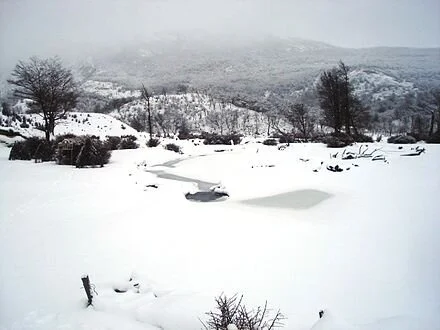
“Outside is the failure to stay in touch
or, really, to ever be in touch. I didn't
ever know them (my neighbors) well.
In winter you are handed a white tray
with a few tiny rock walls, short lines drawn with a ruler,
an indent for where a cellar hole could be
a hyperlink to once go once more to the lake
and told to go at it, go play.’’
From “Deconstructing New England,’’ by Alexandria Peary, a New Hampshire-based poet who grew up in Maine
Use your own materials
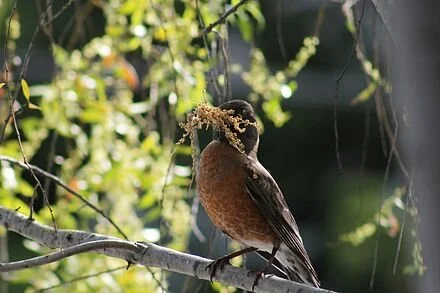
Robin with nest-marking material
“Eschew the skylark and the nightingale, birds that Audubon never found. A national literature ought to be built, as the robin builds its nest, out of the twigs and straws of one's native meadows.”
― Van Wyck Brooks, from The Flowering of New England
Memories of landscapes

“West Hill,’’ by Phil Young, in his joint show with Kimberly Stoney at Concord (Mass.) Center for the Visual Arts through Nov. 24. The gallery says:
“West Hill,’’ by Phil Young, in his joint show with Kimberly Stoney, at Concord (Mass.) Center for the Arts through Nov. 24. The gallery says Mr. Young uses “landscapes as inspiration for his paintings, exploring the various places he's been through color and form.’’ His bio says "he is a colorist and his work is more impressionistic and abstract than representational. His works are made from equal parts memory and imagination, creating a new world out of the familiar one.’’

The Old Manse, in Concord. The house was home to Ralph Waldo Emerson and later Nathaniel Hawthorne. Concord was a center of American literary and, more broadly, intellectual life in the 19th Century.
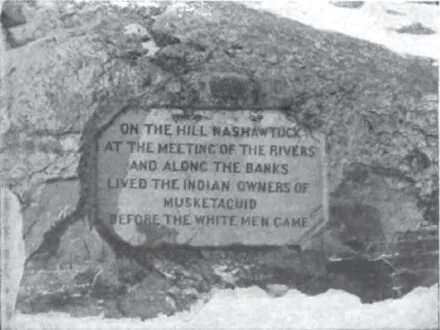
Marker on Egg Rock, in Concord
Who is stoned on the road?

From Robert Whitcomb’s “Digital Diary,’’ in GoLocal24.com
I’ve been worried a long time about the increasing number of people driving around here stoned on marijuana in varying degrees, with outlets selling “medical marijuana,’’ as well as illegal sales of “recreational” pot, in Rhode Island, and with recreational, as well as medical, marijuana legal in Massachusetts. (The Feds have some different ideas about all this.) A big problem is that unlike with alcohol, there seems to be no precise metric to measure when somebody might be impaired by pot.
The issue was front and center in a Nov. 6 Providence Journal story, “Judge ponders: Can impairment by pot be measured,” involving Marshall Howard, charged with driving under the influence, death resulting, in the 2017 death of David Bustin. Mr. Howard’s car hit Mr. Bustin after he had stepped into the street. A blood test showed that Mr. Howard had THC, the mind-altering ingredient in marijuana, in his system at the time. Mr. Howard also had fentanyl and heroin in his car; Mr. Bustin, for his part, was apparently drunk.\
Inebriated America? Are that many people in need of psychic or physical relief?
The story, by Katie Mulvaney, quoted the Superior Court judge in the case, Daniel Procaccini, as saying:
“We don’t have any way to correlate any amount of a substance {such as THC} in a person’s blood to impairment. With alcohol we do.’’ This is a national problem, which we’d better address as throngs hit the road after toking up.
Thank God cars themselves are much safer now than a few decades ago since drivers seem to be ever more distracted.
To read the Massachusetts angle on this, please hit this link.
Chris Powell: Latest Conn. immigration case reveals subversive goal
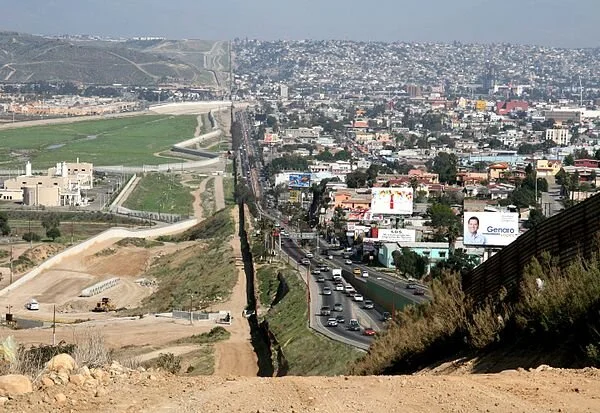
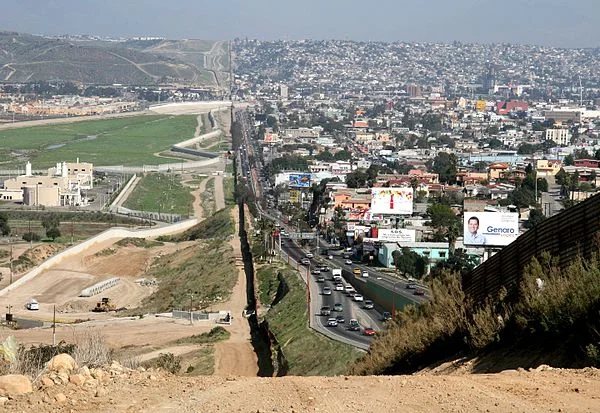
With the border wall separating them, to the left lies San Diego, Calif., and on the right Tijuana, Mexico.
Nobody denies that Domar Shearer, a 23-year-old man from Jamaica, is in the United States illegally, having overstayed a visa three years ago. Nobody denies that he was recently arrested in a domestic disturbance with his wife in Ansonia. Nor does anyone deny that he has been working illegally at a restaurant in Bridgeport.
But Shearer is the latest cause celebre of Connecticut's immigration law nullification movement, enjoying support not just from a New Haven-based organization of immigration law obstructors, Unidad Latina en Accion, but also the state Judicial Department, the state public defender's office, a U.S. senator, and newspapers.
Shearer became a cause the other day when federal immigration agents went looking for him at the courthouse in Derby as he arrived to resolve his criminal charges. The public defender's office let him hide there for hours until court closed and the agents left. Then the nullifiers escorted him to a "safe house" in New Haven, home to thousands of other illegal immigrants, many holding identification cards issued by the city to facilitate their lawbreaking.
The nullifiers portray as an injustice the pursuit of illegal immigrants at courthouses. They say it discourages illegals from seeking justice. But then the people being pursued aren't entitled to be in the country in the first place and the immigration agents would not pursue them at courthouses if those weren't good places to find them.
Of course the nullifiers' idea of justice has no room for federal immigration law. Their premise, which has been largely incorporated into Connecticut law, is that anyone who is in the country illegally and makes it to Connecticut should be exempt from immigration law enforcement unless he is a terrorist.
That is, the objective of the nullifiers is open borders, the end of the United States.
Thanks to the Shearer case, at least this objective must be admitted now. One of the newspapers celebrating Shearer's escape to the underground, the New Haven Independent, even published a photo of him with his rescuers holding revealing signs. One reads, "Erase all borders." Shearer himself holds a sign bearing, in Spanish, an obscenity about immigration agents.
Connecticut U.S. Sen. Richard Blumenthal, who issued a statement supporting Shearer against the agents, should contemplate those signs. Legalizing people who long have lived in the country illegally but productively and without committing offenses is a worthy objective of immigration law reform along with securing the borders. Both liberal and conservative presidents, including Ronald Reagan, have supported it. So is legalizing people who were brought into the country illegally as children and know no other home. But in assisting people who want to erase the country's borders and degrade immigration agents, the senator has forgotten his oath of office.
xxx
ABORTION COMES FIRST: The Connecticut Catholic Conference's annual report on abortion in the state, published this month, shows that Connecticut continues to nullify the law in another way.
That is, the report says Connecticut abortion clinics are attracting minors from states that require parental notification for abortions -- this state has no such law -- and that abortion clinics here increasingly violate state law's requirement to report the ages of abortion recipients.
That is, the report is a reminder that Connecticut law considers abortion more compelling than protecting children against rape.
Chris Powell is a columnist for the Journal Inquirer in Manchester, Conn.

Karen Gross: As school shootings continue, college students must ask if they're next

Scene at Sandy Hook Elementary School, in Newtown, Conn., on Dec. 14, 2012, when heavily armed 20-year-old Adam Lanza shot to death 26 people, including 20 children between six and seven years old, and six adult staff members. Before driving to the school, he shot to death his mother at their Newtown home. As first responders arrived at the school, Lanza committed suicide by shooting himself in the head.
From The New England Journal of Higher Education, a service of The New England Board of Higher Education (nebhe.org)
In a matter of seconds, a student at a high school in Santa Clarita, Calif., injured and killed a handful of his fellow students and then shot himself. He died shortly thereafter. We read about such incidents and lament their happening. We see television footage and peruse articles and social media postings. We mourn for the students injured and killed and worry about their families and friends.
And we wonder why this shooting happened. And we wonder why so many shootings happen.
Despite the usual outpouring of support for survivors and displays of empathy, those of us in higher education often don’t reflect on how all these K-12 shootings can and likely will affect us directly. We don’t consider how high school shootings will impact the college students we now have and the students we will have in the future—especially if we are geographically separated. It is as if we see the K-12 shootings as something that happens “over there” with “younger” students; meanwhile, we worry about a myriad of issues on our own campuses including potential shootings on campus, but also drug overdoses and sexual harassment.
The story that struck a chord
One particular story in the Los Angeles Times that got my attention. It was about how the shooting at the high school in Santa Clarita affected the students at a nearby elementary school. These younger students were preparing for a Thanksgiving pageant. The image of youngsters in their Pilgrim costumes crying upon learning of the shooting and being held in place at their school is fraught with irony: a supposed celebration of freedom and togetherness (even if sanitized by a retelling of our history with Native Americans) is disturbed by violence. No “Thanks” in this planned Thanksgiving pageant. While the emotions differed among the younger and somewhat older students at the elementary school, they were affected, as were their parents, according to the article and other reports.
Thinking about that story made me realize that many in higher education (with some exceptions of course) do not realize that trauma travels with a student forward in time. And it is as if trauma were in a suitcase and with the passage of time, that suitcase grows. As and when new traumas occur or there are new triggering events, the trauma suitcase expands and the holder of the suitcase experiences their autonomic nervous system on high alert.
As one author quoted in a recent article on student mental health stated, trauma sits in an invisible backpack that a student carries. What is in that suitcase/backpack affects not just the student him or herself; it affects those around the student, including those who teach them. That’s where secondary and vicarious trauma occur.
In sum, the reach of shootings is wide and deep and continuous.
Trauma and college students
The students who have experienced shootings will, one hopes, someday enter postsecondary education. But the institutions that will be serving them need to know that the trauma of the applicants, and later of enrolled students, does not get parked at the proverbial gate to higher education. And for those entering a residential college, with the transition into a dorm, the challenges are even greater: new roommate, new living situation, new location. For all new college students, there is a sense of disquiet when the new collegiate experience starts, and they are the “newbies,” even if they are enthusiastic, engaged and willing to learn.
We often use orientations at the start of college to inform students on a wide range of matters, including sexual policies, drug use, alcohol and mental health. We provide IDs, and paperwork is completed. We give out swipe cards. There are financial aid or bursar meetings. Residential assistants hold get-togethers. There are often placement tests.
And, sadly, we think students are absorbing all this, even when tempered with “get-to-know-you games.”
What is happening for many students is that their autonomic nervous systems are on high alert. They cannot really hear, absorb and process what they are being told. They are trying to find their way to the bathroom and are worried about their interpersonal and academic success. They may think they flunked the placement test. They didn’t really understand the financial aid repayment options. They wonder if there were people there who would like them. They may be lonely or feel separation anxiety.
While student life personnel may deal effectively with some of these issues, faculty tend to just launch right into their subjects as if being in college is anticipated, expected and everyone is ready to roll ahead in the disciplines of the courses they select. Then students receive a syllabus, which is often long and the name itself is off-putting for some. We assign massive reading and ask questions to which students don’t know the answers or are reluctant to answer.
And that’s just the first week.
Transitions are not our strong suit
Here’s my point: Going to college is a transition and if you have ever been traumatized in your past, that event was your first transition. You transitioned from not being traumatized to being traumatized. And, once traumatized, other transitions kick off negative signals since the first transition was bad, and tell the autonomic nervous system to be on high alert.
For students who have been traumatized in the past, who have experienced attachment disorders or other trauma symptomology, there is unease. Whether or not students recognize what is happening to them, something is happening inside of them. And those adults within the college (not the new students who are adults of which there are a growing number) are often unaware of or unable to recognize trauma symptomology. They attribute what they see to a myriad of other factors, including that the quality of students is declining with the need to have better high school preparation and the decline of values in a generation. Perhaps the students are too “snowflaky” and their parents too involved.
One shooting, many consequences for students
The students in Santa Clarita have been traumatized by the shooting; the impact of the shooting on each student will differ depending on their background in terms of family stability and family dysfunction, prior trauma from other events including death, illness, accidents and injuries. The degree of closeness to the deceased and injured and the shooter are all issues that will affect these students. How the trauma and its symptoms are handled by their school and within their community are issues too, particularly when the school reopens and the details of the events are disclosed.
And anniversaries will occur and recur. Those are inevitabilities.
I worry a lot about those students who will head off to college soon, whether from Santa Clarita or elsewhere. Will this tragedy change where they apply? Will it change how they feel about leaving home? And once they choose a school, how easy will it be to adjust? Do they need a year off to work and reflect and process? Will they feel safe in a new place and space? Will they feel cared about by some adult? Will they have an outlet in which to share how the memories of the shooting keep flooding back at different times of day and night? Will they want a seat at orientation near a door? Will they want a dorm room on a high floor or a low floor?
Then, consider these possible other reactions of the survivors. Will they not want to attend classes in the morning (around the time of the shooting)? Where will they sit in the classroom? Will they be looking for exits? How will they respond to dorm alarms and other loud sounds and future drills? Will these survivors be able to manage stress? What if a student on their new campus is injured or killed or becomes ill? When the shooting occurred, what were they doing actually and can they do whatever that was again? Will a quadrangle ever feel totally safe?
As to the elementary school students, they will proceed through the educational pipeline and hopefully, many will land in colleges at some point in the next decade or so. They will not have forgotten the shooting or if they have, they have only forgotten it in their conscious memory. What has happened to them in the decade between the shooting and entering college? Any more trauma? Yes, of course. There will be other school shootings and deaths and injuries and car accidents.
Our trauma suitcases travel with us
Here’s the point: The school shooting will eventually land on college campuses in the invisible backpacks of students. Regrettably, most colleges are not trauma-informed nor trauma-responsive. And folks will be shocked when these students struggle or barely stay in school or drop out or stop out. Their learning, their memories, their engagement can all be impacted.
It’s time to see the trauma around us and how it affects education. And we need educators who can and will be ready, willing and able to be trauma-responsive at the university level. Are you confident that will happen? I’m not. That’s why this shooting makes the need to address trauma across the educational pipeline not a luxury, but a necessity.
The time to start is now.
Karen Gross is former president of Southern Vermont College and senior policy adviser to the U.S. Department of Education. She specializes in student success and trauma across the educational landscape. Her new book, Educating for Trauma, will be released in June 2020 by Columbia Teachers College Press.
The life of Frank Lloyd Wright: Seeking light and harmony in the midst of personal disaster
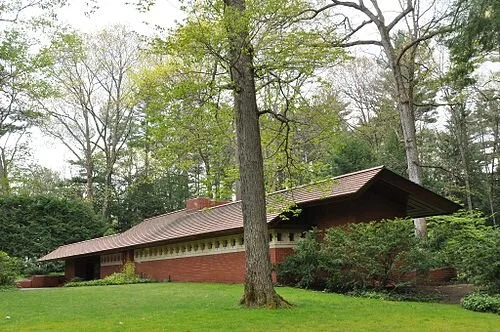
The Zimmerman House, in Manchester, N.H., one of only five houses in New England designed by Frank Lloyd Wright and the only one open to the public.
From Robert Whitcomb’s “Digital Diary,’’ in GoLocal24.com
Frank Lloyd Wright was arguably the greatest U.S. architect so far, designing natural-light-filled, “organic’’ buildings that fit in elegantly with their surroundings. He was also often a superb, if untrustworthy, writer. But his life – especially the first part of his adulthood, was rife with disasters, most horrifically murders and fires, as well as extra-marital scandals and financial bad behavior and distress. The central horror came on Aug. 15, 1914, when a crazed servant set Wright’s already famous Wisconsin residence, Taliesen, ablaze and murdered Wright’s mistress, Mamah Cheney, her two young children and four others with an ax.
Paul Hendrickson, in his new book Plagued by Fire: Dreams and Furies of Frank Lloyd Wright (1867-1959), a thickly researched, passionate and often deeply speculative -- and sometimes overly ruminative biography – brings this huge figure to life in all his genius, arrogance, reckless ambition, contradictions and doubts. Along the way, he also weaves in a great deal of American aesthetic, sociological (including racial) and even economic history. But then Wright got around as he designed more than 1,000 structures, of which 532 were completed. And his family and friends comprised a Shakespearean cast of characters.
Mr. Hendrickson summed up Wright’s gigantic life thus:
“If harmony and order were his great artistic ideals. Wright could find little of them in his own debt-plagued, scandal-wracked, death-haunted history.” We are fortunate that many Frank Lloyd Wright buildings are still around to marvel at.
William Morgan: The utilitarian and the romantic in the Granite State
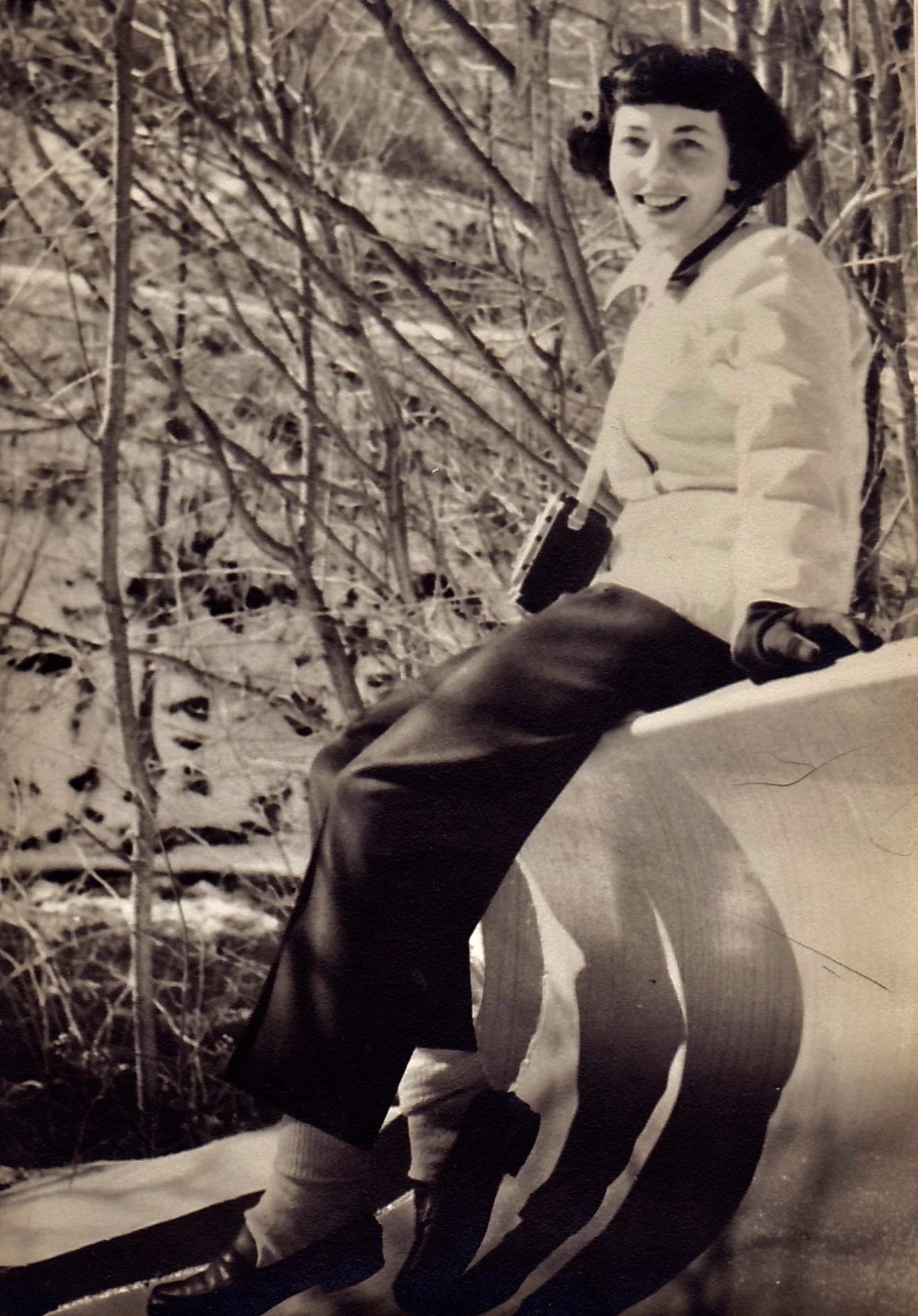
A 50-cent picture found in a junk store in Warren, R.I., is the ultimate Granite State winter pin-up. On the rear, penned in real ink, is the legend: “Sue Nardi on Snowplow/South Lyndboro, N.H./Feb. 12, 1950’’
Lyndeborough is a small upland village in southwestern New Hampshire, just above where Stony Brook joins the Souhegan River, which provided power for the 19th-Century textile mills at Wilton, N.H.
The image was printed in someone’s basement or in a school darkroom, as the edges of the image are not parallel. My guess is that this is probably a yearbook photograph.
It is more romantic, however, to imagine that the photographer was Sue Nardi’s adoring boyfriend. (Valentine’s Day was just two days away.)
The fetching Italian-American dressed up for this glamour shot. Despite the snow, she is wearing penny loafers and her trousers are seriously ironed. (Feb. 12 of that year was a Sunday, but surely Miss Nardi would have worn a dress to Mass?)
If still with us, Sue would be around 90 – perhaps still treasuring memories of posing against that essential northern New England implement, a snowplow.
William Morgan is an essayist and architectural historian. He is the author of Monadnock Summer: the Architectural Legacy of Dublin, New Hampshire. His next book, Snowbound: Dwelling in Winter, will be published next year by Princeton Architectural Press.
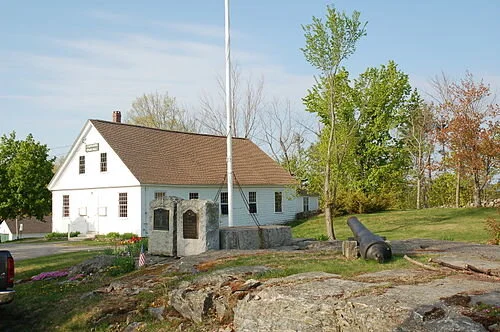
Lyndeborough Town Hall, built in 1846.
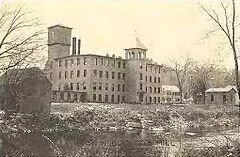
Wilton Woolen Co. mill in 1912. There were lots of woolen mills in New England, originally because it was prime sheep-raising country and New Englanders needed wool to keep warm in the region’s long cold season.
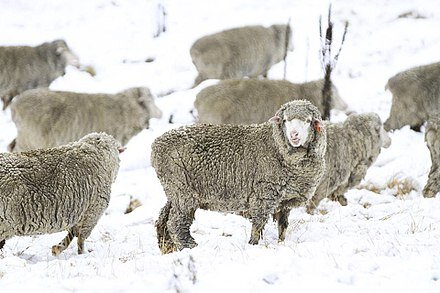
New England Merino sheep, famed for the quality of their wool. Merino sheep were introduced to Vermont in 1802. By 1837, 1 million sheep were in the state. But the price of wool dropped to 25 cents/pound in the late 1840s. The state could not handle more efficient competition from other states, and sheep-raising in the Green Mountain State collapsed. Still, it was a bonanza for decades.
Gray, or colorless?

“Thanksgiving,’’ by Jennie Augusta Brownscombe
If months were marked by colors, November in New England would be colored gray.
— Madeleine M. Kunin, diplomat, author and politician. She was the 77th governor of Vermont, from 1985 until 1991.
Jill Richardson: New EPA rule would undermine science

From OtherWords.org
The Trump Environmental Protection Agency wants to introduce a new rule: Its scientists can only use studies that make all of their data public.
The new proposal is crafted to sound like a win for transparency, which is supposed to be a good thing. In reality, the rule will significantly harm public health — and loosen the reins on polluters.
And that, of course, is the idea.
Let me explain. I am a graduate student in sociology, a social science. I study people, which means I collect some kind of data about them. For any scientist who studies people, transparency is important — but so is confidentiality.
Any basic research ethics class includes famous cases of unethical research on people that occurred in the not too distant past. So now, our institutions carefully review each study on people to ensure they are ethical.
Ethical research requires providing participants with enough information that they can give informed consent to participate. It means not taking advantage of vulnerable populations (like prison inmates or mental health patients), minimizing any risk of harm that might come to the people you are studying as much as possible, and disclosing any risk before they agree to participate.
In my case, that means that in any study I’ve done, I’ve promised my participants confidentiality.
With their permission, I might quote them in a publication using a fake name, but only if I can do so in a way that won’t allow anyone to identify them. I don’t want anything they tell me to be used to harm them back in their communities.
In the case of the new EPA rules, the information collected in public health studies can be even more intimate. When scientists study the effects of pollution on people’s health, they may confidentially review people’s private medical records. Obviously, these records should not be made public
When a researcher cannot promise confidentiality, the quality of their research suffers. Fewer people may be willing to participate, which might harm the reliability of the results. Those who do will be less open.
How can we trust studies in which all of the data is not made public? Often, some of the data is made public, or at least made available to others in certain circumstances (such as by request).
Additionally, science is not an individual endeavor. Communities of scientists in each field work together to advance the knowledge within that field. Any new study will be picked apart by everyone who reads it, because that’s what we do to each other. Others will try to replicate your findings — and if they can’t, your conclusions will be called into question.
It’s rough on the ego, but it’s good for science.
Dismissing any study that does not make its data public, on the other hand — particularly when that data has a good reason to remain confidential, like medical data — serves to harm science, not help it.
And when you can’t do good science, you can’t base your public health regulations — your pesticide bans, your pollution controls, your clean water rules, and whatever else — on good science.
Given the track record of the Trump administration on the environment so far, it’s far more plausible that this proposal is intended to eliminate necessary public health regulations, not to promote transparency.
OtherWords columnist Jill Richardson is pursuing a PhD in sociology at the University of Wisconsin-Madison.
But the mountains aren't high enough

In New Hampshire’s Franconia Range
I met a lady from the South who said
(You won't believe she said it, but she said it):
"None of my family ever worked, or had
A thing to sell.
" I don't suppose the work
Much matters.
You may work for all of me.
I've seen the time I've had to work myself.
The having anything to sell is what
Is the disgrace in man or state or nation.
I met a traveler from Arkansas
Who boasted of his state as beautiful
For diamonds and apples.
"Diamonds
And apples in commercial quantities?"
I asked him, on my guard.
"Oh, yes," he answered,
Off his.
The time was evening in the Pullman.
I see the porter's made your bed," I told him.
I met a Californian who would
Talk California—a state so blessed,
He said, in climate, none bad ever died there
A natural death, and Vigilance Committees
Had had to organize to stock the graveyards
And vindicate the state's humanity.
"Just the way Stefansson runs on," I murmured,
"About the British Arctic.
That's what comes
Of being in the market with a climate.’’
I met a poet from another state,
A zealot full of fluid inspiration,
Who in the name of fluid inspiration,
But in the best style of bad salesmanship,
Angrily tried to male me write a protest
(In verse I think) against the Volstead Act.
He didn't even offer me a drink
Until I asked for one to steady him.
This is called having an idea to sell.
It never could have happened in New Hampshire.
The only person really soiled with trade
I ever stumbled on in old New Hampshire
Was someone who had just come back ashamed
From selling things in California.
He'd built a noble mansard roof with balls
On turrets, like Constantinople, deep
In woods some ten miles from a railroad station,
As if to put forever out of mind
The hope of being, as we say, received.
I found him standing at the close of day
Inside the threshold of his open barn,
Like a lone actor on a gloomy stage—
And recognized him, through the iron gray
In which his face was muffled to the eyes,
As an old boyhood friend, and once indeed
A drover with me on the road to Brighton.
His farm was "grounds," and not a farm at all;
His house among the local sheds and shanties
Rose like a factor's at a trading station.
And be was rich, and I was still a rascal.
I couldn't keep from asking impolitely,
Where bad he been and what had he been doing?
How did he get so? (Rich was understood.)
In dealing in "old rags" in San Francisco.
Oh, it was terrible as well could be.
We both of us turned over in our graves.
Just specimens is all New Hampshire has,
One each of everything as in a showcase,
Which naturally she doesn't care to sell.
She had one President.
(Pronounce him Purse,
And make the most of it for better or worse.
He's your one chance to score against the state.
She had one Daniel Webster.
He was all
The Daniel Webster ever was or shall be.
She had the Dartmouth needed to produce him.
I call her old.
She has one family
Whose claim is good to being settled here
Before the era of colonization,
And before that of exploration even.
John Smith remarked them as be coasted by,
Dangling their legs and fishing off a wharf
At the Isles of Shoals, and satisfied himself
They weren't Red Indians but veritable
Pre-primitives of the white race, dawn people,
Like those who furnished Adam's sons with wives;
However uninnocent they may have been
In being there so early in our history.
They'd been there then a hundred years or more.
Pity he didn't ask what they were up to
At that date with a wharf already built,
And take their name.
They've since told me their name—
Today an honored one in Nottingham.
As for what they were up to more than fishing—
Suppose they weren't behaving Puritanly,
The hour bad not yet struck for being good,
Mankind had not yet gone on the Sabbatical.
It became an explorer of the deep
Not to explore too deep in others' business.
Did you but know of him, New Hampshire has
One real reformer who would change the world
So it would be accepted by two classes,
Artists the minute they set up as artists,
Before, that is, they are themselves accepted,
And boys the minute they get out of college.
I can't help thinking those are tests to go by.
And she has one I don't know what to call him,
Who comes from Philadelphia every year
With a great flock of chickens of rare breeds
He wants to give the educational
Advantages of growing almost wild
Under the watchful eye of hawk and eagle
Dorkings because they're spoken of by Chaucer,
Sussex because they're spoken of by Herrick
She has a touch of gold.
New Hampshire gold—
You may have heard of it.
I had a farm
Offered me not long since up Berlin way
With a mine on it that was worked for gold;
But not gold in commercial quantities,
Just enough gold to make the engagement rings
And marriage rings of those who owned the farm.
What gold more innocent could one have asked for?
One of my children ranging after rocks
Lately brought home from Andover or Canaan
A specimen of beryl with a trace
Of radium.
I know with radium
The trace would have to be the merest trace
To be below the threshold of commercial;
But trust New Hampshire not to have enough
Of radium or anything to sell.
A specimen of everything, I said.
She has one witch—old style.
She lives in Colebrook.
(The only other witch I ever met
Was lately at a cut-glass dinner in Boston.
There were four candles and four people present.
The witch was young, and beautiful (new style),
And open-minded.
She was free to question
Her gift for reading letters locked in boxes.
Why was it so much greater when the boxes
Were metal than it was when they were wooden?
It made the world seem so mysterious.
The S'ciety for Psychical Research
Was cognizant.
Her husband was worth millions.
I think he owned some shares in Harvard College.
New Hampshire used to have at Salem
A company we called the White Corpuscles,
Whose duty was at any hour of night
To rush in sheets and fool's caps where they smelled
A thing the least bit doubtfully perscented
And give someone the Skipper Ireson's Ride.
One each of everything as in a showcase.
More than enough land for a specimen
You'll say she has, but there there enters in
Something else to protect her from herself
There quality makes up for quantity.
Not even New Hampshire farms are much for sale.
The farm I made my home on in the mountains
1 had to take by force rather than buy.
I caught the owner outdoors by himself
Raking.
up after winter, and I said,
“I’m going to put you off this farm: I want it.’’
“Where are you going to put me? In the road?”
“I’m going to put you on the farm next to it.’’
“Why won't the farm next to it do for you?"
"I like this better.’’
It was really better.
Apples? New Hampshire has them, but unsprayed,
With no suspicion in stern end or blossom end
Of vitriol or arsenate of lead,
And so not good for anything but cider.
Her unpruned grapes are flung like lariats
Far up the birches out of reach of man.
A state producing precious metals, stones,
And—writing; none of these except perhaps
The precious literature in quantity
Or quality to worry the producer
About disposing of it.
Do you know,
Considering the market, there are more
Poems produced than any other thing?
No wonder poets sometimes have to seem
So much more businesslike than businessmen.
Their wares are so much harder to get rid of.
She's one of the two best states in the Union.
Vermont's the other.
And the two have been
Yokefellows in the sap yoke from of old
In many Marches.
And they lie like wedges,
Thick end to thin end and thin end to thick end,
And are a figure of the way the strong
Of mind and strong of arm should fit together,
One thick where one is thin and vice versa.
New Hampshire raises the Connecticut
In a trout hatchery near Canada,
But soon divides the river with Vermont.
Both are delightful states for their absurdly
Small towns—Lost Nation, Bungey, Muddy Boo,
Poplin, Still Corners (so called not because
The place is silent all day long, nor yet
Because it boasts a whisky still—because
It set out once to be a city and still
Is only corners, crossroads in a wood).
And I remember one whose name appeared
Between the pictures on a movie screen
Election night once in Franconia,
When everything had gone Republican
And Democrats were sore in need of comfort:
Easton goes Democratic, Wilson 4
Hughes 2.
And everybody to the saddest
Laughed the loud laugh the big laugh at the little.
New York (five million) laughs at Manchester,
Manchester (sixty or seventy thousand) laughs
At Littleton (four thousand), Littleton
Laughs at Franconia (seven hundred), and
Franconia laughs, I fear—-did laugh that night--
At Easton.
What has Easton left to laugh at,
And like the actress exclaim "Oh, my God" at?
There's Bungey; and for Bungey there are towns,
Whole townships named but without population.
Anything I can say about New Hampshire
Will serve almost as well about Vermont,
Excepting that they differ in their mountains.
The Vermont mountains stretch extended straight;
New Hampshire mountains Curl up in a coil.
I had been coming to New Hampshire mountains.
And here I am and what am I to say?
Here first my theme becomes embarrassing.
Emerson said, "The God who made New Hampshire
Taunted the lofty land with little men.
"
Another Massachusetts poet said,
"I go no more to summer in New Hampshire.
I've given up my summer place in Dublin.’’
"
But when I asked to know what ailed New Hampshire,
She said she couldn't stand the people in it,
The little men (it's Massachusetts speaking).
And when I asked to know what ailed the people,
She said, "Go read your own books and find out.’’
"
I may as well confess myself the author
Of several books against the world in general.
To take them as against a special state
Or even nation's to restrict my meaning.
I'm what is called a sensibilitist,
Or otherwise an environmentalist.
I refuse to adapt myself a mite
To any change from hot to cold, from wet
To dry, from poor to rich, or back again.
I make a virtue of my suffering
From nearly everything that goes on round me.
In other words, I know wherever I am,
Being the creature of literature I am,
1 sball not lack for pain to keep me awake.
Kit Marlowe taught me how to say my prayers:
"Why, this is Hell, nor am I out of it.’’
Samoa, Russia, Ireland I complain of,
No less than England, France, and Italy.
Because I wrote my novels in New Hampshire
Is no proof that I aimed them at New Hampshire.
When I left Massachusetts years ago
Between two days, the reason why I sought
New Hampshire, not Connecticut,
Rhode Island, New York, or Vermont was this:
Where I was living then, New Hampshire offered
The nearest boundary to escape across.
I hadn't an illusion in my handbag
About the people being better there
Than those I left behind.
I thought they weren't.
I thought they couldn't be.
And yet they were.
I'd sure had no such friends in Massachusetts
As Hall of Windham, Gay of Atkinson,
Bartlett of Raymond (now of Colorado),
Harris of Derry, and Lynch of Bethlehem.
The glorious bards of Massachusetts seem
To want to make New Hampshire people over.
They taunt the lofty land with little men.
I don't know what to say about the people.
For art's sake one could almost wish them worse
Rather than better.
How are we to write
The Russian novel in America
As long as life goes so unterribly?
There is the pinch from which our only outcry
In literature to date is heard to come.
We get what little misery we can
Out of not having cause for misery.
It makes the guild of novel writers sick
To be expected to be Dostoievskis
On nothing worse than too much luck and comfort.
This is not sorrow, though; it's just the vapors,
And recognized as such in Russia itself
Under the new regime, and so forbidden.
If well it is with Russia, then feel free
To say so or be stood against the wall
And shot.
It's Pollyanna now or death.
This, then, is the new freedom we hear tell of;
And very sensible.
No state can build
A literature that shall at once be sound
And sad on a foundation of well-being.
To show the level of intelligence
Among us: it was just a Warren farmer
Whose horse had pulled him short up in the road
By me, a stranger.
This is what he said,
From nothing but embarrassment and want
Of anything more sociable to say:
"You hear those bound dogs sing on Moosilauke?
Well, they remind me of the hue and cry
We've heard against the Mid -Victorians
And never rightly understood till Bryan
Retired from politics and joined the chorus.
The matter with the Mid-Victorians
Seems to have been a man named John L.
Darwin.
"Go 'long," I said to him, he to his horse.
I knew a man who failing as a farmer
Burned down his farmhouse for the fire insurance,
And spent the proceeds on a telescope
To satisfy a lifelong curiosity
About our place among the infinities.
And how was that for otherworldliness?
If I must choose which I would elevate —
The people or the already lofty mountains
I'd elevate the already lofty mountains
The only fault I find with old New Hampshire
Is that her mountains aren't quite high enough.
I was not always so; I've come to be so.
How, to my sorrow, how have I attained
A height from which to look down critical
On mountains? What has given me assurance
To say what height becomes New Hampshire mountains,
Or any mountains? Can it be some strength
I feel, as of an earthquake in my back,
To heave them higher to the morning star?
Can it be foreign travel in the Alps?
Or having seen and credited a moment
The solid molding of vast peaks of cloud
Behind the pitiful reality
Of Lincoln, Lafayette, and Liberty?
Or some such sense as says bow high shall jet
The fountain in proportion to the basin?
No, none of these has raised me to my throne
Of intellectual dissatisfaction,
But the sad accident of having seen
Our actual mountains given in a map
Of early times as twice the height they are—
Ten thousand feet instead of only five—
Which shows how sad an accident may be.
Five thousand is no longer high enough.
Whereas I never had a good idea
About improving people in the world,
Here I am overfertile in suggestion,
And cannot rest from planning day or night
How high I'd thrust the peaks in summer snow
To tap the upper sky and draw a flow
Of frosty night air on the vale below
Down from the stars to freeze the dew as starry.
The more the sensibilitist I am
The more I seem to want my mountains wild;
The way the wiry gang-boss liked the logjam.
After he'd picked the lock and got it started,
He dodged a log that lifted like an arm
Against the sky to break his back for him,
Then came in dancing, skipping with his life
Across the roar and chaos, and the words
We saw him say along the zigzag journey
Were doubtless as the words we heard him say
On coming nearer: "Wasn't she an i-deal
Son-of-a-bitch? You bet she was an i-deal.’’
For all her mountains fall a little short,
Her people not quite short enough for Art,
She's still New Hampshire; a most restful state.
Lately in converse with a New York alec
About the new school of the pseudo-phallic,
I found myself in a close corner where
I bad to make an almost funny choice.
"Choose you which you will be—a prude, or puke,
Mewling and puking in the public arms.’’
"Me for the hills where I don’t have to choose.’’
"But if you bad to choose, which would you be?"
1 wouldn't be a prude afraid of nature.
I know a man who took a double ax
And went alone against a grove of trees;
But his heart failing him, he dropped the ax
And ran for shelter quoting Matthew Arnold:
"'Nature is cruel, man is sick of blood':
There s been enough shed without shedding mine.
Remember Birnam Wood! The wood's in flux!"
He had a special terror of the flux
That showed itself in dendrophobia.
The only decent tree had been to mill
And educated into boards, be said.
He knew too well for any earthly use
The line where man leaves off and nature starts.
And never overstepped it save in dreams.
He stood on the safe side of the line talking—
Which is sheer Matthew Arnoldism,
The cult of one who owned himself "a foiled
Circuitous wanderer," and "took dejectedly
His seat upon the intellectual throne"—
Agreed in 'frowning on these improvised
Altars the woods are full of nowadays,
Again as in the days when Ahaz sinned
By worship under green trees in the open.
Scarcely a mile but that I come on one,
A black-checked stone and stick of rain-washed charcoal.
Even to say the groves were God's first temples
Comes too near to Ahaz' sin for safety.
Nothing not built with hands of course is sacred.
But here is not a question of what's sacred;
Rather of what to face or run away from.
I'd hate to be a runaway from nature.
And neither would I choose to be a puke
Who cares not what be does in company,
And when he can't do anything, falls back
On words, and tries his worst to make words speak
Louder than actions, and sometimes achieves it.
It seems a narrow choice the age insists on
8ow about being a good Greek, for instance)
That course, they tell me, isn't offered this year.
"Come, but this isn't choosing—puke or prude?"
Well, if I have to choose one or the other,
I choose to be a plain New Hampshire farmer
With an income in cash of, say, a thousand
(From, say, a publisher in New York City).
It's restful to arrive at a decision,
And restful just to think about New Hampshire.
At present I am living in Vermont.
— “New Hampshire,’’ by Robert Frost
Lots of pictures and fun and Christmas gifts

The annual Little Pictures Show at the Providence Art Club is great fun. To learn more, please hit this link.

Crafty crows

Adapted from Robert Whitcomb’s “Digital Diary,’’ in GoLocal24.com
Crows seem to be most excitable in November, at least in New England.
From crows.net:
“This {mid-November to mid-December} is the time when the big communal roosts are forming…arge number of crows will be gathering together in the evenings to spend the night in roosts that may contain anywhere from several hundred to tens of thousands of crows. Crows from a fairly large geographical area, covering a circle with perhaps a 20 mile or larger radius, will begin flying in the late afternoon or early evening towards a central roost location. It appears that in many cases, crows from various parts of the area served by the roost will stop at one or more staging area along the way where groups of crows gather and remain a short time before proceeding to the main roost. To use a human analogy, one might say that families of crows proceed to staging areas, where the clans gather, before flying on to gather as a tribe at the roost….”
“Although roosts may occur in a wide variety of surroundings, most commonly they are found in areas with large, mature trees not growing to densely, relatively near a water source such as a river or lake. In cities favorite areas seem to be cemeteries, college campuses, parks, malls, railroad yards, and old industrial areas.’’
No wonder they like our neighborhood so much!
They sure drop massive quantities of guano on our cars. But they sure do a great job removing the bodies of car-squashed squirrels from the roads.
Much has been made of recent research showing the high intelligence of crows and ravens, which look like crows but are larger. Parrots and the corvid family of crows, ravens and jays are considered the most intelligent birds.
They can, for example, remember individual humans, count and use tools. This naturally leads people, as they do with, particularly, their dogs and cats, to assign them human qualities. It’s as if we want to expand our human community to include other species as subsidiaries of us, the ruling class. But of course, whatever their range of intelligence, including emotional intelligence, they live in worlds far different from ours. Beware anthropomorphizing them.
To read more, please this link.
“Histories are more full of examples of the fidelity of dogs than of friends.’’
-- Alexander Pope
Play it again, Shawn

“Musician III” (found material and paint), by Shawn Farley, in his show at the Augusta Savage Gallery, at the University of Massachusetts at Amherst, through Nov. 26.
The gallery says that Mr. Farley’s mixed-media constructions “apply discarded and found materials to yield soulful results. ‘‘
Poisoning the Merrimack

From Robert Whitcomb’s “Digital Diary,’’ in GoLocal24.com
The Trump administration doesn’t particularly like environmental rules because they can inconvenience some businesses, whose bosses/owners might be big campaign contributors. It’s been trying to weaken or delete some regulations, meant to protect people and the broader environment.
Here’s a troubling example of its attitude:
Federal and state environmental officials have renewed a permit letting Turnkey Landfill, in Rochester, N.H., send as much as 100,000 gallons a day of polluted runoff to a Lowell, Mass., treatment plant that empties into the Merrimack River, which provides drinking water to hundreds of thousands of people a day.
The polluted water has large amounts of highly toxic chemicals known as PFAS, which have been linked to kidney cancer, low infant birth weights and other diseases, reports The Boston Globe, which said:
“The company’s tests showed that the amount of PFAS, known as ‘forever chemicals’ because they never fully degrade, was more than 100 times higher than federal and state guidelines and more than 400 times higher than stricter standards being considered in Massachusetts.’’
“While the Lowell Regional Wastewater Utility treats the landfill runoff before discharging it into the river, the plant lacks the expensive equipment to filter out PFAS. Worse, environmental advocates say, the treatment process can make the chemicals more toxic, enabling them to bind in ways that make them harder to break down.”
Don’t expect the EPA and the Granite State to change their minds (EPA Administrator Andrew Wheeler is a former coal-industry lobbyist.) You might want to stick to bottled water when you’re in the Lowell area…
To read more, please hit this link.

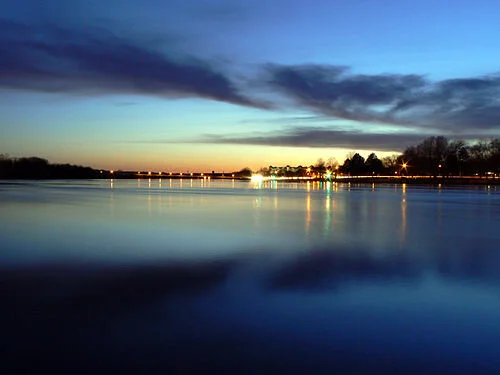
The Merrimack at sunset in Lowell
'Friendly in the dark chill'
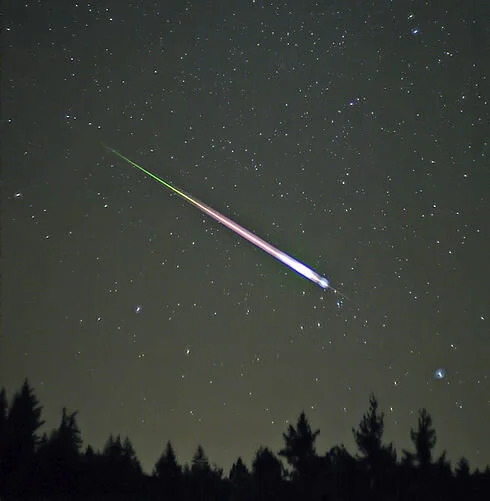
A Leonid meteor streaks across the sky during a meteor ‘‘shower.’’
"The sky is streaked with them
burning holes in black space --’/
like fireworks, someone says
all friendly in the dark chill
of Newcomb Hollow in November,
friends known only by voices.’’
From “Leonids Over Us,’’ by Marge Piercy, a Wellfleet, Mass., poet. Newcomb Hollow Beach is part of the Cape Cod National Seashore.
'Nature in 3-D'
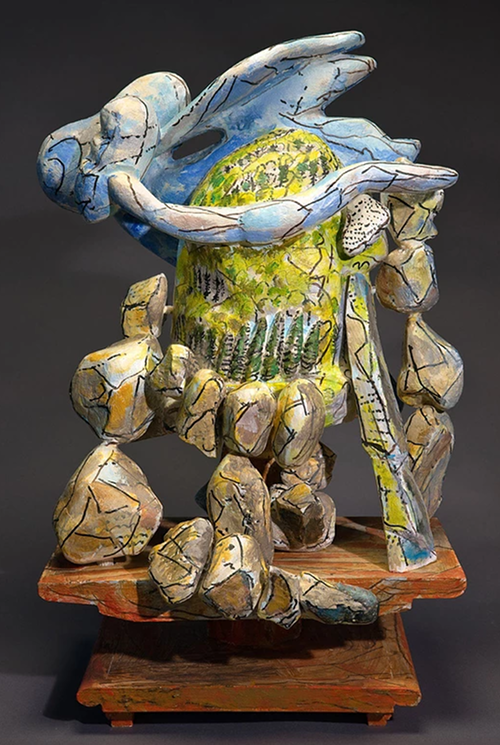
“Mountain View Spring,’’ by Nick Edmonds, in his show at Boston Design Center, through Nov. 29.
His sculptures are made of wood and inspired by Japanese woodworking techniques he learned when he spent eight months in Japan during the 1970s. “Each piece is made of many complex forms, joined together in a single whole. He replicates landscapes and other natural environments for viewers to lose themselves in, creating nature in 3-D,‘‘ the gallery says..
November-looking leaves

Encaustic collage by Jeanne Borofsky, in her show “Jeanne Borofsky: Natural Expressions,” at Creative Connections Gallery, Ashburnham, Mass., through Nov. 30.
The gallery says: “Natural Expressions’’ showcases the encaustic collages of Borofsky, who “finds inspiration in the natural world, utilizing patterns of bark, leaves and water in each piece. Also present in her work are unnatural elements like stamps, maps and electronic odds and ends, which meld seamlessly with the natural to create a complete piece.’’
Ashburnham is a rural/exurban town, with views of Mt. Monadnock to the north and Mt. Wachusett to the north. It’s best known for Cushing Academy, a well-regarded private boarding and day school.
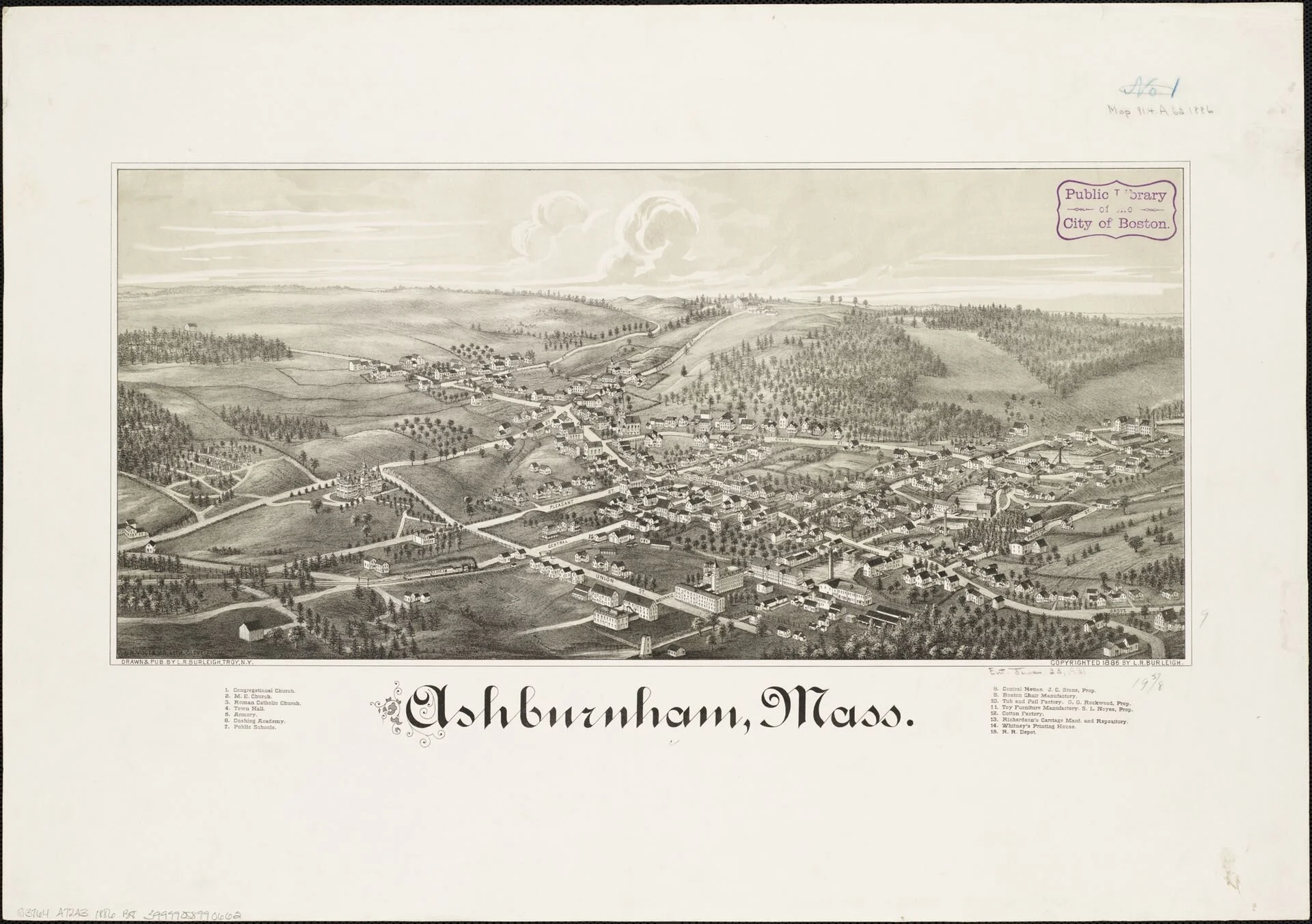
Print of Ashburnham from 1886 by L.R. Burleig with list of landmarks depicted including Cushing Academy.
David Warsh: Societies search for a unifying 'worthy ogre'
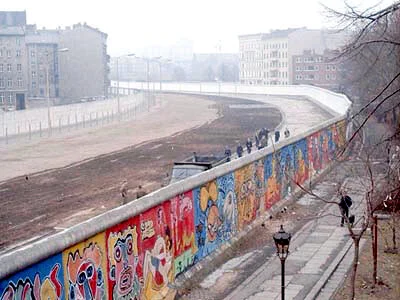
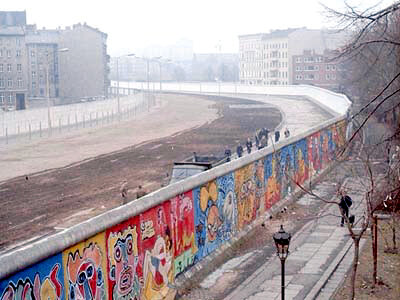
View from the West Berlin side of the Berlin Wall, with its graffiti art, in 1986. The wall's "death strip" is on the east side of the Wall.
During the six months I spent in Berlin many years ago, Café November was a frequent destination, often in the company of Thomas Geoghegan, who, predictably, had found it. The dilapidated Prenzlauer Berg neighborhood was becoming evermore gentrified. But Café November had opened in 1993, before Ostalgie set in. November was fraught with significance in memory; it was the month of the Armistice that ended World War I and in which the Kaiser abdicated, 1918; of Kristallnacht, in 1938; in which the Nazi Army became encircled at Stalingrad, in 1942; in which Berlin was first partitioned East and West, in 1945; and, of course, the month when partition ended, in 1989.
In all the stories I read the other week about the 30th anniversary of the end of the Berlin Wall, the single article that seemed to me most thoughtful was an interview with Wolfgang Hübner, editor of Neues Deutschland. Once the official paper of the East German Communist Party, controlled by its central committee, ND has seen its circulation decline from 1.1 million in 1989 to around 25,000 readers today. Under the headline German Paper that spoke for GDR still fights for socialism, Hübner told Financial Times correspondent Tobias Buck:
Our readers expect us to look back [at the falloff the Wall] in a way that does justice to their own experiences and to their memories of the GDR. They don’t wish the GDR back the way it was, and they mean that. There is a widespread feeling that things went wrong. But they also think there were some basic ideas [underpinning the socialist system] that should be back on the agenda. People say: the GDR never took part in a war. There were no homeless. There was no unemployment…. But the paper as it appears today could not have been published in the GDR.
That sense of loss seems central to German’s political problems today. The generous terms of reunification are recounted in this well-balanced article from The Economist last week, along with the relative upheaval suffered by citizens of the former GDR during the long, slow process of matching the development of West Germany. “On October 4, 1990 [the day after reunification], after a night of partying I carried on my life as normal,” a senior Berlin bureaucrat told the magazine. “Not a single East German had the same experience.” Immigration has exacerbated a situation that had already become testy.
The desirability of paying attention to the experience of others was emphasized elsewhere in connection with the years since 1989. In 1989 Wasn’t the End of History After All, political scientist Yascha Mounk explained, in The Wall Street Journal (subscription required) how the motivations behind the rebellion against communism in Eastern Europe were always more mixed than the Western triumphalist narrative suggested.
Those brave protesters in the streets of Dresden and Gdansk, Budapest and Sofia, were united by a hatred of their communist regimes. But they were far less unified in their aspirations for the future. A great number did seek to realize the core values of liberal democracy. But others primarily wanted to liberate their nations from Russian domination, to revive the influence of their ancestral religion or to give free rein to nationalism. In that light, today’s battle against liberal democracy by populists like Hungary’s Viktor Orban and Poland’s Jaroslaw Kaczynski is not so much a betrayal of the revolution of 1989 as a civil war among its protagonists.
Civil war is sometimes mentioned in connection with the U.S., too. I’ve long believed that domestic policy in America was shaped by foreign policy at least since 1939, and that the Cold War imposed a discipline on American discourse that lasted for most of forty years, It eroded during the 1980s and was lost altogether when the Soviet Union dissolved. Financial Times columnist Janan Ganesh concisely made that argument last week, in What the US lost when the Berlin Wall fell, that the U.S. requires an external enemy to serve as a “binding agent.”
“As long as the country was menaced from the outside, there was a natural limit on its internal squabbles.” Since 1989, partisanship has grown rampant. Citing the writer Peter Beinart, he notes that George H.W. Bush was the last president whose election was universally recognized as legitimate. Since then, Bill Clinton was dogged by accusations of Arkansas scandals, George W, Bush was said to have been installed by friendly judges, Barack Obama was accused of lacking citizenship, and Donald Trump to have been elected thanks to Russian interference.
When the wall fell, wrote Ganesh, “so did a certain kind of US nationhood.” Islam didn’t do as a unifying enemy. Neither will China. “The partisanship that followed will endure until the next worthy ogre comes along.” The columnist ended on an especially dire note.
It is as though hatred obeys the first law of thermodynamics. Like energy, it can be transferred but never destroyed. The less of it a nation directs outward, the more it must channel at home. America’s victory in the Cold War was a feat of strategy and patience that should be saluted this weekend. It just happens to be a victory from which it has never recovered.
Not yet, anyway. True, the divisions today seem very deep. But the 2020 presidential election offers fresh hope that a young, moderate Midwesterner may be elected. (I have grown partial to Pete Buttigieg and look forward to the Iowa caucuses.)
As for the next “worthy ogre,” global warming will play that role for decades to come. If you believe the science, there can be no doubt that a long, taxing, dangerous struggle lies ahead. If you believe, with Henry Adams, that “Politics, as a practice, whatever its professions, has always been the systematic organization of hatreds,” then expect growing personification of atmospheric polluters.
. xxx
New on the EP bookshelf:
Deaths of Despair and the Future of Capitalism, by Anne Case and Angus Deaton (Princeton, March 2020)
David Warsh, an economic historian and veteran columnist, is proprietor of economicprincipals.com, based in Somerville, Mass., where this column originated.