
Vox clamantis in deserto





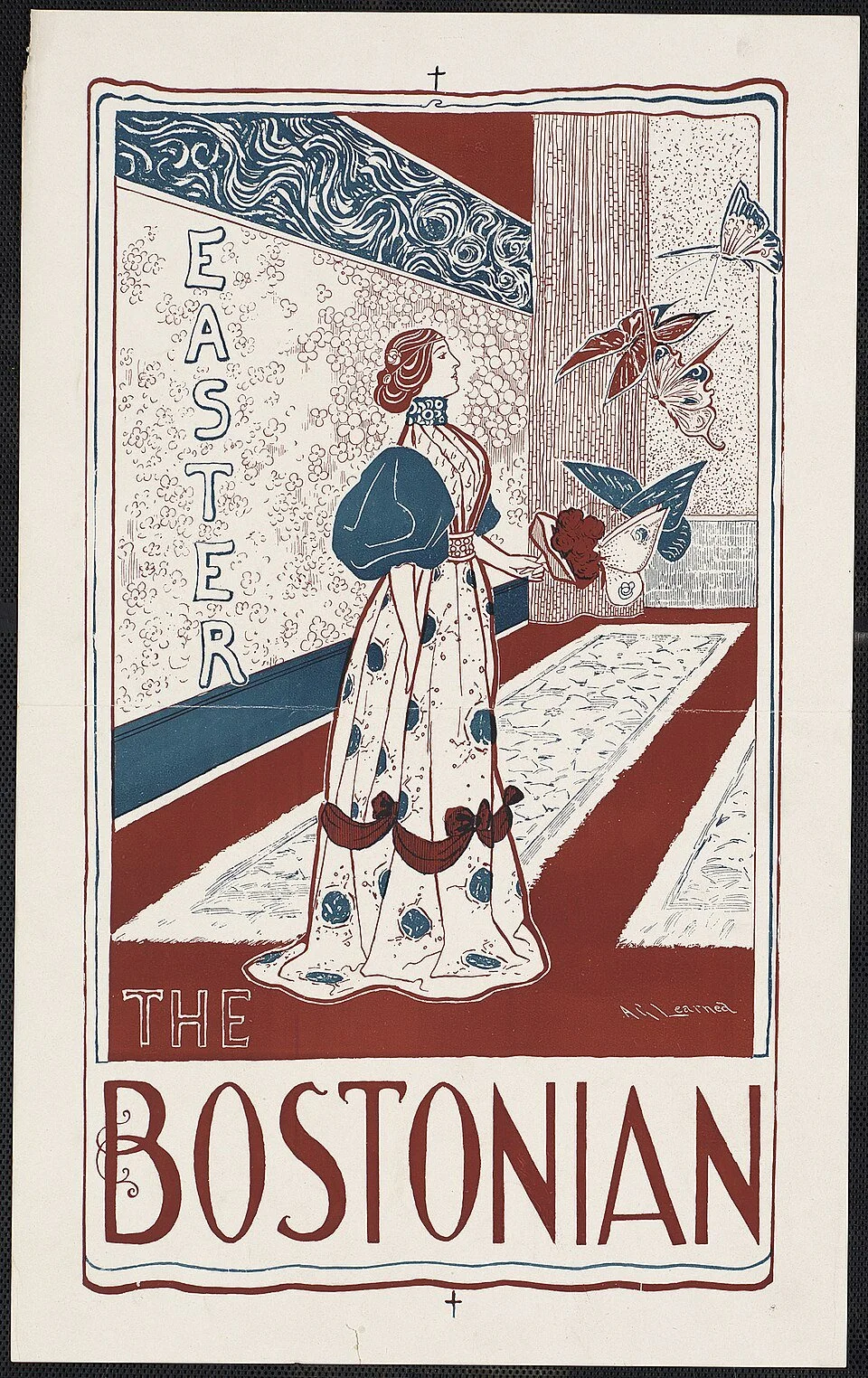
Lots of pictures and fun and Christmas gifts

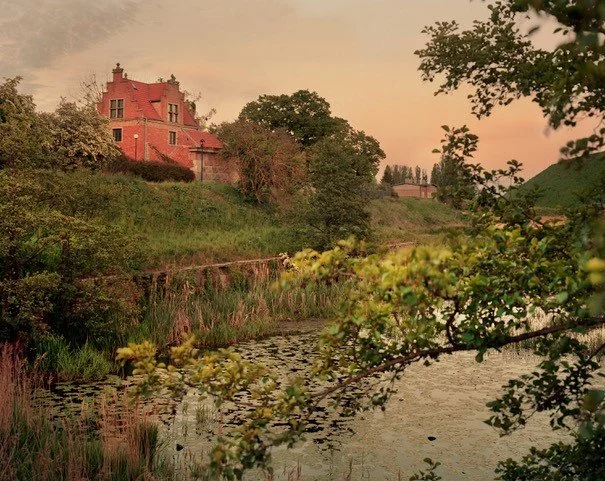
The annual Little Pictures Show at the Providence Art Club is great fun. To learn more, please hit this link.

Crafty crows

Adapted from Robert Whitcomb’s “Digital Diary,’’ in GoLocal24.com
Crows seem to be most excitable in November, at least in New England.
From crows.net:
“This {mid-November to mid-December} is the time when the big communal roosts are forming…arge number of crows will be gathering together in the evenings to spend the night in roosts that may contain anywhere from several hundred to tens of thousands of crows. Crows from a fairly large geographical area, covering a circle with perhaps a 20 mile or larger radius, will begin flying in the late afternoon or early evening towards a central roost location. It appears that in many cases, crows from various parts of the area served by the roost will stop at one or more staging area along the way where groups of crows gather and remain a short time before proceeding to the main roost. To use a human analogy, one might say that families of crows proceed to staging areas, where the clans gather, before flying on to gather as a tribe at the roost….”
“Although roosts may occur in a wide variety of surroundings, most commonly they are found in areas with large, mature trees not growing to densely, relatively near a water source such as a river or lake. In cities favorite areas seem to be cemeteries, college campuses, parks, malls, railroad yards, and old industrial areas.’’
No wonder they like our neighborhood so much!
They sure drop massive quantities of guano on our cars. But they sure do a great job removing the bodies of car-squashed squirrels from the roads.
Much has been made of recent research showing the high intelligence of crows and ravens, which look like crows but are larger. Parrots and the corvid family of crows, ravens and jays are considered the most intelligent birds.
They can, for example, remember individual humans, count and use tools. This naturally leads people, as they do with, particularly, their dogs and cats, to assign them human qualities. It’s as if we want to expand our human community to include other species as subsidiaries of us, the ruling class. But of course, whatever their range of intelligence, including emotional intelligence, they live in worlds far different from ours. Beware anthropomorphizing them.
To read more, please this link.
“Histories are more full of examples of the fidelity of dogs than of friends.’’
-- Alexander Pope
Play it again, Shawn

“Musician III” (found material and paint), by Shawn Farley, in his show at the Augusta Savage Gallery, at the University of Massachusetts at Amherst, through Nov. 26.
The gallery says that Mr. Farley’s mixed-media constructions “apply discarded and found materials to yield soulful results. ‘‘

Poisoning the Merrimack

From Robert Whitcomb’s “Digital Diary,’’ in GoLocal24.com
The Trump administration doesn’t particularly like environmental rules because they can inconvenience some businesses, whose bosses/owners might be big campaign contributors. It’s been trying to weaken or delete some regulations, meant to protect people and the broader environment.
Here’s a troubling example of its attitude:
Federal and state environmental officials have renewed a permit letting Turnkey Landfill, in Rochester, N.H., send as much as 100,000 gallons a day of polluted runoff to a Lowell, Mass., treatment plant that empties into the Merrimack River, which provides drinking water to hundreds of thousands of people a day.
The polluted water has large amounts of highly toxic chemicals known as PFAS, which have been linked to kidney cancer, low infant birth weights and other diseases, reports The Boston Globe, which said:
“The company’s tests showed that the amount of PFAS, known as ‘forever chemicals’ because they never fully degrade, was more than 100 times higher than federal and state guidelines and more than 400 times higher than stricter standards being considered in Massachusetts.’’
“While the Lowell Regional Wastewater Utility treats the landfill runoff before discharging it into the river, the plant lacks the expensive equipment to filter out PFAS. Worse, environmental advocates say, the treatment process can make the chemicals more toxic, enabling them to bind in ways that make them harder to break down.”
Don’t expect the EPA and the Granite State to change their minds (EPA Administrator Andrew Wheeler is a former coal-industry lobbyist.) You might want to stick to bottled water when you’re in the Lowell area…
To read more, please hit this link.

The Merrimack at sunset in Lowell
'Friendly in the dark chill'

A Leonid meteor streaks across the sky during a meteor ‘‘shower.’’
"The sky is streaked with them
burning holes in black space --’/
like fireworks, someone says
all friendly in the dark chill
of Newcomb Hollow in November,
friends known only by voices.’’
From “Leonids Over Us,’’ by Marge Piercy, a Wellfleet, Mass., poet. Newcomb Hollow Beach is part of the Cape Cod National Seashore.
'Nature in 3-D'
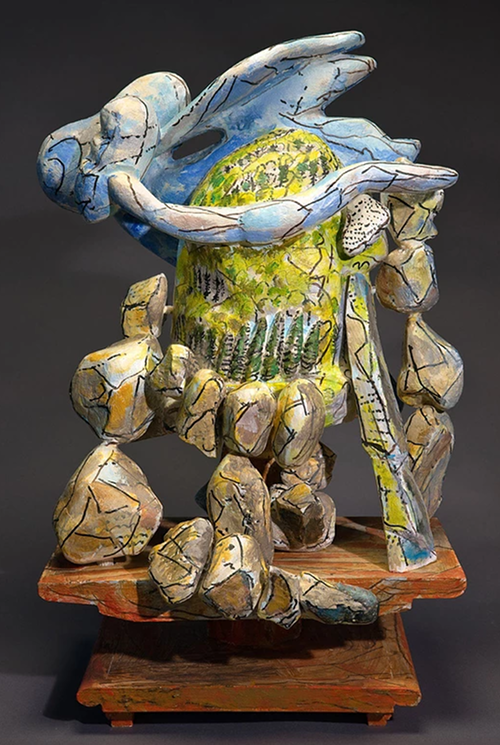
“Mountain View Spring,’’ by Nick Edmonds, in his show at Boston Design Center, through Nov. 29.
His sculptures are made of wood and inspired by Japanese woodworking techniques he learned when he spent eight months in Japan during the 1970s. “Each piece is made of many complex forms, joined together in a single whole. He replicates landscapes and other natural environments for viewers to lose themselves in, creating nature in 3-D,‘‘ the gallery says..
November-looking leaves

Encaustic collage by Jeanne Borofsky, in her show “Jeanne Borofsky: Natural Expressions,” at Creative Connections Gallery, Ashburnham, Mass., through Nov. 30.
The gallery says: “Natural Expressions’’ showcases the encaustic collages of Borofsky, who “finds inspiration in the natural world, utilizing patterns of bark, leaves and water in each piece. Also present in her work are unnatural elements like stamps, maps and electronic odds and ends, which meld seamlessly with the natural to create a complete piece.’’
Ashburnham is a rural/exurban town, with views of Mt. Monadnock to the north and Mt. Wachusett to the north. It’s best known for Cushing Academy, a well-regarded private boarding and day school.
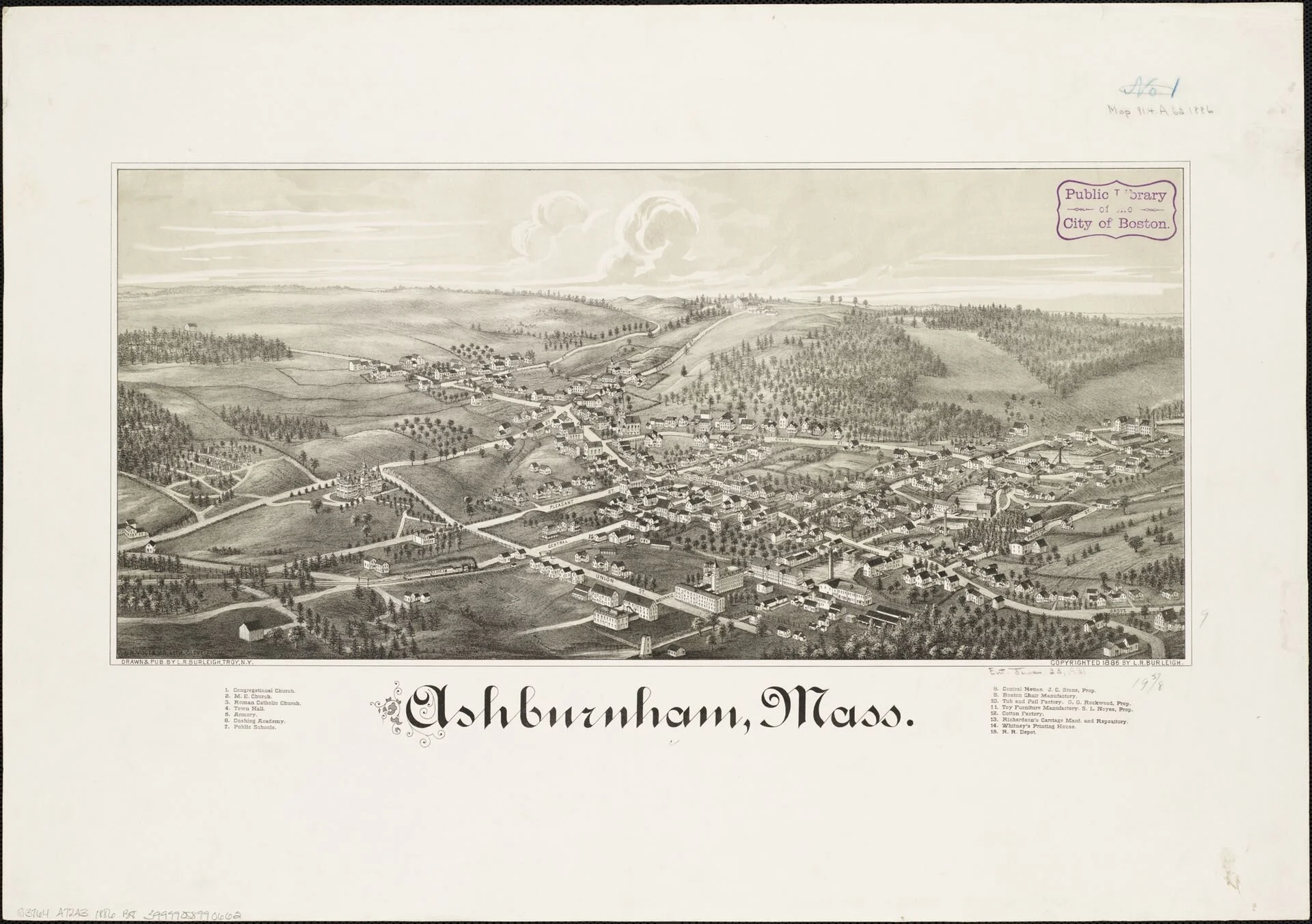
Print of Ashburnham from 1886 by L.R. Burleig with list of landmarks depicted including Cushing Academy.

David Warsh: Societies search for a unifying 'worthy ogre'

View from the West Berlin side of the Berlin Wall, with its graffiti art, in 1986. The wall's "death strip" is on the east side of the Wall.
During the six months I spent in Berlin many years ago, Café November was a frequent destination, often in the company of Thomas Geoghegan, who, predictably, had found it. The dilapidated Prenzlauer Berg neighborhood was becoming evermore gentrified. But Café November had opened in 1993, before Ostalgie set in. November was fraught with significance in memory; it was the month of the Armistice that ended World War I and in which the Kaiser abdicated, 1918; of Kristallnacht, in 1938; in which the Nazi Army became encircled at Stalingrad, in 1942; in which Berlin was first partitioned East and West, in 1945; and, of course, the month when partition ended, in 1989.
In all the stories I read the other week about the 30th anniversary of the end of the Berlin Wall, the single article that seemed to me most thoughtful was an interview with Wolfgang Hübner, editor of Neues Deutschland. Once the official paper of the East German Communist Party, controlled by its central committee, ND has seen its circulation decline from 1.1 million in 1989 to around 25,000 readers today. Under the headline German Paper that spoke for GDR still fights for socialism, Hübner told Financial Times correspondent Tobias Buck:
Our readers expect us to look back [at the falloff the Wall] in a way that does justice to their own experiences and to their memories of the GDR. They don’t wish the GDR back the way it was, and they mean that. There is a widespread feeling that things went wrong. But they also think there were some basic ideas [underpinning the socialist system] that should be back on the agenda. People say: the GDR never took part in a war. There were no homeless. There was no unemployment…. But the paper as it appears today could not have been published in the GDR.
That sense of loss seems central to German’s political problems today. The generous terms of reunification are recounted in this well-balanced article from The Economist last week, along with the relative upheaval suffered by citizens of the former GDR during the long, slow process of matching the development of West Germany. “On October 4, 1990 [the day after reunification], after a night of partying I carried on my life as normal,” a senior Berlin bureaucrat told the magazine. “Not a single East German had the same experience.” Immigration has exacerbated a situation that had already become testy.
The desirability of paying attention to the experience of others was emphasized elsewhere in connection with the years since 1989. In 1989 Wasn’t the End of History After All, political scientist Yascha Mounk explained, in The Wall Street Journal (subscription required) how the motivations behind the rebellion against communism in Eastern Europe were always more mixed than the Western triumphalist narrative suggested.
Those brave protesters in the streets of Dresden and Gdansk, Budapest and Sofia, were united by a hatred of their communist regimes. But they were far less unified in their aspirations for the future. A great number did seek to realize the core values of liberal democracy. But others primarily wanted to liberate their nations from Russian domination, to revive the influence of their ancestral religion or to give free rein to nationalism. In that light, today’s battle against liberal democracy by populists like Hungary’s Viktor Orban and Poland’s Jaroslaw Kaczynski is not so much a betrayal of the revolution of 1989 as a civil war among its protagonists.
Civil war is sometimes mentioned in connection with the U.S., too. I’ve long believed that domestic policy in America was shaped by foreign policy at least since 1939, and that the Cold War imposed a discipline on American discourse that lasted for most of forty years, It eroded during the 1980s and was lost altogether when the Soviet Union dissolved. Financial Times columnist Janan Ganesh concisely made that argument last week, in What the US lost when the Berlin Wall fell, that the U.S. requires an external enemy to serve as a “binding agent.”
“As long as the country was menaced from the outside, there was a natural limit on its internal squabbles.” Since 1989, partisanship has grown rampant. Citing the writer Peter Beinart, he notes that George H.W. Bush was the last president whose election was universally recognized as legitimate. Since then, Bill Clinton was dogged by accusations of Arkansas scandals, George W, Bush was said to have been installed by friendly judges, Barack Obama was accused of lacking citizenship, and Donald Trump to have been elected thanks to Russian interference.
When the wall fell, wrote Ganesh, “so did a certain kind of US nationhood.” Islam didn’t do as a unifying enemy. Neither will China. “The partisanship that followed will endure until the next worthy ogre comes along.” The columnist ended on an especially dire note.
It is as though hatred obeys the first law of thermodynamics. Like energy, it can be transferred but never destroyed. The less of it a nation directs outward, the more it must channel at home. America’s victory in the Cold War was a feat of strategy and patience that should be saluted this weekend. It just happens to be a victory from which it has never recovered.
Not yet, anyway. True, the divisions today seem very deep. But the 2020 presidential election offers fresh hope that a young, moderate Midwesterner may be elected. (I have grown partial to Pete Buttigieg and look forward to the Iowa caucuses.)
As for the next “worthy ogre,” global warming will play that role for decades to come. If you believe the science, there can be no doubt that a long, taxing, dangerous struggle lies ahead. If you believe, with Henry Adams, that “Politics, as a practice, whatever its professions, has always been the systematic organization of hatreds,” then expect growing personification of atmospheric polluters.
. xxx
New on the EP bookshelf:
Deaths of Despair and the Future of Capitalism, by Anne Case and Angus Deaton (Princeton, March 2020)
David Warsh, an economic historian and veteran columnist, is proprietor of economicprincipals.com, based in Somerville, Mass., where this column originated.
Getting off before the mountains

On the Massachusetts Turnpike in skidding season
“Once, just west of Framingham on the Worcester Turnpike or Route 9 in Massachusetts, I caught a ride in a truck that had worn brakes. The driver, a jolly red-nosed individual with a white beard who could have passed as Santa Claus, suggested that I might want to get out considering the situation regarding the truck’s brakes. Not wanting to turn down a ride in the middle of the night, I rode it out with the driver. Going uphill was all right, but coming down was decidedly hairy. The driver knew what he was doing and used his engine to slow himself down, but he had to depend on his emergency brake if he wanted to, or had to, stop. At one traffic light, which was on a downhill slope, he couldn’t bring his rig to a stop and just blew through the intersection, horn blowing, weaving past the cross traffic. …. He relied on his loud air horn, which sounded even louder in the dark of night. Fun was fun and eventually we got to Worcester, where I was glad to get off in one piece. I hope that he got his load to where it was going, but I knew that the farther west on Route 9 he went, the more mountainous the terrain would become and I didn’t want any part of that. Besides, this was where I needed to get off. My next leg would take me through Sturbridge and then on to Connecticut.’’
― Captain Hank Bracker, from his book Seawater One
Negin Owliaei: Billionaires, media and stealth politics
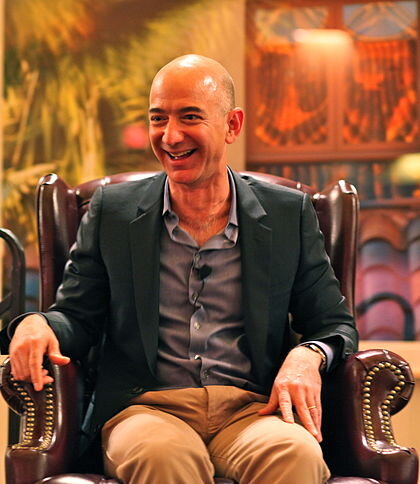
Amazon’s Jeff Bezos, who owns The Washington Post
From OtherWords.org
Bill Gates wants you to know that he pays taxes.
“I’ve paid more than $10 billion in taxes. I’ve paid more than anyone in taxes,” Gates told journalist Andrew Ross Sorkin. “But when you say I should pay $100 billion, OK, then I’m starting to do a little math about what I have left over.”
Supposedly Gates was talking about a wealth tax 2020 candidates have supported. But no plan yet proposed would seize $100 billion from the philanthrocapitalist anytime soon. Even if it did, he’d still be one of the richest men in the world, with $7 billion left over.
Gates isn’t the only billionaire who’s worried. JPMorgan Chase CEO Jamie Dimon also has concerns about the rising resentment towards his fellow elites.
“I think you should vilify Nazis,” Dimon told Lesley Stahl, “but you shouldn’t vilify people who worked hard to accomplish things.” Billionaire investor Leon Cooperman, who’s become a fixture on CNBC, recently teared up while complaining about the “vilification of billionaires.”
Why do the feelings of the 600 Americans that constitute our billionaire class suck up so much media attention?
For one thing, billionaires literally own the news. Buying up media companies is a new rite of passage for the ultra wealthy, such as the purchase of the Washington Post by Amazon head Jeff Bezos, or TIME by tech CEO Marc Benioff.
They’ll say they’re all about editorial independence, but the truth is billionaire ownership can affect news output. When billionaire Joe Ricketts found out the staff of DNAinfo, a network of city-based news sites he owned, was unionizing, he promptly shut down the entire venture out of spite.
There are more subtle ways in which the rich buy media access. The Gates Foundation, for example, has poured millions in donations into the media over the last several years to raise awareness around the foundation’s philanthropic goals — including its controversial funding of charter schools.
Not all billionaire power is publicly broadcast, however.
In their book Billionaires and Stealth Politics, researchers Benjamin Page, Jason Seawright and Matthew J. Lacombe document how economic elites have banded together to lobby for extremely conservative policies, such as cutting estate taxes, opposing regulations on the environment and Wall Street, and gutting social programs
Because these moves are highly unpopular, they’ve done this work in the background.
That means there’s a network of billionaires aligned with the Koch brothers, who’ve poured hundreds of millions of dollars into anti-labor policies. And Rupert Murdoch, the media mogul who changed the media landscape with Fox News. And casino magnate Sheldon Adelson, who’s spending his billions shaping U.S. foreign policy.
Their enormous wealth offers them an outlandishly oversized role in our democracy. It’s poisoning both our politics and our media.
So how about a ban on billionaires? Let’s tax away their wealth, but let’s get them off our airwaves, too. Imagine what we’d learn if corporate media didn’t devote entire news cycles to the whims of the rich.
You may not have heard, but for the last several months, the sanitation workers at Republic Services have been fighting for higher wages. “I haven’t had a raise since 2004,” Demetrius Tart told The Guardian. Meanwhile, the company is making a killing from the 2017 tax cuts, and returned more than $1 billion to shareholders through stock buybacks.
The company’s largest shareholder? Bill Gates. Workers took their fight directly to the billionaire, protesting outside a Gates Foundation event in September with signs that read, “Bill Gates treats his workers like garbage.” He ignored them.
Maybe these sanitation workers could get the airtime instead.
Negin Owliaei is an inequality researcher at the Institute for Policy Studies and a co-editor of Inequality.org.
Accidental electronic art

“Broken Television 300” (unique digital print), in Patty deGrandpre’s show “Broken Television,’’ at Bromfield Gallery, Boston, through Dec. 1. The show presents digital prints of bad TV signals.
New chances for Fall River
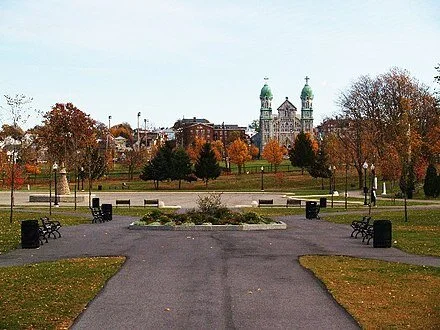
Kennedy Park in Fall River, with the famous towers of St. Anne’s Church in the background.
From Robert Whitcomb’s “Digital Diary,’’ in GoLocal24.com
It was good news indeed that Paul Coogan defeated the twice-indicted incumbent mayor, Jasiel Correia, and City Administrator Cathy Ann Viveiros, a Correia ally running as a write-in, and will be the new mayor of troubled Fall River. Mr. Coogan, a member of the city’s school committee, is well respected and holds promise to be an honest and steadying force for the city, which has faced far too much corruption, as well as socio-economic challenges.
Sleaze alert: The (Fall River) Herald News published a leaked video of a secret meeting where Mr. Correia told supporters that he couldn't beat Mr. Coogan, head to head, but that at least one person (presto -- Ms. Viveiros!) would launch a write-in campaign, helping him by dividing the vote. Luckily for the city, the scheme failed. Mr. Coogan won with 79 percent of the vote, with Mayor Correia, getting only 7 percent. Clearly the voters want a big change!
For the leaked-audio story, please hit this link.
Fall River has much poverty and plenty of drug problems, but also some great strengths, including notably hard-working residents, a spectacular hilly site at the head of Mount Hope Bay and some beautiful structures, especially (to me) those old stone mill buildings that look so beautiful as you drive on Route 195, particularly as the sun comes up and sets. Further, Massachusetts’s South Coast Rail project will restore commuter rail service between Boston and southeastern Massachusetts, with stations in Taunton, Fall River and New Bedford; service is expected to be restored by the end of 2023. These are currently the only major cities within 50 miles of Boston lacking commuter rail access to Boston. South Coast Rail will boost the region’s economy by connecting it much tighter with rich Greater Boston. This will include luring more refugees from the sky-high housing costs up there to seek affordable digs in Fall River.
For a long time, New Bedford, which has long been twinned in the public mind with Fall River, has had much better mayoral administration than the Spindle City. Let’s hope that Mr. Coogan’s victory evens that out.
Llewellyn King: How to attack cancer with data mining
NASA’s Omar Hatamleh
The word is exaptation. It will change the future, and it may save your life
It is a word traditionally used in evolutionary biology. But now in scientific and high-tech circles, it is used to describe finding and adapting processes and compounds to uses for which they were not originally intended.
In biology, exaptation is used to describe how an evolving species uses a trait in a new way.
The classic cited example of exaptation is prehistoric creatures that developed wings to keep warm. A later iteration in the same species finds wings can also be used to fly.
In today’s use of the word, it means cross-fertilization of old discoveries with new technologies; extant remedies applied in new ways.
For example, a medicine that was created to treat one disease may be used effectively for another. A drug destined for a specific cancer may be used to treat an immune disorder such as Myalgic Encephalomyelitis, also known as Chronic Fatigue Syndrome. A material developed for space travel may be ideal for strength and lightness in an automobile.
All this takes on much greater importance in the age of mega data and computer capacity to delve into it and find treasuries of new uses.
Today’s machine learning enables the data to be squeezed and pummeled into yielding extraordinary applications and solutions.
“The challenge is to break down silos and to get companies to democratize their data internally and externally,” says Ryan Caldwell, CEO of MX, a financial technology company.
Now a forward-thinking NASA engineer wants to put this approach -- this multidisciplinary, multi-material, multi-compound, multi-procedural, multi-operational data approach -- on a fast track, accelerating cures and solutions.
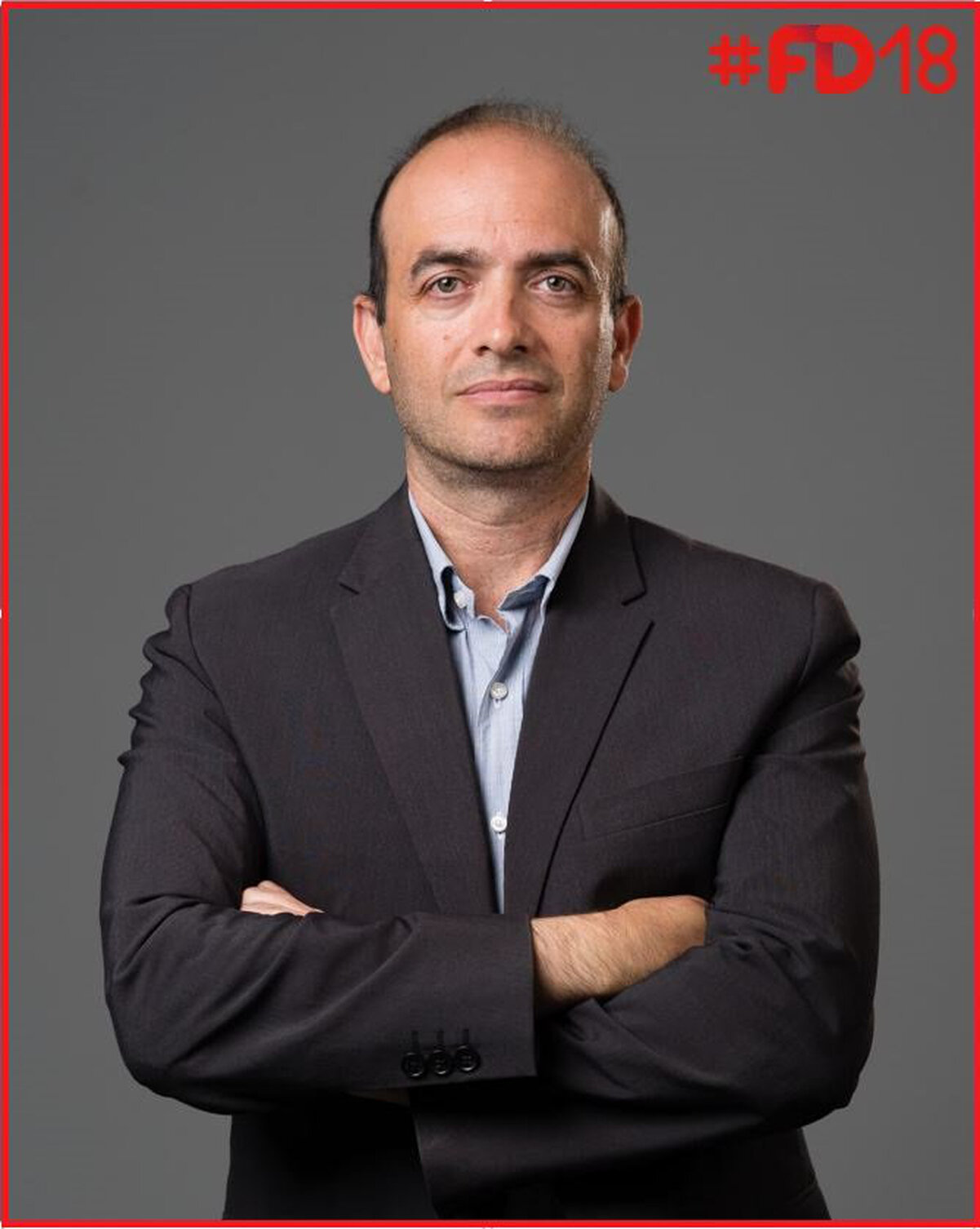
He is Omar Hatamleh, chief innovation officer, engineering, at the Johnson Space Center (in Houston) of the National Aeronautics and Space Administration and executive director of the Space Studies Program at the International Space University. Hatamleh, a polymath with a fistful of degrees, is establishing Infinity Institute, a new kind of think tank that will accelerate cross-industry innovation over the whole spectrum of discovery and application.
Think discovery and rediscovery as the findings of the past are linked to the needs of today, and as findings in one technology can pollinate unrelated technologies. Essentially, it is the story of NASA and the collateral developments from the space program. Exaptation at work.
The genesis of the Infinity Institute is to be found in a series of four annual NASA cross-industry innovation conferences -- the last just concluded.
They were notable for what was not on the agenda: no large discussions of money or the lack of it; no whining about government or regulations, or court decisions. Just a world of science, ideas and the bond between the seemingly incompatible, which when brought together inform each other. A cellist, Jennifer Stumm, described the math in Bach and what that means for science. A NASA scientist, Steve Rader, described how to find affinity ideas through the Internet of Things. An animated filmmaker, Charlie Wen of Marvel Studios, revealed synergies with industrial design.
In the last of these conferences, data expert Caldwell described how he used the very kind of data management and interrogation Infinity Institute has in mind to save the life of a colleague at MX.
When Brandon Dewitt was diagnosed with terminal cancer in his lungs and face at age 33, and given six months to live, Caldwell went to work to break down the medical silos, which enclose so much medicine and hide so many research results. A new treatment being tested in Oregon, which he found, shrunk multiple tumors in Dewitt’s lungs and cheek and saved his life.
When Caldwell’s 2 ½-year-old daughter Chloe was given the wrong medicine in an emergency room, her heart stopped cold. Doctors said would live only a short time without a heart transplant. Caldwell and his wife went to work: They established a war room with computers and whiteboards and bored into the research. A therapy was found and Chloe, now nearly four, is doing well.
Hatamleh’s first target for the new, sweeping concept of exaptation is cancer.
You would think that cancer is well-researched, but Hatamleh believes the exaptation route is the way to go: “We want to break down barriers, go across industries and identify emerging technologies from various industries and explore their application in other fields.”
He believes he can half the death rate from cancer in 10 years by cross-pollinating technologies and therapies and using the kinds of techniques and ideas on display at his unique innovation conferences.
Llewellyn King is executive producer and host of White House Chronicle, on PBS. His email is llewellynking1@gmail.com and he’s based in Rhode Island and Washington, D.C.
3 new industries for New England?
From Robert Whitcomb’s “Digital Diary,’’ in GoLocal24.com

Biochar
Herewith three products that might produce some economic and environmental benefits for New England—and the world. One is something called biochar, a charcoal that can increase soil fertility and resistance to some diseases affecting crops and reduce farm runoff into waterways. Perhaps most interesting is that it has been researched as a carbon-sequestration product to fight global warming.
And bioochar can be made from wood chips, as well as straw, husks, landscaping waste, manure and even sewage sludge. It’s being used around the world. New England, much of it being heavily forested, is a very good source of wood chips.

Threads plucked from a Saffron flower to be dried and used for various purposes
Then there’s the possibly highly lucrative potential of growing saffron (a flower that’s a member of the crocus family) in Rhode Island. As the wonderful local nature writer Todd McLeish writes in phys.org:
“Saffron is the world's most expensive spice, selling for about $5,000 per pound at wholesale rates, and 90 percent of the global saffron harvest comes from Iran. But University of Rhode Island agriculture researchers have found that Ocean State farms have the potential to get a share of the market as demand for saffron in the United States grows.’’ Saffron is also used for food coloring and fabric dye (think Buddhist monks’ robes}, and some have touted its uses against cancer, depression and age-related macular degeneration.
“The URI experimental saffron plot yielded 12 pounds of saffron per acre last year, compared to about 5 pounds per acre in {mostly arid} Iran in the second year of growth,’’ Mr. McLeish’s article said.
Another attraction: "It's a fall flowering plant and isn't harvested until late October, so it extends the season for farmers whose growing season is mostly over by now," Rahmatallah Gheshm, a URI postdoctoral researcher who moved to Rhode Island after being a vegetable seed producer and saffron grower in Iran, told Mr. McLeish.
To read the article, please hit this link.

The interior of a quahog shell
Then there’s Brendan Breen, who has figured out how to culture pearls in quahogs, something he learned how to do starting at an aquaculture class at the University of Rhode Island. By the way, reminder: Shellfish aquaculture cleans water. Given that Rhode Island is a major center of the jewelry business, this development is particularly good news.
The Newport Daily News ran a good story a while back on Mr. Breen’s efforts. Hit this link to read it.

Shefali Luthra: Warren's projection of out-of-pocket health-care costs holds up to scrutiny

“If we make no changes over the next 10 years, Americans will reach into their pockets and pay out about $11 trillion on insurance premiums, copays, deductibles and uncovered medical expenses.”
— Massachusetts Sen. Elizabeth Warren in an Instagram post about her “Medicare for All” plan.
Promoting her much-discussed plan to create a single-payer “Medicare for All” health system, Sen. Elizabeth Warren emphasized a striking figure.
“If we make no changes over the next 10 years, Americans will reach into their pockets and pay out about $11 trillion on insurance premiums, co-pays, deductibles and uncovered medical expenses,” the Democratic presidential candidate said in an Instagram video posted Monday.
This fact check was produced in partnership with PolitiFact.
The Democratic health-care debate has been full of competing analyses and estimates about what Medicare for All might cost, what it might save and who would bear the brunt of paying for it. But this precise number was new to us.
If true, it would be a figure both staggering and significant to the unfolding debate, as Americans try to understand how Warren’s brand of a single-payer health system could affect their pocketbooks. So we decided to dig in.
A Reasonable Estimate
We contacted the Warren campaign, which redirected us to a report from the Urban Institute, a Washington think tank, as well as to federal estimates of household out-of-pocket expenses and premium costs over the next decade.
The Urban report doesn’t include the $11 trillion figure. But economist Linda Blumberg, who authored the paper, told us the statistic is “perfectly consistent” with the analysis.
If anything, she said, the number is a lowball figure. When Blumberg and her team crunched the numbers, they found that, under the existing health-care system, Americans can expect to pay $11.7 trillion between out-of-pocket costs — the co-pays, deductibles and uncovered medical expenses — and premiums over the next decade. That calculation comes from Urban’s model for projecting what individual households might expect to spend, factoring in inflation, on these types of health costs.
“Talking about the amount of money we expect households to be spending over time is a very important part of trying to educate people on what single-payer would do, and what the tradeoffs are for them,” said Blumberg, who previously advised the Clinton White House on health policy. On the numbers, “they’re roughly in the right neighborhood,” she added.
We consulted other analysts, too, and as far as we can tell, no one else has done a similar calculation.
Experts told us that Urban’s estimate — and the Warren campaign’s use of it — checks out, based on what we know about American health care spending.
Cynthia Cox, a vice president at the Kaiser Family Foundation and expert on the Affordable Care Act, pointed to what a typical American family currently spends on health care: about $5,000 per year, when you look at out-of-pocket costs and premiums combined. Extrapolating from there, she said, Warren’s claim seems reasonable. (Kaiser Health News is an editorially independent program of the foundation.)
“Over the course of 10 years, when you add it up — that sounds about right,” Cox said. “The reality is, people do spend a lot on health care out of their pockets, and there’s a lot spent on their behalf by employers or taxpayer-funded programs that they never see.”
Under Warren’s health-care plan, Americans would pay nothing directly out-of-pocket — no premiums, copays or deductibles — for health care. So that $11 trillion would disappear from the cost side of the ledger.
The figure Warren sited also tracks with national health expenditure projections for out-of-pocket health costs and health premium growth.
The Bigger Picture
Still, there are serious questions about the financing such a shift would require.
And Warren’s Medicare for All plan has been under intense scrutiny since she unveiled it earlier this month, with many critics suggesting it’s too optimistic in its estimates of how much money a single-payer system would cost.
Warren suggests the federal government would need to come up with $20.5 trillion — well below Urban’s estimate of $34 trillion. The difference comes largely from assumptions about how much the government could save, as well as decisions about how much to pay doctors and hospitals.
Warren’s financing structure includes cracking down on tax evasion, new taxes on financial institutions and the wealthiest Americans, and maintaining what many employers currently pay into the system. Critics say that could yield its own inefficiencies.
For instance, the way employer payments are structured could disproportionately harm small businesses, or lower-wage workers, noted Paul Ginsburg, who directs the USC-Brookings Schaeffer Initiative for Health Policy. He also argued that doctors and hospitals —represented by powerful lobbying organizations in Washington — could successfully battle any effort to pay them less, driving up what the government needs to spend.
Still, those disputes are separate from the question of this particular statistic. Here, Warren’s on firm ground.
Analysts also said the $11 trillion number gets at a larger point. Americans currently pay a lot out-of-pocket on health care. Certainly, some might see a tax hike under Warren’s proposed reform, or see downward pressure on their salaries.
Still, others could experience major pocketbook relief.
To be sure, Medicare for All is not the only approach to ameliorating what families pay for health care. Other, more incremental proposals — such as building on the ACA’s coverage expansions or pursuing a “Medicare for all who want it” approach touted by former Vice President Joe Biden and Pete Buttigieg, the South Bend, Ind., mayor — would cut into the $11 trillion as well, Cox said.
While it wouldn’t eliminate that household cost burden, it would require less in taxes to finance.
“There’s a lot of ways to bring down what people spend on health care,” Cox said. “Any expansion of the role of public programs is likely to bring down individuals’ costs. It’s just a question of how much taxes have to go up to pay for that.”
Our Rating
In her explanation of how she would structure and finance Medicare for All, Warren highlighted what Americans currently pay for “insurance premiums, copays, deductibles and uncovered medical expenses.”
The $11 trillion figure is staggering — and it checks out. Whether and how to address that issue is fiercely controversial, but on this particular stat, Warren’s statement is accurate. We rate it True.
Shefali Luthra is a reporter for Kaiser Health News
Shefali Luthra: ShefaliL@kff.org, @Shefalil
SOURCES:
Instagram, “Medicare for All” post, Elizabeth Warren, Nov. 4, 2019
Medium, “Ending the Stranglehold of Health Care Costs on American Families,” Elizabeth Warren, Nov. 1, 2019
Centers for Medicare & Medicaid Services, “NHE Fact Sheet,” April 26, 2019
The Urban Institute, “From Incremental to Comprehensive Health Reform: How Various Reform Options Compare on Coverage and Costs,” Oct. 16, 2019
Peterson-Kaiser Health System Tracker, Household Health Spending Calculator, Nov. 5, 2019
Email Interview with Warren 2020 presidential campaign staff member, Nov. 4, 2019
Telephone Interview with Linda Blumberg, institute fellow in the Health Policy Center at the Urban Institute, Nov. 4, 2019
Telephone Interview with Cynthia Cox, vice president at the Kaiser Family Foundation and director for the program on the ACA, Nov. 4, 2019
Telephone Interview with Paul Ginsburg, director of USC-Brookings Schaeffer Initiative for Health Policy, Nov. 5, 2019
'Major center of graphic arts'

“Squibble A’’ (aquatint and etching), by Joe Moore, in the show “Selections From Mixit Print Studio,’’ at Brickbottom Artists Association, Somerville, Mass., Dec. 5-Jan. 11.
The gallery says:
“Over time Mixit Print Studio {in Somerville} has made its mark on the Greater Boston scene, and sponsored artists from other regions of the US, and abroad.” Sinclair Hitchings, former keeper of prints at the Boston Public Library, wrote in the catalog for our 25th anniversary exhibition: “The world at large does not know—but many American graphic artists do know—that Greater Boston is a major center of graphic arts production. It is this level of skill and sophistication which artists bring to Mixit Print Studio. Thousands of prints by hundreds of area artists have rolled through the presses of Mixit Print Studio.”

Chris Powell: Connecticut's toll trauma

Gov. Ned Lamont's plan for imposing tolls on Connecticut's highways has devolved over a few months from 50 tolling stations producing about $800 million a year to just 14 stations at bridges needing renovation, where a mere fraction of that $800 million would be raised.
So what happened to the plan? The governor, a Democrat, eventually calculated that while his party has comfortable majorities in both houses of the General Assembly, a majority can be built for tolls only on the smallest scale, since the Republicans are opposed and many Democrats are fearful of retaliation from their constituents.
Some of the governor's ideas for transportation improvements are compelling, like bringing more passenger service to Tweed New Haven Airport or a serious amount to Sikorsky Memorial Airport,. in Stratford, along with modernizing the Metro-North commuter railroad from New Haven to New York. But putting tolls all over the place would be far too visible to voters. It also would be a regressive form of taxation, falling mainly on the poor and middle class, whom the Democrats purport to represent. Meanwhile the state's ever-rising taxes are inducing people with higher incomes to leave the state, which continues to lose population relative to the rest of the country.
Democratic legislators are usually willing to raise taxes, so their reluctance with tolls indicates a change in political atmosphere. Such a change was also indicated by the most notable result of this year's municipal election campaigns -- the defeat of New Haven Mayor Toni Harp by Justin Elicker in the Democratic primary and then again in last week's election, where Harp ran as the candidate of the government employee union-dominated Working Families Party. Harp had just raised New Haven's property taxes by 11 percent and her administration lately was full of costly incompetence.
Since Democratic legislators fear tolls and since even overwhelmingly Democratic New Haven seems sick of taxes, people here slowly may be wising up. So the government class may be vulnerable if Connecticut ever has an opposition party not led by President Trump.
In any case, tolls are not really for transportation purposes. Rather they are for allowing the state's Democratic regime to avoid economizing in the rest of government in favor of transportation.
Tolls will let state government continue to overlook its mistaken and expensive policies with education, welfare, and government employees, where ever more spending fails to improve learning, worsens the dependence of the unskilled, and makes public administration less efficient and accountable.
Connecticut needs profound reform in these respects, and enacting tolls will only reduce the pressure on elected officials to choose the public interest over special interests.
The state's most fearsome special interest, the Connecticut Education Association, the teachers union, inadvertently illustrated one of those choices the other day. The union issued a report about “sick” schools -- schools that, because of deferred maintenance and lack of improvements, suffer from mold, excessive heat, and such.
But school maintenance and improvements are neglected in large part because state law requires binding arbitration of teacher union contracts, thereby giving teacher compensation priority in budgeting. There's no binding arbitration for “sick” schools, so maintenance and improvements are often deferred in favor of raising teacher pay.
What's really sick here is the law, since it serves only the special interest, letting it cannibalize the rest of government.
Chris Powell is a columnist for the Journal Inquirer, in Manchester, Conn.

Mass. keeps leading the way on medical matters
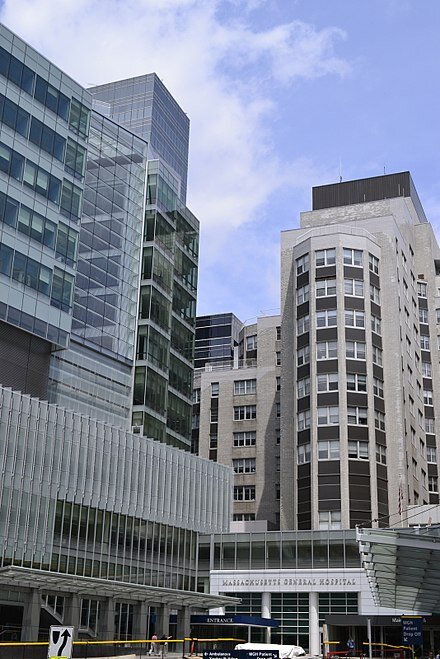
The main entrance of Massachusetts General Hospital, in Boston
From Robert Whitcomb’s “Digital Diary,’’ in GoLocal24.com
Massachusetts continues to lead the nation on health-care reform. It has long had among the greatest concentrations of medical care and research in the world, in large part because of its universities and associated hospitals. And the health-insurance law nicknamed “Romneycare,’’ after then-Gov. Mitt Romney, who helped lead it into law, morphed into the national Affordable Care Act, aka “Obamacare.’’
And now Gov. Charlie Baker, a former long-time CEO of the insurer Harvard Pilgrim Health Care, has come up with a big bill to further improve care in the commonwealth while trying to limit price increases.
Before I go on, consider the “super users’’ – the 5 percent of patients whose care comprises about half of America’s health-care costs. Some almost seem to live in hospital emergency rooms and many have mental illnesses and/or substance-abuse issues that sent them there.
The governor’s bill would require hospitals and insurers to increase by 30 percent over the next three years their spending on primary care and behavioral health, but without increasing overall spending. Given how many illnesses and injuries are made inevitable by thin primary care and often difficult to obtain mental-and-behavioral-health treatment, that makes sense. The governor says that less than 15 percent of percent of total medical expenses are spent on the combination of primary care and behavioral health. Instead, the big money goes to treat severe and chronic illnesses, many cases of which could have been prevented and/or at least diminished with much more available – and promoted -- primary care and mental-and-behavioral-health coverage. Mr. Baker’s package would also simplify insurance paperwork for mental-and-behavioral-health providers to help expand coverage in this sector, which is still woefully low compared to so-called “physical health,’’ as if the brain isn’t an organ.
American health care is pretty good at rescuing people in extremis but mediocre at preventing what they need to be rescued from.
There are other fine things in the package, including boosting state monitoring of drugs and their prices -- including those drugs bought through the private market and not just Medicaid -- that cost more than $50,000 per person per year – and expanding telemedicine, which cuts expenses in a number of ways.
I hope that other states, and the Feds, try some of these ideas, too. As usual, Massachusetts is a beacon for those seeking to build better health systems.
'Unexpected forms'
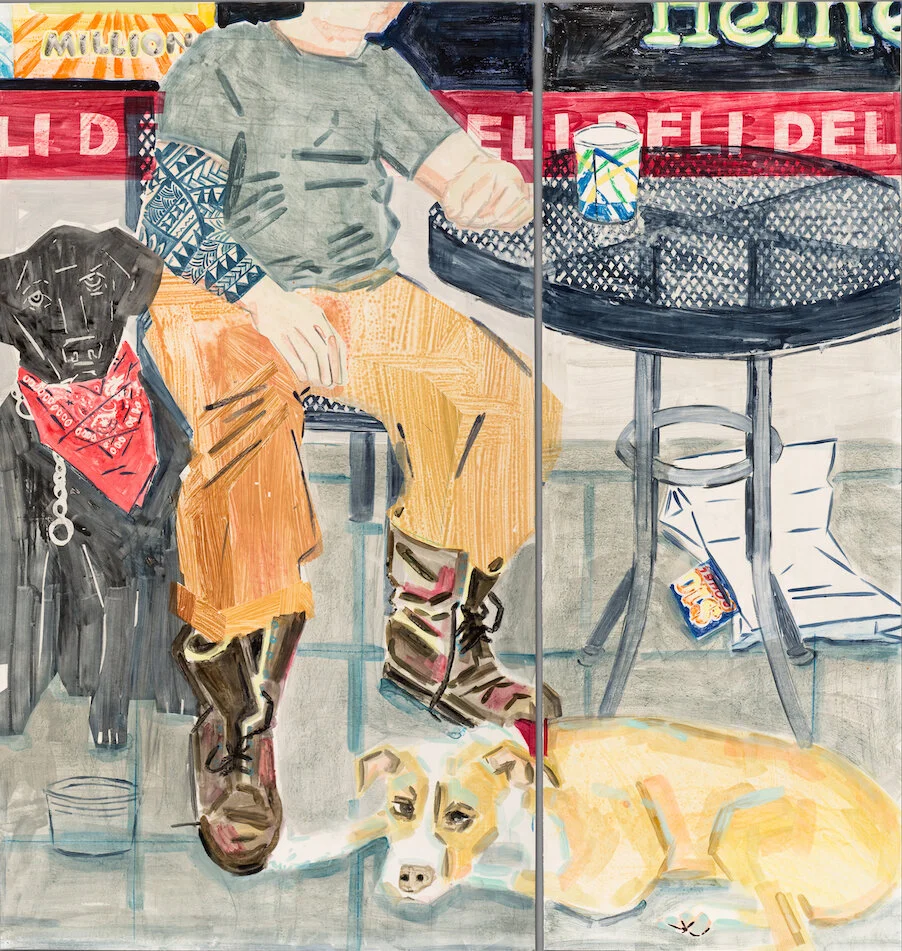
“Deli bag and lottery ticket (Gutter Punk with his dogs)’’ (watercolor monoprint), by Stella Ebner, in her show “And & With,’’ at Cade Tompkins Projects, Providence, Nov. 16-Dec. 21.
The gallery says: “‘And & With’’ features screen prints, water-based woodblock prints and watercolor monoprints, exploring the inherent qualities of printmaking to examine how imagery in our society is created and conveyed within the context of a deep appreciation for the moments that are left outside the picture frame - the overlooked, the forgotten.
“In the screen prints, Ebner is interested in pushing the boundaries of the medium by overlapping multiple transparent pigments that build to form the whole. The distinctive overlay of color and imagery that printmaking allows, gives rise to new and unexpected forms and relationships.’’
Make sure they're not eating
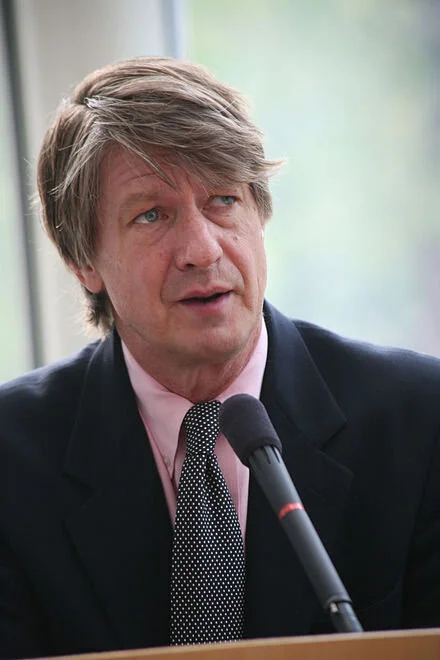
P.J. O’Rourke
“New Hampshire polling data are unreliable because, when you call the Granite State's registered Republicans and independents in the middle of dinner and ask them who they're going to vote for, they have a mouth full of mashed potatoes and you can't understand what they say.’’
— P.J. O’Rourke, essayist and satirist. He lives in Sharon. N.H. ,and is often on TV and radio with this wisecracks.
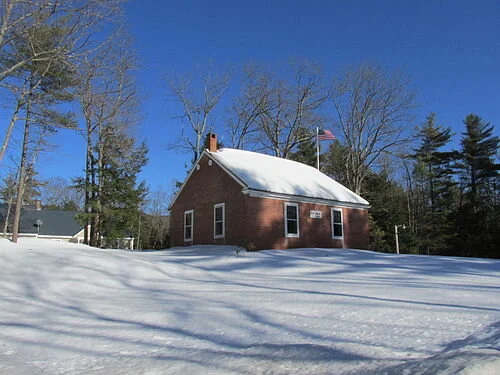
Schoolhouse in Sharon built in 1832