
Vox clamantis in deserto



At the PCFR, looking at religion, geopolitics, war and peace

The Islamic Cultural Center in Vienna
— Photo by Bwang
To members and friends of The Providence Committee on Foreign Relations (thepcfr.org; pcfremail@gmail.com):
On Thursday, Dec. 5, we’ll welcome as our dinner speaker Dr. Elizabeth H. Prodromou, who directs the Initiative on Religion, Law, and Diplomacy, and is visiting associate professor of conflict resolution, at The Fletcher School of Law and Diplomacy at Tufts University. She titles her talk "God, Soft Power, and Geopolitics: Religion as a Tool for Conflict Prevention/Generation". All PCFR dinner events are held at the Hope Club, at 6 Benevolent St., Providence.
Dr. Prodromou is also a non-resident senior fellow and co-chair of the Working Group on Christians and Religious Pluralism, at the Center for Religious Freedom at the Hudson Institute, and is also non-resident fellow at The Hedayah International Center of Excellence for Countering Violent Extremism, based in Abu Dhabi.
Dr. Prodromou is former vice chair and commissioner on the U.S. Commission on International Religious Freedom and was a member of the U.S. Secretary of State’s Religion & Foreign Policy Working Group. Her research focuses on geopolitics and religion, with particular focus on the intersection of religion, democracy, and security in the Middle East and Southeastern Europe. Her current research project focus on Orthodox Christianity and geopolitics, as well as on religion and migration in Greece.
Schedule:
6:00 - 6:30 PM: Cocktails
6:30 - 7:30: Dinner (salad, entree, dessert/coffee)
7:30 - 8:30: Speaker Presentation
8:30 - 9:00: Q&A with Speaker.
Please let us know if you have any dietary restrictions.
For information on the PCFR, including on how to join, please see our Web site – thepcfr.org – or email pcfremail@gmail.com or call 401-523-3957
Better than driving on Route 146, especially in winter
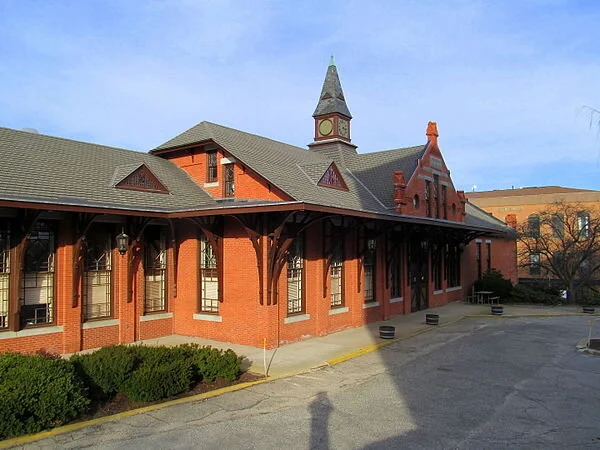
Woonsocket train depot
From Robert Whitcomb’s “Digital Diary,’’ in GoLocal24.com
Let’s hope that Boston Surface Rail Co. can settle its dispute with the Rhode Island Department of Transportation over the company’s use of the historic train depot (built in 1882!) in Woonsocket and be able to start passenger rail service (and bus service to supplement it) between that city and Worcester sometime next year. It would be one of America’s first private passenger rail companies since the creation of quasi-public Amtrak, in 1971.
The service would be a boon to those who want to stay off crowded Route 146, in the Providence-Worcester corridor, and serve an area now with very thin public transportation. And consider that huge CVS is based in Woonsocket; more than a few of its employees would be happy to use public transportation.
Remember that Greater Providence is the second-largest metro area in New England, after Boston, and Worcester proper the second-largest city; Providence proper is the third-largest.
Anything to get more people off the roads between Greater Providence and Worcester would he most appreciated! The service would be particularly appreciated in the winter: The area crossed by Route 146, being fairly high (by New England standards) and well inland, gets lots of snow most winters.
Boston Surface Rail asserts that the Rhode Island Department of Transportation has been difficult to deal with. RIDOT should prioritize improving non-car travel in this important corridor. Why is it that it seems so difficult to get new projects launched in the Ocean State?
To read GoLocal’s story on this, please hit this link.
xxx

Warhol, et al., in Worcester
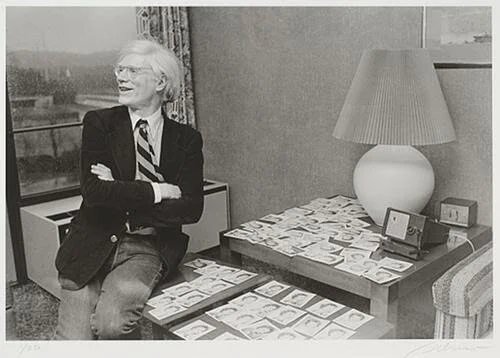
“Andy Warhol aside Polaroids of Caroline Ireland,‘‘ about 1979 (digital inkjet print), by Rowland Scherman. (Gift of Howard G. Davis, III A.K.A. David Davis, 2011.162.) © Rowland Scherman, in the Worcester Art Museum’s new show “Photo Revolution: Andy Warhol to Cindy Sherman,’’ which starts Nov. 16. The museum says the show “explores in depth the symbiotic relationship between photography and contemporary art and traces the work of iconic artists from the 1960s to the 1980s.’’
Llewellyn King: A big Warren weakness -- she always takes the bait


Sen. Elizabeth Warren
The Democratic deep state – it is not made up of Democrats in the bureaucracies, but rather those who make up the core of the party -- is in agony.
Solid, middle-of-the-road, fad-proof Democrats are not happy. They are the ones most likely to have thrown their support early to Joe Biden, and who now are eyeing Elizabeth Warren with apprehension and a sense of the inevitable.
Warren exhibits all the weaknesses of someone who, at her core, is not a professional politician. She blunders into traps whether they are set for her or not. She is vulnerable to the political equivalent of fatal attraction.
Biden lurches from gaffe to gaffe and is haunted by the positions he took a long time ago. Some of his social positions turn out to be like asbestos: decades ago, seen as a cure-all building material, now lethal.
Where Biden stumbles over the issues of the past, Warren walks into the traps of today. She is one of those self-harming politicians who shoots before she takes aim.
When Donald Trump mocked her claims of Native American ancestry, Warren took the bait and ended with a hook in her gullet. A more seasoned politician would not have been goaded by a street fighter into taking a DNA test, resulting in an apology. Ignorance met incaution and Trump won.
Warren also swallowed the impeachment bait of the left, ignoring the caution of centrists who worried about the outcome in an election year. If the Senate acquits, Trump claims exoneration.
Then there is the Medicare for All trap into which Warren not so much fell as she propelled herself. Because Bernie Sanders, who reminds me of King Lear, and his field commander Alexandria Ocasio-Cortez and others on the left favored it, Warren had to leap in, ill-prepared.
The prima facie logic is there, but the mechanism is not. It is easy to see that Medicare is a very popular program that works. It is also easy to see that the United States pays more than twice as much on health care as any other nation.
Those, like myself, who have experienced state systems abroad, as well a Medicare at home, know the virtues of the single-payer system with patient-chosen, private insurance on the top for private hospital rooms, elective surgery and pampering that is not basic medicine. But we also know that the switch to Medicare for All would be hugely dislocating.
Employer-paid health care is a tax on business but substituting that with a straight tax is politically challenging, structurally difficult, and impossible to sell at this stage in the evolution of health care. It likely will give a new Democratic president a constitutional hernia.
Warren seems determined to embrace the one thing that makes the left and its ideas electorally vulnerable: The left wants to tell the electorate what it is going to take away.
Consider this short list of the left’s confiscations which the centrists must negotiate, not endorse: We want your guns, we want your employer-paid health care, we want your gasoline-powered car, and we want the traditional source of your electricity. Trust us, you will love these confiscations.
Those are the position traps for Warren. To make a political sale -- or any sale – do not tell the customers what you are going to take away from them.
It is well known that Republicans roll their eyes in private at the mention of Trump, while supporting him in public. Democratic centrists -- that place where the true soul of a party resides, where its expertise dwells, and where its most thoughtful counsel is to be heard -- roll their eyes at the mention of all the leading candidates. They like Pete Buttigieg but think him unelectable. If elected, they worry that Warren would fall into the traps set for her around the world -- as Trump has with Vladimir Putin, Xi Jinping and Kim Jong-un.
Politics needs passion. “She is better than Trump,” is not a passionate rallying cry.
Llewellyn King is executive producer and host of White House Chronicle, on PBS. His email is llewellynking1@gmail.com and he’s based in Rhode Island and Washington, D.C.
Linda Gasparello
Co-host and Producer
"White House Chronicle" on PBS
Mobile: (202) 441-2703
Website: whchronicle.com
Patricia A. Marshall, Robert J. Awkward, Stephanie Teixeira: Mass. is examplar of getting free stuff for colleges

Via The New England Journal of Higher Education, a service of The New England Board of Higher Education (nebhe.org), on whose advisory board New England Diary editor Robert Whitcomb used to sit.
In just over a year, Massachusetts public colleges and universities have galvanized a statewide movement to adopt more comprehensive use of Open Educational Resources (OER). How did state and campus leaders achieve such momentum?
By way of background, OER includes teaching, learning and research materials in any medium—digital or otherwise—that reside in the public domain or have been released under an open license that permits no-cost access, use, adaptation and redistribution by others with no or limited restrictions.
There had been prior nascent efforts to increase the utilization of OER in Massachusetts including: the launch of the Open Education Initiative at UMass Amherst, the MA #Go Open Project funded by a TAACCCT grant and the creation of a MA Community College OER Hub.
These initiatives served as watershed moments in the journey to begin to make more faculty, staff, administrators and students aware of the utility of OER as a learning approach and as an effective way of reducing rapidly rising textbook costs. For example, the efforts at the University of Massachusetts Amherst have benefitted nearly 13,000 students and have resulted in $1.8 million in savings. The Go Open community college program involved 9,000 students and 115 faculty members resulting in savings of $1.2 million for students, and the launch of the MA Community College OER Hub brought a repository for newly created open educational resources.
However, these efforts were accelerated when the statewide Student Advisory Council (SAC) presented a resolution to the state Board of Higher Education (BHE) in April 2018 asking the board to recognize OER as an approach to generate textbook costs savings for students and calling on the state Department of Higher Education (DHE) to explore and identify opportunities for implementing OER on a broader scale. Further, SAC noted that it would continue its advocacy for and support of OER.
The equity angle
During this same timeframe, Higher Education Commissioner Carlos E. Santiago was nurturing the development of what is now known as the Equity Agenda for Massachusetts public higher education. The Equity Agenda, officially adopted by the BHE in December 2018, aims to significantly raise the enrollment, attainment and long-term success outcomes among underrepresented student populations.
The goals of OER to reduce student textbook costs align with the Equity Agenda to increase persistence and completion of underrepresented students by: having a positive impact on student learning, addressing increasing interest among key stakeholders (e.g., students, public higher education institutions and faculty), responding to rising costs since textbook costs have risen by 88% over the last decade (OER State Policy Playbook, 2018), and addressing increasing interest in the Legislature.
________________________________________
A Textbook Case of Unaffordability
In a Florida Virtual Campus Survey conducted in 2012 and again in 2016, 20,000 public students
were asked what the cost of required textbooks had caused them to do in their academic careers.
Here are some of the results:
• Not purchase the required textbook: Two out of three
• Not register for a specific course: One out of two
• Take fewer courses: One out of two
• Earn a poor grade: One out of three
• Drop a course: One out of four
• Fail a course: One out of five
________________________________________
OER performs
This led the DHE to increase its involvement in OER beginning with awarding two direct OER Performance Incentive Fund (PIF) grants of $150,000 to the Massachusetts OER Collaborative, comprising UMass Amherst, Worcester State University, Northern Essex Community College and Holyoke Community College; and $100,000 to the Viking OER Textbook Affordability Initiative at Salem State University. In addition, two indirect OER PIF grants were distributed to Northern Essex Community College for its Competency-Based Pathways in Early Education for $198,414 and to Massasoit Community College for its Early College Strategies to Enhance Learning for $59,525.
In late fall 2018, Commissioner Santiago established an OER Working Group to convene, study, evaluate and make recommendations to him and the BHE that addressed:
The need to identify lower-cost educational resources for students
The BHE’s goals of increasing access and affordability, closing performance gaps and increasing completion
The issue of addressing equity for underserved, low-income, and first-generation students, especially students of color
Enhancing instructor effectiveness while lowering costs for students.
The OER Working Group convened in November 2018, co-chaired by Marilyn Billings, who heads the Office for Scholarly Research Communications at UMass Amherst, and Susan Tashjian, coordinator of instructional technology at Northern Essex Community College. The OER Working Group was staffed by Robert Awkward and the work overseen by Patricia A. Marshall, both at the DHE and both authors of this NEJHE piece. The OER Working Group consisted of 21 members representing all higher education segments and geographic locations in Massachusetts and included faculty, librarians, administrators, students and external representatives, including union, bookstore and employer reps.
First, a survey
To begin this initiative, the DHE partnered with the Massachusetts OER Collaborative to create and distribute a statewide OER survey to establish a baseline on OER utilization. The survey response rate was 100% and it provided very useful information on the state of OER in Massachusetts. The following are highlights from the 2018 OER Prevalence Survey:
71% of Massachusetts public higher education institutions had some level of OER activity
Although there were higher and lower numbers of courses served, eleven to 20 was the most prevalent number of courses using OER, resulting in student savings of $10,000 to $100,000 for about half of the institutions (47%)
English, Math and Biology were the highest enrolled courses and the courses with the most OER use
Faculty select their textbook individually or as a common textbook
Most prevalent deterrents to faculty adoption of OER included:
Too hard to find what I need (25%)
Not enough resources for my subject (19%)
Not enough high-quality resources (17%).
The survey data was used not only to inform the work of the OER Working Group, but also to inform the Massachusetts OER Collaborative as it designed OER training for faculty across the state. Nearly 500 faculty attended five successful regional training sessions at UMass Amherst, Worcester State University, Northern Essex Community College, Roxbury Community College and Bridgewater State University.
After the kickoff meeting of the OER Working Group in November 2018, the work was divided into five subcommittees to fulfill the mission. The subcommittees included: Faculty Development, Infrastructure, Marketing Communications, Policy & Legislative, and Stakeholders. The subcommittees began meeting and working in December and met continuously until they submitted their subcommittee reports in April 2019.
Meanwhile, the Student Advisory Council continued its efforts to support and encourage greater utilization of OER across the state as it had promised, holding a Legislative Advocacy Day in January 2019, a Public Higher Education Advocacy Day in March 2019 and an OER Photo Campaign (during the international Open Education Week) in the spring of 2019.
A timeline
By April 2019, the five subcommittees had completed their work and submitted their reports to create a draft full report, which was reviewed and revised by the OER Working Group. The draft full report was used to provide an update on OER to the BHE’s Academic Affairs Committee. In addition to sharing the research and findings with the committee, it contained time-sequenced recommendations.
The short-term recommendations called for adopting a statewide OER definition, designating a statewide coordinator, establishing a statewide advisory council, encouraging and supporting continued student advocacy of OER and identifying OER courses in course management systems
The mid-term recommendations included: providing OER faculty professional development, actively promoting the use of OER for graduate and continuing education and expanding a unified OER repository to make the discovery of local content easier.
In the long term, it called for increasing funding to address campus technology challenges and encouraging the consideration of OER in faculty tenure and promotion.
During the summer, DHE staff finalized the full report and sent it to public higher education presidents and chancellors to obtain their insight, ideas and perspective on the findings and recommendations, and how they will impact their campuses. The feedback received was incorporated into the final full report to the commissioner. After his review, the commissioner recommended the full report and a motion being submitted to the BHE’s Academic Affairs Committee to accept the final report and to implement the recommendations at its Oct. 15 meeting. After a useful and engaged discussion, including active participation by the two student members on the Academic Affairs Committee, the motion was approved unanimously. The ACC brought the final report and motion to the BHE on Oct. 22, where it was again approved unanimously, including active support by the student voting member of the BHE.
This OER initiative has been an exciting, multipronged effort that has actively engaged stakeholders from the grassroots and actively partnered with students. The utilization of a broad, diverse, representative working group to develop thoughtful and useful recommendations for BHE consideration and action was key to achieving useful and effective outcomes. Finally, the opportunity to coordinate these efforts with other campuses and with PIF grantees, and to work with OER advocacy groups and other states, has been rewarding to everyone involved. Nicole Allen, director of education for Scholarly Publishing Alliance Resource Coalition (SPARC), a national OER advocacy organization, noted that “Massachusetts is an exemplar for state policy action.”
Ultimately, the largest beneficiaries of this work will be the students of Massachusetts for whom reducing the cost of textbooks and other ancillary learning materials will significantly reduce student direct, out-of-pocket expenses.
In addition, the quality of student learning will also increase. The national student success initiative Achieving the Dream conducted a study comparing the use of OER to traditional textbooks at 32 community colleges in four states. According to the study, “more than 60 percent of students reported that the overall quality of their learning experience in an OER course was higher than in a typical non-OER course.” This is the power of collective action focused on a shared goal. The Massachusetts DHE is proud to be an active participant in this institutional change effort on behalf of the students at our public colleges and universities.
Patricia A. Marshall is deputy commissioner for academic affairs & student success at the Massachusetts Department of Higher Education. Robert J. Awkward is director of learning outcomes assessment at the department. Stephanie Teixeira is former Massachusetts Student Advisory Council chair. Visit here to view the final OER report and recommendations.
Chris Powell: First frost and a blessing to be left alone

Over the weekend frost finally came down on the vegetable garden, killing off the plants that only a few weeks ago were triumphant in the harvest, leaving only the hardy greens, which bravely will keep producing until the frost comes every night and kills them off too. It's a sad time for those who know intimately from their own labor how supermarket vegetables can't come close to the snap of a freshly picked pole bean or pepper and how supermarket tomatoes imported from Florida, California, or a greenhouse somewhere resemble only in shape the tomatoes from a backyard garden or nearby farm.
Of course, the local apples, pears, and winter squash will be around through the end of the year, and the cognoscenti fortunate enough to live near a fruit farm that still dares to make and sell unpasteurized cider will celebrate every sip as they righteously disdain the brutalized pasteurized stuff that makes only health departments happy. There is no evening tonic like four or five parts unpasteurized Connecticut cider to one part Tennessee whiskey to a half part fresh lemon juice served over ice. It will cure anything, even the state's venal politics, at least for a few hours.
Sad as it always is, the first frost was right on schedule -- Halloween time -- and this year Connecticut's rather short growing season was a good one, with gentle but adequate rain and plenty of sun and warmth, a happy contrast with the floods in the Midwestern breadbasket and the South and the wind-stoked fires that have devastated California despite the state's reputation for temperate weather.
Indeed, old Connecticut can be surprisingly productive agriculturally. Almost any homeowner here with a sunny spot on his property and some chicken-wire fencing to discourage the rabbits, woodchucks and deer can impress family and friends with fresher and better-tasting vegetables as well as the quiet glory of nature -- and in the process can get some productive exercise and a healthy tan. No work on a treadmill at the gym can accomplish that.
Connecticut is too small, hilly, rocky, and developed for agriculture here to be consistently profitable or to make a national reputation, and farm work is too hard a career for most people, who never have to break a sweat to earn their livings at a computer screen or a cash register. The state's once-famous shade tobacco industry that not so long ago employed thousands of teenagers every summer is dying out, which may not be such a tragedy amid the unhealthfulness of smoking, though there may be worse things than a cigar after dinner on the deck or patio -- like television news and talk shows.
But as times and politics become so hateful and stupid, it can be a blessing to be overlooked and left alone like those who work Connecticut's soil on the farm or in the back yard. Now for a few months the soil will sleep and renew itself under the snow, the farmers and their helpers here and elsewhere having done their jobs for another year. They will reflect on what worked well and what didn't and plan to do better come spring. Once again the old hymn thanks them and, most of all, as distinguished writer and Connecticut Gov. Wilbur L. Cross (1862-1948) would say, the Creator and Preserver:
All is safely gathered in
Ere the winter storms begin.
Chris Powell is a columnist for the Journal Inquirer, in Manchester, Conn.
Torn politics

Detail from “The Unraveling” (cotton knit and polyester fabrics), by Adrienne Sloane, in her show “Topical Fiber Work” (responses to current politics), at Bromfield Gallery, Boston, through Dec. 1

Let’s join Atlantic Standard Time

From Robert Whitcomb’s “Digital Diary,’’ in GoLocal24.com
So Eastern Daylight Savings Time has ended for this year and we’re back on Eastern Standard Time. Too bad!
Still, I continue to hope that the New England states, with the possible exception of Connecticut, whose southwestern corner is tightly connected with New York City, will eventually adopt year-round Daylight Savings Time – or call it Atlantic Standard Time, which is used in Canada’s Maritime Provinces.
This will lengthen the light in the afternoon and address how far east New England really is. It would raise the spirits and productivity of most people.
Yes, many public and private school schedules now force many students (and their parents!) to get up when it’s still dark during Eastern Standard Time. But many studies have shown that students, and particularly teens, would do better with a later school opening time anyway. This would, of course, conflict with early hours at many businesses. Perhaps some employers could make things more flexible for parents – for instance letting them start work later and end later.
So now we enter what many, including me, find the dreariest month – sullen, gray and brown and getting darker and darker throughout – with only a good Nor’easter lending it some pizazz as it blows through the now open woods. But November can also have a sere, spare and quiet beauty.


'Among the dark pines'
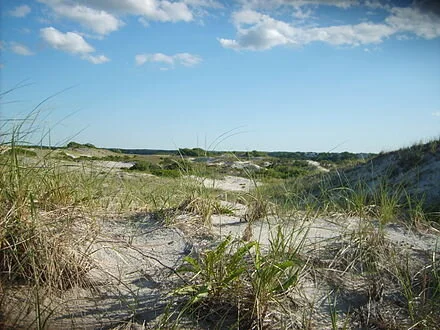
Dunes atS andy Neck, in Sandwich, on Cape Cod Bay
“The thin, slant willows by the flooded bog,
The huge stranded hulk and the floating log,
Sorrow with life began!
“And among the dark pines, and along the flat shore,
O the wind, and the wind, for evermore!
What will become of man?’’
— From “Cape Cod, ‘‘ by George Santayana (1863-1952)
Digitizing Rhode Island's historic newspapers

From Robert Whitcomb’s “Digital Diary,’’ in GoLocal24.com
An exciting project I’ll be helping out with a bit: U.S. Sen. Jack Reed has announced that $250,000 in federal funding “will help support an ongoing partnership between Providence Public Library and the Rhode Island Historical Society (RIHS) to complete an extensive newspaper digitization project that will celebrate and honor Rhode Island’s rich history by preserving historic newspapers and converting their contents into digital files.
“The funds are being awarded as part of the National Digital Newspaper Program (NDNP), a partnership between the National Endowment for the Humanities (NEH) and the Library of Congress to create a national digital resource of historically significant newspapers published between 1690 and 1963 from all the states and U.S. territories available through the Library of Congress for the first time in history.’’
That Rhode Island’s history is so long and rich -- with so many striking and still controversial events and vivid personalities -- will make this project exciting and create a very useful new resource for historians and other citizens, even as physical newspapers continue to disappear.
Catalyzed by imprisonment
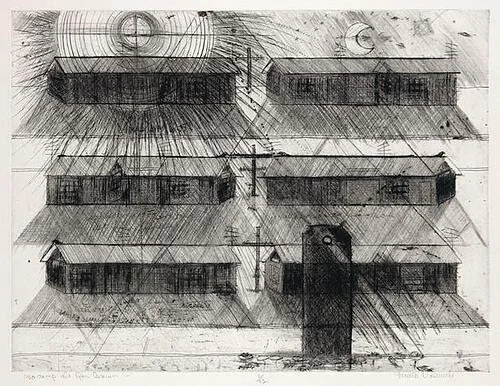
Munio Makuuchi. “Neo Camp ala Ron Brown” ( etching, drypoint, scraping and burnishing on warm white Arches paper), by the late Munio Makuuchi, in the show “Defiant Vision: Prints & Poetry,’’ at the Smith College Museum of Art , in Northampton, Mass., through Dec. 8 This work was purchased with the Elizabeth Halsey Dock {Smith College} Class of 1933 Fund. © The Estate of Munio Makuuchi.
The museum says that Munio Makuuchi, “born Howard Takahashi, was a Japanese-American artist and poet born in 1934. {He died in 2000.} He and his family were imprisoned in Minidoka Relocation Center, an internment camp, for three years during World War II, and this experience was a catalyst for his artistic vision

David Warsh: 'Technocrats vs. democrats?'

Flowchart of four phases (enrollment, allocation, intervention, follow-up, and data analysis) of a parallel randomized trial of two groups (in a controlled trial, one of the interventions serves as the control), modified from the CONSORT (Consolidated Standards of Reporting Trials) 2010 Statement.
—From Wikipedia
SOMERVILLE, Mass.
Ten years ago, Princeton University economist Angus Deaton used his Keynes Lecture to the British Academy to sound a note of caution about the new New Thing in development economics: the randomized controlled trial (RCT), or field experiment. He recounted the general frustration with the failure of traditional econometric methods to swiftly unlock the secrets of economic development (and with the inability of development agencies to learn more from their own experience). He surveyed the rising enthusiasm for RCTs as an alternative path to reliable knowledge without the traditional fuss.
He argued against the trend. “[E]xperiments have no special ability to produce more credible knowledge than other methods, and… actual experiments are frequently subject to practical problems that undermine any claims to statistical or epistemic superiority.” Citing a maxim of philosopher Nancy Cartwright, Deaton wrote,
Randomization is not a gold standard because “there is no gold standard,” Randomized controlled trials cannot automatically trump other evidence, they do not occupy any special place in some hierarchy of evidence, nor does it make sense to refer to them as “hard” while other methods are “soft”. These rhetorical devices are just that; a metaphor is not an argument.
More positively, Deaton continued,
I shall argue that the analysis of projects needs to be refocused towards the investigation of potentially generalizable mechanisms that explain why and in what contexts projects can be expected to work. The best of the experimental work in development economics already does so, because its practitioners are too talented to be bound by their own methodological prescriptions. Yet there would be much to be said for doing so more openly. I concur with the general message in [Ray] Pawson and [Nick] Tilley…, who argue that thirty years of project evaluation in sociology, education and criminology was largely unsuccessful because it focused on whether projects work instead of on why they work.
Nevertheless, the RCT movement continued to attract adherents, and researchers attracted more and for funding from the World Bank and like-minded foundations with an interest in ameliorating global poverty. Poor Economics A Radical Rethinking of the Way to Fight Global Poverty (Public Affairs, 2012), by Abhijit Banerjee and Esther Duflo, both of the Massachusetts Institute of Technology, imparted an impetus to the movement. Duflo’s 2017 Ely Lecture to the annual meeting of the American Economic Association, The Economist as Plumber, especially attracted interest. As economists seek to help governments design new policies and regulations, she argued,
[T]hey take on an added responsibility to engage with the details of policy making and, in doing so, to adopt the mindset of a plumber. Plumbers try to predict as well as possible what may work in the real world, mindful that tinkering and adjusting will be necessary since our models gives us very little theoretical guidance on what (and how) details will matter. Economists should seriously engage with plumbing, in the interest of both society and our discipline.
In 2015, awarding the Nobel Prize for economics, the Royal Swedish Academy of Sciences cited Deaton “for his analysis of consumption, poverty, and welfare.” Last month, they cited Banerjee, Duflo, and Michael Kremer, of Harvard University, “for their experimental approach to alleviating global poverty.”
Last week Deaton was back, with “Randomization in the tropics revisited: a theme and eleven variations,” a chapter prepared for Randomized Controlled Trials in the Field of Development: a Critical Perspective (Oxford, forthcoming), by Florent Bédécarrats, Isabelle Guérin and François Roubaud, Economic Principals tumbled to Deaton’s essay too late to do much more than read it and recommend it here. Many EP readers will wish to read it for themselves. Deaton is a remarkably clear and forceful writer.
This time the tenor was a little more personal.
Jean Drèze has provided an excellent discussion of the issues of going from evidence for policy. One of his examples is the provision of eggs to schoolchildren in India, a country where many children are inadequately nourished. An RCT could be used to establish that children provided with eggs come to school more often, learn more, and are better nourished. For many donors and RCT advocates, that would be enough to push for a “school eggs” policy. But policy depends on many other things; there is a powerful vegetarian lobby that will oppose it, there is a poultry industry that will lobby, and another group that will claim that their powdered eggs – or even their patented egg substitute – will do better still. Dealing with such questions is not the territory of the experimenters, but of politicians, and of the many others with expertise in policy administration. Social plumbing should be left to social plumbers, not experimental economists who have no special knowledge, and no legitimacy at all.
The argument – does it load the dice to call it technocrats vs. democrats? – promises to be long running, with attention soon to shift to Silicon Valley know-it-alls and the Gates Foundation. Banerjee and Duflo’s new book, Good Economics for Hard Times (Public Affairs) appears November 12. The next chapter will air Dec. 8, when this year’s laureates are scheduled to give their lectures in Stockholm – live-streamed, for those who care to watch.
. xxx
New on the Economic Principals bookshelf:
The Man Who Solved the Market: How Jim Simons Launched the Quant Revolution, by Gregory Zuckerman (Penguin)
David Warsh, an economic historian and veteran columnist, is proprietor of Somerville-based economicprincipals.com, where this column first ran.
]
Da
Exploding heads for explosive times

“Everyone is an Alienígeno,’’ by Enrique Chagoya, in the show “From the Head and the Heart,’’ at the Center for Contemporary Printmaking, Norwalk, Conn., through Nov. 10.
— Courtesy of Shark's Ink, Lyons, Colo.
— Photo credit: Bud Shark.
The show takes on a wide range of political and social topics. The pieces are recent creations representing artists’ views on various issues, including immigration, gun control, LGBTQ+ rights and others.

Aerial view of Norwalk, on Long Island. The richest folks tend to live near the water, in such sections as Rowayton. Norwalk is also headquarters for some big corporations and still has some manufacturing. It’s not entirely affluent: It has its share of poor neighborhoods, too.
Returning to Eagle Pond Farm
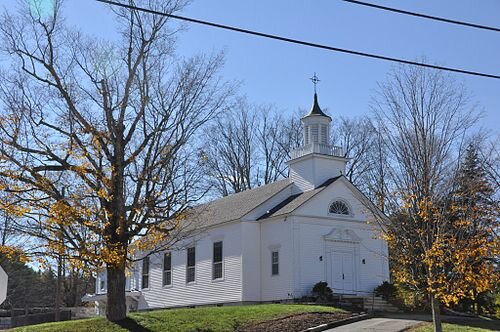
Wilmot Baptist Church
“The last red leaves fall to the ground
and frost has blackened the herbs and asters
that grew beside the porch. The air
is still and cool, and the withered grass
lies flat in the field. A nuthatch spirals
down the rough trunk of the tree.’’
— From “Back from the City,’’ by Jane Kenyon (1947-1995). She was New Hampshire’s poet laureate at the time of her death, from leukemia. She was the wife of poet Donald Hall (1928-1918), who was the U.S. poet laureate in 2006-07.
They lived at Eagle Pond Farm, his ancestral home in Wilmot, N.H.
From the Wikipedia article on Wilmot:
“Mt. Kearsarge, elevation 2,931 feet (893 m) above sea level, on the southeastern border, is the highest point in town. Winslow State Park, at the northern foot of the mountain, provides access by two hiking trails to the summit. The state park and the Winslow Trail are named after Captain John Winslow, the commander of the USS Kearsarge, which in June 1864 sank the CSS Alabama in the English Channel in a famous Civil War sea battle.
“The town is the home of Camps Kenwood and Evergreen, on Eagle Pond.’’
Editor’s Note: I used to look forward to seeing the impressive-looking (for its modest height) bulk of Mt. Kearsarge on my way between home, near Boston, and college, at Dartmouth, in Hanover, N.H.
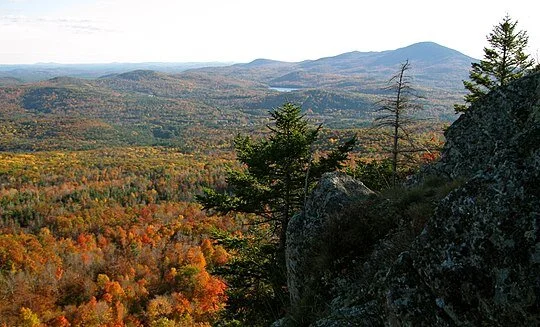
View of Mt. Kearsarge from The Bulkhead on Ragged Mountain. The summit of Kearsarge has remained bare since a 1796 forest fire.

Sam Pizzigati: How much 'inequality tax' are you paying?

In the Swiss Alps
From OtherWords.org
BOSTON
What’s the richest country?
That may seem like a simple question, but it’s not. According to the Global Wealth Report from banking giant Credit Suisse, it all depends on how we define “richest.”
If we mean the nation with the most total wealth, we have a clear No. 1: the United States. The 245 million U.S. adults hold a combined net worth of $106 trillion.
No other nation comes close. China ranks a distant second, with a mere $64 trillion, Japan even further back at $25 trillion.
But if we mean the nation with the most wealth per person, top billing goes to Switzerland. The average Swiss adult is sitting on a $565,000 personal nest-egg. Americans average $432,000, only good enough for second place.
So does Switzerland merit the title of the world’s wealthiest nation? Not necessarily.
The Swiss may sport the world’s highest average wealth, but that doesn’t automatically mean that their nation has the world’s richest average people.
We’re not playing word games here. We’re talking about the important distinction that statisticians draw between mean and median.
To calculate a national wealth mean — a simple average — researchers just divide total wealth by number of people. The problem? If some people have fantastically more wealth than other people, the resulting average will give a misleading picture about economic life as average people live it.
Medians can paint a more realistic picture. Statisticians calculate the median wealth of a nation by identifying the midpoint in the nation’s wealth distribution — that point at which half the nation’s population has more wealth and half less.
Medians, in other words, can tell us how much wealth ordinary people hold.
By this median measure, Switzerland holds up as a strikingly wealthy nation. The United States does not. Typical Swiss adults turn out to hold $228,000 in net worth, the most in the world. Typical Americans hold personal fortunes worth just $66,000.
Typical Canadians, with $107,000 per adult, have more wealth than that U.S. total. So do typical Taiwanese ($70,000), typical Brits ($97,000), and typical Australians ($181,000).
Overall, typical adults in 16 other developed nations have more wealth than we do here. Typical Japanese adults, for instance, hold $110,000 in personal wealth, a net worth considerably higher than the $66,000 Americans can claim.
Why do ordinary Americans have so little wealth when they live in a nation that has so much? In a word: inequality. Other nations have much more equal distributions of income and wealth than the United States.
Japan in particular stands out here. The new Credit Suisse 2019 Global Wealth Report notes that Japan “has a more equal wealth distribution than any other major country.” Japan’s richest 10 percent holds less than half their nation’s wealth, just 48 percent. In the United States, the top 10 percent hold nearly 76 percent, over three-quarters of national wealth.
How would typical Americans fare if we were as equal as Japan? If we succeeded at turning our economy around that way, the net worth of America’s most typical adults would triple, from $66,000 to $199,000.
In effect, the difference between those two totals amounts to an “inequality tax.”
By letting our rich grab an oversized share of the wealth all of us help create, we are taxing ourselves into economic insecurity. Other nations don’t tolerate greed grabs. Why should we?
Sam Pizzigati, based in Boston, co-edits Inequality.org for the Institute for Policy Studies. His latest book is The Case for a Maximum Wage.
HOW MUCH ‘INEQUALITY TAX’ ARE YOU PAYING?
If the U.S. were as equal as Japan, the average American’s wealth would triple. Inequality is like a tax on two-thirds of your income.
By Sam Pizzigati | October 29, 2019
Who is the world’s richest country?
That may seem like a simple question, but it’s not. According to the Global Wealth Report from banking giant Credit Suisse, it all depends on how we define “richest.”
If we mean the nation with the most total wealth, we have a clear No. 1: the United States. The 245 million U.S. adults hold a combined net worth of $106 trillion.
No other nation comes close. China ranks a distant second, with a mere $64 trillion, Japan even further back at $25 trillion.
But if we mean the nation with the most wealth per person, top billing goes to Switzerland. The average Swiss adult is sitting on a $565,000 personal nest-egg. Americans average $432,000, only good enough for second place.
So does Switzerland merit the title of the world’s wealthiest nation? Not necessarily.
The Swiss may sport the world’s highest average wealth, but that doesn’t automatically mean that their nation has the world’s richest average people.
We’re not playing word games here. We’re talking about the important distinction that statisticians draw between mean and median.
To calculate a national wealth mean — a simple average — researchers just divide total wealth by number of people. The problem? If some people have fantastically more wealth than other people, the resulting average will give a misleading picture about economic life as average people live it.
Medians can paint a more realistic picture. Statisticians calculate the median wealth of a nation by identifying the midpoint in the nation’s wealth distribution — that point at which half the nation’s population has more wealth and half less.
Medians, in other words, can tell us how much wealth ordinary people hold.
By this median measure, Switzerland holds up as a strikingly wealthy nation. The United States does not. Typical Swiss adults turn out to hold $228,000 in net worth, the most in the world. Typical Americans hold personal fortunes worth just $66,000.
Typical Canadians, with $107,000 per adult, have more wealth than that U.S. total. So do typical Taiwanese ($70,000), typical Brits ($97,000), and typical Australians ($181,000).
Overall, typical adults in 16 other developed nations have more wealth than we do here. Typical Japanese adults, for instance, hold $110,000 in personal wealth, a net worth considerably higher than the $66,000 Americans can claim.
Why do ordinary Americans have so little wealth when they live in a nation that has so much? In a word: inequality. Other nations have much more equal distributions of income and wealth than the United States.
Japan in particular stands out here. The new Credit Suisse 2019 Global Wealth Report notes that Japan “has a more equal wealth distribution than any other major country.” Japan’s richest 10 percent holds less than half their nation’s wealth, just 48 percent. In the United States, the top 10 percent hold nearly 76 percent, over three-quarters of national wealth.
How would typical Americans fare if we were as equal as Japan? If we succeeded at turning our economy around that way, the net worth of America’s most typical adults would triple, from $66,000 to $199,000.
In effect, the difference between those two totals amounts to an “inequality tax.”
By letting our rich grab an oversized share of the wealth all of us help create, we are taxing ourselves into economic insecurity. Other nations don’t tolerate greed grabs. Why should we?
Related Posts:
OtherWords commentaries are free to re-publish in print and online — all it takes is a simple attribution to OtherWords.org. To get a roundup of our work each Wednesday, sign up for our free weekly newsletter here.
Sam Pizzigati co-edits Inequality.org for the Institute for Policy Studies. His latest book is The Case for a Maximum Wage. This op-ed was distributed by OtherWords.org.
'Say it like it looks'
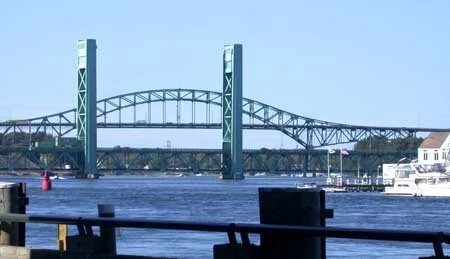
Piscataqua River from Portsmouth, N.H., with the former Sarah Mildred Long Bridge and the Piscataqua River Bridge (background).
"Winnipesaukee and Piscataqua:
“People new to the New Hampshire area come in contact with a ton of words they can’t pronounce. Here’s a hint, say it like it looks, if you get it wrong, a New Hampshirite is probably too nice to make fun of you for it and they’ll teach you how to say it correctly.''
-- Spencer McKee
Glamorous Newport nuptials in 'The New Gilded Age'
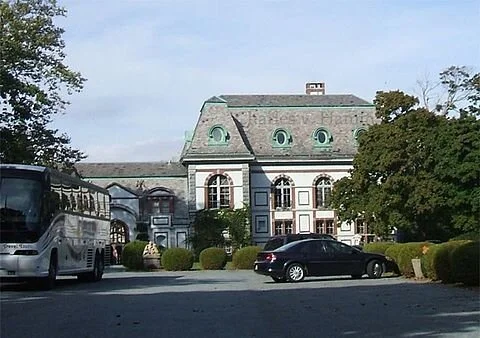
The east facade of Belcourt Castle. is a former summer cottage designed by the famed architect Richard Morris Hunt for Oliver Hazard Perry Belmont. Construction was begun in 1891 and finished in 1894 — during the Gilded Age. It’s on Bellevue Avenue, in Newport.
The term for this period (1870s to about 1900) was derived from writer Mark Twain's and Charles Dudley Warner's 1873 novel The Gilded Age: A Tale of Today, which satirized an era of serious social problems masked by a thin gold gilding. Many historians and economists call the period since the 1980s to today “The New Gilded Age’’ — a time of show-off wealth and ever more extreme income inequality.
From Robert Whitcomb’s “Digital Diary,’ in GoLocal24.com
I have no interest per se in the beautiful movie star Jennifer Lawrence and the man she married the other weekend in a big bash at Newport’s Belcourt Castle mansion, owned by none other than Carolyn Rafaelian, owner/empress of the junk-jewelry empire Alex and Ani. The groom was Cooke Maroney, who runs a high-end New York art gallery and seems to usually be unshaven – in what we used to call the “Yasser Arafat look,’’ after the unshaven face of the late Palestine Liberation Organization leader. But that such “glamorous’’ events keep happening in The City by the Sea, even in the off-season, is good news for Rhode Island’s economy. Keep ‘em coming.
How wonderful that we have Newport, our mini but spectacular international city, chock full of interesting stuff.
The 'cat prefers the rain to me'

TIME Magazine cover from March 2, 1925 featuring Amy Lowell.
The vine leaves against the brick walls of my house,
Are rusty and broken.
Dead leaves gather under the pine-trees,
The brittle boughs of lilac-bushes
Sweep against the stars.
And I sit under a lamp
Trying to write down the emptiness of my heart.
Even the cat will not stay with me,
But prefers the rain
Under the meagre shelter of a cellar window.
— “November,’’ by Amy Lowell (1874-1925), very eccentric, cigar-smoking Boston-based Imagist poet
To read how she helped save The Boston Athenaeum, please hit this link. (The article contains the error that she died in 1920.)

The formidable Boston Athenaeum