
Vox clamantis in deserto





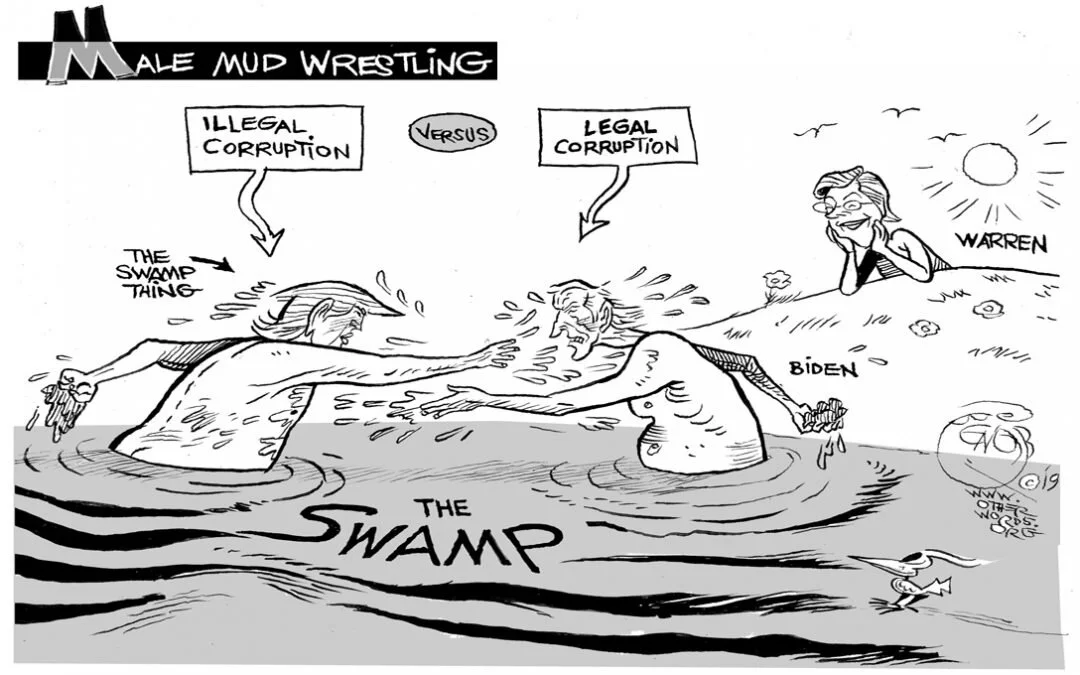
Is Boston signaling recession?

Boston skyline from Belmont
From Robert Whitcomb’s “Digital Diary,’’ in GoLocal24.com
The very rich greater Boston area may be signaling that a recession is coming. Bloomberg News reports that for the first time since the Great Recession “tenants in the third quarter cut back on office and lab space in Boston, Cambridge and the suburbs, said Aaron Jodka, who leads the research team at Colliers International Group Inc.’s Boston office. A quarter-over-quarter reduction in occupied space in all three markets has only happened during recessions or in the early stages of a recovery, he said.’’ Boston has seen a boom in the construction of office and luxury residential space since the end of the Great Recession, with new skyscrapers making downtown resemble Manhattan.
New York and some other cities are reporting declines similar to what’s being reported in Boston.
We often don’t know we're in a recession until after one has started. A big challenge in fighting the next one will be that the oceanic federal budget deficits, in part from Republican tax cuts for the rich, as well as the very, very low interest rates engineered by the Federal Reserve, apparently at least partly in response to pressure from Trump, even in a time of (general) prosperity, will give the federal government far weaker tools than in previous downturns to fight a recession. They’ve used them up when they didn’t need them.
Happily, the Bay State has a very able administration led by Gov. Charlie Baker that would probably deal with the challenges of recession better than the leaderships of most states, and, of course, Massachusetts will continue to be one of America’s richest places.
To read more, please hit this link.

Todd McLeish: Could a tough N.E. hard coral help save tropical corals?

Northern Star Coral is found in the waters along the Rhode Island coastline. In this photo, the northern star coral is attached to a rock and near green alga, commonly called sea lettuce, and red alga.
— ecoRI News photo
From ecoRI News (ecori.org)
The ongoing decline of tropical coral reefs around the world is causing a domino effect that could impact the quarter of marine life that depends on this ecosystem. Reefs are becoming bleached and dying as warming waters force corals to expel the algae that live in their tissues and produce sugars to provide food for the coral.
A Rhode Island scientist is co-leading a collaborative effort to determine if New England’s only hard coral species — a variety that can survive bleaching — could provide a solution to the coral-bleaching problem in the tropics.
Northern Star Coral is found in a range that extends from the Gulf of Mexico to Cape Cod.
“Some corals in Florida can have hundreds to thousands of individuals in one colony, and they can be 10 to 20 feet high. Here in Rhode Island, most of our coral colonies are about the size of a silver dollar. They don’t get big, mainly because they don’t grow during the winter,” said Koty Sharp, Roger Williams University associate professor of biology, marine biology and environmental science. “They’re also not super charismatic; they’re not as visually impressive. But under a microscope we see beautiful structures, tentacles, mouths, different colors.”
Sharp believes that the Northern Star Coral’s adaptability to life in both temperate and tropical waters may provide insight into how corals handle the stress of changing environmental conditions, which could ultimately help tropical corals be resilient to the climate crisis.
“Because the Northern Star Coral lives in this large latitudinal range, individuals of the same species experience really different temperature changes and really different environmental shifts throughout the year,” she said. “They’re exposed to different thermal regimes — drastic shifts up here and stable temperature conditions down south. That gives us the flexibility to learn more about how an individual’s history or experience of temperatures and water-quality conditions may influence the physiology of the organism and how that influences its resilience.”
Sharp and colleagues from throughout the species’ range are conducting a variety of experiments to learn about the symbiotic relationship between algae and Northern Star Coral, as well as investigations of its thermal resilience, tolerance for heavy metals, and how it responds to other threats. Sharp’s focus is on the bacteria that live in and on the coral.
“The peculiar thing about this species is that because it goes through winters where water temperatures drop to 2 degrees Celsius, they go through a period of dormancy in winter when they retract into their skeleton and shut up for the winter,” she said. “We don’t know much about what happens during that period of inactivity, but from our bacterial data, it looks like there is very little regulation of the surface microbiome of the coral in winter, and then in spring there is a reorganization of the microbiome.
“We’re focused on finding the processes that happen so they can have this spring awakening. Every New Englander can relate to this; what do we do to regroup and reboot? That’s the key to coral’s resilience to such extreme temperatures and conditions that are unfavorable to most coral species.”
Sharp and a team of Roger Williams University undergraduates are conducting several laboratory experiments designed to identify the factors that influence coral health and its relationship with its algal partners. They are also using DNA sequencing to identify the types of bacteria that live in the corals, culturing those bacteria, and determining what role each plays.
“We’re finding there are bacteria in and on the coral that we think are very important for defense against marine diseases,” Sharp said. “Some are actively inhibiting the growth of potential coral pathogens.’’
How the results of Sharp’s research can be transferred to helping tropical corals become resilient to warming temperatures is uncertain
“We’re hoping to learn more about how corals recover from disturbance, whether a thermal disturbance like a warming event or a winter event up here in New England,” Sharp said. “My lab is interested in what that recovery looks like from a microbial perspective. But it’s not necessarily the goal to apply microbes from New England to tropical reefs. What’s more broadly useful is identifying the mechanisms they use for recovery.
“If bacteria provide the ability to resist or recover from stress, then what’s the biochemistry of that success? It may be as simple as the production of certain chemicals that kill other pathogens. It may be that there are certain compounds the bacteria make in the springtime that support the growth of the coral host. We just don’t know a lot about the functional significance of associated bacteria, but we’re excited to learn more about the partnership and how it can be translated to corals in the tropics.”
Sharp is pleased with each of the small successes she and her students are achieving, like their recent ability to spawn corals in the lab and create the conditions the larval corals need to settle on a rock and start to grow. This will enable her to grow multiple generations of larval corals that her colleagues around the country can use in their own studies.
“It’s a New England coral that we can learn a lot from about coastal ecosystems in New England, but we also want to translate our findings to the tropics in new and powerful ways,” she said. “We need all the information we can get.”
Rhode Island resident and author Todd McLeish, a frequent EcoRI News contributor runs a wildlife blog.
Not for smoking

“Fall Grass” (fine art print), by Bobby Baker, at Bobby Baker Gallery, Cataumet, Mass. Copyright Bobby Baker Fine Art.
Pamela Thompson: In Maine, re-envisioning teacher education

At the Center for Innovation in Education, at Thomas College. Note that chairs and tables are on rollers.
From The New England Journal of Higher Education, a service of The New England Journal of Higher Education (nebhe.org)
What does it mean to re-envision teacher education? This is the question that the faculty at the newly named Lunder School of Education at Thomas College, in Waterville, Maine, have been asking and exploring. More than a quixotic pursuit, the purpose of this inquiry has been to re-design what we think of as classroom space, to re-construct an educator preparation curriculum, and to model both the distinct art and distinct science of creative teaching.
Setting aside the hubris of a formulaic approach to improvement in the wider field of teacher education, we recognize that a major challenge to re-envisioning teacher education is overcoming the systemic notions of “what school is supposed to look like” including “what teaching is supposed to look like.” We are also aware that many people have experiential memory from their own schooling. They may even have recollections of elementary or high school teachers during their time as students. A collective public memory can be an asset in shaping a support for an enlightened and educated society; however, it can also sustain a status quo or worse, an attitude of what was “good enough for me back in the day” is “good enough for them today.”
By way of example, if you imagine for a moment what the standard American school classroom looked like in 1900, desks in rows, blackboard and teacher in front of a room of seated students, go ahead and conduct a Google search today for classroom and what will inevitably appear will be a room with desks, often in rows with the teacher at the head of room.
As former PreK-12 classroom teachers, we chose to push the boundaries of our imagination. Having experienced for ourselves what was, we have pursued a different imagery of what a classroom can be and it inspired our thinking in the design our own institutional learning space.
We also recognize that there is a national shortage of qualified educators, not only in the New England region, but also nationally. The Learning Policy Institute reports “an estimated teacher shortage of 300,000 new teachers by 2020, and by 2025, that number will increase to 316,000 annually.”
A Thomas response
Thomas College is leading the field of teacher preparation through the design of its three-year programs in Education, which are now being offered across our suite of early childhood, elementary and secondary programs. Students can earn a teaching degree and be recommended for certification in three years.
There is a need for practical answers to systemic challenges in the ways we approach contemporary teacher education, while we also need to incubate and support a new generation of teachers to serve a highly diverse population in a chronically under-compensated profession. Adjusted for inflation, the average salary for teachers was 2% lower in 2016–17 than in 1990–91, according to the National Council on Education Statistics.
If the author and essayist Jonathan Swift was correct in his definition that vision is the art of seeing what is invisible to others, then a re-envisioning of teacher education requires a courageous imagination, a willingness to tinker with current ways of doing, and resources to support a shared vision.
In 2015, the Education faculty and senior administration at Thomas articulated a grant proposal that led to the Lunder Foundation committing $1.75 million to establish the Center for Innovation in Education (CIE) at the college. The Lunder Foundation, created by Peter and Paula Lunder in 1988, has a long history of investing in Maine, particularly in higher education, the arts and healthcare.
The Education faculty planned the physical design of the CIE to reflect an aesthetic, naturally lighted, uncluttered, adaptable, multiple-use learning space. All tables and chairs are on wheels. There is an area with comfortable overstuffed chairs, a coffee station, an aquarium with tropical fish, a deep sink and workspace and art materials shelving. There is no clock, however; while we recognize an institutional schedule, we want to model to our pre-service teachers that learning time should not be regulated by artificial means but by deep interest, authentic engagement and personal reflection.
The construction of the open concept learning space actualizes a philosophical idea that encourages teaching as a public activity. Classes are often held at the same time in two separate areas of the large learning space. Students are encouraged to use the space as a learning lab, meeting or study space. Faculty offices are intentionally situated at the perimeter of the center. An adjacent design center acts as a maker space, which houses, laptops, 3-D printers, microscopes, a telescope, and virtual-reality headsets that are integrated with standards-based curricular resources, educational gaming software, 360 cameras, robotics, science and art materials. A diverse collection of children’s and young adult literature is accessible to pre-service teachers. Faculty encourage student exploration of emerging educational technologies. Most recently, we are engaging them in immersive experiences with curricular applications of virtual reality, with the intent of providing access of worlds beyond the four walls of the traditional classroom.
Gaining STEAM
In 2016, the success of the CIE advanced the college’s strategic initiative to establish a School of Education. The faculty committed to a set of courses that encouraged student voice and choice in meeting learning objectives, along with programmatic integration of coursework in STEAM (Science, Technology, Engineering the Arts and Mathematics). We want our graduates to be able model student-centered learning, and we do this by guiding personal, authentic learning experiences. By requiring our Education majors to take coursework in Educational Game Design, we are putting into practice recent research that confirms that over “55 functions of the human learning experience” are being activated while students are involved in playing a game.
This year, Peter and Paula Lunder honored our efforts again with a $2.5 million gift toward Thomas College endowed scholarships and giving their name to our School of Education.
We do not have all the answers yet in the work of re-envisioning of teacher education; however, we want our graduates to be able to deliver curriculum and teach content in a way that reflects the reality of their students’ cultural, economic and technological futures. In recent years, we have seen a steady rise to nearly 95% of our graduating Education majors who obtain a teaching position within six months of commencement. A large percentage of those graduates choose to remain in Maine to begin their professional careers in teaching.
Our work is supported by the work of the CIE, which continues to serve as a key resource center, housed within the school of education and acts as the physical space where the faculty delivers innovative coursework in undergraduate and graduate programs. The CIE also collaborates with education and business-focused partners to extend professional development opportunities to PreK-12 classroom teachers and finally, the center provides a platform for faculty and students to showcase their work and action research in the areas of STEAM and emerging technologies.
As faculty, we are still seeking, striving and pursuing a model of teacher education that reflects the dynamic atmosphere of the classrooms that pre-service teachers will be entering, the schools they will be influencing, and the next generation of students they will be leading towards what may be possible to see.
Pamela Thompson is chair of the Lunder School of Education at Thomas College.
Memory in black and white
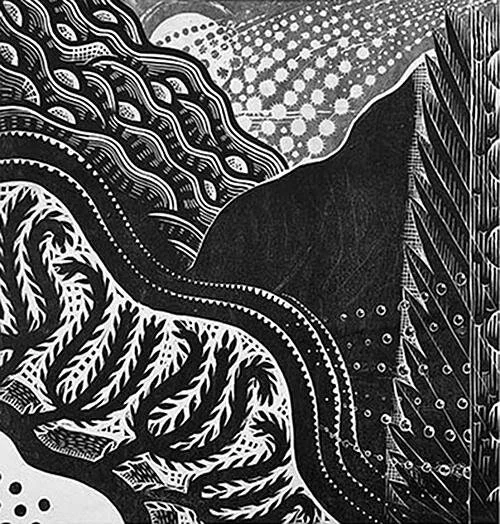
“Meteor Shower’’ (linoleum cut/collage), in Julia Talcott’s show “On the Night You Were Born,’’ an exhibition of relief prints exploring landscape and memory, at Bromfield Gallery, Boston, through Oct. 27.
When we think of linoleum, we think of the ‘50s….
Third Cape Cod Canal road bridge too much

The Bourne Bridge and the Cape Cod Canal Railroad Bridge
From Robert Whitcomb’s “Digital Diary,’’ in GoLocal24.com
’m glad that the Army Corps of Engineers decided against proposing a third bridge over the Cape Cod Canal, though some folks in the tourist trade liked the idea. The already overdeveloped and fragile Cape doesn’t need more cars funneled onto the long, narrow (and washing away) glacial moraine.
The corps does propose replacing the deteriorating Bourne and Sagamore bridges, which were built in the ‘30s. The new bridges would include four travel lanes, two added lanes for merging traffic, and – praise be to God! -- a median separating the on-Cape and off-Cape-bound traffic on each bridge. The lack of a median has added a certain frisson to driving over the New Deal era spans, especially as tank-like SUV’s, which always seem to be speeding, plow across.
Also encouraging is that there will be improved access for bike riders and pedestrians to enjoy the dramatic views of the world’s largest sea-level canal, with steep, wooded bluffs plunging down to it. The current structures would remain in service until the new bridges open to traffic.
The Cape needs more rail service (including railroad stations) as an alternative to cars. So I’m glad the quaint, vertical-lift railroad bridge, also put up in the ‘30s, at the western end of the canal, is not being torn down; it’s said to be in good condition.

Sarah Anderson: Of Mattel's vast pay gap and a model Iowa employer

This is the first Barbie, introduced by Mattel in 1959.
Via OtherWords.org
Mattel executives say they’re worried about girls developing “self-limiting beliefs,” resulting in a “dream gap” with boys.
So the giant toymaker rolled out an extensive line of “Career Dolls,” including Barbie pilots, firefighters, and robotic engineers, to inspire its young patrons. But there’s one career you won’t find in this line: the typical working woman on the Mattel payroll.
That median employee would be an Indonesian factory worker who earned just $5,489 in 2018. By contrast, Mattel CEO Ynon Kreiz took home $18.7 million — 3,408 times more than his line workers.
Talk about a dream gap.
Mattel is just one of 50 U.S. corporations that paid their CEO more than 1,000 times more than their typical employee last year, according to a new Institute for Policy Studies report.
This doesn’t just impact foreign factory workers. Starbucks, Gap, Chipotle, Foot Locker, and Williams-Sonoma are all examples of companies where U.S.-based workers would have to labor for a full millennium to earn as much as their CEO did in one year.
No single mortal adds more than 1,000 times as much value to a company as any other employee. Corporate leaders seem to know this, because they avoid media questions about their pay gaps like the plague.
Recently, a Marketwatch reporter asked 11 companies to comment on their extremely wide pay disparities. Only three were brave enough to respond, and their excuses were embarrassingly lame.
A Mattel spokesperson pointed out that $5 million of the CEO’s $18.7 million take was a hiring bonus. Without that one-time payout, Mattel’s pay gap would’ve been a “mere” 2,496 to 1.
Chipotle’s PR department insisted that their CEO’s $33.5 million paycheck was perfectly in line with “his peer group.” All the other kids are doing it!
Walmart’s flack pivoted away from the CEO’s $23.6 million paycheck to boast about the company’s recently increased starting pay — a whopping $11 per hour. Despite this bounty, Walmart workers still somehow take home 1,076 times less than their CEO.
These gaps weren’t always the norm. Back in the 1950s, the ratio between CEO and typical worker pay was around 20 to 1.
In a recent op-ed in USA Today, 98-year-old entrepreneur and former Iowa congressman Berkley Bedell described the philosophy that guided him and many other business leaders back in that era.
Businesses “had to have a purpose grander than just piling up profits,” he wrote, and “I tried to live my business life from that perspective.”
As the CEO of the fishing tackle manufacturer Berkley, Bedell started a profit-sharing program that distributed 20 percent of the company’s earnings to workers. An employee recreation fund fostered team spirit and gave everyone on his payroll the chance to go on fishing trips or to ball games.
“I never paid myself more than four or five times what my employees were making,” he recalls. “I lived like my friends in my hometown of Spirit Lake, Iowa. I drove an older car, served as a Scoutmaster, and resided in a modest home. I had a good life.”
Yet today’s overpaid CEOs are unlikely to start sharing that good life — and the wealth that finances it — more equitably without public policies to prod them in this direction.
Some of Bedell’s proposals include putting workers on corporate boards and giving companies with modest pay gaps preferential treatment, such as lower tax rates and a leg up in government contracting.
These kinds of policies recognize the dignity and value in the labor of all employees — not just the guy in the corner office.
Sarah Anderson is a co-editor of Inequality.org at the Institute for Policy Studies and a co-author of the IPS report “Executive Excess: Making Corporations Pay for Big Pay Gaps’’.
Woodland wonders

Blue pencil and graphite drawing by Stacey Cushner, in her show “Intangible Aspects of the Forest.’’ at Kingston Gallery, Boston, Dec. 4-Dec. 29.
The gallery explains:
“Stacey Cushner’s drawings and installations in Intangible Aspects of the Forest harken to the time the artist looked in wonder at the woodland while walking to school, taking a shortcut through one particular patch of forest. Through her work, she meticulously realizes the sumptuous greens, bright blue skies, old oaks, towering pine trees, butterflies, birds, and thick unwieldy grass of her childhood memories.
‘Irresolute of alms’

 A Field of Stubble, lying sere
Beneath the second Sun --
Its Toils to Brindled People thrust --
Its Triumphs -- to the Bin --
Accosted by a timid Bird
Irresolute of Alms --
Is often seen -- but seldom felt,
On our New England Farms --
— Emily Dickinson
David Warsh: Oligopolies, 'Transaction Man' and 'Mayday'
SOMERVILLE, Mass.
Reading Transaction Man: The Rise of the Deal and the Decline of the American Dream, by Nicholas Lemann (Farrar, Straus), I experienced a mounting sense that something in the argument was hidden from me, and perhaps from the author himself.
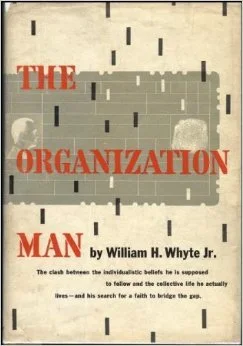
I understood well enough that Lemann chose his title in contradistinction to The Organization Man, William H. Whyte Jr.’s best-selling 1956 book that inveighed against the hierarchic ethos that seemed to dominate America in the 1950s: well-roundedness, belongingness, togetherness and specialization. Whyte was against gray flannel suits, ticky-tacky houses, business schools and giant corporations; against conformity in general. He was in favor of genius and innovation, entrepreneurs and philanthropic foundations “immune to the pressures of immediacy or the importunings of the balance sheet.”
Lemann is enthusiastic about organizations of all sorts, or institutions, as he prefers to call them, and against the forces that have eroded them. Transaction Man (who just as easily could be a woman) is to be found, he says, engaged in private equity, venture capital, hedge funds, strategic consulting, global philanthropy, education reform, “breaking corporations apart and rearranging them in ways that have made it just about impossible for anybody these days to be an Organization Man.”
That much, too, I understood. Bloomberg Businessweek’s cover story last week proclaimed, “You Live in Private Equity’s World.” But what are these practitioners of “the deal” about? The PE industry didn’t exist 30 years ago; today it has trillions of dollars under management, Bloomberg explained its seemingly irresistible rise this way: “In a world where bonds are paying next to nothing – and some have negative yields – many big investors are desperate for the higher returns PE managers seem to be able to squeeze from the markets.” I was almost finished with Transaction Man before I came across a passage that clicked, as Lemann explained one last time:
When a challenge presents itself – how to educate our children, how to fight poverty, how to change politics, how to improve the tone of polarized society – any proposed solution that can be characterized as relying on bureaucracies, organizations, government agencies, or established interest groups, is doomed to lose the argument. Only innovation, disruption, destruction and individualizing can possibly work. In the manner of someone who thinks the cure for a hangover is another drink, the country keeps reacting to troubles produced by the deterioration of its institutional life by embracing further deterioration. In polls, faith in the core institutions of American life, government, business, religions, public schools, news organizations, the legal system – has been falling for decades. In response, we persist in thinking about solutions that would continue to weaken these institutions, to the point that it would become nearly impossible for them to regain our trust.
But what is the nature of these “solutions”? Nobody goes around promising to deliver “innovation, disruption, destruction and individualizing.” Those often are the effect, but they are not the pitch. What Transaction Men promise are market solutions. Underneath the idiosyncratic use of the words “transactions” and “deals,” what Lemann is really writing about are markets. The word scarcely occurs in the book. When I turned to the index, what I found was this: “markets, see free-market purism; investment banking; specific financial instruments.”
Lemann, a distinguished journalist, has written eloquently about race relations and social mobility, among other things over a career spanning 40 years. But he is a newcomer to business history. I’m willing to bet he never took an economics course in college. That means that he is a stranger to the most fundamental characteristic of markets, captured by the metaphor of an Invisible Hand: the tendency toward equalization of rates of return, enforced by the disposition of investors to shift from low to higher returns. Markets are what the transactions industry – or, better, the restructuring industry – has been all about.
Specifically, Lemann doesn’t understand oligopolies, heavily concentrated industries with little competition that are able to set prices and pay, at least for a time, generous wages and benefits to their employees. They differ from monopolies in that a handful of companies dominate the relevant market, rather than a single provider. Oligopolies created the world of the Fifties, especially in America, whose industrial base was energized, not damaged, by the devastation of World War II.
Oligopolies prevail in many Silicon Valley industries today. But their high rates of return inspire competition. Other companies enter the business, often with the advantage of new and better techniques. More workers acquire necessary skills, and wages fall. Corporations relocate to cut their costs. What once seemed insuperable advantages get competed away. Consumers grow richer, but institutions and practices that once governed production erode and change. The best recent account of this I know – An Extraordinary Time: The End of the Postwar Boom and the Return of the Ordinary Economy, by Marc Levinson (Basic, 2016), received relatively little attention when it appeared.
For someone without an economics background, Lemann does an awfully good job of assembling a scorecard of those whose work played major roles in elucidating and often justifying what has been happening these last half century. He does so in those 20 pages on “free market fundamentals” at the University of Chicago in the years after 1960. His discussion of the work of Harry Markowitz, Franco Modigliani, Milton Friedman, Eugene Fama, Merton Miller, Myron Scholes, Robert Merton, Ronald Coase – all of them recognized by an economics Nobel Prize – occurs in a savvy chapter about Michael C. Jensen, one Chicago economist who has not acquired that extra measure of fame. Yet Jensen’s work , beginning with “The Theory of the Firm: Managerial Behavior, Agency Costs and Ownership Structure,” with William Meckling, which appeared in 1976, did more than any other finding to underpin with economic logic the revolution in corporate governance that has transformed the global business landscape.
But Lemann stops one layer short of uncovering the most fundamental development of all in his story of institutional change. That occurred on May 1, 1975, when Congress outlawed the cartel that permitted the New York Stock Exchange (NYSE) to fix commissions on its trades. “Mayday” was, as journalist Chris Welles described it not long afterwards, in The Last Days of the Club: (Dutton, 1975), “quite a spectacle,” at least to the little coteries of newsmen who followed Wall Street in those days.
For nearly 200 years, Welles wrote, Wall Street firms had insulated themselves from competition. They had operated as a club, apart from all other industries, free to cooperate and monopolize, and therefore able to allocate capital pretty much throughout the American economy. But, for one reason or another, the Nixon administration had turned against them; the Justice Department of John Mitchell and Richard Kleindienst had led the fight in federal courts.
In the wake of Watergate, the NYSE found itself powerless to deflect the onrushing legislation. “Once the privileged, protected elite of the nation’s financial system, members of the Club had been reduced –or elevated, depending on one’s point of view – to [the role of] typical businessmen, feverishly scrambling to boost revenues, cut costs, squeeze out earnings, beat competitors, and increase market share.” It was, for instance, the prospect of Mayday that induced the investment banking firm Morgan Stanley to move its headquarters from Wall Street to midtown Manhattan, the better to compete with the nation’s biggest banks – a tremor which would end, a quarter century later, with the demise of the Glass-Steagall Act.
The Treasury Department report that made the case for ending fixed commission was written by James Lorie, a professor of economics and business administration at the Graduate School of Business of the University of Chicago. He had been appointed to the task by William Simon, a former senior partner of Salomon Brothers who became secretary of the Treasury under President Ford. Simon went on to help found the private equity industry with a series of leveraged buyouts in the Eighties, along with Michael Milken, Carl Icahn, T. Boone Pickens, Irwin Jacobs, and others.
Lorie remained at the University of Chicago, presiding over its Center for Research in Securities Prices, and died in 2005, at 83. He was never, as far as I know, mentioned in connection with a Nobel Prize, because the grounds for abolishing fix commissions had been obvious to market participants. What he did was provide the formal logic, upending a report a year earlier by former Federal Reserve Chairman William McChesney Martin, who had recommended maintaining the old system. But no single action did more than Mayday to promote the restructuring movement – the market turn – to which Lemann complains. None better illustrates the intimate dialogue between practice, theory, and more practice.
As I finished Transaction Man, my eye fell on a review of a new commemorative edition of Abbey Road, the Beatles’ final recording together, which appeared in late 1969. The original title was to have been Everest. The four had agreed to fly to Nepal to photograph an album cover. But when the mixing sessions ran long, Paul McCartney proposed photographing the cover in Abbey Road, outside the studio, and so they did. The group met to discuss another album, but a few days later John Lennon returned from playing a solo concert in Toronto with his Plastic Ono Band, and announced that he “wanted a divorce.” And so the most successful band in history, an oligopoly among oligopolies, broke itself up on its own. The book about the wellsprings of the market turn – the fall of the Iron Curtain, Willian Whyte, Milton Friedman, John Lennon, and all the others, has yet to be written.
. xxx
The Nobel Prize in Economics was announced on Monday. See “The Nobel Prize in Economics Turns 50,’’ by Allen Sanderson and John Siegfried, in The American Economist, for interesting lists of Big Ideas, Pedigrees and Might-Have-Beens. Elsewhere, Mervyn King, former governor of the Bank of England, assesses the significance of the award.
. xxx
New on my bookshelf:
Under the Influence: Putting Peer Pressure to Work, by Robert H. Frank (Princeton, January 2020)
How Charts Lie: Getting Smarter about Visual Information, by Alberto Cairo (Norton)
David Warsh, an economic historian and veteran columnist, is proprietor of Somerville-based economicprincipals.com, where this piece first ran.
Much better than nothing

“Maine is the largest producer of wild blueberries in the world. The woody plants occur naturally in the sandy gravel understory of Maine's coastal forests, where little else bothers even trying to grow.’’
— Jeanne Marie Laskas, writer and journalist
Colorful group in gray autumn Provincetown

Untitled watercolor on paper, by Hans Hoffman (1880-1966), in the group show “Color Beyond Description, at the Provincetown Art Association and Museum through Nov. 3. This painting courtesy of The Renate, Hans and Maria Hofmann Trust, © Artist Right Society (ARS), New York.
The curator explains: “This exhibition features the work of Charles Hawthorne, Hans Hofmann and Paul Resika, artists who each used color to striking effect. Hawthrone is renowned as the great teacher of the early Provincetown Art Colony. He painted with both oil and watercolors, with his watercolors in particular demonstrating the movement of color and form. Hofmann is also known for his use of color in his crayon drawings and watercolor paintings. It's in those mediums where his use of color in space is at its most fluid. Resika, a student of Hofmann's, is a colorist painter who combines the techniques of both Hofmann and Hawthorne with his own eye for vibrant color and use of gouache alongside watercolor.’’

Tim Faulkner: The role of small New England farms in combatting global warming

— Photo Frank Carini, ecoRI News
From ecoRI News (ecori.org)
Farming and the climate crisis are no doubt interconnected even in relatively farm-scarce southern New England. But local farming operations, including fishing and aquaculture, are increasingly considered part of the climate-adaptation solution and may even help to mitigate global warming.
“How are we going to be more sustainable in our region and continue to feed ourselves?” asked Sue AnderBois, moderator of a panel on climate and food at the Oct. 4 Rhode Island Energy, Environment & Oceans Leaders Day hosted by Sen. Sheldon Whitehouse, D-R.I.
As director for food strategy with the Rhode Island Commerce Corporation, AnderBois looks for business opportunities that advance food and farming policies in the state. There is definitely room to grow.
Rhode Island produces less than 5 percent of the food it consumes. This means that the Ocean State, and much of New England in fact, rely on food from places suffering from severe climate impacts such as drought-stricken California and the Amazon rainforest, a tropical region being destroyed to raise meat for fast-food restaurants.
Some of our local food sources are also moving away. Lobsters and other popular seafood staples are leaving Rhode Island waters because they are too warm. To counteract this change, the state is supporting businesses that market and process underutilized fish and plants and seafood moving into Rhode Island waters such as Jonah crab and black sea bass.
One of the panelists, Bonnie Hardy, canceled her appearance at the event to tend to work at her planned crab-processing facility in East Providence. A business processing local kelp is opening soon at the food incubator Hope & Main in Warren.
Consumers can contribute to the climate solution by buying local seafood, especially bivalves. A 2018 study found that eating local clams, mussels, oysters, and scallops is akin to a vegan diet when considering the carbon footprint.
On land, insects will be a growing climate problem for farming. Rising temperatures, a changing climate, and more frequent and intense rains will bring more pests. The state’s Division of Agriculture was overwhelmed this summer by efforts to address the spike in eastern equine encephalitis (EEE). The outbreak is a possible omen of future demands on state agencies, according to AnderBois.
Thanks to public pressure, food-service companies such as Sodexo and Aramak are offering more local food at schools and hospitals. Locally caught and processed dogfish is being used to make fish nuggets for public schools. Brown University, the Rhode Island School of Design, and Johnson & Wales University are all ramping up local food procurement for their kitchens and cafeterias, AnderBois said.
Nationally, however, such practices aren’t trending.
Government support for big agricultural operations at the expense of small farms hurts both local economies and the environment.
Jesse Rye, co-executive director of Farm Fresh Rhode Island, was appalled by the Trump administration’s recent decision to relocate federal research agencies such as the National Institute of Food and Agriculture from Washington, D.C., to the heart of “Big Ag” territory in Kansas City, Mo.
He said the actions by Trump favor large “commodity” farmers at the expense of small farms. The loss of research on nutrition and food insecurity is undermining the support structures for local food systems in southern New England, according to Rye.
”This way of disconnecting urban and rural communities is really going to erode the trust that we have in institutions, and I feel plays into the narrative that currently our government or this administration really only cares about the people that own food companies or own large-scale farms,” Rye said.
Any plan to address the climate crisis should take into account the most vulnerable, he said. It will require a “gigantic lift” to change consumer behavior and restructure the food system. He noted that a greater appreciation for scientific research and the true price of food is also necessary.
“We need to have a frank conversation as Americans about what cheap food is and how it’s possible and what are the costs that aren’t actually rolled into the costs we see at the supermarket.” Rye said, adding that society needs to recognize the environmental damage caused by continuing to do business as usual.
Rye urged the public to demand action from local, state, and national officials.
“If you have more time and energy for advocacy and outreach around issues for small farms now is the time to let your representatives hear that,” he said. “We need to let people know on a regional and national level that this is totally not acceptable.”
Brown University Prof. Dawn King, an expert on local food policy, agriculture, and the climate crisis, suggested that farms adhere to regulations for greenhouse-gas emissions as other businesses do. Farming, she noted, accounts for 10 percent of greenhouse gases in the United States and up to 25 percent of global emissions if deforestation is included.
Fertilizers, livestock, manure management, and tillage are the primary emission sources. King has researched manure as a source for compost and energy production. And farms, she said, if managed properly, can be one of the most effective carbon sinks.
“There is a lot we can do with carbon storage,” King said. “And even in Rhode Island that can be part of preserving the farmland that we desperately need to preserve here. Specifically, because we are not a farm state.”
Local farms can store carbon by growing grasses for small-scale beef production. Growing perennials and practicing forestry also capture and store carbon dioxide.
“Unfortunately, we are doing the exact opposite worldwide,” King said.
To get there, King called for a transformative initiative such as the Green New Deal combined with paying farmers to conserve land and practice sustainable soil management. Renewable-energy incentives should also be offered to help farmers earn additional revenue.
“We need to be sure we are protecting small farms,” she said.
Tim Faulkner is a journalist with ecoRI News (ecori.org).

Chris Powell: A sanctuary state for bears

Your suburban neighbor
Nature is and long will remain a great advantage of life in Connecticut. Suburban and rural towns are set in the middle of nature, and the state's small cities are never far away from it. Because of agriculture's decline, the state is more forested than it was a couple of centuries ago, and because state government has amassed so many unfunded liabilities, there won't be much if any economic growth here for decades more. Nature is secure in the state.
But nature is not always benign in Connecticut any more than it is always benign anywhere else. Alligators, deadly snakes and spiders, cougars, and great white sharks are part of nature too and dangerous to civilization. Fortunately Connecticut has few of those but increasingly it has black bears instead.
In the last year in Connecticut bears haven't just knocked down bird feeders. They have broken into houses and injured or killed pets as well as farm animals in their pens. A week ago a bear even attacked a hiker in Southbury.
Bears have been spreading throughout the state from the northwest and have caused consternation even in inner suburbs and cities, prompting environmental police to tranquilize them, tag them, and relocate them to the deep woods.
But soon they come back with their friends and cubs.
So last week the controversy about bear hunting was renewed. Two Republican state senators from the western part of the state, Craig Miner, of Litchfield and Eric Berthel, of Waterbury, called for bear-hunting legislation, perhaps applying only to Litchfield County, where bears seem most numerous, their main point of entry to the state. Animal lovers in the General Assembly and elsewhere promptly renewed their opposition, asserting that bears can be deterred by peaceful methods.
The peaceful deterrence argument is not persuasive, for it concedes a perpetual increase in the bear population and their becoming common everywhere, with Connecticut becoming essentially a "sanctuary state" not just for illegal immigrants but bears as well. Under current policy the state is probably only a few years away from that. Bears are cuter than alligators and Burmese pythons, the bane of South Florida, but there is no good in having such creatures nearby.
A bear-hunting season in Connecticut won't endanger the species but may push bears back toward the north woods, where they belong. It's worth a try.
xxx
Last week Gov. Ned Lamont joined other advocates of the nanny state in celebrating implementation of the new law raising to 21 the age of eligibility for purchasing tobacco products. The rest of Connecticut is supposed to believe that young people don't have older friends to buy them age-restricted contraband.
While the governor and the nanny-staters were celebrating the new tobacco law, Manchester celebrated the inauguration of a 19-year-old member of its Board of Education. The irony of public policy here passed unnoticed -- that the 19-year-old is deemed mature enough to decide how to operate the public schools but not to decide whether to use tobacco or, for that matter, drink alcoholic beverages.
The age of majority will always be arbitrary, a matter of judgment, but to make any sense it has to be consistent. To serve in the military, to vote, and to hold public office at 19 but to be forbidden to purchase tobacco or alcohol is nonsense, but, like so much else in Connecticut, it's the law because it's politically correct nonsense. Mainly it just lets the nanny-staters feel good about themselves.
Chris Powell is a columnist for the Journal Inquirer, in Manchester, Conn.
-END-
'Bostonistis'

Seal of the Boston Athenaeum, one of the centers of the city’s high culture, and, some might say, its intellectual snobbery
"No doubt the Bostonian has always been noted for a certain chronic irritability _ a sort of Bostonistis — which, in its primitive puritan form, seemed due to knowing too much of his neighbors, and thinking too much of himself.''
— Henry Adams (1838-1918), writer, historian and member of the storied Massachusetts dynasty that started with American Founding Father John Adams
Entering the 'posthuman era'?

“Untitled #1 ‘ (mixed media collage), by Margaret Hart, in her show “Situated Becomings,’’ at Kingston Gallery, Boston, through October.
She explains: “Imagine a cyborg collage: a becoming of gender possibilities, an image depicting fragments of technology, organic parts and hints of human gender forms through the spaces imaged or the objects included. What is collage and what could it be, beyond a simple form of cut-and-paste image making, when focused on the issue of gender in this posthuman era?’’
“These works began from asking myself a question: How can collage, intersecting with fiction and feminism, contribute to a posthuman understanding of gender?’’
'Death seems a comely thing'

— Photo by Valerii Tkachenko
Know'st thou not at the fall of the leaf
How the heart feels a languid grief
Laid on it for a covering,
And how sleep seems a goodly thing
In Autumn at the fall of the leaf?
And how the swift beat of the brain
Falters because it is in vain,
In Autumn at the fall of the leaf
Knowest thou not? and how the chief
Of joys seems—not to suffer pain?
Know'st thou not at the fall of the leaf
How the soul feels like a dried sheaf
Bound up at length for harvesting,
And how death seems a comely thing
In Autumn at the fall of the leaf?
— “Autumn Song,’’ by Dante Gabriel Rossetti (1828-1882)
Related
Why Harvard's weird take on Asian-American applicants?


From Robert Whitcomb’s “Digital Diary,’’ in GoLocal24.com
U.S. District Judge Allison Burroughs has ruled that Harvard’s admissions process doesn’t discriminate against Asian-American applicants, though, she wrote, the university could improve the process with more training and oversight.
But a mystery: Judge Burroughs noted that Asian-American applicants generally got lower ratings on such qualities as integrity, fortitude and empathy. How would Harvard admissions officers come up with such measurements? Makes no sense to me.
Anyway, Harvard and other very selective schools take into account ethnicity among many other factors in putting together a first-year class. The admissions process at elite institutions has to be complicated as the schools strive for diversity so that their schools are at least marginally representative of America. For the courts and other parts of government to try to micromanage the process, especially at private institutions, is inappropriate.
This issue is particularly resonant in New England, with so many highly selective schools, most famously four (Harvard, Yale, Brown and Dartmouth) of the eight Ivy League schools and MIT. Ed Blum, the lawsuit’s originator, was previously involved in challenging the University of Texas’s affirmative-action program. Blum is a right-wing zealot whose efforts would restore what has in effect been white privilege to the admissions process.
Cozy or ominous?

“Lantern and Fireplace’’ (wood engraving), by Wanda Gag (1893-1946), at the Art Complex Museum, Duxbury, Mass. The museum says::
“Gág became a highly praised printmaker in New York in the 1920s and 1930s, and was recognized for her skill in depicting scenes of everyday life. She was born in New Ulm, Minn.,, and grew up with the customs and fairy tales of her parents' native Bohemia. She was widely known for her children's books, including Millions of Cats, and her illustrated translations of Grimm's Fairy Tales and Snow White and the Seven Dwarfs.