
Vox clamantis in deserto




Shading the departed

“Passage: Forest Hills Cemetery #2 “ (gouache on panel), by Vivki Kocher Paret, in her show “Among Trees,’’ at Galatea Fine Art, Boston, Oct . 31-Dec. 1
The gallery says:
She “studies the visual pathways created by filtered light in environmental settings. Whether it be on the woodland floor, through water, or city buildings, the beauty inspired by the ephemeral nature of trees is found to be an uplifting feature in her work.’’

Philip K. Howard: Action, not moderation, is the salve for American polarization

Polarizer in chief
Polarized politics is a formula for public failure, a downward spiral of distrust and greater paralysis. Pulling out of this spiral is difficult because polarization is good business for politicians and pundits. Political coffers fill up with contributions from people who loathe the other side. President Trump has a unique genius for sowing division — playing to people’s fears and attacking the weaknesses of his opponents. Social media fans the flames of the latest outrage.
Some think the cure to polarization is more moderate politicians. By fixing electoral machinery that appears to favor extremists, such as gerrymandering and restricted primaries, reformers hope to return to the happy days when leaders from both parties could sit down and work things out. They long for Ronald Reagan and House Speaker Tip O’Neill.
Moderation is just happy talk, however, without a new vision of how to govern better. How would moderate leaders fix schools, or reduce health care costs, or issue permits within a year’s time instead of a decade? None of the candidates in the 2020 presidential election offers a cure to the alienation that Americans feel towards Washington.
Washington, meanwhile, plows forward, a giant bureaucratic state crammed with red tape and obsolete programs. Democracy has degenerated into a kind of legal perpetual-motion machine, taking upwards of a decade to approve vital infrastructure projects. Bureaucracy is everywhere. According to the World Bank, the U.S. ranks 53rd in ease of starting a business. Practical choices throughout society are stymied by overbearing law — whether maintaining order in the classroom, being candid with an employee, or letting children walk to school alone. Is your paperwork in order?
Reformers have confused cause and effect: Paralyzed government, not polarization, is the original sin of modern government. Bureaucratic densification since the 1970s has made government beyond human control. Government’s inability to respond to public needs is the chicken that laid the egg of polarized politics. The inability of Americans to roll up their sleeves and fix things leads inexorably to extremism. Political leaders who can’t get things done compete instead by pointing fingers and screaming louder.
Populism thrives on fear and anxiety. A collective sense of powerlessness spawns the instinct to vilify “the other.” Government is toothless to deal with dislocations of global commerce, new technology and waves of immigrants. Self-reliance is stymied by faceless bureaucracy. Unresponsive government prompts anxious citizens to embrace populist solutions.
In 1939, the organizational expert Peter Drucker wrote that fascism had taken root because the establishment had offered “no new order” to counteract the dislocation of the Great Depression. But fascism was doomed to fail, Drucker argued, because its popularity was based on attacking scapegoats, not a positive governing vision. The solution to a destabilized society in which people feel powerless, Drucker argued, must be “built upon a concept of the nature of man and of his function and place in society.” People must be able to help themselves and their society.
The way out of America’s downward spiral is not moderation but a radical spring-cleaning of government to re-empower Americans at every level of responsibility. Liberating people to act, not top-down solutions, is the cure to paralysis.
The only cure for alienation is ownership. This requires not wholesale de-regulation, but rebooting government with simpler, open frameworks that set goals and governing principles. Simpler codes will allow Americans to understand what is expected of them and afford them flexibility to get there in their own ways. Only then will officials and citizens have the freedom to make sense of daily choices.
Action, not moderation, is the salve for polarization. Conventional wisdom is that letting individuals use their judgment will exacerbate social conflict. Evidence suggests the opposite: A study in Britain found that professionals with opposed ideological views generally arrive at similar solutions when confronting concrete problems. Studies of American judges and of German bank regulators also found remarkable consistency.
Local communities must be able to run schools in their own ways. Health care providers must be accountable for overall quality, not to compliance police playing “gotcha.” Officials must be empowered to set up and give permits in “one-stop shops.” Governors must have freedom to try new ways to manage unemployment relief and other public services. Citizens must have someone to call, and to blame, when things aren’t working.
Reviving human responsibility does not solve societal challenges such as income stagnation, climate change, or immigration. But it reinvigorates a culture of practical action that is the antidote to corrosive polarization. Empowering people to be practical in their daily challenges will likely rub off in their political views. Polarization will fade away when Americans, waking up each morning, feel that both they and their officials in Washington can make a difference again.
Philip K. Howard is chair of Common Good and author of the new book Try Common Sense (W.W. Norton, 2019). Follow him on Twitter @PhilipKHoward. He’s also a friend and occasional colleague of New England Diary editor Robert Whitcomb. This piece first ran in The Hill.
TAGS DONALD TRUMP POLITICAL POLARIZA
Recipes from the roof

Photo by Jean-Pierre Dalbéra
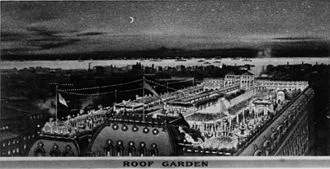
Hotel Astor (in New York) roof garden in 1905
From Robert Whitcomb’s “Digital Diary,’’ in GoLocal24.com
There’s lots of wasted space on the flat roofs of some big buildings, such as hospitals and old factories. They can be put to use for such things as solar panels -- or rooftop farms. That’s what the Boston Medical Center has been doing for the past three years.
EcoWatch reports that the hospital’s rooftop farm produces about 6,000 pounds of food a year, with 3,500 pounds slated for its Preventive Food Pantry, which provides free food to low-income patients. The rest goes to Boston Medical’s other patients, its cafeteria, a “teaching kitchen and an in-house portable farmers market,” the publication reports. More than 25 crops grow in the 2,658-square-foot rooftop garden, said to be the biggest in Boston.
The hospital even offers some courses to patients, employees and their families in how to grow their own healthy food. I love it when previously wasted space – rooftops, parking lots of closed stores and factories, etc. -- is used so productively.

'Telling and hiding volumes'

From Anthony Goicolea’s show “Pose,’’ at the Montserrat College of Art, Beverly, Mass., through Nov. 9. Montserrat says he explores “the stranger side of portraiture, with pieces that are sometimes beautiful and sometimes intentionally grotesque. The figures in these portraits are both revealing and secretive, telling and hiding volumes with coded body language.’’

Sarah Puschmann: Striped bass are being overfished

Researcher with a striped bass
Via ecoRI News (ecori.org)
A new assessment has revealed that striped bass off the Atlantic Coast are being depleted faster than they can replenish, and have been since 2013.
In response, the Atlantic States Marine Fisheries Commission in August issued a collection of possible management options for recreational and commercial fishing, with the goal of reducing the rate of Atlantic striped bass killed by fishing to 18 percent less than the 2017 rate by 2020
This isn’t the first time striped bass have stared the Grim Reaper in his piscine eyes. Back in the 1980s, the population of striped bass that the Atlantic States Marine Fisheries Commission manages — which ply the coastal waters between North Carolina and Maine in search of menhaden, a type of herring — declined so drastically that the commission called a complete moratorium on striped bass fishing.
It worked. By 1995, the population had climbed to record levels. That year 540,000 fish were caught commercially, a sharp increase from the 272,000 caught in 1983. A New York Times article from June of that year jubilantly announced the fish’s “comeback.” With the population restored, restrictions were lifted, and the fish’s numbers remained relatively stable.
To keep tabs on the health of a fish population, biologists check two key indicators. One is the rate of death due to fishing, known as fishing mortality, and the other is the combined weight of all females in a population capable of spawning, known as spawning stock biomass — so, one indicator to judge rate of death and another to judge the potential for birth. After 1995, the death indicator hovered just around the threshold of concern, while the birth indicator was steadily worsening, it didn’t yet trip the worry-wire
Then, in 2013, the mortality rate exceeded the level of concern, leading the Atlantic States Marine Fisheries Commission two years later to decrease the number of fish anglers could take per day from two to one. But it wasn’t until 2018, when the model that biologists use to determine the health of fish populations, the Marine Recreational Information Program, was recalibrated that a startling discovery was revealed.
The most recent data showed that the spawning stock biomass was only 151 million pounds in 2017, far below the newer, higher threshold of 202 million pounds.
“Previously, we thought we were actually above the threshold and now we add in these new numbers, we run the model and we found out wow, we’re not only below [the threshold] but we’ve been below it for five years,” said Nicole Lengyel Costa, biologist for the Rhode Island Department of Environmental Management’s Division of Marine Fisheries.
This has prompted the Atlantic States Marine Fisheries Commission to propose Draft Addendum VI, a set of management options designed to protect the population. One way to do this could be to decrease the number of dead releases by tackling the types of hooks that cause them.
Currently, anglers are allowed to take one fish of a minimum length of 28 inches per day. Quite often, though, the first, second, or third catch is too small to be legal, so the angler throws it back. Of the released striped bass, which the Atlantic States Marine Fisheries Commission estimates this to be 9 percent of all striped bass caught, most don’t actually rejoin the population. They die. In fact, in 2017, 91 percent of releases were dead.
“There are more fish that die that way than anglers taking them out of the water bringing them home to eat,” said Dave Monti, second vice president of the Rhode Island Saltwater Anglers Association and charter boat captain who takes anglers out into Narragansett Bay to fish for striped bass in the spring.
“That’s how dramatic it is,” he said.
Dead releases mainly occur when a fish is hooked not in the mouth but in an internal organ as a result of swallowing the hook. This is why the Atlantic States Marine Fisheries Commission hopes to steer anglers away from using the more easily swallowed J-hooks and toward using circle hooks, which are more likely to puncture a fish in the mouth, not the gut.
This provision, plus other options to decrease the mortality rate of striped bass, including increasing the minimum size allowance or restricting the fish anglers can keep to within a particular size range, are outlined in Draft Addendum VI.
The public comment period for this addendum closes Oct. 7. The Striped Bass Management Board will then consider the public comments and is scheduled to meet Oct. 30 to select which management options to implement.
Sarah Puschmann is a reporting fellow with ecoRI News.
David Warsh: on 'Transaction Man' and the decline of the American Dream

Nicholas Lemann’s The Promised Land: The Great Black Migration and How it Changed America (Knopf, 1991), was a remarkable success. The effect on the South in the 1930s of the mechanization of cotton picking and the phasing out of the share-cropping system was made vivid, thanks to James Agee, Walker Evans, and Richard Wright.
Incredibly, Lehmann’s was only the second book to appear in all the years since about the journey of nearly a million African-American men, woman and children from the Mississippi Delta to the South Side of Chicago in the years after World War II. The Warmth of Other Suns: The Epic Story of America’s Great Migration, by Isabel Wilkerson, added to the story in 2010. (There were even more white sharecroppers, but their diaspora was more diffuse.) Lemann constructed a three-way triangle with which to tell his story: Clarksdale, Miss.; Lawndale, Chicago; and Washington, D.C. He found flesh-and-blood characters to populate his story. And he turned it into a parable of race relations in America since the 1960s.
Before Lemann’s book, what college sophomores interested in race relations knew about the background to race relations was likely Harlem, the Brotherhood of Sleeping Car Porters, and, maybe, the first volume of Taylor Branch’s biography of Martin Luther King Jr., and Common Ground: A Turbulent Decade in the Lives of Three American Families, by J. Anthony Lukas (Knopf, 1985). Afterward, Marquette Park, the Robert Taylor Homes, the Blackstone Rangers, and the Moynihan Report became part of the vernacular. I re-read most of The Promised Land last week. It is a journalistic masterpiece.
Success propelled Lehmann into the stratosphere, in which he wrote two more books: The Big Test: The Secret History of the American Meritocracy (Farrar Straus, 1999), about changing college admission policies over seven decades; and Redemption: The Last Battle of the Civil War (Farrar Straus, 2006), about the mostly successful repression of newly emancipated slaves during the Reconstruction Era. He had moved from The Atlantic to The New Yorker in 1999, and served two five-year terms as dean of the Columbia Graduate School of Journalism, retiring in 2013
So it is not surprising that, in retirement, Lemann should seek to tell the story of another great migration, this one a journey in time rather than a geographical trek. He describes Transaction Man: The Rise of the Deal and the Decline of the American Dream (Farrar Straus, 2019) as “the history of our move from an institution–oriented to a transaction-oriented society.” His narrative begins, he writes,
[W]ith Americans of the early twentieth century confronting the powerful new realty of concentrated economic power and debating how to constrain it. This was an intense, all-consuming, highly consequential battle, fought not just here but worldwide. Out of these intense dissatisfactions and disagreements and conflicts, the institution-based order, with a much bigger national government and the corporation at its anchors, emerged. Then another set of dissatisfactions and disagreements, this one directed against governments and corporations, produced another set of big changes, which in turn,, created the new transactions-based order. And today, a third vision of society based on Internet-enabled networks – which might restore some of what the age of transactions destroyed –is emerging.
In other words, it is a zig-zag story. And as such, Transaction Man makes consistently interesting reading. Lemann is an awfully polished writer after all these years. But the book is not as successful on its own terms as The Promised Land.
The familiar techniques are here. The locations: Chicago Lawn, a formerly thriving industrial neighborhood on Chicago’s South Side, steadily being hollowed out, by white, then black flight to the suburbs, and by the deindustrialization of the Midwest; the offices of Morgan Stanley, a Wall Street fixture, until the company moved its headquarters to midtown Manhattan, in 1973; and, more or less tacked on to complete the triptych structure, Silicon Valley.
There are fully drawn personalities, too, to represent each era.
There is Adolf Berle, 1895-1971, whose name is mostly forgotten now. As author, with Gardner Means, of The Modern Corporation and Private Property, in 1931, a thinker who for a time outranked Peter Drucker, John Kenneth Galbraith, James Burnham, Karl Polanyi, and Alfred Chandler s as a prophet of corporate hegemony. Berle took one side of an argument with family friend Louis Brandeis — regulate corporate planning and control of markets as opposed to break ’em up – an argument that Brandeis eventually won. An early member of President Franklin Roosevelt’s “Brains Trust,” Berle was eventually fobbed off as wartime ambassador to Cuba, where he oversaw the formation of the rate-setting International Air Transit Authority.
There is Michael C. Jensen, born in Minneapolis in 1939, who in 1962 entered the University of Chicago as a graduate student just as the university’s golden age in economics was beginning. Harry Markowitz had left, but Merton Miller had arrived at the Business School, and Roald Coase the law school, and Jensen shared offices with Eugene Fama and Myron Scholes. All but Jensen would be recognized with Nobel Prizes. Jensen went off to the University of Rochester, and in 1976, with William Meckling, published “The Theory of the Firm: Managerial Behavior, Agency Costs, and Ownership Structure,” providing strong analytic bones to an argument that Milton Friedman had made in so many words half a dozen years before: the sole social responsibility of a business was to increase its profit. Berle and Means had argued that the separation of corporate ownership and control was both welcome and all but inevitable. Johnson and Meckling argued that the situation could and should be reversed simply by changing the rules of the game, in the name of competition and lower prices. It was the Brandeis approach to bigness, but with a twist: Rely on financial markets instead of government to facilitate the breaking-up.
Jensen and Meckling’s analysis of what was soon called the market for corporate control provided a public philosophy for the wave of corporate restructuring that had already begun. Instead of returning to Chicago, Jensen left Rochester for the Harvard Business School. Brash manners and high spirits had already cost him what might have been a Nobel medal of his own, but Jensen had enormous success in the classroom, until his daughter’s chance encounter with personal development guru Werner Erhard put him on a different path. Lemann labors valiantly to untangle the role that Chicago played in legitimizing the global market turn. But in his zeal to tell the story of Jensen’s apostasy, he somehow loses the thread of what the man believed.
And there is Reid Hoffman, born in Palo Alto in 1967, a personage suggested by Lemann’s literary agent as a suitable representative of the new age. Hoffman believes, above all else, in scale – that is, bigness that enables big firms to grow bigger. A co-founder – along with Peter Thiel and Elon Musk – of the online payment system PayPal, Hoffman went on to found LinkedIn, the professional networking firm. “Hoffman believed that people want to conduct different parts of their lives in different online communities,” Lemann writes. LinkedIn would became, Hoffman hoped, “the central place where three billion people in the world, including blue-collar workers and students, would MANAGE their careers.”
Microsoft bought LinkedIn in 2016 for $26.2 billion; Hoffman collected $2.5 billion of it. But aside from the fact that Microsoft, Amazon, Google and Facebook have found themselves in the cross-hairs of Sherman and Clayton antitrust statutes, thanks to their successful applications of the gospel of scale, there is little in Hoffman’s story to make you think that Silicon Valley has come up with a viable new way of organizing social governance.
Sandwiched in among these profiles, to provide color and connective tissue, are various victims and propagators of these historical forces: Nick and Amy D’Andrea, owners of a Buick dealership in Chicago Lawn that is eventually torn down to build a Wendy’s hamburger stand; Ann Collier, born in Jackson, Mississippi, who for thirty years has lived nearby; Robert Baldwin, the Morgan Stanley chief executive who in the 1970s put the firm on the course that has taken it to the present day; and Steven Rattner, a one-time Morgan Stanley executive who oversaw government restructuring of the auto industry after 2008.
Making an appearance in an afterword, as an alternative to existing visions, is one last profile, that of Arthur F. Bentley (1870-1957), an obscure Johns Hopkins University-trained political scientist-turned Chicago newspaper reporter. In 1908 Bentley published The Process of Government: A Study of Social Pressures, attracting little attention. He suffered a breakdown and moved to rural Indiana to grow apples. There he corresponded with the likes of Albert Einstein, Thomas Mann, and, especially, Columbia University philosopher John Dewey. By the time Bentley died in 1957, Lemann writes, The Process of Government had been discovered (presumably thanks to Dewey), and was “considered the most important study of politics and society ever produced by an American – required reading for anybody studying those fields seriously,” only to be lost again.
Today, Lemann reports, Bentley’s book is out of print, but its pluralist message, he says, is more relevant than ever. (It is freely available online.) Never mind those “little platoons of society” that Edmund Burke was on about; let government re-regulate industry, strengthen unions, foster a sense of institutional social responsibility, and otherwise bring about a return to the countervailing powers of the halcyon 1950s – when the wrong turn of the zig-zag got underway.
I have to end here. I must catch a plane. To be continued, sometime in the next few weeks. Transaction Man is an interesting book and there is something more to say.
David Warsh, an economic historian and veteran columnist, is proprietor of economicprincipals.com, where this essay first ran.
Chris Powell: 'Nonprofit' Yale, with its vast endowment, is overwhelming New Haven
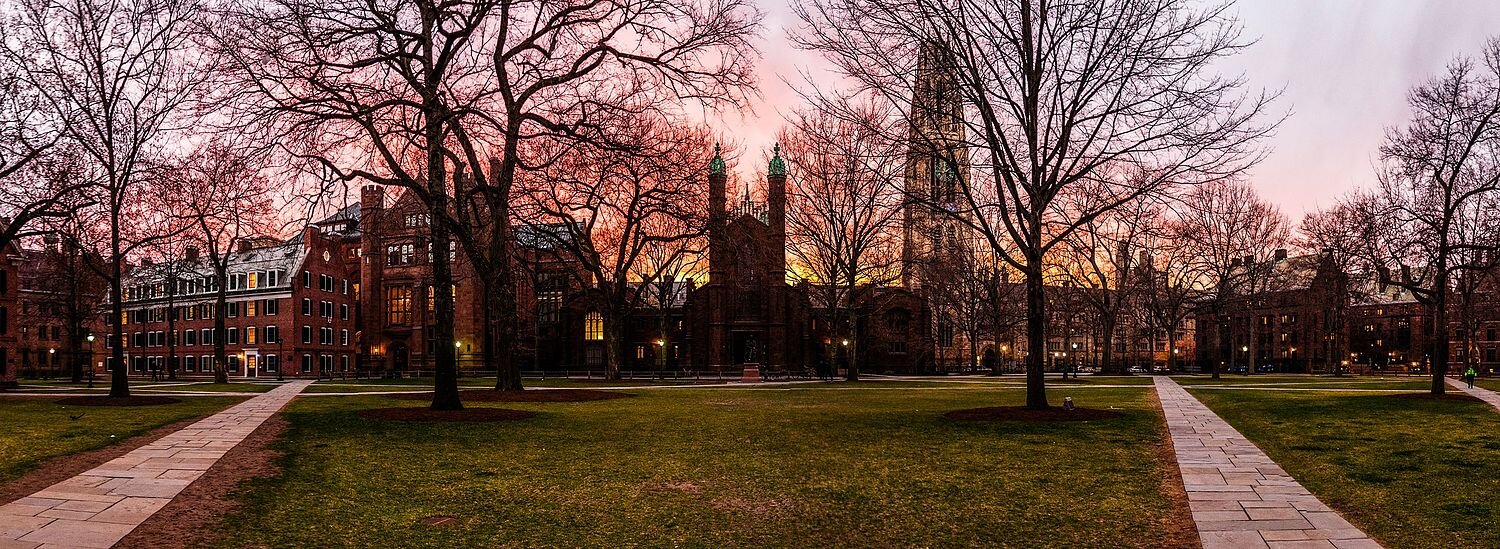
Yale’s Old Campus at dusk
Without Yale University, there might not be much left to New Haven beyond the daily shootings, drug overdoses, indignant demands for nullification of federal immigration law, and good pizza. Even so, Yale may be getting too big not just for New Haven but for Connecticut as well. Indeed, the university seems to be slowly taking over the city, which might be an improvement if it wasn't so undemocratic.
The New Haven Register reported the other day that the university this year converted six buildings from commercial to educational or medical use, thereby rendering them exempt from city property taxes and costing the city $3 million a year. Five months ago the university said it will build a neuroscience research center on the part of the Yale New Haven Hospital campus formerly owned by St. Raphael's Hospital, thereby keeping that prime property off the city tax rolls as well.
Meanwhile Yale's endowment has just broken $30 billion even as the finances of city government and state government remain a mess.
Sometimes nonprofit organizations fall too much in love with the endowments they amass from the tax exemptions conferred by state and federal law. Yale may be an egregious example of this. The university could not acquire much more property for nonprofit use in New Haven without demolishing the city's already weak tax base, and Yale's $30 billion endowment already might cover free or heavily discounted tuition for all ]the university's students for decades.
Unless it plans to acquire the rest of New Haven or even the state, how much larger an endowment does Yale really need?
According to the Register, Yale pays the city $5.6 million a year in property taxes on its nonexempt property and about $12 million more in a voluntary payment and a fee for fire protection. That's nice but still a fraction of what the university might pay without its property tax exemption.
From time to time state legislators and others have proposed taxing university endowments rather than repealing the property tax exemption for all colleges and hospitals, since Yale's endowment is so big that it easily could be taxed without touching any other endowments. The second largest such endowment in the state is said to be that of Wesleyan University in Middletown, only $1 billion. The endowment tax proposals have not gotten anywhere in the General Assembly.
But as Yale slowly consumes New Haven and as nonprofits and government agencies encroach more on the property tax bases of Connecticut's other cities, the rationale for tax exemption for nonprofits weakens, especially as crushing student loan debt shows that higher education is greatly overrated.
Bernie Sanders is not president yet, so any big stash of money is not automatically a target for communistic confiscation. But as long as donations to colleges and universities are tax-exempt and diminish the income tax revenue that otherwise would be collected from the donors by the state and federal governments, huge endowments like Yale's are fairly questioned. It's no matter that such endowments may be growing more from profitable investment than from fresh donations, since they originate mainly in donations that were tax-exempt.
But any revenue from taxing Yale's endowment should flow to state government, not city government, since state government already reimburses half the city's budget and city government is even less competent than state government. The best use of any new revenue for state government might be just to cut state taxes, since “property tax relief” is just a euphemism for raising municipal spending.
Chris Powell is a columnist for the Journal Inquirer, in Manchester, Conn.
-END-
Hard times for hardwood industry

North American Beech tree, an important hardwood
From Robert Whitcomb’s “Digital Diary,’’ in GoLocal24.com
NPR recently ran a story of the damage done to the New England hardwood-lumber industry by Trump’s trade war with China, which has, it is true, long been cheating America right and left in trade, most importantly in theft of U.S. firms’ intellectual property. China has imposed hefty retaliatory tariffs on such important species as red oak, ash and cherry.
The bombastic Trump was right to challenge the Chinese on trade but is too ignorant to know how to do it. Unlike some big agribusiness operations in the politically important Midwest (the Iowa caucuses!), the hardwood industry has received little offsetting compensation from the federal government. You don’t think of New England as a big grower of crops but our densely wooded region grows an important amount of high-value trees not growable in most of the world. Trump offers partial reimbursement (from our taxes) of the losses suffered by Midwest agribusiness because of his tariffs; he should do the same for folks in the hardwood business.
Meanwhile, I wonder how the warming climate will affect the mix of trees in New England. Palmettos in Newport in 2050? To read the NPR report, please hit this link.

Group effort

“Flock #3” (acrylic, rust, migratory instinct and motion on canvas), by Joel Howe, at Alpers Fine Art, Andover, Mass.
Flock #3
Joel Howe
24 x 24 in.
26 x 26 in. (frame)
acrylic, rust, migratory instinct, and motion on canvas
$1,400

Olivia Snow Smith: How Wall Street is killing the newspaper business

Via OtherWords.org
Though lacking the size and prestige of The New York Times or The Washington Post, The Storm Lake Times is very important to its readers.
Two years ago, the small, bi-weekly Iowa paper (circulation: 3,000) won the coveted Pulitzer Prize for taking on agricultural water pollution in the state. If it weren’t for vibrant local papers, stories like these might never come to light.
Unfortunately, all over the country, private equity and hedge funds have been scooping up these cash-strapped papers — and looting them into irrelevance or bankruptcy.
Here’s how it works.
Investors put down a fraction of the purchase price and borrow the rest — and then saddle the company with that debt. Layoffs and cutbacks follow, which leads to a shabbier product. Circulation and revenue decline, then more cuts, and the cycle accelerates.
Eventually the paper is a shadow of its former self, or turned to ashes completely. Wall Street wins, the public loses.
Perhaps the most infamous recent example was the breakdown of the 127-year-old Denver Post. Since private equity firm Alden Global acquired the paper, it has cut two out of every three staff positions — twice the industry rate for downsizing.
To add insult to injury, the firm has been using staff pension funds as its own personal piggy bank. In total, they’ve moved nearly $250 million into investment accounts in the Cayman Islands.
Employees who remain grapple with censorship. Last April, Dave Krieger — editorial page editor of Alden’s Boulder Daily Camera — was fired after self-publishing an opinion piece headlined “Private Equity Owners Endanger Daily Camera’s Future.”
In solidarity, Denver Post editorial page editor Chuck Plunkett resigned, complaining that his publishers were also censoring stories that might offend Alden.
Alden’s Digital First Media runs many other big papers, putting hundreds of newsroom staff at risk of censorship and layoffs. Millions of readers, in turn, may learn only what Alden deems fit for them.
It’s not a new pattern. In 2008, a year after billionaire Sam Zell bought the Tribune Co. — publisher of the Chicago Tribune, Los Angeles Times, and other venerable publications — the company filed for bankruptcy, saddled with $13 billion in debt in what’s been called “the deal from hell.”
After it emerged from bankruptcy, the company was left in the hands of — you guessed it — private equity.
The march of these buyout barons continues. This summer, New Media Investment Group (owner of GateHouse Media) announced plans to buy Gannett. The $1.38 billion deal would unite one-sixth of all daily newspapers across the country, affecting 9 million print readers.
New Media anticipates cutting $300 million in costs each year, suggesting layoffs comparable to those at The Denver Post are in the offing — even as the company and its investor owners harvest profits.
This is a crisis. This country lost more than a fifth of its local newspapers between 2004 and 2018, while newspapers lost almost half of their newsroom employees between 2008 and 2018.
A few lawmakers are catching on.
Senators Elizabeth Warren (D-MA), Tammy Baldwin (D-WI), and Sherrod Brown (D-OH) recently introduced the Stop Wall Street Looting Act to curb these abuses, with Warren specifically calling out private equity firms for decimating local newspapers.
Sen. Bernie Sanders recently introduced an ambitious plan of his own, calling for a moratorium on major media mergers and encouraging newsrooms to unionize nationwide.
Newspapers have been critical to American democracy since its founding. By allowing huge corporations to gut newspapers in the name of making a buck, we’re putting a price tag on that democracy when we need it most.
Olivia Snow Smith works for Take On Wall Street. This op-ed was adapted from TakeOnWallSt.com and distributed by OtherWords.org.
Moving ‘em west

North Adams, Mass., in the Berkshires, well past its factory town prosperity.
From Robert Whitcomb’s “Digital Diary,’’ in GoLocal24.com
Massachusetts state Sen. Eric Lesser, of Longmeadow, has filed a bill in the legislature to reimburse people up to $10,000 for costs associated with moving to one of four counties in the western Bay State and, The Boston Globe reports, “work from home or in a co-working space there.’’ The idea is to get energetic and educated people from prosperous Greater Boston to move to poorer western Massachusetts -- poorer in part because of the long decline in the region’s once thriving manufacturing sector. Senator Lesser hopes that his proposal could help reinvigorate the area, many of whose residents see state government as far too dominated by rich and densely populated Greater Boston.
Senator Lesser got the idea from a similar program now in effect in Vermont, which has so far paid out a modest $125,000 to reimburse folks to move to the thinly populated Green Mountain State. Mr. Lesser’s scheme calls for spending no more than $1 million over three years.
I think that governmental financial incentives, such as special tax breaks or even the aforementioned “bribes’’ to move, have less effect than you might think. Proximity to family, friends and desirable jobs is paramount.
Meanwhile, we’re still at only the start of the climate-refugee era. As scientists discuss regions, such as New England and the Upper Midwest, that will suffer less from accelerating global warming, a few people are leaving such places as Florida’s ever more frequently flooded low-lying coast and Houston’s inundated plains and heading north to live. Their numbers will surge after hurricanes.
Not the center of the universe?!

Image from the show “Copernicus,’’ in the Bannister Gallery, at Rhode Island College, Providence, through Oct. 25. Curated by Jenny Chen Jiaying and Frank Wang Yefeng, this exhibition was inspired by Nicolaus Copernicus's On the Revolutions of the Heavenly Spheres, published in 1543 and the first Western book to challenge geocentrism — the belief that the Earth is the center of the universe. By this, he also suggested by implication that humanity is not the center of the universe, either.
“‘Copernicus,’ the gallery says, “provides a new perspective on the world and humanity, dissecting technology, geopolitics, nature and society to question anthropocentrism, centralization and other ideas common among humans. ‘Copernicus’ aims to challenge viewers and have them think about the modern equivalents of the same sort of questions that Copernicus asked hundreds of years ago.’’

Rick Dalton: Vermont and other rural areas need a lot more than broadband

Burlington. Vt. harbor, on Lake Champlain
From The New England Journal of Higher Education, a service of the New England Journal of Higher Education (nebhe.org)
In recent weeks, presidential candidates have pledged billions of dollars to bring broadband and Internet access to rural America. Pete Buttigieg, Elizabeth Warren, Joe Biden and other Democratic hopefuls correctly realize that a lack of high-speed internet and other attendant technologies has profoundly affected rural economies.
That’s a good start: Poor infrastructure derails job creation, which pushes youth to seek their futures in urban centers. Then as the population shrinks, our rural communities are even less likely to garner the necessary investments that result in jobs.
But the issue that the candidates need to address goes far beyond technology. The 2016 election exposed an urban-rural divide that is consigning our smallest communities to second-tier status. It’s troubling that no candidate has begun to identify a strategy to concentrate on a more sweeping problem: More and more young people in our nation’s rural communities look at their hometowns and realize those places simply can’t support their dreams.
Living in a town of 600 residents, and as the leader of a national organization called CFES Brilliant Pathways, I see the challenges rural America faces every day. CFES works in the nation’s smallest and largest school districts, from Hawaii to New York City, and over the last decade, rural students have fallen further and further behind their urban peers.
In cities, students look around and see possibilities for the future. In rural areas, youth look around and see Main Streets shuttered, disappearing jobs and decreasing populations. Rural youth also are more likely to drink alcohol, vape and become addicted to opioids. As one principal of a rural school in the Adirondack region of New York State told me recently, “Our kids have fewer healthy outlets today. It’s no wonder so many are increasingly involved in risky behaviors.”
Every one of the 125 rural schools our organization has worked with in the past decade has seen its student populations drop, some by more than 60%. These enrollment plunges cause budget cuts and a scarcity of new programs, opportunities and teachers.
The story is different in urban America, where students benefit from programs supported by government, business and private dollars. Urban kids have daily access to Teach For America, Boys & Girls Clubs and myriad other resources and services.
From our headquarters in Essex, N.Y., we look across Lake Champlain at Vermont, the state with the highest percentage of rural residents in the nation. Like other rural states, Vermont has high secondary school graduation numbers, but low college going. Because not enough young Vermonters will have the postsecondary education and training they need, leaders there project a shortfall of 132,000 job-ready workers across the state by 2025. In response, Vermont has an ambitious goal to increase the share of citizens with postsecondary degrees from 60% to 70%. The need is similar in other rural states, but Vermonters are taking action by recognizing the problem and endorsing a solution.
We know opportunity lies in what’s ahead, not in looking back. CFES helps every one of its scholars build a pathway to college and career readiness, through mentoring, development of essential skills, and ongoing exposure to postsecondary education and jobs.
Through a program called Rural Forward, CFES Brilliant Pathways will raise $10 million from corporations, individuals and foundations to support 100 rural schools in needy communities over the next five years. Additionally, Rural Forward will recruit 100 business and 100 college partners who will provide another $10 million of in-kind support, including workshops on admissions and how to pay for college, tuition assistance, mentors, internships and job shadowing. The program will directly help 100,000 rural students become college and career ready, and serve another 500,000 indirectly.
This is happening in an environment where college has become increasingly difficult to sell to rural families who are worried about rising costs and who know that when sons and daughters finish college, they may need to move to urban centers to earn the money they’ll need to pay off loans.
Over the election cycle of the next 14 months, we are going to hear a great deal about the urban-rural schism, which will further expose a sector of our population that has been left behind in a world of exponential change.
CFES hopes to join with government leaders and others in providing a comprehensive and tested strategy to fix a vexing problem threatening our nation. Together we can meet the challenge. The alternative will harm not just our rural communities and residents, but all of us who call America home.
Rick Dalton is founder and CEO of CFES Brilliant Pathways.

Noxious vapors

Various e-smoking devices, including a disposable e-cigarette, a rechargeable e-cigarette, a medium-size tank device, large-size tank devices, an e-cigar and an e-pipe.
— Wikipedia image
From Robert Whitcomb’s “Digital Diary,’’ in GoLocal24.com
Considering the delicious hypocrisy involved in such things, I got a chuckle out of the debate over whether to stop the sale of vaping products because of illnesses associated with the stuff.
Massachusetts Gov. Charlie Baker has imposed a four-month ban on the sale of these products in the commonwealth, during which time the health hazards associated with them will be studied. A little late, eh? And Rhode Island Gov. Gina Raimondo has directed the state Department of Health to prohibit the sale of flavored e-cigarettes.
Governor Baker said: “The use of e-cigarettes and marijuana vaping products is exploding, and we are seeing reports of serious lung illnesses, particularly in our young people.’’ There’s no sense of irony, despite the fact that regular tobacco cigarettes are perfectly legal for adults to buy and far more dangerous than e-cigarettes! Can I buy you a pack of lung cancer and emphysema? But then, the states want the tax money from the sale of the old-fashioned cigs.
Likewise, most states take in vast quantities of money from lotteries and, increasingly, casino operations. Politicians love gambling-related revenue, as they love cigarette taxes, because it helps them avoid raising broad-based taxes. But I suspect that the full social costs of state-promoted gambling in crime, family breakups, bankruptcies, etc., far, far outweigh the revenue benefits of states getting into bed with casino operators and companies such as IGT that serve the gambling industry.
And the entire sector is, by the nature of its services and relations with government, intrinsically corrupt. It’s also highly regressive since desperate poorer people tend to gamble far more than the affluent do.
And poorer people tend to smoke more than richer ones, in part to treat the anxiety associated with economic insecurity and low status.
Collage as constant change

Work by Margaret Hart, in her show “Situated Becomings,’’ at Kingston Gallery, Boston, through October.
The gallery says: “Hart’s work explores the political nature of collage, embedded in its earliest iterations within the Western art historical canon. Using imagery from science and popular culture, Hart harnesses this inherent nature to deepen contemporary discussions of gender and technology, leading to a creative practice of collage as ‘becoming,’ understood most simply as a constant state of change.’’
Hart’s work explores the political nature of collage, embedded in its earliest iterations within the Western art historical canon. Using imagery from science and popular culture, Hart harnesses this inherent nature to deepen contemporary discussions of gender and technology, leading to a creative practice of collage as “becoming,” understood most simply as a constant state of change.
Praying Indians dancing
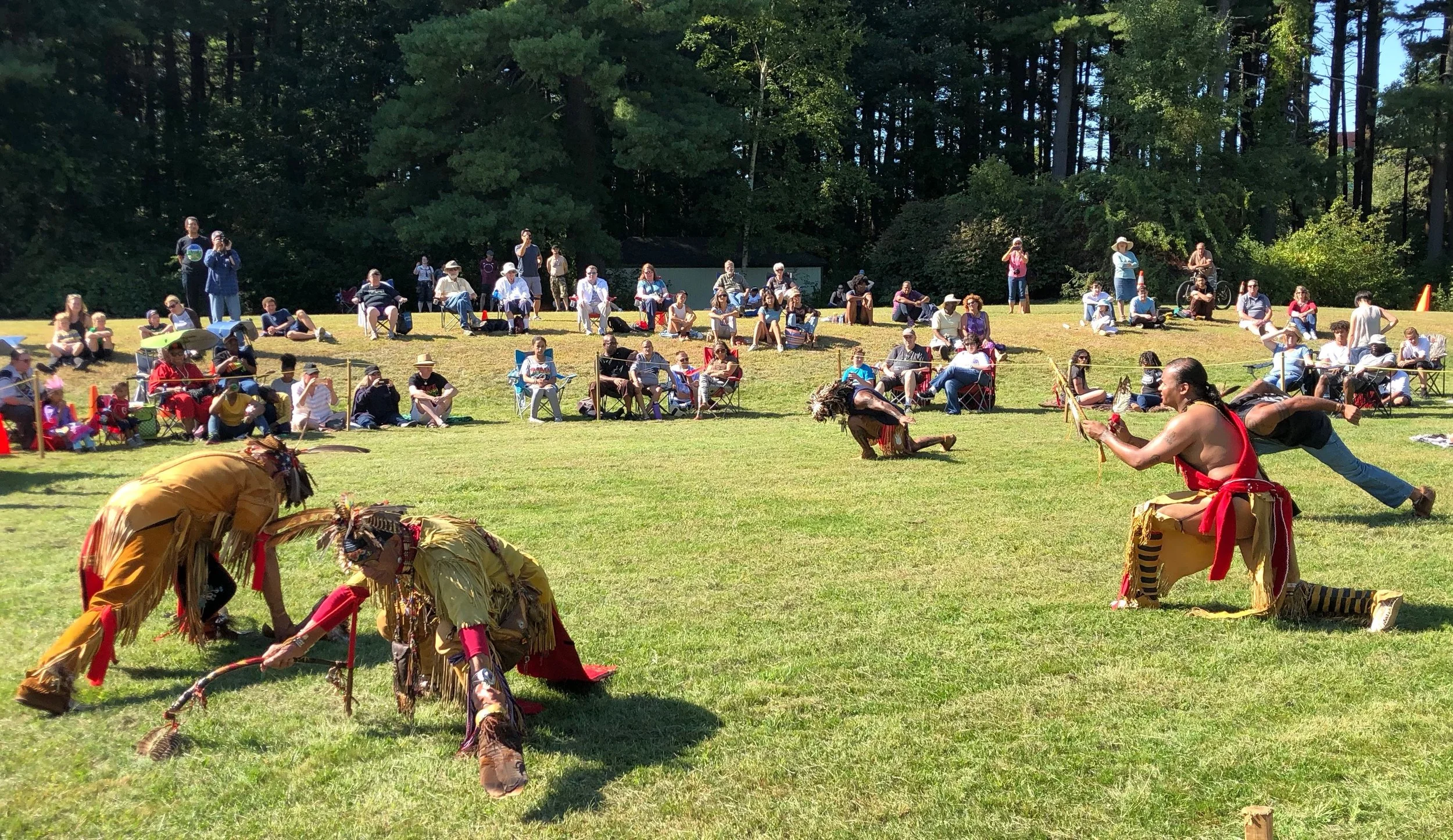
Dance at Pow Wow of Natick {Mass.) Praying Indians Sept. 28
— Photo by Tom Paine
UMaine Augusta campus aims to be cybersecurity center.

From The New England Council (newenglandcouncil.com)
The University of Maine in Augusta (UMA) has opened the Maine Cyber Range to train their students, as well as Maine residents and businesses, to get ahead of fast-changing cyber threats. The training center’s curriculum will prepare learners to fill hundreds of thousands of needed cyber security positions across the U.S.
UMA partnered with CyberBit, a global cyber range firm, to develop their training center. Chief Operating Officer of CyberBit, Gilad Weitman said the partnership would be a “game changer for the state of Maine and New England,” adding that the U.S. is short 300,000 cyber security professionals trained to respond to a modern attack, and at least 14,000 are needed in New England. UMA’s Maine Cyber Range will train students and professionals with the exact same tools they would use in the work place. UMA President Rebecca Wyke noted that cybersecurity is the fastest growing program at the University and the new training center is a continuation of that growth. Senator Angus King of Maine attended the Cyber Range opening to commend UMA for being at the forefront of teaching cybersecurity as “it is not something every college in America is doing.”
“The opening of this training center continues UMA’s mission of providing quality educational opportunities that help fill workforce needs with well-trained graduates for in-demand, highly skilled positions,” said President Wyke.

David Warsh: Republican recess

Patrick J. Buchanan, who helped set in motion what led to Trumpism
SOMERVILLE, Mass.
“THE DEMOCRATS ARE TRYING TO DESTROY THE REPUBICAN PARTY AND ALL THAT IT STANDS FOR,” tweeted President Trump on Sept. 26.
Not surprisingly, he quickly deleted the post. What the GOP stands for is not a conversation he wants to encourage. It will, however, be on many minds as members of Congress head home for a two-week recess.
The conventional view among Democrats is that Trump has pretty completely taken possession of the Republican Party. Reviewing American Carnage: On the Front Lines of the Republican Civil War and the Rise of President Trump, by Tim Alberta, (Harper, 2019), in the current issue of The New York Review of Books, Princeton historian Sean Wilentz dismisses Alberta for his “ingenuousness and lack of historical depth.”
The pioneer of Trump-style Republicanism — isolationist, protectionist, xenophobic, anti-immigrant – was former Nixon speechwriter Pat Buchanan, Wilentz writes. Buchanan’s speech opposing the nomination of George H.W. Bush at the Republican convention of 1992 anticipated Trump almost word for word, he says. The positions each took descended directly from the views of Ohio Sen. Robert Taft, whose candidacy the GOP swept aside in 1952 in favor of nominating Dwight Eisenhower.
Much of the wreckage Trump has caused is simply the expression of his willingness to pursue long-standing Republican policies while coarsening the polarizing politics practiced by the George W. Bush White House. Any number of historians, political scientists, and journalists have chronicled the long history of the Republican Party’s decay, but you won’t find it in Alberta. He would prefer that Trumpism be something other than Republicanism, not its culmination.
As a life-long Democratic voter, I. too, prefer that Trump turns out to be the exception, not the rule. It seems important to remember – Wilentz doesn’t – that two of the finest American achievements of the last 35 years were engineered by Republican administrations operating in the Eisenhower tradition: the end of the Cold War, “and the escape from the Panic of 2008. Recognize, too, that senior veterans of those GOP administrations have taken the lead in proposing revenue-neutral carbon taxation as a response to the crisis of global warming.
Yes, the Republicans have also given us plenty to regret: the wars in Iraq and Afghanistan, wholesale budget irresponsibility, health care intransigence. But the campaign that John McCain led in 2008 was much in line with mainstream post-war Republican traditions,
What are the chances that the Eisenhower-Nixon-Ford-Reagan-Bush wing of the party will reassert itself and take the reins away from Donald Trump? During the next two weeks, Republican Congressional leaders will sample opinion in their districts and search their own souls while Democratic counterparts prepare hearings that are expected to lead to a bill of impeachment. The mainstream press will continue to ferret out details.
What are the chances significant numbers of Republicans will return to Washington prepared to vote against the president? What will happen if they do – or if they don’t? Washington Post columnist Meghan McArdle was right when she wrote last week that “a clear majority of public opinion” must back impeachment if it is to succeed – not a mere plurality or even a slim margin.
But opinion doesn’t move just autonomously, in response to what voters read or see or hear on the news. It must also be galvanized or rallied by political leaders. The Democrats have ventured the opening gambit. South Carolina Sen. Lindsay Graham, a stout Trump defender, sought to stiffen the backs of House Republicans as they left left town. How will they feel when they return? The first skirmishes of a battle for control of the future of the Republican Party begin next month..
Trump famously said, “I could stand in the middle of Fifth Avenue and shoot someone and I wouldn’t lose any voters.” We’ll see if that hyperbolic self-confidence will apply to his latest act of self-sabotage.
David Warsh, an economic historian and veteran columnist, is proprietor of Somerville-based economicprincipals.com, where this essay first appeared.
Wet and wild

“Blacklit #2 (acrylic on multiple acrylic panels), by Jess Hurley Scott, at Edgewater Gallery, Boston, through October.