
Vox clamantis in deserto






The new Kennedy king?
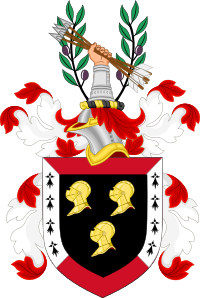
Coat of arms granted to President John F. Kennedy in 1961 by the Chief Herald of Ireland Gerard Slevin
From Robert Whitcomb’s “Digital Diary,’’ in GoLocal24.com
"If your name was Edward Moore instead of Edward Moore Kennedy, your candidacy would be a farce."
-- The bitter comment of then-Massachusetts Atty. Gen. Edward McCormick in 1962 while debating 30-year-old Edward (“Ted”) Kennedy in the Democratic primary for a U.S. Senate seat, which of course Mr. Kennedy won. At the time, his brother John was president and his brother Robert U.S. attorney general.
Given how long ago was the political golden age (around 1946-1990) of the Kennedy family, I was surprised that Congressman Joseph P. Kennedy III, 38, leads Sen. Edward Markey, 73, by double digits in a possible primary fight for Mr. Markey’s seat. Mr. Kennedy, with his famously red hair, is certainly well-spoken, intelligent and good-looking and beats the cadaverous-looking Ed Markey in the charisma department. But ideologically they’re pretty much the same and Mr. Markey has been an effective senator for his constituents. There does seem to be a movement by energized (especially by hatred of Trump) younger Democrats to erode the gerontocracy that currently runs Washington to the primary benefit of the old and affluent.
Llewellyn King: In health-care reform the simplest solution may well be the best
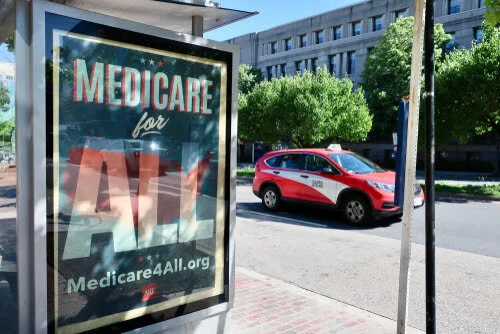
Complex problems cannot be fixed with simple solutions — unless the problems have become so intricate and intractable that only a simple solution will work.
That may be where we are now with health care.
To some, the simple solution that unties the complicated knot is a single-payer system: Replace the whole complex, expensive and teetering system with something new and simpler.
Yet in the intellectual debate — where ideas are discussed long before they are codified into law — there are powerful forces aligned against real health care overhaul.
These are not just on the right, although conservative thinking is opposed to anything that suggests a larger government or even a community role in health care. Unions, which gain strength when they provide health care, do not want to see that leak away, nor do employees who are happy with the health care provided as part of their employment. Better keep that job.
There is also a phalanx of conservative economists who calculate that universal health care will be too expensive and bankrupt the country. This I find dubious because single-payer health care works. There is evidence. It is not uncharted territory. It works from Australia to Britain, from France to Japan.
In short, the advanced countries of the world all have a single-payer system. It costs them about half of the 18 percent of GDP we spend on health care. You might reasonably think something is wrong when you spend more and get less.
The fact is those who experience tax-paid health care like it. No one who has permanent health care, as in Canada or Britain, is asking for it to be ended. National health systems are fiercely defended by those who have them, bar none.
One organization that is fully committed to a single-payer system — also known as Medicare for All in the political debate — is Physicians for a National Health Program (PNHP). It is a national group with headquarters in Chicago and 23,000 health care professional members. It is adamant in its advocacy of a single-payer system and takes aim at the health insurance companies as the source of what ails health care in America.
It rejects partial measures, such as beefing up the Affordable Care Act, improving Medicaid and lessening the effect on the poor in various ways. These, PNHP says, avoid the question at the center of the health care debate: What are the insurance companies for? What wound do they bind? The answer, according to PNHP, is none. They just add cost.
Every hospital, whether a for-profit or a community institution, employs huge staffs, sometimes well in excess of 100 people, for negotiating claims with insurance providers. That is a great burden on hospital costs right there, let alone the costs inside the insurance companies.
In decades of dealing with health insurance, which includes looking at it as a reporter, paying for it as an employer, and occasionally, receiving treatment under private insurance, I can tell you that Medicare is now one of the great improvements in my quality of life and peace of mind. I am also one of the few with the temerity to offer an opinion on health care who has received care, and watched members of my family receive it, under the British system.
I am a free-market person, someone who has and still runs his own business, albeit a very modest one, so I am not in love government for government’s sake.
But neither am I in love with state-sanctioned monopolies in insurance. The health-insurance companies do not provide health care. They make it more expensive. They do not contribute to wellness. They make it more problematical.
We do not have a health-care system. We have a lack of a system: a savage garden full of weeds, where medicine endeavors to grow while the gardeners stand around arguing over money.
PNHP may not have all the answers, but at least it is a pressure group trying to put something on the table, something that serves the rest of the developed world well: single-payer health care.
On Twitter: @llewellynking2
Llewellyn King is executive producer and host of White House Chronicle, on PBS. He’s based in Rhode Island and Washington, D.C.
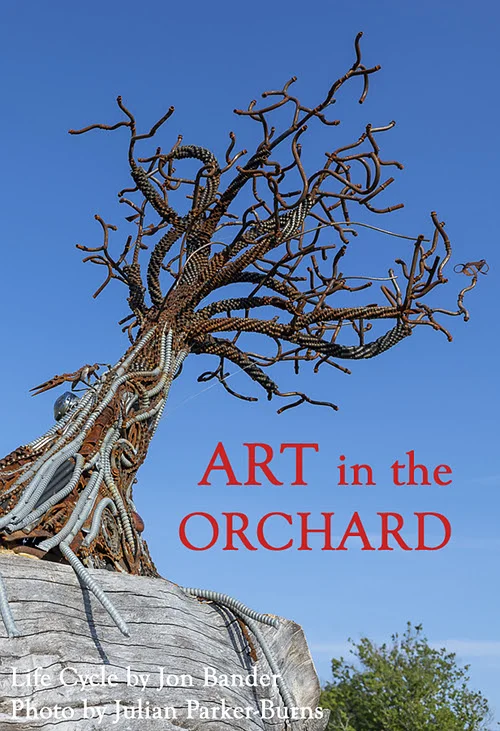
See sculptures, pick apples
This Fifth Biennial Sculpture Exhibition, running through Nov. 25, features 30 juried sculptures and Installations in beautiful Park Hill Orchard, in Easthampton and overlooking Mt. Tom and the Pioneer Valley. There are music and theater workshops most weekends, and the Full Moon Poetry Sculpture Walk. Park Hill Orchard is a working fruit farm, where visitors can pick their own apples and peaches, and watch seasonal farm activities.
P Town's jarring juxtapositions

“Herring Cove Bathhouse Provincetown’’ (archival pigment print), by Jane Paradise, in her show “Classic Provincetown: Photographs of Provincetown and the Province Lands,’’ through Sept. 29, at Galatea Fine Art, Boston.
The gallery says:
“Provincetown is a jarring combination of natural beauty and thriving commercial enterprise. It is incongruous in its landscape and culture. Parts are so pristine that your eyes hurt with the raw beauty, but in summer it is sometimes so crazy with throngs of people that one can get lost and life can slip by quicker than sand in an hourglass. Two irreconcilable sides. Where the human and natural landscapes mingle to tell a unique story.’’

On Commercial Street in Provincetown.
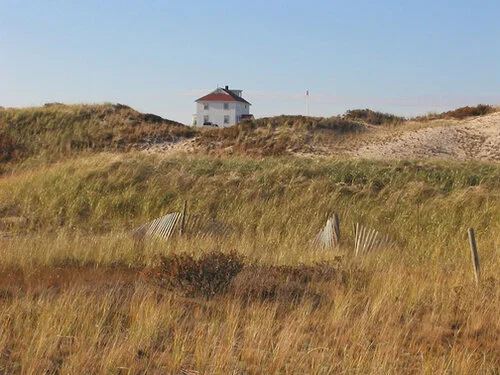
In the Province Lands
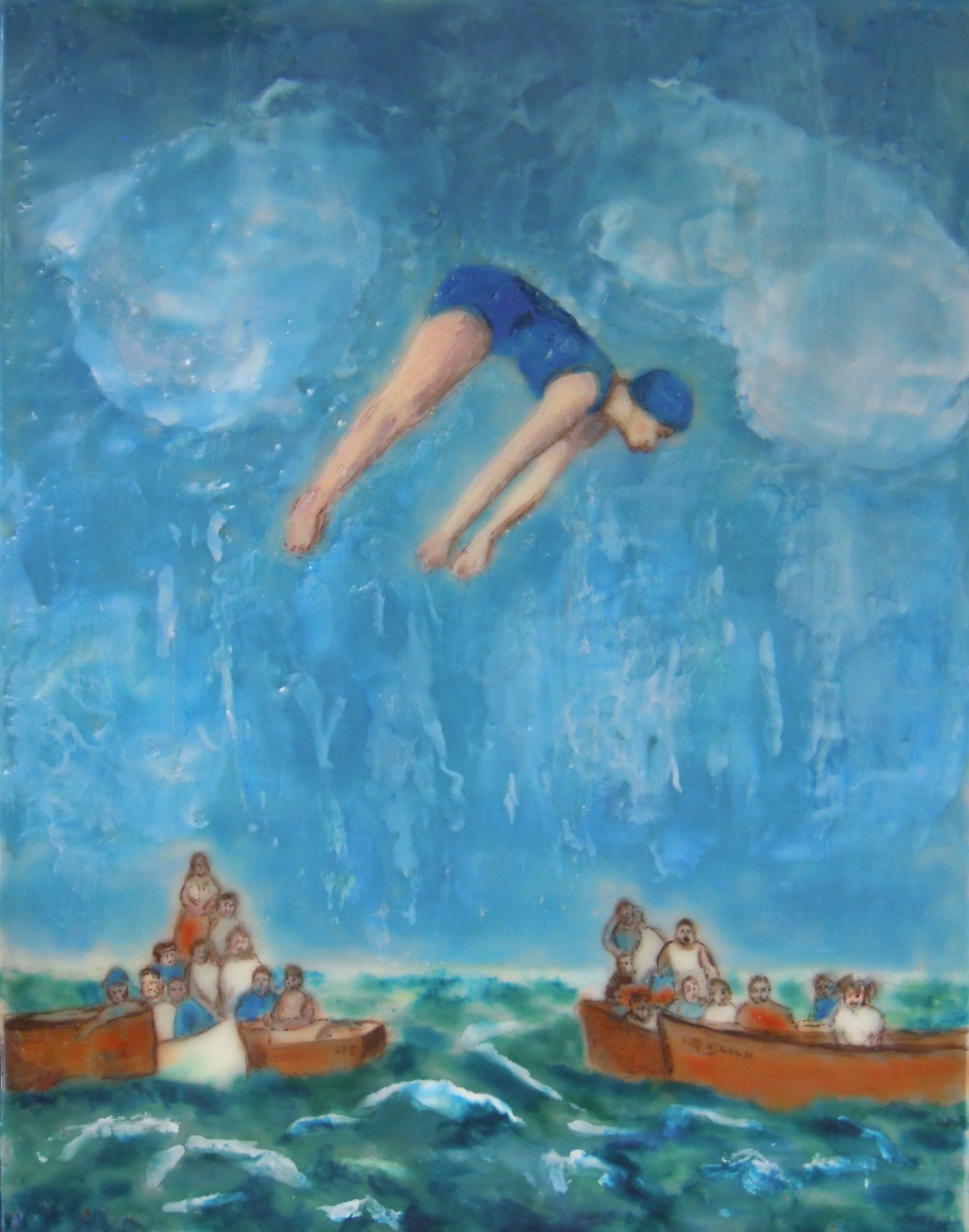
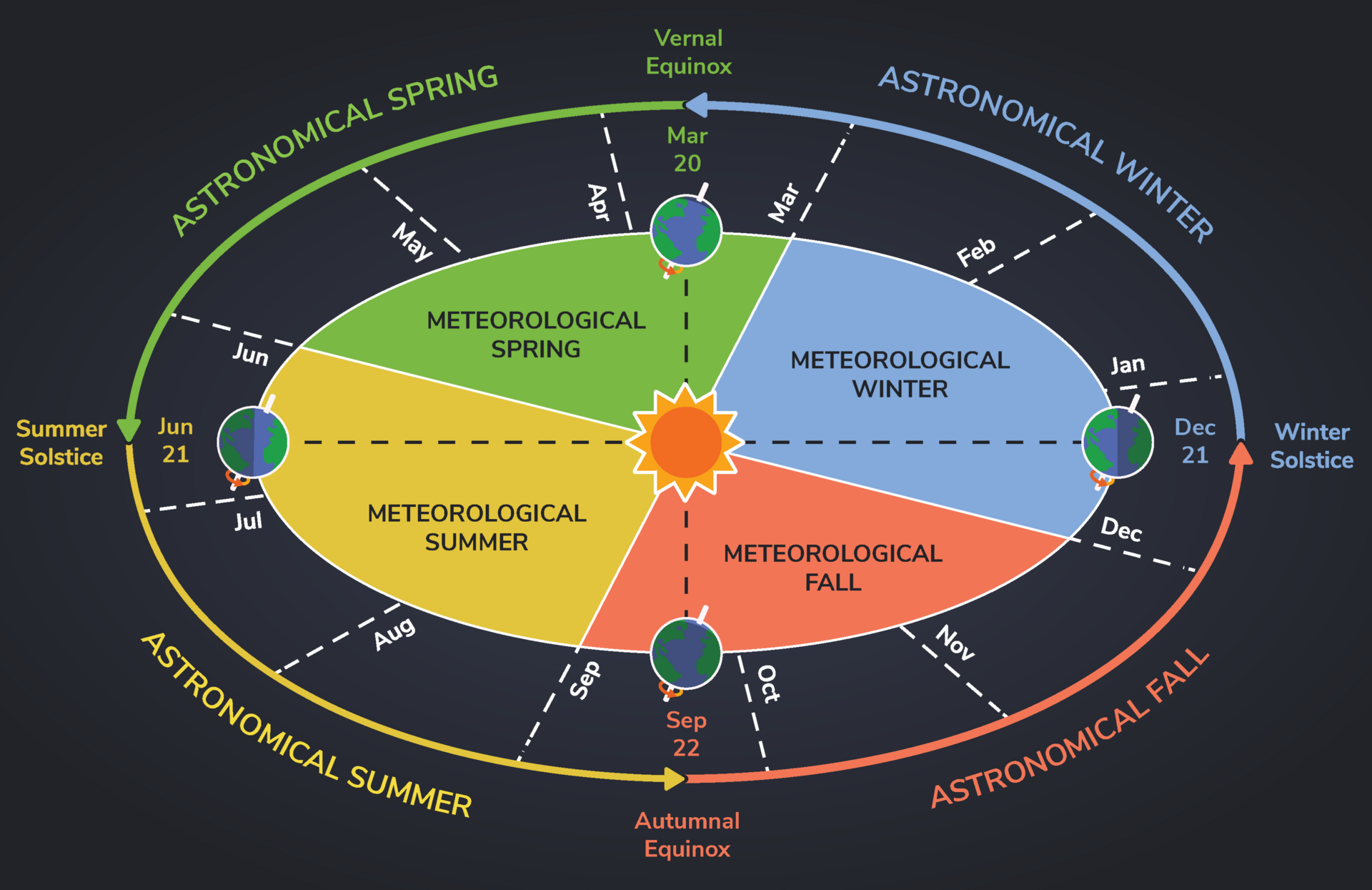
Sayonara summer
From Robert Whitcomb’s “Digital Diary,’’ in GoLocal24.com
I took a youngish couple and their children -- one who is three, the other six -- to a beautiful beach on Buzzards Bay last weekend and watched the family play on the sand and in the almost-lukewarm water. The children were oblivious to time and unstressed by worrying about such things as the looming school year and the coming of colder weather. They were, as people say, “in the moment’’ -- in a kind of paradise of beauty and safety. Would both remember the day, if hazily, decades hence?
An old friend of mine, who lives near the beach, happened to be there staring out toward Cuttyhunk. His wife recently died. We talked a lot about the passage of time as clouds moved in from the west to obscure the blue skies we had enjoyed for the first couple of hours on the beach and the kids shouted and splashed with joy.

“Summer, “ by Joaquín Sorolla (1904)
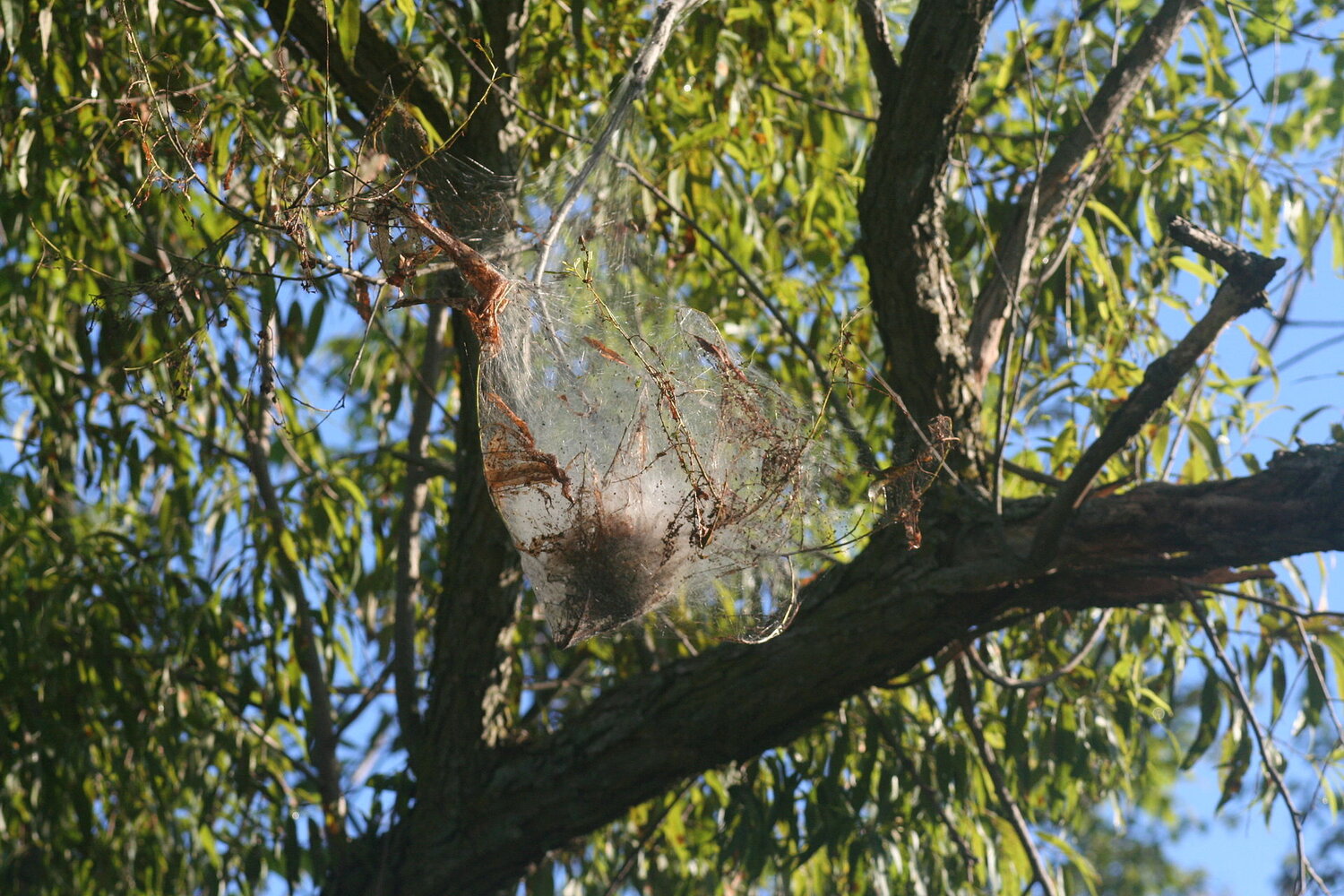
Fall Webworm nest
I love New England’s quirky seasonal signs, such as the Fall Webworm, a moth that in its larval stage creates bizarre webbed nests on tree limbs in the late summer and early fall. Some people hate them but they don’t hurt trees and look very pretty when dew and rain drops are on them. They’re like acorns on the sidewalk, goldenrod along the roads and asters in the gardens – a first course of autumn before the leaves begin turning colors.
Todd McLeish: Looking at sea life's sensitivity to underwater electric cables

Skates apparently move differently than they usually do near electromagnetic fields.
From ecoRI News (ecori.org)
Little is known about how marine life will respond to the electromagnetic fields emanating from the spiderweb of cables carrying electricity from the Block Island Wind Farm and the many other offshore wind-power installations planned for the East Coast. But a new series of studies by a team of oceanographers at the University of Rhode Island suggests that some organisms will definitely be impacted.
“The concern is that DC [direct] currents generate permanent electromagnetic fields, and we don’t really know how organisms will relate to them,” said John King, a professor at URI’s Graduate School of Oceanography. “We know that some organisms, like sharks and skates, are sensitive to these things. So the question becomes, if you build offshore power facilities, will migratory organisms cross the cables or not. Will it affect eels that migrate to the Sargasso Sea or lobsters that have an onshore-offshore annual migration?”
To find out, King and postdoctoral research fellow Zoe Hutchison conducted a series of field experiments around the Cross Sound Cable that carries electricity from New Haven, Conn., to Long Island, N.Y. They attached acoustic tags to skates and lobsters and placed them in an enclosure around the cable. An array of hydrophones in the enclosure detected the animals’ movements. Additional animals were placed in a second enclosure farther from the cable to compare the results.
“We definitely saw effects in behavior in both lobsters and skates, though it was more dramatic in the skates,” said King, who serves on the Rhode Island Coastal Resources Management Council’s Habitat Advisory Board for offshore wind development. “The skates liked to spend time in the areas that had the highest EMFs. Their swimming behavior was definitely altered as they approached the cable. We didn’t see any evidence that a single cable is a migratory barrier, but they could definitely detect it and reacted to it.”
“The skates moved slower around the cable but also moved more often and covered a longer distance,” Hutchison said. “They did a lot more turning, like an exploratory behavior, as if they were looking for food.”
Sharks and skates have a sensory ability to detect the electromagnetic fields (EMF) generated by the circulatory system of their prey, according to King, and they may also use it to find mates.
“They might think the cable indicates a food source, so they spent time around the cable thinking they’re going to get fed,” he said.
The experiment found that lobsters moved less freely around the cable, but the electromagnetic fields didn’t prevent them from crossing it.
“The lobster response was much more subtle than the skates,” Hutchison said. “They had an increased exploratory behavior, too, but it wasn’t as pronounced as the skates. We know that spiny lobsters in the Caribbean use the Earth’s magnetic field to orient themselves and to figure out where to go, so we postulate that American lobsters may have a similar ability to detect magnetic fields.”
King and Hutchison will conduct a similar study with migratory eels this fall, to assess how they are affected by the cables. (They attempted it last year, but little electricity was traveling through the cable at the time.)
Rather than placing the eels in an enclosure around the cable like they did with the skates and lobsters, they will release tagged eels to see how they behave as they cross the cable on their way to the Sargasso Sea, where they spawn.
“Previous studies have shown that eels slow down and investigate every cable they cross,” King said. “One study found that when eels had to cross multiple cables, they slowed down every time. So we wonder if they have a whole bunch of cables to cross, does it slow them down enough that they never get to the Sargasso Sea.”
The researchers noted that just because the behavior of the animals they tested was affected by the cables, it doesn’t necessarily mean they were negatively impacted by them. They are, however, worried about the cumulative impacts of the electromagnetic fields from the numerous cables that will likely be installed for many offshore wind turbines in the future.
“There’s going to be hundreds or thousands of turbines off the East Coast, so it would be nice to understand these effects and how it translates into impacts before they get built,” King said. “Right now the government is pushing full speed ahead to get these things built, and I don’t think they really care that much about their impacts. The environmental reviews are being done really fast.”
King is also worried that the results of his studies are being downplayed by the Bureau of Ocean Energy Management, which funded the research, because of political pressure.
“They hired a consulting company to produce a public document about our studies, and they minimized EMF as a concern and misinterpreted our study,” he said. “We didn’t say that we saw something that needed to be addressed immediately, but we also didn’t say that what we saw is OK and not to worry about it.”
King believes more studies need to be done before any conclusions can be drawn about the effect of electromagnetic fields from power cables on marine life.
“From a marine spatial planning context, it probably makes sense to have cable corridors rather than randomly distribute the cables all over, and that would probably have different results than studies of just a single cable. So we still have some questions to answer.”
Rhode Island resident and author Todd McLeish runs a wildlife blog.
Old Boston going new

An aerial photograph of the Boston Extension of the Massachusetts Turnpike in the New York Central Railroad employee magazine Headlights, February 1965. The New York Central is long dead. In the era of the photo, it was providing deteriorating passenger service, which later was provided by its successor company, the Penn Central (created by merging the New York Central and the Pennsylvania Railroad) taken over by Amtrak in the early ‘70s.
Lovely or ominous

Work by Alfred Glover in his “On the Grounds’’ show at the Art Complex Museum, Duxbury, Mass., Sept. 15-Jan. 12.
Chris Powell: Wallowing in the politically correct in Conn.

Politically correct LED bulb.
Listening to Connecticut Gov. Ned Lamont and U.S. Sen. Richard Blumenthal last week, Connecticut might have thought that government has roundly succeeded in all its important functions and now doesn't have enough to do.
The governor issued a statement opposing President Trump's relaxing of federal energy-efficiency standards so that traditional incandescent light bulbs can continue to be manufactured and used. More modern bulbs, the governor noted, consume much less electricity and work longer than traditional bulbs and thus can save a lot of money.
But the new bulbs also cost more money than the old ones, and while the old ones generate more heat than light, that heat is not all wasted energy, since it is welcomed when the weather is cold.
In any case if the new bulbs really save so much money, people shouldn't need the government to coerce them with regulation or legislation. If, as such coercion suggests, the new bulbs can't put the old ones out of business on their own, people apparently find something undesirable about the new ones.
But the governor did not address that point. Instead he said he wants the General Assembly to pass Connecticut's own coercive legislation to prohibit choice in light bulbs.
Meanwhile Connecticut keeps deteriorating with daily shootings in its anarchic cities, tax increases, neglect of transportation infrastructure, dismal educational performance, child neglect, and so on. As a result inefficient light bulbs don't make even the top 50 on a list of the state's problems. But that may be why the governor is so interested in them and other trivia -- to distract from state government's failure with any problem that matters much, and, of course, to do some politically correct posturing against the insufferable Trump.
As the governor busied himself with light bulbs, Senator Blumenthal seemed to be aspiring to become commissioner of the National Football League. The senator held a press conference at the state Capitol to complain again that the league isn't tough enough on players accused of domestic violence.
But domestic violence does not involve misconduct on the job. It is criminal and thus a matter for law-enforcement authorities.
Nor does the federal government have any jurisdiction over football players particularly. While the NFL has a business exemption from federal antitrust law, an exemption shared with other pro sports leagues, the appropriateness of those exemptions has nothing to do with domestic violence. The exemptions probably should be repealed regardless of any off-the-job misconduct by players.
People in all occupations commit domestic violence. So why is domestic violence by pro football players of special concern to Senator Blumenthal? Does he think that pro football players are uniformly heroes in the public eye? That cliche expired under a tidal wave of well-publicized thuggishness. As newspaper columnist Mary McGrory wrote decades ago: "Baseball is what we were. Football is what we have become."
If the NFL isn't tough enough on domestic violence for the senator, it may be because of concern for due process of law. Why should the league be tougher than a court? A court sentencing a pro football player can take him out of the game faster than the league can, and without the league's financial liability.
And is the senator really sure that government itself is tough enough on its own employees who commit domestic violence? Or would it be too politically incorrect for him to risk offending the government employee unions?
Chris Powell is a columnist for the Journal Inquirer, in Manchester, Conn.
Arcologist at Kingston Gallery
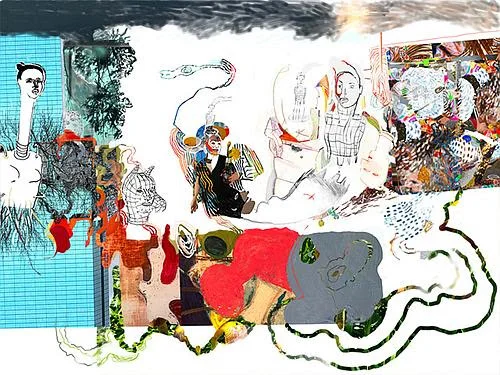
“Invisible Mending” (mixed media, size variable), in her show of the same name at Kingston Gallery, Boston, this month.
She explains her work:
“‘Arcology,’ coined by the late architect Paolo Soleri, is the fusion of architecture and ecology. It describes the tension between space and place, something I consider often, as my work conjures imagined worlds that evoke both the open, sun-filled spaces of South Africa, where I was born and raised, and the colder New England climate where I currently reside.
“My drawings are full of the familiar, the distant, unknown, imagined, and everyday. Bright lyrical vignettes of animals and people dance before us in a metaphysical picture plane, spilling across the walls into ever-building expanses. I weave the images into both linear and non-linear spaces, forming spatial contradictions that emphasize the vastness of space and the immediacy of our experience.
“All phenomena, no matter where they originate, may evoke a sense of curiosity about the unfamiliar and an appreciation of the constant fresh new moment.’’
5G vs. hurricane forecasts

— Source (WP:NFCC#4)

Weather map on the morning of Sept. 21, 1938. The hurricane, then just off Cape Hatteras, roared into Long island and southern New England that afternoon.
From Robert Whitcomb’s “Digital Diary,’’ in GoLocal24.com
Some experts, including Neil Jacobs, the acting head of the National Oceanic and Atmospheric Administration, are warning that the introduction of the much anticipated 5G wireless cellular network could slash weather forecasting accuracy by interfering with data transmission from weather satellites. This could have perilous effects, particularly with hurricane forecasting and especially for New England because hurricanes striking our region tend to move north very fast after they go by Cape Hatteras, N.C. (The infamous New England Hurricane of Sept. 21, 1938 moved more than 50 miles an hour into our region.)
Mr. Jacobs testified to the House Science Committee’s Subcommittee on Environment on May 16 that 5G wireless signals could cut forecast accuracy by 30 percent!
The telecommunications industry, which sees 5G as a vast bonanza, has so far done little to address this challenge.
To read more, please hit this link.

Jill Richardson: It's not about the straws

A few years ago, I had a cupcake problem. I’d go to the cupcake store almost daily and I’d eat at least one cupcake, sometimes more.
At the same time, I wanted to lose weight, or at least stop gaining it. So I kept looking up information about diets and superfoods, just looking for some magical solution to present itself.
Something like: “The key to weight loss is eating large quantities of parsley every day.” Or turmeric, maybe? Ginger? Garlic? Finally, I realized, there is no magical fix. The problem was the cupcakes.
It’s tempting to look for easy ways to fix big problems by trimming around the edges to avoid making the real changes you don’t want to make. Tempting, but not feasible.
That’s similar to what presidential hopeful Elizabeth Warren just said about fixing climate change. She was asked about her position on small changes like banning plastic drinking straws or inefficient light bulbs.
“Give me a break,” she said. “This is exactly what the fossil fuel industry wants us to talk about… They want to be able to stir up a lot of controversy around your lightbulbs, around your straws” when “70 percent of the pollution” comes from “the building industry, the electric power industry, and the oil industry.”
Like my cupcakes, those three industries are the real problem. Banning straws while leaving those three industries in place will make about as much of a dent in the climate as eating two cups of parsley a day while continuing my cupcake habit would have made in my waistline: Not much.
My cupcake habit was a problem, but it was also a symptom of a larger problem. In the end, I got therapy for difficult feelings I was dealing with. Once I took care of my mental health, the emotional eating stopped, and I lost 30 pounds.
Carbon pollution is also a problem as well as a symptom of a larger problem. As Warren pointed out, fossil fuel companies exert too much influence on Washington, preventing us from regulating them in the ways we need to save our climate.
They also hire public relations firms to dupe the public into doubting that the climate crisis is caused by humans — or at least, not by them — and to convince us not to regulate them in a way that would save the planet but cost them money.
We should be looking for win-win solutions to the climate crisis: solutions that create jobs and preserve quality of life and individual freedoms while simultaneously reducing carbon emissions.
In order to do that, we need to curb the corrupt influence of polluting industries that are profiting off of carbon emissions while harming the future of our planet. And, when they try to distract us with light bulbs and drinking straws, we can’t allow ourselves to be fooled.
Jill Richardson , a sociologist, is an OtherWords.org columnist.
Llewellyn King: Beware the tyranny of polling

Comparing 1975 and 2016 referenda on U.K. membership in the European Union (whose predecessor organization, in 1975, was the European Economic Community).
The political chaos in Britain — and the situation in British politics is chaotic — can be laid at the base of two interventions by direct government usurping representative government.
The first is the intervention of polling. Polling, although useful and indeed invaluable most of the time, does restrict the free operation of representative government. The public state of mind the polling day affects the actions of its elected representatives and can inhibit new ideas as they evolve. In the defense of polls, they are reality check when politicians give way to intoxication with their own thinking. Polls are here to stay; an organic part of the political landscape.
Yet the deliberative process can be inhibited by them. It is no accident that the U.S. Senate is regarded as a great deliberative forum: With six years between elections, there is time to work through a problem — at least there should be.
Former Prime Minister David Cameron called a referendum on Britain’s membership in the European Union because his pollster assured him that the public would support him, as they had voted by a large majority for Britain to remain in the European Economic Community, as it was then known, in 1975. Britain’s membership began in 1973.
A poll is a snapshot and reflects not only the feeling of the populace at the time but also the basis of what it thinks it believes or, in fact, does believe.
Cameron did not allow for campaigning and the emotional appeal of inflamed nationalism, plus some pretty hefty fibs from the current Prime Minister Boris Johnson and his allies in the Brexit camp.
Had the E.U. membership issue been left to simmer, as it has simmered for decades, it might eventually have been decided by the elected representatives of the people in Parliament or just simmered on, either to dissipate or develop into an election issue at a later time.
But this has always been a particularly difficult issue for Parliament where the two main parties were split on it. Neither of them, Labor and Conservative, was wholly for Europe or against it. Successive Labor and Conservative governments have stayed firmly in Europe, although complaining all the way — as did Margaret Thatcher during her time as prime minister.
The E.U. referendum was an intrusion of direct government into the workings of parliamentary representative government — a referendum, not favored in Britain’s unwritten constitution, a sort of legal blithe spirit of practice, precedent, tradition and habit, trailing all the way back to the Magna Carta.
The constitution, long believed to gain its strength from its flexibility, now is flexed to a point of full crisis. Polls gave Cameron overconfidence in looking to a referendum to settle a nettlesome issue. It did, but not in the way Cameron and the polls predicted.
Polls are not going away. Recently I visited Quinnipiac University, in Hamden, Conn., home to the influential Quinnipiac Poll, where I conducted a television interview. Conclusion: Those pollsters know what they are doing, and they do it with science and without prejudice. Douglas Schwartz, director of the Quinnipiac Polling Institute, and his staff are employed by the university. The polling arm takes no outside funding, shielding the poll from allegations of political favoritism or manipulation.
It should be recognized by politicians that polls are only a snapshot, a second in time, of evolving public opinion. They do not handle complex issues well and referendums, which are polls taken to extreme, are unreasoning.
It can be argued, and I will not argue against you, that politicians now have abandoned thinking, reasoning and compromising in favor rigidities on both sides of the Atlantic. Yet politicians, in doing their jobs in session, remain a better way of deciding great issues than the whole populace in a committee of the whole.
Britain is in crisis not because it is a democracy, but because it tried something undemocratic and antithetical to its own traditions. The nation that ruled much of the world appears unable to rule itself.
On Twitter: @llewellynking2
Llewellyn King is executive producer and host of White House Chronicle, on PBS.
New PCFR chairwoman; 2019-20 schedule
The Providence Committee on Foreign Relations (thepcfr.org; pcfremail@gmail.com) is pleased to announce that Barbara Ann Fenton has been named chairwoman, succeeding Hannah Hazelton, whose has successfully led the organization for the past couple of years.
Ms. Fenton has lived and studied in Scotland and Australia, and has long had a keen interest in international affairs, especially in regards to global health and environmental issues. This year Fenton was named to Providence Business News's "Top 40 Under 40" list. She has extensive university teaching and political experience.
Fenton stated, "After immensely enjoying the lively evenings that the PCFR dinners are known for, I'm thrilled to be stepping into this role and leading this renowned 91-year-old organization. With guests such as Jon Gage, Tweed Roosevelt and Ambassador Duddy early on in the season, we are looking forward to another energizing year of camaraderie and learning.’’
The Providence Committee on Foreign Relations is an independent private membership organization established in 1928 under the aegis of the Council on Foreign Relations (CFR), which is based in New York. It no longer has a formal connection with the CFR, although CFR-linked experts sometimes speak at PCFR dinners.
The PCFR remains faithful to informing citizens about the world, and hosts around 10 engaging speakers each year in an off-the-record setting. For information about the organization, including on joining, see: www.ThePCFR.org
and/or email:
Below is the current list of our dinner speakers (at our venue, the Hope Club, in Providence) for our 2019-2020 season. There will be refinements and outright changes in topics; the PCFR tries to remain somewhat flexible to respond to news and other events
Our first scheduled speaker comes Wednesday, Oct, 2, with Jonathan Gage, who will talk about how coverage of such international economic stories as trade wars has changed over the years, in part because of new technology, and how that coverage itself changes events.
Mr. Gage has had a very distinguished career in publishing and international journalism. He has served as publisher and CEO of Institutional Investor magazine, as publisher of strategy+business magazine, as a director at Booz Allen Hamilton and Booz & Company, as enterprise editor for Bloomberg News and finance editor of the Paris-based International Herald Tribune (of sainted memory) and as a senior writer for the Boston Consulting Group.
He is a trustee, and former vice chairman, of the Carnegie Council for Ethics in International Affairs.
He has written or edited for such publications as The New York Times, The Washington Post, The Los Angeles Times, Newsweek and Psychology Today magazine.
xxx
On Wednesday, Oct. 23, comes Ambassador Patrick Duddy, who will talk about Venezuelan internal political and economic conditions and relations with the U.S., Cuba, Russia and other nations. Mr. Duddy, currently director of Duke University’s center for Latin American and Caribbean Studies, served as American ambassador to Venezuela during some of the George W. Bush and Obama administrations. The late President Hugo Chavez expelled him but eight months later he resumed his ambassadorship. He finished that assignment in 2010.
Before his ambassadorships, Mr. Duddy served as Deputy Assistant Secretary of State (DAS) for the Western Hemisphere, responsible for the Office of Economic Policy and Summit Coordination, which included the hemispheric energy portfolio, as well for the Offices of Brazil/ Southern Cone Affairs and of Caribbean Affairs. During his tenure as DAS, he played a lead role in coordinating U.S. support for the restoration of democracy in Haiti.
xxx
On Wednesday, Nov. 6, comes Tweed Roosevelt, president of the Theodore Roosevelt Association and great-grandson of that president. He’ll talk about how TR’s foreign policy, which was developed as the U.S. became truly a world power, affected subsequent presidents’ foreign policies. Mr., Roosevelt is also chairman of Roosevelt China Investments, a Boston firm.
In 1992, Mr. Roosevelt rafted down the 1,000-mile Rio Roosevelt in Brazil—a river previously explored by his great-grandfather in 1914 in the Roosevelt-Rondon Scientific Expedition and then called the Rio da Duvida, the River of Doubt. The former president almost died on that legendary and dangerous trip.
xxx
On Thursday, Dec. 5, we’ll welcome Dr. Elizabeth H. Prodromou, who directs the Initiative on Religion, Law, and Diplomacy, and is visiting associate professor of conflict resolution, at The Fletcher School of Law and Diplomacy at Tufts University. She titles her talk "God, Soft Power, and Geopolitics: Religion as a Tool for Conflict Prevention/Generation".
Dr. Prodromou is also a non-resident senior fellow and co-chair of the Working Group on Christians and Religious Pluralism, at the Center for Religious Freedom at the Hudson Institute, and is also non-resident fellow at The Hedayah International Center of Excellence for Countering Violent Extremism, based in Abu Dhabi.
She is former vice chair and commissioner on the U.S. Commission on International Religious Freedom and was a member of the U.S. Secretary of State’s Religion & Foreign Policy Working Group. Her research focuses on geopolitics and religion, with particular focus on the intersection of religion, democracy, and security in the Middle East and Southeastern Europe. Her current research project focus on Orthodox Christianity and geopolitics, as well as on religion and migration in Greece.
xxx
On Wednesday, Jan. 8, comes Michael Fine, M.D., who will talk about his novel Abundance, set in West Africa, and the challenges of providing health care in the Developing World. He will speak on: “Plagues and Pestilence: What we learned (or didn't) from Ebola about Foreign Policy and International Collaboration in the face of epidemics and outbreaks’’
xxx
On Wednesday, Feb. 5, we will welcome as speaker PCFR member Cornelia Dean, book author, science writer and former science editor of The New York and internationally known expert on coastal conditions. She’ll talk how rising seas threaten coastal cities around the world and what they can do about it.
xxx
On Wednesday, March 18, comes Stephen Wellmeier, managing director of Poseidon Expeditions. He’ll talk about the future of adventure travel and especially about Antarctica, and its strange legal status.
xxx
On Wednesday, April 29, comes Trita Parsi, a native of Iran and founder and current president of the National Iranian American Council and author of Treacherous Alliance and A Single Roll of the Dice. He regularly writes articles and appears on TV to comment on foreign policy. He, of course, has a lot to say about U.S- Iranian relations and a lot more.
Mr. Parsi is a co-founder of a new think tank, financed by an unlikely partnership of the right wing Koch Brothers and the left-of-center George Soros. It’s called the Quincy Institute for Responsible Statecraft and dedicated to helping craft a new U.S. foreign policy that would be far less interventionist and put an end to America’s “endless foreign wars.’’
xxx
On Wednesday, May 6, we’ll welcome Serenella Sferza, a political scientist and co-director of the program on Italy at MIT’s Center for International Studies, who will talk about the rise of right-wing populism and other developments in her native land.
She has taught at several US and European universities, and published numerous articles on European politics. Serenella's an affiliate at the Harvard De Gunzburg Center for European Studies and holds the title of Cavaliere of the Ordine della Stella d'Italia conferred by decree of the President of the Republic for the preservation and promotion of national prestige abroad.
June: Keeping open for now but possibly something on China.
In Portsmouth, 19th Century prosperity and decline

“Lowd House Shadows, Fall’’ (gouache on paper), by Carol Aronson-Shore, at Alpers Fine Art, Andover, Mass.
Lowd House is part of Strawberry Banke Museum, in Portsmouth, N.H. The museum says:
“James Drisco built this house across Horse Lane from the Shapley-Drisco House where he lived. He had the house built in 1810, probably as rental property. The house is named for Peter Lowd, a Portsmouth cooper, who bought it in 1824 and lived there with his family until his death in 1837. Making a living at coopering, as demonstrated in Strawbery Banke’s Dinsmore Shop, meant crafting the barrels and kegs needed for shipping New Hampshire products, Lowd was one of the many middleclass artisans who made Portsmouth prosper. In the early 1830s when he had reached the peak of his personal prosperity, Lowd invested the money from his shop on Long Wharf in another wharf and several ships. But after 1833 he and Portsmouth’s finances went into decline and he died leaving his wife and five children with extensive debts.’’
Drawing the line in Duxbury
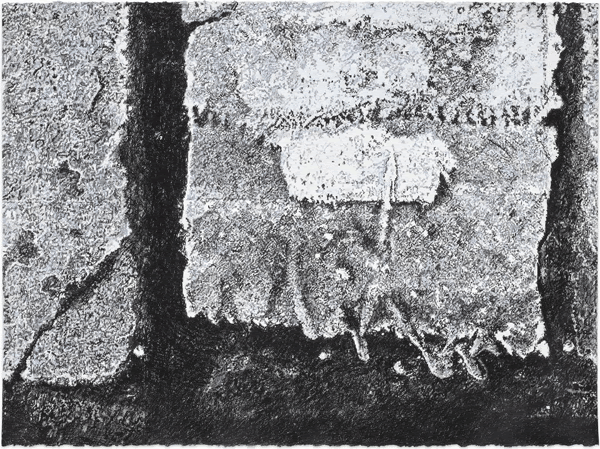
“Fortified’’ (charcoal and pastel), by Lesley Cohen, in the group show “Draw the Line,’’ at the Art Complex Museum, Duxbury, Mass., Sept. 15-Jan 12.
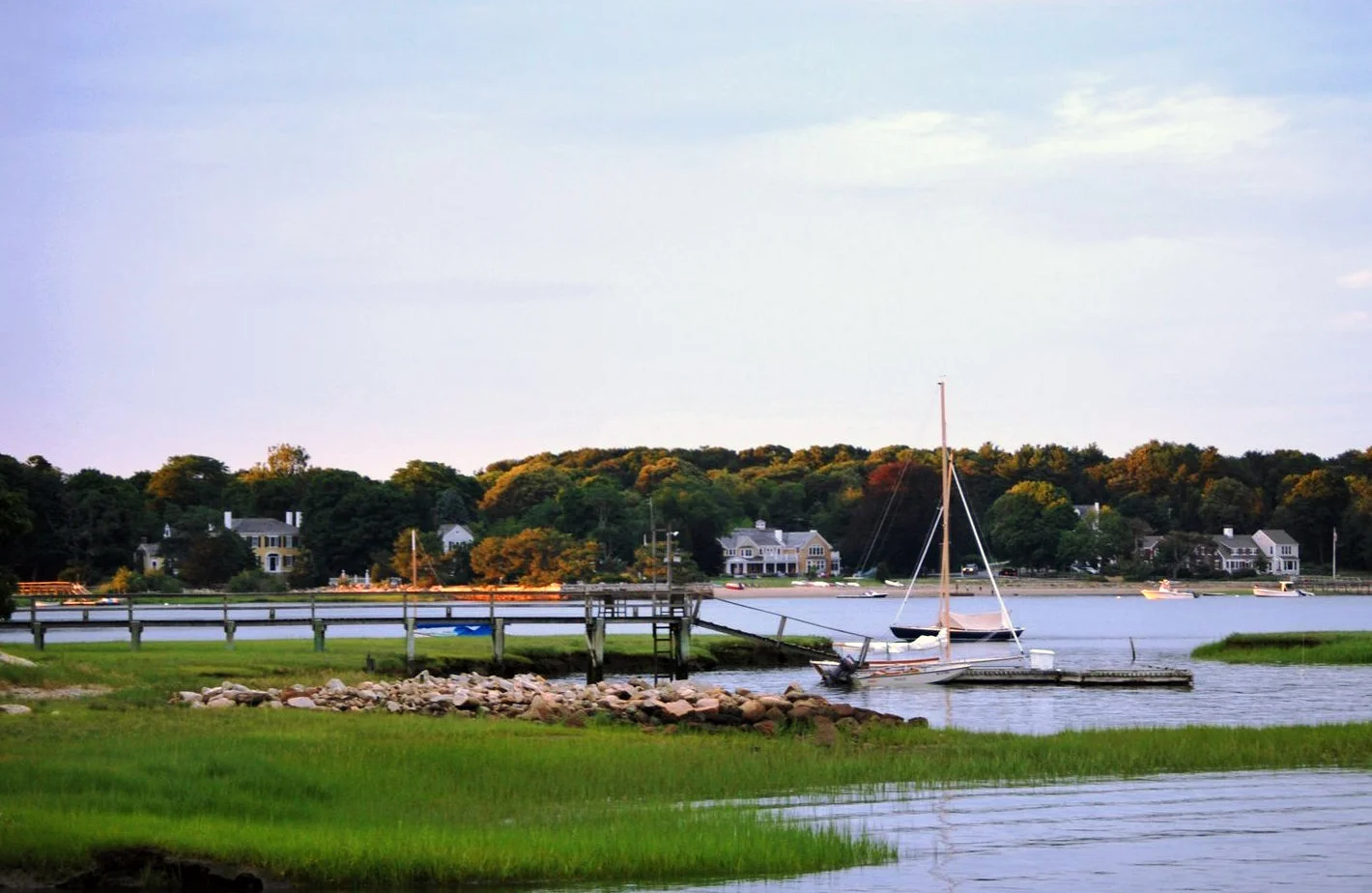
In Duxbury, view of Bluefish River inlet, with “King Caesar House’’ at left. The Federal-style mansion was built in 1809 for Ezra Weston, a well known shipbuilder and merchant nicknamed King Caesar for his influence and prosperity.
— Photo by Ruth W. Demby


Growing cranberries and electricity

“The Cranberry Harvest on the Island of Nantucket,’’ by Eastman Johnson, 1880.
From Robert Whitcomb’s “Digital Diary,’’ in GoLocal24.com
Cranberry bogs, which produce Massachusetts’s largest crop by revenue, are obviously open to full sun. And so a new Massachusetts state solar-energy incentive program is getting a lot of attention from financially struggling cranberry farmers anxious to diversify their revenue.
The Solar Massachusetts Renewable Energy Target (SMART) program pays growers a stipend for the electricity, to be sold to utilities, from solar panels put up on their farmland. While some farmers worry that somehow installation of the panels might hurt their crops, others see the plan as a savior in a time of sharply falling prices for cranberries, which are mostly used for juice.
The program requires growers to continue producing food on the same land as the panels to get the stipend. The mission is to simultaneously promote farmland preservation in a mostly urban and suburban state while boosting locally generated renewable energy. Would the small amount of shading from the solar panels hurt the crop? Probably not, but it will probably take a year or two of observation to know for sure.
We ought to follow the general principle that already existing open space, such as parking lots at dead shopping malls and on rooftops, should be used for solar farms, instead of cutting down trees to make space for the panels.
To learn more, please hit this link and this one, with photo of panels on a bog and one farmer’s story.
Colleen J. Quint: Children's Savings Accounts in New England and beyond

Children playing ball games, Roman artwork, 2nd Century A.D.
From The New England Journal of Higher Education, a service of The New England Board of Higher Education (nebhe.org)
PORTLAND, Maine=
As students throughout New England head back to school this fall, tens of thousands of them have a head start on a bright future through a Children’s Savings Account (CSA). These investments in children’s future postsecondary education are offered in cities and states throughout the region—and beyond—and all share a goal of boosting college-going. CSAs are long-term savings or investment accounts for children that often include incentives such as seed deposit or matches to encourage additional savings. Withdrawals from CSAs are typically restricted for their intended use, usually education after high school.
Whether thought of as improving aspirations, building assets or creating a more educated workforce (or all three!) CSAs have the potential for an outsized impact. Promising early outcomes indicate positive effects on aspirations, academics and even health. Commonly understood as helping to create a college-bound identify, CSA programs are referred to by one leading researcher as “hope in tangible form.”
Earlier this summer, representatives of CSA programs throughout the region and beyond met at the Federal Reserve Bank of Boston for a “Celebration & Showcase” to mark the fifth anniversary of the creation of the New England Consortium of Children’s Savings Accounts (NECCSA). This regional peer learning group meets quarterly to share information and insights, discuss program innovations and explore research opportunities. By the end of last year, participating programs had awarded nearly $65 million to more than 132,000 children through their CSA programs. Importantly, families had invested over $76 million in additional funds.
Connecticut, Maine, Massachusetts and Rhode Island all offer statewide programs in which newborns have the opportunity for a seed grant to a CSA account. Through CHET Baby Scholars in Connecticut, My Alfond Grant in Maine, BabySteps in Massachusetts and CollegeBound Baby in Rhode Island, children born as residents of these states are awarded funds at birth—in some cases automatically, in others when parents open their own account. Massachusetts also has numerous city- and neighborhood-based CSA programs like Boston Saves, Inversant and the Cambridge Housing Authority. Rural northern New Hampshire has a program through AHEAD that helps students start saving in school. And just outside the region, programs are underway as well: a pilot program in New York Kindergartens and a statewide program announced in Pennsylvania.
The work in New England is in many ways a good representation of what is happening across the country. CSA programs can now be found in 34 states with nearly half a million children nationwide benefiting. And the field is building incredible momentum. Legislation has been passed this past year in Nebraska, Colorado and Illinois to create CSAs for children statewide. In the early days of his new administration, California Gov. Gavin Newsom has also committed $50 million to expand CSAs throughout the state. And a Mid-West CSA Consortium, modeled on NECCSA, has developed, supporting nearly a dozen nascent and emerging programs in that region.
So why are so many places deciding to develop CSA programs? There is early and compelling evidence that indicates a strong return on investment. An analysis of national data by the Center for Social Development, Washington University in St. Louis shows that children with a college savings account in their name, even if that account has only a few hundred dollars in it, are three times more likely to go to college and four times more likely to graduate. And a long-term randomized control study of one CSA program in Oklahoma showed that, five years in, children had social and emotional developmental gains as if they had participated in Head Start—and mothers had higher aspirations and lower levels of maternal depression.
Closer to home, the My Alfond Grant program in Maine has been looking at early outcomes as well. As referenced above, the My Alfond Grant program invests $500 at birth for every Maine resident baby. Following a pilot year in 2008, the program used an “opt-in” model from 2009 to 2012 during which time, a college savings account needed to be opened by a child’s first birthday in order for the grant to be awarded. Statewide, about 25,000 children were awarded grants during this time—approximately 40% of eligible children. For babies born as Maine residents beginning January 1, 2013, the $500 Alfond Grant is now awarded automatically. The program is now statewide, automatic, universal and at birth. Just this month, the Alfond Scholarship Foundation, the nonprofit organization that manages the program, announced a major milestone: $50 million invested for the future education of 100,000 Maine children.
With the oldest children benefiting from the My Alfond Grant program entering fifth and sixth grade this fall, high school graduation and college matriculation are still several years away. Yet research conducted by the University of Michigan through a grant from the Charles Stewart Mott Foundation has yielded valuable insights on interim measures of success. A quantitative analysis of family savings behaviors by those involved in the first five years of the My Alfond Grant program (when it used an opt-in model) showed that families at all income levels were saving—including 27% of families with annual household incomes at or below $25,000. Qualitative interviews with families suggest that families with Alfond Grants start thinking about college—and saving for college—at an earlier stage in their child’s life than they would have otherwise. And a recently conducted statewide quantitative survey that included opt-in families, universal families and those without an Alfond Grant found that families whose children had an Alfond Grant reported higher aspirations and even more positive health outcomes than those without a grant. Interestingly, there is no statistical difference between opt-in and universal families; the mere fact of having the Alfond Grant seems to be enough.
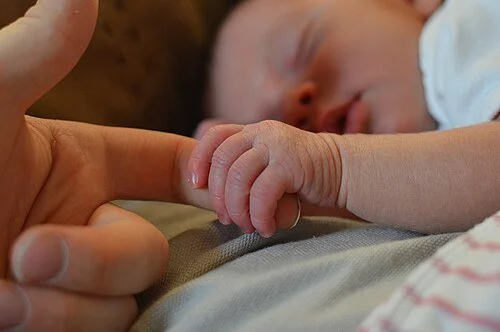
With Massachusetts looking ahead to January 2020 for the rollout of its Baby Steps program and Rhode Island’s recent check-the-box innovation (enabling an account to be opened on behalf of children whose families check a box granting permission to do so on the birth record form), more and more children throughout New England will benefit from having a college savings account in their name. And that can only be a good thing for those children, and for our region.
Colleen J. Quint is president & CEO of the Alfond Scholarship Foundation, which is based in Portland.