
Vox clamantis in deserto







Shefali Luthra: Planned Parenthood tries to revise its image

— Photo by S. MiRK
PROVIDENCE
The Trump administration is pushing ahead with its reproductive health agenda. It has rolled out changes to the Title X program, which funds family planning services for low-income people, that are designed to have a chilling effect on organizations that provide abortions or include this option in counseling. It also has nominated federal judges widely believed to support state-level abortion restrictions. (See visit to Providence clinic below.)
Against that backdrop, Planned Parenthood, known as a staunch defender of abortion rights, is working to recast its public image. Under its president, Dr. Leana Wen, who took office in November, the nation’s largest reproductive health provider is highlighting the breadth of care it provides — treating depression, screening for cancer and diabetes, and taking on complex health problems like soaring maternal mortality rates.
This strategy, analysts say, could buttress Planned Parenthood against the efforts by the White House and other abortion opponents. But it’s complicated. Even as the organization leans into its community health work, Wen isn’t abandoning the abortion-related services that have helped form the organization’s identity — and its opposition.
“We cannot separate out one of our services. That’s not how medicine works,” Wen told Kaiser Health News.
This effort to thread the needle could, if successful, change the public’s perception of Planned Parenthood. But if it backfires, it could make the organization even more vulnerable. Some people are skeptical of the payoff, given how polarizing abortion politics are.
“The minute you start talking about abortion, it’s a risky strategy,” said Karen O’Connor, a political scientist at American University who studies the politics of reproductive health care. It’s likely to attract strong reactions from people who see abortion providers not as reproductive health professionals but as “baby killers,” she said.
“If I was doing it — and this is as somebody who studies social movements and women’s organizations — I would take abortion out of the equation and talk about ‘reproductive health is health care.’”
Already, the new strategy is drawing fire from abortion opponents, who dismiss Planned Parenthood’s positioning as a frontline community health provider.
“This framing is simply a PR exercise,” said Mallory Quigley, vice president of communications at the Susan B. Anthony List, a Washington-based anti-abortion group. “I don’t think this campaign will be successful, and I don’t think it will last long.”
Reproductive health experts have a different view, saying Planned Parenthood’s effort to promote its array of health care offerings — including abortion — is consistent with reality and in line with top medical standards. To bolster this message, Wen, a former Baltimore health commissioner and the first physician to take the group’s helm, has embarked on a national listening tour.
“It’s who we are. We are a health care organization,” Wen said. “That’s what all of our affiliates do around the country, is meeting people where they are with the health services they need.”
So far, Wen and other Planned Parenthood officials have visited 17 affiliates in locations around the country. They plan to visit several more, Wen’s staff confirmed.
The idea is not to standardize what Planned Parenthood sites offer, Wen said, arguing that each clinic should take the lead in devising its own public health programs, based on its patients. Even so, the organization’s national leadership is working to identify the health programs that could be expanded and encouraging clinics around the country to consider implementing those best practices.
Recently, Wen and her team visited the organization’s Rhode Island clinic to investigate how it is planning to expand its primary-care offerings.
The clinic, a 10-minute walk from downtown Providence, serves patients of all genders and ages, its staff noted. It has upped its focus on things like wellness visits, along with its programs to make sure patients who want to have children are healthy before they get pregnant.
Wen also focused on the clinic’s efforts to reduce the area’s maternal mortality rates, a problem that afflicts low-income and black women at far greater rates. In 2018, 18.3 Rhode Island women per 100,000 births died from causes related to the pregnancy; for black women, the figure was 47.2 per 100,000, and for white women, 18.1. Planned Parenthood leadership touted proposed state legislation that would extend Medicaid coverage to doulas, non-medical birth coaches often seen as a valuable resource in reducing maternal deaths.
Wen tours a lab in the basement of a San Jose, Calif., clinic that processes tests for gonorrhea and chlamydia. “When I was in college, we did all the pipetting manually,” she told the staff.(ANNA MARIA BARRY-JESTER)
At a Planned Parenthood Mar Monte clinic in San Jose, Calif., staff members highlighted the facility’s mental health services — keeping behavioral health professionals in the building to help patients transition seamlessly into care — and its in-house testing center for sexually transmitted infections.
At both clinics, staffers talked about helping patients who face a threat of domestic violence find safe housing resources, and steering them toward available resources for things like healthy food.
Even while promoting that work — often overlooked by the public — Wen, a 36-year-old emergency doctor by training, emphasizes abortion services at each stop, trying to weave the message into the public health narrative.
In Providence, the Planned Parenthood team stopped by a news conference to talk about a local bill that, if the Supreme Court scales back Roe v. Wade, would explicitly legalize abortion protections in Rhode Island.
“Abortion is part of the spectrum of full reproductive health care, and we know reproductive health care is health care,” Wen said to applause. “And health care is a human right.”
But it’s unclear how the listening tour and messaging efforts will pan out politically. While a majority of Americans have positive opinions of Planned Parenthood, they are, polling suggests, evenly split on abortion.
“Planned Parenthood to some extent is taking a risky strategy by trying to thread these two. I see these as very different messages,” said O’Connor, the political scientist. “If you take out the ‘abortion is’ and go to reproductive health, you have a winning message that is very simple.”
In other ways, though, this branding effort perhaps comes at the right time, suggested Lucinda Finley, a law professor at the University at Buffalo. She ties the organization to what polling suggests is voters’ No. 1 concern, especially going into the 2020 election: health care.
Framing it as “‘Abortion is health care, health care is a human right’ links it to the larger debate about health care, and how we should provide health care to people in this country,” Finley said.
When asked if this messaging could politically insulate Planned Parenthood from conservative attacks — or win the organization new supporters — Wen suggested the community health emphasis is simply a response to medical needs.
“I don’t want people to think we are doing this because it’s politically the right thing to do,” she said. “It’s the right thing to do because that’s what our patients are requesting.”
Shefali Luthra: ShefaliL@kff.org, @Shefalil
Minnie's old Vermont

“Hairnet Drawer,’’ (hand-colored silver gelatin print; courtesy of the Vermont Folklife Center)., photographed by Neil Rappaport and colored by Susanne Rappaport, in the show “Up Home: Hand-Colored Photographs by Susanne and Neil Rappaport,’’ at the Bennington (Vt.) Museum, through June 11. The museum explains:
“Minnie Griswold died in 1952, at which time her sons locked up their mother's house in Pawlet, VT., and left all her belongings in place, untouched, unaltered. Thirty years later, Pawlet documentarians Susanne and Neil Rappaport were invited into the home and went on to produce a collection of hand-colored photographs of Minnie's home. This exhibition brings together the best in documentary work and artistic expression.’’

Ross E. O'Hara: Food insecurity at New England colleges
Via The New England Journal of Higher Education, a service of The New England Board of Higher Education (nebhe.org)
CAMBRIDGE, Mass.
Food insecurity—defined by the nationally respected Wisconsin HOPE Lab as the limited or uncertain availability of nutritionally adequate and safe foods, or the ability to acquire such foods in a socially acceptable manner—is a troubling trend on college campuses across the country, including in New England.
For example:
A 2016 survey by the Massachusetts Department of Higher Education found that 24 campuses operated or partnered with a food pantry, and a third saw an increase in the number of students utilizing that service.
A 2018 report by the HOPE Lab found that 44% of Massachusetts students at two-year colleges and a third of students at four-year universities were food insecure.
A 2018 study of nearly 1,000 students at the University of New Hampshire found 25% had experienced food insecurity in the past year, with first-generation students and students who receive financial aid at higher risk.
A 2017 study of several thousand students at the University of Vermont found up to 25% were food insecure, with significantly higher rates among students who identify as first-generation, persons of color, and transgender/queer/non-conforming.
As higher education becomes available to many who never before had access, more students than ever are forced to choose between meeting their basic needs and the costs of attending college. While institutions devise strategic solutions to avert this burgeoning crisis, one avenue of support that many students are not taking advantage of is the federal Supplemental Nutrition Assistance Program (SNAP).
In January, the U.S. Government Accountability Office (GAO) issued a report, titled Better Information Could Help Eligible College Students Access Federal Food Assistance Benefits, which acknowledges for the first time at the federal level the problem of college food insecurity.
The GAO goes on to recommend SNAP as a way to help many of these students cover their basic needs. Although a 1980 federal law bars college students from accessing SNAP—based on the outdated assumption that students’ parents will support them—it does grant exemptions for students who demonstrate need, for example, by working at least 20 hours per week or having dependent children. The GAO estimates that these criteria cover over 3 million low-income students nationwide, yet nearly two thirds of those eligible do not access SNAP benefits. How can we get more students who need assistance to sign up for SNAP?
The GAO puts its answer right in the title: Better Information. Many students are unaware of their eligibility, and many colleges are confused by the byzantine rules set forth by the federal Food and Nutrition Service (FNS). The GAO’s main recommendation to remedy this situation is for FNS to clarify the eligibility criteria on its website and make that information easier to find. While these steps will no doubt help, we now know too much about human psychology to think that better information is sufficient to solve this problem. We need to leverage behavioral science to nudge more students to access SNAP.
Behavioral science uses evidence-based strategies to frame and disseminate “better” information in a way that motivates action. These techniques are especially valuable when confronting food insecurity, a problem hidden by many students out of shame. Examples of these behavioral techniques include:
Social norms. The GAO reports that 80% of colleges surveyed struggled with “overcoming the stigma some students associate with accepting help for their basic needs.” Messaging that normalizes seeking help (e.g., “Many college students need help paying for food …”) can ameliorate that stigma by letting students know that they’re not alone in their challenge and move them to access needed resources.
Loss aversion. According to prospect theory, losing $10 is more painful than winning $10 is joyful. An MDRC study that leveraged loss aversion (e.g., “Don’t miss out! Ends April 29!”) increased attendance at an eligibility meeting for an income-supplement program by 73%. Messages that reframe SNAP as a benefit that can be lost, rather than something to be acquired, could motivate student uptake.
Removing hassle factors. Every step in applying for public benefits is a hurdle that can trip people up. A recent experiment by the U.S. Department of Health and Human Services showed that eliminating a prescreening form increased completed applications to adjust child-support payments by more than 12 percentage points. Colleges can remove hassle factors for students needing SNAP by housing related offices (e.g., financial aid; food pantry; counseling) within a single building, using student data already in their possession to automatically prescreen students for benefits, and streamlining application processes as much as possible.
Do techniques like these actually help students with food insecurity? Yes. My colleagues and I at Persistence Plus work with colleges across the country to enhance their student success initiatives through behavioral science. With regard to basic needs insecurity, colleges have witnessed firsthand how behavioral science increases the number of students who benefit from valuable campus resources, like food pantries and emergency aid. For example, an Ohio community college saw a 51% increase in use of the food pantry in just one month after students received a text message from us, such as “Some students miss meals due to $ but they’ve found help at the food pantry. Do you face this challenge?” Students who responded in the affirmative were provided with further social norming to reduce stigma and information on how to access emergency aid.
Behavioral science could enhance the impact of the myriad efforts of New England colleges to support students facing basic needs insecurity.
For example, Bunker Hill Community College, in Charlestown, Mass., has been a national leader in addressing food insecurity. Bunker Hill now houses New England’s first Single Stop location. This “one-stop shop” for connecting students to public benefits has been shown to increase persistence at U.S. community colleges by up to 11%. Bunker Hill is also evaluating a food voucher program that provides eligible students with $25 per week to spend at on-campus food service venues.
Many other colleges have now opened food pantries, such as the Magic Food Bus at Middlesex Community College, in Middletown, Conn. This renovated school bus (minus Ms. Frizzle’s pet lizard) has provided hundreds of students with non-perishable food, toiletries and other essentials. The University of Vermont this year piloted a meal-sharing program, operated by Swipe Out Hunger, where students with unlimited dining hall plans can donate meals to students with limited access. As these programs continue and expand, colleges should keep in mind how their messaging around basic needs insecurity could benefit from behavioral science to drive students to these resources.
The GAO’s recommendation to revamp the FNS website and make college students’ SNAP eligibility easier to understand is an important step, but behavioral science can take us further by enhancing the impact of better information using low-cost and evidence-based strategies. Stakeholders at the federal, state, and local levels should consider not only how to raise awareness of SNAP among colleges and students, but also how to leverage behavioral science to increase use of these funds so desperately needed by so many.
Ross E. O’Hara is a behavioral researcher at Persistence Plus. He shares his thoughts on behavioral science in higher education monthly in his blog, “Nudging Ahead.”
Todd McLeish: Running away from running bamboo

From ecoRI News (ecori.org)
Massachusetts and Connecticut keep a list of illegal and regulated invasive plant species and some nature groups want an updated one started in Rhode Island.
Invasives are plants and animals from a different country or region that reproduce quickly and spread on their own in a new habitat, often with harmful consequences.
They arrive in firewood, shipping containers, and ballast water, or on tire treads. They can be spread by birds or introduced unintentionally through scientific and agricultural research. Many invasive plants start as landscape and decorative plantings.
In Rhode Island, common land-based invasive plants, such as bittersweet, knotweed and multiflora rose, are easy to spot on roadsides throughout the state. These plants proliferate rapidly and are a stubborn nuisance to property owners and land trusts, killing trees and crowding out native species.
Legislation in the Rhode Island Senate (S411) would regulate running bamboo, a fast-spreading plant that quickly crosses property lines. It can penetrate asphalt and the siding of buildings. Many homeowners, not knowing the unintended consequence, plant running bamboo as a natural barrier that offers privacy and blocks out animals such as deer. But some invasive bamboo species can grow 40 feet high and their roots can travel 15 feet a year.
The Protection From Invasive Species Act would prohibit planting of running bamboo within 100 feet of a property line. The plants must otherwise be confined to a container or prevented from spreading roots.
Violators would be liable for the cost of removing the plant from a neighbor’s property, plus any damages. Retailers and landscapers would be required to provide customers written notice of the risks of running bamboo.
The Rhode Island Department of Environmental Management (DEM) would be granted authority to require the removal or destruction of running bamboo. A $100 fine would be imposed to first-time violators and up to $250 for repeat offenders.
Bittersweet vines are choking native plants and trees in southern New England. (Mass Audubon)
To address other invasives, the legislation requires DEM to create a list of invasive-plant species, regulate their sale, and enforce compliance. DEM, however, is opposed to the legislation because the state agency says it already regulates plant pests and can assess fines up $500 for transporting invasive aquatic plants.
DEM noted that it doesn’t allow federally designated noxious weeds to enter the state.
The Rhode Island Farm Bureau fears that the bill would lead to prosecution of farmers for invasive species that they didn’t plant. Bureau President Henry B. Wright III noted that the U.S. Department of Agriculture (USDA) gave multiflora rose to farmers in the 1950s as a control for erosion.
“The plant is now considered to be an invasive species by the USDA as it forms dense thickets that invade pastures and crowd out native species,” Wright wrote in a letter to the Senate Committee on the Environment and Agriculture.
Wright suggested that the state instead offer money to farmers and property owners for the removal of invasive plants.
In 2001, the Rhode Island Natural History Survey created a priority list of invasive plants through the Rhode Island Invasive Species Council.
“But our thinking on invasives has changed quite a bit,” said David Gregg, executive director of Rhode Island Natural History Survey. “There’s been a lot of change in the landscape and nursery industry in that time. And I think we need a new initiative.”
In 2003, Connecticut created a state list of invasives with enforceable rules. Massachusetts created a list of invasive plants in 2004.
Through the Natural History Survey, Rhode Island has been reducing invasives. Between 2010 and 2012, the state spent $300,000 of federal money to train professionals to remove invasive plants from state land and other natural habitat. Gregg noted that during that time the same invasive plants were being planted near these properties.
“In the survey’s opinion, it would be helpful to have an up-to-date list of noxious invasive plants supported by a public process and consensus,” Gregg said at an April 11 Senate committee hearing.
The bill is supported by the Rhode Island Land Trust Council.
The bill was held until a future hearing.
Todd McLeish is a journalist at ecoRI News.
MassMutual eliminating traditional job titles
From The New England Council (newenglandcouncil.com)
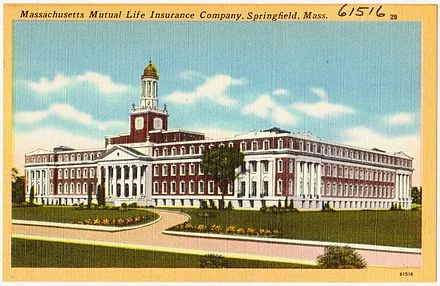
Springfield-based MassMutual, the insurance and other financial services company, has eliminated traditional job titles from their staff as part of a strategy aimed at creating a more agile and innovative environment for its employees. This approach comes from the idea that what you do is more meaningful than what you are called.
MassMutual began implementing these changes two years ago, starting with the executive titles at the assistant vice president level and above. As new hires were made, titles such as ‘head of’ or ‘lead’ were used instead of traditional descriptors. Rather than create more confusion, employees say that the new titles provide greater clarity around each employee’s role. Early employee feedback on the transition has been positive.
MassMutual’s head of Human Resources and Employee Experience, Susan Cicco, explained, “For us, it’s also about finding, attracting and retaining top talent that is intellectually curious and wants to work in a collaborative environment where they can continue to learn, gain experience, be empowered and valued for what they contribute.”
Boost employee stock ownership in Mass.
From Robert Whitcomb’s “Digital Diary,’’ in GoLocal24.com
‘Time and time again a local and highly successful small or medium-size business is bought by a much bigger enterprise from far away and then the jobs at the new local subsidiary are slashed, as are some of its other resources, such as charitable giving, that had benefited the host community.
One way to keep more of such companies locally based is to introduce employee stock-ownership plans, which tend to keep companies headquartered where many of their original employees live. Thus it was good to hear that the Massachusetts Office of Business Development plans to revive the state Office for Employee Involvement and Ownership (EIO); the agency was closed in the Great Recession.
Massachusetts and even Rhode Island are famous as birthplaces of dynamic companies, some of which grow to be very big but many of which end up being bought up by enterprises from far away that have little concern for the original loyal employees who helped get the firms off the ground.
There are various ways to launch employee-stock ownership plans, including bank loans to finance the creation of the plans. The plans could then buy a percentage of (or all of) these closely held companies’ stock, which in many cases would be owned by the founding entrepreneurs who want to retire or otherwise move on.\
Employee stock ownership can also address, in a small way, income inequality by spreading out profits earned by successful companies. In any case, it keeps more wealth in places where companies are founded, and is more likely to keep their morale, and thus productivity, high.
Communities are usually far better served with companies whose managers and other employees feel a commitment to their communities than with ones whose far-off owners just see their subsidiaries as pieces on a chess board.

Philip K. Howard: A radical centrist platform for 2020 --replace red tape with individual responsibility

Centrist politics don’t offer the passion of absolutist solutions. In the words of Rep. Alexandria Ocasio-Cortez (D-N.Y.): “Moderate is not a stance. It’s just an attitude towards life of, like, ‘meh.’”
But electoral success in 2020 likely will hinge on who attracts the centrist voters. One issue seems to unite most Americans: Frustration with how government works. Political scientist Paul Light recently found 63 percent of voters support “very major reform” of federal government, up from 37 percent 20 years ago.
For several decades, Americans have elected “outsider” candidates who promise some version of Barack Obama’s “change we can believe in.” Yet nothing much changes. The elections of Obama and Donald Trump can be viewed as symptoms of unrequited reform. When Obama’s promise of change got bogged down, 8 million Obama voters turned around and voted for Trump. Now Trump’s promise to “drain the swamp” is headed towards futility, amounting to little more than reversing Obama-era executive orders.
What’s missing is a governing vision that makes Americans part of the solution. Only then can leaders attract the popular mandate needed to overcome the resistance of Washington. Only then will there be a principled basis for officials and citizens to make practical choices going forward.
The best model for modern government is to revive the framework of democratic responsibility designed by the Framers: Replace red tape with human responsibility at all levels of society. This governing vision, though centrist, requires a radical simplification of Washington bureaucracies.
Over the past 50 years, almost without anyone noticing as it happened, the jungle of red tape in Washington has grown progressively denser — at this point 150 million words of detailed statutes and regulations (over 180,000 pages of the Code of Federal Regulations and over 40,000 pages of the U.S. Code). The effects of this build-up include bureaucratic paralysis and pervasive micromanagement of daily choices throughout society.
Bureaucracy is staggeringly costly. Common Good’s 2015 report, “Two Years, Not Ten Years,” found that a six-year delay in permitting infrastructure more than doubles the effective cost of projects. Twenty states now have more non-instructional personnel than teachers in their schools, mainly to comply with legal reporting requirements. The administrative costs of American health care are estimated to be as much as 30 percent — that’s about $1 trillion, or $1 million per physician.
Bureaucracy is a prime source of voter alienation. Many Americans today don’t feel free to be themselves — almost any decision, comment, joke, or child’s play activity can involve legal risk. Rule books tell us how to correctly run schools and provide social services. Small businesses are put in an almost impossible position of being regulated by multiple agencies with detailed requirements — a family-owned apple orchard in New York state, for example, is regulated by about 5,000 rules from 17 different regulatory programs. Fear of offending employees leads many companies to impose speech codes that, studies suggest, exacerbate discriminatory feelings.
Since Ronald Reagan’s tenure in the White House, the Republican mantra has been deregulation. Yet what frustrates most Americans is not public goals, such as safeguarding against unsafe work conditions, but micromanaging exactly how to organize a safe workplace with thousands of detailed rules. One-size-fits-all regulations often drive Americans to resistance, because rigid rules don’t honor tradeoffs, local circumstances, or a sense of proportion in enforcement.
This reform vision is simple: Focus regulation on goals and guidelines. Simpler codes will allow Americans to understand what is expected of them and will afford them flexibility to get there in their own ways. The reform is also radical: Legacy bureaucracies must be largely replaced with these simpler codes. Detailed rules would be limited to areas such as effluent limits where specificity is essential. The resulting regulatory overhaul would be historic, comparable in magnitude to the Progressive Era.
Area by area, recodification commissions would propose to Congress new codes. Public goals that require practical choices, such as overseeing safe and adequate services, would allow flexibility and local innovation. Instead of Big Brother breathing down our necks, Washington would be more like a distant uncle, intervening only when citizens or local officials transcended boundaries of reasonableness.
Not that long ago, that’s how government was organized. The Interstate Highway Act in 1956 was 29 pages long. Ten years later, over 20,000 miles of highway had been built. By contrast, the most recent highway bill was almost 500 pages long, and implemented by thousands of pages of regulations.
Law is more effective when people focus on goals. The Constitution is only 15 pages long, but its principles nonetheless are effective to protect our freedoms. Agencies where officials take responsibility for ultimate goals, such as the Centers for Disease Control and Prevention with its focus on disease reduction, accomplish more than those such as the Occupational Safety and Health Administration, which is organized around rote compliance with thousands of rules.
No one designed the current bureaucratic tangle. It just grew and grew more, as each ambiguity sprouted a new rule. Leaders can’t lead it, because the rules trump common sense. But that’s precisely why a new movement is needed. Legacy bureaucracies never fix themselves.
Philip K. Howard is chair of Common Good and author of the new book Try Common Sense (W.W. Norton, 2019). Follow him on Twitter@PhilipKHoward.
TAGS ALEXANDRIA OCASIO-CORTEZ DONALD TRUMP BARACK OBAMA POLITICS OF THE UNITED STATES DEMOCRATIC PARTY REPUBLICAN PARTY 2020 CAMPAIGN FEDERAL GOVERNMENT
Female-mannequin intimacy

Photo by Martine Gutierrez from her series “Girl Friends,’’ in her show “Life/Like: Photographs by Martine Gutierrez,’’ at the Mount Holyoke College Art Museum, South Hadley, Mass. through June 16. The museum notes that “Girl Friends’’ “depicts two same-dressed women in different places and poses, but despite their intimacy, one of the women is a mannequin, challenging the viewer's perception of reality.’’ Note that they’re both wearing wedding dresses.
.
Congestion pricing is coming

From Robert Whitcomb’s “Digital Diary,’’ in GoLocal24.com
So-called congestion pricing to control traffic is inevitable in Boston. It’s coming soon to Manhattan, where New York City officials plan to charge a toll, perhaps around $10 a day, for driving below 60th Street, at the southern end of Central Park. The idea, besides speeding traffic flow and reducing the emission of the greenhouse gases that cause global warming, is to use a lot of that money to fix up Gotham’s deteriorating mass-transit system.
Uber and Lyft, etc., already in effect engage in congestion pricing by charging higher prices during rush hours.
Nick Sifuentes, the executive director of the Tri-State (New York, New Jersey and Connecticut) Transportation Campaign, in a Boston Globe piece, notes that Boston’s traffic congestion is now America’s worst, with New York second. The cost of this, in lost productivity, pollution and mental and physical stress, is immense. Mr. Sifuentes reckons that congestion costs the average Boston commuter $2,291 a year and 164 hours (and growing) stuck in traffic.
And building yet more roads and/or widening the ones we have only helps briefly, before those two are filled, in a variant of the Parkinson’s Law “Expenditure rises to meet income.’’
He notes that: “The lesson is clear: Increasing road capacity only encourages more people to drive, creating more congestion, dividing neighborhoods, inviting sprawl, and polluting communities near and far from the new roadways. We also know it often isn’t enough simply to offer better public transportation; cities have to encourage drivers to change their habits — and as long as roads are free, there is little incentive for commuters to forego unnecessary trips or increase their use of public transit.’’
To read his piece in The Globe, please hit this link.
Through the green

One of Esther Pullman’s large-scale panoramic photographs in her show “Green Places/Green Spaces/Greenhouses,’’ at the Cape Ann Museum, Gloucester, through June 16. The museum says: “Shot over a 20-year period, these large-scale panoramic photographs of greenhouses explore such universal themes as the passage of time, the cycle of the seasons, death and rebirth, and have also unavoidably become a metaphor for our threatened planet.’’
'Shot heard round the world'
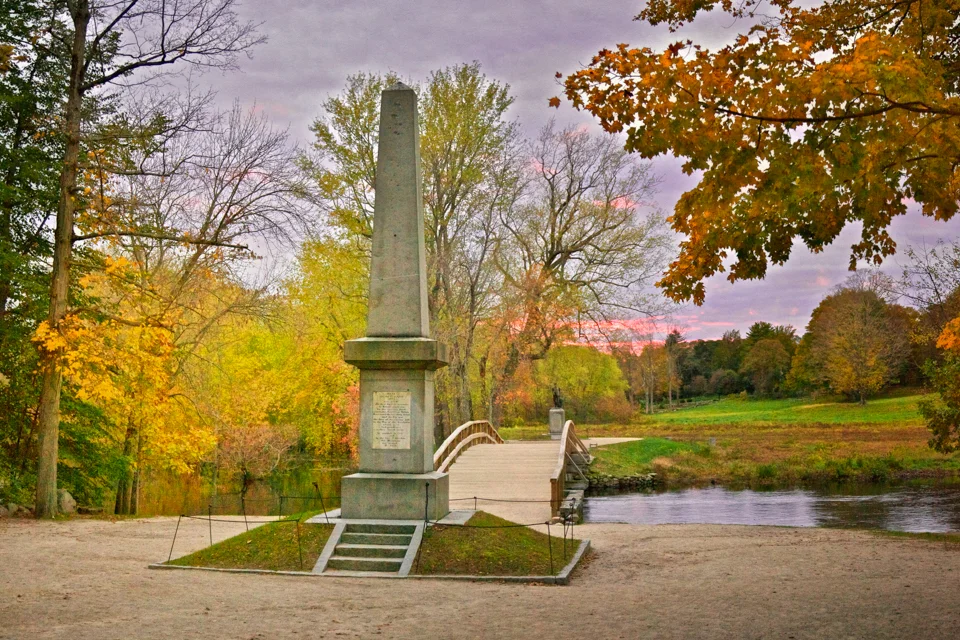
The current version of the Old North Bridge in Concord, site of the first major battle of the Revolutionary War, on April 19, 1775, the date once marked as Patriots Day in Massachusetts, though it is now set for “the third Monday in April.’’ There was a less important skirmish earlier that day in Lexington, down the road. The monument here celebrates that day, as does Emerson’s famous poem.
“Concord Hymn’’
Sung at the Completion of the Battle Monument, July 4, 1837
By the rude bridge that arched the flood,
Their flag to April’s breeze unfurled,
Here once the embattled farmers stood
And fired the shot heard round the world.
The foe long since in silence slept;
Alike the conqueror silent sleeps;
And Time the ruined bridge has swept
Down the dark stream which seaward creeps.
On this green bank, by this soft stream,
We set today a votive stone;
That memory may their deed redeem,
When, like our sires, our sons are gone.
Spirit, that made those heroes dare
To die, and leave their children free,
Bid Time and Nature gently spare
The shaft we raise to them and thee.
The art of fashion in Vermont

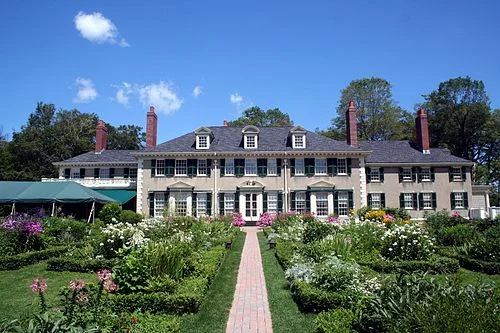
Fashion design by Natalia Martinez Sagan; photography by Nacho Lunadei, in the show “Unusual Threads: Stitching Together the Future of Fashion,’’ at the Southern Vermont Arts Center, Manchester, Vt., May 10-June 23. Manchester is an affluent vacation and weekend town, with a lot of high-end shops. Robert Todd Lincoln, son of the president, built his country estate there, called Hildene (picture of its mansion below). It’s now a museum. There are ski areas nearby.
Karen Gross: About those 'certificates of failure'
From The New England Journal of Higher Education, a service of The New England Board of Higher Education (nebhe.org)
The news is filled with stories about the admissions scandals at elite colleges and universities. And recently, some of the wrongdoers have pled guilty and await punishment. Apparently, prosecutors are seeking jail time. Apart from jail time, I have already suggested approaches to punishment that involve fines that go into a cy pres fund to be redistributed to small non-elite colleges and their students. Ironically (or not), the fake charity to which these parents “donated” was intended to serve low-income kids. Hey, make that really happen … and legally.
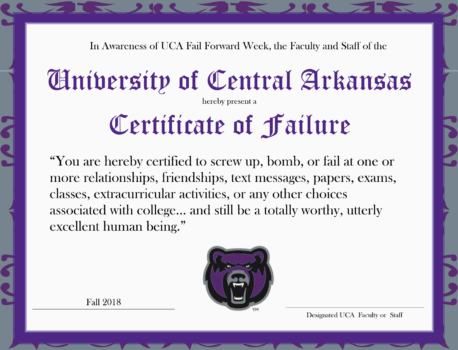
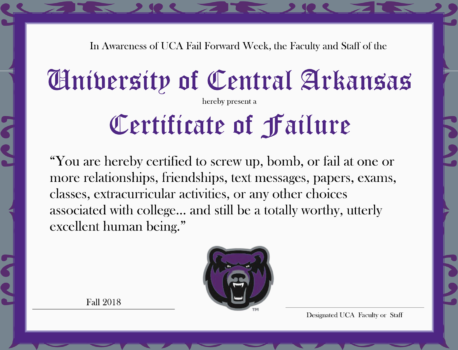
At the same time, there have been articles about the competitiveness of elite colleges and universities and the need to provide courses or partial courses or seminars in failure. The idea is legitimizing failure; it happens to everyone after all. But, since some college students have never experienced failure (see above), the colleges need to include instruction on how to fail. And some even provide “certificates of failure’’ at the beginning or end of the courses. (See image above.)
One of the pre-course certificates is issued, I am embarrassed to say, by my alma mater, Smith College. It is provided before the seminar begins with the suggestion that it be displayed proudly. The certificate provides, in part,
“You are hereby authorized to screw up, bomb or fail at one or more relationships, hookups, friendships, texts, exams, extracurriculars or any other choices associated with college … and still be a totally worthy, utterly excellent human.”
Apparently, students (at least those cited in the article about this in the New York Times) are delighted to hang these words in their dorm room. A recent article in The Washington Post shared similar initiatives, with some institutions replacing the word “failure” with “grit training” or “resiliency education,” although the certificates awarded for failure were noted.
I have no idea who invented this idea of certificates of failure for college students. Was it a psychology professor or a student-life professional or some consultant? Was it an expert in parent-child development? Answer that question, please.
From my perspective, this whole “accept” failure movement strikes me as what we term in other contexts “a first world problem.” In other words, learning about and dealing with failure is a problem for some students attending some elite colleges in America, where they suddenly get a low grade or struggle for the first time in their academic and personal lives.
From my experience in education, spanning early childhood education through adult education, I see the opposite experience among low-income, first-generation, minority, ethnically diverse and immigrant students. Many of these students experience failure early and often. In their schools, they are often, directly or indirectly, signaled: “You can’t make it.” Some are deprived access to gifted programs or AP courses. Surely they are not getting the level of tutoring that the wealthy can afford. There are assumptions, acknowledged or not, as to who progresses and where in education—from elementary school programs to elite public selective high schools to elite colleges (or any college actually). Just peruse the Pell Grant numbers of enrolled students at elite colleges (although the numbers are increasing).
I can’t count the number of students at Southern Vermont College (SVC), which is sadly failing now under current leadership and set to close unless miraculously saved (something for which I have been fighting), who said to me “I was told I was not college material.” Talk about not needing a certificate of failure. And many of the students we accepted back then at SVC had profiles that would have suggested that college was not in their future, let alone graduation. Indeed, the SVC Mountaineer Scholar Program, remarkable in so many respects though undermined of late sadly through mission drift at SVC, aimed to enroll students most thought would “never make it” in higher education. Some had projected graduation rates of under 9%; they too graduated.
There are many reasons that students have failed along the educational pipeline. Poor schools, poor teachers, fiscally underfunded schools, lack of parental support (or other adult support), cultural expectations and norms including few or no individuals believing in success. If you want to see this, view the movie Raising Bertie or the movie STEP. Surrounded by failure of every sort from food scarcity to parental absence, incarceration and addiction to homelessness, many of today’s college students have not experienced success. They have lived lives filled with failures.
These students don’t need lessons in failure; they need lessons in success and their capacity—remarkable capacity—to succeed.
I would add that trauma, a topic about which I have been writing regularly, has been a large contributor to low student expectations and misunderstanding of student capacities. Indeed, we know that trauma has many cognitive effects on student learning, and it is often mistaken for other student shortcomings—when actually the students did not ask for the trauma and had no choice in being on the receiving end. Children who have been traumatized and are not in trauma-sensitive environments with tools to defuse the autonomic nervous system can feel the effects for a lifetime. Trauma’s aftermath can make you feel like a failure when you are anything but. You are a survivor. But trauma and its impacts don’t disappear. Reflect on the recent suicides a year after Parkland and several years after Sandy Hook. Tragic.
Most of us don’t need certificates of failure. We have failed. We have experienced lowered expectations. We know what it is like not to succeed and to watch others around us fail with regularity.
The focus on “certificates of failure” makes me ill actually. It applies to such a narrow segment of college students. Why is it that we can’t pay more attention to the vast majority of students and put our time, our energy, our money and our focus on their successes—hard-fought successes—in a world that dealt them failure? Yet again, we focus all our attention in the media and elsewhere on the elite as if that is all that matters and as if that is somehow representative of the vast majority of the population.
So, with the elite parents bribing and certificates of failure to offset lots of success and soft shells in some children raised to always feel good, let’s shift gears immediately. Let’s help non-elite colleges and students across the educational landscape for whom failure has been a constant companion. We don’t need a certificate of failure. It is evident in lives being lived. Instead, we need folks who believe in our success.
Karen Gross is senior counsel with Finn Partners, former president of Southern Vermont College and author of Breakaway Learners: Strategies for Post-Secondary Success with At-Risk Students.
'Keeping History Above Water'

Hunter House (built in 1748), in Newport’s Point neighborhood, which is endangered by rising sea levels.
From Robert Whitcomb’s “Digital Diary,’’ in GoLocal24.com
Many people along the southern New England coast and beyond will want to follow the work of a consortium called Keeping History Above Water that addresses the threat to low-lying historic neighborhoods from the rising seas associated with global warming. Newport’s Point neighborhood, with its wealth of 18th Century structures, is a prime example of a place in peril. It might become very own Atlantis soon enough.
The group describes itself:
“Keeping History Above Water began as a simple idea for a conference to be hosted by the Newport Restoration Foundation in Newport, Rhode Island in the spring of 2016…. Keeping History Above Water has expanded to include a variety of activities related to climate and cultural heritage across Rhode Island and around the world. Annual conferences, hosted in vulnerable regions across the country, are a centerpiece of Keeping History Above Water.’’
Its next conferences will be in St. Augustine, Fla., May 5-8, and Nantucket, June 26-28.
Here’s the organization’s Web site.
It comes and it goes


The tide rises, the tide falls,
The twilight darkens, the curlew calls;
Along the sea-sands damp and brown
The traveller hastens toward the town,
And the tide rises, the tide falls.
Darkness settles on roofs and walls,
But the sea, the sea in darkness calls;
The little waves, with their soft, white hands,
Efface the footprints in the sands,
And the tide rises, the tide falls.
The morning breaks; the steeds in their stalls
Stamp and neigh, as the hostler calls;
The day returns, but nevermore
Returns the traveller to the shore,
And the tide rises, the tide falls.
“The Tide Rises, the Tide Falls,’’ by Henry Wadsworth Longfellow (1807-1882). In his time, Longfellow was by far the best known New England poet.
A 'finished place'

The Boston Athenaeum, built in 1847
“New England is a finished place. Its destiny is that of Florence or Venice, not Milan while the American empire careens onward toward its unpredicted end. . . . It is the first American section to be finished to achieve stability in the conditions of its life. It is the first old civilization, the first permanent civilization in America.’’
— Bernard DeVoto (1897-1955), historian and essayist
Tour some of New England's great houses and gardens with this book
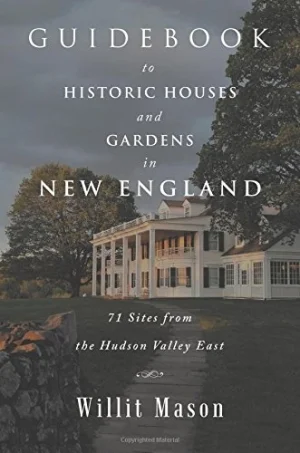
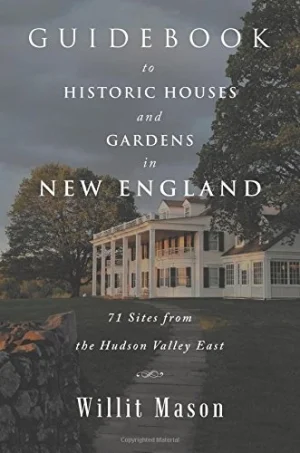
William (“Willit’’ ) Mason, M.D., has written has a delightful – and very handy -- book rich with photos and colorful anecdotes, called Guidebook to Historic Houses and Gardens in New England: 71 Sites from the Hudson Valley East (iUniverse, 240 pages. Paperback. $22.95). Oddly, given the cultural and historical richness of New England and the Hudson Valley, no one else has done a book quite like this before.
The blurb on the back of the book neatly summarizes his story.
“When Willit Mason retired in the summer of 2015, he and his wife decided to celebrate with a grand tour of the Berkshires and the Hudson Valley of New York.
While they intended to enjoy the area’s natural beauty, they also wanted to visit the numerous historic estates and gardens that lie along the Hudson River and the hills of the Berkshires.
But Mason could not find a guidebook highlighting the region’s houses and gardens, including their geographic context, strengths, and weaknesses. He had no way of knowing if one location offered a terrific horticultural experience with less historical value or vice versa.
Mason wrote this comprehensive guide of 71 historic New England houses and gardens to provide an overview of each site. Organized by region, it makes it easy to see as many historic houses and gardens in a limited time.
Filled with family histories, information on the architectural development of properties and overviews of gardens and their surroundings, this is a must-have guide for any New England traveler.’’
Dr. Mason noted of his tours: “Each visit has captured me in different ways, whether it be the scenic views, architecture of the houses, gardens and landscape architecture or collections of art. As we have learned from Downton Abbey, every house has its own personal story. And most of the original owners of the houses I visited in preparing the book have made significant contributions to American history.’’
To order a book, please go to www.willitmason.com
Visions from illness

“Face Object #1 ‘‘ (archival inkjet print from digital photo), by David Weinberg, in the show “If You Could See What I See,’’ by Louise and David Weinberg, at Galatea Fine Art, Boston, May 1-June 2. The gallery says that the pictures in the show were produced during Louise Weinberg’s 15-year struggle with a rare neurologic disease that shares some features with Parkinson’s Disease. This illness and side-effects of medications have affected both her physical abilities and her mental state, “producing vivid hallucinations and altered perception’’.
Galatea says that through discussion with Louise, David Weinberg has produced photographic images that “attempt to depict the visions that Louise experiences. Louise has arranged fragments cut from her drawings and paintings into collages that spring from her unconscious. The works arise from the many degrees of cognitive changes stimulated by the medications treating the neurological illness.’’

Llewellyn King: Information technology has been far from the civic boon hoped for

A 20-year-old fax machine
When the current age of communication started (pick your time, but I think it was when we started sending print by telephone in the form of a fax), it was thought that dictators would fall, and democracy would be reinvigorated.
The first big disappointment was Saudi Arabia. When the Saudis began to get uncensored news and information, it was believed that the grip of the royal family and its extreme religious allies would be loosened. It did not happen. Instead, Saudi Arabia was spurred to use its oil wealth to push conservative Islam around the globe, especially in places where it was present but could be radicalized, including Pakistan and Bangladesh. They poured their money into madrassas -- religious schools -- that preached the Wahhabism, a strict and puritanical interpretation of Sunni Islam.
When Iran, a majority Shia country, was under the dictatorial thumb of the Shah, it was thought that the Iranians, a sophisticated people with an ancient and proud history, would be liberalized by the flow of Western, secular ideas. These ideas came into the country through the presence of visitors and contractors, and a liking for movies and television.
Fax transmission was important in the spread of ideas in Iran. But the faxes that had the biggest effect were not those preaching democracy but those coming from an old Shia cleric living in exile in a village outside Paris, Ayatollah Ruhollah Khomeini. He used the fax to push the Islamic Revolution, which turned out to be a much worse tyranny than the Shah’s
People ask me why, when the mainstream media daily points up President Trump’s failures and transgressions, his supporters are unmoved, disdaining what is being revealed in favor of what they want to believe. They believe in Trump and they believe in his courtiers at Fox News Channel and on talk radio.
People do not react to raw information but, rather, to information that sits well with them for other reasons: what they are predisposed to believe.
Rupert Murdoch, the boss of Fox News, has had a genius, a real genius, for corralling those who felt ignored by society. He did it in Britain with his hugely successful tabloid newspaper, The Sun, and he has done it here with Fox News. In Britain and in the United States, he found and exploited a nativism that both countries had forgotten they had.
Fox News did not invent Trump; instead, the shoe fit. In Britain, The Sun did not invent Brexit. But when it came along, The Sun was ready to lead the charge -- and it did.
How we react to the news depends on our involvement with it in tertiary ways. If you were already convinced of British exceptionalism, you would move toward the hostility to Europe expressed in The Sun. If you think immigrants take jobs, speak strange languages and are usurping our Americanism, you will be gung-ho for Trump’s southern border wall.
In the 1990s you could find, and I did, from Nicaragua to Zimbabwe, old-line Communists lamenting the fall of the Soviet Union. They argued that it had not been given a chance. These people really believed that all that was wanted was more of what did not work.
If you are a Trump supporter, you are genuinely amazed that the mainstream media cannot see that what he is doing is great. Democrats and renegade Republicans, such as columnist George Will, can find nothing, absolutely nothing, good in the Trump presidency.
People, including AOL founder Steve Case, talked idealistically about the Internet in the days when it was getting going as the great, new democratic tool; a boon to global democracy. Wrong. If anything, it stirred up a destructive nationalism.
Information, I have noticed as a journalist who has worked on three continents, does not necessarily shape political opinion.
Political opinion tends to find the media that agree with it, not the other way. But after the two have mated, media can inflame its public partner. Good for two-party rivalry, but not for elucidation.
Llewellyn King is executive producer and host of White House Chronicle, on PBS. His email is llewellynking1@gmail.com. He’s based in Rhode Island and Washington. D.C.
'Elite' schools should boycott US News college rankings
Boycott US News Ranking Racket
From Robert Whitcomb’s “Digital Diary,’’ in GoLocal24.com
The US News & World Report college-rankings system is one reason that the already intense American race for admission to “elite colleges’’ has gotten so much worse in the past few decades and helped lead to the current college-admissions scandals. And yet all institutions, even the ones lumped together as, for example, members of the Ivy League, are so different that comparing them is the old apples-to-oranges problem.
The nation’s most famous universities would help cool this corrupting status race by refusing to cooperate with US News– stop sending them data, etc. Boycott US News! The Ivy League, MIT, the University of Chicago, Duke, the most prestigious state universities, etc., have the gravitas and power to help stem these college-admissions scandals. They can and should do what they can to weaken the power of US News’s lucrative and crooked rating business.